04 August 2020
POLITECNICO DI TORINO
Repository ISTITUZIONALE
Deriving Local Internal Logic for Black Box Models / Pastor, Eliana. - ELETTRONICO. - 2161(2018), pp. 1-4. ((Intervento presentato al convegno SEBD 2018 26th Italian Symposium on Advanced Database Systems tenutosi a Castellaneta Marina (Italy) nel June 24-27, 2018.
Original
Deriving Local Internal Logic for Black Box Models
Publisher: Published DOI: Terms of use: openAccess Publisher copyright
(Article begins on next page)
This article is made available under terms and conditions as specified in the corresponding bibliographic description in the repository
Availability:
This version is available at: 11583/2712649 since: 2018-09-12T17:54:23Z
for Black Box Models
Eliana PastorSupervised by Elena Baralis
Politecnico di Torino, Italy
{eliana.pastor, elena.baralis}@polito.it
Abstract. Despite the widespread use, machine learning methods pro-duce black box models. It is hard to understand how features influence the model prediction. We propose a novel explanation method that ex-plains the predictions of any classifier by analyzing the prediction change obtained by omitting relevant subsets of attribute values. The local in-ternal logic is captured by learning a local model in the neighborhood of the prediction to explain. The explanations provided by our method are effective in detecting associations among attributes and class label.
Keywords: Interpretability·Prediction Explanation·Local model.
1
Introduction
Machine learning algorithms are widely applied in every aspect of our society. Their growing popularity and their widespread use have made it increasingly im-portant to understand why a classification model take a particular decision. The call for more explainable predictions comes also for institution. The European Union approved the GDPR, a regulation for ensuring personal data protection. It states that individuals have the right to receive “meaningful information about the logic involved” in case of automated decision-making. For some authors, this requirement legally mandates a “right to explanation” [2].
We propose a novel model-agnostic explanation method that explains the predictions made on single instances by any classifier. The explanation highlights the internal logic of the model in a neighborhood of the prediction. It is based on the knowledge of the local behavior of the model, captured by an interpretable local model.
2
Related Work
Many algorithms have been proposed for improving the interpretability of al-ready existing classification models. Model-dependent solutions are proposed for
SEBD 2018, June 24-27, 2018, Castellaneta Marina, Italy. Copyright held by the author(s).
2 E. Pastor
handling only specific models. Model-agnostic solutions instead treat the ma-chine learning model as a black box. Our research is focused on these approaches for their general applicability and the advantages derived from it. These methods in fact are applicable to any classification methods without making any assump-tion on their internal logic. Thus, the comparison among different techniques in terms of model interpretability is possible.
While some approaches try to explain the original model globally, others pro-pose a general method for explaining individual predictions, i.e. why particular decisions are made. Ribeiro et al. [4] introduce a model-agnostic method for ex-plaining individual prediction by learning an interpretable and linear model in the locality of the prediction to be explained. However, the linear approximation may not be faithful if the model is highly non-linear even in the locality of the prediction [4]. The locality is captured by randomly perturbed samples around the instance. Thus, non-existing configurations of attribute values can also be generated. Hence, the local model cannot be considered fully trustworthy.
Several works study how a prediction changes if parts of the input compo-nents are omitted. Lemaire et al. [3] and Robnik-ˇSikonja and Kononenko [5] consider how each attribute value is relevant for the prediction for tabular data, by omitting one attribute value at a time. ˇStrumbelj et al. study also the omission of more attribute values together, thus also addressing the attribute interaction [6]. The information of how attributes interact with the others is summarized in one single contribution for each attribute value. Hence, the information of interaction relevance is lost. Moreover, they compute the omission effect for the power set of the attributes. Hence, the method is affected by an exponential time complexity. We propose a novel solution that highlight not only the influence of each attribute value for a particular prediction but also of relevant attribute in-teractions. Moreover, we overcome the problem of exponential time complexity exploiting local properties of the original model to be explained.
3
Method
We propose a novel method applicable to explain individual predictions of any classification method. Given the particular prediction that we want to explain, we omit one or more attribute values at a time and we measure how the diction changes. The relevance of the change is estimated as a difference of pre-diction probabilities with respect to a particular target class. The greater is this difference, the more the omitted attribute values are relevant for the prediction. With respect to existing approaches, we are interested in understanding not only how each single attribute value is significant for the prediction but also how it interacts with the others. An attribute value can determine the predic-tion alone or only if it is in conjuncpredic-tion with others. In the latter case, we need to omit more attributes at the time for observing how the prediction changes. Omit-ting sets of attribute values allows also to deal with the disjunction case. The disjunction condition occurs when more than one configurations of attributes values determines the prediction. We can observe a change of the prediction probability only if we considered the omission of the attribute values together.
The feature values that in conjunction or disjunction are relevant for a pre-diction are highlighted by a local interpretable model. The local model is an associative classifier learned in the neighborhood of the prediction that we want to explain. The local rules, being understandable, provide preliminary insights of why a decision is made by the considered model. Each rule is in AND form. Thus, it gives the information of what attributes together determine the pre-diction. Moreover, a prediction may be determined by more rules. We can deal with the disjunction condition considering jointly the omission of the subsets highlighted by the local rules. Only the relevant attribute subsets provided by the local model are considered, instead of the complete power set of all attribute combinations. Hence, our approach overcomes the exponential time complexity.
4
Preliminary Results
0 0.1 0.2 0.3 0.4 0.5 a, b, e a, bf=2 e=1 d=3 c=2 b=1 a=1 4- target class=1 dataset=monks-1 model=ANN p(class=1|x)=0.999 true class=1(a) 0 0.1 0.2 0.3 0.4 0.5 f=2 e=1 d=3 c=2 b=1 a=1 4- target class=1 dataset=monks-1 model=NB
p(class=1|x)=1 true class=1
(b)
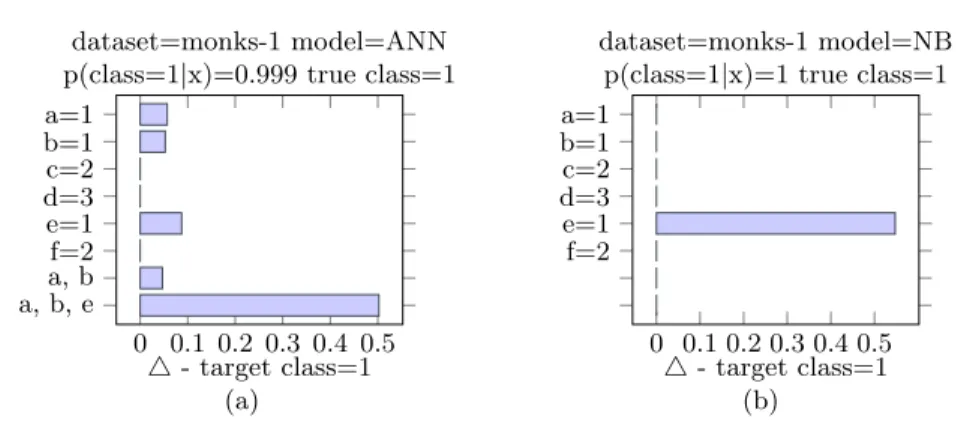
Fig. 1: Explanation of (a) the neural network and (b) the Naive Bayes prediction of a particular instance of the monks-1 data set.
In this section, preliminary outcomes of our novel explanation method are presented. The Monk1 data set is an artificial data set composed by 6 discrete attributesa,b,c,d,e,f and the class label can take value 1 or 0 [1]. Being artificial, the relation between the attributes and the class value is known. The class is 1 if a=bor ife=1, 0 otherwise. We train a MLP ANN using theMonk1 data set. Let x = (a=1, b=1, c=2, d=3, e=1, f=2) be the instance that we want to explain. We know that the “true class” is 1 becausee=1anda=b. The ANN correctly predicts the class label as 1. To estimate the relevant subsets of feature values, we train the associative classifier in the locality of instancex. The local model returns the following association rules:{e= 1} →class= 1, {a= 1, b= 1} →class= 1. Hence, ife=1 the instance is assigned to the class 1 or ifaandbare both equal to 1. These relations should indeed determine the class. Thus, the local behavior captures the true explanation. Once that the relevant subsets are determined, the prediction differences are computed. The estimation is made for each attribute value, for the relevant subset {a=1,b=1} and for the OR of the relevant rules, thus for {a=1,b=1,e=1}. The results are shown in Figure 1a. The terms e=1, a=1 andb=1 have alone a positive importance in the determination of the class. It is interesting to notice that{a=1,b=1} together have not a great prediction
4 E. Pastor
difference but it is comparable to the ones when they are considered alone. Ifa andb are removed together, the class label does not change. The prediction is in fact still 1 because ofe=1. Same considerations can be made fore=1. Removing the rules in OR, the prediction probability drastically changes. Only if considered together, we can observe and quantify how these attributes interact.
If we explain the prediction for the same instance, made by another model, we may obtain a different result. The explanation should capture how the model behaves in the locality of the instance. Different models work differently. This difference may be on the predicted class label, but also on the feature values that drive the prediction. Consider the explanation of the same instance x and still built with respect to class 1, but classified by the Naive Bayes classifier (NB). The local model returns a single relevant rule:{e= 1} →class= 1.
The results are shown in Figure 1b. The NB classifier assigns correctly the in-stancex to class 1, but only becausee=1. The local model and the explanation highlight that the Naive Bayes classifier has not learned the association that if a=b thenclass=1. Because of its assumption of independence between features, it is not able to learn the importance thataandbhave together. Hence, the local model and the explanation in this case successfully reflect the model behavior.
5
Conclusions and Future Work
Preliminary tests show that our technique is able to capture the diverse internal logic of classification techniques. Differently than existing approaches, the impor-tance of relevant subsets of feature values to the prediction is computed. Thus, our method provides to end users the information of what attributes together determine the prediction and the quantification of their influence.
As future work we plan to (i) formalize our approach proposing formal defi-nitions of the prediction change estimation, (ii) evaluate the effect of the neigh-borhood in the local rules and the resulting explanations and (iii) apply the proposed method to real-world data sets, validating explanations through the assistance of domain experts.
Acknowledgements This work is partially funded by SmartData@PoliTO.
References
1. Dheeru, D., Karra Taniskidou, E.: UCI machine learning repository (2017) 2. Goodman, B., Flaxman, S.: European union regulations on algorithmic
decision-making and a “right to explanation”. arXiv preprint arXiv:1606.08813 (2016) 3. Lemaire, V., Feraud, R., Voisine, N.: Contact personalization using a score
under-standing method. In: 2008 IEEE Int. Joint Conf. on Neural Networks. pp. 649–654 4. Ribeiro, M.T., Singh, S., Guestrin, C.: “Why Should I Trust You?”: Explaining the Predictions of Any Classifier. In: Proc. of the 22Nd ACM SIGKDD Int. Conf. on KDD. pp. 1135–1144. KDD ’16, ACM, New York, NY, USA (2016)
5. Robnik-ˇSikonja, M., Kononenko, I.: Explaining classifications for individual in-stances. IEEE Trans. Knowl. Data Eng.20(5), 589–600 (2008)
6. ˇStrumbelj, E., Kononenko, I., Robnik ˇSikonja, M.: Explaining instance classifications with interactions of subsets of feature values. DKE68(10) (2009)