2019
Intelligent Malware Detection Using File-to-file Relations and
Intelligent Malware Detection Using File-to-file Relations and
Enhancing its Security against Adversarial Attacks
Enhancing its Security against Adversarial Attacks
Lingwei ChenFollow this and additional works at: https://researchrepository.wvu.edu/etd Part of the Information Security Commons
Recommended Citation Recommended Citation
Chen, Lingwei, "Intelligent Malware Detection Using File-to-file Relations and Enhancing its Security against Adversarial Attacks" (2019). Graduate Theses, Dissertations, and Problem Reports. 3844. https://researchrepository.wvu.edu/etd/3844
This Dissertation is protected by copyright and/or related rights. It has been brought to you by the The Research Repository @ WVU with permission from the rights-holder(s). You are free to use this Dissertation in any way that is permitted by the copyright and related rights legislation that applies to your use. For other uses you must obtain permission from the rights-holder(s) directly, unless additional rights are indicated by a Creative Commons license in the record and/ or on the work itself. This Dissertation has been accepted for inclusion in WVU Graduate Theses, Dissertations, and Problem Reports collection by an authorized administrator of The Research Repository @ WVU. For more information, please contact [email protected].
Intelligent Malware Detection Using
File-to-file Relations and Enhancing its
Security against Adversarial Attacks
Lingwei Chen
Dissertation submitted to the
Benjamin M. Statler College of Engineering and Mineral Resources at West Virginia University
in partial fulfillment of the requirements for the degree of
Doctor of Philosophy in
Computer Science
Yanfang Ye, Ph.D., Committee Chairperson Donald Adjeroh, Ph.D.
Elaine M. Eschen, Ph.D. Zachariah B. Etienne, Ph.D. Katerina Goseva-Popstojanova, Ph.D.
Lane Department of Computer Science and Electrical Engineering
Morgantown, West Virginia 2019
Keywords: Malware Detection, Machine Learning, Data Mining, File-to-file Relations, Adversarial Attacks and Defenses
Intelligent Malware Detection Using File-to-file Relations and Enhancing its Security against Adversarial Attacks
Lingwei Chen
With computing devices and the Internet being indispensable in people’s everyday life, malware has posed serious threats to their security, making its detection of ut-most concern. To protect legitimate users from the evolving malware attacks, machine learning-based systems have been successfully deployed and offer unparalleled flexibility in automatic malware detection. In most of these systems, resting on the analysis of different content-based features either statically or dynamically extracted from the file samples, various kinds of classifiers are constructed to detect malware. However, besides content-based features, file-to-file relations, such as file co-existence, can provide valuable information in malware detection and make evasion harder. To better understand the properties of file-to-file relations, we construct the file co-existence graph. Resting on the constructed graph, we investigate the semantic relatedness among files, and leverage graph inference, active learning and graph representation learning for malware detection. Comprehensive experimental results on the real sample collections from Comodo Cloud Security Center demonstrate the effectiveness of our proposed learning paradigms.
As machine learning-based detection systems become more widely deployed, the incentive for defeating them increases. Therefore, we go further insight into the arms race between adversarial malware attack and defense, and aim to enhance the security of machine learning-based malware detection systems. In particular, we first explore the adversarial attacks under different scenarios (i.e., different levels of knowledge the attackers might have about the targeted learning system), and define a general attack strategy to thoroughly assess the adversarial behaviors. Then, considering different skills and capabilities of the attackers, we propose the corresponding secure-learning paradigms to counter the adversarial attacks and enhance the security of the learning systems while not compromising the detection accuracy. We conduct a series of comprehensive experimental studies based on the real sample collections from Comodo Cloud Security Center and the promising results demonstrate the effectiveness of our proposed secure-learning models, which can be readily applied to other detection tasks.
iii
Acknowledgments
It is never easy to finish the Ph.D. study and write this dissertation. It would not have been possible to finish without the help of so many people in many ways.
I would first like to express my greatest gratitude to my committee chair and ad-visor, Dr. Yanfang Ye, for her guidance and support not only for this dissertation but throughout the time of my entire Ph.D. study. Her passion, vision, attitude, and love for research is always an inspiration source and influence to me; her expertise, understand-ing, generous guidance, suggestions, valuable comments and revisions make it possible for me to work on such an exciting topic; her devotion of significant time and efforts on mentoring my research has resulted in fourteen publications by the date of this disserta-tion. In particular, our work on adversarial machine learning in malware detection has resulted in several high quality publications, including the prestigiousIEEE EISIC’2017 Best Paper Award and recent publicaitons in top-tier conferences (e.g., ACSAC’2017 with 19.7% acceptance rate, and ACSAC’2018 with 20.1% acceptance rate).
I would also like to thank my committee members, Dr. Donald Adjeroh, Dr. Elaine Eschen, Dr. Katerina Goseva-Popstojanova, and Dr. Zachariah Etienne, for their time and help for my research work; I am very fortunate to work with a cheerful group members, including Shifu Hou, Yujie Fan, Yiming Zhang, Jian Liu, William Harday and Aaron Saas, who exchanged ideas about cybersecurity and machine learning related research work and provided useful suggestions on my dissertation.
I am highly thankful to be blessed by amazing and talented family members and friends, who have made such a positive impact on my daily life, study, and research; last but not the least, I would also like to thank the anti-malware experts of Comodo Security Lab for data collection and helpful discussion. This work is partially supported by the U.S. National Science Foundation under grants CNS-1618629, CNS-1814825 and OAC-1839909, WV Higher Education Policy Commission Grant (HEPC.dsr.18.5), and WVU Research and Scholarship Advancement Grant (R-844).
Contents
Acknowledgments iii
List of Figures vi
List of Tables ix
List of Notations x
List of Acronyms xii
1 Introduction 1
1.1 Background and Motivation . . . 1
1.2 Research Goals . . . 3
1.3 Contributions of This Dissertation . . . 4
1.4 Organization of This Dissertation . . . 7
2 Development of Malware and Malware Detection Techniques 8 2.1 Development of Malware . . . 8
2.1.1 Definition of Malware . . . 8
2.1.2 Taxonomy of Malware . . . 9
2.1.3 History of Malware . . . 11
2.2 Development of Malware Detection Techniques . . . 13
2.2.1 Signature-based Malware Detection . . . 13
2.2.2 Heuristic-based Malware Detection . . . 14
2.2.3 Machine Learning-based Malware Detection . . . 15
2.2.4 Adversarial Machine Learning in Malware Detection . . . 17
3 Intelligent Malware Detection Utilizing File-to-file Relations 20 3.1 File-to-file Relation Graph Construction . . . 21
3.2 An Enhanced Belief Propagation Algorithm for Malware Detection . . . . 24
3.2.1 Standard Belief Propagation . . . 25
3.2.2 Enhanced Belief Propagation . . . 26
3.2.3 Experimental Results and Analysis . . . 28
3.3 Active Learning in Malware Detection . . . 32
3.3.1 Gaining Insight into the Semantic Relatedness . . . 32
3.3.2 Active Learning Framework . . . 38
3.3.3 Experimental Results and Analysis . . . 40
Contents v
3.4.1 Representation Learning using Long Short-term Memory . . . 44
3.4.2 Experimental Results and Analysis . . . 48
3.5 Summary . . . 50
4 Enhancing Security of Learning-based Systems in Malware Detection 52 4.1 Problem Definition . . . 53
4.2 Adversarial Attack . . . 54
4.2.1 Feature Manipulation . . . 56
4.2.2 Adversarial Cost . . . 57
4.2.3 Attack Strategy . . . 58
4.3 SecDefender: A Secure-learning Model against Well-crafted Attack . . . . 59
4.3.1 Feature Representation . . . 59
4.3.2 Well-crafted Attack ModelAdvAttack . . . 61
4.3.3 Secure-learning Model based on AdvAttack . . . 65
4.3.4 Experimental Results and Analysis . . . 68
4.4 SecureDroid: A Secure-learning Paradigm against Various Kinds of Attacks 73 4.4.1 Feature Representation . . . 74
4.4.2 Secure Classifier Construction using Novel feature Selection . . . . 76
4.4.3 Ensemble Learning to Improve Detection Accuracy . . . 80
4.4.4 Experimental Results and Analysis . . . 82
4.5 DroidEye: Fortifying Learning Security over Feature Space . . . 90
4.5.1 Feature Representation . . . 91
4.5.2 Count Featurization . . . 92
4.5.3 Experimental Results and Analysis . . . 96
4.6 Summary . . . 101
5 Conclusion and Future Work 104 5.1 Conclusion . . . 104
5.2 Future Work . . . 106
List of Publications 109
List of Figures
1.1 File relations between a Downloader-Trojans and its related Trojans [149] 2 1.2 File relations between a benign application and its related dynamic link
files [149] . . . 2
2.1 (a) New malware created in the last two years, and (b) total malware created in the last ten years [4]. . . 9
3.1 An example of file-to-file relation graph. . . 21
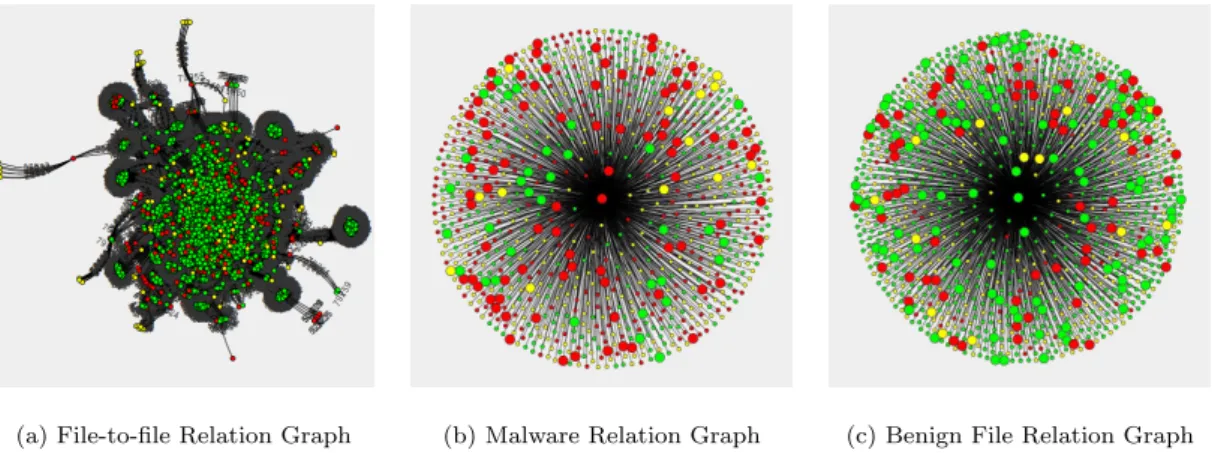
3.2 Visualization of file-to-file relation graphs: (a) a part of the constructed graph; (b) an example of a malware relation graph with one-hop tion; (c) an example of a benign file relation graph with one-hop informa-tion (Red nodes denote malware, green nodes represent benign file, and yellow nodes are unknown file) [27]. . . 22
3.3 A zoom-in view of a part of the constructed file relation graph [66]. . . 23
3.4 Message update from node ito nodej . . . 25
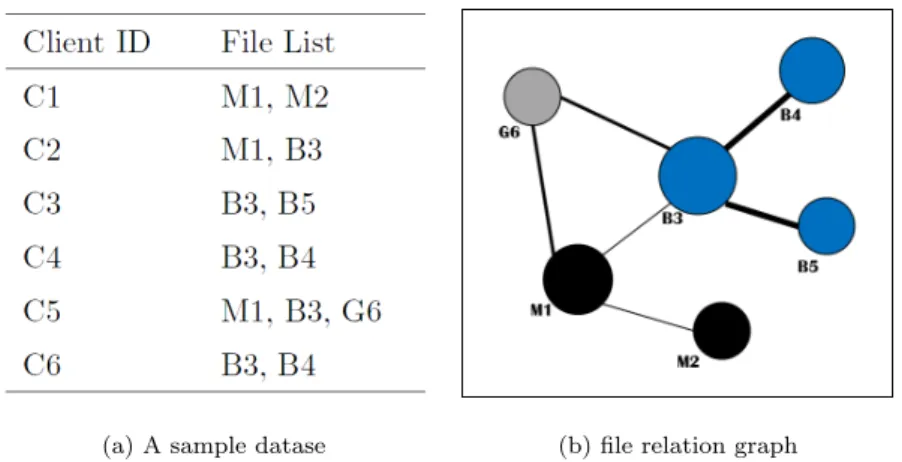
3.5 A sample dataset and its file relation graph constructed . . . 26
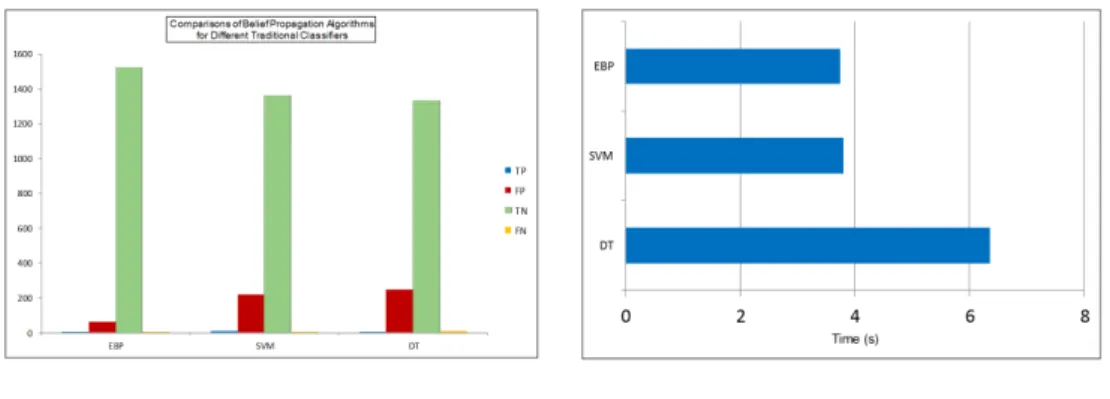
3.6 Comparisons of different belief propagation algorithms . . . 30
3.7 Comparisons of malware detection effectiveness and efficiency between EBP Algorithm and other classification approaches. . . 31
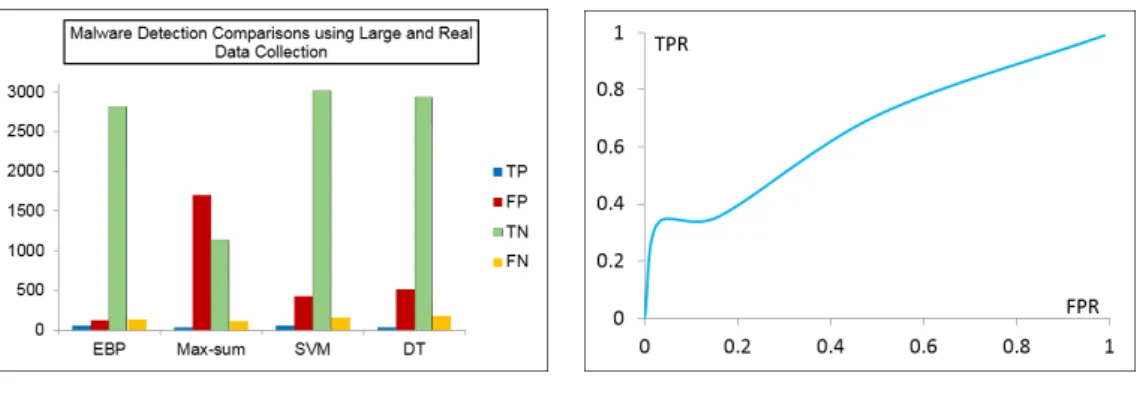
3.8 Malare detection comparisons using large and real data collection. . . 32
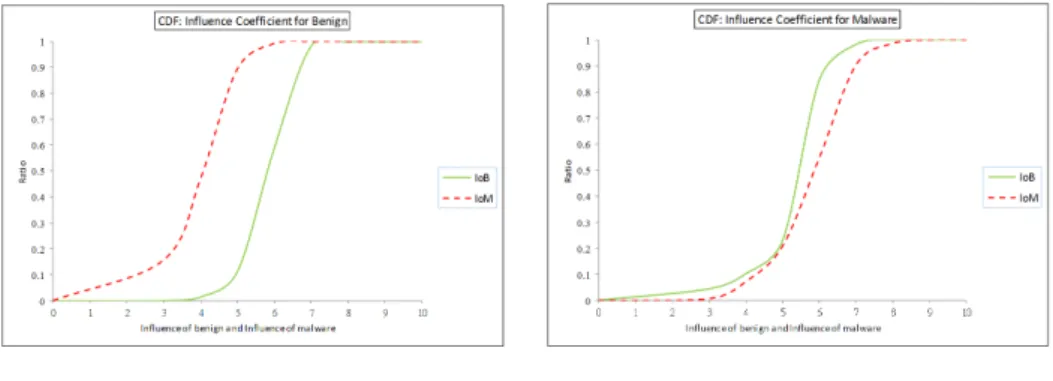
3.9 Indirect influences superior than direct influences for file 1880 (yellow node) 35 3.10 The comparison of benign files and malware in IoB and IoM measures . . 35
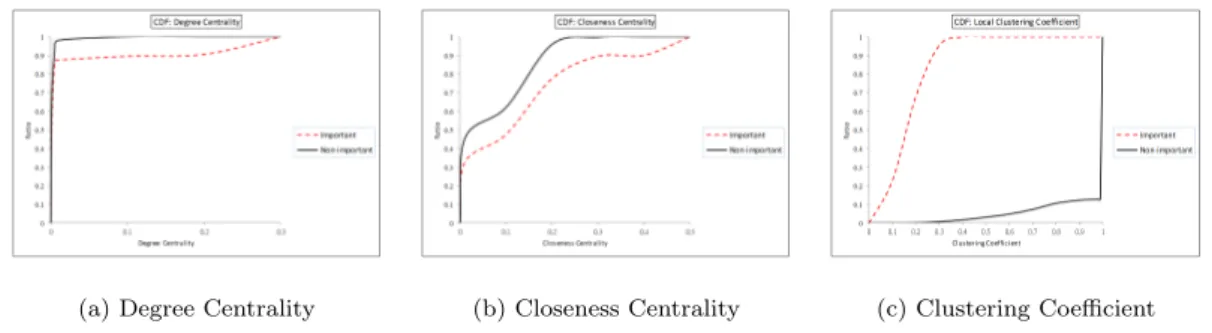
3.11 The comparisons of “important” malware and “non-important” ones. . . . 36
3.12 Graph structure comparisons of “important” and “non-important” mal-ware. (a) Important malwareA and its neighbors; (b) Relations between A’s neighbors; (c) Non-important malwareB and its neighbors; (d) Rela-tions betweenB’s neighbors [27]. . . 37
3.13 An example of malware detection using active learning framework. . . 42
3.14 Comparisons of ROC curves and detection efficiency of different methods 43 3.15 Neighborhood relationships among files. . . 45
3.16 Illustration of encoder-decoder LSTM architecture. . . 46
3.17 Parameter sensitivity evaluation. . . 50
List of Figures vii 4.2 Different scenarios of the adversarial attacks. With the direction of the
inward arrow, the adversarial attacks are depicted with the knowledge of (X,Dˆ), (X, D), and (X, D, f). . . 56 4.3 An overview of system architecture of SecDefender. In this system, the
collected PE files are first represented as d-dimensional binary feature vectors. Then a well-crafted adversarial attack model AdvAttack is for-mulated to generate the adversarial examples, which will be further used for classifier retraining and security regularization. For a new file, based on the extracted features, it will be predicted as either malicious or benign based on the trained classification model. . . 59 4.4 Relevance score distribution of the extracted API calls for the classification
of malware and benign files . . . 61 4.5 The feature distribution of file samples. . . 68 4.6 Comparisons of AdvAttack and other adversarial attacks:
Original-Classifier (0), different adversarial attacks (Method 1 - 4) andAdvAttack
(5) . . . 69 4.7 FNR before and after each attack under different scenarios for all 1,000
testing file samples . . . 70 4.8 Comparisons ofSecDefender and other classification models onACC,F1,
FNR, and ROC curves: Original-Classifier (1),Original-Classifier under attack (2), retrainedOriginal-Classifier (3), and SecDefender (4) . . . 71 4.9 An overview of system architecture of SecureDroid. In the system, the
collected app files are first represented as d-dimensional binary feature vectors. Then SecCLS is applied to select a set of features (each feature
i is selected with probability P(i)) to construct a more secure classifier.
SecENS is later exploited to aggregate different individual classifiers built using SecCLS to classify malicious and benign files. For a new file, based on the extracted features, it will be predicted as either malicious or benign based on the trained classification model. . . 74 4.10 The manipulation costs determined by different feature types and
manip-ulation methods. . . 78 4.11 Effectiveness evaluation of different attacks. . . 84 4.12 Security evaluations under brute-force (BF) attacks, anonymous (AN)
attacks, well-crafted (WC) attacks, and without attacks. . . 86 4.13 Comparisons of different defense methods. . . 88 4.14 Scalability and stability evaluation of SecureDroid. . . 89 4.15 An overview of system architecture of DroidEye. In the system, the
col-lected apps are first represented as d-dimensional binary feature vectors. To harden the evasion, count featurization is used to transform each bi-nary feature vector xi to a continuous feature vector x0i; then softmax
function with adversarial parameter is introduced to find the best trade-off between security and accuracy for the classifier. For a new app, after feature representation, it will be predicted as either benign or malicious using the classifier. . . 90 4.16 Defenses in different feature spaces. . . 92 4.17 An example of count featurization. . . 94
4.18 Evaluation of DroidEye with different τ under AdvAttack with number of manipulated features varying from 10 to 50. . . 98 4.19 Security evaluations of DroidEye and Original-Classifier under
AdvAat-tack, FGSM atAdvAat-tack, ANAatAdvAat-tack, and without attacks. . . 99 4.20 Comparisons of different defense methods. . . 101
ix
List of Tables
3.1 Graph property comparisons . . . 24
3.2 The edge potential design in AESOP[121] . . . 26
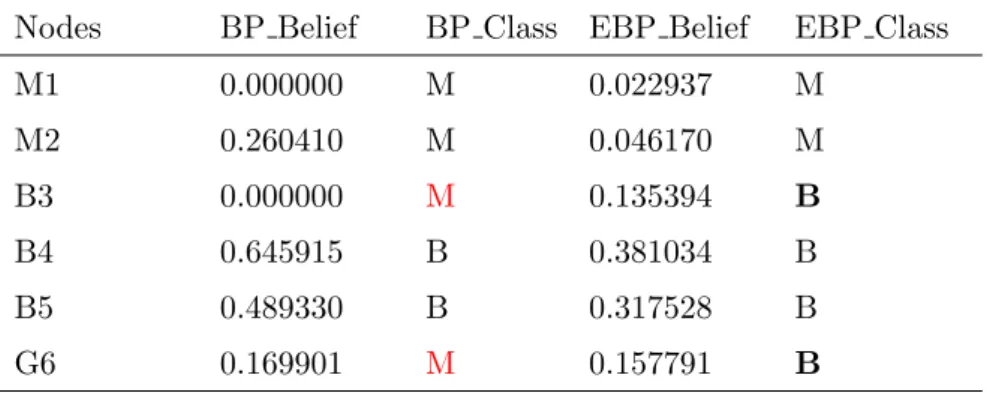
3.3 The results of standard BP and EBP based on Figure 3.5 . . . 27
3.4 The edge potential design in enhanced BP . . . 27
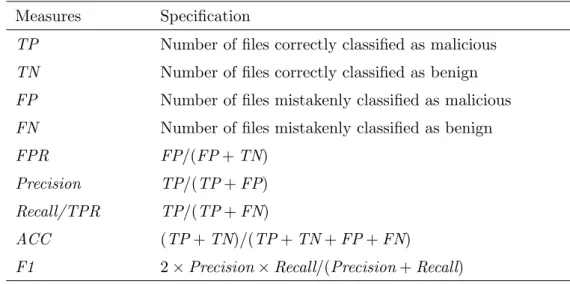
3.5 The evaluation measures of malware detection performance . . . 30
3.6 Malare detection comparisons using large and real data collection . . . 31
3.7 Evaluation of the designed graph-based features . . . 41
3.8 Evaluation of the proposed learning framework in malware detection . . . 42
3.9 Comparisons of different detection methods . . . 43
3.10 Comparisons of file2vec with DeepWalk in malware detection . . . 48
3.11 Comparisons with other machine learning methods . . . 49
4.1 List of the top ranked API calls . . . 62
4.2 Comparisons of different anti-malware scanners . . . 72
4.3 Illustration of extracted features for Android apps inSecureDroid . . . 76
4.4 Performance indices of Android malware detection . . . 83
4.5 Comparison of SecureDroid with SecCLS and ERFS with random fea-ture selection against well-crafted attacks (UnderAtt) and without attacks (NonAtt). . . 87
List of Notations
|.| The size of a set
ξ Lagrange multiplier
Ψ Knowledge of the learning system
τ Adversarial parameter
θ Adversarial attack
δbv Vertex v’s benign neighbors
δmv Vertex v’s malicious neighbors
A(x) Manipulation function
B API calls highly relevant to benign files
bi(vi) Belief value of nodei
Ci The set of clients containing vi
C(x0,x) The adversarial cost function
con(vi, vi) The connectivity between file vi and vj ct Cell activation vectors
D Training sample set
d Vector dimension
E The set of relations between file samples
ev Edges built by allv’s neighbors
Fvi Concatenation of Relation- and Graph-based feature ofvi f Classification function
fi→j(vi, vj) The edge potential from nodei to nodej ft Forget gate at timestept
G The file relation graph
Gvi Graph-based feature of vi gi(vi) The node potential of node i
List of Notations xi
H Hidden layer function
ht The hidden layer vector at timestep t
I(i) The importance ofith-feature
I(vi, vj) Indicator to denote if (vi, vj)∈E I(x,+1) Feature x’s relevance score to malware
I(x,−1) Feature x’s relevance score to benign file
it Input gate at timestep t kv Degree of the vertex v l Walk length
−→
~
Mt The malicious score vector at timestept
M API calls highly relevant to malware
M(vi) The malicious score of node vi
mi→j(vj) The message sent from nodeito node j N(i) The set of nodes neighboring node i ot Output gate at timestept
P(i) The probability of ith-feature being selected
Rvi Relation-based feature of vi r Walks per nodes
S The set of file states
S The security matrix
sb Benign
sm Malicious
su Unknown
sim(Fvi, Fvj) The similarity between vi and vj over the feature spaceF
T(x0,x) The adversarial action function
T The adversarial action matrix
V The set of file samples
vi File samplei
vt The one-hop vector at timestept w(vi) The weight of the node vi
w(vi, vj) The weight of the edge between vi and vj X The feature space
List of Acronyms
ACC Accuracy - (TP+TN)/(TP+TN+FP+FN) API Application Programming Interface
BP Belief Propagation CC Closeness Centrality
CDF Cumulative Distribution Function DoB Degree of Benign files
DoM Degree of Malware DC Degree Centrality DT Decision Tree
EBP Enhanced Belief Propagation FGSM Fast Gradient Sign Method
FN False Negative - number of files (apps) mistakenly classified as benign
FNR False Negative Rate - FN/(TP+FN)
F1 F1 Measure - 2×Precision×Recall/(Precision+Recall) FP False Positive - number of files (apps) mistakenly classified
as malicious
FPR False Positive Rate - FP/(FP+TN) IDK Ideal Knowledge Attack
IoB Influence Coefficient of Benign files IoM Influence Coefficient of Malware IPK Imperfect Knowledge Attack LLC Local Clustering Coefficient LR Logistic Regression
LSTM Long Short-Term Memory MMC Mimicry Attack
List of Acronyms xiii MRS Malicious Relevance Score
Mr.SPA Malicious Relevance Score Propagation Algorithm MSIA Malicious Score Inference Algorithm
NB Na¨ıve Bayes NN Neural Network
PE Portable Executable file Precision Precision - TP/(TP+FP) Recall Recall - TP/(TP+FN)
ROC Receiver Operating Characteristic SVM Support Vector Machine
TN True Negative - number of files (apps) correctly classified as benign
TNR True Negative Rate - TN/(FP+TN)
TP True Positive - number of files (apps) correctly classified as malicious
Chapter 1
Introduction
1.1
Background and Motivation
Malware (e.g., viruses, worms, trojans, backdoors, botnets, ransomware) ismalicious software that is disseminated by attackers as a major weapon to launch a wide range of security attacks, such as disturbing system operations, stealing personal sensitive information without user’s permission, hijacking devices remotely to deliver massive spam emails, or infiltrating user’s online account credentials [144]. With computing devices and the Internet being essential in everyday life, malware poses serious and evolving threats to their security, which present various damages and significant financial loss to Internet users. A study conducted by Kaspersky Lab revealed that nearly half of Internet users have encountered malicious software, in which 80% malware attacks caused problems for the users [74]. It’s also reported that up to one billion dollars were stolen in roughly two years from financial institutions worldwide, due to malware attacks [73]. As a result, the detection of malware is of major concern to both the anti-malware industry and scientific research community.
In order to combat the evolving malware attacks and protect legitimate users from these threats, most malware detection systems in computing devices, especially anti-malware software products (e.g., Symantec, Kaspersky, Comodo), typically use the signature-based method [49]. A signature is a short sequence of bytes unique to each known malware, which allows newly encountered files to be correctly identified with a small error rate [75]. However, driven by economic benefits, today’s malware are cre-ated at a rate of hundreds of thousands per day [149] (i.e., more than 260 million new malware samples were created last two year [4]). Meanwhile, malware attackers easily evade this method through techniques such as obfuscation, polymorphism,
metamor-Chapter 1. Introduction 2 phism, and encryption [119]. In order to remain effective, new and intelligent malware detection techniques need to be investigated. As a result, many research efforts have been conducted on applying machine learning techniques for intelligent malware detec-tion [140, 7, 90, 139, 142, 95, 60, 39, 67, 68, 151, 131, 132, 137, 69]. In these systems, based on different feature representations (e.g., binary n-grams [7], system call graphs [101, 67], dynamic behaviors [49, 132], or Application Programming Interface (API) call blocks [68]), various kinds of classification approaches, such as support vector machine [153, 79, 44, 114], random forest [1] and deep neural network [68, 67, 60], are used for model construction to detect malicious files, which have offered unparalleled flexibility in intelligent malware detection.
Figure 1.1: File relations between a Downloader-Trojans and its related Tro-jans [149]
Figure 1.2: File relations between a be-nign application and its related dynamic link files [149]
Most of the existing systems using machine learning techniques merely utilize local features either statically or dynamically extracted from the file samples to detect mal-ware. As the moral says “man is known by the company he keeps”, in malware detection, a file’s goodness or malice may be judged by the other files that are always associated with it in the different ways. For example, Ye et al. [149] first proposed to utilize file relations for malware detection: as shown in Figure 1.1, we can observe that a Trojan-Downloader “yy(1).exe”, which can download and install multiple unwanted applications (e.g., trojan, adware) from remote servers, is associated with many trojans which are marked as purple color; from Figure 1.2, we can observe that a benign system diagnostic application “everest.exe”, is associated with different benign files marked in green color. Ignoring the relations among file samples is a significant limitation of current malware detection methods. Recently, features beyond file content are starting to be leveraged to curb the security threats that malware poses [149, 25, 121, 72], such as machine-to-file relations [25] and file-to-file relations (e.g., file co-existence) [149, 121], which provide
invaluable insight about the properties of file samples [149]. However, much needs to be done to take full advantage of the relationships of malware and benign files (i.e., malware-malware, malware-benign, benign-benign relations). To better understand the properties of file-to-file relations, we’d like to take a further step to delve deeper into the relationship characteristics of malware and benign files.
Meanwhile, as machine learning-based detection systems become more widely de-ployed, the adversary incentive for defeating them increases [144]. More specifically, machine learning itself may open the possibility for an adversary who maliciously “mis-trains” a classifier (e.g., by changing data distribution or feature importance) in a malware detection system. When the learning system is deployed in a real-world en-vironment, it is of a great interest for malware attackers to actively manipulate the data to make the classifier produce minimum true positive (i.e., maximally misclas-sifying malware as benign), using some combination of prior knowledge, observation, and experimentation [38]. If we look at the evolution of malware detection techniques [49, 119, 101, 39, 25, 149, 60], malware attackers and anti-malware defenders are actu-ally engaged in a never-ending arms race. At each round, both the malware attackers and defenders analyze the vulnerabilities of each other, and develop their own optimal strategies to overcome the opponents [14], which has led to considerable countermea-sures of variability and sophistication between attackers and defenders. For example, when signature-based methods prevailed in malware detection, attackers began to use code obfuscation and encryption to bypass the detection and defeat attempts to analyze their inner mechanisms [77, 67]. Currently, the issues of understanding machine learning security in adversarial settings [152] are starting to be leveraged, from either adversarial [87, 38, 126, 14, 13] or defensive [152, 127, 40, 11, 15] perspectives. However, the appli-cation of adversarial machine learning into malware detection domain has been scarce. With machine learning techniques prevailing in malware detection, such adversaries will become even more outrageous.
1.2
Research Goals
With the above limitations and challenges addressed for intelligent malware detec-tion, in this Ph.D. dissertadetec-tion, we focus on investigating file-to-file relations to facilitate analysis of malware detection, and exploring the adversarial machine learning to en-hance the security of malware detection. Specifically, we describe these research goals (RG1-RG2) in detail as follows:
Chapter 1. Introduction 4
• RG1: Intelligent malware detection utilizing file-to-file relations: To achieve our research goals, we construct the file co-existence graphs between malware and be-nign files, and analyze effective graph-based feature representations and relation-ship characteristics (e.g., mutual influence and difference importances among the files) for intelligent malware detection. Since feeding the graph-based features to the traditional machine learning-based classifiers is an inferior fashion for malware detection, which is incapable of depicting the file-to-file relations, a well designed graph inference framework or graph representation learning framework should be proposed to make the best use of graph structure, and manage to propagate the mutual information between malware and benign files in the constructed relation-ship graphs to promote the optimal solution for file labeling.
• RG2: Enhancing security of machine learning-based malware detection: In the arms race between malware attackers and defenders, they utilize the vulnerabilities of each other and implement their optimal strategies to overcome the opponents. To be resilient against the malware attacks, we analyze the general adversarial strategy to facilitate assessing the security of the classifier. Accordingly, we present several secure-learning paradigms to counter adversarial attacks. To be feasible in practical use for malware detection, in these paradigms, we formulate some models based on the attackers’ skills and capabilities, while others are independent from the knowledge about the structure of the data (e.g., adversarial examples) or the attack model, which are adaptive to all potential attacks without exhibiting significant evidence of manipulation.
1.3
Contributions of This Dissertation
In this dissertation, to address the aforementioned research problems, we conduct feasibility studies, propose different learning methods for intelligent malware detection and adversarial machine learning, and develop the corresponding systems that integrate our proposed methods. The contributions can be summarized as follows:
• We utilize file-to-file relations for intelligent malware detection through construct-ing file co-existence graph construction, designconstruct-ing graph-based features to charac-terize the semantic relatedness among them, and proposing graph learning frame-work to detect malware, which have resulted in 4 publications [31, 27, 66, 143].
– Deep analysis of file-to-file relation graphs: Different from file content based detection, we analyze and utilize the relations among file samples (i.e., co-existences of the files) collected from the user clients to construct file relation graph for malware detection. The newly unknown malware can be detected by its association with the known files (benign or malicious). (See Section 3.1 for details).
– Design enhanced Belief Propagation (EBP) algorithm for unknown file label-ing: Belief Propagation (BP) algorithm is a promising method for solving inference problems over graphs and it has also been successfully used in many domains (e.g., computer vision, coding theory) [150]. However, in our appli-cation, the algorithm should be greatly adapted, which is not a trivial process: we fine tune various components used in the algorithm and carefully design the message update and belief read-out functions for malware detection [31, 66] (See Section 3.2 for details).
– Build effective active learning framework for malware detection: Based on the constructed file-to-file relation graph, we design five graph-based features to represent each file and further analyze its relationship characteristics and have two significant findings: Finding 1: A file can greatly inherit the indirect influences from other files. Finding 2: (1) The importance of each file is different; (2) The neighbors of the important malware are associated through it, while the neighbors of the non-important malicious file are inclined to be a clique. We also use graph metrics to quantitatively validate these findings. Accordingly, we first apply Malicious Score Inference Algorithm (MSIA) to select the representative samples from the large unknown file collection for labeling, and then use EBP algorithm to detect malware [27] (See Section 3.3 for details).
– Leverage Long Short-term Memory for graph representation learning: To learn the representations of files in our constructed graph, we first generate file se-quences based on the random walk, and then deploy Long Short-Term Memory (LSTM) for file sequence modeling and thus learn desirable file representations over graph, which will be fed to a Support Vector Machine (SVM) to train the classification model, based on which the unlabeled file can be predicted if they are malicious or not (See Section 3.4 for details).
en-Chapter 1. Introduction 6 hance the security of machine learning-based detection systems through analyzing adversarial attacks, and formulating secure-learning paradigms to counter the ad-versarial attacks. Our work on adad-versarial machinle learning in malware detection has resulted in 5 publications [32, 33, 28, 29, 30].
– Analyze adversarial attacks under different scenarios: The attackers may have different levels of knowledge of the learning system [126]. We explore the adversarial attacks corresponding to the different scenarios, thoroughly assess the adversary behaviors through feature manipulations, adversarial cost, and attack goals, and accordingly present a general attack strategy for further investigations [32, 33, 29] (See Section 4.2 for details).
– Propose secure-learning paradigms against adversarial attacks: Resting on the learning-based classifier which is degraded by the adversarial malware at-tacks, we propose three secure-learning modelsSecDefender,SecureDroid, and
DroidEye to counter these attacks. In our proposed methods, SecDefender
adopts classifier retraining technique on basis of our proposed adversarial at-tack modelAdvAttack and enhances the robustness of the classifier using the security regularization terms; SecureDroid utilizes a novel feature selection method to build more secure classifier by enforcing attackers to increase the adversarial costs and maximize the manipulations, and introduces an ensem-ble learning approach to aggregate different individual classifiers constructed using our proposed feature selection method to improve system security while not compromising detection accuracy; DroidEye takes advantage of gradient masking for feature space, utilizes count featurization to transform the binary feature space into continuous probabilities encoding the distribution in each class (either benign or malicious) to reduce the adversarial gradient of the learning model, and then introduces softmax function (i.e., normalized expo-nential function) with adversarial parameter to find the best trade-off between security and accuracy for the classifier by tuning the adversarial parameter [32, 33, 28, 30] (See Section 4.3 for details).
• We develop practical systems integrating our proposed methods for comprehen-sive experimental studies on real sample collections from an anti-malware industry company. Specifically, we collect different sample sets from Comodo Cloud Secu-rity Center; based on these real sample collections, we construct practical systems based on our proposed methods and provide a series of comprehensive experiments
to empirically evaluate the performances of these methods [33, 28, 32, 31, 27, 30] (See Section 3.2.3, 3.3.3, 4.3.4, 4.4.4, and 4.5.3 for details).
In sum, by the date of this dissertation, we have had 9 publications [31, 27, 66, 143, 32, 33, 28, 29, 30] in intelligent malware detection using file-to-file relations and adversarial machine learning in malware detection, including the prestigious IEEE EISIC’2017 Best Paper Award.
1.4
Organization of This Dissertation
The rest of the dissertation is organized as follows. Chapter 2 first discusses the devel-opment of malware including its definition in Section 2.1.1, taxonomy in Section 2.1.2, and its history in Section 2.1.3; then specifies the development of malware detection techniques in Section 2.2. Chapter 3 describes file-to-file relation investigation and graph construction in Section 3.1, designs an enhanced Belief Propagation algorithm for unknown file labeling in Section 3.2, builds effective active learning framework for malware detection in Section 3.3, and leverages Long Short-term Memory for graph rep-resentation learning in Section 3.4. Chapter 4 presents the adversarial attacks under different scenarios in Section 4.2, and secure-learning paradigms SecDefender in Sec-tion 4.3, SecureDroid Section 4.4, and DroidEye in Section 4.5. Chapter 5 summarizes this dissertation in Section 5.1 and addresses the future work in Section 5.2.
8
Chapter 2
Development of Malware and
Malware Detection Techniques
2.1
Development of Malware
2.1.1 Definition of Malware
Malware, short formalicious software, generally refers to software programs that are designed to deliberately fulfill different harmful intents of an attacker [12, 51, 36], such as disturbing system operations, encrypting, stealing or deleting sensitive data, hijacking or altering core computing functions and monitoring computer activities of users without their permission, or even bringing down servers and critical infrastructures [106, 65]. Besides that, some other definitions have been also offered to describe malware [70]: Grimes defined malicious code as “any software program designed to move from computer to computer and network to network in order to intentionally modify computer systems without the consent of the owner or operator, that includes viruses, Trojan horses, worms, script attacks, and rogue Internet code” [56]; Vasudevan et al. described malware as a generic term that encompasses viruses, trojans, spywares and other intrusive code [123]; Thomas et al. also described malware as a general term used by computer professionals to mean a variety of forms of hostile, intrusive, or annoying software or program code [122]; while Saracino et al. considered that malware hides treacherous code performing actions in the background that threatens the user privacy, the device integrity, or even user’s credit [113]. In a nutshell, the typical characteristics of malware can be depicted as destructive, unauthorized, stealthy, and transmissible, and they may infiltrate the systems through the vulnerable services over the network, the downloading process from
the Internet, or being tricked by the attackers into deliberately executing malicious codes on their machines [144, 46, 107].
Driven by economic benefits, malware industry has invented automated malware development toolkits (e.g., Zeus, Kronos, MPack, exploit kit) to produce and mutate hundreds of thousands of malicious codes per day using techniques, such as instruction virtualization, packing, polymorphism, emulation, and metamorphism [119]; these mal-ware development toolkits also lead to a massive proliferation of new malmal-ware samples due to their wide availability [144]. As a result, malware has been rapidly gaining preva-lence, spread and infected computing devices at an unprecedented rate around the world. According to AV-TEST Institute’s statistics [4], as shown in Figure 2.1, over 350,000 new malicious programs and potentially unwanted applications are currently registered ev-eryday, while more than 800 million malware have been created in the last ten years. This has posed serious and evolving security threats to Internet users.
Figure 2.1: (a) New malware created in the last two years, and (b) total malware created in the last ten years [4].
2.1.2 Taxonomy of Malware
Malware comes in wide range of variations like virus, worm, backdoor, Trojan-horse, spyware, rootkit, adware, bot, scareware, ransomware [51], which are varying in different purposes and proliferation ways and containing unique characteristics and traits. We would like to provide a brief overview of these most common and prevalent types of malware as follows [144, 106, 70].
• Virus: A virus (e.g., Creeper, Elk Cloner) is a piece of code that replicates by inserting itself into other software programs, files, or the boot sector of the hard
Chapter 2. Development of Malware and Malware Detection Techniques 10 drive. A program that a virus has inserted itself into is infected, and is referred to as the virus’s host. Viruses cannot run independently since they need to be activated by their host programs.
• Worm: A worm (e.g., Love Gate, SQL Slammer) is a program that can run inde-pendently without a host program and propagate a fully working version of itself to other machines. Worms usually spread without any human interaction or directives from the malware authors.
• Backdoor: A backdoor (e.g., Sobig, Mydoom) is a malicious program that bypasses authentication procedures to access and thus compromise a system via a network. Additionally the use of a rootkit or code obfuscation makes the backdoors very difficult to locate.
• Trojan horse: A Trojan horse (e.g., Zeus, ZeroAccess) is a software program de-signed to appear as a legitimate program, thereby tricking a user into installing it onto their computing devices; when embedded by its designer in an application or system, the Trojan horses will perform malicious and unauthorized actions in the backend. Generally Trojans are responsible for the theft or destruction of data.
• Spyware: Spyware (e.g., keyloggers, web beacons) refers to a type of malware that has been designed to gather data and information about users and also observe their activity without users’ knowledge and consent.
• Rootkit: A rootkit (e.g., Knark, Adore) is a form of malware that obtains administrator-level access to the victim’s system. After the installation process, the program provides threat actors root or privileged access to the system. Rootkits can be used in user-mode or tamper with operating system structures as a device driver or a kernel module.
• Adware: Adware, or malvertising (e.g., Fireball, BaiduBarz), not only presents unwanted advertisements to the users to generate revenue, but also use authorized online advertising to spread malicious software.
• Bot: A bot (e.g., Agobot, Sdbot) is a piece of malware that allows the bot master to remotely control the infected system. Bots typically spread through exploiting software vulnerabilities or employing social engineering techniques to allure unsus-pecting users to execute malware binaries. Once a system has been infected, the
bot master can transform these individual victimized systems into a vast network, called a botnet.
• Scareware: Scareware is a form of malware that utilizes social engineering to lure a user into buying and downloading unwanted software, such as fake antivirus soft-ware, which has posed severe financial and privacy-related threats to the victims.
• Ransomware: Ransomware is one of the most popular malware in recent years, which installs stealthily on a victim’s computer and executes a cryptovirology at-tack that prevents users from accessing their system or personal files, and demands ransom payment from the victim in order to regain access.
• Cryptocurrency mining malware: Cryptocurrency mining malware (e.g., Coinhive), also simply called cryptojacking, refers to software programs and malware compo-nents developed to take over a computing device’s resources and use them for cryptocurrency mining without a user’s explicit permission [118].
• Hybrid malware: Hybrid malware combines two or more other forms of malware into a new type to achieve more powerful attack functionalities.
2.1.3 History of Malware
The history of malware starts back in 1949 when John von Neumann began work-ing on self-reproducwork-ing automatons through “Theory and Organization of Complicated Automata” [125]; it seems no one attempted to implement these automatons to cause damage to the system. The root of malware came into life around 1970 named “Creeper”, an experimental self-replicating program written by Bob Thomas that gained access via the ARPANET and copied itself to the remote system where the message “I’m the creeper, catch me if you can!” was displayed [34]. The term “Virus” was first coined by Fred Cohen in 1985 [88]. After that, a massive and outrageous malware industry was born [105]. Kingsoft reported that the average number of infected computers per day was between 2-5 million [76]; while cybercrime will cost the world $6 trillion annually by 2021, up from $3 trillion in 2015 [37]. In this section, we would like to take a brief look at the development of malware and get to know how it evolved and impacted the world as follows [105, 144, 52, 129].
• 1970–1979: Creeper, most commonly recognized as the first computer virus, was created by Bob Thomas in 1971 as an experimental self-replicating program that
Chapter 2. Development of Malware and Malware Detection Techniques 12 corrupted DEC PDP-10 computers running the TENEX operating system; the Wabbit (or rabbit) virus was created in 1974 that blocks up the system of a com-puter through multiple self-replicating; PERVADE virus appeared in 1975 that adheres to other programs and allows them to spread its copies; the term “Worm” was also introduced by John Brunner in 1975.
• 1980–1989: Elk Cloner virus, found in Apple II systems, was written by high school student Richard Skrenta in 1981 that resulted in one of the earliest large-scale virus outbreak to affect personal computers; Brain virus was released in 1986 that is considered as the first virus to infect MS-DOS computers and the first IBM PC compatible virus, while in the same year PC-Writer Trojan was created as one of the earliest Trojans; Vienna virus appeared in 1987 that was regarded as the first virus to infect both COM files and EXE files; Christmas Tree virus was created in the same year that was the first widely disruptive replicating network virus; Morris Worm was released in 1988 to infect a substantial percentage of computers connected to ARPANET while its author (i.e., Robert Morris) became the first malware author convicted for his crimes; AIDS Trojan was spread in 1989 that encrypts all filenames on the system and asks for payment, which is considered as the first known ransomware.
• 1990–1999: Chameleon viruses were developed by Mark Washburn in 1990 as the first family of polymorphic viruses; the first Macro virus, called Concept, was created in 1995 used to infect Microsoft Word documents; in 1996, the first virus designed specifically for Windows 95 files Boza, the first Excel macro virus -Laroux, and the first Linux virus - Staog were released; in 1999, Melissa virus was the first mass-emailing virus that utilizes Outlook address books from infected machines, and sends the copy of itself to 50 people at a time, while ExploreZip worm was detected to destroy Microsoft Office documents.
• 2000–2009: Starting from 2000, Internet and email worms were prevailing across the globe, and malware toolkits drove malware to grow significantly in its number and dissemination. In 2000, the ILOVEYOU worm, one of the most damaging worms ever, was created by a computer science student that infected millions of computers worldwide and costed more than $5.5 billion in damages; In 2001, differ-ent worms were detected that targeted Microsoft systems, such as Sadmind, Sircam, Code Red, Nimda, and Klez; SQL Slammer Worm, one of the fastest spreading
worms of all time, was created in 2003 that caused massive Internet access disrup-tions worldwide; Cabir Virus was released in 2004, which was widely acknowledged as the first mobile phone virus; In the same year, the first internet worm - Witty, and the first known webworm Santy were also launched; the first-ever malware for Mac OS X, a trojhorse known as OSX/Leap-A or OSX/Oompa-A was an-nounced in 2006; computer worm Conficker was found in 2008 causing some of the worst damage seen since SQL Slammer.
• 2010–present: Since 2010, the sophistication of malware has been significantly evolving, that results in advanced malware with different evasion tactics. Stuxnet, a malicious computer worm, was detected in 2000, which was the first worm to attack SCADA systems and one of the most resource-intensive bits of malware created to date; Zeus Trojan, or Zbot released in 2011 was one of the most successful pieces of botnet software in the world, impacting millions of machines; Cryptolocker discovered in 2013 was one of many early ransomware programs; Cerber detected in 2016 was one of the heavy-hitters in the ransomware sphere, and one of the most prolific crypto-malware threats; WannaCry Ransomware and its variants have been spreading globally since 2017 by encrypting data and demanding ransom payments, which is one of the most prevalent and diabolical malware in recent years.
2.2
Development of Malware Detection Techniques
In order to combat the evolving malware attacks and protect legitimate users from these threats, the major defense is the software products from anti-malware compa-nies. With more and more sophisticated malware samples emerging in the wild, both anti-malware industry and researchers have developed various countermeasures for mal-ware detection. In the following sections, we briefly introduce the progress of intelligent malware detection.
2.2.1 Signature-based Malware Detection
Signature-based methods are widely used in anti-malware software products from different companies to provide the major defense against malware, such as Comodo, Kaspersky, Kingsoft, and Symantec [49, 48]. A signature is a short sequence of bytes, which is often unique to each known malware, allowing newly encountered files to be correctly identified with a small error rate [74, 92]. In addition to anti-malware software
Chapter 2. Development of Malware and Malware Detection Techniques 14 products, some early research efforts have also been conducted on signature-based mal-ware detection. Sun et al. [119] developed a signature based malmal-ware detection system called SAVE (Static Analyzer of Vicious Executables) which extracted the signatures from the original malware with the hypothesis that all versions of the same malware share a common core signature; Venugopal et al. [124] detailed a signature matching algorithm to scan malware in mobile devices. This method is traditionally known as time and labor consuming and less responsive to new threats as that signatures are often manually generated, updated, and disseminated by domain experts [144]. As introduced above, the malware industry has invented automated malware development toolkits to create and mutate hundreds of thousands of malicious codes per day which can easily slip through such traditional signature-based malware detection [149, 144, 61].
2.2.2 Heuristic-based Malware Detection
To address the aforementioned challenges, heuristic-based methods were proposed as complements to signature-based methods for malware detection [20]. As opposed to signature-based malware detection, which looks to match signatures found in files with that of a database of known malware, heuristic-based detection uses rules and/or pat-terns determined by experts to look for behaviors which may indicate malicious intent and thus discriminate malware samples and benign files [144]. These rules and patterns should be generic enough to be consistent with variants of the same malware threat, but not falsely matched on benign files [45]. Some classic heuristic-based detection techniques include [85, 24, 109]: neural networks(NNs) being adopted for their adapt-ability to environmental changes and their adapt-ability of prediction [89, 24]; fuzzy logic using approximation for logic rather than precise classical logic [91, 109]; genetic algorithm applying principles of evolutionary biology such as inheritance, mutation, selection and combination for deriving classification rules and selecting appropriate features or opti-mal parameters for opti-malware detection [17, 91]. Heuristic-based opti-malware detection is an effective way to identify unknown threats for the most up-to-date real-time protection, but there are downsides: (1) the analysis of malware samples and the construction of rules/patterns by domain experts is often error-prone, which results in high false pos-itives; (2) this sort of scanning and analysis is time-consuming, which may slow-down system performance [144]. Considering that the speed of malware creation is faster than rules/pattern construction, the unknown files make the clients become more and more overloaded.
2.2.3 Machine Learning-based Malware Detection
To overcome the problem of the clients being heavy and keep the malware detection effective and efficient, cloud-based detection [149] has been recently used by most of the anti-malware vendors, the scheme of which can be summarized as “blocking invalid software programs from a blacklist and authenticating valid software programs from a white list at the client (user) side, and predicting any unknown files (i.e., the gray list) at the cloud (server) side and quickly producing the verdict results to the clients” [149, 144]. More specifically, the signature sets on the clients are first exploited to scan the newly received files; those files that cannot be recognized by existing signatures will be labeled as unknown files and their information will be collected and sent to the cloud server; the learning models constructed on the cloud side will classify the unknown files as malware or benign files, and send back the classification results to the client side immediately. Cloud-based detection enables an up-to-date security solution for malware detection [144]. However, the unknown files in the gray list is constantly increasing. According to the AV-TEST Institute’s report, over 350,000 new malware are released everyday [4]. This calls for intelligent techniques to support efficient and effective malware detection on the cloud side.
Since the quantity, diversity and sophistication of malware have significantly in-creased in recent years, in order to effectively and efficiently detect malware from the real and large daily sample collection, new, intelligent malware detection systems have been developed by applying machine learning techniques [140, 7, 90, 139, 142, 95, 60, 39, 67, 68, 151, 131, 132, 137, 69]. In these methods, malware detection is a two-step pro-cess: feature extraction and classification/clustering. The performance of such malware detection methods critically depend on the extracted features and the categorization techniques. We provide a comprehensive investigation on machine learning-based mal-ware detection techniques as follows.
• Classification: Na¨ıve Bayes on the extracted strings and byte sequences was applied in [114, 50], which claimed that Na¨ıve Bayes classifier performed better than tradi-tional signature-based method. Kolter et al. [79] focused on static analysis of the executable files and compared Na¨ıve Bayes, Support Vector Machine and Decision Tree based on then-grams. Wang et al. [128] extracted registries and activity net-work from spyware and applied Support Vector Machine for surveillance spyware detection. Santos et al. first used n-grams, strings, and OpCode to build Deci-sion Tree and used dynamically extracted behaviors to formulatekNN for malware
Chapter 2. Development of Malware and Malware Detection Techniques 16 detection [111], and then they further proposed semi-supervised algorithms (i.e., collective classification models) on various features for unknown malware detection [112]. Ye et al. [139, 146, 148] proposed IMDS, Hierarchical associative classifier (HAC), and CIMDS performing associative classification on Windows API calls extracted from executable files. Shah et al. [116] applied various feature selection algorithms to obtain the feature sets from PE files and used Artificial Neural Net-works to detect new and unknown malware. Kong et al. [80] extracted the function call graph from each program, collected various types of fine-grained features at the function level, and then applied an ensemble of weighted classifiers for malware detection. Cesare et al. [23] explored string similarity metrics for malware detec-tion based on k-subgraphs and q-grams of structured control flow graphs, while Anderson et al. [2] used similarity metrics on instruction traces to differentiate malware and benign files.
• Clustering: Hou et al. [65] developed the intelligent malware detection system using cluster-oriented ensemble classifiers resting on the analysis of Windows API calls. Most of these existing researches are built on shallow learning architectures, which only made use of the files with class labels (either malicious or benign) during the training phase, while ignoring the important information from the large num-ber of unlabeled file samples, which leave a large room for improvement. Bailey et al. [8] proposed a hierarchical clustering technique that describes malware behav-ior in terms of system state changes and automatically categorized these profiles of malware into groups that reflect similar classes of behaviors and demonstrated how behavior-based clustering provides a more direct and effective way of classi-fying and analyzing Internet malware. Ye et al. [145] presented an Automatic Malware Categorization System (AMCS) on function-based instruction sequences and instruction frequency that groups malware samples into families sharing some common characteristics using a cluster ensemble by aggregating the clustering so-lutions generated by different base clustering algorithms.
• Deep learning: Due to its superior ability in feature learning through multilayer deep architecture [62], deep learning is feasible to learn higher level concepts based on the local feature representations [98]. As a result, researchers have paid much attention to deep learning methods in the domains of malware detection [60, 84, 98, 71, 142]. Ouellette et al. [98] extracted control flow graphs to present malware samples, and used a deep probabilistic model (sum-product network) to
compare the similarities between the unknown file samples and those of represen-tative sample features from known classes of malware. Jung et al. [71] used the features of header, tags, bytecode and API calls and utilized an ensemble learner consisting of different deep learning networks (e.g., deep feed-forward neural net-work, deep recurrent neural network) to classify the Adobe Flash file samples. Li et al. [84] proposed a hybrid malicious code detection approach on the basis of Au-toEncoder and Deep Belief Network, where AuAu-toEncoder was used to reduce the dimensionality of data, and a Deep Belief Network was applied to detect malicious code. Hardy et al. [60] and Ye et al. [142] both exploited API calls as inputs; the difference is that Hardy et al. developed Stacked AutoEncoders (SAEs) while Ye et al. formulated a heterogeneous deep learning framework composed of an AutoEncoder stacked up with multilayer restricted Boltzmann machines (RBMs) for malware detection.
• File relations: Besides those features stated above (e.g., strings and byte sequences,
n-grams, API calls, function call graph, control flow graphs, etc.) extracted from file contents, file-to-machine relation graphs [25] and file-to-file relation graphs [149, 121] were also used as the features for malware detection. Chau et al. [25] and Tamersoy et al. [121] explored standard Belief Propagation (BP) algorithm to implement semi-supervised learning for malware detection. Ye et al. [149] proposed a semi-parametric classification model for combining file content and file relations together for malware detection. Karampatziakis et al. [72] built regression classifiers based on graphs induced by file relationships for malware detection. They showed that the system’s detection accuracy could be significantly improved using the proposed method. File relation graphs have been starting to be leveraged to solve malware detection problems, but all these existing works merely take advantage of the graph structure while not going further to analyze the critical information about their properties and characteristics of the relationships among different file samples.
2.2.4 Adversarial Machine Learning in Malware Detection
Machine learning techniques offer unparalleled flexibility in automatic malware detec-tion. However, machine learning itself can be a target of attack by a malicious adversary [87, 126, 14, 13, 127, 40, 11, 15]. In some cybersecurity domains, there are ample ev-idences that show adversaries can actively manipulate the data to evade the detection
Chapter 2. Development of Malware and Malware Detection Techniques 18 [38, 152, 87, 18, 14]. For example, in the domain of spam email detection, Dalvi et al. [38] examined the cost for measuring each feature of the dataset using Na¨ıve Bayes clas-sifier, and proposed an optimal strategy for the adversary to play against the classifier. Zhang et al. [152] took gradient steps to find the closest evasion point x0 to the mali-cious samplex. The Adversarial Classifier Reverse Engineering (ACRE) framework [87] was introduced to study how an adversary can learn sufficient information to construct adversarial attacks using minimal adversarial cost. Br¨uckner et al. [18] presented the interaction between the learner and the data generator as a static game, and explored the adversarial conditions and properties to find the equilibrial prediction model in the context of spam email filtering. All these adversarial attacks prompt increasing research efforts to improve the security of machine learning.
Specifically, the defense methods can be generally divided into four categories: Stack-elberg game theories [19, 58, 18, 127], feature operations [152, 82, 53], retraining frame-works [54, 133, 83], and ensemble classifier systems [16, 40, 78]. To apply Stackelberg game theories, Bruckner et al. [18] first presented the interaction between the learner and the adversary as a static game, and explored the adversarial properties to find the equilibrium prediction model; they then further simulated the interaction as a Stackel-berg competition, and derived an optimization problem to determine the solution of this game [19]. Wang et al. [127] modeled the adversary action as it controlling a vector
α to modify the training data set X, and transformed the classifier into a convex op-timization problem. More recently, feature operation methods have also been proposed to counter some kinds of adversarial data manipulations, such as feature deletion [53], feature clustering [82], feature reduction [152], etc. In addition, retraining frameworks are becoming more and more widely applied to boost the resilience of learning algorithms through: (1) adding adversarial samples to the training data that evade the previously computed classifier [83, 54], and (2) manipulating the training data distribution that its distribution is matched to the test data [133]. To improve the security of machine learning under generic settings, some research efforts have been devoted to multiple clas-sifier systems. Kolcz et al. [78] applied averaging method resting on random subsets of reweighted features to produce a linear ensemble classifier. Biggio et al. [16] built a multiple-classifier system to improve the robustness of the classifier through bagging, and the random subspace method. Debarr et al. [40] explored randomization to generalize learning model by randomly choosing dataset or features, and estimated parameters that fit the data best. In these ensemble learning systems, randomization is the main method
for feature selection. Though these theories and approaches are promising, the appli-cation of adversarial machine learning into malware detection domain has been scarce with the exception that ˇSrndic et al. [126], Xu et al. [135], and Demontis et al. [41] all exploited PDF malware or Android malware as a case study to evaluate the security of learning-based classifiers (e.g., PDFrate, Hidost, and Drebin). With the popularity of machine learning based detections, such adversaries will become even more violent.
20
Chapter 3
Intelligent Malware Detection
Utilizing File-to-file Relations
File-to-file relations, such as file-co-existence, can provide invaluable information in malware detection and make evasion harder [149, 25, 121, 72]. To better understand the properties of file-to-file relations (i.e., malware-malware, malware-benign, benign-benign relations), we’d like to take a further step to delve deeper into the relationship characteristics of malware and benign files. It is of interest to know:
• How can we construct the file-to-file relation graph between malware and benign files?
• What graph-based features, relationship characteristics, and representations can be employed for malware detection?
• Instead of traditional machine learning-based classification methods, how can we build effective learning frameworks over graph for malware detection?
More specifically, we analyze and utilize the relations among file samples to construct file relation graph. Resting on the constructed file-to-file relation graph, we first present our enhanced Belief Propagation (EBP) algorithm for malware detection; then, we design several new and robust graph-based features to represent each file and further investigate the relationship characteristics of relation graph, on the basis of which, we propose an active learning framework that applies Malicious Score Inference Algorithm (MSIA) to select the representative samples from the large unknown file collection for labeling and then uses EBP algorithm to detect malware; afterwards, we learn representations for files over graph using Long Short-term Memory (LSTM), which will be fed to SVM to train
the classification model and predict if the unlabeled files are malicious or not. To the best of our knowledge, this is the first work of investigating the relationship characteristics of the file-to-file relations in malware detection using social network analysis.
3.1
File-to-file Relation Graph Construction
In this section, we (1) first introduce the file relation graph construction, and (2) then provide deep analysis of malware’s social relation network.
File Relation Graph Construction. Based on the collected data, we construct a file-to-file relation graph to describe the relations among file samples. Generally, two files are related if they are shared by many clients (or equivalently, file lists). The file relation graph is defined asG= (V, E), whereV is the set of file samples andE denotes the relations between file samples, which is shown in Figure 3.1.
Figure 3.1: An example of file-to-file relation graph.
Given two file samplesvi and vj, letCi be the set of clients containingvi and Cj be
the set of clients containingvj. |.|represents the size of a set. The connectivity between vi and vj is computed as
con(vi, vj) =
|CiTCj|
|CiSCj|.
(3.1) If the connectivity between a pair of file samples is greater than the specified threshold (e.g., 0.5), then there is an edge between them. Each file is in a stateS ∈ {sm, sb, su}
(sm: malicious, sb: benign, su: unknown). Assume that vi is in state si and vj is with
Chapter 3. Intelligent Malware Detection Utilizing File-to-file Relations 22
iand nodej can be connected together is defined as
w(vi, vj) = Esi,sj |E|, (3.2) whereEsi,sj
is the number of the edges between all the files with statessi and sj, and
|E| is the number of all the edges. The weight of node vi which denotes its popularity
can be defined as
w(vi) =
|Ci|
|C|, (3.3)
whereC is the set of all the clients.
To visualize the file-to-file relation graph, we analyze the dataset obtained from Comodo Cloud Security Center, which contains the relationships between 60,724 files (9,893 malware, 19,402 benign files and 31,429 unknown files) on 7,093 clients. For the file relations collected from 7,093 clients, we construct the graph consisting of 60,724 nodes and 3,471,288 edges. Figure 3.2(a) shows a part of the constructed graph, while Figure 3.2(b) and (c) give examples of a malware relation graph and a benign file relation graph with one-hop information respectively.
(a) File-to-file Relation Graph (b) Malware Relation Graph (c) Benign File Relation Graph
Figure 3.2: Visualization of file-to-file relation graphs: (a) a part of the constructed graph; (b) an example of a malware relation graph with one-hop information; (c) an example of a benign file relation graph with one-hop information (Red nodes denote malware, green nodes represent benign file, and yellow nodes are unknown file) [27].
Graph Property Overview. To gain an overview about the property of file relation graph, we used a subset of our data collection includes the file lists from 1000 clients which describe file co-existence relations between 1,540 malware, 7,687 benign files, and 2,250 unknown files. Figure 3.3 shows a zoom-in view of a part of the constructed file
relation graph. From Figure 3.3, we can see that many of the red nodes are associated with other red nodes and form some clusters, while the green nodes are also related to other green nodes and form their clusters. The nodes within the same cluster have strong relations with each other: (1) the red clusters may be the variants of malware families (e.g., family of online-game trojans); (2) the green clusters may be the related files of same applications (e.g., Acrobat installation archive and its related files).
Figure 3.3: A zoom-in view of a part of the constructed file relation graph [66].
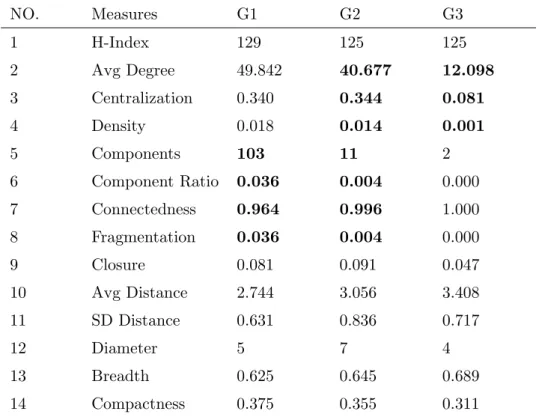
Based on the dataset described above, we also use fourteen measures in Table 3.1 to see the differences between benign file relation graph, ordinary malware (i.e., 1,220 malware whose the existence frequency is < 100) file relation graph and popular mal-ware (i.e., 320 malmal-ware whose existence frequency is ≥ 100) file relation graph. In Table 3.1, from the comparisons ofG1 andG2, we can see that the measures of compo-nents, component ratio, connectedness and fragmentation are different between benign file relation graph and ordinary malware file relation graph; while from the comparisons of G2 and G3, we can see that the measures of avg degree, centralization and density
are different between ordinary malware file relation graph and top popular malware file relation graph. The different properties between benign file relation graph and malware
Chapter 3. Intelligent Malware Detection Utilizing File-to-file Relations 24 file relation graph enable us to discriminate malware and benign files, while the differ-ent properties between ordinary malware file relation graph and popular malware file relation graph may allow us to predict the trend of malware prevalence.
Table 3.1: Graph property comparisons
NO. Measures G1 G2 G3 1 H-Index 129 125 125 2 Avg Degree 49.842 40.677 12.098 3 Centralization 0.340 0.344 0.081 4 Density 0.018 0.014 0.001 5 Components 103 11 2 6 Component Ratio 0.036 0.004 0.000 7 Connectedness 0.964 0.996 1.000 8 Fragmentation 0.036 0.004 0.000 9 Closure 0.081 0.091 0.047 10 Avg Distance 2.744 3.056 3.408 11 SD Distance 0.631 0.836 0.717 12 Diameter 5 7 4 13 Breadth 0.625 0.645 0.689 14 Compactness 0.375 0.355 0.311
“G1”: graph constructed based on 7,687 benign files and files co-exist with them, “G2”: graph constructed based on 1,220 ordinary malware and files co-exist with them, “G3”: graph constructed based on 320 popular malware and files co-exist with them.
3.2
An Enhanced Belief Propagation Algorithm for
Mal-ware Detection
In this section, we first introduce the preliminaries of BP, and analyze the reason why the standard BP fails for our application, then propose an enhanced BP for malware detection based on our constructed file relation graphs: we fine tune various components used in the algorithm and well design the message update and belief read-out functions for malware detection.
3.2.1 Standard Belief Propagation
Belief Propagation (BP) is a promising method for solving inference problems over graphs and it has also been successfully used in many domains (e.g., computer vision, coding theory) [150]. It was first proposed by Judea Pearl [102] to calculate marginal distribution in Markov Random Fields and Bayes Nets. Nodes of the graph perform as a local summation operation by iterations using the prior knowledge from their neighbors and then pass the information to all the neighbors in the form of messages [97]. By definition, the message is the neighbor node’s opinion for the current node’s probability of being in the designated status. The passing operation should cover every pair of connected nodes.
The key idea of BP is to update each node’s message until the sum of messages converge or the iterations reach the designated number. Once the final messages are defined, the belief value of each node will be read out from all its neighbor nodes. The belief is the final result employed for inference. Figure 3.4 illustrates the message update of nodejfrom its neighbor nodeiconsidering all the messages flowing into nodei(except message from nodej).
Figure 3.4: Message update from node ito nodej
Mathematically, the message update equation in standard BP is
mi→j(vj) = X vi∈S fi→j(vi, vj)gi(vi) Y k∈N(i)/j mk→i(vi) (3.4)
where mi→j(vj) is the message sent from nodei to node j, node i’s belief that node j
is in the statevj; both gi(vi) andfi→j(vi, vj) are typically called as energy functions, in
which,gi(vi) is the node potential, meaning the prior probability of node ibeing in the
statevi, whilefi→j(vi, vj) is the edge potential, referring the probability of nodeibeing
in the state vi and node j being in the statevj; S is the set of states; N(i)/j is the set
of nodes neighboring node i(not including node j). BP algorithm stops when message updates converge or a maximum number of iterations has finished. Then we calculate
![Figure 3.3: A zoom-in view of a part of the constructed file relation graph [66].](https://thumb-us.123doks.com/thumbv2/123dok_us/9897771.2483299/37.892.220.676.316.772/figure-zoom-view-constructed-file-relation-graph.webp)