(will be inserted by the editor)
PyCOMPSs: Parallel Computational Workflows in Python
Enric Tejedor · Yolanda Becerra · Guillem Alomar · Anna Queralt ·Rosa M. Badia · Jordi Torres · Toni Cort´es · Jes´us Labarta
Received: date / Accepted: date
Abstract The use of the Python programming lan-guage for scientific computing has been gaining momen-tum in the last years. The fact that it is compact and readable and its complete set of scientific libraries are two important characteristics that favour its adoption. Nevertheless, Python still lacks a solution for easily parallelising generic scripts on distributed infrastruc-tures, since the current alternatives mostly require the use of APIs for message passing or are restricted to embarrassingly-parallel computations.
In that sense, this paper presents PyCOMPSs, a framework that facilitates the development of parallel computational workflows in Python. In this approach, the user programs her script in a sequential fashion and decorates the functions to be run as asynchronous par-allel tasks. A runtime system is in charge of exploiting the inherent concurrency of the script, detecting the data dependencies between tasks and spawning them to the available resources.
Furthermore, we show how this programming model can be built on top of a big data storage architecture, where the data stored in the backend is abstracted and
E. Tejedor, Y. Becerra, G. Alomar, A. Queralt, R. M. Badia, J. Torres, T. Cort´es, J. Labarta
Department of Computer Sciences,
Barcelona Supercomputing Center (BSC-CNS) Barcelona - Spain
E-mail: [email protected], [email protected], [email protected], [email protected]
[email protected], [email protected] [email protected]
R. M. Badia
Artificial Intelligence Research Institute (IIIA), Spanish Council for Scientific Research (CSIC) Barcelona - Spain
E-mail: [email protected]
accessed from the application in the form of persistent objects.
Keywords Scientific Computing·Parallel Program-ming Models·Python·Big Data Storage
1 Introduction
The use of the Python programming language for sci-entific computing has been gaining momentum in the last years, sometimes replacing traditional tools such as Matlab [8]. The fact that Python is free software makes it available to anyone at no cost, and its portability en-ables execution on a variety of platforms. The language itself is compact, readable and very suited for rapid prototyping, while being powerful enough for writing large applications. Even though some people do not consider it efficient enough, Python integrates very well with C/C++, allowing to easily invoke external mod-ules programmed in those languages for the sake of per-formance or code reuse. Furthermore, it has a rich set of scientific libraries, e.g. for numeric computation [9], data processing and analysis [17, 10], plotting [7] and graphical interfaces [6].
All these advantages make Python appealing to the scientific community but, for the language to be used in big projects, it needs to be parallelisable. Its default and most widely-used implementation, CPython [15], cannot run multiple threads at once because of a global lock in the interpreter. In response, a number of alter-natives for spawning multiple Python processes have appeared [11], both for shared-memory environments and for distributed infrastructures such as grids, clus-ters and clouds, as will be discussed in Section 2. How-ever, most of these solutions are MPI wrappers, only permit to launch embarrassingly parallel computations
or require the user to include infrastructure-related de-tails in the application.
In that sense, this paper presents PyCOMPSs, a parallel programming framework for Python applica-tions that overcomes the aforementioned limitaapplica-tions of other approaches. PyCOMPSs is built on top of COMPSs [30, 28] and it aims to facilitate the development of com-putational workflows in Python for distributed infras-tructures. For that purpose, it offers a programming model based on sequential development - the applica-tion is a plain sequential Python script - where the user annotates the functions to be run as asynchronous parallel tasks. A runtime system is in charge of au-tomatically exploiting the inherent concurrency of the script, detecting the data dependencies between tasks and spawning them to the available resources.
Furthermore, for PyCOMPSs scripts to easily ac-cess and compute on huge data sets, the programming model has been implemented on top of a big data stor-age platform. In our proposal, the application sees such big data in the form of regular Python objects that can be made persistent. The objective here is twofold: first, make possible for a Python script to handle big objects (too big to fit in the memory of a single node) and, sec-ond, offer a simple mechanism to access those objects and manage their persistency. Thus, Python programs can keep and share the modifications made to objects, with no need to explicitly read/write the data to persis-tent storage (e.g. a file); the actual access to the data is kept transparent to the programmer, who uses the ref-erences to the objects to operate with them in a normal way. By placing PyCOMPSs on top of such a storage platform, we intend to integrate the automatic detec-tion and exploitadetec-tion of parallelism in Python scripts with a data model that targets both big data and per-sistency.
The paper is structured as follows. Section 2 dis-cusses the related work. Section 3 provides an overview of the PyCOMPSs programming model. Section 4 de-scribes the basic runtime implementation of the model. Section 5 explains how PyCOMPSs has been integrated in a big data storage platform. Section 6 presents the results of the experiments. Finally, the conclusions and future work can be found in Section 7.
2 Related Work
Although Python distributions include a threading mod-ule, there is not a simple way for parallelising applica-tions. Although several threads can be used, the most popular implementation (CPython) does not support thread concurrency and the Global Interpreter Lock
(GIL) does not enable more than one thread to ex-ecute Python bytecode at a time. In [11] the alter-natives available for parallelising Python applications are classified according to the platform that is tack-led: Symmetric Multiprocessing (SMP), Cluster Com-puting, Cloud Computing and Grid Computing.
The Python multiprocessing module [14] supports the spawning of processes in SMP machines using an API similar to the threading module, with explicit calls to create processes, argument passing, execution, syn-chronization, result collection, etc. The multiprocessing module avoids the GIL issue by using subprocesses ini-tiated with a fork system call instead of threads.
Parallel Python (PP) [12] is a Python module which provides mechanisms for parallel execution of Python code on SMP and clusters. It is based on an API which provides explicit functions to specify the number of workers to be used, submit the jobs for execution, get the results from the workers, etc. Similar to the mul-tiprocessing module, all the management of the paral-lelism is delegated to the programmer, mixing the ac-tual algorithm with the parallelism management.
In [29] the Pool/Map approach is described, as well as the Process/Queue approach. The Pool/Map approach spawns a pool of worker processes and returns a list of results. The Python map function is extended to the multiprocessing module and can be used with the Pool class to instantiate with a single operation a set of worker processes that will work in parallel and collect the results, using the regular Python syntax. The Pro-cess/Queue approach again extends the multiprocessing module to enable more than one input parameter to the concurrent function. This approach creates two FIFO queues, one for the input data and one for receiving out-put data. The parallel worker processes are started us-ing the Process class. In the same paper, the Pool/Map, Process/Queue approach and Parallel Python are com-pared when solving parallel astronomical data process-ing applications, the Process/Queue approach showprocess-ing better perfomance. Although in terms of features, Par-allel Python will also enable execution in clusters, while the approaches based in multiprocessing can only be ex-ecuted in a single node.
Other approaches to implement parallelism with Python are based on MPI wrappers. MPI for Python (mpi4py) [22] provides bindings of the Message Passing Interface (MPI) standard for the Python programming language, allow-ing any Python program to exploit multiple processors. It supports point-to-point and collective communica-tions of any picklable Python object, as well as opti-mized communications of Python object exposing the single-segment buffer interface. A similar approach is followed by pyMPI [13].
dispy [4] is a Python framework for parallel execu-tion of computaexecu-tions by distributing them across multi-ple processors in a single machine (SMP), among many machines in a cluster, grid or cloud. It is based on an API that enables to explicitly create jobs, submit them for execution, execute callbacks on job completion, wait for finalization, etc.
Alternatives to flow-based programming in Python are described in [5]. Ruffus [26] offers a syntax to ex-plicitly define computational pipelines in Python us-ing decorators. Cosmos [25] is another alternative to implement workflows in Python using the MapReduce paradigm.
Celery [2] also uses decorators to implement an asyn-chronous invocation of tasks in a server. The execution units are tasks, that are executed concurrently on a sin-gle or more worker web servers using multiprocessing. Tasks can be executed asynchronously or synchronously as invocations to a web service.
With regard these previous alternatives, PyCOMPSs provides an approach to parallelize codes without the need of expressing explicitly the concurrency and to ex-ecute them in distributed platforms, including SMPs, clusters and clouds. Ruffus, as PyCOMPSs, it is based on the use of decorators, although the decorators in Ruffus explicitly tell how the task functions are con-nected between them and the data exchanged between the nodes of the pipelines are always files, while Py-COMPSs is also more flexible in this aspect, giving sup-port to regular Python objects. Ruffus uses the Python multiprocessing module to create one process per task in the pipeline. While Ruffus also provides a parallel construct, it is totally explicit, while in PyCOMPSs the parallelism is implicit, automatically detected by the runtime.
When comparing PyCOMPSs with previous work, it provides a generic (non ad-hoc solution) with a sim-ple and flexible interface. The codes are programmed in native Python, with decorators used to indicate which parts of the code should be instantiated as tasks and to give hints about the arguments’ directionality which will be used by the PyCOMPSs runtime to automati-cally find data dependences between tasks. The API of PyCOMPSs is composed of a single function that it is used to synchronize the completion of tasks at the end of parallel sections.
PyCOMPSs enables programming in parallel in the closest way to sequential code with the minimum num-ber of references in the code to computational and data resources and concurrency. Also, the concurrency that it is supported is not only fork-join or MapReduce, but more flexible parallelism described in tasks’ graphs that are dynamically built at execution time.
In the same way that PyCOMPSs abstracts concur-rency from applications, access to distributed persistent objects is also transparent to the programmer thanks to our persistent storage layer. Current solutions that sup-port persistent objects in Python provide an intuitive way to manage them from applications. Some examples are object databases such as ZODB [20], or the ORM libraries SQLAlchemy [18] or SQLObject [19]. However, they do not implement the functionality that allows PyCOMPSs to exploit data locality, which will be de-tailed in section 5. In particular, they do not provide the information that PyCOMPSs requires to schedule tasks next to the objects they manipulate. Additionally, our storage layer also provides the abiltiy to iterate on persistent dictionaries both expoiting data locality and parallelism.
Another approach to develop programmatic work-flows is Swift, which is based in its own scripting lan-guage and finds the opportunities for parallel execu-tion as a combinaexecu-tion of parallel loop constructs and an implicit data-flow programming model [31]. As data types that are handled, Swift tasks only can manage files. Previously to this work, GRIDSs (the predecessor of COMPSs) was proposed for workflows described in C/C++ [21] also being able to unveal task parallelism through the creation at runtime of a data-dependence task graph defined by files as data objects.
3 PyCOMPSs Programming Model
PyCOMPSs is a programming framework that aims to facilitate the parallelisation of Python scripts. For that purpose, it offers a simple programming model based on sequential development: a PyCOMPSs application is a plain sequential Python script. In the model, the user is mainly responsible for (i) identifying the func-tions to be executed as asynchronous parallel tasks and (ii) annotating them with a standard Python decorator. A runtime system is in charge of exploiting the inher-ent concurrency of the script, automatically detecting and enforcing the data dependencies between tasks and spawning these tasks to the available resources, which can be nodes in a cluster, cloud or grid.
Section 3.1 will present a first example of a Python script parallelised with PyCOMPSs, while Section 3.2 will provide a more comprehensive specification of the PyCOMPSs programming model syntax and options.
3.1 First Example
The first step when programming with PyCOMPSs con-sists in defining the tasks of the application. A Python
script may be composed by calls to multiple functions, and some of them may be computationally intensive. Such functions may be good candidates to be defined as tasks, so that they can be executed in parallel on a set of distributed resources.
As an example, let us consider the code in Fig-ure 1(a). This script performs some computation for a number of steps (line 5) and merges the partial re-sults, of type dictionary, into a final dictionary (line 6, variable result). All the computations receive a config-uration parameter initialised in line 3. The script can be executed as a sequential Python program but, in order to parallelise it with PyCOMPSs, we will define as tasks three functions called by the script: init conf, compute stepandmerge.
Task definition in PyCOMPSs is done by means of Python decorators [3], which are part of the standard Python syntax and permit to wrap calls to functions and with some additional behaviour. In particular, the user needs to add, before the definition of the function, a @task decorator that describes the task. Continuing with the example, Figure 1(b) shows the code of the aforementioned functions together with their@task dec-orators. Functioninit confreturns an object of class Con-figuration (defined in line 1), as stated by its decorator (line 4). Similarly,compute stepreturns a dictionary (as specified in the decorator of line 7) and receives two pa-rameters: an integer and aConfigurationobject. Finally, merge receives two dictionary parameters and merges them into the first one (line 13); in order to state that the first dictionary will be modified inside the task, the decorator defines it as an input-output parameter (line 11).
Once the functions intended to be tasks are properly decorated, a Python script is ready to be executed with PyCOMPSs. When running the script, PyCOMPSs cre-ates an asynchronous task for each invocation to a dec-orated function, adding these tasks to a dependency graph. The nodes of such graph are the tasks, and the edges represent their data dependencies. In order to de-tect data dependencies between tasks, PyCOMPSs uses the information about parameter direction specified in the @task decorator (e.g. INOUT for the dict1 parame-ter of functionmergein Figure 1(b)). For instance, if a task writes some data and a subsequent task reads the same data, there is a data dependency between these tasks. Data dependencies are automatically enforced by PyCOMPSs to ensure the correct execution of the ap-plication.
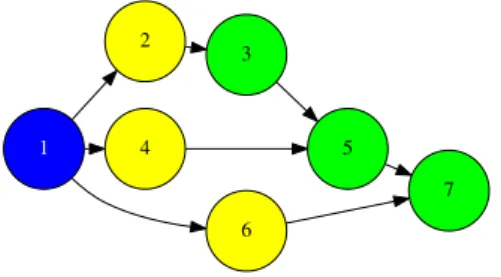
In that sense, Figure 2 depicts the task dependency graph built on the fly by PyCOMPSs for the exam-ple in Figure 1(a). The first asynchronous task that is created corresponds to functioninit conf, and after that
1 result ={} 2 num steps = 3 3 conf =init conf() 4 for i in range(num steps):
5 step res =compute step(i, conf) 6 merge(result, step res)
7 from pycompss.api.api import compss wait on 8 result =compss wait on(result)
9 print ”Result: ”, result (a) 1 class Configuration(object):
...
2 from pycompss.api.task import task 3 from pycompss.api.parameter import * 4 @task(returns = Configuration) 5 def init conf():
6 return Configuration() 7 @task(returns = dict) 8 def compute step(step, conf):
9 res = do some computation(step, conf) 10 return res
11 @task(dict1 = INOUT) 12 def merge(dict1, dict2): 13 dict1.update(dict2)
(b)
Fig. 1 Example of a sequential Python script parallelised with PyCOMPSs: (a) main program of the script, (b) task definition.
the main program proceeds immediately to execute the loop of computation and merge tasks. Inside the loop, a total of 3compute steptasks are generated, and they all depend on the previous init conf task because they re-ceive the configuration objectconfas input parameter -if no direction is spec-ified for a parameter, it defaults to IN. The loop also generates 3mergetasks, each depend-ing on their corresponddepend-ingcompute step for the partial result of the iteration (variablestep res); moreover, each mergetask depends on the result produced by the pre-vious iteration (stored inresult) and, consequently, they are arranged in a chain of tasks.
Once the loop is completely unrolled, the program reaches lines 7-9, where the final result in variableresult is printed. Before printing it, though, the script needs to synchronise for the last value ofresult, produced by the last merge task. In order to do that, PyCOMPSs provides an API function, compss wait on, which stalls the main control flow until the last value of result is obtained. Hence, the call tocompss wait onin line 8 will wait for the lastmergetask to finish before getting and returning the final result, so that it can be printed in line 9.
It is important to note how PyCOMPSs is able to detect and exploit the inherent concurrency of the
1 2 4 6 3 5 7
Fig. 2 Task dependency graph corresponding to the example script in Figure 1.
Argument Value
Formal -INOUT: read-write object. parameter -OUT: write-only object. name -FILE: read-only file.
-FILE INOUT: read-write file. -FILE OUT: write-only file.
returns int(for integer and boolean),long,float, str,dict,list,tuple, user-defined classes. isModifier True(default) orFalse.
priority TrueorFalse(default). Table 1 Arguments of the@taskdecorator.
script, as exhibited by the graph in Figure 2: the com-pute step tasks can be executed in parallel, while the merge tasks cannot. The programmer does not control such parallelisation explicitly; instead, she programs se-quentially and provides information about the task pa-rameters and their direction. Actually, the program in Figure 1 can be executed sequentially by using a se-quential version of the PyCOMPSs libraries, imported in line 7 of Figure 1(a) and lines 2-3 of Figure 1(b).
3.2 Syntax
After discussing a complete PyCOMPSs example in Section 3.1, this section specifies in a more comprehen-sive way the syntax of the PyCOMPSs programming model.
3.2.1 Task Definition
In PyCOMPSs, the user can define as a task: – Functions.
– Instance methods: methods invoked on objects. – Class methods: static methods belonging to a class.
PyCOMPSs tasks can be defined by means of the @taskdecorator, which provides information about the parameters of the function/method and about the task itself. Table 1 summarises all the arguments supported by the decorator.
On the one hand, the metadata corresponding to a parameter is specified as an argument of the decorator,
whose name is the formal parameter’s name and whose value defines the type and direction of the parameter. Thus, when including parameter metadata in the@task decorator, the user has the options shown in the first row of Table 1. The parameter types and directions can be:
– Types: primitive types (integer, long, float, boolean), strings, objects (instances of user-defined classes, dictionaries, lists, tuples, complex numbers) and files are supported. PyCOMPSs is able to automatically infer the parameter type for primitive types, strings and objects, but not for files, which need to be de-fined asFILE.
– Direction: it can be read-only (IN - default), read-write (INOUT) or read-write-only (OUT).
Consequently, in the following cases there is no need to include an argument in the @task decorator for a given task parameter:
– Parameters of primitive types (integer, long, float, boolean) and strings: the type of these parameters can be automatically inferred, and their direction is alwaysIN.
– Read-only object parameters: the type of the pa-rameter is automatically inferred, and the direction defaults to IN.
On the other hand, there are three reserved argu-ments of the@taskdecorator, also presented in Table 1. First, if the function or method returns a value, the pro-grammer must specify the type of that value using the returnsargument. Return values can be seen as param-eters withOUTdirection. Second, for tasks correspond-ing to instance methods, by default the task is assumed to modify the callee object (the object on which the method is invoked). The programmer can tell other-wise by setting theisModifierargument toFalse. Finally, the programmer can also mark a task as a high-priority task by setting thepriorityargument to True. This way, when the task is free of dependencies, it will be sched-uled before any of the available low-priority (regular) tasks. This functionality is useful for tasks that are in the critical path of the application’s task dependency graph.
Figure 3 shows an example of the usage of file pa-rameters in PyCOMPSs tasks, which can be useful to program computational workflows. The script in Fig-ure 3(a) calls a function func, which receives a string parameter containing a file name. Note that, for Py-COMPSs to know that my file is actually a file path that must be treated as such - and not as any other string - the user needs to state that the parameter is of type FILE. In addition, since the code of func updates the file, theINOUTdirection also needs to be specified.
my file = ’sample file.txt’ func(my file)
(a)
from pycompss.api.task import task from pycompss.api.parameter import * @task(f = FILE INOUT)
def func(f):
fd = open(f, ’r+’) ...
(b)
Fig. 3 Example of a task receiving a file parameter: (a) call to function from the application, (b) decorated function.
@task(returns = int) def ret func():
return 1
Fig. 4 Definition of a task returning an integer. class MyClass(object):
...
@task(isModifier = False) def instance method(self):
... # self is NOT modified here Fig. 5 Example of usage of theisModifierflag.
@task(priority = True) def func():
...
Fig. 6 Example of usage of thepriorityflag.
Regarding the other arguments of the@task decora-tor: (i) Figure 4 defines a task that returns an integer value, (ii) Figure 5 shows a usage example of the is-Modifierargument and (iii) Figure 6 defines a task with priority.
3.2.2 Main Program
The main program of the application is a sequential Python script (or scripts) that contains calls to tasks. Tasks can modify or generate data (e.g. a file or ob-ject), and these data can eventually be accessed from the main program. Before doing so, however, the pro-grammer needs to synchronise that data (i.e. stall the main control flow until obtaining the last version pro-duced by the task, which can imply waiting for the task to finish). As a result, the main program can work with the correct version of the data.
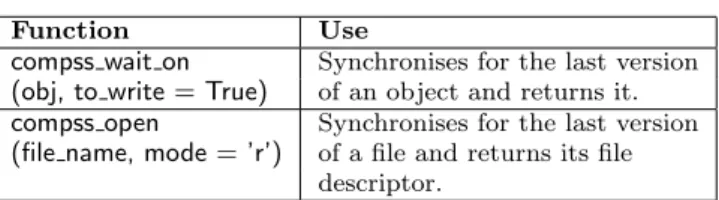
Depending on the data type that is being synchro-nised, two API functions may need to be invoked (sum-marised in Table 2):
– compss wait on(obj, to write = True): synchronises for the last version of object obj and returns the syn-chronised object. It can receive an optional boolean parameterto write, which defaults to True, that
in-Function Use
compss wait on Synchronises for the last version (obj, to write = True) of an object and returns it. compss open Synchronises for the last version (file name, mode = ’r’) of a file and returns its file
descriptor. Table 2 PyCOMPSs API functions.
from pycompss.api.api import compss wait on,compss open my obj = MyClass()
my obj.method()
my obj =compss wait on(my obj) ...
my file = ’file.txt’ func(my file)
fd =compss open(my file) ...
(a) @task(f = FILE OUT) def func(f): ... class MyClass(object): ... @task() def method(self):
... # self is modified here (b)
Fig. 7 Example of synchronisation: (a) main program con-taining the synchronisation calls, (b) task definition.
dicates whether the main program will modify the returned object.
– compss open(file name, mode = ’r’): similar to the Python open()call. It synchronises for the last version of file file nameand returns the file descriptor for that syn-chronised file. It can receive an optional parameter mode, which defaults to’r’, containing the mode in which the file will be opened (the open modes are analogous to those of Python open()).
To illustrate the use of the aforementioned API func-tions, the example in Figure 7 first creates an object of classMyClassand invokes a task method called method that modifies the object; the object is then synchro-nised with compss wait on(), so that it can be used in the main program from that point on. After that, the script invokes a task func that writes a file, which is later synchronised by callingcompss open().
If the programmer defines as a task a function or method that returns a value, that value is not generated until the task executes. However, in order to keep the asynchrony of the task invocation, PyCOMPSs man-agesfuture objects [24]: a representant object is imme-diately returned to the main program when a task is in-voked. The future object mechanism is applied to
prim-1 @task(returns = MyClass) 2 def ret func():
3 return MyClass(...) # o is a future object 4 o = ret func() ... 5 another task(o) ...
6 o.yet another task() ...
7 o = compss wait on(o)
Fig. 8 Future objects in PyCOMPSs.
itive types, strings and objects (including the Python built-in types list, dictionary, tuple and complex).
As shown in Figure 8, a future object returned by a task (object o, line 4) can be involved in subsequent asynchronous task calls (lines 5 and 6), and PyCOMPSs will automatically find the corresponding data depen-dencies. On the other hand, in order to synchronise the future object from the main program, the programmer proceeds in the same way as with any object updated by a task (line 7).
4 Runtime System
The programming model described in Section 3 is en-abled by a runtime system that parallelises the appli-cation on behalf of the user.
This section describes the basic implementation of such runtime system, i.e. how it generates and manages tasks and how it processes the data accessed by those tasks.
4.1 Architecture
PyCOMPSs was designed to operate on top of the COMPSs [30, 28] Java runtime system, acting as a language bind-ing for Python applications. This design decision al-lowed PyCOMPSs to leverage COMPSs’ functionalities and, as a result, require a shorter development time.
Among the functionalities implemented by COMPSs there are data dependency analysis, task scheduling, data transfer and fault tolerance. In addition, it can execute applications on different kinds of distributed infrastructures such as clouds, clusters or grids. On top of the Java runtime, the Python binding handles the computations and data of the application and interacts (through a C++ library) with the Java libraries un-derneath. Figure 9 shows the architecture of the whole framework.
Fig. 9 Architecture of the PyCOMPSs runtime system.
4.2 Task Generation
Calls to functions decorated with @task are wrapped by a function of the Python binding, which forwards the function name and parameters to the Java runtime. With that information, the Java runtime creates a task and adds it to the data dependency graph, immediately returning the control to Python. At this point, the main program can continue executing right after the task in-vocation, possibly invoking more tasks.
Therefore, the Java runtime executes concurrently with the main program of the application, and as the latter issues new task creation requests, the former dy-namically builds a task dependency graph. Such graph represents the inherent concurrency of the program, and determines what can be run in parallel. When a task is free of dependencies, it is scheduled by the run-time system on one of the available resources, specified in XML configuration files.
The default scheduling policy of the runtime is locality-aware. When scheduling a task, the runtime system computes a score for all the available resources and chooses the one with the highest score. This score is the number of task input parameters that are already present on that resource, and consequently they do not need to be transferred.
4.3 Task Offloading and Data Management
Once a task has been scheduled, and before submitting the task to the target resource for execution, the Java runtime transfers the missing task input data to that resource.
Tasks created by a PyCOMPSs application can re-ceive different types of data as a parameter, as ex-plained in Section 3.2. Specifically, tasks work with data that is either in memory (Python objects, primitive types) or disk (files). Such data needs to be forwarded
Fig. 10 Management of objects in the basic implementation of the PyCOMPSs framework.
to the Java runtime, which will be in charge of trans-ferring it to the destination resource where the task will run. Primitive types in Python are mapped by the Python binding to the equivalent types in Java, and files are processed as such on the Java side.
Regarding Python objects, their management is a bit more complex. Figure 10 shows how objects are handled by PyCOMPSs. Objects can be created by a Python application in Python space and later be ac-cessed by a task. Since neither these objects nor their associated classes exist in the Java space, they are se-rialised to files by the Python binding. Hence, when informing the Java runtime of the creation of a new task, the Python binding will define all object param-eters as files so that the Java runtime can process and transfer them.
Once the input data for a task is transferred, the Java runtime will trigger the execution of a Python worker script on the worker resource. This script will process the request of running a task, check which data it needs (deserialising the input objects if necessary) and finally run the task.
The runtime processing described in this section ob-viously comes with an overhead. Therefore, for the re-mote execution of tasks to be worthwhile, the duration of these tasks should be in the order of tens or hundreds of milliseconds, depending on the number of resources to be used.
5 Support for Big Data
Section 4 described the basic implementation of the Py-COMPSs runtime, where tasks operate on data that is either in memory (regular Python objects and primi-tive types) or disk (files). In order to make PyCOMPSs capable of orchestrating applications that process big amounts of data, the data management of PyCOMPSs was extended both at programming model and runtime system levels.
Fig. 11 PyCOMPSs on top of a persistent storage layer.
In that sense, this section presents the work on inte-grating PyCOMPSs in a persistent object storage plat-form. Such platform provides PyCOMPSs scripts, as well as the tasks they generate, with a distributed, fault-tolerant and efficient storage layer. Furthermore, multiple applications can share data in a concurrent way through this layer.
The main objective of the aforementioned platform is facilitate the access to data as much as possible. Any function in a Python script, even if it has not been de-veloped with PyCOMPSs in mind, should be able to seamlessly work with objects in memory or with per-sistent objects, with no need to be adapted for each case. It is the responsibility of the main program, which invokes the function, to decide whether the object in-stance is made persistent or not depending on the pur-pose of such object, but this decision is transparent to the function.
Figure 11 depicts the overall structure of the pro-posed storage platform. Python scripts programmed with the PyCOMPSs model are located at the top of the stack, and the tasks they generate are processed by the PyCOMPSs runtime system. These scripts rely on a Storage API in order to create, delete, insert, re-trieve and iterate over persistent data. At its turn, Py-COMPSs also invokes the Storage API, mainly to ob-tain locality information about persistent data.
The Storage API can be implemented by multiple Storage Backends. A Storage Backend is responsible for storing data in a set of distributed resources, manag-ing data format and organisation and optimismanag-ing data queries.
The next subsections present the extensions to Py-COMPSs that were required to operate on top of this storage platform, and they also describe a backend that implements the Storage API.
5.1 Programming with Persistent Objects
The data that resides in the storage platform can have multiple formats, depending on the backend that stores it. Nevertheless, from the point of view of the applica-tion, such data is abstracted and it is always accessed as Python objects, no matter how it is stored underneath. Consequently, the programming model proposed here is based on the use of objects. Such objects can be made persistent by an application, that is, objects initially allocated in memory can be backed by the persistent storage layer. From that point on, changes to the ob-ject will be forwarded to the backend as well. On the other hand, objects that were made persistent can be retrieved by other applications. This enables interactive sharing of data between applications that run concur-rently.
5.1.1 Managing Persistency
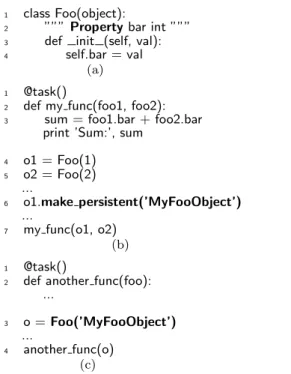
In order to deal with persistent objects, the storage platform requires some knowledge about the classes that will be stored. In particular, since Python is a dynami-cally typed programming language, the names and types of the attributes are not included in the class defini-tion, and they should be specified to correctly map the class representation to the backend. This can be done by means of docstrings, the standard Python documen-tation mechanism, as shown in figure 12(a), line 2. This would be then used to generate the corresponding code that implements the Storage API.
To make an object persistent, the programmer needs to invoke the make persistent method, which is part of the Storage API. Figure 12(b) shows a simple example where two regular Python objects o1 and o2 of class Fooare created (lines 4-5). After that,make persistentis invoked on o1in order to be stored as persistent (line 6). Themake persistentmethod receives a parameter of type string that specifies the alias - a name or identifier - that the user wants to give to that object. Such alias must be unique in the storage namespace, and it can be used afterwards to retrieve the object.
A persistent object can be involved in a task call like any regular (non-persistent) object, as exemplified in line 7 of Figure 12(b), and the programmer does not need to provide any additional information in the@task decorator (line 1). my func can be a pre-existing func-tion, completely unaware of object persistency. Thus, it manipulates the persistent objecto1and the regular objecto2in the same way (line 3). However, in the case ofo1, any changes to the object are transparently per-sisted in the distributed storage. Also importantly, the
1 class Foo(object):
2 ”””Propertybar int ””” 3 def init (self, val): 4 self.bar = val
(a) 1 @task()
2 def my func(foo1, foo2): 3 sum = foo1.bar + foo2.bar
print ’Sum:’, sum 4 o1 = Foo(1) 5 o2 = Foo(2)
...
6 o1.make persistent(’MyFooObject’) ...
7 my func(o1, o2) (b) 1 @task()
2 def another func(foo): ...
3 o =Foo(’MyFooObject’) ...
4 another func(o) (c)
Fig. 12 Managing persistent objects: (a) class definition, (b) producer script that makes an object persistent, (c) consumer script that loads a persistent object.
Method Use
make persistent Stores an object delete persistent Deletes an object from
persistent storage
Constructor(’alias’) Retrieves the persistent object with the alias provided Table 3 Storage API for applications.
PyCOMPSs runtime will try to schedule the task on the resource where the object is stored to favour locality.
Figure 12(c) depicts a small consumer script that loads the same object that was stored in Figure 12(b). In order to do that, the script invokes a constructor of classFoothat receives the alias of the object as param-eter (line 3). This constructor is provided by the im-plementation of the model, and it returns a reference to the desired persistent object. Once the reference is obtained, the object can also participate in a task call (line 4).
Table 3 details the methods included in the Stor-age API that provide applications with the ability to manage persistent objects.
5.1.2 Persistent Dictionaries
A particular case when working with persistent objects is that of dictionaries. The Python dictionary built-in type is an unordered set of key-value pairs. Keys can be of any immutable type, including tuples. Dictionaries
# o contains two dictionaries, foo and bar 1 o = MyClass()
2 o.make persistent(’MyObject’) ...
# set operation on dict bar 3 o.bar[0]= ’mystring’
...
# get operation on dict foo 4 val = o.foo[’mykey’]
(a) # iterate over blocks of keys 1 for block in o.foo.keys(): 2 my func(block)
... 3 @task()
4 def my func(block):
# iterate over keys in a block 5 for key in block:
... (b)
Fig. 13 Managing persistent dictionaries: (a) getting and setting elements, (b) iterating over keys.
(or objects containing dictionaries) can be made per-sistent and, when that happens, the data they contain can be easily mapped to a key-value store in a Storage Backend.
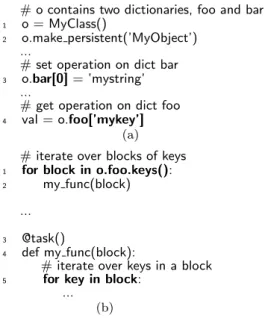
In that sense, a PyCOMPSs application can manip-ulate a persistent dictionary as it would do with any regular Python dictionary, e.g. adding a new key-value pair or requesting the value associated to a given key. Since the dictionary is persistent, any operation will be translated into an access to the persistent data. In Fig-ure 13(a), an object o of class MyClass is instantiated in line 1 and made persistent in line 2. Let us assume that objectohas two attributes of type dictionary,foo and bar. Even if o is persistent, the programmer can add new entries to its dictionaries (line 3) or get the value for a given key (line 4) in a normal way. In the case of a persistent object, though, such operations will be forwarded to the Storage Backend, e.g. a distributed key-value store.
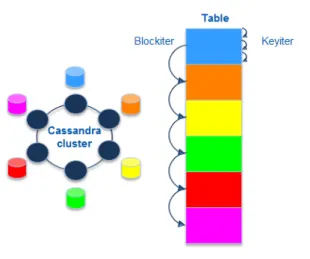
On the other hand, Python allows to retrieve the set of keys in a dictionary by invoking the keys() method on it. In addition, these keys can be iterated to execute some operation for each key-value pair. In a persistent dictionary, obtaining the keys and iterating over them can be done like with a regular dictionary, but the se-mantics of these operations differs from the original one. As can be seen in Figure 13(b), when iterating over the keys of a persistent dictionary (line 1), the iterator will return blocks of keys instead of individual keys. Those blocks correspond to the partitions of key-value pairs in the underlying Storage Backend. This feature is leveraged to exploit data locality: PyCOMPSs tasks
that receive one or more blocks as parameters can be created (line 2), and the PyCOMPSs runtime will try to schedule them in the resource where those blocks reside. If that happens, any access to the keys in that block will be local. For instance, if such block is iterated inside the task to obtain the keys it holds (line 5), the keys (and their associated values) will already be on the resource that runs the task.
5.2 Storage API and Backends
The Storage API lies underneath the application and the PyCOMPSs runtime (Figure 11) and offers meth-ods to access persistent objects and obtain information about them.
Section 5.1 introduced those methods that the Stor-age API provides to manStor-age objects from applications, i.e. to make objects persistent, to load them or to mod-ify their attributes. In addition to these methods, the Storage API also provides a set of methods that enable PyCOMPSs to take into account data locality when scheduling tasks with persistent objects as parameters. In order to do that, the PyCOMPSs runtime invokes thegetLocations method of the Storage API, which re-turns the resources where a given persistent object or block is stored. With this information, PyCOMPSs can try to submit a task to a resource where (at least part of) its input data is already present, thus preventing re-mote accesses to the data from the task. This method receives as a parameter the identifier of an object, which is assigned by the storage platform. This identifier can be obtained by means of the methodgetID. Finally, the method getByID provides a reference to the persistent object with the identifier specified as a parameter.
The methods of the Storage API can be implemented by one or more Storage Backends, which transform the generic operations on persistent objects into specific operations on their associated backend data. The next subsection describes the Storage Backend that has been developed so far for its use in the Storage Platform.
5.2.1 Hecuba
Hecuba is a set of tools and interfaces developed in our research group, that aims to facilitate programmers an efficient and easy interaction with non-relational data-bases. In particular, we have added to Hecuba the im-plementation of the interface necessary to provide Py-COMPSs with a Storage Backend suitable to support Big Data applications. Currently, this interface is imple-mented on Apache Cassandra database, although it is easy to port this implementation to any non-relational key-value data store.
Cassandra [1] is a distributed and highly scalable key-value database. Cassandra implements a non-cen-tralized architecture, based on peer-to-peer communi-cation, in which all nodes of the cluster are able to receive and serve queries. Each node of the cluster is assigned a token. A partitioner function uses this token to decide how data is distributed among the nodes in the shape of a ring.
Data in Cassandra is stored on tables by rows, which are identified by a key chosen by the user. This key can be composed by one or several attributes. In each row the user can add additional attributes also identified by a name. In order to enhance data locality when access-ing data stored in Cassandra, it is necessary to under-stand how is data organized. Cassandra stores data by rows, and one node is responsible for hosting a specific row. The target node is chosen based on the key of the row and of the token of each node by the partitioner algorithm. In order to guarantee data availability, Cas-sandra can be configured to keep several replicas for each data. In a setup with N replicas it is also neces-sary to choose the nodes that will hold each replica. The default replication algorithm selects the N-1 nodes that come after the target node in the ring’s order to store those replicas.
The mapping of a Python dictionary on a data model in Cassandra is straightforward as both consist on val-ues indexed by keys. Thus, the implementation of a Per-sistent Dictionary backed up by Hecuba is straightfor-ward too. We have decided to map each class containing one or more Persistent Dictionary on a Cassandra table. This table is indexed by the same key attributes than the Persistent Dictionaries in the class, and contains as many non-key attributes as Persistent Dictionaries. In the current implementation Hecuba only supports the backing of Persistent Dictionaries but as part of our fu-ture work we plan to extend it to support other type of attributes.
Following with the example described in section 5.1.2, we will show how to implement a class backed up by Hecuba. For the sake of rapid prototyping, our current implementation has some variations regarding the defi-nition of classes explained in section 5.1.1. In particular, figure 15 shows the minimum code required to imple-ment a class containing two Persistent Dictionaries. It is just necessary to indicate that the class is a subclass of StorageObj, which is a class implemented inside Hecuba, and that contains all the methods that are necessary to access and manipulate data backed up by Cassandra. Thus, the code of the application is mostly independent of the data backend used. Notice that programmers can add their own methods to the class definition, the only requirement is that the constructor of the StorageObj
Fig. 14 Configuration of StorageObj.
1 class MyClass(StorageObj): 2 pass (a) 1 Classes: 2 My Class: 3 bar:
4 Key1: ”(keyname1, int)” 5 Type: string
6 foo:
7 Key1: ”(keyname2, string)”
8 Type: int
9 Keyspace: ”database name” (b)
Fig. 15 Defining a user class backed by Hecuba: (a) mini-mum class code, (b) data scheme definition.
class has to be executed each time a new object of the class is instantiated.
In addition to this simple class definition, users have to provide the information necessary to connect to the Cassandra cluster (ip addresses and ports) and to con-figure the database. Configuration of the database re-quires information about the database identifier (keyspace name) and the data scheme (for each table, name and type of each attribute and which attribute is part of the key). Information about the Cassandra cluster can be set through environment variables and it is common to all applications executed on this cluster. Information about the database configuration can be codified in a yaml file. Figure 15 represents the yaml file that the user should provide to complete the configuration of the application. During the initialization phase of the application, Hecuba code reads and parses this yaml file and configures itself to be able to adapt at runtime the generic code of theStorageObjmethods to the particular data schemes defined (see figure 14).
Following we describe the implementation of the in-terface implemented by Hecuba as part of the
Stor-ageObj class. The methods exported to programmers allow to perform the following tasks:
– Make an object persistent: this operation is per-formed through the make persistent method of the StorageObj. The implementation of this method cre-ates the Cassandra table that it is necessary to hold the object and populates it with the data that the object had in memory.
– Object instantiation: it is implemented by the con-structor of the StorageObj class. If the concon-structor receives a parameter, the constructor binds the in-stantiated object with the corresponding Cassandra table. This way, all the following accesses to that object will be translated into accesses to that table. On the contrary, if the constructor does not receive a parameter, all data associated to that new object instance will be kept in memory until the makePer-sistent method is executed.
– Query/Update data: these operations are implemented through theget itemand theset itemmethods of the Persistent Dictionaries. There are two different sce-narios: if the object is in memory, the implementa-tions of these methods are translated into the usual methods of a Python dictionary; if the object is backed by a Cassandra table, then the implementa-tions of these methods consist on queries performed on the Cassandra table.
– Data iteration: as we have explained in section 5.1.2, the implementation of thekeys method of a Persis-tent Dictionary returns a block of keys that will be the input parameter of a task. In order to enhance data locality, we decided to create the blocks of keys based on their node location. This way, PyCOMPSs can use the information about the data location to schedule tasks local to the data. Thus, we have im-plemented two different iterators: one of them to create the different blocks of keys and the other one to traverse all the keys in a block (see figure 16). – Delete a persistent object: this operation is
imple-mented by thedelete persistent method of the Stora-geObjand it just deletes from the database the table that was backing the object.
6 Evaluation
This paper presents the evaluation of PyCOMPSs in two different cases: evaluation of PyCOMPSs standalone and evaluation of PyCOMPSs with the support for Big Data with the Hecuba backend.
Fig. 16 Implementation of iterators.
6.1 Test Environment
The evaluation has been performed in two different environments. The standalone PyCOMPSs tests have been executed in the MareNostrum III supercomputer. MareNostrum III is a cluster with 3,056 compute nodes, each of them 2x Intel SandyBridge-EP E5-2670/1600 20M with 8 cores at 2.6 GHz connected with a Infini-band FDR10 network.
The tests of PyCOMPSs with the support for Big Data have been performed in a cluster of 5 nodes. Each node is equipped with 2 Intel Xeon Quad-Core L5630 at 2.13GHz, 24 GB RAM and 6 TB HDD, and they are interconnected with Gigabit Ethernet. Out of the five nodes, one executes the main program of the applica-tion and the PyCOMPSs master runtime, while the rest are PyCOMPSs worker nodes that execute tasks. The 4 worker nodes also form a Cassandra ring and have the Hecuba backend installed. The master node has an Hecuba client and a Cassandra client.
In all cases we used PyCOMPSs version 1.2 1.
6.2 Standalone Tests
PyCOMPSs has been evaluated in MareNostrum III with two different applications: DimSweep and Neu-ronCorr. DimSweep performs a cluster architecture ex-ploration using the Dimemas simulator performing a parameter sweep of several configuration values: Fabric Interconnection Network latency and bandwidth, num-ber of nodes, CPU speed, and intranode latency and bandwidth.
Dimemas [27] is a simulator of the behavior of MPI applications under different network and architecture
Fig. 17 Performance of DimSweep. The chart shows ellapsed time and speed-up using as baseline the 16 workers case.
conditions by means of replaying the applications’ ex-ecutions recorded in traces. This PyCOMPSs example is codified with two different tasks’ types: one that ex-ecutes the Dimemas simulation and another one that accumulates the results. While the simulation tasks are independent between them, the accumulation tasks cre-ate a chain of dependencies that serialize all them. To avoid a long chain of these tasks at the end of the ex-ecution, these tasks are prioritized in such a way that are inserted between the simulation tasks.
For the experiment a case with a real execution tracefile and a combination of parameters’ configura-tions that generated 2304 tasks was used. Figure 17 shows the results obtained when varying the number of cores used for PyCOMPSs workers from 16 to 512. The time is the total ellapsed time and the speedup is computed using as baseline the case with 16 workers. The results show very good scaling up to 128 workers, reducing a bit for larger processor counts.
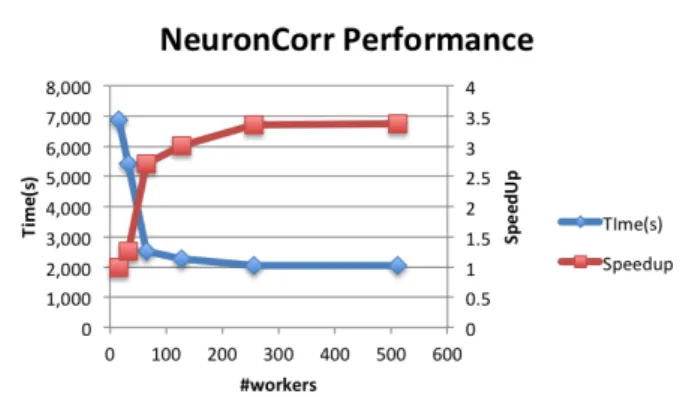
NeuronCorr is a neuroscience data processing exam-ple that computes all mutual cross-correlations between all pairs of a set of spike data [23]. The original example was written in Parallel Python and has been translated to PyCOMPSs. The example has two tasks’ types: one that compute the cross-correlations for a block of data and a second one that gathers the results in a data structure. Since the gathers create a chain of tasks, this type of task is prioritized to avoid a long serial chain at the end of the execution. The evaluation was performed with a data set that generates 2048 tasks.
Figure 18 shows the results obtained for the Neu-ronCorr example. Due to the small granularity of the tasks this example does not scale as well as the Dim-Sweep one.
Fig. 18 Performance of NeuronCorr. The chart shows el-lapsed time and speed-up using as baseline the 16 workers case.
Cassandra topology PyCOMPSs workers Time(s)
4, 4, 0, 0 4, 4, 0, 0 19228
8, 8, 0, 0 8, 8, 0, 0 10273
16, 16, 0, 0 16, 16, 0, 0∗ 12867 16, 16, 16, 16 16, 16, 16, 16∗ 6644 Table 4 Performance results for the NeuronCorr application with persistent storage for some configurations. The column on the left describes the Cassandra configuration, indicating how the Cassandra nodes are mapped in the Minerva clus-ter nodes. The column in the middle describes the number of PyCOMPSs workers mapped in each of the Minerva cluster nodes. In the cases marked with ∗, multithreading is acti-vated.
6.3 Tests on Persistent Storage
For this section, PyCOMPSs has been evaluated with NeuronCorr application, in the Minerva cluster (Fig-ure 19). All simulation tasks are independent, and in-put data is obtained from a Cassandra table previously created. Once the execution starts, input data is struc-tured in blocks, and this information is used by tasks to know which Cassandra node contains its information. Once each task has finished executing, resulting data is saved in Cassandra.
Table 4 presents results using different configura-tions of Cassandra nodes and PyCOMPSs workers for a given input data. The column in the left shows the mapping of the Cassandra nodes to Minerva cluster nodes. The column in the middle shows the mapping of PyCOMPSs workers to the Minerva cluster nodes, us-ing multithreadus-ing in some cases (marked with∗). The same total count of Cassandra nodes and PyCOMPSs workers is used to balance workload. These results show good scaling between the cases of the same nature (with multithreading or without multithreading). The results also reflect the impact of sharing resources between threads when multithreading is used.
Fig. 19 Hecuba Topology for Persistent Storage
7 Conclusions and Future Work
This paper has presented PyCOMPSs, a programming framework that facilitates the development of parallel computational workflows in Python. With PyCOMPSs, the user programs her script in a sequential fashion and decorates the functions to be run as asynchronous par-allel tasks. A runtime system is in charge of exploiting the inherent concurrency of the script, detecting the data dependencies between tasks and spawning them to a set of distributed resources. Those resources can be physical nodes in a cluster or grid or virtual ma-chines in a cloud.
We have also described an extension to the Py-COMPSs programming model and runtime system that builds on top of a persistent object storage layer. In this approach, the application data is stored in a distributed storage backend (e.g. a key-value store like Cassandra). From the application point of view, such data is ab-stracted and accessed as Python objects, no matter the particular backend being used underneath. PyCOMPSs tasks can receive persistent objects as parameters, and these tasks will be scheduled taking into account data locality, launching them to resources that store the data they need. Furthermore, multiple applications can share data in a concurrent way through this persistent object layer.
The future work includes incorporating a new back-end for persistent objects, based on the Scalable Key-Value Store [16] being developed at IBM. On the other hand, we will offer a web portal for programming, de-ploying and executing PyCOMPSs scripts on the cloud, which will leverage the IPython notebook [6] tool as the main interface for interactive script development and execution.
Acknowledgements This work has been supported by the following institutions: the Spanish Government with grant SEV-2011-00067 of Severo Ochoa Program and contract
Com-putaci´on de Altas Prestaciones VI (TIN2012-34557); by the SGR programme (2014-SGR-1051) of the Catalan Govern-ment; by the project The Human Brain Project, funded by the European Commission under contract 604102; and by the Intel-BSC Exascale Lab collaboration.
References
1. Apache cassandra. http://cassandra.apache.org/. 2. Celery: Distributed task queue.
http://www.celeryproject.org.
3. Decorators for Functions and Methods. https://www.python.org/dev/peps/pep-0318/.
4. dispy: Python framework for distributed and parallel computing. http://dispy.sourceforge.net.
5. Flow based programming.
https://wiki.python.org/moin/FlowBasedProgramming. 6. IPython Notebook. http://ipython.org/notebook.html. 7. matplotlib. http://matplotlib.org/.
8. Matrix Laboratory (MATLAB). http://www.mathworks.com/products/matlab/. 9. NumPy. http://www.numpy.org/.
10. pandas. http://pandas.pydata.org/.
11. Parallel Processing and Multiprocessing in Python. https://wiki.python.org/moin/ParallelProcessing. 12. Parallel Python Software.
http://www.parallelpython.com.
13. pyMPI: Putting the py in MPI. http://pympi.sourceforge.net.
14. Python multiprocessing module. https://docs.python.org/2/library/multiprocessing.html. 15. Python programming language.
https://www.python.org/.
16. Scalable Key-Value Store. https://github.com/Scalable-Key-Value.
17. SciPy. http://www.scipy.org/.
18. Sqlalchemy. http://www.sqlalchemy.org/. 19. Sqlobject. http://sqlobject.org/.
20. Zodb object database. http://www.zodb.org.
21. R. M. Badia, J. Labarta, R. Sirvent, J. M. P´erez, J. M. Cela, and R. Grima. Programming grid applications with grid superscalar. Journal of Grid Computing, 1(2):151– 170, 2003.
22. L. Dalcn, R. Paz, M. Storti, and J. DEla. {MPI} for python: Performance improvements and mpi-2 exten-sions. Journal of Parallel and Distributed Computing, 68(5):655 – 662, 2008.
23. M. Denker, B. Wiebelt, D. Fliegner, M. Diesmann, and A. Morrison. Practically trivial parallel data processing in a neuroscience laboratory. In S. Grn and S. Rotter, editors,Analysis of Parallel Spike Trains, volume 7 of
Springer Series in Computational Neuroscience, pages 413–436. Springer US, 2010.
24. Edward F. Walker and Richard Floyd and Paul Neves. Asynchronous Remote Operation Execution in Dis-tributed Systems. In 10th Intl. Conf. on Distributed Computing Systems (ICDCS-10), pages 253–259, May 1990.
25. E. Gafni, L. J. Luquette, A. K. Lancaster, J. B. Hawkins, J.-Y. Jung, Y. Souilmi, D. P. Wall, and P. J. Tonellato. Cosmos: Python library for massively parallel workflows.
Bioinformatics, page btu385, 2014.
26. L. Goodstadt. Ruffus: a lightweight python library for computational pipelines. Bioinformatics, 26(21):2778– 2779, 2010.
27. J. Labarta, S. Girona, V. Pillet, T. Cortes, and L. Gre-goris. DiP: A parallel program development envi-ronment. In L. Bouge, P. Fraigniaud, A. Mignotte, and Y. Robert, editors, Euro-Par’96 Parallel Process-ing, volume 1124 of Lecture Notes in Computer Sci-ence, pages 665–674. Springer Berlin / Heidelberg, 1996. 10.1007/BFb0024763.
28. F. Lordan, E. Tejedor, J. Ejarque, R. Rafanell, J. lvarez, F. Marozzo, D. Lezzi, R. Sirvent, D. Talia, and R. Badia. Servicess: An interoperable programming framework for the cloud.Journal of Grid Computing, 12(1):67–91, 2014. 29. N. Singh, L.-M. Browne, and R. Butler. Parallel astro-nomical data processing with python: Recipes for multi-core machines.Astronomy and Computing, 2:1–10, 2013. 30. E. Tejedor and R. M. Badia. COMP Superscalar: Bring-ing GRID Superscalar and GCM Together. In Eighth IEEE International Symposium on Cluster Computing and the Grid, CCGrid ’08, Lyon, France, pages 185–193, May 2008.
31. Y. Zhao, M. Hategan, B. Clifford, I. Foster, G. Von Laszewski, V. Nefedova, I. Raicu, T. Stef-Praun, and M. Wilde. Swift: Fast, reliable, loosely coupled parallel computation. In Services, 2007 IEEE Congress on, pages 199–206. IEEE, 2007.