TH `ESE
TH `ESE
En vue de l’obtention du
DOCTORAT DE L’UNIVERSIT´E DE TOULOUSE
D´elivr´e par :l’Universit´e Toulouse 3 Paul Sabatier (UT3 Paul Sabatier)Cotutelle internationaleavec l’Institut Sup´erieur de Gestion de Tunis
Pr´esent´ee et soutenue le30/10/2017 par : H´ela GOUIDER
Graphical Preference Representation under a Possibilistic Framework
JURY
Nahla BEN AMOR Professeur d’Universit´e Directrice de th`ese S´ebastien DESTERCKE Directeur de Recherche Examinateur Didier DUBOIS Directeur de Recherche Examinateur Zied ELOUEDI Professeur `a l’Universit´e Pr´esident Sylvain LAGRUE Maˆıtre de conf´erences habilit´e Rapporteur Patrice PERNY Professeur d’Universit´e Rapporteur Henri PRADE Directeur de Recherche Directeur de th`ese
´Ecole doctorale et sp´ecialit´e :
MITT : Domaine STIC : Intelligence Artificielle Unit´e de Recherche :
Institut de Recherche en Informatique de Toulouse (UMR 5505) Directrice(s) de Th`ese :
Nahla BEN AMORetHenri PRADE Rapporteurs :
First of all, I would like to thank all those who contributed to the preparation and writing of my thesis. Obviously, it is difficult to thank everyone, each by his name because it was thanks to the help of many people that I was able to carry out this thesis to its end.
In the first place, I would like to express my gratitude to all my family, thanks to my father and mother who have been the luminous stars for me all along the road and who have always believed in me. I would like to thank my two sisters Dhouha and Houda, my fiance Nizar and all my family for their sincere love and during these years.
My thanks go also to the reviewers, Sylvain Lagrue and Patrice Perny, to whom I associate the members Didier Dubois, Sébastien Destercke and Zied Elouedi, for honoring me with taking time to read in detail my work and whose kindness, interest and advice to continue and improve my research are invaluable.
I would like to thank my thesis directors Nahla Ben Amor and Henri Prade for having accepted to supervise me during the preparation of my thesis. I am delighted to have been able to work in their company because in addition to their scientific support and the human side, they have always been there to support me and advise me throughout the development of my work especially during difficult times. A special thank goes also to Didier Dubois for always being there whenever I had questions, and for his patience and immense knowledge.
A special thank you to Sahar and Amina: you were always there for me. It is almost impos-sible for me to imagine the last three years without my good friends Fatma and Zeineb, who gave me moral support during the years of this thesis.
Thanks, finally, to all the members of the ADRIA team, and more generally to IRIT. I must also add here that I deeply appreciate the LARODEC lab., every single one of it, for their involvement in my personal well-being.
La modélisation structurée de préférences, fondée sur les notions d’indépendance préférentielle, a un potentiel énorme pour fournir des approches efficaces pour la représentation et le raisonne-ment sur les préférences des décideurs dans les applications de la vie réelle. Cette thèse soulève la question de la représentation des préférences par une structure graphique. Nous proposons une nouvelle lecture de réseaux possibilistes, que nous appelons π-pref nets, où les degrés de possibilité représentent des degrés de satisfaction. L’approche utilise des poids de possibilité non-instanciés (appelés poids symboliques), pour définir les tables de préférences conditionnelles. Ces tables donnent naissance à des vecteurs de poids symboliques qui codent les préférences qui sont satisfaites et celles qui sont violées dans un contexte donné. Nous nous concentrons ensuite sur les aspects théoriques de la manipulation de ces vecteurs. En effet, la comparaison de ces vecteurs peut s’appuyer sur différentes méthodes: celles induites par la règle de chaînage basée sur le produit ou celle basée sur le minimum que sous-tend le réseau possibiliste, les raffinements du minimum le discrimin, ou leximin, ainsi que l’ordre Pareto, et le Pareto symétrique qui le raffine. Nous prouvons que la comparaison par produit correspond exactement au celle du Pareto symé-trique et nous nous concentrons sur les avantages de ce dernier par rapport aux autres méthodes. En outre, nous montrons que l’ordre du produit est consistant avec celui obtenu en comparant des ensembles de préférences satisfaites des tables. L’image est complétée par la proposition des algorithmes d’optimisation et de dominance pour lesπ-pref nets.
Dans ce travail, nous discutons divers outils graphiques pour la représentation des préférences. Nous nous focalisons en particulier sur les CP-nets car ils partagent la même structure graphique que lesπ-pref nets et sont basés sur la même nature de préférences. Nous prouvons que les ordres induits par les CP-nets ne peuvent pas contredire ceux desπ-pref nets et nous avons fixé les con-traintes nécessaires pour raffiner les ordres desπ-pref nets afin de capturer les contraintes Ceteris Paribus des CP-nets. Cela indique que les CP-nets représentent potentiellement une sous-classe desπ-pref nets avec des contraintes. Ensuite, nous fournissons une comparaison approfondie entre les différents modèles graphiques qualitatifs et quantitatifs, et lesπ-pref nets. Nous en déduisons que ces derniers peuvent être placés à mi-chemin entre les modèles qualitatifs et les modèles quan-titatifs puisqu’ils ne nécessitent pas une instanciation complète des poids symboliques alors que des informations supplémentaires sur l’importance des poids peuvent être prises en compte.
La dernière partie de ce travail est consacrée à l’extension du modèle proposé pour représen-ter les préférences de plusieurs agents. Dans un premier temps, nous proposons l’utilisation de réseaux possibilistes où les préférences sont de type tout ou rienet nous définissons le conditi-onnement dans le cas de distributions booléennes. Nous montrons par ailleurs que ces réseaux multi-agents ont une contrepartie logique utile pour vérifier la cohérence des agents. Nous expli-quons les étapes principales pour transformer ces réseaux en format logique. Enfin, nous décrivons une extension pour représenter des préférences nuancées et fournissons des algorithmes pour les requêtes d’optimisation et de dominance.
Structured modeling of preference statements, grounded in the notions of preferential indepen-dence, has tremendous potential to provide efficient approaches for modeling and reasoning about decision maker preferences in real-life applications. This thesis raises the question of representing preferences through a graphical structure. We propose a new reading of possibilistic networks, that we callπ-pref nets, where possibility weights represent satisfaction degrees. The approach uses non-instantiated possibility weights, which we call symbolic weights, to define conditional pre-ference tables. These conditional prepre-ference tables give birth to vectors of symbolic weights that reflect the preferences that are satisfied and those that are violated in a considered situation. We then focus on the theoretical aspects of handling of these vectors. Indeed, the comparison of such vectors may rely on different orderings: the ones induced by the product-based, or the minimum-based chain rule underlying the possibilistic network, the discrimin, or leximin refinements of the minimum-based ordering, as well as Pareto ordering, and the symmetric Pareto ordering that refi-nes it. We prove that the product-based comparison corresponds exactly to symmetric Pareto and we focus on its assets compared to the other ordering methods. Besides, we show that product-based ordering is consistent with the ordering obtained by comparing sets of satisfied preference tables. The picture is then completed by the proposition of algorithms for handling optimization and dominance queries.
In this work we discuss various graphical tools for preference representation. We shed light particularly on CP-nets since they share the same graphical structure asπ-pref nets and are based on the same preference statements. We prove that the CP-net orderings cannot contradict those of theπ-pref nets and we found suitable additional constraints to refineπ-pref net orderings in order to capture Ceteris Paribus constraints of CP-nets. This indicates that CP-nets potentially represent a subclass ofπ-pref nets with constraints. Finally, we provide an thorough comparison between the different qualitative and quantitative graphical models andπ-pref nets. We deduce that the latter can be positioned halfway between qualitative and quantitative models since they do not need a full instantiation of the symbolic weights while additional information about the relative strengths of these weights can be taken into account.
The last part of this work is dedicated to extent the proposed model to represent multiple agents preferences. As a first step, we propose the use of possibilistic networks for representing all or nothing multiple agents preferences and define conditioning in the case of Boolean possibilities. These multiple agents networks have a logical counterpart helpful for checking agents consistency. We explain the main steps for transforming multiple agents networks into logical format. Finally, we outline an extension with priority levels of these networks and provide algorithms for handling optimization and dominance queries.
General introduction 1
1 Graphical Preferential Qualitative Models 5
1.1 Introduction . . . 5
1.2 Preference models. . . 7
1.3 Ordering relations . . . 9
1.3.1 Binary preference relations . . . 9
1.3.2 Classical preference structures . . . 11
1.4 Conditional Preference Networks (CP-nets) . . . 12
1.4.1 Preference independence: Ceteris Paribus . . . 12
1.4.2 Model definition and semantics . . . 14
1.4.3 Reasoning with CP-nets . . . 15
1.4.4 Expressivity of CP-nets. . . 16
1.4.5 How to build CP-nets? . . . 18
1.5 Tradeoffs-enhanced CP-nets (TCP-nets) . . . 19
1.6 Preference trees . . . 23
1.6.1 Lexicographic preference trees (LP-trees) . . . 23
1.6.2 A more general representation: Preference trees . . . 25
1.7 Conclusion . . . 26
2 Graphical Preferential Quantitative models 28 2.1 Introduction . . . 28
2.2 Generalized Additive Independence Networks (GAI-nets) . . . 29
2.3 Utility CP-nets (UCP-nets) . . . 33
2.4 Marginal Utility Networks . . . 35
2.5 Ordinal Conditional Functions networks (OCF-nets). . . 39
2.6 Conclusion . . . 40
3 Possibilistic Preference Networks 41 3.1 Introduction . . . 41
3.2 Background on possibility theory. . . 42
3.3 Possibilistic preference networks . . . 44
3.3.1 Conditional preference statements . . . 45
3.3.2 Introducingπ-pref nets . . . 45
3.4 Symbolic weights . . . 48
3.5 On various ways of ordering configurations induced by conditional preference net-works . . . 52
3.5.1 Comparison of orderings without additional constraints on symbolic weights 52 3.5.2 Comparison of orderings with additional constraint on symbolic weights. 55 3.6 Optimization and dominance query. . . 58
3.6.1 Optimization . . . 59
3.6.2 Dominance . . . 59
3.7 Conclusion . . . 60
4 π-Pref nets vs Other Preference Models 62 4.1 Introduction . . . 62
4.2 Logical counterparts ofπ-pref nets . . . 63
4.2.1 Fromπ-pref nets to symbolic logic bases . . . 63
4.2.1.1 Recall on possibilistic logic . . . 64
4.2.1.2 Recall on transformations from possibilistic networks to possi-bilistic logic . . . 64
4.2.1.3 Transformation fromπ-pref nets to symbolic logic bases . . . 66
4.2.2 From aπ-pref net to penalty logic . . . 69
4.3 π-Pref nets vs OCF-nets . . . 73
4.4 π-Pref nets vs CP-nets . . . 73
4.4.1 Consistency between CP-nets andπ-pref nets . . . 77
4.4.2 Towards exact representations of CP-nets byπ-pref nets . . . 82
4.5 π-pref nets vs CP-theories . . . 84
4.6 π-Pref nets vs other models: General discussion . . . 86
4.7 Conclusion . . . 91
5 Graphical Representations of Multiple Agent Preferences 92 5.1 Introduction . . . 92
5.2 Conditioning and possibilistic networks: Boolean case . . . 93
5.3 Multiple agent representations . . . 95
5.3.1 Multiple agent logic . . . 95
5.3.2 Graphical representation of multiple agent preferences . . . 97
5.4 Bridging logical and graphical multiple agent representations . . . 99
5.4.1 Logical encoding of a multiple agent network . . . 99
5.4.2 Transformation of a multiple agent logic into a graphical structure . . . . 100
5.5 Specializing representations and queries . . . 102
5.5.1 Sections and restrictions of networks and logic bases . . . 102
5.6 Extension to graded possibilistic networks . . . 103
5.6.1 Possibilistic multiple agent logic . . . 106
5.6.2 Multi-agent possibilistic graphical representation . . . 106
5.6.2.1 Multi-agent possibilistic networks. . . 106
5.6.2.2 From an ma-πnet to an instantiatedπ-pref net . . . 107
5.7 Related work . . . 108
5.8 Conclusion . . . 109
6 Implementation: A toolbox for Preference Possibilistic Networks 110 6.1 Introduction . . . 110
6.2 A toolbox forπ-pref nets . . . 111
6.2.1 Definition of the network structure . . . 111
6.2.2 Network preference tables and constraints . . . 113
6.2.3 Optimization query . . . 118
6.2.4 Dominance query . . . 119
6.3 An extension for ma-nets . . . 123
6.3.1 The construction of ma-nets . . . 123
6.3.2 Queries for ma-nets. . . 125
6.4 Conclusion . . . 130
General Conclusion 131
Bibliography 141
A Notations 142
1.1 AI methodology for reasoning about preferences [Domshlak, 2008] . . . 8
1.2 Illustrations of preference order relations. . . 13
1.3 An example of a CP-net. . . 14
1.4 The worsening flips graph of the CP-net of Figure 1.3 . . . 15
1.5 An example of a TCP-net . . . 21
1.6 The worsening flips graph of Figure 1.5 . . . 22
1.7 An example of a LP-tree . . . 24
1.8 A collapsed representation of the LP-tree of Figure 1.8 . . . 25
1.9 The P-tree corresponding to the LP-tree of Figure 1.7 . . . 26
2.1 An example of GAI network . . . 30
2.2 Utility tables in the collection phase . . . 31
2.3 An example of a UCP-net. . . 34
2.4 An example of a marginal utility net . . . 36
2.5 An example of utility maximization . . . 38
2.6 An example of a OCF-net. . . 40
3.1 Standard possibilistic network of Example 3.1 . . . 44
3.2 Possibilistic preference network of Example 3.3 . . . 47
3.3 Refinements between orderings in numerical setting . . . 50
3.4 Possibilistic product-based order relative to Example 3.3 . . . 53
3.5 Possibilistic minimum-based order relative to Example 3.3 . . . 54
3.6 Refinements between orderings in symbolic setting with constraints . . . 56
3.7 Refinements between orderings in symbolic setting without constraints . . . 58
4.1 Possibilistic network of Example 4.2 . . . 65
4.2 The possibilistic network of Example 4.3 . . . 68
4.3 The hybrid possibilistic network corresponding to theπ-pref net of Example 4.3 . 69 4.4 Preference network for Example 4.6 . . . 74
4.5 CP-net preferences for Example 4.4 up to transitive closure (5 bold arrows repre-sent Ceteris Paribus preference relations that are not recovered byπ-pref net, 8 one-flip comparisons over 32 can be recovered by transitivity, e.g. fromt1p1c1s2 tot2p1c1s2).. . . 75
4.6 Configuration graph of Ex. 4.6. Thin arrows reflect π, dotted arrows compare setsS(ωi), and bold arrows reflect additional Ceteris Paribus comparisons recove-red by the constraints, also in bold on Fig. 4.5 . . . 76
4.7 P-tree corresponding to the CP-theories of Example 4.13 . . . 86
4.8 Classification of preferential graphical models (Continuous arrows point to exten-sions of CP-nets (including Probabilistic CP-nets (PCP-nets) and Multiple agents CP-nets (mCP-nets) not covered in this chapter since they enlarge the representa-tion to other features, namely uncertainty or multiple agents. These models will be discussed in Chapter 5) and dashed lines corresponding to possible relations are discussed throughout the chapter). . . 87
4.9 Example of transformation from a DAG to a junction tree . . . 90
5.1 DAG of Example 5.3 . . . 98
6.1 The main window of theπ-pref net toolbox . . . 111
6.2 Creating a node . . . 112
6.3 Selection of parents . . . 113
6.5 An example of defining a preference distribution . . . 114
6.6 An example of defining cardinalities . . . 117
6.7 A example of defining a constraint . . . 117
6.8 A example of the optimization query result . . . 119
6.9 An example of a dominance query result . . . 123
1.1 Classical preference structures . . . 11
1.2 Expessivity ofceteris paribusbased models [Santhanam et al., 2016]. . . 22
3.1 Conditional preference specification of Example 3.2. . . 46
3.2 Symbolic vectors associated to each configuration of Example 3.3 . . . 48
4.1 Transformation function from possibilities to penalty weights . . . 70
4.2 Transformation to penalty weights of Example 4.4. . . 72
4.3 Summary table of the graphical preference representation models. . . 88
5.1 Recovering the original knowledge from conditional distributions of Example 5.1 94 5.2 Conditional distributions corresponding to the network of Figure 5.1 . . . 98
5.3 Recovered conditional distributions corresponding the network of Figure 5.1. . . 99
5.4 New conditional distributions yielding the same possibility distribution. . . 99
5.5 Conditional tables of an ma-πnet . . . 107
5.6 Possibility distribution corresponding to the setW ∩O . . . 108
A.1 Notations . . . 143
1 Comparison between two joint possibility degrees . . . 60
2 Finding the optimal configurations for a set of agents . . . 104
3 Comparing two configurations . . . 105
4 Constructing theπ-pref net. . . 112
5 mk_prefnet . . . 113
6 Transitive closure of constraints (Function Complete_consts) . . . 117
7 Optimization query . . . 120
8 Defining the vector of weights . . . 121
9 Comparing vectors of weights . . . 122
10 Constructing the ma-net . . . 124
11 mk_Mprefnet . . . 124
12 Optimization query by ma-net (function Moptimization) . . . 127
13 Finding the maximal set of agents which prefers a given configuration (function accept) . . . 128
14 Verifying if a given set of agents prefers a given configuration . . . 129
15 Comparing two configurations given a set of agents . . . 130
General introduction
Preferences have been studied in philosophy, economics, psychology and computer science and have a wide range of applications, including e-commerce, recommender systems and control. Modelling preferences is inherent in such applications and is considered as a prerequisite for any kind of thorough decision analysis. Handling such information needs a clear distinction between the knowledge about a state of the world and the preferences of an agent about it. Research on preferences in Artificial Intelligence (AI) has offered various ways of tackling the problem of representing preferences, from their acquisition to their formal representation and manipulation. Roughly speaking, two distinct ways to construct such models are possible, each focussing on a different aspect of acquiring preferences. Preference elicitation methods need the user interaction for the construction of the preference formalism while preference learning applies machine lear-ning techniques on available data to predict a model following the specific characteristics of the chosen model. Once the preference model is available, two queries are usually considered: Op-timization and dominance queries for finding the optimal solution and for comparing solutions respectively.
In this thesis, we are interested in preference models that exhibit a graphical structure and are based on an independence relation. In fact, structural properties of preferences can help to reduce the dimensionality of the value function, and thus achieve a compact representation of preferences and, most importantly, a compact representation reduces computation tasks and the elicitation burden.
In classical decision theory, specifying preferences comes down to determining a value function that enables to compare all possible situations. Since the late 1990s, Artificial Intelligence is in-terested in the representation of partially specified and contextually expressed preferences. The problem, thus, is to reconstruct, if not a value function, at least an order relation between all possible situations. This is called compact representation of preferences.
Roughly speaking, one may distinguish between qualitative and quantitative settings. In quan-titative models, such as Generalized Additive Independence networks (GAI nets) [Gonzales and
Perny, 2005] representing preferences comes down to constructing a value function that enables us to compare all possible situations. However, decision-makers are rarely able to express their preferences directly in terms of numerical local value functions due to the considerable cognitive burden of determining accurate numerical values. Instead, qualitative models such as Conditional Preference networks (CP-nets) [Boutilier et al., 2004a, Boutilier et al., 2004b] allow the represen-tation of partially specified and contextually expressed preference relations.
Indeed, Conditional preference networks (CP-nets) [Boutilier et al., 2004a, Boutilier et al., 2004b] are a popular example of qualitative models. They offer a graphical approach and ordi-nal representation of preferences, and provide a simple and compact way to specify them. But despite their success, CP-nets may induce debatable priorities between decision variables and lack a logical counterpart.
Possibility theory offers a natural and simple model to handle uncertain information. It is an appropriate framework for experts to express their opinion about uncertainty numerically using possibility degrees (finite scale values) or qualitatively (ordinal) using total preorder on the uni-verse of discourse. This theory has been used in different areas such as default reasoning [Benfer-hat et al., 1997], qualitative decision [Dubois and Prade, 1995] and preference representation [Ben-ferhat et al., 2001b]. Possibilistic logic [Dubois and Prade, 2004] is a possibilistic framework that can be used for preference representation [Benferhat et al., 2001b]. Beside its capability to express knowledge efficiently and reason with it, this logic is, as well, very efficient to deal with preferen-ces. It induces a total pre-order thanks to its semantics in terms of possibility distributions [Dubois et al., 2006].
This thesis explores the representation of preferences by possibilistic networks, outlined in [Ben Amor et al., 2014] and establishes formal results about them. In fact, during this thesis we are particularly interested in the compact representation of preferences. Our main goal is to conduct thorough study of the possibilistic network based model, define its properties and develop its potential extensions.
In the first part of this thesis, Chapter 1 and 2 offer necessary background on graphical models for representing preferences. Moreover, we recall the basic notions of preferences and orderings.
Chapter 3 is dedicated to our proposed preference representation model. Our focus is, at first, to define the main properties of the model and to highlight its assets. This preference model relies on non-instantiated symbolic degrees which leads to associating each solution to a vector of weights. One can rank-order the different solutions in many different ways. Regarding to this fact, we propose a comparative discussion between the ordering offered by the possible ordering relations.
In addition to this theoretical contribution, we consider the importance to compare the ex-pressive power of our model with other existing models. We aim to highlight some possible transformations between some well-known graphical and logical models for preferences. Chapter 4 is dedicated to this purpose.
Nowadays, collective preference models form an attractive field that attracts much interest in AI community In several areas, it is necessary to have a synthetic view of the preferences of groups of agents. To the best of our knowledge, all the contributions provided in this domain manage the agents based on their proportions not only in terms of profiles. This raises the problem of the extension of possibilistic networks model for preference that can represent the preferences of a group of agents. This model should be able to process these preferences with or without graded satisfaction degrees. Besides, this intended model should allow indifference and the inconsistency of some agents.
In this dissertation, we address various theoretical and applicative issues. Our main contribu-tions are:
• Review all well-known graphical models,
• Set the characteristic of preference possibilistic networks and present their possible queries, • Compare the different ordering relations that may be induced by the model and choose the
most appropriate one from our point of view
• Compare the expressive power of our model to CP-net and some other graphical and logical models for preferences,
• Propose a new qualitative multiple agents graphical model corresponding to an extension of the aforementioned model,
• Extend qualitative multiple agents graphical model to represent gradual preferences, • Propose a toolbox that permits the reasoning with the proposed graphical models. Papers representing the results of this thesis are listed at the end of this thesis1.
This thesis is organized as follows:
• Chapter 1 introduces the basic concepts relative to preferences and reviews all well known qualitative graphical models,
• Chapter 2 is devoted to some graphical models for representing quantitative preferences, • Chapter 3 details a new graphical model based on possibilistic networks. In this chapter,
we focus on needed information to construct the models, the use of symbolic weights and the possible queries that may be performed on the model.
• Chapter 4 aims to position the proposed models with regards other existing qualitative and quantitative models.
1References are [Ben Amor et al., 2015] [Ben Amor et al., 2016b] [Ben Amor et al., 2016a] [Ben Amor et al., 2017b] [Ben Amor et al., 2017a]
• Chapter 5 proposes a new multiple agent graphical model for representing collective and qualitative preferences. We propose algorithms and a quantitative extension for the latter. • Chapter 6 proposes a toolbox implemented in Matlab that offers reasoning algorithms for
Graphical Preferential Qualitative Models
Contents
1.1 Introduction . . . 5
1.2 Preference models . . . 7
1.3 Ordering relations . . . 9
1.4 Conditional Preference Networks (CP-nets) . . . 12
1.5 Tradeoffs-enhanced CP-nets (TCP-nets). . . 19
1.6 Preference trees . . . 23
1.7 Conclusion . . . 26
1.1
Introduction
Modeling preferences is essential in any decision analysis task. However, eliciting these preferen-ces becomes non trivial as soon as configurations are described by a Cartesian product of multiple features such that a configuration is defined as a complete instantiation of all decision variables. Indeed, the direct assessment of a preference relation between these alternatives is usually not feasible due to its combinatorial nature. Thus, the Artificial Intelligence community has carried out extensive research on this topic and has produced a huge number of preference representation approaches [Ben Amor et al., 2016a, Kaci et al., 2014, Domshlak et al., 2011], differing either by their nature (i.e quantitative or qualitative), type (i.e. graphical or logical), or their represented preferences (eg. Ceteris Paribus). A general description of preferential models from the Artifi-cial Intelligence standpoint would be to divide such models into three components; the language,
corresponding to the form of the preference information communicated by the user, the model, de-fined by the induced preference relations between the solutions, and finally the queries performed on the model and exploiting its ability of aggregation [Domshlak, 2008].
A Preference model should achieve a good compromise between three conflicting aspects. First, the need for sufficient flexibility to describe sophisticated decision behaviors. Second, the practical necessity of keeping the elicitation effort at an admissible level as well as the need for efficient procedures to solve preference-based optimization problems. In a preference model, two types of queries are commonly used: namely, optimization queries for finding the optimal confi-guration(s) (i.e. those which are not dominated by others) and dominance queries for comparing configurations. The other important task is the elicitation of the model which corresponds to col-lecting user preferences and building the model.
Fortunately, the decision maker can express contextual preferences that exhibit some indepen-dence relations between decision variables, which allows us to be represent her/his preferences in a compact graphical manner. Moreover, graphical representations facilitate preference elicitation, as well as the construction of an ordering of configurations from these contextual local preferences. This use of graphical preference representations has been inspired by the success of Bayesian net-works as a rigorous and computationally tractable uncertainty management device [Pearl, 1988]. Graphical preference models may be classified based on one main criterion. Namely, preferences can be represented in a qualitative or quantitative manner. Most of practically used preferen-tial graphical models are qualitative [Santhanam et al., 2016, Ben Amor et al., 2016a] since they are easy to elicit. In the sequel, we detail some of the most important ones, namely, Conditi-onal Preference networks (CP-nets) [Boutilier et al., 1999], their extension Tradeoffs-enhanced CP-nets [Brafman and Domshlak, 2002] and Preference trees (P-tree) [Liu, 2016]. These models allow to express various kinds of preference relations over variables or/and their domains. We detail the semantics behind such networks and the induced preference graph that encodes an order between configurations from a given set of preferences. Chapter 2 is dedicated to graphical models where preferences are quantitative.
The chapter is organized as follows. Section 1.2 sketches a general scheme for reasoning about preferences from AI point of view. Section 1.3 offers a reminder of some binary relations that may exist between two configurations (i.e. two complete instantiation of the decision variables used for describing alternatives) and reviews some classical orderings on a set of configurations. In Section 2.4, we present a well-known graphical qualitative model based on Ceteris Paribus independence, entitled CP-nets. Section 2.5 addresses an extension of CP-nets that admit some importance relations between variables. Section 2.6 is devoted to P-trees; a new tree-structured qualitative model that constructs a total ordering between configurations.
1.2
Preference models
The literature of preference modelling is very vast. This can be justified by the various discipli-nes that are interested in the question of modelling preferences. We can cite for instance; eco-nomics [Debreu, 1959], psychology [Tversky and Kahneman, 1975] and artificial intelligence (AI) [Kushmerick et al., 1995].
The general approach of AI to reason about a user preferences has 3 major components, and was proposed in [Domshlak, 2008]:
• The language: In each preference model, choosing the language which is the closest and the most intuitive to the user is important. For instance, pairwise comparisons are very appealing for users since no ambiguity in the interpretation of the information is possible. However, such language turns to be less appealing when the number of configurations is large. As an example, its clear that a user is unable to directly specify an ordering between one hundred of vacation house configurations. Therefore, other preference specification languages should be considered. It was noticed that users are generally willing to provide so-calledgeneralizingstatements of preference (i.e., partially instantiated preference state-ments applying to a large class of situations). For instance, I prefer to spend my vacations next to the beach than downtown. This indicates that the user when generalizing refers to some characteristics of the configurations offered. More precisely, the user here prefers the configurations of vacation houses that have the characteristicnext to the beachto the others. Various ways on how to interpret generalizing preference statements have been proposed in philosophy and AI. Whereas, no agreed-upon generalization is suggested to be the best. In this chapter, we will be concerned by graphical models where generalization (completion) of the contextual preference statements amounts to comparing configurations. For instance CP-nets adopt the Ceteris Paribus completion while possibilistic reasoning suggests some other completion principle based in the Markov property (Chapter 3).
• The preference ordering (called ‘model’ in [Domshlak, 2008]): It consists in the ordering underlying a preference representation. One should make an assumption on the resulting ordering of configurations i.e. the ordering can be partial or total, weak or strict. Generally, in qualitative models, the ordering induced from the model corresponds to the comparisons constructed after the completion step or by transitivity.
• The algorithms: To reason with preference models various types of query are suggested. Generally, the graphical structure of the models plays an important role in reasoning about preferences, even if the user may not be aware of its existence. Most important queries correspond to finding the best configuration (the set of the best configurations) or finding the preference between two configurations. Other variants of such queries are sometimes considered.
Model Language Algorithms
Queries
Total order between configurations Total preorder between configurations Partial order between configurations Partial preorder between configurations
A configuration ω1 is preferred to configuration ω2 A configuration ω1 is good
A configuration ω1 has a value 14
Find the optimal configuration Find the M optimal configurations Compare two configurations Rank order some configurations
Figure 1.1: AI methodology for reasoning about preferences [Domshlak, 2008]
language/algorithms scheme can be instantiated in several ways, and each of these instantiations does unavoidably face some critiques from one side or another.
Finally, preference models are formal representations of preference relations between solu-tions. Such models should be established through the use of a formal language capturing the structure of the described preference and the manipulation of it. Considering formal logic as such a language is well-founded. However, the need of representing such preferences in a succinct, user-friendly way has urged the AI community to offer graphical model representations for this aim. Indeed, graphical models enable the representation of dependence/independence between va-riables which helps the problem to be decomposable. They permit a local processing of elementary preferences by exploiting the structural independence, represented by their graphical component, of the preferential relations. More precisely, the compactness of the language comes from the exploitation of preferential independence. In fact, thanks to the some observed independences among variables, a preference relation over a set of variables can be considered as preference relation pertaining to subsets of these variables, and thus, shown in a more compact way.
Qualitative preferences can correspond either to intra-variable preference relations over the values of a variable or to relative importance preference relations over variables. More precisely, relative importance preferences define priorities between variables, for instance satisfying the pre-ferences of the variableA1 is more important than satisfying the preferences of the variableA2.
While intra-variable preferences with respect to a variable consist on specifying an order relation between the values that may take this variable.
Prior to the problem of the preference representation, the problem of the elicitation or learning of these models arises. Regarding elicitation, building preference models needs an interaction with the user in order to acquire the necessary information and to offer a satisfactory result. Elicitation depends on the chosen representation language and exploits the structure of preferences to reduce the amount of information elicited and the cognitive effort of communication. Therefore, to facili-tate the elicitation process, it is important that the preferential language is as intuitive as possible. In contrast, learning preference networks from data clearly differs from elicitation. Indeed, the le-arning system does not interact with the user by asking some specific requests in order to lead him to express all his preferences. However, the model is built from some observed past user behaviors
1.3
Ordering relations
Binary relations [Bouyssou and Vincke, 2010] are the central tool of most qualitative models. In this section we give an overview of mathematical and computational concepts that will be used throughout the rest of this thesis. First, since preference relations are modelled as binary relations, we recall the definition of the latter and some of their key properties. Then, based on these properties, we present several types of preference structures.
1.3.1
Binary preference relations
LetV = {A1, . . . , AN}be a set of N variables. Each variable Ai has a value domainD(Ai). Elementsai ∈D(Ai)denote values ofAi. Ω ={ω1, . . . , ωn}denotes the universe of discourse, which is the Cartesian product of all variable domains in V. Each elementωi ∈ Ωis called a configuration (or a solution). It corresponds to a complete instantiation of the variables inV. We call a binary relation onΩa subset of the Cartesian productR ⊆ Ω×Ω. We writeωiRωj for (ωi, ωj)∈Randωi¬Rωj for(ωi, ωj)∈/ R.
Let us first remind some properties of binary relations: A binary relationRis said to be:
• Reflexive⇔ ∀ωi ∈Ω,ωiRωi • Irreflexive⇔ ∀ωi∈Ω,ωi¬Rωi • Symmetric⇔ ∀ωi, ωj ∈Ω,ωiRωj ⇒ ωjRωi • Anti-symmetric⇔ ∀ωi, ωj ∈Ω,ωiRωj ∧ωjRωi⇒ ωi =ωj • Asymmetric⇔ωiRωj ⇒ωj¬Rωi • Transitive⇔ ∀ωi, ωj, ωz ∈Ω,ωiRωj∧ωjRωz⇒ ωiRωz
• Complete⇔ ∀ωi, ωj ∈Ω,ωiRωj orωjRωi
• Weakly complete⇔ ∀ωi, ωj ∈Ω,ωiRωj orωjRωi orωi =ωj
• Acyclic⇔ ∀k > 2, ∀ ωi ∈ Ω, i = 1,2, . . . , k, ω1Rω2 andω2Rω3 and. . ., ωk−1Rωk ⇒ω16=ωk
The above mentioned properties are not always independent [Bouyssou and Vincke, 2010]. In-deed, we can check that:
• Asymmetric relation⇔irreflexive and antisymmetric relation. • Complete relation⇔reflexive and weakly complete relation. • Asymmetric relation⇔irreflexive and antisymmetric relation.
For each pair of configurations(ωi, ωj), we are in one of the following four cases: • ωiRωjandωjRωi, denoted byωi ∼ωj, is interpreted as ‘ωiis indifferent toωj’.
• ωi¬Rωjandωj¬Rωi, denoted byωi±ωj, is interpreted as ‘ωiis incomparable toωj’.
• ωiRωjandωj¬Rωi, denoted byωi ωj, is interpreted as ‘ωi is strictly preferred toωj’.
• ωi¬RωjandωjRωi, denoted byωi ≺ωj, is interpreted as ‘ωj is strictly preferred toωi’.
is the asymmetric part ofand∼its symmetrical part. The relationis said to be a preference relation in the wide sense,a strict preference relation and∼an indifference relation. We note the opposite relations≺andpreference relation such as:
ωi ≺ωj ⇔ ωj ωiand ωi ωj ⇔ ωj ωi
If the preference relation of the decision-maker is reflexive and transitive, these preferences meet the strong assumptions of the decision maker rationality defined as follows:
Definition 1.1. A preference relation respects the strong assumptions of the decision maker ratio-nality, if and only if:
• The intersection between∼andis empty;
• ∼is reflexive and symmetric;
• is asymmetric;
Preference structure Properties
Total order complete
antisymmetric transitive
Total preorder complete
transitive
Partial order reflexive
antisymmetric transitive
Preorder reflexive
transitive Table 1.1: Classical preference structures
1.3.2
Classical preference structures
The total order consists on ranking configurations without the possibility of indifference.
Definition 1.2. A total order is a transitive, antisymmetric and complete binary relation.
In a total order, incomparability relations are forbidden and the indifference is only found between two identical configurations.
Definition 1.3. A partial order is a reflexive, antisymmetric and transitive binary relation.
In a partial order, two distinct configurations are either strictly preferred or the two configura-tions are incomparable, such that the strict preference is transitive.
Definition 1.4. A partial preorder is a reflexive and transitive binary relation.
Definition 1.5. A total preorder is a partial preorder that is complete.
A total order is a total preorder which is antisymmetric. Preorders are more general than partial orders, which are special cases of preorders. Indeed, they allow indifference between distinct elements, having the indifference relation as transitive. Table1.1summarizes the characteristics of the preference relations presented above.
These notions are illustrated with several examples of Figure1.2[Liu, 2016]:
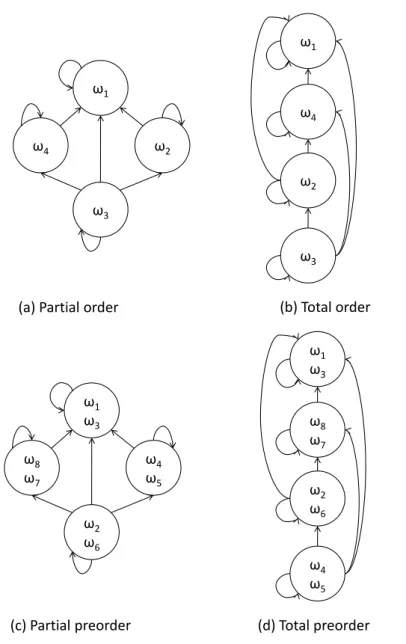
Example 1.1. We assume that the directed edges correspond to strict preferences from a less preferred configuration to a more preferred one, i.e. ωi → ωj means thatωj is strictly preferred to ωi. Note that if a node contains more than one configuration then the preference relation between these configurations is indifference. For Figures1.2a and1.2b we consider that we have
4 configurationsω1, . . . , ω4. It can be checked that Figure1.2a is a partial order sinceω2andω4
are non compared, Figure1.2b is a total order since all the configurations can be compared and there is no equality between configurations. The preference ordering expressed by Figure1.2c and
1.2d is over 8 configurations, namely,ω1, . . . , ω8. Figure1.2c represents a partial preorder since
ω8 andω7 are equally preferred while ω8 andω4 are non-compared and Figure 1.2d is a total
preorder.
1.4
Conditional Preference Networks (CP-nets)
The direct specification of a binary preference relation onΩ ={ω1, . . . , ωn}is rather difficult, as it requires the user to compare up toO(n2)pairs of configurations, which is huge in terms of time (nis exponentially large) and effort. Therefore, qualitative preference models allow for a local and concise specification of preferences.
The user is assumed to express preferences under the form of comparisons between values of each variable, conditioned on some other instantiated variables. CP-nets deal with strictpreference statements. Unconditional statements are of the form: “I prefer a+ to a−”, where a+, a− ∈ {a,¬a} and a− = ¬a+, and we denote them by a+ a−. When A = a+, we say that the quality of the choice for A is good, and is bad otherwise. If the preference onA depends on other variablesP(A)called theparents ofA, andp(A) is an instantiation ofP(A), conditional preference statements are of the form “in the contextp(A), I prefera+toa−”, denoted byp(A) : a+ a−. To each variable we associate a table representing the local preferences on its domain values in each parent context (the value ofa+, respectivelya−, depends on the parents context).
1.4.1
Preference independence: Ceteris Paribus
CP-nets, initially introduced in [Boutilier et al., 2004a], are considered as an efficient model to manage qualitative preferences. This preference model is based on a preferential independence property often referred to as a Ceteris Paribus assumption such that a partial configuration is pre-ferred to another everything else being equal. Formally, it is defined as follows:
Definition 1.6(Preferential independence). LetVbe a set of variables andXbe a subset ofV.X
is said to be preferentially independent from its complementY =V \Xiff for any instantiations,
y, y0, x, x0,
(y, x) (y0, x)⇔ (y, x0) (y0, x0)
Preferential independence is asymmetric. Indeed, it might happen, e.g., for disjoint setsX,Y and
ω1 ω3 ω4 ω5 ω8 ω7 ω2 ω6 (c) Partial preorder ω1 ω2 ω4 ω3
(a) Partial order
ω1 ω2 ω4 ω3 (b) Total order ω1 ω3 ω2 ω6 ω8 ω7 ω4 ω5 (d) Total preorder
Y preferentially independent fromX. This independence is at a work in the graphical structure underlying CP-nets.
1.4.2
Model definition and semantics
Preference networks can be viewed as a qualitative counterpart of Bayesian nets [Pearl, 1988]. More formally:
Definition 1.7(CP-nets). A CP-net consists of a directed graphG = (V,E)whereV denotes the set of nodes andE denotes the set of edges. A node corresponds to a variable. Edges represent the preference dependencies between the variables. To each variableAi we associate a condi-tional preference table that corresponds to a strict total order between the values ofAi, for all instantiationsp(Ai)of parent variablesP(Ai).
ab : c
≻
¬c
a ¬ b : ¬c
≻
c
¬ ab :¬c
≻
c
¬a ¬ b: c
≻
¬c
a
≻
¬a
B
A
C
b
≻
¬b
Figure 1.3: An example of a CP-net
Here, preferences over values of a variable depend only on the parent(s) context, and are preferentially independent from the rest of variables. Contrarily to Bayesian nets, CP-nets may be cyclic (without necessarily encoding inconsistent preferences). Each preference statement in the CP-net implicitly corresponds to a set of comparisons between pairs configurations. For instance, consider two independent variables House type={f lat, villa}and size={large, small}, if the user says "I prefer flats to villas, we can deduce that large flats are preferred to large villas and small flats are preferred to small villas. However, we cannot deduce that small flats are preferred to large villas. In fact, the preference relation is valid provided that the rest of the variables are instantiated in the same way.
A CP-net is said to be satisfiable if there exists at least one partial order of configurations that satisfies it. Note that every acyclic CP-net is satisfiable and leads to a unique partial order [Boutilier et al., 2004a].
abc
ab ¬c
¬ab ¬c
¬a¬b ¬c
¬a¬bc
¬abc
a¬b ¬c
a¬bc
Figure 1.4: The worsening flips graph of the CP-net of Figure1.3
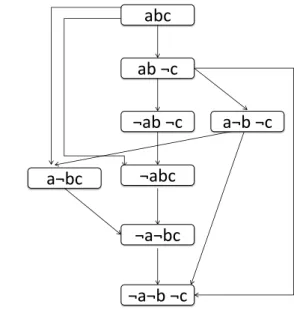
Example 1.2. Let us consider the simple CP-net of Figure1.3, with 3 variables. This CP-net is acyclic thus it is satisfiable and leads to a unique partial order. The building of the worsening flips graph (Figure1.4) leads to the partial ordering: abc CP ab¬c CP ¬ab¬c CP ¬abcCP ¬a¬bc CP ¬a¬b¬c, ab¬c CP a¬b¬c CP ¬a¬b¬c, abc CP a¬bc CP ¬a¬bc which means that the optimal configuration isabc.
1.4.3
Reasoning with CP-nets
Given a CP-net, two queries can be considered, namely, optimization query for finding the best configuration and dominance queries defined by finding a preference relation between two confi-gurations. More precisely:
• As mentioned above, acyclic CP-nets have a unique optimal configuration. Finding it amounts to looking for a configuration where all the conditional preferences are satisfied. It can be done by a simple forward sweeping procedure where, for each node, we assign the most preferred value according to the parents context. For acyclic CP-nets, this procedure is linear w.r.t. the number of variables [Boutilier et al., 2004a]. In contrast, for cyclic ones answering this query needs an NP-hard algorithm and may lead to more than one optimal configuration [Goldsmith et al., 2008].
• Dominance queries are more complex. Using the information in the CP-Tables and applying theCeteris Paribusprinciple, when oneflipsone variable value in a configuration one may obtain either an improved configuration, or a worsened one. These swap pairs can be or-ganized into a collection of worsening (directed) paths with a unique root corresponding to
the best configuration and where the other extremity is the worst one. Thus, a configuration is preferred to another if there exists a chain (directed path) of worsening flips between them [Boutilier et al., 1999]. Note that if for any variableAi ∈ V, Ai is preferentially independent fromV \Ai, then the CP-net graph is disconnected and many configurations cannot be compared. Testing dominance is PSPACE-complete for unrestricted CP-nets, NP-hard for acyclic ones, and quadratic for tree-structures [Goldsmith et al., 2008]. In a recent work [Xin and Liu, 2016], authors have proved that there is a connection between dominance querying and single source shortest path problem [Orlin et al., 2010]. They pro-posed a new exact dominance algorithm entitledJohnson algorithmfor any binary-valued CP-net which runs in a time complexity equal toO(2n∗n2).
In general, the ordering induced by a CP-net is strict and partial, since several configurations may remain incomparable (i.e. no worsening flips chain exists between them). Clearly, acyclic CP-nets cannot exhibit any ties.
Randomly generating CP-nets is helpful for learning experiments [Allen et al., 2014]. Indeed, it enables experimental analysis of CP-net reasoning algorithms, understanding their properties and simulating some social choice experiments. Some research works gave importance to this topic such as [Allen et al., 2016, Allen et al., 2014]. In fact, recently, a novel algorithm for provably generating acyclic CP-nets uniformly at random was proposed in [Allen et al., 2016]. The proposed method allows for multi-valued domains and an arbitrary bounds on the indgree of the dependency graph.
1.4.4
Expressivity of CP-nets
In CP-nets, a parent preference tends to be more important than a child one [Boutilier et al., 1999]. In other words, violating a preference associated with a father node is more important than violating a preference associated with a child one; this priorityimplicitlygiven by the application ofCeteris Paribusmay be debatable. For instance, in the previous example, configurationab¬cis preferred to configuration¬abc. Moreover, this kind of priority is not transitive in the sense that CP-nets cannot always decide whether violating preferences of two children nodes is preferred to violating preferences associated with one child and one grandson node respectively (which might have been expected as being less damaging than violating two children preferences) [Dubois et al., 2013b]. This limitation is problematic since these priorities cannot be questioned and modified. Generally, there are partial preference orderings that CP-nets cannot express, see [Ben Amor et al., 2015] for counterexamples.
Only few works discuss the expressivity and succinctness of CP-nets. Investigation on the expressive power of CP-nets in a quantitative manner are proposed in [Liu and Liao, 2015]. More precisely, the authors address a new concept called expressive efficiency that quantifies the trade-off between expressivity (i.e. the possible preference relations that the model can express) and succinctness (i.e. how much space is needed to store all the preferences) of CP-nets. Moreover, the
authors investigate theexpressivityof two kinds of binary-valued CP-nets namely, set-structured and equal difference CP-nets. Indeed, the preference relations expressed by CP-nets are directly related to the dependency graph. Set-structured CP-nets are specified by a graphical structure where all the nodes are independent (i.e. there is no edges). It was proved that such networks can express 3N −2N preference relations [Liu and Liao, 2015]. Besides, since all nodes are independent, there is only one preference statement per variable. This means that onlyN space is needed to store the preference statements. The other studied kind of net is equal difference CP-nets. These latter are defined by a structure where each node connects to all its followings i.e., the root node is directly related to all the rest of the variables which means that the network has only one root and only one leaf. They proved that from this kind of structure one can construct a total order between configurations. That is, based on this structure, one can express all the preference relations between the configurations. Thus, we have2N−1 ∗(2N −1)preference relations and 2N −1 space is needed to store the conditional preference statements. However, the number of preference relations expressed by an arbitrary structured CP-net remains an open problem [Liu and Liao, 2015].
In general, CP-nets are restricted to binary-valued variables. This would restrict the expressi-vity of CP-nets. Even though the semantics allows for such representations, algorithms for multi-valued acyclic CP-nets were neglected. Roughly, optimization query is easy even for multi-multi-valued CP-nets, however, dominance queries are hard. In fact, the number of nodes of the configuration graph built for finding a worsening path from a configuration to another grows exponentially with the number of configurations [Yaman and Desjardins, 2008]. A methods for handling such vari-ables is to reduce their number into group of multiple values. In [Yaman and Desjardins, 2008], authors have identified a class of multi-valued CP-nets, entitled more-or-less CP-nets, that have the same computational complexity as binary-valued CP-nets. In fact, more-or-less CP-nets consider ordinal variables, i.e monotonic variables, and assume the existence of a single critical point per variable. To reason with such networks, one should aggregate the preferences of a range of values together. Then, after a slight modification of binary dominance algorithm, one can execute the task with the same computational complexity (i.e. NP-complete to PSPACE). However, this class of CP-nets is too restrictive and reasoning with multi-valued CP-nets is still an open question.
The expressivity of CP-net is also restricted by the fact that standard CP-nets cannot express indifference. In fact, each preference statement must be defined as a total order between the values of the variable. This can be explained by the fact that a CP-net that bears indifference may be non satisfiable as illustrated in Example1.3.
Example 1.3. Let us consider a CP-net over two variablesAandB, such thatAis the parent of
B. With the following preference tables: a ∼ ¬a, a : b ¬b,¬a : ¬b b. This asserts that the user is indifferent between the values thatAmay take. The following preferences is deduced:
ab a ∼ b ¬a¬b ¬ab ∼ ab. These statements are not consistent with any preference ranking, hence this network is not satisfiable
2013], since the assumption of a strict preference is too strong from a psychological standpoint and is often too restrictive even for simple preferential problems. [Allen, 2013] proposed to learn CP-nets where preference statements may include incomparability and indifference. For instance, ‘big house∼small house’ means that the user is indifferent about the size of the house. Authors consider a more general question for dominance corresponding toweakdominance i.e. whether
ω1 ω2orω1 ω2. This entails searching for a monotonically worsening flipping sequence such
that a worsening flip either corresponds to strict preference or indifference. If after the transitive closure and in the absence of a rule such thatω1 ω2 orω1 ω2 then the two configurations
remain non comparedω1±ω2.
Constraints on the structure of nets may restrict their expressivity. Indeed, cyclic CP-nets [Brafman and Dimopoulos, 2004] emerge naturally when there is a set of variables that are mutually dependent. In certain situations, it may be more natural to express cyclic preferences even if an acyclic representation could be used, for instance, for preference-based configuration of web page content [Domshlak et al., 2001]. It was noted that such cyclic networks are sometimes consistent and the semantics of CP-nets allows for such cycles (i.e. nothing in the semantics of the CP-net model forces it to be acyclic). It is important to note that cyclic CP-nets do not always lead to a cyclic order of configurations. Testing consistency of general cyclic CP-nets was proposed in [Goldsmith et al., 2008] and proved to be PSPACE-complete along with the dominance testing. Other extensions that may somewhat enhance the expressivity of CP-nets (including Proba-bilistic CP-nets (PCP-nets) [Bigot et al., 2013] and Multiple agents CP-nets (mCP-nets) [Rossi et al., 2004] are not covered here since they enlarge the representation to other features, namely uncertainty or multiple agents).
1.4.5
How to build CP-nets?
CP-nets can be constructed by an expert, elicited from users, or learned from data. Each of these methods may show some strengths and weaknesses. The first method needs a good expertise and knowledge. Indeed, for complex domains even if the graphical structure may seem to be intuitive, finding dependencies and choosing the variables is not always practical.
The second method needs a long process of intake before the model can be employed. [Lang and Mengin, 2009] were interested in passive learning of separable CP-nets. These are set-structured CP-nets whose variables have no conditional dependency, that is to say that the graph has no arc. After that, [Koriche and Zanuttini, 2010] have been interested in eliciting boolean tree-structured acyclic CP-nets. Then, a heuristic algorithm for learning CP-nets from user query was proposed in [Guerin et al., 2013, Allen, 2014]. It has two phases. The first corresponds to constructing a separable CP-net with default CP-tables. Then, iteratively, it refines the model by adding edges and forming more complex CP-tables. While assuming a bound on the number of parents, the algorithm succeeds to construct a CP-net in timeO(Np)such thatN is the number of nodes andpis the bound on the number of parents of each node. The algorithms guarantees that
the preferences it outputs are always consistent with the user preferences.
An empirical study was held to argue about the suitability and tractability of elicitation and validation algorithms with humans [Allen et al., 2015]. In fact, preference information is often messy, not openly available, thus it needs a huge work to collect. Besides, the reliably of such preferences is not always ensured because of the difficulty of interpretation. Moreover, users may express preferences that are not representable by the preferential model. The experimental research aims to test whether users subjectively represent preferences in a way that is consistent with CP-nets. Following this line of stepping back and looking at decision-support systems from the user’s point of view, [Patel, 2016] designed a tool which uses comparative preference statements on the basis of psychological, linguistic and personal considerations.
The last method requires weeks of observations in order to construct a model satisfying the preferences of a user. An algorithm for learning the CP-net from outcome comparisons data was presented in [Dimopoulos et al., 2009]. The algorithm takes as input a set of variables and a set of comparisons between outcomes and outputs a CP-net that is consistent with preferences afforded. Indeed, as a first step it initializes an empty CP-net and adds a node per iteration starting by finding the independent nodes. This learning is proved to be NP-hard even under some simplifying hypothesis.
Preference elicitation is a serious problem in many preference modeling tasks. Models based on Ceteris Paribus independence were designed to make this process simpler and more intuitive which is enhanced by the graphical structure that CP-nets have.
1.5
Tradeoffs-enhanced CP-nets (TCP-nets)
As mentioned above, the expressive power of CP-nets is limited. In particular, we are unable to specify importance relations between variables, beside those implicitly imposed between parents and children. Tradeoffs-enhanced CP-nets (TCP-nets) [Brafman and Domshlak, 2002] are an extension of CP-nets that adds a notion of importance between the variables by enriching the network with new arcs. These arcs express importance relations for stating the priority of a node over another (i.e.,“preference about the values ofA1is more important than preference about the
values ofA2”). Such priority statements may be conditioned on the values of other variables, e.g.,
“if the variableA3 has value a3, the preference about values of A1 is more important than the
preference about the values ofA2.” Formally, TCP-nets are annotated graphs with three types of
edges and are defined as below.
Definition 1.8(TCP-nets). A TCP-netG0 over a setV of variables is a CP-netG = (V,E) aug-mented with two types of arcs:
1. A set of directedi-arcs(whereistands for importance). Ani-arch−−−→Ai, Ajibelongs toG0iff
2. A set of undirectedci-arcs(wherecistands for conditional importance). Aci-arc(Ai, Aj) belongs to G0 iff the relative importance of A
i and Aj is conditioned on Z s.t. Z ⊆ V\{Ai, Aj}. Eachci-arc(Ai, Aj) is associated with a mapping from a subset of DZ to strict total orders over the set{Ai, Aj}.
Let us turn to the expressive power of TCP-nets. TCP-nets obey the preference statements induced byCeteris Paribus, since the ordering obtained is a refinement of the CP-nets ordering. In fact, the refinement brought by TCP-nets cannot override the implicit priority in favor of parents nodes. Indeed, in case one would add a i−, or a ci− arc yielding a preference in favor of a son with respect to a parent (at least in some context), one would face an inconsistency between a worsening I-flip and a worsening CP-flip that act in opposite directions, thus we would have inconsistent TCP-nets.
The main issue for TCP-nets is the challenge of performing queries with this representation. Some first proposals are presented in [Brafman et al., 2006]. For consistent TCP-nets, the optimi-zation procedure works like CP-nets. Indeed, the relative importance relations do not play a role in this case. The dominance problem can be also be treated as a search for an improving flipping sequence, where the notion of flipping sequence is extended. In fact, a flip corresponds either to a CP-flip like CP-nets or to an I-flip (“importance flip”). We assume thatω[X]denote the restriction ofωto variables inX. Letωandω0be two configurations, such thatωdiffers fromω0in the value of exactly two variablesAjandAk, and such thatω[Aj]ω0[Aj]andω[Ak]≺ω0[Ak](given the same values ofP(Aj)andP(Ak)inωandω0). Then, a worsening I-flip fromωtoω0takes place when there is a priority ofAj overAkconditional (or not) on a subset of variablesZ such thatZ takes the same values inωandω0. However, no general algorithm is known for dominance query since results in the context of CP-nets do not seem to be immediately adaptable to TCP-nets.
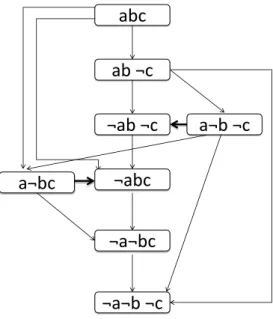
Example 1.4. Let us consider the TCP-net in Figure1.5. An unconditioned importancea . b is added. Indeed, a new arci-arch−−→A, Biis added with respect to the CP-net in Figure1.3. The orde-ring given by the worsening flips graph in Figure1.6is refined, compared to the CP-net. Indeed,
a¬b¬c T CP−net ¬ab¬canda¬bc T CP−net ¬abc, while these configurations comparable by I-flips, are not comparable in the CP-net, see Figure1.3(b). In place of the previous unconditio-ned importance statement, one may exhibit an example ofci-arc(A, B)by stating thatAis more important thanB ifC = c, andB is more important thanA ifC = ¬c. Then, we would have
a¬b¬c≺T CP−net ¬ab¬canda¬bcT CP−net¬abc.
TCP-nets also yield partial orderings that, from the same CP-net preference statements, are refinements of the ordering induced by the corresponding CP-nets.
Example 1.5. Let us consider the following preferences over variablesA andB withD(A) =
{a,¬a}andD(B) = {b,¬b}: (i) In all casesais preferred to¬a; (ii)bis preferred to¬b. The CP-net view yields the order: ab CP a¬b±CP ¬abCP ¬a¬b. No CP-net yields the refined orderab a¬b ¬ab ¬a¬b, while it can be represented with a TCP-net, with the additional information “Ais more important thanB”.
ab : c
≻
¬c
a ¬ b : ¬c
≻
c
¬ ab :¬c
≻
c
¬a ¬ b: c
≻
¬c
a
≻
¬a
B
A
C
b
≻
¬b
Figure 1.5: An example of a TCP-net
Some other related languages such as CI-networks [Bouveret et al., 2009] and CP-theories [Wilson, 2004] allow the statement of relative importance among sets of variables. Particularly, CP-theories, allow statements of the form "A1 is more important than {A2, A3}". CI-nets are
dedicated to the comparison of sets of goods rather than configurations. In fact, CI-nets allow unconditional and monotonic intra-attribute preferences and conditional relative importance pre-ferences over sets of variables of the form "{A1, A2}is more important that{A3, A4}". Formally,
havingVthe set of binary variable,S+,S−,S1andS2subsets of arbitrary variables, a conditional
importance statement onV is a quadrupleγ = (S+, S−, S1, S2) written asS+, S−, S1 . S2. In
other words, this means that ‘if I have all variables inS+and none of the variables inS−, I prefer
obtaining all variables inS1rather than obtaining all variables inS1Ceteris Paribus. CI-nets
com-pare sets of variables of arbitrary sizes while TCP-nets can only express importance statements between single objects Ceteris Paribus [Bouveret et al., 2009]. Besides, in CP-nets, TCP-nets and CP-theories each preference statement can be represented in terms of preferences over values of a single variable, while CI-net expresses preference statements between sets of variables. Note that CI-networks do not express any conditional intra-variable preferences. This is explained by the fact that the larger the set of goods the better for the user (monotonicity w.r.t. set inclusion). Be-sides, CI-nets generalize TCP-nets since they can bear preferences on arbitrary sets of variables, and not only singletons. Since this chapter is dedicated to graphical models, CP-theories will be detailed in Chapter 4.
Table 1.2 summarizes the preference relations expressed by the preference models that are based on the Ceteris paribus independence. A check mark (X) means that the model allows the corresponding preference relation type.
abc
ab ¬c
¬ab ¬c
¬a¬b ¬c
¬a¬bc
¬abc
a¬b ¬c
a¬bc
Figure 1.6: The worsening flips graph of Figure1.5
Preference relation type CP-nets TCP-nets CI-networks CP-theories
Unconditional intra-variable preference X X X
Conditional intra-variable preference X X X
Conditional relative importance X X X
One-many relative importance X X
Many-many relative importance X
![Figure 1.1: AI methodology for reasoning about preferences [Domshlak, 2008]](https://thumb-us.123doks.com/thumbv2/123dok_us/9974239.2489971/26.892.182.741.128.520/figure-ai-methodology-reasoning-preferences-domshlak.webp)