Software Fault Tolerance of Distributed Programs Using Computation Slicing
Neeraj Mittal
Department of Computer Science
The University of Texas at Dallas
Richardson, TX 75083-0688, USA
[email protected]
Vijay K. Garg
∗Department of Electrical and Computer Engineering
The University of Texas at Austin
Austin, TX 78712-1084, USA
[email protected]
Abstract
Writing correct distributed programs is hard. In spite of extensive testing and debugging, software faults persist even in commercial grade software. Many distributed systems, especially those employed in safety-critical environments, should be able to operate properly even in the presence of software faults. Monitoring the execution of a distributed system, and, on detecting a fault, initiating the appropriate corrective action is an important way to tolerate such faults. This gives rise to the predicate detection problem which in-volves finding a consistent cut of a distributed computation, if it exists, that satisfies the given global predicate.
Detecting a predicate in a computation is, however, an NP-complete problem. To ameliorate the associated combi-natorial explosion problem, we introduce the notion of com-putation slice in our earlier papers [5, 10]. Intuitively, slice is a concise representation of those consistent cuts that sat-isfy a certain condition. To detect a predicate, rather than searching the state-space of the computation, it is much more efficient to search the state-space of the slice. In this paper, we provide efficient algorithms to compute the slice for several classes of predicates. Our experimental results demonstrate that slicing can lead to an exponential improvement over existing techniques in terms of time and space.
Keywords: predicate detection, testing and debugging, software-fault tolerance, pruning search-space, partial-order methods
1. Introduction
Writing distributed programs is an error prone activity; it is hard to reason about them because they suffer from the
∗supported in part by the NSF Grants ECS-9907213, CCR-9988225,
Texas Education Board Grant ARP-320, an Engineering Foundation Fel-lowship, and an IBM grant.
combinatorial explosion problem. Software faults (bugs), in particular global faults, are caused by subtle interactions be-tween various components of the system. As such, they may occur only for specific combinations of inputs and certain interleavings of events. This makes it difficult to eliminate them entirely using testing and debugging. In fact, in spite of extensive testing and debugging, software faults persist even in commercial grade software. Many distributed sys-tems, especially those employed in safety-critical environ-ments, should be able to operate properly even in the pres-ence of software faults. Monitoring the execution of a dis-tributed system, and, on detecting a fault, initiating the ap-propriate corrective action is an important way to tolerate such bugs.
In this paper, we focus on detecting those faults that can be expressed as predicates on variables of processes. For example, “no process has the token” can be written as no token1∧no token2∧· · ·∧no tokenn, whereno tokeni
denotes the absence of token on processpi. This gives rise
to the predicate detection problem which involves finding a consistent cut of a distributed computation, if it exists, that satisfies the given global predicate. (This problem is also referred to as detecting a predicate under possibly modality in the literature.) Predicate detection problem also arises in other areas in distributed systems such as testing and debug-ging where it can be used to set conditional breakpoints.
Detecting a predicate in a computation is a hard prob-lem in general [4, 12, 11]. The reason is the combina-torial explosion in the number of possible consistent cuts. Given a computation consisting of nprocesses each with at most k local states, the number of possible consistent cuts of the computation could be as large asO(kn).
Find-ing a consistent cut that satisfies the given predicate may, therefore, require looking at a large number of consistent cuts. In fact, we prove in [11] that detecting a predi-cate in 2-CNF (conjunctive normal form), even when no two clauses contain variables from the same process, is NP-complete, in general. Example of such a predicate is: (x1∨x2)∧(x3∨x4)∧ · · · ∧(xn−1∨xn), where eachxi
2 1 4 4 1 2 0 1 2 -1 0 3 : meta-event x u w d (a) c b a x3 g x2 f x1 e h p3 p1 v p2 {a, e, f, u, v} {b} {w} {g} (b)
Figure 1. (a) A computation and (b) its slice with respect to(x1>1)∧(x363).
is a boolean variable on processpi.
In our earlier papers [5, 10], we introduce the notion of computation slice. Intuitively, slice is a succinct representa-tion of those consistent cuts that satisfy a certain condirepresenta-tion. The slice of a computation with respect to a predicate is a directed graph with the least number of consistent cuts that contains all consistent cuts of the computation for which the predicate evaluates to true. Since we expect global faults to be relatively rare, their slice will be much smaller than the computation itself. Therefore, in order to detect a global fault, rather than searching the state-space of the computa-tion, it is much more efficient to search the state-space of the slice. We also identify a class of predicates, called regular predicates, for which the slice is exact [5, 10]. That is, the slice for a regular predicate contains precisely those consis-tent cuts for which the predicate evaluates to true. In [5], we also present anO(n2
|E|)algorithm to compute the slice for a regular predicate, wherenis the number of processes and Eis the set of events.
As an illustration, suppose we want to detect the pred-icate (x1∗x2+x3 < 5) ∧(x1 > 1)∧(x3 6 3)in the
computation shown in Figure 1(a). The computation con-sists of three processesp1,p2 andp3 hosting integer
vari-ables x1, x2 and x3, respectively. The events are
repre-sented by circles. Each event is labeled with the value of the respective variable immediately after the event is exe-cuted. For example, the value of variablex1 immediately
after executing the eventc is−1. The first event on each process initializes the state of the process and every con-sistent cut contains these initial events. Without
computa-tion slicing, we are forced to examine all consistent cuts of the computation, twenty eight in total, to ascertain whether some consistent cut satisfies the predicate. Alternatively, we can compute a slice of the computation with respect to the predicate(x1 > 1)∧(x3 6 3) as portrayed in
Fig-ure 1(b). A slice is modeled by a directed graph. Each vertex of the graph corresponds to a meta-event, which is a subset of events. If a vertex is contained in a consis-tent cut, the interpretation is that all events correspond-ing to the vertex are contained in the cut. Moreover, a vertex belongs to a consistent cut only if all its incoming neighbours are also present in the cut. We can now re-strict our search to the consistent cuts of the slice which are only six in number, namely{a, e, f, u, v},{a, e, f, u, v, b},
{a, e, f, u, v, w}, {a, e, f, u, v, b, w}, {a, e, f, u, v, w, g}
and{a, e, f, u, v, b, w, g}. The slice has much fewer consis-tent cuts than the computation itself—exponentially smaller in many cases—resulting in substantial savings.
We prove in [10] that it is, in general, intractable to com-pute the slice for an arbitrary predicate. Nonetheless, it is still useful to be able to compute an approximate slice for such a predicate efficiently. An approximate slice may be bigger than the actual slice but will be much smaller than the computation itself. We also provide a polynomitime al-gorithm in [10] to compute an approximate slice for a pred-icate composed from regular predpred-icates using ¬, ∧and∨ operators.
Our contributions in this paper are as follows. First, we provide a faster algorithm for computing the slice for a de-composable regular predicate, which can be expressed as conjunction of clauses where each clause is again a regular predicate but depends on variables of only a small num-ber of processes. For example, consider the regular predi-cate “counters of all processes are approximately synchro-nized”. It can be expressed as: for all processespiandpj,
|counteri−counterj| 6 4ij, where each counteri is a
monotonically non-decreasing variable on pi. Here, each
clause depends on variables of at most two processes. For this predicate, the slicing algorithm given in this paper is ntimes faster than the one in [5], wherenis the number of processes. In general, the time-complexity of the al-gorithm is given byO((n+k2s)
|E|), whereE is the set of events,kis the maximum number of processes spanned by a clause, andsis the maximum number of clauses any single process appears in. For example, for the aforemen-tioned predicate, k = 2ands = n. Second, we give an efficient algorithm to compute the slice for ak-local pred-icate for constantk. Ak-local predicate depends on vari-ables of at mostkprocesses [12]. The time-complexity of the algorithm isO(nmk−1|E|), wheremis the maximum
number of events on a process. Third, we provide an effi-cient algorithm to compute the slice for a linear predicate and its dual post-linear predicate [4]. The class of linear
predicates is a generalization of the class of regular predi-cates. The algorithm has the time-complexity ofO(n2|E|).
As a corollary, it is now possible to compute an approxi-mate slice—in polynomial-time—for a much more general class of predicates than described in [10]. Finally, we dis-cuss our experimental results in evaluating the effectiveness of slicing in pruning the search-space for predicate detec-tion. This is the first experimental study of slicing for any application. As such, our objective in this paper is not to measure the efficacy of the slicing algorithms described in this paper only, but to evaluate the effectiveness of slicing algorithms in general including those in our earlier papers [5, 10]. Our results indicate that slicing can lead to an ex-ponential improvement over existing techniques in terms of time and space. Furthermore, other techniques for reduc-ing the time-complexity [13] and/or the space-complexity [1] are orthogonal to slicing, and as such can actually be used in conjunction with slicing. For instance, Alagar and Venkatesan’s polynomial space algorithm [1] for searching the state-space of a computation can also be used for search-ing the state-space of a slice.
Although, in this paper, we focus on application of slic-ing to predicate detection, slicslic-ing can be employed to re-duce the search-space when monitoring a predicate under other modalities as well including definitely [2, 4], invari-ant [10] and controllable [4].
The paper is organized as follows. In Section 2, we de-scribe our model and notation. In Section 3, we discuss the background on computation slicing necessary to under-stand the rest of the paper. Section 4 describes efficient al-gorithms to compute the slice for three classes of predicates. In Section 5, we discuss our experimental results on slicing. Finally, Section 6 concludes the paper.
2. Model and Notation
Traditionally, a distributed computation is modeled as a partial order on a set of events [8]. In this paper, we re-lax the restriction that the order on events must be a partial order. Instead we use directed graphs to model distributed computations as well as slices. Directed graphs allow us to handle both of them in a uniform and convenient manner.
Given a directed graph G, let V(G) andE(G)denote its set of vertices and edges, respectively. A subset of ver-tices of a directed graph forms a consistent cut if the subset contains a vertex only if it also contains all its incoming neighbours. Formally,
Cis a consistent cut ofG ,
h∀e, f∈V(G) : (e, f)∈E(G) :f ∈C ⇒ e∈Ci Observe that a consistent cut either contains all vertices in a strongly connected component or none of them. Let
C(G)denote the set of consistent cuts of a directed graphG.
Observe that the empty set∅and the set of verticesV(G) trivially belong to C(G). We call them trivial consistent cuts. Also, letP(G)denote the set of pairs of vertices(u, v) such that there is a path fromutovinG. We assume that every vertex has a path to itself.
A distributed computation (or simply a computation)
hE,→iis a directed graph with vertices as the set of events E and edges as →. To limit our attention to only those consistent cuts that can actually occur during an execution, we assume thatP(hE,→i)contains at least the Lamport’s happened-before relation [8]. A distributed computation in our model can contain cycles. This is because, whereas a computation in the traditional or happened-before model captures the observable order of execution of events, a com-putation in our model captures the set of possible consistent cuts. Intuitively, each strongly connected component of a computation can be viewed as a meta-event; all events in a meta-event should be executed atomically.
We assume the presence of fictitious initial and final events on each process. The initial event on processpi,
de-noted by⊥i, occurs before any other event onpi. Likewise,
the final event on processpi, denoted by>i, occurs after all
other events onpi. We assume that all initial events belong
to the same strongly connected component. Similarly, all final events belong to the same strongly connected compo-nent. This ensures that any non-trivial consistent cut will contain all initial events and none of the final events. As a result, every consistent cut of a computation in the tra-ditional model is a non-trivial consistent cut of the corre-sponding computation in our model and vice versa. Only non-trivial consistent cuts are of real interest to us.
A global predicate (or simply a predicate) is defined as a boolean-valued function on variables of processes. Given a consistent cut, a predicate is evaluated with respect to the values of variables resulting after executing all events in the cut. If a predicate b evaluates to true for a consistent cut C, we say that “Csatisfiesb”. We leave the predicate un-defined for the trivial consistent cuts. A global predicate is local if it depends on variables of a single process. It is said to be k-local if it depends on variables of at mostk processes [12].
3. Background
The notion of computation slice is based on the Birkhoff’s Representation Theorem for Finite Distributive Lattices [3] which we describe next.
3.1. Birkhoff’s Theorem
We first describe some concepts needed to understand the theorem. A lattice is said to be distributive if its meet op-erator distributes over its join opop-erator [3]. It can be proved
that meet distributes over join if and only if join distributes over meet. An element of a lattice is called join-irreducible if it cannot be expressed as join of two distinct elements (of the lattice), both different from itself [3].
Let L be a lattice and J I(L) be the set of its join-irreducible elements. In case Lis a distributive lattice, it satisfies an important property. Specifically, every element in Lcan be expressed as the join of some subset of ele-ments inJ I(L)and vice versa [3, Birkhoff’s Theorem]. In other words, J I(L)completely characterizesL. This is significant because|J I(L)|is generally much smaller— exponentially in many cases—than|L|. Hence if some com-putation onLcan instead be performed onJ I(L), we ob-tain a significant computational advantage.
Consider a computationhE,→iand letC(E)denote the set of its consistent cuts. In [5], we show thatC(E)forms a distributive lattice under the relation⊆; its join and meet op-erators correspond to set union (∪) and set intersection (∩), respectively. Furthermore, no additional structural property is satisfied byC(E). There is a one-to-one correspondence between the set of join-irreducible elements of C(E) and the set of strongly connected components ofhE,→i
Now, consider a subsetD ⊆ C(E). We say thatDforms a sublattice ofC(E)ifDis closed under set union and set intersection. That is, given two consistent cuts ofD, the consistent cuts obtained by their set union and set intersec-tion also belong toD. It can be proved that a sublattice of a distributive lattice is also a distributive lattice [3]. Thus if
Dis a sublattice ofC(E), then, using Birkhoff’s Theorem,
J I(D)completely characterizesD. This forms the basis for the notion of computation slice.
3.2. Computation Slice
Roughly speaking, a computation slice (or simply slice) is a succinct representation of all those consistent cuts of the computation that satisfy a certain predicate. More precisely, Definition 1 (slice [10]) A slice of a computation with re-spect to a predicate is the smallest directed graph (with the least number of consistent cuts) that contains all consistent cuts of the given computation for which the predicate eval-uates to true.
We denote the slice of a computation hE,→i with re-spect to a predicatebbyhE,→ib. We prove in [10] that the
slice exists and is uniquely defined for all predicates. The main idea behind the proof is as follows. Consider a com-putationhE,→iand a predicateb. LetC(E)denote the set of consistent cuts ofhE,→iand, further, letCb(E)⊆ C(E)
be the subset of those consistent cuts that satisfyb. We show that there exists a subsetD ⊆ C(E)satisfying the follow-ing conditions. First,DcontainsCb(E), that is,Cb(E)⊆ D.
Second,Dforms a sublattice ofC(E). Last, among all sub-lattices that fulfill the first two conditions, it is the smallest one. From Birkhoff’s Theorem, J I(D), the set of join-irreducible elements ofD, completely characterizesD. We call the poset (partially ordered set) induced on the consis-tent cuts ofJ I(D)by the relation⊆as the slicehE,→ib.
Alternatively, the slice can also be represented by a directed graph drawn on the set of eventsEsuch that its set of con-sistent cuts is given byD. Whereas the poset representation of a slice is better for presentation purposes, the graph rep-resentation is more suited for slicing algorithms.
Every slice derived from the computation hE,→i has the trivial consistent cuts (∅andE) among its set of consis-tent cuts. A slice is empty if it has no non-trivial consisconsis-tent cuts [10]. In the rest of the paper, unless otherwise stated, a consistent cut refers to a non-trivial consistent cut. In gen-eral, a slice will contain consistent cuts that do not satisfy the predicate (besides trivial consistent cuts). In case a slice does not contain any such cut, it is called lean [10]. We now describe the class of predicates for which the slice is lean.
3.3. Regular Predicate
Informally, if a predicate is regular, then the set of con-sistent cuts satisfying the predicate is closed under set inter-section and set union [5]. Equivalently,
Definition 2 (regular predicate [5]) A predicate is said to be regular if, given two consistent cuts that satisfy the pred-icate, the consistent cuts obtained by their set intersection and set union also satisfy the predicate. Formally, given a regular predicateb, and consistent cutsCandD,
(Csatisfiesb)∧(Dsatisfiesb) ⇒
(C∩Dsatisfiesb)∧(C∪Dsatisfiesb) Some examples of regular predicates are: conjunction of local predicates such as “all processes are in red state”, and certain channel predicates including “at most k messages are in transit from processpi to processpj” and “at leastk
messages are in transit from processpito processpj”. We
prove in [5] that the conjunction of two regular predicates is also a regular predicate.
In [5, 10], we provide efficient algorithms to compute the slice for a regular predicate and its complement—referred to as a co-regular predicate. Time-complexities of the two algorithms areO(n2|E|)andO(n2|E|2), respectively,
where n is the number of processes and E is the set of events. We also give optimalO(|E|)algorithms to compute the slice for special cases of regular predicates in [10].
3.4. Grafting Two Slices
Grafting is used to compose two slices [10]. Specifically, given two slices, grafting involves computing either (1) the
smallest slice that contains all consistent cuts common to both the slices, or (2) the smallest slice that contains all consistent cuts that belong to at least one of the slices. The former is referred to as grafting with respect to conjunction, and the latter as grafting with respect to disjunction. Intu-itively, given slices for two regular predicatesb1andb2, the
former can be used to compute the slice forb1∧b2and the
latter forb1∨b2. In [10], we giveO(n|E|)algorithms to
graft two slices.
4. Computing the Slice
In this section, we provide efficient algorithms for computing the slice for three classes of predicates. The first class contains those predicates which can be expressed as conjunction of k-local regular predicates for a smallk; they are referred to as decomposable regular predicates. Note that although each clause of a decomposable regular predicate depends on variables of only a small number of processes, the predicate itself may span a much larger set of processes, possibly even the entire set. The second class consists ofk-local predicates for constantk. This class may contain predicates that are not regular. Finally, the third class consists of linear predicates and their dual.
4.1. Fast Algorithm for Computing the Slice for
Decomposable Regular Predicate
In [5], we provide an O(n2
|E|)algorithm to compute the slice for a regular predicate, wherenis the number of processes andE is the set of events. We now explore the possibility of a faster algorithm for the special case when a regular predicate can be expressed as a conjunction of clauses where each clause is again a regular predicate but spans a small number of processes. An example of such a predicate is “counters of all processes are approximately synchronized”, which can be expressed as:
V
16i,j6n
(|counteri−counterj|64ij)
where each counteri is a monotonically non-decreasing
variable on processpi. In this case, each clause depends on
variables of at most two processes and is therefore 2-local. For this example, our slicing algorithm hasO(n|E|) time-complexity, which is a factor ofnless than that of the algo-rithm in [5]. We describe the algoalgo-rithm in two steps. First, we present a fast algorithm to compute the slice for each clause. Second, we show how to combine these slices to-gether in an efficient manner to obtain the slice for the given regular predicate. Due to lack of space, we only provide a brief description of each step. For details of the algorithm and its proof of correctness, please refer to [9].
In the first step, for each clause, we first take the pro-jection of the computation on those processes whose
vari-ables the clause depends on. We then compute the slice of the projected computation using the algorithm described in [5]. We show that combined time-complexity of comput-ing the slice of the projected computation for all clauses is given byO((n+k2s)
|E|), wheresis the maximum number of clauses any single process appears in. For instance, for the example in the previous paragraph, sisn. (The time-complexity includes the time it takes to compute the projec-tion as well.) In the second step, we combine these slices together efficiently in O((n+ks)|E|) time to obtain the desired slice. The overall time-complexity of the two steps is given byO((n+k2s)
|E|). In casekis O(1) ands is O(n), as is the case with our example, the time-complexity isO(n|E|), which is a factor ofnless than computing the slice directly using the algorithm in [11].
4.2. Computing the Slice for
k-Local Predicate, for
Constant
kIn case the predicate is regular, we can simply use the approach described in the previous section to compute the slice inO(n|E|)time. However, if the predicate is not reg-ular, then the slice produced will only be an approximate one [9]. To compute the (exact) slice for ak-local predi-cate, which is not regular, we use the technique developed by Stoller and Schneider [12]. For a given computation, their technique can be used to transform ak-local predicate into a predicate in k-DNF (disjunctive normal form) with at most mk−1 clauses, wheremis the maximum number
of events on a process. For example, consider the predicate x16=x2. LetV denote the set of values thatx1can take in
the given computation. Thenx16=x2can be rewritten as:
x16=x2 ≡ W v∈V
(x1=v)∧(x26=v)
Note that|V|6m. Thus the resultant predicate, in the above case, consists of m clauses; each clause is a con-junction of local predicates, also referred to as a conjunc-tive predicate [4]. In general, the resultant k-DNF pred-icate will consist of mk−1 clauses. To compute the slice
for each clause, we use the optimalO(|E|)algorithm given in [10]. We then graft these slices together with respect to disjunction to obtain the slice for the given predicate. The overall time-complexity of the algorithm is given by O(nmk−1|E|).
4.3. Computing the Slice for Linear Predicate
A predicate is said to be linear if the set of consistent cuts that satisfy the predicate is closed with respect to set intersection [4]. A post-linear predicate can be defined du-ally. Evidently, the class of linear predicates includes the class of regular predicates. But the converse does not hold.An example of a linear predicate that, in general, is not reg-ular is: “at most kmessages destined for processpi have
not been received yet”. The class of linear predicates is also closed under conjunction [4].
We identify and prove that the algorithm to compute the slice for a regular predicate, given in [5], is applicable even for a linear predicate. The main idea behind the algorithm is as follows. Consider a linear predicateb. For each event e, we defineJb(e)as the least consistent cut that containse
and satisfiesb[5]. In case no consistent cut containingethat also satisfiesbexists or whene ∈ >,Jb(e)is set toE. It
can be proved thatJbis uniquely defined for all events [9].
In [9], we give an O(n2|E|) algorithm to compute Jb(e)
for each evente. We also establish in [9] that the slice for bcan be obtained by constructing a graph with vertices as the set of events, and an edge from an eventeto an event f ifJb(e)⊆Jb(f). Further, we show a way to restrict the
number of edges in the graph toO(n|E|)without adversely affecting the time-complexity.
5. Computing an Approximate Slice
It is, in general, intractable to compute the slice for a predicate [10]. In fact, computing the slice for a predicate in 2-CNF, even when no two clauses contain variables from the same process, is an NP-complete problem. Nonetheless, it is still useful to be able to compute an approximate slice for such a predicate efficiently. An approximate slice may be bigger than the actual slice but may be much smaller than the computation itself.
In [10], we give an efficient polynomial-time algorithm to compute an approximate slice for a predicate composed from regular predicates using¬,∧and∨operators. Utiliz-ing results of this paper, it is now possible to compute an ap-proximate slice, in polynomial-time, for a much larger class of predicates. Specifically, we can now compute an approx-imate slice for a predicate composed from co-regular pred-icates, linear predpred-icates, post-linear predpred-icates, andk-local predicates for constantk, using∧and∨operators.
To compute an approximate slice for such a predicate, we first construct the parse tree for the corresponding boolean expression; all predicates occupy leaf nodes whereas all op-erators occupy non-leaf nodes. We then recursively com-pute the slice by starting with leaf nodes and moving up, level by level, until we reach the root. For a leaf node, we use the slicing algorithm appropriate for the predicate con-tained in the node. For example, if the leaf node contains a linear predicate, we use the algorithm described in Sec-tion 4.3. For a non-leaf node, we use the suitable grafting algorithm depending on the operator.
As an illustration, suppose we wish to compute an ap-proximate slice of a computation with respect to the predi-cate(x1∨x2)∧(x3∨x4), where eachxiis a linear predicate.
We first compute slices for the linear predicatesx1,x2,x3
andx4. We then graft the first two and the last two slices
together with respect to disjunction to obtain (approximate) slices for the clauses x1∨x2 and x3 ∨x4, respectively.
Finally, we graft the slices for both clauses together with respect to conjunction to obtain an approximate slice for (x1∨x2)∧(x3∨x4).
The next section describes our experimental results in evaluating the efficacy of slicing in pruning the search-space for predicate detection.
5.1. Experimental Evaluation
This is the first experimental study of slicing for any ap-plication. Therefore our aim is to evaluate the effectiveness of slicing algorithms in general including those in our ear-lier papers [5, 10] and not just the ones described in this paper.
We compare our approach with Stoller, Unnikrishnan and Liu’s approach [13] which is based on partial-order methods [6]. Intuitively, when searching the state-space, at each consistent cut, partial-order methods allow only a small subset of enabled transitions to be explored. In par-ticular, we use partial-order methods employing both per-sistent and sleep sets for comparison. We consider two ex-amples that are also used by Stoller, Unnikrishnan and Liu to evaluate their approach [13].
The first example, called primary-secondary, concerns an algorithm designed to ensure that the system always con-tains a pair of processes acting together as primary and sec-ondary. The invariant for the algorithm requires that there be a pair of processespi andpj such that (1)pi is acting
as a primary and correctly thinks thatpj is its secondary,
and (2)pj is acting as a secondary and correctly thinks that
piis its primary. Both the primary and the secondary may
choose new processes as their successor at any time; the al-gorithm must ensure that the invariant is never falsified. A global fault, therefore, corresponds to the complement of the invariant which can be expressed as:
¬Ips= V i,j∈[1...n], i6=j
¬isP rimaryi∨ ¬isSecondaryj∨
(secondaryi 6=pj)∨(primaryj6=pi)
Note that¬Ipsis a predicate in CNF where each clause is
a disjunction of two local predicates. An approximate slice for¬Ipscan be computed inO(n3|E|)time. In the second
example, called database partitioning, a database is parti-tioned among processes p2 through pn, while processp1
assigns tasks to these processes based on the current parti-tion. A processpi,i∈[2. . . n], can suggest a new partition
at any time by setting variable changei to true and then
broadcasting a message containing the proposed partition. An invariant that should be maintained is: if no process is
0 1 2 3 4 5 6 7 8 9 10 11 12
amount of time spent (s) -->
number of processes --> no faults computation slicing partial-order methods 0 5 10 15 20 6 7 8 9 10 11 12
amount of memory used (MB) -->
number of processes --> no faults computation slicing partial-order methods (a) 0 0.5 1 1.5 2 2.5 3 3.5 4 6 7 8 9 10 11 12
amount of time spent (s) -->
number of processes --> one injected fault
computation slicing partial-order methods 0 2 4 6 8 10 12 14 6 7 8 9 10 11 12
amount of memory used (MB) -->
number of processes --> one injected fault
computation slicing partial-order methods
(b)
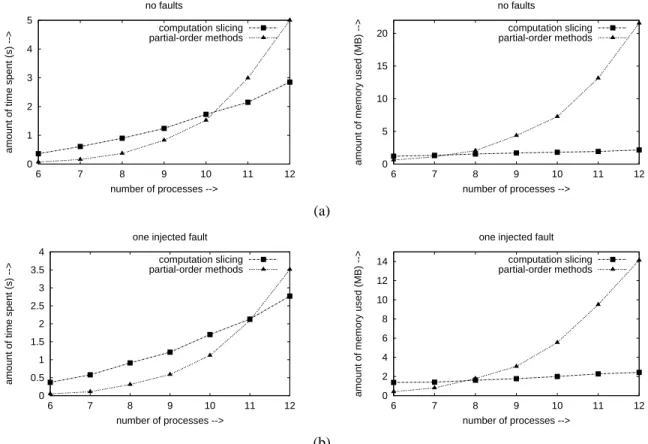
Figure 2. Primary-Secondary example with the number of events on a process upper-bounded by90 for (a) no faults and (b) one injected fault.
changing the partition, then all processes agree on the par-tition. Its complement, corresponding to a global fault, can be expressed as:
¬Idb=¬change2∧ ¬change3∧ · · · ∧ ¬changen∧
W
i,j∈[1...n], i6=j
(partitioni6=partitionj)
Note that the firstn−1clauses of¬Idbare local
predi-cates and the last clause, sayLC, is a disjunction of 2-local predicates. Thus, using the technique described in Sec-tion 4.2,LC can be rewritten as a predicate in DNF with O(n|E|) clauses. To reduce the number of clauses, we proceed as follows. Let V denote the set of values that partition1assumes in the given computation. Then it can
be verified thatLCis logically equivalent to: W v∈V (partition1=v)∧ W 26i6n (partitioni6=v)
This decreases the number of clauses, when LC is rewritten in a form suitable for slice computation, to O(n|V|). Note that|V|is bounded by the number of events on the first process, and therefore we expect n|V| to be O(|E|). As a result, the number of clauses reduces by a
factor ofn.
We use the simulator implemented in Java by Stoller, Unnikrishnan and Liu to generate computations of these protocols. Further details of the two protocols and the sim-ulator can be found elsewhere [13]. We consider two differ-ent scenarios: fault-free and faulty. The simulator always produces fault-free computations. A faulty computation is generated by randomly injecting faults into a fault-free computation. Note that in the first (fault-free) scenario, we know a priori that the computation does not contain a faulty consistent cut. We cannot, however, assume the availability of such knowledge in general. Thus it is important to study the behaviour of the two predicate detection techniques in the fault-free scenario as well.
Algorithms for slicing a computation are implemented in Java. We compare the two predicate detection techniques with respect to the following metrics: amount of time spent and amount of memory used. In case of the former tech-nique, both metrics also include the overhead of computing the slice. We run our experiments on a machine with Pen-tium 4 processor operating at 1.8GHz clock frequency and 512MB of physical memory.
un-0 0.5 1 1.5 2 2.5 3 4 5 6 7 8 9 10
amount of time spent (s) -->
number of processes --> no faults computation slicing partial-order methods 0 0.5 1 1.5 2 2.5 3 4 5 6 7 8 9 10
amount of memory used (MB) -->
number of processes --> no faults computation slicing partial-order methods (a) 0 0.5 1 1.5 2 2.5 3 4 5 6 7 8 9 10
amount of time spent (s) -->
number of processes --> one injected fault
computation slicing partial-order methods 0 0.5 1 1.5 2 2.5 3 4 5 6 7 8 9 10
amount of memory used (MB) -->
number of processes --> one injected fault
computation slicing partial-order methods
(b)
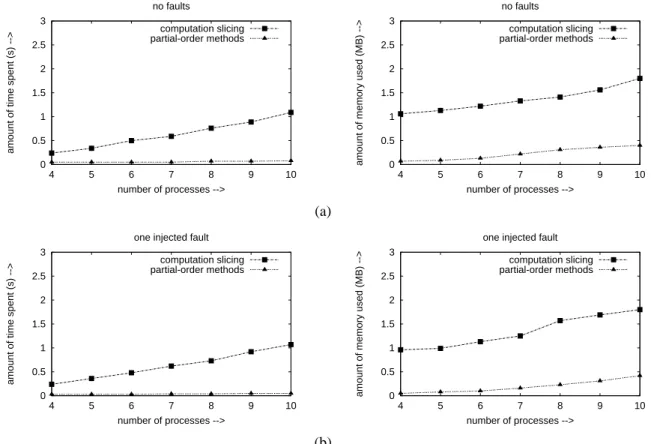
Figure 3. Database partitioning example with the number of events on a process upper-bounded by 80for (c) no faults and (d) one injected fault.
til the number of events on some process reaches 90. With computation slicing, for fault-free computations, the slice is always empty. As the number of processes is increased from 6 to 12, the amount of time spent increases from 0.36s to 2.85s, whereas the amount of memory used increases from 1.21M to 2.16M. On the other hand, with partial-order methods, they increase, almost exponentially, from 0.07s to 5.0s and 0.62M to 21.56M, respectively. Even on injecting a fault, the slice stays quite small. After computing the slice, in our experiments, we only need to examine at the most 13 consistent cuts to locate a faulty consistent cut, if any. The amount of time spent and the amount of memory used, with computation slicing, increase from 0.37s to 2.77s and 1.38M to 2.43M, respectively, as the number of processes is increased from 6 to 12. However, with partial-order meth-ods, they again increase almost exponentially from 0.05s to 3.51s and 0.41M to 14.13M, respectively. Clearly, with slic-ing, both time and space complexities for detecting a global fault, if it exists, in primary-secondary example are polyno-mial in input size for the specified range of parameters. In contrast, with partial-order methods, they are exponential in input size. Figure 2(a) and Figure 2(b) plot the variation in the two metrics with the number of processes for the two
approaches.
The worst-case performance of the partial-order meth-ods approach is quite bad. With 12 processes in the system and the limit on the memory set to 100MB, the approach runs out of memory in approximately 6% of the cases. In around two-thirds of such cases, the computation actually contains a consistent cut that does not satisfy the invariant. It may be noted that we do not include the above-mentioned cases in computing the average amount of time spent and memory used. Including them will only make the average performance of the partial-order methods approach worse. Further, performance of the partial-order methods approach appears to be very sensitive to the location of the fault, in particular, whether it occurs earlier during the search or much later or perhaps does not occur at all. Consequently, the variation or standard deviation in the two metrics is very large. This has implications when predicate detection is em-ployed for achieving software fault tolerance. Specifically, it becomes hard to provision resources (in our case, mem-ory) when using partial-order methods approach. If too lit-tle memory is reserved, then, in many cases, the predicate detection algorithm will not be able to run successfully to completion. On the other hand, if too much memory is
re-served, the memory utilization will be sub-optimal. For database partitioning example, the simulator is run until the number of events on some process reaches 80. Fig-ure 3(c) and FigFig-ure 3(d) plot the variation in the two metrics with the number of processes for the two approaches. As it can be seen, the average performance of partial-order meth-ods is much better than computation slicing. This is because substantial overhead is incurred in computing the slice. The slice itself is quite small. Specifically, for the fault-free sce-nario, the slice is always empty. On the other hand, for the faulty scenario, only at most 4 transitions need to be ex-plored after computing the slice to locate a faulty consistent cut, if any.
Even for database partitioning example, for 10 pro-cesses, the partial-order methods approach runs out of memory in a small fraction—approximately 1%—of the cases. Therefore the worst-case performance of computa-tion slicing is better than partial-order methods. To get the best of both worlds, predicate detection can be first done using the partial-order methods approach. In case it turns out that the approach is using too much memory, say more thancn|E|for some small constantc, and still has not ter-minated, it can be aborted and the computation slicing ap-proach can then be used for predicate detection.
6. Conclusion and Future Work
In this paper, we present efficient algorithms for comput-ing the slice for several classes of predicates. In addition, we also provide heuristics to compute an approximate slice for predicates for which it is otherwise intractable to com-pute the actual slice. We experimentally demonstrate that slicing can indeed be used to prune a large fraction of the set of consistent cuts in an efficient manner.
At present, our algorithms for computing a slice and therefore for detecting a predicate work in an off-line fash-ion. In the future, we plan to develop slicing algorithms that are incremental in nature. As the execution of the sys-tem progresses and more and more events become available, the current slice is updated to reflect the newly generated events.
References
[1] S. Alagar and S. Venkatesan. Techniques to Tackle State Explosion in Global Predicate Detection. IEEE Transactions
on Software Engineering, 27(8):704–714, Aug. 2001.
[2] R. Cooper and K. Marzullo. Consistent Detection of Global Predicates. In Proceedings of the ACM/ONR Workshop on
Parallel and Distributed Debugging, pages 163–173, Santa
Cruz, California, 1991.
[3] B. A. Davey and H. A. Priestley. Introduction to Lattices
and Order. Cambridge University Press, Cambridge, UK,
1990.
[4] V. K. Garg. Elements of Distributed Computing. John Wiley and Sons, Incorporated, New York, NY, 2002.
[5] V. K. Garg and N. Mittal. On Slicing a Distributed Compu-tation. In Proceedings of the 21st IEEE International
Con-ference on Distributed Computing Systems (ICDCS), pages
322–329, Phoenix, Arizona, Apr. 2001.
[6] P. Godefroid. Partial-Order Methods for the Verification of
Concurrent Systems, volume 1032 of Lecture Notes in Com-puter Science. Springer-Verlag, 1996.
[7] R. Jegou, R. Medina, and L. Nourine. Linear Space Algo-rithm for On-line Detection of Global Predicates. In J. De-sel, editor, Proceedings of the International Workshop on
Structures in Concurrency Theory (STRICT), pages 175–
189. Springer-Verlag, 1995.
[8] L. Lamport. Time, Clocks, and the Ordering of Events in a Distributed System. Communications of the ACM (CACM), 21(7):558–565, July 1978.
[9] N. Mittal. Techniques for Analyzing Distributed
Computa-tions. PhD thesis, The University of Texas at Austin, May
2002. Available athttp://www.utdallas.edu/˜neerajm. [10] N. Mittal and V. K. Garg. Computation Slicing:
Tech-niques and Theory. In Proceedings of the Symposium on
Distributed Computing (DISC), pages 78–92, Lisbon,
Por-tugal, Oct. 2001.
[11] N. Mittal and V. K. Garg. On Detecting Global Predicates in Distributed Computations. In Proceedings of the 21st IEEE
International Conference on Distributed Computing Sys-tems (ICDCS), pages 3–10, Phoenix, Arizona, Apr. 2001.
[12] S. D. Stoller and F. Schneider. Faster Possibility Detec-tion by Combining Two Approaches. In Proceedings of
the Workshop on Distributed Algorithms (WDAG), volume
972 of Lecture Notes in Computer Science (LNCS), pages 318–332, France, Sept. 1995.
[13] S. D. Stoller, L. Unnikrishnan, and Y. A. Liu. Efficient De-tection of Global Properties in Distributed Systems Using Partial-Order Methods. In Proceedings of the 12th
Inter-national Conference on Computer-Aided Verification (CAV),
volume 1855 of Lecture Notes in Computer Science (LNCS), pages 264–279. Springer-Verlag, July 2000.