AIS Electronic Library (AISeL)
PACIS 2018 Proceedings
Pacific Asia Conference on Information Systems
(PACIS)
6-26-2018
Dynamic Optimal Pricing Strategies for
Knowledge-Sharing Platforms
Jing Sun
Xiamen University, [email protected]
Xin Fu
Xiamen University, [email protected]
Shun Cai
Xiamen University, [email protected]
Hai-Rong Shi
Xiamen University, [email protected]
Follow this and additional works at:
https://aisel.aisnet.org/pacis2018
This material is brought to you by the Pacific Asia Conference on Information Systems (PACIS) at AIS Electronic Library (AISeL). It has been accepted for inclusion in PACIS 2018 Proceedings by an authorized administrator of AIS Electronic Library (AISeL). For more information, please [email protected].
Recommended Citation
Sun, Jing; Fu, Xin; Cai, Shun; and Shi, Hai-Rong, "Dynamic Optimal Pricing Strategies for Knowledge-Sharing Platforms" (2018).
PACIS 2018 Proceedings. 272.
Dynamic Optimal Pricing Strategies for
Knowledge-Sharing Platforms
Completed Research Paper
Jing Sun
School of Management, Xiamen
University
Xiamen, China
[email protected]
Xin Fu
School of Management, Xiamen
University
Xiamen, China
[email protected]
Shun Cai
School of Management, Xiamen
University
Xiamen, China
[email protected]
Hai-Rong Shi
School of Management, Xiamen
University
Xiamen, China
[email protected]
Abstract
The sharing economy is a fast-growing business model, and the sharing resources have crept from physical assets (e.g., vehicles and houses) to intangible assets (e.g., skills and knowledge). Online knowledge-sharing platforms allow sharers to offer knowledge products in various forms and can generate revenue through charging users subscription and/or transaction fees. How to charge bilateral users is an essential and complex decision-making problem that puzzles knowledge-sharing platforms. This study proposes a dynamic optimal pricing model that involves multiple development stages based on the optimal control theory. In addition, the inherent features of knowledge products and sharers’ social capitals are considered. The applicability and utility of the proposed model is verified through numerical experiments on an empirical dataset from the China’s largest knowledge-sharing platform named Zhihu. The results reveal that the platform can adjust its pricing strategies to achieve different optimization goals and this is conducive to its sustainable development.
Keywords: Dynamic pricing model, knowledge-sharing platforms, two-sided markets, knowledge-sharing economy
Introduction
With the development of community-based information technology and the emergence of Internet platforms, the sharing economy has achieved explosive growth. The sharing economy constructs new social connections, captures the most social value, and promotes the effective utilization of social resources. Users can conveniently share resources through third-party platforms (e.g., Airbnb, Uber,
Lending Club, and Taskrabbit). The sharing mechanism contributes to promote the recirculation or intensive use of resources, and also enables people to access services more effectively and efficiently. CSIC (2017) reported that the market turnover of the sharing economy in 2016 was about 34,520 billion CNY and would continue to grow at an average annual rate of 40% in the coming years. At the early stage of the sharing economy, the sharing resources are often physical assets, such as houses, vehicles and clothes. Since 2016, with the development of this business model, the intangible assets (e.g., information, knowledge, and time) are started to be included.
Over the years, free and abundant Internet content has provided users with convenient access to information, but along with the increasing complexity of content filtering. It becomes more and more difficult and expensive for users to retrieve valuable and useful knowledge from the Internet. Through years of development, online knowledge-sharing platforms not only accumulate a large number of knowledge sharers, but also attract sufficient potential consumers who have strong willingness to pay for high-quality knowledge products. This results in that the knowledge-sharing gradually shifts from the free model to the paid model. The platform becomes an essential and efficient channel that connects the supply and demand sides of the knowledge-sharing economy. Having recognized this, many knowledge-sharing platforms begin to actively explore the plausibility of knowledge transformation and have developed a variety of forms of knowledge-sharing products (e.g., Zhihu Live, Fenda, and
Himalaya FM) with promising results. It has been highlighted in CSIC (2017) that the market turnover in the area of knowledge and technology-sharing increased the most with the annual turnover reaching 610 billion CNY in 2016, therefore the year of 2016 is so-called “the first year” for knowledge-sharing economy.
In the knowledge-sharing market, there are two groups of users referred as knowledge sharers and knowledge consumers. In general, the knowledge-sharing platforms allow sharers to offer knowledge products in various form, and consumers can access products and communicate with sharers after purchases. For the generated revenues, there exist several widely adopted allocation mechanisms, including free of charge, charging transaction/fixed fees to sharers, and charging fees to both sharers and consumers. In order to retain existing active users and attract new users, platforms have to devote intensive human and financial resources for operations and promotions. At the beginning of platform development, platforms provide free services and even price subsidy for bilateral users. However, this is not conducive to the sustainable development of platforms. How to charge bilateral users is therefore an essential and complex decision-making problem that puzzles knowledge-sharing platforms. An optimal pricing model can provide pricing decision-making support for knowledge-sharing platforms to achieve operational goals, and it can also contribute to the sustainable development of knowledge-sharing economy. Recently, researchers are getting interested in the knowledge-knowledge-sharing economy, and most of the existing studies focus on exploring the influential factors of market participants’ willingness to share (Guan et al. 2018; Jin et al. 2015) or consume (Wang et al. 2013). However, research on the pricing strategies of online knowledge-sharing platforms is still scant.
Being an emerging business model, there are several distinctive factors that need to be considered in the pricing model. First, the network effect is an important feature of two-sided markets, and it indicates that the utility of a user joining a platform is mainly depended on the quantity of other users on this platform (Armstrong 2006; Caillaud and Jullien 2003). Apart from the positive cross-group network effects that have been widely discussed in the literature, it is plausible that within-group network effects (Qiu et al. 2016) and negative cross-group network effects (Kim and Tse 2011) may also exist in knowledge-sharing platforms due to online interactions. Second, the innovative knowledge product plays a vital role in the knowledge-sharing market and it has some inherent features. For example, knowledge products may have different validity periods. Also, online knowledge-sharing platforms naturally include social network information. The social capital has an impact on the degree of benefits that bilateral users can obtain from knowledge products. Third, the development process of knowledge-sharing platforms can be divided into different stages. A static pricing model with the single optimization goal (e.g., maximize short-run profits) may not be applicable to the problem at hand.
In an effort to remedy the above pressing issues and challenges, this study proposes a dynamic optimal pricing model for online knowledge-sharing platforms in a monopoly market. In order to meet different optimization goals at different development stages, three stages are innovatively considered, including the start-up, the growth, and the maturity stage. In addition, features of knowledge products (e.g., validity rates and social capitals) and two-sided markets (e.g., network effects) are considered in the pricing model. The proposed model is built upon the diffusion models that are used in the existing works of Xie and Sirbu (1995) and Kim and Tse (2011). This optimal control problem can be transformed into a two-point boundary value problem and can be solved through the optimal control theory. Because the non-linear diffusion model is difficult to find the analytical solutions, the applicability and utility of the proposed model is verified through numerical experiments on an empirical dataset from the China’s
largest knowledge-sharing platform named Zhihu. Some model parameters are also estimated to ensure the feasibility of the numerical solutions. The obtained results indicate that the platform can apply different optimal pricing strategies to satisfy diverse operational goals at different stages.
The remainder of this paper is organized as follows: this study reviews the existing studies on the optimal pricing in two-sided markets, and then proposes a dynamic optimal pricing model in the following two sections. After that, the constructed optimal problem is numerically solved through an empirical dataset, and the obtained results are discussed. The last section concludes this study and puts forward directions for future research.
Literature Review
The two-sided market is a market where one or more platforms can promote effective interactions between the supply and demand sides and attract more users to join the platform through reasonable pricing (Caillaud and Jullien 2003; Rochet and Tirole 2006). There are two significant features of two-sided markets: the non-neutrality of price structure (Rochet and Tirole 2003) and network externality (Armstrong 2006). Considering that the non-neutrality of price structure is difficult to measure, the network externality, also named the network effect, is often used to indicate whether a market is two-sided or not. The existence of network effects in two-two-sided markets has been empirically verified in online peer-to-peer (P2P) lending (Qiu et al. 2016), newspapers and magazines (Argentesi and Filistrucchi 2007; Kaiser and Wright 2006), television media (Wilbur 2008), yellow page advertising (Rysman 2004), online user-generated content (Albuquerque et al. 2012), and video games (Zhou 2017) markets. For example, Qiu et al. (2016) confirmed positive cross-group network effects in the online P2P lending market. When the market was in short supply, there also existed positive within-group network effects between lenders and negative within-group network effects between borrowers. Extant studies (Armstrong 2006; Caillaud and Jullien 2003; Hagiu 2004; Reisinger et al. 2009; Rochet and Tirole 2006) have established the general research framework of the platform optimal pricing. The optimal pricing structure is influenced by network effects (Armstrong 2006; Caillaud and Jullien 2003; Rochet and Tirole 2006), charge mode (Rochet and Tirole 2006), user's platform belonging (Armstrong 2006), price elasticity of demand (Rochet and Tirole 2006), heterogeneity of users (Reisinger et al. 2009), and product differentiation (Hagiu 2004). For instance, Hagiu (2004) explored the impact of user preference on the optimal pricing and found that the stronger the user preference for product diversity was, the more profits the platform obtained from the supply side. In summary, the platform usually adopts a skewed pricing strategy to maximize its revenue, which indicates that the platform charges more fees to one side and subsidizes the other side.
The network effect is the basis of platform pricing models. Li et al. (2010) has stated that there exist positive cross-group network effects between bilateral users in majority of cases, whereas the within-group network effects are depended on the operation situation. For example, in television media platforms, cross-group network effects on audiences from advertisers are negative due to the audiences' aversion to advertisements (Ambrus et al. 2016; Reisinger et al. 2009). There are positive cross-group network effects between two-sided users in e-commerce platforms, while negative within-group network effects may exist between consumer groups (Li et al. 2011) and/or seller groups (Belleflamme and Toulemonde 2009; Yoo et al. 2002) due to the horizontal competition. In the bandwidth markets, in addition to the positive network effects between bilateral users, there are negative network crowding effects with the limitation of the network capacity (Guo and Easley 2016).
Besides network effects, many studies have added other specific factors to the pricing model on the basis of the application features. For instance, Kim and Tse (2014) found that the equilibrium pricing strategy was depended on the transparency of searching information and the search quality of a platform in competitive search-engine markets. Hagiu and Spulber (2014) described the change of the platform equilibrium pricing in video game markets when end users had incomplete information on the price of developer. Gao (2017) proposed the conception of “mixed” two-sided markets where a user can be both buyers and sellers on e-commerce platforms, and also discussed whether a platform should adopt the bundle pricing strategies or not.
Existing literature on the optimal pricing is mainly based on the static model, which reveals the myopic behavior of users. In recent years, more and more researchers have explored the dynamic optimal pricing strategies (Filippas and Gramstad 2016; Garcia et al. 2014; Kim and Tse 2011; Sun and Tse 2007). For example, Kim and Tse (2011) discussed impacts of the complexity of knowledge, knowledge disuse rate, and cross-group network effects among questioners, answers, and accumulated knowledge on a dynamic optimal pricing model for an online Q&A platform, so as to provide suggestions on how to maintain the competitive advantage of this platform. Garcia et al. (2014) stated that the third party (i.e., the malicious users) in operating system markets had negative network effects on bilateral users, and the security of operating systems had important influence on platform competition. Different from the above literature based on network effects, Filippas and Gramstad (2016) analyzed the dynamic optimal pricing from the perspective of consumer cognition, and also found that the dynamic optimal pricing would follow the market-penetration pricing strategy when shared products wear out quickly.
In summary, prior studies on the static optimal pricing mainly based on positive cross-group network effects in traditional two-sided markets (e.g., the media and e-commerce), and they assumed that platforms charged fixed fees to users. Considering characteristics (e.g. highly personalized content and high-frequency trading) of knowledge products, charging fixed fees no longer applies to online knowledge-sharing platforms. In addition, the static model emphasizes short-term benefits rather than the long-term benefits gained by platforms, and profit-making as the single goal of platforms is also unreasonable. Further, the online community environment brings new influential factors for the pricing model. Therefore, this work tackles the above issues and challenges to fill a gap in the literature.
The Model
Overview of Basic Assumptions
According to the product lifecycle theory, a platform has different characteristics and development strategies to optimize at different stages. Existing works (Armstrong 2006; Kim and Tse 2011; Sun and Tse 2007) regarded profit maximization as the optimal goal, which seems not accord with the actual operations. Therefore, in order to better describe the whole process of platform development and optimize the operational goal, this study innovatively divides the process into three stages: the start-up, the growth, and the maturity stage, and constructs corresponding dynamic pricing models to design more reasonable pricing strategies.
Network Effects and Price Structure
This work studies dynamic optimal pricing policies under monopoly. Armstrong (2006) constructed the widely-used platform profit function and user utility function for the monopolistic two-sided network. It assumed that platform revenue came from the periodic fees charged to bilateral users, and the utility that one side users derived from joining the platform increased with the number of users on the other side and decreased with the fixed fees. Nowadays, an increasing number of online platforms offer free access to users for high user traffic, given the problem at hand, this work assumes that the platform only charges transaction fees to knowledge sharers while knowledge consumers can join the platform for free. There exist user-generated content (UGC) and platform-generated content (PGC) on the knowledge-sharing platforms. User-shared knowledge products are UGC, while PGC originates from the bundle of UGC that platforms regard as high-quality and worthy of popularizing. Similar to the online knowledge Q&A platforms, the knowledge-sharing platforms also have few banner advertisements. However, the content of banner advertising is generally UGC or PGC, which is applied to moderately boost product exposure and would not disturb users. Both PGC and banner advertisements have less influence on users, so this work assumes that the major participants on the platforms are sharers and consumers, and there are cross-group network effects between the two groups. Considering the herd behavior in online social networks (Duan 2009; Sun 2013), within-group network effects are also taken into account. In addition to sharers and consumers, the accumulated knowledge products on online knowledge-sharing platforms are another essential factor in attracting bilateral users (Kim and Tse 2011). In general, the positivity and negativity of network effects are depended on the operation situation (Li et al. 2010). In this study, the platform has different characteristics at each stage, so the positive and negative network effects vary
in different stages. Figure 1 depicts network effects among three groups at different stages, where + and - represent positive and negative network effects, respectively.
Figure 1. Network Effects at Different Stages
Parameters of Knowledge Products
The parameter 𝜂 ∈ [0,1] refers to the knowledge product validity rate and higher 𝜂 means the knowledge product has a longer life-time and upgrades slowly. In Zhihu Live platform, some knowledge products (e.g., artistic classic interpretations and summaries of basic subject knowledge) have a relatively longer life-time, while others (e.g., tips for how to choose cost-effective products on Black Friday 2017 and suggestions of how to prepare for the 2017 college entrance examination) update very fast. In the long run, knowledge products with longer life-time have more impacts on platform than those with shorter life-time. For instance, the long-lived knowledge products may weaken the strength of network effects between sharers and consumers, because the demand of consumers can be satisfied from existing accumulated knowledge products.
Second, the social capital also has an impact on the degree of benefits that bilateral users can obtain from accumulated knowledge products. Zhihu Live platform relies on the largest online Q&A community Zhihu in China, so the parameter 𝜃 ∈ [0,1] represents a sharer's social characteristics (e.g., the number of followers and the number of received thanks). The greater value of 𝜃 represents that the sharer has a greater impact, and s/he is more likely to participate in community activities (e.g., knowledge contribution behavior) continuously (Guan et al. 2018). For example, new Lives created by sharers who have a large number of followers will attract more fans to purchase. Note that each knowledge product has its own validity rate and social capital, the average 𝜂 and 𝜃 of accumulated knowledge products represent knowledge characteristics of the platform. Since accumulated knowledge products vary with stages, the value of parameters will be different at each stage.
The Diffusion Model
In a monopoly market, an optimal control problem to optimize the platform's utility is often based on the assumption of users' myopic behavior, which indicates that Internet users join the platform primarily depending on the current user scale and accumulated knowledge product scale. According to the dynamic diffusion model proposed in extant research (Kim and Tse 2011; Xie and Sirbu 1995), it assumes the diffusion process is closely related to the difference (i.e., the unsatisfied demand) between the potential demand and the current demand. Therefore, this study assumes that the diffusion speed of bilateral users (i.e., 𝐵̇(𝑡), and 𝑆̇(𝑡)) is proportional to the unsatisfied demand, and the diffusion speed of accumulated knowledge products (i.e., 𝐾̇(𝑡)) is proportional to the difference between the instantaneous
Knowledge Sharer Accumulated Knowledge Knowledge Consumers + + + +
(a) The start-up stage Maximize user scale
Knowledge Sharer Accumulated Knowledge Knowledge Consumers + + + +
(b) The growth stage Maximize user utility
+ + + + Knowledge Sharer Accumulated Knowledge Knowledge Consumers + — + +
(c) The maturity stage Maximize platform profit
growth of new knowledge products and reduction of obsolete knowledge products. The potential demand is determined by network effects and the price effect. The general form of the diffusion model can be represented as follows:
𝐵̇(𝑡) = 𝜆{𝐷5[𝐵(𝑡), 𝑆(𝑡), 𝐾(𝑡)] − 𝐵(𝑡)}
𝑆̇(𝑡) = 𝜇{𝐷9[𝐵(𝑡), 𝑆(𝑡), 𝐾(𝑡), 𝑝9(𝑡)] − 𝑆(𝑡)}
𝐾̇(𝑡) = 𝐺<[𝐵(𝑡), 𝑆(𝑡), 𝐾(𝑡)] − (1 − 𝜂)𝐾(𝑡) (1)
where 𝑏, 𝑠, and 𝑘 represent consumers, sharers, and accumulated knowledge products, respectively. 𝐵(𝑡), 𝑆(𝑡), 𝐾(𝑡), and 𝑝9(𝑡) are the numbers of consumers, sharers, accumulated knowledge products, and
per transaction fee charged to sharers, respectively, at time 𝑡. 𝐷@(𝑡)(𝑖 ∈ {𝑏, 𝑠}) refers to the potential
demand, which is affected by network effects in Figure 1. 𝐺<(𝑡) represents the instantaneous growth of new accumulated knowledge products, and 1 − 𝜂 is the disuse rate of accumulated knowledge products. 𝜆 ∈ [0,1]and 𝜇 ∈ [0,1] are diffusion rates of consumers and sharers, respectively. The growth rate of consumers or sharers is proportional to the unsatisfied consumer or sharer demand with coefficient 𝜆 or 𝜇, respectively, and the coefficient varies in different stage.
Assume that a general form of the objective function at all stages is 𝜋(𝑡). The optimal control problem in this work is to maximize the following function under constraints Equation (1):
𝑚𝑎𝑥
FG ∫ 𝑒
JKL𝜋(𝑡) 𝑑𝑡 N
LO (2)
Combined with the Pontryagin maximum principle (Aseev and Kryazhimskiy 2004), the above optimal control problem can be converted into a 6×6 two-point boundary value problem (TPBVP). Due to the space limit, the conversion steps are omitted herein. For state variables, the initial value at the growth and maturity stage is the terminal value at its previous stage. The zero-initial value at the start-up stage makes the network unable to grow over time, a positive number is assigned to overcome the “chicken and egg” problem (Caillaud and Jullien 2003). For costate variables, when 𝑇 in Equation (2) is finite, the terminal value is zero; when 𝑇 is infinite, the terminal value conforms to the transversality conditions.
The Start-up Stage
At the start-up stage, a small-scale platform has to dedicate significant resources to amassing new active users as many as possible. Therefore, the operational goal at this stage is to maximize the scale of bilateral users. Social attributes of the Zhihu platform can change user’s behavior patterns. Motivations, such as one’s curiosity, perceived value (e.g., internal satisfaction and professional reputation), peer recognition, and group-size effects, are important for one’s active participation (Jin et al. 2015). For instance, verified users with high impact and/or more social relations joining the platform can promote more users to join. Such social attributes can be reflected through knowledge products’ social capital 𝜃. At this stage, this work assumes that the factor influencing the potential users’ participation is the user scale, and the function of the platform utility and state equations are defined as:
𝑚𝑎𝑥 FG ∫ 𝑒 JKL[𝐵(𝑡) + 𝑆(𝑡)] 𝑑𝑡 LT U 𝐵̇(𝑡) = 𝜆{𝑏VW𝐵(𝑡) + 𝑏XW𝑆(𝑡) − 𝐵(𝑡)} 𝑆̇(𝑡) = 𝜇 Y𝑏ZW𝐵(𝑡) + 𝑏[W𝑆(𝑡) − 𝑟9(𝐵(𝑡) × 𝑝9(𝑡))X− 𝑆(𝑡)] 𝐾̇(𝑡) = 𝐵(𝑡) 𝐿 + 𝐵(𝑡)W𝑆(𝑡) (3) where 𝑏V and 𝑏Xare benefits for consumers from consumers and sharers, respectively; 𝑏Z and 𝑏[ are
effects of consumers and sharers on sharers, respectively; and 𝑟9 refers to the price sensitivity of sharers.
This study chooses the quadratic form of price to satisfy the assumption that the higher the price is, the faster the potential demand declines. On the other hand, the non-linear form also helps to avoid possible Bang-Bang control solutions in the optimal control problem (Sun and Tse 2007). A new knowledge product created by a sharer joins the accumulated knowledge products pool only when consumers purchase it. In general, in the period of ∆𝑡, sharers would like to share W𝑆(𝑡) knowledge products, of which 𝐵(𝑡) (𝐿 + 𝐵(𝑡))⁄ become new accumulated knowledge products with the limitation of consumer purchase intention. 𝐿 is a large positive constant to control the purchase probability of consumers.
The Growth Stage
With the development of the platform, it has accumulated a certain number of users and knowledge products. Factors at the start-up stage are no longer the only factor for potential bilateral users to participate, and users are gradually focusing on accumulated knowledge products. In order to cater to the growing demand of consumers for the content and further attract new users, the platform is dedicated to improving the quality and variety of accumulated knowledge products, which can enhance user utility obtained from the platform. Therefore, at the growth stage, the platform's operational goal is to
maximize the utility of bilateral users. Besides the user scale, the accumulated knowledge product scale is another reason for users joining the platform. The platform utility function and the diffusion model are expressed as follows:
𝑚𝑎𝑥 FG ∫ 𝑒 JKL[𝑈 5(𝑡) + 𝑈9(𝑡)] 𝑑𝑡 Lc LT 𝐵̇(𝑡) = 𝜆{𝑏V(1 + θ)W𝐵(𝑡) + 𝑏XW𝑆(𝑡) + 𝑏ZW𝐾(𝑡) − 𝐵(𝑡)} 𝑆̇(𝑡) = 𝜇 e𝑏[(1 + θ)W𝐵(𝑡) + 𝑏fW𝑆(𝑡) + 𝑏gW𝐾(𝑡) − 1 1 + θ𝑟9(𝐵(𝑡) × 𝑝9(𝑡))X− 𝑆(𝑡)h 𝐾̇(𝑡) = 𝐵(𝑡) 𝐿 + 𝐵(𝑡)W𝑆(𝑡) − (1 − 𝜂)𝐾(𝑡) (4) with the utility function 𝑈@(𝑡) (𝑖 ∈ {𝑏, 𝑠}) of bilateral users
e𝑈5(𝑡) = 𝛼5𝐵(𝑡) + 𝛽5𝑆(𝑡) + 𝛾5𝐾(𝑡)
𝑈9(𝑡) = 𝛼9𝑆(𝑡) + 𝛽9𝐵(𝑡) + 𝛾9𝐾(𝑡) − 𝑝9(𝑡)𝐵(𝑡)
where 𝛼@ is the within-group network effects coefficient, 𝛽@ and 𝛾@ refer to the cross-group network
effects coefficient. 𝑏V, 𝑏X, and 𝑏Z are benefits of the network product or service for consumers from
consumers, sharers, accumulated knowledge products, respectively. 𝑏[, 𝑏f, and 𝑏g are benefits for
sharers from consumers, sharers, accumulated knowledge products, respectively. The validity rate primarily affects the change of knowledge product scale, while the social capital is the main factor influencing user scale changes. The higher social capital indicates that the degree of benefits for sharers from consumers is enhanced due to the fan effect; on the other hand, because of the conformity, it increases the degree of benefits for consumers themselves and also decreases the price sensitivity of sharers. There are a small number of Lives involving specific events (e.g., the Spring Festival, and Tmall 11/11 Shopping Festival) that are prone to invalidation. (1 − 𝜂)𝐾(𝑡) is the proportion of accumulated knowledge products that have been eliminated due to invalidation.
The Maturity Stage
The platform has reached a plateau when the user structure is stable and accumulated knowledge products become abundant at the maturity stage. The platform struggles to achieve the goal of maximizing revenues. In general, accumulated knowledge products have negative cross-group network effects on sharers, but positive cross-group network effects on consumers (Kim and Tse 2011). With the increasing number of accumulated knowledge products, some new knowledge products are likely to replace similar existing knowledge products with premium content or lower price, which inhibits the willingness of sharing knowledge and slows down the production of new knowledge product. The objective function and state equations of the optimal control problem are represented as follows: 𝑚𝑎𝑥 FG ∫ 𝑒 JKL[(𝑝 9(𝑡) − 𝑐)𝐵(𝑡)𝑆(𝑡)] 𝑑𝑡 n Lc 𝐵̇(𝑡) = 𝜆{𝑏V(1 + θ)W𝐵(𝑡) + 𝑏X 1 + 𝜂W𝑆(𝑡) + 𝑏Z(1 + 𝜂)W𝐾(𝑡) − 𝐵(𝑡)} 𝑆̇(𝑡) = 𝜇 e𝑏[(1 + θ)W𝐵(𝑡) − 𝑏fW𝑆(𝑡) − 𝑏g(1 + 𝜂)W𝐾(𝑡) − 1 (1 + θ)(1 + 𝜂)𝑟9(𝐵(𝑡) × 𝑝9(𝑡))X− 𝑆(𝑡)h 𝐾̇(𝑡) = o1 −(1 + 𝜂)𝐾(𝑡) 𝑀 + 𝐾(𝑡) q 𝐵(𝑡) 𝐿 + 𝐵(𝑡)W𝑆(𝑡) − (1 − 𝜂)𝐾(𝑡) (5) where 𝑐 is the average cost of each transaction, including average fixed cost and average variable cost. Fixed cost refers to fixed expenses of platform operations, and variable cost mainly comes from network traffic. Consumers can acquire knowledge through accumulated knowledge products and sharers. The validity rate adjusts the degree of benefits that consumers obtain from sharers and accumulated
knowledge products. The higher validity rate implies consumers get more benefits from accumulated knowledge products and are more likely to purchase accumulated knowledge products rather than new knowledge product to be shared. The competition between sharers and accumulated knowledge products inhibits the active participation of potential sharers. Higher validity rate means more intense competition, which leads to greater losses incurred by accumulated knowledge products for sharers. Besides, an extension of the validity prolongs sharers' earning period, therefore decreasing the price sensitivity. During the time between 𝑡 and 𝑡 + ∆𝑡, sharers will share W𝑆(𝑡) knowledge products, the proportion of consumers willing to buy is 𝐵(𝑡) (𝐿 + 𝐵(𝑡))⁄ , and the probability of accumulated knowledge products meeting the purchasing needs of consumers is (1 + 𝜂)𝐾(𝑡) (𝑀 + 𝐾(𝑡))⁄ . 𝑀 is a large positive constant to control the probability of demands being satisfied by accumulated knowledge products.
Numerical Experiments
The above optimal control problem can be solved through the optimal control theory (Aseev and Kryazhimskiy 2004). This TPBVP contains 6 non-linear differential equations and 6 dynamic variables. It is difficult to derive the analytical solutions, therefore, the TPBVP is solved numerically through an empirical dataset. MATLAB package bvp4c provides a feasible way to solve a TPBVP (Kierzenka and Shampine 2001), and it is employed in this study. Due to space limit, the implementations of solving the TPBVP are omitted herein. The growth of bilateral users and accumulated knowledge products, and the dynamic optimal pricing path at different stages are numerically simulated in this section.
The Dataset
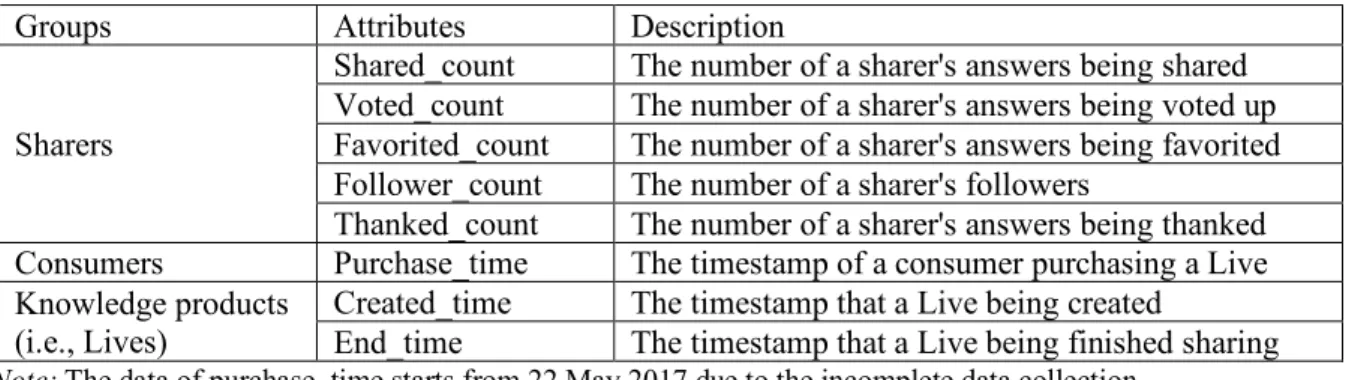
Zhihu is the China’s largest online knowledge-sharing platforms and it released a real-time interactive knowledge-sharing product, known as Zhihu Live1, in May 2016. Zhihu Live allows knowledge sharers to provide knowledge products in the form of “Live” on the platform. Within a Live, a share’s skills, experiences, and knowledge are transformed through PPT, text, voice, and video. Once a consumer purchased a Live, s/he can access all the delivered materials and can even communicate with the share in real time. This is one of the most distinct features between Live and other information goods. As one of the earliest and most successful knowledge-sharing platforms in China, Zhihu Live has attracted a large number of active users since it was launched. As of 1 December 2017, 7,122 Lives have been held on this platform, and they bring in more than 4.28 million purchases with a repurchase rate of 42%. The data used in this study is collected from Zhihu Live platform, and it contains the transaction data during the period from 27 April 2016 to 29 November 2017. The dataset consists of three groups: sharers, consumers, and knowledge products. The involved attributes in this study are summarized in Table 1.
Table 1. Description of Attributes
Groups Attributes Description
Sharers
Shared_count The number of a sharer's answers being shared Voted_count The number of a sharer's answers being voted up Favorited_count The number of a sharer's answers being favorited Follower_count The number of a sharer's followers
Thanked_count The number of a sharer's answers being thanked Consumers Purchase_time The timestamp of a consumer purchasing a Live Knowledge products
(i.e., Lives)
Created_time The timestamp that a Live being created
End_time The timestamp that a Live being finished sharing
Note: The data of purchase_time starts from 22 May 2017 due to the incomplete data collection.
Parameters Estimation
In this study, a Live's creation time, a consumer's purchasing time, and a Live's end time (i.e., created_time, purchase_time, and end_time) are regarded as the time of sharers, consumers and
accumulated knowledge products accessing the platform, respectively. The numbers of bilateral users and accumulated knowledge products would change over time, and they can be counted. Due to an order of magnitude difference in scale, this work takes the logarithm of bilateral user scale. According to Equation (1), the growth rate of the network (i.e., 𝐵̇(𝑡) and 𝑆̇(𝑡)) is proportional to the unsatisfied demand. In order to simplify the calculation, this study regards the current demand 𝐼(𝑡 + 1) (𝐼 ∈ {𝐵, 𝑆}) at time 𝑡 + 1 as the potential demand 𝐷@(𝑡) (𝑖 ∈ {𝑏, 𝑠}) at time 𝑡 to calculate the diffusion rate (i.e., 𝜆(𝑡)
and 𝜇(𝑡)) at time 𝑡. Consequently, the diffusion rate (i.e., 𝜆 and 𝜇) at a certain stage is the average of rates (i.e., 𝜆(𝑡) and 𝜇(𝑡), respectively) during a given time period.
In addition to the diffusion rate, the social capital 𝜃 can be measured by the social interaction data among users. The statistical characteristics of social capital related attributes are summarized in Table 2. As shown in Table 2, the data is highly skewed, and there is a wide divergence among individuals. To address this, this study takes the logarithm of each attribute, and adopts the min-max normalization method to normalize the data. The social capital of each knowledge product is the mean of such attributes’ values. The social capital 𝜃t (𝑗 ∈ {𝑠𝑡𝑎𝑟𝑡𝑢𝑝, 𝑔𝑟𝑜𝑤𝑡ℎ, 𝑚𝑎𝑡𝑢𝑟𝑖𝑡𝑦}) of the platform takes the average of the
social capital of all knowledge products, and such products have been accumulated from the birth of the platform to the end of a certain stage. Considering the validity rate 𝜂, platform's social capital 𝜃 is equal to 𝜃 = 𝜂 × 𝜃t. For remaining parameters that can not be estimated by the available data, this work
pre-defines their values based on the extant research (Kaiser and Wright 2006; Kim and Tse 2011; Sun and Tse 2007). It has been pointed out in Sun and Tse (2007) that the network is able to exceed the critical value and achieve growth when values of the network benefits are sufficiently large. Taken into account of these factors, this work adjusts the parameter values (e.g., benefits parameter 𝑏, probability control parameter 𝐿, 𝑀) to meet the experimental requirements.
Table 2. Statistical Characteristics of Social Capital Related Attributes
Attributes Min Max Mean S.D. Skewness
Follower_count 0 1,438,963 23,615.482 74,121.271 8.637 Shared_count 0 19,238 125.537 714.623 15.596 Voted_count 0 3,950,197 30,689.333 115,082.427 21.418 Favorited_count 0 1,212,634 22,424.128 65,039.907 7.631 Thanked_count 0 598,019 6,314.246 20,039.835 15.062
Numerical Results
The Start-up Stage
This work takes the period from 27 April 2016 to 31 August 2016 as the start-up stage, because the collected data reveals that the daily number of new Lives is relatively small and accumulated knowledge products are increasing slowly within this time period. Given that the small-scale accumulated knowledge products have limit effects on attracting users, network effects between bilateral users are the major factor for new users joining. In addition, effective measures have not been taken to accelerate the development of the platform. The values of model parameters at this stage are shown in Table 3.
Table 3. Parameters and Values at the Start-Up Stage
Parameters Values
𝑡V (time span) 127
𝜆, 𝜇 (diffusion rates) 0.15, 0.26
𝑟 (discounted rate) 0.05
𝑟9 (price-sensitivity parameter) 1
𝐿 (consuming probability control parameter) 5000
𝑏V, 𝑏X, 𝑏Z, 𝑏[ (benefits parameters) 20, 20, 10, 5
𝐵(0), 𝑆(0), 𝐾(0) (initial conditions) 10, 5, 2
The numerical solution is depicted in Figure 2, where the horizontal axis is timeline and the vertical axis represents the numerical value. By default, timeline (i.e., the units on the X-axis) is shown in days.
Figure 2 shows that both consumers and sharers have achieved growth. Since benefits for consumers (i.e., 𝑏V and 𝑏X) are greater than those for sharers (i.e., 𝑏Z and 𝑏[), the growth of consumers is much faster.
The user scale tends to be stable around time 60 due to the saturation of network effects. It is likely that some new knowledge products do not meet the demand of consumers, or sharers eventually give up sharing. Therefore, the number of accumulated knowledge products increases slowly but steadily. In order to attract as many users as possible, the platform offers free access to bilateral users throughout this stage, and this is consistent with the real scenario.
Figure 2. Numerical Results at the Start-Up Stage
The Growth Stage
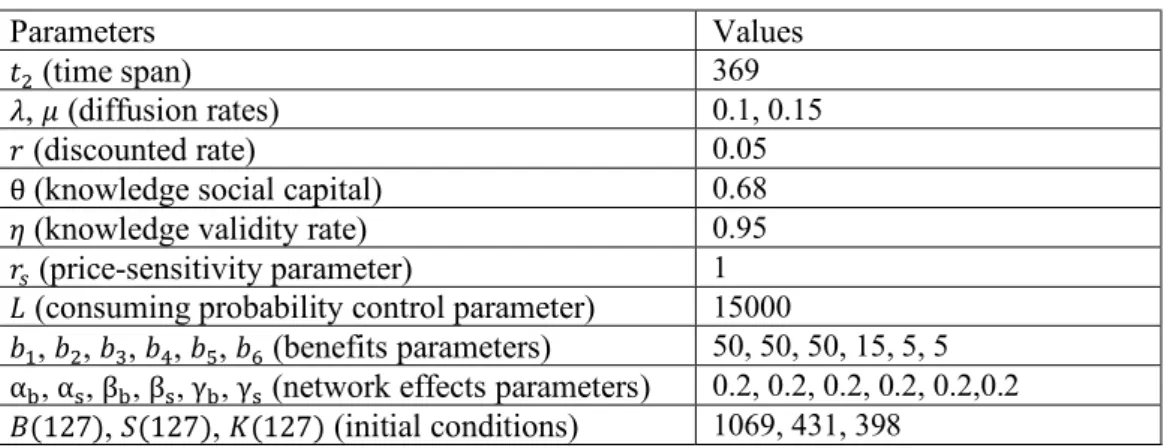
The period from 1 September 2016 to 30 April 2017 is regarded as the growth stage, because the available data reveals that the growth rate of accumulated knowledge products has obviously improved. During this stage, the platform has taken actions to accelerate its development. Varied sales promotions (e.g., discounts, bonuses, and advertisement) have been carried out to attract users since September 2016. In addition, the platform has devoted great efforts to enhance network effects by introducing more influential sharers since October 2016. Also, Zhihu officially launched the Zhihu Bookstore in September 2016, which reflects the fact that Zhihu is intended to build an integrated knowledge payment platform. Zhihu Live, as the core paid knowledge product, its operational goal is also expected to change, because the platform attaches more importance to the content of knowledge products to maximize the utility of bilateral users. Parameters and their values at this stage are summarized in Table 4.
Table 4. Parameters and Values at the Growth Stage
Parameters Values
𝑡X (time span) 369
𝜆, 𝜇 (diffusion rates) 0.1, 0.15
𝑟 (discounted rate) 0.05
θ(knowledge social capital) 0.68
𝜂(knowledge validity rate) 0.95
𝑟9 (price-sensitivity parameter) 1
𝐿 (consuming probability control parameter) 15000
𝑏V, 𝑏X, 𝑏Z, 𝑏[, 𝑏f, 𝑏g (benefits parameters) 50, 50, 50, 15, 5, 5
α}, α~, β}, β~, γ}, γ~ (network effects parameters) 0.2, 0.2, 0.2, 0.2, 0.2,0.2
𝐵(127), 𝑆(127), 𝐾(127) (initial conditions) 1069, 431, 398
The numerical solutions at the growth stage are depicted in Figure 3. Compared to the previous stage, benefits from consumers (i.e., 𝑏V and 𝑏[) and sharers (i.e., 𝑏X) for bilateral users are higher. Together
with the benefits brought from accumulated knowledge products (i.e., 𝑏Z and 𝑏g), the increase in user
scale is larger. On the other hand, because benefits from three groups for consumers are larger than those for sharers, the quantity of consumers increases the fastest. The user scale eventually stabilizes near time
0 20 40 60 80 100 120 Time 0 200 400 600 800 1000 1200
The number of knowledge consumers B(t)
Growth of knowledge consumers on the platform
0 20 40 60 80 100 120 Time 0 50 100 150 200 250 300 350 400 450
The number of knowledge sharers S(t)
Growth of knowledge sharers on the platform
0 20 40 60 80 100 120 Time 0 50 100 150 200 250 300 350 400
The number of accumulated knowledge products K(t)
Growth of accumulated knowledge products on the platform
0 20 40 60 80 100 120 Time -1 -0.8 -0.6 -0.4 -0.2 0 0.2 0.4 0.6 0.8 1 Transaction fees p s (t)
230 due to the saturation of network effects. The number of accumulated knowledge products initially decreases and then increases. Due to the small-scale sharers and insufficient purchasing intention of consumers, the number of accumulated knowledge products shows a decline at the early growth stage. However, along with the increase of users, the number of newly generated knowledge products is larger than that of old disused knowledge products, so the number of accumulated knowledge products begins to rise and finally stabilizes at the later stage of growth. Considering the operational goal of this stage is to maximize the utility of bilateral users, the platform can provide a transaction fee subsidy for sharers and further amass active users. The negative optimal price in Figure 3 indicates the price subsidy, which coincides with the actual situation.
Figure 3. Numerical Results at the Growth Stage
The Maturity Stage
This study regards the period from 1 May 2017 on as the maturity stage. It is known that Zhihu Live has charged 30% of each transaction as the transaction fee to gain revenue since May 2017, and the remainder is owned by sharers. In addition, Zhihu Market released in May 2017 further integrated four kinds of paid knowledge products: Zhihu Live, online bookstore, paid consulting, and private classes, in order to provide a uniform entrance for users. This indicates that Zhihu has realized the transition to a paid knowledge-sharing platform from a free Q&A community. Charging transaction fees to sharers represents that the platform regards maximization profits as its operational goal. Parameters and their values at this stage are summarized in Table 5.
Table 5. Parameters and Values at the Maturity Stage
Parameters Values
𝜆, 𝜇 (diffusion rates) 0.07, 0.13
𝑟 (discounted rate) 0.05
θ(knowledge social capital) 0.49
𝜂(knowledge validity rate) 0.7
𝑐(average cost) 0.01
𝑟9 (price-sensitivity parameter) 1
𝑀(demanding probability control parameter) 600
𝐿 (consuming probability control parameter) 16000
𝑏V, 𝑏X, 𝑏Z, 𝑏[, 𝑏f, 𝑏g (benefits parameters) 60, 60, 60, 5, 10, 10
𝐵(369), 𝑆(369), 𝐾(369) (initial conditions) 14062, 3397, 564
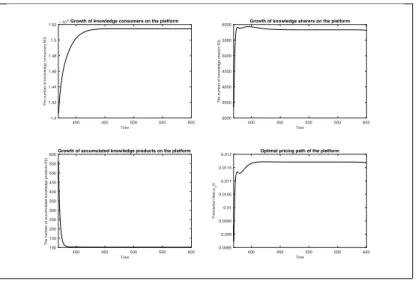
Figure 4 depicts the numerical results at the maturity stage. Although benefits from bilateral users (i.e., 𝑏V and 𝑏X) and accumulated knowledge products (i.e., 𝑏Z) for consumers slightly increase compared to
the growth stage, the increase in the consumer scale has slowed down due to a small increase in the number of sharers and a decrease in the number of accumulated knowledge products. The saturation of network effects causes the consumer scale to reach a steady state around time 440. The increase in the
150 200 250 300 350 Time 0 5000 10000 15000
The number of knowledge consumers B(t)
Growth of knowledge consumers on the platform
150 200 250 300 350 Time 0 500 1000 1500 2000 2500 3000 3500
The number of knowledge sharers S(t)
Growth of knowledge sharers on the platform
150 200 250 300 350 Time 250 300 350 400 450 500 550 600
The number of accumulated knowledge products K(t)
Growth of accumulated knowledge products on the platform
150 200 250 300 350 Time -11 -10 -9 -8 -7 -6 -5 -4 -3 -2 -1 Transaction fees p s (t)
number of consumers has a positive effect on the sharers’ growth at the early maturity stage. However, fewer benefits from consumers (i.e., 𝑏[), losses from sharers and accumulated knowledge products (i.e.,
𝑏f and 𝑏g), and transaction fees (i.e., 𝑝9) all lead to a slight decrease in the sharer scale at the later stage
of maturity. Reasons for the significant decline in the number of accumulated knowledge products are the slower speed of knowledge product generation, which is caused by a reduction in the sharer scale and consumers’ consumption preference for accumulated knowledge products; for another, the faster speed of knowledge product disuse due to market saturation and severe competition. The knowledge-sharing market has gradually matured, so the platform can charge sharers transaction fees to gain some revenue, and it is in consonance with the practical condition.
Figure 4. Numerical Results at the Maturity Stage
In summary, at the start-up stage, the small-scale platform adopts the free strategy to expand the user scale; as the user scale has stabilized under the strategy of free access, the platform subsidizes sharers at the growth stage to further amass users and improve the user utility. At the maturity stage, since the platform has accumulated the sufficient numbers of users and accumulated knowledge products, income can be obtained by charging sharers transaction fees. The above results are consistent with the actual situation of Zhihu Live platform. The small-scale Zhihu Live has taken actions (e.g., discounts, bonuses, coupons, and the introduction of external resources) to amass users at early stages. When the platform grows to a certain size and gains enough influence, it begins to charge transaction fees to sharers for revenues. In addition, because Zhihu Live is one of the largest and most successful online knowledge-sharing platforms in China, those optimal pricing strategies, which are compliant with the real scenario, also provide guidance for other emerging knowledge-sharing platforms. It can also help these platforms design more customized pricing strategies according to their development.
Conclusion and Future Directions
This study proposes a dynamic optimal pricing model for online knowledge-sharing platforms in the monopoly two-sided market. Based on the optimal control theory, the pricing problem at hand can be converted to a two-point boundary value problem, and it can be numerically solved to derive the optimal pricing strategies. The proposed model has been applied to an empirical dataset from the China’s largest knowledge-sharing platform. Some parameters are also estimated to ensure the feasibility of the numerical solutions according to the available data. The results indicate that the scale of bilateral users and accumulated knowledge products, and the dynamic optimal pricing path finally stabilize due to the saturation of network effects. The optimal pricing strategies at different stages are consistent with the practical conditions of Zhihu Live platform. The platform applies the free or price subsidy strategy to expand the user scale and increase the user utility at early stages. It then charges transaction fees to sharers to gain revenues when the platform is mature. It is also advantageous for burgeoning knowledge-sharing platforms to devise more appropriate pricing strategies to their long-term development. This study has several theoretical and practical contributions. First, since the development trajectory of the platform presents a life-cycle trend, the entire development process is innovatively divided into three
400 450 500 550 600 Time 1.4 1.42 1.44 1.46 1.48 1.5 1.52
The number of knowledge consumers B(t)
104Growth of knowledge consumers on the platform
400 450 500 550 600 Time 3000 3500 4000 4500 5000 5500 6000
The number of knowledge sharers S(t)
Growth of knowledge sharers on the platform
400 450 500 550 600 Time 100 150 200 250 300 350 400 450 500 550 600
The number of accumulated knowledge products K(t)
Growth of accumulated knowledge products on the platform
400 450 500 550 600 Time 0.0085 0.009 0.0095 0.01 0.0105 0.011 0.0115 0.012 Transaction fees p s (t)
stages, namely, the start-up, the growth, and the maturity stage. Then, the prior research generally builds a static pricing model to gain short-term benefits, the construction of a dynamic optimal pricing model can help the platform to better develop pricing strategies. Second, different kinds of network effects and the inherent features of knowledge products (e.g., validity rate and social capital) are taken into account in the pricing model. For example, because accumulated knowledge products have important effects for attracting bilateral users on platforms, network effects of accumulated knowledge products are considered. Also, due to the herd behavior in online social networks (Duan 2009; Sun 2013), the within-group network effects are included and discussed. Third, different from existing studies, some of the model parameters are derived from the collected empirical data. This enables the proposed model provide more practical implications. Further, the proposed pricing model is general, and it can be readily applied to other online knowledge-sharing platforms to provide pricing decision support. Such platforms can choose the most appropriate pricing strategy according to their development stages. This also contributes to the sustainable development of the knowledge-sharing economy, and it helps to form a mature business model of this industry.
Although some preliminary promising results have obtained, this study inevitably has several limitations that may trigger further research. The dynamic pricing model is built on the assumption of network effects. Although such effects have been greatly discussed and verified in prior studies, they can also be empirically examined by using the available dataset. Second, the robustness checks of model parameters (e.g., the knowledge product validity rate, social capital, and benefits of the network) will be conducted in the future work. Third, this work studies optimal pricing strategies under the monopoly, pricing strategies under competitive environment will be further discussed.
Acknowledgements
This work is supported by the National Natural Science Foundation of China (Nos. 91746103 and 71301133) and the Fundamental Research Funds for the Central Universities (Project No. 20720161044).
References
Albuquerque, P., Pavlidis, P., Chatow, U., Chen, K.-Y., and Jamal, Z. 2012. “Evaluating Promotional Activities in an Online Two-Sided Market of User-Generated Content,” Marketing Science (31:3), pp. 406-432.
Ambrus, A., Calvano, E., and Reisinger, M. 2016. “Either or Both Competition: A "Two-Sided" Theory of Advertising with Overlapping Viewerships,” American Economic Journal: Microeconomics
(8:3), pp. 189-222.
Argentesi, E., and Filistrucchi, L. 2007. “Estimating Market Power in a Two-Sided Market: The Case of Newspapers,” Journal of Applied Econometrics (22:7), pp. 1247-1266.
Armstrong, M. 2006. “Competition in Two-Sided Markets,” The RAND Journal of Economics (37:3), pp. 668-691.
Aseev, S. M., and Kryazhimskiy, A. V. 2004. “The Pontryagin Maximum Principle and Transversality Conditions for a Class of Optimal Control Problems with Infinite Time Horizons,” SIAM Journal on Control and Optimization (43:3), pp. 1094-1119.
Belleamme, P., and Toulemonde, E. 2009. “Negative Intra-Group Externalities in Two-Sided Markets,”
International Economic Review (50:1), pp. 245-272.
Caillaud, B., and Jullien, B. 2003. “Chicken & Egg: Competition among Intermediation Service Providers,” The RAND Journal of Economics (34:2), pp. 309-328.
CSIC 2017. “The 2017 China Sharing Economy Development Report,” China State Information Centre. http://www.sic.gov.cn/archiver/SIC/UpFile/Files/Htmleditor/201703/20170302125144221.pdf Duan, W.-J. 2009. “Informational Cascades and Software Adoption on the Internet: An Empirical
Investigation,” MIS Quarterly (33:1), pp. 23-48.
Filippas, A., and Gramstad, A. R. 2016. “A Model of Pricing in the Sharing Economy: Pricing Dynamics with Awareness Generating Adoptions,” in Proceedings of the 37th International Conference on Information System, Dublin, Ireland. pp. 1-17.
Gao, M. 2017. “Platform Pricing in Mixes Two-Sided Markets,” International Economic Review, Forthcoming. https://ssrn.com/abstract=2993671.
Garcia, A., Sun, Y., and Shen, J. 2014. “Dynamic Platform Competition with Malicious Users,”
Dynamic Games and Applications (4:3), pp. 290-308.
Guan, T., Wang, L., Jin, J.-H., and Song, X.-L. 2018. “Knowledge Contribution Behavior in Online Q&A Communities: An Empirical Investigation,” Computers in Human Behavior (81:1), pp. 137-147.
Guo, H., and Easley, R. F. 2016. “Network Neutrality Versus Paid Prioritization: Analyzing the Impact on Content Innovation,” Production and Operations Management (25:7), pp. 1261-1273.
Hagiu, A. 2004. “Two-Sided Platforms: Pricing and Social Efficiency,” RIETI discussion paper series
04-E-035, Research Institute of Economy, Trade and Industry, Japan.
Hagiu, A., and Halaburda, H. 2014. “Information and Two-Sided Platform profits,” International Journal of Industrial Organization (34:1), pp. 25-35.
Jin, J.-H., Li, Y.-J., Zhong, X.-J., and Zhai, L. 2015. “Why Users Contribute Knowledge to Online Communities: An Empirical Study of an Online Social Q&A Community,” Information & Management (52:1), pp. 840-849.
Kaiser, U., and Wright, J. 2006. “Price Structure in Two-Sided Markets: Evidence from the Magazine Industry,” International Journal of Industrial Organization (24:1), pp. 1-28.
Kierzenka, J., and Shampine, L. F. 2001. “A BVP Solver Based on Residual Control and the MATLAB PSE,” ACM Transactions on Mathematical Software (27:3), pp. 299-316.
Kim, K., and Tse, E. 2011. “Dynamic Competition Strategy for Online Knowledge-Sharing Platforms,”
International Journal of Electronic Commerce (16:1), pp. 41-76.
Kim, K., and Tse, E. 2014. “Search Engine Competition with a Knowledge-Sharing Service,” Decision Support Systems (66:1), pp. 180-195.
Li, L.-X., Chai, Y.-T., and Liu, Y. 2011. “Inter-Group and Intra-Group Externalities of Two-Sided Markets in Electronic Commerce,” Journal of Service Science and Management (4:1), pp. 52-58. Li, S.-L., Liu, Y.-P., and Bandyopadhyay, S. 2010. “Network Effects in Online Two-Sided Market
Platforms: A Research Note,” Decision Support Systems (49:2), pp. 245-249.
Qiu, J.-X., Nie, F.-Q., Tong, M., and Hu, G.-H. 2016. “Two-Sided Characteristics of the Third-Party Electronic Market: Evidence from Online Peer-to-Peer Lending Marketplace,” Journal of Management Science in China (19:1), pp. 47-59.
Reisinger, M., Ressner, L., and Schmidtke, R. 2009. “Two-Sided Markets with Pecuniary and Participation Externalities,” The Journal of Industrial Economics (57:1), pp. 32-57.
Rochet, J. C., and Tirole, J. 2003. “Platform Competition in Two-Sided Markets,” Journal of the European Economic Association (1:4), pp. 990-1029.
Rochet, J. C., and Tirole, J. 2006. “Two-Sided Sarkets: A Progress Report,” The RAND Journal of Economics (37:3), pp. 645-667.
Rysman, M. 2004. “Competition between Networks: A Study of the Market for Yellow Pages,” The Review of Economic Studies (71:2), pp. 483-512.
Sun, H.-S. 2013. “A Longitudinal Study of Herd Behavior in the Adoption and Continued Use of Technology,” MIS Quarterly (37:4), pp. 1013-1042.
Sun, M.-C., and Tse, E. 2007. “When Does the Winner Take All in Two-Sided Markets?” Review of Network Economics (6:1), pp. 16-40.
Wang, Y.-S., Yeh, C.-H., and Liao, Y.-W. 2013. “What Drives Purchase Intention in the Context of Online Content Services? The Moderating Role of Ethical Self-efficacy for Online Piracy,”
International Journal of Information Management (33:1), pp. 199-208.
Wilbur, K. C. 2008. “A Two-Sided, Empirical Model of Television Advertising and Viewing Markets,” Marketing Science (27:3), pp. 356-378.
Xie, J.-H., and Sirbu, M. 1995. “Price Competition and Compatibility in the Presence of Positive Demand Externalities,” Management Science (41:5), pp. 909-926.
Yoo, B., Choudhary, V., and Mukhopadhyay, T. 2002. “A Model of Neutral B2B Intermediaries,”
Journal of Management Information Systems (19:3), pp. 43-68.
Zhou, Y.-Y. 2017. “Bayesian Estimation of a Dynamic Model of Two-Sided Markets: Application to the U.S. Video Game Industry,” Management Science (63:11), pp. 3874-3894.