S T U D Y P R O T O C O L
Open Access
The effect of skin-to-skin contact at birth,
early versus immediate, on the duration of
exclusive human lactancy in full-term
newborns treated at the Clínica
Universidad de La Sabana: study protocol
for a randomized clinical trial
Sergio Agudelo
1,2*, Oscar Gamboa
3, Fabio Rodríguez
3, Sandra Cala
3, Nathalie Gualdrón
3, Evelyn Obando
3and María Lucía Padrón
3Abstract
Background:Human lactancy is a simple and cost-effective strategy that influences infant and maternal mortality rates. Skin-to-skin contact (SSC) is an immediate postpartum period strategy that has proven to benefit the initiation and continuation of human lactation and to decrease hospitalization during the first week of life. This study aims to determine the effect of SSC initiation at birth (immediate versus early) in healthy, full-term newborns treated at the Universidad de La Sabana Clinic on the duration of exclusive human lactation.
Methods/design:A randomized, blind clinical trial will be performed with full-term healthy newborns born at the Universidad de La Sabana Clinic. The blind trial participants will be those persons measuring the results and analyzing the data. The sample size will be calculated for a type I error of 5 %, a two-tailed type II error of 20 %, and an estimated percentage loss of 30 %; 150 infants will be included in each group. Randomization will be performed using permuted, size-6 blocks. Descriptive analysis will be conducted using central tendency and dispersion measurements. A bivariate analysis will be performed to determine which variables are associated with exclusive lactancy at 6 months. For continuous variables, Student’sttest will be used for independent samples, and the Wilcoxon rank sum test will be used if the assumptions of normality for thettests are not fulfilled. The assumption of normality will be evaluated using the Shapiro-Wilk and Kolmogorov-Smirnov tests. Categorical variables in contingency tables will be constructed to assess the independence between variables using the chi-square test, or Fisher’s exact test when the assumption of the number of cases is not met by the values in the contingency tables multiplied by two. This will be calculated as a measurement of the effect of relative risk (RR) with confidence intervals; the adjusted measurements will be calculated using a multivariate regression Poisson model. Variables with significant results will be used in the bivariate analysis, and those with biological plausibility will be used for the adjustment. The analysis will be carried out for a two-tailed
(Continued on next page)
* Correspondence:[email protected] 1
Universidad de La Sabana, Clínica Universidad de La Sabana, Chía, Cundinamarca, Colombia
2
Assistant professor Universidad de La Sabana, Neonatal Care Unit Coordinator of Clínica Universidad de La Sabana, Campus Puente del Común, Km. 7 Autopista al Norte de Bogotá, 53753 Chía, Cundinamarca, Colombia
Full list of author information is available at the end of the article
(Continued from previous page)
type I error level of 5 %. The Stata 11 program will be used for data analysis. An interim analysis will be performed upon the submission of half the expected events (106), setting limits for the early termination of the trial according to the method proposed by Pampallona and Tsiatis (1994). Intervention: There will be two SSC randomization groups: early versus immediate. After completing the neonatal adaptation process and based on the group assignment, the mother will be left with her newborn child in hospital accommodation. Prior to discharge, the Infant Breast-Feeding Assessment Tool (IBFAT) will be applied. Monitoring will initially be performed with a face-to-face assessment between 3 and 10 days of life, followed by monthly telephone calls for 6 months to verify lactation status.
Discussion:SSC at birth has shown benefits in the short and long term for both the mother and the full-term newborn. Although the meta-analysis that have been done have shown the benefits of this technique, multiple differences in the SSC interventions have been identified because criteria such as the initiation or duration of SSC (dose) have not been unified. Colombia has a malnutrition risk of 11,4 % in the total population for the period 2012-2014, so it is necessary to promote strategies that generate a positive impact on the duration of human lactation, providing support from the clinical setting of humanized delivery which is included in the IAMI strategy (Instituciones Amigas de la Mujer y la Infancia–Friends of Women and Children Institution). Therefore, we propose that the initiation time of SSC in full-term new-borns is related to the duration of exclusive human lactation.
Trial registration:Registered ClinicalTrials.gov Identifier: NCT 02687685. Registered on 2 February 2016. This study is not yet open for participant recruitment.
Keywords:Breast feeding, Skin-to-skin contact
Background
Scientific background and justification
The first 2 h of a baby’s life has been defined as the optimum time to begin human lactation. Skin-to-skin contact (SSC) between newborn and mother in this period improves the chance of successful lactancy in the first hour of life and in the long term [1, 2]. The exclu-sive use of breast milk is the optimal food for infants in the first 6 months. The SSC birth involves placing the naked newborn in the prone position on the bare chest of the mother, drying and covering the baby’s head with a cap and the baby and mother with a sheet. This strat-egy offers benefits to the mother and baby in both the short and long term. Secondary complications for the mother (e.g., mastitis) often lead to inadequate breast-feeding whereas adequate breastbreast-feeding decreases rates of maternal postpartum bleeding and depression, leads to greater cardiorespiratory and thermal stability of the newborn and a decrease in the need for newborn hospitalization within the first week of life; it also initi-ates the colonization of the mother’s own gut flora in the newborn which leads to a decreased risk of infection [3–5], a lower incidence of infectious diseases in the first year of life, and a positive impact on reducing the risk of obesity and of contracting chronic noncommunicable diseases; these human lactation benefits are directly re-lated to the duration of lactation [6, 7].
The SSC strategy has been applied at different times at birth and for different time durations, the latter being understood as being a dose of SSC. Depending on the time of initiation of the SSC intervention, it has been
divided into subcategories (Table 1) [3]. Although the optimum duration for SSC has not been defined, it has been accepted that we must continue and maintain it at least until the baby has completed its first proper suck-ing of the breast and is physiologically stable [1, 3, 6]. In Colombia, in the 2013 Clinical Practice Guidelines of the Ministry of Health and Social Protection for healthy newborn care, it is recommended that SSC should be made immediately during the postpartum procedure while performing immediate interventions and postpon-ing newborn adaptation measures in order to prevent the separation of the newborn from their mother in the immediate newborn period [8]. In the obstetric litera-ture, it is not clear if the benefits of the strategy remain independent of the initiation time of SSC at birth [3]. In Colombia however, the average duration of exclusive lac-tancy is 1.8 months which is well below the worldwide recommendation; additionally, only 56.6 % of Colombian mothers feed their babies breast milk in the first hour of life [9]. Currently, widespread care practices for mothers and newborns in hospitals and care centers make it common for the mother and baby to be separated in the immediate moment following birth, breaking the bond-ing link between them at this time and alterbond-ing the ratio and benefits deriving from this contact [10, 11].
State of the art
Variability is evident in both clinical practice and the ob-stetric literature for both the optimum start time for implementing SCC and its optimum duration, which has created heterogeneous strategy results in research stud-ies as well as interpretation. No studstud-ies have been con-ducted comparing the different SSC initiation times regarding breastfeeding, while recommendations have been made to study whether the initiation time makes a difference in the benefits of the technique [3].
Interventions at birth and the practice of separating the baby from the mother at birth have negative effects on the initiation of breastfeeding. A cross-sectional study of the factors involved in the initiation of lactancy within the first hour of life was conducted in different hospitals in Rio de Janeiro between 1999 and 2001 [11], and found that human lactation occurring during the first hour of life was less frequent if infants were sub-jected to immediate interventions after birth (odds ratio (OR) 0.47, 95 % confidence interval (CI) 0.15 to 0.80), if mothers had no contact with their newborns in the de-livery room (OR 0.62, 95 % CI 0.29 to 0.95), if mothers were undergoing caesarean section (OR 0.48, 95 % CI 0.24 to 0.72) and if mothers were treated at private insti-tutions. Regarding practices that promote exclusive breastfeeding during the hospital stay postpartum, Bramson et al. [12] in California, USA, conducted a co-hort study; the analysis of multivariate logistic regression showed that the following factors –intention of breast-feeding before birth, the sociodemographic characteris-tics of the mother and early SSC applied within the first 3 h of the birth–all correlated positively with exclusive human lactancy during the hospital stay. In addition, a link between the duration of the SSC (dose) and exclu-sive human lactancy was revealed and there is a directly proportional relationship between the dose or time and exclusive lactancy: contact time between 1 and 15 min (OR 1.37, 95 % CI 1189 to 1593), 16 and 30 min (OR 1.66, 95 % CI 1468 to 1888), 31 and 59 min (OR 2.35, 95 % CI 2061 to 2695), and more than an hour (OR 3.14, 95 % CI 2905 to 3405).
Carfoot et al. [13] conducted a randomized clinical trial in the UK in order to assess the effects of early SSC in healthy newborns over 36 weeks on the initiation and duration of human lactation. It included 204 mothers and their newborns who were divided randomly into two groups: early SSC (n= 102): initiated at birth, delay-ing the adaptation intervention until after contact, the
duration was at least 45 min until the first feed was completed or the mother chose to withdraw the SSC and the control group, were receiving routine care (n= 102) understanding this to mean that once born, the routine adaptation interventions are applied, separating the newborn from the mother and/or parent. The inves-tigators measured the success of the first breastfeed as a primary result and as secondary results they measured exclusive lactancy until 4 months, thermoregulation in the first hour of life and the mother’s degree of satisfac-tion. The IBFAT (Infant Breast feeding Assessment Tool) scale was used to evaluate the success of the baby’s first breastfeed. They found that the success of the first feed within the first hour of life was higher in the SSC group (mean 8 %, 95 % CI 1.6 % to 17.6 %) and also higher for the duration of exclusive breastfeeding until the first 4 months of life. Likewise, the thermal stability of the baby was better in the SSC group and mothers also reported greater satisfaction in this group.
Villalón et al. [14] in Chile, conducted a prospective randomized study with newborns of between 38 and 42 weeks’ gestation and weighing between 2500 and 4250 g at birth; the intervention group was defined as
early SSC in which the baby and mother have contact at birth and SCC was continued for 4 h. The control group was defined as the post-birth routine care
group in which the mother is separated from the newborn in order for adaptation care routines to be applied. They evaluated lactancy independent of whether suction took place at birth or not and they considered 2 to 4 h as adequate time for exclusive lactancy and inadequate for those requiring whole or mixed formula feeding. Significant differences were found in favor of the group using early SSC in exclu-sive breastfeeding at 24 h of life (89.9 % versus 63.3 %, p< 0.001), at discharge from hospital (93.3 % versus 66.7 %, p< 0.001), and at 14 days of age (78.8 % versus 56.2 %, p< 0.02).
[image:3.595.57.552.99.135.2]The systematic review by the Cochrane Collaboration [3] found that the SSC has positive effects on human lactation during the first to fourth months of life (OR 1.82, 95 % CI 1.08 to 3.07) and a positive effect on the duration of lactancy (mean difference 42.55, 95 % CI −1.69 to −86.79). Trends in improvement in the overall scores of maternal affection during lactancy, as well as in maternal attachment behaviors, were also found. Other reported benefits are that the new-borns cry less (mean difference −0.01, 95 % CI −8.98 Table 1Subcategories on the time of initiation of skin-to-skin contact (SSC) intervention
At birth or immediately Very early Early When contact is made within the
first minute of birth
Within the first 30 to 40 min after birth and after the mediate and immediate neonatal adaptation interventions have been carried out
to−7.04). No adverse effects were observed or reported. It is important to note that the reviewers reported limita-tions given the variability in the intervention (initiation time of contact and duration) and the definition of variables; proposing SSC initiation time subcategories (immediate,birth,very early, andearly), thus highlighting the need for studies investigating the benefits of the tech-nique in this field.
As to the time of SSC and its duration, Takahashi et al. [15] evaluated the effectiveness of the initiation time and the duration of the SSC using by three indices: the measurement of stress-related cortisol in saliva, circula-tory evaluation of heart rate and respiracircula-tory adaptation, and oxygen saturation. They found that the body temperature at 60 min and 120 min was lower in the SSC birth group (p< 0.001) compared to the very early group (p< 0.05), but all remained within normal ranges. A faster heart rate stability was found in the SSC birth
group compared to early(p= 0.001), there were no sig-nificant differences in respiratory adaptation. Stress levels as indicated by the cortisol level were lower in babies who were in SSC for more than 60 min com-pared to those who were in SSC for less than 60 min (p= 0.046). This study concludes that early SSC within the first 5 min of life, with a continuous dur-ation of more than 60 min, reduces the stress on the baby and improves cardiopulmonary stability at birth.
In Iran, Aghdas et al. [16] evaluated the effect of immediate SSC efficacy for human lactation through a randomized clinical trial with first-time mothers, mea-sured by the BSES (Breastfeeding Self-efficacy Scale) until day 28. The mothers were randomized into two groups:earlySSC, in which the newborn was left in SSC with the mother from birth for 2 h, postponing interven-tions up until that point; and routine care, in which the baby was taken to the radiant heat lamp once the umbil-ical cord had been cut in order to proceed with the interventions. The success of the first breastfeed was evaluated as a secondary result using the IBFAT and the average first lactation. In the SSC group, the self-efficacy in human lactation (BSES) score was 53.42 (standard de-viation (SD) 8.57) versus 49.85 (SD 5.5) in the control group (p= 0.0003). The successful initiation of human lactation was 56.6 % in the intervention group versus 35.6 % in the control group (p= 0.02) and finally, the ini-tiation time of the first feed was 21.98 ± 9.1 min in the SSC group versus 66.55 ± 20.76 min in the routine care group (p= 0.001).
Infant Breast-Feeding Assessment Tool (IBFAT)
Various tools or tests to assess lactancy have been devel-oped. The IBFAT tool was developed and published by Matthews et al. in 1993 to evaluate the behavior of the baby during sucking and swallowing, with a reliability of
91 % [17]. Using six items, the behavior of the baby was quantified and evaluated during lactancy in the first week of life and the focus was concentrated on both the baby and the mother.
Schlomer et al. [18] evaluated two scores as tools to as-sess lactancy, to correlate problems during lactancy and the degree of maternal satisfaction. The LATCH tool, which is a system for the documentation of lactation, identifies areas where intervention is required to support lactancy and focuses on the role of the mother in the process of breastfeeding whereas the IBFAT scale focuses on the baby during feeding. They found that as the scores of both instruments increased there was a tendency to an increase in maternal satisfaction with a decrease in breast-feeding problems, but this was not statistically significant (LATCHr= 0.5,p= 0.06 and IBFATr= 0.49,p= 0.06).
Riordan et al. [19] initially included the IBFAT, MBA (Mother-Baby ASSESS tool) and LATCH tools to assess the reliability and validity of three clinical assessment in-struments for lactancy evaluation. They found that the coefficient reliability was not acceptable for clinical decision-making. Subsequently, Altuntas et al. [20] in 2104, again assessed the validity and reliability of these three scales, finding a positive and significant correl-ation; the MBA tool had a correlation ranging from 0.81 to 0.88, the IBFAT from 0.9 to 0.95, and the LATCH tool between 0.85 and 0.91. They concluded that the three scales or tools are compatible, reliable, and appropriate to evaluate the efficiency of lactancy.
Objectives
To determine the effect of immediate versus early SSC birth on the duration of exclusive human lactancy in healthy, full-term newborns in the Universidad de La Sabana Clinic.
Specific objectives
To evaluate the competence of the newborn human lactancy in the first 24 h of life by using the IBFAT instrument among newborns in immediate SSC compared with early SSC
To determine the prevalence for hospitalization and admission to the neonatal intensive care unit (NICU) in the first week of life between the two SSC groups (immediate versus early)
Hypothesis
○Alternative hypothesis: there is a difference in the percentage of healthy, full-term newborns receiving exclusive human breastfeeding for three or more months between the immediate versus early birth SCC groups:RR≠1
Methods/design
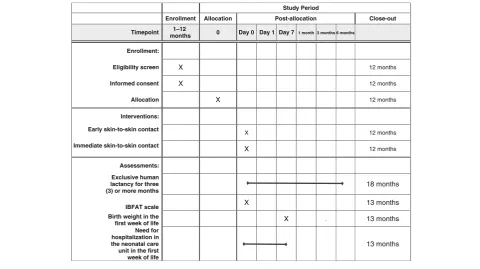
Participants, interventions, and outcomes (see: Table 2 Schedule of enrolment, interventions, and assessments)
Participants
Included healthy, full-term newborns treated at the Universidad de La Sabana Clinic who meet the following criteria:
○Inclusion criteria:
▪Infants of mothers who prenatally express their desire to breastfeed their newborn baby
▪Full-term newborns who are defined, by obstetric method and confirmed by pediatric method (Ballard), as being between 37 and 42 weeks of gestation with appropriate weight for gestational age (between 10th and 90thpercentiles for gestational age)
▪Delivered by vaginal birth
▪Do not require basic or advanced neonatal resuscitation maneuvers
▪Have healthy and stable cardiorespiratory systems at birth
▪Have been permitted to room with the mother
○Exclusion criteria:
▪Mothers and newborns who present absolute or relative contraindications for human lactancy
▪Multiple pregnancies and births
▪Mothers with postpartum complications that limit the onset of human lactation
▪Major fetal congenital malformations that prevent human lactation
Interventions
According to the assigned group, early or immediate SSC will take place.
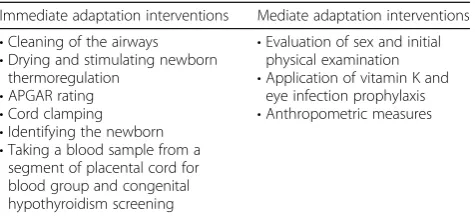
[image:5.595.56.537.461.730.2]Early SSC group (control group) At birth, the baby will be dried and placed on the abdomen and chest of their mother where thermoregulation maneuvers are applied once cord clamping has been completed. At this time, the baby will placed under the radiant heat lamp in order to complete all newborn adaptation in-terventions. Once stable, the mother and the baby will proceed with the initiation of SSC for at least 1 h or until the baby has completed the first lactation ad-equately; SSC will be allowed to continue if the mother expresses a desire to do so. During SSC, the mother and baby will receive monitoring by health personnel. All adaptation interventions, mediate and immediate (Table 3), in the newborn will take place under the radiant heat lamp during the first postnatal hour.
Table 2Schedule of enrollment, interventions, and assessments
Study Period
Enrollment Allocation Post-allocation Close-out
1–12
months 0
X 12 months
X 12 months
X 12 months
X 12 months
X 12 months
18 months
X 13 months
X . 13 months
13 months 1 month 3 months 6 months
Immediate SSC (intervention group) At birth, the baby will be dried and placed at the mother’s breast where thermoregulation maneuvers will be applied and, once cord clamping has taken place, the baby will be left in SSC with the mother where the immediate neonatal adaptation interventions will take place. Mother and baby will be left in SSC for at least 1 h or until the baby has completed its first lactation properly. Once com-pleted, the baby will be taken to the heat lamp to per-form and complete all the newborn mediate adaptation interventions. If the mother expresses the desire to con-tinue in SSC, this will be allowed again after these inter-ventions. During immediate SSC, mother and baby will receive continuous monitoring by the health staff.
Outcomes
Primary outcome Exclusive human lactancy for three or more months: exclusive human lactancy is defined as the time in months with human lactation as the only food source and without having received other liquids or solid foods (except drugs and/or vitamins).
Secondary outcomes
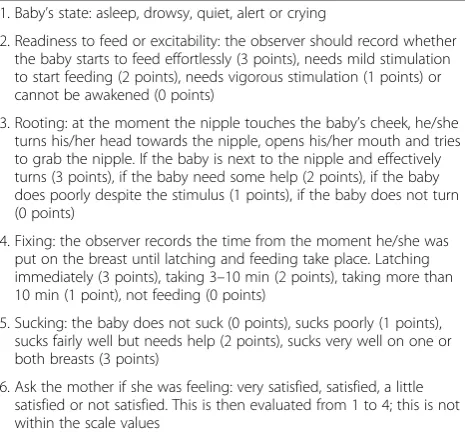
1. Human lactation capacity in the newborn within the first 24 h of life and prior to discharge using the IBFAT scale (Table4)
2. Maternal satisfaction with breastfeeding in the first 24 h according to the IBFAT scale (Table4) 3. Evolution of birth weight in the first week of life 4. The need for hospitalization in the neonatal care
unit in the first week of life
Instruments and times to assess the results
1) Newborn capacity for human lactation: (a) the Infant Breastfeeding Assessment Tool–
IBFAT (newborn human lactancy behavior) within the first 24 h of life and prior to discharge 2) Measurement of the change in weight from birth to
the end of the first week of life: this will only be done with a previously calibrated electronic scale, which will take measurements at birth and in the first week of life. The need for admission to the NICU in the first week of life will be assessed during
the first follow-up visit in the first the week of life (Additional file1)
3) Duration of exclusive human lactation: monthly telephone tracking of breastfeeding status will continue for 6 months or until human lactation is no longer the only food source (Additional file2)
Study procedures
Prior to birth
▪Prior to the start of the study, health personnel (nurses, pediatricians, and obstetricians) will undergo training regarding: SSC after birth in healthy
newborns, human breastfeeding concepts (technical, definition of exclusive lactancy and its effective benefits and contraindications), the institutional human lactation protocol and management of the mothers with their newborn baby
▪The mothers who meet the entry criteria will be identified in the obstetrics and gynecology outpatient department at their prenatal appointment. An obstetric history will be conducted by the physician in order to identify risk factors or conditions that may contraindicate the study. Those mothers who meet the criteria for inclusion will be interviewed in order to explain the purpose of the study, its application and other events to be expected. Should they accept the offer of participation, they will sign an informed consent (Additional file3) and their personal data, telephone number, and email address will be collected for follow-up
▪Those pregnant women who meet the inclusion criteria and sign an informed consent will be classified randomly using opaque envelopes allocated to the intervention or control group. Each envelope will be coded and assigned a study entry number. Prior to delivery, health professionals can determine what the intervention will be and prepare all their personnel to support the mother and child
After birth
▪SSC will be applied according to the assigned group (immediate versus early), and measures of immediate and mediate neonatal adaptation will be applied
Prior to dischargePrior to discharge, the IBFAT instru-ment will be applied to the mother and her infant by the research monitor and/or operational coordinator.
Follow-up
[image:6.595.57.295.98.206.2]▪The first assessment will take place in the first week of life. The mother and the baby will be summoned to the
Table 3Adaptation interventions
Immediate adaptation interventions Mediate adaptation interventions
•Cleaning of the airways
•Drying and stimulating newborn thermoregulation
•APGAR rating
•Cord clamping
•Identifying the newborn
•Taking a blood sample from a segment of placental cord for blood group and congenital hypothyroidism screening
•Evaluation of sex and initial physical examination
•Application of vitamin K and eye infection prophylaxis
Universidad de La Sabana Clinic and a nursing professional will perform it. This consultation aims to record the birth weight, the effectiveness of human lactation and feeding capacity and the need for hospitalization.
▪Monthly follow-up. This follow-up procedure will take place via monthly telephone calls with the mothers for 6 months, checking their adherence to human lactancy and, in the cases where breastfeeding has been suspended, inquiring about the reasons for this.
Registration information
An electronic information collection instrument will be created and a paper record of the data collected for the study will also be kept. Periodically (every month), the research team will verify the information in the database with respect to the physical record. To reduce errors in information collection, double entry of information is performed.
The data will be kept in the research office of the Universidad de La Sabana Clinic and only the research group and regulatory personnel (INVIMA) have access to it if, for any reason, it should be required.
Sample size
24 % babies in Colombia, received exclusive breastfeeding up to 5 months old (9). This was the baseline risk assumed for the sample size calculation [9]. No studies were found that comparing different strategies from SSC; so that esti-mate the sample size, information 2014 Cochrane meta-analysis was used [3], which compares SCC (regardless of the starting time) with nonintervention. In this meta-analysis, SSC increases exclusive human lactancy in babies of 3−6 months of age (RR 1.97, 95 % CI 1.37 to 2.83). With the information of exclusive breastfeeding for Colombia and the effect of SCC, report in the meta-analysis, was estimated a sample size of 300 newborns. This sample was calculated, two tailed, for a type I error of 5 %, a type II error of 20 %, and an estimated loss rate of 30 %. Will be included 150 newborns per study group.
Randomization
The 300 newborns will be randomized using size-6 per-muted blocks to ensure that there will be an equal num-ber of participants in the control group and the intervention group. Once the mother signs the informed consent and the entry data for the study has been en-tered, the operation coordinator of the study will open the opaque envelope, the contents of which determines to which group the mother will be assigned and this in-formation will be recorded immediately in the medical record. The coordinator will verify that the intervention to which the patient was assigned at birth is applied.
Masking
As to the characteristics of the interventions under evaluation, those who measure the results and who will analyze the data will be blind. To ensure that the blind participant who measures the results will be someone other than the health professional applying SSC, that person will not be in the delivery room and will apply the study measurements to all newborns treated at the clinic without knowledge of whether or not they are study participants.
The person conducting the analysis will be given the database in which the variable that identifies whether the research subject belongs to the control group or the inter-vention group is found; this will then be coded and the code that identifies them will not be available to the analyst.
Statistical methods
Descriptive analyses were performed using measures of central tendency (median, average), location (percentiles) and dispersion (standard deviation and ranges) for con-tinuous variables and absolute frequencies and relative for the categories. Bivariate analysis will be performed to determine which variables (evaluation interventions and others) are associated with exclusive lactancy at 6 months. In the continuous variables, the Student’s t
test will be used for independent samples or the Wilcoxon rank sum test when the assumptions of normality for thet
test are not fulfilled. The assumption of normality will be evaluated with the Shapiro-Wilk and Kolmogorov-Smirnov tests. Contingency tables will be constructed in the categorical variables, assessing the independence be-tween variables with the chi-square test, or Fisher’s exact test when the assumption of number of cases per cell in the contingency tables, multiplied by two, is not fulfilled. The relative risk (RR) will be calculated as an effects meas-urement with confidence intervals, adjusted measure-ments will be calculated using a multivariate Poisson regression model, for adjustment variables with significant results those with biological plausibility will be used in the bivariate analysis. An analysis will be carried out for a two-tailed type I error level of 5 %. The Stata 11 program will be used for the data analysis. An interim analysis will be performed upon submission of half of the expected events (106), setting the limits for early termination of the trial according to the methods proposed by Pampallona and Tsiatis 1994 [21].
Intention-to-treat analysis
All study participants will be analyzed in the group to which they were originally randomized. Loss to follow-up will be analyzed as explained below:
▪Descriptive analyses of the lost subjects, will be conducted to determine if they are different from those who continued in the study and whether the losses generated imbalance between the intervention and control groups
▪The effect measure, assuming the worst and best scenario for subjects who were lost to follow-up, will be estimated
Discussion
SSC at birth has shown benefits in the short and long term for both the mother and the full-term newborn. Although the meta-analyses that have been done have shown the benefits of this technique, multiple differences in the SSC interventions have been identified because criteria such as the initiation or duration of SSC (dose) have not been uni-fied. Studies have been conducted with different schemes (immediate, early, and very early) without clarity about which of the initiation times of SCC from birth provides the greatest benefits during infancy.
Colombia has a malnutrition risk of 11,4 % in the total population for the period 2012-2014, so it is necessary to promote strategies that generate a positive impact on the duration of human lactation, providing support from the clinical setting of humanized delivery which is included in the IAMI strategy (Instituciones Amigas de la Mujer y la Infancia – Friends of Women and Children Institution). Therefore, we propose that the initiation time of SSC in full-term newborns is related to the duration of exclusive human lactation.
Human lactation is simple and freely available, pro-vides optimal nutrition for the baby, facilitating their proper growth and development and, therefore, estab-lishing itself as an effective strategy to help reduce disease in the infant population.
This study aims to determine the effect of SSC initi-ation times from birth (immediate versus early) in healthy, full-term newborns on the duration of exclusive human lactation at the Universidad de la Sabana Clinic where the newborns were attended. It also evaluates the human feeding capacity of newborns 24 h after birth by applying the IBFAT scale. Thus, the analysis of weight change in the first week of life and the need for hospitalization and admission to the NICU in the first week of life are also included.
Trials status
This study is not yet open for participant recruitment.
Appendix
Additional files
Additional file 1:Format for data collection in the first face-to-face assessment. (DOCX 12 kb)
Additional file 2:List of data collection in the valuation call. (DOCX 13 kb)
Additional file 3:Informed consent. (DOCX 13 kb)
Additional file 4:Consent for publication. (DOC 24 kb)
Abbreviations
BSES:Breastfeeding self-efficacy Scale; IBFAT: Infant breastfeeding assessment tool; MBA: Mother-baby ASSESS tool; NICU: Neonatal intensive care unit; OR: Odds ratio; RR: Relative risk; SSC: Skin-to-skin contact
Acknowledgements
Not applicable.
Funding
At the time of submission of the protocol we have no funding. It will be submitted for internal funding to the Universidad de La Sabana in the first half of 2016 and for external financing, COLCIENCIAS, in 2016.
Availability of data and materials
The data sets supporting the results of this article are will included within its Additional files.
Authors’contributions
All authors declare that they have read and approved the final version of this manuscript. SAP is responsible for general project coordination, study concept and design, work data analysis and interpretation, critical manuscript revision, and all other aspects of the study. OGG is responsible for study design, study simple size calculation, critical manuscript revision, and for all other aspects of the study. FRM is responsible for study concept and design, work data analysis and interpretation, critical manuscript revision, and is responsible for all other aspects of the study. SC, NG, EO and MLP are responsible for acquisition, analysis and interpretation of the study information, and elaboration and critical manuscript revision.
Competing interests
[image:8.595.305.538.118.335.2]The authors declare that they have no competing interests.
Table 4IBFAT scale (INFANT BREAST-FEEDING ASSESSMENT TOOL)
1. Baby’s state: asleep, drowsy, quiet, alert or crying
2. Readiness to feed or excitability: the observer should record whether the baby starts to feed effortlessly (3 points), needs mild stimulation to start feeding (2 points), needs vigorous stimulation (1 points) or cannot be awakened (0 points)
3. Rooting: at the moment the nipple touches the baby’s cheek, he/she turns his/her head towards the nipple, opens his/her mouth and tries to grab the nipple. If the baby is next to the nipple and effectively turns (3 points), if the baby need some help (2 points), if the baby does poorly despite the stimulus (1 points), if the baby does not turn (0 points)
4. Fixing: the observer records the time from the moment he/she was put on the breast until latching and feeding take place. Latching immediately (3 points), taking 3–10 min (2 points), taking more than 10 min (1 point), not feeding (0 points)
5. Sucking: the baby does not suck (0 points), sucks poorly (1 points), sucks fairly well but needs help (2 points), sucks very well on one or both breasts (3 points)
Consent for publication
The mother or her legal representative will sign the consent for publication (Additional file 4).
Ethics approval and consent to participate
The Institutional Ethics Committee of the Universidad de la Sabana approved the study protocol. According to the Colombian Ministry of Health, Resolution 8430 of 4 October 1993, this study is considered to be more than minimal-risk research because it is a prospective study using random methods of allocation of neonatal adaptation procedures. Although no physiological, psychological or social variable interventions of the individuals occur, a randomized intervention is performed to define the intervention and control group [22]. This research is also subject to ethical standards established to promote and ensure respect for all human beings and to protect their health and rights as determined by the Declaration of Helsinki [23].
The included mothers will sign a written informed consent (Additional file 4) in order to include themselves and their child in the study. It will be completed and signed at a prenatal care visit before birth. This guarantees the possibility of the participant withdrawing from the study freely at any time, without any deterioration in the quality of care provided. To ensure the data and identity confidentiality of patients there will only be access to the instruments used by the study investigators. The research results will be made available to the public, reporting results with integrity and accuracy, and without identifying the participants through publication in scientific journals and events. The principal researcher is responsible for protecting the information and ensuring that it will only be used for the objectives presented in this document.
Author details
1Universidad de La Sabana, Clínica Universidad de La Sabana, Chía,
Cundinamarca, Colombia.2Assistant professor Universidad de La Sabana, Neonatal Care Unit Coordinator of Clínica Universidad de La Sabana, Campus Puente del Común, Km. 7 Autopista al Norte de Bogotá, 53753 Chía, Cundinamarca, Colombia.3School of Medicine, Universidad de la Sabana,
Campus Puente del Común, Km. 7 Autopista al Norte de Bogotá, Chía, Cundinamarca, Colombia.
Received: 12 March 2016 Accepted: 3 September 2016
References
1. Widström A, Lilja G, Aaltomaa‐Michalias P, Dahllöf A, Lintula M, Nissen E. Newborn behaviour to locate the breast when skin‐to‐skin: a possible method for enabling early self‐regulation. Acta Paediatr. 2011;100(1):79–85. 2. Righard L, Alade MO. Effect of delivery room routines on success of first
breast-feed. Lancet. 1990;336(8723):1105–7.
3. Moore ER, Anderson GC, Bergman N, Dowswell T. Early skin-to-skin contact for mothers and their healthy newborn infants. Cochrane Database Syst Rev. 2012;5:CD003519.
4. Gabriel M, Llana Martín I, López Escobar A, Fernández Villalba E, Romero Blanco I, Touza PP. Randomized controlled trial of early skin‐to‐ skin contact: effects on the mother and the newborn. Acta Paediatr. 2010;99(11):1630–4.
5. Thukral A, Sankar MJ, Agarwal R, Gupta N, Deorari AK, Paul VK. Early skin-to-skin contact and breast-feeding behavior in term neonates: a randomized controlled trial. Neonatology. 2012;102(2):114–9.
6. Eidelman AI, Schanler RJ, Johnston M, Landers S, Noble L, Szucs K, et al. Breastfeeding and the use of human milk. Pediatrics. 2012;129(3):e827–41. 7. Chandran L, Gelfer P. Breastfeeding: the essential principles. Pediatr Rev.
2006;27(11):409.
8. GPC_Completa_RNSano.pdf [Internet]. Disponible en: http://gpc.minsalud. gov.co/gpc_sites/Repositorio/Conv_500/GPC_rns/gpc_rns_completa.aspx. Accessed on 2 Sep 2015.
9. Resumenfi.pdf [Internet]. Disponible en: http://www.icbf.gov.co/portal/page/ portal/Descargas1/Resumenfi.pdf. Accessed on 3 Sep 2015.
10. Arango F, Gómez JG, Zuleta JJ. Uso de prácticas clínicas durante el embarazo, parto, puerperio y recién nacido, en hospitales públicos de Manizales–Colombia, 2005. Rev Colomb Obstet Ginecol. 2005;56(4):271–80. 11. Boccolini CS, de Carvalho ML, de Oliveira MIC, Vasconcellos AGG. Factors
associated with breastfeeding in the first hour of life. Rev Saude Publica. 2011;45(1):69–78.
12. Bramson L, Lee JW, Moore E, Montgomery S, Neish C, Bahjri K, et al. Effect of early skin-to-skin mother-infant contact during the first 3 hours following birth on exclusive breastfeeding during the maternity hospital stay. J Hum Lact. 2010.
13. Carfoot S, Williamson P, Dickson R. A randomised controlled trial in the north of England examining the effects of skin-to-skin care on breast feeding. Midwifery. 2005;21(1):71–9.
14. Villalón H, Alvarez P. Efecto a corto plazo del contacto precoz piel a piel sobre la lactancia materna en recién nacidos de término sanos. Rev Chil Pediatría. 1993;64(2):124–8.
15. Takahashi Y, Tamakoshi K, Matsushima M, Kawabe T. Comparison of salivary cortisol, heart rate, and oxygen saturation between early skin-to-skin contact with different initiation and duration times in healthy, full-term infants. Early Hum Dev. 2011;87(3):151–7.
16. Aghdas K, Talat K, Sepideh B. Effect of immediate and continuous mother-infant skin-to-skin contact on breastfeeding self-efficacy of primiparous women: a randomised control trial. Women Birth. 2014;27(1):37–40. 17. Matthews MK. Developing an instrument to assess infant breastfeeding
behaviour in the early neonatal period. Midwifery. 1988;4(4):154–65. 18. Schlomer JA, Kemmerer J, Twiss JJ. Evaluating the association of two
breastfeeding assessment tools with breastfeeding problems and breastfeeding satisfaction. J Hum Lact. 1999;15(1):35–9.
19. Riordan JM, Koehn M. Reliability and validity testing of three breastfeeding assessment tools. J Obstet Gynecol Neonatal Nurs. 1997;26(2):181–7. 20. Altuntas N, Turkyilmaz C, Yildiz H, Kulali F, Hirfanoglu I, Onal E, et al. Validity
and reliability of the Infant Breastfeeding Assessment Tool, the Mother Baby Assessment Tool, and the LATCH scoring system. Breastfeed Med. 2014;9(4):191–5.
21. Pampallona S, Tsiatis AA. Group sequential designs for one-sided and two-sided hypothesis testing with provision for early stopping in favor of the null hypothesis. J Stat Plan Inference. 1994;42(1):19–35.
22. Res__8430_1993_-_Salud.pdf [Internet]. Disponible en: https://www. unisabana.edu.co/fileadmin/Documentos/Investigacion/comite_de_etica/ Res__8430_1993_-_Salud.pdf. Accessed on 22 Sep 2015.
23. Declaracin de Helsinki de la Asociacin Mdica Mundial–helsinki.pdf [Internet]. Disponible en: http://www.conamed.gob.mx/prof_salud/pdf/ helsinki.pdf. Accessed on 22 Sep 2015.
• We accept pre-submission inquiries
• Our selector tool helps you to find the most relevant journal • We provide round the clock customer support
• Convenient online submission • Thorough peer review
• Inclusion in PubMed and all major indexing services • Maximum visibility for your research
Submit your manuscript at www.biomedcentral.com/submit