Quantum computation with phase drift errors.
C´esar Miquel1,2,3∗, Juan Pablo Paz1,2,3,4† and Wojciech Hubert Zurek 1,3‡ 1Institute for Theoretical Physics, University of California, Santa Barbara, CA 93106–4030, USA
2Departamento de F´ısica “J.J. Giambiagi”, FCEN, UBA, Pabell´on 1, Ciudad Universitaria, 1428 Buenos Aires, Argentina
3
Theoretical Astrophysics, MSB288, Los Alamos National Laboratory, Los Alamos, NM 87545, USA
4Instituto de Astronom´ıa y F´ısica del Espacio, CC67 Suc28, 1428 Buenos Aires, Argentina
(December 30, 1996)
We present results of numerical simulations of the evolution of an ion trap quantum computer made out of 18 ions which are subject to a sequence of nearly 15000 laser pulses in order to find the prime factors ofN = 15. We analyze the effect of random and systematic phase drift errors arising from inaccuracies in the laser pulses which induce over (under) rotation of the quantum state. Simple analytic estimates of the tolerance for the quality of driving pulses are presented. We examine the use of watchdog stabilization to partially correct phase drift errors concluding that, in the regime investigated, it is rather inefficient. PACS numbers: 02.70.Rw, 03.65.Bz, 89.80.+h
The key ingredient for quantum computation is the use of quantum parallelism which takes advantage of the fact that the dimensionality of the Hilbert space of the computer is exponentially dependent on its physical size. Feynman [1] pointed out that classical computers are in-trinsically inefficient when simulating the dynamics of a quantum system since for a chain ofL spins we need to store O(2L) complex amplitudes in memory. Since this quantity scales exponentially with the size, he reasoned, a quantum computer would be much more efficient requir-ing, as nature does, only O(L) sites. Shor’s discovery [2] of a quantum algorithm for efficient factoring of in-tegers is solid evidence that quantum computers could exponentially outperform their classical counterparts in problems which are not motivated by quantum mechan-icsper se. The last two years have witnessed an intense research effort aimed at examining the possibilities for taking quantum computation from the realm of ideas to the real world of the laboratory. However, practical im-plications of a “quantum revolution” for computation are still not clear. In this work we will analyze the perfor-mance of the ion–trap quantum information processor [3], which is currently under study by various experi-mental groups around the world (see [4] for a review). For concreteness we analyze the evolution of a quantum computer which runs a program to find the prime fac-tors of a small number (N = 15). Such program can be best represented by a quantum circuit decomposing into a complex sequence of elementary gates, i.e. uni-tary operations affecting qubits individually or in pairs [5]. In our simulations, which tested several factoring
circuits [6], we followed the quantum state of ni = 18 cold trapped ions subject to a predetermined sequence of
np≈15000 (resonant and off–resonant) laser pulses. These simulations face the same problem which prompted Feynman to propose the use of quantum com-puters in the first place: As their Hilbert space in-creases exponentially with their size, any dynamical study rapidly becomes a very hard computational task. Thus, to our knowledge, evolution corresponding to fac-toring in the proposed implementations of quantum com-puters has never been simulated beyond the level of a few qubits or small fragments of the complete algorithm [3]. Here, we present the first results of large numerical sim-ulation of an ion trap quantum computer evolving under realistic (but still rather oversimplified) conditions.
We aim at examining the tolerance of quantum compu-tation to errors which are likely to occur in any optically driven quantum–processor. In fact, for quantum gates to properly operate, most laser pulses are designed to invert population between internal levels (π–pulses). However, the Rabi flopping frequency depends on a variety of phys-ical effects which cause imperfections: Realisticπ–pulses (or any other type of pulse) will always be (π+)–pulses, beinga random variable whose expectation value ¯and dispersionσ characterize the quality of the experimen-tal setup. In our study we analyzed the impact of these timing errors showing that a successful quantum compu-tation (even on a rather small scale) imposes stringent limitations in the quality of laser pulses. Perhaps most importantly, we obtained and verified simple analytic ex-pressions that could be used for estimating the fidelity of the final state of the computer. Our results make evident that error correction and fault tolerant computation [7] are necessary for successfully implementing simple cir-cuits. These techniques would make posible arbitrarily large computations if the precision of the driving laser pulses are above a certain threshold. Unfortunately,
sim-ulating circuits which incorporate quantum error correct-ing codes is still beyond our capabilities: encodcorrect-ing a sin-gle qubit into k (which should be at least 3) makes the time and memory requirements to grow by a factor 2k.
We have also set out to test the effectiveness of the watchdog (or quantum Zeno) effect for error correction. The basic physics of this effect is rather well known: Con-sider a two level system which is initially in state|0iand is subject to a sequence of rotations by an angleθ. After
ksuch rotations the probability for measuring the initial state isP(0) = cos2(kθ), which vanishes whenkθ=π/2. However, measuring the state after each rotation tends to slow down evolution: the probability for finding the qubit always in state|0iisPw(0) = cos2k(θ), which is close to one if θ is sufficiently small. At first sight, using this quantum Zeno effect to stabilize a quantum computation may seem implausible since to implement it one would have to know the ideal state of the computer at some times. However in an ideal factoring circuit, some of the qubits disentangle from the rest of the computer at pre-determined steps of the algorithm allowing for watchdog stabilization. With our simulations we tested this simple idea confirming the existence of watchdog stabilization but concluding that the technique is rather inefficient in the ion trap quantum computer.
In this implementation each qubit is stored in the inter-nal levels of a single ion. Ions are linearly trapped and laser cooled to their translational ground state (in the Lamb–Dicke limit). Two long-lived atomic ground states
|giand|eiof each ion play the role of the computational states (an additional auxiliary level|e0iis needed for im-plementing quantum gates). Each ion can be addressed by a laser and Rabi oscillations between the two com-putational states can be induced by tunning the laser frequency to the energy difference ¯hω between ground and excited state. In this case, the quantum state of the qubit evolves as|Ψ(t)i =U(t)|Ψ(0)i, where the matrix ofU(t) in the (|gi,|ei) basis is:
U(t) = cos Ωt −ie−iΦsin Ωt −ieiΦsin Ωt cos Ωt (1) Thus, controlling the Rabi frequency Ω, the laser phase Φ and the pulse duration t, arbitrary single qubit rota-tions can be performed. To implement two-bit gates one induces interactions between qubits using the center of mass mode as an intermediary: Applying a laser pulse to ion nwith a frequencyω−ν, where ¯hν is the energy of a single phonon of the CM mode, Rabi oscillations are induced between states|gin|1iCM and |ein|0iCM. For these states the evolution operator is also (1), while states
|gin|0iCM and |ein|1iCM remain unchanged by the inter-action. These off-resonance pulses allow swapping infor-mation to and from the center of mass conditioned on the state of thenth qubit. As Cirac and Zoller showed [3], by combining the two types of pulses applied on two
differ-ent ions (and using an auxiliary level as a kind of “work– space”) universal quantum gates can be implemented. Errors in Ωtand Φ, such as the ones arising from fluctu-ations in the laser intensity which produce varifluctu-ations of Ω, will result in over(under) rotations. Suchphase drift errors are the ones of concern here. Other sources of errors, such us the decoherence of the CM mode or the spontaneous decay of the ions, will be ignored. In effect we assume that the computer evolves isolated from the environment being affected only by unitary errors.
The factoring circuit is based on Shor’s algorithm [2]. Prime factors ofN are found by obtaining the orderrof a numberywhich is coprime withN. This is the smallest integer such thatyr= 1 modN(withrone computes the greatest common divisor betweenNandxr/2−1, which is a factor ofN wheneverr is even andxr/2 6= 1 modN). To find r one first chooses y at random and starts the computer in state|Ψ0i= √1qPqj−=01|ji1|0i2. Here, |ji1,2 represent two registers of the computer whose states are defined by the binary representation ofj (qmust be be-tweenN2 and 2N2). Then, by applying a unitary trans-formation mapping state |ji1|0i2 onto |ji1|yjmodNi2, the state of the computer is transformed into |Ψ1i =
1
√qPqj=0−1|ji1|yjmodNi2. Finally, one Fourier trans-forms the first register and measures it. The probabil-ity P(c) for the outcomes of such measurement, whose analytic expression can be derived using standard quan-tum mechanics, is a strongly peaked distribution with the peaks separated by a multiple of 1/r. Thus, measuring the distance between peaks one efficiently gets informa-tion aboutr(see Fig. 1.b).
The most complicated part of the various factoring cir-cuits [6] is the modular exponentiation section (Fourier transform can be efficiently implemented as shown in [8]). The complexity of the modular exponentiation network is such that the circuit involvesO(100)L3 elementary two bit gates [6] (the two registers of the computer require 2LandL qubits respectively). As unitary operators are invertible, the circuit must use reversible logic for which one needs a number of extra “work–qubits” in interme-diate steps of the calculation. For the simplest circuits, such number is 2L+ 1. However, other networks reduce the size of the workspace enlarging the number of op-erations. For example, another circuit we investigated hasL+ 1 work–qubits but requiresO(10)L5 elementary operations (notably, for small numbers this circuit out-performs all others both in space and time). We will not discuss any circuit details here. For the purpose of analising the physical constraints implied by efficient fac-toring on the accuracy of laser pulses it is sufficient to say that the simulations were performed on circuits involv-ing the followinvolv-ing characteristics: 18 two level ions were subjected to 15000 laser pulses (∼104 off–resonant and
∼ 5×10³ resonant). Eight of these ions were used in the first register, four in the second and six were used
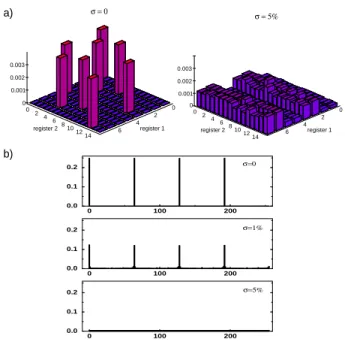
as work–qubits. If all degrees of freedom are taken into account the Hilbert space of the computer is 2×318 di-mensional (each ion contributes with three levels and the CM is effectively two dimensional). Unfortunately, this is too much for a classical computer. However, if we con-sider all pulses involving the auxiliary level |e0i of each ion as perfect a substantial saving is achieved. In this case, the effective dimension of the Hilbert space is 219 which allows for numerical simulations. Taking this into account, the erroneous pulses amount to 75% - 80% of the total. The errors in Ωtand Φ were taken as random vari-ables normally distributed with dispersion σ and mean ¯ . 0 2 4 6 register 1 0 2 4 6 8 10 12 14 register 2 0 0.001 0.002 0.003 σ = 0 a) b) 0 2 4 6 register 1 0 2 4 6 8 1012 14 register 2 0 0.001 0.002 0.003 σ = 5% 0 100 200 0.0 0.1 0.2 0 100 200 0.0 0.1 0.2 0 100 200 0.0 0.1 0.2 σ=0 σ=1% σ=5%
FIG. 1. a) Probability for a measurement of the two reg-isters of a factoring computer. After an error–free modular exponentiation circuit, the computer should be in a
superpo-sition of the form |ji|yjmodNi. As y = 7, the only states
present should be: |0i|1i,|1i|7i,|2i|4i, etc (left figure).
Tim-ing errors distributed with dispersionσ= 5% produce a
prob-ability showing no resemblance to the ideal one. b) Proba-bility of measuring a value in the first register after Fourier
transform forσ= 0, 1 and 5%. For the last case all
period-icity is lost and a uniform distribution arises. Ifσ <∼1% the
distribution shows minor changes in amplitude.
An illustrative example of the data we computed can be seen in Fig. 1 where we represent the joint probability for measuring the two registers of the computer in values (a, x) before the Fourier transform is calculated (Fig. 1.b shows the distribution after Fourier transform is applied). For the case of no systematic error (¯= 0) it is clear that a dispersion of 5% in the accuracy of the pulses com-pletely wipes out the signal one wants to observe (note that the signal disappears before applying the FT cir-cuit. As discussed in [3] the FT circuit is quite resistant to this level of errors but our result shows that,
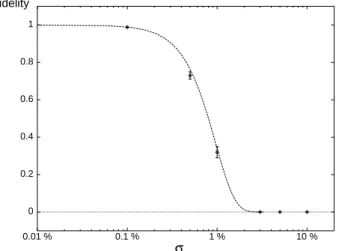
unfor-tunately, this is not the case for modular exponentiation where many more operations are needed). A reasonable parameter quantifying the accuracy of the quantum com-puter is the fidelity, which is defined as the overlap be-tween the actual state (obtained after evolution subject to noise) and the ideal one: F =|hΨactual|Ψideali|2. Our observations show that a fidelity below 1/5 implies the loss of the signal one wants to observe (in generalF is closely related to the probability of observing the system in the correct state, i.e. measuring the first register on a peak in Fig. 1b). In Fig. 2 we show the dependence of fidelity upon the dispersion of the errors. The numer-ical results follow remarkably well a simple formula that can be derived by assuming one haslindependentqubits each one of which is subject ton/l erroneous pulses. In this way (treating the center of mass motion separately, as it is subject to a larger number of pulses) we conclude that the mean fidelity (averaging over the ensemble of errors) is ¯ F = 1 2 1 +e−2ntσ2/l l 1 2 1 +e−2σ2ncm , (2)
where nt is the total number of pulses and ncm is the number of off-resonance ones (which involve the center of mass). This rough estimate was also used to estimate the dependence of the fidelity on the number of oper-ations (for fixed dispersionσ) giving also good quanti-tative agreement with the simulations. We numerically computed a fidelity for every realization of the noise find-ing the average over many (i.e. a few tens) noise realiza-tions. Error bars in Figure 2 correspond to the disper-sion around the mean of the numerically computed result. Fortunately, fluctuations are relatively small and there-fore each run gives a reasonable idea of the average result. The reason for this is that each run corresponds to a ran-dom choice of many (nearly 15000) independent ranran-dom variables. Therefore, fluctuations between different runs are effectively suppressed.
It is also interesting to estimate the number of dimen-sions explored by the state of the computer, which while moving on a large Hilbert space is subject to random perturbations. For this purpose we computed the en-tropy of the density matrix ρav, obtained by averaging the state vector on the ensemble of noise realizations. Linear entropy Slin =−log2( Trρ2av) (which provides a simple lower bound to von–Neumann entropy) turns out to be well approximated by:
Slin=l+ 1−log2 h
(1 +e−4ntσ2/l)l(1 +e−4ncmσ2) i
. (3)
This equation was shown to agree with numerical results and predicts that for dispersions above a few percents the computer explores the entire available Hilbert space (enough statistics to numerically test the above formula was only gathered for dispersions below 2%).
σ Fidelity 0 0.2 0.4 0.6 0.8 1 0.01 % 0.1 % 1 % 10 %
FIG. 2. Fidelity as a function of the noise dispersionσ(for
¯
= 0) at the end of the modular exponentiation circuit for
factoringN = 15 (withq= 256 andy= 7). The dashed line
is the na¨ıve qualitative estimate given by equation (2) with nt= 1.5×10⁴,ncm= 104.
To analyze the effectiveness of watchdog stabilization we simulated a smaller version of our factoring N = 15 circuit with only the first three controlled multipliers. In these simulations we assumed a systematic error using ¯
= 1.1σ. Whenever a work–qubit was expected to be in a state |0i a measurement was performed on it. As the center of mass is supposed to return to the ground state after each gate, a measurement of its state was also carried out (in practice this could be done using a “red light ion” as suggested in [10]). The probability for find-ing all these qubits in the correct state was recorded and the computation was continued on the correct branches only. The final fidelity, defined as the probability for the sequence of correct results, was computed and compared with the previously described one (when no watchdog was performed). The simulations show that watchdog stabilization produces a minor improvement in the fi-delity: For example, when σ = 0.1% the fidelity with watchdog was 0.67 as opposed to 0.64 without it. To es-timate the improvement one should expect we computed the fidelity ofl independent qubits which are subject to watchdog stabilization after each ofn/l rotations by an angle ¯. In this case, the result is rather surprising: this ideal watchdog would produce a fidelity close to 0.99, a number which is much larger than the one computed nu-merically. This inefficiency of the stabilization method can be explained as follows: Measuring the state of a few qubits (the ones that disentangle from the rest of the computer at some intermediate times) one is doing a “partial watchdog”. Thus, after the measurement we know with certainty that the measured qubits are in the “correct” state but the rest of the computer may be in an erroneous one. To test this simple explanation we run a numerical simulation where, after each measurement, the
state of the computer was projected onto the ideal one. In this case, the agreement with the na¨ıve (independent qubit) estimate was good being the fidelity close to 0.99. One of the interesting results of our study is that, al-though the factoring circuit continuously correlates the qubits, the dependence of fidelity on the noise parame-ters, can be estimated using a simple model where non– systematic errors affect each qubit independently (with this model, equation (2) can be easily obtained). How-ever, for purely systematic errors (σ = 0) we were not able to obtain a simple analytic estimate for the fidelity fitting the results of our simulations. For example, as-suming that every qubit evolves independently under the influence of n/l pulses which produce a rotation in an angle ¯ one gets a formula for the mean fidelity which differs from eq. (2) by a term cos 2¯n/lmultiplying each exponential. This na¨ıve estimate predicts a lower fidelity than the one we numerically computed. The reason for this seems to be the existence of cancellations of errors associated, in a nontrivial way, with the reversible na-ture of the circuit (for example, in a controlled not gate systematic errors exactly cancel when the control qubit is in the ground state but propagate otherwise). This suggests that pulse sequences implementing logic gates should be designed to properly compensate for systematic over(under) rotations. If this is achieved, the remaining fidelity is well approximated by equation (2).
We acknowledge the hospitality of the ITP at Santa Barbara where this work was completed. This research was supported in part by the NSF grant No. PHY94– 07194. JPP was also supported by grants from UBACyT, Fundaci´on Antorchas and Conicet (Argentina).
[1] R. Feynman, Int. J. Theo. Phys.,21, 467 (1982).
[2] P. W. Shor, in Proceedings of the 35th Annual
Sympo-sium on Foundations of Computer Science. edited by
S.Goldwasser (IEEE Computer Society, Los Alamitos, CA, 1994), p. 116.
[3] J. I. Cirac and P. Zoller, Phys. Rev. Lett.74, 4091 (1995).
[4] A. Steane, Report No. quant-ph/9608011.
[5] A. Barenco, et. al., Phys. Rev. A52, 3457 (1994).
[6] C. Miquel, J.P. Paz and R. Perazzo, Phys. Rev. A 54,
2605 (1996); V. Vedral, A. Barenco and A. Ekert, Phys.
Rev. A 54, 139 (1996); D. Beckman, A. N. Chari, S.
Devabhaktumi, J. Preskill, Phys. Rev. A 54, 1034; E.
Knill, Private communication.
[7] P. Shor, Phys. Rev. A (1995); A. Steane, Phys. Rev. Lett.
77, 793 (1996); R. Laflamme, C. Miquel, J. P. Paz and
W. Zurek, Phys. Rev. Lett.77, 198 (1996); C. Bennet
D.P. DiVincenzo, J.A. Smolin and W.K. Wooters, Phys.
Rev. A54, 3824 (1996); E. Knill and R. Laflamme (1996)
[8] R. B. Griffiths and C. Niu, Phys. Rev. Lett. 76, 3228 (1996)
[9] W. H. Zurek, Phys. Rev. Lett.53, 391 (1984)
[10] J. I. Cirac, T. Pellizzari and P. Zoller, Science,273, 1207
(1996).