Juniper Networks, Inc. 1194 North Mathilda Avenue Sunnyvale, California 94089 USA
408.745.2000 1.888 JUNIPER www.juniper.net
Enterprise Data Center Network
Reference Architecture
Using a High Performance Network Backbone to Meet the
Requirements of the Modern Enterprise Data Center
Table of Contents
Executive Summary . . . . 4
Introduction . . . . 4
Trends and Challenges . . . . 4
Juniper Networks Approach and Solution . . . . 6
Scope . . . . 6
Target Audience . . . . 6
Enterprise Data Center Network Design Considerations . . . . 7
Virtualization . . . . 8
High Availability Disaster Recovery . . . . 8
Visibility . . . . 8
Network Connectivity . . . . 8
Security . . . . 9
Policy and Control . . . . 9
Quality of Service (QoS) . . . . 10
High Performance . . . . 10
A Green and Environmentally Friendly Data Center . . . . 10
Juniper Networks Data Center Network Architecture . . . .11
Open Systems Approach—Juniper Networks Enterprise Framework . . . .11
Location-Based Approach . . . . 12
Design Principles . . . . 13
High-Level Architecture . . . . 14
Edge Services Tier . . . . 16
Edge Services Connectivity . . . . 16
Edge Services High Availability . . . . 16
Edge Services Performance . . . . 17
Edge Services Security . . . . 17
Core Network Tier . . . . 18
Core Network Connectivity . . . . 19
Core Network HA . . . . 19
Core Network Virtualization . . . . 19
Network Services Tier . . . . 20
Data Center Security Services . . . . 21
Application Front Ending Services . . . . 22
Applications and Data Services Tier . . . . 23
Fibre Channel SANs . . . . 26
iSCSI SANs . . . . 26
Data Center Backbone . . . . 27
Summary . . . . 30
Glossary . . . . 31
Appendix A Juniper Networks Data Center Network Solution Tables . . . . 33
Data Center Product Tables . . . . 33
Data Center Product Tables (by Tier) . . . . 33
Partner Products . . . . 34
Symantec . . . . 34
Kaspersky . . . . 34
SurfControl and Websense . . . . 34
Avaya IG550 . . . . 35
Appendix B Juniper Networks Core Network Power Efficiency Analysis . . . . 35
Executive Summary
The data center is an extremely critical corporate asset . As such, the data center network that connects all critical servers, applications and storage services is a key component that should be carefully planned and managed to meet the growing performance demands of users and many network-centric applications . Juniper Networks offers a comprehensive data center network solution that combines best-in-class products with well-defined practices to build high-performance, robust, virtualized, and cost effective and business supported data center networks .
This reference architecture proposes practices, technologies and products that help data center architects and engineers responsible for answering the requirements of designing modern data center networks .
Introduction
Trends and Challenges
According to research conducted by Nemertes (2006), 91 percent of benchmarked companies were under compliance constraints, and more than 50 percent of companies consolidated their dispersed data centers into fewer but larger data centers in the last 12 months, with even more planning to consolidate in the upcoming 12 months . While enterprises are consolidating their data centers and centralizing their servers, the opposite is happening with the employees themselves . More than 90 percent of employees work remotely and more companies are opening a larger number of branch offices to get closer to their customers . These two divergent trends cause tremendous strain on the enterprise WAN connectivity as more people attempt to access applications that are highly centralized . Further, performance of these applications is becoming a critical bottleneck in terms of employee productivity .
Another interesting trend is that servers are continuing to grow at a high annual rate of 11 percent, while storage is growing at an even higher rate of 22 percent; both of which are causing tremendous strain on the data center’s power and cooling capacity . According to Gartner, OS and application instability is increasing the server sprawl with utilization rates of 20 percent . Also, Coordination Implementation and Operations (CIOs) are increasingly demanding utilization/efficiency reports on servers and storage, which is leading to an increased adoption of virtualization technologies such as VMWare and XenSource .
The major challenges identified by customers regarding their data centers include the following: Power capacity
•
Cooling •
Increasing growth of the data centers •
Availability •
Disaster recovery •
Operational issues concerning change management and controlling operational costs •
Enterprises demand “zero-downtime” or “extreme availability” as businesses become increasingly global and function 24x7 .
Gartner (2007) identifies the following trends from a list of the top 10 disruptive technologies in the data center .
Unified Communications •
The Web as a platform to deliver applications •
Virtualization that goes beyond consolidation •
Mashups and composite applications •
Green IT •
Emerging applications that use Service Oriented Architecture (SOA) and Web services are increasingly computational and network intensive .
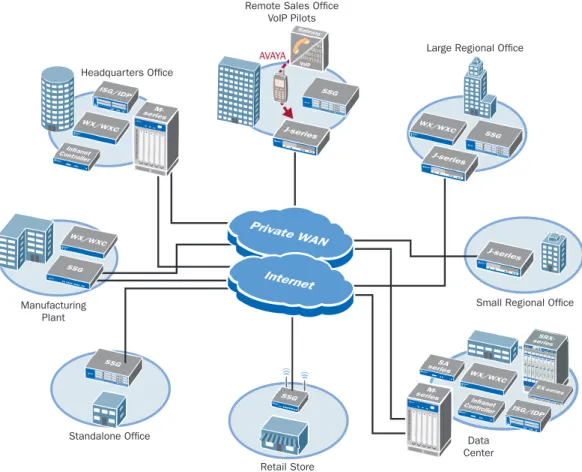
While businesses are attracted to the cost savings of consolidating data centers and therefore are reducing the number of facilities and operating locations, architects face the challenge of designing a data center that centralizes servers and applications that are accessible from a variety of locations (see Figure 1) . Throughout all of these challenges, today’s data center must meet the performance requirements to ensure satisfactory user experiences without compromising security and compliance .
Figure 1: Location-Based Perspective of the Enterprise Network
In addition, Gartner (2007) asserts that 50 percent of the Ethernet switch ports within the data center are used for switch interconnectivity .
Simply designing a data center that only deploys more servers, storage and devices significantly increases network complexity and cost . Organizations must change the way they view their data center network architecture to maximize efficiency gains from technologies such as virtualization . The architecture must use virtualization capabilities such as MPLS and virtual private LAN service (VPLS) to enable an extremely fast, high-performance data center backbone network, to meet the performance demands of the consolidated architecture . The data center network also must offer required components such as security, performance acceleration, high density and a resilient network infrastructure . These critical components help ensure that users sustain the performance needed to succeed in their jobs, and that the network supports their business goals . This document shares Juniper Networks best practices in designing a highly efficient, secure, scalable and flexible data center network . This document also showcases advanced network technologies such as high-density next-generation Ethernet switches, application delivery controllers and WAN acceleration that can be employed to create a seamless user experience, irrespective of the location on the network .
ISG/IDP SSG SSG WX/WXC Infranet Controller J-series M-series M-series Infranet Controller WX/WXC J-series SSG WX/WXC SA series WX/WXC ISG/IDP SSG
Remote Sales Office VoIP Pilots
Private W AN
Headquarters Office
Large Regional Office
Manufacturing Plant
Small Regional Office
Standalone Office Retail Store Data Center SSG Internet J-series Gateway VoIP AVAYA SRX-series EX-series
Juniper Networks Approach and Solution
The Juniper Networks strategy for designing the data center network uses an open systems approach that enables enterprises to design a high-performance data center network that consolidates network elements into fewer networks and employs fewer network devices . This approach simplifies network architecture, enables operational efficiencies, and offers data center networks that are agnostic to multiple media types .
The architecture virtualizes critical network infrastructure components and functionalities such as security, load balancing and applications acceleration, and this architecture deploys and manages based on a combination of business as well as technical heuristics . The architecture optimizes network performance and increases efficiencies within the network infrastructure . The architecture also automates network infrastructure management by connecting smoothly into the customer’s existing management frameworks and third-party tools such as IBM Tivoli .
Scope
The purpose of this document is to provide our partners, customers and potential customers with a data center network architecture that mitigates business risk and supports the modern, consolidated data center . This document addresses the following topics:
Network infrastructure • Security • Connectivity •
Performance aspects of the data center infrastructure •
In addition, this document provides design guidance for the data center network, the inter-data center and associated connectivity . Discussions focus on the following network devices:
Routers • Switches • Firewalls •
Intrusion prevention systems •
VPN access devices •
Application front ends •
WAN acceleration products . •
NOTE: Because application-specific components such as operating systems, processing machines, databases and storage arrays are out of scope of this solution, they are not addressed in this document .
Target Audience
IT managers and security managers •
Systems engineers •
Network analysts and engineers •
Network administrators •
Enterprise Data Center Network Design Considerations
The following section summarizes some of the technical considerations for designing a modern day data center network that must support consolidated and centralized server and storage infrastructure as well as enterprise applications .
NOTE: The design considerations discussed are not necessarily specific to Juniper Networks solutions and can be applied universally to any data center network design, regardless of the vendor .
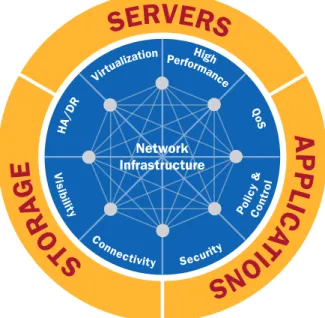
The functional data center network design model (Figure 2) considers key design attributes . Each of these attributes is summarized in the following sections .
Figure 2: Center Network Functional Design Model
As data centers become consolidated, more servers become centralized . The data center can be viewed from the perspective of the different groups of people interacting to create a highly available and functional end user requirement for the enterprise . These groups typically comprise storage, server, application and network groups . Observing all of the installed devices in the data center, we obviously see large racks of servers (X86 servers, blade servers or mainframe systems), different types of storage switches that use Fibre Channel (FC) and InfiniBand, and a variety of applications (Oracle, SAP, Microsoft) that utilize these resources to deliver business requirements . These three silos are connected through a fast, secure and reliable data center network fabric which forms the fourth silo of systems and devices in the data center . The critical attributes for designing today’s data center for extreme availability and superior performance are as follows:
Virtualization—network, server and storage •
High Availability/Disaster Recovery (HADR) •
Visibility—not only in network traffic and security events, but also into application traffic •
Connectivity—ubiquitous connectivity to disparate sets of resources •
Security —security and compliance •
Policy and Control—centralized policy and control •
Quality of Service (QoS) •
High Performance—applications, storage, servers and the network • Virtua lization HA /DR V is ib ility Con nectivity Security Con trol Polic y & Q oS High Performanc e
ST
OR
AG
E
A
P
P
LIC
AT
ION
S
SERVERS
Network InfrastructureVirtualization
As described in Wikipedia, virtualization is a technique for hiding the physical characteristics of computing resources from the way in which other systems, applications or end users interact with those resources . This means making a single physical resource such as a server, an operating system, an application or a storage device appear to function as multiple logical resources; or making multiple physical resources such as storage devices or servers appear as a single logical resource . Virtualization also means making one physical resource appear, with somewhat different characteristics, as one logical resource .
From a network virtualization perspective, there are various technologies that provide data, control and management plane virtualization . A data plane virtualization example is a single physical interface that provides security to multiple network segments using 802 .1q VLAN tagging . From a control plane virtualization perspective, multiple routing domains and protocol instances are other examples . A management plane virtualization example supports multiple logical firewall/VPN security systems that use Virtual Systems (VSYS) for true multi-department or multi-customer environments, such as large enterprises or service providers who offer managed security services all in a single device .
High Availability Disaster Recovery
High Availability Disaster Recovery (HADR) is a key requirement from the data center network perspective and must be considered not only from what is happening within the data center, but also from across multiple data centers . Network high availability should be deployed by using a combination of link redundancy (both external and internal connectivity) and critical device redundancy to ensure network operations and business continuity . In addition, using site redundancy (multiple data centers) is critical to meeting disaster recovery and regulatory compliance objectives . Moreover, devices and systems deployed within the confines of the data center should support component-level high availability, such as redundant power supplies, fans and routing engines . Another important consideration is the software/firmware running on these devices, which should be based on a modular architecture that provides features such as in-service software upgrades (ISSUs) to prevent software failures/upgrade events from impacting the entire device . Software failures/ upgrades should only impact a particular module, thereby ensuring system availability .
Visibility
It is important to have visibility into network traffic and security events to effectively maintain and manage the resources . It is critical to collect IP traffic flow statistics to give enterprises insight into data flow, resource utilization, fault isolation, capacity planning, and tuning and offline security analysis . WAN utilization and user-level visibility can help IT better support application performance by leveraging network services and other resources . Security visibility is crucial to granularly view security events to help determine how these events get handled . Further, extending this visibility to develop a deeper understanding of application-specific traffic is crucial for understanding a wide range of operational and performance information that can impact the users of these applications . For example, specific compression and acceleration technologies can be applied at the network layer to accelerate email applications such as Microsoft Exchange . Another example is preventing employee’s access to services such as YouTube and social networking sites from impacting business applications . Understanding the application (YouTube, Instant Messaging) and enforcing policies based on the application ensures that business critical applications meet or exceed the performance expectations of end users .
Network Connectivity
Customers, partners and employees all require immediate access to applications and information . Modern applications such as supply chain applications, IP telephony, Customer Relationship Management (CRM), Enterprise Resource Planning (ERP), or sales force automation applications demand significant network performance . Concurrently, the challenge of working from any location in the enterprise further increases the complexity .
As part of the data center network design, the following critical aspects of external network connectivity must be considered:
WAN connectivity to enable branch office and campus users to access applications •
Internet connectivity to enable partner access as well as secure remote access for remote •
and mobile users
Superior speed for data center backbone connectivity, data replication, business continuity, •
and use of technologies such as VPLS/MPL
The internal data center comprises one or more server network(s) or data center LANs . The data center LAN hosts a large population of servers that require high-speed and highly available network connectivity . In addition, there can be multiple LAN segments and networks deployed that differ in security and capacity levels and other services offered . Typically, connections of 1 Gbps and higher (while 10 Gbps are becoming the standard) will be available in the data center network, providing at least 1 Gbps to the server and preferably 10 Gbps at network choke points .
Security
The critical resources in any enterprise location are typically the applications themselves and the servers and supporting systems such as storage and databases . Financial, human resources, and manufacturing applications with supporting data typically represent a company’s most critical assets and, if compromised, can create a potential disaster for even the most stable enterprise . The core network security layers must protect these business critical resources from unauthorized user access and attacks, including application-level attacks .
The security design must employ layers of protection from the network edge through the core to the various endpoints, for example defense in depth . A layered security solution protects critical network resources that reside on the network . If one layer fails, the next layer will stop the attack and/or limit the damages that can occur . This level of security allows IT departments to apply the appropriate level of resource protection to the various network entry points based upon their different security, performance and management requirements .
Layers of security that should be deployed at the data center include the following: Denial of Service (DoS) protection at the edge
•
Firewalls to tightly control who and what gets in and out of the network •
VPN to protect internal communications •
Intrusion Prevention System (IPS) solutions to prevent a more generic set of application •
layer attacks
Further, application-layer firewalls and gateways also play a key role in protecting specific application traffic such as XML .
The above-listed solution guidelines address the requirements specified in the NIST recommended best practices, as stated in Guide to General Server Security Guide to General Server Security.1
Policy and Control
Policy-based networking is a powerful concept that enables devices in the network to be efficiently managed, especially within virtualized configurations, and it can be used to provide granular network access control . The policy and control capabilities should allow organizations to centralize policy management while at the same time offer distributed enforcement . The network policy and control solution should provide appropriate levels of access control, policy creation and management, and network and service management, ensuring secure and reliable networks for all applications . In addition, the data center network infrastructure should integrate easily into customers’ existing management frameworks and third-party tools such as Tivoli, and provide best-in-class centralized management, monitoring and reporting services for network services and the infrastructure .
1 Guide to General Server Security, Recommendations of the National Institute of Standards and Technology, Special Publication 800-123
Quality of Service (QoS)
To truly assure application experience over large networks, Quality of Service (QoS) is a key requirement . It is critical to assign and manage QoS levels to ensure satisfactory performance of the various software applications . A minimum of three levels of QoS (each of which determines a priority for applications and resources) are as follows:
Real-time • Business critical • Best effort •
Multiple Protocol Label Switching networks and network traffic engineering capabilities are typically deployed to configure Label Switch Paths (LSPs) with Resource Reservation Protocol (RSVP) or Loader Debugger Protocol (LDP) . This is especially critical with voice and video deployments, as QoS can mitigate latency and jitter issues by sending traffic along preferred paths or by enabling fast reroute to anticipate performance problems or failures . The data center network design should allow the flexibility to assign multiple QoS levels based on end-to-end assessment and allow rapid and efficient management to ensure end-to-end QoS for the enterprise .
High Performance
To effectively address performance requirements related to virtualization, server centralization and data center consolidation, the data center network should boost the performance of all application traffic, whether local or remote . The data center should offer LAN-like user experience levels for all enterprise users irrespective of their physical location . To accomplish this, the data center network should optimize applications, servers, storage and network performance .
WAN optimization techniques that include data compression, TCP and application protocol acceleration, bandwidth allocation and traffic prioritization improve performance network traffic . These techniques can also be applied to data replication, backup and restoration between data centers and remote sites, including disaster recovery sites .
Within the data center, Application Front Ends (AFEs) and load balancing solutions boost the performance of both client-server and Web-based applications, as well as speeding Web page downloads . In addition, designers must consider offloading CPU-intensive functions, such as TCP connection processing and HTTP compression, from backend applications and Web servers . Beyond application acceleration, critical infrastructure components such as routers, switches, firewalls, remote access platforms and other security devices should be built on non-blocking modular architecture, so that they have the performance characteristics necessary to handle the higher volumes of mixed traffic types associated with centralization and consolidation . Designers also should account for remote users .
A Green and Environmentally Friendly Data Center
A green data center is a repository for the storage, management and dissemination of data in which the mechanical, lighting, electrical and computer systems provide maximum energy efficiency with minimum environmental impact . As older data center facilities are upgraded and newer data centers are built, it is important to ensure that the data center network infrastructure is highly energy and space efficient . Network designers should consider power, space and cooling requirements for all network components, and they should compare different architectures and systems so that they can ascertain the environmental and cost impacts across the entire data center . In some environments, it might be more efficient to implement high-end, highly scalable systems that can replace a large number of smaller components, thereby promoting energy and space efficiency . Green initiatives that track resource usage, carbon emissions and efficient utilization of resources, such as power and cooling are important factors when designing a data center . Appendix B presents an analysis of the Juniper Networks MX960 Ethernet Services Router’s effects on reductions in energy consumption and footprint within the data center . Designers can use this appendix as an example for comparative analysis against other core solutions .
Juniper Networks Data Center Network Architecture
The intent of Juniper Networks approach for building the enterprise data center network is to allow enterprises to take advantage of the most advanced technologies, offer a design model that supports the current as well as future applications and data processing requirements of the enterprise, while at the same time reduce the risk and total cost of ownership .
Open Systems Approach—Juniper Networks Enterprise Framework
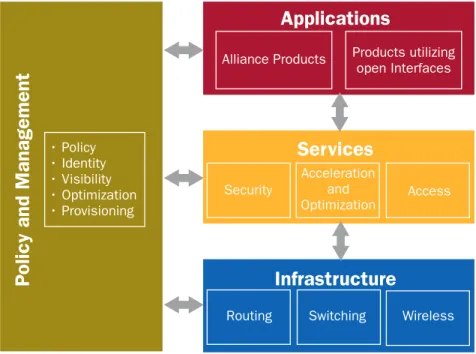
Juniper Networks uses a simplified version of the Open Systems Interconnection (OSI) model that includes three functional layers controlled by a policy and management domain (Figure 3) . These functional layers are as follows:
Applications • Services • Infrastructure •
The applications layer provides support to the various software applications that are required to run the business . It provides the environment that allows applications to run and interoperate . The services layer combines the traditional presentation, session and transport layers and provides support to users and applications . It includes security services, applications interfaces, and
acceleration and optimization services . The infrastructure layer combines the network, data link and physical layers and consists of routing and switching features that manage the network, connection management, data flow and QoS .
The policy and management domain integrates with the customer’s centralized policy and management functions to help reduce operations costs while simultaneously enabling compliance . All three layers are interconnected with open standards-based interfaces that allow enterprises to seamlessly deploy a multivendor solution that provides flexibility to use the best technologies to meet business requirements .
Figure 3: The Juniper Networks Enterprise Framework
Applications
Services
Infrastructure
P
olicy and Management
Alliance Products Security Products utilizing open Interfaces Acceleration and Optimization Access
Routing Switching Wireless
r1PMJDZ r*EFOUJUZ r7JTJCJMJUZ r0QUJNJ[BUJPO r1SPWJTJPOJOH
The Juniper Networks Enterprise Framework supports the next-generation data center network by providing a best-in-class network environment that uses open, standards-based and
industry-accepted interfaces . Enterprises can use this framework to logically view their network infrastructure and applications in order to make decisions that best serve the requirements of deploying enterprise applications .
Juniper Networks takes a holistic approach to next-generation networking and takes into account the user, network and applications perspectives . Our understanding of applications and how they are accessed from a variety of locations enable us to provide an architecture that meets the demands of a variety of users .
Location-Based Approach
physical locations and geographies from which data clients attempt to connect . Enterprises typically have campuses, regional offices, branch offices, a private WAN and data centers .
The key intention of the data center is to offload “always on” requirements from various enterprise locations to a central, stable location that always contains the enterprise’s most recent application data . By decoupling the information store from the physical location of the user, enterprises derive greater efficiencies by creating a centralized pool of resources . This trend of centralizing applications and consolidating multiple facilities makes the WAN or other external networks extremely critical, because users now need to traverse a larger network in order to gain access to data . As such, a great deal of emphasis has been given to the design of the enterprise Private WAN and Internet edge, which in many cases hosts branch office connectivity and remote user connections .
The data center does not typically host users and most certainly does not accommodate data center application users . However, this data center network design model can support different operational requirements that are unique to certain enterprises . Options such as administrative user access can be built into any data center design .
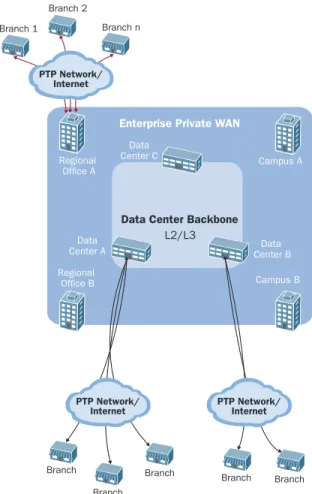
WAN services should extend to all of the remote location connections . Among these services are stateful firewalls, intrusion prevention and WAN acceleration . Figure 4 depicts a high level perspective, illustrating the overall enterprise connectivity into the data center and connectivity between data centers .
Figure 4: Enterprise Network Connectivity to the Data Centers
Design Principles
Key design principles originate from business and technical reasons . The business reasons are fairly clear—optimize capital expenditures and reduce operation expenses . The top level technical requirements include the following:
Leverage shared infrastructures •
Employ virtualization technologies to increase utilization and efficiencies •
Ensure scalability, flexibility, security and application performance over the network •
Juniper Networks key design principles are as follows:
Consolidation of Data Centers and Centralization of Services from Multiple Business Offices—
This principle imposes a variety of technical requirements on the data center network . Centralizing services typically does not improve overall processing time or data availability, but it often increases overall utilization and allows for more streamlined IT operations . Additionally, centralizing services requires maintenance of the unique aspects of legacy distributed processing configurations such that different processing instances may belong to different business entities, such as finance and HR . Uniqueness and operational freedom should remain “virtually” independent .
Virtualization—The virtualization of processing has introduced a new standard in resource pooling and resource utility optimization . Virtualization technologies at various levels are introduced in the data center from virtualization of large storage arrays and servers to network virtualization and
Enterprise Private WAN
Data Center Backbone
Campus A Campus B Regional Office B Regional Office A Data
Center A Center BData
Branch Branch
Branch Branch Branch
Branch 1 Branch 2
Branch n
PTP Network/
Internet PTP Network/Internet Data
Center C
L2/L3 PTP Network/
network service . The network infrastructure manifests virtualization through VPNs, labels and tags of forwarding plane traffic, while the network services manifest virtualization through the definition of service instances and application of unique processing logic to the different instances . The overall data virtualization capabilities of the data center are key requirements that effectively drive network virtualization .
High Availability—Consolidating and centralizing resources, as well as virtual zing technologies,
makes guaranteeing data access all the more critical . Data should be available regardless of the location from which it is being served . The four key vectors that address network HA include the following: Component • Device • Link • Site •
Streamlined Operation and Management of Data Center Services—In a consolidated and
virtualized environment, one of the key elements is a single management platform based on open standards that knows how to control servers, applications, storage and network infrastructure as one . Hence, it is critical to use devices and systems that support open standards-based interfaces and protocols, so that these devices and systems can all be controlled from existing and from evolving customer management systems .
High-Level Architecture
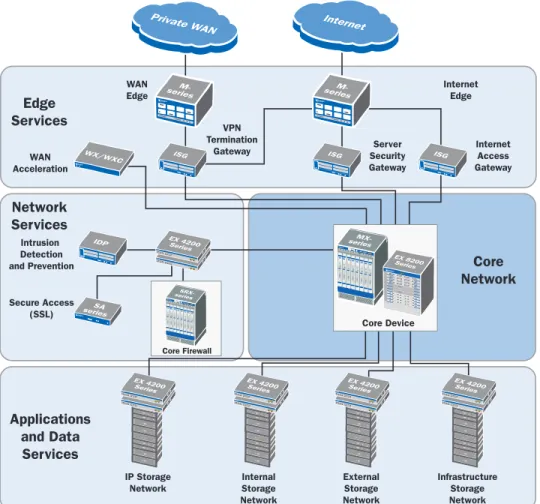
Figure 5 illustrates the Juniper Networks data center network architecture; the following lists the major architectural tiers:
Edge Services Tier—hosts all WAN services connecting to “non-data center” locations •
Core Network Tier—connects all data center networks within and across data centers •
Network Services Tier—supports WAN acceleration, Intrusion Prevention and other network •
services
Applications and Data Services—provides network connectivity to the data center server and •
application infrastructure
Data Center Backbone—provides connectivity between data center facilities for high •
availability, replication and disaster recovery
Figure 5: Juniper Networks Data Center Network Architecture
The data center network scalability requirements are rather significant because they must support centralized applications and data center consolidation . Hosting a large network in one location requires some modularization that allows certain services to be re-applied to applications and areas as needed .
As the data center edge network serves as the key boundary to the data center, it is responsible for maintaining reachability with all other external networks .
It is important to support network applications with an extremely fast core network that is capable of forwarding the total aggregate traffic at line rate . Effectively, the network core can span across multiple locations and multiple devices . Logically, the network core connects all data center networks directly to itself . This attribute is critical in order to offer rack/location-agnostic server-to-network binding, which is a key element in building a virtualized data center fabric that supports automatic repurposing of compute resources . Another benefit of this approach is that it maintains a more controllable HA design, so that a single device includes its own redundancy component to augment an additional device (or set of devices) as a backup system .
Extending all networks to the data center core allows flexibility to enable or disable services to each of the networks independently, in addition to allowing scalable services initiated from demand and available capacity . A virtualized approach for enabling network services optimizes performance and efficiency . A common example is a stateful firewall that provides virtual domain security by directly connecting to the core and by securing multiple physical networks . This approach proves highly useful in segmenting the network by firewall policy .
Edge Services Network Services Core Network Applications and Data Services WAN Acceleration VPN Termination
Gateway SecurityServer
Gateway Internet Access Gateway Intrusion Detection and Prevention Secure Access (SSL) IP Storage
Network InternalStorage Network External Storage Network Infrastructure Storage Network WAN
Edge InternetEdge
Core Firewall SRX-series Internet Private W AN EX 4200 Series EX 4200 Series EX 4200 Series EX 4200 Series EX 4200 Series EX 4200 Series EX 4200 Series EX 4200 Series EX 4200 Series EX 4200Series ISG ISG ISG IDP M-series M-series SA series WX/WXC Core Device MX-series EX 8200Series
Edge Services Tier
The Edge Services tier is responsible for all connectivity and network level security aspects (up to Layer 4) to connect the data center to the outside world . Typically, routers and firewall/VPNs are located in this tier . It is likely that the data center connects to various leased lines connecting to partners, branch offices and to the Internet . For connecting all of these networks, it is important to plan for the following:
Internet routing isolation, for example separating the exterior routing protocols from the •
interior routing protocols
Network Address Translation (NAT) to convert your private IP addresses to public Internet •
routable IP addresses
IPSec VPN tunnel termination for partner, branch and employee connections •
Border security to enforce stateful firewall policies and content inspection •
Quality of service (QoS) •
Network architects have often used L2 switches at the edge to form a hierarchical mesh, with the intention of allowing multitude links to provide fault protection during failure . The Juniper Networks solution employs Juniper Networks M-series multiservice edge routers and Integrated Security Gateway (ISG) firewalls or SRX firewalls . Juniper Networks leverages the routing functionality of the firewalls to provide a routed connectivity solution instead of a traditional switched mesh approach . This method places failure detection and correction into a domain that is solely routed, providing more effective and intelligent network resource use . The direct protocol interaction between the routers (without intervening switches) eliminates the typical layer of Ethernet switches that are commonly used at the edge .
Edge Services Connectivity
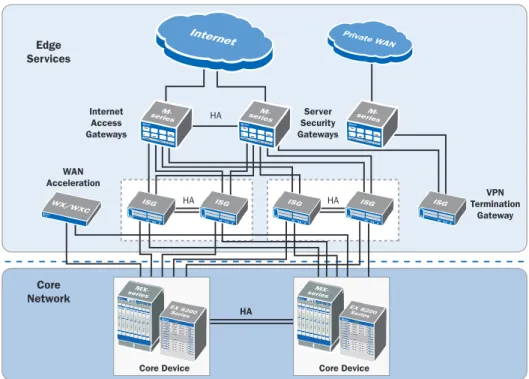
Figure 6 shows the Juniper Networks edge services design and illustrates how the edge services tier connects multiple, external networks to the data center . Edge Services provide all connectivity and network level (up to L4) security aspects for connecting the data center to the outside world . The edge routers and firewall VPNs reside in this tier .
The edge routers are Juniper Networks M-series routers and are the edge devices for both Internet and private WANs . The M-series routers were selected for two primary reasons: interface capacity and throughput .
Each router has a single connection to the Internet (or private WAN) . Connectivity between the edge routers to each ISG firewall creates a fully meshed network . You can link the edge routers to each other using a single gigabit Ethernet link that provides a transit path around a less preferred or failed path . In addition, Juniper Networks uses redundant hardware, Dynamic Routing Protocols (DRPs) and fully meshed links to minimize the amount of failure cases that could impede business continuity .
Edge Services High Availability
The Edge Services tier should provide HA at three levels where appropriate: Link • Device • Component . •
Link-level high availability should be applied at all Internet connections and in cases where additional data centers are available, it is best to keep a single leased line/private WAN connection in each data center . Device-level high availability is relevant only when we enable the link-level high availability setting, as multiple devices cannot utilize a single link themselves . Hence, Internet-facing routers and devices located within edge services layer should support device-level high availability . Additionally, component level high availability such as multiple power supplies, fans and route engines should be mandatory for edge-deployed devices .
Figure 6: Data Center Network Edge Services
In this solution, dynamic routing determines the flow of traffic . Each tier is deployed as a fully meshed solution . As a result, redundant paths are provided on each redundant device . During a link failure, a single device is not lost and this increases environment uptime by avoiding bringing down a viable path, unless necessary .
During a failure, the network requires a minimum of one additional redundant path to route around the failure . While this design itself offers high availability, the addition of a second data center further ensures high availability, as an entire data center could be lost but avoid losing network operability .
Edge Services Performance
As in any other major server concentration, the data center should terminate a large number of WAN acceleration tunnels . These tunnels correspond to as many remote sites as are appropriate for optimal user experience and performance . Some of the WAN acceleration technologies include redundant WAN acceleration tunnels and load balanced WAN acceleration clusters . Both technologies integrate by using intelligent traffic rerouting techniques in the data center .
Edge Services Security
The edge services network serves three major security functions . First, it protects against Denial of Service (DoS) attacks that are most efficiently controlled at the data center edge without using other valuable processing resources . Second, the edge tier firewalls can perform stateful inspection . Third, we implement VPN secure connectivity services . This section covers the design guidelines for these three security functions . These functions cover the protection against the threats outlined in NIST recommended best practice, as stated in the Guide to General Server Security .2
2 Guide to General Server Security, Recommendations of the National Institute of Standards and Technology, Special Publication 800-123
http://csrc .nist .gov/publications/nistpubs/800-123/SP800-123 .pdf Internet Access Gateways Server Security Gateways VPN Termination Gateway Core Network Edge Services WAN Acceleration HA HA HA HA
M-series seriesM- series
M-ISG ISG ISG ISG ISG
WX/WXC Internet Private W AN Core Device MX-series EX 8200Series Core Device MX-series EX 8200Series
For large data centers, Juniper Networks recommends using three sets of firewalls in the Edge Services tier . The first set, the Internet firewalls, must connect to the Internet and receive routing information from the edge routers to enable outbound traffic routing to the Internet . The second set, the Secure Services Gateways (SSGs), secure the server and data resources and software applications for inbound traffic that originates from the Internet . The third set, the IPSec VPN firewalls comprise the connectivity hub for all remote sites and terminate IPSec VPNs from the Internet as well as from the private WAN . The IPSec firewalls also terminate VPN tunnels for all of the remote branches over the private WAN . To provide services to the remote branches, the IPSec VPN firewalls must connect to the network core . Although these firewalls are shown as three sets, for smaller capacities and performance requirements, it is possible to consolidate the three firewalls into one or two sets . General DoS protection to all data center services should be performed at the Edge Services tier . This moves the security intelligence closer to the provider edge, thereby decreasing the number of devices that can potentially be compromised, especially with DoS attacks . A large flood can present challenges to any network, as it can consume all available network bandwidth and might require extra processing by stateful firewalls . Large floods result in high CPU usage and slow response times . While stateful firewalls provide much needed visibility and fine-grade protection against a variety of floods, all stateful firewalls have an upper limit in their capacity to deal with certain types of floods such as SYN or Internet Control Message Protocol (ICMP) . If a firewall is overwhelmed with a flood, the firewall experiences high-CPU loads and might drop legitimate traffic . The specific rate per attack varies per firewall depending upon its configuration and software version . To protect the firewall and network against massive floods, rate limits should be implemented on routers protecting all firewall interfaces . The goal is to limit certain types of traffic, such as TCP control traffic and ICMP types to rates which will not impact available bandwidth and overwhelm the firewall .
As part of the VPN design and encryption protocols selection, there are trade-offs that must be made . Organizations should choose the strongest encryption that does not compromise the performance requirements for the network . Encryption algorithms should be based on a balancing act between security and performance . A longer key length provides more security against brute force attacks yet might require more computational power . Therefore, this approach provides less performance for encrypting large amounts of data . Note that performance considerations should be made for all devices participating in the VPN, not only devices that terminate at the headend . Satellite devices might not be as powerful as the application-specific integrated circuit (ASIC)-accelerated, crypto-powered headend systems . When analyzing the elements, it is important to acknowledge the handshake protocol encryption requirements . These typically use asymmetric encryption algorithms for improved security and might affect the devices dramatically, especially with many VPN peers . One also must consider bulk encryption algorithms . Typically, these algorithms must be symmetrical and at a minimum not be influenced by design due to hardware assistance and the lower cost of hand shakes . However, if the design presents few VPN peers and large amounts of data transfer, this element should be considered; the lowest common denominator will be the speed that determines the VPN capacity . Finally, one should consider hashing algorithms . This selection is primarily done based on security requirements, but if hardware assistance is involved, then design considerations diminish .
Core Network Tier
The Juniper Networks design employs a data center network architecture consisting of two logical forwarding tiers rather than a traditional
3-tier model . Traditional 3-tier networks add an aggregation network between access networks and core networks, and they are the primary method to extend networks because of scalability limitations with most available core network devices . Aggregation at the core allows for more flexibility and easier support for virtualization, but it requires high-speed processing and high availability levels .
One of the biggest advantages of a 2-tier design is a dramatic reduction in the number of devices . Reducing the number of devices provides the following advantages:
Produces significant power savings •
Reduces the facilities footprint of the system •
Offers simplified device management •
Allows tighter security control •
Reduces the number of system failure points •
The scalability of the 2-tier model is typically limited by the scalability of the core network devices . The more traditional 3-tier design, which allows for high scalability requirements, is not discussed in this paper .
Core Network Connectivity
The core network provides the key data center fabric connectivity by connecting routers, servers, appliances and storage devices . It does not directly allow connections between the different
networks that connect to the core, as each network must be contained in a separate routing instance of Virtual Routing and Forwarding (VRF) . In cases where traffic should traverse between the VRFs, the core firewall performs the forwarding according to the security policy . Effectively, the core firewalls should connect between the different networks that reside on the same data center (see
Network Services Tier) .
Core Network HA
The core network is a key component in enabling high availability in the data center network . By connecting all networks to the core network with full redundancy at the core, high availability is achieved without added complexity and dependency on the network protocols and convergence . Traditionally, adding high availability requires redesign of the network, whereas by using standards-based redundancy protocols and a core network approach, high availability is provided at easier operational overhead . In addition to adding redundant devices, it is extremely important to ensure that the core data center devices support in-service operations such as hot-swap interfaces and software upgrades .
Core Network Virtualization
To achieve network virtualization from the server through the network core, there are a variety of options to consider . For all options, a key assumption is the deployment of network systems that deliver line-rate throughput even when all features are turned on . In general, there are two possible approaches:
Extend VLANs from the access layer or server all the way to the network core . •
Use VLANS between servers and access devices and divide the network by using MPLS from •
that point on through the core .
There are advantages and disadvantages to each approach, and each approach might be more practical on a different scale and for data center operators with different skill sets . VLANs that extend all the way to the core are more appropriate for smaller networks . However, in the case of larger networks that face VLAN scaling limitations with more elaborate QoS requirements, MPLS is the preferred choice . Regardless of the approach, the Juniper Networks data center network architecture and solution components provide both approaches without sacrificing performance .
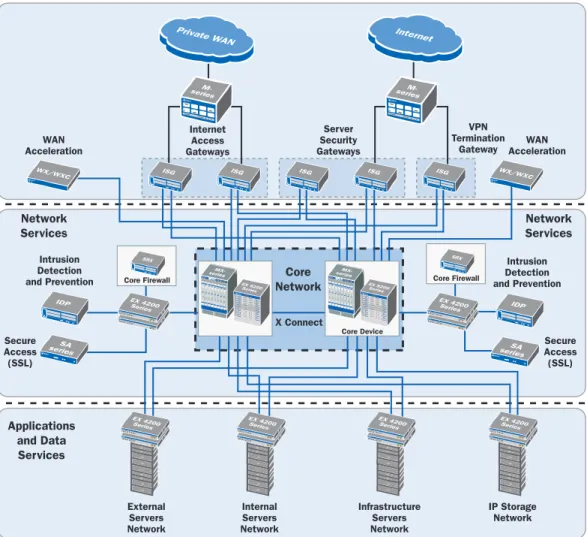
Multiple instances of a single VLAN, residing in different physical access networks, can be joined at the core network across line cards (or not) without impacting performance . Additionally, multiple distinct VLANs, all connecting to a single access switch port, can be seamlessly reclassified and associated with MPLS Label Switched Paths (LSPs) with unique QoS and connectivity characteristics . The Juniper Networks 2-tier architecture provides for a more flexible design option, as depicted in Figure 7 .The MX-series Ethernet Services Routers (ESRs) or EX 8200 series switches reside in the core network and Juniper Networks EX-series Ethernet switch platforms reside in the access layer .
Figure 7: Data Center Core Network and Network Services
Network Services Tier
The network services tie closely to the network protocols that support data center applications . Network services are generally divided into two main categories:
Security services •
Application services •
Throughout this section, we describe both services in greater detail and address the key elements that comprise the data center network architecture .
The Network Services tier should extend itself to any of the server networks hosted in the data center, and apply a network-specific policy and set of configurations to behave appropriately with the traffic in that particular network section . For example, using a security service such as traffic SYN checking/ sequence number checking might only be required for servers available to the outside world . Therefore, the architecture should support the application of these features only to those systems or networks . Most importantly, key characteristics are enabled by a direct logical attachment to the network core of the data center .
Leveraged throughout is the Network Services tier’s ability to extend a shared pool of network services to any of the server and data networks, while allowing for granular and specific network service settings for each one of the services . The network services are virtually available for each of the backend data and service networks by sharing the network service resources across the entire
Core Network Network
Services NetworkServices
Applications and Data
Services WAN
Acceleration AccelerationWAN
VPN Termination Gateway Server Security Gateways Internet Access Gateways Secure Access (SSL) Intrusion Detection and Prevention Intrusion Detection and Prevention Secure Access (SSL) X Connect IP Storage Network External Servers Network Internal Servers Network Infrastructure Servers Network
EX 4200Series EX 4200Series EX 4200Series EX 4200Series IDP WX/WXC Private W AN M-series Internet M-series
ISG ISG ISG ISG ISG
IDP SA series EX 4200Series EX 4200Series SRX Core Firewall Core Device Core Device MX-series EX 8200 Series MX-series EX 8200 Series SRX Core Firewall EX 4200Series EX 4200Series SA series WX/WXC
data center . This approach allows the network designer to intelligently deploy network services to different applications and networks in the data center . Virtual instances are a key consideration in designing the Network Services tier .
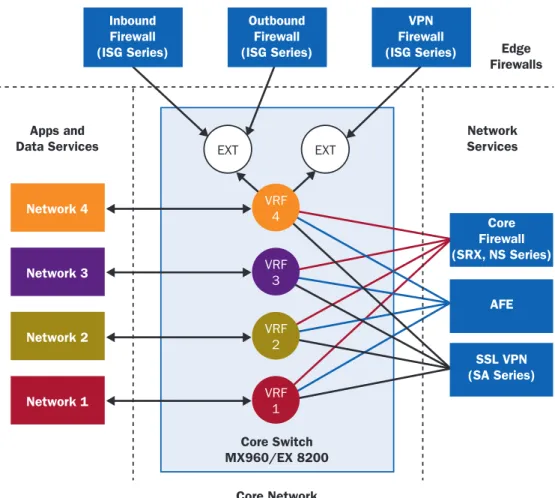
Figure 8 illustrates the connectivity systems (MX-series ESR/EX-8200), application systems (Network N), and the network service systems (depicted on the far right of the diagram) . This diagram provides a core network perspective and shows the interaction between the core and the pooled service devices . The network services include the following systems:
Security services—such as firewalls, Intrusion Detection and Prevention •
Application frontend services—such as server load balancing, SSL offload, HTTP cache, TCP •
multiplex, and global server load balancing (GSLB)
Figure 8: Connectivity Systems, Application Systems and Network Service Systems
Data Center Security Services
One of the most important services of the Network Services tier is the security service . The security service essentially controls segmentation of the data center into separate networks, and it enables secure connectivity between the different networks . Because security services are broadly used, multiple devices participate in the application of security services to the data center server network . These security services at the data center network services layer provide necessary isolation and policy control for communication between servers located at data center . These security services also address the requirements specified in the NIST recommended best practices to protect the data center network from any attacks or malicious activity from un-patched or compromised servers . Refer to the Guide to General Server Security .3
Inbound Firewall (ISG Series) Outbound Firewall (ISG Series) VPN Firewall (ISG Series) Core Firewall (SRX, NS Series) AFE SSL VPN (SA Series) Network 2 Network 1 Network 4 Network 3 EXT EXT VRF 4 VRF 3 VRF 2 VRF 1 Core Switch MX960/EX 8200 Core Network Network Services Edge Firewalls Apps and Data Services
3 Guide to General Server Security, Recommendations of the National Institute of Standards and Technology, Special Publication 800-123
Stateful firewalls are the cornerstone of the data center network’s security service . Stateful firewalls enforce a security policy that aligns with business and operational requirements through the identification and classification of networks . In addition to being the primary L4 access control system, the firewalls help with many security functions in the data center, such as service DoS or quota protections, Deep Inspection to specific applications where it is required and also potential network address translation .
Generally, the first layer of defense inside the data center is the stateful firewall . However, it is important to recognize that the firewall must be capable of extending a logical subset of its functionality as you dedicate the firewall to a specific data center network . The minimum amount of resources that the firewall must dedicate is a separate control and forwarding engine (virtual router) such that all traffic streams are totally isolated, and forwarding decisions will not mistakenly puncture the security protections . An additional attribute in designing a consolidated data center services instance is high availability capabilities that must extend themselves particularly at the services layer to truly design a network that depends on the services for its core functionality .
The Juniper Networks NetScreen firewall systems can split into separate virtual domains of control and forwarding instances or Virtual Systems (VSYS), creating separate virtual domains that allow autonomy to different departments to control their security policies . To connect all of the core networks, the core firewall must participate in routing protocols within the data center network . The Juniper Networks SRX 5800 service gateway provides 120 Gbps firewall, 30 Gbps IDP and 350,000 connections per second . Equipped with a full range of security features, the SRX 5800 is ideally suited for securing large data centers .
Application Security—In addition to assuring secure connectivity at L4, the Network Services tier should employ application security services such as Intrusion Prevention to protect the data center infrastructure . Because these application services are available to all users coming from insecure locations, the risk of application misuse or application DoS increases . In addition, because multiple applications are co-located, this creates a chain effect in which each application is affected by the risk to which another is exposed .
The platforms should support the level of performance required by the data center and be able to inspect L7 information at line-rate speeds . It is necessary to understand that the protocols deconstruct the data streams and build the right context to look for application threats . Therefore, a powerful and rich application protocol decoder is necessary . Also, the integration of the application protocol decoding to firewalls is a key consideration to help reduce the number of devices and to increase overall effectiveness . Finally, virtualization or a context-based security policy application, in which the security systems are able to uniquely treat different networks and applications, is another important consideration .
Application Front Ending Services
It is important to find ways to scale the data center services without a linear increase in the hardware footprint and to ensure that the design does not increase the operational complexity . A key component of the Network Services tier is a solution that enables offloading of non-specialized services from the data center servers .
One should consider deploying a system that supports acceleration for the different application tiers and also provides comprehensive capabilities around the more common and emerging application areas like Web 2 .0 . A data center acceleration solution should boost the performance of both client-server, Web-based, and server-to server-applications, as well as speeding Web page downloads . In addition, the acceleration solution should offload CPU-intensive functions such as TCP connection processing and HTTP compression from backend applications and Web servers . For its part, the application acceleration platform should be seamlessly expandable through stacking or clustering of multiple devices . In addition to advanced traffic management and acceleration, the application front ending service should serve as a standard load balancer . This means forwarding traffic to its destination address from a pool of available addresses .
Organization/business requirements drive the need to allow different applications to be treated differently, and to allow different departments to control and define what acceleration and front ending characteristics they require from the network service . Our solution addresses these requirements .
Applications and Data Services Tier
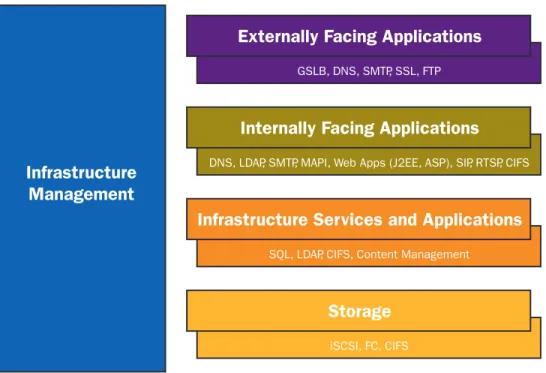
The core network tier connects to the data center services and applications tier which hosts all of the servers, databases and storage . Generally, there are four types of networks and there can be multiple instances of each type . Primary reasons for the multiple instances are separation of duties within the company and differentiated business objectives and IT requirements for the different networks . Figure 9 illustrates the four networks . A description of the four networks is as follows:
External Applications Network
• —can be multiple external networks serving separate network segments . These typically include applications such as the public Website, public mail transfer agent (MTA), Domain Name System (DNS) services and remote access and potential file services that are available through unfiltered access .
Internal Applications Network
• —multiple internal networks serving different levels of internal access from within the campus of branch locations . These networks typically connect internal applications such as finance and human resources systems . Partner applications also reside in the internal network and any specific applications that are exposed to partners such as inventory systems and manufacturing information .
Infrastructure Services Network
• —only servers that are accessible to users are allowed to access infrastructure networks . These are intended to operate only on an automatic basis and performance usually is quite predictable . Common examples of infrastructure services include Lightweight Directory Access Protocol (LDAP), databases, file sharing, content management and middleware servers .
Storage
• —storage networks, such as Fibre Channel, InfiniBand or Internet Small Computer System Interface (iSCSI) are part of the storage networks . Critical application servers directly connect to the storage devices through a separate Host Bus Adapter (HBA) to ensure fast access to data . Other servers connect using Ethernet to access storage facilities .
Figure 9: Data Center Application Network Types/Purposes
Externally Facing Applications
Data Center Services and Applications
GSLB, DNS, SMTP, SSL, FTP
Internally Facing Applications
Infrastructure
Management
DNS, LDAP, SMTP, MAPI, Web Apps (J2EE, ASP), SIP, RTSP, CIFS
Infrastructure Services and Applications
SQL, LDAP, CIFS, Content ManagementStorage
iSCSI, FC, CIFSThe applications and data services tier is primarily responsible for connecting and wiring all servers . Juniper Networks solution provides a flexible deployment option using its Ethernet switching platform and virtual chassis capability . Below are several flexible deployment options that Juniper Networks provides .
Redundant access switch top of the rack deployment •
Server link aggregation with top of the rack deployment •
End of the row access switch deployment •
Redundant access switch top of the rack deployment: This deployment option requires two high-speed, independent, top-of-rack switches that connect to the core network as a solution . In data center environments, servers are interconnected to access switches deployed within server racks . These access switches are often referred to as “top-of-rack” switches due to their location within the data center . Top-of-rack switching provides increased levels of availability because of multiple independent operating characteristics and physical power sources . Servers connect to two different physical switches, each part of a separate virtual chassis ring . Each ring in turn connects to the core network while using a loop detection and high availability L2 protocol .
Data center application connection is as follows:
Each server has two, 1 Gbps access network switches; each server connects to a separate •
access switch for redundancy purposes .
The access switching layer connects to the core network using 10 Gbps uplink; each access •
switch has separate 10 Gbps links .
The server connection links and access switch uplinks can use VLAN trunking technology to •
support both server virtual location and aggregation; all aggregating multiple L2 networks then use fewer connections .
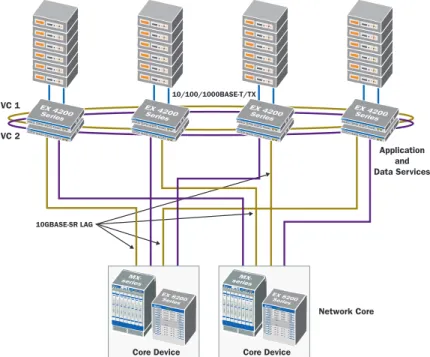
Each internal and external applications network can be segmented into several sub networks (see Figure 10) . The servers that host these applications connect with at least a 1 Gbps (currently moving towards 10 Gbps) link to the Juniper EX-series Virtual Chassis™ switch . The EX-series Virtual Chassis
switch connects to the network core through a 10 Gbps connection . Depending on the number of servers, multiple EX-series Virtual Chassis might be required, as shown in Figure 10 . Juniper Networks recommends dual homing the access layer switches using L3 with OSPF equal-cost multipath (ECMP) instead of the Spanning Tree Protocol (STP) for deterministic behavior for minimal packet loss .
Figure 10: Application and Data Services Network View VC 1 VC 2 10/100/1000BASE-T/TX 10GBASE-SR LAG Application and Data Services Network Core EX 4200Series EX 4200Series EX 4200Series EX 4200Series EX 4200Series EX 4200Series EX 4200Series EX 4200Series Core Device MX-series EX 8200 Series Core Device MX-series EX 8200Series
In data center environments, servers are interconnected to access switches deployed within server racks . Typically, top-of-rack access switches are deployed in pairs to redundantly support servers within a single rack . Juniper Networks EX 4200 Virtual Chassis offers several advantages when deployed as a top-of-rack access switch . The EX 4200 supports a maximum of 48, 10/100/1000BASE-T/TX interfaces for attached server devices at 1Gbps wire-rate per interface . As a result, performance is not compromised . Also, each EX 4200 offers additional wire-rate uplink interfaces, with a maximum of four GbE or two 10GbE uplink modules for interconnecting from the top rack back to the data center core .
Server link aggregation with top of the rack deployment: This deployment requires two, high speed top-of-rack switches that connect to the core network as the solution . Both switches are part of the same virtual chassis (the virtual chassis can extend to multiple racks, allowing a maximum of 10 switches and can be part of the same virtual chassis) . Data center servers can connect to both switches located at top-of-rack with link aggregation technology . This deployment provides flexible top-of-rack deployment with the additional advantage of desired high availability features such as switch/link/uplink/power and fabric redundancy . This approach also provides efficient network bandwidth utilization by actively using both links between server and access switch and by increasing network throughput . The virtual chassis can be dual-homed with an uplink to the core switches using an L3 connection with OSPF equal-cost multipath (ECMP), instead of using STP for deterministic behavior for minimal packet loss .
End of the row access switch deployment: With this deployment, all connections from the data center servers are extended to the switching rack at the end of the row . This deployment model was preferred because of the high availability features of a chassis-based solution which is typically not available with small form factor top-of-rack switches . With Juniper Networks virtual chassis technology, we can deploy top-of-rack switching deployment with all high availability features to end-of-row deployment . We can easily deploy a virtual chassis or the EX 8200 platform for traditional end-of-row deployment .
With Juniper Networks virtual chassis capability, we can leverage ease and flexibility of top-of-rack deployment without compromising any high availability features as compared to the traditional chassis-based solution . With virtual chassis technology, the top-of-rack deployment can expand between data centers located a few kilometers apart .
The EX 4200 also supports the virtual chassis concept, whereby a maximum of 10 EX 4200 switches can be interconnected through a redundant, high-speed 128 Gbps interconnect, yet still be managed and maintained as a single logical device . With the Virtual Chassis technology, the number of managed devices can be reduced by a factor of 10, significantly simplifying operations and reducing costs associated with maintaining large numbers of legacy access switches . Additionally, uplinks can be distributed across multiple EX 4200s in a single virtual chassis, providing uplink performance flexibility and added redundancy levels unfounded in legacy access switches .
The deployment options considered with the application and data services tier provide optimized data transfer for the data center solution . Server-to-server traffic utilizes a high throughput virtual chassis switch fabric across access switches . This provides necessary bandwidth for data transfer between application servers and the database as well as data replication between servers . The user-to-server traffic utilizes aggregated links between the access switches and the core router using the L3 connection of OSPF and ECMP . Separating the network path for user-to-server and server-to-server traffic efficiently utilizes network links and provides a predictable, consistent user experience .