RESOURCE AND PATIENT MANAGEMENT SYSTEM
IHS Clinical Reporting System
(BGP)
National GPRA & PART Report
Performance Measure List and Definitions
Version 12.1
May 2012
Revision History
Date Revision Description Author
Table of Contents
1.0 CRS 2012 National GPRA & PART Report ... 1
1.1 Performance Measures ... 1
1.2 CRS Denominator Definitions ... 5
1.2.1 For All Denominators ... 5
1.2.2 Active Clinical Population ... 5
1.2.3 User Population ... 6
1.2.4 Active Clinical CHS Population ... 7
1.2.5 Active Clinical Behavioral Health Population ... 7
2.0 Performance Measure Topics and Definitions ... 9
2.1 Diabetes Group... 9
2.1.1 Diabetes Prevalence ... 9
2.1.2 Diabetes: Glycemic Control ... 9
2.1.3 Diabetes: Blood Pressure Control ... 11
2.1.4 Diabetes: LDL Assessment ... 13
2.1.5 Diabetes: Nephropathy Assessment ... 14
2.1.6 Diabetic Retinopathy ... 16
2.2 Dental Group ... 18
2.2.1 Access to Dental Services ... 18
2.2.2 Dental Sealants ... 19 2.2.3 Topical Fluoride ... 20 2.3 Immunization Group ... 21 2.3.1 Influenza ... 21 2.3.2 Adult Immunizations ... 22 2.3.3 Childhood Immunizations ... 23
2.4 Cancer Screening Group ... 35
2.4.1 Cancer Screening: Pap Smear Rates ... 35
2.4.2 Cancer Screening: Mammogram Rates ... 37
2.4.3 Colorectal Cancer Screening ... 38
2.4.4 Tobacco Use and Exposure Assessment ... 40
2.4.5 Tobacco Cessation ... 42
2.5 Behavioral Health Group ... 44
2.5.1 Alcohol Screening (FAS Prevention) ... 44
2.5.2 Intimate Partner (Domestic) Violence Screening ... 46
2.5.3 Depression Screening ... 47
2.6 Cardiovascular Disease Related Group ... 48
2.6.1 Obesity Assessment ... 48
2.6.2 Childhood Weight Control ... 49
2.6.3 Comprehensive CVD-Related Assessment ... 51
2.7.1 HIV Screening ... 54
2.8 Other Clinical Group ... 56
2.8.1 Breastfeeding Rates ... 56
Acronym List ... 59
1.0
CRS 2012 National GPRA & PART Report
1.1
Performance Measures
The following performance measures will be reported in the Clinical Reporting System (CRS) 2012 National Government Performance and Results Act of 1993 (GPRA) & Program Assessment Rating Tool (PART) Report.
Notes: Beginning FY 2010, GPRA Developmental will no longer
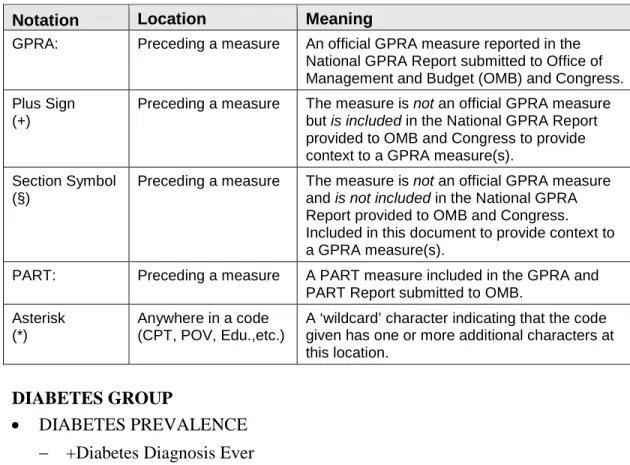
be included in this document and will instead have its own Performance Measure Topics and Definitions document. Notations used in this document are described in Table 1-1.
Table 1-1: Document Notations
Notation Location Meaning
GPRA: Preceding a measure An official GPRA measure reported in the National GPRA Report submitted to Office of Management and Budget (OMB) and Congress. Plus Sign
(+)
Preceding a measure The measure is not an official GPRA measure but is included in the National GPRA Report provided to OMB and Congress to provide context to a GPRA measure(s).
Section Symbol (§)
Preceding a measure The measure is not an official GPRA measure and isnotincluded in the National GPRA Report provided to OMB and Congress. Included in this document to provide context to a GPRA measure(s).
PART: Preceding a measure A PART measure included in the GPRA and PART Report submitted to OMB.
Asterisk (*)
Anywhere in a code (CPT, POV, Edu.,etc.)
A ‘wildcard’ character indicating that the code given has one or more additional characters at this location.
DIABETES GROUP
• DIABETES PREVALENCE
− +Diabetes Diagnosis Ever
− §Diabetes Diagnosis during GPRA Year
• GLYCEMIC CONTROL
− GPRA: Poor Glycemic Control
− §Good Glycemic Control
− GPRA: Ideal Glycemic Control
• BLOOD PRESSURE CONTROL
− §Blood Pressure (BP) Assessed
− GPRA: Controlled BP
• LOW-DENSITY LIPOPROTEIN (LDL) ASSESSMENT
− GPRA: LDL Assessed
− §LDL less than or equal to 100
• NEPHROPATHY ASSESSMENT
− GPRA: Estimated Glomerular Filtration Rate (GFR) & Quantitative Urinary Protein or History of End-Stage Renal Disease (ESRD)
• RETINOPATHY ASSESSMENT
− GPRA: Retinopathy Evaluation (No Refusals) DENTAL GROUP
• ACCESS TO DENTAL
− GPRA: Annual Dental Visit (No Refusals)
• DENTAL SEALANTS
− GPRA: Dental Sealants (No Refusals; count; not rate)
• TOPICAL FLUORIDE
− GPRA: Topical Fluoride Application (No Refusals; count; not rate) IMMUNIZATIONS
• INFLUENZA
− GPRA: Influenza Immunization
• ADULT IMMUNIZATIONS
− GPRA: Pneumovax Ever
• CHILDHOOD IMMUNIZATIONS (19–35 MONTHS)
− §Active Clinical Patients with 4:3:1:3:3 (No Refusals)
− §Active Clinical Patients with 4:3:1:3:3:1 (No Refusals)
− §Active Clinical Patients with 4:3:1:3:3:1:4 (No Refusals)
− §Active IMM Patients with 4:3:1:3:3 (No Refusals)
− GPRA: Active IMM Patients with 4:3:1:3:3:1:4 (No Refusals) − §four DTaP − §three Polio − §one MMR − §three HiB − §three Hepatitis B − §one Varicella − §four Pneumococcal CANCER SCREENING • PAP SMEAR RATES
− GPRA: Pap Smear (No Refusals)
• MAMMOGRAM RATES
− GPRA: Mammogram (No Refusals)
• COLORECTAL CANCER SCREENING
− GPRA: Fecal Occult Blood Test or Fecal Immunochemical Test during report period, Flexible Sigmoidoscopy or Double Contrast Barium Enema (DCBE) in past 5 years, or Colonoscopy in past 10 years (No Refusals)
− §Fecal Occult Blood Test or Fecal Immunochemical Test
• TOBACCO USE AND EXPOSURE ASSESSMENT
− §Tobacco Assessment
• §Tobacco Users
− §Smokers
− §Smokeless Users
• §Exposed to Environmental Tobacco Smoke (ETS)
• TOBACCO CESSATION
− GPRA: Tobacco Cessation Counseling or Smoking Cessation Aid (No Refusals)
− §Quit Tobacco Use
− §Tobacco Cessation Counseling or Refusal, Smoking Cessation Aid, or Quit Tobacco Use
BEHAVIORAL HEALTH
• ALCOHOL SCREENING (FETAL ALCOHOL SYNDROM [FAS] PREVENTION)
• INTIMATE PARTNER VIOLENCE/DOMESTIC VIOLENCE SCREENING
− GPRA: Intimate Partner Violence/Domestic Violence Screening (No Refusals)
• DEPRESSION SCREENING
− GPRA: Depression Screening or Mood Disorder Diagnosis (No Refusals)
− §Depression Screening
− §Mood Disorder Diagnosis
CARDIOVASCULAR DISEASE (CVD)-RELATED • OBESITY ASSESSMENT
− §Obesity Assessment (No Refusals)
• §Assessed as Overweight
• §Assessed as Obese
• §Assessed as Overweight or Obese
• CHILDHOOD WEIGHT CONTROL (CHILDREN 2-5)
− §Body Mass Index (BMI) 95% and Up
− §BMI 85 to 94%
− §BMI greater than or equal to 85%
• COMPREHENSIVE CVD-RELATED ASSESSMENT
− GPRA: BP, LDL, and Tobacco Assessed, BMI, and Lifestyle Counseling (No Refusals)
− §Depression Screen STD GROUP
• HIV SCREENING
− GPRA: Prenatal HIV Screening (No Refusals) OTHER CLINICAL
• BREASTFEEDING RATES
− Patients 30 to 394 days of age screened for infant feeding choice (IFC) at least once.
− Patients 30 to 394 days of age screened for IFC at the age of two months.
− Patients 30 to 394 days of age screened for IFC at the age of six months.
− Patients 30 to 394 days of age screened for IFC at the age of nine months.
− PART: Patients 30 to 394 days of age who were exclusively or mostly breastfed at two months of age.
− Patients 30 to 394 days of age who were exclusively or mostly breastfed at six months of age.
− Patients 30 to 394 days of age who were exclusively or mostly breastfed at nine months of age.
− Patients 30 to 394 days of age who were exclusively or mostly breastfed at the age of one year.
Notes: Definitions for all performance measure topics included in
CRS begin on Section 2.0. Definitions for numerators and denominators that are preceded by “GPRA” represent measures that are reported to OMB and Congress.
Definitions for numerators and denominators preceded by “PART” are reported for the OMB PART.
1.2
CRS Denominator Definitions
1.2.1
For All Denominators
• All patients with name “DEMO,PATIENT” or who are included in the RPMS Demo/Test Patient Search Template (DPST option located in the Patient Care Component [PCC] Management Reports, Other section) will be excluded automatically for all denominators.
• For all measures, except as noted, patient age is calculated as of the beginning of the report period.
1.2.2
Active Clinical Population
1.2.2.1 National GPRA & PART Reporting
• Must have two visits to medical clinics in the past three years. Chart reviews and telephone calls from these clinics do not count; the visits must be face-to-face. At least one visit must be to a core medical clinic. Refer to the Clinical Reporting System (CRS) for FY2012 Clinical Measures User Manual for listing of these clinics.
• Must be alive on the last day of the Report Period.
• Must reside in a community specified in the site’s GPRA community taxonomy, defined as all communities of residence in the defined Contract Health Service (CHS) catchment area.
1.2.2.2 Local Reports
• Must have two visits to medical clinics in the past three years. Chart reviews and telephone calls from these clinics do not count; the visits must be face-to-face. At least one visit must be to a core medical clinic. Refer to the Clinical Reporting System for FY2012 Clinical Measures User Manual for listing of these clinics.
• Must be alive on the last day of the Report Period.
• User defines population type: AI/AN patients only, non AI/AN, or both.
• User defines general population: single community, group of multiple
communities (community taxonomy), user-defined list of patients (patient panel), or all patients regardless of community of residence.
1.2.3
User Population
1.2.3.1 National GPRA & PART Reporting
• Must have been seen at least once in the three years prior to the end of the time period, regardless of the clinic type, and the visit must be either ambulatory (including day surgery or observation) or a hospitalization; the rest of the service categories are excluded.
• Must be alive on the last day of the Report Period.
• Must be AI/AN; defined as Beneficiary 01.
• Must reside in a community specified in the site’s GPRA community taxonomy, defined as all communities of residence in the defined CHS catchment area.
1.2.3.2 Local Reports
• Must have been seen at least once in the three years prior to the end of the time period, regardless of the clinic type, and the visit must be either ambulatory (including day surgery or observation) or a hospitalization; the rest of the service categories are excluded.
• Must be alive on the last day of the Report Period.
• User defines general population: single community, group of multiple
communities (community taxonomy), user-defined list of patients (patient panel), or all patients regardless of community of residence.
1.2.4
Active Clinical CHS Population
CHS-Only Sites1.2.4.1 National GPRA & PART Reporting
• Must have two CHS visits in the three years prior to the end of the Report Period, and the visits must be either ambulatory (including day surgery or observation) or a hospitalization; the rest of the service categories are excluded.
• Must be alive on the last day of the Report period.
• Must be AI/AN; defined as Beneficiary 01. This data item is entered and updated during the Patient Registration process.
• Must reside in a community included in the site’s “official” GPRA community taxonomy, defined as all communities of residence in the CHS catchment area specified in the community taxonomy specified by the user.
1.2.4.2 Local Reports
• Must have two CHS visits in the three years prior to the end of the Report Period, and the visits must be either ambulatory (including day surgery or observation) or a hospitalization; the rest of the service categories are excluded.
• Must be alive on the last day of the Report period.
• User defines population type: AI/AN patients only, non AI/AN, or both.
• User defines general population: single community, group of multiple
communities (community taxonomy), user-defined list of patients (patient panel), or all patients regardless of community of residence.
1.2.5
Active Clinical Behavioral Health Population
1.2.5.1 National GPRA and PART Reporting
Urban Outreach and Referral-Only Sites
• Must have two Behavioral Health visits in the three years prior to the end of the report period, and the visits must be either ambulatory (including day surgery or observation) or a hospitalization; the rest of the service categories are excluded.
• Must be alive on the last day of the report period.
• Must be AI/AN; defined as Beneficiary 01. This data item is entered and updated during the Patient Registration process.
• Must reside in a community included in the site’s “official” GPRA community taxonomy, defined as all communities of residence in the CHS catchment area specified in the community taxonomy specified by the user.
1.2.5.2 Local Reports
• Must have two Behavioral Health visits in the three years prior to the end of the report period, and the visits must be either ambulatory (including day surgery or observation) or a hospitalization; the rest of the service categories are excluded.
• Must be alive on the last day of the report period.
• User defines population type: AI/AN patients only, non-AI/AN, or both.
• User defines general population: single community, group of multiple
communities (community taxonomy), user-defined list of patients (patient panel), or all patients regardless of community of residence.
2.0
Performance Measure Topics and Definitions
The following sections define the performance measure topics and their definitions that are included in the CRS 2012 version 12.1 National GPRA & PART Report.2.1
Diabetes Group
2.1.1
Diabetes Prevalence
2.1.1.1 Owner and Contact
Diabetes Program: Dr. Ann Bullock
2.1.1.2 National Reporting
NATIONAL (included in IHS Performance Report; not reported to OMB and Congress)
2.1.1.3 Denominators
1. User Population patients.
2.1.1.4 Numerators
1. Anyone diagnosed with diabetes (Purpose of Visit [POV] 250.00 to 250.93) ever. 2. Anyone diagnosed with diabetes during the report period.
2.1.1.5 Definitions
Diabetes Diagnosis
At least one diagnosis 250.00 through 250.93 recorded in the V POV file.
2.1.1.6 Patient Lists
Diabetic patients with most recent diagnosis.
2.1.2
Diabetes: Glycemic Control
2.1.2.1 Owner and Contact
2.1.2.2 National Reporting
NATIONAL (included in IHS Performance Report; reported to OMB and Congress)
2.1.2.3 Denominators
1. GPRA: Active Diabetic patients; defined as all Active Clinical patients diagnosed with diabetes (POV 250.00 through 250.93) prior to the report period, and at least two visits in the past year, and two diabetes mellitus (DM)-related visits ever. The key denominator for this and all diabetes-related topics follows.
2.1.2.4 Numerators
1. Hemoglobin A1c documented during the report period. 2. GPRA: Poor control: A1c greater than 9.5.
3. Good control: A1c equals or greater than 7 and less than 8 4. GPRA: Ideal control: A1c less than 7.
2.1.2.5 Definition Diabetes
First DM POV 250.00 through 250.93 recorded in the V POV file prior to the report period.
A1c
Searches for most recent A1c test with a result during the report period. If more than one A1c test is found on the same day or the same visit and one test has a result and the other does not, the test with the result will be used.
If an A1c test with a result is not found, CRS searches for the most recent A1c test without a result.
• A1c defined as any of the following:
– Current Procedural Terminology (CPT) 83036, 83037, 3044F to 3046F, 3047F (old code)
– Logical Observations Identifiers, Names, Codes (LOINC) taxonomy – Site-populated taxonomy DM AUDIT HGB A1C TAX
• CPT 3044F represents A1c less than 7 and will be included in the Ideal Control numerator.
2.1.2.6 GPRA 2012 Target
Poor Glycemic Control: During FY 2012, achieve the tentative target rate of 18.6%
for the proportion of patients with diagnosed diabetes who have poor glycemic control (defined as A1c greater than 9.5).
Ideal Glycemic Control: During FY 2012, achieve the tentative target rate of 32.7%
for the proportion of patients with diagnosed diabetes who have ideal glycemic control (defined as A1c less than 7).
2.1.2.7 Patient Lists
• List of diabetic patients with a documented Alc.
• List of diabetic patients without a documented Alc.
• List of diabetic patients with poor glycemic control (Alc greater than 9.5).
• List of diabetic patients with A1c equal to or greater than 7 and less than 8.
• List of diabetic patients with ideal glycemic control (Alc less than 7).
2.1.3
Diabetes: Blood Pressure Control
2.1.3.1 Owner and Contact
Diabetes Program: Dr. Ann Bullock
2.1.3.2 National Reporting
NATIONAL (included in IHS Performance Report; reported to OMB and Congress)
2.1.3.3 Denominators
1. GPRA: Active Diabetic patients; defined as all Active Clinical patients diagnosed with diabetes (POV 250.00 through 250.93) prior to the report period, and at least two visits in the past year, and two DM-related visits ever. The key denominator for this and all diabetes-related topics follows.
2.1.3.4 Numerators
1. Patients with BP documented during the report period. 2. GPRA: Controlled BP, less than 130/80.
2.1.3.5 Definitions Diabetes
First DM POV 250.00 through 250.93 recorded in the V POV file prior to the report period.
BP Documented
CRS uses mean of last three BPs documented on non-emergency room (ER) visits during the report period. If three BPs are not available, uses mean of last two non-ER BPs. If a visit contains more than one BP, the lowest BP will be used, defined as having the lowest systolic value. The mean Systolic value is calculated by adding the last three (or two) systolic values and dividing by three (or two). The mean Diastolic value is calculated by adding the diastolic values from the last three (or two) BPs and dividing by three (or two). If the systolic and diastolic values do not both meet the criteria for controlled, then the value is considered not controlled.
If CRS is not able to calculate a mean BP, it will search for CPT 0001F, 2000F, 3074F through 3080F or POV V81.1 documented on a non-ER visit during the Report Period.
Controlled BP
CRS uses a mean, as described above where BP is less than 130/80. If the mean systolic and diastolic values do not both meet the criteria for controlled, then the value is considered not controlled.
BP documented and Controlled BP
If CRS is not able to calculate a mean BP from BP measurements, it will search for the most recent of any of the following codes documented on non-ER visits during the report period:
• BP Documented: CPT 0001F or 2000F or POV V81.1; OR
• Systolic: CPT 3074F, 3075F, or 3077F WITH Diastolic: CPT 3078F, 3079F, or 3080F. The systolic and diastolic values do not have to be recorded on the same day. If there are multiple values on the same day, the CPT indicating the lowest value will be used.
• The following combination represents BP less than 130/80 and will be included in the Controlled BP numerator: CPT 3074F and 3078F. All other combinations will not be included in the Controlled BP numerator.
2.1.3.6 GPRA 2012 Target
During FY 2012, achieve the tentative target rate of 38.7% for the proportion of patients with diagnosed diabetes who have achieved BP control (defined as less than 130/80).
2.1.3.7 Patient Lists
• List of diabetic patients who had their BP assessed.
• List of diabetic patients who did not have their BP assessed.
• List of diabetic patients with controlled BP, defined as below130/80.
• List of diabetic patients with uncontrolled BP, defined as above130/80.
2.1.4
Diabetes: LDL Assessment
2.1.4.1 Owner and Contact
Diabetes Program: Dr. Ann Bullock
2.1.4.2 National Reporting
NATIONAL (included in IHS Performance Report; reported to OMB and Congress)
2.1.4.3 Denominators
1. GPRA: Active Diabetic patients; defined as all Active Clinical patients diagnosed with diabetes (POV 250.00 through 250.93) prior to the report period, and at least two visits in the past year, and two DM-related visits ever. The key denominator for this and all diabetes-related topics is below.
2.1.4.4 Numerators
1. GPRA: Patients with LDL completed during the report period, regardless of result.
2. LDL less than or equal to 100
2.1.4.5 Definitions Diabetes
First DM POV 250.00 through 250.93 recorded in the V POV file prior to the report period.
LDL
Searches for most recent LDL test with a result during the report period. If more than one LDL test is found on the same day or the same visit and one test has a result and the other does not, the test with the result will be used. If an LDL test with a result is not found, CRS searches for the most recent LDL test without a result.
• LDL test defined as any of the following:
– CPT 80061, 83700, 83701, 83704, 83715 (old code), 83716 (old code), 83721, 3048F, 3049F, 3050F
– LOINC taxonomy
– Site-populated taxonomy DM AUDIT LDL CHOLESTEROL TAX
• For numerator LDL less than or equal to 100, CPT 3048F will count as meeting the measure
2.1.4.6 GPRA 2012 Target
During FY 2012, achieve the tentative target rate of 70.3% for the proportion of patients with diagnosed diabetes who are assessed for dyslipidemia (LDL cholesterol).
2.1.4.7 Patient Lists
• List of diabetic patients with LDL completed, regardless of result.
• List of diabetic patients without LDL completed.
2.1.5
Diabetes: Nephropathy Assessment
2.1.5.1 Owner and Contact
Diabetes Program: Dr. Ann Bullock
2.1.5.2 National Reporting
NATIONAL (included in IHS Performance Report; reported to OMB and Congress)
2.1.5.3 Denominators
1. GPRA: Active Diabetic patients; defined as all Active Clinical patients diagnosed with diabetes (POV 250.00 through 250.93) prior to the report period, and at least two visits in the past year, and two DM-related visits ever. The key denominator for this and all diabetes-related topics is below.
2.1.5.4 Numerators
1. GPRA: Patients with nephropathy assessment, defined as an estimated GFR and a quantitative urinary protein assessment during the report period or with evidence of diagnosis or treatment of ESRD at any time before the end of the report period.
2.1.5.5 Definitions Diabetes
First DM POV 250.00 through 250.93 recorded in the V POV file prior to the report period.
Estimated GFR
• Site-populated taxonomy BGP GPRA ESTIMATED GFR TAX
• LOINC taxonomy
Quantitative Urine Protein Assessment
• CPT 82042, 82043, 84156
• LOINC taxonomy
• Site-populated taxonomy BGP QUANT URINE PROTEIN
Note: Check with your laboratory supervisor to confirm that the
names you add to your taxonomy reflect quantitative test values.
ESRD
• ESRD diagnosis or treatment defined as any of the following ever:
– CPT 36145, 36147, 36800, 36810, 36815, 36818, 36819, 36820, 36821, 36831 through 36833, 50300, 50320, 50340, 50360, 50365, 50370, 50380, 90951 through 90970 or old codes 90918 through 90925, 90935, 90937, 90939 (old code), 90940, 90945, 90947, 90989, 90993, 90997, 90999, 99512, G0257, G0308 through G0327 (old codes), G0392 (old code), G0393 (old code), S9339
– POV 585.5, 585.6, V42.0, V45.1 (old code), V45.11, V45.12, V56.* – Procedure 38.95, 39.27, 39.42, 39.43, 39.53, 39.93 through 39.95, 54.98,
55.6*
2.1.5.6 GPRA 2012 Target
During FY 2012, achieve the tentative target rate of 57.8% for the proportion of patients with diagnosed diabetes who are assessed for nephropathy.
2.1.5.7 Patient Lists
• List of diabetic patients with nephropathy assessment.
• List of diabetic patients without nephropathy assessment.
2.1.6
Diabetic Retinopathy
2.1.6.1 Owner and Contact
Diabetes Program: Dr. Mark Horton
2.1.6.2 National Reporting
NATIONAL (included in IHS Performance Report; reported to OMB and Congress)
2.1.6.3 Denominators
1. GPRA: Active Diabetic patients; defined as all Active Clinical patients diagnosed with diabetes (POV 250.00 through 250.93) prior to the report period, and at least two visits in the past year, and two DM-related visits ever. The key denominator for this and all diabetes-related topics is below.
2.1.6.4 Numerators
1. GPRA: Patients receiving a qualified retinal evaluation1 during the report period.
Note: This numerator does not include refusals.
2.1.6.5 Definitions Diabetes
First DM POV 250.00 through 250.93 recorded in the V POV file prior to the report period.
Qualified Retinal Evaluation
• Diabetic retinal exam
• Other eye exam
The following methods are qualifying for this measure:
• Dilated retinal evaluation by an optometrist or ophthalmologist.
1
• Seven standard fields stereoscopic photos (Early Treatment Diabetic Retinopathy Study [ETDRS]) evaluated by an optometrist or
Ophthalmologist.
• Any photographic method formally validated to seven standard fields (ETDRS).
Diabetic Retinal Exam
Any of the following during the report period:
• Exam code 03 Diabetic Eye Exam (dilated retinal examination or formally validated2 ETDRS photographic equivalent)
• CPT 2022F Dilated retinal eye exam, 2024F Seven standard field stereoscopic photos with interpretation by an ophthalmologist or optometrist, 2026F Eye imaging formally validated3 to match the diagnosis from seven standard field
stereoscopic photos, S0620 Routine ophthalmological examination including refraction; new patient, S0621 Routine ophthalmological examination
including refraction; established patient, S3000 Diabetic indicator; retinal eye exam, dilated, bilateral.
Other Eye Exam
• Non-DNKA (did not keep appointment) visits to ophthalmology, optometry, or formally validated4 teleophthalmology retinal evaluation clinics
• Non-DNKA visits to an optometrist or ophthalmologist. Searches for any of the following codes in the following order:
– Clinic codes A2 (Diabetic Retinopathy)5, 17, 18
– Provider code 24, 79, 08
– CPT 67028, 67038 (old code), 67039, 67040, 92002, 92004, 92012, 92014 – Procedure 95.02
2.1.6.6 GPRA 2012 Target
During FY 2012, achieve the tentative target rate of 54.8% for the proportion of patients with diagnosed diabetes who receive an annual retinal examination.
2
Validation study properly powered and controlled against the ETDRS gold standard.
3
Ibid.
4
Ibid.
5
2.1.6.7 Patient Lists
• List of diabetic patients who received any retinal screening.
• List of diabetic patients who did not receive any retinal screening.
2.2
Dental Group
2.2.1
Access to Dental Services
2.2.1.1 Owner and Contact
Dental Program: Dr. Patrick Blahut
2.2.1.2 National Reporting
NATIONAL (included in IHS Performance Report; reported to OMB and Congress)
2.2.1.3 Denominators
1. GPRA: User Population patients, broken down by age groups: 0 through 5, 6 through 21, 22 through 34, 35 through 44, 45 through 54, 55 through 74, 75 and older.
2.2.1.4 Numerators
1. GPRA: Patients with documented dental visit during the report period.
Note: This numerator does not include refusals.
2.2.1.5 Definitions
Documented Dental Visit
For non-CHS visits, searches for any of the following:
• Dental ADA code 0000, 0190
• VExam code 30
• POV V72.2
For CHS visits, searches for any visit with an ADA code. CHS visit defined as Type code of C in Visit file.
2.2.1.6 GPRA 2012 Target
During FY 2012, achieve the target rate of 26.9% for the proportion of patients who receive dental services.
2.2.1.7 Patient Lists
• List of patients with documented dental visit.
• List of patients without documented dental visit.
2.2.2
Dental Sealants
2.2.2.1 Owner and Contact
Dental Program: Dr. Patrick Blahut
2.2.2.2 National Reporting
NATIONAL (included in IHS Performance Report; reported to OMB and Congress)
2.2.2.3 Denominators
1. No denominator. This measure is a total count only, not a percentage.
2.2.2.4 Numerators
1. GPRA: Count only (no percentage comparison to denominator). For patients meeting the User Population definition, the total number of dental sealants during the report period.
Note: This numerator does not include refusals.
2.2.2.5 Definitions Dental Sealant
• V Dental ADA code 1351
• CPT code D1351
Only two sealants per tooth will be counted during the report period. Each tooth is identified by the data element Operative Site in RPMS. If both ADA and CPT codes are found on the same visit, only the ADA will be counted.
2.2.2.6 GPRA 2012 Target
During FY 2012, achieve the tentative target count of 276,893 sealants placed in AI/AN patients.
2.2.2.7 Patient Lists
Patients who received dental sealants during report period.
2.2.3
Topical Fluoride
2.2.3.1 Owner and Contact
Dental Program: Dr. Patrick Blahut
2.2.3.2 National Reporting
NATIONAL (included in IHS Performance Report; reported to OMB and Congress)
2.2.3.3 Denominators
1. No denominator. This measure is a total count only, not a percentage.
2.2.3.4 Numerators
1. GPRA: Count only (no percentage comparison to denominator). For patients meeting the User Population definition, the total number of patients with at least one topical fluoride treatment during the report period.
Note: This numerator does not include refusals.
2.2.3.5 Definitions
Topical Fluoride Application
Defined as any of the following:
• Dental ADA codes 1201 (old code), 1203, 1204, 1205 (old code), 1206, 5986
• CPT codes D1203, D1204, D1206, D5986
• POV V07.31
A maximum of one application per patient per visit is allowed. A maximum of four topical fluoride applications are allowed per patient per year for the applications measure.
2.2.3.6 GPRA 2012 Target
During FY 2012, achieve the tentative target count of 161,461 AI/AN patients who receive at least one topical fluoride application.
2.2.3.7 Patient Lists
Patients who received at least one topical fluoride application during report period.
2.3
Immunization Group
2.3.1
Influenza
2.3.1.1 Owner and Contact
Epidemiology Program: Amy Groom, MPH
2.3.1.2 National Reporting
NATIONAL (included in IHS Performance Report; reported to OMB and Congress)
2.3.1.3 Denominators
1. GPRA: Active Clinical patients ages 65 and older.
2.3.1.4 Numerators
1. GPRA: Patients with influenza vaccine documented during the report period or with a contraindication documented at any time before the end of the report period.
Note: The only refusals included in this numerator are
documented not medically indicated (NMI) refusals. A. Patients with a contraindication or a documented NMI refusal
2.3.1.5 Definitions
Influenza Vaccine
Any of the following documented during the report period:
• POV V04.8 (old code), V04.81 not documented with 90663, 90664, 90666 through 90668, 90470, G9141 or G9142, or V06.6 not documented with 90663, 90664, 90666 through 90668, 90470, G9141 or G9142
• CPT 90654 through 90662, 90724 (old code), G0008, G8108 (old code)
• ICD (International Classification of Diseases) Procedure code: 99.52.
Contraindication to Influenza Vaccine
Any of the following documented at any time before the end of the report period:
• Contraindication in the Immunization Package of “Egg Allergy” or “Anaphylaxis”
• PCC NMI Refusal
2.3.1.6 GPRA 2012 Target
During FY 2012, achieve the tentative target rate of 63.4% for the proportion of non-institutionalized adults aged 65 years and older who receive an influenza
immunization.
2.3.1.7 Patient Lists
• List of patients 65 years or older influenza vaccination, contraindication, or NMI refusal.
• List of patients 65 years or older without influenza vaccination, contraindication, or NMI refusal.
2.3.2
Adult Immunizations
2.3.2.1 Owner and Contact
Epidemiology Program: Amy Groom, MPH
2.3.2.2 National Reporting
NATIONAL (included in IHS Performance Report; reported to OMB and Congress)
2.3.2.3 Denominators
2.3.2.4 Numerators
1. GPRA: Patients with Pneumococcal vaccine or contraindication documented at any time before the end of the report period.
Note: The only refusals included in this numerator are
documented NMI refusals.
A. Patients with a contraindication or a documented NMI refusal.
2.3.2.5 Definitions
Pneumococcal Vaccine
Any of the following documented any time before the end of the report period:
• Immunization (CVX) codes 33, 100, 109, 133
• POV V06.6, V03.82
• ICD Procedure 99.55
• CPT 90732, 90669, 90670, G0009, G8115 (old code)
Contraindication to Pneumovax Vaccine
Any of the following documented any time before the end of the report period:
• Contraindication in the Immunization Package of “Anaphylaxis”
• PCC NMI Refusal.
2.3.2.6 GPRA 2012 Target
During FY 2012, achieve the tentative target rate of 87.5% for the proportion of adult patients age 65 years and older who receive a pneumococcal immunization.
2.3.2.7 Patient Lists
• List of patients 65 years or older with pneumovax immunization or contraindication.
• List of patients 65 years or older without pneumovax immunization or contraindication.
2.3.3
Childhood Immunizations
2.3.3.1 Owner and Contact
2.3.3.2 National Reporting
NATIONAL (included in IHS Performance Report; reported to OMB and Congress)
2.3.3.3 Denominators
1. Active Clinical patients ages 19 through 35 months at end of report period. 2. GPRA: User Population patients active in the Immunization Package who are 19
through 35 months at end of report period.
Note: Sites must be running the RPMS Immunization package for
this denominator. Sites not running the package will have a value of zero for this denominator.
2.3.3.4 Numerators
1. Patients who have received the 4:3:1:3:3 combination (i.e. four DTaP, three Polio, one MMR, three HiB, three Hepatitis B), including contraindications and
evidence of disease.
Note: The only refusals included in this numerator are
documented NMI refusals.
2. Patients who have received the 4:3:1:3:3:1 combination (i.e., four DTaP, three Polio, one MMR, three HiB, three Hepatitis B, one Varicella), including contraindications and evidence of disease.
Note: The only refusals included in this numerator are
documented NMI refusals.
3. GPRA: Patients who have received the 4:3:1:3:3:1:4 combination (i.e., four DTaP, three Polio, one MMR, three HiB, three Hepatitis B, one Varicella, four Pneumococcal), including contraindications and evidence of disease.6
Note: The only refusals included in this numerator are
documented NMI refusals.
4. Patients who have received four doses of DTaP ever, including contraindications.
Note: The only refusals included in this numerator are
documented NMI refusals.
6
5. Patients who have received three doses of Polio ever, including contraindications and evidence of disease.
Note: The only refusals included in this numerator are
documented NMI refusals.
6. Patients who have received one dose of MMR ever, including contraindications, and evidence of disease.
Note: The only refusals included in this numerator are
documented NMI refusals.
7. Patients who have received three doses of HiB ever, including contraindications.
Note: The only refusals included in this numerator are
documented NMI refusals.
8. Patients who have received three doses of Hepatitis B vaccine ever, including contraindications and evidence of disease.
Note: The only refusals included in this numerator are
documented NMI refusals.
9. Patients who have received one dose of Varicella ever, including contraindications and evidence of disease.7
Note: The only refusals included in this numerator are
documented NMI refusals.
10.Patients who have received four doses of Pneumococcal conjugate vaccine ever, including contraindications and evidence of disease.8
Note: The only refusals included in this numerator are
documented NMI refusals.
7
Included with GPRA denominator only.
8
2.3.3.5 Definitions Patient Age
Since the age of the patient is calculated at the beginning of the report period, the age range will be adjusted to 7 through 23 months at the beginning of the report period, which makes the patient between the ages of 19 through 35 months at the end of the report period.
Timing of Doses
Because IZ data comes from multiple sources, any IZ codes documented on dates within 10 days of each other will be considered as the same immunization.
Active Immunization Package Patients Denominator
Same as User Population definition except includes only patients flagged as active in the Immunization Package.
Note: Only values for the Current Period will be reported for this
denominator since currently there is not a way to determine if a patient was active in the Immunization Package during the previous year or baseline periods.
Dosage and Types of Immunizations
• Four Doses of DTaP
– Four DTaP or DTP or Tdap
– One DTaP or DTP or Tdap and three DT or Td
– One DTaP or DTP or Tdap and three each of Diphtheria and Tetanus – Four DT and four Acellular Pertussis
– Four Td and four Acellular Pertussis, or
– Four each of Diphtheria, Tetanus, and Acellular Pertussis
• Three Doses of Polio – Three OPV – Three IPV, or
– Combination of OPV & IPV totaling three doses
• One Dose of MMR – MMR
– One M/R and one Mumps – One R/M and one Measles, or
– One each of Measles, Mumps, and Rubella
• Three doses of HIB
• One dose of Varicella
• Four doses of Pneumococcal
NMI refusals, Contraindication, and Evidence of Disease Information
NMI refusals, evidence of disease, and contraindications for individual
immunizations will also count toward meeting the definition, as defined below.
Note: NMI refusals are not counted as refusals; rather, they are
counted as contraindications.
• Each immunization must be refused and documented separately. For example, if a patient has an NMI refusal for Rubella only, then there must be an
immunization, contraindication, or separate NMI refusal for the Measles and Mumps immunizations.
• For immunizations where required number of doses is greater than one, only one NMI refusal is necessary to be counted in the numerator. For example, if there is a single NMI refusal for Hepatitis B, the patient will be included in the numerator.
• To be counted as evidence of disease or contraindication or NMI refusal, a patient must have evidence of disease, a contraindication, or an NMI refusal for any of the immunizations in the numerator. For example, if a patient was Rubella immune but had a Measles and Mumps immunization, the patient would be counted as having evidence of disease for MMR.
• For immunizations where required number of doses is greater than one, only one contraindication is necessary to be counted in the numerator. For
example, if there is a single contraindication for HiB, the patient will be included in the numerator
• Evidence of disease will be checked for at any time in the child's life (prior to the end of the report period.).
Refusal Definitions
Parent or Patient Refusal in Immunization package or PCC Refusal type REF or NMI for any of the following codes:
• DTaP
– Immunization (CVX) codes 20, 50, 106, 107, 110, 120, 130, 132, 146 – CPT 90696, 90698, 90700, 90721, 90723
• DTP
– CPT 90701, 90711 (old code), 90720 • Tdap – Immunization (CVX) code 115 – CPT 90715 • DT – Immunization (CVX) code 28 – CPT 90702 • Td – Immunization (CVX) codes 9, 113 – CPT 90714, 90718 • Diptheria – CPT 90719 • Tetanus – Immunization (CVX) codes 35, 112 – CPT 90703 • Acellular Pertussis – Immunization (CVX) code 11 • OPV – Immunization (CVX) codes 2, 89 – CPT 90712 • IPV – Immunization (CVX) codes 10, 89, 110, 120, 130, 132, 146 – CPT 90696, 90698, 90711 (old code), 90713, 90723 • MMR – Immunization (CVX) codes 3, 94 – CPT 90707, 90710 • M/R – Immunization (CVX) code 4 – CPT 90708 • R/M – Immunization (CVX) code 38 – CPT 90709 (old code) • Measles
– Immunization (CVX) code 5 – CPT 90705 • Mumps – Immunization (CVX) code 7 – CPT 90704 • Rubella – Immunization (CVX) code 6 – CPT 90706 • HiB
– Immunization (CVX) codes 17, 22, 46 through 49, 50, 51, 102, 120, 132, 146
– CPT 90645 through 90648, 90698, 90720 through 90721, 90737 (old code), 90748
• Hepatitis B
– Immunization (CVX) codes 8, 42 through 45, 51, 102, 104, 110, 132, 146 – CPT 90636, 90723, 90731 (old code), 90740, 90743 through 90748,
G0010, Q3021 (old code), Q3023 (old code)
• Varicella – Immunization (CVX) codes 21, 94 – CPT 90710, 90716 • Pneumococcal – Immunization (CVX) codes 33, 100, 109 – CPT 90669, 90670, 90732, G0009, G8115 (old code) Immunization Definitions • DTaP – Immunization (CVX) codes 20, 50, 106, 107, 110, 120, 130, 132, 146 – POV V06.1 – CPT 90696, 90698, 90700, 90721, 90723
• DTaP Contraindication Definition
– Immunization Package contraindication of “Anaphylaxis”
• DTP
– Immunization (CVX) codes 1, 22, 102 – POV V06.1, V06.2, V06.3
– Procedure 99.39
• DTP Contraindication Definition
– Immunization Package contraindication of “Anaphylaxis”
• Tdap
– Immunization (CVX) code 115 – CPT 90715
• Tdap Contraindication Definition
– Immunization Package contraindication of “Anaphylaxis”
• DT
– Immunization (CVX) code 28 – POV V06.5
– CPT 90702
• DT Contraindication Definition
– Immunization Package contraindication of “Anaphylaxis”
• Td
– Immunization (CVX) codes 9, 113 – POV V06.5
– CPT 90714, 90718
• Td Contraindication Definition
– Immunization Package contraindication of “Anaphylaxis”
• Diphtheria – POV V03.5 – CPT 90719 – Procedure 99.36
• Diphtheria Contraindication Definition
– Immunization Package contraindication of “Anaphylaxis”
• Tetanus
– Immunization (CVX) codes 35, 112 – POV V03.7
– CPT 90703 – Procedure 99.38
• Tetanus Contraindication Definition
• Acellular Pertussis
– Immunization (CVX) code 11 – POV V03.6
– Procedure 99.37 (old code)
• Acellular Pertussis Contraindication Definition
– Immunization Package contraindication of “Anaphylaxis”
• OPV
– Immunization (CVX) codes 2, 89 – CPT 90712
• OPV Contraindication Definition
– POV 279, V08, 042, 200 through 202, 203.0, 203.1, 203.8, 204 through 208
– Immunization Package contraindication of “Anaphylaxis”
• IPV
– Immunization (CVX) codes 10, 89, 110, 120, 130, 132, 146 – POV V04.0, V06.3
– CPT 90696, 90698, 90711 (old code), 90713, 90723 – Procedure 99.41
• IPV Evidence of Disease Definitions
– POV or PCC Problem List (active or inactive) 730.70 through 730.79
• IPV Contraindication Definition
– Immunization Package contraindication of “Anaphylaxis” or “Neomycin Allergy” • MMR – Immunization (CVX) codes 3, 94 – POV V06.4 – CPT 90707, 90710 – Procedure 99.48 • MMR Contraindication Definitions
– POV 279, V08, 042, 200 through 202, 203.0, 203.1, 203.8, 204 through 208
– Immunization Package contraindication of “Anaphylaxis,” “Immune Deficiency,” “Immune Deficient,” or ‘Neomycin Allergy”
– Immunization (CVX) code 4 – CPT 90708
• M/R Contraindication Definition
– Immunization Package contraindication of “Anaphylaxis”
• R/M
– Immunization (CVX) code 38 – CPT 90709 (old code)
• R/M Contraindication Definition
– Immunization Package contraindication of “Anaphylaxis”
• Measles
– Immunization (CVX) code 5 – POV V04.2
– CPT 90705 – Procedure 99.45
• Measles Evidence of Disease Definition
POV or PCC Problem List (active or inactive) 055*
• Measles Contraindication Definition
– Immunization Package contraindication of “Anaphylaxis”
• Mumps
– Immunization (CVX) code 7 – POV V04.6
– CPT 90704 – Procedure 99.46
• Mumps Evidence of Disease Definition
– POV or PCC Problem List (active or inactive) 072*
• Mumps Contraindication Definition
– Immunization Package contraindication of “Anaphylaxis”
• Rubella
– Immunization (CVX) code 6 – POV V04.3
– CPT 90706 – Procedure 99.47
– POV or PCC Problem List (active or inactive) 056*, 771.0
• Rubella Contraindication Definition
– Immunization Package contraindication of “Anaphylaxis”
• HiB
– Immunization (CVX) codes 17, 22, 46 through 49, 50, 51, 102, 120, 132, 146
– POV V03.81
– CPT 90645 through 90648, 90698, 90720 through 90721, 90737 (old code), 90748
• HiB Contraindication Definition
– Immunization Package contraindication of “Anaphylaxis”
• Hepatitis B
– Immunization (CVX) codes 8, 42 through 45, 51, 102, 104, 110, 132, 146 – CPT 90636, 90723, 90731 (old code), 90740, 90743 through 90748,
G0010, Q3021 (old code), Q3023 (old code)
• Hepatitis B evidence of disease definition
– POV or PCC Problem List (active or inactive) V02.61, 070.2, 070.3
• Hepatitis B contraindication definition
– Immunization Package contraindication of “Anaphylaxis”
• Varicella
– Immunization (CVX) codes 21, 94 – POV V05.4
– CPT 90710, 90716
• Varicella Evidence of Disease Definition
– POV or PCC Problem List (active or inactive) 052*, 053*
– Immunization Package contraindication of “Hx of Chicken Pox” or “Immune”
• Varicella Contraindication Definitions
– POV 279, V08, 042, 200 through 202, 203.0, 203.1, 203.8, 204 through 208
– Immunization Package contraindication of “Anaphylaxis,” “Immune Deficiency,” “Immune Deficient,” or “Neomycin Allergy”
• Pneumoccocal
– Immunization (CVX) codes 33 Pneumo Polysaccaride, 100 Pneumo Conjugate, 109 Pneumo NOS, 133 Pneumo Conjugate
– POV V06.6, V03.82
– CPT 90669, 90670, 90732, G0009, G8115 (old code)
• Pneumococcal Contraindication Definition
– Immunization Package contraindication of “Anaphylaxis”
2.3.3.6 GPRA 2012 Target
During FY 2012, achieve the tentative target rate of 77.8% for the proportion of AI/AN children ages 19 through 35 months who have received the recommended immunizations.
Note: In FY 2011, the GPRA measure changed to the
4:3:1:3:3:1:4 combination, which includes pneumococcal.
2.3.3.7 Patient Lists
Note: Because age is calculated at the beginning of the report
period, the patient’s age on the list will be between 7 and 23 months.
• List of patients Active Clinical 19 through 35 months who received the
4:3:1:3:3:1:4 combination (four DTaP, three Polio, one MMR, three HiB, three Hep B, one Varicella, four Pneumococcal).
• List of Active Clinical patients 19 through 35 months who have not received the 4:3:1:3:3:1:4 combination (four DTaP, three Polio, one MMR, three HiB, three Hep B, one Varicella, four Pneumococcal). If a patient did not have all doses in a multiple dose vaccine, the IZ will not be listed. For example, if a patient only had two DTaP, no IZ will be listed for DTaP.
• List of Active Immunization Package patients 19 through 35 months who
received the 4:3:1:3:3 combination (four DTaP, three Polio, one MMR, three HiB, three Hep B).
• List of Active Immunization Package patients 19 through 35 months who have not received the 4:3:1:3:3 combination (four DTaP, three Polio, one MMR, three HiB, three Hep B). If a patient did not have all doses in a multiple dose vaccine, the IZ will not be listed. For example, if a patient only had two DTaP, no IZ will be listed for DTaP.
• List of Active Immunization Package patients 19 through 35 months who received the 4:3:1:3:3:1 combination (four DTaP, three Polio, one MMR, three HiB, three Hep B, and one Varicella).
• List of Active Immunization Package patients 19 through 35 months who have not received the 4:3:1:3:3:1 combination (four DTaP, three Polio, one MMR, three HiB, three Hep B, and one Varicella). If a patient did not have all doses in a multiple dose vaccine, the IZ will not be listed. For example, if a patient only had two DTaP, no IZ will be listed for DTaP.
• List of Active Immunization Package patients 19 through 35 months who
received the 4:3:1:3:3:1:4 combination (four DTaP, three Polio, one MMR, three HiB, three Hep B, one Varicella, and four Pneumococcal).
• List of Active Immunization Package patients 19 through 35 months who have not received the 4:3:1:3:3:1:4 combination (four DTaP, three Polio, one MMR, three HiB, three Hep B, one Varicella, and four Pneumococcal). If a patient did not have all doses in a multiple dose vaccine, the IZ will not be listed. For example, if a patient only had two DTaP, no IZ will be listed for DTaP.
2.4
Cancer Screening Group
2.4.1
Cancer Screening: Pap Smear Rates
2.4.1.1 Owner and Contact
Carolyn Aoyama
2.4.1.2 National Reporting
NATIONAL (included in IHS Performance Report; reported to OMB and Congress)
2.4.1.3 Denominators
1. GPRA: Female Active Clinical patients ages 21 through 64 without a documented history of hysterectomy.
Note: Patients must be at least 21 years of age at the beginning of
the report period and less than 65 years of age as of the end of the report period.
2.4.1.4 Numerators
1. GPRA: Patients with a Pap smear documented in the past three years.
2.4.1.5 Definitions Age
Age of the patient is calculated at the beginning of the report period. Patients must be at least 21 years of age at the beginning of the report period and less than 65 years of age as of the end of the report period.
Hysterectomy
Defined as any of the following ever:
• Procedure 68.4 through 68.8
• CPT 51925, 56308 (old code), 58150, 57540, 57545, 57550, 57555, 57556, 58152, 58200 through 58294, 58548, 58550 through 58554, 58570 through 58573, 58951, 58953 through 58954, 58956, 59135
• POV 618.5, V88.01, V88.03
• Women’s Health procedure called Hysterectomy
Pap Smear
• V Lab PAP SMEAR
• POV V67.01 Follow-up Vaginal Pap Smear, V76.2 Screen Mal Neop-Cervix, V72.32 Encounter for Pap Cervical Smear to Confirm Findings of Recent Normal Smear Following Initial Abnormal Smear, V72.3 Gynecological Examination, Pap Cervical Smear as Part of General Gynecological Exam, Pelvic Exam (annual) (periodic) (old code, to be counted for visits prior to October 1, 2004 only), V76.47 Vaginal Pap Smear for Post-Hysterectomy Patients, 795.0*, 795.10 through 16, 795.19
• Procedure 91.46
• CPT 88141 through 88167, 88174 through 88175, G0123, G0124, G0141, G0143 through G0145, G0147, G0148, P3000, P3001, Q0091 Screening Pap Smear
• Women’s Health Procedure called Pap Smear and where the result does not have “ERROR/DISREGARD”
• LOINC taxonomy
• Site-populated taxonomy BGP GPRA PAP SMEAR TAX
2.4.1.6 GPRA 2012 Target
During FY 2012, achieve the tentative target rate of 59.5% for the proportion of female patients ages 21 through 64 without a documented history of hysterectomy who have had a Pap screen within the previous three years.
2.4.1.7 Patient Lists
• List of female patients with a Pap smear documented in the past three years.
• List of female patients without a Pap smear documented in the past three years.
2.4.2
Cancer Screening: Mammogram Rates
2.4.2.1 Owner and Contact
Carolyn Aoyama
2.4.2.2 National Reporting
NATIONAL (included in IHS Performance Report; reported to OMB and Congress)
2.4.2.3 Denominators
1. GPRA: Female Active Clinical patients ages 52 through 64, without a documented bilateral mastectomy or two separate unilateral mastectomies.
Note: The patients must be at least 52 years of age as of the
beginning of the report period and less than 65 years of age as of the end of the report period.
2.4.2.4 Numerators
1. GPRA: All patients who had a Mammogram documented in the past two years.
Note: This numerator does not include refusals.
2.4.2.5 Definitions Age
Age of the patient is calculated at the beginning of the report period. For all denominators, patients must be at least the minimum age as of the beginning of the report period. For the 52 through 64 denominator, the patients must be less than 65 years of age as of the end of the report period.
Bilateral Mastectomy
• CPT 19300.50 through 19307.50 OR 19300 through 19307 with modifier 09950 (50 and 09950 modifiers indicate bilateral), or old codes 19180, 19200, 19220, or 19240, with modifier of 50 or 09950, or
Unilateral Mastectomy
Requires two separate occurrences for either CPT or procedure codes on two different dates of service.
• CPT 19300 through 19307, or old codes 19180, 19200, 19220, 19240
• Procedures 85.41, 85.43, 85.45, 85.47
Mammogram
• V Radiology or CPT 77052 through 77059, 76090 (old code), 76091 (old code), 76092 (old code), G0206, G0204, G0202
• POV V76.11, V76.12, 793.80 Abnormal mammogram, unspecified, 793.81 Mammographic microcalcification, 793.89, Other abnormal findings on radiological exam of breast
• Procedures 87.36, 87.37
• Women’s Health Mammogram Screening, Mammogram Dx Bilat, Mammogram Dx Unilat and where the mammogram result does not have "ERROR/DISREGARD"
2.4.2.6 GPRA 2012 Target
During FY 2012, achieve the tentative target rate of 51.7% for the proportion of female patients ages 52 through 64 who have had mammography screening within the last two years.
2.4.2.7 Patient Lists
• List of female patients with a Mammogram documented in the past two years.
• List of female patients without a Mammogram documented in the past two years.
2.4.3
Colorectal Cancer Screening
2.4.3.1 Owner and Contact
Epidemiology Program: Don Haverkamp
2.4.3.2 National Reporting
2.4.3.3 Denominators
1. GPRA: Active Clinical patients ages 51 through 80 without a documented history of colorectal cancer or total colectomy, broken out by gender.
2.4.3.4 Numerators
1. GPRA: Patients who have had ANY Colorectal Cancer (CRC) screening, defined as any of the following: (1) Fecal Occult Blood Test (FOBT) or Fecal
Immunochemical Test (FIT) during the report period; (2) flexible sigmoidoscopy or double contrast barium enema in the past 5 years; or (3) colonoscopy in the past 10 years.
Note: This numerator does not include refusals.
2. Patients with FOBT or FIT during the report period.
2.4.3.5 Definitions
Denominator Exclusions
Any diagnosis ever of one of the following:
• Colorectal Cancer
– POV 153.*, 154.0, 154.1, 197.5, V10.05
– CPT G0213 through G0215 (old codes), G0231 (old code)
• Total Colectomy
– CPT 44150 through 44151, 44152 (old code), 44153 (old code), 44155 through 44158, 44210 through 44212
– Procedure 45.8 (old code)
Colorectal Cancer Screening
The most recent of any of the following during applicable timeframes:
• FOBT or FIT
– CPT 82270, 82274, 89205 (old code), G0107 (old code), G0328, G0394 (old code)
– LOINC taxonomy
– Site-populated taxonomy BGP GPRA FOB TESTS
• Flexible Sigmoidoscopy
– Procedure 45.24, CPT 45330 through 45345, G0104
– CPT or VRad 74280, G0106, G0120
• Colonoscopy
– POV V76.51 Colon screening
– Procedure 45.22, 45.23, 45.25, 45.42, 45.43
– CPT 44388 through 44394, 44397, 45355, 45378 through 45387, 45391, 45392, G0105, G0121
2.4.3.6 GPRA 2012 Target
During FY 2012, achieve the tentative target rate of 43.2% for the proportion of clinically appropriate patients ages 51 through 80 who have received colorectal screening.
2.4.3.7 Patient Lists
• List of patients 51 through 80 with CRC screening.
• List of patients 51 through 80 without CRC screening.
2.4.4
Tobacco Use and Exposure Assessment
2.4.4.1 Owner and Contact
Mary Wachacha and Chris Lamer, PharmD: Epidemiology Program, Dayle Knutson
2.4.4.2 National Reporting
NATIONAL (included in IHS Performance Report; not reported to OMB and Congress)
2.4.4.3 Denominators
1. Active Clinical patients ages five and older.
2.4.4.4 Numerators
1. Patients screened for tobacco use during the report period.
2. Patients identified during the report period as current tobacco users. A. Current smokers
B. Current smokeless tobacco users
2.4.4.5 Definitions
Tobacco Screening
At least one of the following:
• Any Health Factor for category Tobacco, TOBACCO (SMOKING),
TOBACCO (SMOKELESS – CHEWING/DIP), TOBACCO (EXPOSURE)
• POV or Current PCC Problem List 305.1, 305.1* (old codes), 649.00 through 649.04, V15.82 (tobacco-related diagnosis)
• Dental code 1320
• Patient Education codes containing “TO-”, “-TO”, “-SHS,” 305.1, 305.1* (old codes), 649.00 through 649.04, V15.82, D1320, 99406, 99407, G0375 (old code), G0376 (old code), 1034F, 1035F, 1036F, 1000F, G8455 through G8457 (old codes), G8402 (old code), G8453 (old code)
• CPT D1320, 99406, 99407, G0375 (old code), G0376 (old code), G8455 through G8457 (old codes), G8402 (old code), G8453 (old code), 1034F (Current Tobacco Smoker), 1035F (Current Smokeless Tobacco User), 1036F (Current Tobacco Non-User), 1036F (Current Tobacco Non-User), 1000F (Tobacco Use Assessed)
Tobacco Users
• Health Factors: Current Smoker, Current Smokeless, Current Smoker and Smokeless, Cessation-Smoker, Cessation-Smokeless, Current Smoker, status unknown, Current smoker, every day, Current smoker, some day
• POV 305.1, 305.10 through 305.12 (old codes), 649.00 through 649.04
• CPT 99406, 99407, G0375 (old code), G0376 (old code), 1034F, 1035F, G8455 (old code), G8456 (old code), G8402 (old code), G8453 (old code)
Current Smokers
• Health Factors: Current Smoker, Current Smoker and Smokeless, Cessation-Smoker, Current Cessation-Smoker, status unknown, Current smoker, every day, Current smoker, some day
• POV 305.1, 305.10 through 305.12 (old codes), 649.00 through 649.04
• CPT 99406, 99407, G0375 (old code), G0376 (old code), 1034F, G8455 (old code), G8402 (old code), G8453 (old code)
Current Smokeless
• Health Factors: Current Smokeless, Current Smoker and Smokeless, Cessation-Smokeless
ETS
Health Factors: Smoker in Home, Exposure to Environmental Tobacco Smoke
2.4.4.6 Patient Lists
• List of patients with documented tobacco screening.
• List of patients without documented tobacco screening.
• List of patients identified as current tobacco users, both smokers and smokeless users.
2.4.5
Tobacco Cessation
Note: The GPRA Developmental report contains a set of
denominators, numerators, and logic that may become the GPRA logic in a future GPRA year. This logic is included
only in the GPRA Developmental report.
2.4.5.1 Owner and Contact
Mary Wachacha and Chris Lamer, PharmD: Epidemiology Program, Dayle Knutson
2.4.5.2 National Reporting
NATIONAL (included in IHS Performance Report; reported to OMB and Congress)
2.4.5.3 Denominators
1. GPRA: Active Clinical patients identified as current tobacco users prior to the report period, broken down by gender and age groups: under 12, 12 through 17, 18 and older.
2.4.5.4 Numerators
1. GPRA: Patients who have received tobacco cessation counseling or received a prescription for a smoking cessation aid during the report period.
Note: This numerator does not include refusals.
2. Patients identified during the report period as having quit their tobacco use. 3. Patients who have received tobacco cessation counseling, received a prescription
for a smoking cessation aid, or who quit their tobacco use during the report period.
Note: This numerator does not include refusals.
2.4.5.5 Definitions
Current Tobacco Users
Any of the following documented prior to the report period:
• Health Factors (looks at the last documented in the Tobacco, TOBACCO (SMOKING) and TOBACCO (SMOKELESS – CHEWING/DIP) categories): Current Smoker, Current Smokeless, Current Smoker and Smokeless,
Cessation-Smoker, Cessation-Smokeless, Current Smoker, status unknown, Current smoker, every day, Current smoker, some day
• Last documented Tobacco-related Diagnoses (POV or active Problem List) 305.1, 305.10 through 305.12 (old codes), 649.00 through 649.04
• Last documented CPT 99406, 99407, G0375 (old code), G0376 (old code), 1034F, 1035F, 1035F, G8455 (old code), G8456 (old code), G8402 (old code), G8453 (old code)
If any of the above are found, the patient is considered a tobacco user.
Tobacco Cessation Counseling
Any of the following documented during the report period:
• Patient Education codes containing "TO-", "-TO", "-SHS", 305.1, 305.1* (old codes), 649.00 through 649.04, D1320, 99406, 99407, G0375 (old code), G0376 (old code), 4000F, G8402 (old code), G8453 (old code)
• Clinic code 94
• Dental code 1320
• CPT code D1320, 99406, 99407, G0375 (old code), G0376 (old code), 4000F, 4000F, G8402 (old code), G8453 (old code)
Prescription for Tobacco Cessation Aid
Any of the following:
• Medication in the site-populated BGP CMS SMOKING CESSATION MEDS taxonomy
• Any medication with name containing “NICOTINE PATCH,” “NICOTINE POLACRILEX,” “NICOTINE INHALER,” “NICOTINE NASAL SPRAY”
Quit Tobacco Use
Any of the following documented during the report period:
• POV or Current Active Problem List diagnosis code 305.13 Tobacco use in remission (old code) or V15.82
• Health Factors Previous documented during the report period (looks at the last documented health factor): Previous Smoker, Previous Smokeless, Previous (Former) Smoker, Previous (Former) Smokeless
2.4.5.6 GPRA 2012 Target
During FY 2012, achieve the tentative target rate of 30.0% for the proportion of tobacco-using patients who receive tobacco cessation intervention.
2.4.5.7 Patient Lists
• List of tobacco users with documented tobacco cessation intervention.
• List of tobacco users without documented tobacco cessation intervention.
• List of tobacco users who quit tobacco use.
• List of tobacco users with documented tobacco cessation intervention or who quit tobacco use.
• List of tobacco users without documented tobacco cessation intervention and did not quit tobacco use.
2.5
Behavioral Health Group
2.5.1
Alcohol Screening (FAS Prevention)
2.5.1.1 Owner and Contact
Cheryl Peterson, RN
2.5.1.2 National Reporting
NATIONAL (included in IHS Performance Report; reported to OMB and Congress)
2.5.1.3 Denominators
2.5.1.4 Numerators
1. GPRA: Patients screened for alcohol use, had an alcohol-related diagnosis or procedure, or received alcohol-related patient education during the report period.
Note: This numerator does not include refusals.
2.5.1.5 Definitions
Alcohol Screening
Any of the following during the report period:
• PCC Exam code 35
• Any CAGE Health Factor
• Screening Diagnosis V11.3, V79.1, or Behavioral Health System (BHS) problem code 29.1
• CPT 99408, 99409, G0396, G0397, H0049, H0050, 3016F
• V Measurement in PCC or Behavioral Health (BH) of AUDT, AUDC, or CRFT
Alcohol-Related Diagnosis or Procedure
Any of the following during the report period:
• Alcohol-related Diagnosis
– POV, Current PCC or BHS Problem List 303.*, 305.0*, 291.*, 357.5* – BHS POV 10, 27, 29
• Alcohol-related Procedure
– Procedure 94.46, 94.53, 94.61 through 94.63, 94.67 through 94.69
Alcohol-Related Patient Education
Any of the following during the report period:
• All Patient Education codes containing “AOD-” or “-AOD”, “CD-” or “-CD” (old codes), or V11.3, V79.1, 303.*, 305.0*, 291.* 357.5*, 99408, 99409, G0396, G0397, H0049, H0050, 3016F.
2.5.1.6 GPRA 2012 Target
During FY 2012, achieve the tentative target rate of 58.7% for the proportion of female patients ages 15 through 44 who receive screening for alcohol use.