ADDIS ABABA UNIVERSITY
COLLEGE OF BUSINESS &ECONOMICS
SCHOOL OF GRADUATE STUDIES
SERVICE QUALITY AND CUSTOMER SATISFACTION
IN HOTEL INDUSTRY: THE CASE OF THREE STAR
HOTELS IN ADDIS ABABA, ETHIOPIA
BY:
ABRHAM G/EGZIABHER
JUNE, 2015 ADDIS ABABA
2
Addis Ababa University
College of Business and Economics
MBA Program
Service Quality and Customer Satisfaction in Hotel
Industry:
The Case of Three Star Hotels in Addis Ababa, Ethiopia
By: Abrham G/Egziabher
Advisor: Dr.D. Saravanan
A Thesis Submitted to Addis Ababa University, Department of Management
in Partial Fulfillment of the Requirement for the Degree of Master of Business
Administration.
Addis Ababa University Addis Ababa, Ethiopia
3
Declaration/Confirmation
I, ABREHAM G/EGZIBHER, hereby declare that the thesis work entitled, ‘‘SERVICE QUALITY AND CUSTOMER SATISFACTION IN THE HOTEL INDUSTRY: THE CASE OF THREE STAR HOTELS IN ADDIS ABABA”, is outcome of my own effort and study and that all sources of materials used for the study have been duly acknowledged. I have produced it independently except for the guidance and suggestions of the research advisor.
This study submitted by me for the award of the degree of Master of Business Administration (MBA) in management of Addis Ababa University at Addis Ababa Ethiopia, is original work and it hasn’t been presented for the award of any other Degree, Diploma, Fellowship or other similar titles of any other university or institution.
By: ABRHAM G/EGIZIBHER Signature:
Date: June, 2015 Confirmed by:
4
Addis Ababa University
School of Graduate Studies
This is to certify that the thesis prepared by ABRHAM G/EGIZIBHER, ‘‘SERVICE QUALITY AND CUSTOMER SATISFACTION IN THE HOTEL INDUSTRY: THE CASE OF THREE STAR HOTELS IN ADDIS ABABA ‘and submitted in partial fulfillment of the requirement for the Degree of Master of Business Administration (MBA in Management)complies with the regulations of the university and meets the accepted standard with respect to originality and quality.
Approved by Board of Examiners:
Internal Examiner: Dr. ZEWDIE SHIBRIE (PhD) Signature ___________Date_________
External Examiner: Dr. TEMESGEN Signature __________Date__________
__________________________________________________ Chair of Department or Graduate Program Coordinator
5
ACKNOWLEDGEMENT
First and foremost, I would like to express my deep and sincere gratitude to my supervisor, Dr. D. Saravanan for his enthusiasm, dedication, support and guidance throughout my thesis. I really appreciate the invaluable advice that he has given to me.
My greatest thanks go to my family for always being by my side and encouraging me. Last but not least, I wish to give a special thank to Mr. Filimon Rezene for his great help as well as encouragement. I also send my sincere thanks to many other friends who supported and helped me a lot in collecting survey and during my study.
6
Table of Contents
Abstract ... VI
1. INTRODUCTION ... 1
1.1 Background of the study ... 1
1.2 Statement of the Problem ... 2
1.3 Research Questions... ………… 3
1.4 Objective of the study ... ………. 4
1.5 Hypothesis ... 4
1.6 Scope of the Study ...……….. 4
1.7 Significance of the study ... 5
1.8 Limitations of the Study ...……… 5
1.9 Operational Definition of Terms ...………. 6
1.10 Organization of the Study ...………. 6
CHAPTER TWO REVIEW OF RELATED LITERATURE... 7
2.1 Conceptualizing Service Quality and Customer Satisfaction ... 7
2.2 Customer satisfaction ... 8
2.3 Customer Expectations ...………. 10
2.4 Customer Perception ... 11
2.5. Service quality ... 11
2.6 Hotel Attributes ... 16
2.7. Conceptual Frame work ... 23
2.8 History of Hotel Industry in Ethiopia ... 25
Chapter Three Research Methodology... 3.1 Research Design ... 27 27 3.2. Sampling Technique and Stratification ... 27
3.2.1 The Sampling Procedure ... 27
3.3 Data collection Instruments ... 30
3.3.1 Quantitative Data collection ... 30
3.3.2 Qualitative data collection ...… 30
3. 4. Pilot Study ... 31
3.5 Data Cleaning ... 32
3.6 Methods of Data Analysis ... 32
7
CHAPTER FOUR Data Presentation And Analysis ... 35
4.1 Data Reliability ... 35
4.2 Demographic Data... 35
4.2.1 Hotel guests by genders ... 35
4.2.2 Hotel guests by occupation ... 36
4.2.4 Hotel staying purpose ... 37
4.3 Comparison of Expectation and Perceptions of Local and International Hotel Guests……… 38
4.3.1 Customer Expectation... 40
4.4 Customer Perceptions ... 41
CHAPTER FIVE Summary, Conclusion And Recommendations ... 48
References ... 52 APENDIXES
8 List of Tables
Table 1:- Definition of service quality dimensions ...17
Table 2:- List of Selected hotels ...28
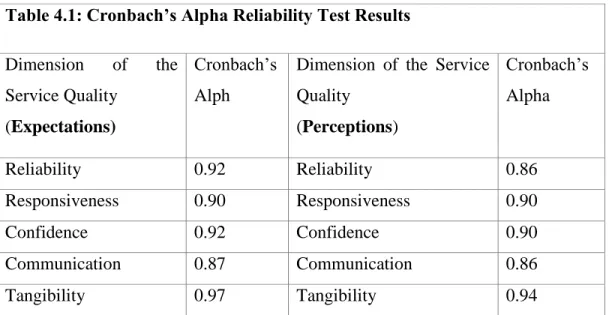
Table 4.1:- Cronbach’s Alpha Reliability test results ...35
Table 4.2.2. Hotel gusts by Occupation ...36
Table 4.3.1. Customer Expectation ...40
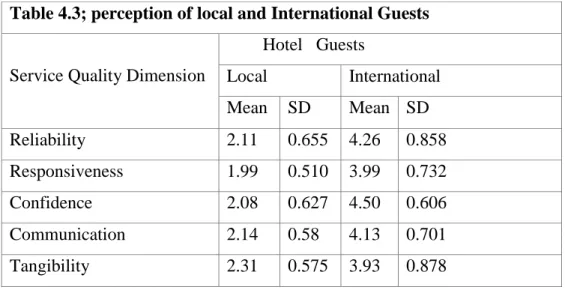
Table 4.3. Perception of Local and International Guests ...41
Table 4.4. Overall satisfaction level ...41
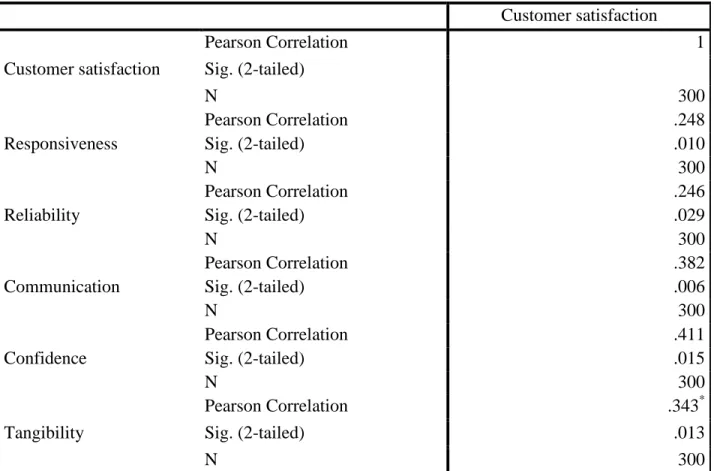
Table 4.6. Correlation analysis ...42
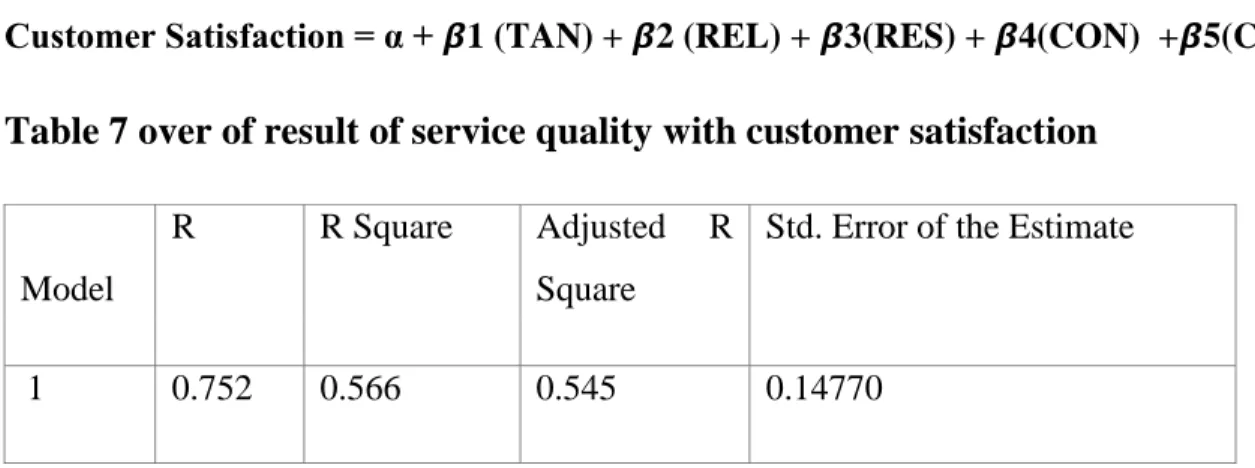
Table 4.8.1. Overall results of service quality with customer satisfaction ...43
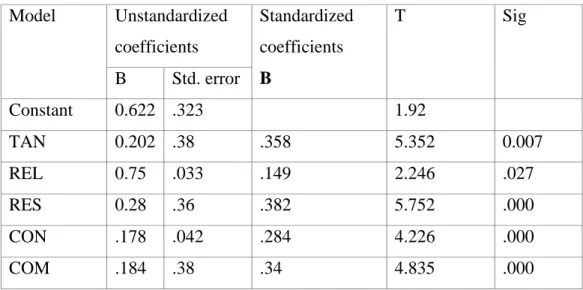
Table 4.8.2. Regression result ...43
9 List of Figure
Figure 1:- Conceptual frame work of the study ...25
Figure 4.2.1:- Pie chart hotel guest by gender ...36
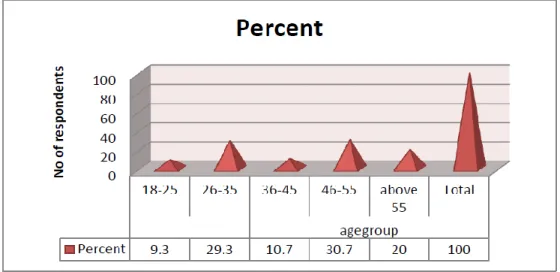
Figure 4.2.3.:- Ages of guests ...37
Figure 4.2.4:- Hotel Staying purpose ...37
Figure 4.2.5.:- Educational level of guests ...38
Figure 4.2.6.:- Hotel Selection ...39
10
Abstract
As the number of arrivals of international tourists gradually increases in Ethiopia, the service quality asserted by the Addis Ababa hotel need to be studied. The main objective of this research is to evaluate the service quality and customer satisfaction of three star hotels in Addis Ababa from the point of view of expectations of the service quality and perceptions of the service delivered by the three star hotels in Addis Ababa. To achieve this objective, descriptive study design were used to analyze the data collected through questionnaire from a sample of 300 international and local guests. These respondents were selected using simple random sampling method and hotels were selected purposively. The data collected through a questionnaire were analyzed using statistical tools such as mean, standard deviation, correlation and regression analysis by applying a modified version of the LQI (LODGING QUALITY INDEX) model comparisons between domestic hotel guests and hotel guests from various international countries were undertaken. The major finding of the study indicates, the hotel guests’ perceptions of service quality provided by the hotel industry were lower than their expectations, The lowest expectations and perceptions were given by Ethiopian guests towards the hotels in Ethiopia and Between domestic hotel guests and hotel guests from International countries the overall customer satisfaction levels towards the hotel stay is not satisfactory. Based on the findings of the study, the researcher recommended that The top management needs to improve quality services so as to satisfy customer’s needs and should hire self-motivated, enthusiastic employees who will like to deal with customer and will try to solve customer complaints and other issues in an effective manner, should provide continuous training to the employees on issues like Responsiveness, Confidence and communication skills while dealing with customers is of immense importance.
Key words: Customer Expectation, Customer Perception, Customer Satisfaction, lodging quality index, Service quality dimension, Service quality.
11
Chapter One: Introduction
1.1 Background of the study
The concept of service quality has been the subject of many research studies in variety of service industries; even the research attention towards hospitality industry has been growing. This concept has been the subject of many conceptual and empirical studies, and it is generally accepted that quality has positive implications for an organization’s performance and competitive position. However, despite the vast amount of research done in the area of service quality, quality related issues have received little research attention within the hospitality context (Harrington and Akehurst, 1996). Further, authors of studies conducted on quality in the service industries have also expressed concern regarding the quality dimensions in hotels and, in particular, with methods used to measure customer perceptions of hotel service quality (Johnston
et al., 1990). A relative increase of investment is recently observed in the hotel & tourism sector. The hotel industry consists of many different services, including accommodation, restaurants, cafes, and catering. The market for the hotel industry, especially classified hotels in a developing country like Ethiopia, is closely linked to the tourism industry, because a majority of consumers for the sector services come from international tourists.
According to Wilson et al., (2008) depicts customer satisfaction has also been a subject of great interest to organizations and researchers alike. The principal objective of organizations is to maximize profits and to minimize cost. Profit maximization can be achieved through increase in sales with lesser costs. One of the factors that can help to increase sales is customer satisfaction, because satisfaction leads to customer loyalty recommendation and repeat purchase.
Customers became very vital in business during the marketing era of the 1950s when companies could produce what they can sell and not just selling. What are the qualities of these services provided to customers? Are the customers satisfied with these services? Thus, this research originated from the fact that customer/consumer is the key to business. In fact, their satisfaction is the most important tool that helps to increase sales and generate profits in the business environment. Moreover, the importance of service quality and customer satisfaction has been proven relevant to help improve the overall performance of organizations (Magi &Julander, 1996).
12
For instance in tourism earning it is directly or indirectly linked with the number of nights spent by visitors in the country, Quality of service is the key factor to maintain the length of stay. As service quality is becoming a major part of business practice, it is important to be able to measure and research its effectiveness. The purpose of this research is to measure and evaluate the level of service quality and customer satisfaction in the hotel industry targeting the three star hotels found in Addis Ababa and to determine which dimension of the service quality has a significant effect in the customer’s level of satisfaction by applying a modified version of SERVQUAL which is the LODGING QUALITY INDEX that was customized for the hotel industry.
1.2 Statement of the Problem
Following the Ethiopian millennium in 2007 every sector of the country goes high particularly in tourism attraction and hotel accommodations. Though a great emphasis is given for the expansion of hotel industry since the early time, many service related problems are still visible. Collecting money with no progress in service quality is fact of today’s Addis Ababa hotels. The conducted preliminary survey through personal observation and unstructured interview before beginning the actual study indicates that, either private or public owned Hotels have much serious quality and customer handling strategy problems. This was seen when the employees were very much delayed both in taking order from the guests who are waiting for their order and, even long wait for the delivery of the order. The other major problems often observed were lack of Hotel service ethics.
The quality of service in hotel industry is an important factor of successful business. The existing trend of complete quality management in hotel industry ensures the achievement of competitive advantage of hotel companies and is therefore the subject of contemporary research into service quality in hotel industry. It is essential to identify the service Quality & whether the customers are given what they need & expect. So this research is purposed to evaluate the service Quality and customer Satisfaction in hotel industry in Ethiopia. Therefore going through the very specific idea, the purpose of this study is to assessthe service quality and customer satisfaction in three star hotels found in Addis Ababa, Ethiopia.
According to Buze ye (2010) in Ethiopia handling of customer related issues are not scientific still it is following traditional way for example throwing the food in front of the guest who, of
13
course, is referred to, as ‘a guest is always right’. They also insult the guest, cheat the guest or failure to give the change back as fast as possible, chewing gum while serving the guests, pasting finger into the nose while serving, touching hair and other bodies, etc.
With all this lack of respect to customers,’ different tourists emphasize that three things attract foreigners to visit Ethiopia. One is presence of sites of different tourist attraction; second Addis Ababa resides continental and international offices to host conferences of different issues. The third factor is security of the country to host anyone who wants to refresh leisure times with no fear of terrorist acts like neighboring Kenya. Due to this fact growth in Ethiopia’s tourism industry continues to be steadily even despite the effect of the global financial crisis. International visitors’ arrival in Ethiopia reached 596,341 in 2012 from 523,438 in 2011, with average growth of 13.92 percent in 2012, (Ministry of Culture and Tourism 2013). With the growth of visitors how are 3 star Hotels in Addis Ababa serve their customers are still encompassed by issues of debates and controversies.
The presences of a number of international organizations in Addis Ababa such as the African Union (AU), the European Union (EU) and the Economic Commission for Africa (ECA), demands the hotel sector to be highly organized and at most delivery of services. Therefore,hotels in Addis Ababa need to have high customers’ orientation in forwarding services to solve problems of service delivery. different researches were conducted on the hospitality industry, for example Bezuye (2010) and Alelign(2013) assessed hotel related services in Ethiopia, however deep investigation of those research lacks analysis of customer service delivery and customer satisfaction of three star hotels in Addis Ababa, Ethiopia. Therefore this research duly investigates service quality and customer satisfaction of three star hotels in Addis Ababa to forward visible and scientific solution to improve service delivery of hotels. Using the modified form of SERVQUAL,which is LODGING QUALITY INDEX that was customized specifically for the hotel industry.
1.3 Research Questions
What are the service quality expectations of customers in three star hotels?
14
Which of the service quality dimensions has significant effect in customers’ satisfaction?
1.4 Objective of the study 1.4.1 General Objective
The general objective of this study is to evaluate the service quality and customer satisfaction in the star hotels in Addis Ababa, Ethiopia.
1.4.2 Specific Objectives
To identify the Expectations of customers toward the services of three star hotels.
To identify the Perceptions of customers toward the services of three star hotels.
To examine the effect of major service Quality dimensions on Customer Satisfaction in three star hotels.
To examine the correlation between Service Quality and Customer Satisfaction.
1.5 Hypothesis
H1 Reliability has significant effect in customer satisfaction.
H2 Responsiveness has a significant effect in customer satisfaction. H3 confidence has a significant effect in customer satisfaction. H4 communication has a significant effect on customer satisfaction. H5 Tangibility has significant effect on customer satisfaction.
1.6 Scope of the Study
Because of the broad nature of the study, accessing all the literature concerning customer satisfaction and service quality is very voluminous. Thus, the study hovered in a limited aspect within the literature, thereby this research focuses on the relationship between customer satisfaction and service quality dimensions of the SERVQUAL/LQI model. Although this topic concerns many stakeholders, the researcher focused on customer perspective and customers who consume services. Also the topic can be viewed from a manufacturing and/or service sector; but it was limited to study it with the hotel sectors since service quality is best evaluated from the
15
service sectors. There are different kinds of star standardized hotels in Addis Ababa but due to interest and eagerness to explore, the study focused on three star hotels found in Addis Ababa. This is due to its number effect and impact in serving a lot number of customers. Moreover including all three star hotels found outside of the capital is not manageable to the student researcher. Therefore the study is limited to ten (10) three star hotels found in Addis Ababa.
1.7 Significance of the study
Upon its completion, this study will benefit hotel managers, employees and customers. Through providing clear information concerning customers’ expectation and perception with regard to service quality dimension which has significant effect on service quality and customer satisfaction in three star hotels in Addis Ababa and the study may benefit researchers’ undertaking further study on a related topic.
1.8 Limitations of the Study
There was different bottle necks that hampers the smooth flow of the research such as hotel owners negative perception of the research questionnaires’ to fill “we don’t have to challenge our customers they are here to refresh” so it needs the researcher to show extraordinary patience and commitment that put its own negative impact to accomplish the research as needed. Moreover the research is geographically limited to three star hotels in Addis Ababa; the capital of the nation and Africa to have huge impact rather than other areas of the country. The outcome of the study is mainly dependent on the individual responses of the respondents who participate in the study. So the result may not be generalizable beyond the specific population. The limitations of this study are given below:
The data and information related with the topic was not easily available.
The hotel confidentially keeps the data. Even sometimes filled questionnaires were kept hidden for themselves. So hotel policy of not disclosing some sensitive data and information for obvious reason posed an obstacle to the practical orientation that could be very much useful.
16 1.9 Operational Definition of Terms
A ‘hotel customer’ was defined in this study as an individual who was a temporary visitor, had stayed overnight at the hotel, and was involved in any services rendered (researcher emphasis).
Service Quality; an author defines service as “any intangible act or performance that one party
offers to another that does not result in the ownership of anything” (Kotler& Keller, 2009: 789)
Customer Expectation; the extent to which a product or service fulfills a customer’s need and desire (Oliver, 1981)
Customer Satisfaction; can also be a person’s feelings of pleasure or disappointment that results
from comparing a product’s perceived performance or outcome with their expectations (WTO, 1985)
Customer Perception; is an opinion about something viewed and assessed and it varies from customers to customers, as every customer has different beliefs towards certain services and products that play an important role in determining customer satisfaction(Reichhelid,1996)
1.10 Organization of the Study
This study is organized in to five chapters. Accordingly, the first chapter commences with the introduction part; the second chapter discusses the related literature of the study; the third chapter focus on research methodology and the fourth chapter discusses data presentation and analysis and finally chapter five stipulates conclusion based on analysis and possible recommendation by the researcher based on investigation.
17
Chapter Two
Review of Related Literature
This chapter outlines the concept of service quality and customer satisfaction. From the last decade, the service sector has become greater economic importance. The elimination of waste due to poor quality and meeting customer expectations are the major challenges facing managers in the service sector. This chapter presents the reasons why we should measure service quality, customer satisfaction in hotel industry as well as their measures. Time by time, different researchers tried to find out the way to measure of service quality and customer satisfaction in the hotel industry. Next scientist generation improved the model of the precedents or invented a new one. Among all, three most popular models to measure customer satisfaction and service quality in the hotel industry are SERVQUAL, HOLSERV and LODGING QUALITY INDEX. Each model has its own strong point and has been used flexibly in hotel industry to present literatures relevant to this research and to provide a theoretical framework. The chapter begins with a review of definitions and some measurements of customer satisfaction and service quality, and then follows by the relationship between customer satisfaction and service quality which leads to the conceptual frame work of the study.
2.1 Conceptualizing Service Quality and Customer Satisfaction
Someone say that service quality and customer satisfaction is critical for the service survival. So what are they? Both of them are intangible but the exact definition is still a controversial issue. Customer satisfaction is a psychological concept that involves the feeling of well-being and pleasure that results from obtaining what one hopes for and expects from an appealing product and/or service (WTO, 1985). To Oliver (1980), customer satisfaction definition is based on the expectation disconfirmation point of view. Before purchasing or using the product or service, customers always have their personal expectation about its performance. After buying or using product or service, if the result is equal or better than expectation, it means the expectation has positive confirmation. In the opposite case, if the result is lower than expectation, we have negative confirmation. Customers are said to be satisfied only if there are positive confirmations of expectation. However, in any case, the level of customer satisfaction is different between different customers because each of them owns their personal needs, demands as well as experiences.
18 2.2 Customer satisfaction
Those who buy the goods or services provided by companies are customers. In other words, a customer is a stakeholder of an organization who provides payment in exchange for the offer provided to him by the organization with the aim of fulfilling a need and to maximize satisfaction. Sometimes the term customer and consumer are confusing. A customer can be a consumer, but a consumer may not necessarily be a customer. Another author explained this difference. I.e. a customer is the person who does the buying of the products and the consumer is the person who ultimately consumes the product (Solomon, 2009)
When a consumer/customer is contented with either the product or services it is termed satisfaction. Satisfaction can also be a person’s feelings of pleasure or disappointment that results from comparing a product’s perceived performance or outcome with their expectations (Kotler& Keller, 2009). As a matter of fact, satisfaction could be the pleasure derived by someone from the consumption of goods or services offered by another person or group of people; or it can be the state of being happy with a situation.
Satisfaction varies from one person to another because it is utility. “One man’s meal is another man’s poison,” an old adage stated describing utility; thus highlighting the fact that it is sometimes very difficult to satisfy everybody or to determine satisfaction among group of individuals.
Moreover Tse& Wilton, (1988) relates client happiness, which is a sign of customer satisfaction, is and has always been the most essential thing for any organization. Customer satisfaction is defined by one author as “the consumer’s response to the evaluation of the perceived discrepancy between prior expectations and the actual performance of the product or service as perceived after its consumption” (hence considering satisfaction as an overall post-purchase evaluation by the consumer” (Fornell, 1992). Some authors stated that there is no specific definition of customer satisfaction, and after their studies of several definitions they defined customer satisfaction as “customer satisfaction is identified by a response (cognitive or affective) that pertains to a particular focus (i.e. a purchase experience and/or the associated product) and occurs at a certain time (i.e. post-purchase, post-consumption)”. (Giese & Cote, 2000)
19
This definition is supported by some other authors, who think that consumer’s level of satisfaction is determined by his or her cumulative experience at the point of contact with the supplier (Sureshchander et al., 2002L). It is factual that, there is no specific definition of customer satisfaction since as the years passes, different authors come up with different definitions. Customer satisfaction has also been defined by another author as the extent to which a product’s perceived performance matches a buyer’s expectations (Kotler et al., 2002). According to Schiffman& Karun (2004) Customer satisfaction is defined as “the individual’s perception of the performance of the products or services in relation to his or her expectations”. In a nutshell, Levy, (2009, NBRI, 2009) defines customer satisfaction could be the pleasure obtained from consuming an offer. Measuring customer satisfaction could be very difficult at times because it is an attempt to measure human feelings. It was for this reason that some existing researcher presented that “the simplest way to know how customers feel, and what they want is to ask them” this applied to the informal measures (Levy, 2009).
Boulding, et al., (1993) &Andreassen, (2000) broaden the idea of customer satisfaction by saying there exist two conceptualizations of customer satisfaction; transaction-specific and cumulative. Following the transaction specific, customer satisfaction is viewed as a post-choice evaluation judgment of a specific purchase occasion (Oliver, 1980 ) until present date, researchers have developed a rich body of literature focusing on this antecedents and consequences of this type of customer satisfaction at the individual level (Yi, 1990). Cumulative customer satisfaction is an overall evaluation based on the total purchase and consumption experiences with a product or service over time. (Fornell, 1992, Johnson &Fornell, 1991). This is more fundamental and useful than transaction specificity customer satisfaction in predicting customer subsequent behavior and firm’s past, present and future performances. It is the cumulative customer satisfaction that motivates a firm’s investment in customer satisfaction.
Customer satisfaction lies in the ideal of the beholder it is very complicated and relative phrase as it is very specific to the customer who measures what satisfies whom. So it invites other probes of what hampers customer satisfaction and needs of the customer
20 2.2.1 Factors that Influence Customer Satisfaction
From literature review, there are many factors that affect customer satisfaction. Such factors include friendly employees, courteous employees, knowledgeable employees, helpful employees, accuracy of billing, billing timeliness, competitive pricing, service quality, good value, billing clarity and quick service (Hokanson, 1995). From the studies carried out in many countries, factors like: service quality, and perceived value, are the key constructs affecting the customer’s satisfaction with mobile services. Studies also point out that customer satisfaction results ultimately in trust, price tolerance, and customer loyalty. Therefore, building customer relationship is a backbone for all organizations in general, and companies in service industries in particular. Issues like: customer satisfaction, service quality, customer perception, customer loyalty, are the main concerns of the nowadays service companies, which improves organization’s performance and translates into more profits.
2.3 Customer Expectations
Expectations play an important role in the satisfaction formation. The extent to which a product or service fulfills a customer’s need and desire may play an important role in forming feelings of satisfaction because of the impact of confirmation or disconfirmation that have on satisfaction. Consumers expect to be delivered quality products and services; therefore companies try to offer quality products and services. The term expectations really matters to companies because they want to know what customers’ expectations are. The term “expectations” has different uses, in the satisfaction literature, it is viewed as a prediction made by a consumer about what is likely to happen during an exchange or transaction. According to Oliver (1981) "… expectations are consumer-defined probabilities of the occurrence of positive and negative events if the consumer engages in some behavior."
In the contrast, Kotler, (2000) opposes in the service quality literature it is defined as desires and wants, what a service provider should offer rather than would offer. Customers form their expectations from their past experience, friends’ advice, and marketers’ and competitors’ information and promises. Therefore, perceived service quality is viewed as the difference between consumers’ perceptions and expectations for the service provided. Organizations in order to keep expectations from rising, they have to perform services properly from the first time (Parasuraman et al. 1988). Thus, customer expectations for the service are likely to rise when the
21
service is not performed as promised. Expectations serve as reference points in customer’s assessment of performance (Cronin& Taylor, 1992). Thus, retailers can increase customer satisfaction by decreasing customer expectations.
2.4 Customer Perception
Perception is a psychological term related with an opinion about something viewed and assessed and it varies from customers to customers, as every customer has different beliefs towards certain services and products that play an important role in determining customer satisfaction. Customer satisfaction is determined by the customers’ perceptions and expectations of the quality of the products and services. In many cases, customer perception is subjective, but it provides some useful insights for organizations to develop their marketing strategies. Providing high level of quality service has become the selling point to attract customer’s attention and is the most important driver that leads to satisfaction. Therefore, customer perception and customer satisfaction are very closely linked together, because if the perceived service is close to customer’s expectations it leads to satisfaction. Satisfied customers provide recommendations; maintain loyalty tow towards the company and customers in turn are more likely to pay price premiums (Reichheld, 1996). What should make a customer to have a good perception of what he/she consumed? It arises question to another related term.
2.5. Service quality
In order for a company’s offer to reach the customers there is a need for services. These services depend on the type of product and it differs in the various organizations. Service can be defined in many ways depending on which area the term is being used. An author defines service as “any intangible act or performance that one party offers to another that does not result in the ownership of anything” (Kotler& Keller, 2009). In all, service can also be defined as an intangible offer by one party to another in exchange of money for pleasure.
According to Solomon (2009 ) defines quality as is one of the things that consumers look for in an offer, which service happens to be one (Quality can also be defined as the totality of features and characteristics of a product or services that bear on its ability to satisfy stated or implied needs (Kotler et al., 2002). It is evident that quality is also related to the value of an offer, which could evoke satisfaction or dissatisfaction on the part of the user.
22
Service quality in the management and marketing literature is the extent to which customers' perceptions of service meet and/or exceed their expectations for example as defined by Zeithaml et al. (1990), cited in Bowen & David, 2005) Thus service quality can intend to be the way in which customers are served in an organization which could be good or poor. Parasuraman defines service quality as “the differences between customer expectations and perceptions of service” (Parasuraman, 1988). They argued that measuring service quality as the difference between perceived and expected service was a valid way and could make management to identify gaps to what they offer as services.
Haywood (1988) explains the aim of providing quality services is to satisfy customers. Measuring service quality is a better way to dictate whether the services are good or bad and whether the customers will or are satisfied with it. A researcher listed in his study: “three components of service quality, called the 3 “Ps” of service quality”. In the study, service quality was described as comprising of three elements:
• “Physical facilities, processes and procedures; • Personal behavior on the part of serving staff, and;
• Professional judgment on the part of serving staff but to get good quality service. “Haywood 1988).
Moreover he stated that “an appropriate, carefully balanced mix of these three elements must be achieved.” (Haywood, 1988,) What constitutes an appropriate mix, according to him will, in part, be determined by the relative degrees of labour intensity, service process customization, and contact and interaction between the customer and the service process. From the look of things, this idea of his could be design to fit with evaluating service quality with the employee perspective.
One of the most useful measurements of service quality is the dimensions from the SERVQUAL model. In the creation of this model for the very first time, “Parasuramanet al. (1985) identified 97 attributes which were condensed into ten dimensions; they were found to have an impact on service quality and were regarded as the criteria that were important to access customer’s expectations and perceptions on delivered service (Kumar et al., 2009).
23
The SERVQUAL scale which is also known as the gap model by Parasuraman, et al. (1988) has been proven to be one of the best ways to measure the quality of services provided to customers. This service evaluation method has been proven consistent and reliable by some authors (Brown et al., 1993). They held that, when perceived or experienced service is less than the expected service; it implies less than satisfactory service quality; and when perceived service is more than expected service, the obvious inference is that service quality is more than satisfactory (Jain et al., 2004).
From the way this theory is presented, it seems the idea of SERVQUAL best fits the evaluation of service quality form the customer perspective. This is because when it is stated “perceived” and “expected” service, it is very clear that this goes to the person, who is going to or is consuming the service; who definitely is the consumer/customer.
The original study by Parasuraman et al., (1988) presented ten dimensions of service quality.
Tangibles: the appearance of physical artefacts and staff members connected with the service (accommodation, equipment, staff uniforms, and so on).
Reliability: the ability to deliver the promised service.
Responsiveness: the readiness of staff members to help in a pleasant and effective way.
Competence: the capability of staff members in executing the service.
Courtesy: the respect, thoughtfulness, and politeness exhibited by staff members who are in contact with the customer.
Credibility: the trustworthiness and honesty of the service provider.
Security: the absence of doubt, economic risk, and physical danger.
Access: the accessibility of the service provider.
Communication: an understandable manner and use of language by the service provider.
Understanding the customer: efforts by the service provider to know and understand the customer.
Kuo-YF, (2003) in his first SERVQUAL model that came had 22 pairs of Likert-type items, where one part measured perceived level of service provided by a particular organization and the other part measured expected level of service quality by respondent. Further investigation led to
24
the finding that, among these 10 dimensions, some were correlated. After refinement, these ten dimensions above were later reduced to five dimensions as below:
Tangibility: physical facilities, equipment, and appearance of personnel
Reliability: ability to perform the promised service dependably and accurately
Responsiveness: willingness to help customers and provide prompt Service
Assurance: knowledge and courtesy of employees and their ability to inspire trust and Confidence
Empathy: caring individualized attention the firm provides to its customers
The aggregated sum of difference between perceptions and expectations from the five dimensions forms the global perceive quality construct. (Laroche et al., 2004) Following this view, customers’ expectations were met through the outcome dimension (reliability) and exceed it by means of the process dimension (tangibility, assurance, responsiveness, and empathy). To confirm the validity of SERVQUAL model in the evaluation of service quality, Zeithaml et al (2006), stated that “service quality is a focused evaluation that reflects the customer’s perception of reliability, assurance, responsiveness, empathy, and tangibles.” They added that among these dimensions, “reliability” has been shown consistently to be the most important dimension in service quality.
Other researchers like Grönroos (1983) saw the need of additional components of service expectations that is functional and technical dimensions. (The idea was that, consumers make service evaluations based on the technical dimension that is what is delivered and on the functional dimension that is how, why, who, and when it is delivered.
2.5.1 Measuring Service Quality
According to Johns and Howard (1998), quality measurements only have operational value if they are able to indicate the ways in which service was or was not satisfactory. For service providers, the assessment of service quality is made during the actual delivery of the service. Much current research on service quality is rooted in expectancy–disconfirmation theory, which holds that customers perceive service quality as the difference between when the actual service performances exceeds expectations and negative when the opposite is the case. Parker and Mathews (2001) found that many studies supported the disconfirmation paradigm but others did
25
not, for example, Churchill and Surprenant (1982) found that neither disconfirmation nor expectations had any effect on customer satisfaction with durable products.
2.5.2 Measuring Service Quality Gaps
Lewis (1987) suggested that what can be measured are the differences between the abstractions. So if we can measure the difference between expectations and perceptions, which was defined as perceived quality, we can therefore determine the level of satisfaction. This concept was quite similar to the conceptual model of service quality suggested by Parasuraman, Zeithaml and Berry (1985), which applied the expectancy– disconfirmation theory. These authors had identified that there were five key discrepancies that can influence customer evaluations of service quality: • Gap 1 was the gap between customer expectations and management’s perceptions of those expectations.
• Gap 2 was the gap between management’s perception of what the customer wants and specifications of service quality.
• Gap 3 was the gap between service quality specifications and delivery of the service.
• Gap 4 was the gap between service delivery and what the company promises to the customer through external communication.
• Gap 5 was the gap between customers’ service expectations and their perceptions of service performance.
Zeithaml and Bitner (2003) stated that in order to manage service quality, it was important to manage the gaps between expectations and perceptions on the part of management, employers and customers. The most important gap (Gap 5) was that between customers’ expectations of service and their perceptions of the service actually delivered. So by referring to the gap model, it was noted that a service marketer must lessen the customer gap (Gap 5). In order to do so, the service provider must first try to lessen the other four gaps (Gap 1, 2 3, and 4) within the organization that inhibit delivery of quality service, as each of these elements contribute towards the expectations and perceptions of customers. Serious action must be taken because how the customers, in these case hotel customers, perceive the level of service performance that meets their expectations will reflect the quality of service provided by the organization. Subsequent to the gap model, Parasuraman et al. (1985) designed the SERVQUAL instrument to identify and measure the gaps between customers’ expectations and perceptions of service quality.
26
Parasuraman et al. (1985) defined service quality in 10 major dimensions that consumers use in forming expectations about, and perceptions of, services. In later research, Parasuraman et al. (1988) revised and defined the service quality into five dimensions — reliability, responsiveness, assurance, empathy, and tangibles (see Table 1 for definitions). The instrument suggested service quality as the gap between customer’s expectations (E) and their perception of the service provider’s performance (P).Hence the service quality scores (Q) can be measured by subtracting the customer’s perception score from the customer’s expectations score.
The SERVQUAL is popularly used by many studies of service quality. It is a multiple-item scale developed to measure service quality by computing the differences between consumers’ desired expectations and their perceptions of a firm’s performance. The instrument has been designed to be applicable across a broad spectrum of services. SERVQUAL has served as the basis for measuring service quality in a number of contexts, including higher education institutions (Galloway, 1998), retail apparel specialty stores (Gagliano&Hathcote, 1994), health club (Walker & Baker, 2000), and hospital service (Hwang, Eves, &Desombre, 2003). A number of practitioners and researchers (Atilgan, Akinci, &Aksoy, 2003; Juwaheer& Ross, 2003; Wong, Dean, & White, 1999) have applied modified versions of SERVQUAL to measure service quality in the hospitality industry.
2.6 Hotel Attributes
Lewis (1987) stated that a consumer of a service seeks to satisfy a set of needs and wants, partly related to the essential service and partly to subsidiary attributes. For example, the main purpose might be a hotel stay and the subsidiary attributes may include accessibility, convenience, timing and flexibility and interaction with service providers and other customers. They would have expectations on how all these needs and wants will be met. When presented with actual offering of these multiple variables, they will form impressions, which immediately compared to expectations, and the level of satisfactions were determined by these perceived service quality. There have been a number of studies on the needs and criteria of customers. The need to comprehend the elements resulted in the development of systems, such as SERVQUAL, and LODGEQUAL to map food and beverages as well as accommodation services (Ingram, 1999). Research on hotel attributes has focused on the relationships between customer satisfactions and service quality or services and facilities (Choi & Chu, 2000).
27 Table 1: Definition of Service Quality Dimensions
Service Quality Dimension Definition
Reliability The ability to perform the service dependably, consistently
andaccurately.
Responsiveness The willingness to help customers and provide prompt service.
Assurance The knowledge and courtesy of employees and their ability to
convey trust and confidence.
Tangibles The physical evidence of service including physical facilities,
appearance of personnel, tools, and equipment used to provide the service
Empathy Caring, individualized attention to its customers.
Source:Parasuraman, Zeithaml, and Berry (1988).
Tsang and Qu (2000), in the International Journal of Contemporary Hospitality Management, used 35 hotel service quality attributes to identify the perceptions gaps of tourists and hotel managers. This study adapted Parasuraman et al.’s (1985) gap analysis. The researchers found that overall service quality provided by the hotel industry in China fell below tourist expectations. The biggest gap between expectations and perceptions of tourists were related to ‘physical facilities’, ‘staff skills and performance’ and ‘price and value’. On the other hand, Kandampully and Suhartanto (2000) have identified four factors (i.e., reception, housekeeping, food and beverages, and price) that were important in determining customer satisfaction. They concluded that not all aspects of a hotel operation were equally important to a customer.
Customer satisfaction with housekeeping was found to be the only significant factor that determined customer loyalty. Reception, food and beverages, and price were regarded as supporting factors when deciding to return, recommend or demonstrate loyalty to a particular hotel. Min and Min (1997) reported that two major service criteria (i.e., overall room values and front-office services) and 14 attributes were relevant to Korean luxury hotels. The overall room values were sub-classified into seven different categories — cleanliness, atmosphere, comfort,
28
quality and sufficiency of room fixtures, size of a guest room, availability of complimentary items, and price. Front-office services, on the other hand, were subdivided into seven attributes On the other hand, Kandampully and Suhartanto (2000) have identified four factors (i.e., reception, housekeeping, food and beverages, and price) that were important in determining customer satisfaction. They concluded that not all aspects of a hotel operation were equally important to a customer. Customer satisfaction with housekeeping was found to be the only significant factor that determined customer loyalty. Reception, food and beverages, and price were regarded as supporting factors when deciding to return, recommend or demonstrate loyalty to a particular hotel.
Moreover, Min and Min (1997) reported that two major service criteria (i.e., overall room values and front-office services) and 14 attributes were relevant to Korean luxury hotels. The overall room values were sub-classified into seven different categories — cleanliness, atmosphere, comfort, quality and sufficiency of room fixtures, size of a guest room, availability of complimentary items, and price. Front-office services, on the other hand, were subdivided into seven attributes. complaints); responsiveness, such as convenience of reservation; promptness of check-in/ check-out; hotel/tour guide information; tangibles such as variety/quality of sports/recreational facilities (e.g., swimming pools, and aerobic exercise rooms); and efficiency of a business center (e.g., fax machines, personal computers, and copiers). By employing the analytical hierarchy process (AHP) and competitive gap analysis, they found that both cleanliness of a guest room and courtesy of hotel staff, were among the attributes that were considered most important, particularly in forming impressions of service quality.
On the other hand, Wong et al. (1999) who used the extended version of SERVQUAL scale — referred to as HOLSERV, found that service quality in the hospitality industry was represented by three dimensions: They were dimensions that were related to employees (behavior and appearance), tangibles and reliability. The best predictor of overall service quality was the employees dimension, and the most important attributes in this dimension was employee gives individual attention to the customers. It ought to be highlighted that this study was conducted only in Australia’s three to five stars hotels, and the findings differed from that conducted in other countries. By using a modified SERVQUAL model, Juwaheer and Ross (2003) found that an overall evaluation of service quality in Mauritian hotels was determined largely by firstly
29
‘assurance factors’ — such as security and safety of guests, and effective handling of complaints and problems by hotel staff, and secondly ‘reliability factors’ — such as hotels perform tasks that have been promised to guests and resolving problems encountered by guests. They found that by focusing on only these factors, hotels in Mauritius would be able to achieve high levels of satisfaction and service quality.
Although the elements listed in SERVQUAL model have been proven to be the main method for evaluating service quality from the consumer’s perspective (Brown et al., 1993), drawbacks in using SERVQUAL in measuring service quality has been the reason that the SERVPERF scale was proposed by Cronin & Taylor (1992, cited in Jain et al. (2004) after they called into question the conceptual basis of the SERVQUAL, having found it, led to confusion with service satisfaction (Jain et al., 2004). These researchers discarded the ´E´ for ´expectation` claiming instead that ´P´ for ´performance´ alone should be used. They meant that higher perceived performance entails higher quality service. Unfortunately, during this past century, customers have changed their behaviours in ways that do not suit organizational behaviour. Till date, it is unclear as to which of SERVQUAL and SERVPERF is superior in measuring service quality. Laroche et al., (2004) made an assessment of the dimensionality of should and will service expectations. They used a survey measuring customers’ post encounter expectations and vis-à-vis a well-known airline with a sample of 363 and examined the existence of hypothesized functional and technical dimensions of should and will expectations and determined the casual relationships between two types of expectations and hypothesized dimensions. They tested their dimensions in the context of the turbulent airline industry. This study was proposed by Grönross (1983) to measure service quality with other service quality dimensions such as technical and functional dimensions.
Hence it was proven that the SERVQUAL model must not be used in evaluating service quality in all organizations. This could mean that; different industries might require different measurements customer satisfaction and service quality. Since customer satisfaction has been considered to be based on the customer’s experience on a particular service encounter, (Cronin & Taylor, 1992) it is in line with the fact that service quality is a determinant of customer satisfaction, because service quality comes from outcome of the services from service providers in organizations.
30
Another author Zeithaml et al (2006) stated in his theory that “definitions of consumer satisfaction relate to a specific transaction (the difference between predicted service and perceived service) in contrast with ‘attitudes’, which are more enduring and less situational-oriented,”
Regarding the relationship between customer satisfaction and service quality, Oliver (1993) first suggested that service quality would be antecedent to customer satisfaction regardless of whether these constructs were cumulative or transaction-specific. Some researchers have found empirical supports for the view of the point mentioned above (Anderson & Sullivan, 1993; Fornell et al 1996; Spreng&Macky 1996); where customer satisfaction came as a result of service quality. In relating customer satisfaction and service quality, researchers have been more precise about the meaning and measurements of satisfaction and service quality. Satisfaction and service quality have certain things in common, but satisfaction generally is a broader concept, whereas service quality focuses specifically on dimensions of service. (Wilson et al., 2008). Although it is stated that other factors such as price and product quality can affect customer satisfaction, perceived service quality is a component of customer satisfaction (Zeithaml et al. 2006). This theory complies with the idea of Wilson et al. (2008) and has been confirmed by the definition of customer satisfaction presented by other researchers.
Some authors have agreed to the fact that service quality determines customer satisfaction. Parasuraman et al., (1985) in their study, proposed that when perceived service quality is high, then it will lead to increase in customer satisfaction. Some other authors did comprehend with the idea brought up by Parasuraman (1995) and they acknowledged that “Customer satisfaction is based upon the level of service quality that is provided by the service providers” (Saravana&Rao, 2007, Lee et al., 2000). Looking into (figure 1), relating it to these authors’ views, it is evident that definition of customer satisfaction involves predicted and perceived service; since service quality acted as one of the factors that influence satisfaction. More evidence of this relationship has been proven by past researches.
As a result of the definition of customer satisfaction presented by Lewis, (1993,), Sivadas& Baker-Prewitt (2000) used a national random telephone survey of 542 shoppers to examine the relationship between service quality, customer satisfaction, and store loyalty within the retail
31
department store context. One of the results was that service quality influences relative attitude and satisfaction with department stores. They found out that there is a relationship between customer satisfaction and service quality.
In line with the findings of Sivadas& Baker-Prewitt (2000), Su et al., (2002,) in their study of customer satisfaction and service quality, found out that; these two variables are related, confirming the definitions of both variables which have always been linked. They also dictated that service quality is more abstract because it may be affected by perceptions of value or by the experiences of others that may not be so good, than customer satisfaction which reflects the customer’s feelings about many encounters and experiences with service firm (Su et al., 2002). In addition to what the other researchers have found out from customer satisfaction and service quality, some other authors Wang &Hing-Po (2002), went into details to bring in customer value in the study of the relationship between customer satisfaction and service quality. Their study used SERVQUAL model in measuring service quality in China’s mobile phone market, but with modification on the basis of focus group discussions and expert opinions to reflect the specific industry attributes and the special culture of China. Emphasis was then paid to the study of the dynamic relationships among service quality, customer value, customer satisfaction and their influences on future behaviors after the key drivers of customer value and customer satisfaction were identified. All of them were based on the development of structural equation models by using PLS-GRAPH Package. (Wang &Hing-Po, 2002) This study blended the study of customer satisfaction and service quality with customer value which added more weight to the linkage between customer satisfaction and service quality because value is what customers look in an offer.
Kuo (2003) conducted a research on service quality of virtual community websites with the purpose of constructing an instrument to evaluate service quality of virtual community websites and to have a further discussion of the relationship between service quality dimensions and overall service quality, customer satisfaction and loyalty. The researcher used Factor analysis, t-test, and Pearson correlation analysis to analyse the data collected from college students of three major universities in Taiwan. One of the results was that” on-line quality and information safety is positively related to the overall service quality, customer satisfaction, and loyalty, but the service quality level of this dimension was the poorest. ” (Kuo, 2003).
32
In contrast to the above studies; Bennett &Barkensjo (2005) studied relationship quality, relationship marketing, and client perceptions of the levels of service quality of charitable organisations. Questions were asked to 100 people on their perceptions of service quality of the organisations that had given them assistance, their satisfaction with a charity service etc. they constructed a model and estimated using the method of partial least square. Also, perceived service quality was measured via adaptations of the SERVQUAL instrument but without any assessments of the respondents' prior expectations concerning the services they would receive from an organisation. In their results, relationship marketing was found to represent an effective weapon for improving both relationship quality and beneficiaries' satisfaction with service provision. They stated that “relationship quality and actual service quality induced beneficiaries to want to recommend a charity to other people and to engage in positive word-of-mouth.” (Bennett &Barkensjo, 2005). Meaning the beneficiaries who stood as the customers were satisfied since recommendation is signal of satisfaction, confirming the idea that service quality is related to customer satisfaction.
They were not directly conducting a research on the relationship between customer satisfaction and service quality, but because when talking about client perceptions, one must think of their satisfaction, and when talking about service quality there is a link between these two as has been proven by many researchers ( Baker-Prewitt, 2000; Kuo-YF, 2003,; Gera, 2011) This means it could be useful to test these three variables (Customer satisfaction, service quality and Service quality dimensions). The study of Bennett &Barkensjo (2005) stated that “the hypothesis elements of SERVQUAL model (Tangible, assurance etc.) were scientifically associated with the service quality construct”. It could be interesting to test SERVQUAL model with the five dimensions and service quality assuming that expectations is included to see if it will be significantly associated.
In support of the use of SERVQUAL in the relationship between customer satisfaction and service quality, Ahmed et al., (2010) conducted a mediation of customer satisfaction relationship between service quality and repurchase intentions for the telecom sector among university students, with SERVQUAL model’s 5 dimension(tangibles, responsiveness, empathy, assurance and reliability) by Parasuraman et al. to measure service quality.
33
To crown the fact that customer satisfaction and service quality are important variables in business research on customers, Gera (2011) investigated the link between service quality, value, satisfaction and behavioral intentions in a public sector bank in India and one of their results states that “Service quality was found to significantly impact on customer satisfaction and value perceptions” (Gera, 2011) The literature review shows latest researches up to 2011 on the relationship between customer satisfaction and service quality. The researches in this area have been covered so far as below;
• It has been researched that there is a relationship between customer satisfaction and service quality.
• It has been researched that service quality could be evaluated with the use of SERVQUAL model.
• It has been researched that service quality could be evaluated by other dimensions of service quality that is, functional and technical and not necessarily SERVQUAL model
• Some researchers even tested service quality and service quality dimensions.
What is lacking is the relationship between customer satisfaction and service quality dimensions. Among all the recent articles that I could reach, none of the studies had tested the five dimensions of SERVQUAL and customer satisfaction and service quality at the same time to confirm this relationship between customer satisfaction and service quality.
2.7. Conceptual Frame work
The aim of this section is to summarize the idea about past literature and to bring out the contributions for this study area. Thus this part starts with the idea generated and the contribution follows.
The general idea from the past literature is that there is a relationship between customer satisfaction and service quality; also that service quality could be evaluated with the use of five service quality dimensions and the most useable is the SERVQUAL scale. A questionnaire for the hotel guests has been developed based on the components of the service quality in the hotel industry classified in the LODGING QUALITY INDEX. Moreover, it is supported by the marketing elements.
34
SERQUAL (Parasuraman, 1988) approach has been the most popular method for choosing because it is quite complete measure for all the service industry. It covers all ten factors of quality of the hotel services. However, it still has some weakness. Consequently, it is not a perfect choice. HOLSERV scale (Hunter and Gerbing, 1982; Parasuraman 1991) is a simpler method compared to SERQUAL. HOLSERV is a customized version of SERQUAL; it is one column questionnaire so it is easier to answer each question. However, to develop this questionnaire, it will be such a long survey that it is difficult to collect a large number of respondents if HOLSERV is applied.
Therefore, the LODGING QUALITY INDEX (Getty and Thompson, 1994) has been chosen to develop the questionnaire. LODGING QUALITY INDEX is not only solved some weakness of SERQUAL but also very specific for the hotel industry.
Following the two clarifications about the different views of customer satisfaction of a customer of either being transaction-specific or cumulative (Boulding et al., 1993; Andreassen, 2000). My theoretical frame work treats customer satisfaction as transaction-specific. Thus, customers in this paper are those who consume the services, satisfaction denotes customer’s desire to maintain a business relationship with the hotel and it is also the feelings of the customers towards the services provided to them by the hotels; while customer satisfaction in this study is the pleasures obtained by customers for the services provided to them by the employees of the hotels.
It has been proven that “perceived service quality is a component of customer satisfaction” (Ziethaml et al. 2006).
Other researchers had proven also that there is a relationship between customer satisfaction and service quality (Sivadas&Baker-Prewitt, 2000; Wang et al., 2002; Kuo-YF, 2003, Liang & Zhang, 2009 Gera, 2011; Sureshchandar, et al., 2002).
Moreover, currently the LQI model has been proven to be the best model to measure service quality in service sectors especially with the customer perspective. This idea generates an assumption that the five dimensions of LQI model could have a direct relationship with customer satisfaction. (Figure 1) The questions that arouse from this assumption is that ‘Is there a significant relationship between customer satisfaction and service quality dimensions? ‘; `Is there a significant relationship between customer satisfaction and service quality?
35
Also, it has been stated that service quality is the overall assessment of a service by the customers, (Eshghi et al., 2008). Also, the five dimension of LQI model has been proven to be the main yardstick used by most of the researchers in the evaluation of service quality (Wilson et al., 2008; Bennett &Barkensjo, 2005 Negi, 2009; Wang &Hing-Po, 2002). This idea generates an assumption that each of the five dimensions of LQI model could have a direct relationship with service quality. (Figure 1) The question that arouse from this assumption is that: ´Is there a significant relationship between Service quality and the five dimensions of LQI model? `
Figure 1: extracted from review of related literature review 2.8 History of Hotel Industry in Ethiopia
History has proved that, the development of hotel industry is connected with travelling. Similarly, the development of hotels in Ethiopia is also associated with the increasing number of travelers both indigenous and foreigners. Developments in Ethiopia’s foreign relations, particularly during the reign of Menelik ii had, relatively speaking, an impressive impact in the country, by implanting the seeds of modernization through the importation of European technology and institutions among which “hotel” is one subject. Therefore its appearance is
Communication
Responsiveness
Customer
Satisfaction
Tangibles
Reliability
Confidence
36
related with the opening of the society in to the western world. Development of modern hotels in Ethiopia traces back to the 19th century.ItegueTaitu hotel, which was built in 1898 (E.C.) at the center of the city (piazza), is the first hotel in Ethiopia. This hotel is currently half burned due to unspecified reasons and lacks original works of the past.
TaituBetul (1851-1918), an Ethiopian empress and the wife of emperor Menelik ii, establish this hotel to provide guests a place to rest and dine. From this time up to the Derg reign, the country had owned for about 50 hotels at a national level and out of these only 19 hotels was to be star rated hotels, according to the report of Tourism Commission in 1994.
Currently, with the emergence of new and modern hotels in the country, the number has grown considerably and there were 500 star rated hotels in Ethiopia. And out of these 116 hotels are found in Addis Ababa, Ministry of culture and tourism (2010), out of these 116 star rated hotels, the international chain hotels are only three in number. These are Hilton Addis, Sheraton Addis, and Radisson Blue hotel.
Nowadays the stock of hotels in Ethiopia has increased sharply over the last few years. While tourist accommodation is available as the major attraction, improvement as well as new construction is taking place, according to ministry of culture and tourism there are 140 hotels in Addis Ababa, 124 in Amhara, 5 in Afar, 13 in Benshangulgumuz, 19 in DireDawa, 16 in Gambela, 7 in Harar, 74 in Oromia, 14 in Somalia, 78 in Southern Nation Nationality and Peoples, and 38 in Tigray.
37
Chapter Three
Research Methodology
3.1 Research Design
The objective of this research was to evaluate the service quality and customer satisfaction in the selected three star hotels in Addis Ababa. It is considered the most suitable research design to be descriptive by its nature, because of its high degree of representativeness and the ease in which a researcher could obtain the participants’ opinion (Polit& Beck 2004).
Moreover, the research followed a cross-sectional descriptive study because the researcher used more than one case in the research (Bryman& Bell, 2003) and in cross-sectional studies variables of interest in a sample of subjects are tested once and the