Sede Amministrativa: Universit`a degli Studi di Padova
Dipartimento di Scienze Statistiche
SCUOLA DI DOTTORATO DI RICERCA IN SCIENZE STATISTICHE CICLO XXIX
Extensions of marginal quantile
regression to the analysis of dependent
data
Direttore della Scuola: Monica Chiogna Supervisori: Matteo Bottai
Acknowledgments
I would like to thank several people for their support during these years.
Matteo Bottai, my supervisor of master and doctoral educations. Thanks for giving me the opportunity to spend part of my PhD at the Karolinska In-stitutet, for all the things you taught me and for your skillful guidance through this PhD project.
My colleagues from the 29th PhD cycle, Paolo, Mirko, Lucia, Khanh, Elisa, Claudia. I am glad to have shared this path with amazing people like you. Thanks for all the support you provided during these years.
My colleagues from University of Padua and Karolinska Institutet, Erlis, Vera, Clovis, Mauro, Xin, Daniel, Celia, Michele, Andrea, Alessio, Nicola, Jonas, Michael and Ulf. Thank you for all the interesting discussions we had during this years, along with your enormous support.
A special thanks toPaolo Frumento, for always being willing to help me. Words cannot express how grateful I am for what you did during these years. They would have been much thougher without your advices.
My parents,Sauro and Elisabetta, and my brother,Marco, for being the pillars of my support.
My friends,Jacopo, Sofia, Erika, Jessica and Massimiliano, for being always there for me.
Above all, I would like to thankLucia, for her unbounded love and cheer-fulness. This journey would not have been the same without you.
Abstract
Dependent data arise frequently in applied research. When quantile regression is the statistical method of choice, several approaches have been proposed that can accommodate dependence among observations. Cluster bootstrap is one of the most popular among them. While practical, this method is generally ineffi-cient and computationally demanding, especially when the number of clusters is large. When the primary interest is on marginal quantiles, estimating equations have been proposed that model the association between the sign of the regres-sion residuals with the Pearson’s correlation coefficient. The latter, however, is an inadequate measure of dependence between binary variables because of its range depends on their marginal probabilities. Instead, we propose to model a working association matrix through odds ratios, which are popular measures of association of binary outcomes. Different working structures can be easily estimated by suitable logistic regression models. These structures can be param-eterized and may depend on covariates and clusters. Simulations demonstrated that the efficiency of the estimator increases as the working correlation structure approaches the true one. We extend the proposed method to penalized estimat-ing equations, they have increasestimat-ingly been used to reduce model complexity in several applications. We focus on penalized smoothly clipped absolute devia-tion models for feature selecdevia-tion and reduced-rank penalized smoothing splines. Simulations showed that the proposed methods potentially improve the per-formance of the marginal quantile regression estimator. When the correlation structure is correctly specified the estimator’s efficiency increases, similarly to what happens in the non-penalized case tackled in the first part of the thesis. We applied the proposed methods to data from a study on cognitive behavior and treatment in patients with obsessive compulsive disorder. To show the full potential of the methods, we modified the original data in some of the analyses.
Abstract
Nella ricerca applicata, i dati dipendenti sono molto frequenti. Nella regres-sione quantile sono stati proposti diversi approcci per tenere in considerazione la dipendenza tra le osservazioni. Uno dei metodi pi`u utilizzato `e il cluster boot-strap, sebbene sia generalmente inefficiente e computazionalmente dispendioso, soprattutto quando il numero di cluster `e elevato. Quando l’interesse princi-pale `e sui quantili marginali, sono state proposte delle equazioni di stima che modellizzano l’associazione tra i segni dei residui di regressione attraverso il coefficiente di correlazione di Pearson. Tuttavia, questa misura `e inadeguata per la dipendenza tra variabili binarie, poich`e il suo range dipende dalle loro probabilit`a marginali. Nella prima parte della tesi viene proposta una matrice di dipendenza definita attraverso gli odds ratios. Le diverse strutture di as-sociazione possono essere stimate attraverso modelli di regressione logistica e possono essere parametrizzate per dipendere da covariate e gruppi. Attraverso uno studio di simulazione viene mostrato che l’efficienza degli stimatori aumenta quando la matrice di associazione `e vicina a quella vera. Nella seconda parte della tesi si estende questo metodo ad equazioni di stima penalizzate, che sono utilizzate per ridurre automaticamente la complessit`a del modello stimato. In quest’ultima parte del lavoro si concentra l’attenzione sui modelli con penalit`a smoothly clipped absolute deviation per la selezione automatica dei predittori e sulle spline penalizzate tramite riduzione di rango. Attraverso uno studio di simulazione mostriamo che questi metodi hanno performance migliori rispetto a quelli senza penalizzazione. Quando la struttura di associazione `e vicina a quella vera l’efficienza dello stimatore aumenta, analogamente al metodo pro-posto nella prima parte della tesi. I metodi discussi nella tesi sono stati applicati ad un dataset proveniente da uno studio sul comportamento cognitivo in pazienti con disturbi ossessivi-compulsivi; inoltre, per mostrare il massimo potenziale dei metodi penalizzati, si `e provveduto a modificare il dataset originale in alcune analisi.
Contents
1 Introduction 8
1.1 Overview . . . 8
1.2 Main contributions of the thesis . . . 10
2 Background 11 2.1 Quantile Regression . . . 11
2.2 Generalized Estimating Equations . . . 15
2.3 Regression Spline . . . 18
2.4 Feature selection methods . . . 20
2.4.1 Subset selection . . . 20
2.4.2 Ridge regression . . . 20
2.4.3 Lasso . . . 21
2.4.4 Smoothly clipped absolute deviation . . . 21
3 Marginal quantile regression with a working odds-ratio matrix 23 3.1 Introduction . . . 23
3.2 Method . . . 25
3.2.1 Estimating the working association matrix . . . 27
3.3 Simulation study . . . 28
3.4 Application to internet-based cognitive therapy data set . . . 34
3.5 A summary . . . 40
4 Penalized marginal quantile models 41 4.1 Introduction . . . 41
4.2 Methods . . . 42
4.2.1 Penalized quantile estimating equations . . . 42
4.2.2 Regularized models for feature selection . . . 43
4.2.3 Reduced-rank penalized splines smoothing . . . 44
4.2.4 Selection of the tuning parameter . . . 45
4.3 Simulation studies . . . 46
4.3.2 Reduced-rank penalized splines smoothing . . . 52 4.4 Application . . . 56 4.5 A summary . . . 62
List of Figures
2.1 Quantile loss function . . . 14 3.1 Mean regression residuals and their estimated kernel density in
the cognitive theraphy application . . . 36 3.2 Boxplot of difficulties in emotion regulation scale at different times 37 3.3 Estimated relationship between difficulties in emotion regulation
scale and time by treatment . . . 39 4.1 Relationship between the response variable Ders and the
predic-torxN P. . . 59 4.2 Predicted function of the nonlinear association between Ders and
xN P obtained through regression splines . . . 60 4.3 Predicted function of the nonlinear association between Ders and
List of Tables
3.1 Empirical coverage of the marginal quantile estimator . . . 30 3.2 Mean squared error of the marginal quantile estimator . . . 31 3.3 Standard error difference between robust and naive estimators
for the marginal quantile estimator . . . 32 3.4 Frequency of correct selections of the working dependence
struc-ture through AIC for the marginal quantile estimator . . . 33 3.5 Estimated quantile regression coefficients, standard errors and
logistic models’ AIC in the cognitive therapy application . . . 38 3.6 Estimated working correlation parameters for the exchangeable
varying with treatment structure in the cognitive theraphy ap-plication . . . 38 4.1 Empirical coverage for the penalized SCAD estimator and other
estimators . . . 49 4.2 Feature selection performed through the penalized SCAD
esti-mator and other estiesti-mators . . . 50 4.3 Mean squared error for the penalized SCAD estimator and other
estimators . . . 51 4.4 Selection of the working dependence structure through AIC for
the penalized SCAD estimator and other estimators . . . 51 4.5 Mean squared error of the predicted function in penalized and
unpenalized spline regression . . . 54 4.6 Frequency of correct selections of the true dependence structure
in penalized and unpenalized spline regression . . . 55 4.7 Estimated quantile regression SCAD coefficients, standard errors
and logistic models’ AIC . . . 58 4.8 AIC of the logistic regression models in reduced-rank penalized
Chapter 1
Introduction
1.1
Overview
This thesis focuses on extensions of population-averaged (marginal) quantile regression. The interest in quantile regression has substantially grown in recent years for several reasons. First, it can describe the whole conditional distribution of the response variable. Second, it is much less sensitive to outliers. Third, it is equivariant to monotone transformations. This property has been used effectively in many settings ( Bottai et al. (2010), de Luca and Boccuzzo (2014)). Quantiles have been used as an alternative to hazard ratio to describe survival curves of groups of individuals, with a number of applications in econometrics and epidemiology ( Koenker and Bilias (2002), Bellavia et al. (2015), Bellavia et al. (2013)). They are also commonly used to study skewed distributions such as income, health care expenditures and unemployment rates ( Centeno and Novo (2006), Wang (2011), Buchinsky (1994)).
Dependent data arise frequently in applied research. For example in econo-metrics, panel data are used to assess time trends and to forecast. A random sample of individuals is selected from a population, and each subject is observed at multiple occasions over time. The multiple observations within each subject may be dependent, while observations from different subjects are independent. This sampling scheme is also widely used in randomized clinical trials to evalu-ate treatment effects. In genetic studies, siblings may be included in the study to separate heredity effects from environmental effects. The dependence can also be caused by spatial factors. Units that are geographically near may be-have similarly, for instance trees in a forest or individuals living in the same area. It is important to take into account the dependence of the data when it is present. Ignoring it may lead to wrong coverage of the confidence intervals and loss of statistical efficiency.
The first contribution of the thesis consists of a novel method to estimate marginal quantile regression where the dependence between observations within the same cluster is modeled through a working odds-ratio matrix. Different working structures can be easily estimated by suitable logistic regression mod-els. These structures can be parametrized to depend on covariates and clusters. When the working correlation is close to the true one, the efficiency of the regression-model estimator increases. We analyzed data from a randomized clinical trial on cognitive behavior. The dataset consisted of 95 families with a child aged 8-12 years with a principal diagnosis of generalised anxiety, panic disorder, separation anxiety, social phobia or specific phobia. Participants were randomised to 10 weeks of internet-based cognitive theraphy (ICBT) with ther-apist support (70 families), or to a waitlist control condition (25 families). At weekly intervals, the amount of difficulties in emotion regulation scale (DERS) was measured on a 0-100 scale, where 0 indicated no difficulties and 100 extreme difficulties. The maximum number of repeated measurements was 14. The main interest of the study was to assess the relationship between the treatment and DERS.
This method was the basis for the remaining contributions of the thesis, two cases of penalized marginal quantile regression: reduced-rank penalized splines smoothing and regularized models for feature selection. The former is common in various fields. In panel data, complex nonlinear trends might be modeled using certain fixed periodic functions or regression splines. However, fixed functions that are not data-driven might not be flexible enough to capture nonlinear trends. Regression splines are flexible but might lead to overfitting. Instead, penalized splines would provide enough flexibility while prevent overfit-ting by automatically selecoverfit-ting the optimal degree of smoothness of a regression spline. The spline complexity is controlled by a penalty term chosen through cross-validation or by minimization of a measure that balances goodness of fit and complexity. The penalty term finds the optimal tradeoff between spline complexity and fit of the predicted function. In contrast to regression splines, penalized splines are less influenced by the initial choice of the number of knots and the degree of the chosen spline.
Regularized models for feature selection are used to select the most impor-tant predictors in a regression models. The model complexity is controlled by a penalty term chosen through either cross-validation or by minimizing a measure of balance between goodness of fit and model complexity. This term finds the optimal tradeoff between spline complexity and fit of the predicted function. Regularized models are used when the number of predictors is large and classi-cal selection methods such as stepwise regression cannot be used. Analogously to reduced-rank penalized splines smoothing methods, they can be used also to
automatically select the splines complexity in a regression spline model. We applied the penalized method to the cognitive-behavior study for treat-ment of obsessive compulsive disorder. To show their full potential, we added a predictor that was nonlinearly associated with the response. We modelled this association through regression splines and we chose the splines complexity through the penalized methods. We also added a large number of uncorrelated predictors to study the behavior of the regularized model.
The outline of the thesis is as follows. Chapter 2 presents some basic no-tions of quantile regression, generalized estimating equano-tions (GEE), regression splines and regularized models. Chapter 3 introduces a novel approach to esti-mate unpenalized marginal quantile models using an odds-ratio matrix. Chap-ter 4 discusses penalized marginal quantile regression splines and regularized marginal quantile models for feature selection in high dimensional data. We conclude the thesis with a discussion on Chapter 5.
1.2
Main contributions of the thesis
The main contributions of the thesis can be summarized as follows.
1. Development of a novel method to estimate marginal quantile regression using a working odds-ratio matrix, with application to a randomized clin-ical trial study on cognitive behavior.
2. Development of reduced-rank penalized splines smoothing for marginal quantile regression.
3. Development of regularized marginal quantile regression for feature selec-tion.
4. Application of the penalized methods to a randomized clinical trial study on cognitive behavior where we added a nonlinear association along with a set of uncorrelated predictors.
Chapter 2
Background
In this chapter we review some important concepts that will be used in the rest of the thesis. In Section 2.1 we present quantile regression and follow the book of Koenker (2005). In Section 2.2 we review generalized estimating equations, and we use mainly the book of Fitzmaurice et al. (2008). In Section 2.3 and 2.4 we present regression splines and methods for feature selection. These concepts will be the basis of penalized methods of Chapter 4 and are taken from the books of Seber and Wild (2003) and Hastie et al. (2011).
2.1
Quantile Regression
Any real-valued random variable X may be characterized by its distribution function
F(x) =P(X≤x) whereas for any 0< τ <1,
F−1(τ) =inf{x:F(x)≥τ}
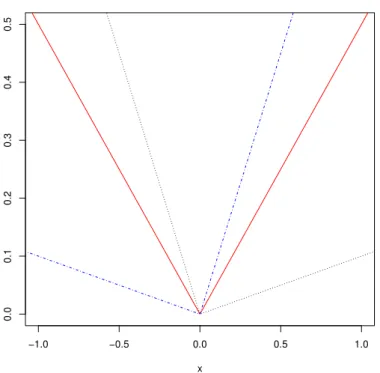
is called the τth quantile of X. The median, F−1(0.5) plays the central role. The quantiles arise from a simple optimization problem. Consider the following problem: a point estimate is required for a random variable with distribution function F. If loss is described by the piecewise linear function illustrated in Figure 2.1
ψ(u) =u(τ−I(u <0)) for some τ∈(0,1), find ˆxto minimize expected loss.
The aim is to minimize E(ψ(X−xˆ)) = (τ−1) Z ˆx −∞ (x−xˆ)dF(x) +τ Z ∞ ˆ x (x−xˆ)dF(x).
Differentiating with respect to ˆx, we have 0 = (1−τ) Z xˆ −∞ dF(x)−τ Z ∞ ˆ x dF(x) =F(ˆx)−τ.
Because F is monotone, any element of {x : F(x) = τ} minimized expected loss. When the solution is unique, ˆx=F−1(τ); otherwise, we have an “interval ofτth quantiles” from which the smallest element must be chosen to adhere to the convention that the empirical quantile function be left-continuous.
It is natural that an optimal point estimator for asymmetric linear loss should lead us to the quantiles. In the symmetric case of absolute value loss it is well known to yield the median. When loss is linear and asymmetric, we prefer a point estimate more likely to leave us on the flatter of two brances of marginal loss. Thus, for example, if an underestimate is marginally three times more costly than an overestimate, we will chose ˆx so thatP(X ≤xˆ) is three times greater thanP(X >xˆ) to compensate. That is, we will choose ˆxto be the 75th percentile ofF. WhenF is replaced by the empirical distribution function
Fn(x) =n−1
n
X
i=1
I(Xi≤x),
we may still choose ˆxto minimize expected loss:
Z ψ(x−xˆ)dFn(x) =n−1 n X i=1 ψ(xi−xˆ)
and doing so yields the τth sample quantile. When τ n is an integer there is again some ambiguity in the solution, but this generally is of little practical consequence. Much more important is the fact that the problem of finding the τth sample quantile, that might seem inherently tied to the notion of an ordering of the sample observations, has been expressed as the solution to a sample optimization problem. This lead to more general methods of estimating models of conditional quantile functions. Least squares offers a template for this development. Knowing that the sample mean solves the problem
min µ∈R n X i=1 (yi−µ)2
µ(x) =xTβ, then β may be estimated by solving min β∈Rp n X i=1 (yi−xTi β)2.
Similarly, since theτth sample quantile, ˆα(τ), solves min α∈R n X i=1 ψ(yi−α)
we are lead to specifying the τth conditional quantile function as Qy(τ|x) =
xTβτ, and to consideration of ˆβτ solving
min β∈Rp n X i=1 ψ(yi−xTiβ).
A possible parametric link between the minimization of the sum of the abso-lute deviates and the maximum likelihood theory is given by the asymmetric Laplace distribution (ALD). We say that a random variableY is distributed as an ALD with parameters µ, σ andτ and we write it Y ∼ALD(µ, σ, τ) if the corresponding density is given by
f(y|µ, σ, τ) = τ(1−τ) σ exp −ψ y−µ σ ,
whereψ(u) =u(τ−I(u≤0)) is the loss function, 0< τ <1 is the skewness pa-rameter,σ >0 is the scale parameter, and−∞< µ <∞is the location param-eter. Set µi =xT
iβ, and y = (y1, . . . , yN). Assuming that yi ∼ALD(µi, σ, τ) then the likelihood for N independent observations is, bar a proportionality constant, L(β, σ, y, τ)∝σ−1exp ( − n X i=1 ψ yi−µi σ )
If we considerσa nuisance parameter, the maximization of the ALD likelihood is equivalent to the minimization of the loss function. The quantile regres-sion estimator can be seen as the quasi-maximum likelihood estimator of an asymmetric Laplace distribution. As we shall see in the next section, this has important connections to generalized estimating equations (GEE).
−1.0 −0.5 0.0 0.5 1.0 0.0 0.1 0.2 0.3 0.4 0.5 x
Figure 2.1: Quantile regression loss function for τ = 0.5 (red),τ = 0.1 (blue) andτ = 0.9 (black).
2.2
Generalized Estimating Equations
Generalized estimating equations are a common approach to account for depen-dence in the data. They provide marginal estimates, where the term marginal is used to emphasize that the model for the mean response at each occasion de-pends only on the covariates of interest, and does not incorporate dependence on previous responses. This is constrast to classical mixed-effect (conditional) models, where the mean response is modeled not only as a function of covariates but is conditional also on random effects.
Marginal models for dependent data separately model the mean response and the dependence among observations. In a marginal model, the goal is to make inferences about the former, whereas the latter is regarded as a nuisance characteristic of the data that must be taken into account in order to make correct inferences about changes in the population mean response over time.
A marginal model for dependent data has the following three-part specifica-tion, with the subscriptiandjdenoting the cluster and the observation within the cluster, respectively:
• The conditional expectation of each response, E(Yij|Xij) = µij, is as-sumed to depend on the covariates through a known link functionh−1(·),
h−1(µij) =ηij =XT ijβ,
whereβ is ap×1 vector of marginal regression parameters.
• The conditional variance of eachYij, given Xij, is assumed to depend on the mean according to
V ar(Yij) =φν(µij),
whereν(·) is a known “variance function” andφis a scale parameter that may be fixed and known or may need to be estimated.
• The conditional dependence of the observations is assumed to be a function of an additional vector of association parameters, sayα.
A crucial aspect of marginal models is that the mean response and the depen-dence among observations are modeled separately. This separation has impor-tant implications for interpretation of the regression parameters in the model for the mean response. In particular, the regression parameters,β, in the marginal model have so-called population-averaged interpretations. That is, they de-scribe how the mean response in the population is related to the covariates. For example, regression parameters in a marginal model might have interpretation
in terms of contrasts of the changes in the mean responses in subpopulations (e.g., different treatment, intervention or exposure groups).
The three-part marginal model specification does not require full distribu-tional assumptions for the data, only a regression model for the mean response. The avoidance of distributional assumptions leads to a method of estimation known as generalized estimating equations. Thus, the GEE approach can be though of as providing a convenient alternative to ML estimation. The GEE ap-proach is a multivariate generalization of the quasi-likelihood apap-proach for gen-eralized linear models. To better understand this connection to quasi-likelihood estimation, in the following we briefly outline the quasi-likelihood approach for generalized linear models for a univariate response before discussing its exten-sion to multivariate responses.
In the following, we now assume N independent observations of a scalar response variable, Yi. Associated with the response, Yi, there are pcovariates,
X1i, . . . , Xpi. We assume that the primary interest is in relating the mean of
Yi,µi=E(Yi|X1i, . . . , Xpi) to the covariates via an appropriate link function,
h−1(µi) =β0+β1X1i+· · ·+βpXpi,
where the link function h−1(·) is a known function. The assumption that Yi has an exponential family distribution has implications for the variance of Yi. In particular, a feature of exponential family distributions is that the variance of Yi can be expressed in terms of a known function of the mean and a scale parameter,
V(Yi) =φν(µi),
where the scale parameter φ > 0. The variance function, ν(µi) describes how the variance of the response is functionally related to the mean of Yi. Next, we consider estimation ofβ. AssumingYifollows an exponential family density with Var(Yi) =φν(µi), the maximum likelihood estimator of β is obtained as the solution to the likelihood score equations,
n X i=1 ∂µi ∂β 0 1 φν(µi){Yi−µi(β)}= 0,
where ∂µi/∂β is the 1×pvector of derivatives, ∂µi/∂βi, i = 1, . . . , p. Inter-estingly, the likelihood equations for generalized linear models depend only on the mean and variance of the response (and the link function). It was suggested using them as “estimating equations” for any choice of link or variance function, even when the particular choice of variance function does not correspond to an exponential family distribution. It was proposed estimating β by solving the
quasi-likelihood equations, n X i=1 ∂µi ∂β 0 Vi−1(Yi−µi(β)) = 0.
For any choice of weights, Vi, the quasi-likelihood estimator of β, say ˆβ, is consistent and asymptotically normal. The choice of weights, Vi = Var(Yi) yields the estimator with smallest variance among all estimators in this class. In summary, the estimation ofβdoes not require distributional assumptions on the response. Quasi-likelihood estimation only requires correct specification of the model for the mean to yield consistent and asymptotically normal estimators of β. That is, a key property of quasi-likelihood estimators is that they are consistent even when the variance of the response has been misspecified, that is, Vi 6=Var(Yi). Specifically, it can be shown that the asymptotic distribution of ˆβ satisfies √ n( ˆβ−β)→N(0, Cβ), where Cβ= lim n→inf tyI −1 0 I1I0−1, I0= 1 n n X i=1 ∂µi ∂β 0 Vi−1 ∂µi ∂β and I1= 1 n n X i=1 ∂µi ∂β 0 Vi−1Var(Yi)Vi−1 ∂µi ∂β
Consistent estimators of the asymptotic covariance of the estimated regression parameters can be obtained using the empirical estimator of Cβ. The empir-ical variance estimator is obtained by evaluating ∂µi/β at ˆβ and substituting (Yi−µiˆ)2 forVar(Yi); this is widely known as the sandwich variance estima-tor. It can be shown that the same asymptotic distribution holds when Vi is estimated rather than known, with Vi replaced by estimated weights, say ˆVi. The multivariate extension of this quasi-likelihood approach can be obtained by replacingYi andµiby their corresponding multivariate counterparts, and using a matrix of weightsVi. In the multivariate case,Vi depends not only onβ but also on the pairwise associations among the observations in theith cluster. In general, the assumed covariance matrix among the responses within a clusterVi
can be specified as
Vi=φA1i/2Ri(α)A1i/2,
where A1i/2=diag{ν(µij)}is a diagonal matrix with diagonal elementsν(µij).
with a specified model forCorr(Yi), with typical element
ρist=ρist(α) =Corr(Yis, Yit;α), s6=t.
In the GEE approach,Viis usually referred to as a “working covariance”, where the term “working” is used to emphasize that Vi is only an approximation to the true covariance matrix. Note that if Ri(α) = I, the ni×ni identity matrix, then the GEE reduces to the quasi-likelihood estimating equations for a generalized linear model that assume the repeated measures are independent. Some common examples of models for the correlation are:
• exchangeable,ρist=α∀s < t; • Toeplitz,ρist=α|s−t|
• first-order autoregressive (AR-1),ρist =α|t−s|, where the correlation de-creases as the time between measurements inde-creases
• unstructured,ρist =αst
For the special case where the outcome is binary, an alternative to the correla-tion as a measure of associacorrela-tion between pairs of binary responses is the odds ratio. In Chapter 3, the odds-ratio has many desirable properties and a more straightforward interpretation.
2.3
Regression Spline
A spline function (q-spline) is a piecewise or segmented polynomial of degreeq
with q−1 continuous derivatives at the changepoints. In the spline literature the changepoints are called knots. We consider only functions of a single vari-able x. Suppose y =f(x) +, butf(x) is completely unknown. When faced with a well-behaved curved trend in a scatterplot, most statisticians would fit a low-order polynomial in x and go on to make inferences which are condi-tional upon the truth of the polynomial model. This is done largely because the family of polynomials is a family of simple curves which is flexible enough to approximate a large variety of shapes. More technically, one could appeal to the Stone-Weierstrass theorem (see Royden [1968:174]), from which it follows that any continuous function on [a, b] can be approximated arbitrarily closely by a polynomial. In pratical terms, a better approximation can be obtained by increasing the order of the polynomial. The cost incurred for doing this is the introduction of additional parameters and some oscillation between data points. Spline functions can be viewed as another way of improving a polynomial ap-proximation. Suppose we are prepared to assume thatf(x) hasq+ 1 continuous
derivatives on [a, b]. Then by Taylor’s theorem, f(x) = q X j=0 φjxj+r(x), where q X j=0 φjxj = q X j=0 1 j! ∂jf(a) ∂xj (x−a) j,
and the remainder is given by
r(x) = 1 q! Z x a ∂q+1f(t) ∂tq+1 (x−t) qdt = 1 q! Z b a ∂q+1f(t) ∂tq+1 (x−t) q +dt
where z+q =zq if z≥0 and 0 otherwise. Use of an order-qpolynomial model ignores the remainder term. Instead of improving the polynomial approximation by increasing the order of the polynomial, it can be achieved by approximating the remainder term. Consider a partitiona≡α0< α1<· · ·< αD−1< αD≡b and approximate the (q+ 1)th derivative off by a step function, then
r(x)≈q1!
D−1
X
d=1
ξd(x−αd)q+.
The final term of the summation has been omitted as (x−b)q+ = 0 forx≤b. The functionf(x) can now be approximated by
f(x)≈ q X j=0 φjxj+ 1 q! D−1 X d=1 ξd(x−αd)q+. (2.1)
This spline approximation can be improved either by increasing the number of knots, or by allowing the data to determine the position of the knots, thus improving the approximation of the integral in the remainder term r(x). The advantage of using splines over increasing the order of the polynomial, in some situations, is that the oscillatory behavior of high-order polynomials can be avoided with splines.
When the positions of the knots αd are treated as fixed, model (2.1) is a linear regression model. Testing whether a knot can be removed and the same polynomial equation used to explain two adhacent segments can be test by testingH0:ξd = 0, which is the commont-test statistics.
2.4
Feature selection methods
2.4.1
Subset selection
Subset selection methods are a common technique to perform feature selection. With subset selection, we retain only a subset of the variables, and eliminate the rest from the model. Least squares regression (or quantile regression) is used to estimate the coefficients of the inputs that are retained. There are a number of different strategies for choosing the subset, including best-subset selection, forward and backward stepwise selection and forward-stagewise regression. By retaining a subset of the predictors and discarding the rest, subset selection produces a model that is interpretable and has possibly lower prediction error than the full model. However, because it is a discrete process, in which variables are either retained or discarded, it often exhibits high variance and does not reduce the prediction error of the full model. Regularized methods are more continuous, and don’t suffer as much from high variability.
2.4.2
Ridge regression
Ridge regression shrinks the regression coefficients by imposing a penalty on their size. The ridge coefficients minimize a penalized residual sum of least squares, ˆ βridge= min β n X i=1 (yi−xTiβ)2+λ p X j=1 βp2
Here λ > 0 is a tuning parameter that controls the amount of shrinkage: the larger the value of λ, the greater the amount of shrinkage. The coefficients are shrunk towards zero. An equivalent way to write the ridge problem is
ˆ βridge = min β n X i=1 (yi−xTi β)2 subject to p X j=1 β2 j ≤t
which makes explicit the size constraint on the parameters. There is a one-to-one correspondence between the parametersλand t. When there are many correlated variables in a linear regression model, their coefficients can become poorly determined and exhibit high variance. A wildly large positive coefficient on one variable can be canceled by a similarly large negative coefficients on its correlated cousing. By imposing a size constraint on the coefficients, this problem is alleviated. Note that the interceptβ0has been left out of the penalty term. Penalization of the intercept would make the procedure depend on the
origin chosen forY; that is, adding a constantcto each of the targetsyi would not simply result in a shift of the predictions by the same amount c. Writing the ridge criterion in matrix form,
RSS(λ) = (y−Xβ)T(y−Xβ) +λβTβ
the ridge regression solutions are easily seen to be ˆ
βridge= (XTX+λI)−1XTy,
where Iis the p×pidentity matrix. Notice that with the choice of quadratic penaltyβTβ, the ridge regression solution is again a linear function of y.
2.4.3
Lasso
The lasso is a shrinkage method like ridge, with subtle but important differences. The lasso estimate is defined by
ˆ βlasso= min β n X i=1 (yi−xT iβ)2+λ p X j=1 |βj|
Equivalenty, we can write ˆ βlasso = min β n X i=1 (yi−xTi β)2 subject to p X j=1 |βj| ≤t
TheL2ridge penaltyPp1βj2is replaced by theL1lasso penaltyPp1|βj|. This lat-ter constraint makes the solutions nonlinear in theyi, and there is no closed form expression as in ridge regression. Computing the lasso solution is a quadratic programming problem, although efficient algorithms are available for comput-ing the entire path of solutions as λ is varied, with the same computational cost as for ridge regression. Because of the nature of the constraint, makingt
sufficiently small will cause some of the coefficients to be exactly zero. Thus the lasso does a kind of continuous subset selection.
2.4.4
Smoothly clipped absolute deviation
The main disadvantage of lasso is that its non-zero coefficients might be bi-ased. The smoothly clipped absolute deviation (SCAD) penalty was shown to
overcome this issue. It is defined as pSCAD λ (β) = λ|β|; if|β| ≤λ −|β|2−22(aλa−1)|β|+λ2; ifλ≤ |β| ≤aλ (a+1)λ2 2 ; if|β|> aλ
wherea >2 andλ >0. It corresponds to a quadratic spline function with knots atλandaλ. The function is continuos and differentiable on (−∞,0)∩(0,∞), but singular at 0 with its derivatives zero outside the range [−aλ, aλ]. This results in small coefficients being set to zero, a few other coefficients being shrunk towards zero while retaining the large coefficients as they are. Thus, SCAD can produce sparse set of solution and approximately unbiased coefficients for large coefficients.
The solution to the SCAD penalty can be given as
ˆ βSCAD j = (|βjˆ | −λ)+sign( ˆβj); if|βjˆ| ≤2λ
{(a−1) ˆβj−sign( ˆβj)aλ/(a−2)}; if 2λ <||βjˆ | ≤aλ
ˆ βj; if|β|> aλ
This thresholding rule involves two unknown parametersλanda. Theoretically, the best pair (λ, a) could be obtained using two dimensional grids search using some criteria like cross validation methods. However, such an implementation could be computationally expensive. Fan and Li (2001) suggesteda= 3.7 is a good choice for variance problems.
Chapter 3
Marginal quantile
regression with a working
odds-ratio matrix
3.1
Introduction
Longitudinal and clustered data represent two frequent data structures in which observations within clusters may be dependent. In this chapter we analyze data from a longitudinal randomized trial on cognitive behavior therapy for treat-ment of obsessive compulsive disorder (Vigerland et al. (2016)). Participants were randomised to ten weeks of internet-based cognitive theraphy (ICBT) with therapist support, or to a waitlist control condition. The main interest of the study was to assess the relationship between the treatment and anxiety disorder score.
Several methods have been proposed to account for the dependence induced by the clustering when estimating marginal quantiles of a response variable. Cluster bootstrap is practical but can become computationally slow when the number of clusters is large. Besides, because it does not model the dependence, it may also be inefficient. Generalized estimating equations (GEE), which can estimate population-averaged models, have become a popular alternative to the bootstrap. The dependence between observations within the same cluster is modeled through a covariance matrix, which is usually assumed to be the same for all clusters. In the literature this matrix is called working covariance matrix, because the estimator is asymptotically correct even if the correlation is misspecified. The term “population-averaged” refers to the fact that the method models the average response over the subpopulation that shares a common value
of the predictors as a function of such predictors (Diggle et al. (2002)).
Quantile regression is a distribution-free method (Koenker (2005)) that de-scribes the entire conditional distribution of a response variable. Marginal quan-tiles were analyzed by Jung (1996), who linked the GEE approach to quantile regression. This method requires the estimation of the density of the residual errors, and is based on estimating equations that are non-smooth with respect to the parameters. More recently, Fu and Wang (2012) provided a smoothed version of Jung’s estimating equation by means of induced smoothing (Brown and Wang (2005)). This method does not require specifying the distribution of the residuals and estimates the parameters and their standard errors jointly.
The main difference between mean and quantile GEE is related to the esti-mation of the working correlation matrix. In the quantile approach, this matrix is estimated from the regression residuals’ signs. However, the Pearson’s corre-lation coefficient is not a good measure of dependence between binary variables because it is bounded by their marginal probabilities.
Because correlation is not a natural scale for binary sign variables, modeling on this scale has several disadvantages. First, it does not provide enough flexibil-ity. For instance, parameters cannot depend on covariates. Second, estimation procedures might be complicated because they have to respect the contraints given by the marginal probabilities. Third, the interpretation of the correlation coefficients may not be straightforward.
Fu et al. (2015) proposed to estimate the working correlation matrix us-ing a gaussian pseudolikelihood. Although this may formulation improved the flexibility, the computational and interpretational issues persist.
Instead, we propose to model a working association matrix defined through odds ratios. In the context of marginal logistic regression, this parametrization was analyzed by Lipsitz et al. (1991) and Carey et al. (1993).
Touloumis et al. (2013) studied the multinomial case. In marginal quantile re-gression, this alternative was mentioned by Yi and He (2009). This chapter explores the odds ratios parametrization in GEE applied to quantile regres-sion. Different working structures can be estimated by specifying appropriate logistic regression models, including multilevel hierarchical data structures. Lo-gistic regression models can be used to select the working dependence structure appropriately.
The rest of the chapter is organized as follows. Section 3.2 presents the smoothed quantile generalized estimating equations and the odds-ratio models. A simulation study is described in Section 3.3. We analyze data from a random-ized trial on cognitive in behavior therapy for treatment of obsessive compulsive disorder in Section 3.4. The chapter is concluded with a summary in Section 3.5.
3.2
Method
Let {yij, xij}, i = 1, . . . , n, j = 1, . . . , Ti be longitudinal data, where yij ∈ R is the response variable and xij ∈ RP is the covariate vector. For brevity, we assume that the number of observations in a cluster Ti is constant across clusters, Ti =T. The general case when Ti 6=T is a straightforward extension. Consider the problem of estimating the conditional τ-th quantile ofy givenx. A simple solution is to treat the observation as independent and minimize the following objective function:
X
i,j
ij ψ(ij),
where ij = yij −xT
ijβτ indicates the residual and ψ(ij) = τ−I(ij < 0) is
a linear transformation of the residual sign. The parameter vector βτ can be estimated by solving
X
i,j
xijψ(ij) = 0
Ignoring the dependence within clusters may lead to wrong standard errors. Consider the set of repeated measures on the i-th individual, denoted by
yi = (y11, . . . , y1T), and its design matrix xi = (x11, . . . , x1T). Each element
of the vector ψ(i) = (ψ(i1), . . . , ψ(iT)) follows a Bernoulli distribution with expectation τ. Therefore, marginal quantile regression can be regarded as a special case of GEE where the mean model is a constant τ and the response variable contains a function of the parameters,I(ij<0). Jung (1996) showed that marginal quantiles can be obtained by
UQ(β) =
n
X
i=1
xTi ΓiWi−1ψτ(i) = 0 (3.1)
where Wi=A1i/2RiA1i/2, Ai=diag(τ(1−τ), . . . , τ(1−τ)),Ri is the residuals sign correlation matrix of thei-th individual, Γi=diag(fi1(0)), . . . , fiT(0)), and
fijindicates the probability density function ofij. The latter can be estimated by (Hall and Sheather (1988))
ˆ fij(0) = 2hnhxTij n ˆ βτ+hn−βτˆ −hn oi−1
where hn is a bandwidth parameter such thathn→0 forn→ ∞, often calcu-lated as hn = 1.57n−1/31.5φ2
Φ−1(τ) /h2
Φ−1(τ) 2i2/3. The covariance matrixWi can be parametrized to increase efficiency. To protect against mis-specification, a sandwich estimator of the standard errors can be used.
The correlation matrix of the regression residuals and of the regression resid-uals’ sign can be different from each other.
As pointed out by Leng and Zhang (2014), ifi has an AR-1 covariance matrix with parameter φthen ψ(i) depends on φas a function of a computationally untractable two-dimensional integral. Other examples can be found in Fu et al. (2015). In general, the regression residuals and their signs have the same corre-lation structure only ifi has an exchangeable or Toeplitz covariance structure. Fu and Wang (2012) proposed to smooth Jung’s estimating equation by means of induced smoothing (Brown and Wang (2005)). They approximated the estimator by adding to the true value β a multivariate standard normal distribution Z and a smoothing parameter Ω, ˆβ =β+ Ω1/2Z. The smoothed estimating equations are obtained by
˜ UQ(β) =EZ(UQ(β+ Ω1/2Z)) = n X i=1 xTiΓiWi−1(η) ˜ψτ(i) = 0 (3.2) where ˜ψτ(i) =1−Φyi1−xTi1β ri1 −τ, . . . ,1−ΦyiT−xTiTβ riT −τT, Φ(·) is the standard normal cumulative distribution andrik= (xT
ikΩxik)1/2.
The derivative of the smoothed score are given by ˜ D(β) = ∂UQ˜ (β) ∂β = n X i=1 XT i ΓiWi−1(η)˜ΛiXi
where ˜Λi is a diagonal matrix with the kth diagonal element r−1ikφ((yik − xT
ikβ)/rik).
The estimation of ˜β and its covariance matrix is obtained through an algo-rithm, summarized by the following steps:
1. Initialization: obtain ˜β0 using ordinary quantile regression; set Ω0 =
n−1Ip andK= 0.
2. Compute the covariance matrix Wi(η) using logistic regression on the residuals sign of the current estimate ˜βK.
3. Update ˜βK+1 and ˜ΩK+1 by: ˜ βK+1 = βK+{−D˜( ˜βK,Ω˜K)}−1UQ˜ (WiK,β˜K,Ω˜K) ˜ ΩK+1 = [ ˜D( ˜βK+1,Ω˜K)]−1Cov{UQ˜ (WiK,β˜K+1}{[ ˜D( ˜βK+1,Ω˜K)]−1}T, whereCov{UG˜ (β)}=Pn i=1xTiΓiWi−1(η) ˜ψτ(i) ˜ψτT(i)Wi−1(η)Γixi.
The final values of ˜β and ˜Ω are the smoothed estimator ofβ and its covariance matrix. The algorithm is fast and it usually requires few iterations to achieve convergence. Some difficulties may arise when estimating marginal quantiles at extreme quantiles, becauseWi(η) is less likely to be positive definite.
3.2.1
Estimating the working association matrix
LetVit=I(yit≤xT
itβτ) be the residual sign of thei-th individual at timetand Vt= (V1t, . . . , Vnt) be the set of residual signs at timet.
A generic elementwzuof the working covariance matrixWi(η) can be written as wzu= τ(1−τ), z=u pzu−τ2, z6=u
where pzu = E(VzVu) = P(Vz = 1, Vu = 1). The elements of Wi(η) can be computed simultaneously through a second set of estimating equations
(Prentice (1988)). These probabilities are bounded byτ, the marginal proba-bility ofVz andVu, as follows:
max(0,2τ−1)≤pzu ≤τ. (3.3)
The correlation coefficient is not a good measure of dependence between binary variables, because it is bounded by their marginal frequencies. Instead, we propose to model a working association matrix defined through odds ratios.
Letηzu be the odds ratio betweenVz andVu,
ηzu= P(Vz= 1, Vu= 1)/P(Vz = 0, Vu= 0)
P(Vz= 0, Vu= 1)/P(Vz = 1, Vu= 0).
LetA={(Vz, Vu)}, z=u, . . . , T, u= 1, . . . , T,be the set of pairwise vectors of all
T
2
residual signs corresponding to the odds ratios in the lower triangular part of the working covariance matrixWi(η). BecauseWi(η) is symmetric, the upper triangular part is the mirror image of the lower part. Consider the new dataset (Vz, Vu, z, u, c). For any working structure ofWi(η), the respective set of odds ratios can be estimated simultaneously through an appropriate definition of the linear predictor in a logistic regression ofVz onVu,Vz|Vu∼Be(µzu).
EstimatingWi(η) using logistic models has some advantages. First, it makes it easy to specify the form of the working covariance matrix. For example,
• Exchangeable: logit(µzu) =α+ηVu; • Toeplitz: logit(µzu) =α+PT−1
i=1 ηiIz−u=iVu+
PT−1
• Unstructured: logit(µzu) =α+P( T 2) i=1ηiIc=iVu+P( T 2) i=1Ic=i.
• Nested Exchangeable: logit(µzu) = α+PK−1
i=1 ηiVuIci=1+PKi=1−1Ici=1, whereci indicates whetherVzand Vu belong to the samei-th cluster. • Exchangeable dependent on a categorical covariateX: logit(µzu) = α+
PK
i=1ηiVuIX=i+PKi=1IX=i, whereK indicates the number of categories
ofX.
Second, logistic models can be used to easily select the most appropri-ate structure of the working covariance matrix. Likelihood comparisons and Akaike’s information criterion may help identify the best structure. Given the marginal probabilitiesτ and the odds ratiosηzu, the joint probabilitiespzucan be obtained by solving the following equation:
(ηzu−1)p2
zu+ (2τ(1−ηzu)−1)pzu+τ2ηzu = 0.
Only the smaller root of the former equation provides probabilities that respect the constraints in equation (3.3).
3.3
Simulation study
We conducted simulations to assess the performance of the proposed method. The response variable was generated from the following model:
yij =β0+β1x1ij+ (1 +|x1ij|)(ij−qτ) i= 1, . . . ,250, j = 1, . . . , T,
where qτ was such that p(ij ≤qτ) = τ. The size of each cluster was sampled from a binomial distributionBinom(T, p), withT = (5,10) andp= 0.8. The co-variatex1ij was sampled from a uniform distributionU(0,1) and the regression
coefficients were set to 1.
We considered the following dependence structures fori = (i1, . . . , iT): • exchangeable, with correlation of 0.3 and 0.6;
• independence;
• Toeplitz, with correlation equal to 0.4 for the first two lags and zero oth-erwise.
The distribution of the error term was multivariate Gaussian with unit variance diagonal.
We conducted a simulation study with 500 independent realizations and esti-mated three different quantiles, τ = (0.10,0.25,0.50). All computations were
performed using R version 3.23. The multivariate Gaussian random variable were generated using the “mvtnorm” library.
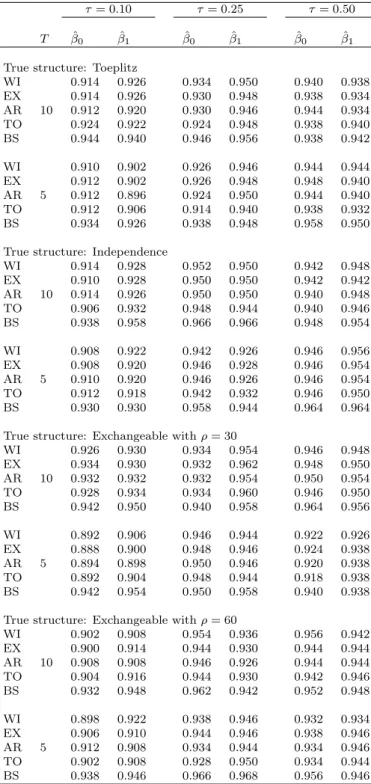
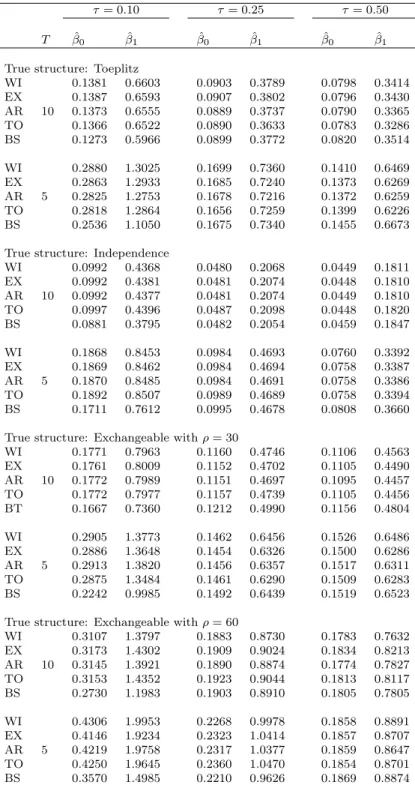
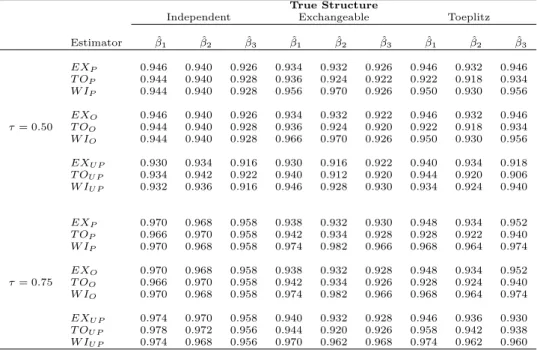
Coverage probabilities were close to their nominal value in all the settings (Table 3.1). The estimator of the 10-th percentile showed undercoverage, with smallest observed value equal to 0.88. Cluster bootstrap had a smaller mean squared error (MSE) than the proposed method when the 10-th percentile was estimated (Table 3.2). This may indicate that the number of clusters for this percentile was not large enough to ensure asymptotic properties. When the 25-th and 50-25-th percentile were estimated, 25-the proposed me25-thod provided smaller mean squared error than cluster bootstrap, regardless of the dependence struc-ture. Similarly to the classic GEE for the expectation of a response variable, selecting the true dependence structure improved the performances of the es-timator in terms of mean squared error. When the true dependence structure was Toeplitz, the estimator obtained using the true dependence structure pro-vided the smallest mean squared error in most of the settings. In the inde-pendent case, results were very similar across all the working structures. In the exchangeable case, the independence and exchangeable structures had the smallest mean squared error.
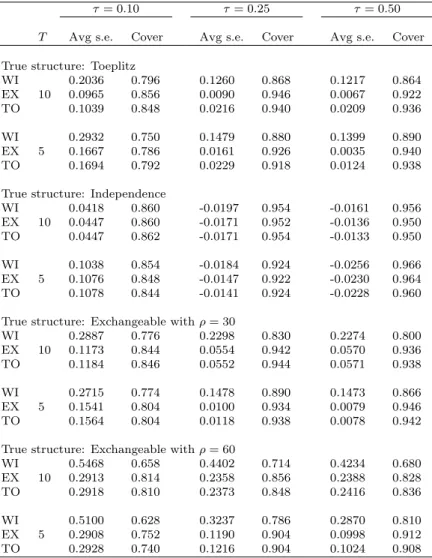
Model-based (naive) standard errors were on average smaller than robust standard errors in all settings (Table 3.3), except the independence case. Mis-specification of the working correlation structure lead to a decrease in the em-pirical coverage of the estimators.
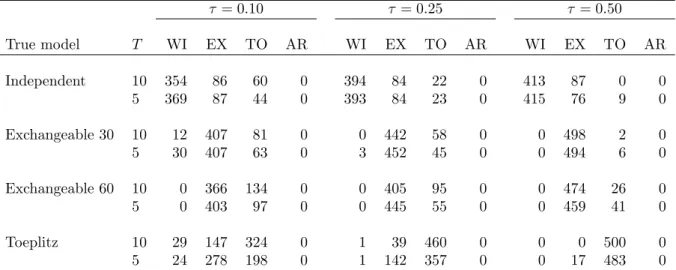
Model selection performed through Akaike’s information criterion selected the true dependence structure with a probability between 80 and 100 percent for the 25-th and 50-th percentiles and between 40 and 75 percent for the 10-th percentile(Table 3.4). The smallest percentage of correct selection was 40 percent, obtained when the true dependence structure was Toeplitz, τ = 0.10 and T = 5. The highest was 100 percent, obtained when the true dependence structure was Toeplitz, τ = 0.50 and T = 10. In general, the percentage of correct selection was higher for the median than the 25-th percentiles.
τ= 0.10 τ= 0.25 τ= 0.50 T βˆ0 βˆ1 βˆ0 βˆ1 βˆ0 βˆ1
True structure: Toeplitz
WI 0.914 0.926 0.934 0.950 0.940 0.938 EX 0.914 0.926 0.930 0.948 0.938 0.934 AR 10 0.912 0.920 0.930 0.946 0.944 0.934 TO 0.924 0.922 0.924 0.948 0.938 0.940 BS 0.944 0.940 0.946 0.956 0.938 0.942 WI 0.910 0.902 0.926 0.946 0.944 0.944 EX 0.912 0.902 0.926 0.948 0.948 0.940 AR 5 0.912 0.896 0.924 0.950 0.944 0.940 TO 0.912 0.906 0.914 0.940 0.938 0.932 BS 0.934 0.926 0.938 0.948 0.958 0.950 True structure: Independence
WI 0.914 0.928 0.952 0.950 0.942 0.948 EX 0.910 0.928 0.950 0.950 0.942 0.942 AR 10 0.914 0.926 0.950 0.950 0.940 0.948 TO 0.906 0.932 0.948 0.944 0.940 0.946 BS 0.938 0.958 0.966 0.966 0.948 0.954 WI 0.908 0.922 0.942 0.926 0.946 0.956 EX 0.908 0.920 0.946 0.928 0.946 0.954 AR 5 0.910 0.920 0.946 0.926 0.946 0.954 TO 0.912 0.918 0.942 0.932 0.946 0.950 BS 0.930 0.930 0.958 0.944 0.964 0.964 True structure: Exchangeable withρ= 30
WI 0.926 0.930 0.934 0.954 0.946 0.948 EX 0.934 0.930 0.932 0.962 0.948 0.950 AR 10 0.932 0.932 0.932 0.954 0.950 0.954 TO 0.928 0.934 0.934 0.960 0.946 0.950 BS 0.942 0.950 0.940 0.958 0.964 0.956 WI 0.892 0.906 0.946 0.944 0.922 0.926 EX 0.888 0.900 0.948 0.946 0.924 0.938 AR 5 0.894 0.898 0.950 0.946 0.920 0.938 TO 0.892 0.904 0.948 0.944 0.918 0.938 BS 0.942 0.954 0.950 0.958 0.940 0.938 True structure: Exchangeable withρ= 60
WI 0.902 0.908 0.954 0.936 0.956 0.942 EX 0.900 0.914 0.944 0.930 0.944 0.944 AR 10 0.908 0.908 0.946 0.926 0.944 0.944 TO 0.904 0.916 0.944 0.930 0.942 0.946 BS 0.932 0.948 0.962 0.942 0.952 0.948 WI 0.898 0.922 0.938 0.946 0.932 0.934 EX 0.906 0.910 0.944 0.946 0.938 0.946 AR 5 0.912 0.908 0.934 0.944 0.934 0.946 TO 0.902 0.908 0.928 0.950 0.934 0.944 BS 0.938 0.946 0.966 0.968 0.956 0.946
Table 3.1: Empirical coverage of the proposed estimator at three quantiles for different working correlation structures, cluster size T and true correla-tion structures. WI=independence, EX=exchangeable, AR=autoregressive, TO=Toeplitz, BS=cluster bootstrap.
τ= 0.10 τ= 0.25 τ= 0.50 T βˆ0 βˆ1 βˆ0 βˆ1 βˆ0 βˆ1
True structure: Toeplitz
WI 0.1381 0.6603 0.0903 0.3789 0.0798 0.3414 EX 0.1387 0.6593 0.0907 0.3802 0.0796 0.3430 AR 10 0.1373 0.6555 0.0889 0.3737 0.0790 0.3365 TO 0.1366 0.6522 0.0890 0.3633 0.0783 0.3286 BS 0.1273 0.5966 0.0899 0.3772 0.0820 0.3514 WI 0.2880 1.3025 0.1699 0.7360 0.1410 0.6469 EX 0.2863 1.2933 0.1685 0.7240 0.1373 0.6269 AR 5 0.2825 1.2753 0.1678 0.7216 0.1372 0.6259 TO 0.2818 1.2864 0.1656 0.7259 0.1399 0.6226 BS 0.2536 1.1050 0.1675 0.7340 0.1455 0.6673 True structure: Independence
WI 0.0992 0.4368 0.0480 0.2068 0.0449 0.1811 EX 0.0992 0.4381 0.0481 0.2074 0.0448 0.1810 AR 10 0.0992 0.4377 0.0481 0.2074 0.0449 0.1810 TO 0.0997 0.4396 0.0487 0.2098 0.0448 0.1820 BS 0.0881 0.3795 0.0482 0.2054 0.0459 0.1847 WI 0.1868 0.8453 0.0984 0.4693 0.0760 0.3392 EX 0.1869 0.8462 0.0984 0.4694 0.0758 0.3387 AR 5 0.1870 0.8485 0.0984 0.4691 0.0758 0.3386 TO 0.1892 0.8507 0.0989 0.4689 0.0758 0.3394 BS 0.1711 0.7612 0.0995 0.4678 0.0808 0.3660 True structure: Exchangeable withρ= 30
WI 0.1771 0.7963 0.1160 0.4746 0.1106 0.4563 EX 0.1761 0.8009 0.1152 0.4702 0.1105 0.4490 AR 10 0.1772 0.7989 0.1151 0.4697 0.1095 0.4457 TO 0.1772 0.7977 0.1157 0.4739 0.1105 0.4456 BT 0.1667 0.7360 0.1212 0.4990 0.1156 0.4804 WI 0.2905 1.3773 0.1462 0.6456 0.1526 0.6486 EX 0.2886 1.3648 0.1454 0.6326 0.1500 0.6286 AR 5 0.2913 1.3820 0.1456 0.6357 0.1517 0.6311 TO 0.2875 1.3484 0.1461 0.6290 0.1509 0.6283 BS 0.2242 0.9985 0.1492 0.6439 0.1519 0.6523 True structure: Exchangeable withρ= 60
WI 0.3107 1.3797 0.1883 0.8730 0.1783 0.7632 EX 0.3173 1.4302 0.1909 0.9024 0.1834 0.8213 AR 10 0.3145 1.3921 0.1890 0.8874 0.1774 0.7827 TO 0.3153 1.4352 0.1923 0.9044 0.1813 0.8117 BS 0.2730 1.1983 0.1903 0.8910 0.1805 0.7805 WI 0.4306 1.9953 0.2268 0.9978 0.1858 0.8891 EX 0.4146 1.9234 0.2323 1.0414 0.1857 0.8707 AR 5 0.4219 1.9758 0.2317 1.0377 0.1859 0.8647 TO 0.4250 1.9645 0.2360 1.0470 0.1854 0.8701 BS 0.3570 1.4985 0.2210 0.9626 0.1869 0.8874
Table 3.2: Mean squared error of the proposed estimator at three quantiles for different working correlation structures, cluster size T and true correla-tion structures. WI=independence, EX=exchangeable, AR=autoregressive, TO=Toeplitz, BS=cluster bootstrap.
τ= 0.10 τ= 0.25 τ= 0.50 T Avg s.e. Cover Avg s.e. Cover Avg s.e. Cover True structure: Toeplitz
WI 0.2036 0.796 0.1260 0.868 0.1217 0.864 EX 10 0.0965 0.856 0.0090 0.946 0.0067 0.922 TO 0.1039 0.848 0.0216 0.940 0.0209 0.936 WI 0.2932 0.750 0.1479 0.880 0.1399 0.890 EX 5 0.1667 0.786 0.0161 0.926 0.0035 0.940 TO 0.1694 0.792 0.0229 0.918 0.0124 0.938 True structure: Independence
WI 0.0418 0.860 -0.0197 0.954 -0.0161 0.956 EX 10 0.0447 0.860 -0.0171 0.952 -0.0136 0.950 TO 0.0447 0.862 -0.0171 0.954 -0.0133 0.950 WI 0.1038 0.854 -0.0184 0.924 -0.0256 0.966 EX 5 0.1076 0.848 -0.0147 0.922 -0.0230 0.964 TO 0.1078 0.844 -0.0141 0.924 -0.0228 0.960 True structure: Exchangeable withρ= 30
WI 0.2887 0.776 0.2298 0.830 0.2274 0.800 EX 10 0.1173 0.844 0.0554 0.942 0.0570 0.936 TO 0.1184 0.846 0.0552 0.944 0.0571 0.938 WI 0.2715 0.774 0.1478 0.890 0.1473 0.866 EX 5 0.1541 0.804 0.0100 0.934 0.0079 0.946 TO 0.1564 0.804 0.0118 0.938 0.0078 0.942 True structure: Exchangeable withρ= 60
WI 0.5468 0.658 0.4402 0.714 0.4234 0.680 EX 10 0.2913 0.814 0.2358 0.856 0.2388 0.828 TO 0.2918 0.810 0.2373 0.848 0.2416 0.836 WI 0.5100 0.628 0.3237 0.786 0.2870 0.810 EX 5 0.2908 0.752 0.1190 0.904 0.0998 0.912 TO 0.2928 0.740 0.1216 0.904 0.1024 0.908
Table 3.3: Standard error difference between the robust and naive estimators (Avg s.e.) and empirical coverage of the naive estimators (Cover) for the pa-rameterβ1at three quantiles for different working correlation structures, cluster size T and true correlation structures. WI=independence, EX=exchangeable, TO=Toeplitz.
τ = 0.10 τ= 0.25 τ = 0.50 True model T WI EX TO AR WI EX TO AR WI EX TO AR Independent 10 354 86 60 0 394 84 22 0 413 87 0 0 5 369 87 44 0 393 84 23 0 415 76 9 0 Exchangeable 30 10 12 407 81 0 0 442 58 0 0 498 2 0 5 30 407 63 0 3 452 45 0 0 494 6 0 Exchangeable 60 10 0 366 134 0 0 405 95 0 0 474 26 0 5 0 403 97 0 0 445 55 0 0 459 41 0 Toeplitz 10 29 147 324 0 1 39 460 0 0 0 500 0 5 24 278 198 0 1 142 357 0 0 17 483 0
Table 3.4: Frequency of correct selections of the true model in different scenarios and quantiles. T indicates the cluster size. WI=independence, EX=exchangeable, TO=Toeplitz, AR=autoregressive.
3.4
Application to internet-based cognitive
ther-apy data set
The dataset consisted of ninety-five (n = 95) families with a child aged 8-12 years with a principal diagnosis of generalised anxiety, panic disorder, separa-tion anxiety, social phobia and specific phobia Vigerland et al. (2016). Partici-pants were randomised to ten weeks of internet-based cognitive theraphy (ICBT) with therapist support (70 families), or to a waitlist control condition (25 fami-lies). At weekly intervals, the amount of difficulties in emotion regulation scale (DERS) was measured on a 0-100 scale, where 0 indicated no difficulties and 100 extreme difficulties. The maximum number of repeated measurements is fourteen (T = 14). Similarly to previous studies, we assumed that data were missing completely at random. The main interest of the study was to assess the relationship between the treatment and DERS.
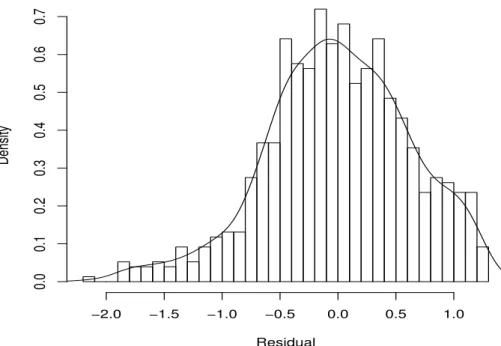
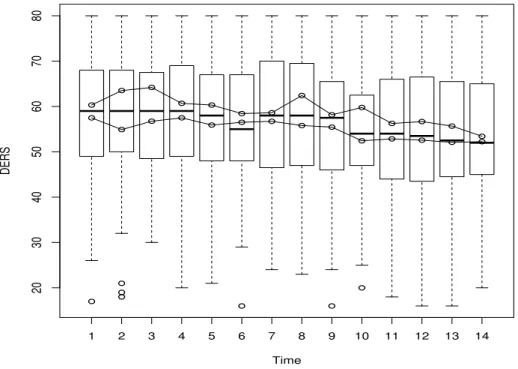
Figure 3.1 shows the residual errors of a classical mean regression and their kernel density. It was markedly skewed and there were several outliers. The mean was not an appropriate summary of it, and we considered quantiles. There seemed to be a time effect on the response variable, both in treated and un-treated groups (Figure 3.2). The intraclass correlation was estimated to be 70%.
We considered three different quantiles,τ= (0.25,0.50,0.75), and estimated the following model:
Q(Dersij|Treat,Time) =β0+β1Treati+β2Timeij+β3Treati×Timeij. (3.4)
We considered an exchangeable, Toeplitz, independence and treatment-dependent exchangeable association structures, along with a cluster bootstrap. Results are shown in Table 3.5.
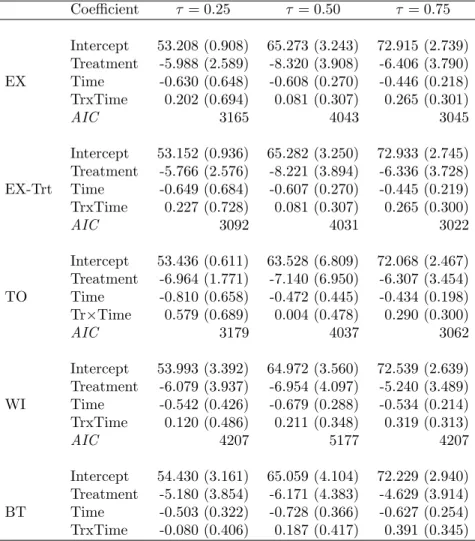
The treatment coefficient, β1, represents the difference in the considered quantile between treatment groups at the start of the study. It was statis-tically significant at the 50-th and 25-th percentiles in the exchangeable and treatment-dependent exchangeable structures. Considering the randomization, the observed difference at baseline can only be explained by chance. The time coefficient, β2, indicates the change in the considered quantile per unit change in time. It was significant at the median with all correlation structures except the Toeplitz. At the 75-th percentile it was significant with all correlation struc-tures. The interaction coefficient,β3, represents the difference in the slope over time between the treatment groups. We found no significant difference in slope. The treatment-dependent exchangeable structure had the smallest AIC. Mea-surements from subjects that were treated were less strongly associated than
those from subjects that were not treated (Table 3.6). Standard errors obtained with cluster bootstrap were up to 50 percent greater than those obtained with the proposed method.
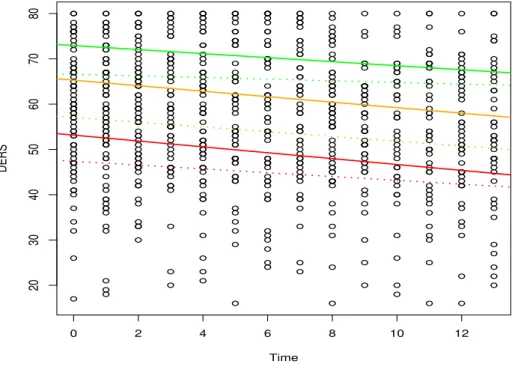
Figure 3.3 shows the relationship between DERS and Time, stratified by treatment. As the estimated quantile increases, the correlation between DERS and time decreases. The differences between treated and untreated are stronger at the median than at other percentiles.
Residual Density −2.0 −1.5 −1.0 −0.5 0.0 0.5 1.0 0.0 0.1 0.2 0.3 0.4 0.5 0.6 0.7
Figure 3.1: Mean regression residuals obtained from model (3.4) and their esti-mated kernel density.
l l l l l l l 1 2 3 4 5 6 7 8 9 10 11 12 13 14 20 30 40 50 60 70 80 Time DERS l l l l l l l l l l l l l l l l l l l l l l l l l l l l
Figure 3.2: Boxplot of difficulties in emotion regulation scale (DERS) at different times. The two lines represents the mean of the response for that specific time in the group of treated and the untreated group.
Coefficient τ= 0.25 τ= 0.50 τ= 0.75 EX Intercept 53.208 (0.908) 65.273 (3.243) 72.915 (2.739) Treatment -5.988 (2.589) -8.320 (3.908) -6.406 (3.790) Time -0.630 (0.648) -0.608 (0.270) -0.446 (0.218) TrxTime 0.202 (0.694) 0.081 (0.307) 0.265 (0.301) AIC 3165 4043 3045 EX-Trt Intercept 53.152 (0.936) 65.282 (3.250) 72.933 (2.745) Treatment -5.766 (2.576) -8.221 (3.894) -6.336 (3.728) Time -0.649 (0.684) -0.607 (0.270) -0.445 (0.219) TrxTime 0.227 (0.728) 0.081 (0.307) 0.265 (0.300) AIC 3092 4031 3022 TO Intercept 53.436 (0.611) 63.528 (6.809) 72.068 (2.467) Treatment -6.964 (1.771) -7.140 (6.950) -6.307 (3.454) Time -0.810 (0.658) -0.472 (0.445) -0.434 (0.198) Tr×Time 0.579 (0.689) 0.004 (0.478) 0.290 (0.300) AIC 3179 4037 3062 WI Intercept 53.993 (3.392) 64.972 (3.560) 72.539 (2.639) Treatment -6.079 (3.937) -6.954 (4.097) -5.240 (3.489) Time -0.542 (0.426) -0.679 (0.288) -0.534 (0.214) TrxTime 0.120 (0.486) 0.211 (0.348) 0.319 (0.313) AIC 4207 5177 4207 BT Intercept 54.430 (3.161) 65.059 (4.104) 72.229 (2.940) Treatment -5.180 (3.854) -6.171 (4.383) -4.629 (3.914) Time -0.503 (0.322) -0.728 (0.366) -0.627 (0.254) TrxTime -0.080 (0.406) 0.187 (0.417) 0.391 (0.345) Table 3.5: Estimated quantile regression coefficients, standard errors (in paren-theses) and logistic models’ AIC for three quantiles using exchangeable (EX), ex-changeable varying with treatment (EX-Trt), Toeplitz (TO) and independence (WI) working correlation structures, along with a cluster bootstrap (BT).
Correlation Parameter τ = 0.25 τ= 0.50 τ= 0.75
φTRT=0 0.06 0.11 0.08
φTRT=1 0.12 0.14 0.12
φExch 0.10 0.13 0.11
Table 3.6: Estimated working correlation parameters for the exchangeable (φExch) and exchangeable varying with treatment (φTRT=1andφTRT=0) struc-tures in the cognitive therapy application.
l l l l l l l l l l l l l l l l l l l l l l l l l l l l l l l l l l l l l l l l l l l l l l l l l l l l l l l l l l l l l l l l l l l l l l l l l l l l l l l l l l l l l l l l l l l l l l l l l l l l l l l l l l l l l l l l l l l l l l l l l l l l l l l l l l l l l l l l l l l l l l l l l l l l l l l l l l l l l l l l l l l l l l l l l l l l l l l l l l l l l l l l l l l l l l l l l l l l l l l l l l l l l l l l l l l l l l l l l l l l l l l l l l l l l l l l l l l l l l l l l l l l l l l l l l l l l l l l l l l l l l l l l l l l l l l l l l l l l l l l l l l l l l l l l l l l l l l l l l l l l l l l l l l l l l l l l l l l l l l l l l l l l l l l l l l l l l l l l l l l l l l l l l l l l l l l l l l l l l l l l l l l l l l l l l l l l l l l l l l l l l l l l l l l l l l l l l l l l l l l l l l l l l l l l l l l l l l l l l l l l l l l l l l l l l l l l l l l l l l l l l l l l l l l l l l l l l l l l l l l l l l l l l l l l l l l l l l l l l l l l l l l l l l l l l l l l l l l l l l l l l l l l l l l l l l l l l l l l l l l l l l l l l l l l l l l l l l l l l l l l l l l l l l l l l l l l l l l l l l l l l l l l l l l l l l l l l l l l l l l l l l l l l l l l l l l l l l l l l l l l l l l l l l l l l l l l l l l l l l l l l l l l l l l l l l l l l l l l l l l l l l l l l l l l l l l l l l l l l l l l l l l l l l l l l l l l l l l l l l l l l l l l l l l l l l l l l l l l l l l l l l l l l l l l l l l l l l l l l l l l l l l l l l l l l l l l l l l l l l l l l l l l l l l l l l l l l l l l l l l l l l l 0 2 4 6 8 10 12 20 30 40 50 60 70 80 Time DERS
Figure 3.3: Estimated relationship between difficulties in emotion regula-tion scale (DERS) and time by treatment at three different quantiles τ = (0.25,0.50,0.75) with an exchangeable correlation structure varying with treat-ment. The dashed lines represent the treated group, while the solid lines repre-sent the untreated group.
3.5
A summary
The present Chapter 3 chapter describes an alternative method to estimate the dependence within clusters for inference on population marginal quantile models. The association matrix of the residuals’ sign is estimated by means of appropriate logistic regression models. The estimation is flexible and computa-tionally fast. In our study the proposed method was approximately as fast as GEE applied to the mean. The best-fitting working structure can be selected by likelihood comparisons or, for non-nested models, by the Akaike’s information criterion. Our simulations showed that this criterion could select the true depen-dence structure with high probability Possible extensions of this work include models for dependence with non-parametric quantile regression, M-estimators, LMS (Cole (1990)) and other classifiers.
Chapter 4
Penalized marginal quantile
models
4.1
Introduction
This chapter presents two penalized versions of the marginal quantile regression estimator of Chapter 3, regularized smoothly clipped absolute deviation (SCAD) models for feature selection and reduced-rank penalized splines smoothing. Pre-vious works in this field generally lack the possibility to either estimate quantiles (Wang et al. (2012), Chen et al. (2013)) or to account for the dependence struc-ture of the data (Sherwood et al. (2016), Pratesi et al. (2009)).
Our proposed methods consist of solving estimating equations composed of two components. The first measures the fit of the model and it is the same as equation 3.2. The second is a penalization component that controls the model complexity through a tuning parameter. In regularized models, the model com-plexity is related to the coefficients’ magnitude. Among the several penalty functions proposed in the literature, we chose the smoothly clipped absolute de-viations (SCAD) penalty. Fan and Li (2001) showed that it has three desiderable properties of model selection: unbiasedness, sparsity and continuity. Other com-mon penalty functions may lack any of these properties. For instance, the lasso penalty does not satisfies the unbiasedness property, the ridge penalty does not statisfied the sparsity property and elastic nets do not satisfy the continuity property.
In reduced-rank penalized spline smoothing, the model complexity is related to the smoothness of the estimated function. There are several choices for the spline basis. We focused on the truncated polynomial spline, because it provides analytical advantages.
In any given setting, other types of penalty functions or splines basis could perform better. The rest of the chapter is organized as follows. Section 4.2 presents the penalized quantile regression method and two special cases. Simu-lation studies are described in Section 4.3. We analyze data from a randomized trial on cognitive in behavior therapy for treatment of obsessive compulsive dis-order in Section 4.4. The chapter is concluded with a discussion in Section 4.5.
4.2
Methods
4.2.1
Penalized quantile estimating equations
Let{yij, xij},i= 1, . . . , n,j= 1, . . . , Ti be longitudinal data, where yij ∈Ris the response variable andxij ∈RP is the covariate vector.
For brevity, we assume that the number of observations in a clusterTiis constant across clusters, Ti = T. The general case when Ti 6= T is a straightforward extension. As was shown in Chapter 3, marginal quantiles can be obtained by solving a smooth estimating equation,
˜ UQ(β) = n X i=1 xTi ΓiWi−1(η) ˜ψτ(i) = 0
The penalized quantile estimating equations are defined as
U(β, λ,Ω) = ˜UQ(β,Ω)−UP(β, λ) = 0 (4.1) Note that if we take ˜UQ(β, X) = Pn
i=1XiTWi−1(η)(Yi−XiTβ), the classical
GEE for the mean, we obtain penalized marginal mean regression.
The tuning parameterλcontrols the entire penalization componentUP(β, λ). When it is zero, the penalization component disappears and the estimating equation reduces to equation 3.2. When it is infinite, the penalization is large. In penalized splines, this forces the estimated function to become linear. In regularized regression, it shrunk all the estimated parameters towards zero.
The complexity of the model might be controlled by a set of tuning pa-rameters. In penalized splines, this allows the estimated function to be more flexible at knots where the function is strongly nonlinear, and less flexible at knots where the function is more linear. In regularized models, this allows to shrink coefficients with a different magnitude.
In this work, we focus on a single tuning parameterλ, selected through either cross-validation techniques or by minimizing a measure that balances goodness of fit and model complexity such as the Bayesian Information Criterion (BIC).
4.2.2
Regularized models for feature selection
There are several penalty functions available to perform feature selection, for instance lasso, elastic nets and smoothly clipped absolute deviation (SCAD). A good penalty function should result in an estimator with three properties: unbi-asedness, sparsity (the estimator automatically sets small estimated coefficients to zero to reduce model complexity) and continuity (a relevant property to avoid instability in model prediction). Among the several penalty functions available, SCAD is one of the few that simultaneously achieves all these properties.
This penalty is defined as
UP(β, λ) = q(λ,|β|)sgn(β), (4.2) q(λ, β) = nλ I(β ≤λ) +(aλ−β)+ λ(a−1) I(β > λ) , (4.3)
whereacan be taken as 3.7 as recommended by Fan and Li (2001).
The non-differentiability of the SCAD penalty might cause computational problems. Hunter and Li (2005) proposed to solve this equations through the minorization-maximization (MM) algorithm. For a small <0, the MM algo-rithm suggests that the penalization term can be approximated by
˜
UP(β, λ) =q(λ,|β|)sign(β) |β|
+|β| (4.4)
In the numerical analyses, we take to be the fixed small number 10−6. The estimation of ˜β and its covariance matrix is obtained through an algorithm, summarized by the following steps:
1. Initialization: set ˆβ0= (0, . . . ,0)
p and Ω0=n−1Ip andK= 0.
2. Compute the cov