c
THE PARALLEL INTERMEDIATE LANGUAGE
BY
ADAM RANDALL SMITH
DISSERTATION
Submitted in partial fulfillment of the requirements for the degree of Doctor of Philosophy in Computer Science
in the Graduate College of the
University of Illinois at Urbana-Champaign, 2015
Urbana, Illinois Doctoral Committee:
Professor David Padua, Chair, Director of Research Professor Laxmikant Kale
Professor Wen-Mei Hwu
Abstract
The next challenge in the evolution of supercomputers will be the transition to exascale systems. However, while the move from terascale to petascale processing was considered evolutionary, it is widely believed that the leap to exascale supercomputers will require revo-lutionary advances. Simply scaling up current technology will not work. The projections for the exascale systems indicate that applications may have to support up to a billion separate threads to efficiently use the hardware, while the amount of memory per arithmetic func-tional unit will drop significantly. This implies the need for exploiting fine-grain parallelism with a programming model other than the currently used message passing or coarse-grain threads. As a response, the programming community is exploring data-driven runtimes. However, in order to utilize the new runtime systems, users will either need to rewrite all of their applications by hand in the new languages, or be provided with tools to help them move to the new languages. Requiring users to rewrite applications is very costly, time consuming, and error prone. We believe a better approach is to help ease users into new programming paradigms by providing them with both a way to utilize existing programming paradigms and applications, as well as providing them a way to write applications directly in the new programming notations.
There is a disconnect between the high level languages such as HTAs that provide high levels of expressibility and programmability, and new data-driven runtimes, such as SCALE and OCR that provide high levels of control on supercomputers of the future. We want to bridge the gap between these notations with a Parallel Intermediate Language (PIL). As new
runtimes are being developed to run on future supercomputers, we believe that a framework to help programmers target these new runtime systems is necessary. Thus, PIL should be retargetable, efficient, and should accept many high level languages as input. Such a frame-work can provide portability across many different machines and runtimes. Furthermore, we believe that when targeting a new runtime systems programmers can achieve increased pro-ductivity and performance through the utilization of multiresolution programming in their applications, while allowing a framework to ease the transition to new notations.
Acknowledgments
The work contained in this thesis would not have been possible without the support and encouragement of many people. I would like to thank my advisor, Professor David Padua. His guidance throughout this work has been invaluable. I would like to thank my committee members Professor Laxmikant Kale, Professor Wen-Mei Hwu, and Doctor Wilfred Pinfold for their helpful suggestions and discussions on the ideas in my work.
I would also like to thank my family for their unending love and support in all of my endeavors. My parents have always encouraged me to follow my dreams, and my wife has helped me to achieve them.
Table of Contents
List of Figures . . . ix
List of Tables . . . xi
Chapter 1 Introduction . . . 1
1.1 Data-Driven Runtimes . . . 3
1.1.1 The Swift Adaptive Runtime Machine . . . 5
1.1.2 The Open Community Runtime . . . 7
1.2 Comparison of Data-Driven Runtimes to Dataflow Programming . . . 10
1.3 High Level Programming Notations and Compilers . . . 10
1.3.1 Hierarchically Tiled Arrays . . . 11
1.3.2 The R-Stream Compiler . . . 12
1.4 Focus for this Thesis . . . 12
1.5 Goals of Thesis . . . 13
1.6 Organization of Thesis . . . 13
Chapter 2 Universal Translation of Parallel Languages . . . 15
2.1 Parallelism . . . 19
2.1.1 Classifying Parallelism . . . 21
2.1.2 Composing Parallelism . . . 24
2.1.3 Examples of Parallelism in Popular Languages . . . 25
2.1.4 Universal Parallelism . . . 27
2.2 Memory Models . . . 27
2.2.1 Shared Memory . . . 27
2.2.2 Distributed Memory . . . 28
2.2.3 Data and Its Placement . . . 28
2.2.4 Communication and Synchronization . . . 29
2.3 Discussion of Parallelism and Memory Models . . . 31
2.3.1 Data Parallelism . . . 31
2.3.2 Task Parallelism . . . 33
2.3.3 SPMD Parallelism . . . 36
2.4 Conclusions on Universal Translation . . . 39
3.1 Syntax and Semantics of PIL . . . 42
3.1.1 Declaration of Data in PIL . . . 43
3.1.2 Body Functions of PIL Nodes . . . 44
3.1.3 PIL Nodes . . . 45
3.1.4 Library Functions Provided with PIL . . . 48
3.1.5 Support for the Implementation of Libraries . . . 54
3.2 Parallelism in PIL . . . 56 3.2.1 Data Parallelism . . . 58 3.2.2 Task Parallelism . . . 58 3.2.3 SPMD Parallelism . . . 58 3.2.4 Composing Parallelism . . . 58 3.3 Memory Models . . . 59
3.3.1 Communication and Synchronization . . . 60
3.4 Discussion of Parallelism and Memory Models . . . 60
3.4.1 Memory Models in PIL . . . 60
3.4.2 Parallelism . . . 61
3.5 Examples of Popular Languages in PIL . . . 69
3.5.1 Acceptance as Input . . . 69
3.5.2 Generation as Output . . . 71
3.6 Portability . . . 72
3.7 Multiresolution Programming . . . 72
3.8 Optimizations in PIL . . . 75
3.9 Conclusions of the Language . . . 78
Chapter 4 The PIL Compiler . . . 79
4.1 Parsing a PIL Program . . . 79
4.2 Generating OpenMP code from PIL . . . 80
4.2.1 Encapsulation of Data . . . 80
4.2.2 Body Functions . . . 80
4.2.3 PIL Nodes . . . 80
4.2.4 Memory Management Library . . . 81
4.2.5 Communication Library . . . 81
4.2.6 Support for the Implementation of Libraries . . . 82
4.3 Generating SCALE code from PIL . . . 82
4.3.1 Encapsulation of Data . . . 82
4.3.2 Body Functions . . . 83
4.3.3 PIL Nodes . . . 83
4.3.4 Memory Management Library . . . 84
4.3.5 Communication Library . . . 84
4.3.6 Support for the Implementation of Libraries . . . 85
4.4 Generating OCR code from PIL . . . 85
4.4.1 Encapsulation of Data . . . 86
4.4.3 PIL Nodes . . . 86
4.4.4 Memory Management Library . . . 86
4.4.5 Communication Library . . . 87
4.4.6 Support for the Implementation of Libraries . . . 87
4.5 Summary of the PIL Compiler Implementation . . . 88
Chapter 5 Experimental Framework . . . 89
5.1 I2PC3 Machine . . . 89
5.2 X-Stack Cluster . . . 90
Chapter 6 Cholesky Factorization: A Top to Bottom Case Study . . . . 91
6.1 Tiled Cholesky Factorization . . . 91
6.2 Fork/Join Cholesky . . . 96
6.2.1 HTA Implementation . . . 98
6.2.2 PIL Implementation . . . 98
6.3 SPMD Cholesky with HTAs . . . 99
6.4 Task Parallelism with Hand Coded PIL . . . 101
6.5 Experimental Results . . . 102
6.5.1 What We Will Show . . . 104
6.5.2 Experimental Data . . . 104
6.5.3 HTA Has Little Overhead . . . 110
6.5.4 Efficiency of the Backends . . . 111
6.5.5 Efficiency of Parallel Versions of the Code . . . 113
6.6 Conclusions from Cholesky Factorization . . . 118
Chapter 7 The NAS Benchmarks with HTAs . . . 119
7.1 The NAS Parallel Benchmarks . . . 120
7.2 HTA NAS Benchmarks Fork/Join Results . . . 122
7.3 HTA NAS Benchmarks SPMD Results . . . 129
7.4 Conclusions from the NAS Benchmarks . . . 135
Chapter 8 Related Work . . . 136
Chapter 9 Future Work . . . 138
9.1 Limitations of the Language . . . 139
Chapter 10 Conclusion . . . 141
Appendix A Supplemental Results . . . 143
A.1 NAS Benchmarks . . . 143
A.2 Cholesky Factorization . . . 146
List of Figures
1.1 Implementations focused on in this thesis. . . 12
2.1 Existing Languages to Data-Driven Runtimes . . . 16
2.2 Existing Languages to PIL to Data-Driven Runtimes . . . 17
2.3 Any to PIL to Any . . . 17
2.4 High level view of our compilation flow. . . 19
2.5 Shared and distributed memory data parallelism. . . 32
2.6 Shared and distributed memory task parallelism. . . 34
2.7 Shared Memory SPMD Parallelism . . . 37
2.8 Distributed Memory SPMD Parallelism . . . 37
3.1 An example PIL Hello World program. . . 42
3.2 The implementation of the gpp t type. . . 44
3.3 The syntax for the declaration of a PIL node. . . 45
3.4 Declaration of a pil barrier node. . . 51
3.5 Declaration of a pil send node. . . 51
3.6 Task graph for communication example. . . 53
3.7 Declaration of a pil recv node. . . 54
3.8 PIL library example. . . 54
3.9 Pseudo code and task graph for an example PIL program . . . 57
3.10 PIL code for the example PIL program . . . 57
3.11 Shared Memory Data Parallel Hello World . . . 62
3.12 Distributed Memory Data Parallel Hello World . . . 63
3.13 An example PIL task parallel Hello World program. . . 65
3.14 Shared Memory Task Parallel Hello World . . . 66
3.15 Distributed Memory Task Parallel Hello World . . . 66
3.16 An example SPMD PIL Hello World program. . . 67
3.17 Shared Memory SPMD Hello World . . . 68
3.18 Distributed memory SPMD Hello World . . . 69
3.19 PIL compiler flow. . . 73
3.20 Node coarsening optimization . . . 76
3.21 Loop interchange optimization . . . 77
6.1 Pseudo code for sequential tiled Cholesky factorization. . . 92
6.2 Progression of a single iteration of the tiled Cholesky factorization algorithm. 93 6.3 Progress of Cholesky factorization on a 4×4 tiled matrix. . . 94
6.4 Task graph of Cholesky factorization. . . 95
6.5 Pseudo code for fork/join parallel tiled Cholesky factorization. . . 96
6.6 Task graph of tiled Cholesky factorization fork/join algorithm. Horizontal lines are global barriers. . . 97
6.7 Pseudo code for HTA tiled Cholesky factorization. . . 98
6.8 PIL code for nodes of data parallel tiled Cholesky factorization. . . 99
6.9 Graph of PIL nodes for data parallel tiled Cholesky factorization. . . 100
6.10 PIL code for nodes of task parallel tiled Cholesky factorization. . . 101
6.11 Graph of PIL nodes for task parallel tiled Cholesky factorization. . . 102
6.12 Speedup on the I2PC machine for Cholesky factorization with 1×1 tiling. . 106
6.13 Speedup on the I2PC machine for Cholesky factorization with 100×100 tiling.107 6.14 Speedup on the I2PC machine for Cholesky factorization with 200×200 tiling.108 6.15 Speedup on the I2PC machine for Cholesky factorization with random tiling. 109 6.16 SPMD asynchrony scheduling. . . 115
6.17 SPMD Cholesky task graph scheduling. . . 116
6.18 Speedup on the I2PC machine for Cholesky factorization with 100×100 ele-ments per tile using reflected cyclic tile distribution. . . 117
7.1 EP and IS fork/join performance on the I2PC machine. . . 123
7.2 CG and MG fork/join performance on the I2PC machine. . . 125
7.3 FT and LU fork/join performance on the I2PC machine. . . 127
7.4 EP and IS SPMD performance on the I2PC machine. . . 130
7.5 CG and MG SPMD performance on the I2PC machine. . . 132
7.6 FT and LU SPMD performance on the I2PC machine. . . 133
A.1 All fork/join performance on X-Stack. . . 144
A.2 All fork/join performance on X-Stack. . . 145
A.3 Cholesky factorization speedup on the X-Stack machine with 1×1 tiling. . . 147 A.4 Cholesky factorization speedup on the X-Stack machine with 100×100 tiling. 148 A.5 Cholesky factorization speedup on the X-Stack machine with 200×200 tiling. 149 A.6 Cholesky factorization speedup on the X-Stack machine with random tiling. 150
List of Tables
2.1 Flynn’s taxonomy . . . 21
2.2 Parallel Constructs in Popular Languages . . . 25
6.1 Frontend implementations . . . 103
6.2 Parallel Algorithms. . . 103
Chapter 1
Introduction
The next challenge in the evolution of supercomputers will be the transition to exascale systems. However, while the move from terascale to petascale processing was considered evolutionary, it is widely believed that the leap to exascale supercomputers will require revolutionary advances. Simply scaling up current technology will not work. The projections for the exascale systems indicate that applications may have to support up to a billion separate threads to efficiently use the hardware, while the amount of memory per arithmetic functional unit will drop significantly [2], [5]. This implies the need for exploiting fine-grain parallelism with a programming model other than the currently used message passing or coarse-grain threads. As a response, the programming community is exploring data-driven runtimes [33]. However, in order to utilize the new runtime systems, users will either need to rewrite all of their applications by hand in the new languages, or be provided with tools to help them move to the new languages. Requiring users to rewrite applications is very costly, time consuming, and error prone. We believe a better approach is to help ease users into new programming paradigms by providing them with both a way to utilize existing programming paradigms and applications, as well as providing them a way to write applications directly in the new programming notations.
The task parallelism required by data-flow runtimes can be highly unstructured. Un-structured applications and algorithms, while capable of providing exceptional performance, can be extremely difficult to reason about, and can therefore cause increased programming effort. In an effort to reduce programming effort while maintaining high performance, several high-level languages have been designed including Chapel [11], Intel Concurrent Collections (CnC) [10], and Hierarchically Tiled Arrays [6]. Furthermore, many applications have been developed in more traditional languages such as MPI [22] and OpenMP [25].
A programming framework that accepts code in high-level parallel notations, and targets parallel runtimes, provides the users the ability to leverage multiresolution programming. Multiresolution programming techniques allow for users to implement code in two or more languages simultaneously. This allows the implementation of separate portions of an appli-cation in the notation that is most suited to the expression of the algorithm. Furthermore, multiresolution programming can allow programmers an environment to facilitate a natural transition from an existing programming notation to a new runtime system.
We propose a parallel intermediate language to try and bridge the gap between a variety of popular programming models and the runtimes of future exascale machines. Our original goal was to target the previously mentioned data-driven runtimes (macro dataflow), but we also want to explore other more traditional runtimes, since these may coexist with the data-driven runtimes on future machines. Additionally, we believe that providing users a multiresolution programming environment enables the user to more easily transition to the new runtime systems. Thus, the intermediate language will need to provide the multiple classes of parallelism necessary for exascale computing as well as target a variety of parallel runtimes while providing the mechanisms necessary for multiresolution programming.
1.1
Data-Driven Runtimes
The data-driven runtimes proposed to run on future exascale supercomputers center around the idea of having many, small, tasks that are created with dependences that are scheduled and coordinated by a dynamic runtime. The runtime can make decisions about where data should be placed, where tasks should be executed, and other issues such as communication patterns that can be based on the state of the machine. Below are some examples of these data-driven runtimes. The goals of these runtimes center around giving the programmer a high-level of control when managing their fine grained tasks. This control can come with a high cost of development in the application due to a lack of expressiveness.
There are many similarities between the data-driven runtimes. All of them have a way of defining a task. Tasks are described in a similar notion to the way a procedure is de-scribed in most programming languages. Each task can have multiple instances executing simultaneously as well.
Computational Units. The computational units available in the data-driven runtimes we have studied are not the physical processors available on the machine, but insteadworker threads running on the machine. The units of work, tasks, are managed by the runtime system, and the runtime must choose a worker thread on which to schedule a task that is ready to run. By managing the worker threads and scheduling units of work on them, the runtime systems can enforce the non-preemption required by the systems. Once a task has been scheduled on the worker thread, it cannot be unscheduled from the thread. It must run to completion.
While the runtime system manages the scheduling of tasks onto worker threads, the operating system manages the scheduling of worker threads to processors. The operating system that schedules the worker thread to a processor can preempt the worker thread, or chose to move it to another processor, but the task cannot be removed from the worker
thread without running to completion. Usually, the runtime systems pin the worker threads to a core so the operating system doesn’t interfere with their scheduling too much.
Task Creation. In all of the data-driven runtimes, there is a syntax for creating an in-stance of a task. During task creation, the dependence information is specified for the task. Tasks that are created are placed on a queue of tasks we shall call the created queue. This is a list of tasks with none or some, but not all, of their dependences satisfied.
Dependence Satisfaction. Tasks can be created with zero or more dependences. All dependences must be satisfied before a task may be scheduled to run. A task created with zero dependences is immediately schedulable. Tasks that have a subset of their dependences satisfied are called partially satisfied. Partially satisfied tasks remain on the created queue until they are fully satisfied.
Schedulable Tasks. Tasks that have all of their dependences satisfied are moved from the created queue to the schedulable queue. This is the work queue that the runtime can pull from to schedule tasks to worker threads.
Scheduling a Task. When there is an idle worker thread, the runtime system will remove one task from the schedulable queue and schedule the task on the worker thread. The runtime system must try and keep all worker threads busy by load balancing the schedulable tasks to worker threads, while paying attention to the data that the tasks might access. It may or may not make good locality decisions based on the access patterns of the task.
Running Tasks. In all of the data-driven runtimes we have studied, all of the tasks are non-preemptable. This means that once a task is moved from the schedulable queue and onto a worker thread, it cannot be put back into the schedulable queue. It must run to
completion. This leads to some interesting design issues about how to break tasks up into smaller tasks. A task that needs to create a subtask to calculate some result, cannot wait for the result to be computed. It must yield the worker thread to allow other tasks to make progress. The task must schedule a continuation task with a dependence on the desired results, so that the continuation task is scheduled when the results are available.
1.1.1
The Swift Adaptive Runtime Machine
The Swift Adaptive Runtime Machine (SWARM) [19] is a runtime system being developed by E.T. International. SWARM is a data-driven runtime that uses codelets as a unit of computation that are triggered by dependences. SWARM is an extension to the C language. SWARM has a higher level programming language called the SWARM Codelet Associa-tion Language (SCALE) that provides syntactic sugar for SWARM code while utilizing the SWARM runtime. In this thesis, we deal exclusively with SCALE code.
Data in SCALE. There is nothing special about data management in SCALE. It just uses the system malloc, free, and associated routines. However, codelets are associated into SCALE procedures. A SCALE procedure is a collection of codelets, and its entry point is always the entry codelet. Each SCALE procedure has a context that contains static variables associated with the procedure. The lifetime of these variables extends across the entire run of the application, but are only accessible by the codelets in the procedure. This provides a mechanism within a procedure for a codelet, if it needs to wait on an event to happen, to initialize a procedure variable, and create a new codelet instance to run when the event has been satisfied. The new EDT can continue using data that is still available in the procedure’s context.
Dependences in SCALE. SCALE utilizes counting dependences. A codelet is specified to be runnable after N satisfactions on the dependence have been called. Once the satis-factions are all made, the codelet is placed on the schedulable queue, and when it begins execution, has access to any procedure variables that may be set.
Program Startup in SCALE. On program start, the program begins in the C main
function, just like a C program. It is the user’s responsibility to call routines to initialize and start the SCALE runtime. Once the SWARM runtime is initialized and started, the user may make calls into the SWARM runtime through SCALE procedures.
Memory Models of SCALE. SCALE has two modes of operation. There is a shared memory mode where a program begins in the C main function, and all codelets that are created will be scheduled to processors available on the local machine. All codelets share the same address space and can share global data through pointers if desired.
There is also a distributed memory mode for SCALE. A program is started with the
swarmrun command, and the command is given arguments that specify the number of pro-cesses to begin, the name of the executable to run, and a host file. The host file specifies on which machines to run the SWARM runtimes. Each process contains its own SCALE runtime in its own address space. Each process may register codelets as remotely runnable, and these special codelets may be instantiated and satisfied by remote processes.
Communication in SCALE. As previously mentioned, a process in SCALE can register codelets as remotely schedulable. These codelets can take parameters, just like any other SCALE codelet. If a remotely schedulable codelet takes parameters, they are sent from the caller, A, to the callee, B, in a buffer, and can be unpacked by the callee when the codelet runs. Thus, A sends a message to B. Notice that the communication is one way, and B does not synchronize with A when the send is initiated. Once the remote codelet begins
execution, it behaves just like a normal codelet and has access to its procedures context.
Computational Units. The SWARM runtime allows for the specification of two levels of logical computational units. The SWARM runtime can work within a shared memory environment, but SWARM is able to handle distributed memory as well. Within a single instance of the SWARM runtime (on a shared memory environment) the environment vari-able SWARM NR THREADS specifies how many worker threads to create at program startup. The host file specifies, for distributed computing, the number of distinct SWARM runtimes to create at program start, as well as the machines on which to run those runtimes. It also specifies how to distribute the processes among the machines.
1.1.2
The Open Community Runtime
The Open Community Runtime (OCR) [24] is a runtime system being developed as part of the Intel X-Stack project. OCR is a data-driven runtime that uses Event Driven Tasks (EDTs) as a unit of computation that are triggered by dependences such as data-blocks (DBs) and events. OCR is built on top of the C programming language. One point of note about OCR is that in order to conform to the OCR model, all dynamically allocated data must be packaged into DBs, and a DB must be set as a dependence to an EDT in order for an EDT to be able to have access to the data. This provides a unique challenge in code generation, since a DB cannot be acquired mid execution of an EDT. Instead, if an EDT needs to acquire a DB, a new EDT must be created with the DB as a dependence.
Data in OCR. All dynamically allocated data in OCR must be packaged into data-blocks. Data-blocks are referred to by a Global Unique Identifier (GUID). In order to receive a pointer to the data in the block, the data-block must be acquired. This acquisition can only be done through dependence satisfactions before the EDT is scheduled. An EDT releases a
data-block on completion. OCR requires that data be packaged into data-blocks because it is designed to run on an architecture being developed with a single physical address space (no virtual memory) [24]. Lack of virtual memory implies that if a piece of data is to be moved from one physical location to another, the pointer to that data must change. OCR reserves the right to move a data-block in memory (hopefully to improve the locality of the EDTs that need access to the data-block), thus changing the pointer that accesses the data. Data-blocks can only be moved when no EDT currently has acquisition of the data block. It may happen that an EDT, A, acquires a data-block, and runs to completion using a pointer acquired to the data. Then, OCR might move the data block in memory, changing the address of the data-block. If a second EDT, B, is then scheduled, it must acquire the data-block to receive a valid pointer to the data, since the pointer that B receives is not different than that of A. If EDT A passes a pointer to the data-block to EDT B, the pointer would be to an invalid address.
Dependences in OCR. When an EDT is created, the number of input dependences is specified, and each dependence gets a slot. Each slot is assigned a GUID. To satisfy a dependence, the GUID of the slot must be known. When a data dependence is satisfied, a data-block can be specified as an input (data dependence) or the data-block field can be left empty (control dependence). Once all of the dependences have been satisfied, and the EDT is running, it may access the DB (or NULLpointer for a control dependence) that is in each of its slots.
Program Startup in OCR. Program execution begins within the mainEdt, similar to the way a C program begins in the main function. At program start, the OCR runtime initializes itself and then creates and schedules the mainEdt. The mainEdt contains user implemented code.
Memory Models of OCR. One interesting facet of OCR is that since it requires contain-ing all dynamically allocated data within data-blocks, runtime manageable pieces of memory, there is only one memory model for OCR. Any program that follows the required conventions regarding data-blocks can be a shared memory or a distributed memory program, depending on how the runtime system manages the data. Thus, in OCR, there is no distinction be-tween a shared memory and a distributed memory application. Currently, OCR only works on shared memory, but the distributed memory implementation is under development. The central theme of the distributed memory OCR runtime is that it will manage placement of EDTs and data-blocks across memory spaces automatically based on runtime information about access patterns of EDTs on their data-blocks. Furthermore, it is expected that the user can provide hints to the runtime about these access patterns and can suggest placement options.
Communication in OCR. Since there is no distinction between the shared memory version of OCR and the distributed memory version, a communication in OCR is as simple as one EDT, A, satisfying a dependence to another EDT, B, with a data-block, D. This is the same as a send of the message D from A to B.
Computational Units. OCR uses a configuration file to specify the organization of the machine on which it is running. A user can specify in the configuration file the number of processors and the amount of memory available to the runtime system to manage. The version of OCR that we use in this thesis is built for x86 using POSIX Threads (Pthreads). There is one Pthread created for each of the processing units specified in the configuration file. Furthermore, the runtime system does one large memory allocation at program start to allocate a single large memory pool that it manages. The runtime system is free to manage the memory within this large block of data any way it sees fit to place and move data-blocks.
1.2
Comparison of Data-Driven Runtimes to Dataflow
Programming
The data-driven runtimes like SCALE and OCR have some of the ideas of dataflow pro-gramming. Each EDT or codelet has a series of dependences that must be satisfied before the EDT or codelet can execute. Once all of the dependences are met, the codelet may be made ready for execution by being placed on the list of schedulable codelets. Like dataflow, the execution order of codelets is nondeterminate and is decided by the runtime scheduler. Furthermore, each worker thread has its own work queue, but the runtime system will work steal from large queues to make sure to keep work in smaller work queues. This dynamic scheduling and work stealing can give performance boosts to unbalanced work loads, while hopefully keeping good locality.
However, in the dataflow model [14, 28] the unit of computation is very fine-grained (often a single operation) and a program expressed in this model requires hardware support for efficient execution. In contrast, in the codelet model, the units of computation, codelets, can be fine-grained computations but not as fine-grained as a single operation. A codelet program contains the definition of codelets and the dependences between codelets. A software runtime system, required for program execution, is responsible for keeping a record of dependences and scheduling codelets for execution when their dependences are satisfied.
1.3
High Level Programming Notations and Compilers
Contrary to the direction that the data-driven runtimes are headed are popular high-level programming notations. These notations center on a theme of high expressivity, fewer lines of code, and high programmer productivity.
1.3.1
Hierarchically Tiled Arrays
Hierarchically Tiled Arrays (HTAs) [6] is a class of objects and operations that encapsulate tiled arrays and data parallel operations on them. HTAs and their operations provide a natural expression for most parallel applications using tiling ubiquitously to control locality and parallelism. The HTA programming paradigm could be a solution to the programma-bility difficulties of codelets discussed previously discussed. HTAs have been successfully implemented in Matlab and C++, and have been studied for both distributed and shared memory environments [9, 16].
An HTA program can be seen as a sequential program containing operations on tiled arrays. It has been demonstrated that HTA code is expressive, concise, and easy to reason about. It is also simple to start from a baseline sequential program and parallelize it with HTA notations. The model provides a global view of data which lets tiles and scalar elements be easily accessed through chains of index tuples without explicitly specifying communication functions to fetch the data required. These features improve programmability and minimizes application development time.
Application codes written in the HTA notation are portable across different classes of machines since low-level details are not exposed to the users; the programmer only needs to be concerned with expressing their application. For example, a map operation can be implemented using a parallel for loop, or it can be implemented as SPMD computations. Users write code using the high-level constructs provided by the HTA paradigm and they need not know the details of the underlying machines. Compared with completely rewriting existing applications using codelets, it can be preferable for application developers to use the more familiar programming paradigm provided by HTA while still enjoying the benefits of executing applications on codelet runtime systems.
Figure 1.1: Implementations focused on in this thesis.
1.3.2
The R-Stream Compiler
R-Stream is a compiler being developed by Reservoir Labs [29]. It is a source-to-source compiler that takes sequential (restricted) C programs as input and automatically generates parallel code for various parallel runtimes and architectures, including SWARM and OCR. R-Stream has knowledge of the architecture being targeted and optimizes for locality in the memory hierarchy during the compilation process. We believe that leveraging the automatic parallelization and low-level cache hierarchy optimizations that R-Stream excels at provides a unique opportunity for nested parallelism within our compilation framework.
1.4
Focus for this Thesis
In this thesis we shall restrict the focus of performance evaluation to one high-level frontend, Hierarchically Tiled Arrays, and three backends: OpenMP, SCALE, and OCR, as depicted in Figure 1.1. The HTA notation is implemented using the library mode available in PIL described in Section 3.1.4, and [31], and the backend code implementation is described in Chapter 4.
We have implemented several benchmarks in the HTA notation that will be discussed in chapters 6 and 7. Where necessary, we have implemented some of the benchmarks directly
in hand-coded PIL, to help explain what is happening within the HTA constructs.
1.5
Goals of Thesis
There is a disconnect between the level languages such as HTAs that provide high-levels of expressibility and programmability, and new data-driven runtimes, such as SCALE and OCR that provide high-levels of control on supercomputers of the future. We want to bridge the gap between these notations with a Parallel Intermediate Language (PIL). As new runtimes are being developed to run on future supercomputers, we believe that a framework to help programmers target these new runtime systems is necessary. Thus, PIL should be retargetable, efficient, and accept many high-level languages as input. Such a framework can provide portability across many different machines and runtimes. Furthermore, we believe that when targeting a new runtime, systems programmers can achieve increased productivity and performance through the utilization of multiresolution programming in their applications, while allowing a framework to ease the transition to new notations.
In this thesis, we will describe such a language and its implementation with various high-level languages and low-high-level parallel runtimes. Furthermore, we will demonstrate that the implementations are efficient by providing an evaluation with multiple motivating examples.
1.6
Organization of Thesis
The remainder of this document is organized as follows. Chapter 2 describes the notion of any-to-any parallel translation. Chapter 3 describes the Parallel Intermediate Language and its design considerations. Chapter 4 details the code generation for the implemented backends. Chapter 5 describes the experimental framework for the performance evaluations. Chapter 6 provides a performance evaluation of a tiled Cholesky Factorization benchmark.
Chapter 7 provides a performance evaluation of the NAS benchmarks. Chapter 8 describes related work on intermediate languages. Chapter 9 describes the proposed direction of future work. Finally, Chapter 10 concludes.
Chapter 2
Universal Translation of Parallel
Languages
The original goal of the work reported in this thesis was to ease the burden of writing code for data-driven runtimes, such as OCR and SWARM. We believe the best way to drive adoption of these new runtimes is to provide the programmer a familiar programming paradigm, while simultaneously providing the ability to write code in the new notation in the form of multiresolution programming [12]. We chose to generate data-driven code based on existing programming paradigms, as shown in Figure 2.1. This approach allows users to focus on algorithm development without needing to be concerned with all of the low level details required by the new runtime systems, such as dependences and task interactions. However, we also want to provide users with a way to supply code written in the new programming paradigms, as well as being able to utilize the expressiveness of high level programming languages.
We want to provide the user with not just a single high level programming language to utilize, but to facilitate programming in multiple frontend languages and running on top of multiple data-driven runtimes. To facilitate this, we chose to standardize on a single
Figure 2.1: Existing Languages to Data-Driven Runtimes
intermediate language, as most compilers do, to ease the implementation of code generation with several frontend languages and several backend languages in mind. This leads to a natural paradigm of existing languages generating the Parallel Intermediate Language (PIL) code, and then the PIL compiler generating backend code for the supported data-driven languages, as in Figure 2.2.
Naturally, the paradigm in Figure 2.2 sparks some interesting questions. Can any no-tation be translated into PIL code? Can the PIL nono-tation generate any arbitrary backend representation, even non-data-driven languages like MPI and OpenMP? What techniques are needed? Do the translations generate efficient code? These questions encapsulate the idea of any-to-any parallel programming, represented in Figure 2.3. In this work we explore the idea of creating a single intermediate language that retains the parallel semantics of the high level languages generating it. We want to explore if we can create such an intermediate language that can be generated fromany parallel language, and can simultaneously generate any other parallel language.
Although the original design for PIL was to target data-driven runtimes (OCR and SWARM), we wanted to make sure that it was designed well enough to do more. We wanted to design PIL in such a way that it can easily compile from a wide range of parallel source language into a wide range of parallel backend language.
Figure 2.2: Existing Languages to PIL to Data-Driven Runtimes
Intel Concurrent Collections (CnC) [10], Chapel [11], Hierarchically Tiled Arrays (HTA) [6], and Structured PIL (SPIL) [26]. Backends that were considered include OpenMP, MPI, Pthreads, CnC, Charm++ [13], SCALE [19], and OCR [24] as seen in Figure 2.3. In this thesis, we focus on the implementation of the HTA frontend, and the OpenMP, SCALE, and OCR backends.
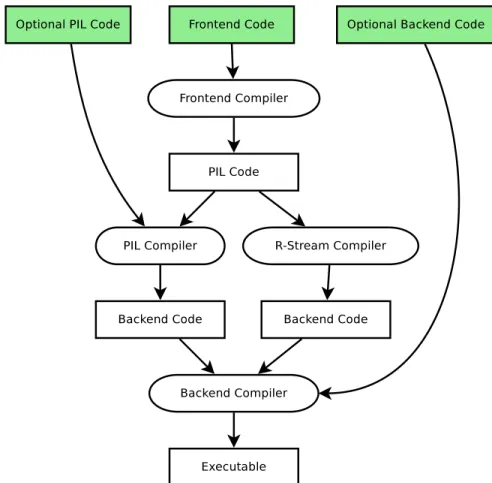
Since PIL will generate parallel runtime code, that is itself a programming language, we added a new compilation phase into the traditional compilation process. This compilation flow can be seen in Figure 2.4. Thus, we are augmenting and complementing existing compil-ers with our new translation phase. We believe that a major problem traditional compilcompil-ers face with compiling parallel programs is that the compilers lower the program into a very low level intermediate language at an early phase. Later, when trying to reason about parallel operations, they must try and raise the parallel operations back up to a higher level that is easier to reason in. This process is very difficult, and as a result, traditional compilers are usually overly cautious about the operations they perform across parallel operations. PIL can provide a framework for optimizations at a higher level, where parallelism is a first-class object and easy to reason about.
During the design of PIL, it became clear that it was not necessary to re-engineer solutions to already solved problems. Thus, we made a conscious decision that PIL itself should not describe the sequential computation steps to be done, but rather describe the parallel structure in the code. PIL relies on the fact that a parallel program is made up of multiple sequential threads of execution working simultaneously. Accordingly, a PIL code is made up of two key pieces. First, the description of the parallelism, and second, the sequential instructions that each worker instance will execute. For simplicity we have chosen to generate all of our backend code based in the C programming language (C+OpenMP, C+SCALE, C+OCR, C+MPI, etc). Thus, a program in PIL is a description of the parallelism in a series of PIL nodes, and the nodes’ associated body functions written in C which represents the
Figure 2.4: High level view of our compilation flow. sequential computation steps.
2.1
Parallelism
When we analyze a program for parallelism, we are working at a higher level than tradi-tional compilers. Accordingly, we are also working at a coarser granularity than traditradi-tional compilers. Most conventional compilers have intermediate languages that operate at or very near the target instruction level. This approach makes instruction-level optimizations easy to reason about, but the coarse-grained parallel operations become obfuscated since they must be raised up from this notation into something easier to reason about. In contrast, PIL operates at a level of granularity where we consider an entire task as a single unit of parallelism. The parallel application is thus concerned with the coordination of these parallel
tasks.
Serializable Parallelism. Because we are not only targeting traditional notations, but also data-driven runtime systems, PIL programs must be serializable. This means that every parallel program represented in the PIL notation must be able to be serialized and run on a single processor. This includes the communication and synchronization operations. The primary reason for this requirement is that some runtime systems (OCR and SCALE) require that a task be non-blocking and tasks are non-preemptable. This means that once a task is scheduled to a worker thread, it cannot be swapped out for another task. Thus, in order to insure that all programs can run to completion, they must be serializable. A non-serializable program is a program that can only correctly execute in parallel. Furthermore, a non-serializable program might result in deadlock in some runtime systems.
Let us take a barrier as a motivating example. There are many ways to implement a barrier in a language. One way is a polling barrier. A polling barrier is one in which the tasks enter the barrier and increment the barrier counter. Once the counter reaches the number of active tasks in the system, then all tasks have entered the barrier, and it is safe for the tasks to be released from the barrier. The tasks that have entered the barrier can poll the counter to monitor its value to check for all tasks to have arrived at the barrier.
The polling barrier approach is not a problem if the number of computational units is larger than the number of active tasks. However, consider the situation when we have four computational units (worker threads), and eight active tasks. In a data-driven runtime like OCR or SCALE, the runtime will schedule the first four tasks that arrive to the barrier to the four worker threads. Then, the active tasks will continue polling the counter waiting for it to be incremented by the other tasks. Remember, the tasks in OCR and SCALE are non-preemptable, and the runtime will not remove them from the worker threads until the tasks run to completion. However, no threads can leave the barrier until all have participated.
Table 2.1: Flynn’s taxonomy
Single Instruction Multiple Instructions
Single Data SISD MISD
Multiple Data SIMD MIMD
The system is now in deadlock because this polling barrier is not serializable.
A solution to make the barrier serializable is to use a two stage barrier. When a task enters the barrier, it can schedule a task with a dependence on the condition that all tasks have entered the barrier. The task that is entering the barrier cannot release the worker thread, so other tasks can enter the barrier. Once all tasks have entered the barrier, the continuation tasks will be fully satisfied and can continue from the barrier.
This algorithm is one example of serializable. The general notion of serializable is that if you have T tasks and P processing elements, an algorithm is serializable if it can run correctly to completion when P = 1. Many algorithms, such as the polling barrier, can encounter deadlock or errors if P < T, and thus are not serializable.
2.1.1
Classifying Parallelism
We use Flynn’s taxonomy, as shown in Table 2.1, to describe the classes of parallelism available in an application. Flynn’s taxonomy is usually referred to within the context of low-level instructions. For example, the first class of parallelism is usually referred to as Single Instruction Single Data (SISD). However, since we are concerned with a coarser grain of parallelism, the task, we do not think of a single instruction, but rather a series of instructions, the task. Nonetheless, we believe that there is a strong corollary between the classifications of Flynn’s taxonomy and the classes of parallelism available in any application. In this work we will replace instructions in Flynn’s taxonomy with tasks and discuss STSD, STMD, MTSD, MTMD parallelism.
Single Task Single Data (STSD). STSD is simply the case of sequential programming. There is no parallelism available here. In the traditional sense each instruction executes one after the other, each operating on its own data. In contrast to SISD, we do not consider a single instruction with that instruction’s single data, but rather an entire single task with that task’s data.
Multiple Task Multiple Data (MTMD). MIMD performs independent sets of instruc-tions on separate data items. This type of parallelism is called task parallelism. From a course-grained perspective, MTMD, this is distinct tasks with each task executing its own series of instructions, and operating on its own private data. Single Program Multiple Data (SPMD) is a sub-category of MTMD, and we treat it as a special case. SPMD parallelism is discussed later.
For the purposes of this thesis, we consider parallel computing to be the management of multiple, simultaneous tasks. Any parallel computation can be achieved by the proper coordination of independent tasks. In its most pure form, multiple tasks will execute asyn-chronously operating on independent data. Synchronization and communication mecha-nisms, discussed later, will need to be provided in order to successfully manage tasks working on shared data.
Single Task Multiple Data (STMD). SIMD performs the same set of instructions on separate data items. This type of parallelism is called data parallelism. In our course-grained context, STMD, we consider a single task with multiple instances each executing on separate data. Data parallelism is a very common way to parallelize operations on arrays. The data to be operated on is separated into logical chunks, for example tiling an array, and each task instance is assigned one of the pieces of work to operate on. All of the tasks work in parallel on their own data. These tasks are coordinated to perform the same instructions on their own data. Technically data parallelism is actually a subset of task parallelism,
since multiple tasks are executing simultaneously on data. This, data parallelism can be constructed from task parallelism. However, it can be extremely convenient to provide syntax for data parallelism, rather than to require the user to construct data parallelism through tasking constructs.
Multiple Task Single Data (MTSD). MISD is another unique case of parallelism, that doesn’t merit much study within the scope of this thesis. MISD uses multiple instruction streams on the same data to try and arrive at the same solution. This mode of parallelism is typically used for fault tolerance. The extra tasks all working to reach the same solution consume extra power, and require more execution resources, without increasing the perfor-mance of the application. Furthermore, since the tasks are all executing different code to compute the solution, they will all arrive at the solution at (possibly greatly) different times. One of the primary considerations of our parallel intermediate language is high perfor-mance. In keeping in the mindset of high performance we do not discuss MTSD execution models in this thesis. That is not to say that MTSD cannot be implemented within the PIL framework. On the contrary, MTSD computation can easily be achieved by using task parallelism to set multiple tasks off executing on the same data. Since MTMD parallelism can be composed from task parallelism, a user that needs MTMD parallelism can construct it.
SPMD Parallelism Single Program Multiple Data (SPMD) programming is a special case of the composition of task parallelism to achieve data parallelism. SPMD parallelism uses a special terminology for the threads of execution within the model, the rank. At program start, multiple SPMD ranks are created and each assigned a specific set of data to operate on. Ranks are differentiated by an identifier that can be queried within the runtime. An SPMD rank may perform specific operations in accordance with its rank identifier. The defining characteristic of SPMD parallelism is that the independent ranks are created at
program start and live throughout the program’s entire execution. This stems from the fact that the P in SPMD stands for an entire program. Traditionally, multiple programs are started to process privately-owned data. Since our model focuses on smaller tasks, we can compose an SPMD rank from multiple consecutive tasks if necessary.
Summary of Parallelism Categorization. As can be derived from our previous discus-sion about the classification of different types of parallelism, we believe that it is sufficient to support only two types of parallelism when compiling from one parallel notation to another: task parallelism and data parallelism. These two forms of parallelism can be combined to represent any type of parallel computation that may be desired. In the formulation of our parallel intermediate language we took this fact into heavy consideration.
2.1.2
Composing Parallelism
Composing parallelism into multiple levels can be beneficial for several reasons. It might be easiest to describe your algorithm if you have a few asynchronous tasks nested within a data parallel operation, or a data parallel operation nested within an asynchronous task. One ubiquitous form of nested parallelism is data parallelism within SPMD, for example, OpenMP nested under MPI. This form of nested parallelism is usually done to more efficiently leverage heterogeneous architectures. That is, to most efficiently utilize hardware at different levels in the hardware hierarchy. The SPMD part of the computation can be used, for example, across a cluster of distributed nodes, and the data parallelism can be used to leverage the multiprocessing capabilities of a single node.
In the context of this thesis, we consider nested parallelism to be the nesting of subtasks under other tasks. In other words, task parallelism within data parallelism, data parallelism within task parallelism, task parallelism within task parallelism, or data parallelism within data parallelism. Another form of nested parallelism can easily be achieved by using
instruc-Table 2.2: Parallel Constructs in Popular Languages
Operation OpenMP Pthreads MPI Chapel SCALE OCR
Data Parallel Parallel Loop yes no no yes no no
Task Parallel Spawn yes yes no yes yes yes
Confluence yes yes no yes yes yes
SPMD Parallel SPMD Parallelism yes no yes no no no
tion level parallelism (ILP) within a single task. In fact, the performance of our parallel intermediate language hinges on the lower level compiler’s ability to take advantage of ILP when available on the hardware. However, PIL operates at a higher level, and does not work at the instruction level.
2.1.3
Examples of Parallelism in Popular Languages
The Parallel constructs from popular programming notations can be seen in Table 2.2. We will now discuss these constructs, and how they fit into our parallel model in a general way. Concrete discussions relating to our intermediate language will be discussed in the next chapter.
Data Parallel Constructs. The basic data parallel operation is the parallel loop. It is available in many parallel programming languages. For example, the parallel for loop in OpenMP and the forall and coforall loops in Chapel. The data parallel notions discussed in Section 2.1.1 encompass these data parallel notations. Chapel’s forall and OpenMP’s parallel for loop behave in the same way. The loop iterations are chunked using a distribution either specified by the user, or implicitly, and one task is created to operate on the iterations composing a chunk. The tasks must all join before continuing execution, unless modified with a construct such as the OpenMP nowait. The Chapel
coforall behaves the same as the forall loop except that one task is always created for each iteration of the loop. The blocking of the forall loop is used as an optimization to keep task creation overhead low.
Task Parallel Constructs. The basic task parallel operation to create a new task is the spawn operation. All of the parallel notations in Table 2.2 support this basic operation except MPI. The reason that MPI does not support this construct is that its parallelism is restricted to SPMD parallelism, and all of the parallel tasks that are to be created are specified on the command line at program start. The basic task parallel operation for two tasks to merge is confluence. OpenMP, Pthreads, SCALE, and OCR all support explicit confluence.
In OpenMP, there are two operations for spawn. First, is the parallel sections oper-ation. This is structured task parallelism in that each task that will be spawned is specified by each section. There is an implicit confluence at the end of the sections, and all tasks must merge before execution can continue. The second form of task parallelism in OpenMP is using the task and taskwaitoperations for spawn and confluence respectively.
The Pthread language centers around the idea of task parallelism. It provides the spawn operation with pthread create, and the confluence operation as the pthread join call.
The Chapel language supports task parallelism with thebegin,sync, andcobegin state-ments. The begin statement is the spawn operation. The syncstatement is the confluence operation, and is wrapped around multiple begin statements that will all merge before the sequential execution can proceed. Thecobeginstatement provides functional equivalence of wrapping begin statements with asyncstatement, but provides a slight optimization in its implementation. The cobeginstatement is semantically equivalent to OpenMP’sparallel sections.
SCALE and OCR focus on task parallelism. Both allow the spawn of a task with a create syntax. The confluence operation is not explicit in the languages since it is created through dependences. However, confluence is allowed. A compiler is required to detect confluence when generating parallel intermediate language code. However, since confluence is explicit in the intermediate language, constructing a confluence operation is trivial.
SPMD Parallel Constructs. MPI is the only programming notation that is build entirely around SPMD parallelism. With an MPI program, the number of ranks is specified at program start, and those are all of the MPI ranks that will exist through the program execution. However, since all of the other languages in Table 2.2 support task parallelism, the functionality of SPMD parallelism can be created by the user is desired. Furthermore, the OpenMP language provides the parallel construct. The parallel construct creates one task per worker thread and all begin executing the instructions inclosed by construct, creating SPMD parallelism.
2.1.4
Universal Parallelism
Any programming notation that wants to be able to translate from any notation to any other notation must be able to represent data parallel as well as task parallel notations. Any successful parallel intermediate language must be able to compose parallelism into as many nested levels as the user requires.
2.2
Memory Models
We classify computer memory models into two broad categories: shared memory and dis-tributed memory. Any programming notation that wants to be able to translate from any notation to any other notation must be able to represent and reason about shared and distributed memory spaces.
2.2.1
Shared Memory
A shared memory machine is one in which a set of processors all have access to the same memory space, be it physical or virtual memory. All forms of parallelism are viable within this machine. Data sharing can be achieved simply by sharing pointers to data within the
memory. Synchronization on the data can be performed with low level atomic operations, with semaphores or mutexes, or with more coarse grain operations such as barriers or point-to-point synchronization.
2.2.2
Distributed Memory
In a distributed memory machine, each distributed task is considered to have its own private memory space. Since no task can access the data contained within other tasks, the tasks must coordinate access to data by some communication method. Tasks cannot simply send a pointer of their data to another task, like in shared memory, since the data may not exist in both tasks address spaces, and the communicated pointer cannot be assumed to be valid. Communicated data must be copied from one memory space to another to be available in the new memory space.
The distributed memory model is more restrictive than shared memory. Because of this, distributed memory tasks can be pooled and composed on a shared memory machine. They can use the same communication model as the pure distributed memory model, but live within the same address space. This is analogous to running multiple MPI ranks on a single, shared-memory machine. There are optimizations that can be achieved if multiple tasks do share a memory space, such as sending as a message a pointer to the data instead of copying the data if it is known that the data will indeed be in scope of the receiving task.
2.2.3
Data and Its Placement
When data is allocated, there are three levels of visibility. The lowest level of data ownership and visibility is task private data. This data can only be read or modified by the task that owns it. This type of data is very common in programming paradigms, and provides a mechanism for data hiding. A parallel intermediate language will need to provide a container
for task private data.
The second level of data visibility is memory space visible. This type of data is visible to all tasks executing in the same memory space. This is a very common form of data sharing. A common usage case is to allocate an array within the shared memory space, and partition it logically to tasks for computation.
The final level of data visibility is globally visible. All tasks, even those in distributed memory spaces, can read or modify this data. This type of memory visibility is uncommon in programming models, since the bookkeeping required for access to the data results in high overhead, and can lead to very poor locality and memory performance if not handled very delicately.
2.2.4
Communication and Synchronization
To coordinate access between multiple executing tasks and shared data, it is necessary to support synchronization of the threads. This can be achieved through the use of communi-cation and synchronization mechanism.
Communication. The two basic communication mechanisms required are send and re-ceive. Send and receive are point-to-point operations, requiring the sender and the receiver to meet to communicate data. Data is communicated in buffers. There are two main consid-erations when dealing with communication: synchronous or asynchronous, and blocking or non-blocking. The most restrictive form of communication is is a blocking synchronous com-munication. Synchronous means that both the send and the receive must complete before either task is allowed to continue. Blocking means the the buffer provided to the commu-nication operation is immediately useable. A synchronous operation implies blocking, but asynchronous operations can either be blocking or non-blocking. For example, a blocking send will copy the data in the buffer immediately so the sender can reuse the buffer
im-mediately after the send completes. A non-blocking send will not make the copy, and the communication of the data will happen at some unknown time after the send is initiated. A synchronization call is necessary after a non-blocking operation to ensure that commu-nication has completed, and the buffer can be reused or freed. The commucommu-nication library we implemented with our intermediate language utilizes blocking asynchronous sends, with blocking synchronous receives.
Complex collective operations can be composed of point-to-point communications. Com-mon collective operations include broadcast, all-to-all, reduction, scan, and more. These collective operations can be provided with special, highly-optimized routines. However, they can be composed from point-to-point communications and are not strictly necessary in a language. A compiler could be used to detect these patters in a language the only provides point-to-point operations and generate the most optimized code. Alternatively, a compiler could expand a collective operation into its basic parts if a language only provides point-to-point constructs.
Synchronization. Since the sends and receives in communication provide a form of syn-chronization, they can compose all of the synchronization one may need. The communi-cation mechanisms send and receive provide point-to-point synchronization. Point-to-point synchronization provides the foundation of any synchronization suite, and can be composed to form any other form of synchronization.
Take, for example, the barrier as a common form of collective synchronization. A barrier can be formed in many ways using point-to-point synchronization. One simple way is a ring barrier composed of two stages. Upon entering the barrier, each task will post a receive to the task on its left to check when the task has entered the barrier. The root task has no prerequisites and can immediately notify the task on his right with a message that it has entered the barrier. The final task will notify the root task that it has entered the barrier,
and this serves as the first release task. Once the root task receives this notification, it knows that all tasks have arrived at the barrier and can be released from the barrier. The root sends a message to the task on his right to notify the task that it may be release, and so on around the ring.
More efficient forms of barriers can be composed using these mechanisms, for example, using tree structures instead of rings. We believe that it can be useful to provide common synchronization mechanisms with a direct syntax, and a more efficient implementation than what can be built from the point-to-point synchronization primitives. However, strictly speaking, these mechanisms are not required in a language, since they can be derived from the point-to-point primitives.
2.3
Discussion of Parallelism and Memory Models
In this section we will discuss each of the classes of parallelism and how they are handled within each memory model. For the sake of clarity we use the wordforkwhen creating tasks within data parallelism and spawn when creating tasks within task parallelism. Addition-ally, we use the term join when data parallel tasks merge, and the term confluence when task parallel tasks merge.
2.3.1
Data Parallelism
A diagram of how data parallelism works can be seen in Figure 2.5 The basic construct in many languages for data parallelism is a parallel for loop. Data parallelism allows for easy understanding of what is happening in a parallel algorithm, since it provides a strict structure. There is a single master task that is operating for the sequential parts that forks multiple worker tasks for the parallel operations. There is a global barrier where all worker tasks must join before the sequential master task can continue operation. The strict
(a) Shared Memory Data Parallelism (b) Distributed Memory Data Parallelism
Figure 2.5: Shared and distributed memory data parallelism.
structure of this data parallelism provides a clean algorithmic representation, however, the global barriers can have high overhead when there are many worker tasks.
Shared Memory Data Parallelism. Data parallelism operating in a shared memory environment can be seen in Figure 2.5a. In the diagram an arrow represents a task. Blue tasks represent the sequential portion of the code, while orange tasks represent the parallel portion. The single box encompassing all of the tasks represents the memory space of the shared memory machine. Since no task arrow crosses the memory space box, they are all contained within the same memory space.
Distributed Memory Data Parallelism. Data parallelism operating in a distributed memory environment can be seen in Figure 2.5b. Notice now we are in distributed memory that the tasks are crossing memory space boundaries. Each parallel task in the diagram operates in its own memory space. Since the tasks are crossing memory space boundaries, communication must be involved. The communication introduces a new form of overhead
into the system, however, it might be worthwhile since distributed machines allow for larger numbers of processors than are available on a single shared memory machine.
A naive implementation of distributed memory data parallelism might ship all data re-quired for a task to complete with the task at creation time. Once the task completes, the resultant data must be sent back to the master thread to be read. However, more efficient communication can be achieved by saving data on the memory spaces of all processors. If possible, the remote tasks can reuse the data and it need not be communicated to that location. Prudent bookkeeping is required for this optimization and must be maintained by the master task.
Universal Data Parallelism Compilation. In order to compile from any parallel nota-tion to any other notanota-tion, an intermediate language and compiler must be able to work with distributed and shared memory data parallelism. However, we believe there is no difference from the user’s view point of the two memory models when concerned with data parallelism. This means when users write parallel codes they need only be concerned with the expression of the parallelism in the algorithm and not with communication of data among the tasks. With this view of data parallelism, a single algorithm can be expressed and written once, while executing on shared or distributed memory. The change from shared memory to dis-tributed memory, or vice versa, can be achieved by supplying a flag to the compiler during compilation to choose the shared or distributed memory model. It is the compiler’s respon-sibility to ensure that the communication of data between the parallel tasks for distributed memory data parallelism is efficient and does not cause unnecessary overhead.
2.3.2
Task Parallelism
Task parallelism is, in our view, the most generic form of parallelism, since any other form of parallelism can be constructed from task parallelism. When a new task is created it can
(a) Shared Memory Task Parallelism (b) Distributed Memory Task Parallelism
Figure 2.6: Shared and distributed memory task parallelism.
execute any instructions or routine it needs to. This is in contrast to data parallelism where all of the created tasks execute the same operation on the data they are assigned. Tasks created can execute asynchronously on independent data or synchronously on shared data.
A diagram of how task parallelism operates can be seen in Figure 2.6. Once again, blue arrows represent sequential tasks and orange arrows represent parallel tasks, and the boxes represent memory spaces. In the example, there are two spawn sites and two confluence sites. The example uses the same algorithm for both the shared and distributed memory execution, and can be seen in one of two different ways. The first sequential task is executing and encounters a spawn point. Now, the choice is to create a single task to execute the spawn while the original task continues its execution, or, alternatively, the original task can end and two new tasks can be created. Either of the two interpretations of the execution is correct in our view and independent of how the users would write their code.
Task parallelism provides a unique opportunity for synchronization that is not present in data parallelism. The structure of data parallelism provides for frequent synchronization
through global barriers. However, by its very nature each task in task parallelism is executing independently, and they must be synchronized. There are a wide variety of synchronization mechanisms: point-to-point, collectives, global barriers or barriers with subsections of tasks. Distributed Memory Task Parallelism. Distributed memory task parallelism is a little more complicated than shared memory task parallelism. An example can be seen in Fig-ure 2.6b. The first consideration required for distributed memory is the placement of the spawned task. This can be decided in one of two ways. First, the user could supply the placement when specifying the information for spawning a task. Alternatively, the runtime system could place the task automatically. Either way, the effect is the same, since the same code can generate either shared or distributed memory task parallelism backend code. In distributed memory, when a task is placed, it must have access to the data it needs to execute. The compiler is responsible for making sure that the data is available to the task by what means may be available through the runtime system.
Since synchronization and communication is a central part of coordinating tasks in task parallelism, the implementation of these operations is essential to distributed task paral-lelism. These operations need to be efficient, and exposed to a programmer.
Shared Memory Task Parallelism. In shared memory any spawned task will execute in the same memory space as the task that creates it. Since a spawned task will need to access data once it is create, new tasks can simply access data already available to them in the memory space. An example of task parallelism on shared memory can be seen in Figure 2.6a. This mode of execution is less restrictive than distributed memory task parallelism, but still has the same placement requirements of distributed memory task parallelism. The spawned tasks will need to be placed on worker threads. Once again, this information can either be decided at run time by the scheduler, or a priori by the user specifying placement. It is most common for the runtime system to make dynamic decisions for shared memory. However,
since the same code can be used to generate either shared memory or distributed memory task parallelism, the placement information can be specified by the user. If specified, it can either be interpreted as worker task placement, and assume the task is pinned to a core, or alternatively as a suggestion, or hint, and can be taken to have a loose meaning by the runtime system. These runtime hints, if acknowledged by the underlying runtime system, can provide a way for the user to explicitly inform the runtime system about placement of data and tasks for locality.
Universal Task Parallelism Compilation. As discussed in this section, the implemen-tation of a language that provides universal translation of parallel codes needs to ensure that it can handle task parallelism. Furthermore, the implementation needs to ensure that there is no difference from a user’s point of view between the implementation of an algorithm for shared memory or distributed memory task parallelism, so that it can generate either at compile time, as specified by compiler flags.
2.3.3
SPMD Parallelism
We believe it is prudent to provide a notation for the SPMD parallelism model because