
University of Louisville
ThinkIR: The University of Louisville's Institutional Repository
Electronic Theses and Dissertations5-2019
Receptive fields optimization in deep learning for
enhanced interpretability, diversity, and resource
efficiency.
Babajide Odunitan Ayinde
University of LouisvilleFollow this and additional works at:https://ir.library.louisville.edu/etd
Part of theComputational Engineering Commons,Other Electrical and Computer Engineering
Commons, and theSignal Processing Commons
This Doctoral Dissertation is brought to you for free and open access by ThinkIR: The University of Louisville's Institutional Repository. It has been accepted for inclusion in Electronic Theses and Dissertations by an authorized administrator of ThinkIR: The University of Louisville's Institutional Repository. This title appears here courtesy of the author, who has retained all other copyrights. For more information, please contact
Recommended Citation
Ayinde, Babajide Odunitan, "Receptive fields optimization in deep learning for enhanced interpretability, diversity, and resource efficiency." (2019).Electronic Theses and Dissertations.Paper 3243.
RECEPTIVE FIELDS OPTIMIZATION IN DEEP LEARNING FOR ENHANCED INTERPRETABILITY, DIVERSITY, AND RESOURCE EFFICIENCY
By
Babajide Odunitan Ayinde
B.S., Obafemi Awolowo University, 2011
M.S., King Fahd University of Petroleum and Minerals, 2015
A Dissertation
Submitted to the Faculty of the
J.B. Speed School of Engineering of the University of Louisville in Partial Fulfillment of the Requirements
for the Degree of
Doctor of Philosophy in Electrical Engineering
Electrical and Computer Engineering University of Louisville
Louisville, Kentucky
RECEPTIVE FIELDS OPTIMIZATION IN DEEP LEARNING FOR ENHANCED INTERPRETABILITY, DIVERSITY, AND RESOURCE EFFICIENCY
Submitted by
Babajide Odunitan Ayinde
A Dissertation Approved on
January 23, 2019
by the Following Dissertation Committee:
Dr Jacek Zurada, Dissertation Director
Dr Tamer Inanc
Dr Eric Rouchka
DEDICATION
This is dedicated to God Almighty for availing the strength, inspiration, knowledge, and understanding required to successfully complete this dissertation. I also dedicate this work to my father Dr Folorunsho Ayinde and my late mother Felicia Mojisola Ayinde. To my beloved wife Ajoke Ayinde and son David Ayinde who have been affected in every way possible by this rigorous quest.
ACKNOWLEDGMENTS
I would like to express my profound gratitude to my advisor, Dr. Jacek Zu-rada, Director of the Computational Intelligence Laboratory at the University of Louisville, for his valuable contributions, guidance, and support towards the com-pletion of this work. I would also like to appreciate the School of Interdisciplinary and Graduate Studies, University of Louisville for awarding me the Dissertation Completion Fellowship to enable me put this work together. My appreciation also goes to Dr Tamer Inanc for the knowledge impacted through the Digital Signal Processing class and also for being one of my dissertation committee members. I would also like to thank Dr. Eric Rouchka and Dr. Huacheng Zeng for agreeing to serve on the dissertation committee. I am grateful for their suggestions, encour-agements, and advice.
There are a number of people without whom this dissertation might not have been written, and to whom I am greatly indebted. I thank my wife and son, Ajoke and David, for their patience, sacrifice, and constant support while this dis-sertation slowly assumes its current form. I am indebted to my dad Dr. Folorunsho Ayinde, my parents-in-law Mr and Mrs Chiazor Ndidi, and Mr and Mrs Bamidele Oresegun for their love, support, and words of encouragement. Thanks to all my siblings, Dr Olusola, Engr. Olugbenga, Mrs Olukemi Oyem, Mrs Omobola Favour, Engr. Ayokunle, Mrs Omolola Akinrinde, Engr. Tolulope for all their support and prayers. I am grateful to all my friends and colleagues at University of Louisville for the wonderful times we shared. A big thank you to everybody who contributed in one way or the other to the success of this dissertation. Ultimately, I thank Almighty God for every success in this process.
ABSTRACT
RECEPTIVE FIELDS OPTIMIZATION IN DEEP LEARNING FOR ENHANCED INTERPRETABILITY, DIVERSITY, AND RESOURCE EFFICIENCY
Babajide Odunitan Ayinde January 23, 2019
In both supervised and unsupervised learning settings, deep neural net-works (DNNs) are known to perform hierarchical and discriminative representa-tion of data. They are capable of automatically extracting excellent hierarchy of features from raw data without the need for manual feature engineering. Over the past few years, the general trend has been that DNNs have grown deeper and larger, amounting to huge number of final parameters and highly nonlinear cas-cade of features, thus improving the flexibility and accuracy of resulting models. In order to account for the scale, diversity and the difficulty of data DNNs learn from, the architectural complexity and the excessive number of weights are of-ten deliberately built in into their design. This flexibility and performance usu-ally come with high computational and memory demands both during training and inference. In addition, insight into the mappings DNN models perform and human ability to understand them still remain very limited. This dissertation ad-dresses some of these limitations by balancing three conflicting objectives: compu-tational/memory demands, interpretability, and accuracy.
This dissertation first introduces some unsupervised feature learning meth-ods in a broader context of dictionary learning. It also sets the tone for deep
autoencoder learning and constraints for data representations in light of remov-ing some of the aforementioned bottlenecks such as the feature interpretability of deep learning models with nonnegativity constraints on receptive fields. In ad-dition, the two main classes of solution to the drawbacks associated with over-parameterization/over-complete representation in deep learning models are also presented. Subsequently, two novel methods, one for each solution class, are pre-sented to address the problems resulting from over-complete representation ex-hibited by most deep learning models. The first method is developed to achieve inference-cost-efficient models via elimination of redundant features with negligi-ble deterioration of prediction accuracy. This is important especially for deploying deep learning models into resource-limited portable devices. The second method aims at diversifying the features of DNNs in the learning phase to improve their performance without undermining their size and capacity. Lastly, feature diversi-fication is considered to stabilize adversarial learning and extensive experimental outcomes show that these methods have the potential of advancing the current state-of-the-art on different learning tasks and benchmark datasets.
TABLE OF CONTENTS
DEDICATION . . . iii
ACKNOWLEDGMENTS . . . iv
ABSTRACT . . . v
List of Tables . . . x
List of Figures . . . xii
CHAPTER INTRODUCTION . . . 1
I. CONSTRAINED FEATURE LEARNING . . . 4
A. Dictionary Learning via Sparse Coding . . . 4
B. Dictionary Learning via Nonnegative Matrix Factorization (NMF) 6 C. Dictionary Learning via Constrained Autoencoders . . . 7
1. Constrained Autoencoders for Sparse Representation . . . . 9
2. Constrained Autoencoders for Part-based Data Represen-tation . . . 11
II. CONSTRAINED AUTOENCODERS FOR ENHANCED DATA UN-DERSTANDING . . . 16
A. L1/L2-Nonnegativity Constrained Sparse Autoencoder (L1/L2 -NCSAE) . . . 17
1. Implication of imposing nonnegative parameters with com-posite decay function . . . 19
2. Experimental Results . . . 20
b. Unsupervised Semantic Feature Learning from Textual
Data . . . 29
c. Illustration of Understandable Feature Extraction byL1/L2 -NCSAE . . . 30
B. Deep Learning of Understandable Features using CascadedL1/L2 -NCSAE . . . 33
1. Image Classification with Enhanced Interpretability . . . 35
2. Document Categorization with Enhanced Interpretability . 39 3. Performance Evaluation on Supervised Learning . . . 43
C. Conclusion . . . 45
III. UNSUPERVISED NONREDUNDANT FEATURE EXTRACTION . . . 46
A. Filtering Redundancy Elimination in Autoencoder-based Deep Networks . . . 47
1. Filter Clustering and Reduction . . . 48
a. Static Reduction of the Number of Redundant Filters . . 48
b. Dynamic Reduction and Reconciliation of Filters . . . . 50
B. Experimental Setup . . . 52
a. Unsupervised Feature Reduction via Filter Pruning . . . 61
b. Effect of Redundant Feature Pruning on Supervised Learn-ing . . . 64
C. Conclusion . . . 72
IV. REDUNDANCY-BASED FILTER PRUNING IN DEEP CONVOLU-TIONAL NEURAL NETWORKS . . . 74
A. Convolutional Feature Clustering and Pruning . . . 78
1. Method A: Pruning of Redundant Filters . . . 80
2. Method B: Pruning of Randomnf Filters . . . 82
1. VGG-16 on CIFAR-10 . . . 87
2. RESNET-56/110 on CIFAR-10 . . . 91
3. Prune and Train from Scratch . . . 101
C. Conclusion . . . 102
V. FEATURE DIVERSIFICATION IN DEEP NEURAL NETWORKS . . . 103
A. Enhancing Feature Diversity by enforcing Dissimilar Feature Ex-traction . . . 106
1. Diversity Regularization . . . 108
2. Implications of imposing feature diversity . . . 110
B. Online Redundant Filter Detection and Dropout . . . 111
1. Online Filtering Redundancy Dropout . . . 112
2. Online Redundancy-based Dropout . . . 113
C. Experiments . . . 115
1. Feature Evolution during Training . . . 117
2. Diversity Regularized Image Classification . . . 122
3. Diversity Regularized Natural Language Inference . . . 126
D. Diversity Regularized Adversarial Learning (DiReAL) . . . 131
E. Conclusion . . . 133
VI. CONCLUSIONS . . . 136
REFERENCES . . . 139
LIST OF TABLES
1 Classification accuracy on MNIST and NORB dataset [1] . . . . 44
2 Parameter settings [2] . . . 54
3 Classification performance on MNIST dataset using initial
net-work configuration 784-200-20-10 [2]. . . 65
4 Classification performance on MNIST dataset using initial
net-work configuration 784-1000-20-10 [2]. . . 67
5 Classification performance on MNIST dataset using initial
net-work configuration 784-1000-200-10 [2]. . . 69
6 Classification performance on MNIST dataset using initial
net-work configuration 784-500-500-10 [2]. . . 70
7 Classification performance on MNIST dataset using initial
net-work configuration 784-1000-1000-10 [2]. . . 71
8 Classification performance on NORB dataset [2]. . . 72
9 Pruning performance on CIFAR dataset using VGG-16 model
atτ =0.54 [3]. . . 92
10 Performance evaluation for three pruning techniques on
CIFAR-10 dataset. Performance with the lowest test error is reported [3]. 93
11 Performance evaluation of three pruning techniques for ResNet
56/110 trained on CIFAR-10 dataset. Performance with the lowest test error is reported [3]. . . 95
12 FLOP and CPU time reduction for inference. Operations in
convolutional and fully connected layer are considered for com-puting FLOP [3]. . . 101
13 Performance on CIFAR dataset [3]. . . 102
14 Test-train error gap on MNIST [4] . . . 120
15 Test error(%) on MNIST. Source: [4] . . . 122
16 Test error(%) on CIFAR-10 without data augmentation. Source:
[4] . . . 125
17 Validation error on ImageNet. Source: [4] . . . 126
18 A select examples from SNLI dataset where E, C, and N
repre-sent Entailment, Contradiction, and Neutral, respectively. Source: [4] . . . 128
LIST OF FIGURES
1 Illustration of Data Matrix Factorization (X ≈ ΦA). X is the
data matrix, columns ofΦare basis vectors, and columns ofA
are the encodings of the samples [5]. . . 5
2 Schematic diagram of a three-layer AE . . . 8
3 RFs or weights of randomly selected 32 out of 196 (n = 196)
hidden neurons of (a) NNSAE (b) NCAE trained using MNIST dataset. Black pixels indicate negative, grey pixels indicate zero-valued weights and white pixels indicate positive weights. The range of weights are scaled to [-1,1] and mapped to the
graycolor map.w=−1 is assigned to black,w =0 to grey, and
w=1 is assigned to white color [5]. . . 12
4 Representation of test image as a linear combination of 4 out of
196 constrained RFs and decoding filters learned from MNIST dataset using NCAE with linear output activation function.
In-put consist of 784 values corresponding to a 28×28 pixel
im-age. Only 70 RFs with largest activations to test image "6" and their corresponding decoding filters are shown. The RFs and the decoding filters are rescaled and portrayed as images on the right hand side. Black pixels indicate negative, and white pix-els indicate positive weights. The range of weights are scaled
to [-1,1] and mapped to the graycolor map.w=−1 is assigned
to black,w = 0 to grey, and w = 1 is assigned to white color.
5 Absolute function approximation using quadratic smoothing
functions withκ= 0.4, 0.7, 1.0 and 1.5 . . . 20
6 (a) Symmetric (G3) and skewed (G1 and G2) weight
distribu-tions. Decay function with three values ofα1andα2for weight
distribution (b)G3(c)G1and (d)G2. [1] . . . 21
7 196 receptive fields (W(1)) learned from MNIST digit data set
using (a) SAE, (b) DpAE (c) NCAE, and (d) L1/L2-NCSAE.
Black pixels indicate negative, and white pixels indicate pos-itive weights. The range of weights are scaled to [-1,1] and
mapped to the graycolor map. w = −1 is assigned to black,
w=0 to grey, andw=1 is assigned to white color [1]. . . 23
8 Encoding weights (W(1)) histograms learned from MNIST digit
data set using (a) SAE, (b) DpAE (c) NCAE, and (d) L1/L2
-NCSAE [1]. . . 24
9 (a) Reconstruction error and (b) Sparsity of hidden units
mea-sured by KL-divergence using MNIST train dataset with p =
0.05 [1]. . . 24
10 t-SNE projection [6] of 196D representations of MNIST
hand-written digits using (a) SAE (b) DpAE (c) NCAE (d) L1/L2
-NCSAE [1]. . . 25
11 Weights of randomly selected 90 out of 200 receptive filters
of (a) SAE (b) DpAE (c) NCAE, and (d) L1/L2-NCSAE using
NORB dataset. The range of weights are scaled to [-1,1] and
mapped to the graycolor map. w <= −1 is assigned to black,
12 The distribution of 200 encoding (W(1)) and decoding filters
(W(2)) weights learned from NORB dataset using (a) DpAE (b)
NCAE (c)L1/L2-NCSAE [1]. . . 27
13 Visualizing 20D representations of a subset of Reuters
Docu-ments data using (a) DpAE, (b) NCAE, and (c) L1/L2-NCSAE
[1]. . . 32
14 Illustration of constrained (non-negative) RF feature extraction
using aL1/L2-NCSAE trained on synthetic data with 3 images
(left). The RFs learned (right) are rescaled and portrayed as im-ages. The range of weights are scaled to [-1,1] and mapped to
the graycolor map.w =−1 is assigned to black,w=0 to grey,
andw=1 is assigned to white color. That is, black pixels
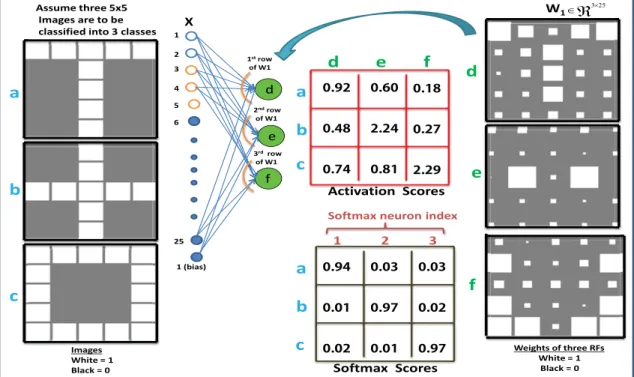
indi-cate negative, and white pixels indiindi-cate positive weights. The dot product of each RF and input pattern shown as Activation Scores and the outputs of Softmax layer as Softmax scores. a,b, and c are the indices of input images; d,e, and f are the RFs indices. The biases are not shown [5]. . . 34
15 Schematic diagram of a deep AE ofL+1 layers constructed
us-ing Stacked Sparse Autoencoder (SSAE) and Softmax Classifier (SMC). . . 35
16 Filtering the signal through the L1/L2-NCSAE trained using
the reduced MNIST data set with class labels 1, 2 and 6. The
test image is a 28×28 pixels image unrolled into a vector of
784 values. Both the input test sample and the receptive fields of the first autoencoding layer are presented as images. The weights of the output layer are plotted as a diagram with one row for each output neuron and one column for every hidden
neuron in(L−1)th layer. The architecture is 784-10-10-3. The
range of weights are scaled to [-1,1] and mapped to the
gray-color map. w = −1 is assigned to black, w = 0 to grey, and
w = 1 is assigned to white color. That is, black pixels indicate
negative, grey pixels indicate zero-valued weights and white pixels indicate positive weights [1]. . . 38
17 The weights were trained using two stacked L1/L2-NCSAEs.
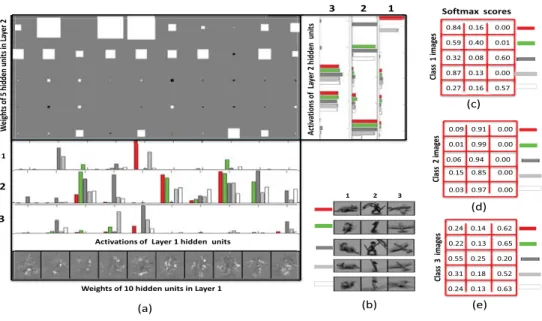
RFs learned from the reduced NORB dataset are plotted as im-ages at the bottom part of (a). The intensity of each pixel is proportional to the magnitude of the weight connected to that pixel in the input image with negative value indicating black, positive values white, and the value 0 corresponding to gray. The biases are not shown. The activations of first layer hidden units for the NORB objects presented in (b) are depicted on the bar chart on top of the RFs. The weights of the second layer AE are plotted as a diagram at the topmost part of (a). Each row of the plot corresponds to the weight of each hidden unit of second AE and each column for weight of every hidden unit of the first layer AE. The magnitude of the weight corresponds to the area of each square; white indicates positive, grey indicates zero, and black negative sign. The activations of second layer hidden units are shown as bar chart in the right-hand side of the second layer weight diagram. Each column shows the ac-tivations of each hidden unit for five color-coded examples of the same object. The outputs of Softmax layer for color-coded test objects with class labels (c) "fourlegged animals" tagged as class 1, (d) "human figures" as class 2, and (e) "airplanes" as class 3 [1]. . . 40
18 Deep network trained on Reuters-21578 data using (a) DpAE,
(b) L1/L2-NCSAE. The area of each square is proportional to
the weight’s magnitude. The range of weights are scaled to
[-1,1] and mapped to the graycolor map. w = −1 is assigned to
19 Filters learned from NORB data set using SAE with (a) 100 orig-inal filters (b) 14 examples of very similar filters with their cor-responding indices at the bottom (c) 32 filters resulting from
agglo-SAE withτ=16, and (d) 32 original filters. Black pixels
indicate negative, and white pixels indicate positive weights [2]. 51
20 Performance of AE on the NORB dataset. (a) Reconstruction
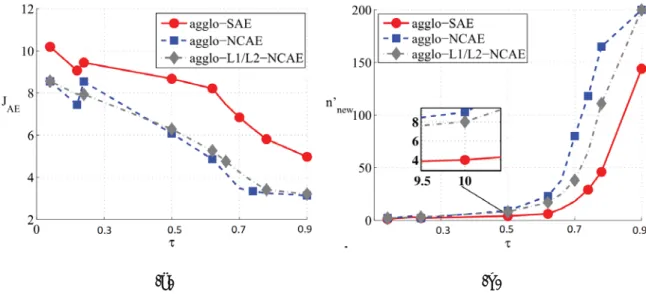
error vs. cluster similarity threshold. (b) Number of RFs vs. cluster similarity threshold for 196 initial filters [2]. . . 55
21 Reconstruction error using SAE, NCAE, andL1/L2-NCAE trained
with the same number of hidden units from experiment with
agglo-SAE, agglo-NCAE, and agglo-L1/L2-NCAE on NORB data
[2]. . . 55
22 100 receptive fields learned from Yale Face Dataset using SAE
with examples of two duplicative RFs [2]. . . 56
23 100 receptive fields learned from Yale Face Dataset using NCAE
with examples of duplicative RFs [2]. . . 56
24 100 receptive fields learned usingL1/L2-NCAE from Yale Face
Dataset, with examples of duplicative RFs [2]. . . 57
25 Filters learned from MNIST data set using SAE (a) 200 RFs with
examples of duplicative filters, (b) 125 RFs for agglo-SAE with
τ=0.6 [2] . . . 57
26 Performance of AE on the MNIST dataset vs. cluster similarity
threshold (a) Reconstruction error (b) RF size (nnew) using 200
27 Reconstruction error using SAE, NCAE, andL1/L2-NCAE trained
with the same number of hidden units from experiment with
agglo-SAE, agglo-NCAE, and agglo-L1/L2-NCAE on MNIST
data [2]. . . 58
28 KL-Divergence sparsity measure with respect to a desired p
= 0.05 using SAE, NCAE, and L1/L2-NCAE trained with the
same number of hidden units (nnew) from experiment with
agglo-SAE, agglo-NCAE, and agglo-L1/L2-NCAE on MNIST data [2]. 59
29 t-SNE projection [6] of 200D representations of MNIST
hand-written digits using (a) SAE (b) NCAE (c) L1/L2-NCAE, (d)
174D representations using agglo-SAE (e) 153D representations using NCAE, and (f) 172D representations using
agglo-L1/L2-NCAE [2]. . . 60
30 Pruning schema of lth layer. (a) Assume filters red, blue, and
green in the first, third, and fifth columns ofW(l), respectively,
are very similar and are located in the same cluster (b) If filter red is sampled as the representative of the cluster, filters blue and green are redundant and their corresponding feature maps
in Z1+1 and related weights in the next layer (third and fifth
rows ofW(l+1)) are all pruned [3]. . . 76
31 Average number of redundant features across all layers ( ¯nr)
against thresholdτ with (a) one (b) two (c) three, and (d) four
hidden layers using MNIST dataset. Network width corre-sponds to the number of hidden units per layer and network depth corresponds to number of hidden layers. Networks with more than one hidden layer have equal number of hidden units in all layers. . . 85
32 t-SNE projection [7] of the activation of last layer of network with (a) one and (b) four hidden layers using 5000 MNIST hand-written digits test samples. All Networks have 1000 hidden units in all layers and all layers use Sigmoid activation function. 86
33 Number of nonredundant filters (nf) vs. cluster similarity
thresh-old (τ) for VGG-16 trained on the CIFAR-10 dataset. Initial
number of filters for each layer is shown in the legend [3]. . . . 88
34 Sensitivity to pruning (a) redundant filters (b) randomn−nf
filters, and (c) redundant filters and retraining for 30 epochs for VGG-16 [3]. . . 90
35 Number of nonredundant filters (nf) vs. cluster similarity
thresh-old (τ) for ResNet-56 trained on the CIFAR-10 dataset. Initial
number of filters for each layer is shown in the legend [3]. . . . 94
36 Number of nonredundant filters (nf) vs. cluster similarity
thresh-old (τ) for ResNet-110 trained on the CIFAR-10 dataset. Initial
number of filters for each layer is shown in the legend [3]. . . . 96
37 Sensitivity to pruning n−nf redundant convolutional filters
in ResNet-56 [3]. . . 98
38 Sensitivity to pruning n−nf redundant convolutional filters
in ResNet-110 [3]. . . 100
39 Illustration of effect of divReg withλ = 10 and τ =0.1 (a) on
three toy filters in (b) iteration 1 (c) iteration 2 and (d) iteration 4 [4]. . . 107
40 Effect of (a) diversity penalty factorλand (b) thresholding
pa-rameterτon diversity regularization costJD(Figure best viewed
41 The distribution of pairwise feature correlation (Ω(1)) in first hidden layer at (a) epoch 2 (b) epoch 300 [4] . . . 118
42 The distribution of pairwise feature correlation (Ω(2)) in
sec-ond hidden layer at (a) epoch 2 (b) epoch 300 [4] . . . 119
43 150 out of 256 encoding features (left) learned from MNIST
digit data set with autoencoders using (a) L1, (b) Dropout (c)
orthoReg, and (d) divReg. The range of weights are scaled and mapped to the graycolor map (right) [4]. . . 120
44 Performance of Multilayer Perceptron (with architecture
784-1024-1024-10) regularized using divReg-1 and trained on the
MNIST dataset vs. thresholdτ∗. (a) Number of nonredundant
features for 1024 initial features. (b) percentage classification error [4] . . . 121
45 Evolution of dropout fraction (α) with divReg-2 using the MNIST
dataset for four different initializations of α in (a) layer 1 and
(b) layer 2. Source: [4] . . . 121
46 Performance evaluation using divReg-2 on MNIST dataset for
four different initializations ofα. Source: [4] . . . 127
47 Learning rate (ξ) schedule for experiments on CIFAR-10 dataset.
Source: [4] . . . 127
48 Schema of Diversity Regularized Adversarial Learning (DiReAL)132
49 Diversity loss of (a) generator with no regularization (b)
gener-ator with diReAL (c) discrimingener-ator with no regularization, and (d) discriminator with DiReAL trained on MNIST dataset. . . . 133
50 Divergence, as measured by Wasserstein distance, between the
51 Synthesized hand-written digits with and without diversity Reg-ularization. . . 134
INTRODUCTION
Many real-world learning problems involve high-dimensional data and the curse of dimensionality is a fundamental issue. Analysis of data with high dimen-sions usually results in significant increase in computational time and space [8, 9]. From practical standpoint, the importance of all features is not the same for a given discriminative task and a good number of features are highly correlated or even re-dundant. This redundancy, in general, would not only increase the computational complexity of the learning process, but also would hinder the interpretability and transparency of the resulting model. However, manual engineering and selection of the most important feature set in high dimensional data for the purpose of elim-inating redundancy is extremely difficult and labor-intensive.
Noticeable research efforts have addressed this issue by designing prepro-cessing and feature extraction pipelines to condition original raw data into forms effectively usable by learning algorithms. However, the process is tedious and requires considerable efforts by experts. In fact, some of the best unsupervised feature extractors (Restricted Boltzmann machines (RBMs) [10], Deep Belief Net-works (DBNs) [11], autoencoders (AE) [12], stacked AE [13], Sparse coding [14], Gaussian Mixture Models (GMMs) [15]) and supervised counterparts (Support Vector Machines (SVM) [16], Gradient Boosting machines (GBMs) [17], neural net-works [18, 19], etc) produce outputs that are unintelligible and inherently hard to decipher their decision making processes. These issues are in fact more prominent when multilayer deep learning (DL) architectures are used. The notion of "deep" in DL does not refer to any kind of deeper understanding/knowledge, rather it refers to the learning of many layers or hierarchies of feature representations. Therefore,
most of the existing DL models can only be used as black-boxes despite their good performance because their knowledge is hidden and can hardly be used to explain their decision making process. Thus limiting their applicability in domains where both justifications of decisions and interpretable inference are required from ma-chines as in medical applications and business intelligence [20].
Most of the problems associated with interpretability and computational efficiency especially in DL models have been attributed to huge number of param-eters, high nonlinearity, and redundancy in input and/or weight spaces [21], [22] [23], [24]. Therefore, designing a fully trainable algorithms that have the capability to learn the appropriate interpretable features and simultaneously eliminate re-dundancy in both input and model is a step towards solving a long-standing open problem of obtaining an optimal architecture that balances accuracy, memory de-mand, and interpretability.
The following five chapters of this dissertation cover important methods in constrained feature learning and data representation, describe methods of training interpretable features, and discuss algorithms to improve post-training inference cost of DNN models. Chapter II starts by describing some of the theoretical foun-dations of representation learning via constrained data matrix decomposition. It then describes some of the main methods for unsupervised feature extraction in artificial neural networks and the concept of receptive fields (RFs). It also explains how interpretable models can result from the extraction of additive part-based fea-tures. It ends with presenting of two approaches for achieving part-based data de-composition with neural networks and highlights some of their tradeoffs in terms of part-based data decomposition and accuracy.
Chapters III focuses on improving the interpretability of autoencoder-based DNN model while preserving the output accuracy. A novel method for impos-ing non-negativity constraints on RFs is introduced to learn interpretable and
dis-criminative features. It focuses on methods that preserves the accuracy of mod-els with interpretable features. Chapters IV and V describe methods that seek to eliminate redundancy in both supervised and unsupervised neural network via RF compression. Chapter IV presents two methods for unsupervised learning of non-redundant sparse RFs to improve both computation and accuracy in the su-pervised phase. Chapter V presents two methods for improving the post-training computational efficiency of supervised deep convolutional neural networks, also via elimination of redundant RFs. A novel method for imposing diversity among RFs during training is presented and discussed in chapter VI to prevent redun-dancy.
CHAPTER I
CONSTRAINED FEATURE LEARNING
Constrained feature learning (CFL) is an important concept in feature en-gineering for unearthing latent representations of data useful for such machine learning tasks as classification, regression, and compression. These representa-tions could reveal what is important in data for a given discriminative task. CFL algorithms that enable feature extraction can generate latent codes for test set dur-ing inference [25,26]. CFL algorithms have become important tools in paradigm of representation learning. These algorithms range from sparse coding concept orig-inally introduced in [14] to Nonnegative Matrix Factorization (NMF) that enforces nonnegativity of both basis vectors and the features to neural networks that im-plement learning with a variety of constraints. They are able to learn constrained representation usually by learning some dictionaries that represents the data. The term dictionary is often used in the context of semantic analysis such as document categorization. When dealing with other tasks and data, these dictionaries are called receptive fields, filters, basis vectors or latent factors.
A. Dictionary Learning via Sparse Coding
Dictionary learning is best illustrated through sparse coding or data matrix
factorization. Assume data matrix Xcontains m data vectorsxj as columns, each
with n elements as shown in Fig. 1. Sparse coding aims to find a set of k basis
FIGURE 1 – Illustration of Data Matrix Factorization (X ≈ ΦA). Xis the data
ma-trix, columns of Φ are basis vectors, and columns of A are the encodings of the
samples [5].
A ∈ Rk×m) such thatX ≈ ΦAforX ∈ Rn×m, andajis a sparse vector for every j.
When no limitation is imposed onk, it is possible to find via sparse coding an
over-complete representation of data in which the number of basis vectorsk is greater
than the original data dimensionalityn. That is, ifk>nthe linear system of
equa-tions is under-determined and sparsity enforcement is needed to avoid obtaining a trivial solution [26].
In order to coerceajto be sparse for every j, a sparsity term is introduced in
the objective function. Sparse combination of basis from an over-complete dictio-nary to represent data has been suggested as the mechanism with which mammal primary visual cortex (V1) work [14,27–30]. The data matrix decomposition is usu-ally formulated as an optimization problem solvable by balancing out the error of
approximation of X by ΦA and the sparsity of A. During the optimization
pro-cess, a trivial solution may result in which entries of A are small due to sparsity
enforcement but are compensated by allowing entries of Φ to assume large
val-ues [27,31,32]. To alleviate this problem, magnitude constraints are usually placed
on the basis vectorsφithrough a process known as regularization by adding decay
term to the objective function. This magnitude constraint is sometimes referred to as a weight decay penalty. Most sparse coding methods [14, 27, 33] require solv-ing iterative optimization problem in order to compute feature descriptor which is
usually computational expensive [26]. The complete optimization objective is thus formulated as in (1). min A,Φ m
∑
j=1 Φaj−xj2 2+γ1Sparsity(aj) +γ2 k∑
i=1 φi2 2 (1)whereγ1andγ2are positive constants that adjust the relative importance of
spar-sity and magnitude (or regularization) constraints, respectively. Formula (1) mini-mizes the distance between the data and its representation given the learned basis.
B. Dictionary Learning via Nonnegative Matrix Factorization (NMF)
Similar to sparse coding, NMF [34] belongs to a class of CFL paradigm that essential to data analysis such as compression, feature selection, visualiza-tion, just to mention a few [35]. NMF finds application in many diverse problem space such as computational biology [36–41], blind source separation [42], cluster-ing [43, 44], community detection [45], collaborative filtercluster-ing [46], just to mention a few. One of the motivation behind NMF is that the emergence of part-based representation in human cognition can be conceptually tied to the nonnegativity constraints [34]. The objective of NMF techniques in general is to approximate data
matrix Xwith nonnegative entries with low rank matrixWH, that is,X ≈WHor
simplyX=WH+N. One of the key choices in NMF is the quantification of
qual-ity of approximation, which generally depends on error N. The most commonly
used measure is the Frobenius norm of N, which assumes the noise in the data is
Gaussian. Another important consideration in CFL is the assumption on the
struc-ture of factors WandH. For instance, if columns ofWare independent, then the
resulting heuristic become independent component analysis (ICA) [47].
The strict constraint on the structure of factors W and H in NMF is that
thereby resulting in additive data representation. The hidden structure of data can be unfolded by learning features that have capabilities to extract the data parts. Similar to the data decomposition illustrated in Fig. 1, NMF decomposes data
ma-trixX ∈ Rn×m with nonnegative real entries into product of two nonnegative
ma-trices W ∈ Rn×k and H ∈ Rk×m, that is, X ≈ WH. The factorization is generally
formulated as an optimization problem with loss function in (2) min
W∈Rn×k,H∈Rk×m||X−W H||
2such thatW≥0 andH≥0
(2)
C. Dictionary Learning via Constrained Autoencoders
Dictionaries are also learnt via a specialized neural network architecture known as autoencoder. One of the popular approaches to CFL is to train autoen-coder (AE) in ways that enforces some desired attributes. The motivation behind the autoencoding is to reconstruct the input from its encoded representation with features that represent the data [48, 49]. The reconstruction is usually achieved by additive linear (sometimes nonlinear) combination through decoding filters. After training, generating latent encodings for test samples is extremely fast, requiring a simple matrix-vector multiplication.
The model of the neural network AE shown in Fig. 2 aims to reconstruct its input vector using unsupervised learning is given in (3).
ˆ
x= fW,b(x)≈x (3)
where x is a normalized input vector, W = {W1,W2}, and b = {b1,b2}
respec-tively represent the weight and biases of the network. It is worth mentioning that
the weight matrixW2 may optionally be constrained byW2 = WT1, in which case
the autoencoder is said to have tied weights. The concept of tied weights is mainly
x1 x2 xn−1 xn ˆ x1 ˆ x2 ˆ xn−1 ˆ xn Decoder Encoder h1 hn
Input Layer HiddenLayer
Decoding Layer
b2
b1
W1 W2
FIGURE 2 – Schematic diagram of a three-layer AE
through W1 into features h. In turn, features h are mapped back to the data ˆX
through W2 in accordance with h = σ(W1X+b1) where σ() is the activation
function. One of the commonly used activation functions is the logistic sigmoid
given asσ(x) = 1/(1+exp(−x)). In order to solve for parameters Wand bin (3), the
average reconstruction error in (4) serves as the optimization objective.
JAE(W,b) = 1 m m
∑
i=1 σ(W2σ(W1xi+b1) +b2)−xi22 (4)We should note that the dictionary learning in sparse coding (1) and AE (4) differ by two aspects. Firstly, the reconstruction error (4) involves mapping of data
into itself by two matricesW1 and W2, while the same error being the first term
of (1) involves one matrix Φ. Secondly, (1) is solved by optimization, while (4) is
based on unsupervised learning ofh.
Imposing meaningful limitations on network parameters generally forces AE network to learn representations that attempts to unearth the underlying struc-ture in data. One of such limitations could be limiting the hidden layer size for compressed representation of the input. In this context, constrained AE implies that some constraints such as sparsity, nonnegativity, weight-decay
regulariza-tion, and/or other constraint types are imposed on the learned features. Exam-ples of such constraints are sparsity as in the Sparse Autoencoder (SAE) [50], or nonnegativity and sparsity as in Nonnegativity-Constrained Autoencoder (NCAE) [1, 51, 52].
Sparsification of features that represent data is increasingly important in learning, especially from big data. This is because sparsity can facilitate efficient and automatic feature selection. In addition, regularization can shrink the mag-nitude of AE weights and improve the generalization. Therefore, constrained AEs are not only used for feature dimensionality reduction, but also for extract-ing sparse, part-based features, and for enhancextract-ing data understandextract-ing.
1. Constrained Autoencoders for Sparse Representation
In AE settings, a network is considered over-sized if the size of the hidden
layer is the same or larger than the input vector size n. In this scenario, AE can
be forced to learn useful representation if additional constraints are added. These constraints can come in form of regularization to ensure sparsity of the hidden-layer representation or addition of noise in the hidden hidden-layer. Sparse representation can provide a interpretation of the input data in terms of a reduced number of parts thereby revealing its hidden structure.
In order to force AE to learn sparse representation,his bounded using the
Kullback-Leibler (KL) divergence function [53–56]. Ifhj(xi) denotes the activation
(or output) of hidden neuron j due to the input xi, the average activation of this
particular neuron is given as: ˆ pj = 1 m m
∑
i=1 hj(xi) (5)If a sparse AE with target activation p is considered, one common method for
[50] as in (6) Sparsity(p||pˆ) = n
∑
j=1 plog p ˆ pj + (1−p)log 1−p 1−pˆj (6)One of many functions a regularizer provides is enforcing certain properties on the weights. Note that weight decay term is also added to the cost function of AE as to prevent overfitting [57]. For a conventional sparse autoencoder (SAE) the decay term is given as in (7). Decay(w) = α 2 2
∑
l=1 sl∑
i=1 sl+1∑
j=1 ||w(i,lj)||22 (7)where α is the weight penalty factor, and w(i,lj) represents the connection between
ith neuron in layerl−1 and jth neuron in layerl. The overall cost function based
on (1) for SAE using penalization then becomes [50]:
JSAE(W,b) = JAE(W,b) +βSparsity(p||pˆ) +Decay(w) (8)
whereβcontrols the sparsity penalty term.
The gradient of (8) is computed in (11) for the purpose of updating the net-work parameters using the backpropagation algorithm [18].
w(ijl) =w(ijl)−ξ ∂ ∂w(ijl)JSAE(W,b) (9) bi(l) =b(il)−ξ ∂ ∂bi(l)JSAE(W,b) (10) where ∂ ∂wij(l)JSAE(W,b) = ∂ ∂w(ijl)JE W,b+β ∂ ∂w(ijl)Sparsity p pˆ+g(w(ijl)) (11)
ξ >0 is the learning rate andg(w(ijl))is called the decay function and it is given as in (12)
Other popular methods for sparsifying AE features while preventing
over-fitting are the dropout technique [58] and family ofk-sparse AEs [59,60]. In dropout
technique, units and their connections are randomly dropped from the network during training. In effect, dropout tends to prevent neurons from co-adapting
thereby leading to good generalization. The concept ofk-sparse AE relies on
iden-tifying thekneurons with largest activations and setting the rest to zero to prevent
overfitting. The k-sparse AE has been found suitable for many dataset because
the valuekcan be tuned to obtain desirable sparsity level in conformity with each
dataset.
2. Constrained Autoencoders for Part-based Data Representation
Part-based representation is a way of decomposing data into parts, which when additively combined regenerate the data [34]. As shown in [34], one way of representing data is by shattering it into various distinct pieces in a manner that additive merging of these pieces can reconstruct the original data. Mapping this intuition to AEs, the idea is to sparsely disintegrate data into parts in the encoding layer and additively process the parts to recombine the original data in the decod-ing layer.
One way to achieve data decomposition with AEs is by using asymmet-ric piecewise linear weight decay function to constrain network parameters to be nonnegative and the resulting network is called Nonnegative Sparse Autoencoder (NNSAE) [61]. Unlike SAE, NNSAE is trained with an online algorithm and tied weights and linear output activation function. It is capable of extracting nonneg-ative features for part-based representation of data. The main difference between
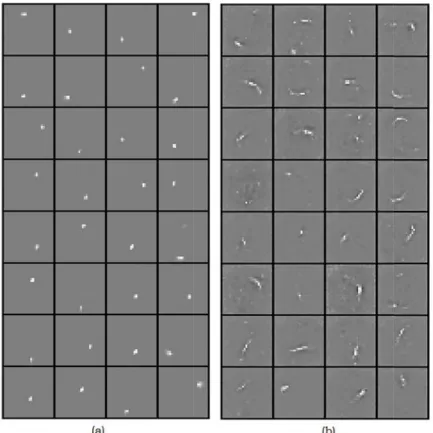
FIGURE 3 – RFs or weights of randomly selected 32 out of 196 (n = 196) hidden neurons of (a) NNSAE (b) NCAE trained using MNIST dataset. Black pixels indi-cate negative, grey pixels indiindi-cate zero-valued weights and white pixels indiindi-cate positive weights. The range of weights are scaled to [-1,1] and mapped to the
gray-color map. w = −1 is assigned to black, w = 0 to grey, andw = 1 is assigned to
conventional SAE and NNSAE is in the decay function given in (13) g(w(ijl)) = −αw(ijl) wij <0 −βw(ijl) wij ≥0 (13)
whereαandβare hyperparameters and 0≤α 1. Ifα =1, the decay function in
(13) ensures a complete prohibition of negative weights. The weight decay func-tion in (12) for SAE can also be viewed as imposing Gaussian prior distribufunc-tion on network weights while NNSAE uses a weight decay mechanism that assumes a virtually deformed Gaussian prior that is skewed with respect to the sign of the
weight. It must be noted thatα =β, (13) is equivalent to (12).
Another variant of NNSAE is the Nonnegativity-Constrained AE (NCAE) [51], which also aim at eliminating negative weight through regularization. This is achieved by imposing nonnegativity constraint in form of a penalty term by replacing the decay term in (8) with (14)
Decay(w) = α 2∑2l=1∑ sl i=1∑ sl+1 j=1 w(ijl)2 wij <0 0 wij ≥0 (14)
where α > 0 is a nonnegativity-constraint weight penalty factor and decay
func-tion is given as g(w(ijl)) = −αw(ijl) wij <0 0 wij ≥0 (15) It is worthy to note that the decay function of NNSAE in (13) is a generalization of
both SAE whenβ=αas in (12) and NCAE whenβ=0 as in (15).
Part-based data decomposition is illustrated using NCAE and NNSAE trained on MNIST digit and both AEs have 196 hidden neurons. Weights of trained net-works are portrayed as images of receptive fields (RFs). Figures 3a and b show the RFs learned by NNSAE and NCAE, respectively. It can be observed that the RFs learned are select parts of handwritten digits such as strokes and dots. The learned featured are localized and tend to look like parts of digits. Part-based
representation is also illustrated in Figure 4 using NCAE trained on MNIST hand-written characters. NCAE with linear decoder architecture (that is, the activation
functionσ()for decoding layer is identity function) was trained in such a manner
that the column ofW1 are coerced to be sparse. RFs and the decoding filters are
displayed on the right hand side. A test image of digit 6 shown is filtered through
the network and activationsh are listed. The vector of activations is very sparse
since it only stimulates 4 out of 196 RFs. The test sample can be reconstructed by additively combining four outputs of decoding filters scaled with magnitudes of
MNIST HANDWRITTEN DIGITS CHARACTERS
Test sample
[h1, …, h70] = [0.4, 0.0, 0.0,0.0,…, 0.0, 0.6, 0.0,0.0,..., 0.9,0.0, 0.5,0.0,0.0,…, 0.0,0.0]
(Hidden Activations)
|
h
1h
34h
48h
50FIGURE 4: Representation of test image as a linear combination of 4 out of 196 constrained RFs and decoding filters learned from MNIST dataset using NCAE with linear output activation function. Input consist of 784 values corresponding
to a 28×28 pixel image. Only 70 RFs with largest activations to test image "6" and
their corresponding decoding filters are shown. The RFs and the decoding filters are rescaled and portrayed as images on the right hand side. Black pixels indicate negative, and white pixels indicate positive weights. The range of weights are
scaled to [-1,1] and mapped to the graycolor map. w = −1 is assigned to black,
CHAPTER II
CONSTRAINED AUTOENCODERS FOR ENHANCED DATA UNDERSTANDING
It is a general belief that humans analyze complex interactions by breaking them into isolated and understandable hierarchical concepts. Methods for learn-ing understandable models, such as decision tree [62] extract only flat data de-scriptions that lack hierarchical concepts. On the other hand, methods that builds model with hierarchical structure usually extract features that are difficult to un-derstand and/or interpret [63, 64]. As shown in [22], one way to reconcile the requirements of hierarchical organization and easier human understandability of concepts in neural networks is by imposing nonnegative-only weights. Moreover, the emergence of part-based representation in human cognition can be conceptu-ally tied to the nonnegativity constraints [34]. Although deep feedforward neural networks have the capability to model multi-level abstraction of data, they are dif-ficult to train and the understandability of features they learn is very limited [65].
Owing to unsupervised pretraining using AE or Restricted Boltzmann ma-chine [66] and better initialization heuristics [67–70], the training difficulties have been alleviated. Some heuristics have also attempted to address the problem of understandability by extracting rules from neural network for individual neurons. These heuristics, however, differentiate rules from individual neuron and their states using special symbols, which in turns increases the opaqueness of the ex-tracted rules. In addition, these symbolic rules becomes more complicated for deep neural networks with no meaningful interpretations. Also, the rule extrac-tion process have been shown to be computaextrac-tionally expensive [21].
The issue of understandability is addressed by drawing inspiration from the idea of NMF [34] and sparse coding [71] and appropriately enforcing space non-negative features. As highlighted in [22], understandability of features learned by neural network models can be fostered by enforcing weights in the network to be nonnegative. This would allow easier inspection and interpretation by eliminating cancelations of incoming neuron signals. In addition, there are neural activities for a subset of hidden units that are strongly correlated with the input and threshold of this correlation is controlled by the bias term. The main shortcoming in [22] is that sparse nonnegative features are obtained by directly mapping negative weights to zero, in effect, significantly deteriorates the performance of the entire network. That is, a portion of the performance is traded with extraction of understandable features. In addition, the heuristic was developed and customized for shallow neural networks. Of special interest to the work in this chapter is the extraction of understandable deep neural network features that preserves the overall network performance.
A. L1/L2-Nonnegativity Constrained Sparse Autoencoder (L1/L2-NCSAE)
As earlier shown using NNSAE [61] and NCAE [51], negative weight can be eliminated from neural network models in an online fashion through regulariza-tion. This is achieved by regularizing the learning cost function with appropriate penalty term. However, a close scrutiny of the weight distribution of both the encoding and decoding layer enforced by the penalty function of NCAE in (14) reveals that many weights are still negative despite imposing nonnegativity
con-straints. The reason for this is that the original L2 norm used in NCAE penalizes
the negative weights with big magnitudes stronger than those with smaller magni-tudes. This forces a good number of the weights to take on small negative values. From experiments carried out using NCAE, these negative weights are essential
for achieve good performance in terms of both reconstruction and classification.
It will be shown that additional L1 term can be used to even out this occurrence,
that is, the additionalL1penalty forces most of the small-valued negative weights
to become zero. The resulting architecture extracts features that are more sparse
with improved reconstruction error and is renamed as L1/L2-Nonnegativity
Con-strained Sparse Autoencoder (L1/L2-NCSAE). The penalty term of NNSAE [61] in
(13) on the other hand also extracts strictly nonnegative feature, however, it does so in a way that deteriorates the classification accuracy when used to pretrain a deep network due of its relatively high reconstruction error.
In order to encourage higher degree of nonnegativity in network’s weights, a penalty term in (16) is added to the objective function resulting in the cost
func-tion expression for L1/L2-NCSAE [1]. The negative weights are regularized by
minimizing their absolute values (L1norm) and their squares (L2norm). The
com-bined action of the L1 and L2 penalties is that they both select only the important negative weights and limits their magnitude. This thus employ a penalty-based negative weight pruning mechanism.
Decay(wij) =
α1Γ(wij,κ) + α22||wij||2 wij <0
0 wij ≥0
(16)
whereα1andα2areL1and L2nonnegativity-constraint weight penalty factors,
re-spectively. The decay functiond(wij)is a composite function denoting the
deriva-tive ofDecay(wij)(16) with respect towijas in (17).
g(wij) =
α1∇
wwij+α2wij wij <0
0 wij ≥0
1. Implication of imposing nonnegative parameters with composite decay func-tion
The graphical illustration of the relation between the weight distribution and the composite decay function is shown in Fig. 6. Ideally, addition of
Frobe-nius norm of the weight matrix (α||W||2F) in (12) to the reconstruction error
im-poses a Gaussian prior on the weight distribution as shown in curve G3 in
Fig-ure 6a. However, using the composite function in (17) results in imposition of
positively-skewed deformed Gaussian distribution as in curves G1 and G2. The
degree of nonnegativity can be adjusted using parametersα1andα2. Both
param-eters have to be carefully chosen to enforce nonnegativity while simultaneously
ensuring good supervised learning outcomes. The effect ofL1(α2 =0),L2(α1=0)
andL1/L2(α1 =0 andα2 =0) nonnegativity penalty terms on weight updates for
weight distributions G1, G2 and G3 are respectively shown in Figure 6c,d, and b.
It can be observed for all the three distributions thatL1/L2regularization enforces
stronger weight decay than individualL1andL2regularization. Other observation
from Figure 6 is that the more positively-skewed the weight distribution becomes, the lesser the weight decay function.
The consequences of minimizing the reconstruction under the regulariza-tion in (16) are that: (i) the average reconstrucregulariza-tion error is reduced (ii) the spar-sity of the hidden layer activations is increased because more negative weights are forced to zero thereby leading to sparsity enhancement, and (iii) the number of nonnegative weights is also increased. As earlier mentioned, the resultant effect
of penalizing the weights simultaneously with L1 and L2 norm is that they both
select only the important negative weights and limits their magnitude. However,
the L1 norm in (16) and (17) is non-differentiable at the origin, and this can lead
to numerical instability during simulations. To circumvent this drawback, one of
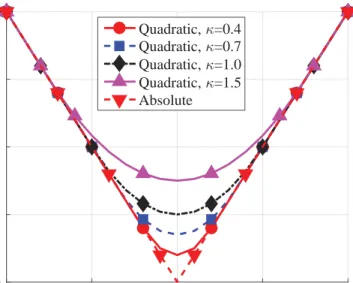
-2 -1 0 1 2 0 0.5 1 1.5 2 Quadratic,κ=0.4 Quadratic,κ=0.7 Quadratic,κ=1.0 Quadratic,κ=1.5 Absolute
FIGURE 5 – Absolute function approximation using quadratic smoothing
func-tions withκ= 0.4, 0.7, 1.0 and 1.5
approximation is defined as follows: Given any finite dimensional vector z and
positive constantκ, the following smoothing function approximates L1norm:
Γ(z,κ) = ||z|| ||z||>κ ||z||2 2κ +κ2 ||z|| ≤κ (18) with gradient ∇zΓ(z,κ) = z ||z|| ||z||>κ z κ ||z|| ≤κ (19) 2. Experimental Results
a. Unsupervised Feature Learning of Image Data In the first set of
experi-ments, three-layer L1/L2-NCSAE, NCAE [51], DpAE [72], and conventional SAE
network with 196 hidden neurons were trained using MNIST dataset of handwrit-ten digits and their ability to discover patterns in high dimensional data are
com-−1 −0.5 0 0.5 1 0 0.2 0.4 0.6 0.8 1 weight w Probability Distribution P(w) G1 G2 G3 (a) −1 −0.5 0 0.5 1 −2 −1.5 −1 −0.5 0 w g(w) α1= 1,α2= 1 α1= 1,α2= 0 α1= 0,α2= 1 (b) −1 0.5 0 0.5 1 2 1.5 1 0.5 0 w g(w) α1= 1,α 2= 1 α1= 1,α2= 0 α1= 0,α 2= 1 (c) −0.5 0 0.5 1 1.5 −1.4 −1.2 −1 −0.8 −0.6 −0.4 −0.2 0 w g(w) α1= 1,α2= 1 α1= 1,α2= 0 α1= 0,α2= 1 (d)
FIGURE 6: (a) Symmetric (G3) and skewed (G1and G2) weight distributions.
De-cay function with three values of α1 and α2 for weight distribution (b) G3 (c) G1
pared. These experiments were run one time and recorded. The encoding weights
W(1), also known as receptive fields or filters as in the case of image data, are
re-shaped, scaled, centered in a 28×28 pixel box and visualized. The filters learned
by L1/L2-NCSAE are compared with that learned by its counterparts, NCAE and
SAE. It can be easily observed from the results in Figure 25 that L1/L2-NCSAE
learned receptive fields that are more sparse and localized than those of SAE, DpAE, and NCAE. It is remarked that the black pixels in both SAE and DpAE fea-tures are results of the negative weights whose values and numbers are reduced in NCAE with nonnegativity constraints, which are further reduced by imposing an
additional L1 penalty term in L1/L2-NCSAE as shown in the histograms located
on the right side of the figure. Although the penalty function in NCAE is a special
case of that in L1/L2-NCSAE (obtained by setting α1 to zero), a close scrutiny of
the weight distribution of both the encoding and decoding layer in NCAE reveals that many weights are still negative despite imposing nonnegativity constraints.
The reason for this is that the original L2 norm used in NCAE penalizes the
neg-ative weights with big magnitudes stronger than those with smaller magnitudes.
This forces a good number of the weights to take on small negative values. L1/L2
-NCSAE uses additionalL1to even out this occurrence, that is, theL1penalty forces
most of the negative weights to become nonnegative.
In the case ofL1/L2-NCSAE, tiny strokes and dots which constitute the
ba-sic part of handwritten digits, are unearthed compared to SAE, DpAE, and NCAE. Most of the features learned by SAE are major parts of the digits or the blurred
version of the digits, which are obviously not as sparse as those learned by L1/L2
-NCSAE. Also, the features learned by DpAE are fuzzy compared to those ofL1/L2
-NCSAE which are sparse and distinct. Therefore, the achieved sparsity in the
en-coding can be traced to the ability of L1 and L2 regularization in enforcing high
(a) SAE (b) DpAE (c) NCAE (d) L1 / L2 -NCSAE FIGURE 7: 196 receptive fields ( W ( 1 ) )learned fr om MNIST digit data set using (a) SAE, (b) DpAE (c) NCAE, and (d) L1 / L2 -NCSAE. Black pixels indicate negative, and white pixels indicate positive weights. The range of weights ar e scaled to [-1,1] and mapped to the graycolor map. w = − 1 is assigned to black, w = 0t og re y, an d w = 1 is assigned to white color [1].
(a) SAE (b) DpAE
(c) NCAE (d)L1/L2-NCSAE
FIGURE 8: Encoding weights (W(1)) histograms learned from MNIST digit data
set using (a) SAE, (b) DpAE (c) NCAE, and (d)L1/L2-NCSAE [1].
100 200 300 400 500 0 2 4 6 8 10 12
No. of hidden nodes
Reconstruction error SAE NCAE L1/L2−NCSAE DpAE 495 500 1.92 2.1 2.2 2.3 (a) 1000 200 300 400 500 0.02 0.04 0.06 0.08 0.1 0.12 0.14 0.16 0.18
No. of hidden nodes
KL−Divergence SAE NCAE L1/L2−NCSAE DpAE 480 490 500 2 4 6 8x 10 −3 (b)
FIGURE 9: (a) Reconstruction error and (b) Sparsity of hidden units measured by
(a) SAE (b) DpAE (c) NCAE (d) L1 / L2 -NCSAE FIGURE 10: t-SNE pr ojection [6] of 196D repr esentations of MNIST handwritten digits using (a) SAE (b) DpAE (c) NCAE (d) L1 / L2 -NCSAE [1].
(a) SAE (b) DpAE (c) NCAE (d) L1 / L2 -NCSAE FIGURE 11: W eights of randomly selected 90 out of 200 receptive filters of (a) SAE (b) DpAE (c) NCAE, and (d) L1 / L2 -NCSAE using NORB dataset. The range of weights ar e scaled to [-1,1] and mapped to the graycolor map. w < = − 1i s assigned to black, w = 0t og re y, an d w > = 1 is assigned to white color [1].
-0.15 -0.1 -0.05 0 0.05 0.1 0.15 0 1000 2000 number μ =-0.0027 * * -0.15 -0.1 -0.05 0 0.05 0.1 0.15 0 1000 2000 number μ =-0.0024 * * (a) -0.6 -0.4 -0.2 0 0.2 0.4 0.6 0.8 0 1000 2000 3000 4000 number Avg(W 1(i,j))= -0.0026 * -0.6 -0.4 -0.2 0 0.2 0.4 0.6 0.8 0 2000 4000 number Avg(W 2(i,j))=0.0826 * * (b) -0.5 0 0.5 1 0 5000 10000 number Avg(W 1(i,j))= 0.0017 -0.5 0 0.5 1 0 5000 10000 number Avg(W 2(i,j))=0.1573 * (c) FIGURE 12: The distribution of 200 encoding ( W ( 1 ) )and decoding filters ( W ( 2 ) )weights learned fr om NORB dataset using (a) DpAE (b) NCAE (c) L1 / L2 -NCSAE [1].
Likewise in Figure 9a,L1/L2-NCSAE with other AEs are compared in terms
of reconstruction error, while varying the number of hidden nodes. As expected, it
can be observed thatL1/L2-NCSAE yields a reasonably lower reconstruction error
on the MNIST training set compared to SAE, DpAE, and NCAE. Although, a close
scrutiny of the result also reveals that the reconstruction error of L1/L2-NCSAE
deteriorates compared to NCAE when the hidden size grows beyond 400.
How-ever on the average,L1/L2-NCSAE reconstructs better than other AEs considered.
It can also be observed that DpAE with 50% dropout has high reconstruction error when the hidden layer size is relatively small (100 or less). This is because the few neurons left are unable to capture the dynamics in the data, which subsequently results in underfitting the data. However, the reconstruction error improves as the
hidden layer size is increased. Lower reconstruction error in the case of L1/L2
-NCSAE and NCAE is an indication that nonnegativity constraint facilitates the learning of parts of digits that are essential for reconstructing the digits. In
ad-dition, the KL-divergence sparsity measure reveals that L1/L2-NCSAE has more
sparse hidden activations than SAE, DpAE and NCAE for different hidden layer
size as shown in Figure 9b. Again, averaging over all the training examples,L1/L2
-NCSAE yields less activated hidden neurons compared to its counterparts.
Also, using t-distributed stochastic neighbor embedding (t-SNE) to project the 196-D representation of MNIST handwritten digits to 2D space, the
distribu-tion of features encoded by 196 encoding filters of SAE, DpAE, NCAE, andL1/L2
-NCSAE are respectively visualized in Figures 10a, b, c, and d. A careful look at Figure 10b reveals that digits "4" and "9" are overlapping in DpAE, and this will inevitably increase the chance of misclassifying these two digits. It can also be ob-served in Figure 10c corresponding to NCAE that digit "2" is projected with two
different landmarks. In sum, the manifolds of digits withL1/L2-NCSAE are more
out the separating boundaries among the digits more easily.
In the second experiment, SAE, NCAE,L1/L2-NCSAE, and DpAE with 200
hidden nodes were trained using the NORB normalized-uniform dataset. The NORB normalized-uniform dataset, which is the second dataset, contains 24, 300 training images and 24, 300 test images of 50 toys from 5 generic categories: four-legged animals, human figures, airplanes, trucks, and cars. The training and test-ing sets consist of 5 instances of each category. Each image consists of two
chan-nels, each of size 96×96 pixels. The inner 64×64 pixels of one of the channels
cropped out and resized using bicubic interpolation to 32×32 pixels that form a
vector with 1024 entries as the input. Randomly selected weights of 90 out of 200
neurons are plotted in Figure 19. It can be seen that L1/L2-NCSAE learned more
sparse features compared to features learned by all the other AEs considered. The
receptive fields learned by L1/L2-NCSAE captured the real actual edges of the
toys while the edges captured by NCAE are fuzzy, and those learned by DpAE and SAE are holistic. As shown in the weight distribution depicted in Figure 12,
L1/L2-NCSAE has both its encoding and decoding weights centered around zero
with most of its weights positive when compared with those of DpAE and NCAE that have weights distributed almost even on both sides of the origin.
b. Unsupervised Semantic Feature Learning from Textual Data In this
ex-periment DpAE, NCAE, andL1/L2-NCSAE are evaluated and compared based on
their ability to extract semantic features from text data, and how they are able to discover the underlined structure in text data. For this purpose, the Reuters-21578 text categorization dataset with 200 features is utilized to train all the three types of AEs with 20 hidden nodes. A subset of 500 examples belonging to categories "grain", "crude", and "money-fx" was extracted from the test set. The experiments were run three times, averaged and recorded. In Figure 13, the 20-dimensional

![FIGURE 8: Encoding weights (W ( 1 ) ) histograms learned from MNIST digit data set using (a) SAE, (b) DpAE (c) NCAE, and (d) L 1 /L 2 -NCSAE [1].](https://thumb-us.123doks.com/thumbv2/123dok_us/362933.2539963/47.918.211.767.113.581/figure-encoding-weights-histograms-learned-mnist-digit-ncsae.webp)


![FIGURE 22: 100 receptive fields learned from Yale Face Dataset using SAE with examples of two duplicative RFs [2].](https://thumb-us.123doks.com/thumbv2/123dok_us/362933.2539963/79.918.166.808.185.417/figure-receptive-fields-learned-yale-dataset-examples-duplicative.webp)