Question Answering and
Query Processing for
Extended Knowledge Graphs
Mohamed Yahya
Dissertation zur Erlangung des Grades
des Doktors der Ingenieurwissenschaften (Dr.-Ing.) der Naturwissenschaftlich-Technischen Fakult¨aten
der Universit¨at des Saarlandes
Saarbr¨ucken 2016
Dean Prof. Dr. Frank-Olaf Schreyer Colloqium 15. April 2016
Saarbr¨ucken, Germany
Examination Board
Chairman Prof. em. Dr. Dr. h.c. Reinhard Wilhelm Reviewer Prof. Hinrich Sch¨utze, PhD
Reviewer Prof. Volker Tresp, PhD
Reviewer Prof. Dr.-Ing. Gerhard Weikum Research Assistant Dr.-Ing. Luciano Del Corro
Abstract
Knowledge graphs have seen wide adoption, in large part owing to their schema-less nature that enables them to grow seamschema-lessly, allowing for new relationships and entities as needed. With this rapid growth, several issues arise: (i) how to allow users to query knowledge graphs in an expressive and user-friendly man-ner, which shields them from all the underlying complexity, (ii) how, given a structured query, can we return satisfactory answers to the user despite possi-ble mismatches between the query vocabulary and structure and the knowledge graph, and (iii) how to automatically acquire new knowledge, which can be fed into a knowledge graph. In this dissertation, we make the following contributions to address the above issues:
– We present DEANNA, a framework for question answering over knowledge graphs, allowing users to easily express complex information needs using natural language and obtain tuples of entities as answers thereby taking advantage of the structure in the knowledge graph.
– We introduce TriniT, a framework that compensates for unsatisfactory re-sults of structured queries over knowledge graphs, either due to mismatches with the knowledge graph or the knowledge graph’s inevitable incomplete-ness. TriniT tackles the two issues by extending the knowledge graph using information extraction over textual corpora, and supporting query relax-ation where a user’s query is rewritten in a manner transparent to the user to compensate for any mismatches with the data.
– We present ReNoun, an open information extraction framework for ex-tracting binary relations mediated by noun phrases and their instances from text. Our scheme extends the state-of-the-art in open information extraction which has thus far focused on relations mediated by verbs. Our experimental evaluations of each of the above contributions demonstrate the effectiveness of our methods in comparison to state-of-the-art approaches.
Kurzfassung
Der Einsatz von Wissensgraphen erfreut sich großer Beliebtheit, die vor allem der schemafreien Natur der Graphen geschuldet ist. Diese erm¨oglicht ein rei-bungsloses Anwachsen des Graphen, so dass neue Relationen und Entit¨aten je nach Bedarf hinzugef¨ugt werden k¨onnen. Durch dieses rapide Anwachsen des Graphen treten allerdings auch einige Fragestellungen auf: (i) Wie kann man Nutzern erm¨oglichen, Wissensgraphen in einer ausdrucksstarken und zugleich nutzerfreundlichen Weise anzufragen, die die Nutzer von der zugrundeliegenden Komplexit¨at abschirmt, (ii) wie k¨onnen f¨ur eine strukturierte Suchanfrage trotz m¨oglicher Diskrepanzen in Vokabular und Struktur zwischen Suchanfrage und Wissensgraph zufriedenstellende Antworten geliefert werden, und (iii) wie kann neues Wissen automatisiert akquiriert werden, um es in einen Wissensgraphen zu integrieren? In der vorliegenden Dissertation werden die folgenden Beitr¨age entwickelt, um die obigen Problemstellungen zu adressieren:
– Wir pr¨asentieren mit DEANNA ein Frage-Antwort-System f¨ur Wissens-graphen, das Nutzern erm¨oglicht, auf einfache Art und Weise komplexe In-formationsbed¨urfnisse nat¨urlichsprachlich auszudr¨ucken. Die Struktur des Wissensgraphen wird dabei dahingehend ausgenutzt, das die Antworten als Entit¨atentupel ausgegeben werden.
– Mit TriniT entwickeln wir ein Framework, dass unbefriedigende Ergebnisse f¨ur strukturierte Suchanfragen auf Wissensgraphen kompensiert. Dabei werden sowohl Fehltreffer als auch unvermeidbare L¨ucken im Wissens-graphen ber¨ucksichtigt. Beide Probleme werden durch TriniT dadurch angegangen, dass der Wissensgraph mithilfe von Methoden der Informa-tionsextraktion aus Textkorpora erweitert wird, und dass Suchanfragen re-laxiert werden. Daf¨ur wird die Suchanfrage eines Nutzers auf transparente und f¨ur den Nutzer nachvollziehbare Weise umgeschrieben, um Fehltreffer auszugleichen.
– Außerdem stellen wir ReNoun vor, ein Framework f¨ur Open Information Extraction zum Extrahieren von bin¨aren Relationen, die durch Nominal-phrasen ausgedr¨uckt werden. Unser Schema erweitert dabei den aktuellen
Forschungsstand im Bereich der offenen Informationsextraktion, da bislang der Fokus auf verbalen Relationen lag.
Unsere experimentellen Evaluierungen der oben genannten Methoden und Sys-teme verdeutlichen die Effektivit¨at unserer Methoden im Vergleich zu State-of-the-Art Ans¨atzen.
Acknowledgments
This dissertation would not have been possible without the support of many people. I am thankful to Gerhard Weikum for taking me on as his student, for his mentoring, and for the countless opportunities he afforded me over the past five years. Gerhard is a brilliant scientist and leader. The breadth and depth of his knowledge is impressive and he has a keen eye for detail. I hope to be like him one day.
I am also thankful to Klaus Berberich. He provided me with a great deal of help and guidance over the past five years. He was always ready to hear me and clarify any points of confusion I have. I enjoyed our lengthy discussions and the cool topics we explored together. I also thank Shady Elbassiouni for his help at the start of my PhD.
I thank Volker Tresp for the collaboration in the early stages of my doctoral studies and for hosting me for an internship at Siemens Corporate Research and Technology in Munich. I also thank him for agreeing to review my dissertation. I wish to thank Alon Halevy for taking me on as an intern. I greatly enjoyed my time at Google in Mountain View, and our conversations. I learned a great deal from him. I also thank Steven Whang for his help and patience during my Google internship and afterwards. He was instrumental in the ReNoun paper seeing the light of day. I also thank Rahul Gupta for his help and guidance during my time there.
I thank my colleagues in the Database and Information Systems group at MPI for the nice time. I learned a great deal from many people at D5, either by talking to them or just observing them work. Of particular note are my two officemates Johannes and Niket, our office neighbors Christina and Luciano, and Abdalghani. I thank Jannik for helping me with the German translation of the abstract of this dissertation.
I wish to thank Hinrich Sch¨utze for agreeing to review my dissertation and for his feedback, which was very helpful in improving the dissertation.
Thanks to the close circle of friends who made life in Saarbr¨ucken bearable over the past seven years: Ahmad Barghash and Fidaa Abed for their infinite supply of wisdom, which immensely influenced how I see the world; the
donians for their hospitality and great sense of humor; the Romanians for their strong opinions; the Germans and Czechs for teaching me how to be precise and intentional.
My parents, Buthaina and Adnan, have invested a great deal in me and my siblings. I am indebted to them beyond repayment. I thank my siblings, Fatima, Mariam, and Omar, for their encouragement. I apologize to all of them for occasionally dropping off the radar, particularly around deadlines.
Contents
1. Introduction 1
1.1. Motivation . . . 1
1.2. Contributions . . . 3
1.3. Organization of the Dissertation . . . 5
2. Background and Prior Work 7 2.1. Knowledge Graphs . . . 7
2.2. Information Extraction . . . 15
2.3. Querying for Knowledge . . . 19
3. DEANNA: Natural Language Question Answering over Knowledge Graphs 25 3.1. Introduction . . . 25
3.2. Related Work . . . 29
3.3. Disambiguation Graph Construction . . . 35
3.4. Optimization Model for Joint Question Disambiguation . . . 42
3.5. Query Generation . . . 47
3.6. Query Extension and Relaxation . . . 48
3.7. Experimental Evaluation . . . 53
3.8. Discussion . . . 60
4. TriniT: Relationship Queries over Extended Knowledge Graphs 63 4.1. Introduction . . . 63
4.2. Related Work . . . 66
4.3. Data Model and Query Language . . . 68
4.4. Query Relaxation . . . 72 4.5. Answer Ranking . . . 74 4.6. Query Processing . . . 77 4.7. Experimental Evaluation . . . 82 4.8. Discussion . . . 92 ix
5. ReNoun: Fact Extraction for Noun-mediated Relations 95
5.1. Introduction . . . 95
5.2. Related Work . . . 98
5.3. Noun Phrases as Relations . . . 101
5.4. Seed Fact Extraction . . . 103
5.5. Pattern and Candidate Fact Generation . . . 105
5.6. Fact Scoring . . . 108 5.7. Experimental Evaluation . . . 110 5.8. Discussion . . . 116 6. Conclusion 119 6.1. Summary . . . 119 6.2. Outlook . . . 120 Appendices 123 A. DEANNA Workload 125 B. TriniT Workload 129 List of Figures 139 List of Tables 140 Bibliography 141
1. Introduction
1.1. Motivation
Traditionally, users interact with search engines by providing them with keywords and getting a list of documents that best match these keywords. While this style of querying is satisfactory in simple settings, it often leaves more to be desired. The two major shortcomings of this paradigm concern answer granularity and query expressiveness. Now, more than ever before, these two issues need close consideration.
Documents are not always the appropriate way to answer a query. Often, a user is interested in more focused answers. Entity search (ES) has been proposed as an extension of traditional corpus-based document retrieval in response to keyword queries. While this has shown rapid progress in the last five years, it is limited in two fundamental and closely tied ways. First, in entity search a query result is a set of individual entities. This means that queries asking for entity pairs that stand in a certain relationship, such as “former regulatory agency members who works for a lobbying organization”, cannot be answered by ES systems. The second limitation of ES, which can also be seen in the example we just gave, comes from its reliance on keyword queries that have limited expressiveness as we detail below.
Keyword queries are highly “telegraphic” (Sawant and Chakrabarti, 2013), which means that they have limited expressiveness. With this limitation, users cannot express complex information needs. Even for seemingly simple queries, telegraphic queries cannot capture the subtleties related to semantics. A tele-graphic query asking for“john kennedy predecessor”issued to a typical ES system will have equal chances of returning LyndonJohnson, whom Kennedy preceded, and DwightEisenhower, who preceded Kennedy. Traditionally, question an-swering has been proposed to overcome this problem. Here, queries are natural language questions. Past research has focused on the problem of factoid question answering where a question has one or few answers that can be, crucially, found in a single textual document.
What is needed is systems that can take complex information needs in the
form of questions and return focused answers possibly in the form of tuples of entities. For the example above, we would like a system to take the question
“Which former regulatory agency members work for a lobbying organization?”
and return two answers: (MichaelPowell, NCTA) and (MeredithBaker, CTIA). The need to support such information needs has been brought on by the new modalities for interacting with search engines. For example, people using their mobile devices to query verticals have very limited space to view answers, and therefore prefer crisp answers in the form of entities. Digital assistants embedded in smartphones and cars are built around voice interaction where users can, with minimal effort, express complex information needs and, again, expect precise and concise answers.
As a first step towards satisfying complex information needs, organizations maintain knowledge graphs: collections of facts expressed in the form of triples composed of a subject and an object, connected by a predicate. Examples are:
IngridBergmann actedIn Casablanca(movie) and
NCTA head MichaelPowell.
Knowledge graphs get their power from their ability to express crisp relationships that hold between entities, which allows them to be the source of crisp answers. Such knowledge graphs have become ubiquitous. They form the backbone of social networks like Facebook, Twitter, and Yelp, specialized databases such as IMDB and Last.fm, and general knowledge such as Freebase, DBpedia, and Yago. Web search engines are capable of returning answers to very simple telegraphic queries from these knowledge graphs (e.g., “casablanca actors”, “Saarbr¨ucken restaurants”). This is done by translating such simple queries to a formal query language used to query their underlying knowledge graph.
This trend poses research challenges along several dimensions:
• Query Language: While telegraphic queries cover a significant portion of queries observed by Web search engines, they are inherently unable to express more complex relationship-centric information needs. Moreover, telegraphic queries are unnatural in certain modalities such as voice-based interaction. For these scenarios, natural language is the most appropriate mode of interaction with search engines. This requires a framework for translating potentially complex user queries posed as questions to a formal representation that can be answered by the knowledge graph.
1.2. CONTRIBUTIONS 3
• Query Processing: In an ideal setting, evaluating a formal query corre-sponding to a user’s information need over a knowledge graph will result in the desired answers. In practice, however, this is often not the case. Knowledge graphs have gaps in their knowledge, which means that a per-fectly formulated query might not return all the expected results, if any at all. Moreover, formulating the correct formal query, either manually by an expert user, or automatically by a machine, is a non-trivial error-prone task. This requires that the engine evaluating formal queries be able to account for these problems by adjusting the user’s query and utilizing external data sources to return the desired answers.
• Knowledge Acquisition: Both the translation of a question to a formal representation and subsequent adjustment of the formal query require re-sources external to the knowledge graph. These include dictionaries that connect natural language utterances to knowledge graph entities and facts, and new sources of facts to remedy any incompleteness in the knowledge graph. While much research has gone into building such resources, there are shortcomings that still need to be addressed. One such shortcoming is in the extraction of relations mediated by noun phrases (e.g., ‘country of origin’) following the open information extraction paradigm.
1.2. Contributions
This dissertation presents three contributions that address the research chal-lenges outlined above:
• Query language: In order to ensure accessibility and expressiveness, we allow users to issue queries in the form of natural language questions. We cannot assume that the average user of a search engine has the technical competence to formulate a query in a formal language that expresses her information need. Even in the case of a technically competent user, the sheer size of a typical knowledge graph and the lack of a schema mean that formulating such a formal query can be a daunting task. Natural language allows users to express complex queries with multiple predicates and join conditions in an unambiguous manner for humans (a whole different story for machines).
To accommodate natural language questions as a query language, we present DEANNA: a system for translating natural language questions to formal
queries over a knowledge graph. DEANNA uses the select-project-join sub-set of SPARQL as its target query language. The translation boils down to solving three forms of ambiguity in query segmentation, mapping segments to knowledge graph primitives, and determining the dependencies between these primitives. As the solution to each of the three forms of ambiguity can inform the solution to the other two, we perform the disambiguation jointly. We formulate the disambiguation problem as an Integer Linear Program (ILP), whose solution gives us the intended formal query. Intu-itively, the ILP looks for the most likely interpretation of the question (the ILP’s objective function) that makes sense (the ILP’s constraints).
• Query Processing: Ideally, once we have the formal query corresponding to a question, obtaining the desired answers is a simple matter of evaluating the query over the underlying knowledge graph. Unfortunately, however, this is often not the case in practice. One major issue with knowledge graphs is their inherent incompleteness. Other problems include queries that contain some incorrect knowledge graph primitives (with respect to the user’s intention), or queries formulated assuming a schema different than that of the knowledge graph.
To remedy the problem of semantic queries with unsatisfactory results, we propose TriniT: a system for relaxed query evaluation and answer scoring over extended knowledge graphs. TriniT evaluates queries over an exten-sion of the basic knowledge graph. This extenexten-sion allows for facts that mix knowledge graph primitives and textual phrases. Such facts are obtained through various information extraction schemes with the goal of boosting recall. TriniT also allows for weighted relaxation rules for reformulating the original user query so that relevant answers not returned by the orig-inal query over the origorig-inal knowledge graph can be returned using the extended knowledge graph. To accommodate relaxed query evaluation, TriniT supports answer scoring and top-k query processing. A language-model based scoring scheme assigns scores to answers, so that users can consume a limited number of top-scoring results based on their needs. The top-k query processing scheme ensures that query processing in our setting terminates as early as possible without the need for exhaustive exploration of the entire query space introduced by the relaxations.
• Knowledge Acquisition: Semantic query translation and query relax-ation rely on resources external to the knowledge graph. Two important resources are additional facts for knowledge graph extension and lexicons
1.3. ORGANIZATION OF THE DISSERTATION 5
for connecting the semantic items in a knowledge graph to natural lan-guage. There has been much research on both problems, with several pub-licly available datasets that we utilize. However, there is a critical gap that we need to fill: the extraction of facts centered around noun phrases. We introduce ReNoun, an open information extraction framework capable of discovering noun phrases that can serve as relations (e.g., ‘country of ori-gin’) and extracting facts centered around them from text. ReNoun also includes a scheme for scoring extracted facts, which reflects the likelihood that a fact is actually expressed by the text. The facts extracted by Re-Noun are used for both knowledge graph extension and finding paraphrases for knowledge graph predicates.
The contributions this dissertation makes lie at the intersection of natural lan-guage processing, information retrieval, and database systems. This dissertation is based on results presented at the following conferences:
• WSDM 2016 (Yahya et al., 2016) • EMNLP 2014 (Yahya et al., 2014) • CIKM 2013 (Yahya et al., 2013) • EMNLP 2012 (Yahya et al., 2012b) • WWW 2012 (Yahya et al., 2012a)
1.3. Organization of the Dissertation
This dissertation is organized as follows. Chapter 2 introduces the general frame-work of knowledge graphs, how they can be queried, and how they can be ex-tended by means of knowledge acquisition. It also presents the state-of-the-art for each of these topics. Chapter 3 presents DEANNA, our framework for question answering over knowledge graphs. In Chapter 4 we present TriniT, a framework that allows for flexible querying of knowledge graphs by remedying any mis-matches between a structured query and the knowledge graph. TrinT works by combining knowledge graph extension and query relaxation. Knowledge graph extension results in facts automatically extracted from textual documents being used to make up for any incompleteness in the knowledge graph. Query relax-ation provides the means to automatically rewrite a user’s query to align it with the underlying extended knowledge graph ensuring better effectiveness through improved recall.
Chapter 5 focuses on the problem of knowledge acquisition whereby knowledge graphs can be extended with new facts. More concretely, it tackles the problem of open information extraction for relations mediated through noun phrases. Finally, in Chapter 6 we conclude this dissertation, recap its main contributions and present possible avenues for future investigation.
2. Background and Prior Work
With the abundance of data publicly available on the Web or privately held by organizations and individuals comes the problem of effectively querying and exploring this data. To quote John Naisbitt, “we are drowning in information but starved for knowledge” (Naisbitt, 1982). This dissertation is focused on giving people access to the knowledge in this data. The dissertation presents three contributions towards this end on the topics of question answering, query evaluation, and knowledge acquisition. This chapter introduces the concepts needed in the rest of this dissertation, motivates each of our contributions, and places these contributions in their context in the relevant research communities. We start in Section 2.1 by presenting the triple-based data model we adopt for expressing knowledge, that of knowledge graphs, and how data in this model can be queried using triple pattern queries. We also introduce three concrete knowledge graphs that we use in the rest of this dissertation.
We next introduce the concept of knowledge acquisition in Section 2.2, focusing on two concrete tasks: named entity recognition and disambiguation, and fact extraction. This section shows how knowledge graphs, introduced in the previous one, can be constructed.
In Section 2.3, we look at the general problem of querying for knowledge. Here, we consider the various alternatives, focusing on their expressiveness and usability.
2.1. Knowledge Graphs
In our setting, the goal of a knowledge graph is to describe a set of entities E, which are uniquely identifiable things such as Rome, IngridBergaman, or Casablanca(movie). This is achieved by connecting them to other entities in E or to literalsLusing a set of predicatesP (e.g.,bornIn,bornOn), or by grouping them into classes C (e.g., actor, movie, ItalianCity). Each such connection or grouping is called a fact, which is the basic unit of knowledge in our model. Definition 2.1 (Fact). Given a set of entities E, classes C, predicates P, and
literalsL, a fact f is a triple f ∈E∪C×P ×E∪C∪L. The components of a triple, in order, are called the subject, predicate, and object.
Entities, classes and predicates in a KG are collectively called semantic items: Definition 2.2 (Semantic Item). Given a KG, a semantic item s is a member of the setS =E∪C∪P.
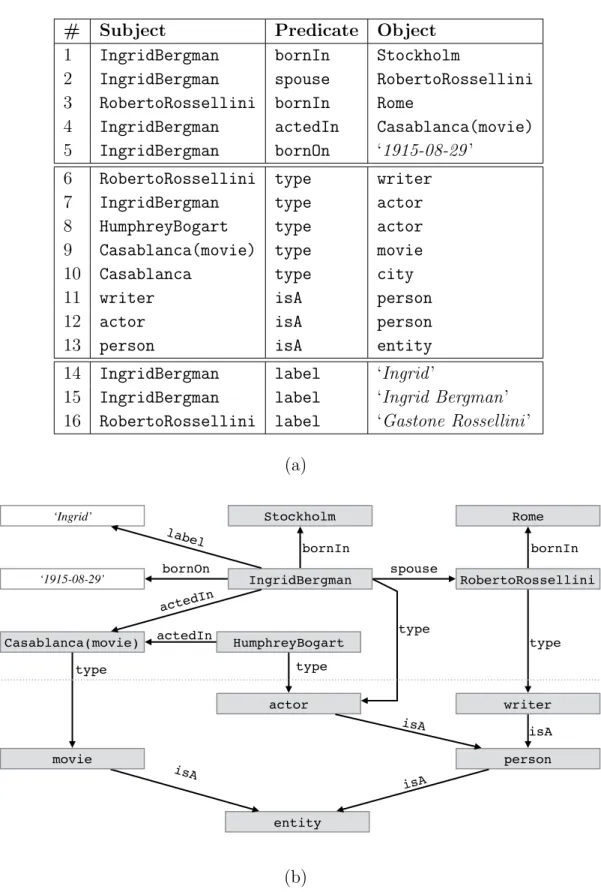
We discuss the various types of semantic items we deal with in this disser-tation below. Literals are constant values used to describe semantic items, but themselves are not described by a knowledge graph, hence, they do not appear as subjects in a fact. Typical examples of literals are numbers, strings, and dates. We will interchangeably refer to facts as triples in this dissertation. We call this model for representing knowledge the subject-predicate-object (SPO) model or triples model. This model serves as the basis for the RDF data model. Figure 2.1(a) shows examples of facts.
A collection of distinct facts is called a knowledge graph, as given in Defini-tion 2.3
Definition 2.3 (Knowledge Graph). A knowledge graph (KG) is a set of facts, KG⊆E∪C×P ×E∪C∪L.
Knowledge graphs are also called knowledge bases. A fact in a KG can be viewed as a labeled edge (the predicate) connecting two nodes (the subject and object), with a collection of facts forming a graph, hence the name knowledge graph. Figure 2.1(a) shows an example KG, part of which is depicted graphically in Figure 2.1(b).
2.1.1. Entities
Entities are the central semantic item of a KG. In fact, the goal of a KG is to describe entities by connecting them to other entities, classes, or literals using predicates, as we stated above. What constitutes an entity can be debated and is often domain and application specific (Sowa, 2000). For this dissertation, the following definition fits our needs: “any abstract or concrete thing that is uniquely identifiable is an entity” (Suchanek, 2009).
For entities, like other semantic items, it is important to point out the distinc-tion between an entity’s id and its names. For example, the 1942 movie directed by Michael Curtiz has the unique id Casablanca(movie). This movie can be referred to by multiple names such as ‘Casablanca’ and ‘Casablanca the movie’. The name ‘Casablanca’ is shared between this entity and the entityCasablanca,
2.1. KNOWLEDGE GRAPHS 9
# Subject Predicate Object
1 IngridBergman bornIn Stockholm
2 IngridBergman spouse RobertoRossellini 3 RobertoRossellini bornIn Rome
4 IngridBergman actedIn Casablanca(movie) 5 IngridBergman bornOn ‘1915-08-29’
6 RobertoRossellini type writer 7 IngridBergman type actor 8 HumphreyBogart type actor 9 Casablanca(movie) type movie 10 Casablanca type city
11 writer isA person
12 actor isA person
13 person isA entity
14 IngridBergman label ‘Ingrid’
15 IngridBergman label ‘Ingrid Bergman’ 16 RobertoRossellini label ‘Gastone Rossellini’
(a) Stockholm Rome RobertoRossellini IngridBergman actor writer person entity HumphreyBogart Casablanca(movie) ‘1915-08-29’ ‘Ingrid’ movie isA isA isA type bornIn bornIn type type actedIn spouse label bornOn actedIn isA type (b)
Figure 2.1.: An example of a knowledge graph in (a) tabular and (b) graph form (only a fragment is shown).
Morocco’s largest city. The name of an entity, which it can share with other entities, is also called asurface form, and is used by humans to refer to an entity in natural language utterances.
Entities are interesting in several applications. Entity-seeking queries form a significant part of Web search queries, with no less than 50% of Web queries in one study asking for entities (Pound et al., 2010b). Entity annotations in textual corpora have been used for search (Bast and Buchhold, 2013; Bast et al., 2014; Hoffart et al., 2014b), faceted search (Li et al., 2010), and analytics (Hoffart et al., 2014a), among other applications.
2.1.2. Classes
Classes, also referred to as types or categories, are named sets of entities. In the example KG of Figure 2.1 we have six distinct classes. The class actor, for instance, contains two entities: IngridBergman and HumphreyBogart. Exactly two predicates can be connected to a class in a KG. The first,type(often called instanceOf), connects entities to classes to which they belong. The second, isA (often called subclassOf), expresses hyponymy/hypernymy relations, and is used to organize classes of a KG into a directed acyclic graph shaped class hierarchy. The type person in our example KG has two subtypes (actor and writer), a single supertype (entity), and transitively contains a total of three entities.
Instances of these two predicates collectively form the ontology within the KG (facts 6-13 in Figure 2.1(a)) which we define as follows:
Definition 2.4 (Ontology). Given a knowledge graph KG, its ontology is the set of facts whose subject or object is a classC. The predicates in such facts are restricted to either type orisA.
Pound et al. (2010b) reports that 12% of Web queries are “type queries”, asking for instances of a specific class. Classes can often express multiple predi-cates in one shot, which makes them particularly valuable for information-seeking tasks. For example, the Yago KG (Suchanek et al., 2007) contains the classes ItaliaNobelLaureatesand RepublicanVicePresidentsOfTheUnitedStates.
In logics terminology, classes can be seen as unary predicates, so we will oc-casionally use the notation c(e) to denote that entity e is a member of class c (i.e., (e type c)).
2.1. KNOWLEDGE GRAPHS 11
2.1.3. Predicates
Predicates in our setting are binary relations, whose first and second arguments are called the subject and object, respectively. Predicates are often referred to as relations or attributes. In the KG setting, relation is used to refer to predicates connecting pairs of semantic items. This is in contrast to an attribute, which is used to connect a semantic item to a literal (e.g., GDP, hIndex).
Predicates have a type signature, which gives the most general class of entities that can occupy each of the subject and object arguments of a predicate. We can write facts as triples in line with Definition 2.1 (e.g., (IngridBergman bornIn Stockholm)) or in logical form (e.g.,bornIn(IngridBergman,Stockholm)).
The power of the triples model lies in the flexibility it offers for cases where the data is evolving. This model, compared to the classical relational model, does not require a schema to be defined upfront. Instead, new predicates can be defined as needed and populating them simply means appending new triples to the KG.
2.1.4. Concrete Knowledge Graphs
In this dissertation, we work with three concrete knowledge graphs, which we briefly present here.
Yago (Hoffart et al., 2013; Suchanek et al., 2007) combines two resources: Wikipedia and WordNet (Fellbaum, 1998). Yago taps into Wikipedia’s infoboxes for facts linking entities to each other and to literals. The ontology in Yago is obtained from Wikipedia’s assignment of entities to categories (for instances of the typepredicate), and a mapping of these categories to noun synsets in Word-Net (for instances of the isA predicate). Yago adopts a rule-based extraction scheme, with each predicate having one or more hand-crafted extractors. Yago is distinguished by its high accuracy extractions and its comprehensive type hi-erarchy.
DBpedia (Auer et al., 2007), like Yago, is based on Wikipedia. DBpedia’s extraction scheme is more liberal than that of Yago, compromising accuracy for recall. Whereas Yago contains about 100 predicates, DBpedia contains thou-sands. These are generally taken over as-is from the infoboxes in Wikipedia with minimal normalization or sanity checking. DBpedia includes Yago’s ontology within it.
Freebase (Bollacker et al., 2008) is a collaboratively edited knowledge graph maintained by Google. Freebase forms an important part of Google’s Knowledge Graph, which is actively used for providing concrete answers in response to Web
queries, whenever possible. Although not directly extracted from Wikipedia, Freebase entities are linked to their corresponding Wikipedia entries when one is available.
2.1.5. Triple Pattern Queries
Triple pattern queries are used to query knowledge graphs. The triple pattern query language we adopt here is based on the SPARQL standard for querying RDF. In what follows we present this model formally. The basic building block here is a triple pattern. For this, we require variables, which stand for semantic items or literals that need to be returned by the query. Variables are always prefixed with a question mark (e.g.,?x).
Definition 2.5 (Triple Pattern and its Answers). Given a set of variables V distinct from semantic items and literals, a triple pattern q is a member of the set V ∪E∪C ×V ∪P ×V ∪S ∪L. An answer (a) to a triple pattern over a KG is a total mapping of variables in q to (S∪L) such that the substitution of the variables with their mappings, denoted a(q), results in a triple t in the KG. An example of a triple pattern is (?x spouse RobertoRossellini), which asks for the spouse of RobertoRossellini. From fact #2 in Figure 2.1(a) we can obtain the answera={(?x,IngridBergman)}. We say that fact #2 matches the triple pattern.
Definition 2.6(Triple Pattern Query).A triple pattern query, or simply a query is a set of triple patternsQ={q1, ..., qn} and a projection setP(Q) of variables. We require the join graph ofQ, whereqi’s are vertices and an edge exists between every pair of vertices sharing a common variable, to be a connected graph (to avoid computing Cartesian products). P(Q) is a (usually proper) subset of the variables in Q, defining the output structure, typically tuples of entities.
We also refer to the triple pattern set Q as a query when the projection set is not relevant for the discussion. An example of a triple pattern query is
SELECT ?x WHERE { ?x actedIn Casablanca(movie) . ?x spouse ?y},
which is composed of two triple patterns and a single projection variable,P(Q) ={?x}. The definition of an answer to a query is a natural extension of an answer to a single triple pattern.
Definition 2.7 (Query Answer). For query Q= {q1, ..., qn} an answer (a) over KG is a total mapping of the variables in Qto (S∪L) such that∀i∈[1..n] :a(qi)∈KG. The restriction of a query answer to variables inP(Q) is called the projected answer, denoted aP.
2.1. KNOWLEDGE GRAPHS 13
For the above query and the KG of Figure 2.1(a), the query has a single answer:
a={(?x,IngridBergman),(?y,RobertoRossellini)}, from which we can obtain the projected answer aP = {(?x,IngridBergman)}, where a was restricted to the projec-tion variable ?x.
While we define an answer as a mapping of (projection) variables to semantic items and literals, we can also view it as a tuple of semantic items and literals, in a manner consistent with relational algebra. When presenting the answer as a tuple, rather than a mapping, we take the convention that the elements of the tuple are ordered according to the lexicographical order of the variables they originate from. For the above example, we can present the answer as a = (IngridBergman,RobertoRossellini), and the projected answer aP = (IngridBergman).
A query can match multiple subgraphs in the KG, each one producing a distinct answer. The set of answers found for a query in a KG is the query result:
Definition 2.8 (Query Result). The result of a queryQ={q1, ..., qn} over a KG is a set of answers A={a1, a2, ...} such that ∀ai ∈A:ai is an answer to Qover the KG. A query result is also called an answer set.
An interesting class of queries is relationship queries:
Definition 2.9 (Relationship Query). Let V ars(Q) be the set of variable in Q. A query Qis called a relationship query if |V ars(Q)| ≥2.
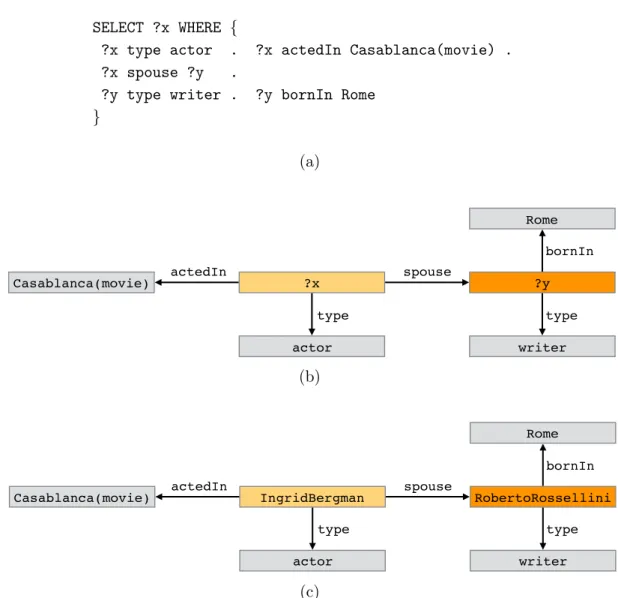
Relationship queries allow us to express information needs where an answer con-tains multiple semantic items (i.e., |P(Q)| ≥ 2). Even when we want (projected) answers composed of individual semantic items, relationship queries allow us to for-mulate queries with multiple ungrounded semantic items. Figure 2.2 shows an example of a relationship query which asks for the “actress who played in Casablanca and was married to a writer born in Rome”. Relationship queries stand in contrast to tradi-tional entity search queries which are conceptually restricted to a single variable both in the body of the query and its projection set (i.e., |P(Q)|= 1). If we were to answer the query of Figure 2.2 using traditional entity search, we would need to first manually find the set of writers born in Rome, and then, for each such writer, ask for actresses who played in Casablanca and were married to the specific writer.
In Section 2.1.3 we discussed the flexibility offered by the RDF model in modeling emerging data. Modeling knowledge using the subject-predicate-object triples model results in the typical triple pattern query being composed of multiple stars, each cen-tered around a variable, with the stars connected to each other by chains. The query of Figure 2.2 is composed of two stars and a chain connecting them.
SELECT ?x WHERE {
?x type actor . ?x actedIn Casablanca(movie) . ?x spouse ?y .
?y type writer . ?y bornIn Rome } (a) Rome ?y ?x actor writer Casablanca(movie) type bornIn type actedIn spouse Rome RobertoRossellini IngridBergman actor writer Casablanca(movie) type bornIn type actedIn spouse (b) Rome ?y ?x actor writer Casablanca(movie) type bornIn type actedIn spouse Rome RobertoRossellini IngridBergman actor writer Casablanca(movie) type bornIn type actedIn spouse (c)
Figure 2.2.: A triple pattern query corresponding to the question“Which actress played in Casablanca and was married to a writer born in Rome?”
in (a) and its graphical representation (b) composed of two stars connected by a chain. The query is matched by the subgraph of the KG shown in (c).
2.2. INFORMATION EXTRACTION 15
2.2. Information Extraction
In the previous section we presented knowledge graphs. An important question is how can we obtain such knowledge graphs in the first place? This is the topic of this section. Most of human knowledge is available in textual form, be it on the Web, in books, newspapers, or manuals, mostly as free text, possibly with some tags to provide lightweight structure (i.e., semistructured data). The goal of information extraction is to extract semantic information from text and put it in a structured machine-readable format – a knowledge graph in our setting (Jurafsky and Martin, 2009).
Information extraction is a very broad area whose ultimate goal is to distill human knowledge into a format that machines can consume and process to facilitate upstream tasks such as language understanding, question answering, and analytics.
2.2.1. Named Entity Recognition and Disambiguation
The purpose of a KG as introduced in Section 2.1 is to describe entities. Named entity recognition (NER) is one of the basic information extraction tasks that serves as the building block for extracting more elaborate information to populate a KG. The task involves finding mentions of named entities in text and classifying them into one of several types. NER systems usually classify entity mentions into one of a handful of coarse types such as person,organization, and location.
Most general-purpose NER systems are trained on data created for shared tasks. The two most prominent are those from the Message Understanding Conference (MUC) (Grishman and Sundheim, 1996) and the Computational Natural Language Learning Conference (CoNLL) (Sang and Meulder, 2003). The data provided by both MUC and CoNLL is based on newswire texts, which use clear well-formed language. The resulting systems, such as the Stanford NER (Finkel et al., 2005), produce very good results on test data with similar characteristics. This system views the problem as one of sequence labeling, deploying conditional random fields to tackle it. However, models trained from the above data do not generalize well when it comes to texts from different domains, or informal texts such as forum posts, tweets, and Web search queries, leading to more recent work tackling the NER task in such texts (Downey et al., 2007; Guo et al., 2009; Ritter et al., 2011). Nadeau and Sekine (2007) gives a comprehensive overview of the NER task.
Complementary to the NER task is that of named entity disambiguation (NED), also called entity linking. The task here is to map ambiguous named entity mentions in a text to a repository of canonical entities. The mentions to be mapped are usually detected using an NER system.
In Section 2.1.1 we listed several applications where entities play a prominent role. These include entity search (Balog et al., 2011), entity-relationship search (Li et al., 2012), search in entity annotated documents (Bast and Buchhold, 2013; Bast et al.,
The incident with Columbia led President Bush to announce plans to retire NASA’s space shuttle fleet Columbia(University) Columbia Pictures Columbia(Shuttle) NASA Nasa(mountain) GeorgeW.Bush GeorgeH.W.Bush 0.5 0.5 0.9 0.1 0.5 0.2 0.3 Entity Context
NASA space, mission, shuttle, astronaut,… Columbia(shuttle) space, crash, 2003, mission, nasa,…
Nasa(mountain) sweden, cottage, silver, mining,…
… …
Figure 2.3.: Named entity disambiguation example. Each highlighted entity mention maps to a KG entity with a prior. The table at the bottom shows the context signature for each entity. Coherence edges shown in blue for two entity pairs only.
2014; Hoffart et al., 2014b), faceted search (Li et al., 2010), and analytics (Hoffart et al., 2014a). Recognizing the importance of entities, there has been a resurgence in interest in named entity recognition and disambiguation (NERD), with most recent works focusing on Wikipedia or KGs connected to it (e.g., Freebase, Yago) as their reference entity repositories. These works rely on a mixture of priors for a surface form standing for a specific entity, the mutual coherence between candidate entities, and the similarity between a candidate entity’s context signature and the disambiguation con-text (Hoffart et al., 2011). The disambiguation of entities in these works is performed in a joint manner, that is, the decision of which entity each mention in a text maps to is done at once for all entities. Joint disambiguation is crucial as the disambigua-tion of entity mendisambigua-tions in a text can be mutually informative. Figure 2.3 shows an example disambiguation instance using this framework. Hoffart (2015) gives a more detailed overview of approaches to NED and discusses extensions to the basic NED task such as cross-document coreference resolution and out-of-KG entity detection. Weissenborn et al. (2015) extends joint entity disambiguation to joint disambiguation of named entities and common nouns.
Realizing the value of corpora annotated with entities, multiple organizations have released corpora with annotations of disambiguated entities. Google released Freebase
2.2. INFORMATION EXTRACTION 17
annotations of the ClueWeb’09 and ClueWeb’12 Corpora (FACC1),1 the TREC KBA stream corpus (FAKBA1), and the TREC Million Query track and Web track queries.2 Yahoo! released a sample of its query log annotated with Wikipedia entities.3 We use
some of these corpora in our work.
2.2.2. Fact Extraction
With documents annotated with named entities, the next logical step is to extract relations that hold between these entities (i.e., facts) or relations connecting them to literals and classes. This task is called fact extraction, but it is common to refer to this specific task as information extraction as well. The result of this process is a knowledge graph as described in Section 2.1. There are different approaches to tackling fact extraction, based on what sources are available for fact extraction and whether the set of relations is known a priori. Consequently, fact extraction systems are typically classified according to the amount of supervision they require, as we detail below.
Supervised Information Extraction
The earliest systems for fact extraction worked by matching hand-crafted lexico-syntactic patterns over textual corpora. Prominent among these are Hearst patterns (Hearst, 1992) for extracting hyponym/hypernym pairs (i.e., instances of isA and type relations in a KG setting). Many large-scale knowledge graphs are the result of a similar process that relies on hand-crafted patterns. In Section 2.1.4 we presented Yago, DBpedia, and Freebase, which rely (at least in part) on manually specified rules for extracting facts from Wikipedia, primarily focusing on the semistructured infoboxes. Manually specifying extraction patterns does not scale when the number of relations for which we want to perform extraction increases. To deal with this issue, focus shifted to building extraction systems that need less supervision.
Semisupervised Information Extraction
In bootrapping, supervision is achieved by providing the extraction system with a small number of example instances of the relations for which we desire to extract facts. DIPRE (Brin, 1998) and Snowball (Agichtein and Gravano, 2000) are two prominent examples of such systems. Mintz et al. (2009) extends this approach to distant super-vision where bootstrapping is done from a large knowledge graph of facts that serves as the source of supervision. In the process of bootstrapping, distant supervision assumes that a sentence containing a pair of entities that appear in a fact in the reference knowl-edge graph is expressing that fact. A classifier is trained on these spotted instances
1 http://lemurproject.org/clueweb09/FACC1/, http://lemurproject.org/clueweb12/FACC1/ 2 http://lemurproject.org/clueweb09/TREC%20Freebase%20Queries,%20v1.1.zip 3http://webscope.sandbox.yahoo.com/catalog.php?datatype=l&did=66
to recognize each occurrence of a relation. Using large knowledge graphs and large text copora allows for very expressive features. The classifier also requires negative examples, these are usually generated from entity pairs that do not appear together in the reference knowledge graph.
PROSPERA (Nakashole et al., 2011) is an extension of distant supervision that can automatically generalize extraction patterns and uses constraint-based reasoning for controlling the quality of patterns and facts. Pattern generalization, achieved through frequent itemset mining, allows for higher recall. By using MaxSat reasoning, PROSPERA can control the quality of the resulting extractions by checking for their mutual consistency. PROSPERA builds on SOFIE (Suchanek et al., 2009) but is more scalable and provides higher recall.
Open Information Extraction
In all the above approaches, the set of relations for which we extract facts is defined upfront, along with a set of examples for each relation. Defining what relations are interesting in a specific domain and coming up with examples for each requires effort by humans. Once the relations in a domain need to be extended, or the domain is changed altogether, the existing data will not be very useful, and manual effort has to be invested again. This does not scale well when the data is continuously evolving, and with it the set of interesting relations.
Open Information Extraction (OpenIE) was proposed as a solution to the problems above. The goal of OpenIE is to perform fact extraction without the need for any domain-specific modeling in a scalable manner on large Web-scale corpora (Etzioni et al., 2004). The initial work on OpenIE, KnowItAll, supported open-ended infor-mation extraction by providing a framework where extraction rules can be manually defined in a domain-independent manner. These rules would trigger Web search engine queries that allow KnowItAll to find documents to which these rules can apply. The Web search engine is also queried to automatically asses the quality of an extraction by aggregating evidence for that extraction. The successor framework, TextRunner, extracted facts by finding spans of text in a large corpus connecting two noun phrases (corresponding to the arguments of a fact) and using a classifier to score such extrac-tions (Banko et al., 2007; Etzioni et al., 2008; Yates et al., 2007). WOEparse (Wu and Weld, 2010) extends this work by using dependency parsing to connect the argument noun phrases along with a similar scoring scheme.
ReVerb (Fader et al., 2011), one of the most widely used OpenIE systems, relies on a small set of patterns over part-of-speech tags to detect relations, and then looks to the left and right of the relation for noun phrases corresponding to its arguments. Subsequently, extractions are tested against a lexical constraint where relations that don’t occur with a sufficient number of distinct arguments are eliminated. The resulting extractions are finally scored using a confidence classifier. OLLIE (Mausam et al., 2012) bootstraps ReVerb by using its extractions as seeds for finding dependency parse
2.3. QUERYING FOR KNOWLEDGE 19
Scheme E U NS
Keywords 7 X X
Questions X X X
Structured queries X 7 7
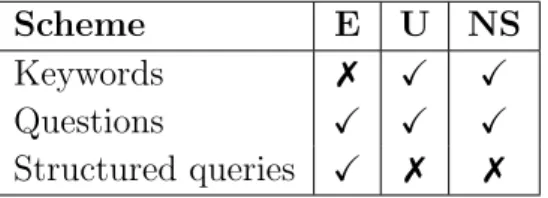
Table 2.1.: Comparison of keywords, natural language questions and structured querying along the dimensions of expressiveness (E), usability (U), and a user’s ability to formulate queries without schema knowledge (NS).
patterns expressing facts.
In Chapter 5 we present an approach to OpenIE that focuses on extracting facts centered around noun phrases, which other systems have neglected, and which can extract the arguments of a relation in a semantically meaningful and consistent manner.
2.3. Querying for Knowledge
We now discuss how we can query for knowledge. The starting point for a user is an
information need for which she would like to obtain answers (B¨uttcher et al., 2010). The user generates a query (or possibly a sequence of queries) from this information need. For a given information need, the query will differ based on the system to which it will be issued.
In this section we look at three querying schemes relevant to this dissertation: key-word querying, structured querying, and question answering. The schemes differ along three main dimensions: expressiveness, usability in terms of the technical knowledge needed to formulate a query, and how much familiarity is required with the data to pose a query. Table 2.1 gives a comparison of the three query schemes along the three dimensions, we elaborate on this below.
2.3.1. Keyword Querying
Most people are familiar withkeyword querying through the use of Web search engines. A keyword query is generally considered a bag ofterms, that is, the order in which they are provided by the user is arbitrary.4 In the typical setting where keywords are used, a user will issue a keyword query to an engine and expect a ranked list of documents, each possibly corresponding to an entity as we discuss below. Other settings have also been explored where keyword queries are used to retrieve tuples from databases or trees from XML documents.
Document retrieval has been a major focus of information retrieval systems since the earliest days of the field (Croft et al., 2009). Here, most of the focus has been on ranking textual documents (Web pages, emails, books, scholarly publications) in response to keyword queries. While the roots of the field go as far back as the mid 1960s, the field saw rapid progress since the mid-1990s due to the popularity of Web search engines and driven in large part by the various tracks of the Text REtrieval Conference (TREC), which was started in 1992. Among the successful approaches for ranked document retrieval is language modeling (Ponte and Croft, 1998; Zhai, 2008) and query expansion (Xu and Croft, 1996) which inspire some of the work in Chapters 3 and 4.
Motivated by the familiarity of users with keyword querying, primarily through their interaction with Web search engines, researches have worked on adapting this form of querying for problems other than document retrieval. Most relevant for our setting of knowledge querying is work on entity search and keyword search over knowledge graphs (and databases in general). Inentity search, the goal is to return an entity or a set of entities in response to a keyword query. State-of-the-art approaches map the problem of entity search to the classical document retrieval setting by constructing per-entity documents and retrieving these documents in response to an entity query. Entity documents are usually fielded, with fields capturing the various facets of an entity. Extensions of this approach allow for fielded queries, minimally with a field for specifying the types to which an entity belongs, and another for a description (with relations or entities) (Balog et al., 2011).
Another class of systems answers keyword queries over databases typically for the purpose exploratory search, with some systems specifically focusing on knowledge graphs. Such systems are a fundamental component for verticals (e.g., Amazon.com), which are predominantly driven by a database containing the topics they offer and their information. Tran et al. (2009) generates the top-k triple pattern queries that best correspond to a keyword query over a specific knowledge graph. Each structured query is derived from a subgraph of the knowledge graph that can connect elements in the knowledge graph mentioned in the keyword query. Elbassuoni and Blanco (2011) adopts an IR-inspired approach, where a set of subgraphs matching a keyword query are retrieved and subsequently ranked based on a statistical language model. In con-trast to the first approach, the second one returns answer subgraphs to the user rather than structured queries. Yu et al. (2009) gives a comprehensive overview of the area of keyword search over relational, graph and XML databases.
Keywords inherently have very limited expressiveness, which means that they cannot be used to fully exploit the structured data available to us in knowledge graphs. For example, the information need expressed by the question shown in Figure 2.2: “Which actress played in Casablanca and was married to a writer born in Rome?”, is hard to capture in its full semantics in a keyword query such as ‘actress played casablanca married writer born in rome’. Moreover, even if the user were to provide a
keyword-2.3. QUERYING FOR KNOWLEDGE 21
querying engine with the full question, she would not benefit in terms of result quality as the engine is not designed to exploit the expressiveness of natural language, making the effort not worthwhile.
An interesting extension of such systems is QUICK (Pound et al., 2010a), which allowsstructured keyword queries. Such queries are meant to be a compromise between keyword queries and structured queries for describing an entity. Using this query language, our example might be formulated as:
“actress, played in(casablanca), married to(writer, born in(rome))”
The various keywords in the structured keyword query are mapped to candidate se-mantic items in the underlying knowledge graph, and the goal becomes finding the set of top-kscoring subgraphs, each of which correponds to a distinct triple pattern query. A subgraph is scored using a combination of syntactic similarity between its items and keywords in the query, and semantic similarity between these items. The top-k
matching subgraphs are found efficiently using an top-kenumeration scheme based on rank-joins (Ilyas et al., 2003). However, even such queries can be hard for the average user to formulate.
2.3.2. Structured Querying
Structured querying over knowledge graphs is on the other extreme from keyword querying. In Section 2.1.5 we presented triple pattern queries for querying knowledge graphs. Here, the information need is expressed unambiguously. Moreover, very com-plex queries can be expressed, particularly relationship queries which in the classical IR setting would require combining cues from multiple documents to obtain an answer. For instance, our running example can be answered using the following query, which we have seen in Figure 2.2(a):
SELECT ?x WHERE {
?x type actor . ?x actedIn Casablanca(movie) . ?x spouse ?y .
?y type writer . ?y bornIn Rome }
Using structured querying suffers from three major problems. First, formulating structured queries in a formal language such as SPARQL is not a trivial task for the average person, who will have no experience in formal languages. Second, even a user experienced at formulating structured queries might struggle to find the correct knowledge graph terms and structure needed to formulate her query. This is due to the large size of a knowledge graph and its underlying vocabulary, and the lack of a schema. Finally, because knowledge graphs are continuously evolving without a fixed schema, the information need underlying a structured query might have multiple answers in
the knowledge graph. However, each answer might require a slightly different query to obtain.
We have already seen how keyword querying was proposed as a way to tackle the issues above and the limitations of keyword querying, particularly when it comes to expressiveness. In this dissertation we tackle the problems above in two ways. In the first, we allow for full fledged natural questions as an alternative for keyword querying. Natural language allows users to express very complex queries without any technical know-how (Chapter 3). In the second, we assume that a structured keyword query is already at hand – either formulated by a user, or automatically generated by a question answering or keyword querying system. We present a triple pattern querying framework that takes a triple pattern query and can automatically adjust it to bridge any gap between the query and the KG. An important component of the second approach is that it allows for processing queries on an extended version of the knowledge graph obtained through information extraction (Chapter 4).
2.3.3. Natural Language Questions
Natural language questions as a query language present an ideal compromise between keyword and structured querying. Questions can be used to express complex informa-tion needs that cannot be expressed as keywords without a significant loss in structure and semantics. Natural language questions are the most intuitive way of formulating an information need, and any human can formulate questions to express their information needs. Moreover, with voice seeing wider adoption as a modality for human-computer interaction, support for questions as a query language will become a must.
The idea of machines answering human questions goes back to the earliest days of computer science. Turing’s scheme for testing whether machines exhibit intelligence, the Truing test, is based on a machine answering questions in a manner indistinguish-able from humans (Turing, 1950). While achieving this goal seems unlikely in the near future, the problem has been tackled from different angles in the past 65 years.
Starting from the mid 1990s, and for a period of about 10 years, question answer-ing saw a revival, primarily in the information retrieval community. This revival was mainly driven by the Web and the availability of large query logs from major search engines at the time (e.g., MSN search and Ask Jeeves). The main driver of QA re-search during this period was NIST’s TREC-QA track, which made available questions donated by Web search engines and corpora in which answers to these questions were to be located.
IBM’s Watson system is one of the milestones in the history of natural language question answering (Ferrucci, 2012; Ferrucci et al., 2010). Watson successfully com-peted against humans at the Jeopardy! television game show. Work on Watson focused on three main topics: question answering (finding answers), strategy (deciding when to answer and how much to bet on a question), and efficiency (answering fast). On the
2.3. QUERYING FOR KNOWLEDGE 23
question answering front, Watson relied mainly on textual corpora, with limited use of knowledge graphs for answering question fragments that can be mapped to a KG with high confidence (Chu-Carroll et al., 2012) and type-checking answer candidates for pruning of spurious answers (Kalyanpur et al., 2011).
In recent years, there has been a resurgence of interest in question answering, this time primarily in the natural language processing and database communities with the goal of question answering over databases, with particular interest in knowledge graphs. In contrast to early work described above, the recent approaches operate over much larger data, and rely heavily on statistical methods rather on purely logical ones. Liang and Potts (2015) gives an overview of the field. We also give a more comprehensive overview in Chapter 3.
In terms of usability, questions are a more accessible medium for expressing com-plex information needs. Most users lack the technical know-how needed to formulate a structured query. Additionally, as discussed in Section 2.1, knowledge graphs are usually large, continually evolving, and lack a schema. This means that finding the right query can be a challenging task, possibly requiring multiple iterations of query reformulation to find the correct query. Natural language questions can relieve the user from this burden by moving it to the machine, which will be responsible for under-standing the question with respect to the underlying data. We present our framework for natural language question answering for knowledge graphs in Chapter 3.
3. DEANNA: Natural Language
Question Answering over
Knowledge Graphs
3.1. Introduction
3.1.1. Motivation
The availability of large knowledge graphs presents a challenge and an opportunity that are, in some sense, duals of each other. The challenge lies in how to make this abundance of knowledge easily accessible to humans. Only a fraction of potential consumers of this knowledge will be versed in formulating triple pattern queries that express their information needs. Even for such people, the sheer size of the data and the lack of a schema means that the task of formulating a triple pattern query can be a challenging task, requiring multiple rounds of tedious query reformulation.
A solution to the above problem is to allow users to query knowledge graphs by posing natural language questions. These questions are subsequently interpreted with respect to the specific KG at hand by mapping them to a triple pattern query, which can be issued to the KG, returning the desired answers to the user.
This new setting of large knowledge graphs presents an opportunity to tackle the question answering problem using new approaches. By working against a knowledge graph, crisp entities can be returned as answers. By exploiting the structure provided by the KG, one can also answer complex questions that require multiple joins, corre-sponding to paths in the KG. In these cases, a KG can be used to return answers that are proper tuples of entities, rather than singletons. Moreover, users will be able to ask for how an answer was derived by looking at the query that produced it.
3.1.2. Problem Statement
The high-level problem we deal with in this chapter is that of question answering over a knowledge graph. Given a knowledge graph KG and a question u (for utterance), our task is to return a result A = {a1, a2, ...}, where each answer in the result is an
n-tuple of entities,ai = (e1, e2, ..., en). Figure 3.1 shows an example of a question and
u=“Who played in Casablanca and was married to a writer born in Rome?”
A ={(IngridBergman, RobertoRossellini)}
Figure 3.1.: An example question and the corresponding result that contains a single answer composed of an entity pair.
its result containing a single answer composed of a pair of entities. We elaborate on the problem description in what follows.
Our task is called question answering over knowledge graphs. We operate with a very broad definition of a question. For us, a question is a natural language utterance, hence the symbolu, that expresses an information need. These can be questions formed with interrogative words (e.g.,“Who was born in New York City?”), yes/no questions (e.g., “Was Obama born in Hawaii?”) and utterances intended as questions, but do not look as such (e.g., “Presidents born in Hawaii.” which is simply a shorter form for asking“Which presidents were born in Hawaii?”).
An answer in our setting is ann-tuple of entities from the KG. In Figure 3.1 we give an example of such an answer. This is in contrast to the classical IR setting, includ-ing the entity-retrieval task (Pound et al., 2010b), where an answer is an individual document (possibly corresponding to a single entity).
While an answer is a tuple of entities from the KG, our definition of the problem does not force us to be able to explain an answer by the facts within the KG. We will assume that the decision about the relevance of an answer in response to a question is done independent of the KG. In this manner, systems working on this task have the freedom to use whatever means and resources necessary to focus on the end task of answering the question at hand, and are not restricted by the unavoidable incompleteness in any KG.
Related to the above point, we focus on the end-to-end task of question answering over a KG. Therefore, our end goal is not to generate the correct triple pattern query in response to a question. In other words, our task is that of question answering rather than semantic parsing. Evaluating the correctness of a query, rather than an answer, is not a well-defined task. A seemingly correct query might miss some or all correct answers due to KG incompleteness. On the other hand, there might be multiple correct queries that capture a question, which produce overlapping or complementary sets of answers. Notwithstanding this discussion, an important component of our QA pipeline is the translation of a question into a triple pattern query.
3.1.3. Contributions & Overview
We present DEANNA, a two-stage end-to-end framework for natural language question answering over knowledge graphs. In the first stage, DEANNA maps a user’s question
3.1. INTRODUCTION 27
to a triple pattern query. In the second stage, it extends and relaxes this query with textual conditions inspired by traditional IR to compensate for any shortcomings in the first part or incompleteness in the KG. Figure 3.2 shows the full pipeline that takes us from a question to its answers, we elaborate below.
In the first stage, DEANNA generates a triple pattern query from the question. For the example question in Figure 3.1, DEANNA would generate the query:
SELECT ?x WHERE {
?x type person . ?x actedIn Casablanca(movie) . ?x spouse ?y . ?y type writer .
?y bornIn Rome }
Generating a triple pattern query from a question is a two-stage process. First, DEANNA constructs a disambiguation graph from the question, which essentially cap-tures all possible interpretations of the question with respect to the KG. To obtain the correct interpretation among these, multiple ambiguities have to be resolved: the seg-mentation of a question into phrases that can be individually mapped to semantic items in the KG, the actual mapping, and connecting these semantic items together in order to construct triple patterns. As the solution to each of the three ambiguities above can inform the resolution of the other ambiguities, we resort to a joint model of disambiguation. Our model utilizes a judiciously designed Integer Linear Program (ILP) for joint disambiguation. The ILP, composed of an objective function and a set of constraints, captures the intuition that we are looking for the most likely inter-pretation of the question (the objective) that also makes sense (the constraints). The constraints make use of the semantic knowledge in the knowledge graph, requiring, for instance, that the arguments of a predicate in a triple pattern match its type signature. The result of the first stage is a triple pattern query.
In the second stage, the triple pattern query is extended with text conditions. These conditions serve two purposes. The first is to account for any parts of the question that could not contribute to the triple pattern query, either due to issues with the interpretation framework or the underlying KG. The second purpose of this extension is to allow for the relaxation of the triple pattern query whenever it is unable to return satisfactory results. We deem a result to be satisfactory when it is non-empty. Triple pattern queries extended with text conditions are evaluated over a combination of the KG and a textual corpus of entity descriptions. Query relaxation is interleaved with query evaluation, and continues until a query returns satisfactory answers to the user. For our running example, we can imagine a KG where thebornInpredicate is sparsely populated, and where the triple pattern query above results in an empty answer set. We would relax the culprit query condition?y bornIn Rometo into a textual condition associated with ?y’s type constraint: ?y type writer ‘born in rome’.
DEANNA answers questions over knowledge graphs composed of entities, predicates, and classes. In this chapter we work over a combination of DBpedia and Yago, two knowledge graphs constructed from Wikipedia as described in Section 2.1.4. The
connection to Wikipedia is crucial, as it allows us to both create the dictionaries and compute the statistics needed by DEANNA. Yago serves as our ontology, while DBpedia provides instance data.
In the following, we first survey related work in Section 3.2. We then describe disambiguation graph construction in Section 3.3. Next, we present our ILP-based joint disambiguation framework for question interpretation in Section 3.4, and how the result is translated to a triple pattern query in Section 3.5. In Section 3.6 we describe our query extension and relaxation framework, and describe answer scoring, which is required to cope with the potentially large number of results returned from relaxation. Finally, we present an experimental evaluation of DEANNA in Section 3.7.
Question
Answers
PhraseDetection Phrase Mapping
Dependency Generation Joint Disambiguation Extended Query Generation Query Relaxation Query Evaluation Disambiguation Graph Construction Query Generation Query Answering
3.2. RELATED WORK 29
3.2. Related Work
Question answering (QA) has been one of the holy grails of computer science research since its early days. It has been tackled by the natural language processing community, the IR community, and, to varying degrees, by the database and logics communities. In what follows we present an overview of the field.
3.2.1. IR-based Question Answering
The 1990s and early to mid 2000s saw a plethora of work on IR-based approaches to questions answering (IR-QA). Progress in this area was mainly driven by the TREC question answering track, which ran annually between 1999 and 2007 (Dang et al., 2007). Here, the focus was mainly on list, factoid, and definition questions posed over text corpora. Over the years, both newswire and blog corpora were used. An answer in this setting was a pair with an answer string and the id of the document where it was found (or ‘NIL’ when none can be found). Answer strings were usually constrained to a predefined number of bytes. Crucially, if an answer could be found for a question, then it was expected to be fully contained within a single textual document. DEANNA, by supporting complex join questions, is able to answer questions that conceptually require evidence from multiple documents by working with structured data.
Most IR-QA systems preprocess the document corpus at hand using the typical IR preprocessing pipeline primarily composed of tokenization, normalization and indexing (Manning et al., 2008). Some systems perform further preprocessing and analysis. For example, the START system (Katz, 1997) uses the parse trees of sentences in a corpus to create ternary subject-predicate-object expressions. These expressions are indexed for use during question answering. Other systems, however, perform such sophisticated analysis at question answering time over the subset of the corpus thought to contain the answer, as we detail below.
The majority of IR-QA systems divide the question answering task into the following subtasks: (i) question analysis, (ii) query formulation, (iii) document retrieval, (iv) passage retrieval, and (v) answer generation.
The most important step in question analysis is determining the expected answer type. For this, IR-QA systems maintain a type taxonomy. For example, Webclopedia (Hovy et al., 2002) uses a taxonomy 140 types manually compiled from analyzing a large question repository. Pasca and Harabagiu (2001) uses a type taxonomy with 8707 so-called concepts, which include verbs and adjectives, that are connected to WordNet noun synsets that correspond to answer types. To determine the answer type of a question, a combination of syntactic parse analysis, template matching, and machine learning are deployed (Li and Roth, 2002; Ravichandran and Hovy, 2002). Such type taxonomies are also important in our setting of question answering over knowledge graphs, and are usually part of the knowledge graph. Knowledge graphs such as
DBpedia and Yago, both of which we use in our work, offer hundreds of thousand of types, some of which are taken over from WordNet, while others are very fine grained (e.g., RepublicanUnitedStatesVicePresidents) and come from Wikipedia.
Query formulation takes the question and formulates a query that can be issued to the IR system, which serves as the interface to the document corpus. The primary consideration here is to create a quer