Multi-Prototype Vector-Space Models of Word Meaning
Joseph ReisingerDepartment of Computer Science The University of Texas at Austin
1 University Station C0500 Austin, TX 78712-0233
Raymond J. Mooney Department of Computer Science The University of Texas at Austin
1 University Station C0500 Austin, TX 78712-0233
Abstract
Current vector-space models of lexical seman-tics create a single “prototype” vector to rep-resent the meaning of a word. However, due to lexical ambiguity, encoding word mean-ing with a smean-ingle vector is problematic. This paper presents a method that uses cluster-ing to produce multiple “sense-specific” vec-tors for each word. This approach provides a context-dependent vector representation of word meaning that naturally accommodates homonymy and polysemy. Experimental com-parisons to human judgements of semantic similarity for both isolated words as well as words in sentential contexts demonstrate the superiority of this approach over both proto-type and exemplar based vector-space models.
1 Introduction
Automatically judging the degree of semantic sim-ilarity between words is an important task useful in text classification (Baker and McCallum, 1998), information retrieval (Sanderson, 1994), textual en-tailment, and other language processing tasks. The standard empirical approach to this task exploits the distributional hypothesis, i.e. that similar words ap-pear in similar contexts (Curran and Moens, 2002; Lin and Pantel, 2002; Pereira et al., 1993). Tra-ditionally, word types are represented by a sin-gle vector of contextual features derived from co-occurrence information, and semantic similarity is computed using some measure of vector distance (Lee, 1999; Lowe, 2001).
However, due to homonymy and polysemy, cap-turing the semantics of a word with a single vector is problematic. For example, the wordclubis similar
to bothbatandassociation,which are not at all simi-lar to each other. Word meaning violates the triangle inequality when viewed at the level of word types, posing a problem for vector-space models (Tver-sky and Gati, 1982). A single “prototype” vector is simply incapable of capturing phenomena such as homonymy and polysemy. Also, most vector-space models are context independent, while the meaning of a word clearly depends on context. The wordclub in “The caveman picked up theclub” is similar tobat in “John hit the robber with abat,” but not in “The batflew out of the cave.”
We present a new resource-lean vector-space model that represents a word’s meaning by asetof distinct “sense specific” vectors. The similarity of two isolated wordsA andBis defined as the mini-mumdistance between one ofA’s vectors and one of B’s vectors. In addition, a context-dependent mean-ing for a word is determined by choosmean-ing one of the vectors in its set based on minimizing the distance to the vector representing the current context. Con-sequently, the model supports judging the similarity of both words in isolation and words in context.
The set of vectors for a word is determined by un-supervised word sense discovery (WSD) (Sch¨utze, 1998), which clusters the contexts in which a word appears. In previous work, vector-space lexical sim-ilarity and word sense discovery have been treated as two separate tasks. This paper shows how they can be combined to create an improved vector-space model of lexical semantics. First, a word’s contexts are clustered to produce groups of similar context vectors. An average “prototype” vector is then com-puted separately for each cluster, producing a set of vectors for each word. Finally, as described above, these cluster vectors can be used to determine the se-109
mantic similarity of both isolated words and words in context. The approach is completely modular, and can integrate any clustering method with any tradi-tional vector-space model.
We present experimental comparisons to human judgements of semantic similarity for both isolated words and words in sentential context. The results demonstrate the superiority of a clustered approach over both traditional prototype and exemplar-based vector-space models. For example, given the iso-lated target word singer our method produces the most similar wordvocalist, while using a single pro-totype gives musician. Given the word cellin the context: “The book was published while Piasecki was still in prison, and a copy was delivered to his cell.” the standard approach producesproteinwhile our method yieldsincarcerated.
The remainder of the paper is organized as fol-lows: Section 2 gives relevant background on pro-totype and exemplar methods for lexical semantics, Section 3 presents our multi-prototype method, Sec-tion 4 presents our experimental evaluaSec-tions, SecSec-tion 5 discusses future work, and Section 6 concludes. 2 Background
Psychological concept models can be roughly di-vided into two classes:
1. Prototype models represented concepts by an abstract prototypical instance, similar to a clus-ter centroid in parametric density estimation. 2. Exemplarmodels represent concepts by a
con-crete set of observed instances, similar to non-parametric approaches to density estimation in statistics (Ashby and Alfonso-Reese, 1995). Tversky and Gati (1982) famously showed that con-ceptual similarity violates the triangle inequality, lending evidence for exemplar-based models in psy-chology. Exemplar models have been previously used for lexical semantics problems such as selec-tional preference (Erk, 2007) and thematic fit (Van-dekerckhove et al., 2009). Individual exemplars can be quite noisy and the model can incur high com-putational overhead at prediction time since naively computing the similarity between two words using each occurrence in a textual corpus as an exemplar requiresO(n2) comparisons. Instead, the standard
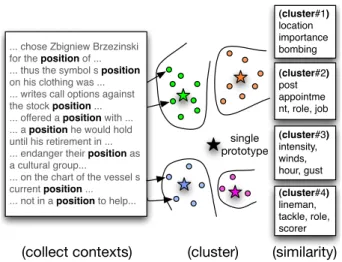
... chose Zbigniew Brzezinski for the position of ... ... thus the symbol s position
on his clothing was ... ... writes call options against the stock position... ... offered a position with ... ... a position he would hold until his retirement in ... ... endanger their position as a cultural group...
... on the chart of the vessel s current position ... ... not in a position to help...
(cluster#2) post appointme nt, role, job (cluster#4) lineman, tackle, role, scorer (cluster#1) location importance bombing
(collect contexts) (cluster)
(cluster#3) intensity, winds, hour, gust (similarity) single prototype
Figure 1: Overview of the multi-prototype approach to near-synonym discovery for a single target word independent of context. Occurrences are clustered and cluster centroids are used as prototype vectors. Note the “hurricane” sense ofposition(cluster 3) is not typically considered appropriate in WSD.
approach is to compute a single prototype vector for each word from its occurrences.
This paper presents amulti-prototypevector space model for lexical semantics with a single parame-terK(the number of clusters) that generalizes both prototype (K = 1) and exemplar (K =N, the total number of instances) methods. Such models have been widely studied in the Psychology literature (Griffiths et al., 2007; Love et al., 2004; Rosseel, 2002). By employing multiple prototypes per word, vector space models can account for homonymy, polysemy and thematic variation in word usage. Furthermore, such approaches require onlyO(K2)
comparisons for computing similarity, yielding po-tential computational savings over the exemplar ap-proach whenK N, while reaping many of the same benefits.
Previous work on lexical semantic relatedness has focused on two approaches: (1) mining monolin-gual or bilinmonolin-gual dictionaries or other pre-existing resources to construct networks of related words (Agirre and Edmond, 2006; Ramage et al., 2009), and (2) using the distributional hypothesis to au-tomatically infer a vector-space prototype of word meaning from large corpora (Agirre et al., 2009; Curran, 2004; Harris, 1954). The former approach tends to have greater precision, but depends on
hand-crafted dictionaries and cannot, in general, model sense frequency (Budanitsky and Hirst, 2006). The latter approach is fundamentally more scalable as it does not rely on specific resources and can model corpus-specific sense distributions. However, the distributional approach can suffer from poor preci-sion, as thematically similar words (e.g.,singerand actor) and antonyms often occur in similar contexts (Lin et al., 2003).
Unsupervised word-sense discovery has been studied by number of researchers (Agirre and Ed-mond, 2006; Sch¨utze, 1998). Most work has also focused on corpus-based distributional approaches, varying the vector-space representation, e.g. by in-corporating syntactic and co-occurrence information from the words surrounding the target term (Pereira et al., 1993; Pantel and Lin, 2002).
3 Multi-Prototype Vector-Space Models Our approach is similar to standard vector-space models of word meaning, with the addition of a per-word-type clustering step: Occurrences for a spe-cific word type are collected from the corpus and clustered using any appropriate method (§3.1). Sim-ilarity between two word types is then computed as a function of their cluster centroids (§3.2), instead of the centroid of all the word’s occurrences. Figure1
gives an overview of this process.
3.1 Clustering Occurrences
Multiple prototypes for each wordware generated by clustering feature vectorsv(c)derived from each occurrencec ∈ C(w) in a large textual corpus and collecting the resulting cluster centroidsπk(w), k∈
[1, K]. This approach is commonly employed in un-supervised word sense discovery; however, we do not assume that clusters correspond to traditional word senses. Rather, we only rely on clusters to cap-ture meaningful variation in word usage.
Our experiments employ amixture of von Mises-Fisher distributions (movMF) clustering method with first-order unigram contexts (Banerjee et al., 2005). Feature vectors v(c) are composed of indi-vidual featuresI(c, f), taken as all unigrams occur-ringf ∈ F in a 10-word window aroundw.
Like spherical k-means (Dhillon and Modha, 2001), movMF models semantic relatedness using
cosine similarity, a standard measure of textual sim-ilarity. However, movMF introduces an additional per-cluster concentration parameter controlling its semantic breadth, allowing it to more accurately model non-uniformities in the distribution of cluster sizes. Based on preliminary experiments comparing various clustering methods, we found movMF gave the best results.
3.2 Measuring Semantic Similarity
The similarity between two words in a multi-prototype model can be computed straightforwardly, requiring only simple modifications to standard dis-tributional similarity methods such as those pre-sented by Curran (2004). Given wordswandw0, we define two noncontextual clustered similarity met-ricsto measure similarity of isolated words:
AvgSim(w, w0) def= 1 K2 K X j=1 K X k=1 d(πk(w), πj(w0))
MaxSim(w, w0) def= max
1≤j≤K,1≤k≤Kd(πk(w), πj(w 0))
where d(·,·) is a standard distributional similarity measure. In AvgSim, word similarity is computed as the average similarity of all pairs of prototype vectors; In MaxSim the similarity is the maximum over all pairwise prototype similarities. All results reported in this paper usecosinesimilarity,1 Cos(w, w0) = P f∈FI(w, f)·I(w0, f) q P f∈FI(w, f)2 q P f∈FI(w0, f)2 We compare across two different feature functions tf-idf weighting and χ2 weighting, chosen due to
their ubiquity in the literature (Agirre et al., 2009; Curran, 2004).
In AvgSim, all prototype pairs contribute equally to the similarity computation, thus two words are judged as similar if many of their senses are simi-lar. MaxSim, on the other hand, only requires a sin-gle pair of prototypes to be close for the words to be judged similar. Thus, MaxSim models the similarity of words that share only a single sense (e.g.batand club) at the cost of lower robustness to noisy clusters that might be introduced whenKis large.
When contextual information is available, AvgSim and MaxSim can be modified to produce
1
more precise similarity computations: AvgSimC(w, w0)def= 1 K2 K X j=1 K X k=1 dc,w,kdc0,w0,jd(πk(w), πj(w0)) MaxSimC(w, w0)def=d(ˆπ(w),πˆ(w0)) wheredc,w,k def = d(v(c), πk(w))is the likelihood of
contextc belonging to clusterπk(w), andπˆ(w)
def =
πarg max1≤k≤Kdc,w,k(w), the maximum likelihood cluster for w in context c. Thus, AvgSimC corre-sponds to soft cluster assignment, weighting each similarity term in AvgSim by the likelihood of the word contexts appearing in their respective clus-ters. MaxSimC corresponds to hard assignment, using only the most probable cluster assignment. Note that AvgSim and MaxSim can be thought of as special cases of AvgSimC and MaxSimC with uni-form weight to each cluster; hence AvgSimC and MaxSimC can be used to compare words in context to isolated words as well.
4 Experimental Evaluation
4.1 Corpora
We employed two corpora to train our models: 1. A snapshot of English Wikipedia taken on Sept.
29th, 2009. Wikitext markup is removed, as are articles with fewer than 100 words, leaving 2.8M articles with a total of 2.05B words. 2. The third edition English Gigaword corpus,
with articles containing fewer than 100 words removed, leaving 6.6M articles and 3.9B words (Graff, 2003).
Wikipedia covers a wider range of sense distribu-tions, whereas Gigaword contains only newswire text and tends to employ fewer senses of most am-biguous words. Our method outperforms baseline methods even on Gigaword, indicating its advan-tages even when the corpus covers few senses.
4.2 Judging Semantic Similarity
To evaluate the quality of various models, we first compared their lexical similarity measurements to human similarity judgements from the WordSim-353 data set (Finkelstein et al., 2001). This test
corpus contains multiple human judgements on 353 word pairs, covering both monosemous and poly-semous words, each rated on a 1–10 integer scale. Spearman’s rank correlation (ρ) with average human judgements (Agirre et al., 2009) was used to mea-sure the quality of various models.
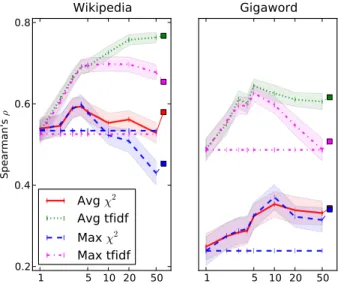
Figure 2 plots Spearman’s ρ on WordSim-353 against the number of clusters (K) for Wikipedia and Gigaword corpora, using pruned tf-idf and χ2
features.2 In general pruned tf-idf features yield higher correlation thanχ2features. Using AvgSim, the multi-prototype approach (K >1) yields higher correlation than the single-prototype approach (K= 1) across all corpora and feature types, achieving state-of-the-art results with pruned tf-idf features. This result is statistically significant in all cases for tf-idf and forK ∈[2,10]on Wikipedia andK > 4
on Gigaword forχ2features.3 MaxSim yields simi-lar performance whenK <10but performance de-grades asKincreases.
It is possible to circumvent the model-selection problem (choosing the best value ofK) by simply combining the prototypes from clusterings of dif-ferent sizes. This approach represents words using both semantically broad and semantically tight pro-totypes, similar to hierarchical clustering. Table 1
and Figure2(squares) show the result of such a com-binedapproach, where the prototypes for clusterings of size 2-5, 10, 20, 50, and 100 are unioned to form a single large prototype set. In general, this approach works about as well as picking the optimal value of
K, even outperforming the single best cluster size for Wikipedia.
Finally, we also compared our method to a pure exemplar approach, averaging similarity across all occurrence pairs.4 Table1 summarizes the results. The exemplar approach yields significantly higher correlation than the single prototype approach in all cases except Gigaword with tf-idf features (p <
0.05). Furthermore, it performs significantlyworse
2
(Feature pruning) We find that results usingtf-idffeatures are extremely sensitive to feature pruning whileχ2features are more robust. In all experiments we prunetf-idffeatures by their overall weight, taking the top 5000. This setting was found to optimize the performance of the single-prototype approach.
3Significance is calculated using the large-sample
approxi-mation of the Spearman ranktest; (p <0.05).
4Averaging across all pairs was found to yield higher
Spearman’sρ prototype exemplar multi-prototype (AvgSim) combined K= 5 K= 20 K= 50 Wikipediatf-idf 0.53±0.02 0.60±0.06 0.69±0.02 0.76±0.01 0.76±0.01 0.77±0.01 Wikipediaχ2 0.54±0.03 0.65±0.07 0.58±0.02 0.56±0.02 0.52±0.03 0.59±0.04 Gigawordtf-idf 0.49±0.02 0.48±0.10 0.64±0.02 0.61±0.02 0.61±0.02 0.62±0.02 Gigawordχ2 0.25±0.03 0.41±0.14 0.32±0.03 0.35±0.03 0.33±0.03 0.34±0.03 Table 1: Spearman correlation on the WordSim-353 dataset broken down by corpus and feature type.
Figure 2: WordSim-353 rank correlation vs. num-ber of clusters (log scale) for both the Wikipedia (left) and Gigaword (right) corpora. Horizontal bars show the performance of single-prototype. Squares indicate performance when combining across clus-terings. Error bars depict 95% confidence intervals using the Spearman test. Squares indicate perfor-mance when combining across clusterings.
than combined multi-prototype for tf-idf features, and does not differ significantly for χ2 features. Overall this result indicates that multi-prototype per-forms at least as well as exemplar in the worst case, and significantly outperforms when using the best feature representation / corpus pair.
4.3 Predicting Near-Synonyms
We next evaluated the multi-prototype approach on its ability to determine the most closely related words for a given target word (using the Wikipedia corpus withtf-idf features). The top k most simi-lar words were computed for each prototype of each target word. Using a forced-choice setup, human subjects were asked to evaluate the quality of these near synonymsrelative to those produced by a
sin-homonymous
carrier, crane, cell, company, issue, interest, match, media, nature, party, practice, plant, racket, recess, reservation, rock, space, value
polysemous
cause, chance, journal, market, network, policy, power, production, series, trading, train
Table 2: Words used in predicting near synonyms.
gle prototype. Participants on Amazon’s Mechani-cal Turk5(Snow et al., 2008) were asked to choose
between two possible alternatives (one from a proto-type model and one from a multi-protoproto-type model) as being most similar to a given target word. The target words were presented either in isolation or in a sentential context randomly selected from the cor-pus. Table2lists the ambiguous words used for this task. They are grouped into homonyms (words with very distinct senses) and polysemes (words with re-lated senses). All words were chosen such that their usages occur within the same part of speech.
In the non-contextual task, 79 unique raters com-pleted 7,620 comparisons of which 72 were dis-carded due to poor performance on a known test set.6 In the contextual task, 127 raters completed 9,930 comparisons of which 87 were discarded.
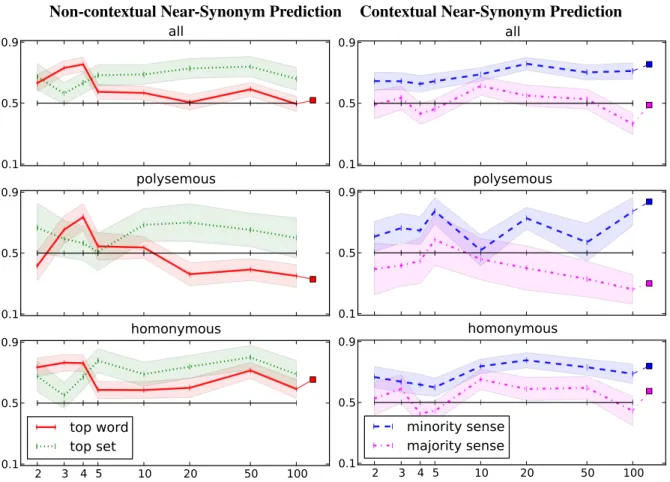
For the non-contextual case, Figure 3 left plots the fraction of raters preferring the multi-prototype prediction (using AvgSim) over that of a single pro-totype as the number of clusters is varied. When asked to choose between the single best word for
5http://mturk.com
6(Rater reliability) The reliability of Mechanical Turk
raters is quite variable, so we computed an accuracy score for each rater by including a control question with a known cor-rect answer in each HIT. Control questions were generated by selecting a random word from WordNet 3.0 and including as possible choices a word in the same synset (correct answer) and a word in a synset with a high path distance (incorrect answer). Raters who got less than 50% of these control questions correct, or spent too little time on the HIT were discarded.
Non-contextual Near-Synonym Prediction Contextual Near-Synonym Prediction
Figure 3: (left) Near-synonym evaluation for isolated words showing fraction of raters preferring multi-prototype results vs. number of clusters. Colored squares indicate performance when combining across clusterings. 95% confidence intervals computed using the Wald test. (right) Near-synonym evaluation for words in a sentential context chosen either from the minority sense or the majority sense.
each method (top word), the multi-prototype pre-diction is chosen significantly more frequently (i.e. the result is above 0.5) when the number of clus-ters is small, but the two methods perform sim-ilarly for larger numbers of clusters (Wald test,
α = 0.05.) Clustering more accurately identi-fies homonyms’ clearly distinct senses and produces prototypes that better capture the different uses of these words. As a result, compared to using a sin-gle prototype, our approach produces better near-synonyms for homonyms compared to polysemes. However, given the right number of clusters, it also produces better results for polysemous words.
The near-synonym prediction task highlights one of the weaknesses of the multi-prototype approach: as the number of clusters increases, the number of occurrences assigned to each cluster decreases, in-creasing noise and resulting in some poor prototypes that mainly cover outliers. The word similarity task
is somewhat robust to this phenomenon, but syn-onym prediction is more affected since only the top predicted choice is used. When raters are forced to chose between the topthreepredictions for each method (presented astop setin Figure3left), the ef-fect of this noise is reduced and the multi-prototype approach remains dominant even for a large num-ber of clusters. This indicates that although more clusters can capture finer-grained sense distinctions, they also can introduce noise.
When presented with words in context (Figure
3 right),7 raters found no significant difference in the two methods for words used in their majority sense.8 However, when a minority sense is
pre-7
Results for the multi-prototype method are generated using AvgSimC (soft assignment) as this was found to significantly outperform MaxSimC.
8Sense frequency determined using Google; senses labeled
sented (e.g. the “prison” sense of cell), raters pre-fer the choice predicted by the multi-prototype ap-proach. This result is to be expected since the sin-gle prototype mainly reflects the majority sense, pre-venting it from predicting appropriate synonyms for a minority sense. Also, once again, the perfor-mance of the multi-prototype approach is better for homonyms than polysemes.
4.4 Predicting Variation in Human Ratings
Variance in pairwise prototype distances can help explain the variance in human similarity judgements for a given word pair. We evaluate this hypothe-sis empirically on WordSim-353 by computing the Spearman correlation between the variance of the per-cluster similarity computations, V[D], D def=
{d(πk(w), πj(w0)) : 1 ≤ k, j ≤ K}, and the
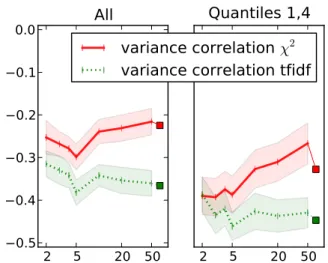
vari-ance of the human annotations for that pair. Cor-relations for each dataset are shown in Figure4left. In general, we find a statistically significantnegative correlation between these values usingχ2 features, indicating that as the entropy of the pairwise cluster similarities increases (i.e., prototypes become more similar, and similarities become uniform), rater dis-agreement increases. This result is intuitive: if the occurrences of a particular word cannot be easily separated into coherent clusters (perhaps indicating high polysemy instead of homonymy), then human judgement will be naturally more difficult.
Rater variance depends more directly on the ac-tual word similarity: word pairs at the extreme ranges of similarity have significantly lower vari-ance as raters are more certain. By removing word pairs with similarity judgements in the middle two quartile ranges (4.4 to 7.5) we find significantly higher variance correlation (Figure 4 right). This result indicates that multi-prototype similarity vari-ance accounts for a secondary effect separate from the primary effect that variance is naturally lower for ratings in extreme ranges.
Although theentropyof the prototypes correlates with the variance of the human ratings, we find that the individual senses captured by each prototype do not correspond to human intuition for a given word, e.g. the “hurricane” sense of position in Figure 1. This notion is evaluated empirically by computing the correlation between the predicted similarity
us-Figure 4: Plots of variance correlation; lower num-bers indicate higher negative correlation, i.e. that prototype entropy predicts rater disagreement. ing the contextual multi-prototype method and hu-man similarity judgements for different usages of thesameword. The Usage Similarity (USim) data set collected in Erk et al. (2009) provides such simi-larity scores from human raters. However, we find no evidence for correlation between USim scores and their corresponding prototype similarity scores (ρ = 0.04), indicating that prototype vectors may not correspond well to human senses.
5 Discussion and Future Work
Table3compares the inferred synonyms for several target words, generally demonstrating the ability of the multi-prototype model to improve the precision of inferred near-synonyms (e.g. in the case ofsinger orneed) as well as its ability to include synonyms from less frequent senses (e.g., theexperimentsense ofresearchor theverifysense ofprove). However, there are a number of ways it could be improved:
Feature representations: Multiple prototypes im-prove Spearman correlation on WordSim-353 com-pared to previous methods using the same under-lying representation (Agirre et al., 2009). How-ever we have not yet evaluated its performance when using more powerful feature representations such those based on Latent or Explicit Semantic Analysis (Deerwester et al., 1990; Gabrilovich and Markovitch, 2007). Due to its modularity, the multi-prototype approach can easily incorporate such ad-vances in order to further improve its effectiveness.
Inferred Thesaurus bass
single guitar, drums, rhythm, piano, acoustic multi basses, contrabass, rhythm, guitar, drums claim
single argue, say, believe, assert, contend multi assert, contend, allege, argue, insist hold
single carry, take, receive, reach, maintain multi carry, maintain, receive, accept, reach maintain
single ensure, establish, achieve, improve, promote multi preserve, ensure, establish, retain, restore prove
single demonstrate, reveal, ensure, confirm, say multi demonstrate, verify, confirm, reveal, admit research
single studies, work, study, training, development multi studies, experiments, study, investigations,
training singer
single musician, actress, actor, guitarist, composer multi vocalist, guitarist, musician,
singer-songwriter, singers
Table 3: Examples of the top 5 inferred near-synonyms using the single- and multi-prototype ap-proaches (with results merged). In general such clustering improves the precision and coverage of the inferred near-synonyms.
Nonparametric clustering: The success of the combined approach indicates that the optimal num-ber of clusters may vary per word. A more prin-cipled approach to selecting the number of proto-types per word is to employ a clustering model with infinite capacity, e.g. the Dirichlet Process Mixture Model (Rasmussen, 2000). Such a model would al-low naturally more polysemous words to adopt more flexible representations.
Cluster similarity metrics: Besides AvgSim and MaxSim, there are many similarity metrics over mixture models, e.g. KL-divergence, which may correlate better with human similarity judgements.
Comparing to traditional senses: Compared to WordNet, our best-performing clusterings are sig-nificantly more fine-grained. Furthermore, they of-ten do not correspond to agreed upon semantic dis-tinctions (e.g., the “hurricane” sense of positionin Fig.1). We posit that the finer-grained senses actu-ally capture useful aspects of word meaning, leading to better correlation with WordSim-353. However, it
would be good to compare prototypes learned from supervised sense inventories to prototypes produced by automatic clustering.
Joint model: The current method independently clusters the contexts of each word, so the senses dis-covered forwcannot influence the senses discovered forw0 6=w. Sharing statistical strength across simi-lar words could yield better results for rarer words. 6 Conclusions
We presented a resource-light model for vector-space word meaning that represents words as col-lections of prototype vectors, naturally accounting for lexical ambiguity. The multi-prototype approach uses word sense discovery to partition a word’s con-texts and construct “sense specific” prototypes for each cluster. Doing so significantly increases the ac-curacy of lexical-similarity computation as demon-strated by improved correlation with human similar-ity judgements and generation of better near syn-onyms according to human evaluators. Further-more, we show that, although performance is sen-sitive to the number of prototypes, combining pro-totypes across a large range of clusterings performs nearly as well as the ex-post best clustering. Finally, variance in the prototype similarities is found to cor-relate with inter-annotator disagreement, suggesting psychological plausibility.
Acknowledgements
We would like to thank Katrin Erk for helpful dis-cussions and making the USim data set available. This work was supported by an NSF Graduate Re-search Fellowship and a Google ReRe-search Award. Experiments were run on the Mastodon Cluster, pro-vided by NSF Grant EIA-0303609.
References
Eneko Agirre and Phillip Edmond. 2006. Word Sense Disambiguation: Algorithms and Applications (Text, Speech and Language Technology). Springer-Verlag New York, Inc., Secaucus, NJ, USA.
Eneko Agirre, Enrique Alfonseca, Keith Hall, Jana Kravalova, Marius Pas¸ca, and Aitor Soroa. 2009. A study on similarity and relatedness using distributional and WordNet-based approaches. InProc. of NAACL-HLT-09, pages 19–27.
F. Gregory Ashby and Leola A. Alfonso-Reese. 1995. Categorization as probability density estimation. J. Math. Psychol., 39(2):216–233.
L. Douglas Baker and Andrew K. McCallum. 1998. Dis-tributional clustering of words for text classification. InProceedings of 21st International ACM SIGIR Con-ference on Research and Development in Information Retrieval, pages 96–103.
Arindam Banerjee, Inderjit Dhillon, Joydeep Ghosh, and Suvrit Sra. 2005. Clustering on the unit hypersphere using von Mises-Fisher distributions. Journal of Ma-chine Learning Research, 6:1345–1382.
Alexander Budanitsky and Graeme Hirst. 2006. Evalu-ating wordnet-based measures of lexical semantic re-latedness.Computational Linguistics, 32(1):13–47. James R. Curran and Marc Moens. 2002. Improvements
in automatic thesaurus extraction. InProceedings of the ACL-02 workshop on Unsupervised lexical acqui-sition, pages 59–66.
James R. Curran. 2004. From Distributional to Seman-tic Similarity. Ph.D. thesis, University of Edinburgh. College of Science.
Scott C. Deerwester, Susan T. Dumais, George W. Fur-nas, Thomas K. Landauer, and Richard A. Harshman. 1990. Indexing by latent semantic analysis. Jour-nal of the American Society for Information Science, 41:391–407.
Inderjit S. Dhillon and Dharmendra S. Modha. 2001. Concept decompositions for large sparse text data us-ing clusterus-ing.Machine Learning, 42:143–175. Katrin Erk, Diana McCarthy, Nicholas Gaylord
Investi-gations on Word Senses, and Word Usages. 2009. In-vestigations on word senses and word usages. InProc. of ACL-09.
Katrin Erk. 2007. A simple, similarity-based model for selectional preferences. In Proceedings of the 45th Annual Meeting of the Association for Computational Linguistics. Association for Computer Linguistics. Lev Finkelstein, Evgeniy Gabrilovich, Yossi Matias,
Ehud Rivlin, Zach Solan, Gadi Wolfman, and Eytan Ruppin. 2001. Placing search in context: the concept revisited. InProc. of WWW-01, pages 406–414, New York, NY, USA. ACM.
Evgeniy Gabrilovich and Shaul Markovitch. 2007. Com-puting semantic relatedness using Wikipedia-based ex-plicit semantic analysis. InProc. of IJCAI-07, pages 1606–1611.
David Graff. 2003. English Gigaword. Linguistic Data Consortium, Philadephia.
Tom L. Griffiths, Kevin. R. Canini, Adam N. Sanborn, and Daniel. J. Navarro. 2007. Unifying rational mod-els of categorization via the hierarchical Dirichlet pro-cess. InProc. of CogSci-07.
Zellig Harris. 1954. Distributional structure. Word, 10(23):146–162.
Lillian Lee. 1999. Measures of distributional similarity. In37th Annual Meeting of the Association for Compu-tational Linguistics, pages 25–32.
Dekang Lin and Patrick Pantel. 2002. Concept discovery from text. InProc. of COLING-02, pages 1–7. Dekang Lin, Shaojun Zhao, Lijuan Qin, and Ming Zhou.
2003. Identifying synonyms among distributionally similar words. InProceedings of the Interational Joint Conference on Artificial Intelligence, pages 1492– 1493. Morgan Kaufmann.
Bradley C. Love, Douglas L. Medin, and Todd M. Gureckis. 2004. SUSTAIN: A network model of cat-egory learning. Psych. Review, 111(2):309–332. Will Lowe. 2001. Towards a theory of semantic space.
InProceedings of the 23rd Annual Meeting of the Cog-nitive Science Society, pages 576–581.
Patrick Pantel and Dekang Lin. 2002. Discovering word senses from text. InProc. of SIGKDD-02, pages 613– 619, New York, NY, USA. ACM.
Fernando C. N. Pereira, Naftali Tishby, and Lillian Lee. 1993. Distributional clustering of English words. In
Proceedings of the 31st Annual Meeting of the Associ-ation for ComputAssoci-ational Linguistics (ACL-93), pages 183–190, Columbus, Ohio.
Daniel Ramage, Anna N. Rafferty, and Christopher D. Manning. 2009. Random walks for text seman-tic similarity. In Proc. of the 2009 Workshop on Graph-based Methods for Natural Language Process-ing (TextGraphs-4), pages 23–31.
Carl E. Rasmussen. 2000. The infinite Gaussian mixture model. InAdvances in Neural Information Processing Systems, pages 554–560. MIT Press.
Yves Rosseel. 2002. Mixture models of categorization.
J. Math. Psychol., 46(2):178–210.
Mark Sanderson. 1994. Word sense disambiguation and information retrieval. In Proc. of SIGIR-94, pages 142–151.
Hinrich Sch¨utze. 1998. Automatic word sense discrimi-nation. Computational Linguistics, 24(1):97–123. Rion Snow, Brendan O’Connor, Daniel Jurafsky, and
An-drew Ng. 2008. Cheap and fast—but is it good? Eval-uating non-expert annotations for natural language tasks. InProc. of EMNLP-08.
Amos Tversky and Itamar Gati. 1982. Similarity, sepa-rability, and the triangle inequality. Psychological Re-view, 89(2):123–154.
Bram Vandekerckhove, Dominiek Sandra, and Walter Daelemans. 2009. A robust and extensible exemplar-based model of thematic fit. InProc. of EACL 2009, pages 826–834. Association for Computational Lin-guistics.