© Copyright 2007 Eduventures, LLC Reproduction Prohibited 1 of 26
Learning Collaborative for Higher Education
Continuing and Professional Education Program Custom Research Report February 2007
Catalog No.116CPECRR0207
Demand for a B.S. in Pharmacy/
Pharmaceutics in NY-NJ Region
Inquiry Overview
A CPE member in the Northeast census region sought data on the demand for a bachelors degree in pharmacy defined by a B.S. focusing on areas relevant to the pharmaceutical industry, in the New York-New Jersey area. The member was most interested in identifying the demand for this degree and hiring expectations among pharmaceutical companies in the region. Additionally, the member sought to identify the structure of other undergraduate programs in pharmacy in order to gain insight into successful program design.
Methodology
In conjunction with the inquiring member, CPE staff
identified organizations with potential demand for and insight into the need for a B.S. in pharmacy and interviewed human resources and pharmaceutical professionals at these
employers and professional associations. CPE staff reviewed data from the Bureau of Labor Statistics (BLS) and the NJ and NY Departments of Labor. CPE staff also referred to institutional Web sites of universities with established undergraduate programs in pharmacy to ascertain information on their structure.
Table of Contents Inquiry Overview 1 Methodology 1 Findings 2 Analysis & Recommendations 24 Bibliography 26
Custom Research Reports - In-depth analysis of issues of concern to individual members. The CPE program maintains dedicated staff to support members' needs for detailed, quick-turnaround research. Requests may be prompted by issues raised in the CPE program's Collaborative Research investigations, may seek to leverage the collective experience of the CPE membership, or may take the form of small-scale primary research investigations or reviews of secondary literature. Requests are fulfilled on a first-come basis and generally take ten weeks to complete subsequent to the receipt of an approved proposal. CPE staff work to deliver accurate, reliable data and information in all cases; however, we cannot guarantee the accuracy of data and information from all sources used.
Data Type Key Sources
Demand for Bachelors Degree in Pharmacy
Bureau of Labor Statistics Pharmaceutical Industry Experts
PHRMA
State Labor Departments Bachelors Degree
in Pharmacy Institutional Websites
Key Questions
What is the potential market demand for a bachelors degree in pharmacy/
pharmaceutics in the NY-NJ region? What is the level of support and demand from regional pharmaceutical companies? How are other degrees in
© Copyright 2006 Eduventures, LLC Reproduction Prohibited 2 of 26
Key steps in this investigation included:
Findings
The objectives of this report were to identify demand for a B.S. in
Pharmacy/Pharmaceutics in the New York-New Jersey region. In addition, CPE staff explored the structure of other similar bachelors degree programs. Thus, in this document CPE staff first review the potential market for a B.S. degree in
pharmacy/pharmaceutics and then pharmaceutical industry demand and support for a B.S. in pharmacy, followed by a comparison of established programs.
CPE staff undertook several different research methods to understand B.S. degree
demand and existing supply. To assess demand, CPE staff reviewed secondary literature, including information from the BLS and the AACP. Interviews with regional industry experts and employers provided additional information on demand. To assess supply, CPE staff identified regional providers and profiled B.S. in Pharmaceutical Sciences programs at AACP Schools of Pharmacy within New York, New Jersey, Pennsylvania, Connecticut, and Massachusetts.
Step 1 Define scope and objectives of inquiry, and formulate hypothesis Step 2 Identify secondary and/or primary sources to be investigated Step 3
Collect data and test research hypothesis Step 4 Summarize key findings with reference to supporting evidence Step 5 Recommend specific actions and areas for further research, if needed Interview CPE member regarding objectives for inquiry Formulate research hypothesis: There is opportunity to offer a bachelors degree in pharmacy in the NY-NJ region Area pharmaceutical organizations PHRMA American Association of Colleges of Pharmacy Bureau of Labor Statistics Institutional Web sites Conduct interviews with area industry experts Collect data from secondary sources Adjust hypothesis based on analysis of data, as necessary Reactions to proposed degree are mixed Area industry expectation for hiring at the B.S. level in a generalist program is moderate Competitors include SUNY-Buffalo, Albany College, Wilkes University Conduct primary research into interest from high school students Follow up with industry contacts to confirm findings within the report; hold focus groups Step 1 Define scope and objectives of inquiry, and formulate hypothesis Step 2 Identify secondary and/or primary sources to be investigated Step 3
Collect data and test research hypothesis Step 4 Summarize key findings with reference to supporting evidence Step 5 Recommend specific actions and areas for further research, if needed Interview CPE member regarding objectives for inquiry Formulate research hypothesis: There is opportunity to offer a bachelors degree in pharmacy in the NY-NJ region Area pharmaceutical organizations PHRMA American Association of Colleges of Pharmacy Bureau of Labor Statistics Institutional Web sites Conduct interviews with area industry experts Collect data from secondary sources Adjust hypothesis based on analysis of data, as necessary Reactions to proposed degree are mixed Area industry expectation for hiring at the B.S. level in a generalist program is moderate Competitors include SUNY-Buffalo, Albany College, Wilkes University Conduct primary research into interest from high school students Follow up with industry contacts to confirm findings within the report; hold focus groups
© Copyright 2006 Eduventures, LLC Reproduction Prohibited 3 of 26
Among the key takeaways of this report are the following: Market Growth Impacting Demand for B.S. in Pharmacy
The New York New Jersey region is anticipated to experience low population growth in the next five years; however, the household income level is rising and the most common educational attainment level is a bachelors degree these trends indicate continued demand for undergraduate programming
The pharmaceutical industry in the New York New Jersey region includes several very large firms such as Johnson & Johnson, Ortho-Neutrogena, and Merck & Co. these employers may be valuable partners in future pharmacy-related programming A bachelors degree is typically an entry point into scientific positions within the pharmaceutical industry and those with a masters or Ph.D. have a greater number of opportunities the inquiring member should structure its programming to meet the needs of niche areas in which hiring at the bachelors degree level is strong
Nationally, high growth is expected among the following occupations in the pharmaceutical industry: medical scientists, business operations specialists,
marketing and sales managers, and biochemists and biophysicists; regionally, high growth is anticipated among pharmacists, life scientists, and sales representatives the inquiring members program should strive to meet the educational requirement of these fields or prepare students for related graduate study where applicable
Approximately 20% of pharmaceutical scientists with the AAPS have a bachelors degree and 80% have an advanced degree; individuals with a bachelors degree and less than five years of experience typically earn just under $60,000 annually the high entry level pay may influence student interest in the proposed degree program Industry Perceptions of the Value of a B.S. in Pharmacy
Hiring among the six employers interviewed is projected to be conservative and stable while the previous two years involved some contraction of the industry in general these growth trends are consistent with those of the state of New Jersey Areas where employers report the most hiring of B.S. prepared individuals include Quality Assurance, Sales, and R&D/Pharmaceutical Technology the inquiring member should structure its program to support these groups
There were mixed impressions of the value of the B.S. in Pharmacy or
Pharmaceutical Sciences to the industry: 3 firms indicated that the value of the program would be moderate to very high, and 3 firms suggest the program would be of moderate to very low value interviewees in business and recruiting operations tend to indicate a high value whereas interviewees working in a more technical capacity indicate a preference for advanced degree candidates
Topic areas of greatest value within a B.S. include a firm understanding of the hard sciences and the following specific areas: sales and marketing, biology, drug development, biotechnology, quality assurance, and chemistry the inquiring member should require specific related content within its degree program
Areas of concentration that employers indicate would have the greatest relevance in the industry include Sales and Marketing and Research & Development these two areas of focus should be offered within the degree program
© Copyright 2006 Eduventures, LLC Reproduction Prohibited 4 of 26
Existing Programs Offering a B.S. in Pharmacy/Pharmaceutical Science
CPE staff identified five institutions in the region offering a B.S. in Pharmaceutical Sciences: The State University of New York at Buffalo, Albany College of Pharmacy at Union College, the University of the Sciences in Philadelphia, Wilkes University, and the Massachusetts College of Pharmacy and Health Sciences there is significant regional competition which may also indicate demand; however, student graduation rates within the pharmaceutical sciences at the B.S. level are limited
All programs are structured in a traditional four-year undergraduate program with face-to-face delivery modality
Required courses commonly include biology, chemistry, mathematics, physiology pharmaceutics, and biochemistry depending on the focus, these courses should also be integrated into the inquiring members curriculum
Competitor programs indicate that graduates are prepared for entry-level employment in the pharmaceutical industry and for graduate school in a variety of areas
The average tuition per credit is $663 for in-state students and $715 for out-of-state students among competitor programs in Pharmaceutical Sciences
Demographic Trends Impacting Demand for a B.S. in Pharmacy/Pharmaceutics In order to understand the demand for a bachelors degree in pharmacy, the inquiring member institution should consider the general demographic population growth and income in the region, the potential job opportunities for graduates of such a program, and the salary expectations for the fields in which graduates would likely be employed. The general population growth within New York and New Jersey is expected to be less than 1% per year for the next five years, indicating growth below the national average; however, this is consistent with much of the Northeast region.
Figure 1. Population and Growth in New Jersey and New York Combined New York and New Jersey -
Statewide Estimate2006 Projection 2006 to 20112011 GrowthAnnual
Total Population 28,183,931 28,810,044 2.20% 0.44% Source: Demographics Now
Census data indicates that while the most common household income level among
residents of New York and New Jersey is $50,000 - $74,999, the higher ranges of income levels are expected to grow into 2011, increasing the average household income to $80,301 and median household income to $58,231. These income levels may indicate increased demand for future post-secondary educational opportunities.
© Copyright 2006 Eduventures, LLC Reproduction Prohibited 5 of 26
Figure 2. New York and New Jersey Average Annual Household Income Annual Household Income Estimate2006 2006% Projection2011 2011% 2006 to 2011
$0 - $15,000 1,463,135 14.20% 1,390,715 13.40% -5.00% $15,000 - $24,999 998,281 9.70% 941,865 9.10% -5.70% $25,000 - $34,999 1,004,188 9.80% 993,586 9.60% -1.10% $35,000 - $49,999 1,351,255 13.20% 1,226,312 11.80% -9.20% $50,000 - $74,999 1,860,791 18.10% 1,772,047 17.10% -4.80% $75,000 - $99,999 1,254,140 12.20% 1,313,793 12.70% 4.80% $100,000 - $149,999 1,345,381 13.10% 1,502,484 14.50% 11.70% $150,000 + 992,190 9.70% 1,246,844 12.00% 25.70% Average Hhld Income 8.30% Median Hhld Income 8.70% $74,128 $80,301 $53,589 $58,231
Source: Demographics Now
The most common educational attainment level among the New York New Jersey population is a high school graduate, attained by over 30% of the population. This
educational attainment level, as well as those with an associates, bachelors, and graduate degree program are expected to grow again demonstrating that while the population may only be growing at a slow rate, the demand for post-secondary education will be rising consistently.
Figure 3. New York and New Jersey Educational Attainment Levels Educational Attainment 2006 Estimate 2006% Projection2011 2011% 2006 to 2011 Age 25+ Population 18,884,113 100.0% 19,523,208 100.0% 3.40%
Grade K - 8 1,035,643 5.5% 814,169 4.2% -21.40%
Grade 9 - 12 1,529,400 8.1% 1,104,719 5.7% -27.80%
High School Graduate 5,825,693 30.9% 6,323,453 32.4% 8.50% Some College, No Degree 2,919,834 15.5% 2,748,300 14.1% -5.90%
Associates Degree 1,383,019 7.3% 1,519,911 7.8% 9.90%
Bachelor's Degree 3,640,015 19.3% 4,117,934 21.1% 13.10%
Graduate Degree 2,550,509 13.5% 2,894,722 14.8% 13.50%
Source: Demographics Now
The pharmaceutical industry in the New York New Jersey region includes several large firms and related occupational opportunities. Across the United States, the
pharmaceutical industry ranks among the fastest growing manufacturing industries, the largest industry class within manufacturing, and is important especially considering the declining growth of the general manufacturing industry. According to the BLS, almost 60% of jobs within the pharmaceutical industry are with firms employing over 500 employees. Large firms in the inquiring member institutions region include those listed in Figure 4.
© Copyright 2006 Eduventures, LLC Reproduction Prohibited 6 of 26
Figure 4. Largest Pharmaceutical Companies in the Region
Company Name Sales ($ mil) Employees
Johnson & Johnson 50,514.00 115,600
Ortho- Neutrogena 7,307.30 95,600
Merck & Co., Inc. 22,011.90 61,500
Wyeth 18,755.80 49,732
Schering- Plough Corporation 9,508.00 32,600
Schering Corporation 2,368.90 18,400
Basfin Corporation 4,268.60 17,331
Pharmacia & Upjohn, Inc 2,059.70 16,000
Novartis Pharmaceuticals Corporation 900.3 7,000
Hoffmann- La Roche Inc. 12,884.10 5,000
The Boc Group Inc 1,614.40 3,600
International Specialty Products Inc. 1,360.00 3,100
Berlin Schering Inc 1,732.10 2,712
Merck Holdings, Inc 346.4 2,700
Johnson & Johnson Pharmaceutical Research & Development, L.L.C. 322.3 2,513
Rhodia Inc. 1,263.00 2,410
Cambrex Corporation 455.1 2,041
Berlex, Inc. 1,258.90 2,000
Organon Pharmaceuticals Usa Inc 223.6 1,747
Janssen, L.P. 206.2 1,600
Daiichi Sankyo, Inc 426.9 1,500
Alpharma Inc. 553.6 1,400
Ge Health 424.3 1,400
Kos Pharmaceuticals, Inc. 751.7 1,361
Dsm Nutritional Products, Inc 153.1 1,200
Novo Industries Of North America, Inc 41 1,200
Lonza America Inc 478.1 1,054
Source: www.hoovers.com
Among those individuals employed in the pharmaceutical industry, pharmaceutical scientists are common; therefore, trends in the employment of chemical or related scientists are relevant to the pharmaceutical industry. According to the Bureau of Labor Statistics:
A bachelors degree in chemistry or a related discipline is the minimum educational requirement; however, many research jobs require a masters degree, or more often a Ph.D.
Job growth will be concentrated in pharmaceutical and medicine manufacturing companies and in professional, scientific, and technical services firms.
Graduates with a bachelors degree will have opportunities at smaller research organizations; those with a masters degree, and particularly those with a Ph.D., will enjoy better opportunities at larger pharmaceutical and biotechnology firms.
© Copyright 2006 Eduventures, LLC Reproduction Prohibited 7 of 26
Figure 5. Pharmaceutical Industry Occupational Employment and Growth in the U.S. Occupation Number in 2004Employment Employment % in 2004 % Change 2004-2014 % Annual Change
Total, all occupations in pharma industry 291,000 100 26.1 2.61
Management, business, and financial
occupations 53,000 18.2 31.7 3.17
Top executives 4,000 1.5 27.8 2.78
Marketing and sales managers 4,000 1.3 34.1 3.41
Industrial production managers 4,000 1.3 28.9 2.89
Natural sciences managers 5,000 1.6 28.9 2.89
Managers, all other 5,000 1.6 28.9 2.89
Business operation specialists, all other 7,000 2.3 41.8 4.18
Accountants and auditors 3,000 1 28.9 2.89
Professional and related occupations 85,000 29.3 31.7 3.17
Computer systems analysts 4,000 1.3 41.7 4.17
Industrial engineers, including health and safey 3,000 1 28.4 2.84
Industrial engineering technicians 3,000 0.9 29.1 2.91
Biochemists and biophysicists 4,000 1.3 41.7 4.17
Microbiologists 3,000 1 28.9 2.89
Medical scientist, except epidemiologists 10,000 3.5 41.8 4.18
Chemists 14,000 5 23.6 2.36
Biological technicians 8,000 2.8 28.2 2.82
Chemical technicians 5,000 1.6 28.9 2.89
Sales and related occupations 9,000 3 27.9 2.79
Sales representatives, wholesale and manufacturing,
technical and scientific products 6,000 2 28.9 2.89
Office and administrative support occupations 34,000 11.6 14.5 1.45 Installation, maintenance, and repair occupations 13,000 4.5 28.8 2.88
Production occupations 79,000 27 21.6 2.16
First-line supevisors/managers of production and
operating workers 7,000 2.5 28.9 2.89
Transportation and material moving occupations 13,000 4.4 20.2 2.02 Source: BLS
Figure 6 identifies employment prospects within Long Island related to occupations relevant for professionals within the pharmaceutical industry. The largest growth is expected among pharmacists and sales representatives of technical and scientific products.
© Copyright 2006 Eduventures, LLC Reproduction Prohibited 8 of 26
Figure 6. Long Island Pharmaceutical-Related Occupational Employment, Wage and Outlook
Job Title Employment Prospects Median Wage Annual Average Openings Training Time
Biological Technicians Favorable $39,590 10 Associate degree Chemical Technicians Favorable $38,900 10 Associate degree
Chemists Favorable $64,060 50 Bachelor's degree
Environmental Scientists and Specialists,
Including Health Favorable $58,680 20 Master's degree Life, Physical, and Social Science Technicians, All
Other Favorable $46,050 10 Associate degree
Medical and Clinical Laboratory Technicians Very Favorable $38,450 70 Associate degree Medical and Clinical Laboratory Technologists Favorable $55,910 60 Bachelor's degree Medical Scientists, Except Epidemiologists Favorable $54,350 20 Doctoral degree Microbiologists Very Favorable $55,050 20 Doctoral degree Pharmacists Very Favorable $90,520 90 First professional degree Pharmacy Technicians Very Favorable $27,280 50 Moderate-term on-the-job training Sales Representatives, Wholesale and
Manufacturing, Technical and Scientific Products Very Favorable $66,430 70 Moderate-term on-the-job training
Source: New York Department of Labor
Most occupations related to the pharmaceutical industry are experiencing favorable employment prospects. The following figure identifies hiring expectations in New York City. The largest need again is for pharmacists and sales representatives in the industry. Many of these related occupations require advanced graduate degrees.
Figure 7. New York City Pharmaceutical-Related Occupational Employment, Wage and Outlook
Job Title Employment Prospects Median Wage Annual Average Openings Training Time
Biochemists and Biophysicists Favorable $54,240 30 Doctoral degree Biological Scientists, All Other Very Favorable $58,340 20 Bachelor's degree Biological Technicians Favorable $39,290 30 Associate degree Chemical Technicians Favorable $36,860 20 Associate degree Chemists Least Favorable $59,320 40 Bachelor's degree Environmental Scientists and Specialists,
Including Health Very Favorable $63,410 40 Master's degree Life, Physical, and Social Science Technicians,
All Other Very Favorable $42,740 90 Associate degree Medical Scientists, Except Epidemiologists Very Favorable $57,270 70 Doctoral degree Microbiologists Favorable $56,250 20 Doctoral degree Pharmacists Very Favorable $88,660 140 First professional degree Pharmacy Technicians Very Favorable $31,250 110 Moderate-term on-the-job training Sales Representatives, Wholesale and
Manufacturing, Technical and Scientific Products Very Favorable $76,700 140 Moderate-term on-the-job training
Source: New York Department of Labor
The New Jersey Department of Labor provides insight to the general trends among pharmaceutical-related employment in the state. The most annual job openings in New Jersey include sales representatives, pharmacists, and life scientists. These trends are provided in Figure 8.
© Copyright 2006 Eduventures, LLC Reproduction Prohibited 9 of 26
Figure 8. New Jersey Pharmaceutical-Related Occupational Employment, Wage and Growth
n % n % n %
Total, All Occupations 4,321,650 100.0 4,732,600 100.0 411,000 9.5 149,540
Life Scientists 7,200 0.2 8,150 0.2 950 13.2 260 N/A
Food Scientists and Technologists 50 0.0 50 0.0 0 16.1 0 Bachelor's degree Biochemists and Biophysicists 1,350 0.0 1,550 0.0 250 17.7 70 Doctoral degree
Epidemiologists 50 0.0 50 0.0 0 7.3 0 Master's degree
Medical Scientists, Except Epidemiologists 3,350 0.1 3,950 0.1 550 17.0 120 Doctoral degree Biological Technicians 2,650 0.1 2,900 0.1 250 9.9 70 Associate degree Chemical Technicians 4,700 0.1 4,700 0.1 0 0.0 120 Associate degree Environmental Science and Protection
Technicians, Including Health 350 0.0 350 0.0 0 0.3 10 Associate degree Pharmacists 7,050 0.2 8,950 0.2 1,850 26.4 320 First professional degree Pharmacy Technicians 4,950 0.1 6,250 0.1 1,300 25.8 190 Moderate-term on-the-job training
Sales Representatives, Wholesale and
Manufacturing 57,750 1.3 65,000 1.4 7,250 12.5 2,240 Moderate-term on-the-job training Sales Representatives, Wholesale and
Manufacturing, Technical and Scientific
Products 14,400 0.3 15,650 0.3 1,250 8.7 500 Moderate-term on-the-job training Annual Average Job Openings Education/Training Requirments
Occupational Title 2004 2014 Change: 2004- 2014
Source: New Jersey Department of Labor
The majority of individuals employed as pharmaceutical scientists (as reported by the American Association of Pharmaceutical Scientists) hold a Ph.D. Additionally,
individuals with a masters degree and a bachelors degree comprise approximately 40% of the pharmaceutical scientists. These trends indicate that the opportunity for a scientific position within the pharmaceutical industry is greater for individuals at the Ph.D. level.
Figure 9. Educational Backgrounds of Members of the American Association of Pharmaceutical Scientists Bachelor's 18% Master's 19% PharmD 3% Ph.D. 58% Other 2%
Source: AAPS Annual Salary Survey
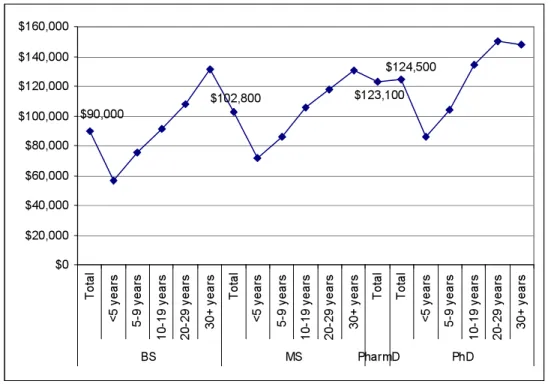
Pay in the pharmaceutical industry is relatively high compared to other industries. An individuals annual salary is positively related to their educational attainment and years of experience. The following figure identifies the average levels of pay by educational attainment (B.S., M.S., Pharm.D., Ph.D.) and by years of experience. Individuals with a
© Copyright 2006 Eduventures, LLC Reproduction Prohibited 10 of 26
bachelors degree often earn just under $60,000 annually with less than five years of experience. This estimation may be similar to what a graduate of a B.S. in Pharmacy or Pharmaceutical Sciences can expect to earn upon graduation.
Figure 10. Annual Salary Based on Educational Attainment and Years of Experience
$124,500 $123,100 $102,800 $90,000 $0 $20,000 $40,000 $60,000 $80,000 $100,000 $120,000 $140,000 $160,000 To ta l <5 y ea rs 5-9 ye ar s 10 -1 9 ye ar s 20 -2 9 ye ar s 30 + ye ar s To ta l <5 y ea rs 5-9 ye ar s 10 -1 9 ye ar s 20 -2 9 ye ar s 30 + ye ar s To ta l To ta l <5 y ea rs 5-9 ye ar s 10 -1 9 ye ar s 20 -2 9 ye ar s 30 + ye ar s BS MS PharmD PhD
Source: AAPS Annual Salary Survey
For individuals working within the pharmaceutical industry (as opposed to academic institutions or the federal government), salary trends are even higher. These salary trends of industry-employed pharmaceutical scientists are listed in Figure 11.
Figure 11. Annual Salary Trends within the Pharmaceutical Industry Based on Education Level Industry
Sector n 25% earn less 50% earn less 75% earn less
Total 1,281 $87,000 $109,000 $140,000
BS 253 $64,900 $86,000 $108,000
MS 235 $76,500 $95,000 $121,000
PharmD 24 $91,500 $118,500 $158,600
PhD 762 $97,400 $120,000 $154,000
© Copyright 2006 Eduventures, LLC Reproduction Prohibited 11 of 26
Industry Perceptions of the Value of a B.S. Pharmacy
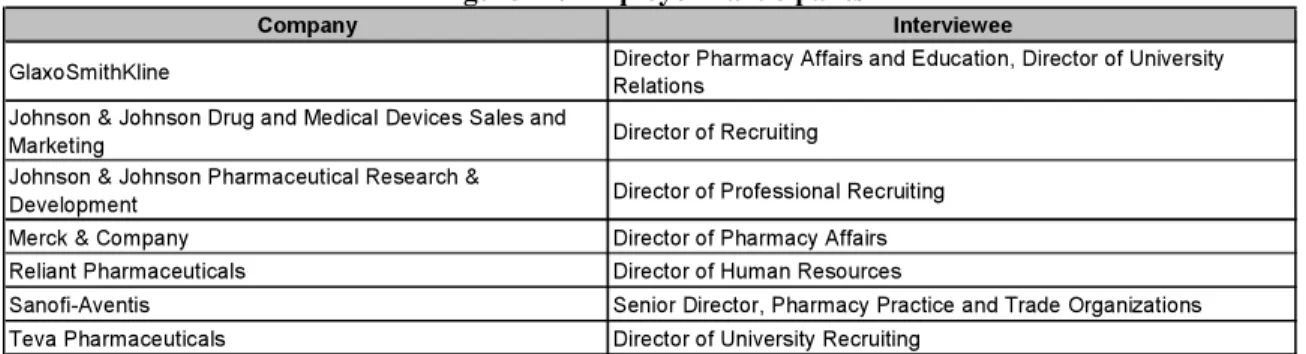
CPE staff contacted individuals within pharmaceutical companies in the New York New Jersey region and engaged in interviews with seven industry experts with insight to the hiring expectations across the organization, and the value of a B.S. in
Pharmacy/Pharmaceutics. The following figure identifies participating organizations interviewed by CPE staff:
Figure 12. Employer Participants
Company Interviewee
GlaxoSmithKline Director Pharmacy Affairs and Education, Director of University Relations Johnson & Johnson Drug and Medical Devices Sales and
Marketing Director of Recruiting
Johnson & Johnson Pharmaceutical Research &
Development Director of Professional Recruiting Merck & Company Director of Pharmacy Affairs Reliant Pharmaceuticals Director of Human Resources
Sanofi-Aventis Senior Director, Pharmacy Practice and Trade Organizations Teva Pharmaceuticals Director of University Recruiting
Hiring Trends
In general, interviewees indicate that the pharmaceutical industry has a somewhat cyclical industry growth pattern and periods where there is more hiring. Interviewed representatives indicated that within the past two years the industry has experienced some consolidation and contraction in the New Jersey New York region. Several interviewed firms indicate that while they are still hiring, the size of their current workforce is
relatively stable, with a few employer exceptions where hiring has been limited or, on the other hand, slightly higher than normal.
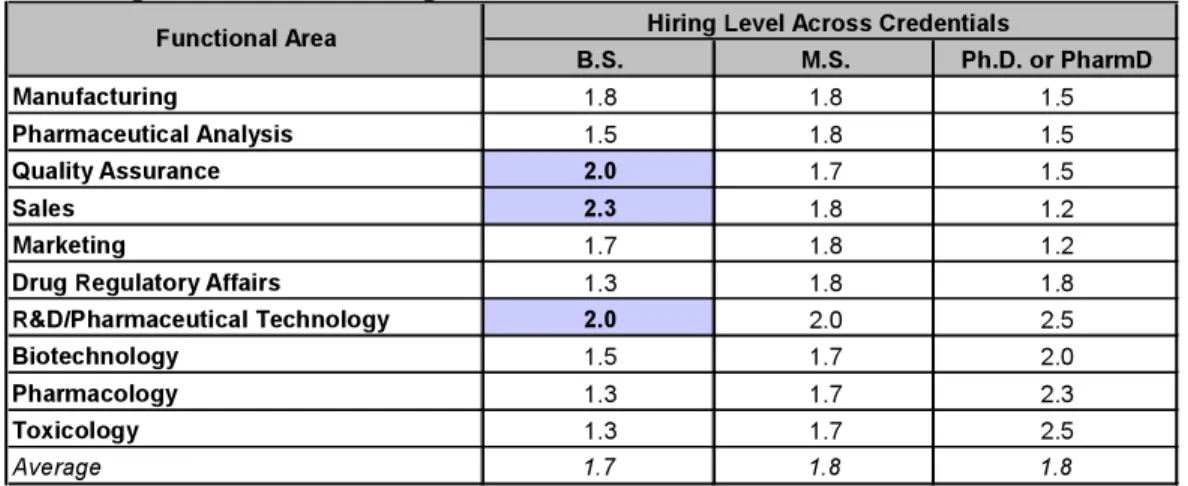
To determine the value of an undergraduate degree in pharmacy, CPE staff asked interviewees to indicate the amount of hiring at the Bachelors, Masters, and Ph.D. levels within specific functional areas of the organization. The following figure identifies trends in hiring across these credential levels by functional area. The functional areas with the highest levels of hiring at the B.S. level include Quality Assurance, Sales, and R&D/Pharmaceutical Technology. These functional areas may present stronger job opportunities to individuals graduating with a B.S. in Pharmacy/Pharmaceutics than other functional areas within the industry.
© Copyright 2006 Eduventures, LLC Reproduction Prohibited 12 of 26
Figure 13. Level of Hiring within Functional Areas Across Credential Levels
B.S. M.S. Ph.D. or PharmD Manufacturing 1.8 1.8 1.5 Pharmaceutical Analysis 1.5 1.8 1.5 Quality Assurance 2.0 1.7 1.5 Sales 2.3 1.8 1.2 Marketing 1.7 1.8 1.2
Drug Regulatory Affairs 1.3 1.8 1.8
R&D/Pharmaceutical Technology 2.0 2.0 2.5
Biotechnology 1.5 1.7 2.0
Pharmacology 1.3 1.7 2.3
Toxicology 1.3 1.7 2.5
Average 1.7 1.8 1.8
Scale: 1=Low levels of hiring, 2=Medium levels of hiring, 3=High levels of hiring
Hiring Level Across Credentials Functional Area
The average number of hires at the B.S. level is lower than that of the M.S. or Ph.D/PharmD level; however, within specific organizations, the demand for B.S. graduates was high in a few specific functional areas. Overall the areas of need for B.S. prepared employees most commonly include sales, quality assurance, and R&D.
According to interviewed employers, there are specific areas that have relatively higher demand at the bachelors degree level than others. These divisions where a bachelors degree is valuable to specific employers are listed below:
Teva Pharmaceuticals Drug Regulatory Affairs Reliant Pharmaceuticals Sales and Marketing GlaxoSmithKline Manufacturing, Sales, and R&D
Sanofi Aventis Manufacturing, Quality Assurance, Sales, and Marketing Merck Pharmaceutical Analysis, Quality Assurance, Sales, and R&D Johnson & Johnson Sales, Manufacturing, Quality Assurance, R&D, and Biotechnology
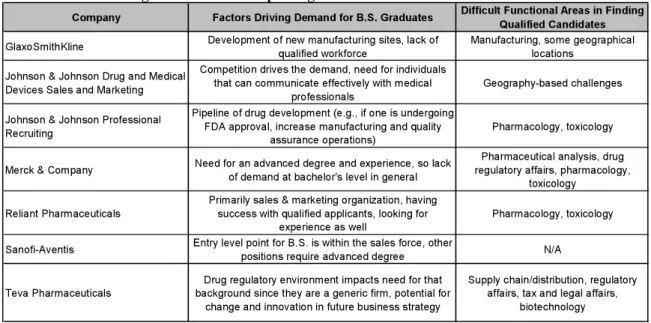
Key factors driving the demand for B.S. graduates at the interviewed firms are provided in the figure below. In addition, Figure 14 identifies functional areas within which the employers experience difficulty in finding qualified candidates
© Copyright 2006 Eduventures, LLC Reproduction Prohibited 13 of 26
Figure 14. Factors Impacting Demand and Hard-to-Fill Areas
Company Factors Driving Demand for B.S. Graduates Difficult Functional Areas in Finding Qualified Candidates GlaxoSmithKline Development of new manufacturing sites, lack of qualified workforce Manufacturing, some geographical locations Johnson & Johnson Drug and Medical
Devices Sales and Marketing
Competition drives the demand, need for individuals that can communicate effectively with medical
professionals Geography-based challenges Johnson & Johnson Professional
Recruiting
Pipeline of drug development (e.g., if one is undergoing FDA approval, increase manufacturing and quality
assurance operations) Pharmacology, toxicology Merck & Company Need for an advanced degree and experience, so lack of demand at bachelor's level in general regulatory affairs, pharmacology, Pharmaceutical analysis, drug
toxicology Reliant Pharmaceuticals Primarily sales & marketing organization, having success with qualified applicants, looking for
experience as well Pharmacology, toxicology Sanofi-Aventis Entry level point for B.S. is within the sales force, other positions require advanced degree N/A
Teva Pharmaceuticals background since they are a generic firm, potential for Drug regulatory environment impacts need for that change and innovation in future business strategy
Supply chain/distribution, regulatory affairs, tax and legal affairs,
biotechnology
Value of a B.S. in Pharmacy/Pharmaceutics
In general, there were mixed opinions on the value of a B.S. in Pharmacy/Pharmaceutics to the interviewees. Employers indicate that the background in the hard sciences would be valuable for both sales and marketing positions and some R&D and scientific positions; however, two interviewed employers indicate that the value of this degree would be no greater (and potentially of less value) than other programs in the traditional sciences.
Among interviewees primarily involved in business operations and recruiting for their pharmaceutical company, there was a general sense that this degree would be valuable for hiring purposes and within specific functional areas. In contrast, among interviewees involved in a very specialized or technical aspect of the industry, there was a level of skepticism in the value of this degree. The general perceptions of the value of the proposed degree program are presented in the following figure.
© Copyright 2006 Eduventures, LLC Reproduction Prohibited 14 of 26
Figure 15. Value of B.S. in Pharmacy/Pharmaceutics
Company Overall Value of B.S. in Pharmaceutics Reasoning
GlaxoSmithKline Moderate/High
Benefit to the organization to have candidates with a strong science background and understanding of the industry, relevant for key positions, need to educate the employers on the curriculum of the program and strengths it provides over traditional sciences
Johnson & Johnson Drug and Medical Devices Sales and
Marketing Very High
Conduct a large amount of hiring at the B.S. level in sales, want candidates that have a strong aptitude in the sciences
Johnson & Johnson Professional
Recruiting High
Line managers are interested in individuals with degrees in pharmaceutical sciences. Also interested in people with experience
Merck & Company Very Low Prefer advanced degree candidates, preference for hard sciences, more value in the master's degree in pharmaceutical sciences/industry
Reliant Pharmaceuticals Low/Moderate Primarily a sales organization looking for individuals with 5-7 years of experience, small R&D unit, preference for PharmD applicants
Sanofi-Aventis Low Tend to hire at the graduate level, lack of value across the entire organization, may only be a few areas of relevance
Teva Pharmaceuticals Moderate
Depends upon alignment with the right part of the business (somewhat limited but relevant application specific to R&D, regulatory affairs, and sales), requires strong science background and some business experience
Qualitative comments by employers profiled within this research investigation provide additional insight into their perception of the value of the proposed degree program. I think the industry is a great field to be in and it would certainly be a benefit to us to have these graduates in areas of manufacturing and for assistant scientists; however, students need to know how to market themselves and compare their backgrounds favorably against other individuals with a more traditional science background.
Director of University Relations, GlaxoSmithKline We want to know that these folks can communicate on a professional level with medical professionals, they need an aptitude for the science behind the profession on a scale of 1 to 10, the attractiveness of this program for sales and marketing people is a 9, very attractive.
Director of Recruiting, Johnson & Johnson, Drug and Medical Devices Sales and Marketing I am involved with hiring individuals who have experience across all professional positions line managers in New Jersey are definitely interested in the Pharmaceutical Science degree A general Pharmaceutical degree that encompasses the lab science and has a diverse mix of related courses would benefit individuals falling into some key job functions like manufacturing, quality assurance, R&D, and biotechnology.
© Copyright 2006 Eduventures, LLC Reproduction Prohibited 15 of 26
The success rate of these programs [B.S. Pharmaceutical Sciences or Pharmacy] has not been that great. If we want someone with a broad background we hire an MBA. In addition, for someone to fill a position in pharmacology, regulatory affairs, and quality assurance we are going after chemists and people with masters degrees. There is a need for strong graduate programs in pharmacology, toxicology, and clinical patient
management.
Director of Pharmacy Affairs, Merck We are not hiring straight of school, we like to see people with 5-7 years of experience, and because of the re-orgs at Pfizer we have a strong applicant pool, so while this may be applicable to a few R&D positions or sales positions, we are not really in need of this degree.
Director of Human Resources, Reliant I have a degree of skepticism from what I have seen people that are successful and desirable candidates are generally advanced people who have gone back and gotten an MBA or another graduate degree, there are only a few areas in which these graduates would have opportunities.
Senior Director, Pharmacy Practice and Trade Organizations, Sanofi-Aventis As a supplement to the data collected within this investigation, the research collected in 2003 by the American Journal of Pharmaceutical Education discusses the value of a B.S. in Pharmaceutical Sciences. This research indicates that a B.S. in Pharmaceutical
Sciences is valuable. Members of the American Association of Pharmaceutical Scientists (AAPS) were asked about the value of designing a B.S. in Pharmaceutical Sciences for industry employment. Their research indicates that 83% of respondents indicate that pharmacy schools should offer these programs to meet industry demand. The general agreement with the level of demand related to specific statements about such programs is provided in the following figure.
© Copyright 2006 Eduventures, LLC Reproduction Prohibited 16 of 26
Figure 16. Perception of Value of Pharmaceutical Degree of Industry (Source: American Journal of Pharmaceutical Education 2003)
Opinions of Whether or Not Pharmacy Schools Should Offer
Undergraduate Degrees in Pharmacy (n=244) Mean Pharmacy schools should offer BS degrees specific to industry employment. 4.0 People with BS degrees in pharmacy would be valuable to my team. 4.0 Four year BS degrees in pharmacy should be offered as a foundation for
graduate studies. 3.9
People with BS degrees in pharmacy would understand the drug development
process better than persons with other BS degrees working for our company. 3.8 More people with BS degrees in pharmacy are needed in the industry. 3.8 People with PhD and BS degree in pharmacy would understand the drug
development process better than PhDs who do not have a pharmacy degree. 3.6 People with a BS degree in pharmacy would have a medical knowledge base
that makes them more valuable to industry than people with other BS degrees. 3.6 Work experience as a pharmacist is valuable for employment in industry. 2.9 People with a PharmD degree are better prepared to work in industry than
people with a BS degree in pharmacy. 2.8
Being a registered pharmacist is necessary to work in industry 1.8 Scale: 1=Strongly disagree, 2=Disagree, 3=Neither disagree nor agree, 4=Agree, 5=Strongly agree
© Copyright 2006 Eduventures, LLC Reproduction Prohibited 17 of 26
Content to Include in a B.S. in Pharmacy/Pharmaceutics
Interviewees commented on the importance of specific content areas to a B.S. in Pharmacy/Pharmaceutics. The following figure identifies the relative rating of specific content areas to the value of the degree program. The topic areas cited as most important included biology, sales and marketing, drug development, biotechnology, chemistry, and quality assurance.
Figure 17. Employer Rating of Content Importance to B.S. in Pharmacy/Pharmaceutics
2.9 3.1 3.2 3.3 3.3 3.3 3.7 3.7 3.8 3.8 4.1 4.3 4.3 4.4 4.5 4.7 0.0 0.5 1.0 1.5 2.0 2.5 3.0 3.5 4.0 4.5 5.0 Industrial Pharmacy Pharmaceutical Engineering Manufacturing Pharmacy Immunology Biostatistics Pharmaceutical Healthcare Biochemistry Pharmaceutical Science/Pharmaceutics Mathematics Microbiology Quality Assurance Chemistry Biotechnology Drug Development Sales and Marketing Biology
Scale: 1=Not at all important, 2=Not very important, 3=Neutral, 4=Important, 5=Very Important
Additional areas cited by some interviewees, which would be relevant to individuals pursuing a bachelors degree in pharmacy or pharmaceutics, include the following:
Regulatory affairs
Business (general, supply chain, finance, marketing, legal environment) Communication (including writing)
Formulation development and scaling up for large manufacturing operations Within the American Journal of Pharmaceutical Education, industry respondents identified the value of specific courses to a B.S. in Pharmaceutical Sciences. The areas identified as most important in this research included drug development, organic chemistry, basic physicochemical principles, and conventional drug delivery systems.
© Copyright 2006 Eduventures, LLC Reproduction Prohibited 18 of 26
Figure 18. Perceptions of Industry Respondents Agreeing that Courses in Stated Content Areas Would be Valuable for a B.S. in Pharmacy Degree (ASPE 2003)
0.0 0.5 1.0 1.5 2.0 2.5 3.0 3.5 4.0 4.5 5.0 Radiopharmacy Physics Immunology Inorganic chemistry Microbiology Calculus Physiology Biology Sterile products Physical chemistry Novel/tareted drug delivery systems Quantitative chemistry Regulatory affairs Biostatistics Research methods Controlled release Biopharmacetics Industry rotation Drug stability Biochemistry Pharmacokinetics Solid oral dosages Conventional drug delivery systems Basic physicochemical prin-ciples Organic chemistry Drug development
Scale: 1=Strongly disagree, 2=Disagree, 3=Neither disagree nor agree, 4=Agree, 5=Strongly agree
Source: ASPE 2003
Taking into consideration the potential job opportunities and areas of demand among profiled employers, the respondents indicated the value of specific undergraduate areas of concentration that would bring additional value to the B.S. program. Areas of
concentration that employers think may be most applicable for a degree in pharmacy/pharmaceutics include those listed below:
Sales and Marketing (most commonly cited) Research and Development (most commonly cited) Cosmetics/Consumer Products
Medical Devices and Diagnostics Engineering
© Copyright 2006 Eduventures, LLC Reproduction Prohibited 19 of 26
Future Dual Degree Opportunities
Most employer interviewees indicate that there is some value in pursuing a dual degree; however, while it may broaden eligibility for more positions or make a candidate slightly more attractive, it is not a requirement for any position in the field. Candidates can increase their general attractiveness in other ways. In addition, the dual degree may be more attractive to the student than it is to an employer.
The dual degree program with the most relevance, and identified as attractive by three employers is a dual PharmD and MBA. One employer indicated that the BSN and MBA may be attractive for individuals interested in pursuing a sales career. Additionally the interviewee from Merck suggests that the PharmD/PhD combination is attractive in areas of Statistics, Population Analysis, and Pharmaco/Epidemiology. These areas are valuable for Pharmaceutical Benefit Managers and the ability to obtain perspective into population analysis is a future demand in the industry. In addition, the Director of Professional Recruiting at Johnson & Johnson suggests a strong value in a PharmD/PhD compared to other dual degree options.
Existing B.S. in Pharmacy/Pharmaceutical Sciences Programs
CPE staff identified Northeast region members of the American Association of Colleges of Pharmacy (AACP) and reviewed the offerings of these schools to identify those with B.S. programs in Pharmacy/Pharmaceutics/Pharmaceutical Sciences. Of those institutions in New York, New Jersey, Pennsylvania, Connecticut, and Massachusetts, five offer a B.S. in Pharmaceutical Sciences. The institutions, degree titles, and Web links are provided below.
Figure 19. Institutions with a B.S. in Pharmaceutical Sciences in the Northeast
Institution * Degree Title Web Link
The State University of New York at Buffalo B.S. Pharmaceutical Sciences http://www.pharmacy.buffalo.edu/psci_desc_degrees.shtml Albany College of Pharmacy at Union College B.S. Pharmaceutical Sciences http://www.acp.edu/academics_bscourses.php University of the Sciences in Philadelphia B.S. Pharmaceutical Sciences http://www.usip.edu/majors/pharmsci.shtml Wilkes University B.S. Pharmaceutical Sciences http://www.wilkes.edu/pages/461.asp Massachusetts College of Pharmacy and Health
Sciences B.S. Pharmaceutical Sciences http://www.mcphs.edu/academics/programs/pharmaceutical_sciences/bs_pharm_sci/
*Schools that are members of AACP (American Association of Colleges of Pharmacy) that have B.S. programs in Pharmacy/Pharmaceutical Sciences in New York, New Jersey, Connecticut, Massachusetts, and Pennsylvania
All of the programs identified are structured in a four-year traditional undergraduate format. The delivery method for all programs is a face-to-face on-campus modality. Required courses for the degree program typically include biology, chemistry,
mathematics, physiology, pharmaceutics, and biochemistry. The figure on the next page identifies the specific required courses for the major (and some suggested courses in addition to those specifically required).
© Copyright 2006 Eduventures, LLC Reproduction Prohibited 20 of 26
Figure 20. Required & Suggested Courses in the B.S. Degree Program
Institution Required Courses
The State University of New York at Buffalo
Principles of Biochemistry Principles of Pharmacology I and II Introduction to Analytical Chemistry Human Physiology I and II
Pharmaceutical Mathematics and Statistics Physical Pharmacy
Case Studies in the Pharmaceutical Sciences Introduction to Research
Undergraduate Research Participation in Pharmaceutical Sciences Introduction to Pharmacokinetics and Biopharmaceutics I Pharmaceutics Seminar I and II
Pharmaceutical Analysis Pharmaceutical Principles
Pharmaceutical Biotechnology: From Bench to Bedside and Virtual Laboratory Important Advances in Pharmaceutical Sciences
Methods of Scientific Communication
Science electives or PHC 408 Undergraduate Research Participation in Pharmaceutical Sciences Two science electives
Albany College of Pharmacy at Union College
General Biology I and II General Chemistry I and II Math Concepts Calculus I and II Humanities I and II and III
Academic Reading and Writing or Principles of Communication* Organic Chemistry I and II
Physics I and II Statistics Biochemistry Molecular Biology
Physiology/Pathophysiology I and II
Pharmaceutics I (Physical Pharmacy) and II (Dosage Forms) Pharmaceutical Analytical Techniques I and II
Pharmacology I Scientific Communication Independent Research I and II
University of the Sciences in Philadelphia
College Composition and Introduction to Literature General Biology I and II
General Chemistry I and II with Labs Mathematical Analysis I and II Pharmaceutical Sciences Orientation I Physical Education I and II
Social Science Fundamental Requirement I and II Intellectual Heritage I and II
Introduction to Biostatistics or Core Elective Introductory Physics I and II
Organic Chemistry I and II and Labs Human Structure & Function I & II Pharmaceutical Sciences Orientation II Biochemistry/Molecular Biology I and Biology II Core Distribution Requirement
Introduction to Communication and Scientific Writing Pharmaceutics and Biopharmaceutics I and II and Lab Pharmaceutical Sciences Seminar I
Introduction to Biostatistics or Core Elective
Legal Aspects of Drug Development, Production, and Marketing Manufacturing Pharmacy I and Lab
Pharmaceutical Sciences Seminar II Project in Pharmaceutics (elective) Survey of Pharmacology Analytical Chemistry and Lab Controlled Release Dosage Forms Cosmetic Science and Lab Research Methods in Drug Delivery
© Copyright 2006 Eduventures, LLC Reproduction Prohibited 21 of 26
Figure 20. Required & Suggested Courses in the B.S. Degree Program (Continued)
Institution Required Courses
Wilkes University
Principles of Mod. Bio. I and. II
Elements & Compounds & Associated Laboratory The Chemical Reaction & Associated Laboratory Calculus I and II
First-Year Foundations and Composition Organic Chemistry I & II & Associated Laboratory General Physics I and II
Elementary Statistics
Fundamentals of Speech and Technical Writing Computers & Applications
Distribution Requirements I and II Medicinal Chemistry
Instrumental Analysis & Associated Laboratory Physical Chemistry I and II
A&P I and II
Distribution Requirements Clinical Research Design Medical Biochemistry Advanced Pharmaceutics Pharmaceutical Regulatory Affairs Heterogeneous Pharmaceutical Systems Operation of Quality Control Systems Solid Dosage Forms
Externship
Biopharmaceutics and Pharmacokinetics Senior Research Project
Pharmacology and Medicinal Chemistry
Massachusetts College of Pharmacy and Health Sciences
Biology I: and Biology II (w/lab) Chemical Principles I and II (w/lab) First Year Seminar 1
Expository I and II
Introduction to Psychology or Introduction to Sociology Foundations of Calculus I and II
American Culture, Identity and Public Life Medical Microbiology (w/ lab)
Organic Chemistry I and II (w/ lab) Statistics
Introduction to Health Care Delivery Analytical Chemistry
Interpersonal Communication in the Health Professions Economics
Human Physiology and II Medical Biochemistry
Pharmaceutics I and II with Labs
Introduction to Pharmacy Practice Management Physico-Chemical Properties of Drug Molecules 3 Pathophysiology
Health Care Ethics Computer Applications Pharmaceutical Regulation and
Pharmacology for Allied Health Professionals Pharmaceutical Technology
© Copyright 2006 Eduventures, LLC Reproduction Prohibited 22 of 26
Most program descriptions indicate that the content of the degree involves a heavy focus in the sciences, with elements that contribute to knowledge of the pharmaceutical
industry and also assist students in analysis and laboratory components. These program descriptions suggest that the degree provides a foundation for a career in the
pharmaceutical industry or further study in pharmacy-related topics. The specific marketing messages and proposed outcomes for individuals majoring in pharmaceutical science are provided in the following figure.
Figure 21. Description of B.S. Degree Programs and Suggested Outcomes or Career Paths for Graduates
Institution Description Outcomes
The State University of New York at Buffalo
This four-year science degree program emphasizes the foundational principles of science and research relevant to the pharmaceutical sciences discipline. The program was one of the first in the country, with the first degree conferred in the 1960s. The program's comprehensive approach to educating students has led to an outstanding reputation throughout the world. The pharmaceutical sciences program emphasizes a laboratory research experience by requiring a structured laboratory course, participation in a research project, and presentation of research results.
Graduates of this program are well educated and well prepared to fulfill positions within the pharmaceutical industry, sales, or graduate studies. Students interested in the major must apply to the pharmaceutical sciences program in the spring of their second (sophomore) year.
Albany College of Pharmacy at Union College
ACPs four-year B.S. in Pharmaceutical Sciences degree provides a strong foundation in the pharmaceutical sciences.
Graduates from this four-year program will be well-prepared for entrance into graduate (M.B.A., M.S., Ph.D.), business, medical, dental, veterinary and law school programs. Students also will be highly qualified for entry-level positions in pharmaceutical, chemical and biotechnology industries. Admission criteria are the same as the Pharm.D. program
University of the Sciences in Philadelphia
As a specialist in pharmaceutical sciences, you will aid in developing, manufacturing, and evaluating products such as tablets, capsules, ointments, and liquids for medicinal, nutritional, and cosmetic use.
Our four-year degree prepares you for a career in: Research, Drug delivery, Product development/formulation, Production/manufacturing, Quality control/quality assurance, Packaging, Drug stability testing, Regulatory affairs. USP's program also offers excellent preparation for those who want to pursue M.S. or Ph.D. degrees in pharmaceutics, as well as those planning to enter medical/osteopathic, dental, M.B.A., or law programs
Wilkes University The rapid change in the pharmacy field is complemented by an equal boom in pharmaceutical research and development.
.The BSPS degree in the pharmaceutical sciences will prepare students who are interested in pharmaceutical research and development of new drugs rather than a career in direct patient care. It will also prepare those who are interested in graduate school.
Massachusetts College of Pharmacy and Health Sciences
This full-time undergraduate program provides a broad-based education in the basic biological and pharmaceutical sciences with a focus on core areas of industrial pharmacy. Learner-centered teaching fosters student engagement and develops intellectual vitality and critical thinking skills. The program integrates the pre-professional studies with the Arts and Sciences core curriculum, emphasizing the basic sciences, oral and written communication skills, the liberal arts, and ethics. The curriculum is designed to develop critical thinking and decision-making skills, encourage the development of honesty, integrity, professionalism and personal responsibility, as well as adaptability and flexibility in response to the ever-changing external environment.
The BS in pharmaceutical sciences program provides skills and experience for use in pharmaceutical, biotechnology and medical device development, formulation, manufacturing, and evaluation and the regulatory oversight of the drug and medical device industry. Graduates are also prepared to continue their education in post-graduate programs that could include pharmaceutics/industrial pharmacy, biotechnology and regulatory affairs masters or doctoral degrees.
© Copyright 2006 Eduventures, LLC Reproduction Prohibited 23 of 26
To get a better sense of the success of these programs in Pharmaceutical Sciences among the profiled institutions, CPE staff identified degrees awarded by the profiled institutions at the B.S. level in related fields, according to the National Center for Education
Statistics. In general, these programs maintain small cohorts of students, as demonstrated in Figure 22.
Figure 22. Number of Degrees Awarded in Pharmacy/Pharmaceutical Sciences at the B.S. Level Institution Degree Title Number of Degrees Conferred July 1, 2004 to June 30, 2005 SUNY at Buffalo Pharmacy, Pharmaceutical Sciences, and Administration, Other 11
Albany College of Pharmacy Pharmacy (PharmD [USA], PharmD or BS/BPharm [Canada]) 5 University of the Sciences in
Philadelphia Pharmacy, Pharmaceutical Sciences, and Administration, Other 10
Wilkes University None listed N/A
Massachusetts College of
Pharmacy and Health Sciences Pharmacy, Pharmaceutical Sciences, and Administration, Other 18 Source: NCES Integrated Post-Secondary Education Data System
Institutions offering their undergraduate degree program in pharmaceutical sciences use the same tuition rates as charged to other traditional undergraduate students.
Additionally, only the State University of New York Buffalo has tuition rates that differ between in-state and out-of-state students. The average tuition and major fees per credit is approximately $700. These details are provided in the following figure.
Figure 23. Estimated Tuition Rates of B.S. Degree Programs
Institution In-State Tuition* Out-of-State Tuition*
The State University of New York at
Buffalo $259.47 $520.47
Albany College of Pharmacy at Union
College $645.00 $645.00
University of the Sciences in
Philadelphia $806.67 $806.67
Wilkes University $824.33 $824.33
Massachusetts College of Pharmacy
and Health Sciences $780.00 $780.00
Average Tuition Rate $663.09 $715.29
*Estimated Tuition is calculated by providing the tuition rate per credit listed by the institution or dividing the yearly tuition for full-time students by 30 (assuming 30 credits per year)
© Copyright 2006 Eduventures, LLC Reproduction Prohibited 24 of 26
Analysis and Recommendations
The New York New Jersey region has a high presence of pharmaceutical companies; the chemical manufacturing industry is the largest industry in the state of New Jersey.
Although this industry is expected to decline slightly, there is expected growth within specific occupations and replacement hiring will make job opportunities steady in the industry. The high numbers of individuals in the region with a high school diploma as their highest level of educational attainment and the growing income levels will increase the demand for further undergraduate educational opportunities. Thus there is evidence of potential demand for education and training to supply a qualified workforce.
The perceived value of a B.S. in Pharmacy/Pharmaceutics varied across organizations CPE staff spoke with during this investigation. Two key market segments emerged technical and scientific and non-technical or less advanced scientifically. Conversations with recruiting, business/sales, and university relations professionals tend to indicate that there are areas of employment such as sales, manufacturing, quality assurance and small segments of R&D within which this degree may be very valuable. In contrast, some interviewees working in more technical and narrow occupations indicated the degree offered less value to the organization. These interviewees suggest that they commonly hire individuals with advanced degrees, both at the Masters and Ph.D. levels. The inquiring member should aim to work with recruiting, sales, and university relations professionals when continuing to develop this degree program.
Employers indicate a demand for experience but also some interest in opportunities for college graduates (of a proposed B.S. program). Across the employers profiled, all seek to hire candidates with prior experience where possible, except for areas like sales in some organizations, specific roles in manufacturing, and some quality assurance or R&D functional areas. In these areas, specific occupations may be targeted to undergraduates and experience may be preferred but not required.
To meet the needs of the industry, the inquiring member institution should provide content in line with the opportunities for B.S. graduates. The inquiring member should aim to develop an internship program or specific industry partnerships to promote internship opportunities to allow students to develop some of this required experience while working towards their degree. The proposed degree program should offer a strong focus on the sciences, with firm basis across the fundamental areas including biology, chemistry, and drug development. The proposed program should prepare graduates for both employment in the industry and advanced graduate work in more targeted fields of expertise. Furthermore, to meet the needs of the area employers, the inquiring member should develop its program to prepare graduates to work within positions of the
following functional areas, potentially by offering areas of related concentration: Sales
Manufacturing Quality Assurance
© Copyright 2006 Eduventures, LLC Reproduction Prohibited 25 of 26
Research & Development
Given the somewhat limited scope of occupations available at the B.S. degree level across area firms, and the relatively small number of degrees awarded by area competitor institutions, the inquiring member, if it moves forward with the proposed program, should anticipate and initiate a small program to test its success.
During the next phases of program development, the inquiring member should leverage the feedback and input of contacts made through this research investigation. Specifically contacts at Johnson & Johnson and GlaxoSmithKline, who are interested in the program, may provide valuable insight to its further development and potential internship
opportunities. In addition, the inquiring member should reach out to undergraduate students to test their interest in the proposed degree program through a primary survey or focus groups of individuals interested in or majoring in the traditional or health-related sciences.
© Copyright 2006 Eduventures, LLC Reproduction Prohibited 26 of 26
Bibliography
American Journal of Pharmaceutical Education, Evaluating the Pharmaceutical Industrys Need for Graduates with a Bachelor of Science Degree in Pharmaceutical Sciences. 2003
American Association of Pharmaceutical Sciences, AAPS Salary Survey 2006,
http://www.aapspharmaceutica.com/careercenter/resources/imagespdfs/salarysurvey2006.pdf Brooks, Jennifer. Director of University Relations, GlaxoSmithKline, Telephone Interview
Bureau of Labor Statistics. Occupational Outlook Handbook Pharmaceutical Industry, BLS. Accessed January 4, 2006. http://www.bls.gov
Caro, James. Senior Director, Pharmacy Practice and Trade Organizations, Sanofi-Aventis. Telephone Interview.
Demographics Now. United States New Jersey and New York Demographic Summary Report Using Census Data 2000, 2006, 2011. http://www.demographicsnow.com/
Hildebrandt, Eric. Director of Sales and Marketing Recruiting, Johnson & Johnson, Telephone Interview. Hoovers Business Information, www.hoovers.com
Kalinowski, Steven. Director of Pharmacy Affairs and Education, GlaxoSmithKline, Telephone Interview. Miller, David. Director of Pharmacy Affairs, Merck & Co., Telephone Interview.
National Center for Education Statistics, IPEDS, College Opportunities Online. www.nces.ed.gov/ipeds
New York Department of Labor,http://www.labor.state.ny.us/workforceindustrydata/index.asp New Jersey Department of Labor, http://www.nj.gov/labor/index.html
Patel, Anisha. Director of Professional Recruiting, Johnson & Johnson, Telephone Interview. Queen, Laura. Director of University Recruiting, Teva Pharmaceuticals, Telephone Interview. Warner, Mary Beth. Director of Human Resources, Reliant Pharmaceuticals, Telephone Interview.