Using Sparse Representation and Local Features
Alessandro Adamo1, Giuliano Grossi2, and Raffaella Lanzarotti2 1 Dipartimento di Matematica, Università degli Studi di Milano
Via Saldini 50, 20133 Milano, Italy
2 Dipartimento di Informatica, Università degli Studi di Milano Via Comelico 39, 20135 Milano, Italy
{adamo,grossi,lanzarotti}@di.unimi.it
Abstract. Face recognition in presence of either occlusions,
illumina-tion changes or large expression variaillumina-tions is still an open problem. This paper addresses this issue presenting a new local-based face recognition system that combines weak classifiers yielding a strong one. The method relies on sparse approximation using dictionaries built on a pool of local features extracted from automatically cropped images. Experiments on the AR database show the effectiveness of our method, which outper-forms current state-of-the art techniques.
Keywords: Sparse representation, face recognition, face partial
occlu-sions, expression variations, illumination variations, local features.
1
Introduction
Nowadays face recognition (FR) techniques perform very well in controlled con-ditions [17] but suffer when applied in real-world contexts [13,10]. This is the frontier we want to investigate in this work. In particular we focus the atten-tion on three aspects: illuminaatten-tion variaatten-tions, continuous occlusions, and large expression variations [12,9]. From the literature it is well known that local-based methods behave better than holistic ones [8,16] in presence of occlusions. This consideration can be extended to both light and expression variations which affect heavily only certain face regions, leaving others less altered [12].
Following these results, we introduce a new Local-based Face Recognition (LFR) system, namelyk-LiMapS_LFR relying on a pool of local features and on the sparse representation paradigm [16] for classification. In particular, we adopt the k-LiMapS sparse approximation algorithm [1,2]: an easy and fast iterative schema based on suitable Lipschitzian type mappings which allows to capture sparsity in feature subspaces spanned by suitable dictionaries.
The system we propose is tested on face images either manually or automat-ically cropped, in order to verify the robustness to possible misalignments. In particular, the automatic cropping is attained adopting the face detector pro-posed in [14], and augmenting the precision applying the eyes and mouth locator (EML) presented in [4].
A. Petrosino (Ed.): ICIAP 2013, Part II, LNCS 8157, pp. 31–40, 2013. c
The proposed technique can be setup adopting any local feature. In this work we use features which have demonstrated a good discriminative capability, such as, raw patches randomly extracted (namely Random Tessellation features), LBP [3], MSLBP [5], Gabor filters [15] and HLAC [6].
The rest of the article is organized as follows: we first recall the general sparse recovery (or sparse representation, SR) framework and the elements of novelty of our method; then we briefly recall the rationale of thek-LiMapSalgorithm, and finally we present extensive results obtained on the AR database [7] comparing our method versus the well known SRC [16] and PFI [11] algorithms, both on manual and automatic face cropping.
2
Sparse Representation-Based Classification
The mathematical problem statement of SR consists in finding the sparsest rep-resentation of a vectorx∈Rngiven an overcomplete dictionaryΦ= [φ
1, . . . , φm]
assumed to be a collection ofm > natoms or vectors inRn. A sparse
represen-tation forxcan be expressed as a linear combination of atoms, i.e.x=iαiφi, or equivalently in matricial form
Φα=x, (1)
and is measured in terms of0pseudo-normα0, simply representing the num-ber of non-zero elements inα. More generally, it is not sensible to assume that the available data x obeys to the precise equality (1) with a sparse represen-tationα0 =k n. A more plausible scenario assumes sparse approximate representation in which there is an ideal noiseless signal x(admitting a sparse representation) corrupted by noise, leading to the modelx=Φα+ε, in which error or noise ε ∈ Rn gives rise, for instances, to measurements or estimates. Adopting this noisy setting, the general goal of finding the sparsest decomposi-tion of the signalxcan be rephrased as the constrained minimization problem
min
α∈Rmx−Φα
2
subject to α0≤k, (P0) where · denotes the2-norm.
In [16] it has been proposed the SRC algorithm, a pioneering work adopting SR as FR system. Here we present a local FRS, namely thek-LiMapS_LFR, which constructs a set of dictionaries based on local features, and combines these weak classifiers via the majority vote rule. The idea is to characterize faces in the training set with a large pool of independent local features, in order to have a sufficiently rich face description even in presence of occlusions or deformations caused by strong expression variations. Thek-LiMapS_LFR system requires as input face images at least roughly localized. To this end, in the case of automatic cropping, the images are preprocessed by the face detector proposed in [14], and the eyes and mouth detector (EML) presented in [4]. The EML, besides the primary functionality of improving the face alignment, reveals possible occlusions as mentioned below. In the following we describe our method.
Suppose we are dealing with cdifferent classes or subjects, labelled 1, . . . , c, and there are exactly k training samples for each subject s∈ {1, . . . , c}. Each training image is characterized applying a pool of features,f1, . . . , fd, to local
subimages or patches cropped around to a fixed set of randomly selected pixels p1, . . . , ph, thus obtainingd×hdictionaries. According to thei-th feature applied
in the j-th pixel, the dictionary Φi,j ∈ Rn×k c (with n < k c) represents the entire training set (consisting ofkimages for each of thecsubjects) obtained by stacking the feature-vectors as columns:
Φi,j=
fi(1,1)(pj), . . . , fi(c,k)(pj)
, i= 1, . . . , d, j = 1, . . . , h. For a given test image I, the FR system extracts the corresponding local features
zi,j=fi(pj), i= 1, . . . , d, j= 1, . . . , h,
and performs thek-LiMapSalgorithm (see next section) to find the sparse vector αsuch thatΦi,jα≈zi,j. In the purpose of solving the membership χi,j of the local featurezi,j, the algorithm looks for the linear span of the training samples in Φi,j associated with the subject s∈ {1, . . . , c} that better approximates the feature vectorzi,j. In other words, by denoting with ˆαs the coefficient vector whose only nonzero entries are the ones inα associated to classs, it classifies zi,jminimizing its residual with the linear combinationΦi,jαˆs, i.e. applying the
following rule:
χi,j= argmin
s∈{1,..,c}zi,j−Φi,j
ˆ
αs, i= 1, . . . , d, j= 1, . . . , h.
The final classification of I is obtained applying the majority vote rule over all local classifier results χ1,1, . . . , χd,h. In Algorithm 1 we sketch the whole
algorithm.
3
k
-LiMapS Rationale
To solve the underdetermined inhomogeneous system (1) our FRS applies thek -LiMapSalgorithm (k-Coefficients Lipschitzian Mappings for Sparsity) proposed in [1], which has demonstrated both its efficacy and its low computa-tional costs. Briefly, for a desired sparsity levelk >0 fixed a priori, the method iterates a parametric family of nonlinear shrinking mappings along the affine space AΦ,x = {α ∈ Rm : Φα = x}, associated to the system favoring sparse
near-feasible solutions. To recover in turn admissible sparse solutions, an alter-nating stage envisages the use of an orthogonal projectorP =I−Φ†Φ, whereIis the identity operator andΦ† = (ΦTΦ)−1
ΦT the Moore-Penrose pseudo-inverse,
onto the feasible space. The process yields a Cauchy sequence {αt}t≥1 in the Hilbert spacem
2 for which limit point exists regardless of the initial guess. At the end of the process, depending on whether the signal under examxadmits or not ak-sparse representation, an hard thresholding operation is applied to solutionα∈Rmso thatα0=k.
Algorithm 1.k-LiMapS_LFR
Dictionary construction:
Require: csubjects,ktraining images per subject,dlocal features
1: Randomly generatehkey points 2: for all Training set images Itdo 3: EML(Viola-Jones(It))
4: for all Key pointspj and Featuresfido
5: Computeft i(pj) 6: end for 7: end for 8: Dictionaries: Φi,j= fi(t)(pj) , t= 1, . . . , c·k
Testing phase on imageI:
1: EML(Viola-Jones(I ))
2: Feature extraction:zi,j=fi(pj), i= 1, . . . , d, j= 1, . . . , h 3: Sparse solutionαviak-LiMapSalgorithm (see next session) 4: Local classifications: χi,j= argmins∈{1,..,c}zi,j−Φi,jαˆs. 5: Majority vote on (χ1,1, . . . , χd,h)
To better understand the computation of the final solution, the pseudo-code ofk-LiMapSis reported in Algorithm 2.
Two aspects affectingk-LiMapSperformance deserve to be discussed: how to tune the sparsity levelk in problem (P0) and how to define the stop condition of the while loop of the algorithm. Guided by empirical evidence on the perfor-mance assessment, we faced the first question by fixingk equal to the number of images per subject in the training set. In this way very few coefficients are preserved while the most part is discarded as shown in Figure 1 (left), where the absolute values of the coefficients are plotted in descent order (blue saved and red discarded). 5 10 15 20 25 30 35 40 45 0.05 0.1 0.15 0.2 0.25 0.3 0.35 5 10 15 20 25 30 0.5 1 1.5 2 2.5 3 3.5 4 # iterations Square errors
Fig. 1.(Left) Absolute values of the coefficients in descent order with sparsity
con-straintk= 5. The first five coefficients (blue stems) are preserved while the remaining (red stems) are discarded. (Right) Approximation error in2-norm referred to some sparse solutions during the iterations ofk-LiMapS.
Algorithm 2.k-LiMapS
Require: ProjectorP=I−Φ†Φ, sparsity levelk, initial guessν=Φ†x
1: α←ν
2: while [ cond ] do
3: α←α−P αe−λ|α| <orthogonal projection>
4: σ←sort (|α|) <descending order coefficients>
5: λ←1/σk <sparsity ratio update>
6: αj←0 ∀js.t. |αj| ≤σk <thresholding>
7: end while
Ensure: An approx. solutions≈Φαs.t.α0≤k
Secondly, a suitable stop condition for the SR process may be grasped ob-serving the minimization of the least squares objective function defined in (P0), under the sparsity constraint forced by the0-pseudo norm. In Figure 1 (right) the error variations together with the number of iterations are drawn for some test images. The graphic captures quite well the typical behavior ofk-LiMapSas minimizer for the problem, highlighting that the local minimum is reached within very few iterations of the while loop at the heart of Algorithm 2. This suggests a stop condition for such a loop: end when no cost function reduction is attained. Notice that the stop condition also influences the time complexity of the algorithm. Although a fair rule to stop the iterative process does not exist, using the above stop condition in the most part of the cases the number of iterations drops to few instances giving a good approximation.
4
Experimental Results
In this section we present the experiments on thek-LiMapS_LFR1. The system could work referring to any pool of local features. In this work we choose five features aiming at capturing a wide variety of image information useful in the FR task: the LBP and its generalization, the MSLBP, are good texture descrip-tors, while the Gabor filters and the HLAC features capture salient edges and characteristic shapes. In addiction to these well justified filters, we also use sim-ple raw data consisting in squared patches (RT) centered in each chosen point and normalized, aiming at reducing possible illumination problems.
The experiments refer to the AR database [7] which consists of face images of 126 subjects (70 men and 56 women) acquired in two sessions, each one varying 13 different conditions covering both illumination and expression variations as well as occlusions caused by either scarves or sunglasses. The experiments have been conducted referring to a pool of 100 subjects (50 men and 50 women), averaging the results over 50 trials so guaranteeing a high confidence level.
1 MATLAB code ofk-LiMapS_LFR and all tests done are available on the website
For comparison purpose, we run both SRC [16] and PFI [11] algorithms. The first represents the state-of-the-art in the sparsity framework, while the second uses a large feature set extracted locally on each image. The SRC algorithm has been developed to manage possible occlusions, so we apply it directly. On the contrary, the PFI algorithm has been proposed for non occluded faces, so, in order to apply it in the occluded case, we discard the corrupted half face (the lower half for scarf and the upper half for sunglasses).
We setup four kinds of experiments described below. In all cases, the training sets consist of non occluded images, with k = 5 (the number of images for subject in training). This is a tradeoff between the necessity of representing subjects in several conditions (potentially constructing a complete base) and the requirement to keepksmall in order to emulate realistic scenarios.
Sunglasses. Training set: all images of subjects acquired in the first session with different illumination conditions, with neutral or smiling expression and no occlusion (labelled as either 1, 2, 5-7). Test set: subjects wearing sunglasses and acquired in different illumination conditions (AR images labelled as 8-10, 21-23).
Scarf. Training set: as in the previous experiment, that is all images labelled as either 1, 2, 5-7. Test set: subjects wearing scarves and acquired in different illumination conditions (images labelled as 11-13, 24-26).
Illuminations. Training set: as in the previous experiment, that is all images labelled as either 1, 2, 5-7. Test set: images with no occlusion corrupted by strong illumination variations (images labelled as 14, 15, 18-20).
Expressions. Training set: all images of subjects acquired in the first session, having different facial expressions (labelled as either 1-4 or 7). Test set: subjects showing strong expression variations and acquired in the second session (images labelled as 15-17).
These kinds of experiments involve many issues. In particular, our investi-gation has been guided by the following questions: “Which is the most critical condition compromising the FRS performance?”. “Does the feature aggregation increases the recognition rate?” and, if yes, “Which is the best combination?”. Secondly: “How much is the amount of inspected local patches influential?” and finally “How hard is to deal with the misalignment?”.
To answer to these questions, we tested the system behavior increasing both the number of features from 1 to 5 (considering all possible feature combina-tions), and the number of characterized points (specifically withN = 50,100,150, 200 randomly selected in non occluded regions), and we run all the experiments on both manual and automatic cropped images.
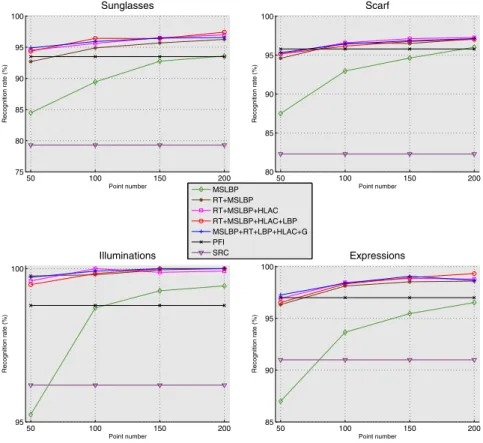
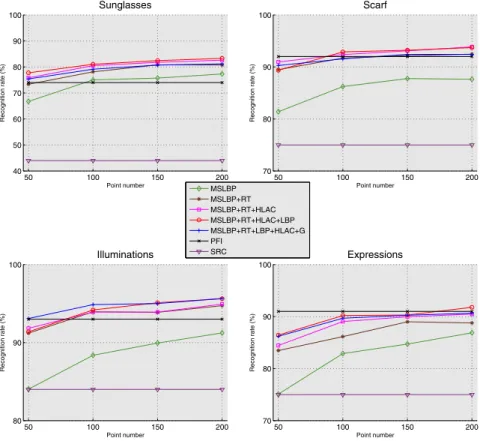
In Fig. 2 and Fig. 3 we report the performance obtained on manually and automatically cropped images respectively. In order to highlight the dependency on the feature pool cardinality and at the same time keeping the results con-cise, we depict for each feature cardinality the best performance we obtained, together with the performance of both the SRC and the PFI algorithms (which are obviously both independent of the valueN).
50 100 150 200 75 80 85 90 95 100 Recognition rate (%) Point number Sunglasses 50 100 150 200 80 85 90 95 100 Recognition rate (%) Point number Scarf 50 100 150 200 95 100 Recognition rate (%) Point number Illuminations 50 100 150 200 85 90 95 100 Recognition rate (%) Point number Expressions MSLBP RT+MSLBP RT+MSLBP+HLAC RT+MSLBP+HLAC+LBP MSLBP+RT+LBP+HLAC+G PFI SRC
Fig. 2. Recognition rates achieved by thek-LiMapS_LFR varying the pool of features,
and by the SRC and the PFI, all considering manually cropped images
Such results allow us to draw some conclusions. Firstly, we notice that the FR task is particularly hard when the eyes are occluded, revealing the high relevance of such face portion. Secondly, it is evident that the feature aggregation helps the recognition system. In particular, the highest performance enhancement is obtained passing from one to two features. Limiting ourselves to the five consid-ered features, the most characterizing one has turn out to be the MSLBP, while the best pair corresponds to (MSLBP, RT).
Concerning the choice of the best feature set among all proposed of the same cardinality, we also notice a desirable property: by adding a new feature to all l-length subsets (with l ∈ {1, . . . ,4}), the best pool of size l+ 1 includes the previous best pool of sizel, so exhibiting good stability and an incremental way to extend the system. For instance, in the case of manual alignment, passing from the best pair (MSLBP, RT) to the best triplet, produces the pool (MSLBP, RT, HLAC), that maintains the best couple.
Naturally, another key parameter conditioning the performance is number of points or patchesN referred by the system. Besides the obvious proportionality
50 100 150 200 40 50 60 70 80 90 100 Recognition rate (%) Point number Sunglasses 50 100 150 200 70 80 90 100 Recognition rate (%) Point number Scarf 50 100 150 200 80 90 100 Recognition rate (%) Point number Illuminations 50 100 150 200 70 80 90 100 Recognition rate (%) Point number Expressions MSLBP MSLBP+RT MSLBP+RT+HLAC MSLBP+RT+HLAC+LBP MSLBP+RT+LBP+HLAC+G PFI SRC
Fig. 3. Recognition rates achieved by thek-LiMapS_LFR varying the pool of features,
and by the SRC and the PFI, all considering automatically cropped images
betweenN and the recognition rate (the denser the face description, the better the performance), we also notice an inverse relationship between N and the standard deviation of the recognition rate, so providing a good stability according to the increasing ofN.
All these considerations cannot be regarded irrespectively of the computa-tional costs: each increment of either the number of features or the number of pointsN increases the computational time. This implies a tradeoff between performance and speed. As far as the computational time of thek-LiMapS algo-rithm is concerned, in case of one feature andN = 50 a test image is processed in about 0.05 seconds on a IntelR CoreTM i5 processor at 64 bit, with 3.6 GHz, and 8 Gb of memory. Naturally, the computational time scales proportionally increasing eitherN or the number of features. Furthermore we remark the in-dependence of both the weak classifiers and the local features, which would made it possible to evaluate in parallel the weak classifiers merging the results subsequently.
Another comment concerns the comparison with the SRC and the PFI sys-tems. As can be seen in the graphs, k-LiMapS_LFR outperforms SRC even with a small value ofN and adopting only one feature. Regarding the compari-son with PFI,k-LiMapS_LFR behaves better when setting N = 100 or more, and adopting at least two features. The only exception is the experiment refer-ring to subjects varying their expression, where the PFI behaves very well. In this case thek-LiMapS_LFR obtains the same performance only withN = 200 and four features.
Finally, let us notice that all the systems worsen their performance pass-ing from manual to automatic cropped images. In particular the average loss is of about the 17% for the SRC, the 9% for the PFI, and the 7% for the k-LiMapS_LFR, showing its greater robustness with respect to this critical aspect.
5
Conclusions
In this paper a new local-FRS has been illustrated. This approach allows to cope with local alteration of the face images, due to either partial occlusions or illumination or expression variations. The system refers to a pool of local features aiming at extracting most of the peculiar uncorrupted information and uses it to define a pool of weak classifiers. The final recognizer is obtained combining the weak classifier via the majority rule. The discriminative strategy of the weak classifier is committed to the sparse recovery paradigm which has recently turned to be successfully applied in face recognition.
Experimental results prove the system effectiveness and robustness, above all when compared with the state of the art in this field. The encouraging results motivate us to investigate this topic furthermore. In particular, we are inter-ested in exploring some selection rules which would allow to maintain the same performance retaining only a fewest set of dictionaries.
References
1. Adamo, A., Grossi, G.: A fixed-point iterative schema for error minimization in k-sparse decomposition. In: Proceedings of the 2011 IEEE International Symposium on Signal Processing and Information Technology, ISSPIT 2011, pp. 167–172. IEEE Computer Society (2011)
2. Adamo, A., Grossi, G., Lanzarotti, R.: Sparse representation based classification for face recognition by k-liMapS algorithm. In: Elmoataz, A., Mammass, D., Lezoray, O., Nouboud, F., Aboutajdine, D. (eds.) ICISP 2012. LNCS, vol. 7340, pp. 245–252. Springer, Heidelberg (2012)
3. Ahonen, T., Hadid, A., Pietikainen, M.: Face recognition with local binary patterns. Proc. Eur. Conf. Comput. Vis., 469–481 (2004)
4. Campadelli, P., Lanzarotti, R., Lipori, G.: Precise eye and mouth localization. International Journal of Pattern Recognition and Artificial Intelligence 23(3) (2009) 5. Chan, C.H., Kittler, J., Messer, K.: Multi-scale local binary pattern histograms for face recognition. In: Lee, S.-W., Li, S.Z. (eds.) ICB 2007. LNCS, vol. 4642, pp. 809–818. Springer, Heidelberg (2007)
6. Liu, F., Wang, Z., Wang, L., Meng, X.: Facial expression recognition using hlac features and wpca. In: Tao, J., Tan, T., Picard, R.W. (eds.) ACII 2005. LNCS, vol. 3784, pp. 88–94. Springer, Heidelberg (2005)
7. Martínez, A., Benavente, R.: The ar face database. Tech. Rep. 24, Computer Vision Center, Bellatera (June 1998),
http://www.cat.uab.cat/Public/Publications/1998/MaB1998
8. Martinez, A.M.: Recognizing imprecisely localized, partially occluded, and expres-sion variant faces from a single sample per class. IEEE Trans. Pattern Analysis and Machine Intelligence 24(6), 748–763 (2002)
9. Naseem, I., Togneri, R., Bennamoun, M.: Linear regression for face recogni-tion. IEEE Transactions on Pattern Analysis and Machiner Intelligence 32(11), 2106–2112 (2010)
10. Rabia, J., Hamid, R.A.: A survey of face recognition techniques. Journal of Infor-mation Processing Systems 5 (2009)
11. Schwartz, W.R., Guo, H., Choi, J., Davis, L.S.: Face identification using large feature sets. IEEE Transactions on Image Processing 21, 2245–2255 (2012) 12. Tan, X., Chen, S., Zhou, Z., Liu, J.: Face recognition under occlusions and variant
expressions with partial similarity. IEEE Transactions on Information Forensics and Security 4(2), 217–230 (2009)
13. Tolba, A., El-Baz, A., El-Harby, A.: Face recognition: A literature review. Int. J. Signal Process. 2, 88–103
14. Viola, P., Jones, M.: Rapid object detection using a boosted cascade of simple features. In: Proc. IEEE Conf. Computer Vision and Pattern Recognition, vol. 1, pp. 511–518 (2001)
15. Wiskott, L., Fellous, J.M., Krüger, N., Malsburg, C.V.D.: Face recognition by elas-tic bunch graph matching. IEEE Transactions on Pattern Analysis and Machine Intelligence 19, 775–779 (1997)
16. Wright, J., Yang, A.Y., Ganesh, A., Sastry, S.S., Ma, Y.: Robust face recognition via sparse representation. IEEE Trans. Pattern Anal. Mach. Intell. 31(2), 210–227 (2009)
17. Zhao, W., Chellappa, R., Phillips, P.J., Rosenfeld, A.: Face recognition: A literature survey. ACM Computing Surveys 35(4), 399–458 (2003)