AUDIO-VISUAL OBJECT LOCALIZATION AND SEPARATION USING LOW-RANK AND
SPARSITY
Jie Pu
1, Yannis Panagakis
1, Stavros Petridis
1and Maja Pantic
1,21
Deparment of Computing, Imperial College London, UK
2
EEMCS, University of Twente, NL
ABSTRACT
The ability to localize visual objects that are associated with an audio source and at the same time seperate the audio sig-nal is a corner stone in several audio-visual sigsig-nal processing applications. Past efforts usually focused on localizing only the visual objects, without audio separation abilities. Besides, they often rely computational expensive pre-processing steps to segment images pixels into object regions before applying localization approaches. We aim to address the problem of audio-visual source localization and separation in an unsu-pervised manner. The proposed approach employs low-rank in order to model the background visual and audio informa-tion and sparsity in order to extract the sparsely correlated components between the audio and visual modalities. In par-ticular, this model decomposes each dataset into a sum of two terms: the low-rank matrices capturing the background uncorrelated information, while the sparse correlated com-ponents modelling the sound source in visual modality and the associated sound in audio modality. To this end a novel optimization problem, involving the minimization of nuclear norms and matrix`1-norms is solved. We evaluated the pro-posed method in 1) visual localization and audio separation and 2) visual-assisted audio denoising. The experimental re-sults demonstrate the effectiveness of the proposed method.
Index Terms— Audiovisual localization, Audio separa-tion, Multi-modal analysis, Low-rank, Sparsity.
1. INTRODUCTION
Audio-visual analysis has recently received increased atten-tion from the signal processing and computer vision com-munities, enabling the development of a wide range of ap-plications such as visual speech recognition [1], audio-visual source separation [2], and multimedia analysis includ-ing person identification from visual resources, audio-visual human robot interaction [3], to name but a few.
In this paper, we aim to localize and separate audio-visual objects without limiting the problem on any specific audio-visual sources (e.g., talking faces [2]). In particular, we fo-cus on robustly localizing the image pixels that are associated
Fig. 1. Overview of the proposed audiovisual source localiza-tion and separalocaliza-tion method. MatrixVcontains in its columns the vectorized video frames while Arepresents the magni-tude of the spectrogram, obtained by applying the short-term Fourier transform to the audio signal. The proposed method decomposesVandAas superposition of low-rank and sparse parts, where the low-rank matrixBvcaptures the background uncorrelated visual information in video, the low-rank ma-trixBa captures the background audio distraction, while the sparse matricesPvandPa capture the correlation among vi-sual and acoustic modalities, revealing the location of pixels associated with the sound producing moving visual object as well as its associated spectrogram.
with an audio source in videos and at the same time sepa-rating the audio signal that is associated with the visual ob-ject. These pixels should be distinguished from other moving objects and the audio signal should correspond to the sound produced by visual object, even in the presence of interfering sounds or background noise existing, which are unrelated to the desired object.
Existing approaches in audio-visual object localization aim to identify either the pixels [4, 5, 6, 7] or the object [8, 9] in videos that are most correlated to the audio. The
pixel-levelapproaches usually do not contain pre-processing to segment video images, and directly take image pixels as the visual input and output correlated pixels as the result of localization. In [4], Kdiron et al. used Canonical Correlation Analysis (CCA) to find the correlation of audio and video modalities in order to detect moving sounding objects.In [5],
the problem was handled by a simply coincidence-based mea-sure, which evaluates the correlation between the onsets of audio and visual modalities. Casanovas et al.[7] used non-linear diffusion to capture the pixels whose motion is most consistent with changes of audio energy, and then applied a graph-cut segmentation procedure [6] to keeps pixels remain-ing in regions. The object-level approaches segment video images into visual atoms or regions before applying localiza-tion. In [8], the authors oversegmented each video frame into a number of small segments, and then clustered them to form visual objects. The audio-associated visual object was finally identified via CCA. In [9], Li et al. first applied an region tracking algorithm to segment the video into regions. Then a nonlinear transformation was implemented to obtain both the audio and visual codes in a common rank correlation space. Finally, the correlation was evaluated by computing the ham-ming distance between the generated codes. However, the aforementioned methods are not able to separate the audio signal associated with the visual objects.
Here, distinct from previous methods we propose a novel method for unsupervised audio-visual source localization
and separation using low-rank and sparsity. To this end, we assume that the background of the video lies in a low-dimensional subspace while the moving foreground objects that produce sound can be regarded as relatively sparse within the image sequence. Moreover, a time-frequency distribution (e.g., spectrogram) of the audio signal is assumed to be a superposition of a low-rank and a sparse part, correspond-ing to spectrogram of the background and the foreground audio produced by the moving objects, respectively. Such assumptions are common in background subtraction [10] and monaural audio separation [11]. Therefore, we seek to ex-press visual and audio representations as superpositions of low-rank and sparse parts, where the low-rank parts capture the background uncorrelated information and the sparse parts account for the correlated audio-visual components, revealing the sound source in visual modality and the associated sound in audio modality. An overview of the proposed method is depicted in Figure 1.
To demonstrate the generality of the proposed method and its algorithmic framework, experiments are performed on two application domains, namely 1) visual localization and audio separation and 2) visual-assisted audio denoising.
2. PROPOSED METHODOLOGY ConsiderV∈RI1×T andA∈
RI2×T representing the visual and the audio modalitites respectively, whereT is the number of frames in the video. In order to localize the visual object that produces sound and seperate its ascosiated audio signal we seek to decompose of each matrix into two terms:
V=Bv+Pv A=Ba+Pa, (1)
whereBv ∈RI1×T, andB
a ∈RI2×T are the low-rank
com-ponents capturing the information about background images and background sounds, respectively andPv ∈ RI1×T, and
Pa ∈RI2×T are sparse components, accounting for the
fore-ground moving object in images and the correlated part of sounds respectively.
To ensure thatPv andPa are maximally correlated they are further decomposed as following:
Pv=Dv·C Pa=Da·C, (2) where dictionary matricesDv ∈ RI1×K,D
a ∈ RI2×K and
C ∈ RK×T represents a common low-dimensional embed-ding among the two modalities capturing their correlation [12]. TheK denotes the number of correlated components between the visual and audio information.
A natural estimator accounting for the low rank of the Bv, Ba components and the sparsity of the correlated Pv , Pa components, is to minimize the rank ofBv, Ba and the number of non-zero entries ofPv ,Pa measured by the` 0-norm, e.g. [10, 13]. Since both the rank and`0-norm min-imization is NP hard [14, 15], we adopted the technique in the robust PCA, which uses the nuclear normk.k∗and the`
1-norm to serve as convex envelopes of the rank and`0-norm respectively. Therefore, the objective function of our novel algorithm is defined as following:
F(Bv,Ba,Pv,Pa) =kBvk∗+kBak∗+λ1kPvk1+λ2kPak1,
where andλ1, λ2are positive parameters to balance the sig-nificance of minimizing the sparsity ofPv,Pa compared to the rank ofBv,Ba.
Furthermore, to smooth the temporal change of the shared matrixCin sparse componentsPvandPa, we applied a tem-poral Laplacian regularizationtrace(C·L·CT)[16], which encodes the sequential relationships in time series data. Thus we formalize the complete constrained optimization problem as following: minimize V kBvk∗+kBak∗+λ1kPvk1 +λ2kPak1+λ3trace(C·L·CT) subject to V=Bv+Dv·C, A=Ba+Da·C Pv=Dv·C, Pa =Da·C (4). Where the unknown matrices are collected in the setV =.
{Bv,Ba,Pv,Pa,Dv,Da,C},λ1, λ2, λ3 > 0are positive pa-rameters and theLis the constructed Laplacian matrix used to smooth the temporal change of the matrixC.
To solve (4), the Alternating Direction Method of Multi-pliers (ADMM) is applied here. To this end the on the
aug-mented Lagrangian function of (4) is formulated as: L(V,M) =kBvk∗+kBak∗+λ1kPvk1+ λ2kPak1+λ3trace(C·L·CT) + hY,V−Bv−Dv·Ci+ µ 2kV−Bv−Dv·Ck 2 F+ hZ,A−Ba−Da·Ci+ µ 2kA−Ba−Da·Ck 2 F+ hG,Dv·C−Pvi+ µ 2kDv·C−Pvk 2 F+ hF,Da·C−Pai+ µ 2kDa·C−Pak 2 F
Where primal variablesV=. {Bv,Ba,Pv,Pa,Dv,Da,C}and M =. {Y,Z,G,F}gathers the Lagrange multipliers associ-ated with the four constraints in (4). Besides, theµ > 0is a positive penalty parameter. The ADMM method minimizes theL(V,M)with respect to each variable in an alternating fashion and then the Lagrange multipliers get updated at each iteration [17]. The procedure is summarized in Algorithm 1.
Within the algorithm the shrinkage operator Sτ(x) is defined as Sτ(x) = sgn(x)max(|x| − τ,0) [10], and it is applied to each element in matrices. The singular value thresholding (SVT) operator [18]Dτ(X) = USτ(Σ)V∗and
X = UΣV∗ is any singular value decomposition. Having found the matricesBv,Ba,Pv, andPa, the nonzero entries inPv indicate the location of pixels that correspond to the moving sound object while the associated audio is obtained by applying the inverse STFT onPa.
3. EXPERIMENTAL EVALUATION
Datasets: The proposed approach is evaluated on 3 videos which have been used in previous studies and one created by ourselves. We useViolin YanniandWooden Horsefrom [8] andGuitar Solofrom [9]. TheWooden HorseandGuitar Solo
are challenging videos since they contain other moving ob-jects. We also created an additional videoTwo Speakerwhere two subjects uttering two different digits from the CUAVE database [19] are merged in the same frame, whereas the audio signal from only of them is kept.
Visual Evaluation: We follow the evaluation framework in [8, 4]. Firstly, we manually segmented the video images into the regions which are correlated (ground truth) and uncorre-lated to the audio signal. Then for evaluation purpose we use theF1measure and theLcterm defined in [4], which provides an evaluation from an energy perspective. The energy of the pixels is defined as:e(~x) =|Wv(~x)|2, whereWvis a resulted image and~xis the pixel coordinate. A satisfactory localiza-tion is obtained if most of the energye(~x)is concentrated in the same region of the ground truth. The localization criterion is defined as [4]:Lc= P ~ x∈Dce(~x) P ~xe(~x) ×R1+R2 Rc WhereR1is the
Algorithm 1ADMM solver for (4)
1: Input: The visual matrixVand the audio matrixA. Regulariser
λ1, λ2, λ3>0, the Laplacian matrixL.
2: Initialize: Set {Bv[0],Ba[0],Pv[0],Pa[0],Dv[0],Da[0], C[0],Y[0],Z[0],G[0],F[0]}to zero matrices,µ >0
3: whilenot convergeddo 4: Bv[t+ 1]← D1 µ(V−Dv[t]·C[t] + 1 µY[t]) 5: Ba[t+ 1]← D1 µ(A−Da[t]·C[t] + 1 µZ[t]) 6: Pv[t+ 1]← Sλ1 µ (Dv[t]·C[t] + 1 µG[t]) 7: Pa[t+ 1]← Sλ2 µ (Da[t]·C[t] +1 µF[t]) 8: Dv[t+ 1] ← 1 2(V−Bv[t+ 1] + 1 µY[t] + Pv[t + 1] −1 µG[t])·C[t] T· C[t]·C[t]T−1 9: Da[t+ 1] ← 1 2(A−Ba[t + 1] + 1 µZ[t] +Pa[t + 1] −1 µF[t])·C[t] T· C[t]·C[t]T−1
10: C[t+ 1] ←solve the Sylvester equation MC[t+1]+C[t+1]N+K=01 11: Y[t+ 1] ←Y[t] +µ(V−Bv[t+ 1]−Dv[t+ 1]·C[t+ 1]) 12: Z[t+ 1] ←Z[t] +µ(A−Ba[t+ 1]−Da[t+ 1]·C[t+ 1]) 13: G[t+ 1] ←G[t] +µ(Dv[t+ 1]·C[t+ 1]−Pv[t+ 1]) 14: F[t+ 1] ←F[t] +µ(Da[t+ 1]·C[t+ 1]−Pa[t+ 1]) 15: µ←min ρ·µ,1018
, whereρis the update factor 16: t←t+ 1
17: end while
18: Output: Background low-rank components {Bv,Ba},
corre-lated sparse components{Pv,Pa}
ground truth,R2is the manually labeled uncorrelated region with audio, andRc stands for the correctly detected region. Besides, theDcrepresents the set of correctly detected pixels: Dc =. {~x:e(~x)>0 and ~x∈R1}.
Audio Evaluation: Following the evaluation framework in [11, 20], we examine the separation results by BSS-EVAL metrics [21]. Specifically, the Source to Distortion Ratio (SDR) is often used to represent the overall performance of audio evaluation. We define the Normalized SDR (NSDR), which only measures the improvement of the SDR between the mixture signalˆsand the resynthesized soundˆvfromPa. That is [20]: NSDR(ˆv, v,sˆ) = SDR(ˆv, v)−SDR(ˆs, v), whereˆvis the separated audio signal,v is the original clean sound, andsˆis the noisy sound.
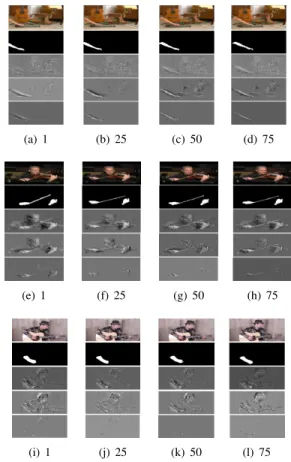
Experimental Results on Visual Localization and Audio Separation: Qualitative results for visual localisation are presented in Fig. 2 where the sparse componentPvis shown. It is clear that the proposed algorithm has successfully identi-fied the sound sources in all the test videos. The hands of the keyboardist, violin player and guitarist in theWooden Horse,
Algorithm
Sparse CCA JIVE Our method Video name criteria
Wooden Horse SDR 32.4912 5.6327 15.3204 F1 0.0635 0.2040 0.5821 Lc 3.6232 14.7482 24.2709 Violin Yanni SDR 7.2470 4.8145 10.4424 F1 0.1941 0.2256 0.5138 Lc 10.9986 10.9917 21.5093 Guitar Solo SDR 31.3086 11.9821 27.3442 F1 0.1509 0.1475 0.3700 Lc 6.8999 4.3918 12.9377 Two Speaker SDR 5.4101 1.1031 6.2373 F1 0.0111 0.0280 0.4324 Lc 14.4921 13.1444 193.7176
Table 1. Quantitative evaluations of each algorithm in the case of clean audio input.
mouth of the left subject in theTwo Speakervideo are cor-rectly identified as the correlated sound sources. On the other hand, sparse CCA and JIVE algorithms capture the moving objects as well in all videos.
Quantitative results for all algorithms shown in Table 1. For comparison purposes, we have also implemented the sparse CCA algorithm [4] and the JIVE algorithm [22]. The proposed algorithm outperforms space CCA and JIVE in terms ofF1,Lc for all videos. As shown in Fig. 2 the proposed approach localises quite accurately the audio pro-ducing region whereas sparse CCA and JIVE produce many false positive detections. In regard to audio separation, the proposed algorithm outperforms sparse CCA and JIVE in terms of SDR in two videos,Violin YanniandTwo Speaker. As for the videosWooden HorseandGuitar Solo, the sparse CCA obtains high values of SDR since it fails to capture the correlation between two sensory modalities and simply retains most of the original audio as the sparse component. Experimental Results on Visually-Assisted Audio Denois-ing: In this section we investigate the capabilities of the proposed algorithm in audio denoising with the assistance of visual information. The audio signal in all videos is cor-rupted with white noise. The signal to noise ratio is 0 dB. In this scenario, the recovered audio sparse componentPa corresponds to the denoised audio signal. Table 2 shows the quantitative results for all methods. The proposed approach outperforms sparse CCA and JIVE in terms of NSDR in all videos except the last one. In the videoTwo Speaker, the sparse CCA obtains the NSDR value with 0.06 higher than our algorithm, which means they perform equally well. The results of visual localization are very similar to Fig. 2 so they are omitted due to lack of space. Also in this case the proposed method outperforms sparse CCA and JIVE.
4. CONCLUSION
In this paper, we proposed a low-rank and sparse model to handle the visual localization and audio separation problem using pixel intensities and audio spectrogram as visual and audio representations. We conducted two set of experiments: (1) visual localisation and audio separation, and (2) visually-assisted denoising. In both cases, the proposed method
cor-Algorithm
Sparse CCA JIVE Our method Video name criteria
Wooden Horse NSDR 4.3623 4.5420 8.8156 F1 0.0635 0.1832 0.5769 Lc 3.6218 12.8927 24.2161 Violin Yanni NSDR 5.3031 4.4270 5.8963 F1 0.1943 0.2258 0.5165 Lc 11.4904 10.6450 20.4378 Guitar Solo NSDR 5.7093 2.6385 14.0807 F1 0.1496 0.1478 0.3412 Lc 6.8872 4.4270 11.8645 Two Speaker NSDR 1.3641 0.8298 1.3026 F1 0.0111 0.0262 0.4156 Lc 14.4919 11.0700 204.0803
Table 2. Quantitative evaluations of each algorithm in the case of noisy audio input.
(a) 1 (b) 25 (c) 50 (d) 75
(e) 1 (f) 25 (g) 50 (h) 75
(i) 1 (j) 25 (k) 50 (l) 75
Fig. 2. Sample frames of the results of each algorithm. These groups of figures are for videoWooden Horse,Violin Yanni
andGuitar Solo. Within each group, each row from top to bot-tom is the original video frames, the manually labeled ground truth, results produced by sparse CCA, by JIVE algorithm and by our algorithm (from the sparse componentPv).
rectly identifies the sound source and separates the audio in all the test videos and can also successfully denoise the signal.
5. ACKNOWLEDGEMENTS
This work has been funded by the European Community Horizon 2020 under grant agreement no. 645094 (SEWA) and no. 688835 (DE- ENIGMA).
6. REFERENCES
[1] Gerasimos Potamianos, Chalapathy Neti, Guillaume Gravier, Ashutosh Garg, and Andrew W Senior, “Recent advances in the automatic recognition of audiovisual speech,”Proceedings of the IEEE, vol. 91, no. 9, pp. 1306–1326, 2003.
[2] Anna Llagostera Casanovas, Gianluca Monaci, Pierre Van-dergheynst, and R´emi Gribonval, “Blind audiovisual source separation based on sparse redundant representations,” IEEE Transactions on Multimedia, vol. 12, no. 5, pp. 358–371, 2010. [3] Aggelos K Katsaggelos, Sara Bahaadini, and Rafael Molina, “Audiovisual fusion: Challenges and new approaches,” Pro-ceedings of the IEEE, vol. 103, no. 9, pp. 1635–1653, 2015. [4] Einat Kidron, Yoav Y Schechner, and Michael Elad, “Pixels
that sound,” in2005 IEEE Computer Society Conference on Computer Vision and Pattern Recognition (CVPR’05). IEEE, 2005, vol. 1, pp. 88–95.
[5] Zohar Barzelay and Yoav Y Schechner, “Harmony in mo-tion,” in2007 IEEE Conference on Computer Vision and Pat-tern Recognition. IEEE, 2007, pp. 1–8.
[6] Anna Llagostera Casanovas and Pierre Vandergheynst, “Un-supervised extraction of audio-visual objects,” in2011 IEEE International Conference on Acoustics, Speech and Signal Pro-cessing (ICASSP). IEEE, 2011, pp. 2284–2287.
[7] A Llagostera Casanovas and Pierre Vandergheynst, “Nonlinear video diffusion based on audio-video synchrony,”IEEE Trans. on Multimedia, 2010.
[8] Hamid Izadinia, Imran Saleemi, and Mubarak Shah, “Multi-modal analysis for identification and segmentation of moving-sounding objects,”IEEE Transactions on Multimedia, vol. 15, no. 2, pp. 378–390, 2013.
[9] Kai Li, Jun Ye, and Kien A Hua, “What’s making that sound?,” inProceedings of the 22nd ACM international conference on Multimedia. ACM, 2014, pp. 147–156.
[10] Emmanuel J Cand`es, Xiaodong Li, Yi Ma, and John Wright, “Robust principal component analysis?,” Journal of the ACM (JACM), vol. 58, no. 3, pp. 11, 2011.
[11] Po-Sen Huang, Scott Deeann Chen, Paris Smaragdis, and Mark Hasegawa-Johnson, “Singing-voice separation from monaural recordings using robust principal component analysis,” in2012 IEEE International Conference on Acoustics, Speech and Sig-nal Processing (ICASSP). IEEE, 2012, pp. 57–60.
[12] Gianluca Monaci, Philippe Jost, Pierre Vandergheynst, Boris Mailhe, Sylvain Lesage, and R´emi Gribonval, “Learning mul-timodal dictionaries,” IEEE Transactions on Image Process-ing, vol. 16, no. 9, pp. 2272–2283, 2007.
[13] Guangcan Liu and Shuicheng Yan, “Active subspace: Toward scalable low-rank learning,” Neural computation, vol. 24, no. 12, pp. 3371–3394, 2012.
[14] Lieven Vandenberghe and Stephen Boyd, “Semidefinite pro-gramming,”SIAM review, vol. 38, no. 1, pp. 49–95, 1996. [15] Balas Kausik Natarajan, “Sparse approximate solutions to
lin-ear systems,” SIAM journal on computing, vol. 24, no. 2, pp. 227–234, 1995.
[16] Sheng Li, Kang Li, and Yun Fu, “Temporal subspace clustering for human motion segmentation,” inProceedings of the IEEE International Conference on Computer Vision, 2015, pp. 4453– 4461.
[17] Yannis Panagakis, Mihalis Nicolaou, Stefanos Zafeiriou, and Maja Pantic, “Robust correlated and individual component analysis,” 2015.
[18] Jian-Feng Cai, Emmanuel J Cand`es, and Zuowei Shen, “A singular value thresholding algorithm for matrix completion,”
SIAM Journal on Optimization, vol. 20, no. 4, pp. 1956–1982, 2010.
[19] Eric K. Patterson, Sabri Gurbuz, Zekeriya Tufekci, and John N. Gowdy, “Moving-talker, speaker-independent feature study, and baseline results using the cuave multimodal speech cor-pus,” EURASIP J. Appl. Signal Process., vol. 2002, no. 1, pp. 1189–1201, Jan. 2002.
[20] Zafar Rafii and Bryan Pardo, “A simple music/voice separa-tion method based on the extracsepara-tion of the repeating musical structure,” in2011 IEEE International Conference on Acous-tics, Speech and Signal Processing (ICASSP). IEEE, 2011, pp. 221–224.
[21] Emmanuel Vincent, R´emi Gribonval, and C´edric F´evotte, “Performance measurement in blind audio source separation,”
IEEE transactions on audio, speech, and language processing, vol. 14, no. 4, pp. 1462–1469, 2006.
[22] Eric F Lock, Katherine A Hoadley, James Stephen Marron, and Andrew B Nobel, “Joint and individual variation explained (jive) for integrated analysis of multiple data types,” The an-nals of applied statistics, vol. 7, no. 1, pp. 523, 2013.