Help–Desk Support System
Thomas Roth–Berghofer1
and Ioannis Iglezakis2 1 tec:inno GmbH, D–67661 Kaiserslautern, Germany [email protected] http://www.tecinno.com 2
DaimlerChrysler AG, Research and Technology, FT3/KL, P.O. Box 2360, D–89013 Ulm, Germany
http://www.daimlerchrysler.com
Abstract. Case–based reasoning has proven to be valuable and commercially successful in many applications, especially in the help–desk area. But current help–desk support tools do not assist in problem solving at all levels of the help– desk organization. This paper proposes an integrated multilevel help–desk sup-port system based on conversational, structural, and textual case–based reasoning tools. It describes their main application areas in help–desk support and how the different case–based reasoning approaches can work together.
1
Motivation
Case–Based Reasoning (CBR) has proven to be valuable and commercially successful in many applications, and especially in the help–desk area.Conversationalcase–based reasoning systems like Inference’s k–Commerce Support suite address the first level help–desk, often provided by call centers. k–Commerce Support helps to increase the first call resolution rate and to provide consistent answers throughout the call center. k–Commerce Support provides solutions for problems of low or medium complexity which occur rather frequently. This and the ease of use even allow the deployment of self–service solutions (e.g. Broderbund, Lucas Arts [6]).
Textualcase–based reasoning also has proven to be helpful at help–desks and in self–service (e.g. SIMATIC Knowledge Manager [6, 4]). In contrast to conversational case–based reasoning systems, this approach does not guide the operator during the conversation with the customer. Textual CBR systems provide an intelligent index to a knowledge base consisting of documents. The operators have to decide what ques-tions to ask by themselves. They need more time to talk to the customers compared to conversational solutions because they address problems of medium or high complexity. A third kind of help–desk support is provided bystructural case–based reason-ing systems. The HOMER application developed in the INRECA–II project1supports
1
INformation and knowledge re–engineering for REasoning from CAses; Esprit contract no. 22196
complex second level help–desks [3, 2]. The application domain is modeled partially in an object oriented way. Based on the created object model the cases are acquired. The similarity of the cases is computed with respect to the structure and the content. HOMER solves problems of high complexity which occur rather seldomly or at least not frequently but which are expensive to solve.
A new case–based reasoning system is tec:inno’s CBR toolbox ORENGE (Open Retrieval ENGinE). ORENGE provides services for structuralandtextual case–based reasoning, e.g. an analyzer service extracts keywords (conceptsorinformation entities, [4]) from textual queries and fills attribute slots specified in an object model accord-ingly. The extracted concepts are then used by a retrieval service to get the cases from various data sources like databases and several types of documents.
In the projectDecreasing the help–desk costs by 50%2structural, textual, and con-versational case–based reasoning will be combined to support the constantly changing environment at debis SH PCM.
The paper is structured as follows: Section 2 describes the current situation at the help–desk of debis SH PCM and points out the challenges it faces. Section 3 outlines the goals and the expected benefits of the project. Section 4 shows the intended system architecture. In section 5 a system improvement approach is sketched, followed by the project plan in section 6. Finally, section 7 concludes the paper with a short summary and questions the project will address.
2
Current Situation at the Help–Desk of debis SH PCM
Companies with new products have to deal with various situations of product faults and lack of user knowledge. The increasing complexity of these products is one reason for this situation; another reason is the increasing amount of people using the same product. Companies need to differentiate themselves from their competitors and people want more features for their money. These reasons are directly related and create a need for customer support. A help–desk provides this customer support as an integral part of a company’s product service function [1, 7].
The first contact point for help is called thefirst level. People working at the first level not only need experience in problem solving for a variety of different domains but also have to be skilled in communications. Not all problems can be solved directly by conversation via telephone. A next level — thesecond level— must eventually be contacted. The people working at the second level are domain experts specializing in various areas. Beyond that, many help–desk organizations have athird levelof support which is provided by the manufacturers of the supported products or by technicians.
2.1 Application Scenario
Not all companies can provide a help–desk, or they do not want to. They more and more buy help–desk services from specialized firms. debis SH PCM is such a firm which sells help–desk services for different demands.
2The partners in this research project are DaimlerChrysler, Research and Technology, FT3/KL, FT3/AV, and FT3/KE, as well as the tool provider tec:inno GmbH, and the application partner debis Systemhaus PCM Computer AG.
debis SH PCM is a corporate member of the debis Systemhaus group. The ZUHD (central user help–desk) in Hamburg is one part of debis SH PCM which offers their customers a central user help–desk, an extension help–desk, temporary help–desks and overflow services for other help–desks. The extension help–desk provides support af-ter the usual business hours. Overflow services are used by other help–desks at peak times to re–route their calls. The temporary help–desks support other companies during special events, e.g. the introduction of new products.
The main focus is the central support for office and back office products, hardware and network infrastructure as well as customer specific applications support. The help– desk is accessible 24 hours a day, 365 days a year with an accessibility of 95%.
2.2 Challenges
Due to the fact that the help–desk at debis SH PCM offers firstandsecond level assis-tance, the operators must constantly widen and deepen their knowledge. This is encour-aged by management with training courses and seminars.
The help–desk at debis SH PCM wants to present itself as being more than just a typical help–desk, and, therefore, needs a flexible and more powerful support system than is currently available.
Customers come and go, and no typical profile can be identified. New applications are introduced, other applications are not supported anymore. First and second level problems come in by turns. The operators and the tools must be flexible to keep up with his constantly changing environment.
3
Project Goals and Expected Benefits
The goals of this project can be divided into the goals of the application partner debis SH PCM and the research goals of DaimlerChrysler, Research and Technology, and tec:inno.
3.1 Goals of debis SH PCM
The main project goal is to decrease costs for running a help–desk service center while increasing the customer satisfaction, with emphasis on customer satisfaction; a difficult task in the ever changing environment at debis SH PCM.
Furthermore, there are several secondary goals to be achieved. debis SH PCM wants to support as many applications as possible, and therefore needs well trained operators with profound knowledge in the offered areas. Case–based reasoning support will help to train the operators and to deepen their knowledge on the job.
Help–desks often suffer from high staff fluctuation rates. New operators must be trained to work efficiently in very short time. The system will help to give them more self–confidence and will increase their competence because it allows the operators to answer questions in areas in which they may have only basic knowledge. This will help to keep the workload at fair levels.
The mentioned aspects are all soft criteria to measure this project’s success [2]. Hard criteria are set, too, but they are considered as not as important as the aspects above.
Hard criteria are problem solution quality, process quality, and organizational qual-ity. Problem solution quality includes recall and precision rates for k–Commerce and ORENGE case–bases, consistency of the case–bases, and a high first resolution rate. The process quality refers to the reduction of time spending for one process, better in-quiry management and call–dispatching. With the increase of the organizational quality it is possible to speedup the help–desk practice time.
3.2 Research Topics
DaimlerChrysler, Research and Technology, and tec:inno are pursuing goals beyond those mentioned above. The support of a mixed first and second level help–desk is a big challenge. This goal shall be achieved by combining conversational, structural and textual case–based reasoning. This combination should improve the knowledge transfer between the operators. The customers of debis SH PCM also can be included in this process because they can provide documents about their IT environment, etc.
The support system will be successful only if it can be maintained easily. There-fore, processes and tools will be developed to ease the maintenance tasks and to keep the system usable. This may include the use of data mining techniques to reduce case acquisition costs (section 5).
debis SH PCM is the application partner because its organization is still under devel-opment. This allows to influence the workflows and to suggest and implement changes in the workflows more easily. Another reason was the complexity of its service envi-ronment.
In a later phase of the project the user interface will be enhanced by the departments FT3/AV and FT3/KE of DaimlerChrysler, Research and Technology. The work of the operators will be made more efficient through adaptable graphical user interfaces and the use of text recognition.
At the end of this project it should be possible to run a help–desk service center at much less cost, with improved customer satisfaction through improved competence of the operators.
4
System Design
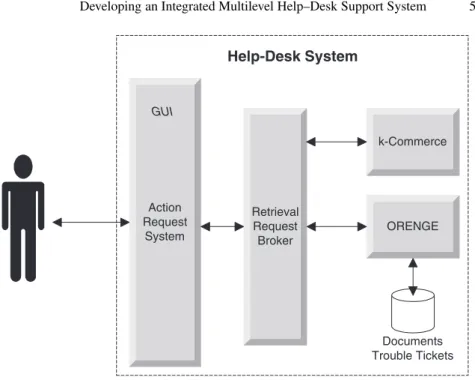
The design of the system centers around the user of the system, the help–desk operator. The system is a classical three-tier client/server system (fig.1). The workflow man-agement tool ARS (Action Request System) acts as the client, whereas k-Commerce and ORENGE provide the server functionality. Both tiers are connected by a retrieval request broker as the middleware. A major design goal is to provide a single access point. The user should not have to hassle with several applications, namely the ARS, k– Commerce Support, and ORENGE at the same time. He should see only one interface which supports him efficiently and intelligently.
Action Request System k-Commerce ORENGE Help-Desk System Documents Trouble Tickets Retrieval Request Broker GUI
Fig. 1.System Architecture
4.1 Workflow
The entry point to the help–desk system is the Action Request System. It controls the workflow at the help–desk organization. For each customer a record is available con-taining information about the customer’s products to be supported by the help–desk.
Each incoming call is recorded by a help–desk operator in atrouble ticketwhich traces all actions executed to solve a given problem. The creator of the trouble ticket becomes theproblem ownerand, therefore, is responsible to provide a solution for the customer.
If an operator can solve a problem during a telephone call, he writes down the solution in the respective trouble ticket and closes it. If the operator can not solve it, he routes the ticket to the appropriate higher level (second or third level support) where it will be treated accordingly. The operators can trace the working state of any ticket at any time.
To help the operators with their tasks the ARS also checks for violated time con-straints. A problem must be solved in a certain amount of time (as defined in the contract between the help–desk and the customer). If such a time interval is about to exceed all operators are notified. Any of the operators then can take the concerned trouble ticket and try to solve it.
In the trouble ticket workflow two phases can be distinguished: an online and an off-line phase. In the onoff-line phase the operator tries to solve the problem at the telephone. This phase will be supported mainly by the conversational CBR tool k–Commerce Sup-port. If there is no solution at hand the operator will end the call. The operator (or a
colleague) will then work offline at the problem. This phase will be supported mainly by the (textual and structural) CBR toolbox ORENGE.
Online Support The nature of conversational CBR systems is to carry on a dialog with
the user of such a system. The user is guided with questions through the problem space to the most promising solution.
The case authors must have the typical caller and the typical help–desk operator in mind to provide the appropriate questions, especially because many of these questions should be used during the phone call. It is important to note that these questions could be asked to the customer without change. Another type of questions will not be asked to the customer, but answered by the operator himself, e.g. by performing some tests.
If the operator finds a solution the complete conversation with k–Commerce will be saved in the trouble ticket for later access, thereby enriching the trouble tickets. This will provide the basis for evaluations using data mining techniques later on in the project.
Offline Support If the operator can not find a solution he ends the call and works at
the problem offline. The operator now must start searching for documents.
Textual CBR — here in the form of ORENGE — provides intelligent access to all sorts of documents, e.g. FAQs and technical documentation. ORENGE supports mainly the second level (in contrast to k–Commerce Support). ORENGE provides no explicit guidance when searching for the correct document. The operator enters a textual query which will be scanned for concepts. Based on these concepts all relevant documents are computed, and the results are ranked accordingly. The user then has to decide which document fits his needs.
A future version of the ORENGE toolbox may provide questions for the operators, too. Research at tec:inno started to compute appropriate questions based on the impor-tance of concepts found in the query. This may lead to a basic guidance for the second level staff.
4.2 Extending the workflow
Both the online and the offline processes will be enhanced in the course of this project. Not only k–Commerce cases will support the operator during a call. ORENGE will sug-gest documents in parallel. Based on the questions and answers given to k–Commerce, ORENGE will retrieve matching documents. They will be presented side by side with the k–Commerce solutions. Of course, there is no time to read entire documents during the call but more experienced operators may get hints for further questions from the document titles or by glancing over the documents.
ORENGE may not only search through documents, but it may also search through the trouble tickets database to find old solutions. In combination with information about the customer, there is a possibility to track down customer related problems and to give feedback to the customer. Maybe at this point data mining techniques could be applied and assumed relations in the data could be revealed.
The operator may freely choose the type of document he wants to have as the search result. This way, he can replay older calls by selecting trouble tickets only, or learn more about the actual problem by choosing tutorials.
5
Improving the system
The cooperation of k–Commerce Support and ORENGE is possible and useful only if the vocabularies of both systems are quite similar, i.e. they share the same vocabulary knowledge container [5]. Therefore, the descriptions of k–Commerce cases as well as the questions and answers must be synchronized with the ORENGE model. Tools have to be developed to assist in this task.
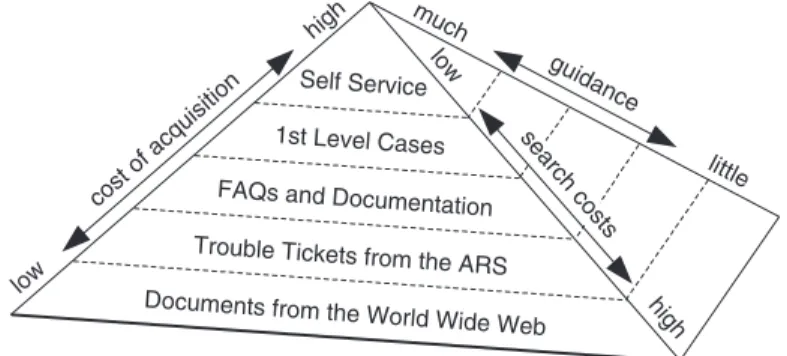
Another aspect of maintaining the system is the improvement of its case–base us-ing data minus-ing techniques. Lookus-ing at the kinds of cases to be used in this system a knowledge pyramidwith three important parameters can be identified (fig. 2): costs of case acquisition, search costs, and amount of guidance.
Self Service 1st Level Cases FAQs and Documentation Trouble Tickets from the ARS Documents from the World Wide Web
cost of acquisition low high search costs high low guidance little much
Fig. 2.Knowledge Pyramid
Of course, the more structured the cases are, the more expensive is the acquisition of the cases. At the top, self service cases mark the most expensive kind of cases be-cause they must be generated very carefully. At the bottom, documents from the World Wide Web are the least expensive cases (regarding their creation). In between lie FAQ collections, product documentation and documents produced by the help–desk staff or others in the organization. Trouble tickets generated by the first level staff are ranked so low because (due to time constraints) they are mostly not very usable. But trouble tickets are in general more useful than documents from the Web because they exist in a known context.
Apparently, the search costs are inversely related to the costs of acquisition. The search costs are low in a fully structured case–base and high in the World Wide Web due to the amount of documents to be searched.
The third parameter reflects this relation, too. As more work is spent on problem solving strategies to better guide the user to a suitable solution the higher are the acqui-sition costs.
The knowledge pyramid parallels the escalation hierarchy in the help–desk organi-zation. The first level support staff needs strong guidance and fast results to help the customer at the telephone with simple problems. The second level support has more time to find solutions and does not need as much guidance. But the second level staff as well depends on good documents.
Therefore, this projects attempts to find techniques topush knowledge upwardin the knowledge pyramid. A starting point may be to use the vocabularies of k–Commerce Support and ORENGE to discover and suggest useful documents at a lower level which then can be compiled into higher level cases by the case authors.
6
Further Work
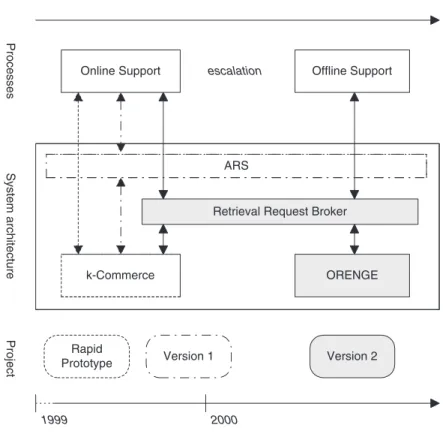
The project started with the building of an initial case–base which will be used for the rapid prototype (fig. 3). Completion of this phase is anticipated at the end of 1999 and will be immediately followed by a first version of the help–desk support system.
In this first version k–Commerce Support and the ARS will be loosely coupled. After the creation of a trouble ticket the operator can access k–Commerce Support as a separate application. Some data about the customer and about the actual problem will be transferred to the CBR tool. The operator, assisted by k–Commerce, then will try to solve the problem together with the customer. The results of this process will be transferred back to the ARS (including all questions and the corresponding answers as well as the solution if the operator has found one). This phase should be finished in early 2000.
The middle tier between ARS and the CBR tools — the Retrieval Request Broker — will be implemented afterwards and should be finished at the end of 2000. The middle tier will provide, first, a tight integration of ARS and the CBR tools, and second, the business logic for the parallel access to k–Commerce and ORENGE.
In the meantime, documents will be collected and/or created. Therefore, the attach-ments used by the k–Commerce suite will be created with their reuse with ORENGE in mind. Other sources for documents are FAQ collections and technical documentation. A model will be prepared based on the vocabulary and the domain specific knowledge used in k–Commerce.
In parallel to these activities maintenance processes will be developed to assist the case authors. These processes must be interwoven with the existing workflows of the help–desk organization.
In 2001 the results will be transferred to other help–desks to prove the concepts developed in the course of this project.
7
Concluding Remarks
Developing a help–desk support system is always a difficult task, but previously it was always done for a fixed customer in a more or less static domain. debis SH PCM
pro-Processes
System architecture
Project
ARS
k-Commerce ORENGE
Retrieval Request Broker
Online Support Offline Support
Rapid
Prototype Version 1 Version 2
escalation
2000 1999
Fig. 3.Project Plan
vides these services in a constantly changing environment and needs a more complex system than those currently available on the market.
There are many open questions to be answered in the course of the project. How can conversational, structural, and textual case–based reasoning tools be combined to effectively assist the help–desk operators in their daily work? How could such a system be maintained efficiently? How should a help–desk infrastructure look like to increase the maintainability of the system? What are the maintenance tasks? The latter will be especially important in a complex system like this.
Another track which will be followed in this project is the use of data mining tech-niques. Is it possible to extract useful concepts from the cases (documents, and trouble tickets) to enhance the CBR model? Can case acquisition costs be reduced?
DaimlerChrysler, Research and Technology, and tec:inno will develop an integrated multilevel help–desk support system in the course of this project together with debis SH PCM as its application partner to answer these questions.
Acknowledgments
The authors like to thank the help–desk staff at debis SH PCM, in particular Wolfgang Behrens, Michael Klische and Siegfried Schaller for their commitment to this project. They also thank Thomas Reinartz (DaimlerChrysler, Research and Technology) and Carsten Priebisch (tec:inno) for the fruitful discussions and their helpful hints.
References
[1] Mehmet G¨oker. Developing case–based help–desk support systems for complex techni-cal equipment. In Ralph Bergmann, Sean Breen, Mehmet G¨oker, Michel Manago, and Stefan Wess, editors,Developing Industrial Case–Based Reasoning Applications: The IN-RECA Methodology, Lecture Notes in Artificial Intelligence, State–of–the–Art–Survey, LNAI 1612, pages 109–131, Berlin, 1999. Springer–Verlag. 2
[2] Mehmet G¨oker and Thomas Roth-Berghofer. Development and utilization of a case-based help-desk support system in a corporate environment. In L. Karl Branting Klaus-Dieter Al-thoff, Ralph Bergmann, editor,Case-Based Reasoning Research and Development, pages 132–146, Berlin, 1999. Springer-Verlag. 1, 3.1
[3] Mehmet G¨oker, Thomas Roth-Berghofer, Ralph Bergmann, Thomas Pantleon, Ralph Traph¨oner, Stefan Wess, and Wolfgang Wilke. The development of HOMER - a case-based CAD/CAM help-desk support tool. In Barry Smyth and P´adraigh Cunningham, editors, Ad-vances in Case-Based Reasoning - 4th European Workshop, EWCBR-98, pages 346–357. Springer-Verlag, 1998. 1
[4] Mario Lenz, Andr´e H¨ubner, and Mirjam Kunze. Textual CBR. In Mario Lenz, Brigitte Bartsch-Sp¨orl, Hans-Dieter Burkhard, and Stefan Wess, editors, Case-Based Reasoning Technology: From Foundations to Applications, Lecture Notes in Artificial Intelligence, pages 115–137, Berlin, 1998. Springer–Verlag. 1, 1
[5] Michael M. Richter. The knowledge contained in similarity measures. Invited Talk at the ICCBR-95, 1995. http://wwwagr.informatik.uni-kl.de/ lsa/CBR/ Richteric-cbr95remarks.html. 5
[6] Thomas Roth-Berghofer. Fallbeispiele zum Customer-Support via WWW. In Friedhelm Bliemel, Georg Fassot, and Axel Theobald, editors,Electronic Commerce: Herausforderun-gen — AnwendunHerausforderun-gen — Perspektiven, pages 335–348, Wiesbaden, 1999. Gabler-Verlag. 1 [7] Evangelos Simoudis and James S. Miller. The application of cbr to help desk applications.