Florida International University
FIU Digital Commons
FIU Electronic Theses and Dissertations University Graduate School
3-25-2009
Development of a New Client-Server Architecture
for Context Aware Mobile Computing
Feng Gui
Florida International University
Follow this and additional works at:http://digitalcommons.fiu.edu/etd
Recommended Citation
Gui, Feng, "Development of a New Client-Server Architecture for Context Aware Mobile Computing" (2009).FIU Electronic Theses and Dissertations.Paper 202.
FLORIDA INTERNATIONAL UNIVERSITY Miami, Florida
DEVELOPMENT OF A NEW CLIENT-SERVER ARCHITECTURE FOR CONTEXT AWARE MOBILE COMPUTING
A dissertation submitted in partial fulfillment of the requirements for the degree of
DOCTOR OF PHILOSOPHY in ELECTRICAL ENGINEERING by Feng Gui 2009
To: Dean Amir Mirmiran
College of Engineering and Computing
This dissertation, written by Feng Gui, and entitled Development of a New Client-Server Architecture for Context-Aware Mobile Computing, having been approved in respect to style and intellectual content, is referred to you for judgment.
We have read this dissertation and recommend that it be approved.
_______________________________________ Armando Barreto _______________________________________ Naphtali Rishe _______________________________________ Jean H. Andrian _______________________________________ Malek Adjouadi, Major Professor
Date of Defense: March 25, 2009
The dissertation of Feng Gui is approved.
_______________________________________ Dean Amir Mirmiran College of Engineering and Computing
_______________________________________ Dean George Walker University Graduate School
DEDICATION
I dedicate this dissertation to Jiong Zhao, my wife, and my parents. Without their support and sacrifice, I would not have possibly achieved such milestone in my life. I would like to thank my professor Dr. Malek Adjouadi who broadened my research interests and advised me throughout my dissertation work. I would like to express my gratitude and thanks to my committee members, Dr. Jean Andrian, Dr. Tadeusz Babij, Dr. Armando Barreto, Dr. Naphtali Rishe, and Dr. Wunnava Subbarao, for all the help they provided and all the recommendations they made. I want to express my gratitude to the CATE lab members for their support and encouragement during the preparation of this dissertation, especially to Mr. Magno Guillen, Ms. Xiaozhen You and Mr. Melvin Ayala.
ACKNOWLEDGMENTS
The research infrastructure of the CATE center and the financial support provided by the National Science Foundation through grants HRD-0317692, 0426125, CNS-0520811, CNS-0540592 and IIS-0308155 are greatly appreciated.
ABSTRACT OF THE DISSERTATION
DEVELOPMENT OF A NEW CLIENT-SERVER ARCHITECTURE FOR CONTEXT- AWARE MOBILE COMPUTING
by Feng Gui
Florida International University, 2009 Miami, Florida
Professor Malek Adjouadi, Major Professor
This dissertation studies the context-aware application with its proposed algorithms at client side. The required context-aware infrastructure is discussed in depth to illustrate that such an infrastructure collects the mobile user’s context information, registers service providers, derives mobile user’s current context, distributes user context among context-aware applications, and provides tailored services. The approach proposed tries to strike a balance between the context server and mobile devices. The context acquisition is centralized at the server to ensure the reusability of context information among mobile devices, while context reasoning remains at the application level. Hence, a centralized context acquisition and distributed context reasoning are viewed as a better solution overall.
The context-aware search application is designed and implemented at the server side. A new algorithm is proposed to take into consideration the user context profiles. By promoting feedback on the dynamics of the system, any prior user selection is now saved for further analysis such that it may contribute to help the results of a subsequent search.
On the basis of these developments at the server side, various solutions are consequently provided at the client side. A proxy software-based component is set up for the purpose of data collection. This research endorses the belief that the proxy at the client side should contain the context reasoning component. Implementation of such a component provides credence to this belief in that the context applications are able to derive the user context profiles. Furthermore, a context cache scheme is implemented to manage the cache on the client device in order to minimize processing requirements and other resources (bandwidth, CPU cycle, power). Java and MySQL platforms are used to implement the proposed architecture and to test scenarios derived from user’s daily activities.
To meet the practical demands required of a testing environment without the impositions of a heavy cost for establishing such a comprehensive infrastructure, a software simulation using a free Yahoo search API is provided as a means to evaluate the effectiveness of the design approach in a most realistic way. The integration of Yahoo search engine into the context-aware architecture design proves how context aware application can meet user demands for tailored services and products in and around the user’s environment. The test results show that the overall design is highly effective, providing new features and enriching the mobile user’s experience through a broad scope of potential applications.
TABLE OF CONTENTS
CHAPTER PAGE
CHAPTER I ... 1
INTRODUCTION ... 1
CHAPTER II ... 7
A RETROSPECTIVE ON CONTEXT AWARENESS ... 7
2.1 Notion of Context ... 7
2.2 Context Entities ... 11
2.3 Fundamental Concepts of Mobile User Context Profiles ... 13
2.4 Context-Aware Mobile Computing ... 14
2.5 Issues of Context Awareness ... 19
2.6 Context Modeling ... 23
2.6.1 Modeling Languages ... 25
2.6.2 User Interaction Modeling ... 25
2.6.3 Activity-Oriented Context Modeling ... 27
2.6.4 Policy Driven Model ... 27
2.6.5 Peer-to-Peer Light-Weight Component Model ... 28
2.6.6 Conceptual Modeling ... 29
2.7 Applications of Context Awareness... 32
2.7.1 Technology Enabling Awareness (TEA) ... 32
2.7.2 Sharing Context Information between Mobile Terminals ... 33
2.7.3 Location-enhanced World Wide Web ... 33
2.7.4 Context-Aware Applications in a Hospital Setting ... 34
CHAPTER III ... 36
CONTEXT AWARE ARCHITECTURE DESIGN AND REQUIREMENTS ... 36
3.1 Introduction ... 36
3.2 Required Context Aware Architecture... 42
3.3 Hardware Infrastructure ... 43 3.4 Software Infrastructure ... 52 3.4.1 Context Interpreter ... 53 3.4.2 Service Registry ... 54 3.4.3 Query/Service Interpreter... 58 3.4.4 Context Manager ... 59 3.4.5 Policy Registry ... 59
3.4.6 Context-Aware Search Manager ... 60
3.4.6.1 Context-aware mobile search ... 64
3.4.6.2 Personalized search query ... 67
3.4.6.3 Reorder Document Set ... 69
3.4.6.4 User Feedback ... 70
3.4.7 Context-Aware Search Application Design Steps ... 70
3.5 Context Reasoning ... 76
CHAPTER IV ... 79
CONTEXT SOLUTION AT CLIENT SIDE ... 79
4.1 Introduction ... 79
4.2 Required Client Side Architecture ... 82
4.3 Client Side Requirements for Context-Aware Solutions ... 83
4.4 Cache Scheme for Client Proxy ... 85
4.5 Implementation of an Artificial Neural Network for Deriving the Weights of the Context Entities ... 91
4.6 Design Steps for the Proxy at the Client Side Including the Cache Scheme .. 92
5 EVALUATION OF THE CONTEXT-AWARE DESIGN ... 95
5.1 Software Platform ... 95
5.2 Evaluation Strategy ... 97
5.3 Vendor GUI ... 102
5.4 Evaluation Method ... 105
5.5 Scenario One: Mobile user roaming in the street... 106
5.6 Scenario Two: Roaming off the main campus of Florida International University ... 111
5.7 Search Engine Manager ... 115
5.8 Cache Scheme ... 125 CHAPTER VI ... 128 CONCLUSION ... 128 LIST OF REFERENCES ... 133 APPENDICES ... 138 VITA ... 257
LIST OF TABLES
TABLE PAGE
Table 5.1 Context entities of scenario 1 ... 108
Table 5.2 Virtual frames of scenario 1 ... 109
Table 5.3 Reference frames of scenario 1 ... 109
Table 5.4 Context Result for scenario 1... 110
Table 5.5 Context entities of scenario 2 ... 113
Table 5.6 Virtual frames of scenario 2 ... 113
Table 5.7 Reference frames of scenario 2 ... 114
Table 5.8 Context Result for scenario 2... 115
Table 5.9 Context entities in Dolphin Mall ... 121
LIST OF FIGURES
FIGURE PAGE
Figure 2.1 Bottom-up Approach for Context Modeling ... 14
Figure 2.2 WiFi Access Points Distributed in Seattle. Courtesy of UbiComp 2003 ... 34
Figure 3.1 Rehman’s Architecture. Courtesy of Pervasive Computing... 42
Figure 3.2 Cost-effective and Scalable Infrastructure Based on 802.11... 45
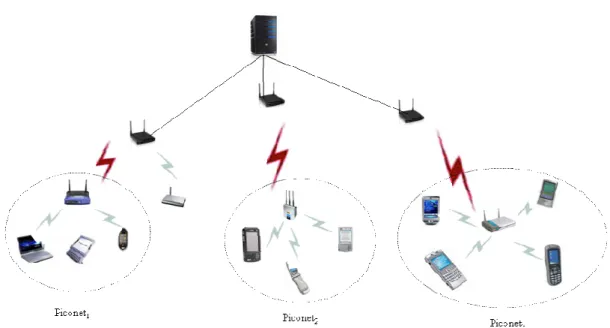
Figure 3.3 Mobile Users Roaming in Piconet ... 47
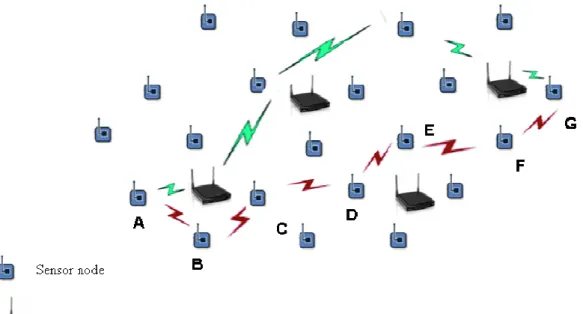
Figure 3.4 The 802.11 Mesh Network Overlaid in WSN ... 51
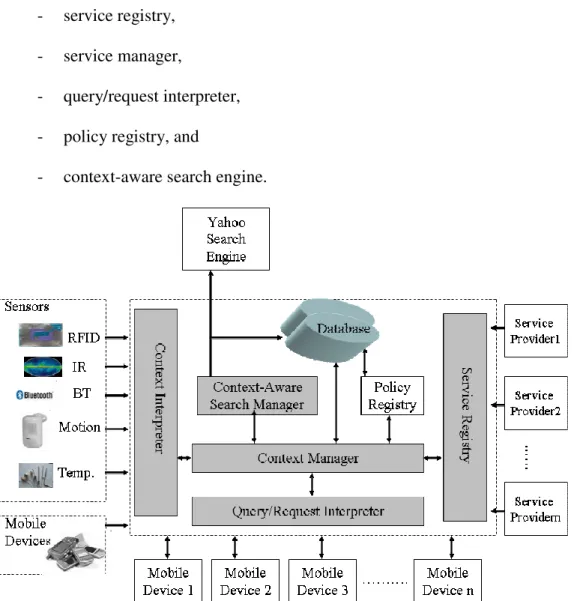
Figure 3.5 Software Architecture and its Context-Aware Server: Blocks shown in gray are modules that were implemented in this dissertation ... 52
Figure 3.6 Context Service Model ... 55
Figure 3.7 System Architecture ... 68
Figure 3.8 Flow Chart for Context-Aware Search Application ... 73
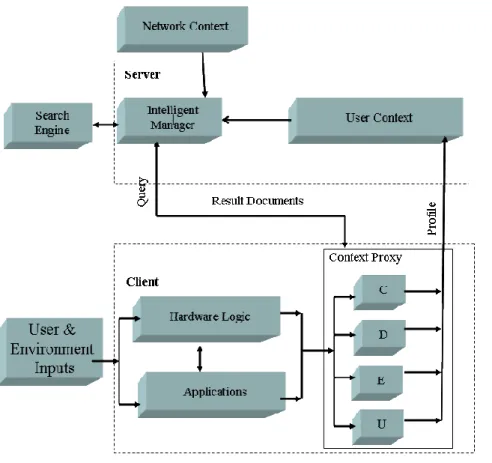
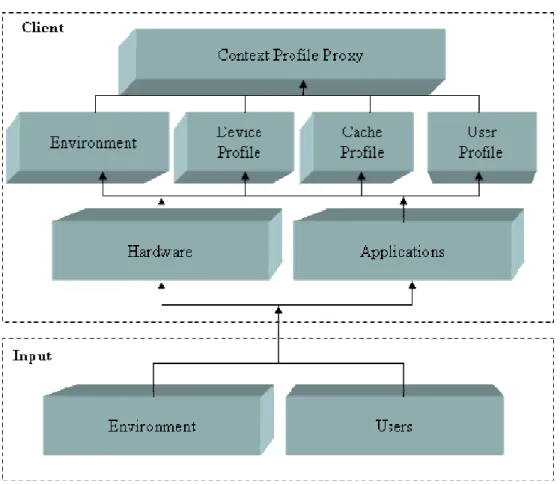
Figure 4.1 Client-Side Architecture ... 86
Figure 4.2 Structure of the Virtual frame... 86
Figure 4.3 Structure of the reference frame ... 87
Figure 4.4 Flow Chart for Proxy with Cache Scheme at Client Side ... 93
Figure 5.1 Simulation Flow of Information and Elements of the Architecture Design .... 98
Figure 5.2 Vendor Login Frame ... 102
Figure 5.3 Vendor Service Registration... 103
Figure 5.4 Display Service Registered in Text ... 104
Figure 5.5 Proxy on Client: ... 106
Figure 5.7 Context Search Application ... 117
Figure 5.8 Returned Search Result for Scenario 1 ... 118
Figure 5.9 Yahoo Search Results without User Context ... 119
Figure 5.10 Scenario for A Travel Route in the Dolphin Mall ... 120
Figure 5.11 Google Search Result for Scenario 3 ... 122
Figure 5.12 Returned Search Result for Scenario 3 ... 123
Figure 5.13 Returned Search Result Augmented With User Feed Back ... 124
Figure 5.14 Effect of a User Vote on the Listing Order ... 125
Figure 5.15 Cache Prune Comparison for Scenario 2: Roaming off FIU campus ... 127
CHAPTER I INTRODUCTION
With the technological advances in wireless communication, mobile devices such as cellular phones evolved from single-task gadgets, for example conversation only, to multi-media devices in mobility. The Internet Protocol (IP) convergence concept in recent years accelerated the trend for ubiquitous computing, playing henceforth an increasingly important role in our daily lives. The concept of context awareness originally stems from the research of human-computer interaction (HCI). One of the objectives in HCI research is to design computer interfaces that reduce user intervention while providing more relevant functions/services to the user. Context awareness came across the attention of HCI research community as the “hot topic” a few years ago. One group of researchers tried to standardize the context definition in a hope that a set of well-defined context concepts is able to interpret mobile user’s changing situation. However, some researchers argue that these predefined context notions are still too vague or general to understand the changing context. Due to mobility, users significantly expand their personal space far beyond fixed indoor environment such as office and home.
At the present time, mobile users are very creative in making use of mobile devices to affect almost every social aspect. Obviously, a fixed set of context notions has very limited success in learning the mobile user’s intention under various scenarios. Another group of researchers point out that context awareness is a study that must also incorporate mobile users’ psychological behavior, group dynamics, and social interaction. This group
of researchers laid their framework on the observations of societal patterns and common psychological behavior of the mobile users within a town or city. This is clearly a challenging and broadly defined problem. In this dissertation, the mobile context is examined and studied focusing on the user-centered empirical approach. This approach is an attempt at exploiting the information environment to suit specific user needs. Context awareness therefore can be viewed as a facilitator for mobile users who seek reduced human interaction and an improved machine-learning process.
With this undertaking, the main objective of this dissertation is to develop a novel context-aware search application which can provide data and services relevant to the user’s given situation and whose design is able to adapt to the day to day changes and user dynamics. The programming language considered throughout this dissertation is Java due to its portable nature, with the notion “Write once, run anywhere”. Three integrated development environment (IDE) tools, Netbeans, Sun Java Wireless Toolkit, and Eclipse, are utilized to implement simulation code. The Java version is 1.6 which includes the IDE Netbeans 6.1.
In Chapter II, the definition of context is provided. Context research remains one of the most important topics in the design of human-computer interfaces (HCI) as well as in applications of artificial intelligence (AI). Ubiquitous computing is still a relatively young discipline. Researchers with different backgrounds in HCI, mobile computing, computer vision, and distributed systems, to name a few, contribute to this research field. A brief history of mobile context is thus given as a background. Research on mobile
context, shifting from the traditional fixed indoor patterns, looks into aspects of psychological and social behavior as well, making this research problem even more challenging. In particular, the context entities are identified to describe the state of the mobile user in a given situation. User profiles which consist of context entities are compiled at the different distributed systems and mobile devices. The context profiles are utilized to describe mobile user’s current state. Context data modeling deals with raw context data acquired from various data sources including wireless sensor network and mobile devices. Context data can be discrete or continuous. In addition, the readings vary widely in format. Context modeling converts data into machine-readable formats. A brief review of context models is given. Over the years, different models of ubiquitous computing were proposed. The most common model is the one based on the conceptual view which mimics the way human perceive the world. The building block of the conceptual modeling is the context entities. Because the high-level context abstraction is distributed to the mobile device, the context modeling does not include this type of abstraction. Key-value pair and object-oriented modeling are the most used structures. However, they are ad-hoc and application specific. XML is used to describe the context data. XML is widely accepted to express data and semantics. The advantage of XML is that a lot of parsers exist in different programming languages. This gives the application developer freedom over the developing tools. The issues of context computing are discussed and possible solutions are introduced in this chapter. These solutions lead to many useful applications. Some interesting applications are enumerated to see how context-aware devices help out users.
Chapter III starts with an introduction of the context-aware architecture. Advances in both mobile devices and carrier network have led to the context aware utility and its preponderant use in day to day activities. The introductory section looks into some of the existing solutions. Each solution has its own advantages and disadvantages, requiring different context architectures with varying hardware and software demands. However, network carriers are reluctant to deploy sensor network due to high cost and lack of high-visibility application. Consequently, a low cost sensor network is provided to address this difficulty. A wireless sensor network takes advantage of the latest WiFi technology, Bluetooth, and mesh network. The required context-aware infrastructure consists of context interpreter, service registry, context manager, request interpreter, policy registry, and context-aware search manger. The context-aware search manager takes user context profiles into account. The user context files are compiled at mobile devices taking advantage of many applications and the distributed computing power. Context profiles are further processed and augmented with other user information at context server. Thus, the search results are tailored to user context. The main objective of context server is to distribute the user context data among applications. Hence, context reusability shields application developers from low level context acquisition. Unlike existing architectures, the context reasoning is distributed to mobile devices.
Chapter IV introduces the algorithms that have been developed at the client side to capture and extract the user context as a foundation that supports the design of the cache scheme, the search engine and the required context-aware server. The relevance of this is that context profiles (user profile, device profile, environment profile and data profile)
need to be fed to the context-aware server, which in turn, will supply all the different context aware applications. Within this design concept, the context aware application developer can now focus more on the context-aware application itself rather dealing with low-level hardware which acquires the context data. These algorithms include: (1) Virtual frame and reference frame calculation; (2) context-aware cache scheme. Based on these technology breakthroughs, a client proxy is designed to manage the context computing on the mobile devices. Identifying context entities, computing context weights, and compiling context profiles are the major tasks conducted by the proxy. Context weights are important measurement of the relevance in user context. The context abstract is quantified and digitized. The values of these context weights should reflect the significant changes in the given situation. The context profiles contain all the recognized context weights. Context profiles are classified into different categories. Device profile describes the hardware configuration of the mobile device and software installation. The user profile reflects mobile user’s personal characteristics such as gender, age, and hobbies. Likewise, the environment profile contains information regarding weather, noise level, surrounding social activities, and available resources. The client proxy compiles these profiles and relieves the operator’s network of number crunching on context profiles. The context profiles are updated either periodically or on the change of major context entities. The proxy sends the compiled context profiles to the server such that the network (server) is aware of the mobile user’s given situation.
Chapter V provides all the simulations based on real-world scenarios to evaluate the merits of (1) the context search as compared to web-based search (Yahoo and Google)
using different roaming scenarios, (2) the use of the cache algorithm in terms of virtual and reference frames which are used to capture user context based on the same scenarios in (1). These simulations prove the effectiveness of the context-aware search application built upon the required context aware architecture. Java applications are written to simulate the developed software modules at different levels. The database server is MySQL which is very popular among open source community. The MySQL server version is 5.1.30. A relational database is designed to store user context information and service provider’s information. The database also supports the context search algorithm. A few assumptions are made due to lack of resource for hardware infrastructure. For these simulations, the user information is assumed to be provided from the required context-aware infrastructure which may include wireless sensor networks, cellular networks, and mobile user devices together with a context aware server. It is noted that all the user information is further converted into digital format in order to extract and process the user context. The simulation takes the required context information from the text files as if the data were provided from the context aware server. Furthermore, test scenarios are generated based on average user activities. Test data and results are presented accordingly. In addition, Yahoo Search API is used to get preliminary search results. These preliminary results are then ranked based on the user context. Furthermore, any user selection will be saved for future reference as a feedback mechanism.
Chapter VI concludes with a retrospective on the accomplishments of this dissertation and provides a reflection on key technological developments that would advance this research field within feasible and economical bounds.
4 CHAPTER II
A RETROSPECTIVE ON CONTEXT AWARENESS
2.1 Notion of Context
Gordon E. Moore, co-founder of Intel, predicted in 1965 that the number of transistors on a chip would double about every two years. His prediction is what is known as Moore’s Law today [1]. In this line of thought however, the size of the computing device changed with the changing application(s). To this day, when massive computing power is involved, it would be because of the inordinate amount of data it needs to process and it would most certainly be shared by many users/researchers. In present days however, the tendency is more for individuals to use multiple personal computers and or mobile, for example notebook and desktop computer, at home and office. This tendency is paralleled in wireless communication through the use of notebooks, PDAs, cellular phones, and other mobile devices with a high proliferation rate [2].
These mobile devices are able to integrate more functions such as MP3 music, digital camera, video stream, mobile TV, Web access, to name a few. Texas Instruments, leading cellular phone chip supplier, offers OMAPTM family of multimedia application processors which integrate the above applications in single-chip solution [3]. Wireless carriers, on the other hand, continue to improve the network infrastructure as new protocols and technologies emerge. Japanese wireless carrier, NTT DoCoMo, became the first carrier in the world to launch the commercial 3G wireless network in 2001. As of
December 2006, the 3G wireless users in Japan alone reached the 60 million mark (http://www.iresearch.com.cn). It is estimated that the number of wireless users in the world will surpass 4 billion by 2010. That is why the widespread of wireless devices is now leading the way in the new research field of ubiquitous computing.
A decade ago pioneer Mark Weiser envisioned that a human would live in an environment surrounded by hundreds of invisible computers connected with wireless networks [4]. Indeed, the ubiquitous computing is now interwoven into our daily lives such that mobile users could access information anytime and anywhere without even knowing the aid of these computers set up around them. In order to achieve Weiser’s vision of ubiquitous computing, understanding user context becomes imperative because such wireless network must be sensitive to the user’s context data which are not explicitly given to these invisible computers in mobile computing. Ubiquitous computing requires the invisible computer networks to cope with context awareness at different levels. The intelligent mobile devices must be aware of the CPU, memory, Operating System, and other device configuration of surrounding computers at the hardware level. At the network level, variations in topology, bandwidth, protocols, congestions, and other real-time traffic parameters must be considered by user devices. At middleware level, the context information affects the application performance, resource allocation, and execution optimization. At application level, the applications must adapt to the interactions, network variation, and changing inputs due to the mobile environment [5]. Finally, the invisible systems must deal with issues such as output display at user interface level. Obviously, such context-aware wireless networks must actively acquire,
analyze, and adapt to mobile user’s given context such as physical environment, social activities, and other dynamic characteristics at different levels without consuming much of the user’s attention.
What is the mobile context then? Context is defined as “the interrelated conditions in which something exists or occurs” in Merriam-Webster’s dictionary. Wikipedia defines that “In mobile computing, context is the circumstances under which a device is being used, e.g. the current occupation of the user.” The definitions of context refer to the understanding of the “interrelated conditions” and “circumstances” of the mobile user. The context must reflect the artifacts and environment the mobile user interacts with. Researchers believe that there exists a strong relationship between context and entities in the environment [6, 7].
So what exactly describes the “interrelated conditions” and “circumstances”? Ideally, context should fully describe the state of the mobile users and their surrounding world at a given time. In general, it is not easy to single out the mobile user’s context from objects and entities which are not relevant to users’ intention. After all, too many things or entities around us have context. Humans have different knowledge, expectations, experiences, priorities, social roles, and tasks to view the world surrounding them. Hence, individuals select the objects in the real world in a subjective way and describe context of the world complexity in an unstructured fashion. Furthermore, the available sensors and sensing technologies limit us to learn the real world complexity in technical aspect. For example, the video cameras can tape mobile users and their surrounding scenes.
However, human interpretation is still needed to describe the mobile users’ emotional expression such as anger and laugh. Based on the above observation, researchers try to refine the definitions of context in ubiquitous computing. Dey defines context as “any information that can be used to characterize the situation of an entity. An entity is a person, place, or object that is considered relevant to the interaction between a user and an application, including the user and applications themselves [8]. Chen and Kots state that two aspects of mobile context must be addressed. Firstly, the behavior of applications on mobile device should reflect characteristics of the surrounding environment. Secondly, the mobile applications themselves indicate the user’s context in some cases, if not necessary in all. They concluded that “Context is the set of environmental states and settings either determines an application’s behavior or in which an application event occurs and is interesting to the user” [9]. The context in ubiquitous computing must reflect the mobile user’s current state including physical and psychological behavior, the objects embedded with computing and communication capabilities, the mobile environment and scenarios, and mobile application’s interactions based on the explicit and implicit user input.
In contrast to prevailing viewpoint on definition of context, Rehman challenges the research community with his notion. He argues that the objects in the real world do not have context at all even though they might have physical properties. He gave an example on this point. A pair of computer loudspeakers on the desk does not have any context in his point of view. Instead, the real world objects form part of the context in interaction between the user and applications [10][11].
2.2 Context Entities
Having defined mobile context, context entities can now be identified in more details. In general, context entity refers to person, location, time of the day, event, objects, artifacts, or combination of the above that are related to the interaction between the user and mobile devices. User’s age, gender, weight, height, and other personal data become the context entities that reflect the user context. Similarly, temperature, noise level, lighting, and location are the context entities that describe the environment context. Context entities can be classified into the following main categories;
• Device context entities refer to the hardware configuration and software applications of the mobile devices. Antenna, LCD display, keypad, stylus, Bluetooth earphone and so on are all good examples of context entities. On the other hand, Operating Systems, browsers, address books are mobile software applications. The middle wares which are not so obvious to mobile users are also device entities.
• User context entities include information regarding the specific mobile user. Age, gender, height, weight and other personal information fall into this group. In addition, user personal preferences such as hobbies, settings for applications, and browser bookmarks are also considered as entities which can be used to derive user context.
• Environment context entities consist of information of the surrounding area of the mobile user. The weather, temperature, lighting, noise level, location, near-by activities, and people are all considered the environment context entities.
• Time is the arguable context entity. Some researchers consider the time context is included in the user activities. Other researchers argue the time is important context which deserves more attention in user context analysis, because it reveals the temporal aspects of the context entities. This dissertation supports the viewpoint of the later group.
However, the above categories do not serve the purpose of defining all context entities to cope with the dynamic and unpredictable mobile user’s characteristics. Instead, these categories serve to list the entities that are most commonly known to ubiquitous computing. Some context entities that are not so obvious sometimes play an important role in some mobile applications. For instance, the history context of the mobile user is crucial to understand if the user’s context remains little changed over a period of time. There are many context entities to be addressed within a context aware architecture beyond the traditional approach, which limits context awareness to location awareness [11]. In this dissertation, the empirical and user-centered approach is applied as means to study the mobile user’s context.
A variety of sensors are applied to capture the context entities in different categories. The details of context acquisition are specified in the later chapter. The industry trend in the past saw the decoupling of sensor layer and the application layer. The purpose of
decoupling is to remove duplication in hardware logic and shield application developers from low-level hardware details [12]. Context-aware applications in general share the context entities acquired from the sensor layer or from the wireless networks. Thus, modeling these context entities becomes an issue. In particular, how can these context entities be represented? Some context entities such as age, weight, and noise level are easy to present and disseminate in digits. While other context entities are not so straight forward. For example, activities of the surrounding area are certainly of interest of many applications such as tour guide systems. Modeling context entities will be discussed later.
2.3 Fundamental Concepts of Mobile User Context Profiles
After acquiring/extracting the context entities from the user context, the next step is to organize the context entities into context profiles. Context entities are grouped into these files in terms of context nature. In this research, context entities are classified, but not limited, into the following major categories;
• User profile describes the user’s characteristics, preferences, activities, emotions, and so on. For example, user’s age, gender, height, weight, health conditions, past incidents, and planned events can be sorted into this category.
• Device profile describes the configuration and functions of the hardware. In addition, this profile includes the software applications and user interfaces. Examples of context entities in this profile are processor, memory, display type, device size, and operating system.
• Environment profile describes surrounding area of the mobile user. This profile stores user location, weather, noise level, temperature, etc.
• Data profile caches user’s data in the local memory.
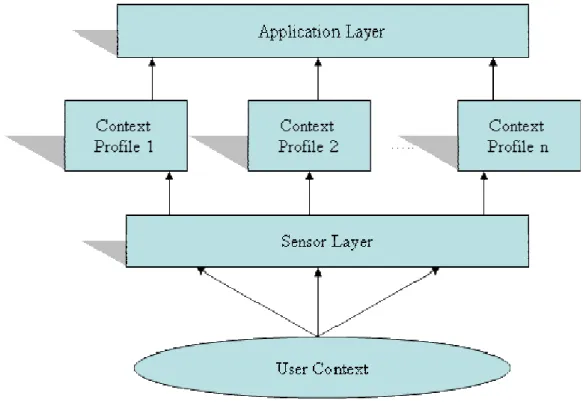
The context profiles facilitate applications in the upper layer. Applications in the upper layer no longer have integrated sensors, so they share context profiles. At this point, the concepts of context, context entities, and context profiles are all introduced. Figure 2.1 illustrates the bottom-up modeling proposed in this dissertation.
2.4 Context-Aware Mobile Computing
A decade ago Mark Weiser predicted that future environment would be surrounded or embedded by “invisible computers” connected with networks. In his article, he states “the most profound technologies are those that disappear. They weave themselves into the
fabric of everyday life until they are indistinguishable from it” [4]. These invisible computers comprise the context-aware systems which complete tasks related to the roaming users as if the nomadic users did them by themselves. Context-aware computing is a paradigm for developing smart systems that can derive mobile user’s need and adapt accordingly on the user’s behalf. Wikipedia explains, “In computer science it [context awareness] refers to the idea that computers can both sense, and react based on their environment. Devices may have information about the circumstances under which they are able to operate and based on rules, or an intelligent stimulus, react accordingly.” Ryan defines context awareness as a term “that describes the ability of the computer to sense and act upon information about its environment, such as location, time, temperature, or user identity. This type information can be used not only to tag information as it is collected in the field, but also to enable selective responses such as triggering alarms or retrieving information relevant to the task at hand [13].
Schilit characterized context awareness as follows “such context-aware software adapts according to the location of use, the collection of nearby people, hosts, and accessible devices, as well as to changes to such things over time. A system with these capabilities can examine the computing environment and react to changes to the environment” [14]. Unlike the idea of invisible computers, Rehman recently points out that context-aware system is based on the interaction between the mobile users and system. He argues that user should play an active role to understand what assumptions the context-aware systems make inference on user’s behalf. The interactive systems, in his mind, should take the user’s feedback. Furthermore, the interactive model allows user
to evaluate the context-aware systems. Over the years, context-aware computing became an interdisciplinary research that involves embedded systems, distributed system, artificial intelligence, human computer interaction, architecture design, and computing science. Researchers with different backgrounds such as mobile computing, AI, distributed systems, and HCI have contributed in all aspects of this relatively young field.
The European Commission proposed project which echoes Weiser’s invisible computer, “A vision of the future is one in which our world of everyday objects and places becomes infused and augmented with information processing and exchange. In this vision, the technology providing these capabilities is unobtrusively merged with real world objects and places, so that in a sense it disappears into the background, taking on a role more similar to electricity an invisible pervasive medium” [15]. To realize Mark Weiser’s ubiquitous computing, it implies that user’s interaction for input should be minimized, if not possible to eliminate the user interaction all together. The “invisible computers”, in Mark Weiser’s vision, do not mean the physical size of the computers is too small to be visible. Nor does it mean that using portable devices, as user goes, is a good example of ubiquitous computing. Instead it requires that the user interface and human-machine interaction in ubiquitous computing are totally different to the traditional wired computers, since keyboards and displays are no longer the only interaction between the mobile user and computers. The mobile devices typically have reduced LCD display and tiny buttons. In ubiquitous computing, the artifacts and environment that surround the mobile user are included as part of the interaction for the context-aware systems. The inputs from the mobile users are implicitly acquired by the context-aware systems as
much as possible. This process is achieved by the collaboration of mobile devices and computer networks around the user. In a sense, the context-aware computing is aimed to assist or even enhance the user interface of the mobile devices.
The invisible computer networks have to be aware of the user’s situation including social and psychological behaviors. It indicates that such context-aware system is able to distribute the user’s context profiles wherever the user goes. This feature overcomes the asymmetry of the invisible context-aware system. In other words, it is not feasible to build context-aware networks with the uniformly distributed hardware and topology all over the areas. Wireless operators are often bound to limited resources. In economic sense, they would focus on the efficiency of the network deployment and invest heavily to areas that generate the most profit. Even within the same operator, it is common that different wireless technologies can be deployed simultaneously. For example, US wireless operator, Sprint, is well on the way to deploy the first WiMax network across the nation which is meant to supplement the 3G CDMA network. Likewise, the Chinese operator, Unicom, has deployed both GSM and CDMA networks across China. The co-existence of various wireless technologies challenges the architecture design, user context acquirement, and context distribution.
In the early days of context awareness research, some experts debated what user context comprises. These same experts, inspired by the study of traditional human computer interaction, proposed to predefine a set of context entities which would cope with all user situations. However, the mobile users significantly expand their personal
space far beyond fixed indoor environment such as office and home. In addition, people utilize their mobile devices creatively in their personal activities or social events. Nowadays, mobile devices find their way to penetrate our daily lives as mobile users utilize them for conversation, email, games, TV, ecommerce, banking, video stream, and so on. The scope of the mobile device usage is thus extended to cope with the various aspects of our society.
Therefore, some researchers argue that the all-embracing set of context entities is too general to capture the user’s context in particular situations. Instead, this group of researchers proposed an empirical approach to find the regularities persistent within particular situations. For example, Luff and Heather [16] are the pioneers who explored how the mobility of artifacts impacts the traditional working settings. In the clinics they studied the “micro-mobility” of medical records. They revealed how the mobility of traditional medical records brings collaboration among doctors and patients. The introduction of computer based medical records changes the way the doctors interact with patient. However, the traditional medical records remain the important resource within medical practice, because it preserves the “ecological dexterity” for the doctors. Simply put, traditional medical records assist the doctor with the communicative flexibility. At the construction site, the specially designed mobile devices are distributed to foreman in order to assist them in the daily operation. Contrary to what application designer hoped for, the mobile devices which are supposed to be carried by foreman remain in the fixed office setting and are managed by the office clerk. The empirical studies contributed by Luff and Heather indicate context-aware application design must be socially acceptable
and useful. The design of context-aware applications must assist the existing collaboration instead of overtaking it in a dramatic fashion. Tamminen and Oulasvirta carried out experiment on 25 adults in Helsinki to study the rapid change of contexts in everyday urban navigation [17]. Their study analyzed the impact of the social interaction, psychological behavior, and group dynamics toward user context. The experiments helped the system designer to better understand the hidden factors within user context along with tangible context entities in the environment. Understandably, the important factors and entities in one situation might not be so crucial in other situations. Even same entities have different impact from one setting to another. The design of context-aware systems can thus be fine-tuned out of trials and errors based on the experiments. More importantly, the empirical studies also provide an accurate evaluation to measure the effectiveness of context-aware design.
2.5 Issues of Context Awareness
The essential part of the context awareness is to design an artificial intelligent architecture which acquires, analyzes, learns, models, and distributes the mobile user’s context [18]. The mobile devices can also contribute to undertake some of the context server’s functions in terms of context acquisition and analysis, as more advances are made in this field of research and as new challenges are ultimately revealed.
Acquiring the user information is the first step towards understanding the changing context. The hardware infrastructure must be provided to collect user context. The solution is two-pronged:
- On the one hand, technological advances enable hardware manufacturers to integrate more hardware logic into wireless terminals. For example, the iPhone from Apple recognizes user’s face and dims the LCD display if user’s face touches the iPhone during the conversation. Korean cell phone maker allows the user to lock/unlock the cell phone with finger prints. These examples show the trend that mobile devices are likely to play a more active role to acquire the user’s context.
- On the other hand, wireless operators have little progress in deploying infrastructure due to the cost factor. Even though the 3G networks can be used to disseminate user context information, most 3G technologies do not take context acquisition into account. Extra hardware infrastructure, especially sensors, must be put in place additionally. The major barriers that hold operator’s infrastructure deployment are high cost and lack of the so-called “killer” applications.
Furthermore, one is also called to reflect on how context acquiring processes at mobile devices and carrier’s network are being coordinated? Once the context data are acquired, we still can ask: how can they be represented? Context data can have all sorts of readings in continuous and discrete forms. How can context data be transformed in a machine readable structure? Context modeling is viewed in this dissertation as the answer for this question. Context modeling is a process to convert context data into a structured
format. In the past, researchers proposed some ad-hoc data structures to express and exchange context information. Object oriented approach was one of the popular data structures to model context entities, as context entities were treated as objects. This approach originates from the programming aspect obviously. XML seems a more interesting way to distribute the context entities, because XML is widely accepted and open to users. Key-value pair is also proposed as a solution due to its simplicity in modeling the context entities.
Another issue is how mobile devices share user context if there is no such infrastructure available to support such context reusability [19]. Researchers proposed solutions ranging from context middle ware to context server in order to support reusability [20]. Nowadays, mobile users are no longer limited to one mobile device anymore. Some mobile users carry multiple mobile devices. A truck driver might drive a truck which has a wireless GPS device in addition to a cell phone. A delivery staff might be equipped with cell phone and wireless devices that scan and update schedule remotely with the company’s database.
These mobile devices might subscribe to different networks. There are underlying variations in the individual networks. For instance, WiMax is an emerging technology which is likely to coexist with other 3G technologies. It is clear that the context sharing infrastructure must interact with heterogeneous networks. For example, Henning Maab proposed a centralized location-information server which is integrated in the network platform [21]. This centralized architecture design is based on directory service. It
provides an application programming interface (API) for mobile devices to query location. Furthermore, different mobile devices need different context information. A mobile scanner designed for a specific task does not process more user information than what it is designed for. For instance, the noise level in the surrounding environment has no value for the task-specific mobile scanner. Clearly, the context sharing mechanism must allow the applications to request related context information.
Despite the noted progress, there are few hardware limitations facing the notion of context awareness. The batteries on the mobile devices restrain the usage of mobile computing. Users demand more applications that consume more power. For instance, the fully charged battery can only support a few hours of conversation on iPhone. Users who are going to watch the mobile TV are likely to shorten usage time before next recharge. In addition, the average memory capacity on a cell phone is less than 1 GB. The typical LCD display on the cell phone is somewhere between 1.8 inches to 2.5 inches. The context aware tools/systems must be running in the background as much as possible. Mobile applications that users work on should have the priority to run in the front. User’s applications should not be interrupted at all. Therefore, the context aware systems are required to use as little system resource as possible. Also the hardware variation in mobile devices makes the design more complicated.
Furthermore, if the surrounding artifacts and environment are included as part of the interaction for context-aware systems, user’s personal data will be shared with computer networks explicitly and implicitly. This is clearly an issue of privacy. How comfortable
are mobile users if their information is distributed to various computer networks along the way they travel? It is very likely that a policy or protocol must be in place to guard data safety. The data protection requires a mechanism to ensure user’s context to trustworthy computer networks. The privacy issue, no doubt, adds complexity to the design of context-aware systems. If mobile users wish to turn off the context awareness feature, they must be provided a means to do so.
2.6 Context Modeling
The most important feature of a context-aware architecture is the reusability of context among applications such that the application developers can focus on the high level application development without the drag on context data acquisition. Because of the heterogeneous nature in context data acquired from various types of sensors, it is crucial to represent context data in a structured format. Put simply, it is desirable to transform the context entities and user space into a digital world which is suitable for machine processing. Context modeling plays a role of converting, analyzing, and composing context into structured data format which can be stored and retrieved for context-aware applications.
Data structure is one relevant domain in context modeling. In the early years of context-awareness research, location-based context modeling revolved around the location. Geometric model and symbolic model are two modeling structures which are ad-hoc in nature. Today, there is still no standard toward the data structure in context
modeling. The most common data structure is the so-called ad-hoc key-value pairs. In this structure, entity is defined as a key and its value is associated with the context key. This data structure is simple and it works. The object-oriented model is a much more balanced modeling structure. This is so because entities can be perceived as objects. Entity types, attributes, context values, and relationships can be mapped into objects, object variables, and object methods. The object-oriented model is also an ad-hoc approach. It abstracts context in high level and encapsulates context data processing in low level. Object-oriented model facilitates context reusability and aggregation. However, some researchers criticize key-value pair and object-oriented structures because they believe these ad-hoc structures lack expressiveness and extensibility. In addition to key-value pair and objected-oriented structure, developers also make use of database to store and retrieve context data. The advantage for database is that standard query is used to facilitate applications using different programming languages. Retrieving from database is faster with database server. Critics point out that database server is not able to resolve context inconsistence.
Over the years, researchers developed context models from different aspects of context awareness. Some models, for example user interaction model, which focus on human-computer interfaces. Conceptual models are based on the context entities. Policy driven models adapt to protocols, network parameters, and carrier policies. The section dwells on some of the context models.
2.6.1 Modeling Languages
In general, various tools exist to model the context entities and relationships among them. Modeling languages are used to describe the context entities and the relationship among them. One of the most used languages is UML (Unified Modeling Language). UML has been widely used in academia due to its clear semantics and graphical presentation. The advantage of the UML is that object classes are fit to model the context entities, attributes, behavior, and relationships. In addition UML links are utilized to associate interaction between context entities. The generated UML charts which include the UML classes and links describe structured context data in the high level forms without the implementation details. Also the UML flow charts demonstrate the events or services triggered when the context data changes between the mobile users and service providers. The other modeling language is ontology language. Context entities in the mobile environment can be entered and deleted from the ontology database in the runtime. Raw context entities can be composed to composite context data with the ontology language constructs like subClassOf. While the disjointWith constructs describe relationship among context entities. One advantage of ontology language is that researchers can use it to build the reasoning mechanism and define the application’s behavior upon the change in context.
2.6.2 User Interaction Modeling
This type of modeling is based on the user interactions. Variations exist in how interactions are defined and the scope of interactions, but the main categories of
interactions remain the same. The main user interactions are user-application interactions, user-network interactions, application-network interactions, and interactions among users. Entities, such as user preferences, network traffic, bandwidth, application requirements, become part of the context only when the interactions happen. Unlike user-center modeling, the focus in this modeling is on the interactions. The user-application interactions include interactions between user and interfaces of applications. User input through key pads, voice recognized module, touchable screen, and stylus are typical interactions. Application behaviors or feedback are interactions controlled by applications.
The user-network interactions cover the user’s behavior toward network variation and network management of user requests from mobile applications. In general, mobile users respond to network variations in terms of bandwidth, connectivity, congestion, and usage cost. For instance, if the user roams out of Wi-Fi network, the underlying cellular network overtakes the connection from vertical hand-off. However, the bandwidth is most likely reduced. So the user might suffer quality of service (QoS) for video streaming applications via network. With low bandwidth or network congestion, the user might turn off the application. On the other hand, the modern network improves in handling user’s traffic. The network is able to classify user traffic based on issues such as QoS. Hence, the network adapts to user device and applications.
The application-network interactions refer to mutual adaptation between the user applications and networks. For example, the IPV6 has priority field for IP packets which
allow the network to adapt and allocate network bandwidth accordingly. Thus QoS can be improved over the IPV4. Human interactions are indirectly involved in this type of interactions.
2.6.3 Activity-Oriented Context Modeling
Unlike the user interaction modeling which centers on the interactions among user, machine, network, and application interfaces, the activity-oriented context modeling is based on the external resources and internal mental process. The external factors are defined as human, artifacts, and environment. The internal mental process refers to user goals and beliefs. The user activities consist of both external factors and internal mental states. In essence, this model requires the designer to predefine the activity plans which also include all the social context factors and cognitive contexts as parameters. The context adaptation is managed by monitoring the switch among user activities. The advantage of such modeling is that system design is simple, since the system just needs to follow the context “template”. The weakness of such modeling is that it does not scale well as more predefined activities are under monitor. In addition, it cannot deal with activities that are not predefined. Finally, it is very difficult if not impossible to detect user’s internal goals and beliefs.
2.6.4 Policy Driven Model
The policy driven modeling is quite different from other models where human-computer interfaces are emphasized or user-centric context take center stage. This type of
modeling makes services adapt to different communication protocols and network characteristics. In the upcoming years, service providers must offer mobile user services which utilize the Next Generation Networks (NGN) which consist of emerging heterogeneous networks, wired networks, and various wireless networks. This requirement makes service context aware to the underlying networks. The policy-based network management has become the subject of extensive research in the past decade. Network administrators are relieved from configuring individual devices to operate under heterogeneous networks. Because services are context-aware and operating on the context aware architecture, so network administrators only need change the policies governing the networks. The policy modeling takes the context-aware object oriented approach which is, in general, based on the Policy Core Information Model (PCIM). Network variables and management policies are mapped in to modeling objects.
2.6.5 Peer-to-Peer Light-Weight Component Model
This model is typically for small-scale applications. The idea of Peer-to-Peer light-weight component model is to develop containers of components (middleware) which abstract and encapsulate the communication protocols utilized to interact among mobile applications. The increasing complexity in software and hardware quickly dampens the development of flexible and dynamic applications. Especially, developers of mobile applications need to take advantage of emerging communication protocols. The peer-to-peer component model shields the protocol details from the application developers such that developers can focus on the features or functions their applications provide to mobile
users. The modeled component is a collection of objects which can provide services to remote peers. The motivation for these components is to provide infrastructural support for context-awareness in mobile peer-to-peer applications. The interfaces of these components are unified such that the details of underlying communication channels are taken care of by these containers. The container has management objects which adapts to user’s mobile devices by selecting appropriate protocols. The peer-to-peer applications are installed on resource-constrained mobile devices and offer seamless configuration of wireless communication among mobile devices at home and office environments.
2.6.6 Conceptual Modeling
Conceptual modeling is based on the fact that it is natural to model context derived from the context entities. The assumption for this modeling is that people share understanding of context that revolves around entities. Furthermore, there exist connections or relationships between entities. Entities reveal more relationships or context when they are combined. For example, person, computer, office and time are context entities. With the presence of all four entities, it is conceivable that the person is likely to work on the computer at the office during business hours. The association of these entities reveals the context. When entities are augmented together, the context is clearer. For the same example above, if office entity is not present, then the possibility that the person is working is much lower.
One of the advantages in conceptual modeling is that it is easy to model the entities in a bottom-up approach since it mirrors the way human perceives the world. However, a complete representation of the world by this model is still a blurred image compared to the reality. First of all, the existing sensors and sensing technologies limit the information about entities that the context-aware system can detect and recognize. In addition, the choice or selection of the entities in the model is subjective to the application developer’s understanding of context. When entities are aggregated, the number of relationships and contexts which can be derived rises. Therefore, entity aggregation makes the modeling complex.
The conceptual modeling is taken as the modeling approach in this dissertation. Context data is thus assumed to be collected from various sources including wireless sensor network, carrier network, WLAN, and mobile devices. The modeling handles data in different forms, for instance discrete or continuous. It also deals with middle-level context abstraction such as transforming the geographical coordinates into a symbolic address. Unlike other context data models, this context model does not include context inference which derives high-level context abstraction for mobile applications. This is due to the belief that individual applications understand the application-related context better than the general-purpose context server.
This is particularly true when the number of context-aware applications increase and the applications become much more sophisticated. Hence, the high-level context abstraction is distributed to the individual mobile device. The distribution of high-level
context abstraction is based on the fact that technological advances make mobile devices seem even more capable. In run time, the mobile application informs the context server of the context data it needs. After receiving formatted context data from the server, the application extracts the high-level abstraction and acts based on the interpreted user context.
The most common data structures used in conceptual modeling are key-value pairs or object-oriented programming. Instead of these ad-hoc data structures, standard XML is used to structure the data in this dissertation. The selection of XML is due to the fact that proposed context server does not have the context reasoning component as other context servers have. Thus, the modeling structure can be much simpler. Context server focuses on the context acquisition and models data into XML format. Since XML is widely accepted in the computing world, XML data can be easily interpreted by different parsers and integrated into different programming languages. The Internet Explorer browser has a built-in XML parser. Most popular programming languages such as Java and C# .net have support to work with XML data structure. A typical example of location in XML modeling is as follows:
<location>
<longitude>x</longitude> <latitude>y</latitude> <altitude>z</altitude>
<symbolic>10555 W Flagler Street<symbolic> </location>
2.7 Applications of Context Awareness
This section enumerates some of the creative applications that consider mobile user’s context.
2.7.1 Technology Enabling Awareness (TEA)
The European project TEA is a good example of architecture for mobile devices. The objective of TEA is to integrate multi-type sensors on a mobile device (http://www.teco.edu/tea/) [22]. The device architecture separates context acquisition from the individual applications. The diverse range of sensors collects information not limited to location only. The design objective is to have plug-in unit for sensors added onto the terminal architecture. The low level sensor acquires the raw information and passes it on to the context cue. The context cues are the higher layer component in the architecture which is responsible to interpret the raw context. Another goal of TEA is to derive user context from the combined sensor pool. The derived user context should enhance understanding of the user situation. TEA provides a development platform for context-aware applications. It established a direction for self-contained solution in context aware study. After TEA rolled out, a few more projects were built based on TEA architecture. Overall, the TEA project had an impact in the context-awareness research.
2.7.2 Sharing Context Information between Mobile Terminals
The TEA architecture allows context sharing among applications on the mobile device. This application provides a user interface solution that displays the friends’ positions in a customized map which runs on mobile devices [23, 24]. The carrier’s network functions as the centralized server which updates and distributes individual context information. The server updates group members of other members’ activities on mobile terminals. Context aware phone calls and short messages can be sent to the intended persons on the map. The application interface provides easy access for the user to use context-aware applications. This application demonstrates a simple architecture design which enables mobile users in a community to share context information.
2.7.3 Location-enhanced World Wide Web
One of the relevant issues in context-awareness research is the high cost of hardware infrastructure which unduly curbs the hardware deployment in the carrier’s network. A good example on how to overcome this drawback is best illustrated by the approach taken by Place Lab. Place Lab built a wireless LAN based on 802.11 location system to assist residents or visitors who navigate in a community [25]. The WiFi positioning algorithm is used to pinpoint the mobile user’s position both outdoor and indoor. User’s location is integrated into a customized browser. A database stores and updates the location-related information. As the mobile user travels in the community, the user is able to get location-enhanced web service. Because WiFi technology is very cost effective, Place Lab’s design is extremely flexible and scalable. The project illustrates the usefulness of context
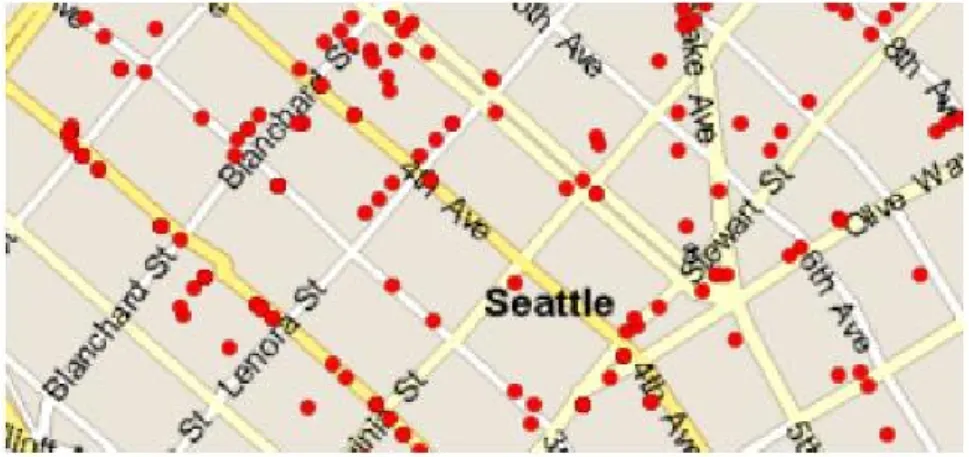
awareness with low cost technology to build the infrastructure. Figure 2.2 shows the wireless LAN comprises WiFi access points which are in red dots.
Figure 2.2 WiFi Access Points Distributed in Seattle. Courtesy of UbiComp 2003
2.7.4 Context-Aware Applications in a Hospital Setting
Clinical computer systems, such as electronic patient records, do not use patient’s given situation into the system design. Physicians have to manually work with same user-interfaces regardless of the individual patients in different clinical situations. The new designed applications take advantage of physicians’ and patients’ given situation. The context-aware hospital bed has for example a built-in computer and a mounted display for entertaining a patient or for displaying patient records [26]. This type of context-aware bed is equipped with RFID sensors which monitor activities of the patient on bed and identify the near-by physicians. For example, when the physician comes by for the ward round routine, the context-aware display recognizes the activities and switches the display to patient record from entertainment programming for the patient. This can be combined with the so-called context-aware pill container with a built-in computer which
displays the medicine schema to the patient and allows the patient to take the pills from the pill container.
The above list of context-aware applications is not a complete one; it only demonstrates that context-aware research starts to make inroads in different real-world situations with varying computing capabilities. All the applications listed here demonstrate useful and effective context-aware devices in real-world environments.
CHAPTER III
CONTEXT AWARE ARCHITECTURE DESIGN AND REQUIREMENTS
3.1Introduction
In the world of ubiquitous computing, knowledge and communication are interwoven entities. Pervasive computing refers to the trend toward casual access to numerous invisible computing devices embedded in the environment. Especially the networked computers are so pervasively available to users “anytime and anywhere” without the user interaction. Pervasive computing benefits users in a way similar to electricity. Consumers are all aware of electricity, and yet when they switch on lights, TV, and other powered devices, the act is taken for granted. Likewise, the future context awareness will become the “context aware utility” for mobile users. People use context-aware applications with little notice of the act.
To support such “context aware utility” everywhere, the appropriate infrastructure for context awareness in the environment is essential. Most researches with ubiquitous computing community take the bottom-up approach. The context acquisition at the bottom really affects the accuracy of the context-aware com