I n a u g u r a l d i s s e r t a t i o n
zur Erlangung des akademischen Grades eines Doktors der Wirtschaftswissenschaften der Universit¨at Mannheim
vorgelegt von Thomas Butter
Zweitberichterstatter: Prof. Dr. Martin Schader Tag der m¨undlichen Pr¨ufung: 30.09.2009
1. Introduction 2
1.1. Problem Outline . . . 2
1.2. Objectives . . . 3
1.3. Methodology . . . 4
1.4. Structural Overview . . . 7
2. Foundations of Mobile Context-Aware Applications 9 2.1. Mobile Applications . . . 10
2.1.1. User Requirements . . . 10
2.1.2. Mobile Software Development . . . 11
2.1.3. Technical Challenges . . . 12
2.1.4. Runtime Environments . . . 13
2.2. Context-Aware Mobile Applications . . . 16
2.2.1. Context in Mobile Applications . . . 17
2.2.2. Context Sensors . . . 21
2.2.3. Quality of Context Data . . . 23
2.2.4. Context Representation . . . 25
2.2.5. Design Patterns for Development of Mobile Applications . 29 2.3. Privacy in Context-Aware Applications . . . 35
2.3.1. Consumer Privacy . . . 36
2.3.2. Data Protection in B2B Environments . . . 37
2.3.3. Private and Public Context . . . 38
3. Service Discovery 40 3.1. Foundations of Context-Aware Service Discovery . . . 42
3.3. A Novel Service Discovery Concept . . . 44
3.3.1. Context Representation . . . 45
3.3.2. Context Manager . . . 48
3.3.3. Service Transformation . . . 49
3.3.4. Server-Based Filtering . . . 49
3.3.5. Mobile Post-Filtering & Ordering . . . 50
3.3.6. Individual Importance of Context Attributes . . . 52
3.4. Prototypical Implementation of the Service Discovery Concept . . 54
3.4.1. Server Component . . . 54
3.4.2. Context Manager . . . 54
3.4.3. Learning . . . 55
3.5. Transferability of the Concept to Navigation . . . 57
3.5.1. Introduction to the Problem Domain . . . 57
3.5.2. Conceptual Elements . . . 58
3.5.3. Finding Connecting Routes . . . 60
3.5.4. Simulation Setup and Results . . . 60
3.6. Evaluation of the Service Discovery Concept . . . 64
4. User Interfaces 66 4.1. Challenges of User Interfaces on Mobile Devices . . . 66
4.2. Existing Mobile UI Approaches . . . 69
4.2.1. Model-based Development . . . 69
4.2.2. Server-side Transformations . . . 70
4.2.3. Java Frameworks . . . 70
4.2.4. Mobile Information Device Profile . . . 71
4.2.5. HTML / Javascript . . . 71
4.2.6. Android . . . 72
4.2.7. Evaluation of Existing Approaches . . . 72
4.3. User Interface Concept . . . 74
4.3.1. Adaptation to User Context . . . 76
4.3.2. XUL on mobile devices . . . 77
4.3.3. Multi-Screen Dialogs . . . 78
4.4. Prototypical Implementation of the Concept . . . 79
4.4.1. API . . . 79
4.4.3. Context / CSS changes . . . 82
4.4.4. Personal Profile / AWT . . . 82
4.4.5. Mobile Information Device Profile . . . 83
4.4.6. Component Interaction. . . 86
4.4.7. Compiling XUL . . . 86
4.4.8. Sample Screens . . . 88
4.5. Evaluation of the User Interface Concept and Implementation . . 90
5. Service Isolation and Data Protection 92 5.1. Requirements of Service Isolation in Mobile Applications . . . 93
5.2. Existing Approaches . . . 95
5.3. Virtual Machine Concept . . . 98
5.4. Design Considerations for VM . . . 100
5.4.1. Class Loading . . . 103
5.4.2. Interpreter . . . 103
5.4.3. Primitive Types, Objects, and Arrays . . . 104
5.4.4. Instances . . . 104
5.4.5. Threads / Locks . . . 104
5.4.6. Accessing Outside Fields / Methods . . . 105
5.4.7. Tracing Data . . . 107
5.5. Evaluation of the Concept and Implementation . . . 111
6. Examples Validating the Utility of the Framework 113 6.1. Consumer Application . . . 113
6.1.1. Service Discovery . . . 115
6.1.2. Conclusions . . . 122
6.2. Mobile Support Application in the Construction Industry . . . 122
6.2.1. Scenario . . . 124
6.2.2. Virtual Environment . . . 125
6.2.3. User Interface Design . . . 125
6.2.4. Searching Tools/Machines . . . 126
6.2.5. Virtual Sensors . . . 126
6.2.6. Collecting Data . . . 127
6.2.7. Conclusions . . . 127
7. Conclusions 129
7.1. Summary . . . 129 7.2. Contribution and Conclusions . . . 130 7.3. Future Research . . . 131
A. Context Serialized Format 133
1.1. Adaptation vs. Available Data . . . 4
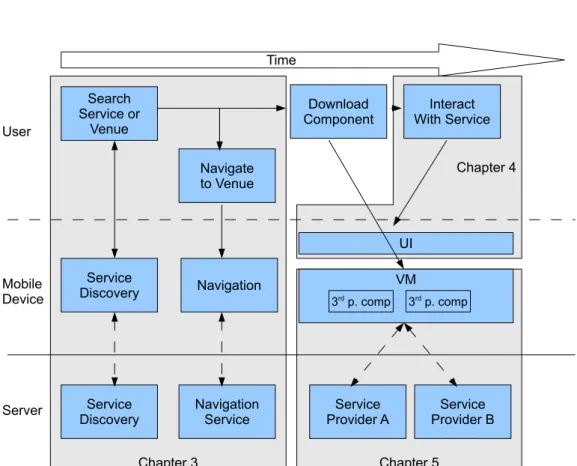
1.2. Overview of the Framework . . . 8
2.1. Java Platform . . . 15
2.2. Partial Definition of a Context Ontology, source: Wang (2004) . . 27
2.3. Definition of a Specific Ontology for Home Domain, Source: Wang (2004) . . . 28
2.4. Graphical Context Model, source: Henricksen (2003) . . . 29
3.1. Service Discovery . . . 45
3.2. Service Discovery . . . 51
3.3. Unique Connections w.r.t. ∆r . . . 59
3.4. Region used in Simulation (source OpenStreetMap) . . . 61
3.5. Karlsruhe with Highlighted AreasR1, R2, and Connecting Routes 62 3.6. Number of Nodes w.r.t. r . . . 62
3.7. Size of Mapdata of Nodes w.r.t. r . . . 63
4.1. Widgets Classdiagram . . . 81
4.2. GUI Creation Sequence-Diagram . . . 85
4.3. Creation Time for a UI using the Parser and Precompiled XUL . 88 4.4. The Application on a High-end PDA . . . 89
4.5. The Application on a Low-resolution, Low-contrast Screen . . . . 89
5.1. VM . . . 100
5.2. Interaction between MixVM and the Class libraries . . . 102
5.3. Arithmetic Instructions . . . 108
5.4. Type Conversion Instructions . . . 108
6.1. Scenario . . . 115
6.2. Start Screen with Menu . . . 116
6.3. User Preferences . . . 117
6.4. Context Attributes Visibility . . . 117
6.5. Service Selection . . . 118
6.6. Gastronomy Guide Settings . . . 120
6.7. Gastro Details . . . 120
6.8. Navigation to Restaurant . . . 121
1.1. Design Science Research Guidelines . . . 6
2.1. Conceptual Categorization of Context . . . 18
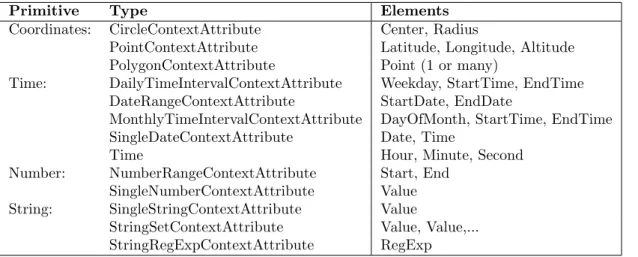
3.1. Primitive Types of the Context Representation . . . 46
3.2. Avg. Speed per Road Type . . . 63
4.1. Example Device Screen Properties . . . 67
4.2. Operating Systems . . . 67
4.3. Evaluation of Related Work . . . 73
5.1. Existing Data Protection Approaches . . . 98
I would like to express my gratitude to all those who gave me the possibility to complete this thesis. First of all, I want to thank Prof. Dr. Armin Heinzl and Prof. Dr. Martin Schader for their guidance and the freedom I received through my studies. They created a productive environment with great colleagues and much to learn.
I also would like to thank Prof. Dr. Franz Rothlauf and Dr. Markus Aleksy for their good advice and support during the time of my thesis.
Furthermore I want to thank the participants of the Mobile Business Research Group and all my other colleagues for the opportunity to work with them.
My special thanks goes to my family and friends whose patience and support were essential for the completion of this thesis.
1.1. Problem Outline
In recent years, the pervasiveness of mobile devices, especially mobile phones and personal digital assistants (PDAs), has increased rapidly. At the same time, wireless communication networks have improved considerably and the usage of mobile devices to access the internet is, with decreasing costs, possible almost everywhere and at any time in industrialized countries. However, the usage of mobile technology and mobile applications to support business processes, trans-actions, and personal tasks is still low compared to their potential.
The improved capabilities resulted in the introduction of many applications for mobile devices by network operators and software vendors. These services were meant to increase the average revenue per user (ARPU) on top of the voice call income. But many of these services have failed and none of them has led to an improved usage of mobile services today, besides e-mail. A new kind of application, the context-aware application, exploits the ubiquity of the mobile devices in order to fit the personal need or task the user is about to execute satisfactorily. Context-aware systems try to improve the communication with the user by adding information about the current context to the explicit user input and by adapting the output to the current setting of the user. While those applications are seen as important steps to a widespread usage, there are strong factors inhibiting their development and adoption.
First of all, the lack of common frameworks handling context data and improv-ing software development increases the cost to build context-aware applications. Each application currently implements its own sensors and logic to handle its data. Furthermore, service providers need to offer tailored services for every con-text of the user. Since no single provider is able to be an expert for all kinds of applications and will not have the necessary number of developers, a
com-mon service which finds services of multiple providers for the current situation of the user is needed. All services need to utilize the context attributes which are locally determined by the user’s situation. Development costs are further boosted by the difficulty of developing applications for multiple devices with varying input/output (IO) capabilities like speech output, small and big screens, full qwerty-keyboards, touchscreens, or numeric keypads.
From the user’s perspective, privacy also endangers the adoption of mobile services. Context information may include very private data and expose the user’s preferences and habits. While the user may trust a single, well-known, provider to secure the private data and to respect the user’s privacy concerns, the problem increases with more and more smaller service providers.
1.2. Objectives
This work examines existing approaches for context-aware mobile applications and develops new ones in order to build a unified framework for mobile services, fostering software development, and to offer a high degree of privacy protection. The framework offers functionality to discover new services, an adaptable user interface (UI) which automatically adapts to the user’s context using a UI de-scription based on well-known standards and isolates chosen services for data protection. This offers new and cost-saving ways to develop applications featur-ing a better adaptation to the user’s situation.
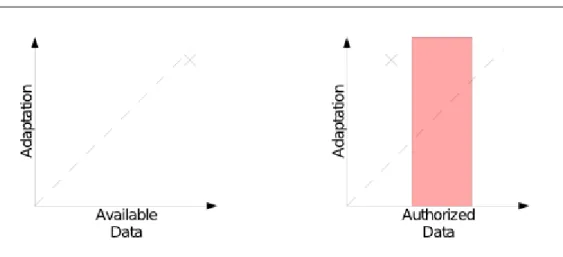
Figure 1.1 shows the correlation of usable context data and adaptability of an application. The left graph indicates that the adaptation increases with the amount of available context data, but the available data on the device is not always equal to the data a user is willing to expose to a service provider. Privacy protection leads to a decrease in context data which is available to a service provider. The level of privacy is individually different for each user denoted by the thick red region. This work aims to improve the adaptability while decreasing the exposure of private data to service providers.
The adaptation in this thesis uses a context model that offers a separation of private data, which may never leave the device of the user and public data that may be used by remote services. It will be shown that through the combination
Figure 1.1.: Adaptation vs. Available Data
of local and remote processing of search queries, a context-aware service discovery will be possible without disclosing private data to the search providers.
Research Questions To reach the above-mentioned objectives, in this thesis, the following research questions will be examined and answered:
• Which tasks and responsibilities of a context-aware application are common and can be fullfiled by a suitable framework?
• How is it possible to generalize and improve the service discovery under the aspect of privacy protection?
• How can the heterogenity of mobile devices be handled by developers, es-pecially for UI design?
• How shall applications be designed for the use on different mobile client devices?
• How is it possible to separate different components and protect private date without limiting their utility?
1.3. Methodology
This study originates from the field of information systems research. In this dis-cipline, two different (but complementary) foundational methodologies can be
identified: behavioral science and design science (March and Smith 1995). Re-search following the behavioral science paradigm focuses on the development and verification of theories of organizational behavior in connection with information systems. Its objective is to understand the interactions between people, tech-nology, and organizations in order to be able to increase the effectiveness and efficiency of information systems which manage these relationships. In contrast to this, the purpose of design science is to improve information systems, to solve problems, and to reach some predefined goals. The focus is on the creation and evaluation of new and innovative artifacts, being either constructs, mod-els, methods, or instantiations (implemented and prototype systems). “Artifacts are represented in a structured form that may vary from software, formal logic, and rigorous mathematics to informal language descriptions”. A prototypical implementation of the framework was implemented and its parts are tested for functionality and their suitability to the given problem (Hevner, March, Park, and Ram 2004).
After the successful evaluation of the individual parts, the complete framework is tested using an exemplary scenario involving several sample services. Using these demo services, a descriptive evaluation of the whole framework is done.
As a consequence of this classification, this study incorporates the conceptual guidelines for design science approaches stated by Hevner (Hevner, March, Park, and Ram 2004). These guidelines can be summarized by the table 1.1.
This work follows each guideline and therefore can be classified as design sci-ence:
• Guideline 1: The result of this thesis is a framework and architectural model for context-aware mobile applications, a method to improve the pri-vacy protection in three relevant areas and a prototype as implemented as instantiation of a developed concept.
• Guideline 2: A relevant business problem is addressed. The problem and its relevance for business is described in chapter 2.
• Guideline 3: The concept is evaluated using the implementation of demo applications in chapter 6 and benchmarking against the requirements is stated in each chapter and chapter 2.
guideline description
Guideline 1: Design science research must produce a viable artifact in the form of a construct, a model, a method, or an instantiation. Guideline 2: The objective of design science research is to develop technology-based solutions to important and relevant busi-ness problems.
Guideline 3: The utility, quality, and efficacy of a design artifact must be rigorously demonstrated via well-executed evaluation meth-ods.
Guideline 4: Effective design science research must provide clear and ver-ifiable contributions in the areas of the design artifact, de-sign foundations, and/or dede-sign methodologies.
Guideline 5: Design science research relies upon the application of rig-orous methods in both the construction and evaluation of the design artifact.
Guideline 6: The search for an effective artifact requires utilizing avail-able means to reach desired ends while satisfying laws in the problem environment.
Guideline 7: Design science research must be presented effectively both to technology-oriented as well as management-oriented au-diences.
Table 1.1.: Design science research guidelines (Source: (Hevner, March, Park, and Ram 2004))
• Guideline 4: New methods for the given problem domains are developed, tested, and individually published for peer review in internal conferences/jour-nals.
• Guideline 5: The construction of the artifacts follows software design prin-ciples and is based on well known software-development patterns outlined in chapter 2.
• Guideline 6: An extensive search for design alternatives was performed and design alternatives are shown to each decision made within the parts of this framework in chapters 3, 4, and 5.
• Guideline 7: The concepts are communicated using different abstraction levels. A high level outline of the concepts, a prototypical implementation of each part of the framework, and a sample application.
1.4. Structural Overview
First of all, the current economic mobile business landscape is shown and current barriers for context-aware services are analyzed. Continuing from this point, the requirements of a platform for context-aware services with the potential to overcome the adoption barriers are constructed.
Based on these requirements, different techniques from the field of software engineering are evaluated for their suitability to the problem. Subsequently, known techniques are combined with new ideas in suitable places to a framework for mobile context-aware applications which fulfill the requirements.
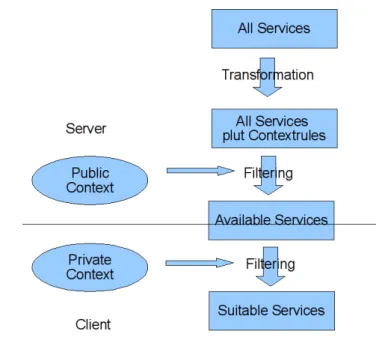
The next three chapters are structured according to the usage of mobile services as shown in figure 1.2. In chapter 3, a concept for service discovery is introduced (Butter et al. 2006; Aleksy et al. 2006; Butter et al. 2006). Service discovery is an elementary part of context-aware systems and the initial step in most usage scenarios. If a physical service, like a restaurant or shop, is found, the user needs to navigate the point of interest. This is also covered in chapter 3. The next chapter shows a user interface framework for easy creation and context usage under the requirement of low privacy invasion (Butter et al. 2007) including a prototypical implementation and an evaluation. Service isolation and data protection are examined in chapter 5. In order to offer a runtime environment for downloaded service components, a virtual machine approach is presented. It provides full access to any resource while preserving privacy. The chapter includes a prototypical implementation and measurements about its performance.
An evaluation of the overall practicability of the framework is given in chap-ter 6. Here, one enchap-tertainment / information application for consumers and a support system for the construction industry is implemented using the developed framework. The last chapter includes a summary, a conclusion, and an outlook on future work.
! " # $ % % # $&
Context-Aware Applications
In parallel to continuous miniaturization, as correctly predicted by Moore’s law1
(Moore 1965), mobile devices got increasingly powerful over the last few years. The networks bandwidth increased a lot, too. Gerry Butters stated in Butters’ Law of Photonics that the cost to transmit a single bit over an (optical) net-work halves every nine months, which is equally true for wireless netnet-works. This advance in technology allows hardware manufacturers to build mobile devices such as laptops, personal digital assistants (PDAs), and smart-phones that have a similar performance as desktop computers had a few years ago.
The inherent mobility of these ubiquitous companions leads to new types of applications, customized to the user’s location. While location-based services are getting more and more popular, the increasing capabilities of miniaturized sensor technology, which eventually will be embedded in future mobile devices, offer more contextual information, not only location information. Using this additional contextual information within services delivers even more value to the user, leading to higher acceptance and adoption. However, creating context-sensitive applications for mobile devices is not a trivial task and developers’ experience with these new kinds of applications is low. Thus, the development of such services and applications or the migration of conventional services to context-sensitive services will require a framework supporting the development of client applications and services.
In this chapter, the foundations for the development of context-aware appli-cations are outlined. The first few paragraphs start with the challenges of mo-bile applications in general, the following deal with the special requirements of 1Moore predicted a doubling in the number of transistors on an integrated circuit every two
context-aware applications, and afterwards give an overview of state of the art solutions.
2.1. Mobile Applications
Mobile applications impose specific user requirements and challenges to the de-velopers. The following sections present an overview of those requirements and challenges.
2.1.1. User Requirements
Besides the technical challenges mentioned before, the requirements of the users are an important factor for the functional and non-functional requirements of mobile applications. According to the studies carried out by Bauer et al. (Bauer, Reichardt, and Schuele 2005; Bauer, Reichardt, Exler, and Tranka 2007) and a general literature review, the following features are of special importance:
• Dynamic information is information that changes while the user is on the move. This type of information should therefore be updated permanently and made available to the user in case that his context deems this to be appropriate (Cheverst et al. 2000, p. 2). Examples of this type of in-formation are traffic inin-formation, weather forecasts, delayed timetables of public transport, etc. (Kaasinen 2003, p. 74). This requirement implies a constant network connection.
• Customization options for the visualization of information need to be con-figurable to match the preference of the user, especially due to the limited display space.
• Nowadays, users are flooded with information and sometimes find it difficult to filter the relevant information on many screens filled with data. Services should therefore not intend to provide the user with the most information, but with correct and condensed information (Bieber, Giersich, Kirste 2001, p. 565). An efficient way to improve the efficiency of mobile information services is to adapt the presentation of the services to the current context.
• Transaction security is another major concern of users (Picot, Neuburger 2002, p. 61; Mustafa, Oberweis, Schnurr 2002, p. 367). Secure transac-tions are a prerequisite for commitment, which is in turn a prerequisite for contracting, which again is an essential for successful business applications (Scheer et al. 2002, p. 101).
• Consumers do also have a great fear which is not connected to any tech-nological concern or the application itself. It is rather rooted in the user’s perception of the overall technological advancement that more and more enters his personal life. Many users feel a loss of control over what is hap-pening with and around them and this feeling again evokes great uneasiness. If the application is too always providing the user with the right service at the exact right time, he will develop a feeling of being totally controlled by technology. Users do not want the applications to lead to a predestined and over-controlled environment in which they are completely managed and controlled by their mobile device (Kaasinen 2003, p. 76).
• Consumers generally hesitate to release personal data. They mainly fear the misuse of their personal data in the sense that it is used for purposes the user not explicitly gave permission to (Diezmann 2001, p. 159; M”ohlenbruch, Schmieder 2002, p. 76). Users also fear their personal data being given to governmental institutions and see the “Big Brother” -vision becoming partially true (Pflug, Meyer 2002, p. 413; Turowski, Pousttchi 2004, p. 101).
All these requirements are important for mobile services and are incorporated in the requirements of the framework components in chapters 3 to 5.
2.1.2. Mobile Software Development
In the following sections, technical challenges and general principles of application development for mobile devices are illustrated. The following terms will be used within these sections and shall be defined as follows:
• Mobile Device: A mobile device is any electronic device carried occassionally
with the user, a network connection, and the ability to store general purpose software. These are typically mobile phones or PDAs.
• Mobile Application: A mobile application is any software executed on a
mobile device.
• Service: A Service offers a certain resource which may be requested from
multiple different users ad hoc. The kind of the offered resource is not relevant and should be considered opaque. A service may be realized by multiple homogenous, parallel running service providers to solve aspects as load-balancing or fault tolerance using replication. Furthermore. it is possible to realize different service providers which offer different Quality-of-Service (QoS) criteria. A service may also be used as a homogenous interface for a subsystem according to the Facade-Pattern (Gamma, Helm, Johnson, and Vlissides 1995)
• Service Provider: A service provider realizes, at least a part of, a certain
service. Using this term, services composed of different components may be better described. According to Shal (Stal 99), a component is a binary, functionally self-contained, software building block which interacts with its environment via a well-defined interface. The component must be able to cope with the embedding in different and non-predictable application contexts.
2.1.3. Technical Challenges
Mobile applications impose several challenges for their development. Especially their smaller size and mobility adds several limitations which have to be worked around:
• Disconnected operation: “Mobile computing invalidates some implicit
as-sumptions in current middleware platforms. For example, the CORBA interoperability protocol and webservices assume a permanent transport connection between the client and the object implementation. In contrast to this, PDAs automatically switch themselves off in order to save battery power. [...]Traditionally, we assumed that application entities would be permanently available during some application association” (Geihs 2001).
• Memory constraints in mobile devices need new programming frameworks allowing the reuse of already installed components, caching, and eviction (Fahy and Clarke 2004).
• Flexibility is important in mobile applications. This is especially the case
since the user’s current situation decides about the range of useable services. Therefore such applications have to include two special abilities: the ability to efficiently register, discover, use and manage services as well as the ability for ad hoc configuration (Fahy and Clarke 2004).
• Mobile code requires increased flexibility and new security mechanisms in
order to ensure integrity of the executing machine. (Geihs 2001)
• Personalization is important to be able to present information relevant for
the user. Customization is a key issue in using mobile devices because it may mitigate some of the limitations of the user interface in terms of size and resolution. Studies show that every additional click reduces the transaction probability by 50% (Durlacher Research, 2000). (Tsalgatidou, Veijalainen, and Pitoura 2000).
• Heterogenous devices offer varying sizes, programming environments, input
and output capabilities. The applications need to be adapted to each device (see chapter 4).
• Privacy is a user requirement and a technical requirement since different
components need to be shielded against each other (see 2.3).
Many facets of the first two challenges can be tackled with development pat-terns known from traditional software engineering. These will be illustrated in this chapter. The others are part of this work’s research questions and are dealt with in the chapters 3, 4, and 5.
2.1.4. Runtime Environments
As a example of heterogenity the different runtime environments of mobile devices need special attention. All of them are incompatible and require development from scratch for all supported platforms. The multitude of device manufacturers
and devices offer many runtime environments for applications. Most widely used are the following runtime environments (K¨ochy 2008):
• Android is an operating system based on linux and developed by Google.
As of today, two handsets from LG and Samsung are available. It features a Java runtime using an incompatible bytecode format and class libraries for licensing reasons.
• The iPhone is a mobile phone from Apple. It is a controlled environment
and allows only applications approved by Apple. Currently applications downloading components at runtime are forbidden. (Zdziarski 2008)
• Windows Mobile is an embedded variant of Microsoft Windows.
Applica-tions in .NET and native applicaApplica-tions in C are possible. (Wind, Jensen, and Torp 2007)
• Symbian is the most widespread smart phone operating system. It offers
an extensive C API and is mainly developed by Nokia. (Harrison and Shackman 2007)
• A Java runtime (Java ME) exists on all smart phones, but Android phones and iPhones. The set of supported optional APIs differs widely. (Muchow 2001)
This thesis considers only the Java ME runtimes as those are available on most mobile phones. All concepts would also be possible on Android or other VM based environments.
2.1.4.1. Mobile Java Variants
Java Mobile Edition (Java ME) technology was originally called J2ME and cre-ated in order to deal with the constraints associcre-ated with small and mobile de-vices. For this purpose, Sun defined the basics for Java ME technology to fit such a limited environment and make it possible to enable Java applications running on small devices with limited memory, display, and power capacity.
The Java ME platform is a collection of technologies and specifications which can be combined to construct a complete runtime environment specifically to fit the requirements of a particular device.
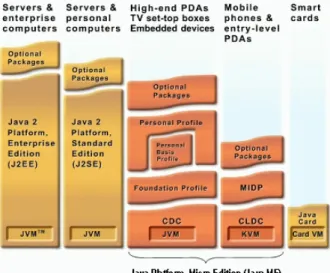
Figure 2.1.: Java Platform The Java ME technology is based on three components:
• Aconfigurationconsists of the most basic set of libraries and virtual machine
capabilities,
• a profile is a set of APIs that support a narrower range of devices, and
• an optional package is a set of APIs not available in all devices with a
specific profile.
The configuration for small devices is called the Connected Limited Device Configuration (CLDC) (Sun 2004) and the more capable configuration is called the Connected Device Profile Configuration (CDC) (Sun 2005). An overview is given in figure 2.1.
Each configuration, as well as each profile and each optional package is defined through the Java Community Process using specifications called Java Specifi-cation Requests (JSR). The configuration targeting resource-constraint devices, such as mobile phones, is called the Connected Limited Device Configuration (CLDC). It is specifically designed to meet the needs for a Java platform to run on devices with limited memory, processing power and graphical capabilities. On top of the different configurations, Java ME platform also specifies a number of profiles defining a set of higher-level APIs that further define the application. A
widely adopted example is to combine the CLDC with the Mobile Information Device Profile (MIDP) in order to provide a complete Java application environ-ment for mobile phones and other devices with similar capabilities. It can be found on the majority of today’s mobile devices that access internet services (Admob 2008).
With the configuration and the profiles, the actual application then resides, using the different available APIs in the profile. For a CLDC and MIDP envi-ronment, which typically is what most mobile devices nowadays are implemented with, an MIDlet is created. An MIDlet is the application created by a Java ME software developer, such as an entertainment application, a business application, or other mobile features. These MIDlets can be written once and run on every available device conforming with the specifications for Java ME technology. The MIDlet can reside on a repository somewhere in the ecosystem and the end user can search for a specific type of application and have it downloaded over the air to his/her device.
The configuration targeted larger devices with more processing and memory capacity and with a network-connection, like high-end personal digital assistants, is called the Connected Device Profile Configuration (CDC). The goal of the CDC is to leverage technology skills and developer tools based on the Java Platform Standard Edition (SE) and to support the feature sets of a broad range of con-nected devices while fitting within their resource constraints.
The CDC configuration offers three distinct profiles: • The Foundation Profile (JSR 219),
• the Personal Basis Profile (JSR 217), and • the Personal Profile (JSR 216).
For each of these profiles, there is a set of optional packages on which the actual application runs, like additions for media applications, telephony, or location services. On high-end PDA, the Personal Profile is the most widespread variant.
2.2. Context-Aware Mobile Applications
Context-aware mobile applications are mobile applications using context to im-prove the usability, efficiency, and benefit of a mobile application. The next
sections describe context in general, how context data is gathered, and the pri-vacy issues caused by its usage.
2.2.1. Context in Mobile Applications
In mobile applications, context describes information about the user, the capa-bilities of the mobile device, or the environment of the user or mobile device. Context can be used for the customization and configuration of services and ap-plications. In literature, there exist many different definitions of context. Most of them define context by listing parameters and categories considered as context or not (Schmidt, Beigl, and Gellersen 1999; Chen and Kotz 2000). The most well-known and used definition can be found in (Dey 2001) who states that ”Context is any information that can be used to characterize the situation of an entity. An entity is a person, place, or object that is considered relevant to the interac-tion between a user and an applicainterac-tion, including the user and the applicainterac-tions themselves.”
Displaying complex content on mobile terminals represents a significant chal-lenge. In particular, in the case that one develops a common infrastructure to serve such content to a multitude of different devices. Some of the mobile devices have severe limitations and constraints. Therefore, providing adapted content to each type of terminal requires the consideration of several aspects that are involved in the adaptation and the delivery of the final content. Context infor-mation can be used to adapt services or applications automatically and thus can remove unnecessary interactions with the user or decrease media breaks. For example, context can be used to adjust the graphical output of a service to the technical properties of a mobile device by neglecting irrelevant information or by changing the used output device from a text-to-speech device to a screen if necessary (e.g. in noisy environments).
Another important area for context usage is to relieve the user from the explicit definition of context and to automatically generate or derive context information from sensors (Gray and Salber 2001). For example, the context property “user is at work” can be automatically derived from the location of the user. As long as the user is located in or next to his office or working place, the user is at work (with high probability) and it is not necessary for the user to define this context property manually. If the description of the user’s situation can be
determined automatically using context information, it is not necessary for the user to define the current situation manually. For instance, when searching for a train connection in a city, information about the current time (important for departure) or the location of the next station can be derived automatically by context information already available and does not need to be specified by the user. Another important aspect is the discovery of new services which may be relevant to the user in his current situation.
Finally, context changes may also be used to trigger actions automatically and to inform the user of newly available possibilities or to start new services. To enable the usage of context information, context providers (e.g. sensors) and the services need to have a common notion for the context attributes used.
2.2.1.1. Categorization of Context
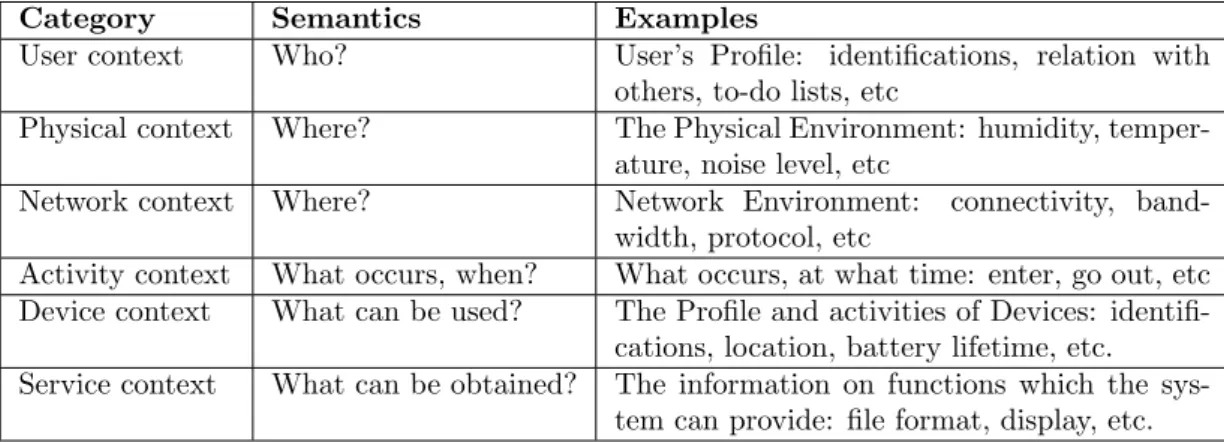
Different categorizations of context attributes exist. The most cited high-level conceptual categorization by Razzaque et al. (Razzaque, Dobson, and Nixon 2005) is shown in Figure 2.1.
Category Semantics Examples
User context Who? User’s Profile: identifications, relation with
others, to-do lists, etc
Physical context Where? The Physical Environment: humidity,
temper-ature, noise level, etc
Network context Where? Network Environment: connectivity,
band-width, protocol, etc
Activity context What occurs, when? What occurs, at what time: enter, go out, etc Device context What can be used? The Profile and activities of Devices:
identifi-cations, location, battery lifetime, etc. Service context What can be obtained? The information on functions which the
sys-tem can provide: file format, display, etc.
Table 2.1.: Conceptual Categorization of Context Conceptual Categorization of Context (source Razzaque, 2005)
Most categorizations are similar, but sometimes have slightly different category boundaries. The common categories among those are listed below. Another way to categorize the attributes is the differentiation by data source. This will be shown in the section afterwards. The most relevant types of context are:
Environmental and Network Context Environmental context combines physi-cal and network context and is everything that describes the situation of the user but is not to be directly caused by the user or his mobile device. Common envi-ronmental attributes are for example constructed from nearby objects, weather, or traffic (Schiller 2004).
Some context-aware systems generate environmental context information from the position of the user and a projection of the real world into a virtual world. Therefore, nearby objects can easily be found using the location of the user. An example is determining the location of nearby stations, restaurants, or taxis. Other context-aware systems find nearby objects and environmental conditions by using local sensors, such as RFID readers and tagged objects (R¨omer, Schoch, Mattern, and D¨uben-dorfer 2003). Frequently, environmental changes occur fast and they are used for triggering automatic actions for the user. However, such changes are difficult to determine reliably (compare 2.2.3.1) and the reliability of such changes should be taken into account before triggering any action based on environmental context.
Device Context Capabilities of mobile devices are valuable criteria for the adaptation of applications to the technical properties of the mobile device. Such parameters do not change as often as environmental context parameters since the device is changed seldom. Relevant context parameters are for example res-olution, display size, input and output capabilities and the capabilities of a web browser. These may restrict or forbid the use of some services or applications entirely and therefore may be used for the selection of suitable services for a user. There are also dynamic properties in this category such as the currently used network connection, the available bandwidth, or the latency and type of payment for the current network connection. Changes in these context attributes can for example be used to trigger automatic synchronizations when a cheap network connection (flatrate) is available or to use graphics with decreased quality in case that only a low bandwidth is available or network traffic is expensive.
User Context The current activity and the role of the user are described by the user status. This context information contains attributes such as work status (leisure time versus work time) or if the user is attending an event (for example a conference). Furthermore, information regarding the role of the user is important
(for example, there is a large difference between the user only attending a talk and the user giving the talk). Such context attributes often determine the availability of the user and can be used to change the types of event notifications or restrict services by the time of availability. An example is to switch off graphical event notifications if the user is involved in a presentation (which can be determined from the user’s calendar).
Profiles Profiles are often seen as part of the user context, but consist of ex-plicitly entered information by the user. Profile information is user-specific and is pre-specified by the user. Such context information determines the way a user wants to interact with his mobile device or properties of the user. This information can be synchronized between multiple devices or stored on a server. Profile information is the most reliable and important source of context infor-mation, because the user enters this information directly. However, as profiles contain private and sensitive information, it is important to protect it and to allow users to restrict their usage to some services and applications (Jarvenpaa, Lang, Takeda, and Tuunainen 2003). There are three basic categories of profile information. The first are preferences/likings of the user. Personal information like gender, age, and family status constitute the second group. Furthermore, relationships to other users may be used together with their status information which is the core of instant messaging systems such as ICQ, Skype, and others.
• Preferences: The personal preferences/likings are the most explicit infor-mation and may be used directly for services or applications.
• Personal Information: Personal information such as gender, age, and family status.
• Relationships: The user’s connections to other users (relationships) can be used by context-aware services and applications in conjunction with the status of related persons or users. Relationship information is at the core of messenger systems such as ICQ and others.
History Previous decisions of the user are also important context that can be used for the customization of services. Therefore, it is useful to save the history of
user decisions and to use this information for forecasts, determination of context, or to predict user behavior (Dey 2001).
2.2.2. Context Sensors
Context sensors are the interface from an application to the real world. They may exist directly within the mobile device or may be located on a server which is queried over the network. The latter one offers access to data of other users, but also involves privacy concerns.
2.2.2.1. Local Context Sensors
Several local sources for context information exist which offer some valuable con-text information. The next sections describe some of them.
Position Location is generally seen as the most important context for mobile services (Cheverst, Davies, Mitchell, Friday, and Efstratiou 2000). Several meth-ods exist to determine the user’s position. The most prominent ones are:
• Global Positioning System (GPS)(Kaplan and Hegarty 2005) is a network
of at least 24 satellites. Each transmits the current time (using high accu-racy atomic-clocks) and the positions of the satellites. The receiver uses the signal of at least four different satellites to compute the current time, lon-gitude, latitude, and altitude. It was introduced in the late 80s by the USA Department of Defense and offers a slightly degraded signal to commer-cial users (about 5m under good conditions). Many mobile devices today include GPS chips, but position acquisiton needs a direct line of sight to the satellites. Using GPS, no position data is available indoors or under a cloudy sky.
• Galileois the European system similar to GPS. It will offer a higher accuracy
and should be fully operational in 2013.
• Cell-based techniques use the infrastructure of GSM and UMTS networks.
It is possible to find the approximate position of the user by looking which antenna and base station he or she uses. Improvements in accuracy are possible by measuring the time a signal needs from the handset to station
(or in the other direction) using different synchronization techniques. An overview of GSM-based positioning systems can be found in Varshavsky et al. (Varshavsky, Chen, de Lara, Froehlich, Haehnel, Hightower, LaMarca, Potter, Sohn, Tang, , and Smith 2006).
• 802.11-based positioning systems The most promising 802.11-based
posi-tioning systems utilize the so-calledfingerprintapproach (e.g., (King, Haen-selmann, and Effelsberg 2007)). This technique comprises two stages: An offline training phase and an online position determination phase. During the offline phase, the signal strength distributions are collected from access points at pre-defined reference points in the operation area. They are stored in a table together with their physical coordinates. An entry in this dataset is called a fingerprint. During the position determination phase, mobile devices sample the signal strengths of access points in their communica-tion range and search for similar patterns in the fingerprint data. The best match is selected and its physical coordinates are returned as the position estimate. With this method, a position accuracy of up to two meters is achievable under good conditions.
Calendar Databases may be a source for information about available free time, the next location and the current task of the user. This information may espe-cially be valuable to find a service supporting the user to find a route to its next destination.
Output Capabilities Tailoring the presentation of an application needs infor-mation about the output capabilities of the device. This data got increasingly dynamic in recent years. Some mobile phones are now equipped with TV outputs, are able to communicate with video projectors over WiFi, or may use heads-up displays in cars.
2.2.2.2. Remote Context Sensors
Using a remote connection, several additional context sources are available. While these do potentially offer important data, they often pose a problem for privacy protection. This issue is discussed in more detail in chapter 3.
Weather While the weather is easily observable by the user, it is hard to “mea-sure” it on a mobile device which may potentially be in a pocket. Therefore. a remote service may query a weather database using the user’s position and return the current weather or a forecast.
Company Schedules In a business environment, it is important which meeting rooms are occupied and which other people are available. Furthermore, social graphs may be used for further inference about likeliness of conversations or the need to meet.
Traffic and Timetables Calculating available time slots involves the place of the next meeting and the optimal routes under the current conditions. The quality of the data may be increased with current traffic or delay data.
Context Sharing Scheduling of ad hoc meetings does not only need the position and the task of one user, but also of the colleagues or friends. This information may be stored centrally on a server (Grossmann, Bauer, H¨onle, K¨appeler, Nick-las, and Schwarz 2005) if all users trust the provider of this service. In contrast to that, peer-to-peer exchange of context information is possible with several mech-anisms. One possibility is the use of instant messaging applications as transport for context data (Leiner 2006).
2.2.3. Quality of Context Data
As mentioned in the previous section, there are multiple sources of context infor-mation. Most of these sources have some technical limitations of accuracy and resolution or are based on inference from other context sources which in turn may degrade the resolution and trustworthiness of context information (Buch-holz, K¨upper, and Schiffers 2003).
From a user’s point of view, the use of inaccurate or wrong context informa-tion is a larger problem than neglecting the context data entirely. Furthermore, derived context attributes rely on a minimum quality of other context attributes they are based on. For example, when determining context information about the role of a user in a presentation (e.g. to determine the type of user notifica-tion), the accurate measurement of the user’s position can be important. It can
be assumed that the user is currently speaking if his position is next to the pre-sentation devices. In constrast, it can be assumed that he is only listening to a presentation in the case that he is constantly located more than five metres away from the presentation devices. Therefore, an accurate measurement of the user’s position is important for determining the derived context information “user is giving/not giving a presentation”. In contrast, when navigating the user to the room for the presentation, an accuracy of five metres may be precise enough to guide the user to the conference room.
New context information can also be derived from other context attributes by inference (Shehzad, Ngo, Pham, and Lee 2004). For example, a context attribute containing the current city can be derived from the geographical location of the mobile device and a city database. For determining new context information, the reliability and accuracy of the used information context is important. When determining the city from the user’s position, determining the user’s position with low accuracy near a city border would lead to a low probability value for the city.
An important issue of context information is private and public context formation. Usually, the user wants to restrict the usage of private context in-formation by the service or application provider. Common ways to restrict the usage is to either not give context information to the service provider or to re-duce the quality of the context information that is given to the service provider (“blurring”).
2.2.3.1. Quality Losses due to Measurement
The context information accuracy loss can be divided into losses due to techni-cal limitations or deliberately introduced errors to protect privacy. In general technical losses are dominant because the others would be stopped by the users if quality deteriotes too much. For example, GPS devices for determining the user’s location have an accuracy of about 15 metres in open field while having a much worse accuracy within cities with limited sky visibility or skyscrapers blocking the line of sight to the satellites. Therefore, it is important for services and applications that make use of context to know about the quality of the con-text information. Determinants of quality of concon-text information are accuracy, reliability, and time lag.
Accuracy The resolution or accuracy of context information usually depends on the technical capabilities of the sensors. In the simplest form, accuracy can be expressed by a confidence interval, which is a range of values where the cor-rect value is inside with a certain high probability. Depending on the type of context matching, a context-aware system could then consider this information by either assuming the center of the interval as the correct value or ignoring it entirely. An advanced form for considering inaccurate context information is to use probability distribution functions. However, such functions are not available for every measurement tool and difficult to evaluate.
Reliability Most context attributes (especially if expressed as Boolean values) have a level of reliability. For example, the reliability of the context information “user is / is not attending a presentation” depends on other context information and may be more or less reliable. To deal with the reliability of context infor-mation, probability values can be assigned to context information in order to be able to consider the trustworthiness during context evaluation. Trustworthiness also plays a role when data entered by other users is used as context information. Here, an anticipated probability of the other user’s trustworthiness can be helpful for deciding if the value is important.
Time Lag Not every context sensor may be able to constantly supply all rele-vant context data at all times. Therefore, context information can be outdated or change over time. To solve problems with time lags, the time of context ac-quisition should be explicitly noted and transmitted to better utilize the context information. Combining time lag of context sensors with the history of context changes can be helpful for making use of context information with time lag.
2.2.4. Context Representation
Different approaches are used to present context data and to model the context of a user.
Key-value models The easiest form of context representation is the storage in map with values for pre-defined keys. For instance, the set of coordinates could be the value for the key “User Location”. These models do not store any kind of
meta data like the accuracy of the values and they do not offer structured data which represents compound data.
Markup scheme models A widely known markup language is the eXtensible Markup Language (XML) which is derived from the Standard Generic Markup Language (SGML). Semi-structured models usually use XML. A characteristic of this model are hierarchical data structures(Strang and Linnhoff-Popien 2004). For instance, one might create the following markup to model the context at-tribute “network bandwidth”:
<context> <network>
<attrib name="bandwidth" type="mbit">10</attrib> </network>
</context>
In contrast to the key-value based models, those models are able to specify meta-data like types (the type attribute in the above example) or dependen-cies(Indulska, Robinson, Rakotonirainy, and Henricksen 2003). Furthermore, the XML documents can be validated against a schema which eases the verification of the data.
Object-oriented models Encapsulation in software engineering ensures that operations on and access to data are performed through a well-defined inter-face, shielding complex internal workings from the outside. Inheritance means that more specialized functionality can be derived from a set of basic function-alities by simply adding new or modified parts while keeping the parts that are common to the specialized and the general case. These concepts facilitate reusability. Object-oriented context models try to apply the same principles in order to manage the complexities of representing and handling context informa-tion. In that respect, they succeed quite well as they can easily be implemented using today’s computing systems and allow for the inclusion of dependencies and meta-information. Using object-oriented programming languages, provid-ing meta-information as well as definprovid-ing and listprovid-ing dependencies, is mostly a question of designing suitable interfaces for context-handling classes(Strang and Linnhoff-Popien 2004).
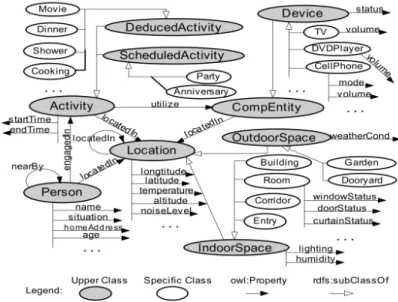
Figure 2.2.: Partial Definition of a Context Ontology, source: Wang (2004)
Logic based models Context can also be expressed in highly formalized logic based models by using facts, rules and expressions. However, logic based models are not very useable on mobile devices since they require a high complexity in their evaluation (Strang and Linnhoff-Popien 2004). General logic reasoning is inherently non-deterministic and thus evaluation algorithms do either not guar-antee to produce a result in a finite period of time or have exponential runtime and high memory consumption (Sch¨oning 2000).
Ontology based models Originally, ontologies have their seeds in philosophy which have been coined differently in the field of computer and information sci-ence(Floridi 2003). In computer science, ontology refers to “an engineering arti-fact, constituted by a specific vocabulary used to describe a certain reality, plus a set of explicit assumptions regarding the intended meaning of the vocabulary words” (Guarino 1998).
An examplary meta model is shown in figure 2.2. The strengths of ontologies are:
• power of expression: context can be formally modeled as a set of concepts and their relations. Subconcepts are capable to define more specific cases of general concepts and context can be enriched using meta-information. In figure 2.3, a subconcept for the example above that shows the more specific home domain is given;
Figure 2.3.: Definition of a Specific Ontology for Home Domain, Source: Wang (2004)
• support for logic inference: higher level context information can be derived from raw context data and context data can be checked for inconsistencies. Ontologies are limited to specific application scenarios as a universal context ontology that covers every conceivable piece of context information for all aspects just might not be attainable(Wang, Zhang, Gu, and Pung 2004). Also, support for logic inference generally poses the same high processing requirement found with logic based models.
Graphical Models Graphical context models are aimed at improving formality and expressiveness in context modeling in the design phase.
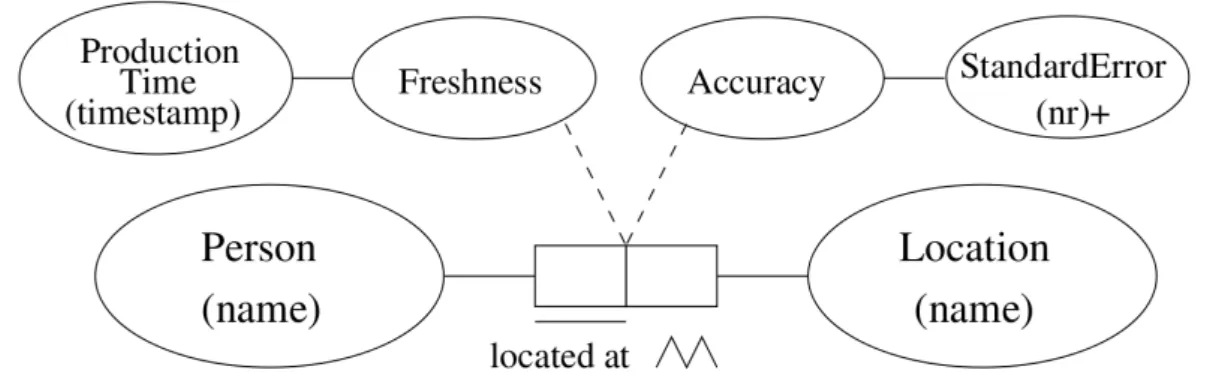
An example of adding quality information to a context model in the form of freshness and accuracy indicators is shown in figure 2.4. Graphical models are not primarily for the actual realization, though some approaches can be adapted quite well to enable context management in database-driven environments, because they are based on entity-relationship diagrams which are commonly used to model databases(Henricksen, Indulska, and Rakotonirainy 2003).
Figure 2.4.: Graphical Context Model, source: Henricksen (2003)
2.2.5. Design Patterns for Development of Mobile
Applications
The previous sections outlined the requirements of context-aware mobile appli-cations. Several definitions and classifications of context and different types of context models to describe context were shown. Besides the need for context models several design techniques are needed to overcome the technical limita-tions of many mobile devices in contrast stationary computers (cf. 2.1.3). Also the high dynamic in usage situations requires special attention. The following sections will show several software design patterns which were choosen as guiding principles to solve some of the technical problems.
Design patterns are simple and concise solutions for common programming problems. Here, they will be used to show the best practices for mobile appli-cation development. The architect Christopher Alexander (Alexander, Ishikawa, Silverstein, et al. 1977) is generally seen as the mental father of the design pattern movement. In the area of software engineering, design patterns became popular by the work of Gamma et al. (Gamma, Helm, Johnson, and Vlissides 1995). Their structure follows certain rules and is based on the following elements:
• Pattern name: The name of a pattern is usually short, yet descriptive, and
acts as an addition to the design vocabulary.
• Problem: Patterns should include a short description of the problem they
• Solution: The solution to the problem is described in a generally applicable way. The elements of the solution are described along with their relation-ships and responsibilities.
• Consequences: While the main consequence of using the pattern is the
solution to the problem, there do often exist side effects. In order to make it easier to understand the trade-off involved in using the pattern, it is important that the potential drawbacks are explained.
As a matter of course, this is not the only possible structure for describing a pattern, in fact Gamma et al. also provide an extended schema (Gamma, Helm, Johnson, and Vlissides 1995) and other authors offer alternative descriptions as well (Fowler 1997).
A design pattern documents a comprehensive solution for common tasks during the program design that evolved through experience into a useable solution for many situations. The engineering task during the object-oriented software design is to find a suitable design pattern for a given programming task or many design patterns which together solve the problem.
The documentation of the design patterns helps in the design process from completing requirements of the given problem to the realization in a programming language. It also acts as a foundation for discussion between the developers about the solution.
The primary use of a design pattern lies in the documentation of a solution for a given class of problems. Design patterns are generally language independent. During the design phase of object-oriented software, they are an accepted tool to foster the design process.
The ability to efficiently discover, manage, and use services is of essential im-portance for the design of mobile solutions. Hereby many problems have to be solved.
Memory constraints Memory is a scarce resource in mobile devices. While many devices feature more than one gigabyte of flash memory for long-term stor-age, the amount of random-access memory for executable software is generally lower than 128MB. Among other things, the deallocation of no longer used ser-vices is important to deal with this scarcity. This section will show different
design patterns for the implementation of an infrastructure which could be used for mobile clients.
In the case of mobile clients, the use of the Evictor-Pattern (Henning and Vinoski 1999; Jain 2001) is the most relevant solution. This approach tries to reach the goal of an efficient use of services through monitoring. Every time a service is accessed, a marker is set. Services which are not used for a long time (least recently used – LRU) or which are used only rarely (least frequently used – LFU) are candidates for deallocation. The deallocation of services may happen periodically or explicit at any time. The pattern involves the following four roles:
• User is using the resource
• Resource offers a specific functionality
• Evictoris the instance which is responsible for the eviction of the resources
• Eviction Strategy defines the criteria for the eviction of resources
The main advantage of this design pattern is transparency for the client, i.e. the mobile client does not have to take care about the eviction of his used ser-vices. The eviction of no longer needed resources is also possible during technical problems, such as a loss of network connection. The only disadvantage is that the client application has no chance to reject the eviction of a service. This dis-advantage is that you need a mechanism to easily to deal with the configuration of the eviction strategy.
Disconnected Operation Another problem is the fact that not every service is always available. This may in turn be caused by technical problems (such as loss of connection) or a changed location. In this case, theLeasing-Pattern (Jain and Kircher 2000a) could be used. This pattern is based on a method that does not offer a service for an unlimited time, but only for a limited period. When the time is over, there are different possibilities. The leasing-concept, which is used e.g. in Jini (Inc. 2003) and is also specified by Sun, was disregarded for mobile location-based patterns in the past. This concept is not only useful for Jini, as the work of Jain and Kircher (Jain and Kircher 2000a) suggests which even talks about a “Leasing Pattern”. The authors focus on the exact details of the problem, the structure, and their possible variants. In technologies which
do not support the leasing concept directly, such as Common Object Request Broker Architecture (CORBA), the concept can be realized through a special service (Aleksy and Gitzel 2002).
The leasing concept involves four roles:
• Resource, which offers a specific functionality
• Resource Claimant / Holder is the component willing to use the resource.
It may only use the resource if it owns a lease.
• Lease is the link between the resource and the resource claimant. It offers
the functionality to free a resource prematurely or to extend the leasing time if possible.
• Lessor / Grantoris the main management part. It manages the assignment
of the resources to the claimants.
Reconfiguration Furthermore, there are some more design patterns which assist in the dynamic reconfiguration of software components, e.g. theService
Configu-rator(Jain and Schmidt 1997) or theComponent Configurator(Schmidt, Rohnert,
Stal, and Schultz 2000). Even more related patterns may be found in Welch et al. (Welch, Marinucci, Masters, and Werme 2002).
The Design Patterns Lazy Acquisition, Virtual Proxy, and Virtual Component may be used in the field of client-development for mobile applications. They especially take things like the conservative use of resources into account and foster the development of adaptable applications.
The second category of the shown Design Patterns is–directly and indirectly– concerned with the client and the service part of the application. For example, the Lookup Pattern works as a link between the client part of a mobile application and the (potentially) used services. The use of the Evictor Patterns frees the mobile client indirectly from the use of elaborate and complex algorithms for the efficient utilization of resources.
Other Design Patterns, i.e. Component Configurator or Service Configura-tor, are concerned with the configuration of services and may lead to a higher flexibility.
Discovery The following paragraphs introduce different design patterns which can be used for the discovery of available services. First aspects of the client applications are examined. Later on, the necessary approaches for the server-based infrastructure are shown.
To utilize a service, a mobile client needs to have the ability to discover available services in a dynamic environment. The offered services could differ depending on the context of the user. This brings in the necessity to decouple the client from the services.
A possibility to solve the first problem would be to let every service periodically broadcast a beacon and make itself known to the clients and thus its potential users. An alternative would be to let every client announce its availability via a broadcast message and every available service sends a reply.
Both techniques are not scalable in the internet and any other unicast network since the broadcast traffic increases with every user and service.
One common solution to this is theLookup-Pattern (Jain and Kircher 2000b). It involves three roles:
• Client, which uses a service,
• Service offering a certain functionality,
• Lookup Service, which allows other services to register. Clients could use
this service to find other services.
This approach is used in different popular technologies, such as the Common Object Request Broker Architecture (CORBA) (OMG 1995). Further patterns concerning service discovery—more exactly a complete pattern language—are described in (P¨arssinen, Teemu, and Eronen 2005).
Flexibility The dynamic behavior of mobile applications is also a challenge for developers. This means that they should not be coupled directly with a service. To decouple the possible heterogeneous mobile clients from the services, the
Ser-vice Abstraction Layer-Pattern (Vogel 2001) may be used. This design pattern
adds another layer between the client-applications and the services. This may be realized using theFacade-Pattern (Gamma, Helm, Johnson, and Vlissides 1995). The Service Abstraction Layer boosts aspects as separation of concerns, generic request handling, controlled evolution, and communication transparency.
In this way, it is possible to tailor services to client applications which are specific to a location or which have different abilities, such as different Quality-of-Service-Characteristics (QoS).
Through the constantly changing business processes and the ongoing advent of emerging technologies, the “Separation of Concerns” (Vlter, Kircher, and Zdun 2000) principle should get special attention. This is, together with the presented patterns, an integral part for the development of platform- and language-neutral mobile applications.
Another problem, which has to be solved, is the efficient use of the resources of the mobile client device. Despite the amazing technical advancements with respect to memory or available bandwidth, these resources are scarce in mobile devices. At this point, one could use patterns such as Virtual Proxy (Gamma, Helm, Johnson, and Vlissides 1995). It creates “proxy” objects which dynamically load “expensive” objects on demand and thus save active memory. For similar reasons, patterns such as theLazy Acquisition-Pattern (Kircher 2001), which aims to acquire memory as late as possible, were created. It is based on the following four roles:
• User, who wants to use a specific resource,
• Resource, which offers a specific functionality,
• Virtual Proxy, which offers the same interface as the resource it represents
and functions as local stand-in,
• Resource Environment, which is responsible for the management of the
resources.
Furthermore, the Virtual Component (Corsaro, Schmidt, Klefstad, and ORyan 2002) helps with the aspects of high configurability and flexibility at run-time. This pattern includes six elements:
• Componentdefines the interface to use the functionality of the Component,
• Concrete Component is the concrete implementation of the Component
which offers the ability to load only the needed parts of the component,
• Component Factory offers an interface and a method to create the
• Concrete Component Factoryis a concrete implementation of a Component Factory which instantiates the Components,
• Loading Strategydecides when to load a Component and when to instantiate
it,
• Unloading Strategy decides when and if a Component and its associated
resources should be freed.
The interface of a Component represents a building-block of an application and is realized through a Concrete Component. For the creation of Concrete Component instances, the corresponding factories are responsible which could use different Loading/Unloading-Strategies.
2.3. Privacy in Context-Aware Applications
Context-awareness provides many benefits for the adaptation of an application to the current task for the user. However, with the advent of mobile devices, which are carried by a user all the time and are always-connected, the protection of the user’s privacy became an important challenge. While the applications are collecting more and more information from sensors and recording the habits and preferences, the potential for intrusion of the user’s privacy becomes even bigger. As Westin defines privacy as “the claim of individuals, groups or institutions to determine for themselves when, how, and to what extent information about them is communicated to others” (Westin 1967), the user must have the possibility to deny the transfer of personal information.
Many studies show that privacy is one of the main issues users are facing in context-aware systems (Barkhuus and Dey 2003; Bauer, Reichardt, and Schuele 2005). Privacy also has an economic value for both the user of a service and the provider, which shows an incentive to invade the privacy of the user (Varian 2002). The increased availability of private data also increases the risk of identity theft (Berghel 2000).
One way to improve the privacy is to make all outgoing data anonymous on the way to the service provider(Tatli, Stegemann, and Lucks 2006). Here, problems arise when subscription services are used which need some kind of authentication.