The University of Chicago
Law Review
Volume 80 Summer 2013 Number 3
O 2018 by The University of Chicago
ARTICLES
Tortfest
J. Shahar DillbarytThis Article argues that mass torte involving multiple tortfeasors can be wel-fare enhancing. It begins by investigating the role of "dilution of liability"-a phe-nomenon that has been condemned for its role in facilitating accidents. According to the literature, in alternative care situations where the damage to the victim is constant, dilution of liability leads to inefficient precaution levels and consequently to more (bad) accidents. The Article deviates from this literature and shows that dilution of liability can be welfare enhancing. This is so even in the quintessential case where dilution of liability has been denounced. The Article further shows that an activity that is socially undesirable and should give rise to liability can become desirable as the number of tortfeasors increases. Put differently, it shows that in some situations an activity that would and should be condemned if conducted by one tortfeasor may become socially desirable if done by many. The Article analyzes the conditions under which such desirable tortfests" occur, and it has important implications to the salience literature. After investigating the impact of tortfests on actors'precaution and activity levels, the Article examines mechanisms that would incentivize actors, in certain situations, to join a group wrongdoing or combine with others to initiate one. The result, it is argued, could increase societal welfare.
t Professor of Law, University of Alabama School of Law. I would like to thank Joe Colquitt, Alan Durham, Richard Epstein, Luigi Franzoni, Nuno Garoupa, David Gilo, Sharon Hannes, Assaf Jacob, Saul Levmore, Susan Lyons, Andy Morriss, Mike Pardo, Paul Pecorino, Ariel Porat, Caryn Roseman, Gil Sadka, Danny Sokol, Louis Visscher, and the participants of the Canadian, European, and Midwest Law and Economics Con-ferences, the University of Chicago and Northwestern Legal Scholarship Workshops, Tel Aviv University Law and Economics Workshop, and the Society for Environmental Law and Economics Conference for their comments, and David Butler, Lauren DeLap and Josh Hess for their research assistance.
INTRODUCTION ... 954
I. DILUTION OF LIABILITY IN ALTERNATIVE CARE SITUATIONS... 960
II. TORTFESTS... 965
A. Simultaneous Tortfests... 966
1. Negligent tortfeasors and the coordination problem... 966
2. Liability without fault. ... 970
3. Group wrongdoing and (no) moral indignation... 976
B. Successive Tortfests... 978
1. The marginal analysis and the free-riding problem... 978
2. In search of additional solutions... 983
C . O bjections... 990
1. The moral argum ent... 990
2. The economist's concern. ... 991
3. The exam ples. ... 995
4. M easuring concerns... 995
5. Antitrust law ... 996
III. BEYOND ALTERNATIVE CARE... 997
A. Dilution of Liability as a Concern... 997
B. Dilution of Liability as a Remedy... 999
CONCLUSION ... 1004 INTRODUCTION
This Article argues that mass torts involving multiple tort-feasors can be welfare enhancing. It begins by investigating the role of "dilution of liability"-a phenomenon that has been con-demned for its role in facilitating wrongdoing. Dilution of liabil-ity often occurs when multiple tortfeasors engage in a wrongful activity that results in an indivisible harm. Because liability is spread among the tortfeasors, the incentive to take care is re-duced as the number of tortfeasors increases. If liability is im-posed on a large enough number of tortfeasors, the expected lia-bility of each tortfeasor may decrease to the point where no one would take care. The result, it is argued, is a net social loss.
The following example is illustrative. Assume that four by-standers, A, B, C, and D, can each avoid an expected harm of
$100 to the victim at a total cost of $60. Taking precaution is
so-cially desirable (60 < 100). But even if all had a duty to furnish aid to the victim, none would. Because the total damage is spread among the bystanders such that each expects to be liable
for only a fraction of the damage, here one-fourth (or $25),' tak-ing precaution is just bad business. It simply does not make any sense to invest $60 in precaution to avoid an expected liability of
$25. Each bystander would prefer to do nothing and face an
ex-pected judgment of $25 rather than invest ex ante $60 in pre-caution. Of course, if there were more bystanders on whom the law imposed a duty, the incentive to take precaution would de-cline even further. In the case of fifty bystanders, for example, none would invest in precaution more than $2 (100/50). Or con-sider a situation where a gas supplier and a restaurant owner could have each avoided a $100 damage to a patron if the former invested $60 in a detection device or the latter purchased a $70 fire extinguisher. Here, both tortfeasors are liable.2 Each had a duty that was breached, resulting in a harm to the victim. Yet, neither will take precaution because the cost of precaution out-weighs the expected judgment (60, 70 > 100/2).
Focusing on similar examples, the prior literature concluded that tort law imposes liability on one or a few salient tortfeasors in order to avoid the dilution of liability.3 The salient tortfeasor may be the one who can avoid the accident at the lowest cost (for example, the gas supplier in the restaurant example). Or, it may be someone who is likely to be the best risk avoider (perhaps a bystander who has a "special relationship" with the victim). But the choice can be strictly arbitrary. In the examples above, im-posing liability on the blue-eyed bystander or the tallest one could be as efficient.4 Being solely responsible for the entire
1
With some simplifying assumptions, this result is independent of the apportion-ment regime. See J. Shahar Dillbary, Apportioning Liability behind a Veil ofUncertain-ty, 62 Hastings L J 1729, 1756-69 (2011).
2 See William M. Landes and Richard A. Posner, Joint and Multiple Tortfeasors:
An Economic Analysis, 9 J Legal Stud 517, 526-28 (1980). Note that efficiency requires
that only one of the two, the lowest cost avoider (here the gas supplier), take care. This result can be achieved by holding both initially liable, but then using the doctrine of in-demnity to shift the entire burden to the gas supplier. Id at 526-27. See also text accom-panying notes 20-24. A different approach would be to exempt the restaurant owner, the higher-cost avoider, from liability altogether.
3 See, for example, Landes and Posner, 9 J Legal Stud at 526 (cited in note 2); Saul Levmore, Waiting for Rescue: An Essay on the Evolution and Incentive Structure of the
Law of Affirmative Obligations, 72 Va L Rev 879, 937-38 (1986); Alon Harel and Assaf
Jacob, An Economic Rationale for the Legal Treatment of Omissions in Tort Law: The
Principle of Salience, 3 Theoretical Inq L 413, 414, 422 (2002); Assaf Jacob, Dilution of Liability and Multiple Tortfeasors in the Context of Liability for Unrequested Precau-tions, 108 Mich L Rev First Impressions 12, 13 (2009). See also Part I.
4 See Harel and Jacob, 3 Theoretical Inq L at 429 (cited in note 3). The solution is imperfect. The "tallest person" criterion may lead to inefficiency if it is not clear who is the tallest and therefore who should take care. The "blue eye" criterion is easier in this
damage, the chosen bystander will invest $60 in precaution to avoid paying $100 in damages. The result may be hard to justify on moral grounds since all actors are assumed to be at fault. It may also contradict notions of corrective justice as the salience solution exempts all but one tortfeasor from liability based on an arbitrary criterion. But, the argument goes, it can be justified on economic grounds.5
The focus of the prior literature was on alternative care sit-uations where any party could avoid the harm (for example, any of the bystanders could save the victim). In these situations, di-lution of liability was condemned as resulting in inefficient pre-caution levels. This Article shows that dilution of liability is not just a "problem"* that must be remedied. Rather, it argues that dilution of liability can be socially desirable. Notably missing from the literature is an analysis of the impact of dilution of lia-bility on beneficial activities. The bystanders and restaurant ex-amples are situations where, if the accident occurs, society would undoubtedly be worse off. These are "bad" accidents in that they do not entail any benefits. They only impose a cost. Moreover, in these examples none of the actors was interested in causing the accident. The bystanders, the gas supplier, and the restaurant owner would have all preferred to avoid the accident and the resulting payment to the victim. They would have avoided the accident if their liability was not diluted or if they could have entered an agreement to share the cost of precaution.7
But not all accidents are the same. Some are socially desir-able. Certain activities are so indispensable that, although they come at some cost to others, they are considered necessary evils that a modern society must accept. Power plant facilities, farm-ing operations, sewer systems, landfills, gas stations, cellular
respect (each bystander likely knows the color of her eyes), but it may lead to over-investment in precaution (if more than one person has blue eyes) or under-over-investment (if no one does). Even if the arbitrary criterion serves as an effective anti-dilution
mecha-nism by singling out only one tortfeasor, it may not be optimal if the chosen one is not the best risk avoider.
5 Id. See also text accompanying note 31. This is especially the case when the best
risk avoider cannot be identified or where each of the agents is the best risk avoider as is the case in the bystanders example.
6 Jacob, 108 Mich L Rev First Impressions at 14 (cited in note 3).
7 In the bystanders example, if transaction costs were not prohibitive (and assum-ing all were liable in the eyes of the law), the four would agree to share the $60 cost of precaution, rather than collectively be subject to an expected judgment of $100.
phone towers, and cement factories are but a few examples.$ Other activities confer benefits as well as costs that can be avoided, but as the number of actors increases, taking care may not be justified.
Consider, for example, a situation where each camper in a heavily forested area values camping at $50, and that each must invest $40 in precaution to avoid a fire that would destroy the victim's $90 cabin.9 Assume further that if a number of campers fail to take care, the several fires would merge and destroy the cabin together. If one camper is on the premises, she would take care and she should (40 < 90). With two campers, the expected
liability each faces is much smaller, $45 (90/2), but the incentive to take care is still strong. Each would invest $40 to avoid an expected judgment of $45 and would realize a net expected gain of $10 (50 - 40). But if three campers are on the premises (and each believes or knows that the others or even just a large enough number of campers are present), none would take care, nor should they! Note that camping is still socially desirable be-cause the total benefits from the activity outweigh the cost
(50 x 3 > 90). Taking care, however, is not. It simply does not
make sense to require each camper to invest $40 up to a total of $120 (40 x 3) to avoid damaging a $90 cabin.
Dilution of liability here is the cure to what would otherwise be an over-investment in precaution. In the first step, liability is imposed on an individual cost-benefit analysis. Here, each camper who did not take care will be found liable because the cost of precaution is less than the expected harm to the victim. Then, as a second step, liability is diluted exactly at the point where the total cost of precaution would outweigh the benefit. Dilution of liability thus serves here as a sorting mechanism to distinguish between accidents that are socially net beneficial and those that are not. It incentivizes actors to avoid inefficient
8 See Restatement (Second) of Torts § 291, comment e (1965); id at § 292, comment
a ("The operation of railways and other public utilities, no matter how carefully carried on, produces accidents which kill or harm many people but the risk involved in the oper-ation is more than counterbalanced by the service which they render the public."); id at
§ 822, comment g; id at § 826, comments a, b, f ("In the case of a cement factory polluting
the air with dust, the utility may be reflected in society's need for building materials.");
Losee v Buchanan, 51 NY 476, 484 (1873) (after noting that members of society are
com-pelled to give up many of their rights, the court explains that "[w]e must have factories, machinery, dams, canals and railroads").
9 The example is based on Restatement (Third) of Torts: Liability for Physical and
Emotional Harm § 27, comment a, illustration 1 (2010), and Restatement (Second) of
Torts § 433A, comment i, illustrations 14-15.
accidents (in the case of one or two campers) but engage in cost-justified activities. This sorting mechanism comes at a low cost. The courts do not need to engage in the complicated task of measuring the total benefits from the actors' activity and the aggregate cost of precautions if care is taken. Nor do the courts need to identify the point where precaution should not be taken. Instead, the courts simply need to apply traditional tort theory to determine the liability of each tortfeasor based on an individ-ual analysis-a task they perform regularly. The decisions to operate and to take care (and the risks that accompany these decisions) are then shifted to the actors themselves.
. By focusing on such valuable activities, this Article shows
that dilution of liability can serve a different role. Not only can it reduce the incentives of existing actors to take care, but in some situations it may even incentivize actors to join others in com-mitting a wrongdoing-the Article uses the term "tortfest" to re-fer to such situations. What the prior literature missed is that dilution of liability may result in a tortfest, and that the tortfest can be socially desirable. Moreover, the Article shows that an ac-tivity that may be socially harmful if conducted by few can be-come desirable as the number of tortfeasors increases. Thus, the Article shows that in some situations an activity that should be condemned if conducted by one or a few tortfeasors may become socially and economically justifiable if conducted by many.
The rest of the Article proceeds as follows. Part I begins with a review of the prior literature. It shows that dilution of li-ability has been described as a concern mainly in situations (1) of alternative care where the entire harm can be avoided by any of the tortfeasors and (2) where the damage does not increase with the number of tortfeasors. It reveals that the analysis often ignored the gains to the tortfeasors and was doctrine specific, fo-cusing on elements such as duty, apportionment rules, and de-fenses such as contributory negligence. Importantly, dilution of liability has been described as a problem that must be remedied: the problem is inefficient precaution levels. When liability is di-luted, the argument goes, often too little or too much care is tak-en. The solution is described as an anti-dilution mechanism that singles out and imposes liability on one or a few salient tortfeasors. The focus of the literature has been both too narrow and too broad. It is too narrow because dilution of liability is not limited to alternative care situations, nor is it necessary for the damage to be constant. The literature has been also too narrow because
dilution of liability is not always a "problem" that must be reme-died. In deviation from the prior literature, Part II shows that dilution of liability can increase welfare by facilitating a tortfest that positively impacts activity levels. This is so even in the ar-chetypical case-alternative care situations where the damage is
constant-where dilution of liability has been denounced.
Specifically, Part II identifies two types of tortfests. The first type, discussed in Part II.A, is that of simultaneous tort-fests. These are tortfests where a number of actors engage in a damaging activity at the same time. Part II.A shows that in simultaneous tortfests dilution of liability can increase welfare
by ameliorating a coordination problem between tortfeasors,
thereby allowing a harmful yet desirable activity to take place. In doing so, Part II.A also contributes to the literature that seeks to explain why the law imposes strict liability in nuisance cases where the parties are clearly not at fault. In many cases, it is clear that the injurers took care, even the utmost care, by em-ploying the best and most recent methods of operation. Yet these injurers are nevertheless subject to (strict) liability. Traditional theory explains the need to impose liability (often referred as a "liability rule") in high-transaction cost settings.10 When the ac-tor and the would-be victim cannot negotiate, a liability rule al-lows the actor to injure first and compensate later."1 In the face of liability, the injurer would do so only if she expects a net gain, that is, only if the expected benefits from the activity outweigh the expected costs. Part II.A identifies a different form of cost that explains why the law prefers a faultless victim over a fault-less injurer. It shows that, even when negotiating with the vic-tim is possible, a liability rule combined with a dilution mecha-nism can alleviate a coordination problem between the tortfest
participants: the would-be buyers.
Part II.B analyzes successive tortfests. These are tortfests where actors join an existing tortfeasor sequentially in time. Part II.B shows that although successive tortfests can be welfare enhancing, they may suffer from a free-riding problem. A marginal cost-benefit analysis-the very one pressed by law-and-economics champions-can exacerbate the problem to the point that a wel-fare-enhancing tortfest will not take place. In some situations it
may even lead to welfare-decreasing tortfests. Part II.B discusses 10 See, for example, William M. Landes and Richard A. Posner, The Economic
Structure of Tort Law 43, 48-51 (Harvard 1987).
11 See text accompanying notes 61-62.
a number of possible solutions. In doing so, it sheds light on an-other debate: whether actual or prorated damages should be im-posed in successive torts. Some jurisdictions employ a marginal analysis holding each tortfeasor liable for the damage she caused even in situations where it is hard, if not impossible, to determine the damages caused by each tortfeasor. Other juris-dictions apply a proration rule in these situations. Part II.B adds to this debate by showing that it may be justified to prorate the damage even when the damage caused by each tortfeasor is clearly and easily ascertainable at no cost. Moreover, it shows that, under certain circumstances, even a rule that imposes lia-bility and subjects to damages actors who clearly did not cause
any harm can be justified. Part II.C discusses some of the
possi-ble objections to facilitating beneficial tortfests. These include moral, legal, and economic considerations as well as alternative mechanisms.
Part III examines the claim that dilution of liability is lim-ited to situations where each actor can single-handedly avoid the harm. This Part reveals, however, that the focus of the prior literature has been misplaced, and it concludes that dilution of liability can occur in a large number of settings. Part III also shows that dilution of liability can positively impact precaution levels. The Article concludes with final remarks.
I. DILUTION OF LIABILITY IN ALTERNATIVE CARE SITUATIONS
Dilution of liability has been described as a concern in situa-tions of alternative care where any of the parties could have avoided the damages. As the bystanders and restaurant exam-ples show, dilution of liability can result in sub-optimal precau-tion levels. Accidents that can and should be avoided by exercis-ing due care won't be if liability is spread among too many tortfeasors. In fact, dilution of liability can also result in over-investment in precaution, as will be shown below. Either distortion represents an inefficiency. The law has not ignored these concerns. In fact, many tort doctrines have been explained as remedies to the problem of dilution of liability in alternative care settings, although not always explicitly so. Common to these doctrines is an attempt to mitigate the concern of dilution of liability by imposing liability on one salient tortfeasor.
Consider then-Professor Guido Calabresi's example on the effect of the comparative negligence defense.12 Assume together with Judge Calabresi that an $80 accident can be avoided if the victim or the defendant invested $60 in precaution. Under a
comparative negligence regime, assuming for simplicity that the parties are equally (or 50 percent) at fault, neither will invest in precaution. Because liability is split (or diluted), neither the plaintiff nor the defendant will invest $60 in precaution to avoid an expected loss of $40 (80/2). The solution is found in the sister doctrine of contributory negligence. Contributory negligence remedies the problem by imposing the entire burden on one par-ty only.13 If the plaintiff is at fault she will be the only one bear-ing the cost and therefore will purchase the precaution (60 < 80). If she is not at fault, the defendant, now the sole party at fault, will take precaution for the same reason.
Comparative negligence, at least under one interpretation that has now been rejected, can also lead to over-investment in precaution. Consider with Judge Richard Posner a situation in which a $1,000 accident can be avoided by the defendant at a cost of $100 or the victim at a cost of $50.15 Initially one may
conclude that under comparative negligence, and assuming for simplicity again that parties are equally at fault, both will in-vest in precaution (50, 100 < 500).16 The result is that an
12 Guido Calabresi, The Costs of Accidents: A Legal and Economic Analysis 158
(Yale 1970). For a critical view of Judge Calabresi's example, see Daniel Orr, The
Supe-riority of Comparative Negligence: Another Vote, 20 J Legal Stud 119, 119-20 (1991).
Re-cent scholarship analyzing the contributory and comparative defenses concluded that in an ideal world of complete information (administrative issues aside) both regimes are efficient. See Steven Shavell, Economic Analysis of Accident Law 14-17 (Harvard 1987); Richard A. Posner, Economic Analysis of Law 222 (Aspen 8th ed 2011); Oren Bar-Gill and Omri Ben-Shahar, The Uneasy Case for Comparative Negligence, 5 Am L & Econ Rev 433, 434, 437-38 n 9 (2003); Giuseppe Dari-Mattiacci and Gerrit De Geest, The
Fil-tering Effect of Sharing Rules, 34 J Legal Stud 207, 210-11 (2005).
13 For a proposal to shift the entire burden to the injurer, see Bar-Gill and Ben-Shahar, 5 Am L & Econ Rev at 437-38 n 9 (cited in note 12).
14 See id at 434, 437-38; Tai-Yeong Chung, Efficiency of Comparative Negligence: A
Game Theoretic Analysis, 22 J Legal Stud 395, 395-96 (1993); Posner, Economic Analysis of Law at 222 (cited in note 12).
15 Posner, Economic Analysis of Law at 219-20 (cited in note 12). See also
Christo-pher J. Robinette and Paul G. Sherland, Contributory or Comparative: Which Is the
Op-timal Negligence Rule?, 24 NIU L Rev 41, 52 (2003).
16 This was indeed Judge Posner's initial conclusion but it was corrected in later editions. Compare Richard A. Posner, Economic Analysis of Law 124 (Little, Brown 2d ed
1977), with Posner, Economic Analysis of Law at 220 (cited in note 12). See also Bar-Gill
and Ben-Shahar, 5 Am L & Econ Rev at 437 (cited in note 12); Chung, 22 J Legal Stud at
399 (cited in note 14). But see note 129 and accompanying text.
accident that can be avoided at a cost of $50 will be avoided at a cost that is 3 times higher. The inefficient result was thought to be the work of dilution of liability.' As recent scholarship ex-plains, "The reason that comparative negligence was thought to generate inefficient incentives is that, by dividing the accident costs among the parties, it provides incentives for both ... to ex-ercise care."18 Contributory negligence was considered more effi-cient because by singling out one party, the cheapest cost avoid-er, the same accident would have been avoided at a cost of $50. This conclusion, however, assumes that the law requires both parties to take care in the above example. But if the standard of care imposes a duty only on the cheapest cost avoider to take care, then even under a comparative regime the efficient result would occur.19 The defendant will not have a duty to take care. And knowing this, the victim-the cheapest cost avoider-will invest $50 in precautions to avoid the $1,000 damage. Im-portantly, under both interpretations the efficient result is achieved by imposing liability on one party only, that is, by adopting an anti-dilution mechanism.
The doctrine of indemnity functions in a similar way.20 It
"shifts the [entire] burden from one joint tortfeasor to another who is better situated to avoid the accident, rather than dividing it between the tortfeasors."21 Imagine, for example, that a $100 harm to the victim can be averted by A, a general contractor, at a cost of $60 or by B, its subcontractor, at a cost of $55. Either can avoid the damage, but it is clear that the preferred way would be for B, the more knowledgeable party who was hired to perform the task and the best cost avoider, to do so. But if the damage is apportioned equally between the parties, neither will take precaution (60, 55 > 50). If, on the other hand, the harm to the victim can be avoided by B at a cost of $10 and the damage is apportioned between the parties such that A is responsible for
75 percent of the damage and B for 25 percent, both will take
precaution (60 < 75, 10 < 25).22 Neither result is efficient. The
17 Bar-Gill and Ben-Shahar, 5 Am L & Econ Rev at 437-38 (cited in note 12). 18 Id at 437.
19 See id; Chung, 22 J Legal Stud at 399-402 (cited in note 14); Shavell, Economic
Analysis of Accident Law at 18 (cited in note 12); Posner, Economic Analysis of Law at
220 (cited in note 12).
20 See Landes and Posner, 9 J Legal Stud at 519 n 5 (cited in note 2). 21 Dillbary, 62 Hastings L J at 1744 (cited in note 1).
22 See Landes and Posner, 9 J Legal Stud at 527-28, 532-37 (cited in note 2). For
former case is one of under-investment in precaution whereas the latter is one of over-investment. The two situations corre-spond to the two examples provided by Judges Posner and Cala-bresi in the injurer-victim context. It is therefore not a surprise that indemnity employs a similar anti-dilution solution. In the above example, it avoids dilution of liability and its ills-inefficient precaution levels-by singling out one tortfeasor. Even if the victim recovered her injury from A and B, A will be able to indemnify from B, the "active" tortfeasor.23 Importantly, Professor William Landes and then-Professor Posner explain that indemnity is required only in alternative care situations.24
More recently, Professors Assaf Jacob and Alon Harel sought to explain why tort law attributes liability primarily to acts but not to omissions.25 They examine why, for example, by-standers (usually) do not have a duty to furnish aid to a person in need whereas a person who voluntarily takes an action may be subject to liability under a theory of negligence.26 They con-clude that this anomaly (imposing liability on those who act but not on those who fail to act) can be explained as an attempt to reduce the risk of dilution of liability. Once again, the authors focus on alternative care settings. Relying on a variant of the bystanders example discussed in the Introduction, they conclude that if the law imposed a duty on all bystanders, requiring each to take precaution, none would.27 If the law imposed liability on four bystanders who can single-handedly avert a $100 harm at a cost of $60, none would take care (60 > 25).28 But if instead the law singled out one person, based on a simple salient feature, the chosen one would take care and the harm would be avoided
(60 < 100).29 The salient feature can be the person who
volun-tarily decided to act (and thereby singled out herself), someone with a special relationship with the victim (an easy-to-verify sorting device), or the cheapest cost avoider (the economist's
23 See id at 533, citing Muth v Urricelqui, 60 Cal Rptr 166, 171-72 (Cal Ct App
1967).
24 Landes and Posner, 9 J Legal Stud at 532 (cited in note 2) (arguing that "the key
to understanding when indemnity will be allowed and when it will be denied is the eco-nomic difference between joint-care and alternative-care situations"). For a survey of in-demnity decisions, see id at 535.
25 Harel and Jacob, 3 Theoretical Inq L at 415 (cited in note 3).
26 Id. See also Jacob, 108 Mich L Rev First Impressions at 12-13 (cited in note 3);
Levmore, 72 Va L Rev at 937-38 (cited in note 3).
27 Harel and Jacob, 3 Theoretical Inq L at 428-29 (cited in note 3).
28 See note 1 and accompanying text.
29 Harel and Jacob, 3 Theoretical Inq L at 429-30 (cited in note 3).
choice).30 But it can also be a completely arbitrary feature, such as singling out the blue-eyed or the tallest bystander.31 Indeed, any salient feature that allows easy pre-selection of one actor may solve the problem.82 Those who are not subject to liability will not take care; the one who was singled out will take care to avoid the crushing liability.
While the prior literature made a more modest claim, trying to identify isolated examples where dilution of liability reduces incentives to take care, Professors Jacob and Harel take a more general approach. They explain that their insight on the differ-ential treatment of acts and omissions in tort law is just "a proxy" or an attempt to highlight a "broader phenomenon in tort law, namely, the special treatment of multiple injurers in alter-native care situations."33 In their view, dilution of liability merits condemnation34 in (1) alternative care cases (2) where the dam-age is constant and (3) liability is spread (or diluted) across a large enough number of tortfeasors-conditions that are met by the bystanders and restaurant examples.35 In these situations,
30 Choosing the cheapest cost avoider, albeit the most efficient solution, is not al-ways feasible. In some cases, identifying that cheapest cost avoider can be a daunting or even impossible task. In others, it would not solve the problem at all. (For example, if all bystanders can avoid the accident at the same cost, choosing the cheapest cost avoider cannot serve as a selective mechanism.)
3 Harel and Jacob, 3 Theoretical Inq L at 429, 432, 436 (cited in note 3). See also Bar-Gill and Ben-Shahar, 5 Am L & Econ Rev at 437-38 n 9 (cited in note 12) (discuss-ing a similar situation and not(discuss-ing that "[t]his [inefficiency] could be avoided, however, if the law were willing to place the burden of care arbitrarily on one party (say, the injur-er), even if both parties can prevent the harm at the same cost).
32 As noted earlier, the solution is imperfect. See note 4.
33 Harel and Jacob, 3 Theoretical Inq L at 414, 420 (cited in note 3). See also id at
414:
[Tjhe article interprets the differential treatment of acts and omissions in tort law as a proxy for a more fundamental distinction between harms caused by multiple injurers, where each one can single-handedly prevent the harm (ei-ther by acting or failing to act), and harms caused by a single injurer (ei(ei-ther by acting or failing to act.
34 Id at 451.
35 Id at 414:
Attributing liability to too many injurers in alternative care situations leads to dilution of liability. Since the overall cost to which a group of injurers is ex-posed is constant, attributing liability to many injurers reduces the portion each has to pay and, consequently, reduces the injurers' incentives to take precautions.
id at 422:
Since the overall cost to which a group of tortfeasors in alternative care situa-tions is exposed is constant, increasing the number of liable tortfeasors will re-duce the compensation paid by each one and, consequently, each one's
they argue, the result is a suboptimal investment in precaution and consequently a decrease in societal welfare. The solution: imposing liability on one or few actors.36
Professors Jacob and Harel make an important contribution
by providing a general methodology that explains the law's
at-tempt to curb some of the detrimental effects of dilution of liabil-ity. Their conclusion, however, is both too broad and too narrow. It is too broad because dilution of liability, even in alternative care situations where the damage is constant-the archetypical case that merits condemnation according to the authors--can be desirable and if so, should be applauded, not condemned. It is too narrow because dilution of liability is not limited to alterna-tive care situations. Nor is it limited to situations where the
damage is constant.
II. TORTFESTS
In the bystanders and restaurant examples, no party want-ed to bring about the harm. All were interestwant-ed in avoiding the accident and the liability that came with it. The parties would avoid the accident if they could negotiate with each other.>< But there are occasions when the parties are in fact interested in combining and causing the harm to the victim and yet the acts, which can be intentional or unintentional, are efficient even if they give rise to liability. This Part analyzes such situations. It shows that in some situations what is and should be condemned if done by one (or a few) is socially desirable if conducted by many. Moreover, this Part reveals that liability serves as a sort-ing mechanism and that it should be imposed on actors of ineffi-cient as well as effiineffi-cient tortfests. In the former case, liability has a deterring effect. In the latter case, liability enables an effi-cient tortfest to take place, but only if the victim is compensated.
incentives to take precautions. Assigning liability to too many tortfeasors in al-ternative care situations therefore will lead to dilution of the liability.
36 Id at 429.
37 This is not the case, however, with the campers. There, not taking precaution was the efficient result even if transaction costs allowed the parties to negotiate. See Introduction.
965
A. Simultaneous Tortfests
1. Negligent tortfeasors and the coordination problem.
To see how dilution of liability can be desirable, consider first the following example. Suppose a factory can avoid an ex-pected damage of $800, the value of a neighboring lake, if it in-vests $450 in a filtering device. Here, the factory will be held li-able if it fails to take care, which is also the socially desirli-able result (450 < 800). But assume now that instead of one factory, two factories are located on the banks of a river that leads to the lake. Note that the total expected damage does not increase with the number of factories (that is, it remains $800, the value of the lake). To ensure it is an alternative care situation,3" assume fur-ther that the filtering device can only be placed on a section of the river where the pollutants and debris from both factories commingle so that any of the factories can avoid the entire dam-age by installing a filter. As with one factory, efficiency requires that the $450 filter be installed to prevent the expected $800 harm. Failing to take precaution would give rise to liability against both factories since each can avoid the expected damage of $800 by investing $450.39 Yet, neither factory will take
38 The assumption is not necessary and is later relaxed. See Part II.B.
3 See Restatement (Second) of Torts § 433A, illustrations 14-15 (stating that, where there are multiple wrongdoers, a victim can recover the full amount of damages from each tortfeasor or both); Restatement (Third) of Torts: Liability for Physical and Emotional Harm § 26, comments a, c, d, h; id at § 27, comments a, f, illustration 4;
Rich-ard W. Wright, The Logic and Fairness of Joint and Several Liability, 23 Memphis St U L Rev 45, 55-61 (1992) (noting that when a defendant's tortious behavior was sufficient for the occurrence of the injury, as in the case where each of two defendants put enough poison in the victim's drink to kill her, the parties are jointly and severally liable for the entire harm); Brief Amici Curiae of American Law Professors in Support of Respondents,
Norfolk & Western Railway Co v Ayers, No 01-963, *13-18 (US filed Aug 19, 2002)
(available on Westlaw at 2002 WL 1964118) ("Professors Brief); Richard W. Wright,
Once More into the Bramble Bush: Duty, Causal Contribution, and the Extent of Legal Responsibility, 54 Vand L Rev 1071, 1100-01, 1106-08 (2001). See also Velsicol Chemical Corp v Rowe, 543 SW2d 337, 343 (Tenn 1976) (allowing a defendant accused of polluting
a park to implead five defendants who operated plants at the same area and holding that "joint and several liability [applies] when an indivisible injury has been caused by the concurrent, but independent, wrongful acts or omissions of two or more wrongdoers, whether the case be one of negligence or nuisance); Landers v East Texas Salt Water
Disposal Co, 248 SW2d 731, 731-34 (Tex 1952) (imposing joint and several liability on
two defendants who independently but concurrently and negligently polluted the plain-tiffs lake, killing the fish and rendering it useless); Phillips Petroleum Co u Hardee, 189
F2d 205, 211-12 (5th Cir 1951):
[W]here persons acting independently are guilty of negligence, and the results of their negligence combine to set up a chain of causation resulting in the
2013] Tortfest 967
precaution because the cost of precaution outweighs the ex-pected liability each factory faces (450 > 400). The exex-pected lia-bility and the incentive to take care will be diluted even further if the number of tortfeasors increases. With n tortfeasors, the expected liability each faces would be 800/n, which means that in the case of 400 factories no one would take care even if the fil-ter costs $3 (3 > 800/400).
Similar examples have been used by others to show the det-rimental effects that result from dilution of liability.40 However, missing in these examples is the fact that in inflicting harm in the form of pollution, the factories also garner some benefits: each makes a profit. The introduction of a profit analysis reveals that dilution of liability can help incentivize actors to engage in
complained of damage, these persons ... are yet joint tort-feasors and, as such, are liable for the damage caused by the conjunction of their separate negli-gence, just as in collision cases, persons acting separately and independently are none the less liable for the whole damage caused where their negligence concurs to produce the result.
Dan B. Dobbs, The Law of Torts § 171 at 415 (West 2000); 61C Am Jur 2d Pollution
Con-trol § 1908 at 966-67 (2010) (noting that in some jurisdictions "when the acts of two or
more persons, although done independently, combine to cause pollution, those persons are liable both jointly and severally for the resulting injury, particularly when the dam-ages are indivisible'); Prairie Oil & Gas Co v Laskey, 46 P2d 484, 486 (Okla 1935):
If concurrent negligence of two or more persons combined together results in an injury to a third person, they are jointly and severally liable and the injured person may recover from either or all; the concurring negligence of one is no excuse or defense to another; each is liable for the whole; even though another was equally culpable, or contributed in a greater degree to the injury.
Michie v Great Lakes Steel Division, National Steel Corp, 495 F2d 213, 215 (6th Cir
1974) (a nuisance suit alleging that air pollutants from defendants' manufacturing plants across the Detroit River combined and created a nuisance); Oakwood Homeowners
Association, Inc v Ford Motor Co, 258 NW2d 475, 484-85 (Mich Ct App 1977) (imposing
joint and several liability in a nuisance suit for pollution against a car manufacturer, a petroleum refinery, a lime processing plant, and a salt company); notes 82-83 and ac-companying text (discussing the imposition of liability in successive cases). But see Re-statement (Second) of Torts § 433A, illustration 5 (identifying circumstances in which liability is apportioned based on the relative fault of the tortfeasors).
4o See, for example, Harel and Jacob, 3 Theoretical Inq L at 429 (cited in note 3). The authors provide two examples of alternative liability situations involving actions (as opposed to omissions) to show the detrimental effects of dilution of liability. In the first, one hundred people each emit one spark, each of which is necessary together with the other sparks to cause a fire. Id at 430. In the second, "several factories pollute the shared water source, but it is only the accumulation of the pollution from all the factories that causes significant damage to the water." Id at 430 n 39. In such cases, they argue "it may be justifiable to excuse tortfeasors in order to prevent the risk of dilution of liability." Id. The authors, however, do not discuss the effect of the profits to the tortfeasors (for exam-ple, the factories). See also Jacob, 108 Mich L Rev First Impressions at 13 (cited in note
certain "wrongful," yet welfaenhancing activities, or as re-ferred to here, tortfests.
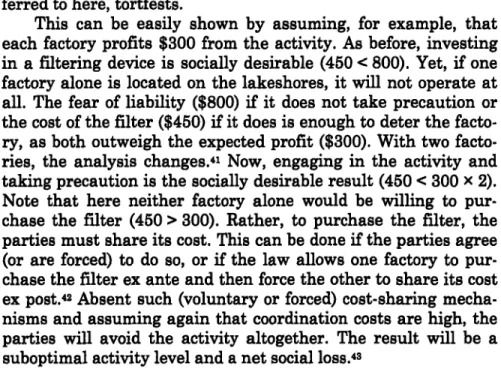
This can be easily shown by assuming, for example, that each factory profits $300 from the activity. As before, investing in a filtering device is socially desirable (450 < 800). Yet, if one factory alone is located on the lakeshores, it will not operate at all. The fear of liability ($800) if it does not take precaution or the cost of the filter ($450) if it does is enough to deter the ry, as both outweigh the expected profit ($300). With two facto-ries, the analysis changes.41 Now, engaging in the activity and taking precaution is the socially desirable result (450 < 300 x 2). Note that here neither factory alone would be willing to pur-chase the filter (450 > 300). Rather, to purpur-chase the filter, the parties must share its cost. This can be done if the parties agree (or are forced) to do so, or if the law allows one factory to pur-chase the filter ex ante and then force the other to share its cost
ex post.42 Absent such (voluntary or forced) cost-sharing
mecha-nisms and assuming again that coordination costs are high, the parties will avoid the activity altogether. The result will be a suboptimal activity level and a net social loss.43
TABLE 1. THE
SOCIAL
COSTS AND BENEFITS FROM POLLUTINGWithout Precaution With Precaution
Number of Total Total Net Total Net
Factories Benefits CostsfLoss Social Costs/Loss Social
Operating Gain/Loss Gain/Loss
Concurrently I
1 300 800 -500 450 -150
2 600 800 -200 450 150
3 900 800 100 450 450
41 The sequential analysis is discussed in Part II.B.
42 See Ariel Porat, Private Production of Public Goods: Liability for Unrequested
Benefits, 108 Mich L Rev 189, 190-91 (2009) (proposing to modify current law to
recog-nize a regime of Expanded Duty of Restitution (EDR) under which "recipients would compensate benefactors for unrequested benefits"); Jacob, 108 Mich L Rev First Impres-sions at 12 (cited in note 3) (arguing that the EDR "provides an interesting and provoca-tive solution to the dilution of liability puzzle").
43 The social loss is $150, the total profit of $600 (300 x 2) minus the $450 cost of precaution.
Tortfest
But if three factories engage in the tortfest, even if transac-tion costs are high such that the parties would not (agree or be forced. to) purchase the filter together, they would nevertheless engage in the activity, because the gain for each would outweigh their private expected cost (800/3 < 300). Here, dilution of liabil-ity facilitates a desirable activliabil-ity. Because the total cost remains constant (the value of the lake is capped at $800), the expected liability of each factory decreases as the number of tortfeasors increases (800/n). Thus, if enough tortfeasors joined the tortfest, an activity that was once socially undesirable (in the case of one factory) would become desirable. Table 1 above summarizes the results and shows how total welfare increases with the number of tortfeasors.
The factory example is similar to the bystanders and res-taurant examples in that, because the harm is constant, liability is diluted as the number of tortfeasors increases. The factory ex-ample, however, is fundamentally different. To begin with, in the restaurant and bystanders examples, dilution of liability re-sulted in an inefficient accident. Because liability was diluted, no one took precaution and the result was a decrease in total welfare. Dilution of liability was thus a problem that was reme-died by imposing liability on one actor only. In the factory ex-ample, on the other hand, dilution of liability is the solution. Di-lution of liability allows a desirable and welfare-enhancing activity to take place. It mitigates a cooperation problem be-tween tortfeasors who, due to high transaction costs, cannot combine to purchase the filtering device. The genius of this mechanism is that dilution of liability incentivizes actors to join the festivity in situations where the benefits from the joint activ-ity outweigh the cost to the victim. If the number of actors is too small, the crushing liability would deter the would-be tortfea-sors from acting. Put differently, dilution of liability serves here (again) as a sorting device that allows good accidents to take place but deters bad ones.
Second, as in the campers example," dilution of liability al-lows the courts to reach an efficient result by engaging in an in-dividual cost-benefit analysis while freeing the courts from en-gaging in the more complicated cost-benefit analysis of the precautions, damages, and benefits. It also frees the courts from
4 See Introduction, notes 125-30 and accompanying text.
the daunting task of determining the exact number of actors that renders the tortfest net beneficial. But while in the campers example dilution of liability impacted the level of precaution, here it impacts the activity level. In the factory example, dilu-tion of liability ensures that, if the total benefit from the activity outweighs the cost, the activity takes place. In the case of three factories, an individual analysis will lead to a judgment against each of the factories (450 < 800), but the dilution of their ex-pected liability (800/3 < 300) would promote their operation.
Third, in the restaurant and bystanders examples, no actor wanted the accident to occur. The bystanders, the restaurant owner, and the gas provider would have all preferred to avoid the accident if they could negotiate rather than be subject to lia-bility. In the factory example, the opposite is true. The factories have the incentive to participate in a tortfest with as many ac-tors as possible.45
Finally, it is important to note that in the above example di-lution of liability provides a second-best sodi-lution. Ideally, the factories should purchase a filter if they decide to produce. This, as Table 1 demonstrates, would increase total welfare from $100 to $450 in the case of three factories. As the next Section shows, however, dilution of liability may even lead to a first-best solution.
2. Liability without fault.
The examples thus far analyzed were situations in which the actors were negligent. The bystanders, the campers, the res-taurant suppliers, and even the factories all failed to take care and for this reason they were found liable. But some activities are so important (or beneficial) to society that the law allows their operation even though they clearly come at a cost to inno-cent parties. Power plant facilities, alternative energy (solar and wind) plants, farming operations, and cement factories are but a few examples of activities that often result in damage to others, but their operation is tolerated.46 Yet, despite a trade-off that
45 If, for example, one hundred factories engaged in the tortfest, each would profit $300, be subject to an expected liability of $8 (800/100), and therefore expect a net profit
of $292 (300 - 8). Total welfare would increase by $29,200 (300 x 100 - 800).
46 See note 8 and accompanying text; Richard A. Epstein, Two Fallacies in the Law
of Joint Torts, 73 Georgetown L J 1377, 1386 (1985) (noting that "it is far from clear that
one wants a world in which there is zero loss from toxics, given that the marginal costs of prevention needed to obtain that situation are exceedingly high, while the last unit of
2013] Tortfest 971 favors the harming activity, even if the actors take the utmost care that foresight and vigilance would require, the actors are nevertheless labeled "tortfeasors" and are held liable.47
benefit is apt to be very low" and explaining that in some situations there is no way a firm could avoid pollution "even if it tried, short of not generating or shipping wastes al-together-which would mean the cessation of all manufacturing of such essential prod-ucts as chemicals and food"). The Second Restatement also acknowledges this trade-off.
"A slaughterhouse," it notes, "may be indispensable to the community, but it usually
renders other land in its immediate vicinity unfit for residential use and enjoyment." Re-statement (Second) of Torts § 827, comment g. The operation of farms and factories "is
ultimately as essential to the general public good as the operation of hospitals and fire departments." Id at § 828, comment e.
4 This is often the case under the nuisance doctrine. To somewhat simplify, a pri-vate nuisance is a substantial invasion of another's interests in the use and enjoyment of her land. Restatement (Second) of Torts § 821F. Liability in nuisance can be based on
negligence, or it may be based on a theory of strict liability if the defendant maintained an abnormally dangerous activity. A third basis for liability, and the one of interest here, is where the invasion is intentional and unreasonable. Dobbs, The Law of Torts § 464 at 1324-25 (cited in note 39); Restatement (Second) of Torts § 821F; Copart Industries, Inc v Consolidated Edison Co of New York, 362 NE2d 968, 971 (NY 1977):
[O]ne is subject to liability for a private nuisance if his conduct is a legal cause of the invasion of the interest in the private use and enjoyment of land and such invasion is (1) intentional and unreasonable, (2) negligent or reckless, or
(3) actionable under the rules governing liability for abnormally dangerous
conditions or activities.
To count as an intentional nuisance it is enough that the actor is "substantially certain that his activities will cause" an invasion to the victim's land. Dobbs, The Law of Torts
§ 464 at 1324-25 (cited in note 39). I will is not required. Id at 1325; Restatement (Sec-ond) of Torts § 825, comments c, d, illustration 2. Thus, where the damage is certain or
very likely to happen, exercising "extraordinary care," even using "the best technology available" does not exempt the defendant from liability. Dobbs, The Law of Torts § 464 at
1325 (cited in note 39). Professor Dan Dobbs explains that such intentional nuisance
'works as a soft version of strict liability." Id. See also Amore v Ohio Turnpike
Commis-sion, 955 NE2d 410, 414 (Ohio Ct App 2011) (analogizing nuisance to strict liability). The
intentional nuisance must also be "unreasonable," but what is "unreasonable" in nui-sance is different than what is "unreasonable" in the tort of negligence. In negligence, unreasonableness refers to the injurer's conduct. Liability is found if the injurer failed to take care where she should. In nuisance, the term "unreasonable" refers to the harm to the victim. Restatement (Second) of Torts § 822, comment b; Dobbs, The Law of Torts § 465 at 1326 (cited in note 39); Smith v Jersey Central Power & Light Co, 24 A3d 300,
310 (NJ Super Ct 2011) ("[L]iability for negligence is based on a want of proper care,
while, ordinarily, a person who creates or maintains a nuisance is liable for the resulting injury to others regardless of the degree of care or skill exercised to avoid such injury."), quoting Monaco v Comfort Bus Line, Inc, 49 A2d 146, 149 (NJ Ct App 1946). An invasion is unreasonable if "the gravity of the harm [to the victim] outweighs the utility of the ac-tor's conduct." Restatement (Second) of Torts § 826. The invasion is also unreasonable if
"the harm caused by the conduct is serious and the financial burden of compensating for this and similar harm to others would not make the continuation of the conduct not fea-sible." Id. This test, like the gravity-utility analysis, ensures that the act is Kaldor-Hicks efficient. In the face of liability that actor would engage in the activity only if the ex-pected gain outweighs the exex-pected loss.
Madison v Ducktown Sulphur, Copper & Iron Co4* is such a
case.49 In Madison, residents and owners of small farms, relying on a nuisance theory, sought damages and injunctive relief en-joining the operation of two copper plants that emitted large volumes of smoke. The court found that the copper operations interfered with the plaintiffs' enjoyment of their property, the value of which was approximately $1,000.o Against this fact, the court found that the plants conducted their business in a lawful way5' and at appropriate locations;52 that they used "the only
known method by which these plants can be operated and their business successfully carried on";53 that the method the plants used was "the only method known to the business or to sci-ence";54 and that the plants "ha[d] made every effort to get rid of the smoke and noxious vapors," including an experiment con-ducted by one of the defendants at a cost of $200,000 to that end with no result.55 The court also found that the utility from the plants' operations was substantial. The two plants accounted for
50 percent of the county's tax revenue and conducted an
indus-try upon which the entire population in the county was "practi-cally dependent."5*
The first chancellor dismissed the plaintiffs' request to en-join the defendants' operations. Despite the great value of the defendants' activities, the Court of Chancery Appeals reversed and issued a perpetual injunction.*7 The question before the Su-preme Court of Tennessee was whether
in order to protect by injunction several small tracts of land, aggregating in value less than $1,000, [the court should is-sue an injunction that would stop] ... two great mining and manufacturing enterprises, that are engaged in work of very great importance, not only to their owners, but to the state, and to the whole country as well, to depopulate a large
48 83 SW 658 (Tenn 1904).
49 See also Bliss v Anaconda Copper Mining Co, 167 F 342, 364 (D Mont 1909).
60 Madison, 83 SW at 666-67.
51 Id at 660.
62 Id at 660, 666-67 ('The defendants cannot reduce their ores in a manner
differ-ent from that they are now employing, and there is no more remote place to which they can remove."). 53 Id at 660. 54 Madison, 83 SW at 660. 5 Id. 6 Id at 661. 57 Id.
town, and deprive thousands of working people of their homes and livelihood, and scatter them broadcast.5*
The court answered in the negative. It explained,
[I]f the injunctive relief sought [were to] be granted, the de-fendants will be compelled to stop operations, and their property will become practically worthless, the immense business conducted by them will cease, and they will be compelled to withdraw from the state. It is a necessary de-duction from the foregoing that a great and increasing in-dustry in the state will be destroyed, and all of the valuable copper properties of the state become worthless.59
The court refused to issue an injunction against the defend-ants in light of their great social value which, it believed, out-weighed the harm they caused the victims. Yet, despite the fact that the defendants were clearly not at fault, and despite the fact that they had taken all possible precautions, the Supreme Court of Tennessee held them liable, labeled them as tortfea-sors, and recognized the victims' right for damages.60
The result is puzzling. If society is interested in such opera-tions, why should the operators be liable for harm they caused but could not avoid? Put differently, between the two faultless parties, the innocent victim and the actor from whom society commissioned (or acquiesced to) an operation knowing that by doing so it invites a harm, why should the actor bear the burden?
The law-and-economics literature explains the imposition of liability in high-transaction cost settings that prevent a deal be-tween the injurer and the victim. Nuisance reduces transaction costs between a would-be seller and a would-be buyer by allow-ing the injurer (the would-be buyer) to pollute first and compen-sate the victim (the would-be seller) later. The conclusion is of-ten backed by examples involving a single injurer and a single
5s Madison, 83 SW at 666-67. 5s Id at 660.
60 Id at 662. The court concluded that "there can be no doubt" that the plaintiffs proved a nuisance that entitled them to damages. Id. It explained that in nuisance cases a judgment of damages is "a matter of absolute right." Id at 664. An injunction, on the other hand, is discretionary and will not be given where damages can adequately com-pensate the victim. Id at 662.
victim,61 or one injurer and multiple victims, to illustrate the holdout concern that may prevent a transaction.62
Dilution of liability can shed some light on this issue and
help clear some of the confusion between nuisance and negli-gence.68 In no-fault liability cases, dilution of liability may play an important role. It helps bring about cost-efficient operations in settings where high transaction costs between the tortfeasors themselves are prohibitive. By facilitating beneficial tortfests, dilution of liability can help maintain the very delicate but often hard to measure trade-off that society engages in.
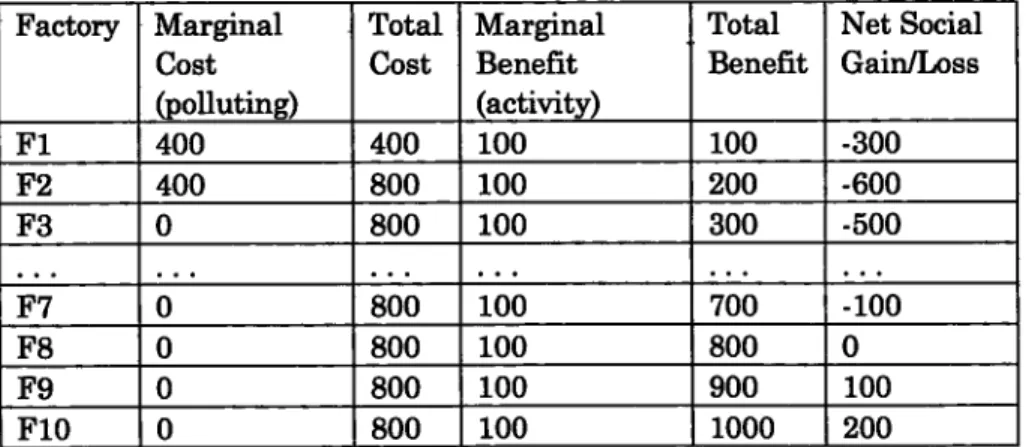
To illustrate, suppose that as before a factory, call it Fl, is located next to an $800 lake and that over a certain period of time the factory expects to gain $300, but that in doing so it will completely destroy the lake. Assume further that no known methods can mitigate or avoid the harm; only stopping the activ-ity will. F1 will thus be liable (perhaps under a theory of negli-gence64 but more likely under a nuisance regime65) because the
61 See, for example, A. Mitchell Polinsky, An Introduction to Law and Economics
17-27 (Wolters Kluwer 4th ed 2011) (providing an excellent overview on the tort of
nui-sance); Landes and Posner, The Economic Structure of Tort Law at 43, 48-51 (cited in note 10).
62 See, for example, Posner, Economic Analysis of Law at 78 (cited in note 12); Po-rat, 108 Mich L Rev at 192-93, 201-03 (cited in note 42).
63 On the difference between the prior literature on nuisance and the explanation offered in this Article, see text accompanying notes 10-11; notes 71-72 and accompany-ing text.
64 Taking precaution usually means that one must drive slower or purchase a safe-ty device such as a filter without changing the activisafe-ty levels: the number of miles driven or the number of units produced. But an actor may be found negligent for not altering her activity levels, for example, when the benefits from the activity are very slight com-pared to the loss generated by the activity. See Posner, Economic Analysis of Law at 226 (cited in note 12); Restatement (Second) of Torts § 297, comment a:
A reasonable man would recognize that there is an inescapable risk in driving
down a narrow and illkept mountain road, winding along precipices unguarded
by walls or railings, particularly if rain, snow, or ice has rendered the road
slippery. The mere use of such a route under the circumstances described may be negligent unless the utility of the route is very great.
65 See McFarlane v City of Niagara Falls, 160 NE 391, 391-92 (NY 1928) (Cardozo)
(holding that "[o]ne who emits noxious fumes or gases day by day in the running of his factory may be liable to his neighbor though he has taken all available precautions... . He is not to do such things at all, whether he is negligent or careful"); Bell v
Gray-Robinson Construction Co, 62 NW2d 390, 392-93 (Wis 1954) ("A nuisance does not
rest on the degree of care used ... but on the degree of danger existing even with the best of care."); Pennoyer v Allen, 14 NW 609, 613 (Wis 1883) (holding that in nuisance cases "it is no defense to show that such business was conducted in a reasonable and proper manner," but rather, "[it is the interruption of such enjoyment and the destruc-tion of such comfort that furnishes the ground of acdestruc-tion"); Jost v Dairyland Power