Information Needs in Software
Ecosystems Development
A Contribution to Improve Tool Support Across Software Systems.
Master Thesis
Philosophisch-naturwissenschaftlichen Fakult¨at der Universit¨at Bern
submited by
Nicole Haenni
2014
Leiter der Arbeit: Prof. Dr. Oscar Nierstrasz
Dr. Mircea Lungu
Abstract
Today’s open-source software repositories support a world-wide networked collabo-ration and inter-dependence among independent developers. Due to the co-existance and co-evolution of projects that depend and rely on each other, these software ecosystems have led to an increased importance in large-scale software engineering.
At present little is known about the interworking of developers and the needs they have to acquire for projects they are not familiar with. To explore this, we conducted an investigation into the nature of the information needs of software developers working on projects that are part of larger ecosystems. In an open-question survey we asked framework and library developers about their information needs with respect to both theirupstream(i.e.,providing code to a code base) anddownstream (i.e.,using code) projects. Our research focuses on the type of information needed, why is it necessary, and how developers obtain this information.
Our findings show a high discrepancy between developers depending on whether they are working in an upstream or downstream context. The downstream needs are grouped into three categories roughly corresponding to the different stages in their relation with an upstream: selection, adoption, and co-evolution. The less numerous upstream needs are grouped into two categories: project statistics and code usage. Based on a concluding closed-question survey we strengthen our findings in respect to their relevance. Current practices are that developers use non-specific tools and ad hoc methods for information gathering. The contribution of our work is an empirical investigation with an analytical comparison of the practices and state-of-the art in program comprehension research. Our research provides a starting point to understand information needs in distributed software development. Our findings reveal that current tools lag far behind the needs of developers. A key contribution of this thesis is the identification of requirements for an ecosystem-aware tool support.
Contents
1 Introduction 7 1.1 Motivation . . . 8 1.2 Research Questions . . . 9 1.3 Thesis Objective . . . 9 1.4 Thesis Outline . . . 9 2 Research Context 11 2.1 Software Development . . . 112.1.1 Version Control Systems . . . 12
2.1.2 Centralized Development . . . 13
2.1.3 Distributed Development . . . 13
2.2 Software Evolution for Distributed Development . . . 14
2.3 Software Dependencies . . . 15
2.4 Software Ecosystems . . . 17
2.4.1 Definition . . . 19
2.4.2 Mining Software Ecosystems . . . 19
2.4.3 Example . . . 19
2.4.4 Characteristics . . . 20
2.5 Problem Definition . . . 21
3 Related Work 22 3.1 Information Needs of a Software Project . . . 22
3.2 Mining Software Ecosystems . . . 24
3.2.1 Codebook - a social company-based ecosystem . . . 24
3.2.2 Seichter - social community-based ecosystem . . . 24
3.2.3 GitHub - a social coding platform ecosystem . . . 25
3.2.4 Software ecosystem visualization analysis (SPO, Softwarenaut) . . . . 25
3.2.5 Mining Library Usage - choosing the right upstream version . . . 25
3.2.6 Case studies on API evolution or deprecation . . . 26
3.2.7 Cells - code clone detections across projects . . . 26
4 Research Method 27 4.1 Research Study Design . . . 27
4.2 Qualitative Survey . . . 30
4.2.1 Data Collection . . . 30 2
CONTENTS 3 4.2.2 Data Analysis . . . 30 4.3 Quantitative Questionnaire . . . 32 4.3.1 Data collection . . . 32 4.3.2 Data Analysis . . . 32 5 Qualitative Results 33 5.1 Participants . . . 33 5.2 Upstream Needs . . . 35 5.2.1 Code Usage . . . 35 5.2.2 Project Statistics . . . 35 5.3 Upstream Motivation . . . 36 5.4 Upstream Practices . . . 36 5.5 Downstream Needs . . . 37 5.5.1 Selection . . . 37 5.5.2 Adoption . . . 38 5.5.3 Co-Evolution . . . 38 5.6 Downstream Motivation . . . 38 5.7 Downstream Practices . . . 39
5.8 Summary of the Findings . . . 40
6 Quantitative Results and Validation 42 6.1 Background of the Respondents . . . 43
6.2 RQ1: Validation of Upstream Needs . . . 45
6.2.1 Code Usage . . . 45
6.2.2 Project statistics . . . 46
6.3 RQ1: Validation of Downstream Needs . . . 47
6.3.1 Selection . . . 47
6.3.2 Adoption . . . 49
6.3.3 Co-Evolution . . . 50
6.4 RQ2: Upstream and Downstream Motivation . . . 51
6.4.1 Upstream motivation . . . 51
6.4.2 Downstream motivation . . . 52
6.5 RQ3: Current practices . . . 54
6.5.1 Inadequate tool support . . . 54
7 Discussion 56 8 Conclusions and Future Work 59 8.1 Contributions . . . 59
8.2 Limitations . . . 60
8.3 Conclusions . . . 60
CONTENTS 4
A Open Coding 63
A.1 Upstream answers from Question 2.1 to 2.3 . . . 64 A.2 Downstream answers from Question 3.1 to 3.3 . . . 68
B Likert items survey 71
C Results of Likert survey 77
C.1 Raw data . . . 77 C.2 Additional questions and answers . . . 81
List of Figures
2.1 Centralized (left) vs. Distributed Version Control Systems . . . 13
2.2 Growth of GitHub repositories in millions (M) . . . 14
2.3 An extract of the Ruby Gem Ecosystem. Illustration is published by Kabbedijk [1]. 17 2.4 An example software ecosystem with inter-dependencies across projects. . . 20
2.5 Illustration of conflicts in projects after deprecation of an upstream functionality. 20 3.1 Microsoft’s Codebook as a company-based software ecosystem. Taken from [2]. 24 3.2 Ecco, a meta-model for inter-dependent projects of an ecosystem [3]. . . 26
4.1 A mixed method exploratory design according to Creswell [4, Chapter 3] . . . 28
4.2 Our research study plan based on an exploratory study . . . 29
4.3 The open-ended survey questions sent to selected developers . . . 31
5.1 Categorized results from open coding process . . . 40
6.1 Background information of the participants from the validation survey . . . 43
6.2 Distribution of repositories and programming languages the participants use . . 44
6.3 Working domain of the participants . . . 44
6.4 Code usage . . . 45 6.5 Projects statistics . . . 46 6.6 Selection . . . 48 6.7 Adoption . . . 49 6.8 Co-Evolution. . . 50 6.9 Upstream motivation . . . 51 6.10 Downstream motivation . . . 52 6.11 Upstream practices . . . 54 6.12 Downstream practices . . . 54
C.1 Plotted Likert items of upstream answers . . . 79
C.2 Plotted Likert items of downstream answers . . . 80
List of Tables
2.1 Definitions of Software Ecosystems . . . 18
4.1 An example of open coding process . . . 31
4.2 An example of a 5-point Likert item . . . 32
5.1 Background information about participants from the open-question survey . . . 34
A.1 2.1 What do you most want to know about the use of your library or framework in your ecosystem? . . . 64
A.2 2.2 Why would that be interesting to know? . . . 65
A.3 2.3 What do you currently do to obtain that information, if anything? . . . 66
A.4 3.1 What do need to know about the libraries or frameworks that you are using? 68 A.5 3.2 Why is that good to know? . . . 69
A.6 3.3 What do you currently do to obtain that information, if anything? . . . 70
C.1 Upstream results from Likert items survey . . . 78
C.2 Downstream results from Likert items survey . . . 78
1
Introduction
“People think that computer science is the art of geniuses but the actual reality is the opposite, just many people doing things that build on each other, like a wall of mini stones.” — Donald Knut In the last decade, technological progress has improved computer power, network bandwidth and storage costs. Therefore software deployment of standalone software projects has turned into collections of software systems organized in source code repositories across the web. The co-existence and co-evolution of a collection of software projects in an environment, we call a software ecosystem[5]. These projects share software components and functionalities that are often implemented by different developers. These software dependencies cross the boundaries of projects and inter-connect similar and complementary software systems.
Consequently, modern software development does not start from scratch. Developers extend, modify or reuse software components of existing software systems for a new project. They interact with fellow developers inside and outside of their own projects bringing in new ideas, concepts and code. We use the term upstream developer to indicate the core developer or a contributor who provides a library or framework to others. One of the developers who integrates such a software dependency is adownstream developer.
This trend of distributed and large-scale software engineering invokes new challenges in terms of software complexity, growth of available data, software maintenance; collaboration, communication and coordination between developers.
CHAPTER 1. INTRODUCTION 8
1.1
Motivation
This thesis focuses on the developers working together in a software ecosystem. Software systems in an ecosystem are linked together due to dependencies they have because of the shared usage of a given API or some other dependencies.
A common relationship between software systems is areuse based dependency: an upstream library or framework provides the source code to a downstream software application. In turn, the downstream projects have upstream dependencies. This relationship comes with challenges (e.g., keeping up with the evolution of an upstream library) and information requirements (e.g.,how is the downstream using a library’s API). These connections may build a mashup of dependencies. They lead to cross-references within and across software systems.
The integration of a library into a project brings other indirect dependencies. Because of this interconnection, the evolution of a software system induces theco-evolutionof corresponding projects. Maintenance becomes an exhausting task and difficult to accomplish without inducing unexpected shortcomings.
To keep software systems up-to-date a downstream project may fetch upstream updates by an existing package manager. However, when updating to a new library version, software projects do not behave as expected [6, 7]. Developers face problems such as: not knowing what has changed, what affects the source code or which of the hosted projects have impacts. When a software will not run or compile, there are minor and tricky solutions: debugging or manually checking the actual source code implications. This issue concerns in the first place the developers working in a downstream context.
Developers join a project, contribute to it and leave it for another project. While such human replacements are often not planned and are unavoidable, a software project remains in its original environment. A new developer has to acquire relevant knowledge of the developing system within a short period [8]. He only retrieves as much information as the software system is able to provide. It is often the case that even local collocated team members do not know how to retrieve specific information.
Today’s integrated development environments (IDE) usually provide only limited in-built features to support general programming tasks. They lack overall and overlapping functionalities that help developers understand an entire ecosystem. During each evolution of a software project, typically the developer team neglects to rework and update documentation. To obtain information, there are internal resources such as debugger mode, performing queries as text searches and reading code comments. To gain knowledge developers need to help themselves with additional external tools, such as wikis or mailing lists. Since Web 2.0 the appearance of social media have become a regular information source such as StackOverflow and Twitter [9].
Putting together all relevant information is a challenging task and a repetitive activity. There-fore understanding a project represents a struggle for a developer [10]. The need for new tool support has been identified in previous research [11].
Due to the increasing distributed software development, gathering project-related information has become even more challenging. At present, distributed development fosters complex and large software systems that invoke a tremendous rise in the amount of data. Hence, the human capability has almost reached its limits in tracking the associations between related projects. By
CHAPTER 1. INTRODUCTION 9 identifying these limits, our study establishes its research area. We examine what information needs developers ask for in this new development domain. This thesis contributes initial insights for future tool support for developers working in software ecosystems.
1.2
Research Questions
We investigate the information needs of developers that interact in a large-scale open-source software development and in the context of a software ecosystem. We identify two distinct roles a software developer assumes when working in this context. As anupstreamdeveloper he provides a framework or a library that otherdownstreamdevelopers make use of. In this research study, we aim to understand the following main research question in the perspectives of the two antagonists.
RQ1 What are the information needs of a software developer working in a software ecosystem context?
To gather additional insights we want to know why these needs are important and how developers currently obtain the information needed. This leads to further research questions:
RQ2 Why are these information needs for the upstream and their downstream developers important?
RQ3 How do upstream and downstream developers currently obtain the information they need?
We probe each research question from the perspective of anupstreamanddownstreamdeveloper.
1.3
Thesis Objective
The goal of this thesis is to gain a better understanding of the type of information needed by developers in the context of a software ecosystem. To identify the information needs that arise across projects in software ecosystems, we survey both developers that work in a downstream and an upstream context.
To accomplish this objective, we intend to take the following actions. Firstly, we aim to collect new insights by interviewing developers that work as framework and library developers. To achieve this we analyzed the answers of an open-questioned survey. Secondly, we validate our findings with appropriate statements with a Likert item survey. From that we can refine key findings and relevant concepts of our results.
1.4
Thesis Outline
This thesis is structured in the following manner.
Chapter 2 (Research Context) provides a review of software engineering state-of-the-art. We show how traditional centralized development changed to modern decentralized develop-ment, followed by a closer scrutiny of software ecosystems.
CHAPTER 1. INTRODUCTION 10
Chapter 3 (Related Work) discusses related studies of information needs in software develop-ment and compares recent research work concerning software ecosystems.
Chapter 4 (Research Method) describes our study design. Our research methodology consists of two phases. First, we apply a Grounded Theory methodology with a preselected group of participants. That way, we analyze answers from an open-questionnaire by classifying similar emerging topics. Second, we evaluate our findings with a closed-questions survey to determine an overall relevance of the previous results.
Chapter 5 (Qualitative Results) presents the initial results from the first iteration. This qualita-tive process is called open-coding.
Chapter 6 (Quantitative Results and Validation) validates our results by validating them in a follow-up closed-question survey. Then, we analyze their relevance in relation to a developer’s needs.
Chapter 7 (Discussion) discusses and interprets our results. We outline the relevance of our study with other current research studies introduced in the related work.
Chapter 8 (Conclusions and Future Work) summarizes the major contributions of this work and outlines the limitations of the study. Then we conclude our research results and propose future directions for further study.
2
Research Context
“In the same way you can never go backward to a slower computer, you can never go backward to a lessened state of connectedness.” — Douglas Coupland In this chapter we set out the context of our research. Initially, we give a brief overview of how the environment of software development has changed over recent years. We describe different development practices and properties. After giving a definition of a software ecosystem, we state the scope of our research interest.
Nowadays the end user of a software application is no longer a person working in isolation on a computer. We use software applications that provide services such as web, mobile and desktop applications interconnected across different platforms. They are able to keep our accounts and data synchronized and up-to-date. Similar to the way a user’s digital life experiences have moved from standalone to web-based applications, the developers have started to shift their coding activities to the Internet as well.
2.1
Software Development
Before we can define our research problem, we need to understand the evolution in software development and practices.
In the past usuallyoneteam ofacompany worked ononeproject hosted inacentral repository. A software repository is the environment where a project is developed and organized. Developers access it on a local storage, an internal network share or on Internet servers through a web interface. It is the place for storing and managing digital items, such as software projects and packages, documentsetc.[12]. In general it manages the versions of the items, dependencies and related meta-data information to describe its semantics.
CHAPTER 2. RESEARCH CONTEXT 12 Since the introduction of distributed version control systems, modern software development has changed in terms of collaboration, coding habits, hosting and deploying projects.
Presently, cloud-based infrastructures have started to ease modern software development by providing platforms as a service (PaaS) to hand over the setup and the maintenance of a software projects to providers such as Heroku1or Parse2.
As a consequence communication over the Internet has increased and it generates every second unprecedented amounts of data (in the Exabyte range for one day). In this context researchers use the modern notion ofbig data [13]. In fact, the interconnectedness is at the beginning of its technical capabilities.
2.1.1 Version Control Systems
Source code management (SCM) is accomplished by a version control system (VCS). Today we distinguish two concepts we briefly explain.
Centralized VCS (CVCS) CVS and Subversion3 (SVN) are the pioneers of version control system tools. The CVCS concept uses the file comparison techniques by storing the delta diffs for each file change. SourceForge4 was the first hosting platform repository for developers to store and provide their projects to others.
The downsides are:
• centralized server repository
• slow response time with large projects
Distributed VCS (DVCS) is the concept that predominates in modern software development. The major tool is Git5. Other versioning tools are: Mercurial6, Bazaar7and BitKeeper8. The DVCS concept stores a snapshot of the entire repository. Therefore each checkout contains a full backup of the code.
The benefits are: • fast performance
• parallel development of large-scale projects • decentralized development
Another DVCS is Monticello9from Pharo that distinguishes objects as classes and methods and is an “out of the box” feature [14].
1https://www.heroku.com 2https://parse.com 3 http://subversion.apache.org 4http://sourceforge.net 5http://github.com 6http://mercurial.selenic.com 7 http://bazaar.canonical.com/en 8http://www.bitkeeper.com 9http://pharo.gemtalksystems.com/book/PharoTools/Monticello
CHAPTER 2. RESEARCH CONTEXT 13 In the following two subsections we describe how developers work together and where the downsides and benefits between CVCS and DVCS are.
2.1.2 Centralized Development
By centralized development we mean that the entire development process is performed usually at one location by one team of a company. As a team, developers organize a software project and its source code within a common integrated development environment application,e.g.,Eclipse IDE and a company-based project repository. In classic development a VCS such as Subversion is the most commonly used tool for software versioning and revision control.
Each developer works locally with a checkout of the source code that is hosted on a main server instance. After writing some code, he commits the changes back to the server repository. For each interaction such asdiffsthe developer has to query the central server first. The server instance controls all access requests, coordinationetc.; it is comparable with the concept of a client-server model (see left illustration in Figure 2.1). Merging source code acquires a lot of resources and it can be very time consuming. Thus, centralized version control is only really acceptable in the context of company-internal software project due to the limitations of performance and size of a code base. In this case most developers code during working hours at the office within its local network. In contrast, however, in the context of open source development a centralized model of source control does not satisfy the needs of global collaboration.
Client Client REMOTE REPO Client CENTRAL REPO Client Client Client update / commit pull / push commit
Figure 2.1: Centralized (left) vs. Distributed Version Control Systems 2.1.3 Distributed Development
In 2005, Linus Torvalds introduced Git, an open-source DVCS. In this approach, there is no central server instance. Instead, it is based on a peer-to-peer concept and communication flows in all directions. Git provides the existence of multiple instances of a software repository (see Figure 2.1). Basically the idea is that each clone (of a git server repository) comes with a local copy of the repository and its entire history. Performance is in general faster than in any CVCS because the operations are executed in the local environment before fetching or pushing the changes over the network. Therefore DVCS has paved the way fordistributeddevelopment. Git has facilitated the open source development which is spread across projects, platforms and teams. The infrastructure implements a directed acyclic graph (DAG).
CHAPTER 2. RESEARCH CONTEXT 14 Nowadays, Git predominates indistributedsoftware development since it is fast and applicable for large and scalable projects. The social hosting website GitHub10 is a well known source code hosting platform that provides Git’s functionalities and adds additional features (e.g.,pull requests, forks). A member can publish the code of a project, another developer can clone this code base into his workspace. We call such a copy of a code base afork. Then, the contributor is free to use or adapt existing parts of the code base. The action of asking the original developer to accept code changes is called apull request. GitHub is a social source code hosting service where projects are collected and evolve over time by different developers.
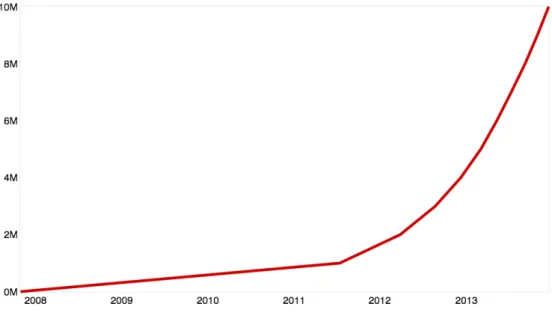
By the end of 2013 GitHub has reached 10 millions repositories11. Figure 2.2 illustrates the
exponential increase since its first launch in April 2008.
Figure 2.2: Growth of GitHub repositories in millions (M).12
2.2
Software Evolution for Distributed Development
The process of software development over time is analogous to the evolutionary process in nature. The termsoftware evolutionis used in this context to describe a system that changes iteratively to keep up its requirements. In this work we consider the notionco-evolutionof inter-dependent projects thus we provide Lehman’s laws of software evolution [15].
1. A software system has to change over time in order to keep up its purpose. If no changes are done, it will become obsolete.
10
http://git-scm.com
11https://github.com/blog/1724-10-million-repositories
12Source: https://f.cloud.github.com/assets/4483/1803667/
CHAPTER 2. RESEARCH CONTEXT 15 2. The result when a software system evolves is that complexity and data volume increase;
and at the same time its quality decreases.
Over time all software changes iteratively to keep up with changing requirements. From that it follows that complexity and volume rises and at the same time quality decreases ([16]).
2.3
Software Dependencies
We must first understand the essential properties that characterizes the usage of a given software project before we introduce the concept of software ecosystems in the next section.
Dependency Management is needed when a dependency between two software systems exists. To ensure the quality of software systems managing such dependencies is essential. It is used to keep track of a new version; or it ensures before installing a software program that all dependent libraries wrapped in a package get installed to meet the requirements. Because these dependencies are system or language dependent developers are forced to handle these relationships separately. In the following we list some possible additions.
• In a Java project dependencies can be defined by some meta-data information in a specific Maven13file.
• Software versions for R code use CRAN, a network of several web and FTP servers to keep versions and documentations up to date [17].
• Modern server-side web applications use the JavaScript library Node.js14which comes with the package managernpm15to manage the versions of dependent modules [17]. In contrast tonpm, Bower16is a dependency package manager for front-end libraries, such as jQuery17or AngularJS18, that ensures the use of a single version.
• The Ruby version managerrvm19 is a command-line tool that manages and allows the selection of a different Ruby version in the same environment. It is advantageous when developers maintain or work on several projects with the requirement of a specified Ruby version.
Software Reuse has become a common solution to problems that reoccur in many projects, by reusing components provided by frameworks or libraries. The development progress improves because the developers save time and effort instead of re-implementing reoccurring components, e.g.,secure login mechanism.
13 http://maven.apache.org 14http://nodejs.org 15https://www.npmjs.org 16 http://bower.io 17 http://jquery.com/ 18https://angularjs.org/ 19https://rvm.io
CHAPTER 2. RESEARCH CONTEXT 16 Benefits can be derived from the fact that many developers in the open-source community have been reusing a software module for some time. As a result the software has been used and tested, thus achieving high quality. Defects in software are often more easily detected and published by the open-source community.
However, dependencies have their downsides. Dependencies within a code base or across projects are even larger in distributed development . The more code a project reuses, the more complexity is added to it. Thus, the main problem is that developers are not able to understand all the dependencies their software relies on.
CHAPTER 2. RESEARCH CONTEXT 17
2.4
Software Ecosystems
In 2003, Messerschmitt [18] introduced the termsoftware ecosystem, and he describes it as“a collection of software products having some degree of symbiotic relationships.” It is a derivation from our biological ecosystem, since there are living organisms that interact with each other and depend on each other in a shared environment. Messerschmitt’s recognizes similar relationships between software products in current marketing strategies.
The concept is a general term, therefore multiple authors look at different aspects of software ecosystems, and they have adapted it for their own purposes [5, 18–20]. In recent years, the term software ecosystem appears more and more frequently in current software research work [19, 21]. The definitions in Table 2.1 provide an overview of different perspectives and definitions. They indicate a top-down analysis: it begins with a business perspective, continues with a technology and contributor view and concludes with the perspective of a software project.
Most researches of software ecosystem relate to market-oriented interests [19],e.g.,how to keep a software product competitive in today’s market, how to keep up the number of usersetc. Software companies, such as Google, Apple, or Facebook, have recognized the importance of extending their platform by allowing external developers to contribute to the enlargement of their array of products. These third-party developers benefit from the established qualities of their technologies just as much the companies profit from the rise of their user base and popularity. Indeed, there is no longer a big company with internal services, but instead a community with contributors have gathered around their technologies to keep up their influence [22].
(a) Collaboration between Ruby developers (b) Ruby gems with inter-dependencies
Figure 2.3: An extract of the Ruby Gem Ecosystem. Illustration is published by Kabbedijk [1]. Kabbedijket al.examined the interacting of developers and inter-dependent Ruby packages[1] as shown in Figure 2.3. Another perspective is the one that considers a software project that uses components from other projects. When one software component changes, all the other are forced to adapt to these changes. Such a collection of software systems is the definition that Lungu provides in his research [5]. In the next section we provide more details.
CHAPTER 2. RESEARCH CONTEXT 18
Table 2.1: Definitions of Software Ecosystems
Different Contexts A Software Ecosystem is . . . Examples
Technology- and Market-based
“a set of businesses functioning as a unit and interacting with a shared market for software and services, together with the relationships among them. These relationships are fre-quently underpinned by a common technolog-ical platform or market and operate through the exchange of information, resources and artifacts” [23]by Slinger et al.
Google/Android, Apple/iOS apps, Eclipse
Social and Business Communities
“a set of software solutions that enable, sup-port and automate the activities and transac-tions by the actors in the associated social or business ecosystem and the organizations that provide these solutions” [20]by Bosch et al.
Facebook API, Dropbox API
Third-party,
Internal and Ex-ternal Developers
“a software platform, a set of internal and ex-ternal developers and a community of domain experts in service to a community of users that compose relevant solution elements to satisfy their needs” [22]by Bosch et al.
EchoNest API, Spo-tify API
Inter-dependent projects
“a collection of software projects that are de-veloped and evolve together in the same envi-ronment” [5]by Lungu et al.
SqueakSource, Apache, Gnome, Ruby Gem repos-itory, Java Maven repositoryetc.
CHAPTER 2. RESEARCH CONTEXT 19 2.4.1 Definition
Today’s software projects are distributed and inter-connected by networks. This work focus to the emerging dependencies across platforms, projects and teams. Lungu [5] define such asoftware ecosystemas
“a collection of software projects which are developed together and which co-evolve together in the same environment”.
An environment can be • a community • a company
• a technical platform
2.4.2 Mining Software Ecosystems
Mining source code repositories is a prevalent research field to investigate the evolution of a software project. To analyze a specific software ecosystem, we consider all involved software project repositories. Lunguet al.defines such a collection including all versions and histories [24] as asuper-repository. They distinguish two different kinds:
• language-based (e.g.,SqueakSource, RubyForge)
• language-agnostic (e.g.,GitHub, company’s intern source code repositories, SourceForge) These super-repositories serve as data pool for case studies [24–26].
2.4.3 Example
Compared to the other definitions in Table 2.1, Lungu looks at individual components as each project consists of several packages and versions [5]. Each software project consists of a couple of packages. Each package holds a history with a number of changed versions.
The illustration in Figure 2.4 describes a mock-up software ecosystem with a minimal representation of possible relationships across projects. Project B provides a software functionality BA; and requiresCA, CB. We infer that Project B uses an upstream library C. Project A depends on B and is a third-party project development. No official notation is defined to describe such a dependency. A possible notation can be specified asB: prov(−,BA); req(CA,CB)etc. A new version can enroll a chain of changes (cross-references) distributed over multiple projects and packages (see Figure 2.5).
CHAPTER 2. RESEARCH CONTEXT 20
Figure 2.4: An example software ecosystem with inter-dependencies across projects.
Figure 2.5: Illustration of conflicts in projects after deprecation of an upstream functionality.
2.4.4 Characteristics
Our definition of software ecosystem focuses on the co-evolution and source-code level inter-dependencies between projects versioned in super-repositories.
Reused-based dependency
The focus lies on software projects that depend on other systems. This relationship is a dependency that is based on reuse. Theupstreamprovides a certain service such as an API method to adownstreamproject.
As a result, sharing common resources enlarges the developer and user community, de-creases development costs but inde-creases dependencies.
Co-evolution
Co-evolution extends the term software evolution from Section 2.2 by including the fact that a software entity of a project evolves implies code adoption in another software project. Changes in a software project leads to changes in the inter-connected software dependencies.
CHAPTER 2. RESEARCH CONTEXT 21 By storing the history of all versions, the co-evolution of a software ecosystem can be analyzed.
When a certain entity evolves, all other entities that are linked together co-evolve. When developers change and reuse parts of a software system relationships and dependencies become more complex and numerous. An entire environment may be impacted.
Consequently, inter-dependencies of projects induce complexity ad complicate maintenance tasks.
2.5
Problem Definition
We observe software systems that grow in size and complexity. The more complexity arises, the less understandable it is for maintainers, contributors and newcomers. Hence, software quality is still demanded by end users. Therefore reliable reusable systems such as frameworks and libraries are often integrated because they provide entire functionalities that are needed over and over again. This dependency again makes the software harder to maintain. These libraries and frameworks hide their implementation details through abstraction. However, hiding complexity in the upstream induces more complexities in the downstream projects. Besides, some of the concealed information is as important to understand. Contemporary software development projects consist of:
• A set of software systems with a group of other systems. They co-evolve together in the same environment.
• A global distributed developer team. Their contribution is usually temporary.
New conditions demand new techniques. We investigate and identify the characteristics of a new way of software development. Very little tool support is available to meet the needs of software developers working in the context of a software ecosystem. Most tools provide only low-level information, as Sillitoet al. reported in their previous research [27]. Because of the lack of appropriate information and documentation research for new tool support is not new [28, 29]. Nevertheless little research has been done towards information retrieval in software ecosystems. Consequently a whole new area of research is opening up. We define the following terms:
Upstream project is a software project producing frameworks or libraries. It provides function-alities by its API to other projects. Anupstream developeris the creator, maintainer or contributor of such a project.
Downstream project is a software project that uses a provided API. Therefore it depends on anupstreamproject. Adownstream developeris the user of an upstream project. Reused components build a tight dependency link between multiple software systems and versions. A software project may have an upstream and downstream role. This illustrates Project B in Figure 2.4. In this thesis, we differentiate between upstream and downsteam developers and ask what information needs they have during the development process. We do not include the needs of other project team members, such as project managers, software architects, testersetc.
3
Related Work
“Technology no longer consists just of hardware or software or even services, but of communities. Increasingly, community is a part of technology, a driver of technology, and an emergent effect of technology.”
— Howard Rheingold We place our research in the recent tradition of empirical studies of developer needs. Several research studies of information needs in traditional software development have been conducted. However, little attention has been paid to investigate the needs that occur when multiple, dis-tributed software projects are involved.
In the first section, we relate our research to other previous studies of finding the needs of developers. Then, we examine what research has been done so far in the context of software ecosystems and developers. Furthermore, we aim to highlight the specific needs in the context in which a project relates as being upstream or downstream to other projects.
3.1
Information Needs of a Software Project
Many studies have focused on identifying the information needs of software developers. Never-theless most research has been done in an isolated development environment. Researchers have investigated how developers work together within a company or team by contributing to a single software system.
Sillitoet al.[27] conducted a study in finding what information developers need when working on a change task. They observed 44 questions. They are specific to their single-system task and refer to implementation details such as method calls, data structures and type hierarchies. Based on these findings they categorized four types of information needs that arise when a software
CHAPTER 3. RELATED WORK 23 project evolves: (1) where is the starting point in a unfamiliar code, (2) adding code invokes the need of related properties of a given software entity such as a method, variablesetc. The other two types relate to multiple entities: (3) comprehension of a group of connected software entities, (4) comprehension of multiple groups of connected software entities. They introduce a representation to model a project’s source code as a graph; with software artifacts as nodes and references or relationships as edges.
They found that most tools (vim, emacs,etc.) are not able to acquire the desired information. They showed that this holds for today’s low-level tools. Available tools do not have deep insight of a program[27, Section 6]. Another observation is that developers use multiple tools to solve a single task. Their study did not reveal any information needs between multiple projects and versions.
Koet al.[30] conducted a field study in finding information needs in software teams. They collected data by taking notes when developers posed questions during their daily work. Their findings include 21 different types of information needs in seven categories with a wider per-spective than Sillito’s study [27]. Their major findings are the knowledge of software artifacts and their co-workers. Their study also revealed nothing about the interaction between different software projects.
Phillipset al.[31] identify information needs to integrate branched versions of a software project. They found four needs: (1) identifying conflicts before they arise, (2) monitoring features with their dependencies, (3) tracking measured data about number of bugs, and (4) test results and others.
In a recent work, Jansen reports on a qualitative study of developers, and how they make choices when it comes to select a technology stack they use. Such a platform has an architecture where software, components, programming languages fit the requirements of the developers,e.g., Microsoft CRM, Django web framework. The most important quality attributes identified are “documentation”, “learnability”, “backward compatibility”, “portability”, and “standardizations across platforms”. He reported that developers rank these properties over platform. They make choices that are not always technical, but they are also business related regarding the number of potential users [32].
Parnin and Rugaber [33] present a conceptual framework for understanding how a program-mer’s memory copes with interruptions during the development process. Their intent was to support work towards the design of development tools capable of compensating for human memory limitations. They also delineate programmer information needs such tools must satisfy and suggest several memory aids such tools could provide.
In Buse and Zimmermann’s research they have analyzed the information needs in software analysis [34]. Their approach is the understanding of information needs of software developers and managers. They focused their study on a business-oriented domain, whilst we examine the needs framework or library developers and their users have. They consider that features can span many parts of a project but did not show any findings across repositories. They have defined a key guideline for an analytic tool.
CHAPTER 3. RELATED WORK 24
3.2
Mining Software Ecosystems
The following section sets out what research has been done according to distributed development in the context of software ecosystems.
3.2.1 Codebook - a social company-based ecosystem
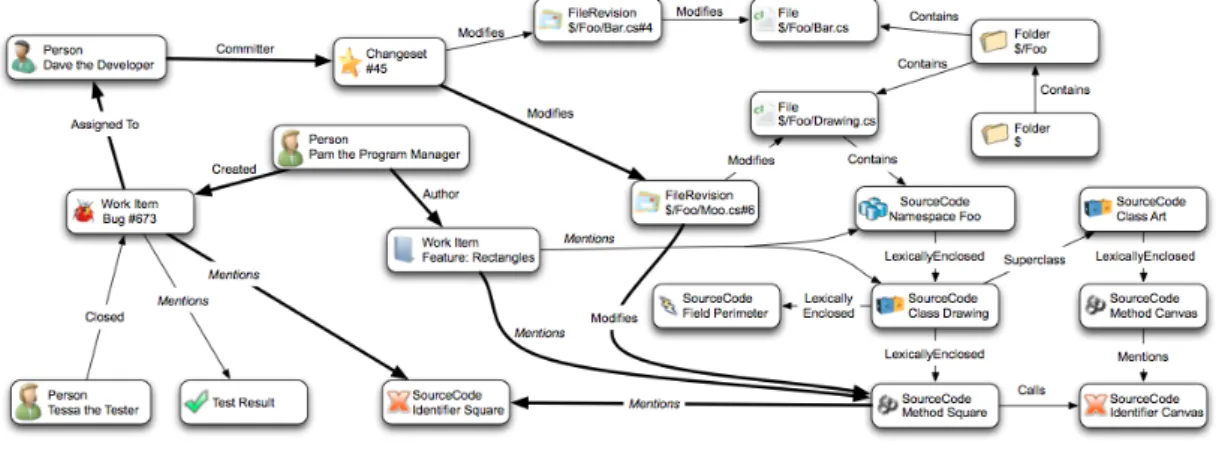
Related to our research Begelet al. have proposed Codebook as a social network that helps developers get information about other developers’ activities [2, 35]. They have discovered that most needs are about discovering, meeting, and keeping track of people, not just code [2]. Figure 3.1 illustrates their ecosystem with different entities,e.g.,Persons, Work Items, Changesets,
Figure 3.1: Microsoft’s Codebook as a company-based software ecosystem. Taken from [2]. FileRevision, File and Source Code. Relationships asmodifies,contains,assigned to,mentions etc.connect them together. According to Begelet al. [2], Codebook provides information about:
• Finding a co-worker who is the original or responsible developer of a certain feature. • Collecting all dependent entities that have a certain relationship with a feature. • Notifying co-workers when a code change affects their features.
• Informing co-workers of intending code changes if other features are involved.
However, Codebook only contains data from the inside of their own company. While Begelet al. have proposed ways to propagate information of projects, people and code; they have not identified the information that developers need.
3.2.2 Seichter - social community-based ecosystem
To improve collaborations between developers Seichteret al.[36] proposed an information re-trieval tool for software ecosystem infrastructures. Inspired by social networks such as Facebook,
CHAPTER 3. RELATED WORK 25 their approach proposes to interconnect software artifacts with corresponding information items. Their main approach is to ensure that information items relate to a software item.
Their concept is that code snippets and other digital items are not attached to developers or any other team members. The idea is that they subscribe to a software item and are its followers like in social networks. Benefits are that the knowledge base of the whole project stays in the network, even if members leave.
3.2.3 GitHub - a social coding platform ecosystem
Coding sites such as GitHub are both: a social network and an online hosting repository. It is a software ecosystem because different projects co-evolve together in this platform. Contrary to Microsoft’s Codebook [2] the environment embeds open-source projects among different teams and companies.
A similar research is the investigation of Dabbish [37], who focuses on the social behavior of active users in the GitHub community. Dabbish reported that developers use social activities as an information resource. They judge a project depending on the social status of the original developer or by the numbers of followers [37]. In our research we focus on the information developers need when working in an ecosystem context.
3.2.4 Software ecosystem visualization analysis (SPO, Softwarenaut)
Lunguet al.[3] introduced a meta-model of a software ecosystem namedEcco. Figure 3.2 illustrates a collection of projects that tracks all relationships itdepends on,usesorprovides functionalities [3] with other software components. Besides it differentiates between changed versions of the project.
The application frameworkSmall Project Observatory (SPO)was the first major work on the analysis of a software ecosystem [25]. It visualizes inter-dependencies of projects and the degree that developers collaborate with each other. As a basis he uses a collection of meta-data of different version control repositories to analyze the relationships within an ecosystem [25]. “A super-repository represents a collection of version control repositories of the projects of an
ecosystem [5]”.
Due to legacy code and lack of documentation developers must rely on reengineering tools to break down a complex software system. Such a tool is Softwarenaut[5]. It recovers the architecture of a system in the context of its software ecosystem.
3.2.5 Mining Library Usage - choosing the right upstream version
Milevaet al. investigate what information supports a downstream developer by deciding what version of a chosen upstream is helpful [38]. For this purpose they developed a tool that examines three different facts: the general usage of the last few versions over a period of recent years, current usage of a specific version and the numbers of downgrades to a prior version. Their result shows that the number of times a certain version is used can be an indicator for its quality.
As an example they studied the Apache ecosystem and its libraries including their different versions. It included a total of 250 projects in the year 2009. All relationships, dependencies
CHAPTER 3. RELATED WORK 26
Figure 3.2: Ecco, a meta-model for inter-dependent projects of an ecosystem [3].
and version numbers are defined in the Maven project object model (POM) file [38]. However, detailed information about API changes are not obtainable because only information about the versions of the libraries are captured.
3.2.6 Case studies on API evolution or deprecation
Another area of research which is related to this work is the empirical study of software archives with the goal of empirically observing phenomena that hold true for software development in general. Such is the work of Robbeset al. in which they empirically study the extend of API deprecation in the Smalltalk ecosystem consisting of hundreds of inter-related projects developed by a community of thousands of Smalltalk developers over a decade [6].
McDonnellet al. conducted a case study on API evolution of the Android Ecosystem[39]. They report that upgrading to a new Android API version takes over a year.
3.2.7 Cells - code clone detections across projects
A software ecosystem may contain large amounts of code duplicated from other projects. Large amounts could be excluded if the duplicated parts are identified. Schwarz’s approach [40] is the first technique to detect cloned implementations across projects in a software ecosystem.
4
Research Method
“It is no longer hard to find the answer to a given question; the hard part is finding the right question and as questions evolve, we gain better insight into our ecosystem and our business.”
— Kevin Weil (Twitter) We have shown in the related work section that although the literature is rich in studies of user needs there is a lack of knowledge about the particular needs in the context of distributed development in open source software ecosystems. The most usual method to enter an unexplored area is to conduct an open-question survey. This method benefits from unpredetermined opinions. We take this approach and we test our findings with an additional closed-question study. In this chapter we outline our research approach and describe our research method.
4.1
Research Study Design
There are three different strategies to investigate a research problem. We briefly outline their properties and differences.
Quantitative methods are applied to test a theory or hypothesis. The process of such a study has its rules and provides a controlled environment. To collect data, surveys with given answers are provided,e.g., yes/no-questions, a group of given answers. Results are based on the occurrences of selected items. Statistical analysis can reveal interesting information about the evaluated data.
Qualitative methods are used to discover new insights. Researchers often conduct interviews with appropriate participants. Qualitative data are collected from individuals in a interactive
CHAPTER 4. RESEARCH METHOD 28 way. The interaction between researchers and participants improves the quality of the responses. The interviewer can pose questions in case of unclarity, and move the conversation in a certain direction. Researchers make use of qualitative methods when research questions surround a broader scope of research area, an unknown subject. Questions such aswhy, what, howcall for a study with qualitative methods.
Mixed methods are a combination of quantitative and qualitative methods. Different variations are described [4]. Triangulationis the process for answering the same research questions by conducting two independent investigations, a qualitative and a quantitative one. To validate the findings the results of both methods must correspond.
Qualitative,
initial findings generalizes
Quantitative
results Interpretation
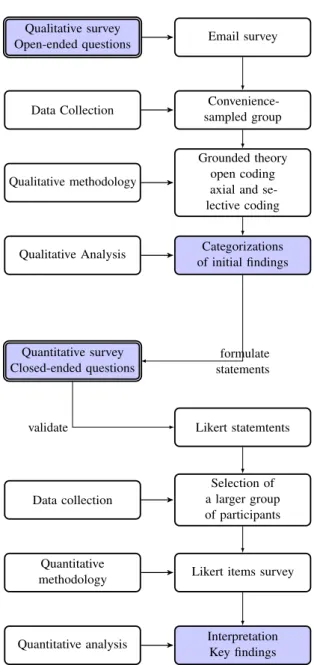
Figure 4.1: A mixed method exploratory design according to Creswell [4, Chapter 3] This research study makes use of a mixed research methods strategy. We applied asequential exploratory design[4, Chapter 3]. A rough overview is illustrated in Figure 4.1. This approach consists of two different research methodologies: a qualitative investigation followed by a quantitative validation survey. For the first part we analyzed and categorized answers of a targeted group of developers. We aimed at the quality of the responses to establish a groundwork for the second investigation. The quantitative part builds on the preceding qualitative results. Based on the reported data we formulated corresponding statements or directly cited a participant’s answer.
For the second procedure we set up a quantitative questionnaire which was provided to a set of indiviudal developers. From these developers we arbitrarily received a large number of answers.
To test and validate the propositions we asked the respondents to rate them according to their agreement level. Then, we evaluated the frequency of agreement and disagreement of each statement. Finally, the findings show the level of relevance or importance of each proposition from the qualitative questionnaire. The results help corroborate and gain a deeper understanding in our research area. The illustration in Figure 4.2 shows the structure of our research design. Both phases are explained in the next sections.
CHAPTER 4. RESEARCH METHOD 29
Qualitative survey
Open-ended questions Email survey
Data Collection
Convenience-sampled group
Qualitative methodology
Grounded theory open coding axial and se-lective coding
Qualitative Analysis Categorizations of initial findings Quantitative survey Closed-ended questions Likert statemtents Data collection Selection of a larger group of participants Quantitative
methodology Likert items survey
Quantitative analysis Interpretation Key findings validate
formulate statements
CHAPTER 4. RESEARCH METHOD 30
4.2
Qualitative Survey
In the first iteration, we did an open-questioned email survey. Compared to in-person interviews, email surveys are not as prone to influencing the participant[41].
We follow the Grounded Theory methodology introduced by Strauss and Corbin[42]. Contrary to beginning with a hypothesis, it induces concepts and a theory that evolve from collected data, and continuously improves in an iterative process.
4.2.1 Data Collection
Sampling participants To identify the needs of developers working in open source ecosystems, we interviewed a selected group via email and in person. We factor practical and theoretical pro-found background knowledge in years in both academic and industry software development. We asked the convenience sampled[43] participants what information needs they have corresponding to their upstream and downstream roles in the software ecosystem in which they craft software.
Open-ended questions The questions are formulated as openly as possible and do not attempt to influence the participant in a certain direction. The survey questions as shipped to the participants are shown in Figure 4.3. According to our research questions we ask for their needs (RQ1), their intentions (RQ2) and their current practices (RQ3). Question 1 is an introductory question to help focus the interview’s subject. We asked in what kind of software ecosystem they are active. Question 2 and its subquestions are addressing framework and library developers. Question 3 and its subquestions are for developers that depend on other projects. In both cases we ask for (2.1 and 3.1)whatkind of information they need, (2.2 and 3.2)whythis information is important and (2.3 and 3.3)howthey obtain that information at the moment.
4.2.2 Data Analysis
To analyze the answers we receive as free-form text, we applied a Grounded Theory methodology as introduced by Strauss and Corbin[42]. In this methodology, contrary to beginning with a pre-conceived theory, one is evolved from the data, and continuously refined in an iterative process. The data analysis includes coding strategies by breaking down the data collection from surveys or other observations into similar units. Typically, the procedure consists of the following steps[44].
1. Open Coding 2. Axial Coding 3. Selective Coding
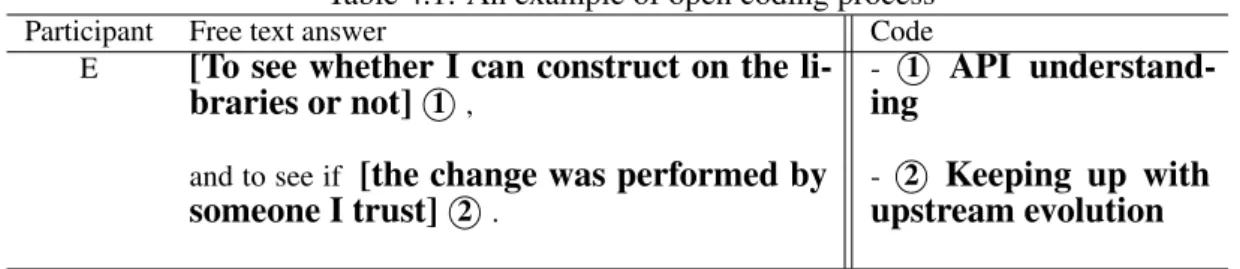
Open Coding (assign labels) We start with an initial coding by identify emerging topics in the free text answers. For each relevant piece of information we assign a suitable term to the original
CHAPTER 4. RESEARCH METHOD 31
1. In what ecosystem are you most active?
2. Are you the developer of a framework or library? If so, what is its name?
2.1. What do you most want to know about the use of your library or framework in your ecosystem?
2.2. Why would that be interesting to know?
2.3. What do you currently do to obtain that information, if anything? 3. Are you using a framework or a library in your ecosystem? If so, name one.
3.1. What do you most want to know about the libraries or frameworks that you are using? 3.2. Why would that be interesting to know?
3.3. What do you currently do to obtain that information, if anything?
Figure 4.3: The open-ended survey questions sent to selected developers
data (see Table 4.1). Such codes1consist of an expression or phrase that maintains the meaning of the original answers.
The following two steps are used. First, assigning the answers with labels by separate researchers independently. Second, re-assigning iteratively the answers to capture various insights. This procedure is repeated until some consistent terminology emerges. The data coded with labels describes concepts. The raw data is available in Appendix A.
Table 4.1: An example of open coding process
Participant Free text answer Code
E [To see whether I can construct on the
li-braries or not]1 ,
- 1 API understand-ing
and to see if [the change was performed by
someone I trust]2 .
- 2 Keeping up with upstream evolution
Axial Coding (establish connections between concepts) By grouping similar codes and con-cepts together we create axial coding categories and themes [42]. The results of the open coding and of the axial coding are presented in Chapter 5.
Selective Coding (create a theory that covers all categories and tells the storyline) In the final stage of coding, a core category emerges from the other categories. This can be done by
CHAPTER 4. RESEARCH METHOD 32 making connections and describing the relationship between two categories. Thus, associating all categories to a theory, tells the storyline.
4.3
Quantitative Questionnaire
In the second iteration, we triangulate our qualitative results by running a closed-question Likert item survey named after psychologist Rensis Likert [45]. It is commonly used to cross-check the consistency with the results from another research method. The participants do not answer with free text, but instead agree or disagree by rating their opinion on a scale.
The two purposes behind this questionnaire are:
1. Validate a set of Likert item statements on a 5-point scale
2. Identify the importance and consistency with the open-question findings 4.3.1 Data collection
Random sampling We performed sampling for data collection to a random target audience consisting of various types of developers. Subscribers in mailing lists range from beginners to professionals. Therefore we published the survey in different open-source communities.
Closed-ended questions We measure the level of agreement with a closed-questioned ques-tionnaire. We use a Likert item survey [45]. For each code from open-questioned analysis, we formulate at least one statement. The purpose of a quantitative analysis is to test these statements and discover some phenomenon.
Participants give their level of agreement or disagreement on a numerical five-point Likert scale [46]. We decided to use an uneven number of agreement levels (see Table 4.2). Thus we do not force a participant to decide for an explicit answer. When statements have extreme answers then they are not unbiased. This method – by rating these Likert item statements – is widely used to validate a research study.
Table 4.2: An example of a 5-point Likert item
I want to ... strongly
disagree disagree neither agree
strongly agree
... know the number of downloads
4.3.2 Data Analysis
With the validation process, we tested the relevance of the ranked Likert items. To compare the results we summarized the five levels of agreement into three raw classifications: agreement, neutrality and disagreement. This enhances the interpretation of the results. From that we derived conclusions.
5
Qualitative Results
“Research is creating new knowledge.” — Neil Armstrong In this chapter we present the findings from our open-ended questionnaire aimed to discover the information needs, motivations, and current practices of software developers working in an ecosystem context. The results were first published in a workshop paper on ecosystem architectures [47]. We provide our findings in chronological order.
We start by giving an overview of the participants we selected to take part in our open-questions survey.
We then present a list of codes that resulted from the open-coding process to answer our research questions. According to our survey questions in Figure 4.3, the codes are divided into three categories:
• Codes that expresswhatthe information needs are
• Codes that expresswhatis the motivation or purpose behind it
• Codes that expresshowthey obtain them with current tools or practices
We continued to undertake an axial-coding analysis. Comparing the codes with each other, we recognized relations and connections among our findings. To identify concepts we grouped similar codes together to appropriate categories.
5.1
Participants
We shipped the email survey to a convenience sampled [43] group of 20 framework and library developers, 14 of whom responded. An additional participant gave us the answers in person. As
CHAPTER 5. QUALITATIVE RESULTS 34 a convention we assigned a reference letter fromAtoN to each participant. Table 5.1 shows industry and academic experiences of the participants. Two respondents (G and L) did not provide any personal background information.
Table 5.1: Background information about participants from the open-question survey ID # Respondent
Code
Academic degree Full time experiences in Industry (# of years since PhD) Upstream Developer Downstream Developer 1 A PhD 4 yes yes 2 B PhD 3 yes yes 3 C PhD 6 yes yes 4 D PhD 5 yes yes 5 E PhD 9 yes yes 6 F PhD 9 yes yes 7 G - - no yes 8 H PhD 1 no yes 9 I PhD 2 yes yes 10 J PhD 9 yes yes 11 K PhD 3 yes yes 12 L - - yes yes 13 M PhD 4 no yes 14 N PhD 3 yes yes
The goal of the first question was to put the a respondent into the right frame of mind in which they would think about the broader context of their work and the inter-dependencies of the systems he is working on. We did not analyze the answers here, but we mention that we had a variety of ecosystems centered around different languages (Smalltalk, Python), technologies (Moose1, SciPy2), and hosted in various online source code repositories (GitHub3, SqueakSource4). Two respondents mentioned two social Q&A websites (StackOverflow.com5and Reddit.com6).
1 http://www.moosetechnology.org 2http://www.scipy.org 3http://github.com 4http://squeaksource.com 5 http://stackoverflow.com 6http://www.reddit.com
CHAPTER 5. QUALITATIVE RESULTS 35
5.2
Upstream Needs
We list and explain the codes that are representative for answer to question 2 in Figure 4.3. The results are numerated and consists of three subcategories:
• Upstream Needs (UN) • Upstream Motivation (UM) • Upstream Practices (UP)
We use the following notation:Code name (ID),(list of participants that support this need);e.g.,
API usage details (UN-2). (B,F,J,K,L). The frequency of occurrences are listed right after the central themes. In addition, we support our findings with appropriate quotations of participants. The original raw data is listed in the Appendix A.
We identified five distinct information needs for upstream developers grouped into two main categories.
5.2.1 Code Usage
This grouping holds developer needs that detail how people use source code.
API usage details (UN-2). (B,F,J,K,L,N)
Developers want to monitor the way the downstream is using the API and collect details about invoked methods and their arguments. This provides insight into the effectiveness of an API and its usage: This includes naming conventions, indentation, comments and so on. A guideline would provide help for maintenance issues, consistency and readability. “Which parts of the code are actively used?” (L).
Runtime statistics (UN-4). (B)
Some developers want statistics about the usage of their library at runtime to help localize and fix failures: “which API methods are called how often and which data is passed to them? How often do they fail with an error?” (B).
Code convention compliance (UN-5). (E)
This includes naming conventions, indentation, comments and so on. A guideline would provide help for maintenance issues, consistency and readability. “Variation of lint rules in my projects along the project history” (E)to ensure that downstream developers follow the conventions the developer set.
5.2.2 Project Statistics
This grouping holds the needs for simple, descriptive numbers describing the impact of the software project.
CHAPTER 5. QUALITATIVE RESULTS 36
Downstream projects (UN-1). (A,C,D,F,I)
Developers want to know how their code fits in the ecosystem. They want to know the number and nature of their downstream projects, and for what purposes the downstream is using a project: “I’d like to know what people build with my frameworks” (A). Respondent (D) wanted to know number of passive downstream developers that track a project’s state.
Forked projects (UN-3). (D,J,L)
Developers want to know about the clones of their work. With infrastructures like Github this is particularly easy to do.
5.3
Upstream Motivation
This grouping represents answers to questions representing the motivation and purpose behind the stated needs.
Strengthening self-esteem (UM-1). (A,I,J)
Pride in one’s work and project motivates this information need. “It is a good motivation if a lot of people like my code and build cool stuff on top of it” (A) and “it helps the self-esteem” (A). Positive feedback and rising popularity keeps a developer motivated and “gives inspiration and hints where to orient the project’s evolution” (J).
Maintaining downstream compatibility (UM-2). (F,I,K)
When developers know how their clients use their framework or library, then they are able to estimate the impact of code changes. If needed, they can notify downstream developers on how to stay compatible. A participant explains: “I want to know [. . . ] the impact [. . . ] when I modify my source code” (K). And another developer states: “I want my clients to know how the library is being used and to assess the impact of possible changes” (F).
Managing resources (UM-3). (B,L)
Discovering unused functionalities allows developers to deprecate them out and to better distribute effort. “To conserve my resources. If people don’t use a method or, a whole feature of the API, why maintain it?” (B).
5.4
Upstream Practices
The grouping holds answers to our question regarding the current practices of developers to fulfill their information needs.
Set up mailing lists (UP-1). (A,F,I,J)
Upstream developers set up mailing lists to get feedback from their downstream users. Subscribers ask and discuss problems and solutions over email communication.
Repository analytics (UP-2). (A,C,D)
Some source code repositories provide analytics for projects. GitHub provides information about forks, downloads, watches, etc. Even monitoring web traffic is of interest: “I observe the web analytics of my project’s home page” (A).
CHAPTER 5. QUALITATIVE RESULTS 37
Monitoring ecosystem commits (UP-3). (F)
In some cases developers track code changes to many projects of interest at once by monitoring news services: “I am monitoring the RSS of SqueakSource [NB: which includes updates on the changes to several hundreds of active projects]” (F).
Social media (UP-4). (A)
Developers use social media tools (e.g., Twitter) to publish the latest news about their project.
5.5
Downstream Needs
Based on the answers to question 3 in Figure 4.3 we synthesized the information needs for the downstream developers. The results are numbered and consist of three subcategories according to the results in Section 5.2 (Upstream Needs):
• Downstream Needs (DN) • Downstream Motivation (DM) • Downstream Practices (DP)
The downstream needs outnumber the upstream ones. We list them here in decreasing order of their occurrence.
5.5.1 Selection
This grouping holds the information needs of a developer during the process of selecting an upstream.
Available public support (DN-2). (A,B,E,J)
Developers want to know the popularity of a framework “Are they popular enough to find support on the web in blogs and on StackOverflow?” (B). A related factor is the responsiveness of the developer team and associated community to provide support: “How likely are they to fix bugs and to respond to feature requests” (B). “. . . whether there are bugs that were left unresolved for a long time” (E).
License type (DN-4). (A,I,L)
A common request is: “Is the license compatible with ours?” (A).
Implementation quality (DN-5). (B,E)
A potential client of a library wants to know how robust its implementation is, how often it is updated, how responsive the developers are, and how fast the library is evolving. “Whether [the project’s code] works or not” (E).
People want to know the level of activity around a library: “Whether they [the libraries] are intensively maintained” (E).
CHAPTER 5. QUALITATIVE RESULTS 38
Comparison with similar upstreams (DN-8). (A)
Find related libraries and frameworks that provide similar functionalities but are indepen-dently developed. “Comparison with similar frameworks” (A)gives the opportunity to consider an alternative upstream.
5.5.2 Adoption
This grouping holds the information needs that pertain to a developer starting to work with a new upstream.
Documentation (DN-3). (B,G,H,M,N)
The potential users of an API require its documentation: “I am basically happy with a good API documentation” (B).
Some developers want to understand the internals of an upstream project and thus require architectural documentation: “[. . . ] expose connections between high-level elements [. . . ] what methods [. . . ] of the packages invoke each other” (N).
Real contextual sample code (DN-7). (C)
Developers want example code snippets which are extracted from other projects with similar functionality. “I’d like to see example code extracted from other projects using the same libs that correspond to functions I’m trying to figure out how to use” (C).
5.5.3 Co-Evolution
This grouping holds the information needs that arise when an upstream dependency co-evolves with others.
Monitoring upstream changes (DN-1). (E,F,K,N)
Developers want notifications of deprecations and substitutions that affect the API they use: “What has changed since the last time I loaded [the library]” (K)and “if they deprecated
some methods” (N).
Compatibility with other systems (DN-6). (L)
A downstream client often depends on multiple upstreams. They want to know whether an individual upstream works with the rest of the configuration. “Does the current version [of the upstream] run on the version of the system I use [downstream]” (L).
5.6
Downstream Motivation
This grouping holds the answers the intentions behind the stated information needs.
API understanding (DM-1). (C,E,G,I,L,M)
Developers want to use functionalities provided by the API right away. This is eased when API names are intuitive and well documented. “To see whether I can construct on the libraries or not” (E). A participant’s answer is that he would like “to spend less time figuring out how to use new libraries” (C).

![Figure 2.3: An extract of the Ruby Gem Ecosystem. Illustration is published by Kabbedijk [1].](https://thumb-us.123doks.com/thumbv2/123dok_us/1672287.2729911/18.892.165.740.606.818/figure-extract-ruby-gem-ecosystem-illustration-published-kabbedijk.webp)

![Figure 3.2: Ecco, a meta-model for inter-dependent projects of an ecosystem [3].](https://thumb-us.123doks.com/thumbv2/123dok_us/1672287.2729911/27.892.298.596.161.376/figure-ecco-meta-model-inter-dependent-projects-ecosystem.webp)
![Figure 4.1: A mixed method exploratory design according to Creswell [4, Chapter 3]](https://thumb-us.123doks.com/thumbv2/123dok_us/1672287.2729911/29.892.138.752.371.428/figure-mixed-method-exploratory-design-according-creswell-chapter.webp)