Published online: 15.06.2012 --- © jbm 2012
--- A. De Chiara
University of Naples “L’Orientale”- Italy e-mail: [email protected]
S-D Logic and CSR: the management of social capital for the
value creation in SMEs
Alessandra De Chiara
Abstract: This paper underlines the importance of relationships with stakeholders for co-create value, according to Service Dominant Logic and Corporate Social Responsibility approaches, and the importance of the management of social capital, in order to strengthen the relational nature of firms. Focusing on SME's, the management of social capital and of reputation and trust, all assets of social capital, is at the base of the long-term performance of SME’s. Their ability to create consent and to develop trust around the entrepreneurial project is an essential element for such enterprises and the management of social capital, in a “responsible” view, appears to be a strategic aspect.
Introduction
At the base of the goal of value creation, in a firm, there is the relational perspective widely accepted by Service Dominant Logic (SDL) and Corporate Social Responsibility approaches, even if developed according to different directions which lead these approaches to different conceptualizations of value.
Starting from traditional studies in philosophy, the concept of relationship has been defined as an interaction and it is clear that through experience, observation and inference, individuals and cultures gain an ever greater knowledge. The way in which knowledge is spread from one to another is then examined in various disciplines, among the others, the theory of the spread, of anthropological mold, and the social learning theory of Bandura (1977), which marks the transition from the behaviourist approach to the definition of cognitivism.
With reference to management studies, it is believed that the theory which represents the company in its relational identity is the stakeholder theory (Freeman, 1984; 2004) which emphasizes the need, in business management, of respect for more diverse interests of stakeholders, which will lead the company to find compatibility between economic objectives and maximizing the return for shareholders and the satisfaction of interests expressed by different stakeholders.
In the more proper marketing studies has been defined interaction in networks of relationships as relationship marketing (Gummesson, 2008), it is defined that “relationships require at least two parties who are in contact each other” (Ibidem, p. 5) and it is underlined that the “relationships are the core of human behaviour”.
In accordance to the vision of relationship as interaction among individuals, in this paper are underlined the relational aspects of Service Dominant Logic (SDL) and Corporate Social Responsibility (CSR).
The relational perspective is evident in S-D logic. The foundational proposition of S-D logic is that organizations, markets, and societies are fundamentally concerned with exchange of service—the applications of competences (knowledge and skills) for the benefit of a party (Vargo and Lusch, 2004, 2008, 2009).
S-D logic embraces concepts of the value-in-use and co-creation of value rather
than the value-in-exchange and embedded-value concepts of G-D logic. Thus, instead
of firms being informed to market to customers, they are instructed to market with
customers, as well as other value-creation partners in the firm’s value network1.
In this perspective, thanks largely to the digital technologies, firms can gain a further opportunity to reconfigure role and relationships within the value-creating system (Normann and Ramirez, 1993) or value net (Parolini, 1996; Mandelli, 1998), where different actors, customers included, work together to co-create value.
The Corporate Social Responsibility (CSR) approach seems to enounce the relationships with all stakeholders and it interprets the value concept under a triple vision, economical, social and environmental. This approach leads firms to find strategic and operative solutions which meet the needs of several stakeholders. As citizens, firms have to reach objectives under a triple profile, economical, social and
environmental (European Commission, 2001) and have to satisfy stakeholders interests related to economical and moral aspects.
This paper underlines the importance of the management of social capital which
appears to be the main aspect to reinforce the relational perspective of firm, in particular in a “responsible” view, and to achieve the target of value, as outlined in the two approaches. This seems particularly true in SMEs, where the relational aspect is a distinctive feature for these operators (Birley, 1985), and therefore the management of social capital is a strategic fact. In particular, in the view of the research of “responsible” competitiveness, some studies have underlined the necessity for SMEs to adopt responsible behaviour in light of the strong bond that these enterprises have with the local system (Harvey et al.1991; Perrini and Tencati, 2008). The ability to create consent and to develop trust around the entrepreneurial project is an essential element for such enterprises. SMEs have more chances to exploit the local engagement and this aspect is a direct effect of SMEs’ social capital.
Beside the paper specifies the necessity for SMEs to define a synergic strategic behaviour with the local system. For SMEs, it is better to adopt a network approach and engage local institution in a role of intermediary for the promotion of CSR strategy among all stakeholders of the area.
The originality of this paper has to be considered a contribution to the debate on corporate social responsibility for the SMEs’ competitiveness.
The paper explains the relational perspective of SDL and of CSR, the value of this perspective in SMEs and the importance of management of social capital, then are presented the managerial implications and the conclusions.
SDL and CSR: the relational perspective
Behind and inside the principles of S-D logic and CSR approaches there is a relational firm vision. This vision emerges clearly, analyzing the core principles of these approaches.
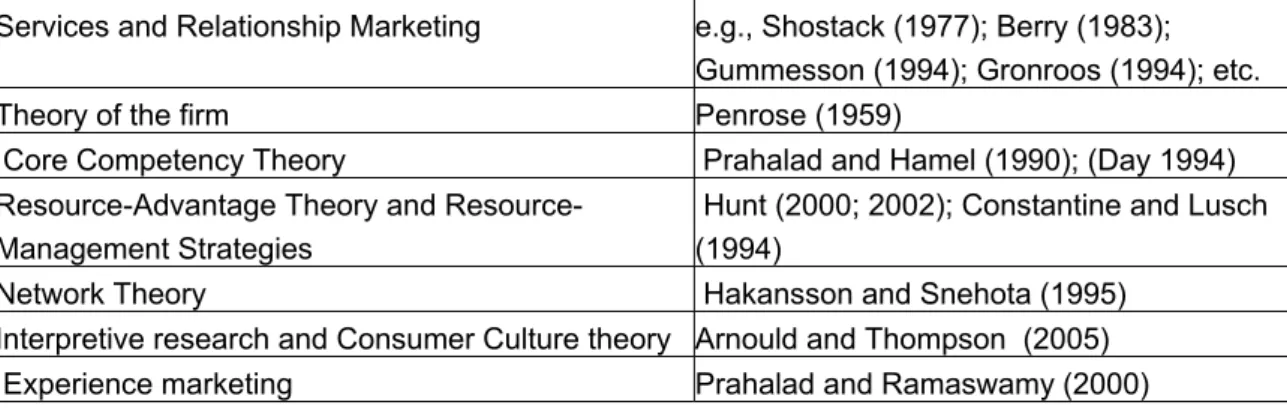
Looking to S-D logic, the partial pedigree (see table 1) and the core foundational premises of this approach (see table 2) (Vargo and Lusch, 2011) show the importance of connections and of network, or as it is clearly cited, it follows “foundations of networked relationships, new value co-creation processes, business interactions, resources integration”2.
The central concept in S-D logic is that service — the application of resources for the benefit of another party — is exchanged for service (Vargo and Lusch, 2004, FP1). “We have interaction in society — service-for-service exchange — and its corollary, value (i.e., benefit) (co)creation, is the glue (common goals of survivability and wellbeing) that holds social units (including economic units) and society in general together” (Vargo and Lusch, 2010, p.4).
Service provision implies the ongoing combination of resources, through integration, and their application, driven by operant resources — the activities of actors. The concept of A2A (Actor to Actor) explains that all actors are source-integrating, service-providing enterprises: every economic actor then is a resource
2 www.sdlogic.net
integrator (Vargo and Lusch, 2008, FP9). Value is always co-created (FP6), the beneficiary is a resource integrator but so are all of the external service providers, each creating its own service-providing resources through its own resource integrating activities.
This orientation points toward a “dynamic, networked and systems orientation to value creation”, where are involved “not only focal actors — the focal service provider (e.g., firm) and beneficiary (e.g., customer) — but also the context — the networks of resources and resource-providing actors — available to these actors” (Vargo and Lusch, 2010, p. 3). Authors admit that many others theories reach this conclusion, underlining as producers, firms, consumers, suppliers, distributors, stakeholders, can be seen as resource-integrating, service-providing enterprises (e.g. customer experiences literature, brand-community literature, stakeholder literature).
In relation to networks, they are not just networks (aggregations of relationships): they are dynamic systems3. Dynamic-system thinking is not new: the pioneering is the
work of Alderson (1957) with his functionalist approach; later the service science defines the service system, the basic unit of analysis, as a value co-creation configuration of people, technology, value propositions connecting internal and external service systems and shared information” (Spohrer, Vargo, Caswell and Maglio, 2008, p. 18).
Another basic concept is the service ecosystem defined as ”a spontaneously sensing and responding spatial and temporal structure of largely loosely coupled, value-proposing social and economic actors interacting through institutions, technology, and language to (1) co-produce service offerings, (2) engage in mutual service provision, and (3) co-create value” (Vargo and Lusch, 2010, p.5).
This approach arises new principles in various disciplines (Vargo and Lusch, 2011): the concepts of interactivity, relationship, network theory, in Business-to-Business Marketing; perceived quality, customer equity, in service(s) Marketing, Relationship.
Therefore the three key variables of marketing seem to be relationships, networks and interaction according to a Relationship Marketing, which is "interaction in networks of relationships".
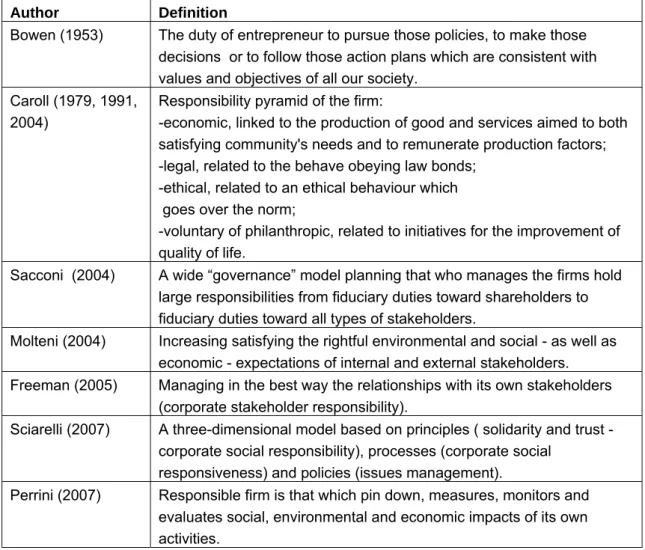
The relational perspective is the base of Corporate Social Responsibility (CSR) approach too. Starting from CSR definition, accepted in the paper, “a concept whereby companies integrate social and environmental concerns in their business operations and in their interaction with their stakeholders on a voluntary basis” (European Commission 2001, p.5) (a brief review of some important definitions is shown in table 3), the relational perspective prevails in the CSR (Zamagni, 2003), by inducing a firm to find strategic and operational solutions that meet the interests of a variety of individuals and stakeholders, which contribute resources / expertise and are an expression of rights and duties towards the company. The stakeholder theory (Freeman, 1984; 2004) is the basis of this approach and with the concept of equity
3 Networking relationships were first emphasized in the 1970s. (Arrow, 1974; Williamson, 1975; Nacamulli, 1986). Various terms have been used to describe these voluntary ties among firms characterized by exchange of information and the achievement of common objectives. This theory has analyzed them in terms of organizational forms, of the governance of networks and of network strategies.
(fairness) and with reference to all categories of stakeholders, "the stakeholder theory opens up the field to conduct an ethical governance, since it recalls the values and principles of a moral nature” (Del Baldo, 2009 , p.66).
Table 1: A Partial Pedigree For S-D Logic (Source: Vargo and Lusch, 2011)
Services and Relationship Marketing e.g., Shostack (1977); Berry (1983); Gummesson (1994); Gronroos (1994); etc.
Theory of the firm Penrose (1959)
Core Competency Theory Prahalad and Hamel (1990); (Day 1994) Advantage Theory and
Resource-Management Strategies
Hunt (2000; 2002); Constantine and Lusch (1994)
Network Theory Hakansson and Snehota (1995)
Interpretive research and Consumer Culture theory Arnould and Thompson (2005)
Experience marketing Prahalad and Ramaswamy (2000)
Table 2: Core Foundational Premises (Source: Vargo and Lusch, 2011)
Premise Explanation/Justification
FP1 Service is the fundamental basis of exchange.
The application of operant resources (knowledge and skills), “service,” is the basis for all exchange. Service is exchanged for service.
FP6 The customer is always a co-creator of value.
Implies value creation is interactional.
FP8 A service centered view is inherently customer oriented and
relational.
FP9 All economic and social actors are resource integrators.
Implies the context of value creation is networks of networks (resource integrators).
FP10 Value is always uniquely and
phenomenological determined by the beneficiary.
Value is idiosyncratic, experiential, contextual, and meaning laden.
It is clear, in this approach, the social function carried out of firms4. The importance of this function has acquired the right value due to a growth of maturity of civil society that has high demands and expectations with respect to public and private institutions that, therefore, must combine and find a balance between economic criteria and social objectives in the governance of their activities.
Doctrine has noted: business, as the most powerful institution in society, must be the instrument of social justice (Prahalad, 2005); “Even the most private of business enterprise is an organ of society and serves a social function… the very nature of the modern business enterprise imposes responsibilities on the manager” (Drucker, 1955, p.375) and “it must consider the impact of every business policy and business action upon society (ibidiem, p.382). In the concept of firms as citizen stands out the role of firms which can be able to bring benefits to society and environment while in the same time improving firm’s competitiveness (Porter and Kramer, 2002, Husted and Allen, 2004).
Although the prime responsibility of a company is generating profits, companies can at the same time contribute to social and environmental objectives, through integrating corporate social responsibility as a strategic investment into their core business strategy, their management instruments and their operations (European commission, 2001). So economic responsibility is the first responsibility of a business, but economic performance is not the only responsibility of a business (Drucker, 1992) and therefore the performance of a company should be measured based on its combined contribution to economic prosperity, environmental quality and social capital, known as triple bottom line, (European Commission, 2001).
Today social responsibility is a requirement for managing a company (Caselli, 1998). We can no longer consider enterprise as merely a social process within which an economic process develops (Bartels, 1967): it needs to uphold ”the binomial society and economy” (Sciarelli 2007, p. 310). CSR is targeted to meet the interests of stakeholder not only economic, but related to moral gratification (Baldarelli, 2008), and to the good repute of behavior (Brennan, 1994). CSR can be traced to the emergence of moral preferences (Del Baldo, 2009). Finally being socially responsible means not only fulfilling legal expectations, but also going beyond compliance and investing more into human capital, the environment and the relations with stakeholders. The experience with investment in environmentally responsible technologies and business practice suggests that going beyond legal compliance can contribute to a company's competitiveness. Going beyond basic legal obligations in the social area, e.g. training, working conditions, management-employee relations, can also have a direct impact on productivity. It opens a way of managing change and of reconciling social development with improved competitiveness (European Commission, 2001).
4 As stated by Vice-President of the European Commission, “businesses of all size must consider their
role in today’s society when making strategic and operational decisions” (Zadek S., MacGillivray A., (2007). “The State of Responsible Competitiveness”, in The State of Responsible Competitiveness 2007, AccountAbility, July 2007, p.13).
Table 3: Some concepts of CSR
Author Definition
Bowen (1953) The duty of entrepreneur to pursue those policies, to make those decisions or to follow those action plans which are consistent with values and objectives of all our society.
Caroll (1979, 1991, 2004)
Responsibility pyramid of the firm:
-economic, linked to the production of good and services aimed to both satisfying community's needs and to remunerate production factors; -legal, related to the behave obeying law bonds;
-ethical, related to an ethical behaviour which goes over the norm;
-voluntary of philanthropic, related to initiatives for the improvement of quality of life.
Sacconi (2004) A wide “governance” model planning that who manages the firms hold large responsibilities from fiduciary duties toward shareholders to fiduciary duties toward all types of stakeholders.
Molteni (2004) Increasing satisfying the rightful environmental and social - as well as economic - expectations of internal and external stakeholders. Freeman (2005) Managing in the best way the relationships with its own stakeholders
(corporate stakeholder responsibility).
Sciarelli (2007) A three-dimensional model based on principles ( solidarity and trust - corporate social responsibility), processes (corporate social
responsiveness) and policies (issues management).
Perrini (2007) Responsible firm is that which pin down, measures, monitors and evaluates social, environmental and economic impacts of its own activities.
The relational perspective prevails in the CSR, perhaps in a broader way than the one presented by the S-D logic:
1. the engagement of actors (employees, customers, suppliers). The statement that if actors are involved they work harder and performance rises, is common to S-D logic (Vargo and Lursh, 2009), even if this approach is based on greater attention to the consumer, evident in FP8: A service centered view is inherently customer oriented and relational (Vargo and Lusch, 2011); while in the CSR approach the engagement of actors is expanded in relation to the type of actors and to their interests;
2. the attention to the role that the company plays in the socio-economic development, in the CSR approach. The performance of a company should be measured based on its combined contribution to economic prosperity, environmental quality and social capital, known as triple bottom line, (European Commission, 2001).
Even if the S-D logic is considered an interesting approach from an ethical perspective “because it is an example of theory that avoids compartmentalizing ethical issues” (Abela, Murphy, 2008, p. 44), however ethical considerations are not explicit in the initial position of Vargo and Lursch (2004), but observe Abela and Murphy that
“many of FPs of S-D logic are inherently ethical” (ibidiem, p.44) and they are useful to reduce ethical conflicts and violations in marketing; similarly to “the centrality of human beings ensures integration of ethical and business issues at the core of the theory, thus avoiding compartmentalization” (ibidiem, p.45).
SMEs and relational perspective: the value of responsible behaviour
The relational aspect is a distinctive feature of SMEs (Birley, 1985), it is a driver for developing strategic paths that are based on the ability to weave informal relationships, internal and external, through the participation in the network (Marchini, 1995). The relatedness within the firm is small and facilitated by the simplicity of the structure and informal relationships between individuals, the relatedness is based on external relationships that contribute to the growth of reliability among the stakeholders.
In SMEs is essential to build and manage a relationship in harmony with partner, both if he is another trader (supplier, company, distributor), both he is a consumer. These companies, in fact, have fewer tools to "impose" a relationship, a circumstance that rather often characterizes large companies by virtue of their contractual power that they exercise towards all stakeholders. Even the local communities, for example in countries developing, are often intimidated by the power wielded by multinational giants.
In SMEs, however, the relationship is built with the partner, there are fewer resources to convince them, while their ability to develop relationships with stakeholders, to create trust, legitimacy, reciprocity and consensus (Spence et al. 2003), are at the base of the long-term performance of SME’s. Therefore, cooperative behaviours are well suited to SMEs and the relational aspect is a hallmark of socially- oriented SMEs (Chirieleison, 2002).
These are the thoughts that lead us to assert that CSR, in view of the coverage of stakeholders, and of not a only economic goals pursued by the company, is an approach that is well suited to SMEs by virtue of their need to create an empathy with stakeholder and to build a relationship with them -a professional relationship of co-creating value for all contractors.
Some authors identify in some characteristics of SMEs traits compatible for the adoption of socially-oriented behavior: the influence of the subjective sphere, the importance of internal and external relatedness, the social roots of the company and the entrepreneur (Speece, 1999; Del Baldo, 2009).
Even in the relation to the objectives of SMEs, you can see that the profit is not always the only objective, but it is a constraint to be respected (Del Baldo, 2009), while winning the respect from the competitors and the community (Sciarelli, 2007), appear crucial in SME. The entrepreneur in the small and medium enterprises is an active member of the community and by virtue of these roots, SMEs have a particularly strong address to the good of the community (Del Baldo, 2009). They have a strong sense of identity and rootedness to the land and socio-economic environment of belonging, as a "business territory" intertwined issues specific to local contexts (Del Baldo, 2009). Some studies have underlined the necessity for SMEs to adopt
responsible behaviour in light of the strong bond that these enterprises have with the local system (Harvey et al., 1991; Perrini and Tencati, 1998).
Typical aspects of the attentiveness of SMEs to CSR have been underlined in literature as in European researches:
it is strongly influenced by the individual values of the owner or manager. The ethical and social values emerge as important factors that explain the involvement of small enterprises in the practices of social responsibility (Observatory of European SMEs, 2004);
it is addressed to the efficiency and efficacy of firm’s activities (used resources and workers) (UNIDO, 2002). The adoption of social responsible behavior seems to be directly tied to the daily question of improving the effectiveness and efficiency of the business activities and the creation of value, therefore the interventions are directed above all to the inside dimension of the enterprise;
SMEs which are involved into network with a interest into quality; have relationships with foreign markets; are involved into productions with an higher level of environmental impact or using strongly an intellectual capital (European Commission, 2002);
there is a major sensibility of SMEs with social/environmental problems of area in which they operate (Molteni and Todisco, 2008);
the adoption of CSR tools also seems to depend on the age of the enterprise, and the end of the fifth year of life marks the point at which the probability of involvement of small enterprises in CSR emerges (Observatory of European SMEs, 2004). As it is positive correlated to firms’ size (CERFE Group, 2001; European Commission, 2002).
As all studies share these aspects of CSR in SMEs: implicit (Matten and Moon, 2004); informal (Perrini, 2006); silent (Jenkins, 2004).
The adoption of responsible and ethical behavior not only is useful as reduction of the use of materials, energy and water; produce an empowerment of human resources and an increase of efficiency of processes and of firm’s reputation (UNIDO, 2007); because it allows to set strategies for product differentiation (Molteni, Todisco, 2008), since it allows to build a set of durable relationships, in short, as it allows to improve the competitiveness of the company.
Therefore the management of social capital seems to be a crucial aspect, especially for SMEs, where the social capital is a strategic asset. “Networks have been identified as an important source of social capital (Burt, 2000, p.282).
For the concept of social capital we refer to “connections among individuals – to social networks and the norms of reciprocity and trustworthiness that arise from them” (Putnam, 2000, p. 19); “Social capital can be considered to be the product of co-operation between various institutions, networks and business partners” (Spence et al., 2003, p.17); it is an interactive concept. From this concept derive the notion of "relational goods" (Gui, 1987), that is to say trust, legitimacy, reciprocity and consensus. These are the key assets of social capital and have been considered the base of the long-term performance of SME’s (Spence et al. 2003, 2004). But social capital does not only bring ethically positive perspectives to the business organisation. It also has a potential dark side (Putnam, 2000, pp. 350–363).
In the presence of trust in relationships, the literature has attributed important effects, such as the reduction of costs for information retrieval and of control of the operations, due to an absence of opportunistic behaviors; the reduction of the time of decision-making (Berg and Cagliardi, 1985; Denison, 1984; Sherwood, 1988; Alvesson, 1993); trust is a key resource of the company, in the approach resources-based view.
It can be traced back to a subjective dimension, relating to the characteristics of the individual, and to an objective dimension (see Table 4).
Table 4: Components of trust (Source: De Chiara, 2007)
Subjective dimension Objective dimension
Trust Attributed to the ability to listen and willingness to accept different perspectives. It invokes the concept of empathy.
Is manifested in their clarity of commitments granted and objectives to be achieved in a common goal and in the safety of action in a common interest.
In SMEs the ability to develop relationships with stakeholders, to create trust, can be considered of primary importance, where we could say that social relations in SMEs are a resource before the other goods. “Social capital is a potentially critical aspect for small business life”(Spence et al., 2003, p.18). SMEs would invest in social capital for at least three aspects: it stabilises mutual expectations and enable collective action (trust); 2. it forms a kind of insurance and 3. it gives access to relevant information (Spence et al., 2003).
SMEs’ ability towards a “responsible” management of social capital, in implementing a CSR strategy, would consent to strength the relational nature of firm and empower it in a virtues cycle: CSR generates assets of social capital and social capital leads to CSR. CSR helps to increase the social capital of SMEs (Spence, Schmidpeter, Habisch, 2003; Perrini, 2006). “Social capital has some important aspects for business ethics – it highlights the manner of doing business and has many points of intersection including issues such as transparency, honesty, co-operation, trust, community investment, organisational citizenship and goodwill” (Spence et al., 2003, p.18).
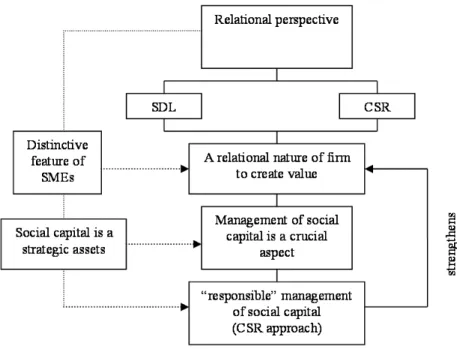
In short, as illustrated in the figure bellowed (Fig. 1), the relational perspective, which is a distinctive feature of SMEs, give substance to the management of social capital, which became a crucial aspect for long-term performance. A “responsible” management of social capital, a management of relationships with stakeholders in a CSR view, by implementing CSR tools, could lead towards an improvement of relationships and to an enouncement of the relational nature of SME, strengthening, then, its social capital.
Fig. 1: Research model
Managerial implications and conclusions
First of all the leadership plays a key role to set a socially responsible behaviour; to create a smooth running of the business system combining the concepts of transparency and accountability through leadership attentive to the human and ethical values and to a model of governance which triggers a mechanism interaction between multiple actors (Bertini, 2008; Del Baldo, 2009). The effects you get are important: the presence of a strong ethical framework and values means that there are less tensions and energies are oriented for the good of the company, its people, society and the environment in which it is part of (Del Baldo, 2009); the higher is the confidence gained by management and / or entrepreneur, rewarded by right results, fair and rewarding, the less complex become the government and governance (Jones, Thomas, 1995). In SMEs this path is simplified thanks to the characteristics of firms - involvement of property in the management; simplicity of the organizational structure that allows direct and informal relationships.
But acting responsibly means taking on a burden that is to say the least untenable for a single actor, especially if small and medium size, if not, it is believed, through the shape of the network. Therefore another important aspect, is to create paths based on the cooperation among firms and institution, local or national, to realized strategies based on CSR (Pulci and Valentini, 2003; Del Baldo, 2009; De Chiara, 2012). It is said by some to achieve as a relational state (Mendoza, 1996) or by others a collaborative governance (Zadek, 2006) that enables to act the systemic forms of innovation, but
also a corporate responsibility clusters (Sancassiani, Rognoni, Frascaroli, 2007).
therefore it becomes fundamental to establish cooperative relationships among the fundamental operators (local institutions, suppliers and sub-suppliers). SMEs can take advantage of the opportunity to operate as a meta-organization, and institutions play a key role in brokering to promote strategies inspired by the CSR, they are intermediaries between businesses and the local context in which they operate.
CSR becomes possible in the network also because becomes possible the "load distribution", of costs, but above all I would say that it becomes possible a contribution of a specific individual contributions that create wealth. So it is necessity to define a synergic strategic behaviour, to adopt a network approach and engage local institution in a role of intermediary for the promotion of CSR strategy among all stakeholders of the area, but also in the role of creator to develop policies and services targeting enterprise by focusing on the quality of human capital and labour.
Clearly there is great excitement around the topic of CSR, in doctrine as by the institutions.
The European Commission follows the “think small first” approach, so firms’ social responsibility concept, practices and tools have to be shaped on the basis of SME features5, as they represent the most important part of European entrepreneurship:
99,8% of firms are SMEs, they assure the 67,4% of employment and produce about the 58% of the total added value (Eurostat, data 2008). Europe, with the Lisbon Strategy (2000), looks at CSR as an essential strategy to strengthen and re-launch the European economic system, focusing on an elevated standard of quality of life, equal opportunity, protection of the environment and attention to society. Later in the communication "Europe 2020: Strategy for smart growth, sustainable and inclusive6",
shooting the three pillars of the Lisbon Strategy, economic, social and environmental, has been recognized a central role to the social dimension, both in terms of employment (the Lisbon target of 70% of employed increased to 75%), and for the fight against poverty with the aim of reducing it to fourth, again in an attempt to reduce regional disparities.
The feeling you get from studying this issue is that the behaviour of international institutions, is changing in recent years, highlighting the feeling that the importance of respect of principles of sustainable development and human rights cannot be guaranteed by the spontaneous initiative of enterprises, although extended to the supply chain, but that it is necessary to action with regulations and standards. So from the guide lines and recommendations issued initially we are going to real laws. An example are: the Human Rights Due Diligence which should be used to assess and reduce a business risk in human right abuse (UN Secretary – General for Business and Human Rights – SRSG-, 2008). “This means adopting a human rights policy, conducting human rights impact assessments, integrating the policy into the company’s operations and culture and tracking and monitoring performance” (Sherman III and Lehr, 2010, pp.4 ). The US Alien Tort Statute is the largest body of domestic law on human rights principles. It refers to indirect involvement by companies too and so due diligence can help a company avoid complicity. It is recognised as an
5 The last report on the state of social responsibility underlines the importance of the adoption of socially
responsible strategies and tools for the competitiveness of SMEs (The State of Responsible Competitiveness, 2007). For a summary of such initiatives, we refer to Tencati et al. 2004.
international standard of conduct for handling disputes involving multinational companies.
More restrictive measures have been taken by Europe in the wood sector (Regulation (EU) No. 955/2010 of the European Parliament and the Council of 20 October 2010, OJ L 295, 12 November 2010, p. 23 ff.) and the U.S. in the fields of “conflict minerals” (Wall Street Reform and Consumer Protection Act, Pub. L. No. 111-203, July 21, 2010, Section 1502). With this Act, signed into law by President Obama on July 21, 2010, are new requirements for manufacturers of products containing tin, tantalum, gold, tungsten or any other “conflict metals.” Specifically, section 1502 of the new law imposes direct U.S. Securities and Exchange Commission (SEC) reporting requirements on any publicly traded companies whose products contain metals derived from conflict minerals. Companies will be required to submit a due diligence plan with their annual SEC report. The SEC has 270 days to finalize the regulations and implement the requirements.
Therefore, the wider welfare of all stakeholders, in some cases, has led the international institutions and national legislation to action for regulating the behaviors in some businesses considered "at risk".
Back to relational nature of the company, the theoretical approaches of CSR and SDL have some common elements but also present substantial differences, explained by different origins and purposes of these approaches. They have the merit to highlight on the strategic value of the social capital of the company, the strategic management of this capital for the firm's performance. This work has wanted to emphasize these aspects in relation to SME, focusing on theoretical analysis, and delaying the phase of empirical research to further works.
References
Abela, A. V. and Murphy, P. E. (2008), Marketing with integrity: ethics and service-dominant logic for marketing, Journal of the Academic Marketing Science vol. 36,
pp. 39-53.
Alderson, W. (1957), Marketing behavior and executive action: A functionalist approach to marketing theory, Homewood, IL: Irwin.
Alvesson, M. (1993), Cultural-ideological modes of management control, Deetz, S. (eds), Cominication Yearbbok 16, Sage, Newbury Park, pp. 3-42.
Arrow, K. J.(1974), I limiti dell’organizzazione, Il Saggiatore, Milano.
Baldarelli, M. G. (2008), Le dimensioni della responsabilità sociale: riflessioni su miti e paradossi in una prospettiva economico-aziendale, working paper, Incontri di Studi CSR & Accountability, Università degli Studi di Urbino, 10 aprile.
Bandura, A. (1977), Social Learning Theory, Prentice Hall, Englewood Cliffs, NJ.
Bartels, R. (1967) A model for ethics in marketing, Journal of marketing, vol. 31,
January,pp.20-26.
Berg, P.O. and Gagliardi, P. (1985), Corporate images: a symbolic perspective of the organization environment interface, paper presented at SCOS on Firm’s imagine, Antibes.
Bertini, U. (2008), Modelli di governance, aspettative degli stakeholder e creazione del valore , AA.VV. 31° Convegno AIDEA, Corporate governance: governo, controllo e struttura finanziaria, Napoli, 16-17 ottobre.
Birley, S. (1985) The role of networks in the entrepreneurial process, Journal of Business Venturing, Vol. 3, n. 1, pp.107-117.
Bowen, H.R. (1953), Social responsibility of the businessman, Harper &Row, New
York.
Caroll, A.B. (1979), A three-dimensional conceptual model of corporate performance
Academy of Management Review, vol. 4, n. 4, pp.497-505.
Caroll, A.B. (1991), The pyramid of corporate social responsibility, Business Horizon,
n. 34 june-august, pp.39-48.
Caroll, A.B. (2004), Managing ethically with global stakeholders: a present and future challenge Academy of Management Executive, vol. 18, n. 2, pp.114-119.
Caselli, L. (1998), Etica dell’impresa e nell’impresa, Sinergie, n.45, pp. 85-88.
Cavusgil, S.T. (1980), On international process of firms, European Research n.8, pp.
273-281.
Cerfe group, Action research on corporate citizenship among European small and medium enterprises, «CERFE Laboratory», 2001.
Chirieleison, C. (2002), Le strategie sociali nel governo dell’azienda, Giuffrè, Milano.
European Commission (2001), Promuovere un quadro europeo per la responsabilità sociale delle imprese, Libro Verde, Bruxelles.
De Chiara, A. (2007), Generare conoscenza on-line. Un modello di analisi, D’Ambra L., Rostirolla, P. and Squillante, M. Metodi, Modelli, e Tecnologie dell’Informazione a Supporto delle Decisioni. Parte prima: metodologie , Franco Angeli, Milano, pp.
45-67.
De Chiara, A. (2012), La competitività responsabile nelle PMI: strategia vincente nei territori nemici, Piccola Impresa/Small Business n. 1.pp.29-52.
Del Baldo, M. (2009), Corporate Social Responsibility e corporate governance: quale nesso nelle PMI?, Rivista Piccola Impresa/Small Business, n.3, pp. 61-102.
Denison, D. R. (1984), Bringing corporate culture to the bottom line, Organization Dynamics, vol. 13, n. 2, pp. 5-22.
Drucker, P. F. (1955), The Practice of Management, HarperCollins Pubblisher, New
York.
Drucker, P. F. (1992), The New Society of Organizations, Harvard Business Review, Sept. – August, pp. 95-104.
European Commission (2002), Corporate Social Responsibility: a business contribution to sustainable development. Brussels, July. http://trade.ec.
Freeman, R. E. (1984), Strategic management: a stakeholder approach, Pitman,
Boston.
Freeman, R. E. (2004), A stakeholder theory of modern corporations, Ethical theory and Business, 7th edn.
Freeman, R.E. (2005), Più qualità e più profitti, Il Sole 24 Ore, Milano.
Gui, B. (1987), Le organizzazioni produttive private senza fine di lucro. Un inquadramento concettuale, Economia Pubblica, n. 4-5, pp. 183-193.
Harvey, B. Van Luijk, K. and Corbetta, G. (1991), Market morality and company size,
Kluver, London.
Husted, B. W. and Allen, D. B. (2004), Corporate social strategy in the multinational enterprise: Antecedents and value creation, paper presented at Academy of International Business, Stockholm, Sweden, July 13.
Jenkins, H M. (2004), A critique of conventional CSR theory: an SME perspective,
Journal of General Management, vol. 29, n. 44, pp. 37-57.
Jones, T. and Thomas, M. (1995), Instruments stakeholder theory: a synthesis of ethics and economics, Academy of Management Review, n. 20, pp.404-437.
Mandelli, A. (1998), Internet marketing, McGraw Hill, Milano.
Marchini, I. (1995), Il governo della piccolo impresa, Vol.II - La gestione strategica, 1°
Ed. ASPI/InsEdit, Genova.
Matten, D. and Moon, J. (2004), Corporate Social Responsibility Education in Europe,
Journal of Business Ethics, vol.54, n. 4, pp. 323-337.
Mendoza, X. (1996), Las transformaciones del sector public en las sociedades avanzadas. Del estado del bienestar al estado relacional, Papers de Formaciò, n.
23, Diputaciò de Barcelona.
Molteni, M. (2004), Responsabilità sociale e performance d’impresa, Vita & Pensiero,
Milano.
Molteni, M. and Todisco, A. (2008), Piccole e medie imprese e CSR. La CSR come leva di differenziazione. Rapporto di ricerca. www.isvi.org.
Nacamulli, R. (1986), Il rapporto tecnologia- economia: un giano bifronte, Economia e Politica Industriale, n. 50, pp. 1-37.
Normann, R. and Ramirez, R. (1993), From value chain to value constellation: designing interactive strategy, Harvard Business Review, vol. 71, n. 4, pp. 65–77.
Observatory of European SMEs (2004), Ex post evaluation of the observatory of European SMEs. Final report. http://ec.europa.eu.
Parolini, C. (1996), Rete del Valore e Strategie Aziendali, Egea., Milano.
Perrini, F. and Tencati, A. (2008), Corporate Social Responsibility, Egea, Milano.
Perrini, F. (2006), SMEs and CSR Theory: evidence and implications from an Italian perspective, Journal of Business Ethics, vol. 23, n. 1, 2006, pp. 65-91.
Perrini, F. (2007), Encouraging CSI in Italy: The enabling role of government in mandating. Motivating, and supporting responsible business practices, working paper n. 35, Corporate Social Responsibility Initiative – Harvard University.
Porter, M.E. and Kramer, R.M. (2002), The competitive advantage of corporate philanthropy, Harvard Business Review, vol. 80, n.12, pp.56-68.
Prahalad, C.K. (2005), The fortune at the bottom of the pyramid, Pearson Education,
Inc., Publishing as Warthon School Publishing, Upple Side River, NJ.
Pulci, P. and Valentini, S. (2003), Un caso di diffusione di responsabilità sociale nelle piccole imprese a livello locale CCIAA, Formaper (a cura di), La responsabilità sociale nelle piccole imprese, Il Sole24 Ore, Milano, pp. 121-138.
Putnam, R. (2000), Bowling Alone: The collapse and revival of American community,
Simon and Schuster, New York.
Sacconi, L. (2004), Responsabilità come governance allargata dell’impresa: una interpretazione basata sulla teoria del contratto sociale e della reputazione,
Rusconi G., Dorigatti M., (a cura di), La responsabilità sociale d’impresa, Franco
Angeli, Milano,pp. 148-166.
Sancassiani, W. Rognoni, C. and Frascaroli E. (2007), Piano strategico-operativo intercomunale di sostenibilità 2007, FocusLab, Associazione dei comuni modenesi del distretto Ceramico, Sassuolo, http://www.provincia.fe.it.
Sciarelli, S. (2007), Etica e responsabilità sociale nell’impresa, Giuffrè Editore, Milano.
Sherman, III J. F. and Lehr, A. (2010), Human rights due diligence: is it too risky? working paper of the Corporate Social Initiative, Harvard University, n. 35,
February, pp.1-22.
Sherwood, J.J. (1988), Creating world cultures with competitive advantage
Organization Dynamicsm, vol. 16, n. 3, pp. 5-27.
Spence, L. J. (1999), Does size matter? The state of art in small business ethics,
Business Ethics: A European Review, Vol. 8, n. 3, pp. 163-174.
Spence, L. J. Habisch, A. and Schimidpeter, R. (2004), Responsibility and social capital: the world of small and medium sized enterprises, Palgrave Macmillan,
Hampshire, England.
Spence, L. J. Schimidpeter, R. and Habisch, A. (2003), Assessing social capital: Small and medium size enterprises in Germany and U.K., Journal of Business Ethics,
Vol. 47, n. 1, pp. 17-29.
Spohrer, J. Vargo, S. Caswell, N. and Maglio, P. (2008), The service system is the basic abstraction of service science,. 41st Annual HICSS Conference Proceedings, Honolulu, Hawaii.
Tencati, A. Perrini, F. and Pogutz, S. (2004), New tools to foster corporate socially responsible behavior, Journal of Business Ethics vol. 53 n. 1/2, pp. 173-190.
UNIDO (2002), Corporate Social Responsibility and the Development Agenda: Should SMEs Care? Sme Technical Working Papers Series , Working Paper No. 13.
UNIDO (2007), The UN Global Compact operational Guide for medium-scale enterprises -July 2007.
Vargo, S.L. and Lusch, R. F. (2004), Evolving to a new dominant logic for marketing,
Journal of Marketing, vol. 68, n. 1, pp. 1−17.
Vargo, S.L. and Lusch, R. F. (2008), Service-dominant logic: Continuing the evolution,
Journal of the Academy of Marketing Science, Vol. 36, n.1, pp.1−10.
Vargo, S. L. and Lusch, R. F. (2009), Thinking out loud (1.0), working paper, June 18, 2009.
Vargo, S.L. and Lusch, R. F.(2010),It's all B2B…and beyond: Toward a systems perspective of the market, Industrial Marketing Management,
doi:10.1016/j.indmarman.2010.06.026
Vargo, S.L. and Lusch, R.F. (2011), Service-Dominant Logic: Foundations and Directions Academy of Marketing, Service Marketing SIG: Westminster Workshop on Service-Dominant Logic January 13-14, 2011.
Williamson, O.E. (1975), Market and Hierarchies, The Free Press, New York.
http://www.sdlogic.net: Service is the fundamental basis of exchange.
http://ec.europa.eu/eu2020/index_en.htm.
Zadek, S. (2006), The logic of collaborative governance: corporate responsibility, accountability, and social contract, Corporate Social Responsibility Initiative,
Zadek, S. and MacGillivray, A. (2007), The State of Responsible Competitiveness, AAVV, The State of Responsible Competitiveness 2007, AccountAbility, July 2007.
Zamagni, S. (2003), Impresa, mercato, economia civile , La Società, n. 4, pp.51-71.
Acknowledgements
This paper represents a deepening of the work presented at the conference "2011 Naples Forum on Service”, 14-17 June 2011, Capri, Naples, Italy.