THE IMPACT OF PROJECT PERFORMANCE ON THE
IMAGE OF THE
CONSTRUCTION INDUSTRY IN BOTSWANA
T.E. NDADI
THE IMPACT OF PROJECT PERFORMANCE ON THE IMAGE
OF THE
CONSTRUCTION INDUSTRY IN BOTSWANA
By
Thabo Enert Ndadi
Submitted in partial fulfilment of the requirements for the degree of Master of Science in the Built Environment
April 2018
i
ABSTRACT
The construction industry is one of the largest sectors in the economy of Botswana, and contributes significantly to the socio-economic development of the country, averaging 6.7 per cent of the country’s gross domestic product (GDP). Botswana operates a free enterprise system where anyone is free to participate, which is supported by the existence of multi-national construction firms operating in the country. The construction industry in Botswana consists of various role players.
As a developing country, Botswana’s construction industry is facing challenges of poor project implementation. The performance of the construction industry has not escaped the public‘s scrutiny of commercial construction and social development projects, resulting in negative perceptions with respect to the sector. This study focuses on the impact of project performance on the image of the construction industry in Botswana, and was conducted on projects underway. When public opinion is formed, a certain image of the business results, therefore the investigation endeavoured to establish the sources of negative perceptions towards the construction industry.
To realise the aforementioned study objectives, an exploratory design sequence method was adopted henceforth applying established and tested quantitative and qualitative systems. A questionnaire was formulated and established to obtain the empirical data on randomly selected projects that were on-going or completed in the past ten years .These included public sector projects, private sector and those undertaken by parastatal organisation. The sample stratum deemed representative picture of the population, included various construction industry stakeholders. To facilitate for an effective data to inform the study, the questionnaire was categorised in three key areas of, biographic data, demographic and the industry best practice perceptions.
The study determined that the capability of firms is influenced by construction management skills, and established regulatory systems. These can determine the extent to which the construction industry delivers the project within the business environment that is guided by the micro, macro and market parameters. As evidenced in the findings, the Botswana construction industry faces a skills’ gap and therefore is reliant on imported labour, and many international firms operating in the country affirm this
ii
observation. The study also addressed the existing regulatory systems, and the effectiveness of institutions.
The study concludes that the existing performance regulatory systems are not adequate or they are ineffectively controlled; industry role players’ behaviour is irresponsible; there is limited skills’ capacity, and political interference accompanies project implementation. While the deterioration in the construction industry can be attributed to imported culture, it is noted that multi-national corporations (MNCs) and other foreign firms can be conduits for technology and knowledge (T&K) transfer to host countries in the developing world. Botswana with its free enterprise market and limited skill capacity and informed by the behaviour of construction industry role players, there is need for a structured integrity restoration process from both regulator and the operators. There is further need for a specific sector regulatory instrument (Act) to regulate the safety, health, and environmental operations in the construction industry. The construction industry also need to support research and development of the industry to be competitive both local and international.
iii
ACKNOWLEDGEMENTS
Writing this treatise has been a challenging and insightful process, which affirms the opinion that construction industry stakeholders in Botswana are still developing and have not yet reached satisfactory professional standards, especially small-scale contractors.
My gratitude goes to my supervisor, Professor John Smallwood, for his valuable input; to Professor Alfred Ngowi for being resourceful; and to my sister, Onneetse Ndadi, for the moral support and encouragement.
This cannot be complete without recognising the valuable support from my wife, Kesebonye Ndadi (Mmagwe-Kago), who solely took care of the children (Tsitsi, Fununu and Kago) during my studies. I also gratefully acknowledge Dr Josiah Nyagwachi, a friend and a mentor, who encouraged me to further my studies.
iv
TABLE OF CONTENTS
ABSTRACT ... i
ACKNOWLEDGEMENTS ... iii
TABLE OF CONTENTS ... iv
LIST OF FIGURES ... viii
LIST OF TABLES ... viii
ACRONYMS ... x
CONTENTS OF THE STUDY . ………1
DEFINITION OF TERMS ... 2
CHAPTER 1 ... 4
1.0 THE PROBLEM AND ITS SETTING ... 4
1.1 INTRODUCTION ... 4
1.2 STATEMENT OF THE PROBLEM ... 6
1.3….SUB-PROBLEMS ... 7
1.4 HYPOTHESES ... 8
1.5 DELIMITATIONS ... 9
1.6 ASSUMPTIONS ... 10
1.7 IMPORTANCE OF THE RESEARCH... 11
1.8 AIMS AND OBJECTIVES OF THE RESEARCH ... 12
CHAPTER 2 ... 13
2.0 THE PRELIMINARY REVIEW OF THE RELATED LITERATURE ... 13
2.1 BUSINESS ENVIRONMENT ... 14
2.1.1 Reflection on the market environment in Botswana ... 17
2.1.2 Characteristics of the construction industry ... 19
2.1.3 Government’s role in the construction industry ... 20
2.1.4 Procurement of construction projects in Botswana ... 22
2.1.4.1 Compliance and regulation ... 23
2.1.5 Construction industry role players ... 24
2.1.6 Construction sector employment status ... 25
2.1.7 Sector income comparison ... 27
2.2 POOR IMAGE OF THE CONSTRUCTION INDUSTRY ... 30
v
2.2.2 Corporate image ... 33
2.2.3 Corporate governance ... 34
2.2.4 Ethical conduct of contractors ... 37
2.2.5 Marketing the construction industry ... 39
2.2.5.1 Corporate social responsibility ... 41
2.2.6 Communication ... 42
2.2.7 Firms industrial relations... 45
2.2.7.1 Employee welfare ... 47
2.2.8 Conflicts ... 47
2.2.9 Violence at work ... 48
2.3 PROJECT BUDGET AND SCHEDULE OVERRUNS ... 49
2.3.1 Performance of public projects ... 50
2.3.2 Poor project performance factors ... 50
2.3.2.1 Procurement systems ... 50
2.3.2 2 Productivity. ... 51
2.3.2.3 Drugs and the work environment ... 52
2.3.2.4 Lack of managerial capacity ... 53
2.3.2.4 Corruption ... 53
2.4 SHORTAGE OF SKILLED PROJECT PERSONNEL ... 55
2.4.1 The level of work permit holders ... 56
2.4.2 Mitigating the construction industry skills gap ... 61
2.4.2.1 Vocational education development ... 61
2.4.2.2 Existing vocational institutions in Botswana ... 63
2.4.2.3 Construction Industry Trust Fund (CITF) ... 63
2.4.2.4 Brigades ... 63
2.4.2.5 Madirelo Training and Testing Centre (MTTC) ... 63
2.4.2.6 Leadership development initiatives ... 64
2.4.2.7 Knowledge management ... 66
2.5 CONSTRUCTION PROJECTS POLLUTE THE ENVIRONMENT . 67 2.5.1 Sources of pollution in the construction industry ... 68
2.5.2 Awareness sources ... 69
2.5.3 Regulation ... 69
2.5.4 Technology ... 69
vi
2.5.6 Waste management and construction activities ... 70
2.5.7 Planning ... 70
2.5.8 Environmental impact assessment ... 70
2.6 LATE DELIVERY OF BUILDING MATERIALS ... 72
2.6.1 Material supply monitoring ... 72
2.6.2 Materials management ... 73
2.6.3 Purchasing procurement ... 73
2.6.4 Delivery management ... 73
2.6.5 Work planning ... 74
2.6.6 Management of the purchasing function ... 74
2.7 CONTRACTORS ABANDON PROJECTS ... 76
2.7.1 The role of contractors in project failure ... 77
2.7.2 Poor work planning ... 77
2.7.3 Regulatory system ... 78
2.7.4 Poor financial management ... 78
2.7.5 Government interventions ... 79
CHAPTER 3 ... 80
3.0 THE RESEARCH DESIGN AND METHODOLOGY ... 80
3.1 INTRODUCTION. ... 80
3.2 THE RESEARCH DESIGN ... 80
3.2.1 Qualitative research ... 80
3.2.2 Quantitative research ... 81
3.2.3 Post-survey research ... 82
3.2.4 Criteria governing the admissibility of the data ... 82
3.3 RESEARCH METHODOLOGY ... 84
3.3.1 Study scope ... 84
3.3.2 Public sector projects ... 84
3.3.3 Private sector projects ... 85
3.3.4 Parastatal projects ... 85
3.4 SAMPLING ... 86
3.5 PILOT SURVEY ... 87
3.5.1 Botswana Housing Corporation (BHC) ... 87
vii
3.5.3 Botswana Development Corporation (BDC) ... 88
3.6 FINDINGS ... 89
3.7 RECOMMENDATIONS ... 91
3.8 SUMMARY ... 92
CHAPTER 4 ... 93
4.0 RESULTS AND FINDINGS ... 93
4.1 RESPONSE RATE. ... 93
4.1.1 Response and non-response bias ... 93
4.1.2 Incentives and cut-off dates ... 93
4.1.3 Sponsorship ... 94
4.2 RESULTS OF THE SURVEY ... 94
4.2.1 Sample stratum ... 94
4.2 2 Demographic data ... 95
4.2.3 Biographic data ... 100
4.2.3.1 Effectiveness of established systems ... 101
4.2.3.2 Likelihood of compliance by the construction industry ... 102
4.2.3.3 Efficiency of contractors in project delivery ... 103
4.2.3.4 Client perception of performance in project delivery ... 104
CHAPTER 5 ... 107
5.0 TESTING OF HYPOTHESES. ... 107
5.1 INTRODUCTION ... 107
5.1.1 Background of the problem ... 107
5.1.2 Derivation of the hypotheses ... 107
5.2 TESTING OF THE HYPOTHESES ... 109
5.2.1 Hypothesis one ... 109 5.2.2 Hypothesis two ... 111 5.2.3 Hypothesis three ... 112 5.2.4 Hypothesis four ... 114 5.1.1 Hypothesis five ... 115 5.1.2 Hypothesis six ... 116 CHAPTER 6 ... 117
viii
6.1 SUMMARY ... 117
6.2 CONCLUSIONS ... 117
6.3 RECOMMENDATIONS ... 118
6.4 RECOMMENDATIONS FOR FUTURE STUDIES ... 119
REFERENCES ... 120
ANNEXURES ... 145
ANNEXURE - A: COVER LETTER ... 145
ANNEXURE - B: QUESTIONNAIRE ... 146
ANNEXURE - C: LANGUAGE EDITOR ... 151
LIST OF FIGURES Figure 2.1: Botswana labour statistics - Construction Sector 2000-2008 ... 17
Figure 2.2: Botswana labour attrition by reason for 2008 ... 18
Figure 2.3: The contribution by the construction industry to the GDP ... 20
Figure 2.4: Value added to GDP by sector in terms of percentages ... 21
Figure 2.5: Permit holders by nationality ... 29
Figure 2.6: Public relations process in business ... 40
Figure 2.7: Stakeholders’ identification hierarchy ... 43
Figure 2.8: Stakeholders’ consultation matrix ... 44
Figure 2.9: Youth employment to population ratio – sub-Saharan countries ... 60
Figure 2.10: Enrolment in tertiary education - sub-Saharan countries ... 62
Figure 2.11: Leadership rating - Blake Mouton theory ... 65
Figure 2.12: Purchasing process outline ... 75
LIST OF TABLES Table 2.1: Building contractors’ grading index ... 23
Table 2.2: Construction industry entry requirements and qualification criteria ... 23
Table 2.3: Stakeholder identification - PESTLE approach ... 25
Table 2.4: Example of projects undertaken by international firms ... 26
Table 2.5: Estimated number of paid employees by sector ... 27
Table 2.6: Sector income comparison ... 28
Table 2.7: Percentage rate of permit holders in the construction sector ... 29
ix
Table 2.9: Contractor performance statistics survey - Botswana ... 33
Table 2.10: Four faces of corporate image... 42
Table 2.11: Factors perceived to increase productivity ... 52
Table 2.12: Statistics of permit holders by gender and nationality in 2008 ... 57
Table 2.13: Total work permit holders by nationality in 2011... 57
Table 2.14: Total permit holders by industry in 2011 ... 58
Table 2.15: Total permit holders by occupation in 2011 ... 59
Table 2.16: Interpretation of the Blake Mouton theory ... 65
Table 3.1: List of entities and oversight ministries ... 85
Table 4.1: Summary of survey sample ... 93
Table 4.2: Sample of stratum ... 94
Table 4.3: Discipline of respondents ... 95
Table 4.4: Level of responsibility of the respondents ... 96
Table 4.5: Respondents’ firms’ level of experience ... 97
Table 4.6: Project implementation process of the respondent... 97
Table 4.7: Gender split of the respondents ... 98
Table 4.8: Age group of the respondents ... 98
Table 4.9: Qualification of the respondents ... 100
Table 4.10: Definition of Likert scale points and variables ... 101
Table 4.11: Definition of Likert scale points and ranges ... 101
Table 4.12: Assessment of established systems in construction ... 102
Table 4.13: Effectiveness of environmental control systems ... 103
Table 4.14: Contractor performance conduct ... 104
Table 4.15: Clients’ perceptions regarding aspects of project performance ... 106
x
ACRONYMS
ABCON Association of Botswana Building and Civil Engineering Contractors ACOP Approved Code of Practice
AIDS Acquired Immune Deficiency Syndrome BHC Botswana Housing Corporation
BIUST Botswana International University of Science and Technology BOCCIM Botswana Confederation of Commerce, Industry and Manpower BOTA Botswana Training Authority
BNPC Botswana National Productivity Centre CBMT Competency Based Modular Training CETA Construction Education Training Authority CIDB Construction Industry Development Board CITF Construction Industry Trust Fund
CSO Central Statistics Office
CSR Corporate social responsibility
DBES Department of Buildings and Engineering Services DCEC Directorate of Corruption and Economic Crime EIA Environmental Impact Assessment
EMS Environmental management system EMPs Environmental Management Plans ERB Engineering Registration Board
ETSSP Education Training Sector Strategic Plan GCI Global Competitiveness Index
GTC Gaborone Technical College HSC Health and Safety Commission
KM Knowledge management
KPI Key performance indicators
PEEPA Public Enterprise Evaluation and Privatisation Agency
LA Local authority
MFDP Ministry of Finance and Development Planning MTTC Madirelo Training and Testing Centre
NDP National Development Plan
NOSA National Occupational Safety Association PPADB Public Procurement and Asset Disposal Board
xi
PPP Private, Public Partnership
SHEQ Safety, Health, Environment and Quality SWBL Structured work -based learning
TEC Tertiary Education Council TI Transparency International HIV Human Immune Virus
1
CONTENTS OF THE STUDY
Chapter one presents the background to the construction industry challenges in project implementation, performance, and the perceived negative image of the sector in Botswana. The status of the problem is explained and separated further into six sub-problems, and six hypotheses, which form the basis of the study. This chapter summarises the significance of the study, the objectives, and the assumptions made to conduct the research.
Chapter two demonstrates the degree of the problem regarding the negative perceptions of the construction industry in the country. This chapter further focuses on: the consequences or impact of project performance on the image of the sector; the salient characteristics of the construction industry role players; key influencing factors of the current state, and the resource capacity. The chapter studies the behaviour of the construction role players towards project implementation, and the subsequent effects on communities.
Chapter three describes the research design and the criteria used to collect the data. The criteria governing the admissibility of the data collected, and the research methodology, and the scope of the study. Furthermore, sampling is discussed and quantified, and lastly, the results of the survey are summarised, and the recommendations presented.
Chapter four outlines the summary of the sample and the data is presented in tables. The results and findings of the research are discussed. The chapter further outlines the responses and non-response bias, incentives, cut-off dates, and the sponsorship of the survey. Lastly, the biographical and demographical data are recorded and tabulated.
In chapter five, the results are presented, leading to the testing of the six hypotheses.
Chapter six contains a summary, and the conclusions reached are presented, followed by recommendations, and lastly, recommendations for future research.
The references are presented thereafter, followed by the appendices, which include the cover letter, and the research questionnaire.
2
DEFINITION OF TERMS Public relations:
Stapelberg (2002: 219) defines public relations as a deliberate, planned, and sustained process of communication to establish and maintain mutual understanding between the business and its environment.
Preece et al. (2003: 105) view public relations as a function which has been at the forefront of converting new culture into tangible form through managing relationships between the provider and the customer, establishing and nurturing communication, trust and understanding throughout the extended supply chain.
Image:
Image is a perception and exists only in the mind of the receiver to formulate an image; the public interpret an identity in a wider context with broader frames of reference (Theaker, 2001: 74).
Stapelberg (2002: 225) alludes to the fact that when public opinion is formed, a certain image of the business is formed.
The stakeholders in construction:
A stakeholder in an organisation is any group or individual who can affect, or is affected by the achievement of the organisation’s objectives. Stakeholders in the construction industry include clients, government, local authorities, suppliers or contractors or subcontractors (Christopher et al., 1998: 3, citing Freeman, (1985).
Strategy:
The firm’s strategy is management‘s action plan for running the business and conducting operations (Thompson et al., 2008: 3).
Construction industry:
That total industry which involves the utilisation of human, economic and natural resources in the conception, design, construction, maintenance or demolition of building and civil engineering works (Institute of Marketing, 1974: 224).
3
Corporate identity:
Corporate identity is what the organisation communicates (either intentionally or un-intentional) via various ways (Theaker, 2004: 74).
Organisational culture:
Werner (2009: 25) defines organisational culture as a system of shared assumptions held by members which distinguishes one organisation from others.
Neuland (2007: 74) defines culture as an integrated system of values and norms that are shared among a group of people.
Preece et al. (2003: 158), citing Gurteen (1999), state that culture can be thought of as a relatively rigid tacit infrastructure of ideas that shape not only our thinking, but also our behaviour and perception of our business environment.
Performance management:
Axson (2007: 23) defines performance management as a principal mechanism for assessing the impact of change and tuning the business to survive and prosper.
Baron (1998: 7), citing Werner (2007: 102) defines performance management as a strategic and integrated approach to delivering sustained success to organisations.
4
CHAPTER 1
1. THE PROBLEM AND ITS SETTING 1.1 INTRODUCTION
Deficient performance by contractors has delayed the completion, expansion, and cyclical maintenance of government-funded projects, which include the completing of the Oodi College of Applied Arts and Technology, owing to the unavailability of some building materials locally. The delays in the extensions to the Gaborone Technical College (GTC) and Automotive Trades Training Centre (ATTC) were attributed to the late payment of the contractor, because of non-compliant documents, which were inconsistent with European Union (EU) procedures. In all the aforementioned situations, cost overruns were inevitable and the delays affected the user community (Maruapula, 2008: 22).
The Botswana government operates a comprehensive tendering and evaluation process for all government purchases and the absence of an industry-wide quality assurance system has meant that the quality of products and services in the construction industry remain doubtful. Contractors produce non-conforming work on site for various reasons. It could be due to profit maximisation, lack of understanding of the requirements in instances where the documentation is inadequate, or where the contractors lack experience, qualifications or commitment (Palalani, 2000: 24).
While project performance measures can be undertaken relative to a variety of aspects of projects, the Construction Industry Development Board (cidb) in South Africa uses several construction industry indicators (CIIs) to measure the performance of the construction industry by measuring client satisfaction with respect to project milestone dates achieved, construction costs versus planned contractors’ performance, consultants’ performance, and the quality of materials used. Smallwood (2000: 128), citing Rwelamila and Savile (1994), suggests that client performance measures are cost, quality, time, and utility.
However, Smallwood (2000: 128) further highlights that in addition to the traditional performance measures, there are non-traditional measures, namely:
5
health and safety (H&S); productivity, and
worker satisfaction.
This research places more emphasis on the non-traditional measures which have generally been ignored in the industry. Axson (2007: 54) concurs that best practices occur relative to policy, process, information, organisation, people, and technology. Collectively, the best practices provide a comprehensive framework for designing, implementing and operating at the optimal level of performance.The Botswana construction industry is facing a challenge in addressing the negative image of the industry as perceived by the public. Mselle (2000) in Ngowi and Ssegawa (2000: 47) states that construction firms suffer in terms of losses and loss of profit. Furthermore, because of bad or poor implementation, the image of the firms is not only tarnished, but their likely future engagement by clients, and consultants, is diminished as a result.
The government is an essential major stakeholder in most projects in the construction industry. It is unfortunate that many organisations in Botswana do not sufficiently emphasise the importance of health and safety (H&S) practices, and Briscoe (2001: 1) observes that the annual labour report highlights an increased number of accidents at work over the years. To address H&S at work in Botswana, there are two important acts, which are the Employment Act and the Factories Act. This legislation is the major reference in terms of H&S in Botswana. Lack of the sector Act is not the sole cause for non-compliance.
To enhance H&S standards, some local operating firms have adopted the South African Occupational Health and Safety Act and regulations, 85 of 1993 as a guiding principle. Some firms have affiliated to the National Occupational Safety Association (NOSA) to facilitate for compliance audit by the association. Palalani (2000: 22) acknowledges that the construction industry in Botswana has contributed significantly to the socio-economic development of the country. However, it also faces numerous challenges, inter alia, human resource development, capacity development, and lack of competitiveness among citizen firms.
6
1.2 STATEMENT OF THE PROBLEM
Poor project implementation strategies and a shortage of resources in the construction industry result in poor project performance and, subsequently, a poor image of the construction industry.
There are indications to suggest that Botswana as a developing country faces many project management challenges, which include, but are not limited to, shortages of skilled personnel, resulting in projects that overrun budget and schedule. During the past five years, there has been an increase in the number of projects that have not been successfully completed, or construction sites that have been abandoned by contractors.
The image of the construction sector is therefore of great concern in a competitive market characterised by globalisation. Botswana's construction sector, especially on sites managed by local contractors, which was established through the citizen empowerment initiatives, continues to lose public trust in terms of delivery of successful projects.
7
1.3 SUB–PROBLEMS
Sub-problem 1:
The image of the construction industry is poor.
Sub-problem 2:
Projects overrun budget and schedule.
Sub-problem 3:
There is a shortage of skilled project personnel.
Sub-problem 4:
Contractors abandon projects.
Sub-problem 5:
Construction projects pollute the environment.
Sub-problem 6:
8
1.4 HYPOTHESES Hypothesis 1:
H1.1 The poor performance of contractors negatively affects their image. H1.2 Contractors do not have a public relations function.
H1.3 Contractors do not undertake public relations interventions.
Hypothesis 2:
H2.1 Contractors lack the requisite resources. H2.2 Contractors’ planning is inadequate.
Hypothesis 3:
H3.1 Contractors do not train workers to enhance their skills. H3.2 Construction human resource planning is inadequate.
Hypothesis 4:
H4.1 Contractors mismanage project resources.
H4.2 Corrupt practices exist in project procurement.
H4.3 Government implementation policies influence poor project performance.
Hypothesis 5:
H5.1 Contractors do not implement environmental management plans (EMPs) during construction.
Hypothesis 6:
H6.1 Contractors do not undertake proper materials management. H6.2 Construction material is in short supply.
9
1.5 DELIMITATIONS
The study was delimited in terms of the following:
1.4.1 Construction projects funded by government at central and local government level;
1.4.2 Construction projects undertaken by established construction firms registered with the registrar of companies through the Companies Act, Republic of Botswana;
1.4.3 Projects undertaken in the past five years and current projects across formal project establishment;
1.4.4 Formal projects in terms of the existence of contract documentation in excess of 2 Million pula in value;
1.4.5 Higher scale contractors in categories D & E as established by the Public Procurement and Assets Disposal Board (PPADB) profiles owing to resource constraints, and
1.4.6 In terms of geographical location, projects nationally, but with sample strata reflective of four administrative districts, namely Gaborone, Francistown, Lobatse, and Selibe-Phikwe, to give a broader assessment of the industry at a national level.
The administrative districts are a local government structure setup to de-centralise the service provision from central government. District councils are led by the Council Secretary who is the Chief Executive Officer and who reports to the Permanent Secretary in the Ministry of Local Government.
10
1.6 ASSUMPTIONS:
The researcher considered the assumptions as follows in the context of the research:
1.5.1 The construction industry regulatory systems in Botswana are established, and adequately regulate participants and new entrants to the industry;
1.5.2 Construction project sites are by the nature of their activities accepted as polluted and perilous where accidents are prone to occur;
1.5.3 There are adequate qualified project managers and construction managers in Botswana;
1.5.4 Political leadership is key in infrastructure project implementation owing to the social and economic objective of such projects;
1.5.5 Construction project procurement is transparent, and award is based on merit to competent and resourced contractors;
1.5.6 Cost and schedule variations occur in the construction industry;
1.5.7 Construction projects by nature are not permanent, therefore their mobility is associated with many social ills in society;
1.5.8 Construction managers are competent to undertake public relations’ challenges that arise on construction sites, and do not require public relations practitioners to be employed, and
1.5.9 There are established systems, regulations and Acts to manage the environmental conflict within sector activities.
11
1.7 IMPORTANCE OF THE RESEACH
There are indications to suggest that Botswana as a developing country faces many project implementation challenges, therefore the current image of the construction sector is of great concern in a competitive market.
Maruapula (2008: 4) points out that apart from poor project implementation, the magnitude of wastage on Botswana government funded projects is rampant. Harris and Bekker (2007: 111) citing McCaffer (2001: 26) advise that unless a construction firm can guarantee its client a quality product, it can now no longer compete effectively in the modern construction market. Quality now stands alongside price as a major discriminating factor in terms of contractor selection by clients.
The importance of this study therefore is to identify areas where contractors do not comply, draw attention to the extent of the resultant market loss, and suggest possible solutions to these problems. The results obtained from this study may also indicate areas where contractors need to improve within their organisations. Project completion continues to remain a challenge in Botswana's construction sector, especially on sites managed by local contractors.
A further review of challenges facing project administration in Botswana, includes the Auditor-General’s report regarding the construction of school kitchens project (2005: 35), which identified that at twelve local authorities, there was a general failure to excecute the proposed construction projects in a systematic and planned manner. Overall, the six local authorities were only able to complete 76 per cent of the projects, with some contractors abandoning work due to a shortage of funds to complete the project, or demanding a increase in the contract sum.
The government of Botswana has not placed restrictions on entry into the construction industry, and when an industry is developing, working within the boundaries of existing systems and a lack of a clearly coordinated, and coherent system will impact on the industry, hence the need for a paradigm shift. Palalani (2000: 27) concurs that Botswana practises the free enterprise system, and therefore anyone should be free to participate in the industry.
12
1.8 OBJECTIVES OF THE RESEARCH
This study aims to bring attention to and create awareness of the need to improve the image of the construction industry in Botswana and measures that influence a paradigm shift in the current approach to match international market standards. Deficient performance by contractors has delayed completion of several projects sponsored by the government, and these impacts on the communities who are intended to benefit from these facilities, which include social and economic infrastructure projects, therefore resulting in huge financial losses.
The negative publicity may be attributable to poor project implementation strategy, and lack of communication with stakeholders. It is therefore vital that the study presents concepts, analytical tools, which require change of status in this competitive arena particularly intended to improve the image of the construction industry. Therefore, the research addresses measures that influence a paradigm shift in the current approach to match international market standards by focusing on the following:
Identifying the probable causes of the negative public perception of the construction industry in Botswana and the extent the negative image impacts on the industry’s reputation;
Identifying interventions that can be made to change the negative perception of the public towards the construction industry and improving the future welfare of the industry in Botswana;
Identifying factors that influence the construction market environment in Botswana and the disparities that exist in the international construction environment, and
Measuring awareness regarding safety, health, environment and, quality elements in a project environment as well as the attitude of contractors towards safety, health, environment and quality (SHEQ) systems.
13
CHAPTER 2
2.0 REVIEW OF THE RELATED LITERATURE
This research is motivated by increased negative publicity relative to the construction industry in Botswana, and the perception of the people towards the industry.
Maruapula (2008: 4) observes that in the past, and particularly the fiscal period 2005 / 2006, Botswana was characterised by incidences of poor project delivery with their associated problems, to the extent that the national assembly debated such issues in almost all the sessions that year. The challenges associated with poor project delivery have not escaped the construction sector in the country despite the eight years of awareness and publicity given to it in the media. Matambo’s (2016: 12) budget speech in the financial year 2016 / 2017 corroborates a backlog in infrastructure development, which the government considered to address during the fiscal year under review. This will also include evaluation of the quality of existing vocational education and training programmes.
According to the Ministry of Finance and Development Planning’s (MFDP) midterm review of the National Development Plan 10 (2013: 10), Botswana is ranked favourably in terms of issues of governance. However, there is still a need to be alert to the fact that corruption, excessive red-tape and bureaucratic environments, in addition to costs, can reduce the economy’s competitiveness. A poor work ethic and productivity have similar effects on competitiveness and, sectors such as the construction industry’s involvement in infrastructure development, which provides an environment where local business capacity and skills can thrive and develop.
The tumult around contractors’ performance is not only localised to the national assembly debates, but also extends to local authority structures i.e. town councils, and district councils. This is confirmed by the fact that the Lobatse Town Council (Municipality) also held contractors accountable for failure to deliver projects on time (Daily News, 2012: 14).
While several factors influence the outcome of projects, a lack of coordination, monitoring and regulation, primarily creates an environment of counter-accusation in
14
terms of contract compliance and performance. It is this kind of set-up that gives rise to a situation where the client accuses the contractor, and in turn, the contractors blame the client. To affirm the status of the industry, Kologwe (2013: 24) states that “…Botswana Housing Corporation accuses local contractors of selling tenders to Chinese companies, while locals on the other hand accuse Botswana Housing Corporation of favouring Chinese Companies.” It is evident from the above that concern for project performance exists from both a client and developer perspective, and that of the contractor.
Maruapula (2008: 4) concurs that in the absence of regulatory institutions, the industry’s integrity is compromised as there is an instance at local authority where it is reported that the construction cost of a low-cost two-bedroom house classified as LA2 type at Tutume sub-district amounted to 1.4 million pula, which is considered 10 times more than the estimated cost of an equivalent development. Further observation is made that apart from poor project implementation, the magnitude of waste on Botswana government funded projects is unbelievably high.
2.1 BUSINESS ENVIRONMENT
The construction environment globally is guided by similar business parameters to that of other business sectors. Jacobs (2001: 48) identifies the elements a business enterprise must contend with, namely:
The micro environment;
The market environment, and The macro environment.
Jacobs (2001: 48) further defines the roles of the following parameters found in the business environment as follows:
Micro environment – This refers to aspects such as the firm’s objectives, rules, regulations, policy, budget, decisions, plans, and organisational structure;
Market environment – The interaction that takes place between one’s business and its immediate environment. The immediate environment includes the consumer and their needs, suppliers and creditors, staff and your own competitors in the market, and
15
Macro environment – This refers to the economic, political social technological and ecological factors in the environment. They are usually environmental forces that cannot affect one’s business directly.
It is the above business environment parameters that influence the Botswana construction market. This research further identifies some mitigation measures to factors influencing the industry negatively. Barrile et al. (2005: 12) state that the critical point about the environments of a business is that they will have an impact on performance, but not always to the same degree.
While the environment is perceived to have a direct influence on the actions of the industry players, the culture of an organisation can be entrenched in the fact that a firm can transfer a negative culture in a clear environment. Schultz et al. (2003: 26) agree that an organisation`s culture stems from its founder`s thinking and business philosophy. The more deep rooted the culture is, the more difficult it will be to change it. Werner (2007: 9) argues that managers are responsible for working with and through others to achieve organisational objectives in a changing environment, and they must understand and be able to influence components such as tasks, technology, structure, and people, to achieve the desired results.
It is therefore this skill, which is necessary to ensure the delivery of projects in the construction industry. Botswana construction is mostly dominated by multinational companies with international and regional establishments, hence the resulting culture is not localised. Sun and Howard (2004: 25) concur that businesses of all types must review their processes in the light of new technology and maintain their competitiveness; the construction industry is no exception.
Schieg (2009: 149) observes that successful strategies for integrated project management should be compatible with economic, social, cultural, institutional, technological, technical, environmental, and legal / regulatory situations in the country. The way project execution considers the above identified aspects, can have positive or negative effects on overall project performance because the desired output should have consideration for the integration of an existing environment. The Environmental Impact Assessment Act 2006 requires that an environmental impact assessment be carried out
16
prior to any project implementation and it is important to ensure that project stakeholder consultation is not limited to project planning. Yip (2000: 107) observes that after the original consultation / planning permission and procurement are complete, the public can do little in response to the reality of the construction phase and why should the contractor care? It is this resultant attitude towards the operating environment, which antagonises the public regarding the construction industry activities.
While there are different project performance measures, it is the way the industry perceives project performance that informs the current culture where the contractor’s focus is on project performance in terms of on time, schedule and cost, without consideration for the environmental effects. Caru et al. (2004: 532) argue that experience of satisfaction with the performance of the firm by the customer is more relevant than the project completion in time and within the budget. Karvinen and Bennet (2006: 410) determined that priority should be given to providing customers with what the firm has promised - quality products, and service on time. Dainty et al. (2004: 389) acknowledge that the poor image of the industry also has an impact on attracting new entrants to the construction industry, hence recruitment challenges.
Cartlidge (2004: xiii) also alludes to the fact that organisations in all market sectors increasingly operate in a service-oriented culture where the expectations of consumers, and indeed construction clients, have been inevitably raised. With the global market being highly competitive, the construction industry in Botswana needs to consider that the consumer or client remains the focus in the sector and a turnaround strategy is necessary to sustain the market. To achieve this objective the industry needs to know the influencing factors.
Yung et al. (2004: 331) highlight that construction projects involve numerous stakeholders, and their satisfaction could directly influence the performance of subsequent projects. Driven by a desire to improve project success, the critical satisfaction factors pertinent to the construction management process should be identified.
17
2.1.1 REFLECTION ON THE MARKET ENVIRONMENT IN BOTSWANA
To understand the role of the environment, one needs to appreciate that construction projects have become progressively multicultural, especially for countries with a limited labour force where there is a need to depend on migrant workers. The Central Statistics labour report (2014: 25) indicates that construction permit holders account for 18.2 per cent of the total work permit holders in Botswana. The figure is the third largest after agriculture, real estate, and business services. This status reflects the fact that the Botswana construction industry is multicultural. During the 2011 population and housing census it was established that construction permit holders’ numbers had declined to 11% from 15% in 2008, and according to the Central Statistics labour report (2014: 25) the figure increased to 18.2%.
It will be unwise to neglect the environment in which the contractor operates as well as the nature of the construction industry since the Botswana construction industry is also affected by the global operating environment. A further illustration of the existing environment is outlined by the estimated numbers of paid up employees in the construction industry that has gradually declined from 29 000 in March 2003, to 22 000 in 2008, 15 529 in 2011 and subsequently 24 092 in March 2017 (Statistics Botswana, Formal sector employment survey June 2017).
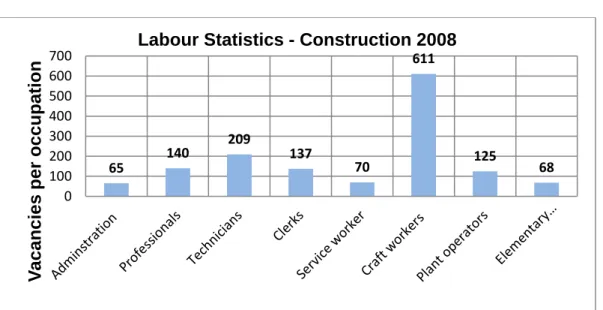
Figure 2.1: Labour statistics - Construction sector (Source: Labour Statistics report, 2008: 10). (No further data regarding this indicator could be established beyound 2008).
65 140 209 137 70 611 125 68 0 100 200 300 400 500 600 700 V a c a nc ie s pe r oc c upation
18
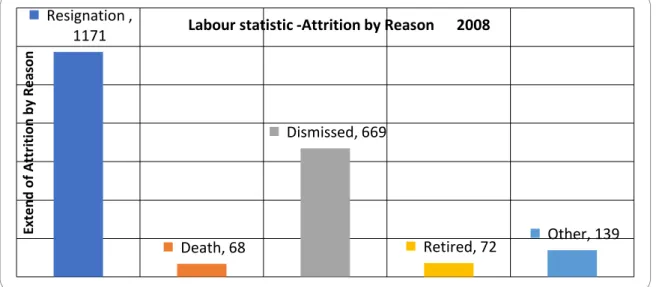
Figure 2.1 above illustrates a higher vacancy rate in the category of craft workers and technicians. These groups are more critical in term of the delivery of quality workmanship. Also, the scarcity of this category impacts significantly on project performance in terms of schedule, hence cost escalation remains inevitable to achieve targets. The loss of expertise also negatively impacts on every project performance and such a factor cannot be ignored. Figure 2.2 below illustrates the attrition by reason in the construction industry in Botswana during the review period of 2008. (No data beyond 2008 is documented regarding this indicator).
.
Figure 2.2: Labour attrition (Source: Labour Statistics report, 2008: 25).
It is evident from the preceding Figure 2.2 that resignation remains the highest, followed by dismissal. While there are other contributing factors, cultural conflict cannot solely be responsible for resignations and dismissals, though this can have a significant effect. Jones and Saad (2003: 129) observe that a multicultural environment can easily create problems related to unfair treatment or discrimination. It is also considered a source for visible conflict normally associated with communication, wage segmentation, task assignment, and trust. Jones and Saad (2003: 132) identify that scapegoat theory principle that states that “beliefs and religion are important aspects that need to be considered in order to realise a constructive working and living environment on a multicultural project.” The level of resignation and dismissal also plays a role in people’s perceptions about the industry because of the resultant effects on individual families’ financial outcome. Resignation , 1171 Death, 68 Dismissed, 669 Retired, 72 Other, 139 Exte n d o f A tt ri tion b y R e ason
19
2.1.2 CHARACTERISTICS OF THE CONSTRUCTION INDUSTRY
Dainty et al. (2005: 9), citing Loosemore et al. (2003), point out that the key characteristic of construction project environments is their unpredictability relative to static production industries. The Botswana government, as a major player in the industry, remains the client of most development projects. However, the government has set a regulatory body, the Public Procurement Asset and Disposal Board (PPADB), to oversee procurement of all government-funded projects.
Neuland (2007: 72) observes that international business differs from domestic business because countries have different political, legal, and economic systems as well as different cultures. The presence of the South African multinational firms in Botswana further influences similarities in the construction industry. Hauptfleisch and Sigle (2000: 34) identify characteristics of the South African construction industry, which appear alike to those in Botswana, as follows:
The industry is fragmented (numerous role players in separate enterprises); The nature of the work is cyclical, resulting from economic variables;
The labour supply is inadequate in terms of skills with poor levels of training; Materials supply with price increase is beyond the control of the contractor; Productivity problems result from a lack of training and management
commitment;
Cost of capital equipment is extremely high - the civil engineering contracting industry is particularly capital intensive;
Contractors often have a shortage of operating capital whilst retention funds and guarantees strain liquidity and underpayment of main; subcontractors’ places financial strain on their operations;
There is consumer resistance to technological development and changes hampers innovation, and
The status and image of the construction industry is not of a high standing.
As Hauptfleisch and Sigle (2000: 7) assert, in Botswana, which is a developing country with a small population, the construction industry depends on advanced economies such as that of South Africa. Matambo (2016: 3), in his budget speech, asserts that the economic performance of the Southern African Development Community (SADC) mirrors that of the global outlook. It is also noted that for Botswana’s economy to achieve a
20
robust international competiveness, growth in productivity and improved efficiency among domestic economic entities are important.
2.1.3 GOVERNMENT ROLE IN THE CONSTRUCTION INDUSTRY
The construction industry plays a vital role in the economy of the country, and Maruapula (2008: 6) observes that the government of Botswana is a major employer and key player in the economy of the country. The role of the government therefore cannot be overlooked and the government cannot afford to ignore construction industry affairs. The Botswana government role in the infrastructure has so far been that of a financier in many facets, and indirectly, a regulator.
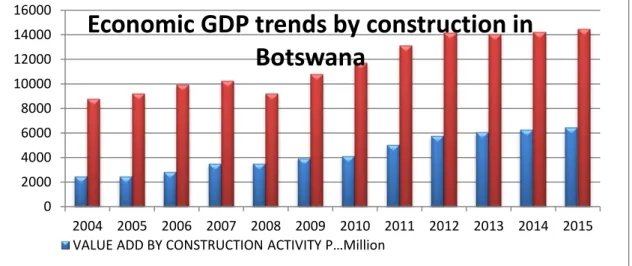
Figure 2.3 below gives a graphical presentation of the economic contribution of the construction industry to the GDP of the country.
Figure 2.3: Value add by construction industry to country’s GDP (Source; Statistics Botswana - GDP, First quarter 2016).
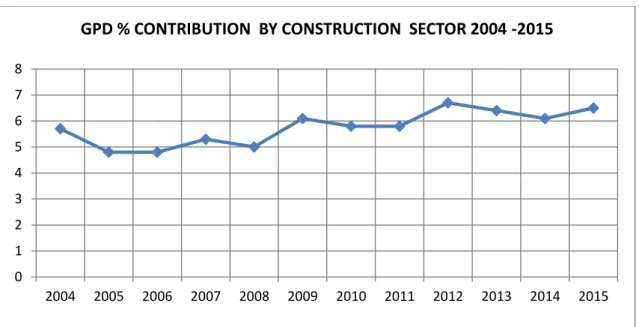
It is evident from the results in Figure 2.3, that since 2004, the construction sector expenditure and the value added by the sector have gradually inceased from 5.7% cent to a peak of 6.7% in 2012 and subsequently declining in 2015 to 6.5%.
0 2000 4000 6000 8000 10000 12000 14000 16000 2004 2005 2006 2007 2008 2009 2010 2011 2012 2013 2014 2015
Economic GDP trends by construction in
Botswana
VALUE ADD BY CONSTRUCTION ACTIVITY P…Million
21
Figure 2.4: Value added by the sector in percentages (Source Statistics Botswana,GDP, First Quarter 2016).
2.1.3.1 Government as a client
The government remains a key client in several economic activities through various government set-ups, which are as follows:
The central government development budget is implemented by the Ministry of Infrastructure Science and Technology whereupon several consultants are appointed to oversee the project implementation;
Local government projects are also implemented at the ministerial level. These include mostly social development projects, e.g. financing of self-housing schemes, which is government assistance to low-income groups to afford them a basic housing unit. Local government oversees the implementation of the loan scheme at subsidised rates. Through local authorities, the government also undertakes some capital development projects, and
Parastatals - These are semi-government organisations run by a board of directors, which obtain funding directly from government. An example of such is the Botswana Housing Corporation (BHC). The Botswana government supports the BHC in pursuing its mandate to provide affordable housing to the Batswana on behalf of the government. The BHC is a major property developer in the country for low-income to 0 1 2 3 4 5 6 7 8 2004 2005 2006 2007 2008 2009 2010 2011 2012 2013 2014 2015
22
high-income housing units, which are thereafter leased or sold to the public through strict conditions of first time buyers.
2.1.3.2 Government as a regulator
The Botswana government has set some institutions to oversee monitoring. The Public Procurement, Asset and Disposal Board (PPADB) established by an Act of Parliament (Cap: 42:08, 2006) undertakes the regulation of procurement of service providers in Botswana, including the construction industry.
Construction contributed 5.7 per cent of the country’s GDP in 2004 with a peak of 6.7 per cent in 2012. This shows the extent to which the sector contributes to the economy of the country (Botswana Statistics, GDP report 2015: 78). In this regard, the government has conferred interest as a major player to the PPADB for regulation, particularly on government projects, which impact significantly on the improvement of the construction industry - Public Procurement and Asset Disposal Act No 10 of 2001. The government also supports established professional bodies to regulate the operations of the sector.
The Engineering Registration Board (ERB) is an example where entry is determined by certain qualification criteria. The ERB is a statutory body charged with the responsibility of regulating the activities and conduct of engineering role players in Botswana as empowered by the Engineers Registration Act No. 23 of 2013 and implemented in 2014. Its objectives are to promote the highest standard of engineering practice in Botswana, and protect the welfare and interest of the public in terms of engineering practice.
2.1.4 PROCUREMENT OF CONSTRUCTION PROJECTS IN BOTSWANA
As outlined earlier, Botswana practises a free economy market, and competition is pivotal to works award. Jones et al. (2003: 21) note that competition is inherent in construction culture, but price is the primary determinant of success. Time plays a role, as does quality, but price most frequently dominates the customer-supplier relationship. The Botswana government operates a comprehensive tendering and evaluation process for all government purchases, including building and infrastructure development. The procurement structure of the government-funded projects in Botswana is through the Public Procurement and Asset Disposal Board. The Board is responsible for the implementation and management of the public procurement and disposal process aimed
23
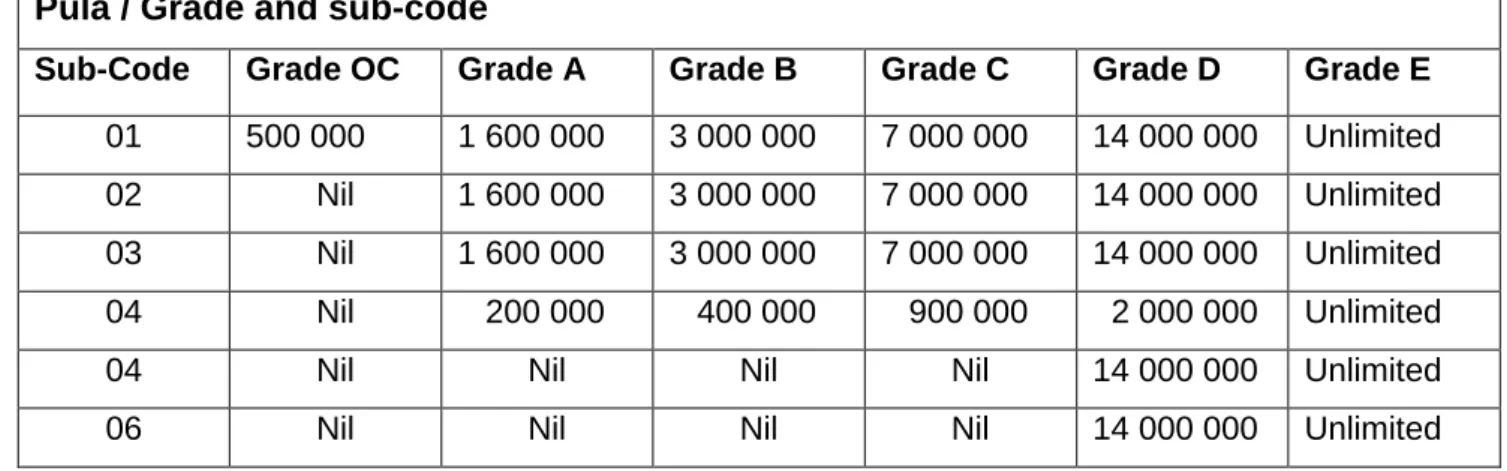
at ensuring an efficient, fair, accountable competitive procurement process in which the people of Botswana will have confidence (PPADB Annual Report, 2009 / 2010). The evaluation of project procurement is facilitated by using set contractor categories as set out in Table 2.1
Table 2.1: Building contractor grading ceiling Pula / Grade and sub-code
Sub-Code Grade OC Grade A Grade B Grade C Grade D Grade E
01 500 000 1 600 000 3 000 000 7 000 000 14 000 000 Unlimited 02 Nil 1 600 000 3 000 000 7 000 000 14 000 000 Unlimited 03 Nil 1 600 000 3 000 000 7 000 000 14 000 000 Unlimited 04 Nil 200 000 400 000 900 000 2 000 000 Unlimited
04 Nil Nil Nil Nil 14 000 000 Unlimited
06 Nil Nil Nil Nil 14 000 000 Unlimited
Source: PPADB, Contractor registration guidelines 2009
2.1.4.1 Compliance and regulation
The PPADB has reviewed entry requirements for construction industry players in 2014 as illustrated in Table 2.2 below:
Table 2.2: Construction Industry entry requirements
Grade Ceiling Qualification
Key staff Key Staff Relevant Experience Experience of the company OC 1 500 000 Certificate in
Building 2 years None
A 3 000 000 Diploma/NCC in
Building 2 years
2 Projects from Grade OC
B 7 200 000 Diploma in Building 3 years 2 Project from
Grade A
C 12 000 000 Degree in Building 2 years 2 Projects from
Grade B
D 30 000 000 Degree in Building 4 years 2 Projects from
Grade C
E Unlimited Degree in Building 5 years 2 Projects from
Grade D
24
To assess the effectiveness of the Board, during the financial year 2009 / 2010, the PPADB considered 1 473 applications for registration, most of which (1 233) were for construction. This was followed distantly by ICT at 109. The figure of 84 per cent of new entrants highlights growth in the sector. It is notable that in line with the above requirement for any practitioner to register as a contractor with PPADB, the candidate is required to comply with the provisions of the professional body, the ERB. The government of Botswana, through the PPADB Act section 50, established a punitive measure in 2009 to de-register companies. The measure targets companies that fail to successfully complete government-funded projects within the stipulated project time after referral to a disciplinary committee for consideration. The delisting is enforced by excluding prospective bidders from government projects. With the necessary knowledge that government is the major developer, contractors are making all efforts to comply. The construction industry, through a consultative conference by stakeholders in December 2010, reached the decision to set up the Construction Industry Regulatory Board (CIRB), similar to the cidb in South Africa. The authority is aimed at driving an integrated construction industry development strategy.
2.1.5 INDUSTRY ROLE PLAYERS
Botswana practises a free market economy system where everyone is free to compete in an open market. Palalani (2000), in Ngowi and Ssegawa (2000: 22), identifies the major challenge facing the construction industry in Botswana as dominance of the construction industry by foreign firms in all sub-sectors. Given this, the domestic contractors should have the capacity to effectively compete with internationally established firms, some of whom have compromised their record in terms of ethics. This gives the local industry a negative image in the eyes of the public. Stapelberg (2002) in Nieuwenhuizen (2002: 217) observes that the support of the public unfortunately cannot be purchased along with the rest of the stock. It must have been earned and maintained, and it is here that public relations are involved. The identification of possible stakeholders is a precondition for any participatory planning process. If stakeholders are not identified, they cannot be invited to participate.To further justify the fact that the construction industry needs to change, Pryor (2001: 9) points out that people both within and outside the construction industry need to alter their perceptions to conduct business in today’s market place. It is therefore imperative to develop a stakeholder management tool, and stakeholder analysis is a repeated exercise with representatives of the involved stakeholder groups.
25
This assures a deeper understanding of the issues by stakeholders, and prevents the exclusion of stakeholders at any stage.
2.1.5.1 Stakeholder identification
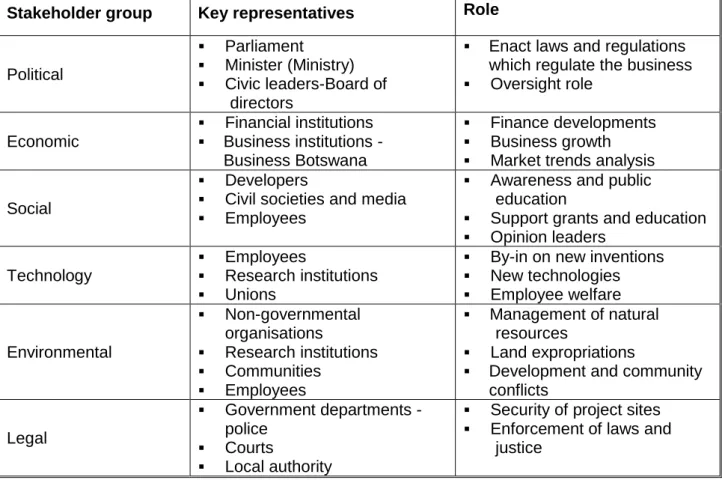
The construction sector does have key stakeholders that cannot be ignored. Having a clear purpose is important for effective stakeholder engagement. A vision of the desired outcome results in the engagement process being more meaningful for all involved. Having a clear purpose, the matrix is then used to identify the relevant stakeholders, and manage their involvement in the most appropriate way. The PESTLE principles have been used to outline the importance of stakeholders within a construction industry scenario, as indicated in Table 2.3 below. This is a useful tool for understanding the ’big picture’ of the environment in which an organisation operates, and understanding the environment in which organisations operate internally and externally (Hopkins, 2015: 158).
Table 2.3: Stakeholders using the PESTLE Approach
Source: Hopkins 2015:158 –PESTLE classification system.
Stakeholder group Key representatives Role
Political
Parliament Minister (Ministry) Civic leaders-Board of
directors
Enact laws and regulations which regulate the business Oversight role Economic Financial institutions Business institutions - Business Botswana Finance developments Business growth Market trends analysis Social
Developers
Civil societies and media Employees
Awareness and public education
Support grants and education Opinion leaders
Technology
Employees
Research institutions Unions
By-in on new inventions New technologies Employee welfare Environmental Non-governmental organisations Research institutions Communities Employees Management of natural resources Land expropriations
Development and community conflicts Legal Government departments - police Courts Local authority
Security of project sites Enforcement of laws and
26
Through the PESTLE principle applied above, a quick glance at any construction firm reveals that most firms have vast numbers of potential stakeholders, both internally and externally. The understanding of the current situation was used to confirm the approaches needed to drive success. Major government projects are currently mostly undertaken by multinational firms (Table 2.4).
Table 2.4: Projects undertaken by international firms.
Item Project name Firm Country of origin
1 SSK International Airport Sino-Hydro China
2 BUIST Sino-Hydro China
3 Masa Towers - CBD ICC South Africa
4 Francistown Airport upgrading
China-State construction China 5 Francistown Stadium Tuwana Construction China 6 Francistown
Ramokgwebana Road
Sino-Hydro China
7 Bokamoso Hospital China State Company China 8 Lobatse Stadium China
Jiang-Su-International
China
9 Kang Hukuntsi Road Sino-Hydro China
10 Multi-functional building for UB
China Civil China
Source: Researcher's own.
2.1.6 CONSTRUCTION SECTOR EMPLOYMENT STATUS
It is important to reflect on the sector employment status in view that the construction industry plays a key role in the economy of the country and non-performance of the sector impacts on the socio-political issues. The sector employment status highlights the role of a sector on the development of the country and subsequently its people. The construction industry remains one of the major employers in the economy of Botswana and a negative image of the industry dents the overall socio-economic development of the country.
Table 2.5 further illustrates the categories of sectors which have a significant influence on the economy of Botswana, highlighting the level of employment.
27
Table 2.5: Estimated Number of paid employees by sector
Sector / Economic activity Total number (2008) Total number (2017)
Health & Social work 2 297 3 342
Water & Electricity 2 781 5 197
Other community activities 3 454 4 528
Agriculture 5 713 6 560
Finance & Business services 7 469 8 703
Education 9 708 10 278
Mining & Quarrying 11 630 8 102
Transport & Communication 12 372 14 019
Hotels & Restaurants 15 683 18 790
Real Estate & Business services 17 924 20 676
Construction 21 965 23 652
Manufacturing 36 674 37 681
Wholesale & Retail trade 45 520 50 988
Central government 94 121 103 682
Local government 28 480 88 359
Total 315 791 341 036
Source: Statistics Botswana – Botswana statistically year book 2012/2013 (2015: 42).and the Employment Sector survey - June (2017: 7)
The construction industry is the third largest employment sector, and the second largest in terms of the male gender, namely 87.1 per cent. It is second to that of mining, and quarrying at 90.7 per cent (CSO-Labour statistic report 2011: 8) in terms of male gender representivity.
2.1.7 SECTOR COMPARABLE INCOME
An industry income status enlightens regarding the level of attraction that the industry has in terms of local and international professionals who in turn improve the sector development. High levels of attrition in a sector come with a loss of skills capacity. Pryor (2001: 5) highlights that another area of market concern presently affecting the construction industry is foreign competition, and this factor is felt more at national level than the local level, but ultimately foreign competition impacts the local level. Mmegi (2010: 27) attests to the above and gives an example of a typical setup of a multi-national construction environment in Botswana where construction workers allege
28
maltreatment from a Chinese multinational company: “Workers employed by Tuwana Construction, have complained of maltreatment at the hands of their employers to the parliamentary labour relations committee.”
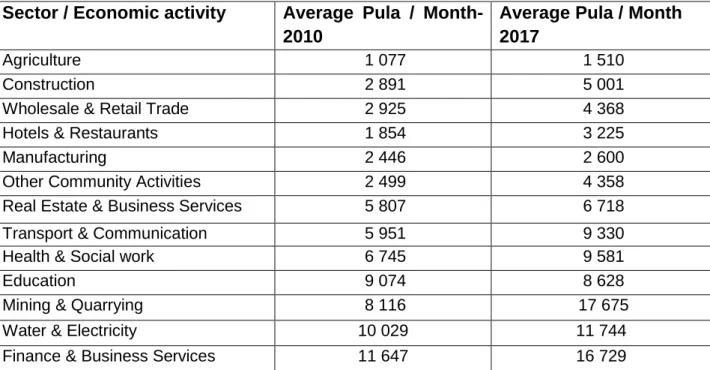
“Principal to the allegation is that the employer, a Chinese company, often favours Zimbabweans at the expense of locals, because the latter would compromise to work weekends without being paid as per the employment contract.” Table 2.6 gives an overview of the sector remuneration in comparison with other sectors as these influence potential new entrants to the construction industry.
Table 2.6: Average monthly remuneration
Sector / Economic activity Average Pula / Month-2010
Average Pula / Month 2017
Agriculture 1 077 1 510
Construction 2 891 5 001
Wholesale & Retail Trade 2 925 4 368
Hotels & Restaurants 1 854 3 225
Manufacturing 2 446 2 600
Other Community Activities 2 499 4 358
Real Estate & Business Services 5 807 6 718
Transport & Communication 5 951 9 330
Health & Social work 6 745 9 581
Education 9 074 8 628
Mining & Quarrying 8 116 17 675
Water & Electricity 10 029 11 744
Finance & Business Services 11 647 16 729
Source: Formal Sector Employment Survey, CSO, (2017: 9).
Table 2.6 shows that construction is rated the sixth lowest paying of the thirteen sectors of the economy in Botswana. Figure 2.5 highlights the level of permit holders in terms of the top four nationalities over a period of four years, starting from 2008 to 2011. The results illustrate the fact that the dominant permit holders are Zimbabwean nationals, followed by Chinese nationals. This result confirms an earlier observation that Chinese contractors prefer Zimbabwean workers.
29
Figure 2.5: Permit holders by nationality over a seven-year trend (Labour Statistics, CSO, (2014).
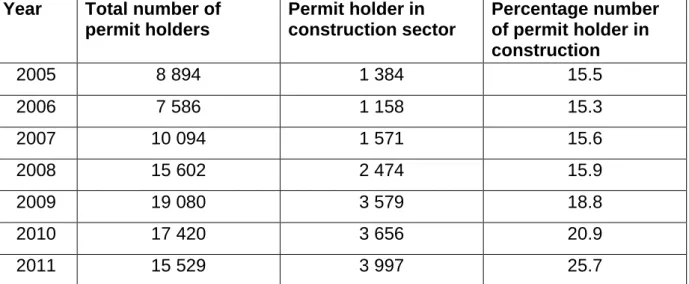
A further observation is made in terms of the percentage of permit holders involved in the construction industry only.
Table 2.7: Percentage rate of permit holders in construction sector Year Total number of
permit holders Permit holder in construction sector Percentage number of permit holder in construction 2005 8 894 1 384 15.5 2006 7 586 1 158 15.3 2007 10 094 1 571 15.6 2008 15 602 2 474 15.9 2009 19 080 3 579 18.8 2010 17 420 3 656 20.9 2011 15 529 3 997 25.7
Source: Labour Statistics, CSO, and September 2012.
The above statistics point to an increase of 65.8 per cent in permit holders in the construction industry for the period 2005 to 2011.
0 2000 4000 6000 8000 10000
Zimbabweans Chinese South African Indians
Zimbabweans Chinese South African Indians
2014 2363 783 1172 724 2013 2774 1261 1334 581 2012 3822 2676 1324 890 2011 5419 3827 1795 1194 2010 7743 3128 1732 1383 2009 8779 3005 1711 1657 2008 6947 2141 1473 1509 2014 2013 2012 2011 2010 2009 2008