NetPal: A Dynamic Network
Administration Knowledge Base
Ashley George, Adetokunbo Makanju,
Evangelos Milios, Nur Zincir-Heywood
Faculty of Computer Science
Dalhousie University
Halifax, NS
{ageorge, makanju, eem, zincir}@cs.dal.ca
Markus Latzel, Sotirios Stergiopoulos
Palomino System Innovations Inc.
Toronto, ON
{markus, sotirios}@palominosys.com
Abstract
Netpal is a web-based dynamic knowledge base system designed to assist network administra-tors in their troubleshooting tasks, in recall-ing and storrecall-ing experience, and in identify-ing new failure cases and their symptoms. In the context of web hosting environments, Net-pal summarises network data and and supports retrieval of relevant organisational experience for system administrators. The system design draws on a variety of domains including knowl-edge management, information retrieval, ma-chine learning and network management. We describe the system architecture, user interface design, user software testing and future direc-tions for development.
1
Introduction
In the course of their duties, system adminis-trators acquire and retain extensive specialised knowledge regarding the operation of complex systems and networks. Experienced system ad-ministrators can rapidly narrow the field of candidate solutions when confronted with net-work faults and associated evidence. Thus the value of experience for a system administrator is high; the administrator uses this knowledge
Copyright c2008 Dr. Evangelos Milios, Dr. Nur Zincir-Heywood, Ashley George, Tokunbo Makanju, Markus Latzel, Sotirios Stergiopoulos. Permission to copy is hereby granted provided the original copyright notice is reproduced in copies made.
to judge an appropriate initial avenue of in-vestigation. This presents an opportunity to optimise use of time and resources by creating a system which supports experience manage-ment [2, 8, 9] and recall in system administra-tors through suggestion of relevant previously recorded experience cases.
In addition to knowing how to solve a recog-nised fault, an administrator needs to detect the evidence which characterises a fault. The collective data stream generated by hosts in a large network grows to exceed that which can be sorted by ad-hoc visual inspection. Numer-ical and visual tools for filtering and reduc-ing the data stream allow the administrator to gain a high-level overview of their network’s be-haviour.
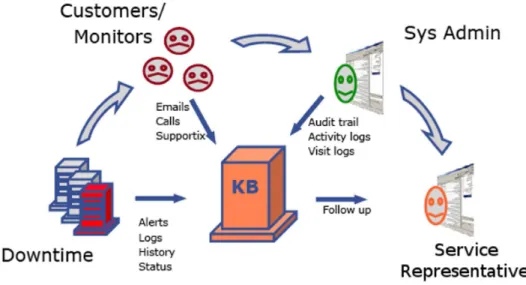
In the NetPal project, a prototype experi-ence retrieval system for system administrators was produced in the context of the web host-ing business. Our goal is to reduce the learn-ing curve faced by junior system administrators and to supplement recall in senior system ad-ministrators through retrieval of previous expe-rience cases, integrated with web-based report-ing and analysis of network event data, particu-larly host-based server log data. We approach this problem through a combination of infor-mation retrieval, knowledge management, host and network analysis and user interface design. The process of troubleshooting a network fault is described in [10] as containing the fol-lowing steps and roughly illustrated in Figure 1.
Figure 1: NetPal: network fault lifecycle diagram 1. alarm collection
2. customer satisfaction maintenance 3. alarm filtering and correlation 4. fault diagnosis
5. development and implementation of an ac-tion plan
6. verification of fault elimination
7. statistical analysis of fault management process
The fourth and fifth steps are considered to ac-count for 80% of the troubleshooting efforts, based on experience in Palomino; reductions in the effort required from system administrators both for identifying faults and planning resolu-tions would result in significant savings for an organisation. We aim to achieve these reduc-tions by increasing the amount of relevant prior information available to system administrators as they tackle a particular fault scenario.
2
Motivation
The NetPal project is inspired by previous ef-forts in constructing network knowledge man-agement systems [4, 7, 10, 6]. Many of these
systems incorporate rule-based or case-based reasoning. We also take note of a success-ful experimental medical diagnosis support sys-tem, based on similar principles of retrieving literature relevant to a case using text mining techniques [12]. Drawing on these sources, we focus on constructing a system which acts to ease the recall of experience and the interpre-tation of system information by administrators. Therefore we are less concerned with automat-ically producing corrections for problems; we are more interested in prompting both learn-ing and recall in employees who are well-suited for correcting emerging problems.
2.1
Rule- and Case-based
Reasoning
Rule-based reasoning (RBR) systems, in the context of computer network management, tend to take a control systems approach, as re-viewed in [4]. In a network-oriented control system, there is a database of rules which sists of conditions and procedures. The con-ditions represent knowledge about the normal operating state of the network. When these conditions are violated, the network enters an irregular operating state. At this point, proce-dures can be executed to ostensibly return the state of the network to the normal operating
state. In [7], Lewis suggests that rule-based reasoning systems tend to suffer from brittle-ness and a “knowledge acquisition bottleneck”. These faults are respectively characterised by difficulty in adapting to novel problem situa-tions and an unconditioned growth of the rule-base as new conditions and procedures are in-serted. In the latter case, the database becomes unmanageable and may lead to unpredictable behaviour.
Following this assessment, Lewis proposes a case-based reasoning system to record and adapt “episodes of problem solving” where the adaptation of these episodes consists of ob-serving interactions with the case database (“abstraction/respecialization adaptation”) or modifications directly to the cases themselves (“critic-based adaptation”) [7]. The system, ’Critter’, enhances a typical trouble ticket database system by introducing constraint-based ticket filtering and user feedback-capturing mechanisms for updating the case database over time while minimising user in-tervention where possible. Lewis’ augmenta-tion of the trouble ticket system appears to favour a predicate-oriented representation (as with RBR) where we prefer an information re-trieval strategy.
An alternate approach to case-based reason-ing for system administration is to insert the reasoning system at a different point in the problem resolution process. In [10], the case-based reasoning system is situated closer to the alarm collection source, in the sense that alarms are processed by the system before a ticket is raised, in the hopes of reducing the volume of raised tickets. This approach tar-gets a coarse-grained control system - when the collected alarms match the preconditions for a case, that case and its attached proce-dures are automatically applied to resolve the problem. Contrast this coarse-grained activ-ity with the application of a discrete series of individual rules and procedures geared to in-crementally restore operational state, as in a rule-based system. For their experimental test-ing, pre-defined cases were used. It was found that procedures were automatically applied to 8% of faults over time, leaving 92% of faults for “in-site maintenance”.
Each of the systems described in these works
focuses on applying fine-grained or coarse-grained procedures in the context of telecom-munications systems when predetermined con-ditions are matched. In the fine-grained case, the expert is required to craft a number of condition-action statement pairs which incre-mentally return the system to its ideal operat-ing state. In the coarse-grained case, the do-main expert crafts a complex condition and a complex procedural response which returns the system to its ideal operating state. In both cases, the requirement of formal statements for conditions and solutions suggests difficulty in future adaptation of the rule or case base to changing network conditions.
2.2
Information Retrieval and
Medical Diagnosis Support
Patients in a clinical setting may exhibit a mixture of symptoms, giving rise to multiple plausible explanations for their condition. The caregiver for the patient is expected to infer from the observed symptoms (and patient case history) an accurate diagnosis which will pro-vide a basis for corrective and preventative medical action.
In the context of medical diagnosis, ISABEL [12] is a diagnosis support system which, in early trials, has reduced errors of “diagnosis omission” [11, 16, 13]. ISABEL is reminiscent of a search engine and is heavily tailored to-ward searching medical literature. This con-tent restriction allows for the implementation of domain-specific features, including presenta-tion of probabilistically ranked diagnoses, ex-pert annotations of case material and more. Unlike the rule-based and case-based systems described in the previous section, the purpose of ISABEL is not to automatically apply rules or case-based scripts but to act as a reminder aide for the expert.
Much as a doctor may benefit from prompt-ing to consider alternative diagnoses, network administrators may also benefit from a sys-tem which prompts knowledge recall. Our problem domain requires a different approach from ISABEL given that there is no systemic, widely applicable body of diagnostic litera-ture which uniquely characterises root causes of fault symptoms for web hosting environments.
Thus we provide the administrator with search and visualisation tools to help them interac-tively narrow their hypotheses.
We aim to enhance the abilities of admin-istrators to filter generated system events and to recover previous work experience. Where rule-based and case-based systems attempted to automatically detect conditions and apply scripted solutions, we rely on arming adminis-trators with increased prior information so they may better assess conditions and produce solu-tions. Where ISABEL links medical literature to symptom descriptions, we index and present previous experience and domain-specific docu-ments to aid the administrator in gaining un-derstanding of the current case. We aim not to automate all problem-solving but to improve knowledge transmission and recall for junior and senior network administrators.
3
The Web Hosting
Environment
In our work, NetPal is developed and tested in the context of the small to medium web host-ing environment. Servers deployed in a web hosting environment handle hosting responsi-bilities in a distributed manner. In addition to web content, there are many services offered by the web hosting provider to support their customers, including email, domain name ser-vices and custom application support. The web hosting environment therefore produces multi-ple kinds of faults, emanating from different hardware, software, customer and consumer sources.
The hardware and software configuration se-lected by a web hosting provider will depend on customer needs. Cardellini et al [3] de-scribe several configuration scenarios for han-dling high-load web applications. While small customers with relatively static website content consume a fraction of a server’s capacity, cus-tomers with high traffic and application pro-cessing costs require concurrent solutions con-suming multiple physical servers, both for pro-cessing and for redundancy.
Allocation of resources in a web hosting envi-ronment is therefore multiplied over reliability and responsibilities. To handle these
respon-sibilities, there are typically groups of servers dedicated to
• handling web requests
• application layer processing
• database and object retrieval
NetPal targets this kind of heterogeneous op-erating environment which contains off-the-shelf components, custom components and per-customer hardware and software configura-tions. By taking an information retrieval ap-proach, we hope to mitigate some of this het-erogeneity when searching through collected data. For our testbed environments, we chose to simulate a complex hosting environment by replaying log data and case history collected at Palomino Inc. into databases on the NetPal test servers. In Section 5, we further describe how our software testers interacted with this system and summarise their feedback.
4
System Architecture
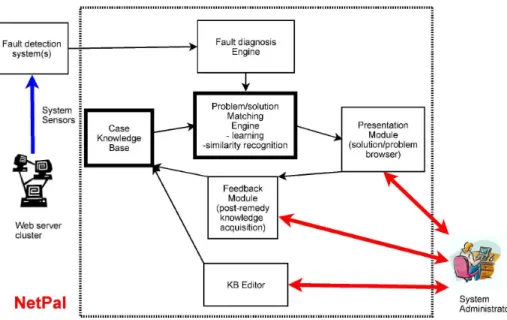
The NetPal system is composed of a set of core components which are intended to integrate with external fault detection systems. The core components include the following.
• case knowledge base
• problem/solution matching engine
• presentation, feedback and editor modules Their component interactions are summarised in Figure 2.
4.1
Case and Problem/Solution
Matching
Underlying the case knowledge and prob-lem/solution matching engine is an information retrieval (IR) subsystem. In an information re-trieval system, the prevailing metaphor is that of query-answering, normally by returning a ranked set of documents for the user’s query under a measure of relevancy [1, 5].
In our system, queries can be generated man-ually or automatically as the system adminis-trator interacts with NetPal and builds a case.
Figure 2: NetPal core system components diagram We then make recommendations for related
ar-ticles, cases and events (logfile entries, at this time). The administrator can also query the relevant components individually. We would typically generate a list of keywords from case components but an example of a manual sam-ple query might be a series of keywords gar-nered from observing log entries or a best initial hypothesis, such as
• “php open_basedir”
• “domain conf problem”
These kind of queries can be extended through query expansion: using a thesaurus with do-main knowledge to automatically produce a list of synonyms. We use query expansion to op-tionally broaden the scope of queries generated in NetPal.
4.1.1 Information Retrieval
We adopt the vector space model to char-acterise our cases for retrieval purposes and to capture the similarity between vectors us-ing the cosine angle distance. This model, originally described in [14] and summarised in [5], represents documents as vectors in a term frequency-inverse document frequency (TF-IDF) space. We describe this model here as a basis for our system.
LetT name the vocabulary of unique terms extracted from the document corpus andti be
thei’th term inT. LetDbe the set of all docu-ments anddj be a particular document. Then,
the normalised term frequencytfij is given by
tfij =
nij
|dj|
(1) where the frequency of occurrence of termti
in documentdjis denoted bynij. This measure
captures the relative importance of a term in a particular document while accounting for the effect of varying document length.
The in-document term frequency (TF) is one component of the representation. The other is the inverse document frequency (IDF). Given a term ti, the inverse document frequency is
calculated as idfi= log | D| |{dj : ti∈dj}| (2) This quantity characterises the support of the term ti in the document corpus; terms
which appear in few documents obtain a high IDF score while terms which occur widely throughout the document set will score closer to zero.
For document dj and term ti, tf idfij is the
product of these quantities. The term fre-quency captures the in-document importance
for ti and the inverse document frequency
captures the whole-corpus importance for ti.
These values, multiplied, reward most those terms which are highly characteristic of a par-ticular document, yet not widely occurring with respect to the entire document set. Fi-nally, a particular document dj is represented
as a vector of such TF-IDF scores, with one entry for each term in the vocabularyT, as in Equation 4.
tf idfij =tfij·idfi (3)
dj=tf idf(1,j), tf idf(2,j),· · ·, tf idf(|T|,j)
(4) We facilitate retrieval of document vectors by constructing an inverted index [1, 5] relat-ing terms to the documents in which they ap-pear. This enables a query document to be matched against terms in the database which in turn generates a set of candidate matching documents. That is, for each term in the query document, the corresponding set of documents in which that term appears is fetched from the database. However, these document sets may overlap and they are unordered. Therefore, we order them based on the cosine angle similarity between the query vector,q, and the vector for each document in the result set.
cossim(q, dj) = P itf idfiq·tf idfij q P itf idf 2 iq· q P itf idf 2 ij (5) The query vector can be generated manu-ally or automaticmanu-ally from different sources; we adapt the information retrieval system to dif-ferent tasks through modifying the indexing and either requesting query input or generat-ing queries automatically.
4.1.2 Documents and Queries in NetPal
We described the vector space model for infor-mation retrieval. In NetPal, we use this model for retrieving indexed articles, cases and events. Each of these type of documents is represented as a vector of tf idf weight values in a corre-sponding index. We reduce the index size by filtering unrepresentative terms, as is common
in information retrieval applications [1, 5]; in particular, we filter terms by their inverse doc-ument frequency, reducing the term dimension-ality of our indices by an order of magnitude. (e.g., from tens of thousands of terms to a thou-sand terms.)
We produced a system taxonomy through a combination of automatic generation and ex-pert refinement of the vocabulary, and with manual organisation of the taxonomy’s hierar-chical structure. We use the taxonomy to ex-pand queries by introducing related terms. For problem/solution case matching, we generate queries automatically from terms in the case it-self and any attachments it may hold (including text fields, log events and attached articles or cases). When directly searching through cases, we expressly allow the user to input queries and optionally expand these using the taxonomy.
4.1.3 Log Data Acquisition Engine
We developed a system for aggregating logged data, dubbed the ’Log Data Acquisition En-gine’ (or LDAE). The LDAE is a background process which serves to collect system log data from multiple hosts, process the entries to allow basic grouping of like events, and feed the data into an SQL database for manual or automatic correlation with cases in NetPal.
Feeding log entries through an aggregator en-ables the collection of global log data statis-tics. We initially attempted using an as-sociation rule mining algorithm for identify-ing strong subpatterns in log entries, as in Vaarandi [17, 15]. This would allow us to per-form grouping of log entries in the user inter-face by frequent shared tokens. However, the offline cost of this algorithm was prohibitive for our system.
Therefore, we selected a static set of regular expressions for matching common logfile pat-terns. This included dates, times, IP addresses, common services, local hostnames and more. By replacing highly-variant substrings in con-secutive entries with common tokens, we could enable a limited version of the grouping effect we aimed to achieve. We employ this in the user interface for ’collapsing’ like entries into clusters and reducing the number of log entries on display.
In sum, the role of the LDAE is to collect and preprocess log data, from multiple services dis-tributed across hosting servers, and to aggre-gate this data in a central database. Once these log entries are collected in the central database, they can be indexed for subsequent retrieval in NetPal.
4.2
User and Web
Interface Design
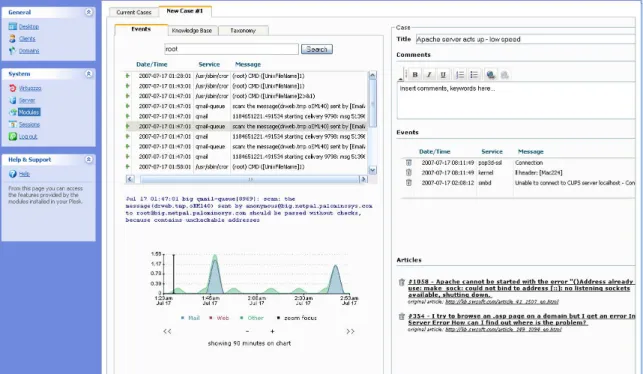
The main NetPal interface consists of a web-based module which can be integrated in pop-ular web hosting control panel software as a plugin or can be run separately as a standalone web application. Figure 3 displays an overview of the NetPal user interface. A number of com-ponents are visible and we address these here.
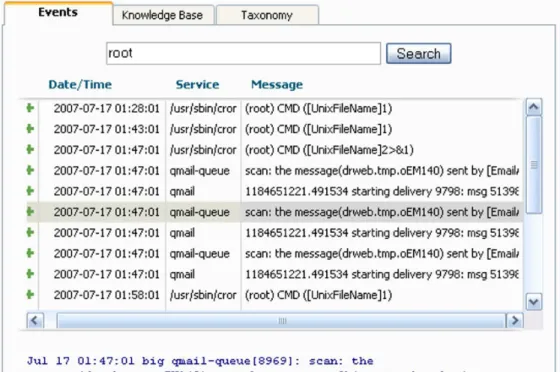
The main page is divided into two panes. We focus on the left pane which contains the event browser and event graph. The event browser is pictured in greater detail in Figure 4 (a). The browser includes several features to aid in sift-ing through logged data. Like cases, events are searchable and the list of relevant events can be narrowed by entering search terms in the search field at the top of the event browser. Each event is initially depicted using a one-line summary, here containing the date/time of oc-currence, the service responsible for generating the event and the message associated with this event. Notice here that the raw event can be recalled by selecting the desired event in the browsing list; the event then is displayed in its entirety below the list.
Underneath the events browser is the events graph, depicted in Figure 4 (b). The events graph is meant to impart the level of event ac-tivity over time. The height of the peaks on the chart corresponds to the number of events occurring during that time interval. The time interval of the graph can be modified for greater detail. The graph is color coded, as in the leg-end, to indicate which services generate which peaks. Note that clicking anywhere within the graph repositions the event browser’s listing to show events surrounding the chosen time.
The left-hand pane also has multiple tabs at the top. The default pane contains the event browser and event graph. Alternate panes in-clude search interfaces for cases and articles,
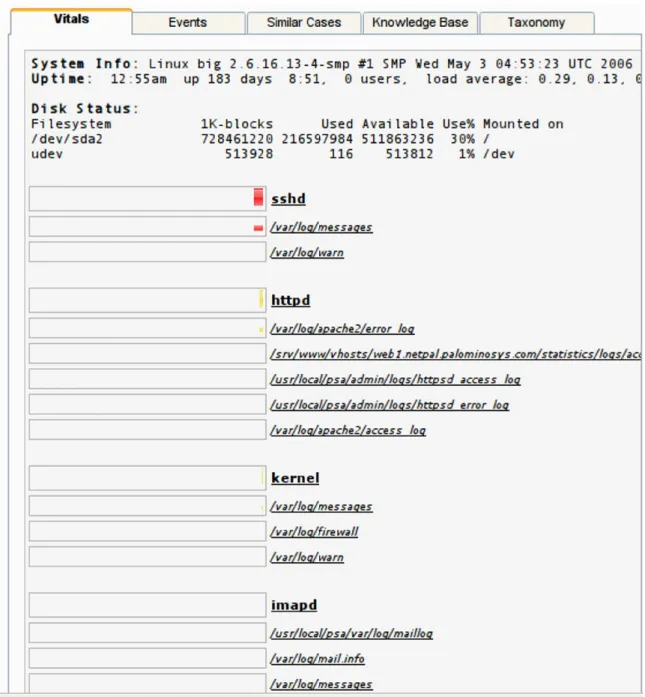
a visual representation of the domain taxon-omy (a text-based tree component) and the “vi-tal signs” component. The vi“vi-tals component indicates the proportion of errors recorded in each logfile on the main host and commonly requested system statistics. The vitals compo-nent is depicted in Figure 5.
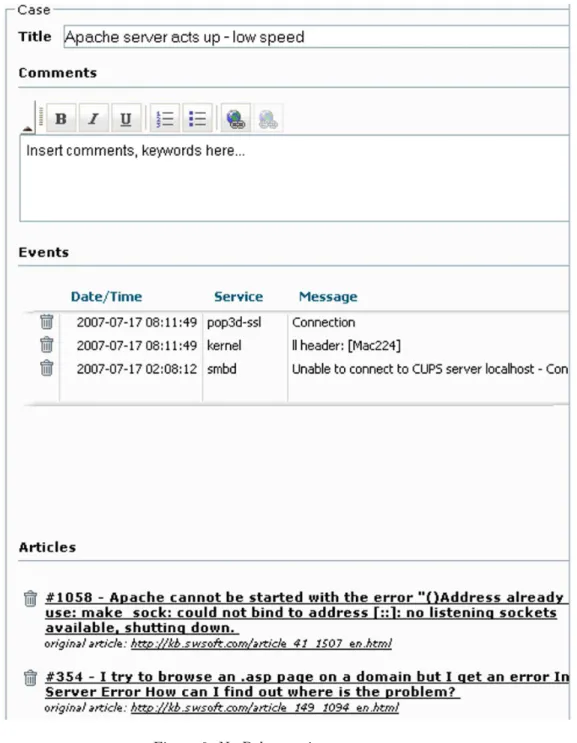
When a new case is opened or a case is retrieved from the case base, the case edi-tor/viewer, as in Figure 6, is populated with data in each relevant field either by the database or by the user. The user can populate a case by interacting with the event search in the left-hand pane, including dragging relevant events from the left pane to the right or adding them at the click of a button. As fields are filled, events added and cases linked to the cur-rent case, a heterogeneous data structure repre-senting the case is constructed internally. This structure is stored as the user modifies it and is indexed for matching and retrieval.
5
Software Testing
As our prototype neared completion, we sought software testing feedback from candidate users about the usability and suitability of the soft-ware for two real-world system administration tasks reconstructed from experience by staff at Palomino Inc. At Dalhousie University, we ob-tained feedback on these scenarios from five testers, of which three were permanent IT staff members and two were co-operative education students working as IT helpdesk assistants. At Palomino Inc., feedback was obtained from two professional system administrators outside the company who volunteered their time to test the system.
5.1
Testing Configuration
At each site (Dalhousie University and Palomino Inc.), we set up a server running the NetPal system. We populated the NetPal database with sample cases, knowledge base articles and log data, previously recorded by Palomino Inc. during instances of problem-solving. We provided each tester with a soft-ware manual explaining the components of the NetPal system. The testers received scenario outlines describing observed faults which the
Figure 3: NetPal prototype user interface testers would attempt to ’diagnose’, given the
hypothetical circumstances.
Testers were required to consider the fault symptoms, sift the log data using the web in-terface, build a case using NetPal, accurately identify the root cause of the observed fault and propose a reasonable solution based on experi-ence (articles and cases) where possible. They were not required to fully implement the pro-posed solution. We asked the testers to de-scribe their experiences with each scenario on a per-component basis and to provide ratings for the usefulness of each component for each scenario.
5.2
Tester Feedback
The components which we asked our testers to rate and on which we asked them to comment included the event list and graph (Figure 4, (a) and (b), respectively), the vital signs compo-nent (Figure 5), the case viewer/editor (Figure 6), the taxonomy tree and the knowledge base search.
The event list component (for searching and browsing of aggregated log data) was most
highly rated by the administrators and IT staff. The two help desk assistants gave the event listing the lowest rating. The most requested feature for the event listing was that NetPal should expose additional filtering and search features, particularly filtering on severity. The most common complaints were that there was display lag when scrolling or paging in the log event listing window and that for usability the event list should be more easily resized.
The event graph received mixed ratings. Al-though the majority of our testers agreed that the graph helped to situate the event listing in time and to give a sense of the period of the log data, very few indicated that they used the zooming or panning feature to support their problem solving. The reasons offered for this included the lack of resolution in the graph dis-play and the latency of the graph refresh rate. The vital signs component was highly rated by all testers. From the perspective of the administrative group, collecting frequently queried system data into a common display was compelling. From the perspective of the helpdesk assistants, the at-a-glance sorted list of error rate per log file was appealing. One
(a)
(b)
administrator requested that this component provide an expanded summary of local and net-work features.
Most testers suggested a middling rating for the case viewer/editor. An experienced admin-istrator requested further automation at this point, suggesting that there be some method to jumpstart the population of a new case’s fields. Another administrator requested minor inter-face enhancements (e.g. larger font, resizing). The rest of the testers found the viewer/editor serviceable but that the testing scenarios pro-vided little opportunity to exercise this feature to the fullest.
We provided a display of the system tax-onomy on a separate tab. This was imple-mented using a simple tree widget displaying the terms in the taxonomy along with their hierarchical relationships. Most of our testers couldn’t relate the taxonomy to their problem-solving task. Two testers said that the taxon-omy helped them to find topical synonyms in their search of the knowledge base.
Finally, we provided an interface for query-ing our database of collected knowledge articles and cases. Here the testers gave mixed ratings; some were able to locate relevant articles and cases and some were not. The direct search in-terfaces appealed to some users for the power to refine one’s query directly and manually. Most requested that the search results should more strongly resemble popular search engines.
5.3
Discussion
The events list component and the vital signs component resonated with the administrators and IT staff. These components capture com-monly made system queries. Encoding queries directly in the interface succeeds where these capture frequently used previous working expe-rience and make it immediately accessible and replicable. So we can think of one kind of ex-perience as accumulated patterns of system in-teraction which emanate from the administra-tor. If we can strongly capture these in the interface, we should enable the administrator to dispense with rote behaviours in their daily work. Several administrators asked for addi-tional filtering criteria (e.g. by severity); this suggests either careful statistics or
standard-ised semantics for log files would be valuable. One tester suggested including an embedded terminal, opening an opportunity for automat-ically capturing command sequences for future reference.
Although the event list appealed most to senior staff, it held little interest for junior testers. It’s unclear exactly how much the stu-dents were put off by network latency in the updating of the list of events. Eliminating net-work delays from the prototype would allow us to answer this question. It may be that a com-bination of inexperience and frustration pre-vented them from fully accessing the implicit experience represented by the events list com-ponent.
All our testers expressed some approval of the temporal and visual summary communi-cated by the events graph; yet, none of them found navigation via the graph to be useful in their testing scenarios. One way to improve the navigation might be to use a visualisation which directly expresses a discrete metric of the log data. The graph, as it stands in Figure 4 (b), uses a continuous function to represent fre-quency over time. On the other hand, events in a log file are discrete occurrences. Our testers might be better served with a discrete visuali-sation which can be drilled down, rather than a continuous one. (This might permit, in the extreme, the events list and the graph to be merged for additional screen real estate.)
For our test scenarios, in addition to the set of cases we crafted manually, we treated our ar-ticle database as equivalent to cases for testing purposes. But, while the articles with which we bootstrapped the database are in the same problem domain (that is, web hosting), they are only an approximation of experience cases. One administrator commented that many of the articles in the knowledge base were re-lated to initialisation or permanent configura-tion problems whereas the testing scenarios re-lated more to transient problems. Additionally, the number of articles we used to bootstrap the initial database was small, on the order of a few thousand; this may have limited the applicabil-ity of the case base for our test scenarios.
6
Conclusion
We have described the components, devel-opment and testing of a prototype network administration information system, NetPal, which is a synthesis of information retrieval, human-computer interaction, event analysis and experience retrieval. We outlined the sig-nificant user interface components, described the inner workings of the retrieval system and our model for acquiring and processing log data for consumption in the main system. We ob-tained feedback from testers which will aid us in selecting future directions for the project.
Our prototype faces hurdles yet we have es-tablished a footing on which to base future de-velopment and research. Future dede-velopment on NetPal will focus on automatic experience collection for the case database, improving the human factors associated with a dynamic web application, applying more sophisticated data mining techniques to our acquired event data, particularly to examine the apriori-like algo-rithm of Vaarandi as a clustering model and to enable enhanced visualisations, and fine-tuning our search engine for optimum retrieval.
Acknowledgements
We acknowledge the financial support of Precarn Inc. and the Natural Sciences and Engineering Research Council of Canada.
Ashley Georgereceived his BCS and MCS in 2003
and 2006 respectively from Dalhousie University and is now pursuing his Ph.D. His research interests focus on machine learning, document mining, network and system security and philosophy of science.
Adetokunbo Makanju obtained his B.Sc. from
the Department of Computer Science at University of Lagos, Nigeria and his M.CS. in 2008 from Dalhousie University. He is presently studying for his Ph.D. with the Faculty of Computer Science at Dalhousie University. His research interests are in the areas of wireless networks, intrusion detection, genetic programming and case-based reasoning.
Evangelos Milios is Professor and Killam Chair
of Computer Science with the Faculty of Computer Science at Dalhousie University. He received a diploma in Electrical Engineering from the National Technical University of Athens, Greece, in 1980 and M.Sc. and Ph.D. degrees in Electrical Engineering and Computer Science from the Massachusetts Institute
of Technology, Cambridge, Massachusetts in 1986. At Dalhousie, he served as Director of the Graduate Program (1999-2002) and he is currently Associate Dean, Research. His current research activity is centered on modelling and mining of content and link structure of Networked Information Spaces.
Nur Zincir-Heywood is Associate Professor
in the Faculty of Computer Science at Dalhousie University, NS, Canada. She obtained her B.Sc., M.Sc. and Ph.D. in Computer Engineering from Ege University, Turkey in 1991, 1993 and 1998 respectively. Her research interests include network services and management, network information retrieval, and the effects of the Internet and information technologies on socio -economic development.
Markus Latzel is President & CEO of Palomino System Innovations Inc, a successful university spin-off in its seventh successful year. He received his M.Eng. in Computer Science and Electrical Engineering from University of Paderborn, Germany in 1999. His research and publications are in areas of intelligent systems, robotic systems, knowledge management, hierarchical databases, HCI and computer vision.
Sotirios Stergiopoulosrecieved his B.Sc. in Com-puter Science from York University, Toronto, ON, Canada. He was previously with MacDonald Dettwiler and Array Systems Computing. He is currently Lead Application Developer for Palomino System Innova-tions, Inc., Toronto.
References
[1] Ricardo A. Baeza-Yates and Berthier Ribeiro-Neto. Modern Information Re-trieval. Addison-Wesley Longman Pub-lishing Co., Inc., Boston, MA, USA, 1999. [2] Ralph Bergmann. Experience Manage-ment: Foundations, Development Method-ology, and Internet-Based Applications. Springer-Verlag New York, Inc., Secaucus, NJ, USA, 2002.
[3] Valeria Cardellini, Emiliano Casalicchio, Michele Colajanni, and Philip S. Yu. The state of the art in locally distributed web-server systems. ACM Comput. Surv., 34(2):263–311, 2002.
[4] R.N. Cronk, P.H. Callahan, and L. Bern-stein. Rule-based expert systems for net-work management and operations: an in-troduction. Network, IEEE, 2(5):7–21, Sep 1988.
[5] David A. Grossman and Ophir Frieder.
Information Retrieval: Algorithms and Heuristics, Second Edition. Springer, Dor-drecht, The Netherlands, 2004.
[6] H. Inamura, O. Takahashi, T. Ishikawa, H. Shigeno, and K. Okada. Automat-ing detection of faults in tcp implemen-tations. Advanced Information Network-ing and Applications, 2004. AINA 2004. 18th International Conference on, 1:315– 320 Vol.1, 2004.
[7] L. Lewis. A case-based reasoning approach to the management of faults in commu-nication networks. INFOCOM ’93. Pro-ceedings.Twelfth Annual Joint Conference of the IEEE Computer and Communica-tions Societies. Networking: Foundation for the Future. IEEE, pages 1422–1429 vol.3, 1993.
[8] Mirjam Minor. Erfahrungsmanagement mit fallbasierten Assistenzsystemen (Ex-perience Management with Case-based as-sistant systems). PhD thesis, 2006. [9] Mirjam Minor and Christina Biermann.
Case acquisition and semantic cross-linking for case-based experience manage-ment systems. In Du Zhang, Taghi M. Khoshgoftaar, and Mei-Ling Shyu, edi-tors, IRI, pages 433–438. IEEE Systems, Man, and Cybernetics Society, 2005. [10] G. Penido, J.M. Nogueira, and
C. Machado. An automatic fault diagnosis and correction system for telecommuni-cations management. Integrated Network
Management, 1999. Distributed
Man-agement for the Networked Millennium. Proceedings of the Sixth IFIP/IEEE Inter-national Symposium on, pages 777–791, 1999.
[11] P. Ramnarayan, N. Cronje, R. Brown, R. Negus, B. Coode, P. Moss, T. Hassan, W. Hamer, and J. Britto. Validation of a diagnostic reminder system in emergency medicine: a multi-centre study. Emer-gency Medicine Journal, pages 619–624, 2007.
[12] P. Ramnarayan, G. Kulkarni, A. Tomlin-son, and J. Britto. Isabel: a novel internet-delivered clinical decision support system.
Current Perspectives in Healthcare Com-puting, pages 245–246, 2004.
[13] P. Ramnarayan, A. Winrow, M. Coren, V. Nanduri, R. Buchdahl, B. Jacobs, H. Fisher, P.M. Taylor, J.C. Wyatt, and J. Britto. Diagnostic omission errors in acute paediatric practice: impact of a reminder system on decision-making.
Medical Informatics and Decision Making, 2006.
[14] G. Salton, A. Wong, and C. S. Yang. A vector space model for automatic in-dexing. Commun. ACM, 18(11):613–620, 1975.
[15] J. Stearley. Towards informatic analysis of syslogs. Cluster Computing, 2004 IEEE International Conference on, pages 309– 318, 20-23 Sept. 2004.
[16] Neal J. Thomas, Padmanabhan Ram-narayan, Michael J. Bell, Prabhat Ma-heshwari, Shaun Wilson, Emily B. Nazar-ian, Lorri M. Phipps, David C. Stockwell, Michael Engel, Frank A. Maffei, Harish G. Vyas, and Joseph Britto. An international assessment of a web-based diagnostic tool in critically ill children. Technology and Health Care, pages 103–110, 2008. [17] R. Vaarandi. A data clustering
algo-rithm for mining patterns from event logs.
IP Operations and Management, 2003.
(IPOM 2003). 3rd IEEE Workshop on,