Bulletin of the Marine Geology, Vol. 33, No. 1, June 2018, pp. 1 to 14
Structural complexity in the boundary of forearc basin – accretionary
wedge in the northwesternmost Sunda active margin
Kompleksitas struktur di batas cekungan busur muka – prisma akresi di
bagian ujung baratlaut tepian aktif Sunda
Maruf M. Mukti
Sedimentary geology & tectonics Group (SaGeT), Research Center for Geotechnology, LIPI. Jalan Sangkuriang, Bandung 40135, Indonesia
Corresponding author: [email protected]
(Received 27 March 2018; in revised form 29 May 2018; accepted 30 May 2018)
AB STR AC T :The area from Andaman to northern Sumatran margin is a region where major faults collided that complicates the structural configuration. The origin of structures in the boundary between the accretionary wedge and forearc basin in the northwesternmost segment of the Sunda margin has been a subject of debates. This article reviews several published works on the Andaman – north Sumatran margin to characterize the boundary between forearc basin and accretionary wedge. Complex strain partitioning in this margin is characterized by sliver faults that crossing boundaries between the backarc basin, volcanic arc, forearc basin, and accretionary wedge. The fault zone can be divided into two segments: The West Andaman Fault (WAF) in the north and Simeulue Fault (SiF) in the southern part. A restraining step-over formed in between WAF and SiF. The SiF may extent onshore Simeulue to a strike-slip fault onshore. Strain-partitioning in such an oblique convergent margin appears to have formed a new deformation zone rather than reactivated the major rheological boundary in between the accretionary wedge and forearc basin. The eastern margin of the Andaman-north Sumatra accretionary wedge appears to have form as landward-vergent backthrusts of Diligent Fault (DF) and Nicobar Aceh Fault (NAF) rather than strike-slip faults. This characteristic appears to have formed in the similar way with the compressional structures dominated the eastern margin accretionary wedge of the central and south Sumatra forearc.
Keywords: Andaman, North Sumatra, forearc, structure, accretionary wedge, strain partitioning
AB ST RA K :Daerah Andaman - Sumatera bagian utara adalah wilayah di mana patahan-patahan besar saling bertemu dan membuat konfigurasi struktur menjadi rumit. Asal-usul struktur di batas antara prisma akresi dan cekungan busur muka di bagian paling baratlaut dari tepian Sunda telah menjadi topik perdebatan. Artikel ini mengulas beberapa studi yang telah diterbitkan sebelumnya mengenai tepian Andaman - Sumatra bagian utara untuk mengkarakterisasikan batas antara cekungan muka dan prisma akresi. Pemisahan regangan yang kompleks di tepian ini dicirikan oleh sliver fault yang melintasi batas antara cekungan busur belakang, busur vulkanik, cekungan busur muka, dan prisma akresi. Zona sesar tersebut dapat dibagi menjadi dua segmen, yaitu Sesar Andaman Barat (WAF) di utara dan Simeulue Fault (SiF) di bagian selatan. Sebuah restraining step-over terbentuk di antara WAF dan SiF. SiF kemungkinan menerus sampai ke Pulau Simeulue dan menyatu dengan sesar geser. Pemisahan regangan di tepian konvergen yang miring seperti itu tampaknya telah membentuk zona deformasi baru daripada mengaktifkan kembali batas reologi utama di antara prisma akresi dan cekungan busur muka. Batas bagian timur dari prisma akresi di Andaman – Sumatera bagian utara memiliki bentuk sebagai backthrusts berarah darat yaitu Sesar Diligent (DF) dan Sesar Nicobar Aceh (NAF) dan bukan merupakan sesar geser. Karakteristik ini tampaknya terbentuk dengan proses yang mirip dengan struktur-struktur kompresional yang mendominasi bagian timur prisma akresi di daerah Sumatra bagian tengah dan selatan.
INTRODUCTION
The origin of the boundary between forearc basin and forearc slope in the convergent margin has been the subject of debates by geologists. Convergent margins can be simply divide into two classes based on mass balances in the subduction zones: accretionary and erosive types (Clift and Vannucchi, 2004; von Huene and Scholl, 1991). Accretionary margins are characterized by accumulation of thrusted and deformed trench and oceanic sediments in the forearc slope, whilst the erosive type is marked by steep trench slopes, dominated by mixtures of volcanic, plutonic, and mantle rocks, with limited sedimentary rocks (Clift and Vannucchi, 2004). In the subduction accretion zone, where trench sedimentations occur rapidly (von Huene and Scholl, 1991), the accretionary complex is buttressed by a backstop that developed as trenchward-dipping or arcward-trenchward-dipping geometry (Byrne et al., 1988; 1993). In both types of backstop geometry, boundary of accretionary wedge and forearc basin is marked by development of compressional structures (Hoth et al., 2007; McClay et al., 2004; Noda, 2016; Storti et al., 2000. In oblique active margins, the boundary between forearc basin and accretionary prism is characterized by strike-slip faults (Berglar et al., 2010; Malod and Kemal, 1996; Martin et al., 2014), where the slope of the backstop tends to be vertical.
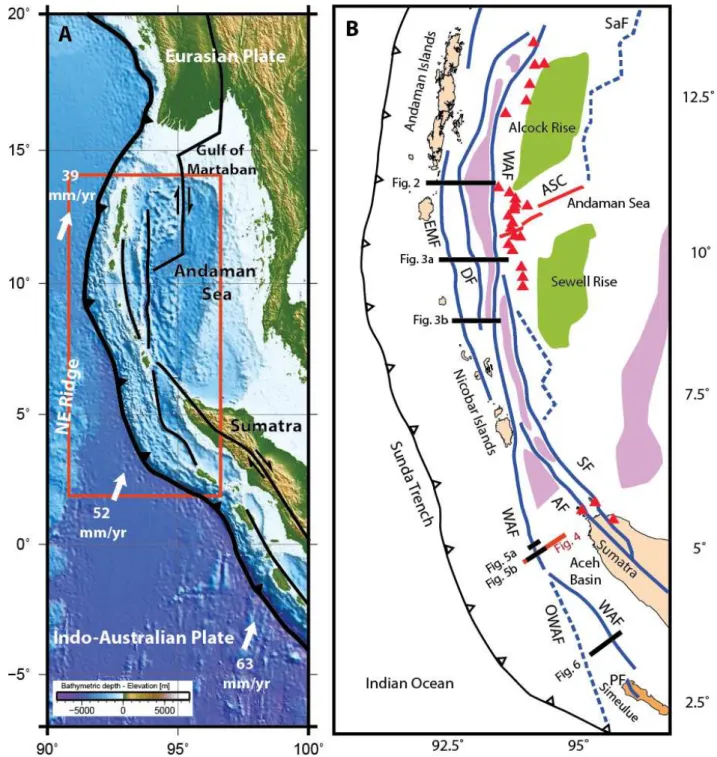
The area from Andaman to northern Sumatran margin is a region where major structures collided. The region is composed of the northern extension of the Sumatran Fault (SF), the southern extension of the Sagaing Fault (SaF) and Andaman Sea Spreading Center. Another fault zone developed in this area, the West Andaman Fault (WAF) that stretches for more than 1200 km along a north-south trending from the Andaman Sea to the Sumatran forearc (Figure 1). The origin of this structure has been interpreted as a strike-slip fault that developed in the boundary between the forearc high and forearc basin (Berglar et al., 2010; Curray, 2005; Izart et al., 1994; Malod and Kemal, 1996; Martin et al., 2014). However, recent works with better resolution of seismic reflection data revealed the occurrence of landward-vergence backthrusts in the trenchward margin of the forearc basins (Chauhan et al., 2009; Hananto et al., 2012; Moeremans and Singh, 2015; Singh et al., 2011, 2013). Detailed structural observation on seismic reflection data crossing the northern Sumatran forearc suggested that the border between the forearc basin and accretionary complex is complicated by multiple structures with strike-slip faults appears to be active (Martin et al., 2014). Further southeast in the central and southern Sumatran forearc, the margin of the forearc basin is marked by thrusting and folding (Deighton et al., 2014; Mukti et al., 2011; 2012a; 2012b; Samuel et al., 1995). Several published
works on the Andaman – north Sumatran margin were reevaluated in this study to characterize the structural styles developed in the boundary between forearc basin and accretionary wedge.
Geological setting
In the Andaman-Nicobar subduction system, the Indo-Australian plate subducts beneath the Eurasian plate in a nearly arc-parallel direction (McCaffrey, 1992; 2009) (Figure 1). This area stretches from the Gulf of Martaban in the north to the Aceh Basin in the south and can be divided into the western part dominated by compressional and strike-slip deformation, the central area that comprised the spreading center and Alcock and Sewell rises, the eastern region dominated by extensional, oblique-slip and strike-slip sedimentary basin, and the northern region that include several sedimentary basinal lows and highs (Curray, 2005; Moeremans and Singh, 2015; Morley, 2015). The western region covers the Andaman-Nicobar accretionary complex and the forearc basins. The forearc high islands are composed of remnant Cretaceous ophiolites (Pedersen et al., 2010) that covered by younger sedimentary successions (Allen et al., 2007; Roy and Banerjee, 2016). Trench-parallel structures formed in the accretionary complex as strike-slip and extensional faults of the Diligent (DF) and East Margin fault (EMF) zones (Curray, 2005; Curray et al., 1978). However, recent seismic reflection data show anticlines and thrust faults in the DF (Cochran, 2010). To the east, WAF appears to have crossed the spreading center and continues farther south to the north Sumatra forearc as a major strike-slip fault zone (Curray, 2005; Curray et al., 1978; Izart et al., 1994; Malod and Kemal, 1996). Several authors named this fault zone as the Andaman-Nicobar Fault that stretches from offshore Nicobar to the axis of the Andaman Spreading Center (ASC) (Jourdain et al., 2016; Moeremans and Singh, 2015; Singh et al., 2013). The ASC separates the Alcock and Sewell rises due to the birth of ~130 km wide of oceanic crust (Curray, 2005). The main valley of this spreading is characterized by a flat seafloor along 190 km long in ENE trend that divided into 4 segments (Raju et al., 2004).
In the northern Sumatran forearc, the Aceh forearc basin is bordered by Sumatra Island to the east and WAF to the west (Figure 1). Further west, the accretionary wedge marked the trenchward margin of northern Sumatra forearc. To the southeast, a prominent bathymetric rise bordered the basin and referred to as Tuba Ridge (TR) (Berglar et al., 2010; Izart et al., 1994; Malod and Kemal, 1996). Simeulue basin occupied the area to the southeast of TR that filled by more than 5 seconds two-way traveltime (twt) of sediments
Figure 1. A. Stuctural configuration of the Andaman-north Sumatra forearc. Vectors and rate of convergence bertween the Indo-Australian Plate and Eurasian Plate is from Moeremans and Singh (2015). B. Major structures based on Cochran (2010) and Curray (2005). Shaded area is topographic high in the bathymetry. SaF = Sagaing Fault, WAF = West Andaman Fault, ASC = Andaman Spreading Center, DF = Diligent Fault, EMF = East Margin Fault, SF = Sumatra Fault, AF = Aceh Fault, OWAF = Old West Andaman Fault, PF = Pagaja Fault.
consisted of pre-Neogene sequence and 3 sequences of Neogene basin fills (Berglar et al., 2008). Similar equivalent sedimentary units had been identified in the Aceh Basin and their deposition is related to the development of major strike-slip faults, such as SF and the WAF (Izart et al., 1994). Several works support the hypothesis of strike-slip related basins in the northern Sumatra forearc (Berglar et al., 2008; 2010; 2017; Martin et al., 2014; Seeber et al., 2007) that also applied to their extension in the southern Sumatran forearc (Diament et al., 1992; Hall et al., 1993; Sapiie et al., 2015). However, detail geological field work in the central Sumatra forearc island argued that the western margin of the forearc basin is characterized by compressional structures that is likely to have developed during inversion tectonic (Samuel and Harbury, 1996). Recent works with higher quality of seismic reflection imaging reveal the existence of landward-vergence backthrusts in the boundary between the forearc basins and forearc highs (Chauhan
et al., 2009; Deighton et al., 2014; Mukti et al., 2012a; Singh et al., 2008; 2010) and reveal the role of fold-thrust orogeny in the formation of forearc high and accretionary wedge complex that influence the development of forearc basin (Mukti et al., 2012a).
METHODS
The available published geologic-geophysical data in the northwesternmost Sunda forearc were reviewed in this paper (Berglar et al., 2010; Cochran, 2010; Curray, 2005; Deighton et al., 2014; Hananto
et al., 2012; Martin et al., 2014; Moeremans and
Singh, 2015; Pesicek et al., 2010; Singh et al., 2013). Furthermore, several onshore field works (Aribowo
et al., 2014; Endharto and Sukido, 1994; Roy and
Banerjee, 2016; Samuel and Harbury, 1996) were highlighted in this paper.RESULTS
WAF – ANF – MFZ
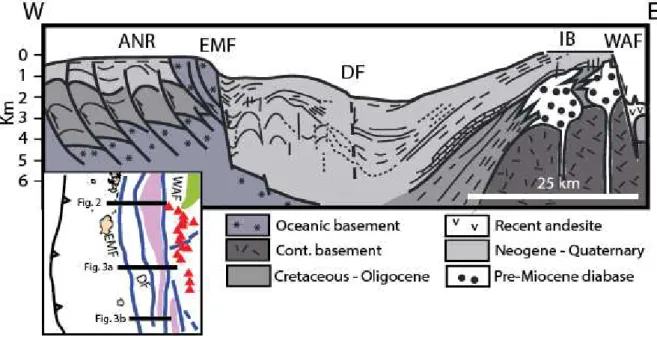
To the north of the ASC, a cuesta morphology is observed to form shallow bathymetry along 300 km in a relatively north-south direction from the Martaban Gulf to the offshore Nicobar Island (Figure 1). The top of the cuesta is called the Invisible Bank and its eastern steep slope is interpreted to have formed by the West Andaman Fault (Curray, 2005; Curray et al., 1978). In the western slope of Invisible Bank (IB), tilted strata of possibly Cretaceous – Paleogene age are observed that thickened toward the basin to the west (Figure 2). The overlying Neogene strata exhibit similar pattern with deformed sequence in the area of DF-EMF. Recently acquired seismic reflection data in between CurrayÊs line in Figure 2 and the ASC shows similar tilted strata in the western flank of IB (Moeremans and Singh, 2015). However, they argued that WAF is actually formed in the depression to the east of IB, as evidence by offset of reflectors beneath the seafloor. Furthermore, faulted blocks are observed to the east of the IB and had been interpreted as part of an active right-lateral strike-slip fault (Goli and Pandey, 2014).
To the south of the spreading center, trace of the WAF still can be observed in bathymetry, gravity and
Figure 2. Interpretation of seismic section in the Andaman showing EMF (Eastern Margin Fault), DF (Diligent Fault) and WAF (West Andaman Fault). Modified after Curray (2005), Moeremans and Singh (2015). Invisible Bank (IB) is tilted strata that formed a cuesta morphology with steep slope of WAF in the eastern part. ANR = Andaman Nicobar Ridge.
seismic reflection data (Cochran, 2010; Curray, 2005). A gravity high over the WAF appears to have formed the eastern boundary of the deep gravity low over the forearc basin (Cochran, 2010). The WAF ridge to the south of ASC had been suggested to have formed by a component of compression and uplift across the fault that related with spreading in the ASC (Curray, 2005). This uplift is evidenced by fossil of benthic foraminifera normally found deeper than 1000m discovered in a dredge sample from a depth of 490 m (Frerichs, 1971). Seismic reflection data in the southern part of the WAF imaged similar cuesta that formed IB but named as Andaman-Nicobar Fault (Moeremans and Singh, 2015) (Figure 3). They argued that the steep fault of ANF (WAF of Curray) in the southern ASC could have been the sliver fault prior to that observed in the northern part of ASC.
The WAF is traceable on the bathymetry as a linear feature extent farther south to offshore Nicobar and even to northern Sumatra (Figure 1). A surface fault break had been proposed in the area around Nicobar Island by some author (Pandey et al., 2017) although there is no high resolution bathymetry to support that. However, relocation of the hypocenters of events between the 2004 and 2005 Sumatran earthquakes show activity only in the segment of WAF from the spreading center to the Nicobar Island (Cochran, 2010). Furthermore, a cluster of seismicity is observed in the area of juxtaposition of the WAF and the northern extension of the Sumatran Fault (Cochran, 2010). Acquired swath bathymetry around the WAF (Cochran, 2010) showing a decrease of slope angle and throw of the WAF offshore Nicobar Island.
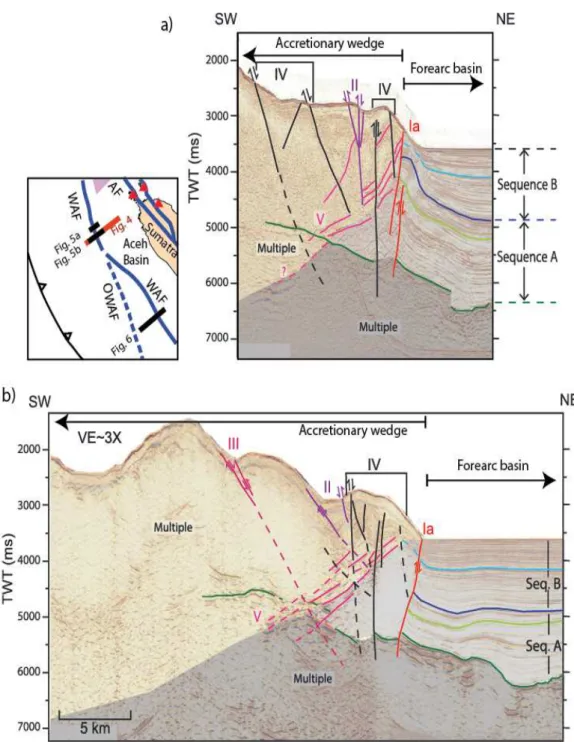
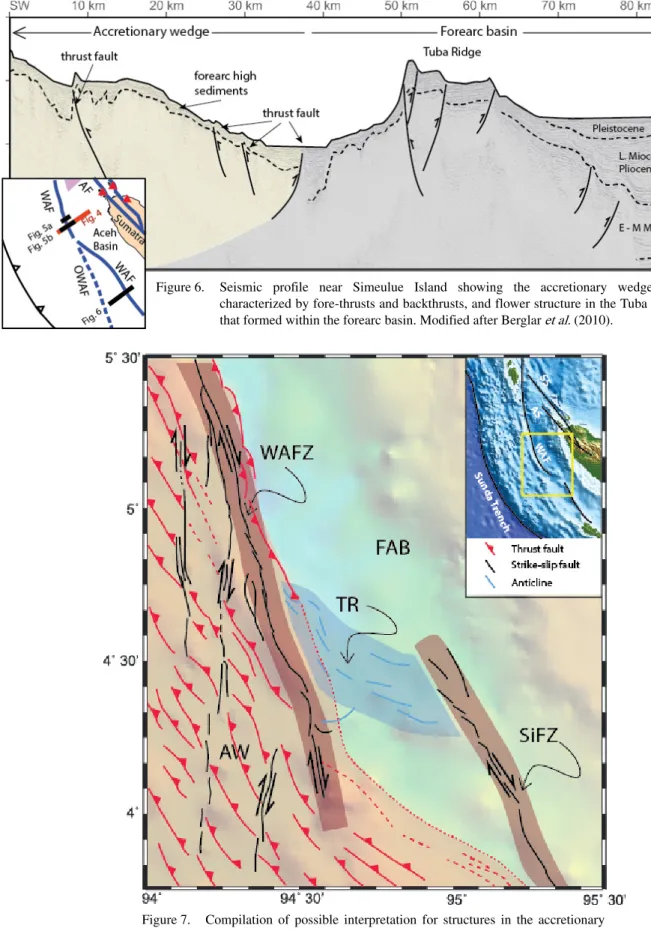
In the northern Sumatra forearc, the WAF is consistently showing vertical offsets of reflectors in several recent seismic reflection data that interpreted as a strike-slip faults in the western margin of the Aceh Forearc Basin (Berglar et al., 2010; Martin et al., 2014) (Figures 4,5). On the seafloor, this fault zone appears to have crossed the area of accretionary wedge and developed farther west (Hananto et al., 2012; Martin et al., 2014), even though WAF had been suggested to have formed a rheological boundary between the forearc basin and accretionary wedge (Izart et al., 1994; Martin et al., 2014). The WAF appears to have continued to a complex of anticlinal structures that interpreted as Tuba Ridge (Berglar et al., 2010; 2017; Izart et al., 1994; Malod and Kemal, 1996), which was bounded the east by another strike-slip fault developed within the forearc basin. This strike-slip fault has been interpreted to have formed the southern extension of the WAF or MFZ (Berglar et al., 2010; Hananto et al., 2012; Izart et al., 1994; Malod and Kemal, 1996; Martin et al., 2014) (Figures 6,7). Farther south, this strike-slip fault has been suggested to have extent either to the Simeulue
Island or offshore Simeulue Basin (Berglar et al., 2010; Hananto et al., 2012; Martin et al., 2014).
Re-examination of high resolution bathymetry data (Hananto et al., 2012; Martin et al., 2014) showing indeed the strike-slip fault of WAF is developed in the eastern side of the landward-margin of accretionary wedge in the northern part of Aceh Basin and extend farther southwest in the southern part (Figure 7). Farther up north in the Andaman, the WAF had been interpreted to have developed from the backarc and forearc basin (Cochran, 2010; Curray, 2005; Moeremans and Singh, 2015; Singh et al., 2013). Therefore, this study support the hypothesis that WAF/ ANF is indeed a major sliver fault developed in the Andaman-northern Sumatra (Singh et al., 2013).
Tuba Ridge had been interpreted as an anticlinal structure within WAF (Malod et al., 1995) that marked a change in the bathymetry of Aceh and Simeulue basins (Berglar et al., 2010). This ridge has also been proposed to have formed as a transpressional stepover between the WAF and MFZ (Berglar et al., 2010). However, here the MFZ is marked as a strike-slip fault in the forearc basin, whereas is in its type locality the MFZ has been interpreted as landward-vergence backthrusts in the arcward margin of accretionary wedge (Deighton et al., 2014; Mukti et al., 2011; 2012a; 2012b; Singh et al., 2011; 2010). Furthermore, the strike-slip faults in the Simeulue forearc basin appear to have extent farther south the Simeulue Island (Hananto et al., 2012) (Figure 7). A relatively north-south trending fault is observed in the northern part of Simuelue Island and extent father southeast along the axis of the island (Aribowo et al., 2014; Endharto and Sukido, 1994). Hence, here we proposed to name this strike-slip fault as the Simuelue Fault (SiF), to avoid confusion with the previous interpretation.
DF – EMF – backthrusts in the northern Sumatra accretionary wedge
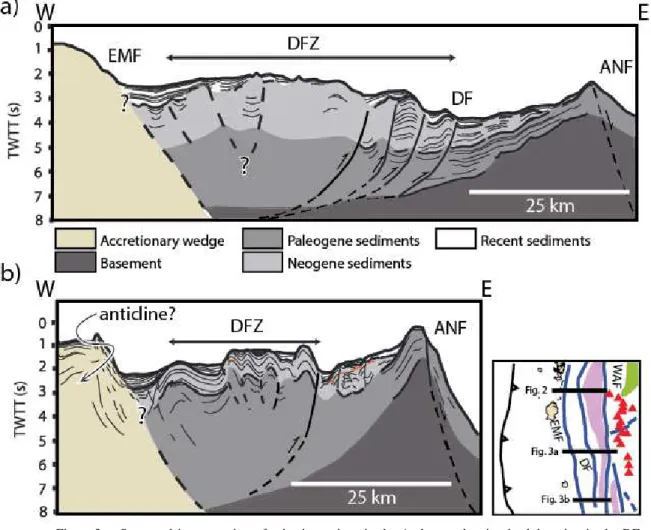
Diligent Fault (DF) has been interpreted to have formed as a strike-slip fault that dissected the Paleogene-Neogene strata in the Andaman forearc basin (Curray, 2005). However, the vertical offset of reflectors in this fault zone is not prominent. (Figure 2 and all figures in Curray (2005). On recently acquired seismic reflection data, the area of DFZ exhibit compressional faults that may related with deformation zone in the East Margin Fault (EMF); hence the structural style could not be formed due east-west extension in the crust (Cochran, 2010). Furthermore, recently acquired seismic data in the Andaman Sea show that DFZ is actually landward-vergent thrusts rather than strike-slip faults (Moeremans and Singh, 2015; Singh et al., 2013) (Figure 3). Moreover, seismic reflection images acquired in 2002-2003 showing
Figure 3. Structural interpretation of seismic sections in the Andaman showing backthrusting in the DF (Diligent Fault), anticline in the EMF (Eastern Margin Fault), and ANF (Andaman Nicobar Fault) to the south of Andaman Spreading Center (ASC). Modified after Moeremans and Singh (2015). ANF is equivalent to WAF (West Andaman Fault) of Curray (2005). DFZ (Diligent Fault Zone) is dominated by thrust faults and folded sediments.
Figure 4. Structural interpretation of seismic section in the north Sumatra forearc basin showing structural style of the WAF, which is characterized by nearly vertical faults, modified after Berglar et al.
(2010), Martin et al. (2014). However, a west-dipping reflector (black dash line) is also observed beneath the WAF that is likely to represent a landward-vergence thrust.
Figure 5. Detail structural identification of WAF in the northern Sumatra forearc showing different possible type and geometry (Martin et al., 2014). See Figure 1 for the location of lines. Faults of type I to IV is characterized by thrust and normal offset on the seafloor and belong to the WAF strike-slip fault zone. Type V is thrust with no surface offset.
Figure 6. Seismic profile near Simeulue Island showing the accretionary wedge that characterized by fore-thrusts and backthrusts, and flower structure in the Tuba Ridge that formed within the forearc basin. Modified after Berglar et al. (2010).
Figure 7. Compilation of possible interpretation for structures in the accretionary wedge (AW) that is bounded by landward- and seaward-vergence thrusts. The West Andaman Fault zone (WAFZ) is a strike-slip fault zone that crossed the accretionary wedge, whilst Simeulue Fault zone (SiFZ) is a strike-slip fault zone developed in the forearc basin that over stepped and formed the Tuba Ridge (TR). Possible splays of the WAF developed further west in the accretionary wedge. FAB = Forearc basin.
anticlinal structures and landward-vergence thrusts are prominent in the DFZ (Goli and Pandey, 2014; Pandey
et al., 2017). However, the width of DFZ decreased toward south with the occurrence of steeper thrust with the deformed strata.
To the west, EMF has been interpreted as a strike-slip fault with some vertical offset of reflectors in the subsurface (Cochran, 2010; Curray, 2005; Raju et al., 2004) (Figure 2). Recently acquired seismic reflection data in the Andaman Sea also support this mechanism for the EMF by showing a large subsiding basin to the east of the EMF (Moeremans and Singh, 2015). However, re-observation on the data set reveal that anticlinal structures are prominence in the area of the EMF (Goli and Pandey, 2014; Moeremans and Singh, 2015; Pandey et al., 2017), suggesting that vertical fault in the slope of the EMF seems to be unlikely. These folded sediments in the EMF zone may coeval to the younger sedimentary successions observed in Andaman Island (Allen et al., 2007; Roy and Banerjee, 2016). A vertical fault plane may have developed within the axis of the anticlines, as normally observed in the strike-slip fault zone (Berglar et al., 2010). However, this study could not conclude it based on the available data set. A second scenario for the anticlinal structures is it represent a blind-thrust in the subsurface as have been proposed in the fold thrust belt development (Hubbard and Shaw, 2009; Shaw et al., 1999). Moreover, farther south in the Sumatran forearc, structures within the forearc high are dominated by folding and thrusting in the accretionary wedge (Deighton et al., 2014; Hananto et al., 2012; Mukti et al., 2011,;2012a; 2012b). Uplift of the forearc high island induced development of subaerial unconformity that followed by the growth of carbonate that normally hindered seismic wave propagation to the subsurface, hence seismic reflection imaging beneath these carbonates becomes difficult.
DISCUSSION
The WAF remains a prominent morphologic feature to the north of the ASC and probably was one of the primary active structures prior to the initiation of spreading in the Andaman Sea (Cochran, 2010). The northern segment of this fault zone may extent from the Gulf of Martaban in the north (Cochran, 2010; Curray, 2005; Goli and Pandey, 2014; Pandey etal., 2017) to offshore Nicobar Island (Pandey et al., 2017). However, the southern boundary of this northern segment should be observed in high resolution bathymetry data. The segment formed crossing boundary from backarc basin, volcanic arc, and forearc basin. Here the fault zone is named as the northern segment of WAF, agreeing the results of previous workers in this area (e.g. Curray, 2005).
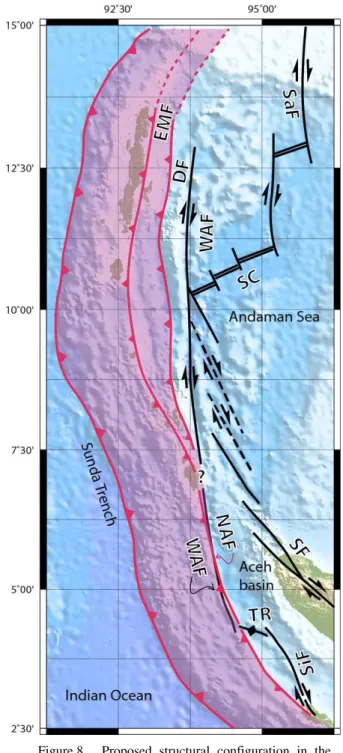
The southern segment of the WAF stretches from the south of Nicobar Island to the accretionary wedge complex of northern Sumatra in the Aceh forearc (Figure 8). Several splays of this fault zone developed farther southwest in the accretionary wedge. Farther south the southern segment of WAF appears to step over
Figure 8. Proposed structural configuration in the northwesternmost Sunda margin based on this review. See text for detail. Shaded area is the accretionary wedge complex. EMF = Eastern Margin Fault, DF = Diligent Fault, WAF = West Andaman Fault, SaF = Sagaing Fault, ASC = Andaman Spreading Center, NAF = Nicobar Aceh Fault, SiF = Simeulue Fault, TR = Tuba Ridge, SF = Sumatra Fault.
with SiF and formed the transpressional anticline, TR (Figure 8). The SiF itself developed farther south to the Simeulue Island and may have continued with the Pagaja Fault onshore (Aribowo et al., 2014; Endharto and Sukido, 1994) (Figure 1). These observations suggest that slip-partitioning in such an oblique convergent margin tends to initiate a new deformation zone rather than reactivated the major rheological boundary. Similar scenario occurred in the Southern Burma where the active Sagaing Fault indeed developed crossing several tectonic provinces (Sloan et al., 2017).
Based on the compilation of new data acquired in 2008 (Moeremans and Singh, 2015), the arcward margin of the Andaman-north Sumatra accretionary
wedge is marked by landward-vergent thrusts of the Diligent Fault in the north and Nicobar Aceh Fault in the south (Figure 2). Similar seismic images and geologic cross section in this boundary zone have been observed in the central and southern Sumatran forearc (Deighton et al., 2014; Mukti et al., 2011; 2012a; 2012b; Samuel and Harbury, 1996; Singh et al., 2011), suggesting that compressional structures dominated structural style in the inner part of accretionary wedge. Focal mechanisms of earthquakes in the region show no evidence of active strike-slip in the eastern margin of Andaman-north Sumatra accretionary wedge (Hananto
et al., 2012; Singh et al., 2010; 2013). Projection of relocated hypocenters of the 2004 and 1976 events in the northern Sumatran forearc suggesting that the 1976
Figure 9. Map (A) and projection (B) of relocated hypocenters of events before the 2004 great earthquake (black), after the 2004 event but before the 2005 event (purple) and after the 2005 event (blue) (Pesicek et al., 2010). Green is aftershocks of the 1976 events that possibly initiated in the forearc basement as backthrust or reactivated basement structures. CMT solutions for the 2004 and the 1976 events shown at their relocated positions. The location of WAF is from Curray (2005).
event may have initiated in the forearc basement as backthrust or reactivated basement (Pesicek et al., 2010) (Figure 9).
Despite the obliquity of the present-day convergence in the northernmost Sunda margin, our regional observation shows similar development of a major zone of backthrusting observed in the case of orthogonal convergence as have been proposed by previous works (Chauhan et al., 2009; Moeremans and Singh, 2015; Singh et al., 2008; 2013). Experiments performed with oblique convergence indeed exhibit landward-vergence thrusting in the rear margin of accretionary wedge (McClay et al., 2004). Based on the undeformed strata in the area between DF and ANF-WAF, it is clear that this area does not belong to the accretionary complex as had been suggested by several authors (Berglar et al., 2017; Izart et al., 1994; Martin et al., 2014; Seeber et al., 2007). The accretionary complex in the oblique Andaman-northern Sumatra subduction zone is bounded by fold-thrust belts in the landward and seaward margins.
CONCLUSIONS
In the Andaman-north Sumatra forearc, the complex strain partitioning is characterized by sliver faults that crossing boundaries between the backarc basin, volcanic arc, forearc basin, and accretionary wedge. The fault zone can be divided into two segments of WAF in the north and SiF in the southern part. A restraining step-over formed in between WAF and SiF. The SiF may extent onshore Simeulue to a strike-slip fault onshore. Slip-partitioning in such an oblique convergent margin appears to have formed a new deformation zone rather than reactivated the major rheological boundary in between the accretionary wedge and forearc basin. The eastern margin of the Andaman-north Sumatra accretionary wedge appears to have form as landward-vergent backthrusts rather than strike-slip faults, differed from the previous reconstruction. This characteristic appears to have formed in the similar way with the compressional structures dominated the eastern margin accretionary wedge of the central and south Sumatra forearc.
ACKNOWLEDGEMENTS
The author thanked the editor (Yudi Darlan) and the reviewer (Herman Darman) for their comments and suggestion that improved the clarity of the manuscript.
REFERENCES
Allen, R., Carter, A., Najman, Y., Bandopadhyay, P.C., Chapman, H.J., Bickle, M.J., Garzanti, E., Vezzoli, G., Andò, S., Foster, G.L., & Gerring, C., 2007. New constraints on the sedimentation
and uplift history of the Andaman-Nicobar accretionary prism, South Andaman Island, in: Draut, A., Clift, P.D., Scholl, D.W. (Eds.), Formation and Applications of the Sedimentary Record in Arc Collision Zones: The Geological Society of America Special Paper 436. Geological Society of America, 1–34.
Aribowo, S., Handayani, L., Hananto, N.D., Gaol, K.L., Syuhada, & Anggono, T., 2014. Deformasi kompleks di Pulau Simuelue, Sumatra: Interaksi antara struktur dan diapirisme. Riset Geologi dan Pertambangan, 24(2): 131–144.
Berglar, K., Gaedicke, C., Franke, D., Ladage, S., Klingelhoefer, F., & Djajadihardja, Y.S., 2010. Structural evolution and strike-slip tectonics off north-western Sumatra. Tectonophysics, 480(1-4): 19–132.
Berglar, K., Gaedicke, C., Ladage, S., & Thöle, H., 2017. The Mentawai forearc sliver off Sumatra: A model for a strike-slip duplex at a regional scale. Tectonophysics, 710-711: 225–231. Berglar, K., Gaedicke, C., Lutz, R., Franke, D., &
Djajadihardja, Y.S., 2008. Neogene subsidence and stratigraphy of the Simeulue forearc basin, Northwest Sumatra. Marine Geology. 253(1-2): 1–13.
Byrne, D.E., Davis, D.M., & Sykes, L.R., 1988. Loci and maximum size of thrust earthquakes and the mechanics of the shallow region of subduction zones. Tectonics, 7(4): 833–857.
Byrne, D.E., Wang, W., & Davis, D.M., 1993. Mechanical role of backstops in the growth of forearcs. Tectonics 12(1): 123–144.
Chauhan, A.P.S., Singh, S.C., Hananto, N.D., Carton, H., Klingelhoefer, F., Dessa, J.-X., Permana, H., White, N.J., Graindorge, D., & Team, S.S., 2009. Seismic imaging of forearc backthrusts at northern Sumatra subduction zone. Geophysical Journal International 179(3): 1772–1780. Clift, P., & Vannucchi, P., 2004. Controls on tectonic
accretion versus erosion in subduction zones: Implications for the origin and recycling of the continental crust. Reviews of Geophysics, 42(2): 1–31.
Cochran, J.R., 2010. Morphology and tectonics of the Andaman Forearc, northeastern Indian Ocean.
Geophysical Journal International, 182(2): 631–651.
Curray, J.R., 2005. Tectonics and history of the Andaman Sea region. Journal of Asian Earth Sciences, 25(1): 187–232.
Curray, J.R., Moore, D.G., Lawver, L.A., Emmel, F.J., Raitt, R.W., Henry, M., & Kieckhefer, R., 1978. Tectonics of the Andaman Sea and Burma, in: Watkins, J., Montadert, L., Dickerson, P.W. (Eds.), Geological and Geophysical Investigations of Continental Margins,
American Association Petroleum Geologists Memoir, 29: 189–198.
Deighton, I., Mukti, M.M., Singh, S., Travis, T., Hardwick, A., & Hernon, K., 2014. Nias Basin, NW Sumatra – New insight into forearc structure and hydrocarbon prospectivity from long-offset 2D seismic data, in: Proceedings, Indonesian Petroleum Association, Thirty-Eighth Annual Convention & Exhibition, Jakarta, IPA14–G–299.
Diament, M., Harjono, H., Karta, K., Deplus, C., Dahrin, D., Zen, M.T., Gerard, M., Lassal, O., Martin, A., & Malod, J., 1992. Mentawai fault zone off Sumatra: A new key to the geodynamics of western Indonesia. Geology, 20(3): 259–262.
Endharto, M., Sukido, 1994. Geologic map of the Sinabang Sheet, Sumatera. Bandung.
Frerichs, W.E., 1971. Paleobathymetric trends of neogene foraminiferal assemblages and sea floor tectonism in the Andaman Sea area.
Marine Geology, 11(3): 159–173.
Goli, A., & Pandey, D.K., 2014. Structural characteristics of the andaman forearc inferred from interpretation of multichannel seismic reflection data. Acta Geologica Sinica-English Edition, 88(4): 1145–1156.
Hall, D.M., Duff, B.A., Courbe, M.C., Seubert, B.W., Siahaan, M., & Wirabudi, A.D., 1993. The southern fore-arc zone of Sumatra: Cainozoic basin-forming tectonism and hydrocarbon potential, in: Proceedings Indonesian Petroleum Association, Twenty Second Annual Convention, Indonesian Petroleum Association, Jakarta, 319–344.
Hananto, N., Singh, S., Mukti, M.M., & Deighton, I., 2012. Neotectonics of north Sumatra forearc, in: Proceedings Indonesian Petroleum Association, Thirty-Sixth Annual Convention & Exhibition, IPA–G–100.
Hoth, S., Hoffmann-Rothe, A., & Kukowski, N., 2007. Frontal accretion: An internal clock for bivergent wedge deformation and surface uplift.
Journal of Geophysical Research: Solid Earth, 112(B6): 1-17, B06408.
Hubbard, J., & Shaw, J.H., 2009. Uplift of the Longmen Shan and Tibetan plateau, and the 2008 Wenchuan (M = 7.9) earthquake. Nature
458(7235): 1-14.
Izart, A., Kemal, B.M., & Malod, J.A., 1994. Seismic stratigraphy and subsidence evolution of the northwest Sumatra fore-arc basin. Marine Geology, 122(1-2): 109–124.
Jourdain, A., Singh, S.C., Escartin, J., Klinger, Y., Raju, K.A.K., & Mcardle, J., 2016. Crustal accretion at a sedimented spreading centre in the Andaman Sea, Geology, 44(5): 351–354. Malod, J.A., Karta, K., Beslier, M.O., & Zen, M.T.,
1995. From normal to oblique subduction: Tectonic relationships between Java and Sumatra. Journal Southeast Asian Earth Sciences, 12(1-2): 85–93.
Malod, J.A., & Kemal, B.M., 1996. The Sumatra margin: Oblique subduction and lateral displacement of the accretionary prism, in: Hall, R., Blundell, D. (Eds.), Tectonic Evolution of Southeast Asia, Geological Society Special Publication, 106(1):9–28.
Martin, K.M., Gulick, S.P.S., Austin Jr., J.A., Berglar, K., Franke, D., & Udrekh, 2014. The West Andaman Fault: A complex strain-partitioning boundary at the seaward edge of the Aceh Basin, offshore Sumatra. Tectonics, 33(5): 786–806.
McCaffrey, R., 1992. Oblique plate convergence, slip vectors, and forearc deformation. Journal of Geophysical Research: Solid Earth, 97(B6): 8905-8915.
McCaffrey, R., 2009. The Tectonic Framework of the Sumatran Subduction Zone. Annual Review of Earth and Planetary Sciences, 37: 345–366. McClay, K.R., Whitehouse, P.S., Dooley, T., &
Richards, M., 2004. 3D evolution of fold and thrust belts formed by oblique convergence.
Marine and Petroleum Geology. 21(7):
857–877.
Moeremans, R.E., & Singh, S.C., 2015. Fore-arc basin deformation in the Andaman-Nicobar segment of the Sumatra-Andaman subduction zone: Insight from high-resolution seismic reflection data. Tectonics, 34(8): 1736–1750.
Morley, C.K., 2015. Cenozoic structural evolution of the Andaman Sea: evolution from an extensional to a sheared margin. Geological Society, London, Special Publications, 431: 1-25.
Mukti, M.M., Singh, S.C., Hananto, N.D., Permana, H., & Deighton, I., 2011. Doubly Vergent Accretionary Wedge Active Tectonics in The Sumatra Subduction Zone, in: AGU Fall Meeting. American Geophysical Union, San Francisco, T21B–2356.
Mukti, M.M., Singh, S.C., Deighton, I., Hananto, N.D., Moeremans, R., Permana, H., 2012a. Structural evolution of backthrusting in the Mentawai Fault Zone, offshore Sumatran forearc. Geochemistry, Geophysics, Geosystems 13(12): 1–21.
Mukti, M.M., Singh, S.C., Moeremans, R., Hananto, N.D., Permana, H., & Deighton, I., 2012b. Neotectonics of the Southern Sumatran Forearc,
in: Indonesian Petroleum Association, 36th
Annual Convention and Exhibition,
IPA12–G–074.
Noda, A., 2016. Forearc basins: Types, geometries, and relationships to subduction zone dynamics.
Geological Society of American Bulletin,
128(5-6): 879–895.
Pandey, D.K., Anitha, G., Prerna, R., & Pandey, A., 2017. Late Cenozoic seismic stratigraphy of the Andaman Forearc Basin, Indian Ocean.
Petroleum Science, 14(4): 648–661.
Pedersen, R.B., Searle, M.P., Carter, A., & Bandopadhyay, P.C., 2010. U–Pb zircon age of the Andaman ophiolite: implications for the beginning of subduction beneath the Andaman–Sumatra arc. Journal of Geological Society, London. 167(6): 1105–1112.
Pesicek, J.D., Thurber, C.H., Zhang, H., DeShon, H.R., Engdahl, E.R., & Widiyantoro, S., 2010. Teleseismic double-difference relocation of earthquakes along the Sumatra-Andaman subduction zone using a 3-D model. Journal of
Geophysical Research: Solid Earth, 115
B10303: 1-20.
Raju, K.A.K., Ramprasad, T., Rao, P.S., Rao, B.R., & Varghese, J., 2004. New insights into the tectonic evolution of the Andaman basin, northeast Indian Ocean. Earth and Planetary Science Letters, 221(1-4): 145–162.
Roy, S.K., & Banerjee, S., 2016. Soft Sediment Deformation Structures in the Andaman Flysch Group, Andaman Basin: Evidence for Palaeogene Seismic Activity in the Island Arc.
Berita Sedimentologi, 35: 55–64.
Samuel, M.A., & Harbury, N.A., 1996. The Mentawai fault zone and deformation of the Sumatran Forearc in the Nias area, in: Hall, R., Blundell,
D. (Eds.), Tectonic Evolution of Southeast Asia, Geological Society of London, Special Publication, 106(1): 337–351.
Samuel, M.A., Harbury, N.A., Jones, M.., & Matthews, S.J., 1995. Inversion-controlled uplift of an outer-arc ridge: Nias Island, offshore Sumatra,
in: Buchanan, J.G., Buchanan, P.G. (Eds.), Basin Inversion. Geological Society, London, Special Publication, 88(1): 473–492.
Sapiie, B., Yulian, F., Chandra, J., Satyana, A.H., Dharmayanti, D., Rustam, A.H., & Deighton, I., 2015. Geology and Tectonic Evolution of Fore-Arc Basins: Implications of Future Hydrocarbon Potential in the Western Indonesia, in: Proceedings Indonesian Petroleum Association 39th Annual Convention & Exhibition.
Seeber, L., Mueller, C., Fujiwara, T., Arai, K., Soh, W., Djajadihardja, Y., & Cormier, M., 2007. Accretion, mass wasting, and partitioned strain over the 26 Dec 2004 Mw9.2 rupture offshore Aceh, northern Sumatra. Earth and Planetary Science Letters, 263(1-2): 16–31.
Shaw, J.H., Bilotti, F., & Brennan, P.A., 1999. Patterns of imbricate thrusting. Geological Society of America Bulletin 111(8):1140–1154.
Singh, S.C., Carton, H., Tapponnier, P., Hananto, N.D., Chauhan, A.P.S., Hartoyo, D., Bayly, M., Moeljopranoto, S., Bunting, T., Christie, P., Lubis, H., & Martin, J., 2008. Seismic evidence for broken oceanic crust in the 2004 Sumatra earthquake epicentral region. Nature Geoscience, 1(11): 777–781.
Singh, S.C., Hananto, N.D., & Chauhan, A.P.S., 2011. Enhanced reflectivity of backthrusts in the recent great Sumatran earthquake rupture zones.
Geophysical Research Letters, 38(4): 1–5. Singh, S.C., Hananto, N.D., Chauhan, A.P.S.,
Permana, H., Denolle, M., Hendriyana, A., & Natawidjaja, D., 2010. Evidence of active backthrusting at the NE Margin of Mentawai Islands, SW Sumatra. Geophysical Journal International, 180(2): 703–714.
Singh, S.C., Moeremans, R., Mcardle, J., & Johansen, K., 2013. Seismic images of the sliver strike-slip fault and back thrust in the Andaman-Nicobar region. Journal of Geophysical Research. 118(10): 5208–5224.
Sloan, R.A., Elliott, J.R., Searle, M.P., & Morley, C.K., 2017. Active tectonics of Myanmar and the Andaman Sea. Geological Society, London, Memoirs, 48(1): 19–52.
Storti, F., Salvini, F., & McClay, K., 2000. Synchronous and velocity-partitioned thrusting and thrust polarity reversal in experimentally produced, doubly-vergent thrust wedges: Implications for natural orogens. Tectonics, 19(2): 378–396.
von Huene, R., & Scholl, D.W., 1991. Observation at convergent margins concernng sediments subduction, subduction erosion, and the growth of continental crust. Reviews of Geophysics,