A General-Purpose, Energy-Efficient, and Context-Aware Acoustic Event
Detection Platform for Mobile Devices
A Dissertation Presented to
the Faculty of the School of Engineering and Applied Science University of Virginia
In Partial Fulfillment of the requirements for the Degree Doctor of Philosophy (Computer Science)
by
S M Shahriar Nirjon August 2014
Abstract
Humans are extremely capable of remembering, recognizing, and acting upon hundreds of thousands of different types of acoustic events on a day-to-day basis. Decades of research on acoustic sensing have led to the creation of systems that now understand speech, recognizes the speaker, and finds a song. However, apart from speech, music, and some application specific sounds, the problem of recognizing varieties of general-purpose sounds that a mobile device encounters all the time has remained unsolved. The overarching goal of this research is to enable rapid development of mobile applications that recognize general-purpose acoustic events. As these applications are meant to run on a mobile device, the technical goals of this research include – energy-efficiency, communication-efficiency, leveraging the user contexts such as the location and position of the mobile device in order to improve the classification accuracy, and ease of application development.
With this goal in mind, we have built a general-purpose, energy-efficient, and context-aware acoustic event detection platform for mobile devices called – theAuditeurplatform. Auditeur enables mobile application developers to have their application register for and get notified on a wide variety of acoustic events. Auditeur is backed by a cloud service to store crowd-contributed sound clips and to generate an energy-efficient and context-aware classification plan for the mobile device. When an acoustic event type has been registered, the mobile device instantiates the necessary acoustic processing modules and wires them together to dynamically form an acoustic processing pipeline in accordance with the classification plan. The mobile device then captures, processes, and classifies acoustic events locally and efficiently. Our analysis on user-contributed empirical data shows that Auditeur’s energy-aware acoustic feature selection algorithm is capable of increasing the device-lifetime by33.4%, sacrificing less than2%of the maximum achievable accuracy. We implement seven applications with Auditeur, and deploy them in real-world scenarios to demonstrate that Auditeur is versatile,11.04%−441.42%less power hungry, and10.71%−13.86%more accurate in detecting acoustic events, compared to state-of-the-art techniques. We perform a user study involving 15 participants to demonstrate that even a novice programmer can implement the core logic of an interesting application with Auditeur in less than 30 minutes, using only15−20lines of Java code.
Besides Auditeur, three other systems have been developed in this research which empower some aspects of the platform. First, we introducesMFCC, which is an approximation to a well-known acoustic feature called the
Abstract ii
frequency cepstral coefficient (MFCC). The motivation behind sMFCC is to enable faster extraction of MFCC features in applications that must sample the microphone at a very high rate and yet has to meet the real-time requirement. Second, we have developed theMultiNets, which is capable of switching wireless networking interfaces (WiFi and 3G) on a mobile device based on a predefined policy, such as saving energy during wireless data communication. The motivation behind MultiNets is to enable energy-efficient mobile-cloud communication in applications that must communicate quite frequently with a remote server over the Internet. Third, we have developed theMusical-Heart, which is a system that provides a biofeedback-based and context-aware music recommendation service to a mobile device. The motivation behind Musical-Heart is to build a convenient, non-invasive, personalized and low-cost wellness monitoring system that obtains heart rate and activity level information from a pair of specially designed earphones while a user is listening to the music on his mobile device.
Approval Sheet
This dissertation is submitted in partial fulfillment of the requirements for the degree of Doctor of Philosophy (Computer Science)
S M Shahriar Nirjon
This dissertation has been read and approved by the Examining Committee:
John A. Stankovic, Advisor
Kamin Whitehouse, Committee Chair
Alfred Weaver
John Lach
Stephen G. Wilson, Minor Representative
Accepted for the School of Engineering and Applied Science:
James H. Aylor, Dean, School of Engineering and Applied Science August 2014
Acknowledgement
Contents
Acknowledgement v Contents v List of Tables . . . x List of Figures . . . xi 1 Introduction 1 1.1 Motivation . . . 2 1.2 Technical Challenges . . . 41.3 Thesis Statement and Solution Overview . . . 5
1.3.1 Thesis Statement . . . 5
1.3.2 Solution Overview . . . 5
1.4 Contributions . . . 6
1.5 Caveats . . . 8
1.6 Organization of the Dissertation . . . 9
2 Related Work 11 2.1 Special-Purpose Acoustic Event Detection . . . 11
2.2 Web Services for Mobile Devices . . . 12
2.3 Resource Aware Classification . . . 12
2.4 Network Interface Switching . . . 13
2.5 Exploiting Sparseness in Speech . . . 13
2.6 Heart Rate Detection on Mobile Devices . . . 14
2.7 Inferring Activity Context on Mobile Devices . . . 14
2.8 Music Recommendation Systems . . . 15
2.9 Summary . . . 15
3 Background and Terminologies 16 3.1 Acoustic Events . . . 16
3.2 Tagged Soundlets . . . 17
3.2.1 Content and Container Tags . . . 17
3.2.2 Lookfor and Within Tags . . . 17
3.3 Public and Private Soundlets . . . 17
3.3.1 Public Soundlets . . . 18
3.3.2 Private Soundlets . . . 18
3.4 Mobility Contexts . . . 18
3.5 Mel-Frequency Cepstral Coefficients . . . 19
3.6 Sparse Fast Fourier Transform . . . 19
3.7 ECG, Heart Beat and Pulse . . . 20
3.8 Tempo, Pitch and Energy . . . 20
3.9 Heart Rate Training Zones . . . 21
3.10 Summary . . . 22
Contents vii
4 Mobile-Cloud Platform Overview 23
4.1 The Auditeur Platform . . . 23
4.2 Workflow of Auditeur . . . 26
4.2.1 Tagging and Uploading Soundlets . . . 26
4.2.2 Obtaining a Classification Plan . . . 27
4.2.3 Acoustic Event Detection . . . 28
4.2.4 API Example . . . 28
4.3 Key System Features . . . 29
4.3.1 People in the Loop . . . 29
4.3.2 Personalization as well as Generalization . . . 29
4.3.3 Cloud-Directed On-Device Processing . . . 30
4.3.4 Designed for Efficiency . . . 30
4.3.5 Context Awareness . . . 30
4.4 Summary . . . 30
5 Implementation of the Auditeur Platform 32 5.1 On-Device Processing Components . . . 32
5.1.1 The Sound Engine . . . 33
5.1.2 Mobility Context Generation . . . 36
5.1.3 Communication to the Cloud . . . 36
5.1.4 Public and Internal API . . . 36
5.2 In-Cloud Processing Components . . . 37
5.2.1 Training Set Generation . . . 37
5.2.2 Feature Selection . . . 38
5.2.3 Processing Units and Parameter Selection . . . 39
5.2.4 Tag Matching Service . . . 40
5.2.5 Storage and Caching . . . 40
5.3 Summary . . . 41
6 Evaluation of the Auditeur Platform 42 6.1 Experimental Setup . . . 42
6.2 System Measurements . . . 43
6.2.1 CPU and Memory Footprint . . . 43
6.2.2 Energy Measurements . . . 43
6.3 Empirical Evaluation . . . 44
6.3.1 Lifetime and Accuracy Trade-off . . . 44
6.3.2 Evaluating Feature Selection Algorithm . . . 45
6.3.3 Illustration of Energy Efficiency . . . 46
6.3.4 Processing Delay . . . 46 6.4 Case Studies . . . 47 6.4.1 Power Consumption . . . 48 6.4.2 Detection Accuracy . . . 49 6.4.3 Context Awareness . . . 50 6.5 User Study . . . 50 6.6 Discussion . . . 52 6.7 Summary . . . 52
7 Exploiting Sparseness in Speech Signals 54 7.1 The Sparse MFCC Feature . . . 54
7.2 Motivation . . . 56
7.3 The Sparse MFCC Algorithm . . . 57
7.3.1 Estimation of Sparseness . . . 57
7.3.2 Computing sMFCC . . . 58
Contents viii
7.5 Experimental Results . . . 59
7.5.1 Sparseness in Speech . . . 59
7.5.2 Sparse Approximation Error in sMFCC . . . 60
7.5.3 Speedup in sMFCC . . . 61
7.5.4 A Simple Spoken Word Recognizer . . . 61
7.6 Summary . . . 64
8 Mobile-Cloud Communication Efficiency 65 8.1 The MultiNets Engine . . . 66
8.2 Switching Network Interfaces . . . 68
8.2.1 The Network Interface Switching Problem . . . 68
8.2.2 Potential for Switching Interfaces . . . 69
8.2.3 Summary of Findings . . . 71
8.3 Switching in MultiNets . . . 71
8.3.1 Connectionless Sessions . . . 71
8.3.2 Connection-Oriented Sessions . . . 72
8.3.3 Switching API . . . 72
8.4 Design and Implementation . . . 73
8.4.1 The Switching Engine . . . 73
8.4.2 The Monitoring Engine . . . 74
8.4.3 The Selection Policy . . . 75
8.4.4 Layered Implementation . . . 76
8.4.5 The Switching API . . . 76
8.5 Experimental Setup . . . 78 8.5.1 Hardware Setup . . . 78 8.5.2 Software Setup . . . 78 8.6 System Overhead . . . 79 8.7 Switching Time . . . 80 8.7.1 Energy Measurements . . . 82
8.8 Trace Driven Experiments . . . 84
8.8.1 Energy Efficiency . . . 84
8.8.2 Offloading Traffic . . . 85
8.8.3 Throughput . . . 85
8.9 Deployment Experiment . . . 86
8.9.1 Energy Efficiency . . . 87
8.9.2 Offloading and Throughput . . . 88
8.9.3 Energy Efficiency vs. Offload Trade-off . . . 89
8.10 Summary . . . 89
9 A Special Type of Acoustic Event 90 9.1 The Musical-Heart Application . . . 91
9.2 Usage Scenarios . . . 93
9.2.1 Personal Trainer: Goal-Directed Aerobics . . . 93
9.2.2 Music Recommendation: Biofeedback and Collaboration . . . 93
9.3 System Architecture . . . 94
9.3.1 The Septimu Platform . . . 94
9.3.2 Processing on Smartphone . . . 95
9.3.3 Web Services . . . 96
9.4 Heart Rate Measurement . . . 97
9.4.1 Filtering . . . 98
9.4.2 Detection . . . 98
9.5 Activity and Context Detection . . . 100
9.5.1 Activity Level Detection . . . 100
Contents ix
9.6 Music Suggestion and Rating . . . 103
9.6.1 PI-controller Design . . . 103
9.6.2 Automated Music Rating . . . 106
9.7 Technology and Algorithm Evaluation . . . 106
9.7.1 Experimental Setup . . . 106
9.7.2 Evaluation of Septimu Platform . . . 107
9.7.3 Empirical Study . . . 107
9.7.4 Evaluation of Heart Rate Measurement . . . 109
9.7.5 Evaluation of Activity Level Detection . . . 112
9.7.6 Fitness of System Model . . . 112
9.8 Real Deployment . . . 113
9.8.1 Goal Directed Aerobics . . . 113
9.8.2 Music Recommendation via Biofeedback and Collaboration . . . 114
9.9 Summary . . . 116
10 Conclusion 117 10.1 Summary and Key Contributions . . . 117
10.1.1 A Mobile-Cloud Platform for Acoustic Event Detection . . . 117
10.1.2 Exploting Sparseness in Speech . . . 118
10.1.3 Mobile-Cloud Communication Efficiency . . . 118
10.1.4 An Application Detecting a Special Type of Acoustic Event . . . 118
10.2 Limitations and Future Improvements . . . 119
10.3 Future Research Directions . . . 120
Appendices 121
A Optimum Energy Computation in MultiNets 122
B Media Coverage of Musical-Heart 123
List of Tables
3.1 Heart rate training zones. . . 22
5.1 List of Acoustic Processing Units in Auditeur. . . 34
5.2 List of Public Classes in Auditeur API. . . 37
5.3 Parameter Choices for Different Acoustic Processing Units. . . 40
6.1 Overhead of Auditeur. . . 43
6.2 Description of Empirical Datasets . . . 45
6.3 Description of Applications in Case Studies. . . 48
6.4 Application Ideas from User Study. . . 51
8.1 Description of SwitchingManager API. . . 77
8.2 Benchmarks for MultiNets. . . 79
8.3 Lines of Code to Implement MultiNets. . . 80
8.4 Switching Time Measurements. . . 81
8.5 Bandwidth of WiFi, HSPA+ and 3G. . . 86
8.6 Offloading and Throughput with MultiNets. . . 88
8.7 Energy and Offload Tradeoff in MultiNets. . . 89
9.1 Poll Results of Activity Contexts. . . 102
9.2 Activity Context Detection Algorithm. . . 103
9.3 Design of PI Controller. . . 105
9.4 Power Consumption of Septimu. . . 107
9.5 Detecting Single Activity. . . 112
9.6 Detecting Activity Sequence. . . 112
9.7 A Cardio Exercise Program. . . 113
List of Figures
1.1 Conceptual Integrations of Systems. . . 5
3.1 Heart Beat Signals. . . 20
3.2 Illustration of Tempo and Pitch. . . 21
4.1 Contributing Soundlets to the Cloud. . . 27
4.2 Obtaining a Classification Plan. . . 27
4.3 On-device Acoustic Event Detection. . . 28
4.4 Auditeur API Usage. . . 29
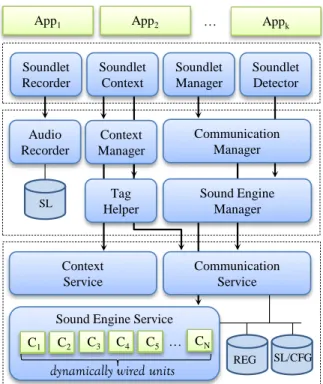
5.1 On-device Processing Components. . . 33
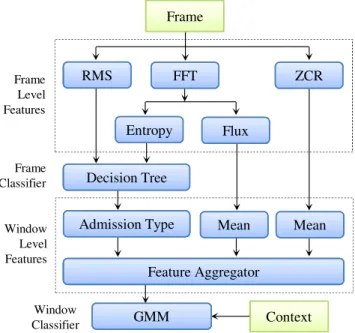
5.2 On-device Acoustic Processing Pipeline. . . 33
5.3 Example Acoustic Processing Pipeline in XML Format. . . 35
5.4 An Instance of a Dynamically Created Pipeline. . . 35
6.1 Energy consumptions by various feature extractors. . . 44
6.2 Accuracy vs. Lifetime Trade-off in Auditeur. . . 45
6.3 Performance of feature selector in Auditeur. . . 46
6.4 Illustration of Energy Efficiency in Auditeur. . . 46
6.5 Processing Delay in Auditeur. . . 47
6.6 Power Consumptions of Applications. . . 48
6.7 Accuracy of Applications. . . 49
6.8 Context-Awareness of Applications. . . 50
6.9 Results of User Study. . . 51
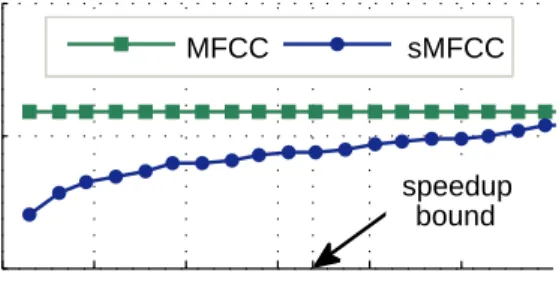
7.1 MFCC Computation Time at Various Sampling Rates. . . 56
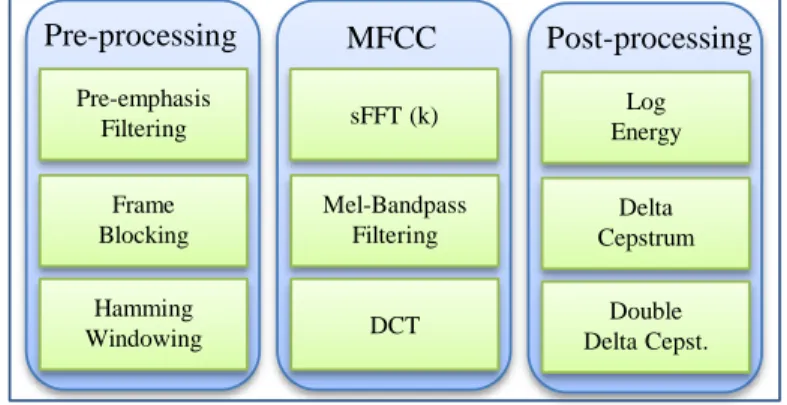
7.2 Steps in MFCC Computation. . . 58
7.3 Sparseness in Speech Signals. . . 60
7.4 Approximation Error in sMFCC. . . 60
7.5 Comparison of MFCC and sMFCC features. . . 61
7.6 Accuracy of Word Recognizer using sMFCC and MFCC Features. . . 62
7.7 Computation Time of Word Recognizer using sMFCC and MFCC Features. . . 63
8.1 Illustration of Network Interface Switching. . . 68
8.2 Concurrency of TCP Sessions in Mobile Devices. . . 69
8.3 Lifetime of TCP Sessions in Mobile Devices. . . 70
8.4 Data Activity in TCP Sessions in Mobile Devices. . . 70
8.5 Using switchInterface() method. . . 73
8.6 MultiNets Architecture. . . 73
8.7 MultiNets State Diagram. . . 74
8.8 Layered Implementation of MultiNets. . . 77
8.9 Using MultiNets API. . . 78
8.10 Benchmark Results of MultiNets. . . 80
List of Figures xii
8.11 Illustration of Interface Switching. . . 81
8.12 Timeout and Switching Time. . . 82
8.13 Energy Measurement Devices and Setup. . . 83
8.14 Energy Consumptions of WiFi and 3G. . . 83
8.15 Energy Savings with MultiNets. . . 84
8.16 Offloading Data to Wifi with MultiNets. . . 85
8.17 Higher Throughput with MultiNets. . . 86
8.18 MultiNets Deployment Tour Route. . . 87
8.19 Energy Savings with MultiNets in Deployment Experiment. . . 88
9.1 The Septimu Earphones. . . 94
9.2 System Diagram of Musical-Heart. . . 96
9.3 Web Services in Musical-Heart. . . 97
9.4 Filtering Music Out from Heart Beats. . . 98
9.5 Activity Level Detection with Septimu. . . 101
9.6 Detecting Lying and Sitting with Septimu . . . 102
9.7 Biofeedback-based Music Recommendation. . . 104
9.8 Music and Heart Rate Relationship Study. . . 109
9.9 Effect of Music Features at Different Activity Levels. . . 109
9.10 Evaluation of Heart Rate Measurement Algorithm on Empirical Dataset. . . 110
9.11 Evaluation of Heart Rate Measurement Algorithm on MIT-BIH Dataset. . . 111
9.12 Comparison of Heart Rate Measurement Approaches. . . 111
9.13 Fitness of PI Controller Model. . . 113
9.14 Heart Rate Intensity Measurement Results. . . 115
9.15 Activity Level Measurement Results. . . 115
Chapter 1
Introduction
Our day starts with the sound of an alarm clock, and throughout the day, we hear and respond to a wide variety of sounds. Over the course of evolution, humans have mastered the capability of remembering, recognizing, and acting upon hundreds of thousands of different types of acoustic events on a day-to-day basis. The aim of this research is to make a mobile device capable of doing the same – i.e. to recognize sounds that it captures with the on-board microphone and to deliver the recognized acoustic events to applications that are interested in them.
Decades of research on acoustic sensing have led to the creation of systems that now understand speech, supports voice activated search feature, recognizes the speaker, and finds a song. For example, in October 2011, Apple introduced an intelligent personal assistant called – Siri[1], which offers conversational interaction with many applications, including reminders, weather, stocks, messaging, email, calendar, contacts, notes, music, clocks, and web browser. Following that footstep, Google introduced theirOK Googlefeature which allows the user to speak into his Android phone or tablet to do things like web search, get directions, and send messages. Web services and applications like Shazam [2] have been created, which provides a music identification service. However, apart from speech, music, and some application-specific sounds, the problem of recognizing varieties of general-purpose sounds that a mobile device encounters all the time has remained unsolved.
The overarching goal of this research is to enable rapid development of mobile applications that recognize general-purpose acoustic events on mobile devices. As these acoustic event recognizers are meant to run on a mobile device, the technical goals include – energy-efficiency, communication-efficiency, leveraging the user contexts such as the location and position of the mobile device in order to improve the classification accuracy, and ease of application development.
In this chapter, we present the motivation behind this research (Section 1.1), identify the core research challenges (Section 1.2), and then state our thesis statement and provide an overview of our solution (Section 1.4). These are followed by a list of contributions (Section 1.3) and some caveats (Section 1.5). Finally, we describe the organization of
Chapter 1 Introduction 2
this thesis (Section 1.6).
1.1
Motivation
If we think of all the applications that are in the app-store of various mobile platforms and perform any kind of acoustic processing, soon we will realize that these applications relate to mainly two types of sounds – speech and music. We find it a great missed opportunity that all mobile devices come with an acoustic sensor, i.e. the on-device microphone, and yet we do not see many applications that recognize and act upon varieties of sounds that we hear all the time around us. Imagine the possibilities that we could turn into realities, if we could have mobile applications that recognize various types of sounds. By recognizing the sounds that someone makes during his sleep, such as – yawning, snoring, coughing, bed-movement, and mumbling, we could create an application that measures his sleep quality. By recognizing the sounds of whining, baby talks, and baby crying – we could create a baby monitoring application for a busy mother. Or, we could create a nice social monitoring application that keeps track of how much a person is talking, laughing, crying, or yelling, and how many people and who he is talking to. Thelack of a general-purpose acoustic event classification serviceis the primary reason why there are not so many applications that detect such general-purpose sounds on a mobile device.
Mobile application developers depend heavily on APIs provided to them by the mobile OS platform for common tasks, but when it lacks necessary functions for their application, it costs developers weeks of time for implementation. Beyond just time, many developers do not have the necessary technical background to implement these functions correctly or efficiently. Because of this, there is a growing trend where mobile applications are paired with numerous web services by other providers to get access to specialized or computationally demanding tasks. Microsoft’s Hawaii [3], for example, supports path prediction, key-value storage, translator, relay, rendezvous, OCR, and speech-to-text services. Google provides services such as web search, maps, play, YouTube, cloud drive, and Gmail. Other providers give access to data sources such as weather, financial data, airline information, and parcel tracking. However, to the best of our knowledge, there is no web service that provides a general-purpose acoustic event classification service for mobile devices.
Mobile devices, such as smartphones and tablets, have begun to use their microphones for various acoustic processing tasks, but most of the applications are special purpose acoustic event detectors. Examples of voice and music based systems include: speaker identification [4], speech recognition [5], emotion and stress detection [6, 7], conversation and human behavior inference [8, 9], music recognition [2], music search and discovery [10], and music genre classification. There are other types of applications that fall into the non-voice, non-music category, such as a cough detector [11], a heart beat counter [12], and logical location inference [13, 14]. These examples are limited in number and acoustic sensing is often one of multiple sensing modalities in these works. There are existing works [15, 16] that consider
1.1 Motivation 3
multiple types of acoustic events. SoundSense [15] considers speech, music and ambient sound, and provides a mechanism to label clusters of ambient sounds to extend the set of classes. Jigsaw [16] considers speech and sounds related to activities of daily living. These systems still lack in providing tools and mechanisms to easily extend detection capabilities and effectively support development process. They are limited for general purpose acoustic event detection service for mobile devices and in exploiting the promising opportunities given by already prevailing mobile devices and tablets equipped with microphones.
To address this need, we have built a general-purpose acoustic event detection platform called theAuditeur. The basic idea of Auditeur is that – mobile device users all over the world will record and upload short-duration sound clips to the cloud, and a cloud-service will automatically create classifiers for those sounds. These classifiers can then be downloaded and run on the device to recognize future occurrences of that specific type of sound. Aside from the ability to dynamically create classifiers to recognize a wide variety of sounds, two aspects of Auditeur make it unique and ideal for mobile platforms. First, the classifiers created by Auditeur are energy-aware. An input to the classifier creation service is an energy bound, and based on that bound, Auditeur weaves the best acoustic processing pipeline that ensures that the classifiers run within the energy bound and yet achieve a very high accuracy. Second, the classifiers created by Auditeur are context-aware. Auditeur is capable of automatically determining the user-contexts, such as the location of the user and the position of the mobile device with respect to human body, and dynamically loads a different classifier whenever the user context changes. Auditeur also provides an easy-to-use API for the mobile application developers to foster the creation of applications.
Besides Auditeur, three other systems have been developed in this research which empowers some aspects of the Auditeur platform. First, we have developed thesMFCCacoustic feature, which is an approximation to a well-known acoustic feature called theMel-Frequency Cepstral Coefficient (MFCC). The motivation behind which is to enable faster extraction of MFCC features in applications that must sample the microphone at a very high rate and yet has to meet the real-time requirement. Second, we have developed the MultiNets, which is capable of switching wireless networking interfaces (WiFi and 3G) on a mobile device based on a predefined policy, such as saving energy during wireless data communication. The motivation behind MultiNets is to enable energy-efficient mobile-cloud communication in applications that must communicate quite frequently with a remote server over the Internet. Third, we have developed the Musical-Heart, which is a system that provides a biofeedback-based and context-aware music recommendation service to a mobile device. The motivation behind Musical-Heart is to build a convenient, non-invasive, personalized and low-cost wellness monitoring system that obtains heart rate and activity level information from a pair of specially designed earphones while a user is listening to the music on his mobile device. Timeline wise, Musical-Heart was developed as a standalone application prior to the creation of the Auditeur platform. However, we have shown that Musical-Heart’s heart rate detection can also be implemented with Auditeur.
Chapter 1 Introduction 4
1.2
Technical Challenges
This thesis addresses a number of key technical challenges in building a general-purpose, energy-efficient, and context-aware acoustic event detection service platform for mobile devices.
First, applications are diverse in nature. Different applications require to recognize a different set of sounds, which in turn requires different types of preprocessing, acoustic feature extractors, and classifiers. Buildinga generic platform that is capable of automatically generating many applications that recognize a wide variety of acoustic eventsis therefore challenging.
Second, battery-life is a scarce resource for mobile devices. Building energy-efficient applications is in general a hard problem, and acoustic processing adds further complexity on top of it. Some applications may want to continuously sense the microphone for a very long period. Without carefully planning ahead of time, it is impossible to guarantee that an application will not drain the battery in the middle of its expected lifetime. One major challenge is thereforeto design an acoustic event classifier which is accurate yet runs under a given energy budget.
Third, acoustic event classification is dependent upon the user contexts. A classifier that works perfectly indoors does not necessarily perform accurately when it runs outdoors. The types of possible acoustic events also change with user’s location. Distance from the mobile device to the source of the sound also matters. For these reasons, we need to consider the user context when classifying acoustic events in order to achieve a higher accuracy. On-board sensors on a mobile device provides us with a rich set of user contexts, such as the location of the user and the position of the mobile device with respect to the body. One challenge is therefore toleverage the user contexts in order to improve the accuracy of acoustic event classification.
Fourth, in order to facilitate a rapid development of mobile applications, we provide APIs to the developers. An important challenge ishow to design a generic API that is easy to learn, easy to use, and expressive enough to specify different acoustic event types in the same manner.
Fifth, different acoustic signals have different properties. Speech signals, for example, are extremely sparse in the frequency domain. This sparseness in speech allows us to design an efficient frequency domain feature extraction module that runs several times faster. We demonstratehow the sparseness in speech signals is exploited to make the on-device acoustic processing faster.
Sixth, there are some applications that must communicate to one or more remote servers over the Internet during its lifetime. A mobile device communicates to the cloud using either a WiFi or a cellular network. Each of these interfaces has its pros and cons. By selecting the right network interface to communicate with a remote server, it is possible to save energy and increase throughput. We demonstratehow to make dynamic choices on which wireless interface to use for an efficient mobile-cloud communication.
1.3 Thesis Statement and Solution Overview 5
Seventh, as an illustration of a special-purpose acoustic event detection application, we have developed the Musical-Heart system. This system comes with several technical challenges of its own, such as – detecting heartbeats from acoustic signals collected from the ear, detecting the activity level of the user from accelerometer readings obtained from the ear, and recommending music based on the heart rate and the activity level of a person in order to achieve a target heart rate goal.
1.3
Thesis Statement and Solution Overview
1.3.1
Thesis Statement
This dissertation investigates the following hypothesis:
It is possible to detect and classify acoustic events on a mobile device, which is – more generic, highly-accurate, more energy-efficient, adaptive to user context, and easier to program – when compared to state-of-the-art special-purpose acoustic event detection systems that use on-device or cloud-assisted classifiers.
1.3.2
Solution Overview
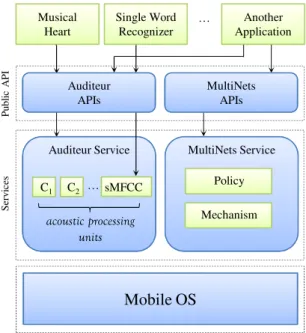
In order to prove our hypothesis, we have built a total of four systems: Auditeur, sMFCC, MultiNets, and Musical-Heart. A conceptual integration of all four systems are shown in Figure 1.1.
Auditeur Service Musical Heart P u bl ic A P I S er v ic es C1 C2 … acoustic processing units … sMFCC MultiNets Service Mechanism Policy
Mobile OS
Single Word Recognizer Auditeur APIs Another Application MultiNets APIsChapter 1 Introduction 6
At the bottom layer of the figure, we have the mobile operating system which is the Android OS in our case. Both Auditeur and MultiNets run as a system service on top of the mobile OS. Auditeur offers services related to sound recognition, whereas MultiNets offers services related to wireless network interface switching. The sMFCC module is a part of the Auditeur service like other acoustic processing units inside it. The public API layer provides APIs to the applications with which they access the services offered by Auditeur and MultiNets. With Auditeur API, an application registers for and gets notified on various types of acoustic events. With MultiNets API, an application selects what policy (e.g., energy saving, or high throughput) should be applied during mobile-cloud communications.
The top layer consists of three running applications. The fist application is the Musical-Heart system which uses the Auditeur API. Auditeur notifies Musical-Heart application whenever it detects a heartbeat event in the streaming acoustic data from a special-purpose earphone hardware. The earphone is called the Septimu, which we have built as part of the Musical-Heart system.
The second application also uses the Auditeur API, but its specialty is that, it uses the sMFCC module besides other acoustic processing units in Auditeur. The application is a simple single spoken word recognizer that recognizes words from a fixed vocabulary. By using the sMFCC module instead of the regular MFCC module, this application achieves several orders of magnitude speedup in acoustic event detection with the cost of a slight reduction in accuracy.
The third application is a conceptual one which uses both the Auditeur and the MultiNets APIs. An example of such as application could be an integrated asthma monitoring system that assesses the severity of asthmatic wheezing and crackling sounds using the Auditeur service and talks to a remote server to obtain information such as the weather condition, pollen level, pollution level, and air quality, using the MultiNets service. Building such an application is currently in progress, however, the system is not part of this thesis.
1.4
Contributions
The contributions of this dissertation are the following:
• Auditeur– a versatile, general-purpose, flexible, extensible, context-aware, and efficient end-to-end acoustic event detection platform for mobile devices, backed by the cloud. The system comes with a sound recognition service on the mobile device, which is capable of dynamically wiring acoustic processing units, and running an energy-and context-aware classification plan on the phone, energy-and provides APIs to register for energy-and get notified on specific sound events.
• A collection of crowd-contributed, admission controlled, and contextually-tagged short sound clips in the cloud available to the developers, and an API to upload and manage them. The collection contains over5000tagged
1.4 Contributions 7
sound clips which are collected by35volunteers, over a nine month period, from three different regions (Virginia, Toronto, and Beijing).
• An acoustic feature selection algorithm that automatically generates energy-aware acoustic event detection plans for a mobile device, given the types of sounds that an application wants to recognize and an energy budget. Our empirical evaluation shows that the algorithm is capable of increasing the device-lifetime by33.4%, sacrificing less than2%of its maximum achievable accuracy.
• We implement seven applications with Auditeur, and deploy them in real-world scenarios to demonstrate that Auditeur is versatile,11.04%−441.42%less power hungry, and10.71%−13.86%more accurate in detecting acoustic events, compared to state-of-the-art techniques. A user study demonstrates that novice programmers can implement the core logic of interesting applications with Auditeur in less than30mins and using only15−20 lines of Java code.
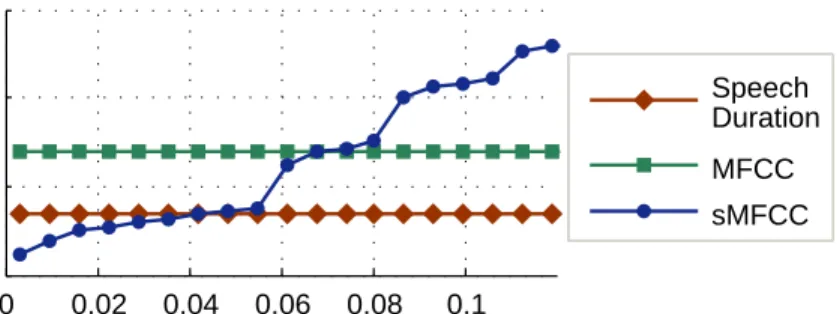
• sMFCC – an algorithm, inspired by [56, 57], which enables the extraction of frequency domain acoustic features inside a mobile device in real-time, without requiring any support from a remote server even when the sampling rate is as high as44.1KHz. We implement a simple spoken word recognition application using both MFCC and sMFCC features, show that sMFCC is expected to be upto 5.84times faster and its accuracy is within 1.1%−3.9%of that of MFCC, and determine the conditions under which sMFCC runs in real-time.
• We conduct a three months long empirical study and summarize the TCP characteristics in Android smartphones, complementing a similar study with iPhone users in [17, 18]. We devise a switching technique which is client-based, transparent to applications, and does not require any protocol changes.
• MultiNets– which is to the best of our knowledge, the first complete system of this kind and demonstrate its performance in a real-world scenario. MultiNets outperforms the state-of-the-art Android system either by saving up to33.75%energy, or achieving near-optimal offloading, or achieving near-optimal throughput while substantially reducing TCP interruptions due to switching.
• We design and implement three switching policies for MultiNets. Our analysis on usage data collected from real mobile device users shows that with switching, we can save27.4%of the energy, offload79.82%data traffic, or achieve7times more throughput on average.
• Septimu, the first wearable, programmable hardware platform designed around low-cost and small form-factor IMUs and microphone sensors that are embedded into conventional earphones, and communicate to the phone via the audio jack and Bluetooth.
Chapter 1 Introduction 8
• Musical-Heart, a complete sensing system that monitors the user’s heart rate and activity level – passively and without interrupting the regular usage of the phone – while the user is listening to music, and recommends songs based on the history of heart’s response, activity level, desired heart rate and social collaboration.
• We devise three novel algorithms in Musical-Heart: (1) a threshold free, noise resistant, accurate, and real-time heart rate measurement algorithm that detects heart beats from a mixture of acoustic signals from the earbuds, (2) a simple yet highly accurate, person-specific, 3-class activity level detection algorithm that exploits accelerometer readings from the earbuds, and (3) a PI-controller that recommends music to the user based on the past history of responses to different music and helps maintain the target heart rate at different activity levels.
• We perform a pilot study by collecting ground truth data of heart rates, and summarizing it to show the effect of music on heart rate at various activity levels. The dataset is further used to show that the detected heart rate is 75%−85%correlated to the ground truth, with an average error of7.5BPM. The accuracy of the person-specific, 3-class activity level detector is on average96.8%, where these activity levels are separated based on their differing impacts on heart rate.
• We demonstrate the practicality of Musical-Heart by deploying it in two real world scenarios, and show that Musical-Heart helps the user in achieving a desired heart rate intensity with an average error of less than12.2%, and the quality of recommendations improves over time.
1.5
Caveats
The systems and tools that are built during this research come with a few caveats:
• Auditeur is capable of detecting sound events that are recognizable from short-term time and frequency domain features. Recognizing sounds that depend heavily on temporal variations, such as long spoken sentences, are not suitable for it. Especially, speech recognition is a complex and well-studied problem having several well-known solutions. Hence, we leave it out of the scope of Auditeur.
• The acoustic features and classifiers used in Auditeur are shown to recognize a wide variety of sounds, but yet no such list is ever exhaustive. It is possible that for a new type of acoustic classification problem, we may have to incorporate new acoustic processing modules into the system in order for Auditeur to be able to detect that sound. Auditeur is an extensible system where addition of a new feature extractor or a new classifier unit is easy. Such extensions do not require any change to the framework.
• The scalability of the services running on the cloud is not addressed in this thesis as this is by itself a well-formed research problem. Our implementation of Auditeur is a proof of concept and runs on an Amazon EC2 instance.
1.6 Organization of the Dissertation 9
In the future, we plan to move our server to Google App Engine which provides automatic scaling of applications without requiring us to manage the machines by ourselves.
• The general applicability of sMFCC acoustic feature is not fully explored in this research. We only have studied speech signals and shown that sMFCC is applicable to speech. In the future, we plan to explore the applicability of sMFCC on sounds other than just speech and make the choice between MFCC and sMFCC automatic in Auditeur.
• The absolute values of the measured energy consumption of Auditeur, MultiNets, and Musical-Heart are dependent on the model of the mobile device as well as the operating system. However, when comparing energy consumptions of two systems, we ran both systems on the same mobile device and repeated an experiment multiple times so that the comparison is fair.
• We perform an empirical study which shows that the TCP sessions on a mobile device are short-lived – which is the basis of uninterrupted interface switching mechanism in MultiNets. In the future mobile systems, this assumption may not be true and applications running on MultiNets will encounter interruptions during switching. It is thus advised to use the MultiNets APIs to create short-lived TCP sessions so that the interruptions do not happen.
• The pilot study that we conducted in Musical-Heart to model the relationship between music and heart rate involves35participants and the full system was tested on4 volunteers only. This only provides us with an existential proof of the concept of controlling heart rate with music. The generalizability of the system requires further deployment and investigation. In the future, we plan to make the Musical-Heart service public, so that we can have more data to support our claim.
1.6
Organization of the Dissertation
The rest of the dissertation is organized as follows:
• Chapter 2 presents the state-of-the-art in technologies related to Auditeur, sMFCC, MultiNets, and Musical-Heart systems that are developed in this thesis.
• Chapter 3 describes some basic terminology that are used in the later chapters.
• Chapter 4 provides an overview of the mobile-cloud platform by introducing Auditeur, providing an overview of its workflow, and describing some key properties of the system.
Chapter 1 Introduction 10
• Chapter 5 describes the implementation of the Auditeur platform by providing the implementation details of the on-device processing components as well as the cloud services.
• Chapter 6 provides an in-depth evaluation of the Auditeur platform.
• Chapter 7 describes the motivation, algorithm, and evalution of the sparse MFCC (sMFCC) feature.
• Chapter 8 describes MultiNets’s policy oriented dynamic network interface switching algorithm and its evalution.
• Chapter 9 describes the details of the Musical-Heart system – including its hardware, heart rate measurement algorithm, activity level detection algorithm, biofeedback-based music recommendation algorithm, and an in-depth evaluation of the system.
Chapter 2
Related Work
This chapter presents the state-of-the-art in technologies related to Auditeur, sMFCC, MultiNets, and Musical-Heart systems that are developed in this thesis. The chapter covers existing systems that detect special types of acoustic events (Section 2.1), examples of web services that are commonly used by mobile application developers (Section 2.2), resource aware sensor data classification systems which are related to Auditeur’s energy-aware classification algorithm (Section 2.3), approaches in switching network interfaces that are related to MultiNets (Section 2.4), works that exploit sparseness in data (Section 2.5), various techniques for heart rate detection on a mobile device (Section 2.6), techniques that detect activity context of a mobile device user (Section 2.7), and existing approaches to automatic music recommendation (Section 2.7) which are related to Musical-Heart’s biofeedback-based music recommendation system.
2.1
Special-Purpose Acoustic Event Detection
Acoustic sensing on mobile devices has been used in many works. Examples of voice and music sensing applications are, speaker identification [4], speech recognition [5], emotion and stress detection [6, 7], conversation and human behavior inference [8, 9], music recognition, search and discovery [2, 10]. There are some limited number of applications that consider other types of sounds. MusicalHeart [12] uses a special-purpose microphone to count heart beats, [11] counts coughs, Nericel [19] detects horns, Ear-phone [20] monitors noise pollution, SurroundSense [13] and CSP [14] infer logical location. All these systems detect only one specific type of sound. SoundSense [15] distinguishes voice from music and noise, and clusters other sounds. But unlike Auditeur, none of these systems aim at solving the general purpose acoustic event detection problem. Some works are technically similar to Auditeur, but solve different problems. TagSense [21] senses people, activity and context in a picture, and creates tags on-the-fly, whereas Auditeur involves people in the sound tagging process, but provides automated tag suggestions. Sphinx [5] uses generic processing units which are similar to the APUs in Auditeur, but they have a simpler pipeline, highly tuned to solve the speech recognition
Chapter 2 Related Work 12
problem. Pickle [22] creates privacy preserving classifiers on the cloud whereas we preserve privacy by providing the user with private spaces, and classifiers in Auditeur are trained for energy efficiency.
2.2
Web Services for Mobile Devices
There are several web services available for mobile application developers. Hawaii [3] provides a social mobile sharing (SMASH) a service for rapid prototyping of social computing applications, a service to predict a user’s destination using the current route, a key-value storage for application-wide state information, a text translation service, providing relay points in the cloud for applications’ communication, an optical character recognition service (OCR), and an English speech-to-text service. But Hawaii does not have an acoustic event detection service. Google provides services such as: web search, Google maps, application store (Google play), video streaming (YouTube), Google cloud drive, and an email service (Gmail). Other providers give access to data sources such as weather, financial data, airline information, and parcel location tracking. Unlike Auditeur, none of these provide a sound recognition service and API to the developers.
2.3
Resource Aware Classification
There are several works that deal with resource aware sensor data classification on mobile devices. Kobe [23] is a tool to generate energy and latency aware classifiers, but unlike Auditeur, it requires uninterrupted mobile-cloud communication for adaptive code-offloading (as it is required in systems like MAUI [24] and Odessa [25]), it is not sensitive to user context, and their set of features is predetermined and fixed by the developer. Orchestrator [26] enables multiple applications to effectively share resources (e.g. sensors) whose availability changes dynamically. The optimum plan selection problem in Orchestrator is similar to the acoustic feature selection problem in Auditeur. However, unlike Auditeur, their selection algorithm is not scalable as they enumerate an exponential number of plans while Auditeur uses a polynomial time algorithm to eliminate the need for enumeration of exponential number of subsets of features and thus limits the total number of plans to consider. [27] proposes a heuristic algorithm to select a subset of sensors and their tolerance levels so that they can infer multiple contexts in an energy efficient manner. Feature selection is a problem studied by many; [28] provides a survey. WEKA [29] implements several of these attribute selection methods. But, our problem is different as our selection criterion is to minimize energy consumption, not to minimize the number of features. Like Auditeur, symmetrical uncertainty has been used in [30] as a goodness measure.
2.4 Network Interface Switching 13
2.4
Network Interface Switching
Switching among multiple network interfaces of a mobile device has been considered in the literature. New protocols in various layers have been designed to support switching among access networks. Wang et al. [31] propose a rate control algorithm for multiple access networks, which needs to be integrated into application-layer protocols. Kim and Copeland [32], and Wu et al. [33] propose TCP variants that result in better performance by switching among access networks. Mobile IP [34] uses foreign/home agents to forward network traffic from/to a smartphone that move among access networks, but incurs additional network latency. Mobile IP v6 [35] uses optimized routes for lower network latency, but it still relies on deploying foreign/home agents for mobility management. In contrast to MultiNets, widely deploying TCP variants and mobile IP agents in the Internet incur tremendous costs and burden, and may take years to be done.
Gateways between mobile devices and the Internet can be used for accessing multiple network interfaces. Balasub-ramanian et al. [36] design a system to reduce the network traffic over cellular networks by transmitting delay tolerant data over WiFi and real-time data over cellular networks. Sharma et al. [37] propose a system that uses gateways to aggregate network resources from multiple access networks among several collaborative smartphones. Armstrong et al. [38] use a proxy to notify the phone via SMS about content updates and suggests interface to use. Unlike MultiNets, gateway solutions require deploying expensive gateways, incurs additional network latency, and may need users to configure the proxy settings in applications.
A master/slave solution [39] chooses an always-connected access network as the master network, and uses other access networks as slave networks for opportunistic routing. Different from MultiNets, deploying master/slave solutions requires complete control over multiple access networks, which is difficult due to business reasons. Higgins et al. [40] propose intentional networking where applications provide hints to the system and system chooses the best interface opportunistically. In contrast, MultiNets is completely transparent to the existing aplications. Rahmati et al. [18] demonstrate the feasibility of TCP flow migration on iPhones, but they do not address or rigorously quantify the policies and different benefits of switching interfaces.
2.5
Exploiting Sparseness in Speech
Sparseness in data is exploited in many application domains such as learning decision trees [41], compressed sens-ing [42], analysis of Boolean functions [43], large scale time series data analysis [44], similarity search [45], and homogeneous multi-scale problems [46]. In our work, we perform an empirical study on the sparseness in speech data collected on smartphones with the goal of exploiting the sparseness to expedite the MFCC feature computation. MFCC is a widely used feature for analyzing acoustic signals [47, 48, 49, 50, 51]. MFCC is used for spoken word
Chapter 2 Related Work 14
recognition [47], voice recognition [48], speaker identification [49], music modeling [50], and music similarity mea-sure [51]. [52] presents a nice comparison of different MFCC implementations. However, in our work, we introduce a sparse MFCC (sMFCC) which is a sparse approximation of MFCC and is efficient to extract.
Comparison of several speech recognition techniques on mobile devices is described in [53]. [4] performs speaker identification, [15] classifies sound into voice, music or ambient sound, and [9] classifies conversion. But all of these applications limit their sampling rate to its minimum. [12] uses a high sampling rate to extract heart beats from acoustic signals, but the system is not fully real-time. In this dissertation, we analyze the feasibility of using sMFCC features that is expected to run in real-time and at higher data rates.
2.6
Heart Rate Detection on Mobile Devices
The smartphones applications that measure heart rate use three basic principles: camera, microphone, and accelerometer based. Camera based applications (Instant Heart Rate, PulsePhone) detect pulses by measuring the changes in the intensity of light passing through the finger. Microphone based applications (Heart Monitor, iRunXtream) require the user to hold the microphone directly over heart, or neck, or wrist to detect beats. Accelerometer bases techniques (iHeart) are indirect, in which, the user measure his pulse with one hand (e.g. from neck) and taps or shakes the phone with other hand in the rhythm of the heart beats. Our approach in Musical-Heart is microphone based, but the difference is, in all of the existing applications, the heart rate monitoring requires active engagement of the user, whereas Musical-Heart obtain heart beats from the ear without interrupting the user’s music listening activity. Other approaches that detect heart beats from the ear [54, 55] use a combination of infrared LED and accelerometers.
2.7
Inferring Activity Context on Mobile Devices
Several works are related to our activity detection algorithm. [56] concludes that it is practical to attribute various activities into different categories which is similar to the activity levels in Musical-Heart. [57] describes an accelerometer based activity classification algorithm for determining whether or not the user is riding in a vehicle, or in a bus, or another vehicle for cooperative transit tracking. In our work, we only require to detect whether someone is indoors vs. outdoors, and his current speed. [58] presents a mobile sensing platform to recognize various activities including walking, running and cycling. [59] presents a wearable platform for motion analysis of patients being treated for neuromotor disorders. [60] detects user’s caloric expenditure via sensor data from a mobile phone worn on the hip. But these works require the user to wear sensors at specific positions of the body. In our case, the user naturally wears the earphone in the ear. [61] performs activity recognition from user-annotated acceleration data, which is different than
2.8 Music Recommendation Systems 15
our unsupervised learning. [62] presents a high performance wireless platform to capture human body motion. In our system, we do not require a high speed communication to the server.
2.8
Music Recommendation Systems
Music has been shown to improve sleep quality [63, 64], cope with stress [65], improve performance [66, 67], influence brain activity [68], and increase motor coordination [69]. However, we only consider the response of the heart to music. Studies have shown that exercise intensity and tempo are correlated linearly [70], and relaxing music (e.g., Bach, Vivaldi, Mozart) result in reduction of heart rate and its variability [71]. We perform a similar study, but the difference is ours involves smartphone users who are mobile and whose activity levels change.
Existing approaches for automatic music recommendation are: using one or more seed songs [72, 73], retrieve similar music by matching the tempo [74], and learning the habit (e.g., music genre, preferences, or time of day) of the user [75, 76]. None of these consider any physiological effects of music on the user. Physiological information, such as gait and heart rate, have been considered in [77, 78, 79, 80]. But the downside of these approaches are, first, the user has to use a separate device (e.g. ECG or pulse oximeter) which is an inconvenience, second, the music recommendation is based on an overly simplistic and general rule of thumbs, i.e., to suggest music with a matching tempo, which is not personalized, and third, the recommendation is not situation aware and mostly targeted to a single scenario of jogging.
2.9
Summary
This chapter presents the state-of-the-art in technologies related to Auditeur, sMFCC, MultiNets, and Musical-Heart systems that are developed in this thesis. We have covered some systems and algorithms that are related to Auditeur’s acoustic event detection and energy aware classification, MultiNets’s network interface switching technique, and Musical-Heart’s heart rate detection and biofeedback-based music recommendation techniques.
Chapter 3
Background and Terminologies
This chapter describes some basic terminologies that are used in the later chapters. The first four sections (Sections 3.1-3.4) of this chapter define acoustic events, tagged soundlets and their types, and the mobility contexts that are used in the Auditeur platform. The next two sections (Sections 3.5- 3.6) describe the MFCC acoustic feature and the sparse FFT which are required to understand the sMFCC algorithm in Chapter 7. The last three sections (Sections 3.7- 3.9) explain basic concepts, such as the ECG, heart beats, pulse, tempo, pitch, energy, and heart rate training zones, which are used in Chapter 9 where we describe the MultiNets system.
3.1
Acoustic Events
We define anacoustic eventas a short-duration (1−3s) sound that we can name. Examples of acoustic events include – speech; music; sound of a machine such as a printer, a telephone, or an air conditioner; sound of a vehicle such as a car, a bus, or an airplane; sound of human emotions such as laughter, yelling, or crying; etc.
Suppose, in an audio clip of60seconds, a person is talking for15seconds, laughing for3seconds, and the rest of the clip contains silence. Considering each acoustic event having a duration of a second, the clip contains a total of15 talking events,3laughter events, and42silence events.
The duration of an acoustic event is called thewindow sizein Auditeur. It denotes the amount of audio data that are taken for classification as a single event. The developer of an application decides the window size based on the requirement of an application. The example in the previous paragraph has a window size of1second which is the default window size in Auditeur.
3.2 Tagged Soundlets 17
3.2
Tagged Soundlets
Atagged soundletis a short-duration (3−30s) audio clip, recorded on a mobile device along with two types of contextual information: user given tags and the mobile device generated context. The logical tags associated with a soundlet are the user given identifiers that describe its content and the surrounding environmental context. Examples of tags are in Table 6.2. Other than these two types of tags, we also keep a record of some meta information about the sound clip. The list of Meta information contains – the audio file information (e.g., audio format, sampling rate, and PCM data), and recording information (e.g., user ID, device model, date-time, GPS location, and environmental noise level).
3.2.1
Content and Container Tags
While the user chooses the tags that he wants to use to describe a soundlet, we require him to enlist two kinds of tags:
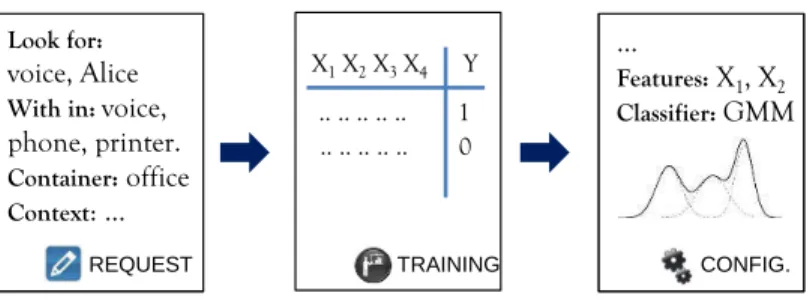
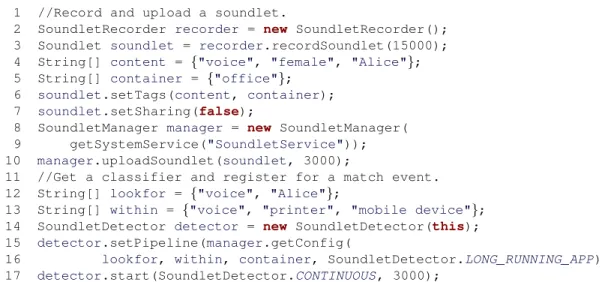
content, andcontainertags. These two types of tags are used during the upload of a soundlet to the cloud. The content tags describe what the soundis, and the container tags describe the background which contains the sound. For example, a15srecording of Alice’s voice at her office should have{voice, female, Alice}in the list of content tags, and {office}in the list of container tags.
3.2.2
Lookfor and Within Tags
Two types of tags are used to make a request for a classifier to the cloud from the mobile device. Thelookfortags describe a class of soundlets that the user wants to recognize, and thewithintags describe the class of soundlets that represents the universe of sounds, i.e. the set of sounds that might be present in the environment along with the sound that he wants to recognize. For example, when creating a training set for a classifier that detects Alice’s voice at her office: the lookfor tags should have{voice, Alice}on the list, the within tags should include{voice, printer, phone}, and the container should be{office}as before.
3.3
Public and Private Soundlets
The space of soundlets is logically partitioned into two subspaces from a user’s point of view –publicandprivate. A
userof Auditeur is anyone who has an account in Auditeur. Typically, the user is an application developer, who uses the public space by default, but may use a private space with proper permissions from an end-user.
Chapter 3 Background and Terminologies 18
3.3.1
Public Soundlets
The public space contains shared soundlets, contributed by all users of Auditeur. This is visible to everyone, and does not require any authentication to access. However, there are two constraints that must be met by each soundlet.
There is a predefined fixed set of tags that can be attached to public soundlets. The user cannot create, modify or delete any tag. The set of tags is maintained by the system admin of Auditeur. Although, at present, there are over 1000different tags, we admit that no fixed set is ever sufficient to cover the enormous possibilities of tags. However, limiting the tags in the public space keeps the space manageable and provides a way to ensure the confidence in sound recognition.
Every public soundlet goes through a sanity check to ensure that it is not an outlier with respect to other soundlets with the same tags. Thus, a public soundlet is not immediately made visible to everyone until it passes an outlier detection test. This is to ensure that no attacker can mess up the public space by filling it with soundlets with non-representative tags. A service running on the cloud automatically detects non-conforming soundlets using a distance based outlier detection technique [81] which is described in Section 5.2.4.
3.3.2
Private Soundlets
Private soundlets are user specific and are not shared. The user has to access his private space using proper authentica-tions. Unlike public soundlets, the private ones are not limited by the tag and sanity constraints, i.e. a user can upload any sound he likes into his private space and attach whatever tag he wants to describe it. However, the list of content and container tags has to be the same (in number of tags and the spelling of tags) in order for two soundlets to be treated as belonging to the same class.
We keep provision for private space in our design in order to complement the public space which is limited by the choices of tags and has a high degree of sanity requirement. The private space is more flexible, tailored to the specific needs of a user, and if properly used, an infinite number of possible sounds can be stored and recognized by our system making it highly extensible.
3.4
Mobility Contexts
The mobility context refers to additional information about the soundlets which may or may not be conveyed by the tags. These are similar to the tags in the manner they are used by the recognition algorithm, but they are different in the manner they are generated. The mobility context is either automatically generated by an algorithm using information from the on-board sensors, or they are assumed. The developer of the application specifies whether an automatically generated context or an assumed context – whichever is more suitable to the application – should be used.
3.5 Mel-Frequency Cepstral Coefficients 19
Aside from basic audio information such as the sampling rate, encoding, duration, and timestamp, Auditeur generates three types of contexts, which are: (1) the location of the user, (2) the position of the device with respect to body, and (3) the environmental noise level. Section 5.1.2 provides an elaboration of mobility contexts. Note that, the developer of an application can always override the context generation process. We keep this provision in Auditeur as context generation has its overhead and in many cases an application is used only in a few specific presumed contexts. For example, an application that detects vehicle sounds can assume that the location is outdoors instead of periodically getting it computed.
3.5
Mel-Frequency Cepstral Coefficients
The Mel-Frequency Cestrum Coefficients (MFCC) is one of the most popular short-term, frequency domain acoustic features of speech signals [82]. The MFCC have been widely used in speech analysis because of their compact representation (typically, each speech frame is represented by a39-element vector), close resemblance to how human ear responds to different sound frequencies, and their less susceptibility to environmental noise.
The MFCC feature extraction starts with the estimation of the power spectrum which is obtained by taking the square of the absolute values of the FFT coefficients. However, prior to computing the power spectrum, typically each speech frame passes through a pre-emphasis filter which is followed by a windowing process. The log-power spectrum is used instead of the power-spectrum as human hearing works in decibel scales. The log-power spectrum then goes through a filtering process. A filter-bank with around20triangular band-pass filters is applied to reduce the dimensionality. These filters follow a Mel-scale which is linear up to1KHz and logarithmic for the larger frequencies – resembling human hearing. Finally, a discrete cosine transform (DCT) is performed to compress the information and to make the vectors uncorrelated. Only the lower-order coefficients (typically 13) are used and the rest are discarded. The 13-MFCCs plus the deltas and double deltas constitute a 39-element feature vector for each speech frame.
3.6
Sparse Fast Fourier Transform
The discrete Fourier transform (DFT) is one of the most significant algorithms in the digital signal processing domain. The fastest algorithm that computes DFT of ann-dimensional signal isO(nlogn)-time. However, a recent algorithm [83, 84] coined sparse FFT (sFFT) has broken this bound for a special case of DFT where the signals are sparse. A signal is considered sparse if most of its Fourier coefficients are small or very close to zero. For a small numberkof non-zero Fourier coefficients, sFFT computes the Fourier transformation inO(klogn)-time.
The basic idea of sFFT is to hash the Fourier coefficients into a small number of bins. The signal being sparse in the frequency domain, it is less likely that each bin will have more than one large coefficient. The binning process is
Chapter 3 Background and Terminologies 20
done inO(Blogn)whereBis the number of bins – by at first permuting the time-domain signals and then filtering them. Each bin at this point ideally has only one large Fourier coefficient, and only such ‘lonely’ coefficients are taken into the solution. The process is repeatedΘ(logk)times, each time varying the bin sizeB=k/2rwhere the integer
r∈[0,logk], so that allkcoefficients are obtained. The overall running time of the algorithm is dominated by the first iteration, and hence the time complexity isO(klogn). The algorithm is probabilistic, but for exactk-sparse signals (i.e. at mostkof the coefficients are significant), the algorithm is optimal, as long ask=nΩ(1).
3.7
ECG, Heart Beat and Pulse
The electrocardiogram (ECG) is the most reliable tool for assessing the condition of the heart and measuring the heart rate. Getting an ECG reading is a non-invasive procedure in which a set of electrodes is attached to specific regions of a body to record the electrical activity of the heart.
P R Q S T P R Q S T P R Q S T P R Q S T
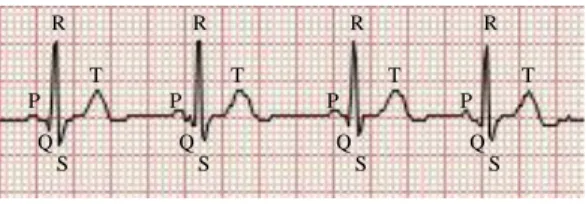
Figure 3.1: The interval between consecutive R waves determines the heart rate.
Figure 3.1 shows a portion of an ECG record comprising of four consecutiveheartbeats. The various waves (or, peaks) that are seen on a heartbeat are historically denoted by the letters: P, Q, R, S, and T. R waves are more visible than others in an ECG record. Hence, the instantaneous heart rate is usually obtained by taking the inverse of the time interval between two consecutive R waves. Since the instantaneous heart rate varies with respiration, the average of 30−60instantaneous readings is taken to obtain the average heart rate, expressed in beats per minute (BPM). While the heart rate directly refers to the frequency of the heart’s beating, thepulse, on the other hand, is the contraction and expansion of an artery due to the beating of the heart. The heart rate and the pulse rate are usually the same – unless for some reason, blood finds it difficult to pass through the arteries. Pulses can be felt on different parts of the body, e.g., neck, wrist, and ears.
3.8
Tempo, Pitch and Energy
As with human heartbeats, the rhythmic, repetitive and recognizable pulsating sound in music, often produced by percussion instruments (e.g., drums), is called thebeat. Thetempoof a song is the indicator of the number of beats played per unit time. The tempo of a music is similar to heart rate in human and has the same unit, i.e. beats per minute
3.9 Heart Rate Training Zones 21
(BPM). Thepitchis related to the frequency of the sound wave, and is determined by how quickly the sound wave is making the air vibrate. Theenergyof a signal is computed simply by taking the root average of the square of the amplitude, called root-mean-square (RMS) energy.
0 10 20 30 40 −1 0 1 Time (Sec) Digital Samples
(a) Original Music
0 10 20 30 40 −1 0 1 Time (Sec) Digital Samples (b) Increased Tempo 0 0.05 0.1 0 2 4 x 10⁷ Frequency (Normalized) Amplitude (c) Original Music 0 0.05 0.1 0 2 4 x 10⁷ Frequency (Normalized) Amplitude (d) Increased Pitch Figure 3.2: Illustration of tempo and pitch of music.
Figures 3.2(a) and 3.2(c) show the time domain and frequency domain characteristics of a40-second slice of music. Figure 3.2(b) shows the effect of increasing the tempo and Figure 3.2(d) shows the effect of increasing the pitch of the music. Increasing the tempo squeezes the samples into a shorter duration, and increasing the pitch shifts the power spectrum towards a higher frequency.
3.9
Heart Rate Training Zones
Depending on the amount of effort (intensity) a person spends during exercise, he or she can be at different heart rate
training zones. Heart rate training zones are expressed in terms of the percentage of the maximum heart rate of a person. The maximum heart rate of a person can either be directly measured or be computed using Miller’s formula:
HRmax= 217−age×0.85. Table 3.1 shows5heart rate zones, the intensity ranges and their corresponding effects. The target heart rate of a person given the intensity value,I, is calculated by:HRtarget=HRrest+(HRmax−HRrest)×I.
Chapter 3 Background and Terminologies 22
Zone Effect
Healthy Strengthens heart, improves muscle mass. 50%−60% Reduces fat, cholesterol, and blood pressure.
Temperate Basic endurance. 60%−70% Fat burning.
Aerobic Strengthen cardiovascular system. 70%−80% Step up lung capacity.
Anaerobic Getting faster. 80%−90% Getting fitter.
Red Line Working out here hurts. 90%-100% Increased potential for injury.
Table 3.1: Heart rate training zones.
3.10
Summary
The material in this chapter provides the basic terminologies that are used in the later chapters of this dissertation. We define acoustic events, soundlets and their types, and mobility contexts that we use in Auditeur. We provide the basic background on MFCC acoustic feature and sparse FFT. We also present some basic concepts of heart rates, music related acoustic features, and heart rate training zones which are used in Musical-Heart.
Chapter 4
Mobile-Cloud Platform Overview
This chapter provides an overview ofAuditeur, which is a general-purpose, energy-efficient, and context-aware acoustic event detection platform for mobile devices. Auditeur enables application developers to have their application register for and get notified on a wide variety of acoustic events. Auditeur is backed by a cloud service to store user contributed sound clips and to generate an energy-efficient and context-aware classification plan for the mobile device. When an acoustic event type has been registered, the mobile device instantiates the necessary acoustic processing modules and wires them together to execute the plan. The mobile device then captures, processes, and classifies acoustic events locally and efficiently. In this chapter, we at first introduce the Auditeur platform and describe the motivation behind the system (Section 4.1). We also compare and contrast various aspects of Auditeur with other related systems in more detail than we have done earlier in Chapter 2. The next section provides an overview of the workflow of Auditeur by describing its three steps along with an example API usage (Section 4.2). The third section provides an overview of the key properties of Auditeur (Section 4.3).
4.1
The Auditeur Platform
Being able to deliver mobile applications quickly to customers is crucial in today’s highly competitive application market. Developers depend heavily on APIs provided to them by the mobile OS platform for common tasks, but when it lacks necessary functions for their application, it costs developers weeks of time for implementation. Beyond just time, many developers do not have the necessary technical background to implement these functions correctly or efficiently. Because of this, there is a growing trend where mobile applications are paired with numerous web services by other providers to get access to specialized or computationally demanding tasks. Microsoft’s Hawaii [3], for example, supports path prediction, key-value storage, translator, relay, rendezvous, OCR, and speech-to-text services. Google
Chapter 4 Mobile-Cloud Platform Overview 24
provides services such as web search, maps, play, YouTube, cloud drive, and Gmail. Other providers give access to data sources such as weather, financial data, airline information, and parcel tracking.
Mobile devices, such as smartphones and tablets, have begun to use their microphones for various acoustic processing tasks, but most of the applications are special purpose acoustic event detectors. Examples of voice and music based systems include: speaker identification [4], speech recognition [5], emotion and stress detection [6, 7], conversation and human behavior inference [8, 9], music recognition [2], music search and discovery [10], and music genre classification. There are other types of applications that fall into the non-voice, non-music category, such as a cough detector [11], a heart beat counter [12], and logical location inference [13, 14]. These examples are limited in number and acoustic sensing is often one of multiple sensing modal