Suparna Bhattacharya
Steven Pratt
Badari Pulavarty
Janet Morgan
IBM Linux Technology Center
[email protected], [email protected], [email protected], [email protected]
Abstract
This paper describes the Asynchronous I/O (AIO) support in the Linux® 2.5 kernel, addi-tional funcaddi-tionality available as patchsets, and plans for further improvements. More specifi-cally, the following topics are treated in some depth:
• Asynchronous filesystem I/O • Asynchronous direct I/O • Asynchronous vector I/O
As of Linux 2.5, AIO falls into the common mainline path underlying all I/O operations, whether synchronous or asynchronous. The implications of this, and other significant ways in which the design for AIO in 2.5 differs from the patches that existed for 2.4, are explored as part of the discussion.
1
Introduction
All modern operating systems provide a vari-ety of I/O capabilities, each characterized by their particular features and performance. One
such capability is Asynchronous I/O, an impor-tant component of Enterprise Systems which allows applications to overlap processing with I/O operations for improved utilization of CPU and devices.
AIO can be used to improve application per-formance and connection management for web servers, proxy servers, databases, I/O intensive applications and various others.
Some of the capabilities and features provided by AIO are:
• The ability to submit multiple I/O requests with a single system call.
• The ability to submit an I/O request with-out waiting for its completion and to over-lap the request with other processing.
• Optimization of disk activity by the kernel through combining or reordering the indi-vidual requests of a batched I/O.
• Better CPU utilization and system throughput by eliminating extra threads and reducing context switches.
2
Design principles
An AIO implementation can be characterized by the set of design principles on which it is based. This section examines AIO support in the Linux kernel in light of a few key aspects and design alternatives.
2.1 External interface design alternatives
There are at least two external interface design alternatives:
• A design that exposes essentially the same interfaces for synchronous and asyn-chronous operations with options to dis-tinguish between mode of invocation [2]. • A design that defines a unique set of
inter-faces for asynchronous operations in sup-port of AIO-specific requirements such as batch submission of different request types [4].
The AIO interface for Linux implements the second type of external interface design.
2.2 Internal design alternatives
There are several key features and possible ap-proaches for the internal design of an AIO im-plementation:
• System design:
– Implement the entire path of the
op-eration as fully asynchronous from the top down. Any synchronous I/O is just a trivial wrapper for perform-ing asynchronous I/O and waitperform-ing for its completion [2].
– Synchronous and asynchronous paths can be separate, to an extent,
and can be tuned for different performance characteristics (for example, minimal latency versus maximal throughput) [10].
• Approaches for providing asynchrony:
– Offload the entire I/O to thread
pools (these may be either user-level threads, as in glibc, or kernel worker threads).
– Use a hybrid approach where
initi-ation of I/O occurs asynchronously and notification of completion oc-curs synchronously using a pool of waiting threads ([3] and [13]).
– Implement a true asynchronous state
machine for every operation [10]. • Mechanisms for handling user-context
de-pendencies:
– Convert buffers or other such state
into a context-independent form at I/O submission (e.g., by mapping down user-pages) [10].
– Maintain dedicated per-address space service threads to execute context-dependent steps in the caller’s context [3].
The internal design of the AIO support avail-able for Linux 2.4 and the support integrated into Linux 2.5 differ on the above key features. Those differences will be discussed in some detail in later sections.
Other design aspects and issues that are rele-vant to AIO but which are outside the main fo-cus of this paper include ([8] describes some of these issues in detail):
• The sequencing of operations and steps within an operation that supports
POSIX_SYNCHRONIZED_IO and
POSIX_PRIORITIZED_IO require-ments ([5]), as well as the extent of flexibility to order or parallelize re-quests to maximize throughput within reasonable latency bounds.
• AIO throttling: deciding on the queue depths and returning an error (-EAGAIN) when the depth is exceeded, or if sources are unavailable to complete the re-quest (rather than forcing the process to sleep).
• Completion notification, queuing, and wakeup policies including the design of a flexible completion notification API and optimization considerations like cache-warmth, latency and batching. In the Linux AIO implementation, every AIO request is associated with a completion queue. One or more application threads explicitly wait on this completion queue for completion event(s), where flexible grouping is determined at the time of I/O submission. An exclusive LIFO wakeup policy is used among multiple such threads, and a wakeup is issued whenever I/O completes.
• Support for I/O cancellation.
• User/kernel interface compatibility (per POSIX).
2.3 2.4 Design
The key characteristics of the AIO implemen-tation for the Linux 2.4 kernel are described in [8] and available as patches at [10]. The de-sign:
• Implements asynchronous I/O paths and interfaces separately, leaving existing syn-chronous I/O paths unchanged. Reuse of
existing, underlying asynchronous code is done where possible, for example, raw I/O.
• Implements an asynchronous state ma-chine for all operations. Processing oc-curs in a series of non-blocking steps driven by asynchronous waitqueue call-backs. Each stage of processing com-pletes with the queueing of deferred work using "work-to-do" primitives. Sufficient state is saved to proceed with the next step, which is run in the context of a ker-nel thread.
• Maps down user pages during I/O submis-sion. Modifies the logic to transfer data to/from mapped user pages in order to re-move the user-context dependency for the copy to/from userspace buffers.
The advantages of these choices are:
• Synchronous I/O performance is unaf-fected by asynchronous I/O logic, which allows AIO to be implemented and tuned in a way that is optimum for asynchronous I/O patterns.
• The work-to-do primitive permits state to be carried forward to enable continua-tion from exactly where processing left off when a blocking point was encountered. • The need for additional threads to
com-plete the I/O transfer in the caller’s con-text is avoided.
There are, however, some disadvantages to the AIO implementation (patchset) for Linux 2.4:
• The duplication of logic between syn-chronous and asynsyn-chronous paths makes the code difficult to maintain.
• The asynchronous state machine is a com-plex model and therefore more prone to errors and races that can be hard to debug. • The implementation can lead to inefficient utilization of TLB mappings, especially for small buffers. It also forces the pin-ning down of all pages involved in the en-tire I/O request.
These problems motivated a new approach for the implementation of AIO in the Linux 2.5 kernel.
2.4 2.5 Design
Although the AIO design for Linux 2.5 uses most of the core infrastructure from the 2.4 de-sign, the 2.5 design is built on a very different model:
• Asynchronous I/O has been made a first-class citizen of the kernel. Now AIO paths underlie regular synchronous I/O in-terfaces instead of just being grafted from the outside.
• A retry-based model replaces the ear-lier work-to-do state-machine implemen-tation. Retries are triggered through asyn-chronous notification as each step in the process completes. However in some cases, such as direct I/O, asynchronous completion notification occurs directly from interrupt context without requiring any retries.
• User-context dependencies are handled by making worker threads take on (i.e., tem-porarily switch to) the caller’s address space when executing retries.
In a retry-based model, an operation executes by running through a series of iterations. Each
iteration makes as much progress as possible in a non-blocking manner and returns. The model assumes that a restart of the operation from where it left off will occur at the next opportunity. To ensure that another opportu-nity indeed arises, each iteration initiates steps towards progress without waiting. The itera-tion then sets up to be notified when enough progress has been made and it is worth trying the next iteration. This cycle is repeated until the entire operation is finished.
The implications and issues associated with the retry-based model are:
• Tuning for the needs of both synchronous and asynchronous I/O can be difficult because of the issues of latency ver-sus throughput. Performance studies are needed to understand whether AIO over-head causes a degradation in synchronous I/O performance. It is expected that the characteristics are better when the under-lying operation is already inherently asyn-chronous or rewritten to an asynasyn-chronous form, rather than just modified in order to be retried.
• Retries pass through some initial pro-cessing steps each time. These process-ing steps involve overhead. Savprocess-ing state across retries can help reduce some of the redundant regeneration, albeit with some loss of generality.
• Switching address spaces in the retry thread can be costly. The impact would probably be experienced to a greater ex-tent when multiple AIO processes are run-ning. Performance studies are needed to determine if this is a problem.
Note that I/O cancellation is easier to handle in a retry-based model; any future retries can sim-ply be disabled if the I/O has been cancelled.
Retries are driven by AIO workqueues. If a retry does not complete in a very short time, it can delay other AIO operations that are under-way in the system. Therefore, tuning the AIO workqueues and the degree of asynchrony of retry instances each have a bearing on overall system performance.
3
AIO support for filesystem I/O
The Linux VFS implementation, especially as of the 2.5 kernel, is well-structured for retry-based I/O. The VFS is already capable of pro-cessing and continuing some parts of an I/O operation outside the user’s context (e.g., for readahead, deferred writebacks, syncing of file data and delayed block allocation). The im-plementation even maintains certain state in theinodeor address space to enable deferred background processing of writeouts. This abil-ity to maintain state makes the retry model a natural choice for implementing filesystem AIO.
Linux 2.5 is currently without real support for regular (buffered) filesystem AIO. While ext2, JFS and NFS define their aio_read
and aio_write methods to default to
generic_file_aio_read/write,
these routines show fully synchronous behav-ior unless the file is opened with O_DIRECT. This means that anio_submitcan block for regular AIO read/write operations while the application assumes it is doing asynchronous I/O.
Our implementation of the retry model for filesystem AIO, available as a patchset from [6], involved identifying and focusing on the most significant blocking points in an opera-tion. This was followed by observations from initial experimentation and profiling results, and the conversion of those blocking points to retry exit points.
The implementation we chose starts retries at a very high level. Retries are driven directly by the AIO infrastructure and kicked off via asyn-chronous waitqueue functions. In synasyn-chronous I/O context, the default waitqueue entries are synchronous and therefore do not cause an exit at a retry point.
One of the goals of our implementation for filesystem AIO was to minimize changes to ex-isting synchronous I/O paths. The intent was to achieve a reasonable level of asynchrony in a way that could then be further optimized and tuned for workloads of relevance.
3.1 Design decisions
• Level at which retries are triggered: The high-level AIO code retries filesys-tem read/write operations, passing in the remaining parts of the buffer to be read or written with each retry.
• How and when a retry is triggered: Asynchronous waitqueue functions are used instead of blocking waits to trigger a retry (to "kick" a dormantiocbinto ac-tion) when the operation is ready to con-tinue.
Synchronous routines such as
lock_page, wait_on_page_
bit, andwait_on_bufferhave been modified to asynchronous variations. Instead of blocking, these routines queue an asynchronous wait and return with a special return code, -EIOCBRETRY. The return value is propagated all the way up to the invoking AIO handler. For this process to work correctly, the calling rou-tine at each level in the call chain needs to break out gracefully if a callee returns the
-EIOCBRETRY exit code.
• Operation-specific state preserved across retries:
In our implementation [7], the high-level AIO code adjusts the parameters to read or write as retries progress. The parame-ters are adjusted by the retry routine based on the return value from the filesystem operation indicating the number of bytes transferred.
A recent patch by Benjamin LaHaise [11] proposes moving the filesystem API
read/write parameter values to the
iocb structure. This change would en-able retries to be triggered at the API level rather than through a high-level AIO han-dler.
• Extent of asynchrony:
Ideally, an AIO operation is completely non-blocking. If too few resources ex-ist for an AIO operation to be completely non-blocking, the operation is expected to return -EAGAIN to the application rather than cause the process to sleep while wait-ing for resources to become available. However, converting all potential block-ing points that could be encountered in existing file I/O paths to an asyn-chronous form involves trade-offs in terms of complexity and/or invasiveness. In some cases, this tradeoff produces only marginal gains in the degree of asyn-chrony.
This issue motivated a focus on first identifying and tackling the major block-ing points and less deeply nested cases to achieve maximum asynchrony benefits with reasonably limited changes. The so-lution can then be incrementally improved to attain greater asynchrony.
• Handling synchronous operations:
No retries currently occur in the syn-chronous case. The low-level code distin-guishes between synchronous and asyn-chronous waits, so a break-out and retry
occurs only in the latter case while the process blocks as before in the event of a synchronous wait. Further investiga-tion is required to determine if the retry model can be used uniformly, even for the synchronous case, without performance degradation or significant code changes. • Compatibility with existing code:
– Wrapper routines are needed for
synchronous versions of asyn-chronous routines.
– Callers that cannot handle
asyn-chronous returns need special care e.g., making sure that a synchronous context is specified to potentially asynchronous callees.
– Code that can be triggered in
both synchronous and asynchronous mode may present some tricky is-sues.
– Special cases like code that may
be called via page faults in asyn-chronous context may need to be treated carefully.
3.2 Filesystem AIO read
A filesystem read operation results in a page cache lookup for each full or partial page of data requested to be read. If the page is already in the page cache, the read operation locks the page and copies the contents into the corre-sponding section of the user-space buffer. If the page isn’t cached, then the read operation creates a new page-cache page and issues I/O to read it in. It may, in fact, read ahead sev-eral pages at the same time. The read operation then waits for the I/O to complete (by waiting for a lock on the page), and then performs the copy into user space.
Based on initial profiling results the crucial blocking points identified in this sequence were found to occur in:
• lock_page
• cond_resched
• wait_on_page_bit
Of these routines the following were converted to retry exit points by introducing correspond-ing versions of the routines that accept a wait-queue entry parameter:
lock_page --> lock_page_wq wait_on_page_bit -->
wait_on_page_bit_wq
When a blocking condition arises, these routines propagate a return value of
-EIOCBRETRY from generic_file_
aio_read. When unblocked, the waitqueue
routine which was notified activates a retry of the entire sequence.
As an aside, the existing readahead logic helps reduce retries for AIO just as it helps reduce context switches for synchronous I/O. In prac-tice, this logic does not actually cause a volley of retries for every page of a large sequential read.
The following routines are other potential blocking points that may occur in a filesystem read path that have not yet been converted to retry exits:
• cond_resched
• meta-data read (get block and read of block bitmap)
• request-queue congestion
• atime updates (corresponding journal up-dates)
Making the underlying readpages operation asynchronous by addressing the last three blocking points above might require more de-tailed work. Initial results indicate that signif-icant gains have already been realized without doing so.
3.3 Filesystem AIO write
The degree of blocking involved in a syn-chronous write operation is expected to be less than in the read case. This is because (unless
O_SYNC or O_DSYNC are specified) a write
operation only needs to wait until file blocks are mapped to disk and data is copied into (written to) the page cache. The actual write out to disk typically happens in a deferred way in the context of background kernel threads or earlier in the process via an explicit sync opera-tion. However, for throttling reasons, a wait for pending I/O may also occur in write context. Some of the more prominent blocking points identified in the this sequence were found to occur in:
• cond_resched
• wait_on_buffer (during a get block
operation)
• find_lock_page
• blk_congestion_wait
Of these, the following routines were converted to retry exit points by introducing correspond-ing versions of the routines that accept a wait-queue entry parameter:
down --> down_wq wait_on_buffer --> wait_on_buffer_wq sb_bread --> sb_bread_wq ext2_get_block --> ext2_get_block_wq find_lock_page --> find_lock_page_wq blk_congestion_wait --> blk_congestion_wait_wq
The asynchronous get block support has cur-rently been implemented only for ext2, and only used by ext2_prepare_write. All other instances where a filesystem-specific get block routine is involved use the synchronous version. In view of the kind of I/O patterns ex-pected for AIO writes (for example, database workloads), block allocation has not been a fo-cus for conversion to asynchronous mode. The following routines are other potential blocking points that could occur in a filesys-tem write path that have not yet been converted to retry exits:
• cond_resched
• other meta-data updates, journal writes
Also, the case where O_SYNC or O_DSYNC were specified at the time when the file was opened has not yet been converted to be asyn-chronous.
3.4 Preliminary observations
Preliminary testing to explore the viability of the above-described approach to filesystem AIO support reveals a significant reduction in the time spent in io_submit (especially for large reads) when the file is not already cached (for example, on first-time access). In the write case, asynchronous get block support had to be incorporated to obtain a measurable bene-fit. For the cached case, no observable differ-ences were noted, as expected. The patch does not appear to have any effect on synchronous read/write performance.
A second experiment involved temporarily moving the retries into the io_getevents
context rather than into worker threads. This move enabled a sanity check usingstraceto detect any gross impact on CPU utilization.
Thorough performance testing is underway to determine the effect on overall system perfor-mance and to identify opportunities for tuning.
3.5 Issues and todos
• Should the cond_resched calls in read/write be converted to retry points? • Are asynchronous get block
implementa-tions needed for other filesystems (e.g., JFS)?
• Optional: should the retry model be used for direct I/O (DIO) or should syn-chronous DIO support be changed to wait for the completion of asynchronous DIO? • Should relevant filesystem APIs be modi-fied to add an explicit waitqueue parame-ter?
• Should theiocbstate be updated directly by the filesystem APIs or by the high-level AIO handler after every retry?
4
AIO support for direct I/O
Direct I/O (raw and O_DIRECT) transfers data between a user buffer and a device with-out copying the data through the kernel’s buffer cache. This mechanism can boost performance if the data is unlikely to be used again in the short term (during a disk backup, for exam-ple), or for applications such as large database management systems that perform their own caching.
Direct I/O (DIO) support was consolidated and redesigned in Linux 2.5. The old scalability problems caused by preallocating kiobufs and buffer heads were eliminated by virtue of the new BIO structure. Also, the 2.5 DIO code streams the entire I/O request (based on the un-derlying driver capability) rather than breaking the request into sector-sized chunks.
Any filesystem can make use of the DIO support in Linux 2.5 by defining a
direct_IO method in the address_
space_operationsstructure. The method
must pass back to the DIO code a filesystem-specific get block function, but the DIO support takes care of everything else.
Asynchronous I/O support for DIO was added in Linux 2.5. The following caveats are worth noting:
• Waiting for I/O is done asynchronously but multiple points in the submission codepath can potentially cause the process to block (such as the pinning of user pages or processing in the filesystem get block routine).
• The DIO code calls set_page_dirty
before performing I/O since the rou-tine must be called in process context. Once the I/O completes, the DIO code— operating in interrupt context—checks whether the pages are still dirty. If so, nothing further is done; otherwise, the pages are made dirty again via a workqueue run in process context.
5
Vector AIO
5.1 2.5 readv/writev improvements
In Linux 2.5, direct I/O (raw and O_DIRECT) readv/writev was changed to submit all seg-ments or iovecs of a request before waiting for I/O completion. Prior to this change, DIO readv/writev was processed in a loop by calling the filesystem read/write operations for each iovec in turn.
The change to submit the I/O for all iovecs before waiting was a critical performance fix for DIO. For example, tests performed on an
aic-attached raw disk using 4Kx8 readv/writev showed the following improvement:
Random writev 8.7 times faster Sequential writev 6.6 times faster Random readv sys time improves 5x Sequential readv sys time improves 5x Random mixed I/O 5 times faster
Sequential mixed I/O 6.6 times faster
5.2 AIO readv/writev
With the DIO readv/writev changes integrated into Linux 2.5, we considered extending the functionality to AIO. One problem is that AIO readv/writev ops are not defined in
the file_operations structure, nor are
readv/writev part of the AIO API command set. Further, the interface to io_submit is already an array ofiocbstructures analogous to the vector of a readv/writev request, so a real question is whether AIO readv/writev support is even needed. To answer the question, we prototyped the following changes [12]:
• added aio_readv/writev ops to the
file_operationsstructure
• definedaio_readv/writevops in the raw driver
• added 32- and 64-bit readv and writev command types to the AIO API
• added support for readv/writev command types tofs/aio.c:
fs/aio.c | 156 ++++ include/linux/aio.h | 1 include/linux/aio_abi.h | 14 ++++ include/linux/fs.h | 2 4 files changed, 173 insertions(+)
5.3 Preliminary results
With the above-noted changes, we were able to test whether an io_submit for N iovecs is
more performant than an io_submit for N iocbs.
io_submit for N iocbs: io_submit -->
---iocb[0] |aio_buf|aio_nbytes|read/write opcode|
---iocb[1] |aio_buf|aio_nbytes|read/write opcode|
...
iocb[N-1] |aio_buf|aio_nbytes|read/write opcode| ---io_submit for N iovecs:
io_submit -->
---iocb[0] |aio_buf|aio_nbytes=N|readv/writev opcode|
---| ---> iovec[0] |iov_base|iov_len| ---iovec[1] |iov_base|iov_len| ... iovec[N-1] |iov_base|iov_len|
---Based on preliminary data [1] using direct I/O,
an io_submit for N iovecs outperforms an
io_submit for N iocbs by as much as
two-to-one. While there is a singleio_submitin both cases, aio readv/writev shortens codepath (i.e., one instead of N calls to the underlying driver method) and normally results in fewer bios/callbacks.
5.4 Issues
The problem with the proposed support for AIO readv/writev is that it creates code re-dundancy in the custom and generic filesys-tem layers by adding two more methods to the
file_operations structure. One solution
is to first collapse theread/write/readv/
writev/aio_read/aio_writemethods
into simplyaio_readandaio_writeand to convert those methods into vectored form [11].
6
Performance
6.1 System setupAll benchmarks for this paper were performed on an 8-way 700MHz Pentium™III machine
with 4GB of main memory and a 2MB L2 cache. The disk subsystem used for the I/O tests consisted of 4 IBM®
ServeRAID-4H™dual-channel SCSI controllers with 10 9GB disk drives per channel totalling 80 phys-ical drives. The drives were configured in sets of 4 (2 drives from each channel) in a RAID-0 configuration to produce 2RAID-0 36GB logical drives. The software on the system was SuSE Linux Enterprise Server 8.0. Where noted in the results, the kernel was changed to 2.5.68 plus required patches [7]. For AIO benchmark-ing, libaio-0.3.92 was installed on the system.
6.2 Microbenchmark
The benchmark program used to analyze AIO performance is a custom benchmark called rawiobench [9]. Rawiobench spawns multiple threads to perform I/O to raw or block devices. It can use a variety of APIs to perform I/O including read/write, readv/writev,
pread/pwrite and io_submit. Support
exists for both random and sequential I/O and the exact nature of the I/O request is depen-dent on the actual test being performed. Each thread runs until all threads have completed a minimum number of I/O operations at which time all of the threads are stopped and the total throughput for all threads is calculated. Statis-tics on CPU utilization are tracked during the run.
The rawiobench benchmark will be run a num-ber of different ways to try to characterize the performance of AIO compared to synchronous I/O. The focus will be on the 2.5 kernel. The first comparison is designed to measure the overhead of the AIO APIs versus using the normal read/write APIs (referred to as the "overhead" test). For this test rawiobench will be run using 160 threads each doing I/O to one of the 20 logical drives for both sequen-tial and random cases. In the AIO case, an
io_submit/io_get_events pair is sub-mitted in place of the normal read or write call. The baseline synchronous tests will be referred to in the charts simply as "seqread" "seqwrite" "ranread" "ranwrite" with an extension of ei-ther "ODIR" for a block device opened with the O_DIRECT flag or "RAW" for a raw de-vice. For the AIO version of this test, "aio" is prepended to the test name (e.g., aioseqread). The second comparison is an attempt to reduce the number of threads used by AIO and to take advantage of the ability to submit multiple I/Os in a single request. To accomplish this the number of threads for AIO was reduced from 8 per device to 8 total (down from 160). Each thread is now responsible for doing I/O to ev-ery device instead of just one. This is done by building anio_submitwith 20 I/O requests (1 for each device). The process waits for all I/Os to complete before sending new I/Os. This AIO test variation is called "batch mode" and is referred to in the charts by adding a "b" to the front of the test name (e.g., bseqaioread). The third comparison will improve upon the second by having each AIO process calling
io_getevents with a minimum number
equal to 1 so that as soon as any previously submitted I/O completes, a new I/O will be driven. This AIO test variation is called "min-imum batch mode" and is referred to in the charts by adding a "minb" to the front to the test name (e.g., minbseqaioread).
In all sequential test variations, a global offset variable per device is used to make sure that each block is read only once. This offset vari-able is modified using thelock xadd assem-bly instruction to ensure correct SMP opera-tion.
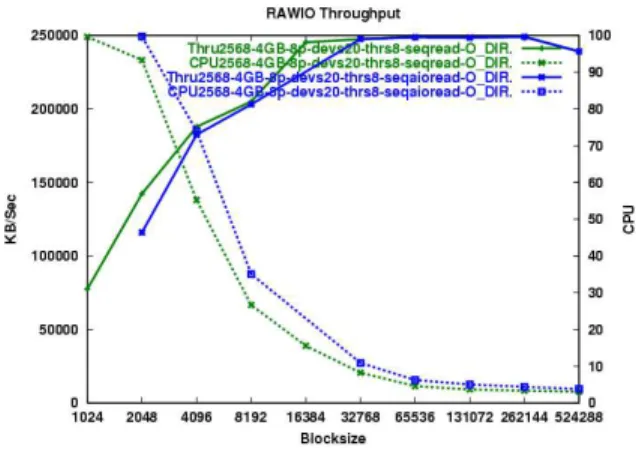
Figure 1: Sequential Read Overhead
6.3 Results, comparison and analysis
Raw and O_DIRECT performed nearly iden-tically on all of the benchmarks tests. In order to reduce redundant data and analysis, only the data from O_DIRECT will be presented here. For the first comparison of AIO overhead, the results show that there is significant overhead to the AIO model for sequential reads (Figure 1). For small block sizes where the benchmark is CPU bound, the AIO version has signifi-cantly lower throughput values. Once the block size reaches 8K and we are no longer CPU bound, AIO catches up in terms of throughput, but averages about 20% to 25% higher CPU utilization.
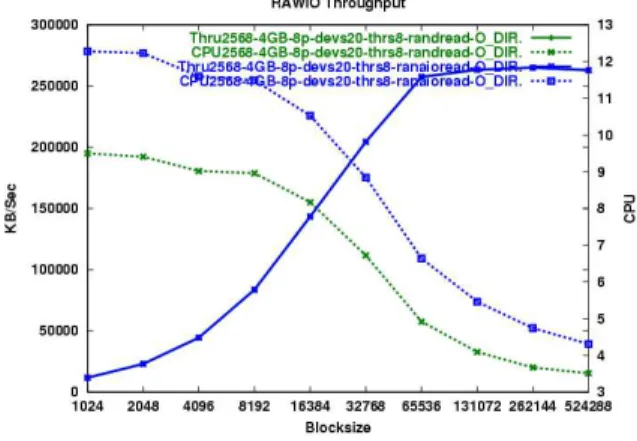
In Figure 2 we can see the performance of random reads using AIO is identical to syn-chronous I/O in terms of throughput, but av-erages approximately 20% higher CPU utiliza-tion. By comparing synchronous random read plus seeks with random pread calls (Figure 3) we see that there is minimal measurable over-head associated with having two system calls instead of one. From this we can infer that the overhead seen using AIO in this test is associ-ated with the AIO internals, and not the cost of the additional API call. This overhead seems
Figure 2: Random Read Overhead
Figure 3: read vs. pread
excessive and probably indicates a problem in the AIO kernel code. More investigation is re-quired to understand where this extra time is being spent in AIO.
For write performance we can see that AIO achieves approximately the same level of throughput as synchronous I/O, but at a signif-icantly higher cost in terms of CPU utilization at smaller block sizes. For example, during the sequential write test at 2K block sizes, AIO uses 97% CPU while synchronous uses only 55%. This mirrors the behavior we see in the read tests and is another indication of problems within the AIO code.
Figure 4: Sequential Write Overhead
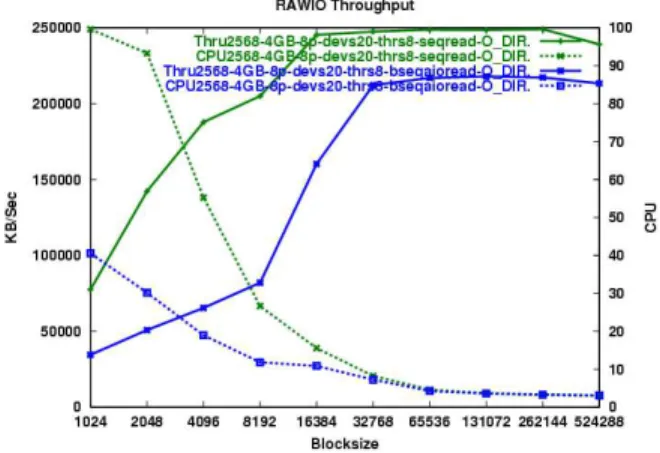
Figure 6: Sequential Read Batch
Figure 7: Random Read Batch
Batch mode AIO performs poorly on the se-quential and random read tests. Throughput is significantly lower as is CPU utilization (Fig-ures 6,7). This is probably due to the fact that we can drive more I/Os in a single request than the I/O subsystem can handle, but we must wait for all the I/Os to complete before continuing. This results in multiple drives being idle while waiting for the last I/O in a submission to com-plete.
AIO batch mode also under-performs on the write tests. While CPU utilization is lower, it never achieves the same throughput values as synchronous I/O. This can be seen in Figures 8 and 9.
Figure 8: Sequential Write Batch
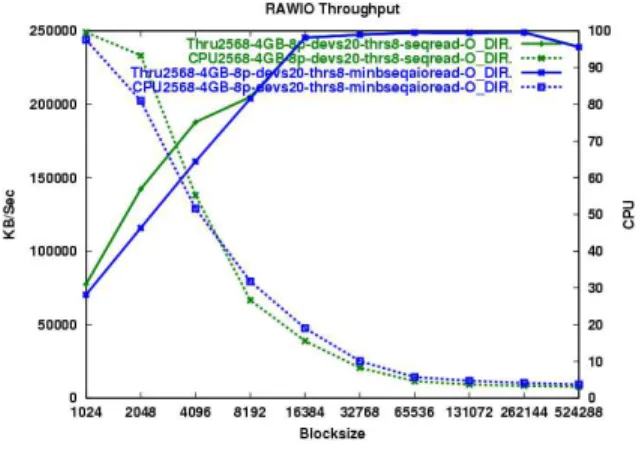
Figure 10: Sequential Read Minimum Batch Minimum batch mode improves considerably on the overhead and batch mode tests; how-ever, for O_DIRECT access AIO either lags in throughput or uses more CPU for all block sizes in the sequential read test (Figure 10). For the random read test minimum batch mode AIO has identical throughput to synchronous reads, but uses from 10% to 20% more CPU in all cases (Figure 11). Sequential minimum batch mode AIO comes close to the perfor-mance (both throughput and CPU utilization) of synchronous, but does not ever perform bet-ter.
Minimum batch mode sequential writes, like reads, lag behind synchronous writes in terms of overall performance (Figure 12). This dif-ference gets smaller and smaller as the block size increases. For random writes (Figure 9), the difference increases as the block size in-creases.
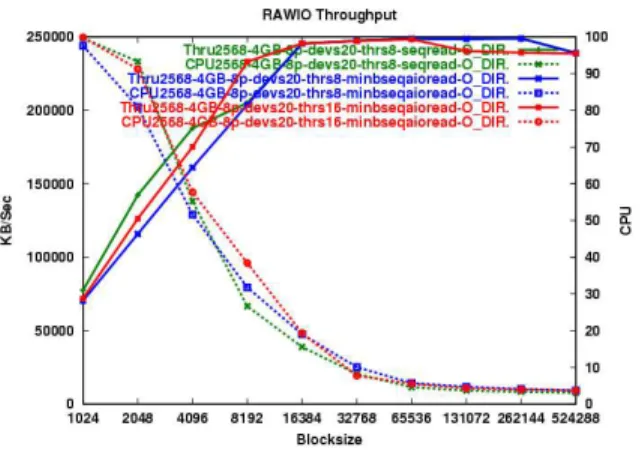
Since we are seeing lower CPU utilization for minimum batch mode AIO at smaller block sizes we tried increasing the number of threads in that mode to see if we could drive higher I/O throughput. The results seen in Figure 14 show that indeed for smaller block sizes that using 16 threads instead of 8 did increase the through-put, even beating synchronous I/O at the 8K block size. For block sizes larger than 8K the
Figure 11: Random Read Minimum Batch
Figure 12: Sequential Write Minimum Batch
increase in number of threads either made no difference, or causes a degradation in through-put.
Figure 14: Sequential Read Minimum Batch with 16 threads
In conclusion, there appears to be no con-ditions for raw or O_DIRECT access un-der which AIO can show a noticeable bene-fit. There are however, cases where AIO will cause reductions in throughput and higher CPU utilization. Further investigation is required to determine if changes in the kernel code can be made to improve the performance of AIO to the level of synchronous I/O.
It should be noted that at the larger block sizes, CPU utilization is so low (less than 5%) for both synchronous I/O and AIO that the dif-ference should not be an issue. Since using minimum batch mode achieves nearly the same throughput as synchronous I/O for these large block sizes, an application could choose to use AIO without any noticeable penalty. There may be cases where the semantics of the AIO calls make it easier for an application to coordi-nate I/O, thus improving the overall efficiency of the application.
6.3.1 Future work
The patches which are available to enable AIO for buffered filesystem access are not stable enough to collect performance data at present. Also, due to time constraints, no rawiobench testcases were developed to verify the effec-tiveness of the readv/writev enhancements for AIO [12]. Both items are left as follow-on work.
7
Acknowledgments
We would like to thank the many people
on the [email protected] and
mailing lists who provided us with valuable comments and suggestions during the devel-opment of these patches. In particular, we would like to thank Benjamin LaHaise, author of the Linux kernel AIO subsystem. The retry based model for AIO, which we used in the filesystem AIO patches, was originally suggested by Ben.
This work was developed as part of the Linux Scalability Effort (LSE) on SourceForge
(sourceforge.net/projects/lse).
The patches developed by the authors and mentioned in this paper can be found in the "I/O Scalability" package at the LSE site.
8
Trademarks
This work represents the view of the authors and does not necessarily represent the view of IBM.
IBM and ServeRAID are trademarks or regis-tered trademarks of International Business Ma-chines Corporation in the United States, other coun-tries, or both.
Pentium is a trademark of Intel Corporation in the United States, other countries or both.
Windows is a trademark of Microsoft Corporation in the United States, other countries or both.
Linux is a trademark of Linus Torvalds.
Other company, product, and service names may be trademarks or service marks of others.
References
[1] AIO readv/writev performance data.
http://osdn.dl.sourceforge. net/sourceforge/lse/
vector-aio.data.
[2] Asynchronous I/O on Windows®NT.
[3] Kernel Asynchronous I/O
implementation for Linux from SGI.
http:
//oss.sgi.com/projects/kaio.
[4] POSIX Asynchronous I/O.
[5] Open Group Base Specifications Issue 6 IEEE Std 1003.1.
http://www.opengroup.org/ onlinepubs/007904975/toc. htm, 2003.
[6] Suparna Bhattacharya. 2.5 Linux Kernel Asynchronous I/O patches.
http://sourceforge.net/
projects/lse.
[7] Suparna Bhattacharya. 2.5 Linux Kernel Asynchronous I/O rollup patch.
http://osdn.dl.sourceforge. net/sourceforge/lse/
aiordwr-rollup.patch.
[8] Suparna Bhattacharya. Design Notes on Asynchronous I/O for Linux.
http://lse.sourceforge.net/
io/aionotes.txt.
[9] Steven Pratt Bill Hartner. rawiobench microbenchmark.
http://www-124.ibm.com/ developerworks/opensource/ linuxperf/rawread/rawr%ead. html.
[10] Benjamin LaHaise. 2.4 Linux Kernel Asynchronous I/O patches.
http://www.kernel.org/pub/ linux/kernel/people/bcrl/
aio/patches/.
[11] Benjamin LaHaise. Collapsed read/write iocb argument-based filesystem
interfaces.
http://marc.theaimsgroup. com/?l=linux-aio&m=
104922878126300\&w=2.
[12] Janet Morgan. 2.5 Linux Kernel
Asynchronous I/O readv/writev patches.
http://marc.theaimsgroup. com/?l=linux-aio&m=
103485397403768\&w=2.
[13] Venkateshwaran Venkataramani Muthian Sivathanu and Remzi H. Arapaci-Dusseau. Block Asynchronous I/O: A Flexible Infrastructure for User Level Filesystems.
http://www.cs.wisc.edu/
Linux Symposium
July 23th–26th, 2003
Ottawa, Ontario
Andrew J. Hutton, Steamballoon, Inc.
Stephanie Donovan, Linux Symposium
C. Craig Ross, Linux Symposium
Review Committee
Alan Cox, Red Hat, Inc.
Andi Kleen, SuSE, GmbH
Matthew Wilcox, Hewlett-Packard
Gerrit Huizenga, IBM
Andrew J. Hutton, Steamballoon, Inc.
C. Craig Ross, Linux Symposium
Martin K. Petersen, Wild Open Source, Inc.
Proceedings Formatting Team
John W. Lockhart, Red Hat, Inc.
Authors retain copyright to all submitted papers, but have granted unlimited redistribution rights to all as a condition of submission.