Narrowing the Digital Generation Gap – e-Learning Program for
Teachers on Water Environment Education
Hsin-Yu Shan
Department of Civil Engineering, National Chiao Tung University
[email protected]
Jen-Gaw Lee
National Center for High-Performance Computing
[email protected]
Frances Su
Microelectronics and Information Systems Research Center, National Chiao Tung
University
[email protected]
Abstract
This paper describes the lessons learned from a very large scale e-learning program for on-the-job training of school teachers on water environment. School teachers are not as familiar with e-learning as their students due to the generation gap created by the rapidly growing information and communication technology. This program tapped into the potential of using e-learning for continued education of more than 200,000 teachers who are required by the Ministry of Education to take 20 hours of courses each year. Up to date, thousands of teachers have completed the e-learning program. Valuable information is obtained on the behavior and feedback of the trainees. It shows that younger teachers and those with a background in natural science are much more willing to take part in the e-learning program. In addition, teachers interact very little with each other and the instructors. Nevertheless, the quality and the convenience of the water environment training program inspired most of the participants to accept e-learning as the better way for continued education and to join similar e-learning programs in the future.
1 Introduction
Environmental awareness and knowledge is considered as an important aspect to be incorporated into the learning of all subjects in all levels of schools in Taiwan since the Earth Summit in 1992. As the school education reform which integrate various aspects into traditional subjects such as language and mathematics for the entire 9-year period of compulsory education, school teachers has to obtain additional knowledge and skills on topics such as water environment. On the other hand, school teachers are required by the Ministry of Education to take 20 hours of courses as on-the-job continued education. As a result, it creates an excellent opportunity for the government to educate the teachers on water environment and sustainable development as the first step toward nurturing a new generation of citizens of high environmental awareness and capability to act. However, the training more than 200,000 school teachers in the entire nation with good instructors and high quality course contents
is a formidable task through traditional face to face learning. Obviously, the delivery of high quality water education training courses to thousands of teachers all over the island in a short time can rely on no other method than distance learning.
Under the leadership of Taiwan International Institute for Water Education (TIIWE), a plan for the comprehensive water education training program was devised and the project team is formed. The team consists of TIIWE, Graduate Institute of Environmental Engineering of National Taiwan University, Environment Conservation Center of National Taiwan Normal University, ITS EduMedia Studio of Microelectronics and Information Systems Research Center of National Chiao Tung University (NCTU), China-Times Cultural and Educational Foundation, and National Center for High-Performance Computing (NCHC). The training program is co-sponsored by the Ministry of Education, the Environmental Protection Agency, and the Water Resources Agency. The target participants of the water education training
program described in this paper are the 200,000 teachers from elementary schools, junior and senior high schools, and vocational schools. During 2004, 2005, 2006, a total of 5,617 people registered to participate and 3,940 participants finished at least one of the modules. The total number of modules taken by the participants was more than 15,000. The participants were awarded certificate for the modules and hours they completed.
2 The e-Learning Program
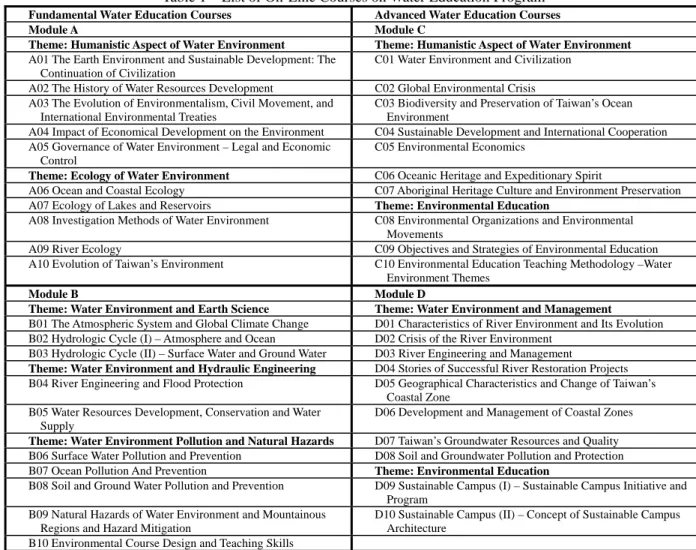
For the first two years of the project, a total of 40 1.5-hours of on-line courses were produced. In addition to the on-line courses, the participants could take the optional one day face-to-face course which includes half day of classroom discussion and half day of field trip to enhance their learning. The instructors include university professors and senior officials of government agencies. The overall course structure and classes are listed in Table 1.
Table 1 List of On-Line Courses on Water Education Program
Fundamental Water Education Courses Advanced Water Education Courses
Module A Module C
Theme: Humanistic Aspect of Water Environment Theme: Humanistic Aspect of Water Environment
A01 The Earth Environment and Sustainable Development: The Continuation of Civilization
C01 Water Environment and Civilization
A02 The History of Water Resources Development C02 Global Environmental Crisis A03 The Evolution of Environmentalism, Civil Movement, and
International Environmental Treaties
C03 Biodiversity and Preservation of Taiwan’s Ocean Environment
A04 Impact of Economical Development on the Environment C04 Sustainable Development and International Cooperation A05 Governance of Water Environment – Legal and Economic
Control
C05 Environmental Economics
Theme: Ecology of Water Environment C06 Oceanic Heritage and Expeditionary Spirit
A06 Ocean and Coastal Ecology C07 Aboriginal Heritage Culture and Environment Preservation A07 Ecology of Lakes and Reservoirs Theme: Environmental Education
A08 Investigation Methods of Water Environment C08 Environmental Organizations and Environmental Movements
A09 River Ecology C09 Objectives and Strategies of Environmental Education A10 Evolution of Taiwan’s Environment C10 Environmental Education Teaching Methodology –Water
Environment Themes
Module B Module D
Theme: Water Environment and Earth Science Theme: Water Environment and Management
B01 The Atmospheric System and Global Climate Change D01 Characteristics of River Environment and Its Evolution B02 Hydrologic Cycle (I) – Atmosphere and Ocean D02 Crisis of the River Environment
B03 Hydrologic Cycle (II) – Surface Water and Ground Water D03 River Engineering and Management
Theme: Water Environment and Hydraulic Engineering D04 Stories of Successful River Restoration Projects B04 River Engineering and Flood Protection D05 Geographical Characteristics and Change of Taiwan’s
Coastal Zone B05 Water Resources Development, Conservation and Water
Supply
D06 Development and Management of Coastal Zones
Theme: Water Environment Pollution and Natural Hazards D07 Taiwan’s Groundwater Resources and Quality B06 Surface Water Pollution and Prevention D08 Soil and Groundwater Pollution and Protection B07 Ocean Pollution And Prevention Theme: Environmental Education
B08 Soil and Ground Water Pollution and Prevention D09 Sustainable Campus (I) – Sustainable Campus Initiative and Program
B09 Natural Hazards of Water Environment and Mountainous Regions and Hazard Mitigation
D10 Sustainable Campus (II) – Concept of Sustainable Campus Architecture
B10 Environmental Course Design and Teaching Skills
The on-line course is accessed through the water environment e-learning website hosted in NCHC with the URL http://water.emc.nctu.edu.tw. In addition to the on-line courses, the website also contains other crucial components for e-learning: announcement board, concise articles on various topics regarding water environment, discussion boards, assorted and annotated internet links to environmental education related websites, and participants’ email list. The learning management system (LMS) is developed by ITS EduMedia Studio and fully conforms to SCORM standards.
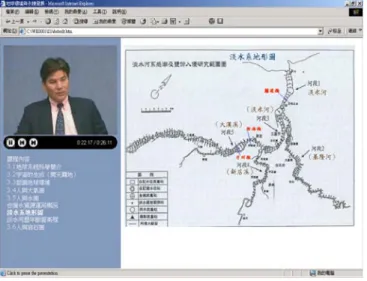
The courses were produced using Microsoft® Producer [1] to display video of lecturing and Powerpoint presentation at the same time. Figure 1 is a screen shot from the on-line lecture on “Earth Environment and Sustainable Development.” According to the course content, each 1.5-hour course was divided into sections of about 15 to 20 minutes which is the time span the participants can maintain highly concentrated. This short time section also allowed the participants to fully utilize fragmented time between their classes and other activities in schools or at home. All videos
are encrypted by Microsoft® DRM (Digital Rights Management) [2] technology to protect intellectual property rights. Microsoft® media servers were deployed to provide video 150 Kbps
course video streaming [3] to participants’ computers which is connected through TANet (Taiwan Academic Network) or ADSL.
Figure 1 Sample Screen of the On-Line Course Table 2 Number of Participants of the eLearning Program
2004 2005 1 2005 2 2006
Registered 1305 1252 1392 1668
Completed 702 915 987 1336
Dropout Rate 46.2% 26.9% 29.1% 19.9%
In order to enhance the achievement of learning, the following policies are designed and applied:
z 40 courses are organized into 4 modules, each module contains 10 courses.
z Each student has to enroll for at least 1 module.
z The certificate is only awarded to the participants after completion of modules. z For each category
Each week two new courses were put on-line.
Each course is open for 2 weeks. Furthermore, the participants were required to complete a course evaluation survey before their course hours was recorded officially.
3 Result of the Training Program
A total of 4 terms of e-learning were delivered from 2004 through 2006. The numbers of participants registered and completed at least one module are listed in Table 2.
From the age distribution of participants shown in Fig. 2, it is obvious that this program attracts much higher percentage of younger teachers [4]. About 80% participants are between 20 and 40.
0% 5% 10% 15% 20% 25% 30% 35% 40% 45% <20 21-30 31-40 41-50 >50 Participant Whole nation
Figure 2 Comparison of Age Distribution of the Participants and All Teachers in Taiwan
52. 2% 18.7% 6.4% 3.0% 1.5% 0.4% 3.4% 14 .5 % 50. 8 % 24. 4% 17. 0 % 7.8% 0% 10% 20% 30% 40% 50% 60% Elem enta ry sc hool Junio r hig h scho ol Senior high s cho ol Vocati ona l sc hool Unive rsity Kinde rgarte n Inte rn te acher Other s Participant Whole nation
Figure 3 Distribution of Participants’ Background
The distribution of the backgrounds of the participants is shown in Fig. 3. Among the participants, 52.2% are elementary school teachers, 18.7% are junior high school teachers, 6.4% are senior high school teachers, 3.0% are vocational school teachers. About 14.5% of the participants were public servants, students, and general public. It is interesting to compare variation of the participants’ specialized area with their purpose. As shown in Fig. 4, initially most participants are teachers in natural science, but as time went on, more and more teachers in other specialized area join the program.
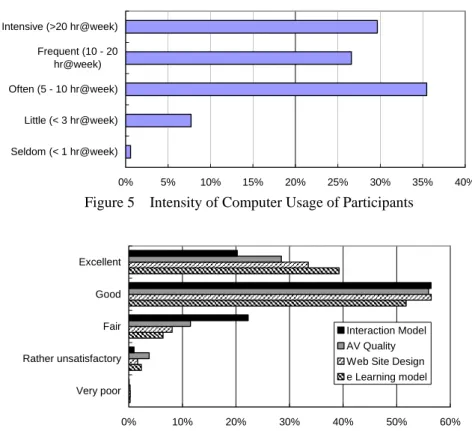
It is also important to note that approximately 82% of the participants never participated in any education or training programs on water environment and 68% had no previous e-learning experience. However, most of the participants are already frequent computer users before the program where more than 80% of the participants
use computers at least 5 hours per week (Fig. 5).
0% 10% 20% 30% 40% 50% 60% 70% 80% 90% Lan guag e Math Nat ural Sci ence Social Sci ence General Educ ation App lied Te chnol ogy Art Busi ness Other 2004 2005 - 1 2005 - 2 2006
Figure 4 Distribution of Participants’ Specialized Area 0% 5% 10% 15% 20% 25% 30% 35% 40% Seldom (< 1 hr@week) Little (< 3 hr@week) Often (5 - 10 hr@week) Frequent (10 - 20 hr@week) Intensive (>20 hr@week)
Figure 5 Intensity of Computer Usage of Participants
0% 10% 20% 30% 40% 50% 60% Very poor Rather unsatisfactory Fair Good Excellent Interaction Model AV Quality Web Site Design e Learning model
Figure 6 Rating of the eLearning Program and the LMS Platform The effectiveness of learning was assessed by
results of (1) pretest and post test and (2) after course quiz. The test results showed that the improvement of participants understanding of important concepts varies but the highest percentage is close to 20%. On the other hand, the results of the after course quizzes showed an average correct rate ranged from 51% to 88% as the breadth and depth of the courses and the difficulty of quiz questions vary.
Furthermore, the design, organization and management of the program were evaluated with compulsory participant survey. As shown in Fig. 6, the participants give the e-learning program and the LMS very good rating. However, currently the quality of video is as satisfactory due to the limitation of the bandwidth on the users’ end and can be easily enhanced in the future. The most critical issue is that the interaction among the participants and/or with instructor is significantly
less satisfactory. The limitation comes from the nature of asynchronous on-line course and the browser. The participants interacted with the instructor and among each other through discussion board and file sharing, which is far from spontaneous as face to face discussion. This particular result points out a very specific aspect for future improvement.
About 97% of the participant expressed they would like to join on-line learning program on other subjects. In general, although about 68% of participants had their first experience in e-learning by joining this program and become supporters of e-learning. Considering the difficulties of many of the participants had with the software, operating systems, hardware, and internet connections at the start of the courses, the quick acceptance and preference of e-learning programs are quite encouraging.
5 Lessons Learned
There are several important lessons learned form the user behavior and their responses to the program:
(1) User habit is not easy to change
The participants simply shut down the computer without clicking and closing the on-line course window such that the system could not record the logout time. There are a lot of requests by the participants asking servicing staff let them pass courses claiming that they’ve done watching it but not getting the LMS to show valid records. Good habits are not easy to establish.
(2) Service manpower loading can be heavy The on-line course had a rough start since most of the participants did not have any experiences such that they run into problems with their
computer operating systems, Internet browsers, or internet connections. The participants report their difficulties with the “error report” function, and the technical support team helped them solve their problems through instructions over the phone or email.
For 2004 project period, 384 error reports were received, among which 160 reports were posted in the first week. Two LMS engineers were responsible to solve all the technical problems. Almost all of the technical difficulties were resolved quickly and some of them become the content of the website’s FAQ. As time went on, technical problems such as internet, operating system, and browser decreased. However, the loading of two staff members who served as teaching assistants remained as heavy as the start.
Participants have all sorts of problems regarding asking register after closing date, how the course hours was recorded, how the certificate can be awarded, requesting for make up classes, and questions of the content of the courses or quizzes. The program allows the participants to login even after they had finished the courses in order to let them interact with each other and form a community among themselves. However, this requires the staff constantly monitored the website and answered questions. Not surprisingly, there is a distinct shift of user behavior over time. Those who join earliest and most interested in water environment are most active all through the term including Saturdays and Sundays (Fig. 7). More over, they logged in the system weeks after the end of the term for discussion (Fig. 8). The later participants were much less interested and much less active, which in a way relieved some pressure on the staff. 0 1000 2000 3000 4000 5000 6000 7000 8000 L o gi n C o u n t .
Mon Tue Wed Thu Fri Sat Sun
Days Week 7 Week 6 Week 5 Week 4 Week 3 Week 2 Week 1 A = 1378 B = 1302 Total = 2680 Number = 1426 0 2000 4000 6000 8000 10000 12000 14000 16000 L ogi n C o unt .
Mon Tue Wed Thu Fri Sat Sun Day Week 7 Week 6 Week 5 Week 4 Week 3 Week 2 Week 1 A = 1487 B = 1382 C = 1180 D = 1187 Total = 5236 Number = 1782
(a) 2005 1 E-Learning Term (b) 2006 E-Learning Term Figure 7 2006 E-learning Term Login Record Week Analysis
0 200 400 600 800 1000 1200 1400 1600 1800 1 5 9 13 17 21 25 29 33 37 41 45 49 53 57 61 65 69 73 77 81 Day Logi n C o u n t . A = 1378 B = 1302 Total = 2680 Number = 1426 End 0 500 1000 1500 2000 2500 3000 3500 1 4 7 10 13 16 19 22 25 28 31 34 37 40 43 46 49 52 55 58 61 64 67 Day Log in C oun t . A = 1487 B = 1382 C = 1180 D = 1187 Total = 5236 Number = 1782 End
(a) 2005 1 E-Learning Term (b) 2005 2 E-Learning Term Figure 8 E-Learning Term Login Record
0% 10% 20% 30% 40% 50% 60% Very poor Rather unsatisfactory Fair Good Excellent Interaction Time management Learning
Figure 9 Self Assessment on e-Learning Abilities
0% 5% 10% 15% 20% 25% 30% 35% 40% Course subjects Course induced Environmental issues Program Administration Others Total = 266
Figure 10 Statistics of Discussion Subjects (3) Facilitation of interaction/discussion is
important
Although more than 50% participants considered themselves to have more frequent communication than in classroom learning, interaction remains the least satisfactory part of the e-learning experience (Fig. 9). The knowledge transfer and time management is significantly better than interaction. The statistics shows even worse. There were only 266 discussion subjects posted by the participants on the discussion board. The project manager and teaching assistants spent a lot of effort in responding the messages and keeping the discussion alive. These messages only got 1,211 responding posted messages and were read 45,219 times. In other words, most participants never actively interact with any fellow participants. Figure 10 shows the categories of discussion subjects posted. Most of them are
related to the courses or environmental issues. (4) Expanded use of the program is limitless
A lot of participants login the LMS and play back the on-line course in the geography, earth science, and social science class they are teaching and directly let the students watch the on-line course. Moreover, the courses have been rearranged to become formal on-line courses delivered in the universities and community colleges. Government agencies also requested the project team to reorganize the courses to establish training programs for public servants and volunteer workers.
6 Conclusion
pioneering in Taiwan. Vital experiences regarding the design and management of the program, the LMS, the on-line courses, and behavior of the learners were obtained. The final phase of the projects will be carried out in 2008. Fifteen new on-line courses will be developed and delivered, including 5 delivered in English to establish a module on Asian water environment. In addition, experiment with co-life on-line conferencing system to facilitate interaction will be incorporated into the program. The system will be used for case history discussion host by the instructors for experimental purpose. This system developed by NCHC allows 60 people to joint a discussion session simultaneously with full video and file presentation/exchange capacity. Application of new technologies will continued to be explored with the support from NCHC and other partners.
References
[1] Microsoft Producer,
http://www.microsoft.com/office/powerpoint/ producer/prodinfo/default.mspx, 2007
[2] Microsoft Digital Rights Management,
http://www.microsoft.com/windows/windows media/drm/default.aspx, 2007
[3] Microsoft Streaming Technology, http://www.pcmag.com/article2/0,1759,7855, 00.asp, 2007
[4] Ministry of Education, 2006 Education in Taiwan, 2006