Bouncing Back from Psychological Contract Breach:
How Commitment Recovers over Time
Omar N. Solinger VU University Amsterdam
P. Matthijs Bal University of Bath
Joeri Hofmans Vrije Universiteit Brussel
Paul G.W. Jansen VU University Amsterdam
RUNNING HEAD: Psychological Contract Breach Recovery
Bouncing Back from Psychological Contract Breach:
How Commitment Recovers over Time
Abstract
The Post-Violation Model of the psychological contract (Tomprou, Rousseau, & Hansen, 2015) outlines four ways in which a psychological contract may be resolved after breach (i.e., psychological contract thriving, reactivation, impairment, and dissolution). To explore the implications of this model for post-breach restoration of organizational commitment, we recorded dynamic patterns of organizational commitment across a fine-grained longitudinal design in a sample of young academics who reported breach events while undergoing job changes (N = 109). By tracking organizational commitment up until 10 weeks after the first reported breach event, we ascertain that employees may indeed bounce back from a breach incidence, albeit that some employees do so more successfully than others. We further
demonstrate that the emotional impact of the breach and post-breach perceived organizational support are related to the success of the breach resolution process. Additionally, we reveal a non-linear component in post-breach trajectories of commitment which suggests that
processes determining breach resolution success are more complex than currently assumed.
Keywords: commitment, psychological contract, coping, process, within-person, functional
Psychological contracts between the employee and the organization serve the employee to evaluate how much contribution and future investment one should dedicate to the
organization and how much one should expect from the organization in return (Rousseau, 1995). Existing research on psychological contracts suggests that shocks to the psychological contract, denoted as psychological contract breaches, may have detrimental effects on
employee outcomes such as commitment to the organization (Zhao, Wayne, Glibkowski, & Bravo, 2007). For instance, there is an abundance of research showing that breach is followed by lower levels of organizational commitment (e.g., Bal et al., 2008; Dulac, Coyle-Shapiro, Henderson, & Wayne, 2008; Ng et al., 2010; Raja et al., 2004; Zhao et al., 2007). If the employee cannot expect the organization to provide returns on his / her contributions to the organization, the individual responds with lowering investments, including one’s commitment to the organization. But an important question that has not been investigated yet, is whether, once a breach has occurred, organizational commitment –as an indicator of the state of the psychological contract– could recover from such a shock.
Even though longitudinal studies have recently become more prominent (e.g., Conway & Briner, 2002; Dulac et al., 2008; Ng et al., 2010; Robinson & Rousseau, 1994), scholars have traditionally zoomed in on one element of the breach episode (i.e., the perception of breach) while leaving another element of a breach episode (i.e., post-breach reactions and violation resolution) unexplored (cf., Bankins, 2015; Tomprou et al., 2015). The Post-Violation Model (Tomprou et al., 2015) was specifically built to address this omission and provides a framework of different ways in which individuals may respond to breach. This is an important theoretical contribution to the field, because currently it is unknown whether people are able to recover once a breach has occurred. Moreover, we do not know what are the main characteristics of the recovery process.
Since the Post-Violation Model has only been recently published (Tomprou et al., 2015), it has not yet been empirically tested. In particular, longitudinal research tracking the dynamics of breach resolution in the post-breach period is virtually non-existent. In addition, the Post Violation Model itself may be refined and extended by more time-based empirical research. That is, the model explains potential differences between pre- and post-breach psychological contracts, but does not specify how individuals arrive at these renewed psychological contracts over time (i.e., the actual process of resolution).
To address this we adopt a process approach, studying contract breach as a discrete event and reacting to breach as a process stretching out over a period of time (Bankins, 2015; Conway & Briner, 2002; Rousseau, 1995). Specifically, we investigate individuals’
trajectories of organizational commitment before, during, and after breaches experienced among 109 individuals experiencing various job changes in academic working life. Our study is the first to closely monitor breach as a dynamic episode consisting both of the breach event, and of individual post-breach commitment trajectories up until 10 weeks after the breach.
Moreover, the commitment trajectories of individuals before, during and after the event of a breach likely depend on contextual factors (Bal et al., 2010; Morrison & Robinson, 1997). Investigation of these factors is important to understand why some people recover more easily, when recovery is facilitated, and when recovery is delayed. First, we argue that a greater emotional impact of a breach, which in the literature is referred to as ‘violation’ (Morrison & Robinson, 1997), will diminish the chance of quick recovery after a breach, while a weaker emotional impact will speed up the recovery process. Similarly, when organizations provide support to the employees once a breach has occurred, the recovery process may speed up (cf., Bal et al., 2010).
This study contributes to extant theorizing about the person-organization relationship by supporting and extending the Post-Violation Model (Tomprou et al., 2015). That is, we
ascertain that post-breach trajectories of commitment (which logically follow from the Post-Violation Model) indeed differ mainly based on the success of recovery after breach. We also support the proposition that personal and organizational factors relate to the odds of
successful breach resolution. Additionally, we extend the Post-Violation model by showing that there are substantially different ways one may get at these post-breach end states (e.g., via delayed recovery, premature recovery), which each impinge on the final state of recovery. We argue that a model of post-breach recovery should take two dimensions into account: (1) whether commitment bounces back from a breach or not (i.e., the relative success of breach resolution) and (2) its (non-linear) trajectory; these dimensions are fundamental to recovery and are explained by different factors.
Theoretical Background
The Post-Violation ModelContract breach refers to employee perceptions regarding the extent to which the organization has failed to live up to its promises or obligations (e.g., Morrison & Robinson, 1997; Zhao et al., 2007). In other words, breach is a perceived discrepancy between an employee’s
expectations derived from the psychological contract and the actual experiences. In the seminal work (Rousseau, 1995), psychological contract breach (henceforth: breach) was conceptualized as event where an employee perceives a discrepancy between what has been promised (or is obligated) and what has been delivered. The Post-Violation Model (Tomprou et al., 2015), based on self-regulation theory and coping, provides explanatory principles for the different ways in which breach perceivers resolve their breaches in the aftermath of a breach event and re-establish their psychological contracts. Self-regulation theory assumes that individuals monitor their current experiences with one’s employer relative to a standard (i.e., the psychological contract); if there is a discrepancy, the individual is motivated to reduce this discrepancy, such as by lowering one’s contributions to the organization.
A crucial assumption of the self-regulation model is that the perception of the
likelihood that the breach can be resolved, is a central factor in explaining post-breach coping choices (Tomprou et al., 2015). Coping refers to a broad array of responses to the distress resulting from negative experiences (Carver & Conner-Smith, 2010). Coping responses may differ by the degree to which one approaches or avoids the stressor (Carver & Connor-Smith, 2010). Approach-oriented coping responses include problem solving, such as taking action to try to address the discrepancy directly. The breach perceiver tries to correct, repair, or actively renegotiate the observed discrepancies. Approach-oriented coping may also include emotion-focused coping where one tries to resolve the state of negative affect (Tomprou et al., 2015). Avoidance-oriented coping, on the other hand, involves mental and behavioral
disengagement, which helps to avoid the negative consequences of the stressor by moving away from it. Mental withdrawal involves lowering of one’s commitment and involvement, and thinking of leaving. Behavioral withdrawal involves behaviors such as increased lateness, shirking, absenteeism, and eventually turnover (Zhao et al., 2007; Harrison, Newman, & Roth, 2006).1 If the probability of successful resolution is perceived to be low (vs. high), the breach perceiver is more likely to choose an avoidance-oriented (vs. approach-oriented) coping response (Tomprou et al., 2015).
Coping choices, in turn, have consequences for the breach perceiver’s development of a post-breach psychological contract (i.e., the different end states of the breach resolution process). The Post-Violation Model outlines four such end states, ranging from successful to unsuccessful resolution. Highly successful resolution of the breach will result in either psychological contract thriving or reactivation. Less successful resolution will result in either
1 We will rely on coping theory as also outlined by the Post-Violation Model, but do not perform tests of specific
coping styles. The fact that coping responses are important in the post-breach resolution process is already demonstrated elsewhere (Bankins, 2015). As do Tomprou et al., (2015) and Bankins (2015), we assume that coping responses are the generative principles that explain why and how the post-breach trajectories of recovery unfold the way they do.
psychological contract impairment, or dissolution. Psychological contract thriving is a post-breach end state where the relationship with the employer has improved after a post-breach and has become more beneficial to the parties involved. Psychological contract reactivation happens when the content of the post-breach contract is equivalent to the pre-breach contract
Psychological contract impairment refers to a scenario where the content of the post-breach contract is less attractive and there is less alignment between employee and employer
obligations as compared to the pre-breach contract. Finally, psychological contract dissolution is the breakdown of the psychological contract where the employee can no longer rely on the psychological contract to decide on his/her contributions and investments to the employer.
Commitment and the Psychological Contract
In this paper we examine dynamic reaction patterns in organizational commitment after psychological contract breach. Conceptually, organizational commitment is one of the first phenomena to consider when dynamic improvement or deterioration of the employee-organization bond comes to mind (Klein, Mollow, & Brinsfield, 2012; Meyer et al., 2002; Solinger, Van Olffen, Roe, & Hofmans, 2013). In particular, a commitment has recently been re-conceptualized from a motivational perspective as a volitional bond that is reflected in a dedication and responsibility for a target (Klein, Molloy, & Brinsfield, 2012, p. 131). It has also been re-conceptualized from an attitudinal perspective, as a dynamic summary of evaluative affect, cognitions about the organization, and a pledge to serve and enhance the organization’s purposes (Solinger, van Olffen, & Roe, 2008, p. 80; Solinger, Hofmans, & Van Olffen, 2015). Given that a psychological contract between the employee and the organization helps the individual evaluate how much the employee should expect from the organization and how much contribution and future investment an employee should dedicate to the organization in return(Rousseau, 1995), there is some overlap between commitment and
psychological contract literatures. Although a commitment is not the same as a psychological contract, high commitment usually signals favorable psychological contracts, while low commitment usually signals impaired or dissolved psychological contracts (Millward & Hopkins, 1998).
There are also empirical reasons to choose commitment as a focal phenomenon. To extend the Post-Violation Model and test it in a dynamic research setting, we need an indicator which is affected by psychological contract breach and which can be tracked over time in a process of recovery. There is abundant research showing that breach is related to declining organizational commitment (e.g., Bal et al., 2008; Ng et al., 2010; Raja et al., 2004; Zhao et al., 2007). There is also recent evidence that commitment is a dynamic phenomenon that lends itself well to fine-grained longitudinal measurement (e.g., Solinger, et al., 2013). For these reasons, we use organizational commitment as a dynamic indicator of the relative favorability of the psychological contract.
Post-breach commitment trajectories
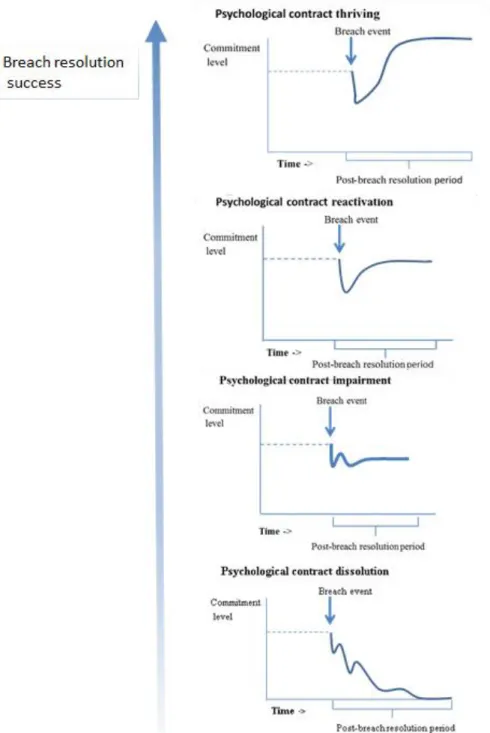
A dynamic understanding of commitment means that an employee’s commitment is continuously adapted over time as the employee-organization bonds strengthen or weaken. It may even imply that job attitudes such as commitment can bounce back after a breach event in a process of re-committing to the organization, akin to the process of re-establishing the psychological contract in the Post-Violation Model described above. The four types of post-breach psychological contracts (i.e., thriving, reactivation, impairment, and dissolution) can be used to generate a model of four generic post-breach commitment trajectories which occupy different positions on a continuum ranging from breach resolution success (bouncing back from a breach) to failure (commitment is permanently affected by the breach). These commitment trajectories follow from the four post-breach psychological contracts outlined by
the Post-Violation Model (see Figure 1). If the psychological contract thrives after breach, commitment is expected to bounce back such that it will end up at even higher levels than initial, pre-breach commitment levels. If the psychological contract is reactivated,
commitment will initially decrease based on the breach, but will bounce back to initial, pre-breach levels. If a psychological contract is impaired after breach, the individual is forced to accept a less-than-ideal employment situation and will be willing to invest less effort than before to support the organization. This implies a declining commitment trajectory, and a temporary search for a new, lower level of commitment. If a psychological contract dissolves after breach, the Post-Violation Model predicts that employees are no longer committed to the organization and may withdraw from contributing to the organization (Tomprou et al., 2015). Given this prediction, it follows that psychological contract dissolution is predicated by a rapid decline toward low levels of commitment (i.e., lower than the initial pre-breach levels). Both the impairment trajectory and the dissolution trajectory are expected to show decline in commitment after a breach has occurred; the difference is that in the impairment trajectory the decline is not as rapid and the employee is expected to find a stable level of commitment again, albeit lower than the prior, pre-breach, commitment level. In sum, hypothesis 1 is:
Hypothesis 1: Post-breach trajectories of commitment are governed by the relative success of breach resolution.
--- Insert Figure 1 about here --- Determinants of breach resolution success
In line with the Post Violation Model, we assume that personal and organizational factors determine perceived probability of successful breach resolution, which has
downstream consequences for the final success (i.e., the end state) of the resolution process. The perceived severity of the breach. The most prominent personal factor that will
breach is a negative experience that can be highly stressful and taxing for the individual (Gakovic & Tetrick, 2003). Severe breaches are typically referred to as psychological contract ‘violations’, because large discrepancies in the contract generally tend to be accompanied with high emotional salience to the employee (Morrison & Robinson, 1997). However, not all breaches are experienced in this way. Some breaches follow from a small discrepancy and therefore are accompanied by a very limited emotional reaction (Morrison & Robinson, 1997). In such instances, breach has occurred but without a felt violation, as the emotional salience of the breach is minimal (Morrison & Robinson, 1997). Meta-analytic research has supported this view, and shows that the relations of felt violation with organizational
commitment are much stronger than the relations between perceived breach and commitment (Zhao et al., 2007). When breaches are more emotionally severe, chances of successful breach resolution are diminished. In line with cognitive appraisal theory (see e.g., Dulac et al., 2008), individuals evaluate the personal significance of events, including a breach, and decide on acting upon these events according to the personal significance of the event. Therefore, highly emotional breaches are more likely to have a greater impact on the employee. Moreover, it may be expected that the chances of ending with an impaired post-breach psychological contract (i.e., lower post-breach commitment than before) are higher when felt violation is also higher (Dulac et al., 2008). We therefore expect that the recovery trajectory is partly explained by the emotional impact of the breach involved. Hypothesis 2 therefore is:
Hypothesis 2: The emotional impact of the breach is negatively related with the odds of successful recovery in post-breach commitment trajectories.
Perceived organizational responsiveness. It isnot only the employee who is
involved in a breach, but the employer as well. When the employer offers compensation, compelling promises, or sincere apologies to breach perceivers, then the perceived odds of successful resolution of the psychological contract will increase (Tomprou et al., 2015). In
response, the breach perceiver is more likely to engage in problem solving coping to remedy the breach. In this way, breach resolution is affected by the efforts of two parties (Tomprou, et al., 2015). Perceived organizational responsiveness does not necessarily need to come from tangible offers made by the organization – organizational actions may also be interpreted as a symbol of support. For instance, Schweiger and DeNisi (1991) found that weekly
communication from the CEO during a merger (representing a breach) tends to restore commitment and trust among the merger recipients. The authors argued that it was not the information or the communication per se, but its symbolic influence that explained its benign, curative effects.
Therefore, we argue that a prominent factor to affect perceptions of organizational supportiveness is perceived organizational support (Rhoades & Eisenberger, 2002). This construct refers to the degree to which employees perceive that the organization cares for their well-being and values their contributions. Although perceived organizational support (POS) is a perception of the employee, recent meta-analytic evidence shows that these perceptions are strongly rooted in organizational actions such as transformational leadership, supervisor support, coworker support, procedural justice, and participation in decision making (see Kurtessis et al., 2015). Previous studies have indeed shown that POStends to diminish the negative effects of contract breach (e.g., Dulac et al., 2008). Employees who perceive that they receive much support from their organization may be likely to be more positively biased towards their organization, feel more in control when negative events have happened, and are less likely to blame their organization when they experience breach (Bal et al., 2010; Dulac et al., 2008). Although the existing evidence is cross-sectional—confounding perceptions of breach (breach event) with reactions to breach (post-breach process; cf. Bolger & Schilling, 1991) —there is reason to believe that perceived organizational support is an important factor in the recovery process. We argue that this factor predicts recovery after breach, and more
specifically, we expect that post-breach perceived organizational support increases the odds of bouncing back (successfully recovering) from breach.
Hypothesis 3: Post-breach Perceived Organizational Support increases the odds of successful recovery in post-breach commitment trajectories
Apart from the fact that it allowed us to perform a direct test of the Post-Violation Model’s propositions (Tomprou et al,. 2015), our longitudinal study also provided us with an
opportunity to explore the effects of other types of events (not discussed by Tomprou et al., 2015) on the post-breach recovery of organizational commitment. Bankins (2015), for
instance, found that psychological contracts may restore based on factors which do not impact breach resolution directly, but which function as accelerators (augmenting the negative effect of breach) or decelerators (attenuating the negative effect of breach) in the post-breach recovery period. As a potential accelerator, we were particularly interested in the effects of accumulating breach events where the process of recovery is most likely negatively affected by yet another breach event. As a potential decelerator (‘buffer’), we were interested in the potentially benign effects of positive off-the-job events on breach resolution success.
Commitment may also bounce back because of positive life experiences that are unrelated to the breach event. In particular, positive private events facilitate detachment from work and restore an employee’s positive energy levels and positive affect (Sonnentag, Binnewies, & Mojza, 2010). Such off-the-job recovery may, in turn, help the individual to come to a sense of understanding of work-related breaches and may come to see the breach in more positive light (cf., Bankins, 2015; Binnewies, Sonnentag, & Mojza, 2009).
Methods
SampleRespondents were contacted as part of a larger data collection effort2 on job changes in academic and post-academic life. Our sample is based on a pool of 277 PhD graduates who were about to graduate in the next year. Note that the status of a Ph.D. graduate is very close that of faculty (thus employee, not a student) in the Dutch and Flemish system. Ph.D.
graduates came from a broad array of scientific disciplines in the 17 universities in the Netherlands (74%) and Flanders (26%). A total of 160 (58%) out of the initial 277 Ph.D. graduates responded to our invitation e-mails and continued their participation. Within this initial sample of 160 Ph.D. graduates, four job change situations occurred, namely remaining employed by the alma mater university after graduation (Stayers; N = 43; 27% of the 160; alma mater as focal target of breach and commitment), joining new organizations (Entrants; N = 72; 45% of 160; new organization as focal target), leaving the alma mater university
(Exiters: N = 23; 14% of 160; alma mater as focal target), and finishing the Ph.D. thesis under a temporarily extended contract (Temps: N = 22; 14% of 160; alma mater as focal target). The sample of Exiters had a fixed exit date of employment (they were all supposed to leave their alma maters) and therefore this sample was created based on this administrative criterion. As the Results section will show, job change situation had no effect on the recovery trajectories of commitment.
The original datasheet contained 1746 time-based observations from 160 participants. Because our focus is on the post-breach trajectories of commitment, we deleted the time-based data of 35 subjects who did not report contract breach events. We also deleted subjects with less than three measurement occasions in the 10 weeks following the breach because
2 Parts of this data collection effort have been published on before by Solinger, van Olffen, Roe, & Hofmans
(2013; the Entrants dataset; N = 72) and by Solinger, Hofmans, & van Olffen (2015; the Entrants and Exiters datasets).
breach recovery is argued to be a non-linear process (see also Bankins, 2015), and to test for this non-linearity at least 3 observations are needed. After deleting these subjects, 109 subjects were retained. Subjects were all aged between 26 and 35, and there were relatively more women than men in these final samples (Exiters: N=18, 11 women; Stayers: N=35, 28 women; Entrants: N=41, 26 women; Temps: N=15, 13 women).
Research Design
Because of our interest in post-breach commitment trajectories, we used weekly measures of breach events and organizational commitment with up to 25 weeks per person. Weekly measurement is frequent enough to pick up contract breach events and changes in
commitment,but not so frequent that it fatally jeopardizes participation on the long term. For analysis purposes, we selected for each person only the first breach event reported in the data (provided that the individual has already entered the organization). Next, we retained the data until 10 weeks after this event (yielding a maximum of 11 observations per individual from the moment of breach). The rest of the time-based data was discarded. It was not always possible to obtain a full grid of 11 weeks, which was for example due to the subject quitting participation or because the time frame of 25 weeks had ended. In total, we retained 775 observations, with the average number of observations per participant being 7.11 (SD = 2.46). Entrants had on average 6.73 observations (SD = 2.66); Stayers had an average of 6.91 observations (SD = 2.67); Exiters had an average of 8.00 observations (SD = 1.88); and Temps had an average of 7.53 observations (SD = 1.88). An ANOVA test revealed that there were no significant between-group differences regarding the number of observations (F (3,105) = 1.35; p =.264).
We based the 10-week duration of the post-breach episode on the following analysis. In our study, we made an attempt to gauge the length of the recovery period after the breach
event by including an extra page in our measurement application where the literal text of the previously entered breach events would show up again in the screen the following week. Next to the display of the literal text entered in the previous week, subjects were asked: “Check below which events are still important to you at the moment.” If indicated as no longer important, the breach would no longer show up in subsequent sessions. Instead, if the breach was checked as still ‘important’, then the breach would keep showing up in next session until it was checked as ‘unimportant’. In this way, we measured the subjective duration of each contract breach event. On average, the breach events (selected for our analysis) were checked as still ‘important’ for 2.13 weeks (SD = 2.45). The median score was 1 week and the
maximum score 10 weeks. We found that the length in which the person said the breach was still important did not correlate with any of our post-breach recovery trajectories (see Table 1). To cast the widest possible net, we chose to set the recovery period to the maximal
observed period in which the subjects told that the event was still important, being ten weeks.
Procedure
The data for this study were collected over three measurement stages: (1: Sign-up phase) extracting an initial subject pool in the year 2007, (2) experience sampling
measurement tracking commitment and breach events across 25 weekly measures among the Exiters, Stayers, Entrants, and Temps groups in the year 2008-early 2009. In the final phase (3: Follow-up), we administered a follow-up survey in the year mid 2008-early 2009.
Sign-up phase. In the Sign-up stage, we sent invitation e-mails to all Ph.D. graduates
in their final years in all universities in the Netherlands in Flanders. Those who clicked on participation or non-participation links were directed to a very short survey that tested for potential sampling bias. In particular, we used two different links in the invitation e-mail, one stating: “Yes, I belong to the target population and I want to participate”(N = 277) and the other stating: “Yes, I belong to the target population, but I do not want to participate.” (N =
92). Note that to belong to the target population one had to be in the final year of the Ph.D. project. The two links directed to short questionnaires asking for job satisfaction, supervisor satisfaction (both single item), and organizational commitment. There was no significant difference between participants (N = 277) and non-participants (N=92) on organizational commitment (t = .65; n.s.), overall satisfaction (t = .26; n.s.), or supervisor satisfaction (t = -1.5; n.s.). This analysis suggests that there was no sampling or self-selection bias on
workplace attitudes (commitment and satisfaction) in our sample.
Experience sampling measurement stage. For the experience sampling measurement
stage, we created an online measurement tool which could be accessed via a hyperlink and a password. In this tool, we took weekly measures of organizational commitment, contract breach, and private events. Experience sampling measurement of organizational commitment was done in a way that allowed the respondent to see his/her own trajectory as it unfolds over time. This is a type of self-anchored scaling (Hofmans, Theuns & Van Acker, 2009) which makes the instrument more sensitive to pick up on small but valid changes over time. Namely, through pattern-based rather than point-based measurement, people become more cognizant of the change they report, which is our prime focus of interest (see also Solinger et al., 2013). Hofmans et al. (2009) have shown that self-anchored scaling performs well in terms of minimizing measurement error in a temporal setting.
Follow-up phase. In the Follow-up phase we measured covariates, such as perceived
organizational support (POS). Scales in this phase were administered in English, which is possible given the high level of proficiency of the English language among Ph.D. graduates.
Measures
Organizational commitment. Considering our emphasis on capturing commitment dynamics, we used the 3-item Commitment Attitude Scale (3CAS), which has featured in
previous work as a dynamic measure of commitment (Solinger et al., 2015; Solinger et al., 2013). Consistent with the tripartite model of job attitudes (see Solinger et al., 2008; Judge & Kammeyer-Mueller, 2012), 3CAS taps into affective (‘What I feel toward [my organization]: I am proud’), cognitive (‘What I think: I belong to [my organization]), and behavioral
information for the commitment attitude (What I do [for my organization]: I
engage/participate). Note that the wording of these items corresponds to items that can be found in conventional scales of commitment (e.g., Mowday et al., 1982; Allen & Meyer, 1990). Further, each item was accompanied with a brief explanation (e.g., To ‘belong’ indicates your thoughts and beliefs about your organization, e.g., this is a wonderful/corrupt organization; or: ‘To ‘engage’ is to have a readiness to act for the organization’s benefit, e.g., do what is needed’). The construct validity of the 3CAS measure has already been established and is documented elsewhere in detail (Solinger et al., 2015). We used a
continuous 0-100 visual analogue scale on which subjects could indicate their current position (cf., Fischer & To, 2012). Because our analyses pertain to the within-person level (i.e., we look at factors that drive within-person fluctuations in commitment recovery), internal consistency reliability of the 3-item scale was tested at the within-person level using the multilevel confirmatory factor analysis approach of Geldhof, Preacher, and Zyphur (2014). The within-person omega reliability coefficient equaled .82, which indicates that the three items sufficiently converge and reliably capture dynamic shifts in the commitment attitude construct.
Psychological contract breach. Contract breach events were measured using an open question using the following instruction: “Click here to describe an event that you interpret as a broken promise from the side of the organization or someone representing it. A promise can be explicit (written or verbal agreement) or can be implicit (e.g., you found out this week that you did not receive the recognition you thought you deserved). Be as specific as possible.”
Subjects could describe whatever happened, with this description being limited to 250 words. To gauge the type of breach reported in the data, two subject matter experts assessed the breach texts and categorized them using three common types of breach: transactional, relational, and ideological breach. Transactional breaches are discrepancies between employer-employee obligations that are short-term focused obligations with a monetizable scope (Rousseau, 1995). Relational breaches are perceived discrepancies in employee-employer obligations that consist of socio-emotional elements with a long-term and open-ended focus. Ideological breaches are perceived discrepancies in obligations from the side of the employer that are directed at the pursuit of a principle or cause (Thompson & Bunderson, 2003, p. 573). Curiously, we did not encounter any instances of ideological breach in our data; 16 % of the breaches were transactional and 84% relational in nature. The type of breach was not related to post-breach commitment trajectories.
Emotional impact of the breach. On the same web page where participants reported
their breaches, participants also answered the single-item question “To what extent does this get to you, emotionally?” Akin to the commitment scale, this item was answered using a 0-100 visual analogue scale (ranging from ‘To a great extent: 0-100’ to ‘Not at all: 0’). Again, past responses were shown on the left side. In this way, we tried to capture the emotional salience of the breach, which is consensually described as a ‘violation’ (Zhao et al., 2007). The average score on the emotional impact measure was 71.36 (SD = 29.01). We therefore may conclude that a large portion of breaches resulted in a felt violation (Zhao et al., 2007).
Perceived Organizational Support. The variable Perceived Organizational Support was measured in the Follow-up phase using an 8-item questionnaire by Rhoades and
Eisenberger (2002). Sample items are: ‘My organization would forgive an honest mistake from my part’; ‘My organization cares about my well-being’. Items were rated using a 7-point Likert response format, and Cronbach α equaled .80.
Variables created for exploratory purposes. As indicated before, we also
constructed a number of exploratory variables: breach accumulation and off-the-job positive experiences. As for the breach accumulation variable, we counted the number of contract breaches in the (10 week) recovery period after the first contract breach event. This number averaged below one (M # broken promises = .74; SD # broken promises = 1.29). This indicates that there is a relatively low degree of accumulation of contract breach events in our data. As for the positive off-the-job experiences variable, subjects could also enter private events on a
separate page within 250 words of text: ‘Click here to fill out an event which has happened in your personal life.’ We simply counted the number of positive private events entered in our system during the 10-week breach resolution period (e.g. hobbies, pregnancy, parties,
holidays, weekends off, romantic experiences, and the like). On average participants filled out 1.42 positive private events (SD = 2.18) in the post-breach resolution period.
Analytical Procedures
To capture individual differences in trajectories of commitment following contract breach, we applied Functional Data Analysis (FDA; see Dass & Shropshire, 2012; Ramsay & Silverman, 2005). FDA pertains to a set of statistical tools specifically designed for the analysis of functions or curves, which makes it an ideal candidate for modeling complex dynamic processes that evolve over time (Silverman & Ramsay, 2005). The goal of FDA is to try to obtain insight in the process that generates the observations3 (Ramsay & Silverman, 2005). To achieve this goal, FDA replaces the original observations by smooth curves or continuous functions and then uses these curves as the unit of observation for further analyses. A major
3 In FDA, the issue of error of measurement is dealt with by means of smoothing. However, for sparse
longitudinal data smoothing is problematic. A Matlab software package called Principal Analysis via
Conditional Expectation (PACE) uses smoothing of the mean function and covariance surface, which eliminates the effect of noise contamination and can be done when data are sparsely sampled (Müller & Sentürk, 2011). For more information regarding PACE and its smoothing methods, see Müller, 2006 and Yao, Müller, & Wang, 2004).
advantage of FDA is that the curves can adopt any form, which is required when modeling highly dynamic, nonlinear processes.
In the present paper, we analyzed the commitment trajectories using functional Principal Component Analysis (fPCA; Yao, Müller, & Wang, 2005). fPCA is derived from traditional Principal Component Analysis (PCA) and has the same underlying concepts and goals (Dass & Shropshire, 2012). However, rather than using discrete ‘scores’ as input for a PCA, fPCA uses entire trajectories as PCA input. Moreover, akin to the usual PCA, the analyses decompose the data into latent factors/principal components (Hypothesis 1). Component (factor) loadings were used as dependent variables in trying to explain the main trajectories after breach (hypotheses 2-3).
Very much like in traditional PCA, an important step in the analysis is to decide how many principal components to retain. Two popular criteria to aid in this decision are the Bayesian Information Criterion (BIC) and the Percentage of Variance Explained (PVE). In case of the BIC, the component solution that minimizes the BIC is selected, while for the PVE components that explain 90% of variance are considered appropriate (Dass & Shropshire, 2012). In the present study, we used the combination of both methods. Because we were interested in commitment trajectories following contract breach, and less in between-person differences in the overall levels of commitment, we person-centered the commitment scores before performing the fPCA analysis.
Results
Preliminary testsTo test heterogeneity in the commitment patterns following breach, we tested whether the linear, quadratic, and cubic effects of time (number of weeks after the breach) varied across individuals. This was done using multilevel regression analysis by first testing a random intercept, fixed slopes model with the group-mean centered commitment scores as dependent
variable and t, t², and t³ as predictors (Model 1). Next, we expanded the model in a stepwise fashion by first including a random slope for t (Model 2), then for t and t² (Model 3), and finally for t, t², and t³ (Model 4). Subsequently, we tested whether the linear slope varied across individuals by comparing Model 1 with Model 2, whether the quadratic slope varied across individuals by comparing Model 2 with Model 3, and whether the cubic slope varied across individuals by comparing Model 3 with Model 4 using Chi-square difference tests. This analysis revealed that there was substantial between-person variability in the linear (χ2(2) = 140.47; p <.001), quadratic (χ2(3) = 54.03; p <.001), and cubic slopes (χ2(4) = 42.95; p <.001). This test clearly shows that reactions to breach (a) are highly non-linear, and (b) differ between individuals, which warrants our FDA approach.
Establishing Post-Breach Commitment Trajectories
Knowing that there are significant between-person differences in the recovery from breach, we subjected the group-mean centered commitment scores from week 0 to week 10 to an fPCA. For this analysis the BIC value was minimal when two functional principal components were retained. In this solution, the first functional component accounted for 73.80% and the second functional component for an additional 23.76% of the variance (together explaining 97.56% of the variance in the data). As such, the BIC and PVE criterion both suggest that the commitment trajectories following breach can best be explained by two functional principal components.
To demonstrate that the combination of these two functional principal components indeed captures the majority of the variance in the original data, we plotted the raw data (full lines) and the reconstructed curves based on the functional principal component loadings and scores (the dotted lines) for six randomly selected individuals in our dataset (see Figure 2). As can be seen, the predicted trajectories are very close to the raw trajectories for all six
--- Inset Figure 2 about here ---
To aid the interpretation of the two functional components, we plotted predicted commitment trajectories for people scoring + 1 and – 1 SD on the functional component scores, while taking an average score on the other functional component (see Ramsay & Silverman, 2005). This shows that the first functional component captures the degree of success of recovery (see the left panel in Figure 3). In particular, a positive loading
(represented by the + signs in Figure 3) on the first functional component represents a steep increase in commitment after breach, whereas a negative score (represented by the – signs in Figure 3) reflects a steep drop in commitment after breach. Thus, high component loadings on this first functional component match with our expectation of recovery after breach, while low component loadings match with our idea of no recovery. The second functional component, which is shown in the right panel of Figure 3, reflects a non-linear reaction pattern. The larger the loading on the second functional component (in absolute value), the steeper the U-shaped pattern. In particular, high component loadings (+1 SD) point to a trajectory where
commitment first decreases and then increases again. This type of recovery matches with a quick reaction to (and hence a fast recovery after) breach. Low loadings (-1 SD) on the second component display an opposite recovery type where people have a delayed reaction to breach as commitment first increases and then decreases (inverted U-shaped). We call this
‘premature recovery’ because recovery seems to be quick but unsustainable. All in all, the fPCA analysis supports Hypothesis 1 as the most important functional principal component (capturing 73.80% of the variance) pertains to the relative success of breach resolution. At the same time, our findings suggest that post-breach trajectories of commitment are governed by a non-linear process as well, namely delayed (e.g., U-shaped) or premature recovery (e.g., inverted U-shaped). Together, both processes (which are in our analysis represented by the
two functional principal components) explain the vast majority of variation in the data (i.e., 97.56%).
--- Insert Figure 3 about here ---
In a next step, we related the functional component scores to the difference in commitment level before and after breach (see Figure 4). The commitment level before breach was computed as the average of the commitment level in weeks -3, -2, and -1 (i.e., 3, 2, and 1 week before the breach was reported), while the commitment level after breach was obtained by averaging the commitment levels in weeks 8, 9, and 10 (i.e., 8, 9, and 10 weeks after the breach was reported). Although we found no relationship between the scores on functional component 2 and the difference in commitment level (r = .13; n = 53; p = .361), the functional component scores on component 1 (representing the relative success of breach resolution) were strongly negatively related to the difference in commitment before and after breach (r = -.65; n = 53; p < .001). This implies that people who are likely to have a
successful breach resolution (i.e., those with higher scores on component 1) have a higher commitment level after breach than before. Conversely, people who are likely to have a non-successful breach resolution (i.e., those with lower scores on component 1) typically have a lower commitment level after breach. Moreover, the left panel in Figure 4 also reveals that there are individuals who end up at virtually the same commitment level (these individuals have a functional component score close to 0). Altogether, these findings provide further support for Hypothesis 1, and also suggest that the four post-breach commitment trajectories implied by the post-violation model have indeed occurred in our data.
--- Paste Figure 4 about here ---
Finally, ANOVA tests with the functional component scores as outcomes and PhD group (i.e., Exiters, Stayers, Entrants or Temps) as the predictor revealed that the four job
change groups did not differ with respect to their reaction to contract breach (F(3,105) = 1.90; p = .134 for Component 1 and F(3,105) =1.08; p = .363 for Component 2). This means that the post-breach commitment trajectories have a rather universal character in our sample. Predicting Recovery from Breach
To test hypotheses 2 and 3, we related individual differences in the scores on the first component to individual differences in emotional impact (‘violation’) and perceived
organizational support. A positive correlation with the first component implies a higher chance of successful breach resolution, whereas a negative correlation implies a higher chance of showing no recovery. In line with hypotheses 2 and 3, we found that emotional impact was negatively (r = -.33; n = 79; p = .003), while POS was positively related to the scores on the first component (r = .32; n = 61; p = .010). We also tested the unique predictive effects of emotional impact and POS using multiple regression analysis. This analysis showed that, when emotional impact and POS are entered simultaneously in the regression model, both emotional impact (B = -.29; p=.025) and POS (B = .31; p=.017) uniquely predict the scores on the first component (R2 = .22). This indicates that lower emotional impact scores and higher POS scores increase the odds of a successful recovery after breach, while higher emotional impact and lower POS scores increase the odds of no recovery and thus a sustained decline of commitment once breach has occurred.
--- Insert Table 1 about here ---
Finally, we explored whether individual differences on the second principal
component relates to any of the covariates. Although scores on this component were unrelated to emotional impact (r = .03; n = 79; p = .772) and POS (r = -.10; n = 61; p = .443), we found a positive correlation with the number of reported breaches in the violation resolution period (r = .25; n = 109; p = .010) and the number of reported positive private events in this period (r = .23; n = 109; p = .016). In particular, experiencing more breaches and more positive private
events increases the odds of a delayed recovery. The number of reported breaches (r = .03; n = 109; p = .793) as well as the number of positive private events (r = .07; n = 109; p = .487) was unrelated to the scores on the first component. Finally, because of the positive correlation between the number of reported breaches and the number of private positive events (see Table 1), we tested the unique predictive validity of both predictors using multiple regression
analysis. This analysis showed that, when the number of reported breaches and the number of private positive events are entered simultaneously in the regression model, the number of reported breaches (B = .19; p=.068), but not the number of reported private positive events (B = .16; p=.111) uniquely (and marginally) predicts the scores on the second, quadratic
component.
Discussion
In this paper we have explored post-breach commitment trajectories and have connected them to theoretical propositions outlined in the Post-Violation Model of psychological contracts (see Figure 1; Tomprou et al., 2015). We have tested and supported key hypotheses
underlying the post-violation model. First, the Post-Violation Model assumes that post-breach contracts differ according to the relative success of the breach resolution process. Our results support this assumption (see Figure 4). In particular, our results show that many post-breach commitment trajectories bounce back to their initial levels, where some remain lower than before or even end up higher than before (thriving after breach). The latter happens only for a few individuals though. Second, we have demonstrated that the emotional salience of breach (a personal factor) and post-breach perceived organizational support (based on organizational factors) uniquely impact on the degree of breach resolution success (H2 and H3).
Implications for Post-Breach Psychological Contract Theory
On top of these results showing support for the Post-Violation Model, we also extend it by showing that there are different trajectories by which one may arrive at the same end state. For instance, we show that one can bounce back quickly or show no signs of post-breach restoration of commitment (simple post-post-breach trajectory functions), but this bouncing back may also take more time because it is further determined by more complex, polynomial trajectories such as delayed recovery (e.g., shaped) or premature recovery (e.g., inverted U-shaped). These two post-breach trajectory dimensions – breach resolution success and non-linear pathways of recovery– are explained by different factors. That is, perceived
organizational support and the emotional impact of the breach relate to the first dimension (i.e., breach resolution success), but not to the second. Moreover, accumulation of breach relates to the second dimension (including delayed recovery trajectories), but not to the first.
While the Post-Violation Model focuses on psychological contract types as end states, our data revealed that non-linear pathways to recovery may interfere with the direct and linear breach resolution process suggested by Tomprou et al. (2015). After all, our analyses showed that observed trajectories are not only driven by breach resolution success, which essentially comes down to (linear) pre- versus post-breach differences, but also by non-linearity in recovery. The observed non-linearity has ramifications for post-breach psychological contract theory. It warrants a level of sophistication in theorizing that goes beyond mere pre- versus post-breach differences in commitment and psychological contracts in favor of factors which underlie non-linear types of recovery as well. By assuming mainly approach- or avoidance-oriented coping responses, the post-violation model is rather restrictive in terms of coping choices. That is, the model assumes that breach perceivers are immediately searching for a solution after a breach incidence. However, not all individuals focus their full attention on a stressor when it happens, neither will all individuals immediately search for a solution
(Skinner et al., 2003), or stay consistent in their coping choices. The present theory, thus, leaves only little room for factors which assure non-linear recovery pathways, such as unfocused mourning (Kűbler-Ross, 1997), gradual acceptance, alternation between different ways of coping (e.g., between denial, opposition, and acceptance), acquiescence, distraction, or plain denial.
For this reason, we introduced positive off the job events as an exploratory variable to see whether a typically unfocused type of coping (i.e., seeking positive distraction in issues other than the stressor, in this case in one’s private life) would contribute to non-linear types of recovery. However indirect, ‘distraction’ is a potentially successful type of coping because it allows for a process of gradual acceptance which happens because of attention shifts to other events and activities – a type of coping which is generally considered to be operative when ‘time heals wounds’ (e.g., Skinner et al., 2003). When attention shifts to positive events in the private sphere (e.g., to mastery experiences, hobbies, playing with children, parties, romantic dinners) it becomes easier for the individual to forget about a breach event or accept it for what it is, and develop a sense of understanding. Accumulating breach events, on the other hand were expected to exacerbate the impact of the breach because they would hinder the subject’s acceptance and thus to decelerate the process of post-breach recovery. Moreover, accumulation of events has been conceptualized before as a variable which would contribute to non-linear effects over time – where later events may have a disproportionate effect on outcomes relative to earlier events (George & Jones, 2000). Our observation that
accumulating breach events indeed relate to delayed recovery in the non-linear component, is noteworthy in that regard. Potentially, breach accumulation did result in a disproportionate decline of commitment but not to such a degree that it resulted in a ‘no recovery’ pattern; it only delayed recovery for a while.
Our results with regard to the effect of off the job events on the non-linear component should be interpreted with caution, though. The effect disappeared when event accumulation was added to the model. An alternative explanation to this finding is that there is a correlation between delayed recovery and equity sensitive individuals (cf., Raja, Johns, & Ntalianis, 2004). These individuals are more sensitive to breach and may generally need more time to recover. At the same time, these individuals are more vigilant to pick up on both positive events (e.g., in the private life) and negative events (other breaches).
The flipside of the non-linear trajectory dimension is also theoretically interesting. It suggests a series of trajectories that we have called ‘premature recovery’; where commitment levels seem to restore very quickly but later drop off again. This pattern might be explained by an escape/avoidance coping response (Skinner et al., 2003). It is reasonable to assume that escape first results in an extremely quick recovery from breach (because of denial/wishful thinking processes); this positive effect is however unsustainable because the impact of the breach event has not been properly worked through (Kűbler-Ross, 1997).
As for the typical duration of a breach resolution episode, we found that a breach event may take a maximum of ten weeks, although in most of the cases recovery happens within two weeks. We found this to be remarkably quick. A caveat here is that there is a distinction between the duration of the subjective importance of breach on the one hand and a post-breach commitment trajectory on the other hand, especially given our finding that they are uncorrelated. This non-finding is substantively interesting. Apparently, a breach may remain ‘important’ in the sense that it has now been incorporated in a revised psychological contract. Conversely, the individual might no longer be very cognizant of a particular breach, even though it still carries on to have a negative effect via accumulation effects. In fact, we found that the accumulation of breach events was related to post-breach recovery of
commitment, but the subjective duration of the breach was not. This subject remains an issue for future research.
Implications for commitment theory and research
Our study has shown empirically that arguments made earlier by commitment scholars that commitment is a dynamic phenomenon which is responsive to events are indeed valid and that commitment is dynamic over time (e.g., Brown, 1996; Klein, Molloy, & Brinsfield, 2012). More specifically, our theory and results challenge traditional thinking on how
workplace experiences contribute to growing or declining levels of commitment. For instance, traditional models on the role of commitment in the turnover process (e.g., March & Simon, 1958; Steers & Mowday, 1981), assume that gradual accumulation of negative experiences will decrease commitment and satisfaction which will eventually culminate in turnover. Our results show that a single workplace event may potentially destroy a commitment in a matter of weeks. Moreover, traditional thinking assumes that events carry on to have a negative effect on commitment; yet, we have shown that most of the individuals in our sample recover from negative experiences (and some even end up with higher levels of commitment). Our study, thus, calls for more refined theory on the effects of particular types of events, those with a presumed negative effect (e.g., breach), but also those with a presumed positive effect (e.g., promotions, peak experiences). Would it be more realistic, for instance, to assume a homeostatis model where commitment is only temporarily disturbed by exogenous shocks (cf. Bowling, Beehr, Wagner, & Libkuman, 2005)? Or can we identify different trajectory classes which correspond with individual differences in how we deal with positive or negative circumstances (cf. Solinger et al., 2013)? Given the fact that work experiences are considered among the most prominent antecedents of commitment (Meyer & Allen, 1997; Meyer, Stanley, Herscovitch, & Topolnytsky, 2002), this is an important issue for future research.
Further, our study makes a methodological contribution to commitment research. Workplace experiences are often operationalized as a score on a scale (e.g., one creates a psychological contract breach scale containing items like ‘I have not received everything promised to me in exchange for my contributions’; Robinson & Rousseau, 1994). ‘Variable-izing’ work experiences in this way underspecifies the notion of work experience, because one does not know which event one has in mind and how far back in history one goes when answering to these scale items. As a consequence, it is usually hard to distinguish the specific experience one is interested in from irrelevant or spurious others (see e.g., Coyle-Shapiro & Conway, 2005; Montes & Zweig, 2009, for examples). We believe that operationalizing work experiences such as breach as specific events localized in time is a way to solving this
problem. We have, for instance, separated perceptions of breach (the breach event) from dynamic reactions to breach (i.e., the process of recovery; Bolger & Schilling, 1991) and separated initial events from accumulated events. This methodology is consistent with more general exhortations that theory and research improves if we specify when things happen (Mitchell & James, 2001). Also, we have shown a way how one might study the effect of an event on commitment dynamics with the use of a new analysis technique (Functional Data Analysis and functional Principal Component Analysis). This technique is relatively new to managerial science (Dass & Shophire, 2012) and bears great promise for what might be learnt about the dynamics of commitment.
Limitations
A first limitation concerns sampling. PhD graduates are attractive for the job market, which in itself makes them a very select group of people who may, at times, even be indulged by employers. This may have positively biased post-breach reaction patterns to show more favorable recovery patterns than one would normally observe in organizations. Further, we
studied only those subjects who reported psychological contract breach events. As a consequence, it is possible that we have sampled those subjects who are relatively more vigilant (i.e., more neurotic, lower self-esteem, higher in external locus of control, and more equity sensitive) relative to the average population (see e.g., Raja, Johns, & Ntalianis, 2004). Moreover, after deleting subjects without breach events we ended up with a higher proportion of women in the sample. Theoretically, however, this sampling bias is of little consequence because our theoretical focus is on recovery from breach, which is irrelevant to those who do not experience breach events.
Second, we have intentionally used a relatively new temporal measurement procedure where respondents see their own trajectories as they take shape over time (see also Solinger et al., 2013). While acknowledging the potential strengths of this design (i.e., observing more reliable change), pattern-based responding may elicit response mechanisms, such as
consistency bias, Gestalt theories on how change should unfold, confirmation bias, and naive extrapolation, all of which generally may bias responders towards consistency and positivity (e.g., Reb & Cropanzano, 2007). In that sense, our use of pattern-based responses may be both a strength and a limitation. For the purposes of our research, however, these potential biases are not detrimental because the expected temporal effects of psychological contract breach are opposite (hence not confounding) to these predictions: they bring about trajectory disruptions (not consistency) and more negative (rather than more positive) responses. In any case, investigating the positive and potential negative effects of pattern-based responding in an experience sampling measurement context is an important objective for future research.
A third limitation is that we have used a relatively new measure of organizational commitment, the 3CAS measure. While the nomological validity of the 3CAS measure has been established previously (Solinger, et al., 2015), the convergent validity with other
empirical relationships with the Affective Commitment Scale (Allen & Meyer, 1990) and/or the Unidimensional Target-free measure of commitment, as advocated by Klein et al. (2014).
A final limitation is that with an ‘organization’ as a target of commitment one does not know which organizational constituent subjects actually have in mind when giving their answers. In fact, through an open question in our Follow-up questionnaire, we found out that, of our total sample, 69% indicated that subjects had multiple constituents in mind, including supervisor (62%), close colleagues (52%), the organization as a whole (36%), structural divisions (e.g. department, faculty; 34%), symbolic features (e.g., the secretariat; 12%), top management (9%), work group (7%), purpose/goals/advancement (6%), among others. It is clear that commitment to each of these constituents may potentially invite separate
trajectories. Note, however, that there is also a danger of an infinite regress here as all these different targets are themselves made up of new constituents. The diffuse nature of the organization as a target is not specific to our study, but has wider implications. It regards the inherent subjectivity of how employees locally construct and anthropomorphize the idea of an ‘organization.’ This problem is recognized in psychological contract literature as well where there is similar ambiguity regarding which constituent(s) is (are) involved in contracting (Guest, 1998).
Conclusion
Can employees bounce back from a psychological contract breach incidence? We ascertained that many individuals (each in their own ways) indeed bounce back from a breach, which seems good news for managers seeking to harness employee commitment despite difficult times and organizational mistakes. We also show that personal factors (i.e., the emotional salience of the breach) and organizational factors (i.e., post-breach perceived
organizational support) have an impact on breach resolution success. Finally, we extend the post-violation model (Tomprou et al., 2015) by showing that merely looking at pre- versus post-breach differences in the psychological contract does not suffice: breach resolution is a non-linear process which (among other non-linear forms) includes episodes of delayed or even premature recovery.
References
Allen, N. J., & Meyer, J. P. (1990). The measurement and antecedents of affective, continuance, and normative commitment to the organization. Journal of Occupational Psychology, 63, 252-276.
Bal, P. M., Chiaburu, D., & Jansen, P. G. W. (2010). Contract breach and work performance: Is social exchange a buffer or intensifier? Journal of Managerial Psychology, 25(3), 252-272.
Bal, P. M., De Lange, A. H., Jansen, P. G., & Van Der Velde, M. E. (2008). Contract breach and job attitudes: A meta-analysis of age as a moderator. Journal of Vocational Behavior, 72(1), 143-158.
Bankins, S. (Advance online publication). A process perspective on psychological contract change: Making sense of, and repairing, psychological contract breach and violation through employee coping actions. Journal of Organizational Behavior, DOI:
10.1002/job.2007.
Binnewies, C., Sonnentag, S., & Mojza, E. J. (2009). Feeling recovered and thinking about the good sides of one’s work. Journal of Occupational Health Psychology, 14(3), 243-256.
Bolger, N., & Schilling, E. A. (1991). Personality and the problems of everyday life: The role of neuroticism in exposure and reactivity to daily stressors. Journal of
Personality, 59(3), 355-386.
Bowling, N. A., Beehr, T. A., Wagner, S. H., & Libkuman, T. M. (2005). Adaptation-level theory, opponent process theory, and dispositions: An integrated approach to the stability of job satisfaction. Journal of Applied Psychology, 90(6), 1044-1053.
Brown, R. B. (1996). Organizational commitment: Clarifying the concept and simplifying the existing construct typology. Journal of Vocational Behavior, 49, 230-251.
Carver, C. S., & Connor-Smith, J. (2010). Personality and coping. Annual Review of Psychology, 61, 679-704.
Conway, N., & Briner, R. B. (2002). A daily diary study of affective responses to contract breach and exceeded promises. Journal of Organizational Behavior, 23(3), 287-302. Coyle-Shapiro, J. A., & Conway, N. (2005). Exchange relationships: Examining
psychological contracts and perceived organizational support. Journal of Applied Psychology, 90(4), 774-781.
Dass, M., & Shropshire, C. (2012). Introducing Functional Data Analysis to Managerial Science. Organizational Research Methods, 15(4), 693-721.
Dulac, T., Coyle-Shapiro, J. A-M, Henderson, D., J., & Wayne, S. J. (2008). Not all responses to breach are the same: The interconnection of social exchange and psychological contract processes in organizations. Academy of Management Journal, 51(6), 1079-1098.
Fisher, C. D., & To, M. L. (2012). Using experience sampling methodology in organizational behavior. Journal of Organizational Behavior, 33, 865-877.
Gakovic, A., & Tetrick, L. E. (2003). Contract breach as a source of strain for employees. Journal of Business and Psychology, 18(2), 235-246.
Geldhof, G. J., Preacher, K. J., & Zyphur, M. J. (2014). Reliability estimation in a multilevel confirmatory factor analysis framework. Psychological Methods, 19, 72-91.
George, J. M., & Jones, G. R. (2000). The role of time in theory and theory building. Journal of Management, 26(4), 657-684.
Guest, D. E. (1998). Is the psychological contract worth taking seriously? Journal of Organizational Behavior, 19(1), 649-664.
Hofmans, J., Theuns, P., & Van Acker, F. (2009). Combining quality and quantity. A
psychometric evaluation of the self-anchoring scale. Quality & Quantity, 43, 703-716. Harrison, D. A., Newman, D. A., & Roth, P. L. (2006). How important are job attitudes?
Meta-analytic comparisons of integrative behavioral outcomes and time sequences. Academy of Management Journal, 49(2), 305-325.
Judge, T. A., & Kammeyer-Mueller, J. D. (2012). Job attitudes. Annual Review of Psychology, 63, 341-367.
Klein, H. J., Molloy, J. C., & Brinsfield, C. T. (2012). Reconceptualizing workplace commitment to redress a stretched construct: Revisiting assumptions and removing confounds. Academy of Management Review, 37, 130-151.
Klein, H. J., Cooper, J. T., Molloy, J. C., & Swanson, J. A. (2014). The assessment of commitment: Advantages of a unidimensional, target-free approach. Journal of Applied Psychology, 99(2), 222-238.
Kübler-Ross, E. (1997). On death and dying. New York: Simon and Schuster.
Kurtessis, J. N., Eisenberger, R., Ford, M. T., Buffardi, L. C., Stewart, K. A., & Adis, C. S. (2015). Perceived Organizational Support: A meta-analytic evaluation of
organizational support theory. Journal of Management.
March, J. G., & Simon, H. A. (1958). Organizations. New York: Wiley.
Meyer, J. P., & Allen, N. J. (1997). Commitment in the workplace: Theory, research, and application. London: Sage.
Meyer, J. P., Stanley, D. J., Herscovitch, L., & Topolnytsksy, L. (2002). Affective, continuance, and normative commitment to the organization: A meta-analysis of antecedents, correlates, and consequences. Journal of Vocational Behavior, 61(1), 20-52.
Millward, L. J., & Hopkins, L. J. (1998). Psychological contracts, organizational and job commitment. Journal of Applied Social Psychology, 28(16), 1530-1556.
Mitchell, T. R., & James, L. R. (2001). Building better theory: Time and the specification of when things happen. Academy of Management Review, 26(4), 530-547.
Montes, S. D., & Zweig, D. (2009). Do promises matter? An exploration of the role of promises in psychological contract breach. Journal of Applied Psychology, 94(5), 1243-1260.
Morrison, E.W., & Robinson, S.L. (1997). When employees feel betrayed: A model of how psychological contract violation develops. Academy of Management Review, 22, 226-256.
Mowday, R. T., Porter, L. W., & Steers, R. M. (1982). Employee-organization linkages: The psychology of commitment, absenteeism and turnover. New York: Academic Press. Müller, H. G., & Şentürk, D. (2011). Functional Varying Coefficient Models. In Recent
Advances in Functional Data Analysis and Related Topics (pp. 225-230). Physica-Verlag HD.
Ng, T. W., Feldman, D. C., & Lam, S. S. (2010). Contract breaches, organizational
commitment, and innovation-related behaviors: A latent growth modeling approach. Journal of applied Psychology, 95(4), 744-751.
Park, C. L., & Folkman, S. (1997). Meaning in the context of stress and coping. Review of General Psychology, 1(2), 115-144.