University of Leeds
Faculty of Engineering
School of Electronic and Electrical Engineering
Energy Efficient IP over WDM Networks
Using Network Coding
Mohamed Osman Ibrahim Musa
The candidate confirms that the work submitted is his/her own, except where work which has formed part of jointly authored publications has been included. The contribution of the candidate and the other authors to this work has been explicitly indicated below. The candidate confirms that appropriate credit has been given within the thesis where reference has been made to the work of others.
Chapter 3 is based on the work from:
M. Musa, T. El-Gorashi, and J. Elmirghani, “Energy Efficient Core Networks Using Network Coding,” in Transparent Optical Networks (ICTON), 2015 17th Interna-tional Conference on, July 2015.
And:
M. Musa, T. El-Gorashi, and J. Elmirghani, “Network Coding for Energy Efficiency in Bypass IP/WDM Networks” in Transparent Optical Networks (ICTON), 2016 18th International Conference on, July 2016.
And:
M. Musa, T. El-Gorashi, and J. Elmirghani, “Network Coding for Energy Efficiency in Core Networks ” Lightwave Technology, Journal of,2016, Submitted for publica-tion.
These papers have been published jointly with my PhD supervisors Prof. Jaafar Elmirghani and Dr. Taisir Elgorashi.
Chapter 4 is based on the work from:
M. Musa, T. El-Gorashi, and J. Elmirghani, “Bounds on Energy Efficient Network Coding in Core Networks” IEEE Transactions on Communications, 2016, Submitted for publication.
This paper have been published jointly with my PhD supervisors Prof. Jaafar Elmirghani and Dr. Taisir Elgorashi.
Chapter 5 is based on the work from:
M. Musa, T. El-Gorashi, and J. Elmirghani, “Energy Efficient Survivable IP over WDM networks with network coding” Optical Communications and Networking, Journal of, 2016.
This paper have been published jointly with my PhD supervisors Prof. Jaafar Elmirghani and Dr. Taisir Elgorashi.
Chapter 6 is based on the work from:
M. Musa, T. El-Gorashi, and J. Elmirghani, “Bounds On Energy Efficient Survivable Optical Networks With And Without Network Coding” IEEE/ACM Transactions on Networking, 2016, Submitted for publication.
This paper have been published jointly with my PhD supervisors Prof. Jaafar Elmirghani and Dr. Taisir Elgorashi.
This copy has been supplied on the understanding that it is copyright material and that no quotation from the thesis may be published without proper acknowledge-ment.
c
Acknowledgements
Foremost, all praise is due to Allah, for life, good health and all the blessings I have. I would like to express my sincere gratitude to my supervisor Prof. Jaafar Elmirghani for the support during my Ph.D, for his patience, guidance and sharing of his immense knowledge. His guidance helped me during the time of research and writing of this thesis.
I would like to thank my second supervisor Dr. Taisir Elgorashi for the continuous support, encouragement, insightful comments, and useful discussions I had with her during my PhD.
I thank my fellow colleagues in the Communication Systems and Networking group for the stimulating discussions, for all the help and support they provided me, and for all the good times we have had in the last four years.
Finally, I would like to dedicate this thesis to my parents; to my father, Osman Ibrahim Musa and my mother, Amal Mohamed Hamdeen. I have been extremely fortunate in my life to have parents who have shown me unconditional love and support. They have played an important role in the development of my identity and shaping who I am today. I am very grateful for their sacrifices, their dedication, for instilling into me the desire for success, and for supporting me spiritually throughout my life. Many thanks also to my beloved brothers and sisters for making my life enjoyable and full of fun.
Abstract
In this thesis we propose the use of network coding to improve the energy efficiency in core networks, by reducing the resources required to process traffic flows at in-termediate nodes. We study the energy efficiency of the proposed scheme through three approaches: (i) developing a mixed integer linear programme (MILP) to op-timise the use of network resources. (ii) developing a heuristic based on minimum hop routing. (iii) deriving an analytical bounds and closed form expressions. The results of the MILP model show that implementing network coding over typical net-works can introduce savings up to 33% compared to the conventional architectures. The results of the heuristic show that the energy efficient minimum hop routing in network coding enabled networks achieves power savings approaching those of the MILP model. The analytically calculated power savings also confirm the savings achieved by the model. Furthermore, we study the impact of network topology on the savings obtained by implementing network coding. The results show that the savings increase as the hop count of the network topology increases. Using the de-rived expressions, we calculated the maximum power savings for regular topologies as the number of nodes grows. The power savings asymptotically approach 45% and 23% for the ring (and line) and star topology, respectively.
We also investigate the use of network coding in 1+1 survivable IP over WDM networks. We study the energy efficiency of this scheme through MILP, a heuristic with five operating options, and analytical bounds. We evaluate the MILP and the heuristics on typical and regular network topologies. Implementing network coding can produce savings up to 37% on the ring topology and 23% considering typical topologies. We also study the impact of varying the demand volumes on the network coding performance. We also develop analytical bounds for the conventional 1+1 protection and the 1+1 with network coding to verify the results of the MILP and
the heuristics and study the impact of topology, focusing on the full mesh and ring topologies, providing a detailed analysis considering the impact of the network size.
Contents
Acknowledgements i
Abstract ii
1 Introduction 1
1.1 Motivation and Objectives . . . 3
1.2 Original Contributions . . . 4
1.3 Publications . . . 5
1.4 Thesis Outline . . . 6
2 Review of Optical Networks and Network Coding 7 2.1 Introduction . . . 7
2.2 Optical networks . . . 8
2.2.1 A brief history . . . 8
CONTENTS v
2.2.3 IP over WDM . . . 11
2.3 Energy Efficiency in Core Networks . . . 15
2.3.1 Approaches . . . 17
2.4 Network Coding . . . 23
2.4.1 What is Network Coding? . . . 23
2.4.2 Benefits of Network Coding . . . 25
2.4.3 Challenges of Network Coding . . . 26
2.4.4 Network Coding in Optical Networks . . . 28
2.5 Mixed Integer Linear programming (MILP) . . . 30
3 Network Coding in Optical Networks 35 3.1 Introduction . . . 35
3.2 Concept Description . . . 36
3.3 The MILP Model . . . 40
3.4 Network Performance Evaluation . . . 48
3.4.1 Example Topologies . . . 51
3.4.2 Regular Topologies . . . 55
3.5 Network coding With Partitioning . . . 58
3.6 Network Coding in Bypass IP over WDM Networks . . . 62
CONTENTS vi
4 Bounds on Energy Efficient Network Coding 68
4.1 Introduction . . . 68
4.2 Conventional scenario . . . 68
4.3 Network Coding Scenario . . . 70
4.3.1 Star Topology . . . 73
4.3.2 Ring Topology: Odd number of nodes . . . 73
4.3.3 Ring Topology: Even number of nodes . . . 73
4.3.4 Line Topology . . . 73
4.4 Summary . . . 86
5 Energy Efficient Survivable IP over WDM Networks with Network Coding 87 5.1 Introduction . . . 87
5.2 Background . . . 88
5.3 1 + 1 Protection with Network Coding . . . 90
5.4 MILP model . . . 92
5.5 Heuristic . . . 98
5.5.1 Encodable Graph Formation . . . 99
5.5.2 Paths Calculation . . . 101
CONTENTS vii
5.5.4 The Stable Matching Problem . . . 103
5.6 Results . . . 104
5.6.1 Five Node Topology . . . 105
5.6.2 Common Topologies . . . 108
5.7 Regular Topologies . . . 110
5.8 Impact of Traffic Variation . . . 113
5.9 Summary . . . 114
6 Bounds on Energy Efficient Survivable Optical Networks with and Without Network Coding 116 6.1 Introduction . . . 116
6.2 Analytical Formulas . . . 117
6.3 Regular Topologies . . . 122
6.3.1 Full Mesh Topology . . . 122
6.3.2 Ring Topology . . . 126
6.4 Summary . . . 136
7 Conclusions and Future Directions 137 7.1 Summary of Thesis Contributions . . . 137
7.2 Future Directions . . . 140
7.2.2 Network Coded PON Based Data Centre Architectures . . . . 141
7.2.3 High Order Codes for Survivable Network Coded Optical Net-works . . . 141
7.2.4 Routing, Wavelength and Network Coding Assignment in All Optical Networks . . . 142
7.2.5 Network Coding for Flexible WDM Grid . . . 142
7.2.6 Industrial implementation . . . 143
Appendices 144
A Suurbelle algorithm 145
List of Figures
2.1 Simple configuration of the WDM network . . . 10
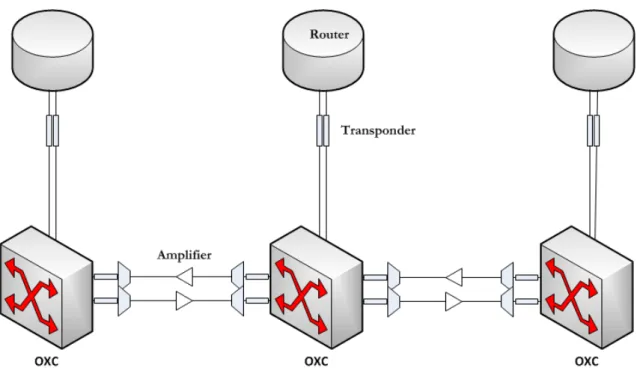
2.2 The architecture of IP over WDM networks . . . 13
2.3 Cisco Global IP Traffic Forecast for different services [1] . . . 16
2.4 The butterfly network with network coding . . . 23
3.1 The butterfly network (a) and the three nodes network (b) . . . 36
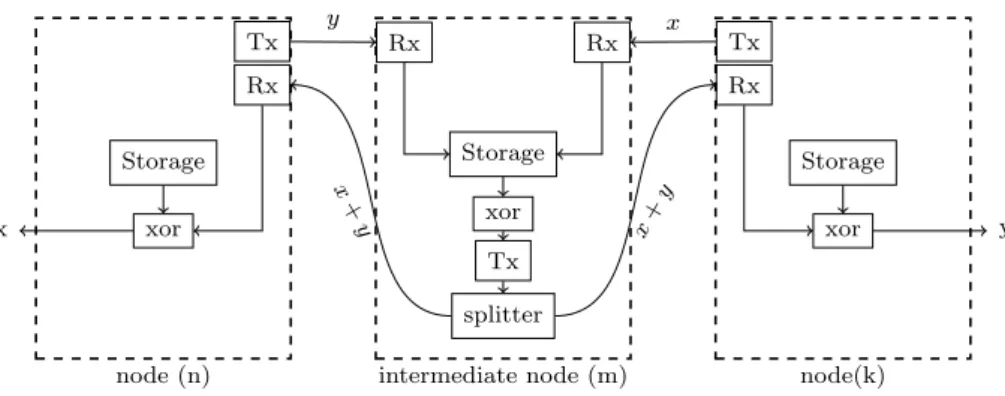
3.2 Conventional architecture (a), and Network coding architecture (b) . 37 3.3 Network coding node architecture . . . 38
3.4 Network coding at two intermediate nodes . . . 39
3.5 The NSFNET topology . . . 49
3.6 The USNET topology . . . 49
3.7 Average traffic demands at different times of the day[4] . . . 50
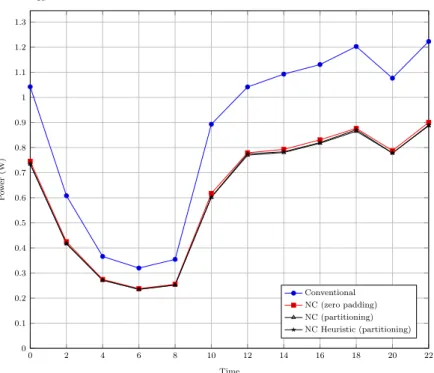
3.8 The power consumption of the NSFNET network with and without network coding . . . 53
LIST OF FIGURES x 3.9 The power consumption of the USNET network with and without
network coding . . . 54
3.10 Comparison between the number of the two port types in the NSFNET nodes . . . 54
3.11 The power consumption of the NSFNET network with and without network coding using gravity model . . . 55
3.12 The NSFNET connected by ring and star topologies . . . 56
3.13 power consumption of the Ring and Star topologies with and without network coding (MILP results) . . . 57
3.14 Maximum, minimum and average daily power savings in different network coded topologies . . . 57
3.15 Approaches to ports calculation . . . 59
3.16 Power consumption of the NSFNET under NC with partitioning ap-proach . . . 61
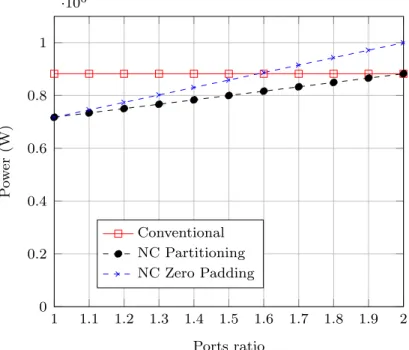
3.17 power consumption versus ports ratio using the MILP model . . . 62
3.18 Power consumption of the network for different coded transponders’ power values . . . 65
3.19 Power consumption of the NSFNET with bypass at different time of the day . . . 66
4.1 Power consumption of the analytical and MILP models for the NSFNET under the zero padding approach . . . 74
LIST OF FIGURES xi 4.2 Effect of network coding on large network sizes (A:analytical and
H:Heuristic) . . . 75
4.3 MILP results, the upper and lower bounds of the zero padding net-work coding approach . . . 84
4.4 MILP results, the upper and lower bounds of the partitioning network coding approach . . . 85
5.1 Example of using network coding for protection . . . 91
5.2 Six node topology under consideration . . . 100
5.3 The encodable graph where each node represents a demand for a six node topology . . . 101
5.4 The Weighted encodable graph . . . 103
5.5 Five node topology under consideration . . . 105
5.6 Power consumption of the 5 node topology with equal demands . . . 105
5.7 Power savings of the various approaches with equal traffic for 5 nodes topology . . . 106
5.8 Power consumption of the 5 node topology for random demands . . . 107
5.9 Power savings of the various approaches with random demands for the 5 nodes topology . . . 108
5.10 Power consumption of the NSFNET . . . 109
5.12 Power consumption of the various approaches for a 14 node fullmesh topology . . . 111
5.13 Power savings of the various approaches with equal traffic for 14 node full mesh topology . . . 111
5.14 Power consumption of the various approaches for a 14 node ring topol-ogy . . . 112
5.15 Power savings of the various approaches with equal traffic for 14 node ring topology . . . 112
5.16 Comparison of the power consumption for different topologies . . . . 113
5.17 Power consumption of the various approaches for equal demands vs demand volume . . . 114
6.1 The weighted encodable graph for a full mesh of size 4, 5 and 6 respectively . . . 124
6.2 The power savings of the full mesh topology with multiple sizes . . . 127
6.3 Encoding pairs for two rings with different odd number of nodes . . . 130
6.4 Encoding pairs for two rings with different even number of nodes . . . 133
List of Tables
3.1 List of the sets used in the MILP model . . . 41
3.2 List of the parameters used in the MILP model . . . 41
3.3 List of the variables used in the MILP model . . . 42
3.4 Network Parameters . . . 51
3.5 Network Parameters for the bypass case [2] . . . 64
5.1 List of the sets used in the MILP model . . . 92
5.2 List of the parameters used in the MILP model . . . 92
Nomenclature
AMPL A Mathematical Programming Language
ATM Asynchronous transfer mode
CBC Coin-or branch and cu
CCN Content Centric Networking
CRS Cisco Carrier Routing System
CWDM Coarse Wavelength Division Multiplexing
dB Decibel
DeMUX De Multiplexer
DWDM Dense Wavelength Division Multiplexing
EDFA Erbium Doped Fibre Amplifier
EPON Ethernet Passive Optical Network
FDM Frequency Division Multiplexing
FiWi Fibre Wireless
GB Giga Bytes
Gbps Giga Bits Per Seconds
GeSI Global e-Sustainability Initiative
GHG Green House Gases
GNU GNU Not Unix
IBM International Business Machines
ICT Information and Communication Technologies
InGaAsP Indium gallium arsenide phosphide
IP Internet Protocol
KIT Karlsruhe Institute of Technology
km Kilo Meters
Mbps Mega Bits Per Seconds
MILP Mixed Integer Linear Program
MPλS MultiProtocol Lambda Switching
MPLS MultiProtocol Label Switching
MUX Multiplexer
NC Network Coding
NEC Nippon Electric Company
NG-PON Next Generation Passive Optical Network
NP Nondeterministic Polynomial time
NRZ Non Return to Zero
NSFNET National Science Foundation Network
NTT Nippon Telegraph and Telephone
OC Optical Carrier
OEO Optical Electrical Optical
OLT Optical Line Terminal
ONU Optical Network Unit
OOK On Off Keying
OXC Optical Cross Connects
PON Passive Optical Network
PPP Point to Point Protocol
QoS Quality Of Service
RAM Random Access Memory
SDH Synchronous digital hierarchy
SMF Single Mode Fibre
SONET Synchronous Optical Networking
Tbps Tera Bits Per Seconds
TDM Time Division Multiplexing
US The United States
USA The United States of America
USNET United States Network
WDM Wavelength Division Multiplexing
Chapter 1
Introduction
There is no denying that the recent years have experienced an explosion in data usage accompanied by a shift of trends in data generation, consumption and storage. This change has brought about a unique and improved set of new uses and applications and expanded the horizons, but required a considerable evolution to the underlying infrastructure to support its operation. One of the main challenges experienced in ICT is its energy efficiency, and evolving the ICT infrastructure to be energy efficient sustaining the ever increasing demands has been one of the main themes of ICT research in the last few years.
The GeSI SMARTer 2020 report [3] estimates the total emission of ICT in 2011 to be 1.9% of the global emissions, comparable to the aviation industry, and expected to rise to 2.3% by the year 2020. Economically, as an example, European telecoms are expected to cost over 4 Billion US dollars for energy operational expenses [4]. What adds to the problem is that traffic continues to grow exponentially. The total Internet traffic is expected to double every year, which is more than 1000x in 20 years [1]. The energy saving growth, on the other hand, is growing slowly at a rate
of 10-15% every year. The gap between traffic growth and energy consumption will continue to expand if the current systems are left as they are.
Several proposals have been put forward to make networks energy efficient, including improved networking equipment, improved network design and architecture, improv-ing operational techniques to maximise consolidation of resources, improvimprov-ing traffic routing, and many more. Several organisations and standards have been setup to define energy efficient systems. The work is still on-going and this research aims at contributing to the solution of the problem.
One of the ideas that has enjoyed a great reception from the networking research community is network coding, introduced in 2000, promising to improve the capacity of the network leading to a considerable improvement in throughput by performing coding operations on top of conventional routing [5]. Of all the sectors, wireless networks received most of the efforts due to the suitability of implementation to network coding requirements, as wireless terminals and access points are multicast mediums in nature. Optical networks, however, received almost no attention from the network coding research community, leaving a big gap in the literature, and potential to improve network performance.
A key question relates to the suitability of network coding in optical networks. If suitable, how significant it is and under what conditions, and most importantly how to devise systems and techniques to maximise these improvements. These are the headline questions that this thesis investigates, with particular emphasis on improving network energy efficiency.
1.1
Motivation and Objectives
The main objective is to build an energy efficient IP over WDM network by using network coding and investigate the potential energy savings possible, optimise the network operations to maximise energy efficiency, as well as open doors for research in optical networks using network coding. In order to perform this, the following objectives are set:
• Evaluate the use of network coding in optical networks and the potential sav-ings in typical networks using common traffic. From there the main factors affecting network coding performance are to be studied and optimised using a Mixed Integer Linear Programming (MILP) model. In addition, develop heuristics that provide savings closer to the MILP model performance, and study the impact of varying the traffic demands as well as the network topol-ogy.
• Produce analytical closed-form expressions and bounds to validate the MILP and the heuristic and use them as a tool to study scenarios that are too complex to be studied using the MILP model, and provide an upper limit to the achievable energy efficiency which aids in deciding how much more effort needs to be dedicated to reach the maximum energy efficiency.
• Evaluate the use of network coding in survivable optical networks using 1+1 protection schemes, and study its behaviour, optimise it using MILP, develop heuristics that can be used in large network sizes, and develop analytical bounds to understands the limits of performance and to validate the MILP and heuristics as well as study network situations like big network sizes, that are harder to solve using the MILP.
1.2
Original Contributions
• We were the first to introduce network coding in IP over WDM networks by designing a new type of router port that employs the simplest of the net-work codes, i.e. the XOR code, to improve energy efficiency of IP over WDM networks. We developed a MILP model and a heuristic and quantified the savings using the NSFNET and USNET topologies. We designed two archi-tectures considering the potential imbalance between the two encoded flows, one zero pads the smaller flow and the other partitions the bigger flow. We investigated network coding in both non-bypass and bypass variants of IP over WDM networks.
• We developed analytical bounds and closed form expressions to the power con-sumption for the network coded approach as well as the conventional approach and used them to validate the MILP model. In addition to that, we studied the behaviour of networks with a high number of nodes.
• We investigated the use of network coding in survivable optical networks with 1+1 protection to approach the efficiency of 1:1 protection with the reliability of the 1+1 protection by encoding one of the link disjoint paths of a demand with another. We developed a MILP model and a heuristic with five operating options and studied the behaviour in common networks as well as regular topologies, and studied the impact of traffic on the savings.
• We derived analytical bounds for the performance of 1+1 survivable optical networks and studied the impact of topology, focusing on the special full mesh and ring topology providing a detailed analysis considering the impact of the network size.
1.3
Publications
The following Journal and conference papers have been published and submitted for publications:
1. M. Musa, T. El-Gorashi, and J. Elmirghani, “Energy Efficient Core Networks Using Network Coding,” in Transparent Optical Networks (ICTON), 2015 17th International Conference on, July 2015.
2. M. Musa, T. El-Gorashi, and J. Elmirghani, “Network Coding for Energy Efficiency in Bypass IP/WDM Networks” in Transparent Optical Networks (ICTON), 2016 18th International Conference on, July 2016.
3. M. Musa, T. El-Gorashi, and J. Elmirghani, “Network Coding for Energy Ef-ficiency in Core Networks” Lightwave Technology, Journal of,2016, Submitted for publication.
4. M. Musa, T. El-Gorashi, and J. Elmirghani, “Bounds on Energy Efficient Network Coding in Core Networks” IEEE Transactions on Communications, 2016, Submitted for publication.
5. M. Musa, T. El-Gorashi, and J. Elmirghani, “Energy Efficient Survivable IP over WDM networks with network coding” Optical Communications and Net-working, Journal of, 2016, Submitted for publication.
6. M. Musa, T. El-Gorashi, and J. Elmirghani, “Bounds On Energy Efficient Survivable Optical Networks with And Without Network Coding” IEEE/ACM Transactions on Networking, 2016, Submitted for publication.
1.4
Thesis Outline
Following this chapter, this thesis is organized as follows:
Chapter 2 presents a review of the core network and its components, network coding as well as a brief overview of the efforts underway to improve the energy efficiency in optical networks.
Chapter 3 presents the new optical network architecture that exploits network cod-ing. A thorough study of the energy efficiency benefits of the approach with evalu-ation using an MILP model and a heuristic is provided.
Chapter 4 provides closed form expressions and analytical lower and upper bounds for network coding supported IP over WDM networks presented in Chapter 3.
Chapter 5 provides a study on the use of network coding to provide energy efficient 1+1 protection in optical networks, by evaluating it through a MILP and a heuristic and studying the traffic and topological impact of the network.
Chapter 6 provides analytical bounds on the survivable network coded 1+1 optical networks provided in Chapter 5, as a verification an extension to very large network sizes.
Chapter 7 summarises the thesis contributions and provides a set of possible future directions of work.
Chapter 2
Review of Optical Networks and
Network Coding
2.1
Introduction
In this chapter an overview of the components of this thesis is presented. An exam-ination of the IP over WDM networks architecture and components followed by an overview of energy efficiency with a focus on core networks, presenting the current situation, efforts and potential research areas. We follow that by an introduction to network coding, followed by a review on the work done in using network coding for optical networks. We also give a brief introduction to the mixed integer linear programming approach used to provide one of the models of networks in this thesis.
2.2
Optical networks
IP over WDM is a networking scheme where IP data units are transported over optical networks employing wavelength division multiplexing (WDM). The combi-nation of these two systems came about after a long phase of improvements to the previously used architectures. In this section we give a brief introduction to existing optical network architectures, and then we focus on IP over WDM networks and their elements
2.2.1
A brief history
In 1966, Charles Kao and George Hockam [6], in the middle of an era that used copper wire as a main mean of communication, proposed using light guided inside a long tube of glass for transporting information. Although the idea was revolutionary, it was not practical enough due to the inability to manufacture optical cables with very low attenuation as the attenuation factor was 1000 dB/km compared to 5-10 dB/km for coaxial cables at that time. However, these high losses were not inherent but rather due to contaminants which, if removed, would lead to extremely low losses [6]. Improvements followed over the years in optical fibre manufacturing and light sources such as lasers. In 1975, a fibre with 45 Mbps rate using GaAs semiconductor laser, operating at 0.8µm was commercialised. This system however, required the presence of repeaters every 7 km [7].
In the 1980s, the central wavelength moved to the low losses window around 1.33µm and a major leap was the introduction of the single mode fibre (core diameter of 8-10 microns compared to 50-100 microns of the multimode fibre). The single mode fibre (SMF) improved the performance by many folds. However another type of
laser had to be used compatible with the SMF, so InGaAsP semiconductor lasers were used. The bit rates reached 1.7 Gbps and the spacing between repeaters was 50 km [8]. The next move was centring the transmission on the 1.55µm window, in which the fibre has the lowest attenuation; 0.2 dB/km. The dispersion, however, was high in this region, but with the help of dispersion shifted fibres and using a limited spectrum laser, 8 Gbps transmission was achieved with doubled repeater spacing to 68km [9].
In the early 1990’s two major achievements paved the way to huge data rates sys-tems; the invention of the optical fibre amplifier [10] and wavelength division mul-tiplexing [11] for capacity improvement. A WDM system capable of transmitting 8 channels each carrying 10 Gbps was demonstrated [12]. Improvements followed each other; data rates passed the Tbps barrier in the mid 1990’s [13]. Alcatel-Lucent in 2009 achieved 15 Tbps using 155 channels of 100Gbps each. In 2010 NTT achieved a 69.1 Tbps over a large span of 240 km, using 432 wavelengths each carrying 171 Gbps [14]. KIT managed in 2011 to transmit 26 Tbps per wavelength, for a distance of 50 km [15]. In 2011, NEC managed to transmit a 101 Tbps over a long distance of 165 km, using 370 channels of 273 Gbps each [16]. Another breakthrough came at the end of 2012, where NEC and Corning managed to break the petabit/s level by using a 12 core fibre over a distance 52.4 km [17].
In a recent paper, the authors in [18] experimentally demonstrated WDM data transmission at propagation speed 99.7% of the speed of light, by improving upon photonic band-gap fibres that have a hollow-core. This propagation speed is a significant improvement over the silica glass fibres, in which light propagates 31% slower than vacuum. The rate they managed to transmit is 73.7 Tbps.
Figure 2.1: Simple configuration of the WDM network
2.2.2
Optical networks
The fast rise in optical fibre capacities, with the electronic limitations on the de-vices speed signalled the need for multiplexing techniques where low rate signals are combined into a higher rate transmission. The first way to perform this multiplex-ing is by the use of time division multiplexmultiplex-ing, and it can be done electronically or optically. The famous SONET/SDH standards use electronic TDM and the highest transmission available today is the OC-768/STM-256 40Gbps which multiplexes 4 10Gbps OC-192/STM-64. The hierarchy goes up in multiples of four in data rates from to the basic OC-3/STM-1 rate of 155 Mb/s. Optical TDM is faster, although commercially not yet available, experiments demonstrated multiplexing 10 Gbps streams into a 250 Gbps stream [19].
Wavelength division multiplexing (WDM), shown in Figure 2.1 is a multiplexing scheme that is analogous to FDM in radio system. The optical bandwidth is divided into slower narrowband bandwidth components, referred to as wavelengths. Signals from the client side are transformed into a compatible wavelength configuration through the use of transponders and multiplexed using wavelength multiplexers and are carried over the optical fibre. At the receiver side, the composite WDM signal is demultiplexed into its individual wavelengths to be consumed by received clients.
The total available bandwidth is divided in the WDM scheme into two standards: Coarse WDM (CWDM) [20] and Dense WDM (DWDM) [21]. The CWDM uses multiple transmission windows and provide 16 channels. The DWDM standard, uses the C-band region (1530 nm-1560 nm) and can provide two schemes, the first provides 40 channels at 100GHz wavelength separation and the second provides 80 channels at 50GHz separation.
The first use of WDM was for expanding the bandwidth of point to point optical communications systems. The bandwidth expansion turned into bandwidth man-agement with the creation of more wavelength sensitive equipment such as switching and routing and with advent of active elements, this added wavelength as another degree of freedom in addition to time and space.
There are two approaches of routing wavelengths in WDM networks; wavelength routing and broadcast and select. In wavelength routing networks, switching is done based on the knowledge of the wavelength and the port of entry. For an NxN network, there is a way of wavelength assignment where only N wavelengths are needed instead of N2, however, N2 fibres are needed [22]. The other option is broadcast and select; here a broadcasting star couples all inputs and broadcasts them to every output, the receiver then selects the desired channel/transmitter based on its current pass frequency. If the lasers and detectors are tunable, several configurations can be realised such as the multicast functionality [11].
2.2.3
IP over WDM
The Internet Protocol (IP) came as a natural progressive choice to carry the variety of service forms (voice, data, and media content such as video) by encapsulating them into the packets format provided by the IP protocol. This is the result of the
popularity of the Internet and the rapid advances in broadband technologies. WDM as the direct provider of capacity is the logical choice to carry the IP payload and hence the selection of the current layered combination as IP over WDM [23] [24]. This combination was a result of multiple protocol stack changes as technologies were being displaced for a better alternatives.
In the early 1990’s IP was carried over ATM, a protocol that proved itself in terms of integrating multiple services and providing QoS. This is fed to another layer that multiplexes many ATM low rate flows into a higher rate flow using the TDM based SONET/SDH protocol, which is finally handed to the WDM layer where the latter is carried over fibre. This stack required four major devices, IP routers, ATM switches, SONET Add drop multiplexer and WDM equipment. It lacked efficiency, there was overlap in functionality, and the protocols overhead was large. SONET and IP both perform aggregation, each layer has its own restoration functionality, and all layers perform routing, while the MPλS performs QoS. Having multiple layers with shared functionality decreased the reliability of the system.
In the late 1990’s, MPλS (the optical equivalent to MPLS) [25], was introduced to the stack replacing the ATM. It was first carried over Point-to-Point Protocol (PPP) and was encapsulated in SONET frames. But later in 2000 the PPP was replaced by Ethernet. IP over WDM emerged as the winning combination [26]. IP routers are now capable of running at 10Gbps, 40Gbps and 100Gbps and the IP layer is used for traffic aggregation, protection and route calculation [27]. WDM layer is used for providing the routes, flow protection and network restoration. The protection and route assignment are coordinated between these layers [19], [28]. Figure 2.2 shows the components used in an IP over WDM network (3 nodes shown for simplicity). We describe them here briefly:
Figure 2.2: The architecture of IP over WDM networks
IP routers are the parts responsible for routing in the IP layers and represent the client side of the optical terminal. They receive the aggregated traffic from edge routers and interface the optical side of the network.
Optical Cross Connects (OXC) are essential elements in the WDM network as they provide switching of optical signals between input and output ports. They can pro-vide light path instantiation and can close down paths dynamically. Additionally they can support switching light paths, management and protection functionality. They may also include wavelength conversion capabilities, multiplexing and groom-ing capabilities internally [29].
OXC have migrated from being opaque to transparent with the third option of be-ing translucent [30] [31]. In the opaque OXC the switchbe-ing fabric is either entirely electrical or a mixture of optical fabric with optical-electrical-optical conversion. In transparent OXC the signal is switched between the input and output ports without the need for an optical-electrical-conversion. The opaque OXC supports
regenera-tion, wavelength conversion and bit-level monitoring at the cost of the electrical conversion delay and power consumption. In translucent OXCs, the switching stage consists of both the electronic module and optical module offering both options for switching signals. While the optical switching module is preferred, the electronic module comes in handy when the optical switching module is occupied or the func-tionality of regeneration is needed, therefore providing a compromise between full transparency and the choice of regeneration.
Transponders are used when the format of the optical signal needs to be adapted to another format. The client side of the transponder receives the signal from the IP router, which is generally carried on an optical fibre operating at the 1310nm wavelength. The transponder converts the client side signal into an electronic signal which is back converted to the required WDM wavelength. The reverse is done on the receiving side of the network. Although this functionality is carried out using Optical-Electrical-Optical conversion, it is expected to change to all optical with the maturing of the all optical technology. Transponders can also have network management functionality and monitoring by adding an overhead and they have the ability to add Forward error correction.
Optical amplifiers amplify optical signals directly without converting them to elec-trical signals. Erbium doped fibre amplifiers (EDFAs) have revolutionised optical communications in WDM networks, because they provide high gains in the 1.55µm window in the order of 25dB and are independent of the signal shape and bit rate. They can be used as in-line amplifiers where the links are attenuation limited. Here they are placed at regular link intervals (80-120 km) to compensate for the 0.2 dB/km attenuation of the fibre. They are used also as post amplifiers to increase the power of the transmitter, or as preamplifiers to improve receiver sensitivity. ED-FAs can also be used as booster amplifiers when couplers are used to compensate
for the losses [32], [33].
2.2.3.1 Multiplexers/Demultiplexers
Multiplexers are used to combine and separate the multiple wavelengths carried in the fibre. Currently the standards for multiplexing are the coarse and dense WDM multiplexing (CWDM and DWDM) differing by the channel separation; 20nm for the CWDM and 0.8 nm for the DWDM [20], [21].
2.3
Energy Efficiency in Core Networks
According to GeSI SMARTer 2020 report [3], the ICT sector contributes about 2.6% of the total greenhouse gas (GHG) emission, an alarming amount comparable in magnitude to the aviation industry. Telecom infrastructure contributes about 22% of the total ICT power consumption while data centres’ share is 19%, with the 59% of the ICT power consumption contribution coming from end user equipment. This however is expected to change by the year 2020, where The power consumption from end user equipment will drop to 53%, while data centres will experience a growth in power consumption to 24%, and the telecom networks will remain close to 23%. While ICT itself is used to mitigate the GHG emission, it is not energy efficient. This continuous expansion in ICT calls for new approaches to cut the power consumption of ICT to its lowest possible levels.
Figure 2.3 shows the traffic trends for the different services [1]. It shows that the IP traffic exhibits a 22 percent compound annual growth rate from 2015 to 2020, exceeding 2.3 ZetaBytes per year by 2020. The figure also shows the different services and their contributions, with Internet video and IP video on demand reaching over
80 percent of the total traffic. The escalation of demands as shown in Figure 2.3 will lead to continued increase in energy consumption in the network, unless measures are taken to reduce power consumption.
Figure 2.3: Cisco Global IP Traffic Forecast for different services [1]
The roadmap toward achieving energy efficiency goals is first to estimate the cur-rent energy efficiency trends and then assess possible solutions. Possible research areas are to be identified and major challenges need to be addressed. These areas are integrated in a holistic and consolidated way, so all the savings are combined together. Finally measurements and benchmarking should take place to determine where along the way the current savings are.
The work on energy consumption of the Internet was pioneered by the work of [34] and [35] by showing the necessity to improve the power consumption of the Internet. Greentouch is a consortium [36] formed in 2010 with the aim of increasing network energy efficiency by 1000x compared to the level of 2010 by delivering efficient archi-tectures, roadmaps and specifications by fostering collaboration between academics, ICT industry experts and non-governmental research experts from the entire world.
2.3.1
Approaches
There has been a growing amount of effort to improve energy efficiency in ICT. The work spans all the ICT domains, including terminal equipment, networks and data centres. Here we focus on the network side, and among the 3 network variants, core, metro or access, we focus on the core network where the energy density is highest and where the group has contributed to GreenTouch [37].
The first effort on improving the Internet energy efficiency was carried out by [34], where the authors showed that selectively putting network elements to sleep im-proves energy efficiency, but requires changes to the current system. Here we group energy efficiency approaches in core networks into 4 main approaches: components, data, network and energy source. Each category has its own subcategories, and all of them can be applied in a holistic approach, combining the benefits of each in a coherent manner.
2.3.1.1 Energy efficient components
In the components level, the approach is to take each element of the network and improve its energy efficiency by engineering efficient electronics and reducing the level of complexity. First, all components can migrate to include power efficient electronics and optical devices can use power efficient photonics as well as power efficient integration. For instance, improving optical fibres properties and mitigating impairments reduces the need for amplifiers and regenerators, and hence reduces energy consumption.
Migration to all optical architectures eliminates the need for using optical to elec-trical conversion, hence using less equipment to route traffic. The authors in [38]
discussed how optics can improve energy efficiency of networking components. The authors in [39] have examined the benefits of using photonic switching in terms of energy efficiency improvement. They analysed the contribution of buffers and OXCs to the total energy consumption. They have shown that these elements vary slowly with access rate and their contribution in energy consumption is low. So even if photonic switching is used, the reduction in power consumption is not significant. One may argue that this result only considers the components savings alone. Migra-tion into all optical switches has an impact on higher layer on the higher layers of the network, and future work has the potential to coordinate transmissions through optical band switching, optical flow switching, and the use of large optical packets which can reduce the use of routers and improve energy efficiency [40].
Cisco [41] has introduced a new router/OXC platform that changes the interaction between the IP and DWDM layers. Based on the fact that 70-80% of the overall traffic handled by the router is a pass through traffic, but OEO conversion occurs anyway, resulting in additional cost in terms of operational power, cooling power and space cost where many racks are needed [41]. This approach keeps traffic as much as possible in the optical domain, and transponders are shifted to the router line cards instead of OXC ports. CRS-1 is an example of a router that uses this feature.
In the IP layer, routers are the most power consuming elements of the network. A significant portion of this power is dedicated to cooling, and it’s shared for the whole chassis. It was shown in [42] that the full chassis consumes less power per transferred bit the less full it is. Also they showed that a chassis with high speed line cards supported, is more energy efficient. The authors in [43] addressed the issue of mixed line rates and its effect on energy efficiency. They show that using mixed line rates is better than a single line rate network.
2.3.1.2 Power Adaptive Components
Network components possess a power profile which dictates the power consumption given a certain utilisation. This offers opportunities in allowing the component to adapt to the current load by introducing sleep modes in the general case or selec-tively switching on and off components resulting in a considerable amount of power savings. The authors in [44] developed multiple traffic models from traffic observa-tions showing the potential for power savings if these traffic changes were followed by the operating equipment. In [45], it was shown that shutting down idle line cards and chassis of IP routers can save energy. A similar approach was presented in [46] by shutting down line cards when the traffic load is low. Putting network elements to sleep has been shown in [47] to save up to half of the core network power consumption by reconfiguring nodes and links to follow traffic variation.
The authors in [48] divided the level of turning off various elements into three levels: the instruction level where elements inside the CPU can be turned off, this scale is the sub microseconds scale. The seconds is between the microseconds and milliseconds, where the CPU can be put to sleep, situations in this level are like inter-packet communication. Between flows, scales from seconds to hours, is the third case where the entire system can be turned off. This approach can be implemented by shaping the traffic pattern, grouping information to add more sleeping opportunities.
2.3.1.3 Data Distribution
Packet size has been shown in [49] to be a significant parameter in reducing the power consumption of router ports as the smaller the packet size is, the more power is consumed in the router. Therefore carefully engineering packet sizes has the
potential to save power at the possible cost of increased delay. Data presentation includes protocols encapsulation and coding. The information can be compressed to its minimum possible value. Compression can be at the network level. There can be cross layer compression and inter-flow coding. Reliability of the transmission can be increased by channel coding, which reduces the need for regenerators along the way, saving energy. This approach is the least used approach in achieving energy efficiency, while having a great potential. The authors in [50] provide a discussion of the data compression benefits in energy efficiency in optical networks and the authors in [51] investigated the savings in power consumption by compressing data in IP over WDM networks through MILP modelling and heuristics using fixed and mixed line rates and different compression rates for different data types.
The authors in [49] showed that the packet size can be optimised to save energy, the larger the packet size the more is the energy efficiency achieved, with impact on delay, hence there exists an energy efficiency delay trade-off.
End to end grooming is shown by [52] to be more efficient than link by link grooming. Grooming is an essential function of IP over WDM network, and by increasing utilisation of link power efficiency is increased.
Data centres constitute a huge section of savings. In [53], the authors considered the impact of the number of data centres, their locations and the upload and download rates on the energy efficiency. They also studied the effect of replicating content with different popularity in the network and minimising the overall routing cost. With the availability of renewable energy, they found that it is better to move data centres to the location of renewable energy sources than to transmit renewable energy to data centres. To minimise access overhead to the limited number of data centres, caches are used. The impact of using caches on energy efficiency has been
addressed by [54]. They show the savings offered using different content popularity distributions.
In [55], the authors evaluated the savings achieved by using content delivery net-works with dynamic optical bypass. They show that this configuration achieves better savings when high download rates are used to access very large files. The same authors in another paper [56] compare the dynamic optical bypass savings with content centric networking (CCN). They show that CCN is more efficient with popular content, while the other is more efficient with less popular content.
The advantage of using bit torrent peer-to-peer content distribution over the client server has been studied in [57] where the authors showed that having random peers selection is not different from the client server model energy-wise, but using a power minimised approach leads to savings of up to 30%.
2.3.1.4 Network Design
At the network level, switching traffic from source to destination is affected by the network topology and architecture and the route traffic takes. By carefully managing network topology by allowing the traffic flow to consume the lowest power possible, and hence switching off network equipment, a considerable amount of savings can be achieved. The authors in [58] provide a good survey of this approach.
The work in [59], considered designing an energy efficient IP over WDM core net-work. They quantified the effect of using bypass where traffic is routed only in the optical layer, and they found it to be significantly higher in efficiency that the non-bypass case.
dynamically based on the requirements. The design of the topology for energy efficiency takes the traffic demand as a parameter. The fact that the demands are dynamic, and the topology is static introduces inefficiency and under-utilisation to the system. Architecture on demand tries to bridge this dynamism seamlessly. The study in [60] proposed an architecture on demand which can be interconnected in 20 ms to build flexible OXC architectures that follow traffic needs.
In [61] the authors investigated the application of virtual network embedding in core networks where the network is virtualised to multiple virtual networks, and by consolidating networking resources, energy efficiency can be achieved.
2.3.1.5 Energy source
Here, the energy sources are divided to renewable and non-renewable sources. It is desirable to migrate to a full renewable energy source operated network, potentially saving energy running costs and having reduced carbon footprint. However, there are many challenges to provision of renewable energy sources.
The work in [62] considered the problem of using a limited number of renewable energy sources in the IP over WDM network. They investigated the impact of the number of sources and their location on the energy efficiency and carbon footprint minimisation problems. The results show that it is more efficient to place renewable energy sources at the centre of the network.
2.4
Network Coding
2.4.1
What is Network Coding?
Communication is about transmitting a piece of information from one point to an-other. In a network, this transmission is assisted by intermediate nodes that relay the information until it reaches its destination. While the source can encode the information which is later decoded by the receiver, intermediate nodes simply re-ceive and forward it without any coding. Information in this regard is considered a commodity, and the essence of network design is flow conservation (what goes in, comes out).
While the commodity flow paradigm has kept the network in operation since its first days, it has not utilised its potential to the limit; intermediate nodes are essential to data transmission and hence should be utilised to improve overall performance. This is what Ahlswede et al. proposed in their pioneering paper [5].
1 s 2 3 4 5 6 X Y Y X Y X Y X Y X 1 s 2 3 4 5 6 X Y Y X Y X X+Y X+Y X+Y
To simply represent network coding, we use the famous butterfly network shown in Figure 2.4. Starting with the conventional routing approach (left), assume source
s is to multicast two pieces of information (X and Y) of a unit rate each using the butterfly network with edges of a unit capacity each, to the two receivers d1 and d2. It is only possible if the min cut max flow theorem holds for each of the transmissions separately. The min-cut max-flow theorem [63], [64] states that the value of the minimum cut that separates the source from the receiver is the maximum amount of information that can be sent; the cut is the collection of edges that if removed, the source and destination get disconnected. In this case, the middle link (3,4) will be a bottleneck. And so the multicast will not be admissible with the rate intended. In contrast, if we allow node 3 to perform an XOR operation on the two pieces (addition in the binary field), and later at the destination nodes the xor is performed again on the two packets received, this bottleneck is avoided and the intended rate is achieved. This achievable rate is the multicast capacity of the network. Network coding is a generalisation of this case, for arbitrary topologies, arbitrary traffic and demands scenarios and arbitrary codes.
The work of Ahlswede et al. was followed by the significant work of [65] which de-scribed an approach to achieve optimal solution for multicast over directed acyclic graphs by applying linear codes and proving they are sufficient to achieve the multi-cast capacity. The work of [66] provided an Algebraic framework for network coding, which later drove the development of random linear network codes [67], [68] where the coding coefficients at different nodes in the network are selected randomly.
Following its discovered potential, researchers expanded the study and implementa-tion in different dimensions. An informaimplementa-tion theoretical framework was developed in [69–71]. The use of network coding in undirected networks was started by [72], and [73]. It showed that the previous work that assumed acyclic networks can be
extended to cyclic scenarios. Another significant extension of network coding was made by [74] and [75] where they showed that the network coding problem repre-sents a generalisation of the classical problem of error correcting codes, by providing redundancy in the extra space dimension in addition to the time domain.
Complexity and algorithms for optimal codes are currently among the main branches of network coding theory. Different factors were studied, such as the size of the alphabet and the number of destination nodes and their distribution [76], while [77–79] provided low complexity polynomial time algorithms for multicast network coding.
2.4.2
Benefits of Network Coding
2.4.2.1 Throughput
Network coding makes better use of shared links in the network. Many information flows are combined together over a finite field, the result is a flow several times smaller than the flows combined in the normal routing scheme. This throughput gain depends on the network architecture and traffic demands. There is no specific figure to quantise throughput, but given a certain topology and traffic demands one can quantify the possible gain region over these circumstances.
2.4.2.2 Resources
Resource savings can be achieved by the introduction of network coding. The fact that we need fewer resources to satisfy the same demands of the classical non-network coding approach minimises the cost of the employment of these resources; the cost
can mean expenses or energy footprint. In certain circumstances, network coding can reduce transmission time as compared to the classical approach (3 transmissions instead of 4 [80]). This minimises the delay greatly.
2.4.2.3 Security
The free added security by implementing coding at nodes and the multipath di-versity that occurs as a result of network coding constitutes a significant security enhancement. However, it’s a double edged sword; it is also a challenge, as we will see later.
2.4.3
Challenges of Network Coding
2.4.3.1 Complexity
While implementing network coding improves performance, it comes at the expense of complexity of the functionality implemented in nodes. The level of complexity and its corresponding performance gain is a major question. Achieving high performance with the minimum possible complexity is a goal everybody is looking to achieve. Complexity should also be considered at the network level. The number of nodes with coding ability, their location given a certain topology and the level of complexity of each are few examples of the issues. The complexity problem is in itself a complex problem.
2.4.3.2 Delay
Delay can be a consequence of complexity, but we rather think of it as a separate matter. Even with the simplest codes, the node may be waiting for information flow from other nodes to perform an operation. Also the benefits of network coding are impeded by the delay generated by the process. The delay is mentioned also in the benefits section, which makes it also an interesting property. The net benefit of the delay issue must be significant when implementing network coding.
2.4.3.3 Synchronisation
Nodes that may take more than one information flow should acquire extra infor-mation for synchronisation, especially for real time applications (e.g voice, video streaming). It is worth noting that in a specific class of networks where synchroni-sation is an inherent property of their design and implementation, network coding becomes a viable possibility.
2.4.3.4 Scalability
Two features have to be considered, the first is the migration of existing infrastruc-ture to support network coding, and the second is the change of network coding scheme as the network expands and requirements change. The goal in solving such a problem will be to minimise the differential coding requirement as the network changes, ultimately to zero.
2.4.3.5 Security
Introducing intermediate entities that can perform operations on the data can result in serious preaches to the security, contrary to the scheme where the only involved parties in communication (source, destination) are allowed to perform coding and decoding. This requires investment in increasing security measures of the imple-mented system.
2.4.4
Network Coding in Optical Networks
The use of network coding in optical networks has received little attention. Most of its use was the direct and apparent exploitation of the areas where there are multicast scenarios, such as passive optical networks, or the case of multiple paths as in protection, here we review all the work carried out so far.
2.4.4.1 Protection
The first application of network coding in optical networks started in 2006, by [81] where the authors considered the problem of protection in mesh optical networks. They built on the 1+N p-cycles protection approach and introduced network coding. They showed that the outage time in a failure scenario is no longer than the delay over the cycle. The authors in [82] used network coding with reduced link capacities to provide protection over single link failures by providing backup protection paths which carry coded data from all sources, instead of using dedicated protection paths. They also provide implementation aspects of their two proposed protection schemes NPS-1 and NPS-2.
The work in [81] was extended in [83] by implementing the network coding protection scheme on an overlay layer which makes the deployment simple, scalable and does not require the synchronisation required by the original scheme. They also compared the cost of the proposed scheme with the 1+1 scheme and included multiple link failures, by sharing of the protection circuit by a number of paths.
2.4.4.2 Passive Optical Network
It has been shown in [84] that through the use of network coding for multicast in the PON, a reduction in the total packet delay and the packet loss ratio is achieved. The simulation was done for intra-ONU traffic using 1Gbps EPON. Improvements on the throughput of the downlink by 50% in [85] were achieved without imposing any hardware changes. The approach carried out to quantify the gains is analytical and by simulation. The results showed the outcome of this approach in the queuing delays, gains in throughput, and the variability of traffic. The implementation for PON was taken to the NG-PONs by the work in [85] which showed that using NC in NG-PONs has a great potential in improving throughput, reliability in bad conditions and delay. Their work, in contrast to the previous two, focused in more detail on the impact on performance. They also showed that applying NC for FiWi networks has additional benefits.
The only work, to our knowledge, that addressed the energy efficiency of network coding was done by [86], applied to NG-PONs. They used NetFPGAs to emulate the use of NC in EPON (IEEE 802.3ah). They combined NC with sleep cycles in the downstream, which resulted in better energy efficiency. The work in [87] and [88] introduced network coding in optical networks by finding multicast scenarios in optical networks, which is similar to what have been done in wireless. The authors
exploit multicast OXCs and solves the problem by dividing it into two stages, the first is finding sub graphs of the topology to code over and then finding suitable codes.
2.4.4.3 Physical Layer Network Coding (All Optical)
An optical layer network coding approach was presented in [89] though it is more of a polarisation multiplexing scheme where two streams are combined through a polarisation beam combiner. At the receiving end, with delay differences from the two streams a preamble for the first stream and a postamble from the second stream can be detected where useful information about each of them can be detected and an estimate of each stream can be received. The work demonstrated a practical prototype as a proof of concept with 10Gbps NRZ OOK optical frames.
2.5
Mixed Integer Linear programming (MILP)
Mathematical programming is an optimisation technique where an optimum solution to a function referred to as the objective function is found satisfying a set of bounds and constraints [90]. The programme consists of four main elements:• The objective function: this is maximised or minimised during the optimisa-tion process and whose value represents the outcome of the programme.
• Optimisation variables: these are the variables that are varied adhering to constraints to optimise the objective function.
• Constraints: which are a set of mathematical inequalities that define the fea-sibility region of the solution
• Bounds of variables: determine the upper and lower bounds of each variable in the problem.
Mixed Integer Linear Programming is a mathematical optimisation programme in which all the bounds, constraints and the objective function are linear and the vari-ables are a mixture of integer and non-integer values [91]. An important subclass is the binary mixed integer linear programmes where some of the variable have 0,1 values which are used to model decision variables. Integer programming is an NP-complete problem where the time to find a solution to the problem cannot be found in polynomial time. For this kind of problems, even for smaller instances of the problem is hard to have a polynomial time solution. Polynomial time solutions are fast, as the number of steps to calculate the solution is a polynomial function of the size of the input. The standard form is:
Objective function f =c1x1+c2x2+...+cnxn Constraints: a11x1+a12x2+...+a1nxn≤b1 a21x1+a22x2+...+a2nxn≤b2 an1x1+an2x2+...+annxn ≤bn
x1 ≥0, x2 ≥0, ..., xn ≥0
Normally, the variables are continuous, making the problem solvable in polynomial time. If some or all of them, however, are constrained to integers, the problem is called mixed integer linear programming (MILP), and the problem turns into an NP hard problem for which no polynomial time algorithm has been discovered yet.
MILP problems are non-convex, therefore systematic approaches are used for their solution and the most common way is Branch and bound approach [92]. Branch and bound approach divides the problem solution into stages, the first is solving the relaxed problem with no integer constraints through the standard optimisation methods. In case the integer solution is found in this result, the optimisation stops. depending on the number of integer variables having non-integer relaxed solution, the algorithms selects one variable and branches by creating subproblems. The solution is repeated until the solution satisfies all the integral constraints.
Genetic algorithms [93] are also used to find a solution by performing successive iterations on randomly generated solutions and continuously optimising over gener-ations. The algorithm randomly generates potential solutions satisfying the integer constraints which at the first stage are usually not optimal. These candidate solu-tions are transformed into more optimal solusolu-tions through mutasolu-tions and crossovers and filtered by performing a fitness test after which only the best solutions survive. Although these methods provide near optimal solutions, generally they are not able to prove that the solution is optimal.
The network is based on sharing resources, most of the time there is no direct path between the source and destination. The traffic has to pass through intermediate nodes, passing several links. The set of links connecting the source and the
desti-nation is called a path. There may be many paths for a single demand, and each path carries a portion of the demand; the demand flow variables represent the traffic carried in each path. The link capacity is the amount of traffic the link can handle at low error rates, and the unit representing the demand volume should be the same as the link capacity unit, e.g. Gbps. The nodal degree of a node is the number of links that enter or leave that node, and so can be divided into the in-degree and an out-degree respectively.
The main approach adopted when using linear programming in network design in-volves representing the basic functionality of the network in terms of constraints, and a feasible region. The programme must search inside the feasible set and selects the optimum values of the variables that maximises (or minimises) a defined objective function. In networks, the objective function is the aim of the design represented by a function that is dependent on many design variables. Examples of objectives include Minimising Energy consumption, minimising routing cost, minimising con-gestion, minimising delay. . . etc.
Constraints define limitations on the set of feasible solutions. Three constraints are typically essential to every network design problem, as they represent the main and basic function of the network, these are:
• Capacity conservation: This simply states that, the total amount of flow pass-ing through a given link cannot exceed its capacity.
• Flow conservation: This states that the traffic flowing into a node is the same traffic flowing out of a node, if the node is not a source or a destination. If it is a source, the traffic out of the node minus the traffic entering the node equals the demand originating in the node. If it is a destination, the traffic that enters it minus the traffic that leaves it equals the demand destined to it.
• Flow variables legitimacy constraint: These constraints that define the possible region over which flow variables can take values, and most of the time these are non-negativity constraints. Since each flow variable should have a positive value, if not zero.
The mathematical formulation is represented in computer systems in many ways, the most popular of which is the AMPL (A Mathematical Programming Language) [94]. This AMPL formulation is fed into MILP solvers of which there exist many options (CPLEX [95], GNU GLPK [96], CBC [97], lpsolve [98],...etc). The one commonly used and the one used in this work is the IBM ILP CPLEX optimisation suite [95]. This solver either ran on an i5, 3.3 GHz, 64GB of RAM machine, or in a High Performance Computing cluster with 16 cores and 256 GB RAM.
Chapter 3
Network Coding in Optical
Networks
3.1
Introduction
In this chapter a change in node architecture to improve the energy efficiency of IP over WDM networks under unicast connections is proposed. This new architecture facilitates network coding for the unicast bidirectional flows between node pairs. The functionality of a node is upgraded from the mere store and forward to the store, code and forward functionality, where the coding is done with the flow from the opposite direction. This can be done at the IP layer (IP router) or the optical layer.
3.2
Concept Description
The concept of network coding is usually illustrated by the well-known butterfly network shown in Figure 3.1 (left). Here the sourcesk andn want to multicast two units of information, X, andY, to two receivers, d2 and d1, respectively. Assuming all links have a unit capacity, tracing the flows will lead to a bottleneck in link (m, u). Instead of doubling the link capacity to resolve this bottleneck, the link capacity can be shared by the two flows by encoding the flows by an XOR operation in node m and multicasting the encoded flow to d1 andd2 from nodeu.
n Y m X k X⊕Y X⊕Y n m k d1 u d2 Y X X ⊕ Y X⊕ Y X⊕ Y Y X
Figure 3.1: The butterfly network (a) and the three nodes network (b)
Figure 3.1 (b) shows a special case of the butterfly network where each of the nodes pairs (n, d1), (m, u) and (k, d2) are considered a single node, where the links con-necting them are regarded as storage rather than communication links, this converts the butterfly network to a 3 node network n, m and k. This special butterfly can perform network coding in a unicast scenario. Suppose node k wants to transmit the information units X to node n, and node n wants to transmit Y to node k. Both flows will go through the intermediate node m, which can combine the flows using the XOR gate and multicast back the encoded flow to both end nodes. Each node retrieves the information unit intended to it by XOR coding the received unit
A B C A B C
Conventional Port NC port
Figure 3.2: Conventional architecture (a), and Network coding architecture (b)
with the stored information unit. In the middle node where coding is performed, we encounter resource savings.
The new approach is described in Figure 3.2. At end nodes where flows originate or terminate, the same ports as the conventional routing approach will be used. At intermediate nodes, however, two conventional ports will be replaced by a single port that implements the coding functionality. During the course of this work, we will use the term conventional port (architecture) to refer to the current implementation, and the NC port (architecture) for the network coding enabled IP port. The coding functionality used here is the mere modulo-2 addition (XOR). For the three nodes example shown in Figure 3.2 the number of ports is reduced from 4 conventional ports to 1 NC port and 2 conventional ports. The amount of power savings will depend on the ratio of the power consumption of the two types of ports as well as how the network assign flows to routes.
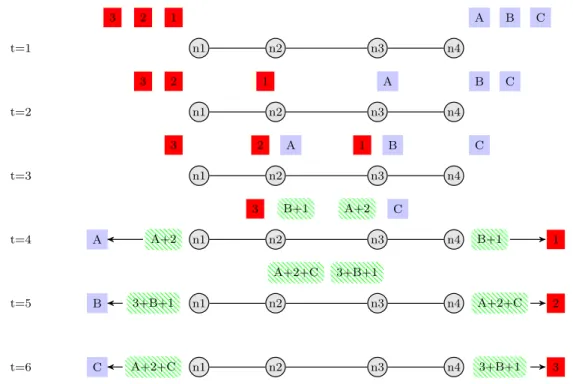
The architecture of the network coding enabled IP over WDM node is illustrated in Figure 3.3. In addition to the transmitter and receiver found in conventional ports, an extra receiver is required to enable the port to receive the two flows to be encoded. Storage is needed to synchronise data before encoding. Note that, even if we perform the synchronisation in the IP layer, different data flows may not arrive at the intermediate node at the same time therefore, storage is essential here. The
![Figure 3.7: Average traffic demands at different times of the day[4]](https://thumb-us.123doks.com/thumbv2/123dok_us/10132360.2914174/71.892.253.724.121.513/figure-average-traffic-demands-different-times-day.webp)