Proceedings of ICON-2010: 8th International Conference on Natural Language Processing, Macmillan Publish-ers, India. Also accessible from http://ltrc.iiit.ac.in/proceedings/ICON-2010
Statistically Motivated Example-based Machine Translation using
Translation Memory
Sandipan Dandapat, Sara Morrissey, Sudip Kumar Naskar, and Harold Somers Centre for Next Generation Localisation
Dublin City University Glasnevin, Dublin 9, Ireland
{sdandapat, smorri, snaskar, hsomers}@computing.dcu.ie
Abstract
In this paper we present a novel way of integrating Translation Memory into an Example-based Machine Translation Sys-tem (EBMT) to deal with the issue of low resources. We have used a dialogue of 380 sentences as the example-base for our system. The translation units in the Translation Memories are automatically extracted based on the aligned phrases (words) of a statistical machine transla-tion (SMT) system. We attempt to use the approach to improve translation from English to Bangla as many statistical ma-chine translation systems have difficulty with such small amounts of training data. We have found the approach shows im-provement over a baseline SMT system.
1
Introduction
In 1988 IBM’s Peter Brown presented a ‘purely statistical’ approach to machine translation (MT) (Brown et al., 1988) at the Second TMI confer-ence at Carnegie Mellon University. Since then most MT research has been carried out in the SMT paradigm. In parallel a lot of research has also been rooted in the EBMT paradigm, follow-ing the framework proposed by Nagao (Nagao, 1984). Furthermore, since the development of Moses, an open-source toolkit for SMT (Koehn et al, 2007), people seem to have moved away from EBMT with the exception of a few recent works (Kim et al., 2010; Phillips and Brown, 2009; Smith and Clark, 2009; Somers et al., 2009; Farwell and Padro, 2009; Lepage et al., 2008; Bosch et al., 2007). Although both SMT and EBMT systems are data-driven approaches to MT, each of them has their own strengths and limitations. Typically, an SMT system works well when a significant amount of training data
(i.e. parallel bilingual corpus) is available for the language pair. SMT approaches also been shown to have some difficulties with free word order languages (Khalilov et al., 2010). In contrast, an EBMT approach can be developed with a limited example-base; also an EBMT system works well when training and test set are quite close in na-ture. This is because EBMT systems reuse the segment of a test sentence that can be found in the source side of the example-base.
EBMT is often linked with another related technique, namely “Translation Memory” (TM). The commonality between EBMT and TM is the idea of the reuse of examples from the existing translations. The main difference between EBMT and TM is that EBMT is an automated technique for translation whereas TM is an interactive tool for the human translator.
In this paper, we describe our attempt to use EBMT and TM to tackle the English–Bangla language pair which had proved troublesome with low BLEU scores for various SMT ap-proaches (Islam et al., 2010). We attempt to translate medical-receptionist dialogues, primar-ily appointment scheduling. Our first task was to collect an English-language corpus of patient-receptionist dialogue to develop the English– Bangla parallel corpus. A major difficulty in col-lecting genuine data in the medical field, or any domain where personal information is involved, is that the confidentiality and other ethical issues more or less preclude using genuine data col-lected in situ. Thus, it is important to develop an MT system based on a limited amount of data which can be collected by simulating the ap-pointment scheduling with a medical secretary.
Keeping the above difficulties in mind, we are inspired to use an EBMT approach. In this paper we examine different experiments and report which is the most meaningful for this problem of data sparseness.
The rest of the paper is organized as follows. The next section presents related research in the
area of TM and some research with Indian Lan-guage MT. Section 3 describes some related is-sues for translating medical domain data. Section 4 describes the detail of our EBMT-based ap-proach. Section 5 presents the experimental setup, the data and the results obtained with dif-ferent experiments. Section 6 presents the obser-vations with some error analysis. We conclude in section 7.
2
Related Work
The original idea of TM was developed by Mar-tin Kay in his well-known ‘Proper Place’ paper (Kay, 1980). A TM essentially stores source- and target-language translation pairs for effective reuse of the previous translations. TM is often used to store examples of EBMT systems. TM is also widely used in computer-aided translation (CAT) systems to help the professional transla-tors. EBMT systems first find the example (or a set of examples) from the TM which most closely matches the source-language string to be translated (Somers, 2003). After retrieving a set of examples, with associated translations, EBMT systems automatically extract the translation of the proper fragment and combine them to pro-duce a grammatical target output. On the other hand, CAT systems segment the input text to be translated and compare each segment against the translation units (TU) in the TM (Bowker, 2002). The CAT systems produce one or more target equivalent for the source segment and profes-sional translators select and recombine them (perhaps with modification) for the desired trans-lation. Both EBMT- and CAT- based systems (Somers, 2003) are developed based on idea similar premise but in an EBMT approach selec-tion and recombinaselec-tion is done automatically to produce the translation without the help of a pro-fessional translator.
Phrase-based SMT systems (Koehn, 2009), produce a source-target aligned phrase table which could be adapted as a TM to a CAT envi-ronment (Bourdiallet, 2009). To the best of our knowledge, so far no one has used SMT phrase tables within an EBMT system as a TM. How-ever, it is worth mentioning that some work has been carried out to integrate MT in a CAT envi-ronment to translate the whole segment using the MT system when no matching TU is found in the TM. The TransType system (Langlais et al., 2000; Langlais et al., 2002) integrates a SMT system within a text editor. Our approach
at-tempts to integrate the TM (obtained from SMT system) within an EBMT system.
2.1 Previous Work on Indian Language MT Although a lot of work has been carried out for English to Indian Language (IL) translation using rule-based MT, some recent works focus on data-driven MT for ILs (Islam et al., 2010; Ramana-than et al., 2009; RamanaRamana-than et al., 2008; Am-bati and Rohini, 2007; Naskar and Bandyop-adhyay, 2005). However, very little work has been carried out for English to Bangla data-driven MT (Islam et al., 2010; Naskar and Bandyopadhyay, 2005). Bangla is the main spo-ken language in Bangladesh, the second most commonly spoken language in India and the sixth most commonly spoken language in the world. Islam et al. (2010) describes a phrase based SMT system for English to Bangla transla-tion using different corpora. An EBMT system has been developed by identifying source phrases using syntactic processing and the target is gen-erated using a phrasal example-base (Naskar and Bandyopadhyay, 2005). As far as we can tell, no work has been carried out for the medical do-main especially translation of dialogues for ap-pointment scheduling. Also to our knowledge, there has been no research on TM or a combina-tion of TM with EBMT for Bangla.
3
Issues with Medical Domain
The development of an MT system for the medi-cal-receptionist dialogue has three main potential difficulties which we will explain here.
3.1 Corpora Collection and Translation Our first task is to collect an English-language corpus of patient-receptionist dialogue. It is dif-ficult to collect medical data due to the involve-ment of personalized information. Thus there exists a lot of confidentiality and other ethical issues. This difficulty has long been recognized in medical training, where “standardized pa-tients” (SPs) are used with medical students, that is, actors trained to simulate consistently the re-sponses of a patient in a particular medical set-tings. Training SPs is of course a major under-taking in itself necessarily involving experts, so for the purpose of our work we made a compro-mise in that we engaged an experienced GP’s receptionist to participate in a number of role-play sessions with the native English speakers. These are all recorded and later transcribed. Thus, we believe that our corpus contains samples that
are realistic, and offer a broad coverage of our target domain. Due to the involvement of the aforementioned stages, it is time-consuming and expensive to collect a large amount of medical-receptionist dialogue. Thus our corpus comprises 380 dialogue turns. In transcription, this works out at just under 3,000 words (a very small cor-pus by any standard), each sentence turn is on average 8 words.
The next stage in the process was to manually translate our English corpus in to Bangla. Trans-lation between any languages, whether related or not, involves cases where closely following the source text (a “literal” translation, within the grammatical constraints of the target language) can result in a stilted, unnatural or incorrect translation. This is especially the case when translating medical-receptionist dialogue be-tween English and Bangla which has a wide syn-tactic difference. This has a serious implication for our approach to MT. A good example is the dialogue in (1):
(1) a. Which doctor would you prefer? b. I don’t mind.
The response (1b) can be translated in the fol-lowing ways in (2).
(2) a. আিমিকছুমেনকরবনা৷ Ami kichhu mane karba nA.1
I SOME MIND DO-FUTURE NOT. I don’t mind.
b. েযেকােনাeকজনেকেদখােলiহেব৷ ye kono ekajanake dekhAlei habe. WHO-RELATIVE ANY ”ONE PER-SON”-ACCUSATIVE SHOW-CONDITIONAL PARTICIPLE-EMPHATIC BE-FUTURE.
Can see either of them.
The literal translation (2a) without the context would be misleading or meaningless. Thus, in Bangla, a literal translation (2a) is less preferable than a more explicit translation (2b). We are keeping (2b) as the translation of (1b) though none of the English words has an equivalent in the target side. This scenario might affect an SMT system trained on such a corpus. However, to ensure the closeness and fluency in the dia-logue we concentrate on meaningful translation
1 In this paper we use ITRANS convention to tran-scribe Bangla script: http://www.aczoom.com/itrans/.
in context. This issue occurs quite frequently while translating English dialogue corpus to Bangla. Along with this we have found other difficulties such as lexical choice and translating borrowed words.
3.2 Size and Type of the Corpora
Since both SMT and EBMT are data-driven ma-chine translation techniques, the first thing needed is the machine readable parallel corpus. To adopt any data-driven machine translation system, there is also the question of the size of the example database: how many examples are needed? As reported in the previous section, our corpus is particularly small in comparison with standard data-driven training corpora which can sometime enter into the millions of parallel train-ing sentences. The SMT models are based on probability distribution which requires a signifi-cant bi-corpus otherwise it suffers from the sparse data problem. As far as we can tell, there is no SMT system developed with only 380 par-allel sentences. In contrast, many EBMT systems have been developed with such a small corpus. Table 1 lists some of the EBMT systems devel-oped using a small amount of parallel data (de-tails can be found in Somers, 2003).
System Language Pair Size
TTL English → Turkish 488 TDMT English → Japanese 350 EDGAR German → English 303 ReVerb English → German 214 ReVerb Irish → English 120 METLA-1 English → French 29 METLA English → Urdu 7 Table 1: Size of example database in EBMT systems The sizes of the example database in Table1 mo-tivate us to develop an EBMT system for medi-cal-receptionist dialogue even when a very small amount of parallel data is available.
We have found that medical-receptionist dia-logue is comprised of very similar sentences. This is illustrated in example (3) and (4).
(3) a. I need a medical for my insurance com-pany.
b. I need a medical for my new job.
(4) a. The doctor told me to come back for a follow up appointment.
b. The doctor told me to call back in a week.
The portions in italics are the only difference between (a) and (b). Thus, it might be helpful to reuse the translation of the common part while translating a new sentence. The above observa-tion leads us to use EBMT to reuse some parts of the sentence which are common with the closest sentence in the example-base.
3.3 Building Translation Memory
Building high quality TM is an expensive and time consuming process (Marcu, 2001). As we have no access to any TM for the medical do-main, we decided to build a TM automatically from our small patient-dialogue corpus. We use Moses2 to automatically build this TM. Based on Moses word alignment (using GIZA++) and a phrase table, we construct two TMs for further use. Our first TM is based on the aligned phrase pairs from the Moses phrase table (PT). It has been observed that a source phrase has multiple target equivalents. We keep all the target equiva-lents in a sorted order based on the phrase trans-lation probability. This essentially helps us in the matching procedure (see section 4.1) but during recombination we only consider the most prob-able target equivalent (see section 4.3). We shall call this PT in the rest of the paper. Another TM is created based on the word aligned file from source to target language. Like PT, we also keep the multiple target equivalents for a source word in a sorted order. This essentially creates a lexical table (LT) of source- and target-language equivalent word pairs. We shall call this LT in the rest of the paper.
4
Our Approach
Like all other EBMT system our particular ap-proach is also comprised of three stages - Match-ing, Adaptability and Recombination.
4.1 Matching
The first step in an EBMT system is to find source language example(s) that closely match with the input sentence. In particular in our ap-proach, we find the closestsentence (sc) from the example-base for the input sentence (s) to be translated. We have used a word-based edit dis-tance metric (Levenshtein, 1965; Wagner and
2 Moses (http://www.statmt.org/moses/) is a SMT system that automatically trains a translation model for any language pair. The lexical translation table (of training step 4) and score phrases (of training step 6) are used to build our TMs.
Fischer, 1974) to find this closest match sentence from the example-base (
{ }
1Ni
s
) based on the fol-lowing equation.( , )
( , ) 1
max(| |,| |)
i i iED s s
score s s
s
s
= −
(1)where |x| denotes the length (in words) of a sen-tences and ED(x,y) refers to the word based edit distance between x and y.
Based on the above fuzzy scoring criteria, we are able to choose the closest match for the input sentence to be translated. For the two input sen-tences in (5) the corresponding closest fuzzy-matched sentences from the example-base are given in (6) respectively.
(5) a. Ok, I have booked you in for eleven fif-teen on Friday with Dr. Thomas.
b. Is it possible to book an appointment later this week?
(6) a. Ok, I have booked you in for three thirty on Thursday with Dr. Kelly.
b. Is it possible to book an appointment with the nurse?
Then we consider the associated translation ( t c
s
) in (7) from the example-base for the closest match source sentence in (6) as the skeleton translation of the input sentences to be translated (5).
(7) a. আcা , আিম আপনার জনয্ বৃহsিতবার িতনেট িতিরেশ ডাঃ েকিলর সােথ বুk কেরিছ ৷ AchchhA , Ami ApanAra janya bRRihas-patibAra tinaTe tirishe DAH kelira sAthe buk karechhi.
WELL, I YOU-OBLIQUE FOR THURS-DAY THREE THIRTY-LOCATIVE DR. KELLY-OBLIQUE WITH BOOK DO-FIRST PERSON-PRESENT PARTICI-PLE.
b. নােসর্র সােথ eকটা aয্পয়nেমn বুk করা সmব িক ?
nArsera sAthe ekaTA aypaYnTamenTa buk kara sambhaba ki ?
NURSE-OBLIQUE WITH ONE AP-POINTMENT BOOK DO-GERUND POSSIBLE “IS IT”?
We will use some segment of the associated skeleton translation (7) to produce the new trans-lation in the following two subsections.
4.2 Adaptability
After matching and retrieving an example, with its associated translation, the next step is to ex-tract from that translation the inappropriate fragments. In order to do that, we align the three sentences - the input (s), the closest source-side match (sc) and its target equivalent (
t c
s
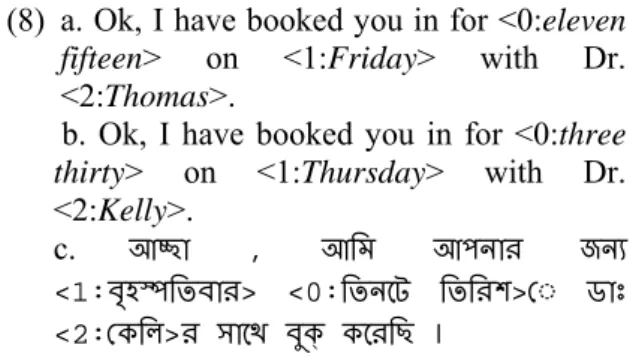
).First, we mark the mismatch portion between s and sc while computing the edit distance in equa-tion (1). This is shown in example (8) with angu-lar brackets (the numbers within anguangu-lar brackets index the mismatched segments). Further we align the mismatch portion of sc with its associ-ated translation t
c
s
. We use the two translationmemories PT and LT to find the match between sc and
t c
s
. Based on the source-target aligned pair from the PT and LT we mark the mismatch seg-ment in the tc
s
as in (8c). The portions markedwith angular brackets in (8c) are aligned with the mismatch portion in (8b). Here also, the numbers within the angular brackets in t
c
s
is the mapping between the segments with sc.
(8) a. Ok, I have booked you in for <0:eleven fifteen> on <1:Friday> with Dr. <2:Thomas>.
b. Ok, I have booked you in for <0:three thirty> on <1:Thursday> with Dr. <2:Kelly>.
c. আcা , আিম আপনার জনয্
<1:বৃহsিতবার> <0:িতনেট িতিরশ>ে◌ ডাঃ <2:েকিল>র সােথ বুk কেরিছ ৷
With the help of above matching, in the recom-bination step, we will replace the segments within the angular brackets keeping the remain-ing matched fragments unchanged.
4.3 Recombination
The final step of our EBMT approach is recom-bination, to add or substitute the segments from the input sentence (s) with the skeleton transla-tion equivalent ( t
c
s
). From the example (8), we need to replace the three segments in (8c) {বৃহsিতবার (bRRihaspatibAra [Thursday]), িতনেট িতিরশ (tinaTe tirishe [three thirty]) and েকিল (keli [Kelly])} with three corresponding source segments in (8a) {eleven fifteen, Friday and Thomas} to produce a target equivalent. Thus keeping the mapping we produce (9).(9) আcা, আিম আপনার জনয্ <1:Friday> <0:eleven fifteen>ে◌ ডাঃ <2:Thomas>র সােথ বুk কেরিছ ৷
Note that there might not be a one-to-one corre-spondence between s and
s
ct. If there is someex-tra segment in s which does not have any map-ping in t
c
s
then we add the new segment from s in target equivalent ( tc
s
). If there is an extrasegment in t c
s
then we simply delete them from the target translation. Thus we have produced the target equivalent as in (9) after add-ing/deleting/substituting segments form the input sentence to be translated (s) with the skeleton translation ( tc
s
). Then, we translate the newun-translated segments in (9). We translate these new segments in two ways to understand their relative performance. First, we translate them using the Moses decoder and putting them in the desired positions we produce the target equiva-lent. Second, we use the PT and LT to produce the translation of the un-translated segments. The detail of the algorithm is given in Figure 1.
Figure 1: Algorithm for recombining the fragment from the aligned sentences (s, sc and
t c
s
).Replacing the untranslated segment in (9) with the translation obtained using the PT and LT, we get the output translation of the original input sentence in (10).
(10) আcা , আিম আপনার জনয্ < kবার> <eগারটা আসেতে◌> ডাঃ <Thomas>র সােথ বুk কেরিছ ৷
Note that unknown words are not translated with the approach which is mostly the case for all MT techniques. Incorrect translations are obtained due to incorrect word/phrase alignments.
5
Experiments
First, we conduct two different experiments to estimate the baseline accuracy of our approach for the English to Bangla translation task.
1. We use MaTrEx (Stroppa and Way, 2006; Dandapat et al., 2010), an open-source SMT system OpenMaTrEx3 and compare the re-sults with our approach.
2. Based on the matching step (section 4.1) of the EBMT, we obtain the closest target-side equivalent (the skeleton sentence) and con-sider this as the baseline output for the input to be translated. This is referred to as EBMT in the experiments below. We will consider this as the baseline accuracy for our ap-proach.
We have conducted different experiments using different TM and SMT decoding. After obtain-ing the skeleton translation, in the recombination step, we use two different translation memories (PT and LT) to translate unmatched segment based on the algorithm described in Figure 1. Thus, we have two more systems:
3. The recombination step of the EBMT uses the PT as the only example-base. We refer to this as EBMT+TM(PT).
4. Both PT and LT have been used as example-bases by the EBMT system. We call this EBMT+TM(PT,LT).
Finally, instead of using PT and LT to trans-late the unmatched portion of the input sentence, we use the SMT decoder to obtain the translation. Thus, we obtain the translation of X (=
x
1n) in Figure 1 using TX = SMT(X).5. We translate the unmatched segment of the input using SMT for the recombination. We shall call this as EBMT+SMT.
Thus, we have a total of 5 systems under dif-ferent combination schemes of EBMT, TM and SMT. The same training and test set has been used to evaluate the systems.
3http://www.openmatrex.org/
5.1 Data used for the Experiments
For all the experiments we have used the same English-Bangla corpus described in section 3.1. The training data consist of 381 parallel sen-tences. A fixed set of 41 sentences disjoint from the training set have been used to test the sys-tems. The test set is also a dialogue exchange between a patient and the receptionist. Note that none of the sentences from the test sentence be-longs to the training set though the test examples are quite close to the example-base.
5.2 Results
We have used both automatic metrics and man-ual evaluation methods. The widely used BLEU (Papineni et al., 2002) and NIST (Doddington, 2002) score is used for automatic evaluation of our systems. BLEU score captures the fluency of the translation while the translation adequacy is captured by NIST score. Table 2 summarizes the accuracy obtained with the different systems.
System BLEU NIST
SMT 39.32 4.84
EBMT 50.38 5.32
EBMT+TM(PT) 57.47 5.92
EBMT+TM(PT,LT) 57.56 6.00
EBMT+SMT 52.01 5.51
Table 2: System accuracies obtained by different models
Note that the baseline SMT BLEU score is 39.32 but the baseline EBMT gives a BLEU score of 50.38%. This absolute improvement of 11.06 BLEU point motivates us to use skeleton sen-tences and make further changes to some frag-ment in the skeleton sentences with respect to the original input sentence to be translated. We have achieved 57.47 BLEU score with our EBMT+TM(PT) system – an absolute improve-ment of 7.09 in BLEU score over the baseline EBMT score. However, the use of LT along with the PT (EBMT+TM(PT,LT)) has a little improvement in both BLEU ( absolute 0.09) and NIST (absolute 0.08) score over the EBMT+TM(PT) system. On the contrary, the EBMT+SMT system has an accuracy of 52.01 BLEU score which reflects an improvement of 1.63 absolute BLEU point over the baseline EBMT system but no improvement compared to any of the TM-integrated EBMT-based systems.
In addition to the above automatic evaluations, we also performed a manual evaluation to under-stand the translation quality from human
per-spective. While manually evaluating the MT sys-tems, we assign values from two five-point scales representing fluency and adequacy (LDC, 2005). The five-point scale of adequacy indicates how much meaning is conveyed in the hypothe-sis translation in connection to the reference translation. The five-point scale of fluency indi-cates the closeness of the hypothesis translation to natural speech. The two scales are explained below.
Fluency
Adequacy
(meaning expressed) 5 = Flawless Bangla 5 = All
4 = Good Bangla 4 = Most 3 = Non-native Bangla 3 = Much 2 = Disfluent Bangla 2 = Little 1 = Incomprehensible 1 = None
Using the above scale 4 different native Bangla speakers were asked to score each trans-lation produced by the different MT systems. Table 3 shows the average fluency and adequacy of our different MT systems.
System Fluency Adequacy
SMT 3.00 3.16
EBMT+TM(PT) 3.50 3.55
EBMT+TM(PT,LT) 3.50 3.70
EBMT+SMT 3.44 3.52
Table 3: Average Fluency and Adequacy of the MT Systems in the scale of 1-5
Like automatic evaluation, we see that the EBMT-based system uniformly improves both fluency and adequacy over SMT. The increase of 0.44 – 0.5 in fluency and 0.36 – 0.54 on SMT is noteworthy. Though there is not much difference in fluency between the three combinations but the use of LT (EBMT+TM(PT,LT)) has
im-provement on other two combinations (EBMT+TM(PT), EBMT+SMT).
6
Observations
We find that the baseline EBMT system has higher accuracy across all metrics compared to the baseline SMT system. This is due to the fact that large segments of the input sentences to be translated can be found with the example-base. This helps to retain the word order in the target translation which would otherwise affect the BLEU score. In contrast, the SMT-based system essentially does not use these matched segments as a whole instead the SMT decoder prefers the most probable translation. Due to the availability of a very small corpus the SMT decoder suffers with the sparse data problem.
EBMT+TM(PT) has better accuracy than the baseline SMT and EBMT systems. The use of word-level TM (LT) improves the accuracy of the translation system with respect to all other systems. The use of LT ensures that no known word is left un-translated in the target language. Altogether, the use of EBMT and TM together has shown considerable improvement over all MT evaluation metrics.
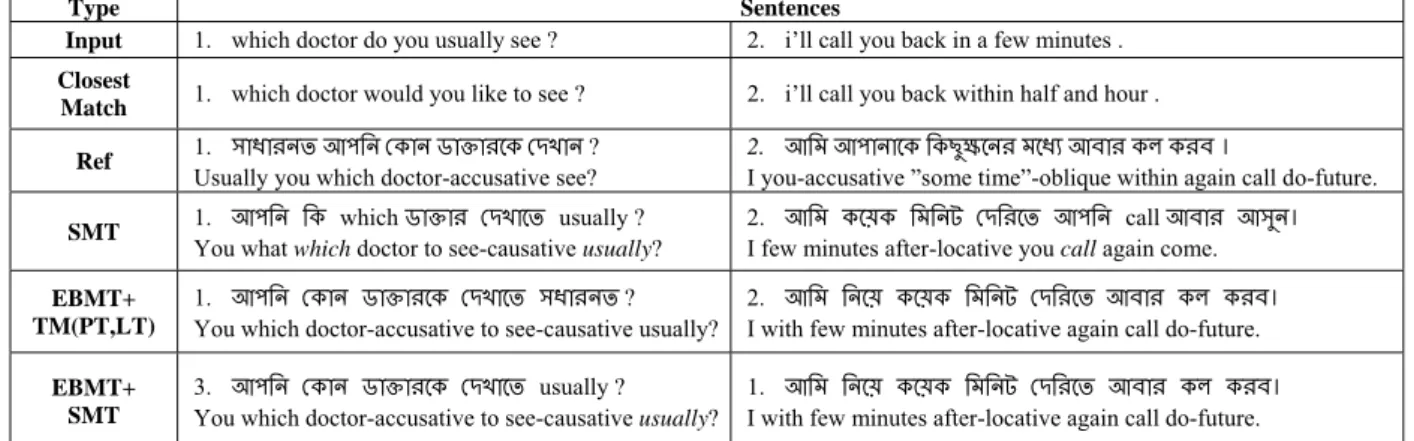
The combination of SMT with EBMT (EBMT+SMT) has some improvement over both baseline systems (SMT and EBMT). However, the EBMT+SMT system has much lower accu-racy compared to the combined systems of EBMT and TM (EBMT+TM(PT) and EBMT+TM(PT,LT)). This is due to the fact that while SMT is used to translating the un-matched segments some words are left untrans-lated. From the example output of the system in Table 4, we can see that for the first sentence the word ‘usually’ has no translation produced by the EBMT+SMT system.
Table 4: Translations of example sentences using three different systems. The words in italics in the gloss rep-resent un-translated words.
Type Sentences Input 1. which doctor do you usually see ? 2. i’ll call you back in a few minutes .
Closest
Match 1. which doctor would you like to see ? 2. i’ll call you back within half and hour .
Ref 1.Usually you which doctor-accusative see? সাধারনতআপিনেকানডাkারেকেদখান ? 2.I you-accusative ”some time”-oblique within again call do-future. আিমআপানােকিকছুkেনরমেধয্আবারকলকরব৷ SMT 1. আপিন িক which ডাkার েদখােত usually ?
You what which doctor to see-causative usually?
2. আিম কেয়ক িমিনট েদিরেত আপিন call আবার আসুন৷
I few minutes after-locative you call again come.
EBMT+ TM(PT,LT)
1. আপিন েকান ডাkারেক েদখােত সধারনত ? You which doctor-accusative to see-causative usually?
2. আিম িনেয় কেয়ক িমিনট েদিরেত আবার কল করব৷
I with few minutes after-locative again call do-future.
EBMT+ SMT
3. আপিন েকান ডাkারেক েদখােত usually ? You which doctor-accusative to see-causative usually?
1. আিম িনেয় কেয়ক িমিনট েদিরেত আবার কল করব৷
6.1 Assessment of Error Types
The errors are propagated mostly due to the wrong source-target equivalent in the phrase table and lexical table which are being used as the translation units in our TM (PT and LT). This results in some incorrect alignment in the matching step of our EBMT system. For ex-ample, the first sentence in Table 4, the match-ing module gives the followmatch-ing alignment:
s : which doctor <do> you <usually> see ? sc : which doctor <would> you <like to> see ?
t c
s
: আপিন েকান ডাkারেক েদখােত <1:চান> ? Apani kona DAktArake dekhAte chAna? YOU WHICH DOCTOR-ACCUSATIVE TO SEE-CAUSATIVE WANT?In the above example, the word ‘would’ doesn’t have any alignment in t
c
s
.The threetarget equivalents in the PT {a. হেব (habe [is-3Fr]) b. বলব (balaba [say-1Fr]) c. িক (ki [what])} of the word ‘would’ do not match with any of the word in t
c
s
. Also, the system suffers when there is a mismatch either in the verb or in the subject of the sentence. This is because the inflection on the verbs depends on the morphological attributes of the subject.The second type of error is propagated dur-ing the recombination step. In the second ex-ample in Table 4, we have successfully matched the fragments as follows:
s : i’ll call you back <in a few minutes> . sc : i’ll call you back <within half and hour> .
t c
s
: আিম <0:আধ ঘnা েথেক eক ঘnার িভতের> আবার কল করব৷Ami Adha ghanTA theke eka ghanTAra bhitare AbAra kala karaba. I half an hour to one hour within again call future
However, in the recombination step, we need to generate the translation for the segment ‘in a few minutes’. We have found that the por-tion ‘a few minutes’ has a translation equiva-lent ‘কেয়ক িমিনট েদিরেত (kaYeka miniTa de-rite)’ in PT. Thus, we still need to translate the word ‘in’ to generate the target equivalent for the whole segment. For the word ‘in’, the PT has a separate entry with three target equivalents – a. িনেয় (niYe) b. িনেয় আসেত (niYe Asate) c. আসুন (Asuna). Picking the
most probable target equivalent for ‘in’ and combining with the target equivalent of ‘a few minutes’, we generate ‘িনেয় কেয়ক িমিনট েদিরেত (niYe kaYeka miniTa derite)’. This is not a flu-ent target equivalflu-ent because we don’t need to translate the word ‘in’ separately as this has been already been captured in the inflection (েত – te[locative]) of the final word of the target equivalent of ‘a few minutes’.
7
Conclusion and Future Work
The experiments described in the paper show initial investigations for combining translation memories in an EBMT framework. The results show that all the EBMT approaches work better compared to the SMT-based system. The integration of TM with the EBMT framework has improved the translation quality and the best accuracy has been achieved while two translation memories (PT and LT) are in use along with the EBMT framework.
However, based on the observations and propagated errors discussed in the previous section, we intend to use more sophisticated Matching and Adaptability techniques considering the syntax of the examples and test sentences to overcome the false positive adaptations as in section 6.1. We also plan to use morpho-syntactic information during recombination to improve the translation quality.
Acknowledgements
This research is supported by the Science Foundation Ireland (Grant 07/CE/I1142) as part of the Centre for Next Generation Localisation (http://www.cngl.ie) at Dublin City University.
References
V. Ambati and U. Rohini. 2007. A hybrid approach to example based machine translation for Indian languages. In Proceedings of 5th International Conference on Natural Language Processing (ICON 2007), Hyderabad, India, pp. 4-6.
P. Brown, J. Cocke, S. Della Pietra, V. Della Pietra, F. Jelinek, R. Mercer, & P. Roossin. 1988. A statistical approach to French/English translation. In Proceedings of 2nd International Conference on Theoretical and Methodological Issues in Machine Translation of Natural Languages (TMI 1988), Pittsburgh, Pennsylvania, pp. 810-823.
A. van den Bosch, N. Stroppa and A. Way. 2007. A memory-based classification approach to marker-based EBMT. In METIS-II Workshop:
New Approaches to Machine Translation, Leu-ven, Belgium, pp. 63-72.
J. Bourdaillet, S. Huet, F. Gotti, G. Lapalme and P. Langlais. 2009. Enhancing the bilingual concordancer TransSearch with word-level alignment. In Proceedings, volume 5549 of Lecture Notes in Artificial Intelligence: 22nd Canadian Conference on Artificial of Intelligence (Canadian AI 2009), Springer-Verlag, pp. 27-38.
L. Bowker. 2002. Computer-aided translation technology: a practical introduction. Chapter Translation memory systems, University of Ottawa Press, Ottawa, pp. 92-127.
S. Dandapat, M. Forcada, D. Groves, S. Penkale, J. Tinsley and A. Way. 2010. OpenMaTrEx: A free/open-source marker-driven example-base machine translation system. In Proceedings of Icetal 2010, the 7th International Conference on Natural Language Processing, Reykjavik, Iceland, pp. 121-126.
G. Doddington. 2002. Automatic evaluation of machine translation quality using n-gram occurrence statistics. In Proceedings of the 2nd international conference on Human Language Technology Research (HLT 2002), San Diego, California, pp. 138-145.
D. Farwell and L. Padró. 2009. FreeLing: from a multilingual open-source analyzer suite to an EBMT platform. In Proceedings of the 3rd International Workshop on Example-Based Machine Translation (EBMT 2009), Dublin, Ireland, pp.37-43.
Md. Z. Islam, J. Tiedemann and A. Eisele. 2010. English to Bangla phrase-based machine translation. In Proceedings of the 14th Annual conference of the European Association for Machine Translation (EAMT 2010), Saint-Raphaël, France, no page number.
M. Kay. 1980. The proper place of men and machine in language translation. Research Report CSL-80-11. Xerox PARC, Palo Alto, California. Reprinted in: Machine Translation 12(1-2), 1997, pp. 3-23; and in: Nirenburg, S. et al. (eds.) Readings in machine translation (Cambridge, Mass.: MIT Press, 2003), pp. 221-232.
M. Khalilov, J.A.R. Fonollosa, I. Skadina, E. Bralitis and L. Pretkalnina. 2010. English-Latvian SMT: the challenge of translating into a free word order language. In Proceedings of the second International Workshop on Spoken Language Technologies for Under-resourced Languages (SLTU 2010), Penang, Malaysia, pp. 87-94.
J.D. Kim, R.D. Brown, & J.G. Carbonell: Chunk-based EBMT. 2010. In Proceedings of the 14th Annual conference of the European Association
for Machine Translation (EAMT 2010), Saint-Raphaël, France, no page number.
P. Koehn, H. Hoang, A. Birch, C. Callison-Burch, M. Federico, N. Bertoldi, B. Cowan, W. Shen, C. Moran, R. Zens, C. Dyer, O. Bojar, A. Constantin and E. Herbst. 2007. Moses: open source toolkit for statistical machine translation. In Proceedings of Association of Computational Linguistics (ACL 2007), Prague, Czech Republic, pp. 177-180.
P. Koehn. 2009. Statistical Machine Translation, Cambridge University Press.
P. Langlais, G. Foster and G. Lapalme. 2000. TransType: a computer-aided translation typing system. In Proceedings of ANLP/NAACL 2000 workshop: Embedded machine translation systems, Seattle, Washington, pp.46-51.
P. Langlais, G. Lapalme and M. Loranger. 2002. TransType : Development-evaluation cycles to boost translator’s productivity. Machine Translation, 15(4):77-98.
V. I. Lavenshtein. 1965. Binary Codes capable of correcting deletions, insertions, and reversals. Doklady Akademii Nauk SSSR, 163(4):845-848. English translation in Soviet Physics Doklady, 10(8), 707-710.
Y. Lepage, A. Lardilleux, J. Gosme and J.L. Manguin. 2008. The GREYC machine translation system for the IWSLT 2008 evaluation campaign. In Proceedings of the International Workshop on Spoken Language Translation (IWSLT 2008), Hawaii, USA; pp. 39-45.
D. Marcu. 2001. Towards a unified approach to memory- and statistical-based machine translation. In Proceedings of the 39th Annual Meeting on Association for Computational Linguistics (ACL 2001), Toulouse, France, pp.386-393.
S.K. Naskar and S. Bandyopadhyay. 2005. A phrasal EBMT system for translating English to Bengali. In Proceedings of MT Summit X, Phuket, Thailand, pp.372-379.
M. Nagao. 1984. A framework of a mechanical translation between Japanese and English by analogy principle. In Artificial and human intelligence, Amsterdam: North Holland, pp. 173-180.
K. Papineni, S. Roukos, T. Ward and W. J. Zhu. 2002. “BLEU: a method for automatic evaluation of machine translation”. In Proceedings of 40th Annual meeting of the Association of Computation Linguistics (ACL 2007), Philadelphia, Pennsylvania, pp. 311-318. A.B. Phillips and R.D. Brown. 2009. Cunei
ma-chine translation platform: system description. In Proceedings of the 3rd International Workshop
on Example-Based Machine Translation (EBMT 2009), Dublin, Ireland, pp. 29-36.
A. Ramanathan, H. Choudhary, A. Ghosh and P. Bhattacharyya. 2009. Case markers and morphology: addressing the crux of the fluency problem in English-Hindi SMT. In Proceedings of the 47th Annual Meeting of the ACL and the 4th International Joint Conference on Natural Language Processing ( ACL-IJCNLP-2009), Suntec, Singapore, pp. 800-808.
A. Ramanathan, P. Bhattacharyya, J. Hegde, R. M. Shah and M. Sasikumar. 2008. Simple syntactic and morphological processing can help English-Hindi statistical machine translation. In Proceedings of 3rd International Joint Conference on Natural Language Processing (IJCNLP 2008), January 7-12, 2008, Hyderabad, India, pp. 513-520.
J. Smith and S. Clark. 2009. EBMT for SMT: a new EBMT-SMT hybrid. In Proceedings of the 3rd International Workshop on Example-Based Machine Translation (EBMT 2009), Dublin, Ireland, pp. 3-10.
H. Somers, S. Dandapat and S.K. Naskar. 2009. A review of EBMT using proportional analogies. In Proceedings of the 3rd International Workshop on Example-Based Machine Translation (EBMT 2009), Dublin, Ireland, pp. 53-60.
H. Somers. 2003. Translation Memory Systems. In Harold Somers, editor, Computers and translation: a translator’s guide, John Benjamins, pp. 31-47.
H. Somers. 2003. An overview of EBMT. In Michael Carl and Andy Way, editors, Recent advances in example-based machine translation, Kluwer Academic Publishers, pp. 3-57.
N. Stroppa and A. Way. 2006. MaTrEx: the DCU machine translation system for IWSLT 2006. In Proceedings of the International Workshop on Spoken Language Translation (IWSLT 2006), Kyoto, Japan, pp. 31-36.
R.A. Wagner and M.J. Fischer. 1974. The string to string correction problem. Journal of the ACM (JACM), 21(1):168-173.
T. Watanabe, J. Suzuki, H. Tsukada and H. Isozaki. 2007. Online large-margin training for statistical machine translation. In Proceedings of the Conference on Empirical Methods in Natural Language Processing (EMNLP-2007), Prague, Czech Republic. pp. 764-773.