POUR L'OBTENTION DU GRADE DE DOCTEUR ÈS SCIENCES
acceptée sur proposition du jury: Prof. J.-Y. Le Boudec, président du jury Prof. G. De Micheli, Prof. J. Sifakis, directeurs de thèse
Prof. S. Baruah, rapporteur Prof. I. Puaut, rapporteuse Prof. D. Atienza Alonso, rapporteur
Hard Real-time
Multi-processor Systems
THÈSE NO 8146 (2017)
ÉCOLE POLYTECHNIQUE FÉDÉRALE DE LAUSANNE
PRÉSENTÉE LE 10 NOVEMBRE 2017 À LA FACULTÉ INFORMATIQUE ET COMMUNICATIONS
LABORATOIRE DES SYSTÈMES INTÉGRÉS (IC/STI)
PROGRAMME DOCTORAL EN INFORMATIQUE ET COMMUNICATIONS
PAR
Times do not wait — Thucydides Στους γονείς μου, Στους διδάσκοντες μου, Σε όσους πίστεψαν σε εμένα. To my parents, To those who taught me, To those who believed in me.
I had the the honour and privilege to be advised by Prof. Joseph Sifakis and Prof. Giovanni De Micheli. As an expert of hard real-time systems once told me: “No graduate student simply chooses the problem of hard real-time systems; it is always assigned to them by their advisor.” — Prof. Baruah.
I would like to extend my gratitude towards my main advisor, Prof. Sifakis, for providing me with the opportunity of exploring the research problems present in the domain of hard real-time systems. The true value of such systems, as well as the difficulty of the underlying challenges, only becomes apparent after years of efforts, for which I now am thankful. Additionally, his constant persistence towards theoretical and scientific rigour has equipped me with a valuable research skill-set that will accompany me for the rest of my life. I also vastly appreciate Prof. De Micheli’s provisions that allowed this work to be completed, as well as his patience and understanding during personally challenging periods. I feel deeply indebted to both of them for this opportunity in my professional life. Their support and guidance is unparalleled and I honestly aspire that some day my contributions will be able to compensate their efforts.
I am grateful to Prof. Sanjoy Baruah, Prof. Isabelle Puaut, Prof. David Atienza Alonso and Prof. Jean-Yves Le Boudec for honouring me in serving as the thesis jury. I thank them for taking the time to read my thesis and for their invaluable comments on my work and its perspectives. I would like to additionally thank Prof. Baruah for being my mentor during a research visit at University of North Carolina at Chapel Hill, which enabled me to significantly increase my knowledge on mixed-criticality systems and scheduling under uncertainty. I thank him for the insightful scientific discussions, which I greatly enjoyed. I could not possibly omit the unseen heroes behind this dissertation; Dr. Alena Simalatsar and Dr. Federico Angiolini. Their day-to-day efforts in instilling a scientific spirit will never be forgotten. Special thanks go to Dr. Angiolini, Anastasia Mavridou and Stefanos Antaris for proofreading my thesis. Their assistance in improving this manuscript on all levels was precious.
I want to thank all members of the Rigorous System Design (RiSD) lab and Integrated Systems (LSI) lab for creating a pleasant and motivating working environment. I thank Mrs. Arianne Staudenmann and Mrs. Christina Govoni for their constant availability and assistance on administrative tasks, while maintaining a positive spirit at all times. I would also like to express my gratitude to my dear friends for enriching my life with happiness, joy and laughter. Thank you Abbas, Alex, Androklis, Apostolos, Ashkan,
Despina, Eleni, Eleni, Evangelos, Evgenia, Grigorios, Ignatio, Ioannis, Ioulia, Katerina, Loukia, Manos, Matt, Myrsini, Pavlos, Panagiotis, Stefanos and Theodoros.
Last, but most importantly, I thank my parents, Stamatia and Georgios, for their trust and unconditional love throughout the years. Ultimately, there are no words to express the magnitude of my gratitude towards them. Finally, I am deeply grateful to Georgios Bootsalis; the first man who expressed his belief in me (beyond my family). Without it, I would not have never started this journey.
Modern computing systems are based onmulti-processor systems, i.e. multiple cores on
the same chip. Hard real-timesystems are required to perform particular tasks within
certain amount of time; failure to do so characterises an unaccepted behavior. Hard real-time systems are found in safety-critical applications, e.g. airbag control software, flight control software, etc. In safety-critical applications, failure to meet the real-time constraints can have catastrophic effects.
Thesafe and, at the same time,efficient deployment of applications on multi-processors
with hard real-time constraints is a challenging task. Scheduling methods and Models of Computation, that provide safe deployments, require a realistic estimation of the Worst-Case Execution Time (WCET) of tasks. The simultaneous access of shared resources by parallel tasks causesinterference delays, due to hardware arbitration, which affecs WCET.
Interference delays can be accounted for, with the pessimistic assumption that all possible interference will occur. Resulting schedules would be exceedingly conservative, thus the benefits of a multi-processor would be significantly negated. Producing less pessimistic schedules is challenging due to the inter-dependency between WCET estimation and deployment optimisation. Accurate estimation of interference delays -and thus estimation of task WCET- depends on the way an application is deployed; deployment is an optimisation problem that depends on the estimation of task WCET. Another efficiency gap, which is of consequence in several systems (e.g. airbag control), stems from the fact that rarely tasks execute with their WCET. Safe runtime adaptation based on the Actual Execution Times, can yield additional improvements in terms of latency (more responsive systems).
To achieveefficiency and retainadaptability, we propose that interference analysis should
be coupled with the deployment process. The proposed interference analysis method estimates the possible amount of interference, based on an architecture and an application model. As more information is provided, such asscheduling, memory mapping, etc, the
per-task interference estimation becomes more accurate. Thus, the method computes
interference-sensitive WCET estimations (isWCET).
Based on the isWCET method, we propose a method to break the inter-dependency
between WCET estimation and deployment optimisation. Initially, the isWCETs are
over-approximated, by assuming worst-case interference, and a safe deployment is derived. Subsequently, the proposed method computes accurate isWCETs by spatio-temporal
(space). Based on accurateisWCETs, the deployment solution is improved to provide
better latency guarantees.
We also propose a distributed runtime adaptation technique, that aims to improve run-time latency. Using isWCET estimations restricts the possible adaptations, as
an adaptation might increase the interference and violate the safety guarantees. The proposed technique introduces statically scheduling dependencies between tasks that prevent additional interference. At runtime, a self-timed scheduling policy that respects these dependencies, is applied, proven to be safe, and with minimal overhead.
Experimental evaluation on Kalray MPPA-256 shows that our methods improveisWCET
up to 36%, guaranteed latency up to 46%, runtime performance up to 42%, with a consolidated performance gain of 50%.
Key words: hard real-time systems, interference-sensitive WCET, runtime adaptation, Kalray MPPA-256
Les systèmes informatiques modernes sont basés sur des systèmes multiprocesseurs, c’est-à-dire avec plusieurs cœurs sur la même puce. Des systèmes temps-réel durs sont nécessaires pour effectuer des tâches particulières en un certain laps de temps ; un échec caractérise un comportement non accepté. Des systèmes temps-réel durs se retrouvent dans des applications critiques pour la sécurité, par exemple dans les logiciels de contrôle des airbags, les logiciels de contrôle de vol, etc.. Pour des applications critiques pour la sécurité, le non-respect des contraintes de temps réel peut avoir des effets catastrophiques. Le déploiement sûr et, en même temps, efficace des applications sur un
multiproces-seur, sous des contraintes de temps réel dur, pose un problème difficile. Les méthodes d’ordonnancement et les modèles de calcul visées à des déploiements sûrs nécessitent une estimation réaliste du temps d’exécution le plus pessimiste (Worst Case Execution Time - WCET) des tâches. L’accès simultané par des tâches parallèles aux ressources partagées entraîne desretards d’interférenceen raison de l’arbitrage hardware. Les retards
d’interférence peuvent bien être pris en compte, en faisant l’hypothèse pessimiste selon laquelle toute interférence possible se produirait. Les ordonnancements résultants se-raient extrêmement conservateurs, de sorte que les avantages du multiprocesseur sese-raient significativement réduits. Cependant, produire des ordonnancements moins pessimistes est difficile en raison de l’interdépendance entre l’estimation du WCET et l’optimisation du déploiement. L’estimation précise des retards d’interférence - et donc l’estimation du WCET des tâches - dépend de la façon dont une application est déployée ; le déploiement est un problème d’optimisation qui dépend de l’estimation du WCET des tâches. Une autre inefficacité, qui peut être lourde dans plusieurs systèmes (par exemple, le contrôle des airbags), découle du fait que rarement les tâches s’exécutent avec leur WCET. Une adaptation de l’exécution basée sur les temps d’exécution réels, pourvu qu’elle soit sûre, peut apporter des améliorations supplémentaires en termes de temps de réponse (systèmes plus réactifs).
Pour atteindre l’efficacité et conserver l’adaptabilité, nous proposons que l’analyse des
interférences soit associée au processus de déploiement. La méthode d’analyse d’inter-férence proposée identifie les interd’inter-férences possibles, en fonction d’une architecture et d’un modèle d’application. À mesure que d’autres informations sont fournies, telles que l’ordonnancement, la répartition de la mémoire, etc., l’estimation de l’interférence pour chaque tâche devient plus précise. Ainsi, la méthode calcule un temps d’exécution tenant les interférences en compte (interference-sensitive WCET -isWCET).
Sur la base de l’isWCET, nous proposons une méthode pour découpler l’interdépendance
entre l’estimation du WCET et l’optimisation du déploiement. En une première phase, lesisWCET sont surestimés, en supposant les interférences les plus défavorables, et un
déploiement sûr est dérivé. Par la suite, la méthode proposée calcule desisWCETs plus
précis par exclusion spatio-temporelle, c’est-à-dire en excluant les interférences des tâches qui partagent des ressources (espace) mais ne se chevauchent pas dans le temps. Basé sur cesisWCETs précis, la solution de déploiement est améliorée pour optimiser les temps
de réponse.
Nous proposons également une technique d’adaptation répartie, qui vise à améliorer les temps de réponse en temps réel. L’utilisation des estimations d’isWCET restreint les
adaptations possibles, car une adaptation pourrait augmenter les interférences et violer les garanties de sûreté. La technique proposée introduit statiquement des dépendances d’ordonnancement entre les tâches, ce qui empêche l’apparition d’interférences supplé-mentaires. Au moment de l’exécution, une politique d’ordonnancement auto-cadencée qui respecte ces dépendances est appliquée, et prouvée comme étant sûre et peu lourde. L’évaluation expérimentale sur une plate-forme Kalray MPPA-256 montre que nos méthodes améliorent les isWCETs jusqu’à 36%, les temps de réponse garantis jusqu’à 46%, et les performances jusqu’à42%, avec un gain de performance consolidé de50%.
Mots clefs: systèmes en temps réel durs, WCET sensible aux interférences, adaptation d’exécution, Kalray MPPA-256, NoC
Acknowledgements i
Abstract (English/Français) iii
List of figures ix
List of tables xi
1 Introduction 1
1.1 The need of Multi-processors . . . 1
1.2 Challenges in Hard Real-time Multi-processor Systems . . . 2
1.3 Thesis Statement and Contributions . . . 7
1.4 Dissertation Outline . . . 8
2 Preliminaries 11 2.1 Real-time Deployment Problem Formulation . . . 14
2.2 Processor Architecture Models . . . 15
2.2.1 Homogeneous Architecture Types . . . 16
2.2.2 Generic Architecture Model . . . 18
2.2.3 Kalray MPPA-256 . . . 19
2.3 Application and System model . . . 20
2.3.1 Application Model . . . 23
2.3.2 System Model . . . 25
2.3.3 Deployment . . . 26
3 Interference-sensitive WCET 29 3.1 Interference Model . . . 30
3.1.1 Hardware Arbitration Policies . . . 32
3.2 Interference Analysis . . . 34 3.2.1 Intra-cluster Interference . . . 37 3.2.2 Inter-cluster Interference . . . 38 3.2.3 NoC Interference . . . 39 3.2.4 Safety . . . 41 3.3 Evaluation . . . 43
3.3.1 Experimental Setup . . . 43
3.3.2 Evaluation Results . . . 44
3.4 Related work . . . 48
3.4.1 WCET Analysis and Scheduling . . . 49
3.5 Summary . . . 51
4 Application Deployment 53 4.1 Safe Deployment . . . 55
4.1.1 Partitioning/Placement . . . 56
4.1.2 Acquiring the System Model . . . 57
4.1.3 Scheduling, Task Mapping and FIFO Allocation . . . 60
4.1.4 Memory Mapping, NoC Routing . . . 62
4.1.5 Deployment tightening . . . 63 4.1.6 Safety . . . 64 4.2 Evaluation . . . 66 4.2.1 Experimental Setup . . . 66 4.2.2 Evaluation Results . . . 66 4.3 Related work . . . 68 4.4 Summary . . . 70 5 Runtime Adaptation 73 5.1 Theoretical Results . . . 75
5.2 Interference-sensitive Runtime Adaptation . . . 78
5.2.1 Runtime Monitor Operation . . . 80
5.2.2 Monitor Overhead . . . 81 5.2.3 Safety . . . 82 5.3 Evaluation . . . 83 5.3.1 Evaluation Setup . . . 83 5.3.2 Evaluation Results . . . 84 5.4 Related work . . . 86 5.5 Summary . . . 87
6 Conclusions and Future Work 89
Bibliography 102
1.1 Power trends for desktop processors . . . 2
1.2 A typical design process for hard real-time uni-processor systems . . . 3
1.3 Example of varying WCET due to interference . . . 4
1.4 “WCET estimation” and “deployment optimisation” inter-dependency . . 5
1.5 State-of-the-art . . . 6
1.6 Global overview of the proposed approaches . . . 8
2.1 Abstract and concrete models . . . 13
2.2 Optimal real-time deployment for known WCET . . . 14
2.3 Different types of processor architectures. . . 15
2.4 A typical centralised multi-processor architecture. . . 16
2.5 A typical distributed multi-processor architecture. . . 17
2.6 A typical mixed multi-processor architecture. . . 18
2.7 Kalray MPPA-256 compute cluster . . . 19
2.8 Kalray MPPA-256 NoC topology . . . 20
2.9 Example of underflow protection . . . 23
2.10 A split join graph . . . 24
2.11 Corresponding task graph, with arrows denoting the input/output FIFOs 24 2.12 Example of a system model . . . 26
3.1 Overview of the isWCET approach . . . 30
3.2 Kalray MPPA-256 memory bank arbitration . . . 39
3.3 Kalray MPPA-256 NoC router arbitration . . . 40
3.4 Percentage of spatio-temporally excluded interference . . . 45
3.5 Percentage overhead due to interference . . . 46
3.6 Task model for various data-parallelisation factors . . . 47
3.7 Latency reduction due to data-parallelisation . . . 47
3.8 Average percentage reduction of tasks WCET . . . 48
4.1 Overview of the deployment approach. . . 54
4.2 System model for two dependent actors . . . 59
4.3 Example of schedulesβandβ0. . . 65
5.1 Example task set that can cause a timing-anomaly . . . 76
5.2 Example of a timing-anomaly . . . 76
5.3 Example of monitor operation for four tasks on two cores . . . 80
5.4 Guaranteed (offline) and runtime (online) latency gain . . . 85
5.5 Comparison of the observed latency vs the guaranteed latency of the produce-process-consume application . . . 86
3.1 Projections of a task-set V, a dependency relation E and an execution
model E M=(V,E) . . . 37 3.2 Kalray MPPA-256 arbitration constants . . . 43 3.3 Worst-case latency of StreamIt benchmarks deployed on Kalray MPPA-256 44 4.1 Extension of functionsα,δi so,σfor communication actors . . . 59 5.1 Monitor computation overhead . . . 82 5.2 Monitor interference overhead . . . 82
1.1
The need of Multi-processors
Modern computing systems are based onmulti-processor systems, i.e. processors with
more than one processing element (PE) integrated in the same chip. Architectures based on the multi-processor paradigm allowed systems to scale and accommodate more demanding applications. This is apparent nowadays, from large distributed systems and cloud services to mobile applications and autonomous vehicles. The main reason that led the processor manufacturing industry to the multi-processor paradigm was the need for higher performance. While it is not the purpose of this thesis to study the concrete phenomena that mandated the use of multi-processors, it is important to outline the main reasons, as they do affect hard real-time systems which did not scale as the rest computing systems. From the ’80s until the beginning of the millennium, the processor manufacturing industry was focusing its efforts in increasing the density of transistors in a chip. Smaller transistors present smaller capacitive loads to their drivers, which can thus switch faster. As an immediate consequence, transistor-based units could be operated at higher clock frequencies, resulting in faster processors. This would lead in faster processors that could meet the increasing processing demand.
Despite that the increase of transistor density continued at the same rate for years, known as Moore’s Law [92], the processor manufacturing industry shifted its focus to
multi-processor architectures. The main reasons for this shift are related to power demand,
heat dissipation and operating frequency. As a higher operating frequency requires a higher power supply, it results in higher heat dissipation due to power leakage. Therefore, there is limit in frequency at which a chip can be operated for long periods of time without overheating and requiring a reasonable amount of power [6]. This limit, often called Power Wall [65], was reached in 2004 when prototypes of the Tejas processor (the cancelled Pentium IV successor), operating at 2.8 GHz, required 150 Watts.
Figure 1.1 – Trends of required power for desktop processors [113]
multi-processor architectures, where multiple PEs — called cores— are bundled in the
same integrated circuit. The first designs and implementations consisted of 8 or fewer cores on the same die, sharing resources of the chip, e.g. memories, bus interconnect, buses to the shared and main memory, etc. This scheme could not scale up to several dozens or hundreds of cores, as sharing the same communication medium was deemed an impractical approach [55]. This gave birth to a new interconnection paradigm, the
Network-on-Chip (NoC) [12, 32], which consists of routing nodes, network interfaces
and links among them forming a network. Behind each network interface are located one (or more) cores with a private memory. Cores can exchange data over the NoC, accessed through the network interface, thus decoupling computation and communication operations. NoC routers, as in computer networks, are responsible for data routing between the source and target core.
1.2
Challenges in Hard Real-time Multi-processor Systems
While multi-processor and NoC based architectures were realised to meet the increasing processing demand in several computing domains, the fact that multiple resources are extensively shared, compared to uniprocessor systems, has a significant impact for real-time computing. Real-time systems are computing systems which are required to perform
particular tasks within certain amount of time, called deadlines. Whether there is value in responding beyond the deadline distinguisheshard fromsoft real-time systems [26, 14]. In
order to prove that deadlines are met, hard real-time systems are required to be formally modelled, while soft real-time – being defined as not hard – have no such requirement, in general. For example, the airbag control system of modern cars is a hard real-time system, as deploying the airbag after its deadline can potentially harm the driver. On the other hand, responding to keyboard strokes or mouse clicks is considered a soft real-time, as it is desirable to react to such events even past their deadlines. Therefore,
Timing Analysis (WCET) Schedulability Analysis WCET Offline schedule Uni-processor Application Model A B C Online rescheduling Design-time Run-time Time 1 Core 2 3 4 5 6 7 8 9 WCET v1 v2 Time 1 Core 2 3 4 5 6 7 8 9 AET v1 v2
Figure 1.2 – A typical design process for hard real-time uni-processor systems
in order to prove that deadlines are met, it is important for hard real-time systems to have analysable and predictable timing behavior.
Modelling, analysing and optimising the timing behavior of uniprocessor-based real-time systems was the focus for several decades, for the Scheduling [14, 26, 82] and Verification communities [53, 22, 75, 31]. Formal models of real-time systems are based on the notion of tasks, which are units of execution, ranging from a bundle of instructions up to a
whole set of programming functions. Using such models, the timing behavior of the system can then be studied, analysed and/or optimised. Typically, approaches that provide hard real-time guarantees [14, 26, 34, 25] are based on the notion ofWorst-Case Execution Time (WCET) of tasks, i.e. the maximum amount of time required for a task
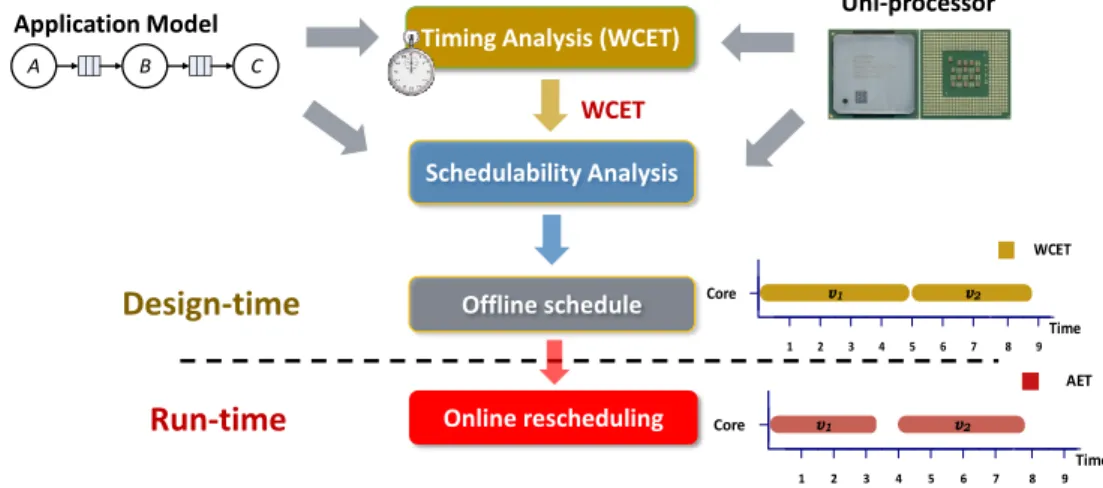
to execute in the target architecture under any possible valid input [112, 41]. Acquiring the exact WCET for a task is rather challenging, and not feasible in all cases. Acquiring exact WCET requires to consider all possible execution paths of the application (at source/binary code level) an all possible execution scenarios of instructions at the target architecture, including out-of-order execution, branch prediction, cache replacement policy, data/instruction prefetching, etc. [112, 110]. This leads to an exponential number of possible executions which have to be explored. Even for small-sized applications this exploration cost is prohibiting, rendering acquisition of exact WCET impractical [112]. Figure 1.2 illustrates a typical design process [26, 34, 25, 14, 112, 31] for realizing hard real-time uni-processor systems. Given a set of application tasks, the first step of such a process is to perform timing analysis of those tasks in order to acquire their WCET estimation for the target architecture. Using these WCET estimations, the process performs a schedulability analysis, for a given scheduling policy decided at design-time, to determine if all the real-time constraints (internal deadlines, latency guarantees, etc.) are met. Upon success, the process may generate (offline) static schedules and timing information, which could be used as input for a run-time scheduler. At runtime, the
Time
1Core3
Core2
2 3 4 5 6 7 8 9WCET
iso
Interference
Core1
v
1v
2v
4v
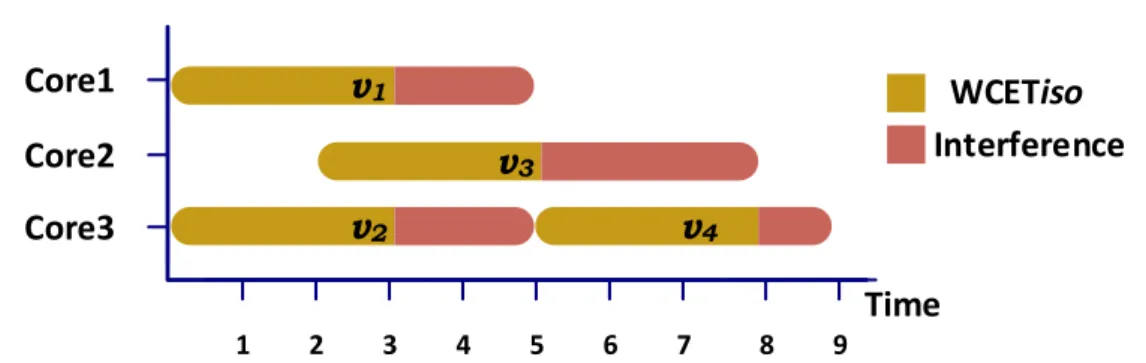
3Figure 1.3 – Example of varying WCET for four equivalent tasks executed on three cores. Tasksv1,v2 will experience, in the worst-case, two time units of interference due to their
mutual overlapping and the overlapping withv3; Taskv3will experience three time units
from tasksv1,v2,v4, while taskv4 only one time unit from v3 (WCETiso denotes WCET
in isolation, i.e. in absence of interference)
predetermined scheduling policy is implemented or, if additional information is provided, a run-time policy is enforced which, nevertheless, must be proven that preserves the acquired real-time guarantees (deadlines, latency).
Certainly, there are several variations of the “typical” design process for realising hard real-time systems, each with its benefits and shortcomings, on a uni-processor. However, with the rise of new architectures with multiple PEs, timing analysis and optimisation becomes even more challenging [14, 33, 105, 70, 40]. This is due to sharing several arbitrated resources among these PEs (memories and interconnects) which introduces timing delays and changes the timing behavior in a non-deterministic manner. As pointed out by Davis and Burns [34]: “A recent survey of WCET techniques [112] concluded that no static analysis currently exists for multi-core processors which have such1 complex hardware interactions. Research in this area has either aimed to develop a fully statically analysable multi-core CPU, or to move from providing deterministic WCET estimates to providing probabilistic ones with a high degree of confidence.”
A motivating example of the variability of WCET estimations, due to resource sharing, is outlined in Figure 1.3. Consider four equivalent tasks, e.g. an image filter applied to four different parts of an image. These tasks, being equivalent, have the same WCET when executed in isolation. If the overhead per overlapping task is of one unit, it is clear that the WCET of each task will increase, with the amount of WCET increase being dependant on how and when these tasks are executed. Therefore, despite the fact that these tasks are equivalent, thus have the same WCET in isolation, their WCET varies according to the chosen deployment.
In order to naturally extend the uni-processor deployment approaches to multi-processor architectures, one would have to over-approximate the tasks WCET, such that the WCET
WCET estimation
•
WCET
iso
•
Interference
Deployment
•
Mapping
•
Scheduling
•
Mem. Allocation
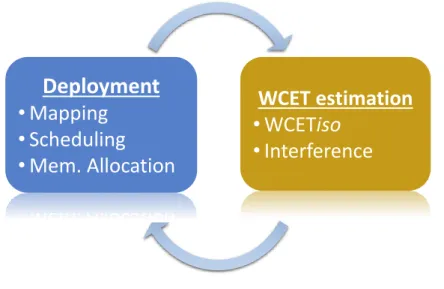
Figure 1.4 – “WCET estimation” and “deployment optimisation” inter-dependency; optimisation of the former depends on the latter, and vice versa
accounts for all possible interferences. Nevertheless, such a pessimistic WCET estimation will result in under-utilised systems, thus seriously undermining the advantages of utilising multi-processors. This is often called the “one-out-of-m processors” problem [63], where the additional processing capacity is negated by the pessimism of the WCET. In fact recent research [64], including research performed within this dissertation [100, 99, 97] shows that WCET estimations which account for interferences from parallel tasks can be 150%, or even 750%, of the corresponding estimations in absence of interference. Yet, the vast majority of scheduling approaches that aim to address hard real-time systems, either for standard task models [34, 14, 26, 82, 50] or Models of Computation (MoCs) [68, 49, 67, 17, 72, 19], require the a-priori knowledge of tasks WCETs. This,
of course, is not without reason; one being that research performed from the ’60s until late ’90s made a then reasonable assumption that delays due to arbitration of shared resources are negligible since processors operated in low frequencies and comprised of a low-number of cores.
Another, and more important reason for thea-priori knowledge of WCET assumption, is
the inter-dependency between “WCET estimation” and “deployment optimisation” that appears in multi-processor systems [34]. Accurate estimation of interference delays -and by extension estimation of tasks WCET- depends on the way an application is deployed. But, optimisation of hard real-time deployment (in terms of latency) is a constrained optimisation problem that depends on the estimation of tasks WCET, thus creating a cyclic dependency between the two main aspects of realising hard real-time systems.
Software Hardware
Scheduling
Theory Model-based Resource Partitioning
Resource Regulation Deterministic Resources •EDF-based •RM-based •Ad-hoc •Mixed– criticality •SDF •KPN •Timed automata •Memory / Cache coloring / partitioning •Time partitioning •PREM •Sliced Execution •Memory •Bus •NoC •Caches •Scratchpad •Buses •NoC
WCET Assume known Assume known Improved Improved Improved
Efficiency (varies) (varies) Improved Improved Improved
Adaptability* (varies) (varies) Restricted/None (slows-down runtimeFull ) (slows-down runtimeFull )
* Ratio of safe adaptations to total adaptations (directly affects runtime performance)
Figure 1.5 – Overview of the state-of-art
In order to resolve this cyclic dependencies and still acquire reasonable WCET estimations, several state-of-the-art approaches (Figure 1.5) employ resource isolation [34, 94, 21, 81], or resource regulation [78, 36, 66, 64] techniques. In resource isolation, access to shared resources (buses, memories, NoC routers) is restricted to strictly one core (e.g. spatial partitioning [102], memory coloring) or one core at a given time (e.g. temporal partitioning [23, 48], temporal isolation [21, 81]). This is achieved either at the hardware level (e.g. TDMA) or using software mechanisms [34]. Resource regulation techniques, on the other hand, allow the simultaneous use of resources, but restrict the amount of requests to a shared resource per core within a predefined time window.
While such approaches restrict the pessimism in WCET estimations, and thus provide more efficient deployments, they can undermine run-time performance as they restrict adaptability. Consider, as an example, the hypothetical scenario where the airbag (SRS)
control software of a vehicle is executed in the same multi-processor as the automatic braking (ABS) control software. Both software have real-time guarantees and there is a benefit in executing them as fast as possible. In the case of resource isolation techniques, the SRS cannot access resources dedicated to ABS while ABS is executing, and vice versa. In the case of resource regulation, while accessing a shared resource is permitted, the amount of requests is restricted over time, which essentially slows down the execution of both the SRS and ABS software.
This dissertation holistically provides methods for deployment of applications to multi-processors architectures, as the authors of [33, 104], but with the aim of providing hard real-time guarantees. In order to realise efficient hard real-time systems, without sacrificing adaptability [94, 21, 81], task WCETs are improved as the deployment process progresses. A similar idea [41] is being advocated by the on-going European-funded project Argo [84].
1.3
Thesis Statement and Contributions
This dissertation aims to stand between the two ends of the spectrum of approaches, that is (i) methods that do not restrictadaptability, but overestimate WCET and provide
pessimistic latency guarantees, and (ii) methods that provideaccurate WCET estimations
and tight latency guarantees, but restrict run-time performance. To bridge that gap, this dissertation proposes novel methods for safely deploying a streaming application to a generic homogeneous architecture, by coupling the WCET estimation method to the deployment process.
The first proposed method is an interference analysis, calledisWCET method, which
given an architecture model, an application model with data-dependencies, and the WCET estimations of the application’s tasks (in absence of interference), estimates the possible amount of interference. As more information is provided, such astask mapping, scheduling,memory mapping, etc., the per-task interference estimation becomes more
accurate, but also more sensitive to changes. Theseinterference-sensitive estimations are
considered safe only for deployments in which the maximum interference each task can experience is at most as those interference-sensitive estimations.
The second proposal is to couple such anisWCET method to a deployment process for
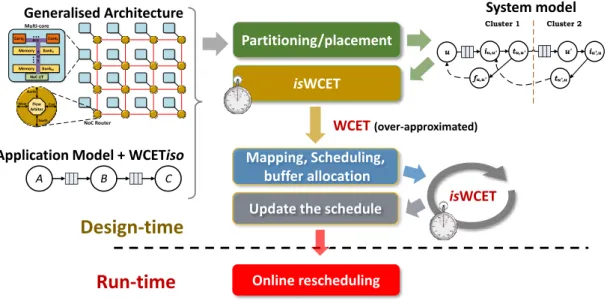
a multi-processor architecture, as shown in Figure 1.6. The proposed process derives safe (in terms or real-time constraints, buffer protection and deadlock freedom) and efficient deployments, by gradually providing information to the isWCET method. To
illustrate the benefits of such coupling, we apply such an approach to a variant of SDF graphs, called split-join graphs. Intuitively, split-join graphs model explicitly task-/data-parallelism of actors, by allowing potentially parallel firings of actors to read/write to the same channel.
Still, while the generated deployment solution is safe and improved in terms of guaranteed latency, run-time performance can be severely undermined, since the worst-case is unlikely to occur at runtime. While theisWCET-based deployments are more efficient, in order to
avoid violating the real-time guarantees, such deployments permit only certain adaptations out of the possible many. The adaptations that are deemed safe should not increase the interference any task may suffer in the worst-case. Therefore, the third contribution of this dissertation is a novel, interference-sensitive, runtime adaptation technique, calledisRA,
which is suitable for deployments based onisWCET estimations. Being a distributed
approach, the execution of the runtime monitors responsible for enforcing the adaptation policy can also cause interference. For this reason, the runtime monitors are designed, and implemented, having minimal execution time and induced interference, thus avoiding undermining runtime performance and still meeting the real-time guarantees.
The final contribution of this thesis, is the realisation of all the aforementioned methods and techniques for an actual multi-processor (Kalray MPPA-256). All of the approaches
Partitioning/placement isWCET System model Mapping, Scheduling, buffer allocation WCET (over-approximated)
Update the schedule
Generalised Architecture
Application Model + WCETiso
A B C isWCET Online rescheduling
Design-time
Run-time
NoC Router Memory Bank0 Memory BankM ... ... NoC I/F CoreK B U S BUS Core0 North South East Flow Arbiter West Multi-core u iu,u’ tu,u’ u' fu,u’ iu’,u tu’,u Cluster 1 Cluster 2Figure 1.6 – Global overview of the proposed approaches
were evaluated on this multi-processor with real-life applications (StreamIt benchmark), outlining the benefits that each method contributes to the the problem of application deployment with real-time guarantees.
1.4
Dissertation Outline
Chapter 2 presents the fundamental models used for streaming applications and generic
architectures. Based upon these models, an execution model is derived which faithfully captures possible executions of the application deployed on a generic architecture and serves as the intermediate representation for the various steps of the proposed approaches. Based on an execution model, in Chapter 3, a novel interference analysis and WCET
estimation method is presented, calledisWCET. As more information is available about
the application deployment (such as memory mapping, task mapping, task scheduling, etc.), theisWCET method provides more accurate interference estimations, via iteratively
applyingspatio-temporal exclusion, thus acquiring more accurate, but sensitive, WCET
estimations. The method is formally proven to be (i) safe, (ii) exact and (iii) always converges. Experimental results of the StreamIt benchmark deployed on the Kalray
MPPA-256 multi-processor show that the isWCET method is able to exclude74%of the interference delays on average, improve WCET estimations up to36% and reduce the average overhead due to interference to less than 10%.
In Chapter 4, a safe deployment process is presented that leverages the outcomes of
the isWCET method. The deployment method manages to break the inter-dependency
proposed deployment process estimates tasks WCET using theisWCET method, without
any information regarding the deployment. Once a safe deployment is acquired, the process provides the deployment information to theisWCET method to derive tighter
WCET estimations and adapts accordingly the acquired deployment. Extending the results of Chapter 3, experimental evaluation shows that coupling theisWCET with the
deployment process, can improve guaranteed latency up to 46%.
Chapter 5 presents a novel distributed runtime adaptation technique, calledisRA, which
builds uponisWCET estimations and aims at improving run-time latency. The proposed isRA technique restricts executions that would introduce additional interferences, beyond
the ones already accounted for by the deployment process. The method is proven to be safe and illustrated to have minimal overhead in execution time and induced interference. The
isRA is experimentally evaluated with the StreamIt benchmark deployed on the Kalray
MPPA-256 multi-processor, using theisWCET method and the proposed deployment
process. Experimental results show that the isRA improves runtime latency by 22% on average, up to 42%. Thus, the consolidated improvement in latency, from all the proposed methods, can be of more than 50%.
To provide real-time guarantees for an application deployed on an architecture, formal models for the application and the target architecture are necessary. An application is often considered in literature (e.g. [82, 14, 40, 34]) to consist of a set of computation tasks which may be data-dependent. When all these computation tasks are executed, the
application is considered to have completed its execution, that is, the input data have been consumed and the desired output has been produced. The output is considered to be correct if during the execution there are no data-races, deadlocks etc. In a very abstract manner, we can represent an application as atask graph A=(V0,E0) whereV0 is the set
of computation tasks and E0 is the dependency relation among the computation tasks.
Deploying an application on a multi-processor architecture may also require additional tasks in order to faithfully model architecture-specific operations of the underlying
architecture, such as hardware synchronisation, NoC transfers, etc. Therefore, the resulting system can be viewed as a task graphS=(V,E), derived from the application graph, which contains the original computation and additional architecture-specific tasks and respects the data-dependencies of the application.
Given a set of given real-time constraints for an application, the real-time deployment of an application on a multi-processor architecture involves several decisions. These decisions drill down to well known problems, that is (i)processor mapping, (ii) memory mapping, (iii) NoC routing and (iv) processor scheduling. Processor mapping (often also
called task mapping) refers to the decision of assigning tasks to PEs (without considering the order of execution), while processor scheduling is the decision of the order of task execution. Often, especially in Scheduling Theory [82], these are collectively referred as scheduling problem, but we will make the aforementioned distinction as it has a significant impact on our approaches. The memory mapping problem refers to the decision of which parts of the memory will be assigned to each task in order to perform its execution. Finally, NoC routing is a typical network problem of deciding the sequence of routers that packets or flows should traverse, in order to reach their destination. All these decisions have an impact on the resource demands and execution times of tasks, thus affecting the
efficiency of the system.
As a semi-formal definition of what a real-time deployment consists of, let the tuple D = (µK,µM,ρ,β,²) be the non-preemptivedeployment solution, i.e the collective solution
of these problems, where:
• µK is the function which assigns tasks to PEs (processor or task mapping problem)
• µM is the function which maps tasks data-dependencies, private variables and
binary code to memory (memory mapping problem)
• ρ is the routing of the data-flows on the NoC (NoC routing problem)
• βand²are the functions which denote the begin and end times of tasks, respectively (scheduling problem)
In order to generate a deployment solution which meets certain real-time constraints, e.g. tasks finish before some given deadlines and/or the execution finishes prior to a given latency constraint, timing information of the application’s tasks must be provided. The required timing information for each task is called Worst-Case Execution Time
(WCET), which is the maximum amount of time required for a task to execute in the target architecture under any possible valid input. In architectures with multiple PEs the actual WCET of any task v can vary according to thedeployment, due to sharing
arbitrated resources among PEs which introducesinterference delays and changes the
timing behavior in a non-deterministic way.
In principle, the WCET of a task v can be decomposed into the WCET in isolation, i.e.
in absence of interference, and the interference delays. Thus, given a deployment solution
D, for any taskv its total duration of execution is:
διD(v) def
= δi so(v) + ι
D(v) (2.1)
where δi so(v) is the WCET in isolation, which is assumed constant regardless of the deploymentD, andιD(v)is the amount of delays that task v experiences from
simultane-ously executed tasks. The assumption that the WCET in isolation is constant, and does not depend on the deploymentD, implies a homogeneous architecture, i.e. all PEs are
identical. Even in such architectures, while the WCET in isolationδi so(v)for any task v
does not depend on the deployment D, the same is not true for the interference delays
ιD(v)as they vary based on the deployment D. We will callδ
ιD theinterference-sensitive
WCET, or simplyisWCET.
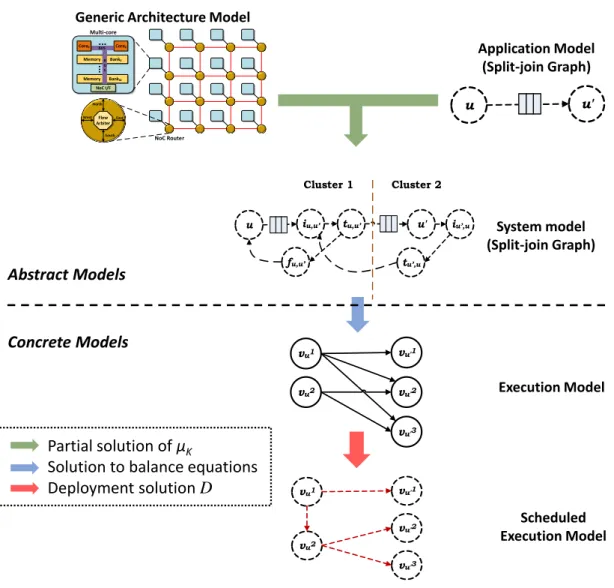
Our approaches involve several models (Figure 2.1); Initially, two abstract models are consider as input, i.e. application model and architecture model. These are used to
vu1 vu'1 vu'2 vu'3 vu2 NoC Router Memory Bank0 Memory BankM ... NoC I/F B U S North South East Flow Arbiter West Application Model (Split-join Graph) System model (Split-join Graph) Execution Model Scheduled Execution Model Abstract Models Concrete Models u u' vu1 vu'1 vu'2 vu'3 vu2 u iu,u’ tu,u’ u' fu,u’ iu’,u tu’,u Cluster 1 Cluster 2 Partial solution of μΚ
Solution to balance equations
Deployment solution D
Figure 2.1 – Abstract and concrete models
model to the targetarchitecture model. The system model is transformed in the execution
model, which contains all the tasks of the system. The purpose is to solve the majority of optimisation problems, required to acquire a safe deployment, on the abstract model, i.e. system model. Whenever the system model cannot be used efficiently, its corresponding execution model is used. The execution model, serves also another purpose. When the safe deployment is derived, the execution model is transformed to the scheduled execution model, which is the input for our runtime adaptation, along with the deployment solution. This transformation of the execution model will play a crucial role in the efficiency of the proposed runtime adaptation, but this will be discussed on Chapter 5.
In the next subsections the real-time deployment problem is formulated and the afore-mentioned abstract and concrete models (in Figure 2.1) are formally defined.
2.1
Real-time Deployment Problem Formulation
Theoptimal, in terms of time, deployment of an application on the target architecture
consists of finding the solution with the smallestlatencyto the i) processor mapping (µK),
ii) memory mapping (µM), iii) NoC routing (ρ) and iv) scheduling (β,²) sub-problems,
such that givenreal-time constraints are met. Thus, the real-time deployment problem
can be formulated as a constrained optimisation problem: FindD = (µK,µM,ρ,β,²) s.t. min µ max v∈V (²(v)) ¶ subject toCRT
whereCRT is a set of real-time constraints of the form “some tasks should finish before their deadline”, i.e. v∈V, ²(v)≤dv. To illustrate a simplified version of the whole
problem, consider Figure 2.2, where four tasks are deployed on two cores. Each task has a (known) WCET of three times units and its respective deadlines is illustrated with a dashed-line. Time 1 Core2 Core1 2 3 4 5 6 7 8 9 WCET v1 v2 v4 v3 d1,d2 d3 d4
Figure 2.2 – Optimal real-time deployment for known WCET
The focus of this dissertation is onnon-preemptive, homogeneoussystems. In homogeneous
systems the PEs of the architecture are identical and the WCET in isolation,δi so(v), of any taskv∈V is the same on all PEs. Non-preemptive systems are those in which once a
task has started its execution, it cannot be interrupted and the task’s required resources (memory locations, PE) cannot be used until the task finishes execution. Thus, given the
isWCET διD the task-end function², for non-preemptive systems, is defined as:
²(v)def=β(v)+διD(v) ∀v∈V (2.2)
Notice that even for non-preemptive systems the optimisation problem becomes rather complicated, as the exact valuation of the optimisation function²depends on the solution of the optimisation problemD.
There are several variations of the same problem depending on the type of architecture and the assumptions made about the WCET. For example, for a multi-processor architecture with a bus-based interconnect, the deployment reduces to a tuple without the NoC routing function ρ (i.e. D = (µK,µM,β)), while if the WCET estimations are pessimistically
estimated to include all possible interference delays, the deployment can even reduce to
D = (µK,β). These variations can reduce the complexity of the deployment problem but
also lead to inefficient systems (details can be found in Section 3). As opposed to many techniques in the literature, this dissertation does not rely on overly pessimistic WCET estimations, since one of its aims is to explore and outline the impact of such pessimism to the efficiency of the resulting system.
2.2
Processor Architecture Models
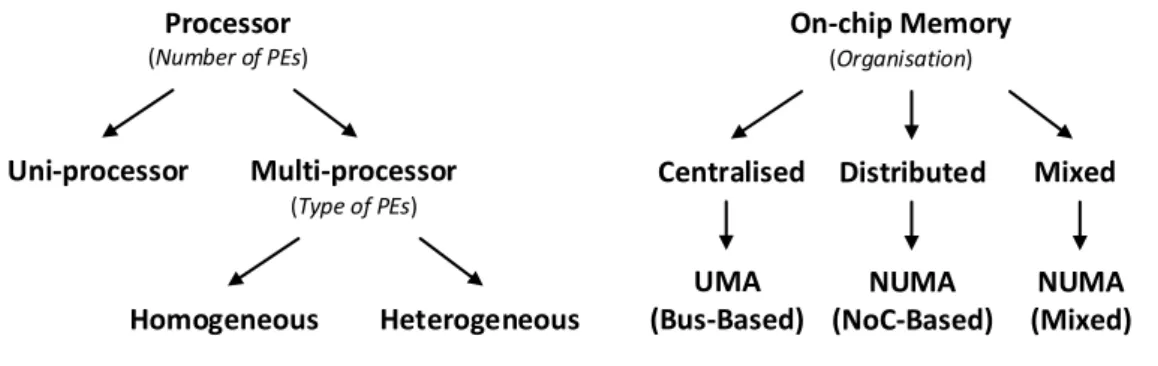
At the time this dissertation was written, several research [58] and commercial [61, 108, 60, 87, 46] computing platforms with multiple PEs were available. These broadly can be categorised according to i) the type of PEs and ii) the on-chip memory organisation, as illustrated in Figure 2.3.
Homogeneous (as opposed toheterogeneous) are the platforms where the PEs are of the
same type, e.g. CPU [60, 80], GPU [79], DSP, and have the same overall speed when executing a task, i.e. all PEs have the same clock speed, cache size, I/O interfaces and any other mechanism that can affect the PEs’ timing behavior. From the perspective of how the shared memory is organised, there are three main categories, i.e. centralised, distributed and mixed. Incentralised memory organisation, the time for any PE to access
any memory location (typically via a bus) is uniform, when there is no interference, that is the time does not depend on the targeted memory location/address. On the other hand, in thedistributed memory organisation, PEs use a different mechanism, such as Direct Memory Access (DMA) engines or NoC, to access various memory locations, thus
having aNon-Uniform Memory Access (NUMA) in terms of timing. The mixed memory
organisation is a combination of thecentralised and distributed memory organisations,
where a subset of PEs access their shared memory uniformly, but accessing the memory shared by another set of PEs is non-uniform.
(Number of PEs)
Uni-processor Multi-processor
(Type of PEs)
Homogeneous Heterogeneous
Processor On-chip Memory
(Organisation)
Centralised Distributed Mixed
UMA (Bus-Based) NUMA (NoC-Based) NUMA (Mixed)
2.2.1 Homogeneous Architecture Types
The focus of this dissertation is onhomogeneous multi-processor architectures, with the
PEs being general purpose cores, for reasons explained in the Introduction. Following is a description of the homogeneous architectures covered in this dissertation according to their on-chip memory organisation. It must be pointed out that while the terms “centralised”, “Uniform Memory Access”, “distributed”, “Non-Uniform Memory Access”
frequently refer to main memory organisation, here are used for the on-chip memory. Centralised architectures Memory Bank0 Memory BankM
...
...
CoreK B U S BUS Core0Figure 2.4 – A typical centralised multi-processor architecture.
In centralised homogeneous architectures, a number of general purpose PEs, henceforth cores, have a private cache memory (for instructions and data) but also share a part of the on-chip memory. The shared memory can be divided in several banks and cores can access a bank via a bus. Thus, in the general case, a bus connects a subset of the cores with a subset of the banks. To resolve conflicts of simultaneous requests for shared resources, i.e. buses, memory, these resources are arbitrated causingtiming interference.
Thus, a simultaneous memory request can be arbitrated at the bus arbiter, to resolve which core uses the bus first, and also at the memory arbiter, to resolve which memory request is served first by the memory controller of the memory bank.
For the purpose of interference analysis, it is assumed that a memory arbiter is dedicated to one memory bank. This is assumption is not restrictive as, in the case of multiple banks per memory arbiter, these banks can be considered as one. Also, it assumed that a continuous region on a memory bank can be allocated, as in sequential memory addressing, e.g. Kalray MPPA-256 [37], or strided memory allocation, e.g. CUDA [51].
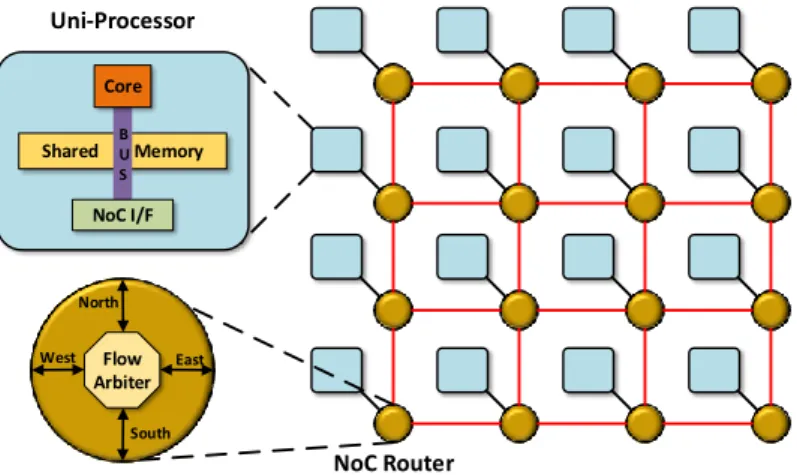
NoC Router Shared Memory Uni-Processor B U S Core NoC I/F North South East Flow Arbiter West
Figure 2.5 – A typical distributed multi-processor architecture.
Distributed architectures
In distributed homogeneous architectures several computing nodes are interconnected with a NoC. The computing nodes have a single core, with its private instruction and data caches, connected with a bus to the shared memory. In that sense, it is no different than a uni-processor. Additionally, a computing node has a NoC interface (NoC I/F) through which data are sent/received from other computing nodes. In order to parallelise data transfers, the NoC I/F can have multiple channels. A data transfer between a source and a destination computing node, the source NoC I/F (using its channels independently of what the core is executing) reads data from the shared memory, forms the network packets and injects them into the NoC, via a link to its corresponding NoC router. The packets are then forwarded from router to router, according to a routing policy, until they reach their destination. At the receiving end, the destination NoC I/F retrieves the data from the packets and places them into the destination shared memory, thus completing the data transfer.
Apart from the bus and memory arbiter that exist to resolve conflicts between the core and the NoC I/F of a computing node, there is an additional arbiter at each NoC router. For the purpose of interference analysis, it is assumed that when two packets simultaneously arrive at a NoC router from different input network links and are directed to the same output links, the flow arbiter decides which packet will be served first. As, the focus of this dissertation is in interference, it is also assumed that NoC routers will not block and cause back-pressure (which can be achieved by flow regulation at the source [36]). We consider that such assumption can be alleviated with proper adaptations of the interference analysis, but in principle should be handled by the deployment process and not the interference analysis.
Mixed architectures NoC Router Memory Bank0 Memory BankM
...
...
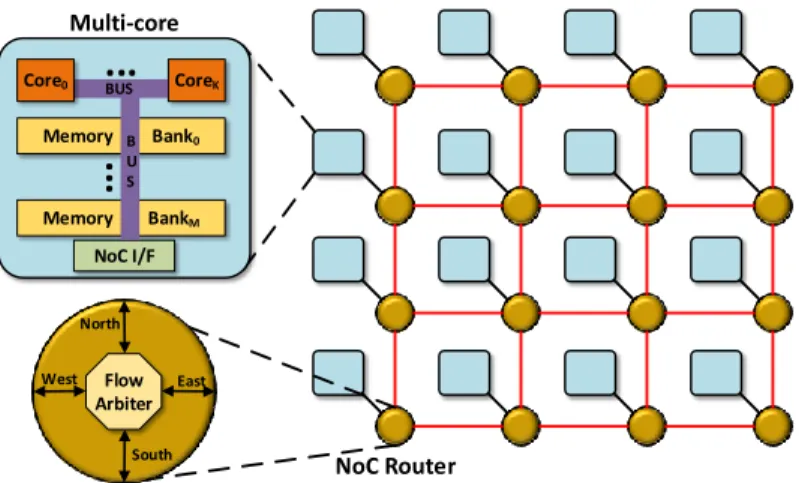
NoC I/F CoreK B U S BUS Core0 North South East Flow Arbiter West Multi-coreFigure 2.6 – A typical mixed multi-processor architecture.
Mixed homogeneous architectures are a combination of the centralised and distributed architectures. Their main difference from the distributed paradigm is that the computing node is replaced by a computing cluster, which essentially is a multi-processor with a
NoC I/F. In terms of arbitration points, mixed architectures are the same as distributed architectures, i.e. they have memory, bus and flow arbiters. But, compared to distributed architectures, the number of sources of arbitrated requests, and by extension sources of timing interference, is larger.
Stemming out from the focus on homogeneous architectures, it is assumed that the computing clusters are identical in the sense that the time to execute a task does not depend on which computing cluster is executed.
2.2.2 Generic Architecture Model
In order to capture the different architectures with a single model that will be used in the proposed methods of this dissertation, the generic architecture model is introduced. A
single model is important as it enhances applicability of the proposed methods, which in the context of hard real-time systems is desirable, as safety properties have to be proven only once.
Definition 2.2.1 (Generic architecture model). A generic architecture model is a tuple
GA = (C, K, L, M, N)where:
• C is a set of computing clusters
• L⊆C×C is a set of links among computing clusters that form the NoC
• M is a set of memory banks per cluster
• N is the set of NoC channels of a NoC I/F
When the generic architecture model is instantiated to a concrete architecture model matching with one of the homogeneous architecture types described earlier, i.e. (i) the centralised architecturesMA = (C,K,;, M, ;) which do not have a NoC interconnect, (ii) the distributed architectures DA= (C,{k},L,M,N) with one core k per cluster,
and (iii) the mixed architectures MX = (C,K, L, M, N) .
For the architectures that have a NoC it is assumed that each cluster has one NoC I/F, with multiple channels, connected to a single dedicated NoC router [32] and has a separate bus to access the shared memory.
2.2.3 Kalray MPPA-256
The Kalray MPPA-256 chip consists of 256 processing VLIW cores grouped in 16 computing clusters with each cluster comprising 16 processing cores at 400M H z and 2M B of shared scratchpad memory (Figure 2.7). The shared memory consists of 16
independent 128kB memory banks with64-bit words organised in two sides, odd and even. Each cluster has one NoC I/F, subdivided in transmit (Tx) and (Rx) interfaces,
implemented with an a8-channel DMA engine [38].
Each cluster NoC I/F is coupled with a dedicated NoC router, which are organised in a 2D-torus topology (Figure 2.8). Each router has 5 full duplex links, one for each direction plus one for its corresponding computing cluster. Each link to another router has an
Figure 2.8 – Kalray MPPA-256 NoC topology [36].
independent round-robin arbiter and 4 FIFOs, one per input direction. The link to its dedicated cluster has one additional FIFO, so the cluster can send packets to itself. This means that the router can send back received packets from its cluster, but not from other routers.
Having this particular architecture that matches the generic architecture model GA, the
Kalray MPPA-256 can be reconfigured (depending on how an application is deployed) according to the different types of architectures considered. In specific the Kalray MPPA-256 can serve as:
• Centralised architecture: where only one computing cluster is utilised
• Distributed architecture: where only one core from each cluster is utilised
• Mixed architecture: where the full chip, i.e all 256 cores, are utilised
2.3
Application and System model
To provide real-time guarantees for an application, deployed on an architecture, a formal model for the application is also necessary. An application consists of a set ofcomputation tasks. There is one significant distinction, encountered especially in the Scheduling Theory
community, for the set of computation tasks. Independent tasks are those tasks which,
if ready, can be scheduled in any order, while fordependent tasks there is an inherent
scheduling order imposed. For example, compressing an image according to the JPEG standard requires that the image is split in blocks before it is transformed using the
Discrete Cosine Transformation (DCT) method. So, from a task perspective, there is a
data-dependency between the tasks that form the blocks and the DCT transformation tasks.
When all of these computation tasks are executed, the application is considered to have completed an execution, that is, the input data have been consumed and the desired
output has been produced. The output is considered to be correct if during the execution there are no data-races, deadlocks etc. This dissertation considers applications that are composed ofdata-dependent computation tasks and areiteratively executed on a stream
of input data, calledstreaming [109] or data-flow [68, 49] applications. This particular
class of applications is suitable for architectures with large number of cores, as they exhibit a high degree of task- and data- parallelism.
An application composed of a set ofcomputation taskswith dependencies can be modelled
with variousModels of Computations (MoCs), such asSynchronous Data-Flow graphs
(SDFs) [68] and Kahn Process Networks (KPNs) [49]. Such models provide necessary
correctness properties (such as deadlock freedom, absence of data-races, confluency, buffer protection, etc.) by-construction, if their semantics are respected. Without being strictly restricted to, an application will be modelled as a particular class of SDFs, called split-join graphs [106]. The choice of this particular model is due to (i) the explicit modelling of parallelisation factors and (ii) available tool-chain for these models.
Generally, an SDF model is a directed graph SDF=(U,E) with U being a set of
com-putation actors and the binary relation E representing a set of FIFO channels among
them.. In this model,actors communicate with each other by sending ordered streams
of data elements (called tokens). When an actor is fired —which corresponds to the
notion of task execution— it consumes a fixed amount of data tokens from its input FIFOs and produces a fixed amount of data tokens to its output FIFOs. These amounts are called production-/consumption rates and are defined for each of the actor’s FIFOs.
The production/consumption of data tokens are blocking operations, that is, if an input FIFO is empty (respectively an output FIFO is full) the corresponding read (respectively write) operation will be blocked until the FIFO contains enough data (respectively has enough free space).
Generally, it is considered acceptable in SDF models to fire an actor before input data and output space is available, as the actor would block when it would try to access a FIFO. Nevertheless, typical scheduling approaches generate schedules that avoid such situations. In our case where timing correctness is of importance, blocking of an actor would mean that its WCET would change. Thus, to guarantee correctness, a deployment solution must ensure that prior to firing an actor, there is enough data at its input FIFOs and enough free space at its output FIFOs. Otherwise, the actor would block, which would alter its WCET in isolation. Additionally, for efficient utilisation of the on-chip memory, it is assumed that actors can use their allocated space in their input/output FIFOs, to load/store intermediate results of their computation.
To guarantee that there is an unbounded execution of the SDF with bounded FIFOs,
which essentially state that after a finite number of actor firings all data, which were produced, are consumed.
Definition 2.3.1(SDF Consistency). For each FIFOe∈U, withe=(u,u0), let#u, #u0 be the number of times actorsu,u0 are fired, respectively. Also let route be the production
rate ofu and ri ne the consumption rateu0 for FIFO e; a SDF isconsistent if there is a
non-zero integer solution to the followingbalance equations, for all edges e=(u,u0)∈U:
∃#u, #u0∈N+: #u∗route =#u0∗ri ne (2.3) For consistent SDFs, the existence of unbounded, i.e. deadlock free, execution of that
SDF with bounded FIFOs is decidable [67]. ■
There are several advantages of SDF models apart from guaranteeing correctness proper-ties; SDF models can be used to model complex applications and allows to explore the latency-throughput-buffer trade-offs.
Given a solution to the balance equations, theexecution model can be constructed, by
deriving a task graph containing one task for each actor firing and a dependency relation that describes which firings of two dependent actors can be performed in parallel. This is essential to compute the set of tasks that can be executed in parallel with a given task, which affects the interference estimations in Chapter 3.
Definition 2.3.2 (Execution model). An execution modelE M(ES) of a directed acyclic
task graphG=(V,E)is its parameterised versionE M(ES) = (V,E∪ES)where the
data-dependency relationE is augmented with additional scheduling dependencies ES, such
that E M(ES)is also a DAG. ■
Definition 2.3.3. Given a consistent SDF graphSDF=(U,E) and the solution of the balance equations (the number of firings #u for each actor u∈U) and rue (the rate of
actoru for its FIFOe), the execution model E M(;)with unbounded FIFOs is derived as follows:
• V =©
viu | ∀u∈U,∀i∈[1, #u]
ª
, that is vui denotes the it h firing of actoru
• E =
n
(viu,vuj0)| (u,u0)∈E, (i−1)∗ru(u,u0)<j∗ru(u0,u0)
o
, that is, between two data-depend actors u,u0, the taskvuj0 cannot be executed before its input data from task viu have been produced.
■ The dependencies of the execution model essentially prevent from FIFOs to underflow, by preventing a task v0 to execute, if the taskv that produces the input data ofv0 has
u
u'
rout =3 rin =2 (a)v
u1v
u'1v
u'2v
u'3v
u2 (b)Figure 2.9 – Example of underflow protection through the dependency relation E of the
execution modelE M
Example 2.3.4. Consider the SDF graph of Figure 2.9a, with actoru producing three
tokens at each firing and actor u0 consuming two. In Figure 2.9b, the corresponding
execution model is presented for the minimal solution of the balance equation of the SDF graph. The dependency relation constructed prevents all tasks of actoru0, i.e. vu10,v2u0,vu30, to be executed before the first firing of actoru, i.e. vu1. The second firing of u0 requires
tokens from the first and the second firing ofu, according to production/consumption
rates, therefore task v2u0 is forced to execute after vu2. The same does not hold for the
first firing of u0, so task v1u0 can executed in parallel with the second firing of actoru.
This is permitted in the execution model as taskvu10 does not depend on vu2. ■
2.3.1 Application Model
A split-join graph [106] S J =(U,E,α) is a directed acyclic (DAG) SDF graph (U,E) annotated with a parallelisation functionα, assigning a parallelisation factorα(e)∈Q+
for each edge e of the graph. An edge e with parallelisation factor α(e)>1 is called split, with α(e)<1 is called join and with α(e)=1 is called neutral. Split-join graphs
also require a well-formedness condition which states that “the product of parallelisation
factors should be 1 for any path from a starting actor (i.e. with no predecessors) to an ending actor (i.e. with no successors) and the sequences of parallelisation factors of those paths respect the matching-parenthesis grammar1. This condition essentially
ensures that all splits are joined in a meaningful manner, that is, all splits are eventually joined and that a split factora is matched with a join factor a1. For example consider
the following sequences:
![Figure 1.1 – Trends of required power for desktop processors [113]](https://thumb-us.123doks.com/thumbv2/123dok_us/10114298.2911992/18.892.119.733.148.428/figure-trends-required-power-desktop-processors.webp)