Wireless Networks
Ruiqi Ding
A Dissertation submitted in fulfilment of the requirements for the award of Doctor of Philosophy (Ph.D.)
to the
Dublin City University
Faculty of Engineering and Computing School of Electronic Engineering
Supervisor: Dr. Gabriel-Miro Muntean
I hereby certify that this material, which I now submit for assessment on the pro-gramme of study leading to the award of Doctor of Philosophy is entirely my own work, and that I have exercised reasonable care to ensure that the work is original, and does not to the best of my knowledge breach any law of copyright, and has not been taken from the work of others save and to the extent that such work has been cited and acknowledged within the text of my work.
Signed: ID No.: Date:
List of Publication viii
Abstract ix
Acknowledgements x
List of Tables xii
List of Figures xiv
Abbreviations xviii
1 Introduction 1
1.1 Research Motivation . . . 1 1.2 Problem Statement . . . 4 1.3 Solution Overview and Contributions . . . 5 1.3.1 Energy-oriented Application-based System Profiling - ASP . . 7 1.3.2 Context-aware Differentiated Adaptive Routing - AWERA . . 8 1.3.3 Device-Differentiated Adaptive Content Delivery - DEAS . . 8 1.3.4 Energy-efficient Device-differentiated Cooperative Adaptive
Mul-timedia Delivery - EDCAM . . . 9 1.4 Thesis Structure . . . 10
2 Background and Related Works 12
2.2.2 Hierarchical Routing . . . 18
2.2.3 Differentiate Devices . . . 19
2.2.4 Geographic Routing . . . 20
2.2.5 Energy Aware Routing with QoS Support . . . 22
2.2.6 Content-based Routing . . . 25
2.3 Cross-layer Approaches to Energy Efficiency . . . 30
2.3.1 General Aproaches . . . 32
2.3.2 Content Sharing . . . 34
2.3.3 Traffic Shaping . . . 35
2.3.4 Joint Routing and Sleep Scheduling . . . 37
2.3.5 QoS Through Packet Prioritisation . . . 40
2.4 Energy Efficient Mobile Platforms . . . 44
2.4.1 Energy Efficient Wireless Interfaces . . . 45
2.4.2 Processors . . . 46
2.4.3 Graphical Display . . . 48
2.4.4 Power Management at Operating System Level . . . 51
2.4.5 Background Works . . . 56
2.4.5.1 Measurement-based Energy Characterisation . . . . 56
2.4.5.2 Utilisation-based Energy Modelling . . . 57
2.4.6 Energy Efficient Applications . . . 60
2.4.6.1 Data Compression Techniques . . . 61
2.4.6.2 Adaptive Control at Application Layer . . . 64
2.4.6.3 Partial Caching . . . 67
2.5 Chapter Summary . . . 72
3 Energy-oriented Application-based System Profiling and Prototype-based
3.3 ASP Architecture . . . 77 3.4 ASP Algorithm . . . 78 3.4.1 Overview . . . 78 3.4.2 Initialization Phase . . . 80 3.4.2.1 Regression Algorithms . . . 82 3.4.3 Monitoring Phase . . . 85 3.4.4 Working Phase . . . 86 3.5 Software Implementation . . . 88
3.6 Predictor Selection for Regression-based Modelling . . . 89
3.6.1 Real Tests . . . 89
3.6.2 Observations . . . 98
3.7 Regression-based Model Training . . . 99
3.7.1 Training Strategy . . . 100
3.8 Results of Model Training and Model Validation . . . 101
3.8.1 Prediction Using Current Value v.s. Using Calculated Power Value . . . 101
3.8.2 Training Using Predefined Tasks v.s. Incremental Adaptive Training Using Daily Used Applications . . . 103
3.8.3 Model Validation with Video Delivery . . . 103
3.8.4 Utilisation-based Estimation v.s. Power Signature-based Esti-mation . . . 109
3.8.5 Overhead Analysis . . . 110
3.9 Chapter Summary . . . 111
4 Application-aware Energy-efficient Routing Architecture, Algorithms and Testing 112 4.1 Overview . . . 112
4.4 AWERA Algorithm . . . 120
4.4.1 Node Cost Computation Based on Application Profile . . . . 120
4.4.2 Routing Mechanism . . . 122
4.4.3 Routing Cost Computation . . . 123
4.5 Simulation Testing and Result Analysis - AWERA . . . 125
4.5.1 Simulation Testing Environment . . . 125
4.5.1.1 Brief introduction to NS-2 . . . 125
4.5.1.2 AWERA NS-2 Model . . . 126
4.5.2 Simulation Scenario 1 - Power Source and Application Type Differentiation . . . 127
4.5.2.1 Test Scenario Goals . . . 127
4.5.2.2 Simulation Settings . . . 128
4.5.2.3 Simulation Results . . . 129
4.5.3 Simulation Scenario 2 - Light to Moderate Loaded Network . 134 4.5.3.1 Test Scenario Goals . . . 134
4.5.3.2 Simulation Settings . . . 134
4.5.3.3 Simulation Results . . . 136
4.5.4 Simulation Scenario 3 - Heavy Loaded Network . . . 141
4.5.4.1 Test Scenario Goals . . . 141
4.5.4.2 Simulation Settings . . . 141
4.5.4.3 Simulation Results . . . 143
4.6 Chapter Summary . . . 147
5 Device-differentiated Adaptive Content Delivery Architecture, Algorithms and Testing 148 5.1 Overview . . . 148
5.5 Simulation Testing and Result Analysis - DEAS . . . 155
5.5.1 Simulation Testing Environment . . . 155
5.5.1.1 Brief introduction to NS-3 . . . 155
5.5.1.2 DEAS NS-3 Model . . . 156
5.5.2 Simulation Scenario 1 - Effect of Background Traffic Increase in A WiFi Network . . . 158
5.5.2.1 Simulation Goals . . . 158
5.5.2.2 Simulation Settings . . . 158
5.5.2.3 Simulation Results . . . 161
5.5.3 Simulation Scenario 2 - Effect of Background Traffic in a LTE Network . . . 163
5.5.3.1 Simulation Goals . . . 163
5.5.3.2 Simulation Settings . . . 163
5.5.3.3 Simulation Results . . . 165
5.6 Chapter Summary . . . 168
6 Energy-efficient Device-differentiated Cooperative Adaptive Multimedia Delivery Architecture, Algorithms and Testing 170 6.1 Overview . . . 170
6.1.1 Hybrid Content Sharing and Quality Adaptation for Energy Saving at Client Device . . . 171
6.1.2 Device Profiling for Quality Adaptation and Partner Selection of Content Sharing . . . 173
6.2 EDCAM Use Case Scenario . . . 175
6.3 EDCAM Architecture . . . 176
6.3.1 Energy-oriented Application-based System Profiling . . . 178
6.4.1 Energy-oriented Device System Profiling . . . 181
6.4.2 Energy-efficient Quality Adaptation Algorithm . . . 181
6.4.3 Two-party Cooperative Downloading . . . 181
6.4.3.1 Motivation for Two-party Sharing . . . 181
6.4.3.2 Content Sharing Mechanism . . . 183
6.4.4 Overhead and Benefit Analysis . . . 185
6.5 Simulation Testing and Result Analysis - EDCAM . . . 189
6.5.1 EDCAM NS-3 Model and Simulation Testing Environment . 189 6.5.2 Simulation Scenario - Heterogeneous Wireless Network Envi-ronment: LTE and WiFi . . . 190
6.5.2.1 Simulation Settings . . . 191
6.5.2.2 Simulation Results . . . 194
6.6 Chapter Summary . . . 201
7 Conclusions and Future Work 203 7.1 Overview . . . 203
7.2 Contributions . . . 204
7.3 Future Work . . . 208
• Ding, Ruiqi; Muntean, Gabriel-Miro, ”Device characteristics-based differenti-ated Energy-efficient Adaptive Solution for video delivery over heterogeneous wireless networks,”Wireless Communications and Networking Conference (WCNC), 2013 IEEE, pp.4588,4593, Shanghai, China, 7-10 April 2013
• Ding, Ruiqi; Muntean, Gabriel-Miro, ”A Novel device and application-aWare Energy efficient Routing Algorithm for WLANs,” Globecom Workshops (GC Wkshps), 2012 IEEE, pp.481,486, CA, USA, 3-7 Dec. 2012
• Ding, Ruiqi; Muntean, Gabriel-Miro, ”A context-aware cross-layer energy-efficient adaptive routing algorithm for WLAN communications,”Local Computer Net-works (LCN), 2012 IEEE 37th Conference on, pp.176,179, FL, USA, 22-25 Oct. 2012
• Ding, Ruiqi; Muntean, Gabriel-Miro, ”An Energy-oriented Node Characteristics-Aware Routing Algorithm for wireless LAN,”Broadband Multimedia Systems and Broadcasting (BMSB), 2011 IEEE International Symposium on , pp.1,6, Germany 8-10 June 2011
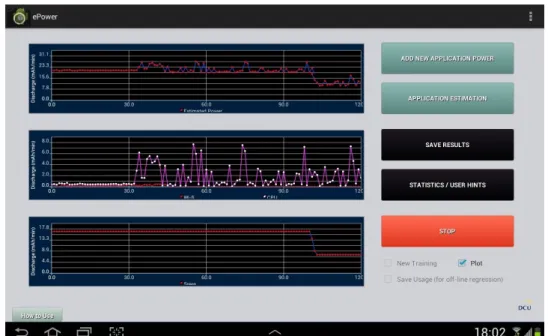
Energy efficiency is a key issue of highest importance to mobile wireless device users, as those devices are powered by batteries with limited power capacity. It is of very high interest to provide device differentiated user centric energy-efficient multi-media content delivery based on current application type, energy-oriented device fea-tures and user preferences. This thesis presents the following research contributions in the area of energy efficient multimedia delivery over heterogeneous wireless networks: 1. ASP: Energy-oriented Application-based System profiling for mobile devices: This profiling provides services to other contributions in this thesis. By monitoring the running applications and the corresponding power demand on the smart mobile device, a device energy model is obtained. The model is used in conjunction with applications’ power signature to provide device energy constraints posed by running applications.
2.AWERA: A context-aWare cross-layer Energy-efficient adaptive Routing Algo-rithm for mobile devices in ad-hoc wireless LAN. AWERA takes its routing decisions based on current node energy constraint by making use of ASP. AWERA uses less energy constrained devices to relay data to other devices and therefore conserves the energy of either the more energy demanding devices or those with lower energy bud-gets.
3.DEAS: A Device characteristics-based differentiated Energy-efficient Adaptive Solution for video delivery over heterogeneous wireless networks. Based on the energy constraint, DEAS performs energy efficient content delivery adaptation for the current application. Unlike the existing solutions, DEAS takes all the applications running on the system into account and better balances QoS and energy efficiency.
4. EDCAM: Energy-efficient Device-differentiated Cooperative Adaptive Multi-media Delivery Solution. EDCAM is a hybrid innovative approach which combines multimedia quality adaptation and content sharing mechanisms to save energy at client devices. EDCAM relies on ASP for individual device energy constraints assessment.
5. A comprehensive survey on state-of-the-art energy-efficient network protocols and energy-saving network technologies.
First and foremost I want to thank my parents, especially my mother, who has always been the best mother and my inspiration since I do not even remember. She raised me with endless love, immense encouragement and condition-less support. The weekly phone conversion with her is a crucial element of my life in Ireland as it gives me strengthen every time I need it. She knows me better than myself and even the smallest step in my life is literally impossible without her. I would also like to thank all the relatives in my big family as I truly appreciate their love and support, which encouraged my adventure in Ireland.
I would like to thank my girlfriend Yang, who is the most attractive lady and more importantly, the best companion. This is not only because she is the only person who can appreciate my quirkiness and sense of humour, but she has always cheered me up on the darkest days and has gone through all my adventures in Ireland with me, including happiness, sadness, difficulties and even the smallest achievements. She has contributed so much to my academic achievement, my life and much much more. I believe she has made me a better person since our days in Wuhan University.
I want to thank my supervisor Gabriel Muntean. It has been an honour and pleasure to be his student. Call me biased, I think he is the most supportive and knowledgeable mentor one can have. He has taught me so much about research, thinking, writing, English, life and much more. I always struggle to organise my ideas rationally and present them clearly. Gabriel has patiently helped me to improve the way I think, write and present. His professionalism and love to work, his sincere kindness to everybody will be my lifetime inspiration. He literally gave me immense support whenever I need it no matter what I was facing. I am more than grateful for all the corrections he made to this thesis, every single paper, poster and presentation. He helped me to live up to my potential.
I gratefully acknowledge the funding sources that made my Ph.D. work possible. I was co funded by Irish Research Council and Citadel 100 Ltd. My life in Ireland was made possible by their generous support. Besides, Citadel 100 gave me a very
understanding are among the best things I have encountered in Ireland. I am truly grateful that they tolerated me to take my time to explore and learn. I gladly spread the words of theses good people and this great company in the conferences in different continents.
Many many thanks to the members of PEL at DCU. They have contributed im-mensely to my personal and professional time at DCU. Zhenhui is a dear friend. I am so grateful for his kind advices on personal and professional life in Ireland. As senior group members, Bogdan and Ramona helped me to get started with my PhD life. The China crows (Zhenhui, Shengyang, Ting and Longhao) and I went through the some-what similar path from China to PEL at DCU so we always have a lot to talk and share. I learnt a lot about Ireland from Martin, Ronan and Lejla. Martin’s expertise in Linux made my life easier as PEL’s server admin. I enjoyed my chat and laugh with Irina, Ronan and Quang, it seems we are never running out of topics.
I want to thank the technical staffs of the school of Electronic Engineering, espe-cially Robert Clare, a very kind, helpful and supportive man. I bothered him so many times for borrowing tools, printing posters, fixing devices and making 10 copies of door cards! I acknowledge the effort of Eduardo to build the prototype with me. He is my first student and it was a great pleasure working with him. Many thanks to Gabriel and Yang again for their effort to improve this thesis.
I gratefully acknowledge Prof. Zhili Sun, Dr. Xiaojun Wang, and Dr. Conor Brennan for making this happen.
I would like to thank my first car, the little Clio, which took me to every county of Ireland. Lastly, I want to thank Dublin City University and the great country of Ireland for all the resources and opportunities they gave me!
Dublin, November 2013 Ruiqi Ding
2.1 Energy efficient Network protocols. . . 27
2.2 Energy efficient Cross-layer Approaches. . . 42
2.3 Energy consumption at architectural level. . . 44
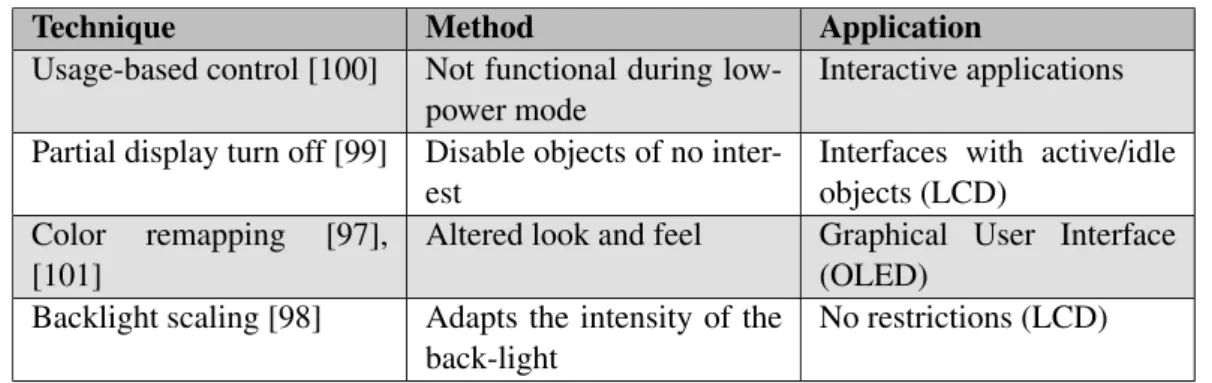
2.4 Graphical Display Energy Saving Techniques . . . 51
2.5 Energy saving technologies at OS level. . . 55
2.6 Energy Efficiency at Application Layer. . . 70
3.1 Component Workload Profile Table . . . 79
3.2 Application Profile Table . . . 85
3.3 Error Rate of Models Using Different Target Value for Training . . . . 101
3.4 Error Rate of Models Using Different Training Applications . . . 103
3.5 Error Rate of Playing ”Interview” At Different Quality Levels . . . . 105
3.6 Error Rate of Playing ”Surfing” At Different Quality Levels . . . 105
3.7 Error Rate of Playing ”Top Gear” At Different Quality Levels . . . . 109
3.8 Error Rate of Utilisation-based Estimation and Power Signature-based Estimation . . . 109
3.9 Overhead Results . . . 110
4.1 Calculation of Individual Components’ Utility Functions . . . 120
4.2 Real Readings in Idle State when GSM and WiFi Are Used . . . 120
4.3 Simulation Settings for AWERA Scenario 1 . . . 130
4.4 AWERA Scenario 1: Results from Stationary Scenario . . . 132
4.8 AWERA Scenario 2: Results from Simulation (Data Rate: 250 kbps) . 138 4.9 AWERA Scenario 2: Results from Simulation (Data Rate: 350 kbps) . 139
4.10 Simplified model used for testing . . . 143
4.11 Simulation Settings for AWERA Scenario 3 . . . 144
4.12 AWERA Scenario 3: Results from Simulation (1Mbps) . . . 146
5.1 Background Traffic Classes for DEAS Scenario 1 . . . 158
5.2 Simulation Settings for DEAS Scenario 1 . . . 160
5.3 DEAS Scenario 1: Simulation Results for NonAd . . . 162
5.4 DEAS Scenario 1: Simulation Results for SAMMy . . . 163
5.5 DEAS Scenario 1: Simulation Results for DEAS . . . 163
5.6 Background Traffic Classes: Number of Background Traffic Subscribers for DEAS Scenario 2 . . . 164
5.7 Simulation Settings for DEAS Scenario 2 . . . 166
5.8 DEAS Scenario 2: Simulation Results for DEAS . . . 168
5.9 DEAS Scenario 2: Simulation Results for ESTREL . . . 168
5.10 DEAS Scenario 2: Simulation Results for NonAd . . . 168
6.1 Parameter Definitions . . . 186
6.2 Background Traffic Classes: Number of Background Traffic Subscribers for EDCAM Scenario . . . 192
6.3 Simulation Settings for EDCAM . . . 193
6.4 EDCAM Scenario: Simulation Results for EDCAM . . . 195
6.5 EDCAM Scenario: Simulation Results for DEAS . . . 195
6.6 EDCAM Scenario: Simulation Results for ESTREL . . . 196
1.1 Mobile users in a heterogeneous wireless network environment . . . . 2
1.2 Relation between Four Contributions . . . 6
2.1 Layered Protocols Model . . . 13
2.2 Classification of Energy Efficient Network Protocols . . . 15
2.3 Minimum Battery Cost Routing . . . 17
2.4 Low Energy Adaptive Clustering Hierarchy (LEACH). . . 20
2.5 Geographic Adaptive Fidelity Protocol . . . 21
2.6 Illustration of General Cross-layer Approach. . . 31
2.7 Illustration of Traffic Shaping. . . 36
2.8 Illustration of Application-specific Network Management for Energy-aware Streaming. . . 36
2.9 PEDAMACS: Joint Routing and MAC Layer Sleep Scheduling. . . . 38
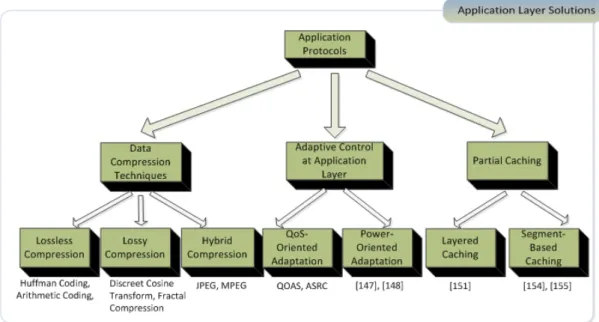
2.10 Classification of Application Level Optimization Techniques. . . 60
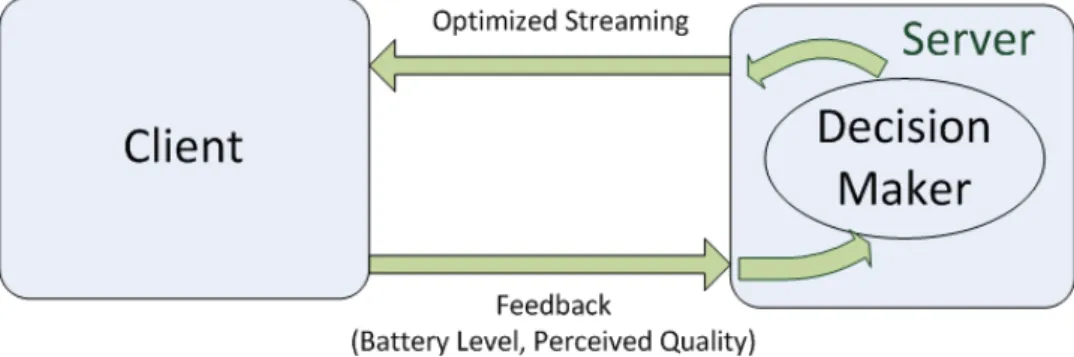
2.11 Illustration of Adaptive Control at Application Level. . . 63
2.12 Illustration of Partial Caching. . . 67
3.1 The Architecture of ASP . . . 77
3.2 The Architecture of Neural Network for Regression . . . 84
3.3 Graphical User Interface . . . 88
3.4 Class Diagram of Java Implementation . . . 89
3.5 Real Tests : Set-up of Devices . . . 91
3.9 Relation between Battery Discharge and CPU Workload - Two-stage
Frequency Setting . . . 94
3.10 Relation between Battery Discharge and CPU Workload without Know-ing Frequency SettKnow-ings . . . 95
3.11 Relation between Battery Discharge and CPU Frequency Settings . . 95
3.12 Relation between Battery Discharge and Bit Rate (Outbound Traffic) . 97 3.13 Relation between Battery Discharge and Packet Rate (Outbound Traffic) 97 3.14 Relation between Battery Discharge and Bit Rate (Inbound Traffic) . . 98
3.15 Estimations of Models Using Power as Training Target . . . 102
3.16 Estimations of Models Using Current as Training Target . . . 102
3.17 Estimations of Models Trained Using Predefined Tasks . . . 104
3.18 Estimations of Models Trained Using Daily Used Applications . . . . 104
3.19 Estimations of Playing High Quality ”Interview” . . . 105
3.20 Estimations of Playing Low Quality ”Interview” . . . 106
3.21 Estimations of Playing High Quality ”Surfing” . . . 106
3.22 Estimations of Playing Low Quality ”Surfing” . . . 107
3.23 Estimations of Playing High Quality ”Top Gear” . . . 107
3.24 Estimations of Playing Medium Quality ”Top Gear” . . . 108
3.25 Estimations of Playing Low Quality ”Top Gear” . . . 108
3.26 Utilisation-based Estimations (SVR) and Power Signature-based Esti-mations . . . 110
4.1 Example of Use Case Scenario for AWERA - Theme Park . . . 115
4.2 The Architecture of ASP and AWERA . . . 117
4.3 Cross-layer Mechanism of AWERA Working with ASP . . . 119
4.4 Class Diagram of AWERA Implementation in NS-2 . . . 126
4.7 Average Throughput - In Stationary Case (Kbps) . . . 131
4.8 Average Delay - In Stationary Case (Sec) . . . 131
4.9 Average Remaining Energy for Nodes Performing Multimedia Deliv-ery and Web Browsing, respectively - In Mobile Case (J) . . . 131
4.10 Average Throughput - In Mobile Case (Kbps) . . . 132
4.11 Average Delay - In Mobile Case (Sec) . . . 132
4.12 Simulation Topology - AWERA Scenario 2 . . . 135
4.13 AWERA Scenario 2: Average Energy Consumption of Nodes from Class A (J) . . . 139
4.14 AWERA Scenario 2: Average Energy Consumption of Nodes from Class B (J) . . . 139
4.15 AWERA Scenario 2: Average Energy Consumption of Nodes from Class C (J) . . . 140
4.16 AWERA Scenario 2: Average End-to-end Delay (Sec) . . . 140
4.17 AWERA Scenario 2: Average Throughput of Receiver Nodes (Kbps) . 140 4.18 Simulation Topology - AWERA Scenario 3 . . . 142
4.19 AWERA Scenario 3: Average Energy Consumption of Class A Nodes (J) . . . 144
4.20 AWERA Scenario 3: Average Energy Consumption of Class B Nodes (J) . . . 145
4.21 AWERA Scenario 3: Average Energy Consumption of Class C Nodes (J) . . . 145
4.22 AWERA Scenario 3: Average End-to-end Delay (Sec) . . . 145
4.23 AWERA Scenario 3: Average Throughput of Receiver Nodes (Kbps) . 146 5.1 Use Case Scenario of DEAS . . . 150
5.5 DEAS Scenario 1: Packet Loss Rate (%) . . . 161
5.6 DEAS Scenario 1: Energy Consumption (J) . . . 161
5.7 DEAS Scenario 1: Quality - PSNR (dB) . . . 162
5.8 Simulation Topology - DEAS Scenario 2 . . . 164
5.9 DEAS Scenario 2: Energy Consumption (J) . . . 166
5.10 DEAS Scenario 2: Quality - PSNR (dB) . . . 167
5.11 DEAS Scenario 2: Jitter (Sec) . . . 167
5.12 DEAS Scenario 2: Delay (Sec) . . . 168
6.1 The Latest Heterogeneous Wireless Networks . . . 172
6.2 Use Case Scenario of EDCAM . . . 176
6.3 Different Multimedia Content Delivery Strategy . . . 177
6.4 ASP Mechanism . . . 177
6.5 Architecture of EDCAM . . . 179
6.6 Sharing Partner Selection . . . 180
6.7 Handshake Procedure to Establish a Connection with the Partner for Content Sharing . . . 185
6.8 Class Diagram of EDCAM Implementation in NS-3 . . . 189
6.9 Simulation Topology - EDCAM . . . 190
6.10 EDCAM Scenario: Remaining Energy - 1Mbps Background Traffic . 197 6.11 EDCAM Scenario: Remaining Energy - 2Mbps Background Traffic . 197 6.12 EDCAM Scenario: Average Delay - 1Mbps Background Traffic . . . 198
6.13 EDCAM Scenario: Average Delay - 2Mbps Background Traffic . . . 198
6.14 EDCAM Scenario: Average Jitter - 1Mbps Background Traffic . . . . 199
6.15 EDCAM Scenario: Average Jitter - 2Mbps Background Traffic . . . . 199
6.16 EDCAM Scenario: Average PSNR - 1Mbps Background Traffic . . . 200
3G Third Generation of Mobile Telecommunications Technology
4G Fourth Generation of Mobile Telecommunications Technology
ACK Acknowledgement
AID Association ID
AMPS Advanced Mobile Phone System
AP Access Point
ARQ Automatic Repeat Request
ASN Access Service Network
AUC Authentication Centre
BE Best Effort
BSC Base Station Controller
BSS Base Station Subsystem
BSS Base Service Set
BTS Base Transceiver Stations
CBR Constant Bit Rate
CDMA Code Division Multiple Access
CDN Content Delivery Network
CN Core Network
DCF Distributed Coordination Function
DCT Discreet Cosine Transform
DIFS DCF Interframe Space
DSSS Direct-Sequence Spread Spectrum
EDGE Enhanced Data rates for Global Evolution
EIR Equipment Identification Register
ertPS extended real-time Polling Service
ETSI European Telecommunications Standards Institute
FDMA Frequency Division Multiple Access
FEC Forward Error Correction
FR Full Reference
FTP File Transfer Protocol
GPRS General Packet Radio Service
GSM Global System for Mobile Communications
HLR Home Location Register
HTTP Hypertext Transfer Protocol
IBSS Independent BSS
ICMP Internet Control Message Protocol
ICT Information and Communications Technologies
IMT-2000 International Mobile Telecommunications-2000
IP Internet Protocol
IPv4 Internet Protocol version 4
IPv6 Internet Protocol version 6
ITU International Telecommunications Union
JPEG Joint Photographic Experts Group
MAC Medium Access Control
MIMO Multiple Input Multiple Output
MOS Mean Opinion Score
MPEG Moving Pictures Experts Group
MSC Mobile Service Switching Centre
MSS Maximum Segment Size
NAV Network Allocation Vector
NMT Nordic Mobile Telephony
NR No Reference
nrtPS non-real-time Polling Service
NSP Network Service Provider
NSS Network Switching Subsystem
OFDM Orthogonal Frequency-Division Multiplexing
PAT Packet/ApplicaTion manager
PCF Point Coordination Function
PDA Personal Digital Assistants
PDV Packet Delay Variation
PESQ Perceptual Evaluation of Speech Quality
PEVQ Perceptual Evaluation of Video Quality
POP Post Office Protocol
PSM Power Saving Mode
PSQM Perceptual Speech Quality Measurement
QoE Quality of Experience
QoS Quality of Service
RR Reduced Reference
RTCP RTP Control Protocol
RTP Real-Time Transport Protocol
RTT Round Trip Time
rtPS real-time Polling Service
RTS Request-To-Send
RTSP Real Time Streaming Protocol
Rx Receive
SIFS Short Inter-Frame Space
SIM Subscriber Identity Module
SMTP Simple Mail Transfer Protocol
STELA Slow sTart Exponential and Linear Algorithm
TCP Transmission Control Protocol
TDMA Frequency Division Multiple Access
TIM Traffic Indication Map
Tx Transmit
UDP User Datagram Protocol
UGS Unsolicited Grant Service
UMTS Universal Mobile Telecommunications System
UE User Equipment
UTRAN UMTS Radio Access Network
VBR Variable Bit Rate
VLR Visitor Location Register
VoIP Voice over IP
WCDMA Wideband Code Division Multiple Access
WiFi Wireless Fidelity
WiMAX Worldwide Interoperability for Microwave Access
WNIC Wireless Network Interface Card
WPAN Wireless Personal Area Network
Introduction
1.1
Research Motivation
In recent years, the applications relying on wireless communications have extended their usage from narrow industrial areas to people’s daily life. The latest innovative digital mobile devices, such as smart phones and tablet PCs, are bringing the exten-sive developments of wireless communication technologies in the consumer device sector. This has exponentially increased the number of people connecting to the In-ternet through cellular and broadband wireless networks via mobile devices. People can work on such devices connected wirelessly to the Internet from homes, restaurants or even travelling trains. Some international conferences are held over the Internet to save costs and reduce CO2 emissions.
According to statistical results from industry reports and surveys, of the world’s 4 billion mobile phones in use, over 1.08 billions are smart phones, and half of the local searches are performed on mobile devices [1].
Smart devices are equipped with WiFi interfaces to connect to the wireless LAN infrastructure, often deployed in family homes, shopping malls or theme parks [2] in order to provide mobile users’ access to information and complex applications. This
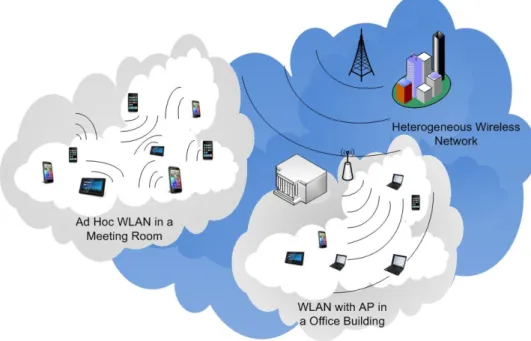
Figure 1.1: Mobile users in a heterogeneous wireless network environment
kind of wireless LAN may work alone or act as part of a heterogeneous network envi-ronment connected to the Internet. Many mobile devices have also cellular network in-terfaces to enable their connectivity to 3G/3.5G/4G networks in areas where broadband is not deployed. Cellular networks and wireless MAN/LANs are often used together to provide anywhere and any time connectivity. Therefore the coexistence of various network types as part of heterogeneous network environments is envisaged as the fu-ture in wireless networking. A hybrid ad-hoc and infrastrucfu-ture network environment is illustrated in Fig.1.1.
Along with the increasing coverage of the wireless networks, the emerging rich media features of the latest services also contribute to the popularity of the smart de-vices. The latest digital mobile devices support complex rich media applications which offer excellent user experience and large range of services, including file sharing, on line banking, family entertainment, online social networks, GPS navigation, and much more. Notably, recently more than half of the Internet searches were performed from mobile devices [1] and multimedia-based traffic accounts for 49 percent and 53 per-cent of the total data consumption over smartphones and tablets, respectively [3]. This
trend shows how people are increasingly using mobile wireless-enabled services.
The massive development and deployment of wireless networks have resulted in new demands and new challenges with regard to energy efficiency and performance. Energy efficiency is investigated both for the content providers [4] and client devices. On one hand, people demand more powerful devices and faster networks to accom-modate multimedia content delivery and complex applications, and these demands require more energy expenses. One the other hand, people expect devices to have slim shapes and large capacity battery to support the device running longer periods be-tween recharges without compromising mobility. This situation imposes challenges to the design of the energy efficient multimedia content delivery with regard to both the hardware (e.g. network infrastructure, smart phones) and software (e.g. applications, networking protocols). Moreover, increasing amounts of multimedia content are de-livered and will be exchanged over the future wireless networks, which requires new protocols and new solutions in order to suit the high bit rate, high timing constraint network traffic delivery.
As indicated by Martin et al [5], there is a need for a more sophisticated approach that takes into account the nature of the current application and current battery lev-els, analyses and processes the data and adjusts the delivery process in an innovative manner in order to prolong the battery life in real time for mobile devices. In this thesis, we address this issue and present a suite of energy efficiency solutions which include an energy efficient routing algorithm for mobile devices over ad-hoc and a cooperative adaptive multimedia delivery solution for mobile devices. Their Device-Differentiation feature is made possible by a novel Energy-oriented System Profiling process, a self-constructive application-aware energy modelling technique for mobile devices. The algorithms have been tested with both simulations and a prototype system that has been specifically developed.
1.2
Problem Statement
With the increasing deployment of heterogeneous wireless networks and fast devel-opment of smart devices, energy efficient multimedia content delivery becomes an important element in wireless networking. This observation is backed by concrete data: Cisco estimates handsets will generate in excess of 50 percent of mobile data traffic in 2014, and the video content will account for more than two thirds of the globe networking traffic by 2016 [6]. This trend is made possible by the multimedia capability support and ubiquitous network connectivity provided by the latest smart mobile devices.
Energy efficiency has always been a key issue in wireless communication. First, wireless communication requires cable free devices, which offer constant connectivity even on the move. In this case, the mobile devices are powered by battery with lim-ited capacity rather than mains power supply. Secondly, smart phone and tablet PC manufactures upgrade the devices with the more energy demanding faster processors and larger screens every year, while the revolution of the battery capacity does not take place at the same pace. To increase device lifetime by installing larger batteries would make people reluctant to carry and use mobile devices so often. In conclusion, energy constraint is always a big challenge for wireless networks and wireless devices.
In addition, as Information and Communications Technologies (ICT) sector is still developing all over the world, energy conservation has become a global environmental issue. Technology analysts claims that the ICT industry contributes with 2 percent to the global carbon emissions, which is approximately equivalent with that of the aviation industry. Moreover, it is estimated that ICT will be responsible for 3 percent of global emissions by 2020. However, the use of ICT can also increase energy efficiency and reduce emissions in other sectors, for example, transportation [7]. Therefore smart use of novel ICT technologies can determine reductions in CO2 emissions as well.
features and wireless networking protocols. For example, the CPU of smart phones will shut down part of its components when the work load is light; some smart phone applications sense the lighting conditions in the environment and adjust the back light brightness of the screen accordingly; some energy efficient routing and application layer protocols are proposed for energy saving during wireless data transmissions.
As smart devices gain more and more popularity all over the world, the content of networking traffic is changing during the years. For example, more multimedia content traffic is being delivered. In the old days of the Internet, the tiny bandwidth and slow computing capability determined the content of network traffic to be text dominated, for example, made of emails and Unix commands. Nowadays, VoIP, on line video chat, on line video sharing, and interactive gaming push the limit of the device as well as the wireless networks by exchanging rich media content. This multimedia content forms a very important element in the context of mobile device usage. In this sense, successful and efficient multimedia content transmission plays an important role in today’s networks.
In this context, there is a need to keep record of the device energy constraint infor-mation. This information is utilised by carefully designed protocols to provide device differentiated service for energy efficiency benefit of both the device and network. Maintaining energy constraint information and designing such protocols are problems. In this thesis, various device-differentiated energy-efficient solutions are presented and discussed. The major contributions are outlined in the next section.
1.3
Solution Overview and Contributions
This thesis presents ASP, an intelligent automatic ”energy-oriented Application-based System Profiling” process that builds an incrementally updated energy model for indi-vidual mobile devices. The process calculates the energy constraints of smart motile devices on demand. Using the energy constraint information provided by ASP, a
Figure 1.2: Relation between Four Contributions
Context-aware Differentiated Cross-layer Energy-efficient Routing solution (AWERA), and a Device-differentiated Adaptive Video Delivery solution (DEAS) were proposed and presented in this thesis. Based on DEAS, an Adaptive Energy Efficient Coop-erative Content Delivery solution (EDCAM) was proposed to utilise the multi-home capability of model mobile devices for further energy savings. The relation between these four contributions is depicted in Fig.1.2.
Various applications, devices and wireless links yield different contexts, and these contexts affect both performance and energy efficiency. AWERA keeps record of de-vice energy constraint using energy model and application power signature to differ-entiate devices for energy efficient ad-hoc routing which conserves more energy for relatively energy vulnerable devices.
DEAS monitors the active video application in terms of perceived quality, as es-timated using PSNR, and calculates device energy constraint using ASP. The infor-mation is then used by an energy-efficient quality adaptation algorithm to request the server to perform quality adjustments to the content delivery. This solution conserves
energy by requesting the less energy demanding lower quality content for devices with tight energy constraints.
EDCAM is a hybrid innovative content delivery solution that combines multimedia quality adaptation and content sharing mechanisms to save energy at client devices. EDCAM relies on ASP to assess individualdevice energy constraint. These constraints along with QoS delivery scores are used as metrics for the multimedia delivery quality adaptation. Each device will then search for a content sharing partner from which to retrieve the content, and therefore reduces the usage of high energy consuming networks and increases energy efficiency.
1.3.1 Energy-oriented Application-based System Profiling - ASP
According to the latest research [8] [9], the device energy constraints vary significantly for different applications. Besides, network traffic processing is one of the most en-ergy consuming tasks for the mobile devices. Based on these results, ASP’s goal is to record the power signatures in terms of typical power of mobile device for different ap-plications and maintains such information in the form of an application-based system profile. The profile is updated along the lifetime of the mobile device usage. Addi-tionally, a regression-based automatic energy modelling technique is used to generate the energy model for individual devices. Knowing the running applications’ type, the energy model along with the application profile will generate the current device energy constraint on demand.
This effort creates a learning mechanism for the device to adapt to the context environment automatically and reduces the overhead of monitoring. An initialisation phase is conducted to each device once only in order to make the learning process de-vice independent. The contribution is novel as ASP improves existing utilisation-based models by using application signatures for inexpensive and easy energy constraint esti-mations. For proof of concept purposes, ASP was implemented as a prototype system
on an Android platform.
1.3.2 Context-aware Differentiated Adaptive Routing - AWERA
Based on ASP, AWERA obtains and maintains context information, including link quality of the available links and energy constraint of the available devices. The con-text information makes possible to differentiate devices according to their concon-text of usage, in order to achieve prioritised routing/energy saving in ad-hoc routing scenar-ios. Moreover, the periodical updating mechanism enables adapt the routing strategy to any change in the context. In a mobile device formed ad-hoc wireless LAN, AW-ERA encourages devices with high energy budgets to act as intermediate nodes for data relaying in order to save energy at the devices with tight energy budgets.
Based on the energy model provided by ASP and context information, an adap-tive routing protocol is specially designed for energy efficient wireless routing. First, the context information is passed on to the network layer. In addition, link quality of the wireless links to the available neighbours is also considered in the routing pro-cess. Consequently, a dedicated routing information processing component converts the context information and link layer feedback into a new metric, which is maintained in a special routing table to accommodate such energy constraint-related context in-formation. The routing table will be updated periodically to suit any changes in the context. Such cross-layer effort makes AWERA effective in adapting to the change of context and efficient in energy conservation. Consequently, AWERA makes routing decisions intelligently and adaptively so that the most energy efficient routes are used during wireless data transmissions.
1.3.3 Device-Differentiated Adaptive Content Delivery - DEAS
The limited battery capacity of current mobile devices and increasing amount of rich media content delivered over wireless networks have driven the latest research on
en-ergy efficient content delivery over wireless networks. Many enen-ergy-aware research solutions have been proposed, such as traffic shaping, content adaptation, content sharing, etc. The existing solutions focus on the delivery application without con-sidering application running environment and device features that put different energy constraints on the whole content delivery process. DEAS based on ASP’s profile, per-forms energy efficient content delivery adaptation for the current multimedia delivery application. When the current energy budget is low, for example, when the device is running other energy consuming applications or the battery energy level is low, DEAS will request the content provider to transmit lower quality content to save energy. This is because lower quality content requires less energy for decoding and data transmis-sion. While the energy budget becomes higher, for example, when the other energy consuming application is closed, DEAS will request the content provider to transmit the multimedia content of higher quality.
1.3.4 Energy-efficient Device-differentiated Cooperative Adaptive Mul-timedia Delivery - EDCAM
Energy-efficient multimedia content delivery to mobile devices has always been an important subject. Since the increasingly affordable and powerful smart mobile de-vices are equipped with multiple networking interfaces, the multi-home networking capability of mobile devices has to be addressed to improve device energy efficiency. However, content sharing technique utilising multiple networking interfaces is mostly investigated for server bandwidth saving instead of client energy saving. Meanwhile content provider and client propose potential for device-based energy saving by offer-ing the same content at different quality levels and by quality adaptation (see DEAS).
In this context, EDCAM is proposed as a hybrid solution which combines multi-media content quality adaptation with content sharing aiming at saving energy at client devices. It uses ASP for energy-oriented application-based system profiling. The
en-tation while the device is receiving multimedia content. The device will then search for a content sharing partner to download the content collaboratively for reducing cellular interface usage and better energy efficiency.
EDCAM’s sharing-assisted adaptive delivery introduces two-party content sharing to address the above problems. The device establishes a simple ad-hoc WiFi connec-tion to a partner downloading the same content of the same quality. Secondly either device downloads half of the content and fetches the other half from each other. There-fore, the group management overhead is minimised.
1.4
Thesis Structure
This thesis is organised as such:
• Chapter 1 introduces the research motivation and the major contributions.
• Chapter 2 presents background knowledge and related works on energy efficient solutions at network layer, application layer, mobile platforms as well as cross layer energy saving solutions.
• Chapter 3 introduces ASP, the energy-oriented application-aware system pro-filling technique used to provide device energy constraint information to other proposed solutions. Then it presents the prototype implementation of ASP and the real test results, including scenario set-up, testing strategy, energy model validation and results analysis.
• Chapter 4 introduces AWERA and explains its architecture and algorithm, in-cluding routing cost calculation and routing mechanism. Then it presents the simulation test bed description and testing results for AWERA in comparison with MBCR and AODV.
includ-ing battery life time calculation and quality adaptation mechanism. Then it presents the simulation test bed description, and testing results for DEAS in comparison with SAMMy, ESTREL and No adaptation.
• Chapter 6 introduces EDCAM and explains its architecture and algorithm in-cluding sharing partner selection and content sharing mechanism. Then it presents the simulation test bed description, and testing results for EDCAM in compari-son with DEAS, ESTREL and No adaptation.
Background and Related Works
2.1
Layered Protocols Model
Network technology makes end-to-end communication possible by delivering data from the source device to the destination device. Sometimes data has to travel along different networks and devices to reach its final destination. In order to meet perfor-mance requirements and maintain connectivity and compatibility, researchers designed various protocols to regulate the behaviour of network devices while sending, receiving and forwarding data. These protocols are distributed over a protocol stack consisting of various layers, each layer offering services to the layer above. In this chapter, we focus on a five-layer-model where the protocol stack from top down, is divided into application layer, transport layer, network layer, data link layer including Medium Ac-cess Control (MAC) layer and Physical layer as illustrated in Fig. 2.1.
Application layer implements various protocols used by user applications such as video streaming, file sharing (FTP), web surfing (HTTP), etc. It governs end-to-end application-specific data communication transparently. From the viewpoint of appli-cation layer, appliappli-cations are communicating with each other directly. Appliappli-cation’s running status can be adjusted to conserve energy and collect user response to support
Figure 2.1: Layered Protocols Model
QoS.
Transport layer ensures end-to-end data transfer between source-host and destination-host by establishing and maintaining the connection between the pair of destination-hosts. It pro-vides a simplified networking interface to each host without the complexity of network topology. Retransmission mechanisms and congestion control can be tuned to support QoS.
Network layer maintains an identifier for each host in the network and performs routing by directing packets to the right network device, namely the router/host closer to the destination, so that packets could cross one or more networks to reach the desti-nation. IP hand-off can be performed for mobile hosts to maintain connectivity. Rout-ing protocols can apply energy-aware and performance-related metrics while makRout-ing routing decisions.
The protocols at data link and especially at MAC layer, a sub layer of link layer, are deployed at a lower layer and govern the access to communication medium ensuring packet exchange between direct linked devices. Improved MAC layer protocol may effectively improve energy efficiency and performance.
Physical layer takes care of the very low level bit-by-bit data transmission.
Energy saving techniques and QoS support features can be implemented into pro-tocols at each individual layer, including cross layer approaches where propro-tocols at different layers can easily interact with each other exchanging information regarding
link quality, energy consumption, error rate and various other types of parameters.
2.2
Energy-Efficient Network Layer
Network layer maintains the identifier of each host within the network (i.e. IP ad-dress) according to which routing protocols identify each individual host in order to be able to find a path from a source to the destination over one or more networks. It can effectively reduce the energy consumption of the networks by reducing the en-ergy consumption at relaying devices and router. For example,EABF[10] and [11] effectively improve the energy efficiency of packet forwarding devices from the view point of hardware design. Energy efficient routing protocols achieve the same goal of saving energy from the view point of routing protocol design. Routing protocols gather information such as distance between hosts, link quality, bandwidth availability and number of intermediate hosts. Based on this information, possible routes intercon-necting each pair of hosts are calculated. A desirable route can then be selected if any available. This can be done in a distributed fashion by allowing hosts to make their own decisions, or have a centralized decision making approach.
Transmitting a packet from a source host to the destination host is similar to navi-gating through a big city or event between locations in distinct cities. For a big city, it is quite common to have a number of buses that could take the passenger to the desti-nation through different routes. Among those routes, there will be a route taking least time, a route having shortest distance, a route having least gas consumption, and so on. Normally, people would go for the one taking least time, namely go for the rout-ing protocol that can deliver data as soon as possible with shortest delay. However, to find the most energy efficient route could make more sense in certain scenarios due to the fact that each host may have different energy constraints (remaining energy level, battery capacity, energy depletion rate, etc).
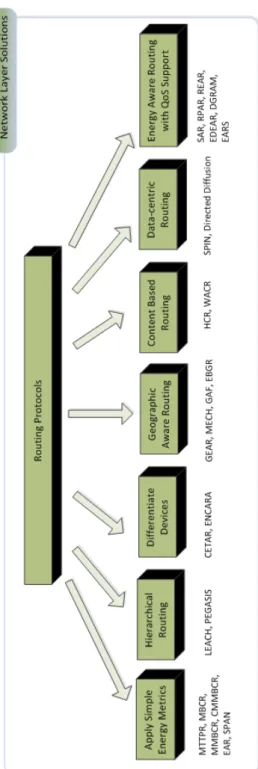
Figure 2.2: Classification of Energy Efficient Network Protocols .
metrics can be used by the routing process as well as geographic information. The hierarchical structure of mobile hosts also promotes better performance and energy efficiency. In addition, more recent routing techniques including data-centric routing
and content-based routing are content centric and application-aware, which is a handy feature for performance optimization. Besides, QoS support can be embedded into the routing process by traffic differentiation and load balance at network level.
The classification of energy efficient network layer protocols is depicted in Fig. 2.2. The following sections present various energy-aware packet routing techniques.
2.2.1 Energy-aware Routing
Energy-aware routing is of paramount importance especially for applications involving ad-hoc multi-hop wireless networks where the limited energy capacity of most typical wireless devices brings this challenge forward. The amount of energy consumed to transmit a packet between two hosts depends on the link quality and state. In the context of ad-hoc networks where two distant hosts can be connected over distinct links and routes an energy efficient routing protocol can conserve energy by specifying a certain route from the source to the destination based on energy considerations.
Minimum Total Transmission Power Routing (MTTPR) [12] takes the most straight forward approach by selecting the route with the least total energy cost. It usually takes several hops from the source to the destination, and each hop requires a certain amount of energy to transmit a packet. For every candidate path from the source host to the destination, MTTPR collects and adds up the energy cost of each hop to give a total cost for each path, and consequently selects the path with the least total energy consumption.
Besides the amount of consumed energy, the capacity and remaining energy level of battery could also be a metric for energy aware routing protocols, because devices with more remaining battery could survive longer and forward more incoming packets than those with little remaining battery capacity. Instead of total energy consumption, Minimum Battery Cost Routing [13] chooses the total remaining battery capacity of every device along each path as the metric and gives the total remaining battery
capac-Figure 2.3: Minimum Battery Cost Routing
ity of each route. It compares the battery capacity of all possible routes and uses the one with devices along it of most remaining energy. This is shown in Fig.2.3, where the black path containing more hops might be selected as an optimal on other than the red path, due to the fact that the black path includes two fully charged nodes, which makes the black path have more total remaining energy than the red one. Because MBCR considers a path as one entity, it fails to anticipate such fact as a path with most battery remaining could include a device with very little remaining energy. If a route as such is used, it will drain the energy of the ”weak device” and becomes broken path soon.
To address this issue Min-Max Battery Cost Routing (MMBCR) [13] checks the remaining battery level of each device to avoid involving devices with low power along the path.
Conditional Min-Max Battery Cost routing [13] is a hybrid solution mixing MTTPR and MMBCR. The remaining energy of each device along the path is con-sidered, together with the total energy consumption for each path. The two factors combined determine the cost of each route.
Arezoomand et al. [14] improved MBCR by recording the hop count of each route as well as the total energy consumption, thus avoiding devices with little energy since these will bring down the average remaining energy per hop.
Energy Aware Routing (EAR)[15] is a more sophisticated solution which con-siders both energy cost of each hop and the residual energy level of each host. The normalized values of these two measures are used by EAR to compute and select routes. Based on these values a host chooses the neighbor with the highest energy level and lowest link energy cost. Consequently, EAR achieves efficient energy distri-bution among hosts and avoids unbalanced energy consumption.
Span[16] is a distributed algorithm which allows each host to make its own deci-sions regarding sleep schedule. By evaluating the available energy and the contribution it can make to the overall network connectivity (the more pair of hosts it can connect, the more it can contribute) it decide if it should stay in active mode or switch to sleep mode. Therefore Span is a localized routing solution that decreases routing overhead, scales well and has short route computing delay.
Wei et al. [17] presents an energy saving dynamic relaying scheme in cooperative networks using finite-state Markov decision process based prediction method. The Markov decision process is used to predict the upcoming channel state, relay selection and transmission power selection. The formulated decision process results in energy efficient relay selection that makes more efficient use of wireless channels.
2.2.2 Hierarchical Routing
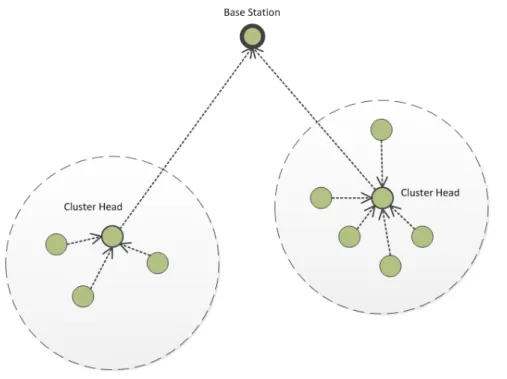
For infrastructure-based wireless networks, hosts need to communicate with base sta-tions regardless of the distance. However, routing protocols could organize hosts into clusters and elect a head for each cluster so that only that particular host has to com-municate directly with the base station. In this manner, the rest of the hosts within the same cluster only communicate with the head host, which is closer and accessing it is
more energy efficient.
Low Energy Adaptive Clustering Hierarchy (LEACH) [18, 19] is a cluster-based solution as depicted in Fig. 2.4.
PEGASIS[20, 21] is a chain-based hierarchical routing algorithm. Each non-head host only exchange packets with its two direct neighbors forming a chain for each cluster. Compared with LEACH, this mechanism further reduces energy consumption since it requires even less energy to communicate with direct neighbors instead of the cluster head.
The main disadvantages of the above solutions include the head host depleting battery faster due to extra workload to aggregate packets from every cluster member and communicate with the base station on their behalf. On the other hand, single tier clustering may not be as effective as expected for wide area routing.
To address these issues, Liu et al. [22] presents a multi-levels cluster-based routing solution for wireless vehicular sensor networks which rotates the holder of the cluster head duty and offers multi-tier cluster hierarchy. It outperforms LEACH in terms of stability and energy efficiency for long range communications. Furthermore, multi-tier clustering makes large scale deployment possible, which is suitable for vehicular network applications.
2.2.3 Differentiate Devices
Energy Type Aware Routing (CETAR)[23] differentiates devices based on their role in data exchange: receiver or sender. A device sending data packets to other hosts for a long period is considered an active sender. This device consumes more energy with data generation and forwarding. CETAR discourages active sender to act as routers in order to conserve the energy of these active senders.
Figure 2.4: Low Energy Adaptive Clustering Hierarchy (LEACH).
same wireless network regardless of their software environment, power source, battery quality, etc. For instance, a laptop running on-line gaming applications tend to exhaust its battery faster than a Smartphone browsing the web. A mains powered desktop PC has no energy concern as such at all.
ENCARA[24] differentiates devices by their energy-related characteristics such as software environment and hardware specification. Consequently devices with criti-cal energy constraints will be protected for longer battery lifetime.
2.2.4 Geographic Routing
Geographic information is a very important piece of the routing puzzle for energy aware path computation. It is more energy efficient for hosts to transmit packets to those closer to them, since it requires less power to perform short range data trans-missions. On the other hand it is always efficient to transmit data packets towards the direction of the destination host.
Geographical and Energy Aware Routing (GEAR)[25] makes use of geograph-ical and energy aware neighbor selection algorithms to forward packets to the tar-get region which covers a relatively small number of hosts including the destination. The protocol disseminates the packet in the region by recursive geographic forward-ing/restricted flooding mechanisms. First, the area pointing towards the destination is established as a target region which is the preliminary direction for the routing path to follow.
Minimum energy communication network (MECN)[26] is a distributed local-ized algorithm which computes an energy efficient topology with energy efficient paths from destinations to sources by using each host’s location information from its global positioning device (i.e. Global Positioning System).
Figure 2.5: Geographic Adaptive Fidelity Protocol
Geographic Adaptive Fidelity Protocol(GAF) [27] makes use of location infor-mation gathered from GPS to divide the whole area into virtual grids and each host in the network will use the information to fit in a grid. As illustrated in Fig.2.5, within each grid, the host with highest residual energy will be elected as a master (M nodes) that forwards packets for the rest hosts (S nodes) in the same grid. This solution shares the same idea as hierarchical routing and works with the assistance of location infor-mation. ThePower Aware Localized Routing Protocol(PLR) [28, 28] is a localized routing protocol assuming hosts to know only location information of neighbours and the destination. In this manner, source hosts need only to find the best route to next stop towards the direction of the final destination, rather than finding the optimal route
to the destination. PLR needs less routing packets, less overhead and response more quickly to topology change, consequently this mechanism conserves energy for wire-less hosts.
Recently, Zhang et al. [29] proposed anEnergy-efficient Beacon-less Geographic Routing protocol (EBGR). Conventional geographic routing uses beacon mecha-nisms to maintain location information for routing decisions leading to extra routing overhead. EBGR does not apply such beacon mechanisms. Instead, a localized rout-ing decision is made when a host has a packet to transmit. First, the host will have to define the ideal position for the next hop based on the direction of the destination and energy efficient distance, and then it chooses the host that is closest to the ideal position with respect to the upper bound set for distance and energy consumption.
Many geographic routing solutions assume the availability of real time geographic information . However, it is challenging to obtain such information in reality, es-pecially in delay/disruption tolerant networks. Reach-and-Spread[30] assumes the real time geographic information of mobile destination is unavailable. Therefore it estimates the movement range of the destination based on its historical geographic in-formation. A two-phase mechanism was proposed to reach to the destination range first and spread the message in that range in phase two. The evaluation results show its benefit in terms of delivery ratio, delivery latency and overhead ratio.
2.2.5 Energy Aware Routing with QoS Support
Recently, the networks transport an increasing amount of multimedia content requiring QoS support raising new challenges for the design of routing protocols.
Luo et al. proposed a delay constrained routing algorithm for LEO satellite net-works in [31]. The routing of LEO satellite netnet-works is challenging due to the move-ment of satellites and the network topology. The slow re-routing process results in poor QoS. In this context, the authors proposed a weighted graph model to analyse the
routing problem and the proposed routing algorithm uses approximation methodology to find the path that meets the delay constraint.
Sequential Assignment Routing (SAR)[32] constructs multiple trees, rooted at a neighbor, and allows all hosts to have multiple paths to other hosts with different QoS and energy constraints. By estimating the maximum number of packets which can be transmitted before battery depletion and the QoS metric (delay and priority of packets) along a certain route the optimal path can be selected. The QoS metric is evaluated by weighted delay value in conjunction with the priority of packets. Since SAR is designed for Wireless Sensor Networks (WSN) with low mobility, it is table driven and maintained by periodically exchanging energy and QoS updates between hosts.
Real-time Power-Aware Routing (RPAR)[33] protocol supports energy efficient real-time communications in wireless sensor networks (WSNs). It dynamically adapts transmission power and routing decisions based on packet deadlines in order to achieve energy efficiency and delay guarantees for real-time applications. The neighbor man-agement applies on-demand mechanisms rather than periodical beacon transmissions. Consequently neighbor discovery is only triggered when there is no route available, and it only allows hosts that can meet the required bit-rates to reply and join the routing table. In addition, when bit-rate requirements are satisfied, it will decrease the trans-mission power to improve energy efficiency, otherwise it increases the transtrans-mission power to assure effective data transport. This mechanism effectively reduces energy cost for neighbor management. However, RPAR may suffer from sudden congestions.
Bandwidth is an important resource in wireless networks since multiple interfaces may share the available channel bandwidth and cause interference during communica-tion. Therefore, being able to estimate bandwidth availability and allocate it efficiently could be an effective approach to achieve better performance.
EffatParvar et al. [34] proposed a solution which makes hosts query the bandwidth availability of their neighbors and estimate bandwidth requirements for effective
com-munication in order to enable admission control mechanisms. Thus, only effective wireless communications can take place. Furthermore, it encourages local repair of broken links, where hosts try to fix the broken paths or find a bypass locally without initiating new route search.
Taleb et al. [35] proposed a cross layer approach for TCP/RTP-based multime-dia applications in heterogeneous wireless environments. In such environments, the bandwidth availability over different network types may vary raising new challenges. To address these issues, the proposed solution makes use of a cross layer approach. A physical layer mechanism detects overlapping access point coverage areas and pro-vides useful information to assist hand-off decisions. The application layer records user mobility pattern and estimates next possible access point. With this support, net-work layer is able to find alternative (new) routes in the overlapping area. Transport layer uses two routes to setup two connections, of which the new connection uses dummy packets for bandwidth availability estimation via TCP/RTP. This combined solution proved to be efficient in terms of performance and energy efficiency.
REAR [36] is a reliable energy aware routing protocol. It considers residual en-ergy capacity of each host and each candidate route. Hosts will forward routing pack-ets after a delay, which is determined by their remaining energy level. In other words, hosts with high remaining energy capacity will forward routing packets first and will be selected as the next hop. With the depletion of available energy, a path energy level may be lower than a threshold and will be replaced by a new path in order to achieve balanced energy usage. To ensure reliable data communication, REAR applies a re-transmission mechanism with acknowledgment packets. Furthermore, it makes use of multiple routes to ensure successful transmission as well.
EDEAR[37] applies reinforcement learning to achieve energy and delay efficient routing. Wireless networks often experience dynamic traffic conditions and this at-tribute makes QoS support an important requirement for routing. Reinforcement learn-ing process can adjust the routlearn-ing algorithm based on parameters that reflect current
status of the whole environment (i.e. traffic conditions). Therefore, reinforcement learning makes adaptive routing possible, where routing protocol estimates delay and routing cost according to previously collected data. EDEAR collects information re-garding the residual energy of each host, energy consumed on each link of one-hop neighbors and link delay from intermediate hosts and compute the cost for each path. EDEAR explores the whole network and uses exploring agents to learn from past ex-perience in order to compute the best path.
DGRAM[38] is a TDMA based energy efficient and delay-aware routing solu-tion. It requires beacon exchange to collect location information and uses slot reuse techniques to achieve shorter delay. First, hosts have to be uniformly distributed and exchange location information to learn the topology. Then, DGRAM constructs a log-ical structure based on the network topology with several tiers to ensure data packets are transmitted towards the destination from the inner tier to outer tier. Based on math-ematical analysis, DGRAM provides delay guaranteed routing with energy efficiency considerations.
EARS[39] is an energy efficient and reliable data-centric routing protocol. Data-centric routing protocols, a widely used type of routing protocols for WSN, suffer from large energy costs resulted from large amount of overhead traffic used to advertise interests and explore data availability. EARS introduces a new metric considering data rate and frame error rate at MAC layer for each host to exclude links of bad quality from the process of advertising interests, so that better communication reliability and energy efficiency are achieved.
2.2.6 Content-based Routing
Content distribution networks (CDN), multimedia content is stored, cached and repli-cated at server level. User requests for the same content will be directed to several servers in order to avoid server overloading and high delays with negative impact on
QoS. In other words, content-based routing is an act of load balancing for better per-formance.
An approach to content based routing is to use DNS servers to store information regarding candidate servers for content distribution and redirect user requests to a par-ticular server based on pre-defined performance metrics. Another approach is to make routers content-aware by using upper layer information and construct content-aware networks in order to make routing decisions with respect to content-based policies.
Miura et al. [40] proposed a solution taking the second approach. A natural way to load balance is to aggregate information of each server current load. However, this may result in significant amount of traffic overhead. As a matter of fact, network delay is very important as well and it reflects the condition of links reasonably accurate. Consequently routers are used to monitor each traffic flow and calculate the application layer Round Trip Time (RTT) between the router and the server to record total response time. By doing this, it reduces routing overhead and still delivers good performance. In addition, it applies probabilistic server selection in case client requests concentrate at a single server. However, the latency between the router and the server cannot accurately reflect the latency between the client and the server. Therefore, the closer the client is to the router, the more accurate the results will be.
Hierarchical Content Routing[41] organizes servers with replicated content into clusters to form a hierarchical structure, where routing process is performed intra-cluster-wise and inter-intra-cluster-wise. For intra-cluster content-based routing, hashing-based schemes are applied. Each router maintains a hashing table of content held by other servers within the cluster, so that each router can effectively query another a router for available content with reduced routing overhead. Meanwhile, inter-cluster content based routing is performed using queries. A content request will be forwarded via the cluster head to neighbor clusters. This hierarchical solution is suitable for large-scale scenarios.
Wide area content based routing[42] uses tag mechanisms to support routing. It constructs a virtual content network (VCN) between clients and servers. Once the client request arrives at the edge of the VCN, this routing scheme tags the packet with routing policy information and content information, which will be added to all consequent packets of the same traffic flow. The content aware routers in the VCN will make routing decisions based on the tags. This scheme is efficient and it saves effort for consecutive packets in the same flow and provides another layer for efficient router level data processing.
Carzaniga et al. [43] proposed another content-based routing scheme which is based on message broadcasting. It builds up a virtual layer to include attributes rep-resenting content information for packets. Hosts keep track of servers holding certain content by recognizing certain attribute values. When receiving requests, intermediate hosts try to match predicates of requests against their record and find the route to the source.
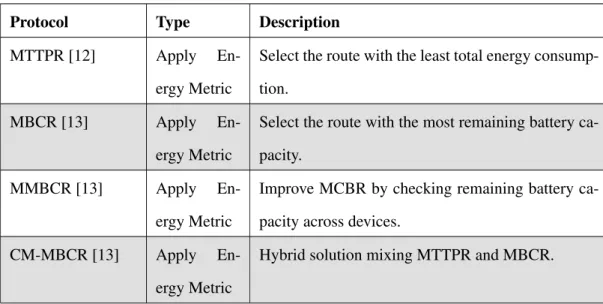
Table 2.1 presents an overview of the energy efficient solutions for the network protocols discussed in this section.
Table 2.1: Energy efficient Network protocols.
Protocol Type Description
MTTPR [12] Apply En-ergy Metric
Select the route with the least total energy consump-tion.
MBCR [13] Apply En-ergy Metric
Select the route with the most remaining battery ca-pacity.
MMBCR [13] Apply En-ergy Metric
Improve MCBR by checking remaining battery ca-pacity across devices.
CM-MBCR [13] Apply En-ergy Metric