The case for a 0.05% criminal law blood alcohol
concentration limit for driving
E Chamberlain, R Solomon
. . . . Injury Prevention2002;8(Suppl III):iii1–iii17
C
anada established its current 0.08%Crimi-nal Codeblood alcohol concentration (BAC)
limit for drivers in 1969*.1 2At the time, this
was a substantial improvement, as it established a
per se BAC limit under the criminal law and
required impaired driving suspects to provide breath samples. However, in the more than three decades that have followed, breath testing instru-ments have become more accurate, public atti-tudes toward impaired driving have hardened, and scientific research has established that impairment begins at levels below 0.08%. In response, the international trend was and
contin-ues to be to reduceper seBAC limits to 0.05% or
lower. The legal BAC limits of various countries are not always uniformly reported. The legal limit is reported to be 0.05% in numerous countries, including Argentina, Australia, Austria, Belgium, Bulgaria, Croatia, Denmark, Finland, France, Ger-many, Greece, Iceland, Israel, Italy, Macedonia, the Netherlands, Norway, Portugal, Slovenia, and Spain. Russia and Sweden have a legal limit of 0.02%, and Poland has a limit of 0.03%. Finally, the official limit is reported to be 0.00% in the Czech Republic, Hungary, Malaysia, Romania, Saudi Arabia, and Turkey, while Japan’s limit is 0.00% in practice.3–5
Nevertheless, the Canadian federal govern-ment has been reluctant to follow this inter-national trend. In 1999, the House of Commons Standing Committee on Justice and Human Rights received numerous submissions support-ing a 0.05% BAC limit. However, in its final report,
Toward Eliminating Impaired Driving,6the Standing
Committee rejected the proposals to lower the
Criminal Code BAC limit to 0.05%. The
Commit-tee’s reasons included: “a lack of scientific evidence that there would be any value in lower-ing the legal BAC limit”, a “lack of consensus among experts in the field”, “a loss of public sup-port”, and “additional enforcement burdens”. Finally, concerns were expressed that there would be insufficient police and judicial resources to cope with a lower BAC limit, because it would “more than double the number of drivers who would be liable to prosecution”.
Unfortunately, the Committee failed to care-fully analyze the 0.05% issue or consider the growing body of relevant research. The concerns
the Committee expressed about a 0.05% BAC limit were either unfounded or exaggerated, and its conclusion on the issue is contrary to the weight of evidence on the traffic safety benefits of lowering BAC limits. In our view, the 0.05% issue warrants far more thorough consideration, par-ticularly in Canada.
Despite the progress that has been made, impaired driving remains, by far, the leading
criminal cause of death7–9and one of the leading
criminal causes of injury7 10in Canada. In recent
years, alcohol related crashes have claimed between two and three times as many lives
annu-ally as all violent crimes combined.9 Alcohol
related crashes have been estimated to cost Cana-dian society between 1.5 and 10 billion dollars a
year.11Opinion poll data indicate that millions of
Canadians continue to drink and drive, many in situations when they thought they were over the legal limit.12–14As we shall discuss, Canada already
lags far behind the world leaders in traffic safety in terms of the high percentage of impairment among its fatally injured drivers.
The purpose of this paper is to review the evidence regarding the potential benefits of
creat-ing a 0.05% Criminal Code offence in Canada.
Although the exact details must be left to the leg-islative process, what is envisaged is a federal summary conviction offence that would include: ticketing and other streamlined procedures for processing cases; the option of entering a guilty plea without a court appearance; substantially lower penalties than the existing 0.08% BAC offence; and provisions to protect first time 0.05% BAC offenders who do not reoffend from having a permanent criminal record.
Unlike the situation in many jurisdictions, no single level of government in Canada has comprehensive constitutional authority over im-paired driving. Under theConstitution Act, 1867,15
the federal government may enact criminal offences prohibiting various aspects of drinking and driving, but has no authority to regulate driving or licensing. Even if the federal govern-ment wanted, it could not impose administrative licence suspensions on drinking drivers or inter-fere with the provinces’ and territories’ adminis-trative licence suspension initiatives. In turn, the provinces and territories have broad authority over roads, driving and licensing, and can create offences in relation to these matters. However, the provinces and territories do not have the constitu-tional authority to create crimes.
. . . . *Defines the offence of impaired driving to include both driving while one’s ability to do so is impaired by alcohol or drugs (s 253(a)) and driving with a BAC above 0.08% (s. 253(b)). Although drinking drivers with BACs below 0.08% may be convicted under s 253(a), this is uncommon. Consistent with usual practice in Canada, we have used the term “impaired driver” in a narrower sense to refer to drivers with BACs above 0.08%, unless otherwise indicated.
. . . . Abbreviations:BAC, blood alcohol concentration; FARS, Fatality Analysis Reporting System; GAO, General Accounting Office; NHTSA, National Highway Traffic Safety Administration; TIRF, Traffic Injury Research Foundation
See end of article for authors’ affiliations . . . . Professor Robert Solomon, Faculty of Law, University of Western Ontario, London, Ontario, Canada N6A 3K7;
[email protected] . . . .
The proposed criminal 0.05% offence would not replace, but
rather would complement, both the existing Criminal Code
impaired driving offences and the provincial and territorial short-term administrative licence suspension legislation. Thus, for example, an Ontario driver whose tested BAC was 0.07% would be subject to both a 12 hour licence suspension under the
provincialHighway Traffic Act16and a criminal charge of driving
with a BAC above 0.05% under the federalCriminal Code.17
This paper is divided into four sections. The first briefly examines the research on the adverse effects of small amounts of alcohol on driving related skills and abilities. The second sec-tion reviews the studies on the increased relative risks of fatal crashes among drivers at various BAC levels. In the third section, we discuss the real world impact of lowering various administrative and criminal BAC limits in Canada and abroad. The fourth section addresses the arguments, drawn primarily from the Committee Report, that have been raised in opposition
to introducing a 0.05%Criminal CodeBAC offence in Canada.
In the conclusion, we argue that the evidence supports the
introduction of a 0.05%Criminal Codeoffence. Contrary to the
Committee Report, we suggest that a 0.05%Criminal CodeBAC
limit is an essential element of any meaningful reform of Canada’s federal impaired driving laws. Although the issue falls outside the scope of this paper, in our view the other essential element is the enactment of broader and more efficient police powers to stop vehicles, detect drinking drivers, and gather evidence of impairment.
Given the unique constitutional division of legislative powers between Canada’s federal and provincial governments, there is no exact parallel that can be drawn from the international experience with lower BAC limits. Moreover, no two jurisdic-tions have identical legislation governing police powers, driver licensing, alcohol regulation, or the other variables that would likely affect the impact of lowering various types of BAC limits. Since there is no one conclusive study or perfect analogy, all of the relevant evidence from Canada and abroad must be consid-ered. In our view, one cannot predict the exact nature or specific magnitude of the traffic safety benefits that will result from
cre-ating a newCriminal Code0.05% BAC offence. Nevertheless, as
will be shown, the weight of the evidence indicates that this measure will contribute to significant reductions in drinking and driving, and resultant crashes, injuries, and fatalities.
While this paper focuses on Canada’s legal and enforcement framework, the majority of the discussion is applicable to any country contemplating a change in its legal BAC limit. Evidence on the effects of alcohol on driving related skills and the relative risk of crash is relevant to drivers in any jurisdic-tion. The review of the real world experience with lower BAC limits encompasses diverse BAC laws drawn from numerous countries. Moreover, many of the arguments made against a
0.05% Criminal Code BAC limit in Canada have been raised
before in other jurisdictions and, no doubt, will be raised again whenever lower BAC limits are proposed.
SECTION I. EFFECTS OF LOW DOSES OF ALCOHOL
International medical and traffic safety studies spanning sev-eral decades have established that driving related skills and driving performance are adversely affected by relatively small and moderate amounts of alcohol. As early as 1960, a British Medical Association report stated that “a concentration of 50 mg% of alcohol in 100 ml of blood while driving a motor vehi-cle is the highest that can be accepted as entirely consistent
with the safety of other road users”.18 More recently, the
authors of a review of 109 studies on the effects of low doses of alcohol concluded that there is “strong evidence that impairment of some driving-related skills begins with any
departure from a zero BAC”.19Moreover, they found that those
skills and abilities considered to be most important for driving were among the most sensitive to alcohol. We briefly summa-rize below the evidence relating to several of the key skills and abilities.
(A) Vision
Studies consistently show that visual functions are adversely
affected at BACs as low as 0.03%.19Because alcohol generally
has a relaxing effect on muscles, it impairs the ability to control
the fine, discrete muscles that move and focus the eyes.20
Spe-cifically, BACs between 0.03% and 0.05% interfere with volun-tary eye movements and impair the eyes’ ability to rapidly track a moving target.21The ability to track objects is critical to
driv-ing, as drivers must be able to focus on certain objects and track them as the objects and their own vehicles move. A driver’s ability to focus is impaired by alcohol’s relaxing effect on the muscle that controls the shape of the eye’s lens.20
Further, research indicates that drivers who have been drink-ing move their eyes less frequently and fixate on one area for longer periods of time. Visual acuity is hampered because alco-hol reduces the amount of oxygen in the bloodstream, and thereby impairs the sensitivity of the cones at the back of the eyeball, which help to transmit colour images from the retina to the brain. Drinking drivers may also suffer from double vision, as their relaxed eye muscles impair the eyes’ ability to work together. This affects the driver’s ability to judge distance, which
has been found to be impaired at BACs as low as 0.047%.19As a
result of this decreased depth perception, drivers may have dif-ficulty changing lanes, passing other cars, or determining
whether a vehicle is moving toward or away from them.20
Alcohol can also affect a driver’s night vision.22Drivers who
have been drinking have a slower recovery rate from headlight glare, as it takes longer for their pupils to enlarge again after
being exposed to bright light.20The alcohol-reduced sensitivity
of the rods and cones exacerbates the already difficult task of seeing in low light, reducing a driver’s ability to detect objects in the field of view. This is of particular concern because
drinking drivers tend to be more prevalent at night.23Finally,
drivers who have consumed relatively moderate amounts of alcohol have reduced peripheral vision, and are less likely “to perceive or recognize objects and signals outside the central
visual field”.24One study found that the deficit in peripheral
detection ability is 6% at a BAC of 0.02%, and 20% at BACs
between 0.05% and 0.08%.24
(B) Vigilance and drowsiness
Low doses of alcohol have a negative effect on vigilance and
drowsiness.19In their 2000 literature review, Moskowitz and
Fiorentino reviewed nine studies on vigilance, comprising 18 separate test results. Every study found impairment of vigilance tasks at BACs of 0.03% and above. These studies generally tested the subjects’ ability to sustain attention or remain alert over extended periods of time. These skills are critical if drivers are to remain watchful for hazards, particu-larly when the drive is long, routine, or uneventful.
Somewhat related to the vigilance issue are the studies that show that drivers with BACs as low as 0.01% are likely to fall
asleep faster than sober drivers.19 This is particularly
important because recent studies have indicated that drowsy drivers are a notable traffic safety concern. For example, the Australian Federal Office of Road Safety has estimated that
25% to 35% of all fatal crashes involve driver fatigue.25Traffic
authorities in New Zealand estimated that fatigue is involved in 5% of injury crashes and 8% of fatal crashes. However, they noted that these figures likely underestimate the problem, given the difficulty of recognizing fatigue as a contributing factor in a crash.26
Further, approximately one third of all fatal crashes involv-ing fatigue in New Zealand also involved a driver who had
been drinking.26A similar pattern was found in a New York
study, where more than one in three drivers surveyed after a drowsy driving crash admitted that they had consumed
alcohol.27 Even small amounts of alcohol can enhance the
effects of drowsiness, and the risk patterns for drowsy and
crashes, driver fatigue crashes most often occur during late night hours27 28or on the weekend,29involve a single vehicle,27
and cause serious injuries or death.30 Alcohol related and
driver fatigue crashes are also more likely to involve young
male drivers than other types of crashes.27While some of these
similarities can be attributed to lifestyle patterns, it is notable that drowsiness affects the same set of driving related skills as low doses of alcohol, particularly reaction time, vigilance, and
information processing.27
(C) Psychomotor skills
Low doses of alcohol can adversely affect the psychomotor skills related to driving, especially steering and braking. One study indicated that significant impairment of steering ability
begins with BACs as low as 0.035%.31 Similarly, a Canadian
study conducted on closed roads and airport taxiways found that subjects with a mean BAC of 0.06% had significantly
impaired performance in steering accuracy.32In another study,
drivers with a mean BAC of 0.042% hit substantially more
cones in an evasive manoeuvre at 50 km per hour.33That study
also recorded significant declines in braking ability at that same BAC. Finally, a more recent American experiment, which tested impairment at various BACs on a closed driving course, found that braking ability was decreased by approximately
30% at BACs of 0.03%.34
(D) Information processing
Alcohol consumption adversely affects the brain’s ability to process information. Drivers who have been drinking take longer to respond to stimuli like road signs and traffic signals. As a result, they tend to take notice of fewer sources of
infor-mation than drivers with 0.00% BACs.21 Alcohol also affects
the ability to reason and form a decision, which results in
drivers taking longer to respond to road hazards.35 Taken
together, these factors suggest that drivers who have consumed even small or moderate amounts of alcohol will have a delayed response to traffic situations. While most stud-ies have examined and found impairment of information processing skills under “normal” driving conditions, the risks would likely be greatly increased in more demanding or emer-gency situations, such as poor weather or a potential crash.
The United States Transportation Research Board has used a four-stage model to explain the driver’s decision making
process.36According to this model, a driver must see a situation
developing, recognize it, decide how to respond, and perform the required physical tasks, such as braking and steering. This model combines perceptual, cognitive, and psychomotor abili-ties. The Board concluded that the first three stages are directly and adversely affected by low BACs, in terms of both speed and accuracy. Moreover, while the speed of response in the final phase is not measurably affected by small amounts of alcohol, the Board noted that this stage is often compromised by a “speed-accuracy trade-off”. In other words, subjects respond as quickly, but more inaccurately. This risk of an inappropriate or inaccurate response occurs at BACs as low as 0.021%. Thus, drivers who have consumed even small amounts of alcohol are less likely to respond as quickly or appropriately when confronted by a hazard requiring a quick decision, such as suddenly encountering a cyclist on the road.
(E) Divided attention skills
In addition to information processing, drivers’ ability to recognize and respond appropriately to dangerous situations is also dependent on the ability to divide their attention between or among tasks. Experimental studies have reported that small amounts of alcohol have their greatest effects on divided attention skills, which may be impaired even at BAC
levels below 0.01%.19 The tests that measure these skills
require the subjects to perform two tasks at the same time, typically a central tracking task and a peripheral visual search
task. This closely resembles driving, which, for example, requires drivers to maintain their lane position while constantly scanning the environment for hazards.
These effects of alcohol were recently examined in a National Highway Traffic Safety Administration (NHTSA) study, involving 168 subjects of various ages with different
patterns of drinking.37It required the subjects to perform both
divided attention and driving simulator tasks. The divided attention test required the subjects to perform a tracking task in combination with a peripheral search and recognition task. The driving simulator tested the subjects’ abilities in rural, suburban and urban environments, with various traffic hazards and peripheral signals. In total, the two sets of tests involved 14 different response measures.
Prior to the tests, the subjects participated in practice sessions to become familiar with the apparatus. The subjects’ performance without drinking was then tested to provide a baseline for comparison (the “pre-treatment score”). The offi-cial tests were performed on two days, one week apart. On each of the testing days, half of the subjects received a placebo and half were tested at 0.02% BAC intervals on a descending scale. To produce this descending scale, most subjects were given sufficient alcohol to obtain a BAC of 0.10%, while the light drinkers were provided with alcohol to a peak BAC of 0.08%. The subjects then participated in the tests as their BACs declined to 0.00%. The final driving simulator tests were per-formed when the subjects’ BACs were 0.02%, while the final divided attention tests were performed when the subjects’
BACs reached 0.00%. The authors, Moskowitzet al, noted that
testing on a descending BAC may underestimate impairment, which is generally more pronounced as an individual’s BAC is rising.
A subject’s performance was classified as “impaired” if he or she scored more poorly, relative to his or her pre-treatment score, with alcohol than with the placebo. Although it is beyond the scope of this paper, it is interesting that the indi-viduals’ driving related skills remained adversely affected by their drinking even after their BACs had fallen to 0.00%.
During the divided attention tasks, the researchers measured reaction time, tracking error, and the number and percentage of incorrect responses on the peripheral search and recognition task. The measures most sensitive to low doses of alcohol were tracking error and reaction time. Figure 1
illustrates Moskowitzet al’s findings with respect to selected
divided attention tasks.
Figure 1 Impairment of selected divided attention tasks at various BACs. Source: Moskowitz H, Burns M, Fiorentino D,et al. Driver characteristics and impairment at various BACs. Washington, DC: NHTSA, 2000.
On the driving simulator, Moskowitzet alexamined speed deviation, lane deviation, the number of times over the speed limit, reaction time, the number of collisions, and the number and percentage of incorrect responses to peripheral road signals. Of these, the most sensitive to small amounts of alco-hol were lane deviation, speed deviation, and the number of times the subject exceeded the speed limit. Figure 2 illustrates the study’s conclusions respecting selected measures on the driving simulator.
On the whole, the study found that, at a BAC of 0.04%, more than half of the subjects were “impaired” in all but two of the 14 response measures. By 0.06%, more than half were impaired in all of the responses measured. Furthermore, the individual response measures for each part of the study were added together to produce a composite score, or “performance index,” for the divided attention skills and for the driving simulator tasks. As indicated in the above graphs, the performance indices revealed that 82% of the subjects’ divided attention skills were impaired at a BAC of 0.06%, and 84% had impaired performance on the driving simulator at the same BAC. The authors stated that the “major conclusion of this study is that a majority of the driving population is impaired in some important measures at BACs as low as 0.02% BAC. Although research at BACs below 0.03% has been limited, the scientific literature contains no evidence of a threshold BAC below which impairment does not occur”.
Apparently, the authors did not test subjects whose peak BACs were in a more moderate range. In fairness, it may well be argued that subjects whose peak BACs were, for example, 0.04% would have performed better than if their peak BACs were 0.10% and they were tested when their BACs had fallen to 0.04%. This fact may help explain the high levels of impaired performance the authors witnessed at very low BAC levels.
(F) Summary
Both laboratory and field studies indicate that important driving related skills are adversely affected by relatively small amounts of alcohol. The affected skills include vision, steering, braking, vigilance and, more importantly, information processing and divided attention tasks. The studies have never been seriously challenged, suggesting a reasonable consensus among experts about the adverse effects of small and moder-ate amounts of alcohol on driving relmoder-ated skills and abilities.
Admittedly, the effects identified in controlled laboratory experiments are likely different from those that would occur in real world driving situations. Studies like those described above cannot predict with certainty the nature and magnitude of the effects that small and moderate amounts of alcohol will have on actual drivers. However, since one cannot test alcohol impairment on public roads, we must draw what reasonable conclusions we can from laboratory, driving simulator, and closed access course testing.
SECTION II. THE RELATIVE RISK OF CRASH AT VARIOUS BACS
In this section, we examine the research on the relative risk of crash at various BAC levels, with particular emphasis on the 0.05% to 0.10% range. Given the adverse effects of relatively small and moderate amounts of alcohol on critical driving skills and abilities, it is not surprising that the relative risk of a fatal crash rises sharply at BAC levels well below 0.10%.
(A) Early studies
Beginning with Borkenstein’s landmark “Grand Rapids
Study” in 1964,38early studies established that a driver’s
rela-tive risk of crash is directly related to his or her BAC. Although Borkenstein’s study has been criticized for failing to accurately identify the crash risk associated with the variables of age, sex and drinking practices,37its overall conclusion that the relative
risk of crash increases with a driver’s BAC has not been chal-lenged. Similar early studies were performed in Vermont
(1971)39and Adelaide, Australia (1980).40
Each of these studies examined the relative risk for drivers with various BACs, and each showed a correlation between BAC and the relative risk of crash. Interestingly, calculations of “accident involvement ratio” prepared by the authors of the Adelaide study also showed that the risks increase with crash severity. The Grand Rapids study examined any crashes that were reported to police, while the Adelaide study examined crashes “to which an ambulance was called”, and the Vermont study examined fatal crashes. At BACs of 0.07% to 0.09%, for example, the studies showed accident involvement ratios of 1.77, 3.2 and 4.1, respectively. This pattern of increased risk is consistent with the later relative risk studies.
(B) Recent studies
A 1991 American study reported that, for drivers with BACs in the 0.05% to 0.09% range, the risk of a fatal single vehicle crash for males aged 25 and over was nearly nine times higher
than for their counterparts with BACs of 0.01% or below.41
Updating the 1991 study using 1996 data, Zador, Krawchuk and Voas reported in 2000 that, “each 0.02 percentage point increase in the BAC of a driver with a non-zero BAC more than doubled the risk of receiving a fatal injury in a single vehicle crash among male drivers aged 16–20, and nearly doubled the
comparable risk among the other driver groups”.42
It should be noted that Zador et al used a statistical
modeling method to obtain their results. The case (crash) data reflect a census of all US crashes through the Fatality Analysis Reporting System (FARS), while the exposure data (drinking and driving without a crash) reflect survey data from a much narrower sample (the 1996 National Roadside Survey). Thus, the study may be more valuable in so far as it shows a general risk pattern rather than the actual magnitude of the risk for a specific driving population.
As illustrated in table 1, the relative risks rise sharply in the 0.080% to 0.099% BAC range, which is particularly relevant to the current Canadian criminal BAC limit. Although Canada’s
Criminal CodeBAC limit is 0.08%, surveys indicate that most
police in Canada will not charge impaired drivers unless both of the BAC readings taken for evidentiary purposes
(hereinaf-ter “evidentiary breath tests”) are 0.10% or higher.43This is
largely due to the Canadian courts’ acceptance of certain
Figure 2 Impairment of selected skills on a driving simulator at various BACs. The last tests on the simulator were conducted when the subjects’ BACs were 0.02%. Source: Moskowitz H, Burns M, Fiorentino D,et al. Driver characteristics and impairment at various BACs. Washington, DC: NHTSA, 2000.
defences and the margin of error they attribute to breath
test-ing machines. Consequently, Canada has ade facto criminal
BAC limit of 0.10%, leaving drivers in the 0.081% to 0.099% range largely immune from criminal sanction.
Canadian research has also documented the increased risks
associated with BACs below 0.10%.44 45 A Traffic Injury
Research Foundation (TIRF) study indicated that drivers with BACs of 0.051% to 0.08% are 7.2 times more likely to be
involved in a fatal crash than drivers with 0.00% BACs.46In
addition, TIRF has consistently documented the extremely
high relative risks among young drinking drivers.47 48One of
their earlier youth studies reported that 16–19 year old drivers with BACs of 0.08% to 0.099% have 40 times the risk of a fatal crash than comparable youth who have not consumed alcohol.49
Research also shows that the relative risk of crash per trip at low to moderate BACs is much higher for infrequent drinkers than for regular drinkers with the same BAC. For example, an American report indicated that, at the relatively moderate BAC of 0.06%, the risk of crash relative to their sober counterparts increases nearly 700% for those who drink on an annual basis, 425% for those who drink monthly, and only 50% for those
who drink daily.50 It is likely that the relative risk for
infrequent drinkers is even more disproportionate at the high BAC levels typically associated with serious traffic crashes. This research challenges the emphasis that has been placed on the so-called “hard core” drinking drivers relative to the more stereotypical “social” drinkers who only occasionally drink immoderately.
(C) Summary
The data on the relative risk of crash have not been seriously challenged by opponents of lower BAC limits. Rather, opponents have focused on the more elevated relative risks that are found at extremely high BACs, discounting the risks at lower BACs. However, the research suggests that it is inap-propriate to ignore the substantially elevated risks in the 0.050% to 0.099% BAC range, particularly for young, infrequent, and occasional drinkers.
SECTION III. EXPERIENCE WITH LOWER BAC LIMITS
Given the diverse nature of the various types of BAC laws, care must be exercised in drawing parallels. For the purposes of our analysis, we have therefore divided the BAC laws into three broad types. The first type are administrative BAC laws, the violation of which typically results in a licence suspension. Although the driver is sanctioned, he or she has not commit-ted any offence, and there are generally no long term licensing or other consequences. In Canada, the current provincial and territorial 12 to 24 hour administrative licence suspension laws, most of which are based on a 0.05% BAC, would be
among the least intrusive of this type of BAC law. In many cases, the driver is simply required to relinquish the wheel to a sober, licensed passenger, and to surrender his or her licence, which can be retrieved from the police 12 to 24 hours later.
The second type of BAC law creates a regulatory offence, typically under the highway traffic or driver licensing legisla-tion. The driver is usually subject to a small fine and a modest licence suspension, and a record of the offence is maintained. Such offences, particularly if repeated or coupled with other driving infractions, can have significant licensing conse-quences, but they do not carry the social stigma or legal con-sequences of a criminal offence.
The third type of BAC laws creates a criminal offence. Although there is considerable variation in these laws, those who violate a criminal BAC limit will likely be subject to a substantial fine and licence suspension. Moreover, they may face incarceration if their BACs are very high (above 0.15%), they are in a crash involving personal injury or death, or they have a prior impaired driving conviction. These offenders will also have what is generally referred to as a criminal record and will be subject to the various disabilities that this entails.
In the following section, we describe the Canadian and international experience with lower BAC limits. The discus-sion is divided into four subsections. The first examines the American experience in lowering the criminal BAC level from 0.10% to 0.08%. In the second subsection, we analyze the impact of introducing zero or low administrative BAC limits for young and novice drivers. The third subsection describes the effects of the short term provincial and territorial admin-istrative licence suspension legislation in Canada. Finally, in the fourth subsection, we document the international experi-ence with legal BAC limits of 0.05% or lower.
(A) Lowering the criminal BAC limit from 0.10% to 0.08% in American states
Beginning with Utah in August 1983, a number of American
states have lowered their criminalper selimits from 0.10% to
0.08%. As of March 2002, 32 states, Puerto Rico and the
District of Columbia had introduced 0.08% BAC legislation.51
In the fall of 2000, Congress passed the Transportation
Appropriations Bill, which will allow the federal government to
withhold 2% of certain highway construction funds from
states that do not enact 0.08%per selimits by 2004.52The
pen-alty increases to 8% by 2007. As the number of states with 0.08% criminal BAC limits is almost certain to increase, the body of American research on lower BAC limits should grow correspondingly. Nevertheless, the existing research already provides considerable data regarding the effects of lower criminal BAC limits on impaired driving and related crash statistics.
As indicated, the American evidence reflects the impact of lowering the criminal BAC limit from 0.10% to 0.08%, and thus provides only an indirect comparison for the proposed change from 0.08% to 0.05% in Canada. The effects of a lower limit in Canada will not be directly proportional to those that occurred in the United States. However, the overall weight of the American studies shows that the lower criminal BAC lim-its did have a beneficial effect, and one can expect that a lower criminal limit in Canada would follow a similar trend. As explained earlier, given police charging practices, a 0.05%
Criminal Code offence in Canada would most directly affect
drivers with BACs of 0.07% to 0.10%. Thus, the American 0.08% experience may be more relevant to a Canadian 0.05% law than it might first appear.
A preliminary assessment of the first five states to introduce
0.08% BAC limits showed promising results.53As illustrated in
table 2, four of the five states had statistically significant decreases in alcohol related fatal crashes after implementing the legislation. Maine was the only state to have no statistically significant decreases in alcohol related fatal
Table 1 Relative risk of fatal single vehicle crash for males at various BACs
Age BAC (%) 0.020– 0.049 0.050–0.079 0.080–0.099 0.100–0.149 16–20 4.64 17.32 51.87 240.89 21–34 2.75 6.53 13.43 36.89 >35 2.57 5.79 11.38 29.30
The study used a baseline relative risk of 1.00 for drivers with 0.00% BACs of the same age and sex as the respective study groups. That is, 16–20 year old males were compared to 16–20 year old males with 0.00% BAC, whose relative risk was taken to be 1.00. Source: Zador PL, Krawchuk SA, Voas RB. Alcohol-related relative risk of driver fatalities and driver involvement in fatal crashes in relation to driver age and gender: an update using 1996 Data. J Stud Alcohol 2000;61:387–95.
crashes after introducing a 0.08% BAC limit. However, a later study noted that Maine’s results might have been affected by its relatively small number of monthly traffic fatalities, as well as the “overall long term downward trend” in such fatalities
that it was experiencing at the time of the report.54 The
preliminary assessment did not consider other factors that might possibly have influenced the statistics, nor did it
consider overall crash rates or trends.53 Consequently, the
results do not provide strong evidence that the lower BAC limits caused a reduction in alcohol related crash fatalities. Nevertheless, the data indicate that lower criminal BAC limits were associated with reduced alcohol involvement in fatal crashes.
Moreover, a more recent time series analysis of 11 states by
Apsler et aldid consider the effects of confounding factors,
particularly administrative licence revocation laws, in its
analysis of 0.08% BAC limits.54 That study confirmed the
promising findings of the preliminary assessment, and concluded that lowering the BAC limit had a deterrent effect. Seven of the 11 states experienced statistically significant decreases in at least one measure of alcohol involvement in traffic fatalities. Of note, four states had statistically signifi-cant reductions in fatally injured drivers with BACs over 0.10%, five had reductions in the number of fatally injured drivers testing positive for alcohol, and three had significant reductions in the ratio of high BAC to sober drivers. Four states had no statistically significant reductions in the measures that were reported.
Scientific support for the 0.08% BAC limit in the United States has not been unanimous. A study of North Carolina’s decision to lower the limit from 0.10% to 0.08% in October 1993 found that there was “little clear effect” of the lower limit
on alcohol related crashes in the state.55However, the authors
noted that North Carolina was already experiencing an ongo-ing decline in alcohol related fatal crashes, and that the sharpest declines had occurred in early to mid-1992—only a little more than a year before the 0.08% BAC limit took effect. Thus, while alcohol involvement in fatal crashes decreased by 36% between 1991 and 1995, the authors concluded that no specific declines could be attributed to the lower BAC limit. However, the authors also noted that North Carolina has a reputation for being “tough” on drinking drivers, and that awareness of the new 0.08% limit was not particularly high.
In addition, a 1999 General Accounting Office (GAO) report criticized the methodology and conclusions of several early
0.08% BAC studies.56 The GAO also criticized more recent
studies due to their “mixed” results, but spoke more approvingly of their methodology. Not surprisingly, the alcohol industry has been quick to publicize one clause from the GAO’s conclusion: “the evidence does not conclusively estab-lish that .08 BAC laws by themselves result in reductions in
the number and severity of crashes involving alcohol”.57–59
However, for the reasons discussed below, we believe that the publicity surrounding this clause in the GAO’s conclusion is misleading.
Most importantly, the GAO’s statement was taken out of context. The first clause of the statement reads: “indications are that .08 BAC laws in combination with other drunk driv-ing laws as well as sustained public education and infor-mation efforts and strong enforcement can be effective”. It is misleading to omit this first half of the much cited conclusion. Second, the clause itself must be read carefully. Obviously, laws that are not publicized or enforced are unlikely to produce results that will “conclusively establish” their effectiveness. Moreover, to our knowledge, it has not been suggested that the mere enactment of lower BAC limits is suf-ficient. Rather, it is generally accepted that a more comprehen-sive approach is required, including measures to increase pub-lic awareness and improve enforcement.
In any event, several recent studies have reaffirmed the
promising results of the earlier studies. In 2000, Hingsonet al
examined the impact of 0.08%per selaws in the six states that
lowered their limits in 1993 and 1994.60They compared fatal
crash data in each of those states with a nearby state that retained a 0.10% BAC limit. In order to address concerns with
their previous study,61 the authors chose comparison states
based on four criteria: a common border, similar population size, 75% or more of fatally injured drivers tested for BAC, and similar trends in the proportion of alcohol related fatal crashes. The authors then performed a meta-analysis of the overall relative change due to the 0.08% BAC laws across the six state pairs, in order to prevent any anomalies that may have resulted from the individual state pairings.
The meta-analysis revealed that the six states with 0.08% BAC limits had a 6% greater relative decline in the percentage of fatally injured drivers with BACs above 0.10% than the comparison states. Similar results were found regarding trends in the number of fatal crashes involving a driver who had been drinking. These results are significant, given that the reductions were independent of administrative licence revoca-tion laws. The authors concluded with a recommendarevoca-tion that all states adopt 0.08% BAC laws.
More recently, a study of the lower BAC limit in Illinois, introduced in 1997, showed a 13.7% decrease in the number of
fatally injured drivers who had been drinking.62This included
reductions at both high and moderate BACs. Notably, the five adjacent states of Indiana, Iowa, Kentucky, Missouri and Wis-consin, all of which had 0.10% BAC limits, experienced no statistically significant changes in alcohol related fatalities. The study estimated that the 0.08% BAC law may have saved 47 lives in Illinois in the first year of its implementation.
A 2000 study by Voaset alexamined the effects of key
alco-hol safety laws in all 50 states and the District of Columbia.63
The study analyzed data from the FARS over a 16-year period, and controlled for potential confounding measures, such as vehicle miles travelled, unemployment rates, alcohol con-sumption, and safety belt laws. The authors estimated that the reductions attributable to the effects of the 0.08% BAC laws were 7.8% fewer fatalities among drivers with BACs between
Table 2 Decreases in alcohol related crashes after 0.08% BAC legislation
State Measure % Decrease
California Fatally injured drivers with BACs over 0.10% 4 Oregon Fatally injured drivers who had been drinking 9 Fatally injured drivers with BACs over 0.10% 11 Police reported driver alcohol involvement in fatal crashes 13 Overall estimated alcohol involvement in fatal crashes 11 Utah Police reported driver alcohol involvement in fatal crashes 30 Vermont Fatally injured drivers who had been drinking 36 Fatally injured drivers with BACs over 0.10% 31 Overall estimated alcohol involvement in fatal crashes 40
Source: National Center for Statistics and Analysis, Mathematical Analysis Division.A preliminary assessment of the impact of lowering the illegal BAC per se limit to 0.08 in five states. Washington: National Highway Traffic Safety Administration, 1994.
0.01% and 0.09%, and 8% fewer fatalities among drivers with BACs above 0.10%. Translated into the number of crashes, the 0.08% BAC laws were estimated to have prevented 274 fatali-ties in 1997 in the 16 states that had such laws in effect. Fur-ther, the authors estimated that, had all states had 0.08% BAC laws throughout 1997, an additional 590 lives could have been saved.
Finally, the effectiveness of 0.08% BAC laws was most
recently examined by Shultset alin a meta-analysis published
in late 2001.64The authors identified nine research studies that
had sufficient design quality and execution, all of which examined data from police reports of crashes on public roads. The states covered by the studies were geographically diverse and had varying population densities. The meta-analysis found that 0.08% BAC laws resulted in a median reduction of 7% in alcohol related motor vehicle fatalities. More impor-tantly, the meta-analysis concluded that the studies “provide
strong evidence that .08 BAC laws are effective in reducing
alcohol-related crash fatalities” (emphasis added). This was the highest level of confidence assigned to an intervention in the study.
Although some of the earlier American research has been questioned, the overall weight of evidence suggests that low-ering the criminal BAC limit has positive effects on alcohol related fatal crashes. The lower limit is particularly effective when combined with administrative licence revocation laws, but is also beneficial when introduced independently of such laws. Moreover, the statistics indicate that the lower limit reduced both the number of fatally injured drivers who had been drinking and the number who had BACs above 0.10%, suggesting that it helped to reduce drinking and driving among drivers at various BAC levels. In its totality, the Ameri-can research, particularly the most recent work, strongly sup-ports the view that lower criminal BAC limits reduce alcohol related crashes. While a 0.05% criminal BAC offence in Canada may not have exactly the same impact, it is likely that the law would have similar positive results.
Furthermore, one must consider that every American state already has a minimum drinking age of 21 and a BAC limit of
0.02% or less for drivers under 21.64 These initiatives have
already reduced impaired driving among young drivers, a population that has, by far, the highest relative risk of crash death at all BAC levels. Were these laws not already in effect, the American 0.08% laws would likely have had a much greater impact on young drivers, and thus on the overall reductions in alcohol related crashes. In Canada, the legal drinking age is lower than in the United States. While some provinces have graduated licensing programs with low administrative BAC limits, no jurisdiction imposes such a BAC limit on all drivers under 21. Therefore, a reduction in the
Criminal Code BAC limit in Canada would likely result in
greater declines in alcohol related crashes among these young drivers. In turn, this should also contribute to sharper declines in the total number of alcohol related crashes in Canada
rela-tive to the American experience.47
(B) Lower limits for young and beginning drivers
Zero and low administrative BAC limits have been enacted for young and beginning drivers in numerous jurisdictions, often
as part of a graduated licensing program.65–67Such drivers are
generally recognized as being uniquely vulnerable to the risk of an alcohol related crash, because they are typically both
inexperienced drivers and inexperienced drinkers.64 Clearly,
these BAC limits are specifically targeted, regulatory in nature,
and are not directly comparable to a general 0.05% BAC
Crimi-nal Codeoffence. Nevertheless, the experience with zero and
low limits may shed some light on the expected effects of a 0.05% criminal BAC offence.
Zero and low BAC restrictions have consistently been shown to reduce alcohol related traffic deaths among youth. A
study of the American states that introduced these limits for young drivers between 1983 and 1992 found a 16% decrease in single vehicle nighttime fatal crashes among affected drivers,
while such crashes in “control” states increased by 1%.65The
largest improvement, a 22% decrease in fatal single vehicle nighttime crashes, occurred in states that implemented a zero BAC limit.
A more recent NHTSA study also reported the positive effects of a zero BAC restriction. For example, when Maine introduced a zero BAC restriction for all drivers under the legal drinking age in 1995, the number of nighttime single vehicle
injury crashes among such drivers fell by 36%.67 Similarly,
when Oregon extended its zero BAC restriction to include all drivers under 21 years of age, it experienced a 40% reduction in nighttime single vehicle crashes among affected drivers. Finally, the positive impact of zero and low BAC restrictions was confirmed in a meta-analysis published in 2001, which
reviewed four American and two Australian studies.64
The American and Australian studies are consistent with the research in those Canadian jurisdictions that have introduced zero BAC restrictions as part of their graduated licensing programs. For example, an Ontario survey of licensed high school students, conducted before and after the introduction of graduated licensing, indicated a 25% reduction in the number of males who reported driving after drinking
any alcohol.68 Moreover, a recent evaluation of Ontario’s
graduated licensing program attributed a 27% decrease in alcohol related collisions to the zero BAC restriction.69
The success of zero and low BAC restrictions for young drivers suggests that a criminal 0.05% BAC offence for all drivers would also have a beneficial effect. Both laws are intended to discourage drinking before driving, and to make drivers aware of the dangers of impaired driving. Moreover, both laws encourage drivers to carefully consider the amount of alcohol they consume, and to plan ahead and arrange alter-nate transportation if they intend to drink. Finally, both laws recognize that driving after drinking even moderate amounts of alcohol will noticeably increase the risk of a crash.
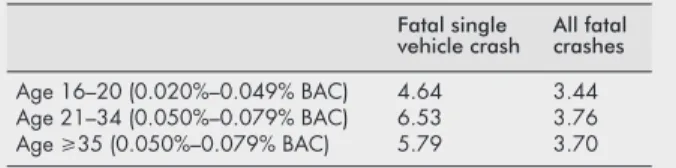
Interestingly, as table 3 illustrates, the relative risk of crash for young drivers at low BAC levels is lower than that for older drivers at moderate BAC levels. If traffic safety experts consider these relative risks sufficiently compelling to introduce zero or low BAC restrictions for young drivers, then risks of this magnitude should also be sufficient to warrant a
0.05%Criminal CodeBAC limit for all drivers. It is incongruous
to speak of these risks as “high” or “elevated” in terms of youth,49but “marginal” in terms of other drivers.70Instead, the
similarly elevated risks of crash involvement should be addressed by lower BAC limits, regardless of the segment of the population affected.
The willingness to enforce stricter laws for youth may, in part, reflect a protective attitude toward this population, who are already at an increased risk of crash. Such policy considerations may help to politically justify more restrictive BAC laws for youth, even though older drivers with “moderate” BACs have a similar or higher relative risk of fatal
Table 3 Relative risk for young and older male drivers at “low” and “moderate” BACs
Fatal single
vehicle crash All fatalcrashes Age 16–20 (0.020%–0.049% BAC) 4.64 3.44 Age 21–34 (0.050%–0.079% BAC) 6.53 3.76 Age>35 (0.050%–0.079% BAC) 5.79 3.70 Source: Zador PL, Krawchuk SA, Voas RB. Alcohol-related relative risk of driver fatalities and driver involvement in fatal crashes in relation to driver age and gender: an update using 1996 data.J Stud Alcohol 2000;61:387–95.
crash. Nevertheless, the positive experience with introducing
zero and low BAC limits suggests that a generalCriminal Code
0.05% BAC offence would also reduce impaired driving.
(C) Provincial and territorial 0.05% BAC administrative licence suspensions
All of the Canadian provinces and territories, with the excep-tion of Quebec, have some form of administrative “0.05%” BAC licence suspension in force. British Columbia first intro-duced a short-term administrative licence suspension in 1977,
followed by,inter alia, Ontario in 1981 and New Brunswick in
1985.71–73 Under the federal Criminal Code, the police may
demand a roadside breath test from a driver who is suspected of having any alcohol in his or her body. Generally, the provin-cial and territorial legislation now authorizes the police to suspend a driver’s licence for 12 or 24 hours, depending on the jurisdiction, if the driver refuses the test or registers a BAC of
0.05% or higher.74–76The BAC threshold is 0.04% in
Saskatch-ewan and 0.06% in the Northwest Territories. Moreover, in some provinces, the police can suspend a driver’s licence if they believe that the driver is impaired, even in the absence of
a confirmatory breath test.77 For ease of reference, we will
hereinafter refer to all of the various types of provincial and territorial roadside suspension provisions globally as “provin-cial” or “administrative” 0.05% BAC laws. It must be remem-bered that these provisions do not create offences and, with few exceptions, carry no long term consequences.
To our knowledge, no extensive review of the provincial 0.05% BAC laws has been undertaken in Canada, and only one
study exists that addresses the issue.78Due to the short follow
up period, the study’s conclusion that Ontario’s 0.05% BAC law may have had “a small, short term effect on the proportion of Ontario’s alcohol related fatalities” is not surprising. The researchers noted that media coverage of the new law was scant and that there was a corresponding lack of awareness among the public. Most importantly, however, only 59% of police administrators reported that their forces owned roadside screening devices at the time of the study, and only 40% of uniformed officers had ever used such a device. With-out screening devices, police simply could not enforce a 0.05% BAC roadside suspension law. Thus, the one existing study examining provincial 0.05% laws is of little relevance today, when such devices are readily available and in widespread use. It is likely that, as public awareness grew and more police obtained and began using screening devices, the impact of the administrative 0.05% BAC laws increased. Indeed, a number of more long term trends suggest that such laws have had a positive effect on impaired driving. In Ontario, alcohol related crashes steadily declined in the decade after the introduction
of the administrative 0.05% BAC law.79 Between 1982 and
1991, the rate of drinking drivers involved in crashes per 1000 licensed drivers fell by 58%. Similarly, between 1982 and 1989, the number of non-drinking drivers involved in crashes increased by 37%, while the number of drinking drivers involved in crashes decreased steadily. However, the declines in Ontario’s alcohol related crash statistics can be attributed, in part, to the collective impact of several other factors, including the hardening of public attitudes toward impaired driving, other changes in the Ontario traffic legislation, and
substantive amendments to theCriminal Code’s impaired
driv-ing provisions.
Nevertheless, similar positive results have occurred in the other Canadian jurisdictions that subsequently introduced administrative 0.05% BAC limits. Moreover, the confounding variables of the 1980s did not likely play a significant part in the impaired driving reductions that followed the introduc-tion of an administrative 0.05% BAC law in Prince Edward Island in 1993, and in Newfoundland and Labrador in
1994.80 81 In the year after the laws’ introduction, alcohol
involvement in fatal crashes declined from 64% to 36% in
Prince Edward Island, and from 47% to 27% in Newfoundland
and Labrador.8 While both provinces have experienced
fluctuations in impaired driving since introducing their 0.05% BAC laws, there has been a general reduction in the
percent-age of fatally injured drivers with positive BACs.8
Although the evidence is incomplete, general trends suggest that the provincial 0.05% BAC laws have contributed to reduc-tions in alcohol related crashes and fatalities. These trends are particularly promising because the current provincial 0.05% laws in Canada are only administrative in nature, create no offence and, thus, carry no penalty. In most jurisdictions, the driver is simply inconvenienced for 12 or 24 hours. We suggest
that a 0.05%Criminal Codeoffence, coupled with the existing
0.05% administrative licence suspensions, would have a considerably greater positive impact than the administrative licence suspensions alone. In Canada, a criminal charge is viewed as a far more serious matter than a provincial charge, let alone a transitory administrative licensing sanction. The
proposed 0.05%Criminal Code offence would carry a fine, a
substantial driving prohibition, and a permanent criminal record (except for first offenders who do not reoffend).
It may be argued that some police may be inclined to proceed with only the administrative licence suspension
because of the added work involved in laying aCriminal Code
charge. However, the streamlined enforcement and processing features of the proposed 0.05% offence should partially address this concern. In any event, this problem does not
jus-tify opposing a 0.05%Criminal Codeoffence, but rather,
under-scores the need to enhance enforcement powers and
streamline the processing of impaired driving charges.82This
would improve the certainty of punishment and help
maximize the deterrent impact of the new Criminal Code
offence.
(D) International experiences with BAC limits of 0.05% or lower
The 0.05% BAC limit is standard in most of the western world. Those jurisdictions that have lowered their legal BAC limits have experienced general reductions in drinking and driving, and its related deaths and injuries. Among the primary hold-outs on a 0.05% BAC limit are Canada, New Zealand, the United States, and the United Kingdom. Although a 1998 report from the House of Lords Select Committee on European Communities recommended that the United Kingdom intro-duce a 0.05% BAC limit, the government rejected that
recommendation in March 2000.83 This decision appears to
have been influenced, in part, by pressure from the alcohol industry.84
It is difficult to obtain definitive information on whether the 0.05% BAC law in a particular country creates a regulatory or criminal offence. The existing reviews of this legislation are
contradictory in how they characterize the offences.3 4
Nevertheless, the penalties and procedures most countries adopt in their 0.05% BAC legislation suggest that it creates a regulatory, rather than a criminal, offence.
It is important to emphasize, however, that these 0.05% regulatory offences are not comparable to the 0.05% adminis-trative licence suspensions in Canada. In most countries, driv-ers with BACs of 0.05% are committing an offence and receive a fine and a licence suspension lasting several weeks or
months.3Conversely, the provincial 0.05% laws in Canada
cre-ate no offence, involve a mere 12 to 24 hour licence suspension and generally have no long term consequences. In several
important respects, the proposed 0.05% Criminal Code BAC
offence more closely resembles the regulatory offences in many of the 0.05% BAC jurisdictions.
The balance of this subsection examines the international experience with BAC limits of 0.05% or lower in terms of traf-fic safety, public attitudes, and its relevance to Canada.
(i) Impact on traffic safety
Numerous jurisdictions have published reports on the positive
traffic safety results of their low BAC limits.85For example, a
long term study of the Netherlands’ 0.05% BAC law, introduced in 1974, suggested that it contributed to a broad and sustained decline in the total number of drinking
drivers.86 In Belgium, where the BAC limit was reduced to
0.05% in 1994, there was a 10% decrease in traffic fatalities in
1995, and a further 11% decrease in 1996.22 Another study
examined the impact of the French decision to lower its BAC limit from 0.08% to 0.05% in September 1996. In the province of Haute-Savoie, where the study was conducted, annual alco-hol related crash fatalities fell from about 100 before the legal
change to 64 in 1997.87
Sweden’s 0.02% BAC limit has also shown positive results. Although the country introduced a 0.05% BAC limit in the 1950s, the move to an even lower limit in 1990 further improved traffic safety. A 1997 study by Norström and Laurell reported that, in the six years after the introduction of the 0.02% BAC limit, there was a 9.7% reduction in fatal crashes, an 11% reduction in single vehicle crashes, and a 7.5%
reduc-tion in all crashes.88The authors emphasized that the clearest
effects occurred in fatal and single vehicle crashes, the catego-ries of crashes in which alcohol is most likely to be involved. This suggests that crash reductions cannot be attributed solely to existing trends, but were caused, in part, by the lower BAC limit. Their results are supported by a 2000 study, which esti-mated that the 0.02% BAC limit resulted in an approximate 10% decrease in fatal crashes and a 12% decrease in severe personal injury crashes.89
Norström and Laurell also examined the average BAC of convicted drinking drivers and found that it had decreased by
9% between 1987 and 1991.88In fact, a comparison of the BAC
distribution indicated that, while drivers with BACs above 0.15% made up 57.1% of all impaired driving offenders in 1987, their proportion dropped to 47.4% in 1991. Taken together, these figures suggest that the lower BAC limit reduced the degree of impairment among the highest BAC offenders.
In Austria, the legal BAC limit was lowered from 0.08% to
0.05% in January 1998.90A recent study of this change found
that there was an overall 9.37% decrease in alcohol related crashes relative to the total number of crashes. However, the authors noted that intense media and enforcement campaigns also occurred around the time that the limit was lowered, making it nearly impossible to attribute the reductions to any one of these factors, at least in the short term. Nevertheless, the authors concluded that “lowering the legal BAC-limit from .08% to .05% in combination with intensive police enforcement and reporting in the media leads to a positive short-term effect”. This supports the view that a 0.05% BAC limit, as part of a comprehensive approach to fighting impaired driving, can have beneficial effects.
In 1997, Henstridgeet alconducted a time series analysis of
random breath testing and 0.05% BAC laws in Australia, con-trolling for seasonal effects, weather, economic trends, road
use, alcohol consumption, and day of the week.91Although the
primary focus of the study was the impact of random breath testing, its findings on the impact of 0.05% BAC laws were also noteworthy. The study statistically removed the impact of other countermeasures in order to determine the specific per-centages of the declines that were attributable directly to either random breath testing or the lower BAC limit. The report, which analyzed traffic data for periods ranging from 13 to 17 years, indicates that those states that reduced their BAC limits from 0.08% to 0.05% experienced positive results.
For example, after Queensland reduced itsper seBAC limit
to 0.05% in December 1982, there was a 14% reduction in
seri-ous collisions and an 18% reduction in fatal collisions.91These
results were not confounded by the effects of random breath
testing, as it was not introduced until eight years later. Similarly, the 0.05% BAC restriction in New South Wales was estimated to have reduced serious collisions by 7%, fatal colli-sions by 8%, and single-vehicle nighttime collicolli-sions by 11%. This translated into the prevention of 605 serious, 75 fatal, and 296 single vehicle nighttime collisions per year. While the 0.05% BAC limit was only introduced two years before random breath testing in New South Wales, the authors factored this into their analysis and attempted to determine the crash reductions specifically attributable to each of the interven-tions.
A 1994 study in South Australia, where the legal BAC limit was not changed until 1991, reported that the number of nighttime drivers who had been drinking was reduced by
14.1%.92However, a second study of South Australia in 1995
found that the 0.05% BAC limit did not significantly affect the
number of fatally injured drivers who were legally impaired.93
Nevertheless, even this latter study found some positive effects, as the percentage of legally impaired, crash involved drivers with BACs over 0.15% decreased from 60% in 1991 to 56% in 1993.
This last figure supports other Australian research indicat-ing that the lower BAC limit had a substantial effect on driv-ers with high BACs (above 0.15%). For instance, a study in the Australian Capital Territory examined random breath testing data for the 12 months prior to and after the 0.05% BAC limit
was enacted.94 This included approximately 92 000 tests in
1990 and 82 000 tests in 1991. The researchers found a 34% decrease in the percentage of random breath tested drivers with BACs between 0.15% and 0.199%, and a 58% decrease in the percentage above 0.20%. Similarly, the breath tests taken for evidentiary purposes after crashes showed a 31% decrease in drivers with BACs above 0.15%, and a 46% decrease in driv-ers above 0.20%. The authors suggested that the decreases among high BAC drivers may reflect that heavy drinkers were taking steps to avoid driving after drinking.
Given that drivers at high BAC levels are at the greatest relative risk of crash, such reductions would have a substantial impact on the number of alcohol related deaths and injuries in Canada. TIRF has estimated that drivers with BACs above 0.15% are 243.8 times more likely to be involved in a fatal
crash than drivers with zero BACs.46A recent American study
found that male drivers aged 21 to 34 with BACs of 0.15% and higher are 572 times more likely to be killed in a single vehicle
crash than sober drivers of the same age.42Thus, even though
a 0.05% BAC limit would appear to be aimed at drivers with moderate BACs, its potential impact on the behaviour of high BAC drivers has important traffic safety implications.
(ii) Impact on public attitudes and driving behaviour
The international studies also suggest that lower BAC limits may contribute to positive changes in public attitudes toward drinking and driving. For example, roadside surveys in Germany indicated that the impending introduction of a 0.05% limit contributed to positive changes in the BAC
distri-bution of drinking drivers.95The authors suggested that this
“anticipatory effect” resulted from the enhanced police patrols and publicity that preceded the legal change. Moreover, some drivers erroneously believed that the 0.05% BAC limit had already been enacted. In any case, the study indicated that drivers were motivated to change their drinking habits by an impending or perceived change in the legal limit.
It has also been suggested that lower BAC limits encourage drivers to keep a better count of the drinks they consume in
order to stay within the limit.96In this way, a lower BAC limit
can have a strong preventive impact. For example, a study of the Danish 0.05% BAC law, introduced in March 1998, found that the legal change motivated Danes to reduce their alcohol
consumption before driving.97 The number of drivers who
number who drank one drink or less increased from 71% to 80% between 1997 and 1998. The top two reasons given for the change in drinking behaviour were that the legal limit had been lowered, and that the respondent’s attitude toward drinking and driving had changed.
The preventive impact of a lower BAC limit was also
illustrated by an Australian survey of drinking behaviour.98It
suggested that the lower limit helped to make people more aware of the need to control their drinking before driving. Those who planned to drive home drank less than those who were not driving. Moreover, a large majority felt it was wrong to violate the legal BAC limit. The authors also noted that even heavy drinkers generally chose either not to drive home or to moderate their drinking if they were driving.
Canadian attitudes would not necessarily change in the same manner or to the same degree as those in other countries that have introduced lower BAC limits. However, it is noteworthy that changes in BAC limits generally appear to change attitudes for the better in terms of traffic safety and drinking behaviour.
(iii) The international experience and its relevance to Canada
The traffic safety benefits of 0.05% BAC limits are influenced by various factors, including the related drinking and driving legislation, enforcement, legal traditions, geography, and drinking behaviour. Thus, a 0.05% offence will not likely have the identical impact in Canada that it has had in any other country. Moreover, we will not be able to assess its precise impact unless and until such an offence is created. In the interim, we believe that Canada should examine and learn from the international experience.
As illustrated in figure 3, Canada has a much higher rate of legal impairment among fatally injured drivers than a number of comparable countries. This is likely due to a number of fac-tors, including enforcement practices, other countermeasures, and the methods by which alcohol attributed fatalities are defined and assessed. Nevertheless, the comparison shows a correspondence between the legal BAC limit and the percent-age of fatally injured drivers who were legally impaired. For example, the top four countries all have BAC limits of 0.05% or lower, while three of the bottom four countries have BAC lim-its of 0.08% or higher.
Currently, approximately 3000 people die in motor vehicle
crashes in Canada every year.99 A recent Canadian study,
reviewing the international experience, reported that lowering the criminal BAC limit to 0.05% could result in reductions of 6% to 18% in total crash fatalities, or between 185 and 555
fatalities a year.4Based on this study, the maximum saving of
lives would be equivalent to eliminating almost all homicides
in Canada.9While we might be more cautious about drawing
parallels from the international experience, the evidence
suggests that lowering the Criminal Code BAC limit will
contribute to traffic safety benefits.
(iv) Summary
Virtually every jurisdiction that has introduced a BAC limit of 0.05% or lower has experienced some traffic safety benefits in terms of reduced crashes, injuries, and fatalities. Some coun-tries have also had reductions in the mean BACs of impaired drivers and in the ratio of high BAC to moderate BAC drivers. In fact, both Sweden and the Australian Capital Territory reported that the lower BAC limit had significant effects on high BAC drivers. This is supported by evidence of the lower limit’s ability to change public attitudes about drinking and driving, and to make drivers more conscious of their drinking and the need to plan for alternative transportation. In summary, the international experience with BAC limits of 0.05% and lower provides strong support for the creation of a criminal 0.05% BAC offence in Canada.
SECTION IV. ANSWERING THE CRITICISMS OF A
0.05%CRIMINAL CODEBAC OFFENCE IN CANADA
In this section, we respond to the arguments that have been
raised in opposition to a 0.05%Criminal CodeBAC offence in
Canada. These criticisms are drawn largely from the submis-sions to, and conclusubmis-sions of, the House of Commons Standing Committee on Justice and Human Rights.
(A) “There is a lack of consensus among experts on the issue of lower BAC limits”
The Standing Committee on Justice and Human Rights expressed concern over the “lack of consensus among experts in the field” about the benefits of a lower BAC limit. Given the state of the research, this argument appears to be unfounded or, at the very least, outdated. As indicated, there is a general consensus that critical driving related skills are adversely affected at BACs below 0.05%, and that the skills that are most important to driving are also among the most sensitive to alcohol. There is a parallel body of unchallenged research on the increased relative risk of fatal crash at “moderate” BACs. These risks are particularly pronounced at BACs from 0.08%– 0.099%, a range that is essentially immune from criminal sanction under Canada’s current law.
The clear trend in the international community has been to lower BAC limits. Moreover, numerous leading medical, accident prevention, and traffic safety organizations in the world support some form of a BAC limit of 0.05% or lower, including the World Medical Association, the American and British Medical Associations, the European Commission, the European Transport Safety Council, the Royal Society for the Prevention of Accidents, the World Health Organization, the International Transportation Safety Association, the Associ-ation for the Advancement of Automotive Medicine, the American College of Emergency Physicians, and the
Austral-ian Transport Safety Bureau.96 100–103In Canada, the lower limit
is supported by, among others, the Canadian Medical Associ-ation, the Canadian Public Health AssociAssoci-ation, the Centre for Addiction and Mental Health, the Council on Drug Abuse, the
Addictions Foundation of Manitoba, and MADD Canada.6
(B) “There is no evidence that a 0.05% BAC offence would save lives”
As noted, the consistent bodies of research on the effects of low doses of alcohol on driving related skills and the increased relative risk of crash at “moderate” BACs have gone largely unchallenged. Rather, most of the criticism in Canada relates
to whether a lowerCriminal CodeBAC limit would actually save
lives. For example, one researcher said that there are “relatively few” valid evaluation studies of lower BAC limits and that scientific evidence supporting such an amendment is
Figure 3 Legal impairmentamong fatally injured drivers 1997–98. *At the time of the report, the criminal BAC limit was 0.08% in 15 American states and 0.10% in 33 states. Over 60% of American states now have a criminal BAC limit of 0.08%. Source:Road Safety Forum: Beyond 2001(CD ROM). Ottawa: Transport Canada, 2001.