Dissertation
Top-k Semantic Caching
by
Christoph Ehlers
submitted to
Department of Informatics and Mathematics,
University of Passau
April, 2015
Supervisor:
Chair of Information Management University of Passau Innstraße 43 94032 Passau, Germany E-mail: [email protected] Web: http://www.im.uni-passau.de/ 2. Reviewer: Professor Dr. Werner Kießling
Chair of Databases and Information Systems Institute of Computer Science
University of Augsburg Universitätsstraße 6a 86159 Augsburg, Germany
E-mail: [email protected]
Abstract
The subject of this thesis is the intelligent caching of top-k queries in an environment with high latency and low throughput. In such an environment, caching can be used to reduce network traffic and improve response time. Slow database connections of mobile devices and to databases, which have been offshored, are practical use cases.
A semantic cache is a query-based cache that caches query results and maintains their semantic description. It reuses partial matches of previous query results. Each query that is processed by the semantic cache is split into two disjoint parts: one that can be completely answered with tuples of the cache (probe query), and another that requires tuples to be transferred from the server (remainder query).
Existing semantic caches do not support top-k queries, i.e., ordered and limited queries. In this thesis, we present an innovative semantic cache that naturally supports top-k queries. The support of top-k queries in a semantic cache has considerable effects on cache elements, operations on cache elements – like creation, difference, intersection, and union – and query answering. Hence, we introduce new techniques for cache management and query processing. They enable the semantic cache to become a true top-k semantic cache.
In addition, we have developed a new algorithm that can estimate the lower bounds of query results of sorted queries using multidimensional histograms. Using this algorithm, our top-k semantic cache is able to pipeline partial query results of top-k queries. Thereby, query execution performance can be significantly increased.
We have implemented a prototype of a top-k semantic cache called IQCache (Intelligent
QueryCache). An extensive and thorough evaluation with various benchmarks using our prototype demonstrates the applicability and performance of top-k semantic caching in practice. The experiments prove that the top-k semantic cache invariably outperforms simple hash-based caching strategies and scales very well.
Contents
Abstract i
Contents iii
I. Fundamentals 1
1. Introduction and Motivation 3
1.1. Semantic Caching . . . 3
1.2. Running Example . . . 5
1.2.1. Three Queries . . . 6
1.2.2. Database Instance . . . 7
1.2.3. A Motivation for Top-k Semantic Caching . . . 7
1.3. Problem Description . . . 13
1.4. Approach . . . 13
1.5. Assumptions . . . 14
1.6. Contributions . . . 15
1.7. Overview . . . 16
2. Related Work of Semantic Caching 19 2.1. Semantic Caching of SQL Queries . . . 19
2.2. Semantic Caching of Non-SQL Queries . . . 22
2.2.1. XML Databases . . . 22
2.2.2. Web Queries and Information Retrieval . . . 23
2.2.3. Spatial Data . . . 23
2.3. Other Related Caching Techniques . . . 23
2.3.1. Logical Caching . . . 24
2.3.2. Table Caching . . . 24
2.3.3. Answering Queries Using Views . . . 25
2.3.4. Caching of Top-k Queries with Linear Score Functions . . . 25
3. Satisfiability 27 3.1. Satisfiablity and Domains . . . 27
3.1.2. The Varchar Domain . . . 28
3.1.3. From SAT to SMT . . . 30
3.2. SMT Solver . . . 31
3.2.1. Solver Selection . . . 31
3.2.2. Hybrid Solver . . . 33
3.3. Three-valued Logic and SQL . . . 41
3.3.1. Conjunction, Disjunction, Negation . . . 41
3.3.2. Isunknown . . . 41
3.3.3. Partial Equivalence . . . 44
3.4. Satisfiability and Three-valued Logic . . . 46
3.4.1. Overlaps . . . 46
3.4.2. Subsumptions . . . 47
II. Top-k Semantic Cache Design 51 4. Segments 53 4.1. Segment Definition . . . 53
4.1.1. Definition . . . 53
4.1.2. Conditions . . . 56
4.1.3. Order By Condition of Lexicographical Orderings . . . 60
4.1.4. Orderings Using Arbitrary Score Functions . . . 63
4.2. Set Operations on Segments . . . 67
4.2.1. Creation of a New Segment . . . 67
4.2.2. Difference of Two Segments . . . 78
4.2.3. Intersection of Two Segments . . . 92
4.2.4. Union of Two Segments . . . 96
4.2.4.1. The General Case . . . 96
4.2.4.2. A Special Case . . . 101
5. Pipelining 107 5.1. Multidimensional Histograms . . . 107
5.1.1. Definition . . . 108
5.2. Histograms for the Estimation of Query Bounds . . . 109
5.2.1. Properties of Histograms for the Estimation of Query Bounds . . . 109
5.2.2. NP-Completeness of Optimal Histogram Selection . . . 112
5.3. Estimating Query Bounds with Histograms . . . 117
5.3.1. The Idea . . . 117
5.3.2. A Sample Multidimensional Histogram . . . 120
5.3.3. The Algorithm . . . 123
Contents
5.3.5. Generalization of Supported Orderings . . . 144
6. Top-k Semantic Caching 149 6.1. Organization . . . 149
6.2. Query Processing . . . 153
6.2.1. Find Overlapping Segments . . . 153
6.2.2. Load Missing Attributes . . . 153
6.2.3. Load More Tuples . . . 155
6.2.4. Answer Query . . . 155
6.2.5. Coalescing Strategies . . . 160
6.2.5.1. Full coalescing . . . 160
6.2.5.2. No coalescing . . . 162
III. Prototype IQCache, Evaluation and Discussion 165 7. Implementation 167 7.1. Overview . . . 167
7.2. Best Cache Replacement Strategy . . . 170
7.3. Best Histograms for the Estimation of Query Bounds . . . 170
8. Evaluation 171 8.1. Benchmark Selection . . . 171 8.2. Caches . . . 174 8.3. Set-up . . . 175 8.4. Twitter Benchmark . . . 179 8.4.1. Description . . . 179 8.4.2. Evaluation . . . 179
8.4.2.1. Cache Size and Hit Rate . . . 179
8.4.2.2. Cache Size and Execution Time . . . 180
8.4.2.3. Server Latency and Execution Time . . . 180
8.4.2.4. Throughput and Execution Time . . . 182
8.4.2.5. Satisfiability Checks and Execution Time . . . 182
8.4.2.6. Estimation Performance and Execution Time . . . 183
8.4.2.7. Scale and Hit Rate . . . 186
8.4.2.8. Scale and Execution Time . . . 186
8.4.2.9. Scale and Number of Considered Segments . . . 186
8.4.2.10. Scale and Number of Used Segments . . . 188
8.5. Yahoo! Cloud Serving Benchmark . . . 190
8.5.2. Evaluation . . . 190
8.5.2.1. Cache Size and Hit Rate . . . 190
8.5.2.2. Cache Size and Execution Time . . . 191
8.5.2.3. Server Latency and Execution Time . . . 191
8.5.2.4. Throughput and Execution Time . . . 193
8.5.2.5. Satisfiability Checks and Execution Time . . . 193
8.5.2.6. Estimation Performance and Execution Time . . . 195
8.5.2.7. Scale and Hit Rate . . . 197
8.5.2.8. Scale and Execution Time . . . 199
8.5.2.9. Scale and Number of Considered Segments . . . 199
8.5.2.10. Scale and Number of Used Segments . . . 201
8.6. MonArch 3 . . . 203
8.6.1. Description . . . 203
8.6.2. Evaluation . . . 204
8.6.2.1. Cache Size and Hit Rate . . . 204
8.6.2.2. Cache Size and Execution Time . . . 205
8.7. Discussion and Comparison of Results . . . 207
9. Conclusion 209 9.1. Future Work . . . 209
9.1.1. Prefetching . . . 209
9.1.2. Context . . . 210
9.1.3. The Mobile Use Case . . . 211
9.2. Conclusion . . . 214 A. Histogram Creation with Window Functions 217
Bibliography 221 List of Figures 243 List of Tables 247 List of Algorithms 249 List of Listings 251 List of Examples 253 List of Definitions 255
Part I.
1. Introduction and Motivation
In an environment with high latency and low throughput, caching can be used to reduce network traffic and improve response time [CFLS91, DR92].
This is particularly true for a mobile computing environment. A cache can be used to intelligently store data of mobile applications (e.g., map apps). It can also be used to cope with a slow connection and connection disruptions when checking and entering data on location. Examples are taking inventory in stores, maintenance and machine care (e.g., cars, ships) and work progress in production.
Data caching also becomes important if the database is distant. This may be due to offshoring (e.g., a transatlantic connection) or the fact that the database has been moved into the cloud. Caching is also necessary if the system is a globally distributed client-server architecture with a central database to unburden the central server (e.g., a logistics company that operates world-wide). Data caching is viewed as a key technique for efficient application servers [Moh02].
Furthermore, it is possible to save energy through caching [LRS+12].
Semantic caching has proven to be a very successful caching scheme for mobile computing environments and distributed systems. It provides better performance than page caching [CFZ94, FCL93] or tuple caching [DFJ+96]. In addition, semantic caching achieves a significant workload reduction in distributed systems [RDK03].
When semantic caching was first proposed, solvers for logical expressions over various domains, i.e., SMT solvers, did not exist. Only in the last ten years, since the introduction of the annual SMT-COMP competition [SMT05, CSW14], efficient SMT solvers have been developed and continuously been improved. Now is the time to revisit semantic caching and apply SMT solvers to it. We are the first to do so.
1.1. Semantic Caching
We definesemantic cachingby the following main properties [DFJ+96, KB96, JAT+06]:
Query cache: A semantic cache is a query-based cache that caches query results. Typically, the elements of a semantic cache are calledsegmentsorregions.
Description with logical expressions: The semantic cache maintains logical expressions that describe the tuples contained in its segments or rather the area that is occupied by
the segment. This approach makes a semantic cache a logical cache and distinguishes it from a page caches or tuple caches.
Disjointness: In a semantic cache, no tuple is stored more than once. Hence, redundancy in the cache is reduced. A semantic cache can achieve this property by ensuring that all segments are disjoint. This approach yields another advantage in query processing: If a segment is found that overlaps with a given query, all tuples of the overlap certainly contribute to the result of the query, because they cannot be contained in any other segment.
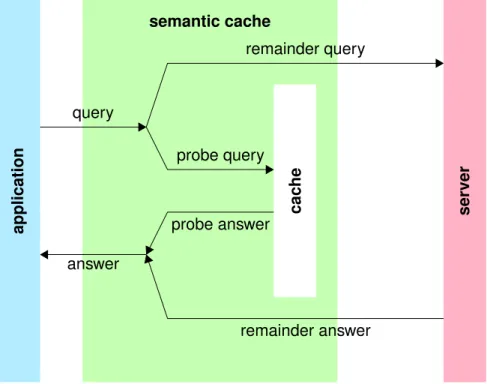
Partial answering: A semantic cache reuses partial matches of previous query results. Each query that is processed by the semantic cache is split into two disjoint parts: one that can be completely answered with tuples of the cache (probe query), and another that requires tuples to be transferred from the server (remainder query). Figure 1.1 illustrates this process.
application semantic cache ser ver cac he query answer probe query probe answer remainder query remainder answer
1.2. Running Example
1.2. Running Example
This thesis uses a running example, which exemplifies and illustrates the algorithms and propositions that are introduced. The running example is a simplified blogging platform (see figure 1.2). On this platform, authors can compose posts, which can be assigned to various post categories. Each post may contain a number of images, which, on their part, can be assigned to image categories.
author postcategory id : INTEGER is assigned to name : VARCHAR(40) score : DOUBLE total : INTEGER name : VARCHAR(30) title : VARCHAR(100) content : VARCHAR(5000) likes : INTEGER dislikes : INTEGER created : TIMESTAMP N 1 N N M 1 changed : TIMESTAMP composes contains id: INTEGER width: INTEGER height: INTEGER post
image N is assigned to M imagecategory
name : VARCHAR(30) uri : VARCHAR(50)
Figure 1.2.: Entity-relationship model of the running example using Chen’s notation [Che76]
For each author, we store a unique id, their name, their total number of posts and a score. The latter is calculated by a formula that uses the likes and dislikes of the author’s posts. A post has a unique id, a title, its content and a number of likes and dislikes. In addition, the time and date of creation and last change are stored. Posts may contain images. They are referenced by their URI. A post must not use the same image twice. When an image is included in a post, its preferred width and height should be specified. With this information, the back-end system is able to scale the image before delivery to reduce network load. For different posts, naturally, different preferred width and height can be given. Both post categories and image categories are identified by their respective names.
Figure 1.2 contains an entity-relationship model of the running example using Chen’s notation [Che76]. Figure 1.3 shows the table definitions of the running example, which include primary key constraints, foreign key constraints and chosen data types.
author : {[ id : INTEGER, name : VARCHAR(40), score : DOUBLE, total : INTEGER ]} post : {[ id : INTEGER, title :VARCHAR(100), content : VARCHAR(5000), likes : INTEGER, dislikes : INTEGER, created :TIMESTAMP, changed : TIMESTAMP,
author : INTEGER(→author.id)
]}
image : {[
post : INTEGER(→post.id), uri :VARCHAR(50), width : INTEGER, height :INTEGER ]} postcategory : {[ name : VARCHAR(30), post : INTEGER(→post.id)
]}
imagecategory : {[
name : VARCHAR(30),
post : INTEGER(→image.post), image :INTEGER(→image.uri)
]}
Figure 1.3.: Table definitions of the running example
1.2.1. Three Queries
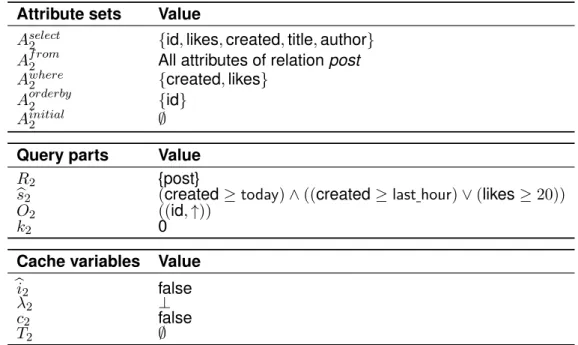
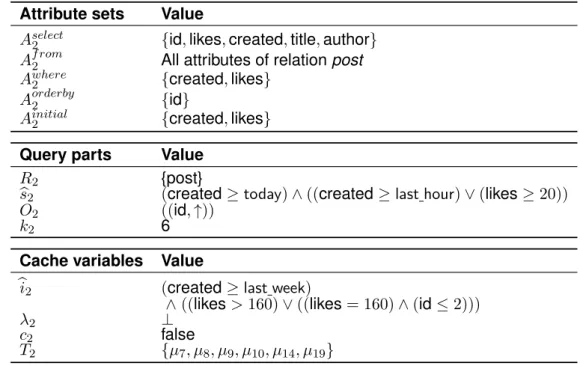
To exemplify most of the algorithms in this thesis, we will use a sequence of three queries calledq1,q2 andq3. All three queries are top-10 queries. They all use the relationpost. They all have the sameselect clause, which consists of the id of the post, its number of likes, its creation date, its title and its author’s id. But the three queries do have different
whereconditions and use varying orderings in theorder by clause.
Queryq1returns the top ten most liked posts of last week (see listing 1.1). But it only considers posts with at least one hundred likes.
1 SELECT p.id, p.likes, p.created, p.title, p.author 2 FROM post p
3 WHERE (p.created >= LAST_WEEK) AND (p.likes >= 100) 4 ORDER BY p.likes DESC
5 LIMIT 10
1.2. Running Example
Queryq2 fetches today’s posts (see listing 1.2). But this query only returns posts that either have at least twenty likes or have been created within the hour. The posts are ascendingly ordered by their respective id.
1 SELECT p.id, p.likes, p.created, p.title, p.author 2 FROM post p
3 WHERE (p.created >= TODAY)
4 AND ((p.created >= LAST_HOUR) OR (p.likes >= 20)) 5 ORDER BY p.id ASC
6 LIMIT 10
Listing 1.2: Queryq2: a top-k query returning today’s posts by id
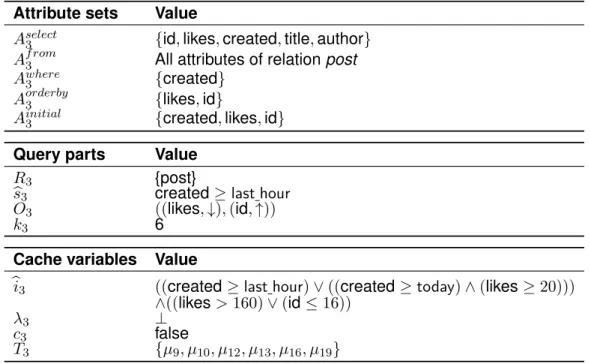
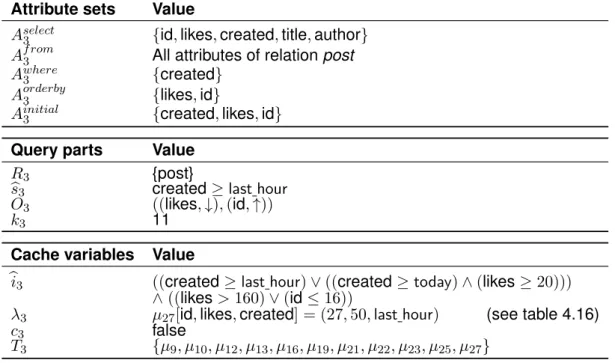
Queryq3 returns the top ten most liked posts that have been created within the last hour (see listing 1.3).
1 SELECT p.id, p.likes, p.created, p.title, p.author 2 FROM post p
3 WHERE p.created >= LAST_HOUR 4 ORDER BY p.likes DESC 5 LIMIT 10
Listing 1.3: Queryq3: a top-k query returning the most liked posts of the last hour
1.2.2. Database Instance
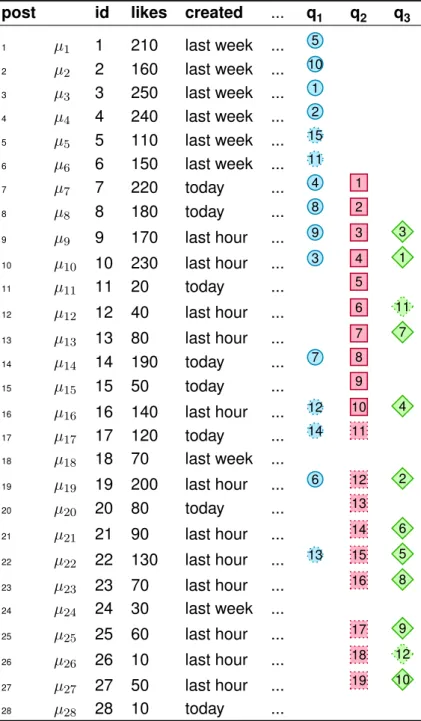
To execute the queriesq1,q2andq3, we need a sample instance of the relationpost of the running example (see table 1.1).
The tuples have the artificially numbered ids 1 to 28. They are addressed byµid, i.e., the
first tuple of relationpost is called tupleµ1.
Note that only the columnsid,likes andcreated are given. These are the columns that are used in thewhereconditions andorder by clauses of the queriesq1,q2 andq3. Only these columns, we need to know to determine the result of the three queries.
Table 1.1 also shows the results of queriesq1,q2andq3using this sample instance of the relationpost.
1.2.3. A Motivation for Top-k Semantic Caching
We start with the execution of queryq1. It returns, in that order, the tuplesµ3,µ4,µ10,µ7,
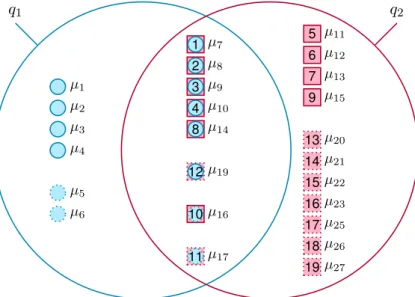
µ1,µ19,µ14,µ8,µ9andµ2(see table 1.1). Afterward, we execute queryq2, which returns, in that order, the tuplesµ7,µ8,µ9,µ10, µ11,µ12,µ13,µ14,µ15 andµ16(see table 1.1). Obviously, the results of queriesq1 andq2 overlap. The tuples µ7,µ8,µ9,µ10 andµ14 are contained in the results of both queries (see figure 1.4).
Note that tupleµ16satisfies thewhere condition of query q1, but is not loaded by the query, because it is only at position twelve of the ordering of queryq1. Therefore, queryq2 must load this tuple by itself.
post id likes created ... q1 q2 q3 1 µ1 1 210 last week ... 5 2 µ2 2 160 last week ... 10 3 µ3 3 250 last week ... 1 4 µ4 4 240 last week ... 2 5 µ5 5 110 last week ... 15 6 µ6 6 150 last week ... 11 7 µ7 7 220 today ... 4 1 8 µ8 8 180 today ... 8 2 9 µ9 9 170 last hour ... 9 3 3 10 µ10 10 230 last hour ... 3 4 1 11 µ11 11 20 today ... 5 12 µ12 12 40 last hour ... 6 11 13 µ13 13 80 last hour ... 7 7 14 µ14 14 190 today ... 7 8 15 µ15 15 50 today ... 9 16 µ16 16 140 last hour ... 12 10 4 17 µ17 17 120 today ... 14 11 18 µ18 18 70 last week ... 19 µ19 19 200 last hour ... 6 12 2 20 µ20 20 80 today ... 13 21 µ21 21 90 last hour ... 14 6 22 µ22 22 130 last hour ... 13 15 5 23 µ23 23 70 last hour ... 16 8 24 µ24 24 30 last week ... 25 µ25 25 60 last hour ... 17 9 26 µ26 26 10 last hour ... 18 12 27 µ27 27 50 last hour ... 19 10 28 µ28 28 10 today ...
1.2. Running Example
Tupleµ19, on the other hand, is loaded by queryq1, but is not used by queryq2, because it is only at position twelve of the ordering used by queryq2.
In contrast, tupleµ17is needed by neither queryq1 nor queryq2, even though it satisfies both theirwhereconditions, because it is only at position 14 for queryq1 or position 11 for queryq2, respectively.
q1 q2 µ1 µ2 µ3 µ4 µ5 µ6 1 µ7 2 µ8 3 µ9 4 µ10 8 µ14 12µ19 10µ16 11µ17 5 µ11 6 µ12 7 µ13 9 µ15 13µ20 14µ21 15µ22 16µ23 17µ25 18µ26 19µ27
Figure 1.4.: Overlap between queryq1 and queryq2
A traditional semantic cache [KB96, DFJ+96, JAT+06] would not be of much help to exploit the overlap of queryq1 and queryq2. First, it would not be able to store the result of query q1 because of the limitation. Secondly, because the queryq2 is sorted, the cache would need to wait for the server to transfer the remaining tuplesµ11,µ12,µ13,µ15 andµ16. Thereby, the benefit of the semantic cache would be almost nullified.
However, a top-k semantic cache that naturally supports sorted and limited queries is able to store the results of queriesq1 andq2. In addition, it is able to estimate a lower bound for the first tuple from the server in the result of queryq2 using a multidimensional histogram. This allows for pipelining.
The first four tuples of the result of query q2, i.e., µ7, µ8, µ9 and µ10, have already been loaded by queryq1. If the cache is able to evaluate, e.g., with a multidimensional histogram, that all tuples that will have to be loaded from the server are greater than these four tuples, it can immediately return these four tuples. In this way, it is able to pipeline the result of queryq2(see figure 1.5).
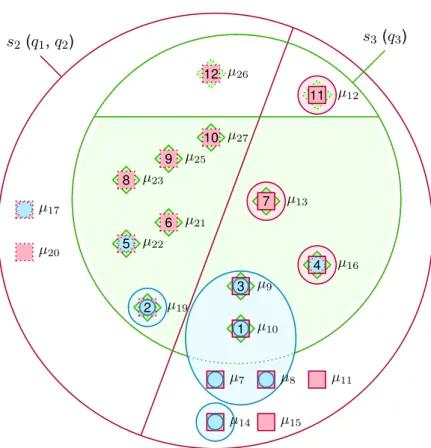
After queryq1 and then queryq2 have been processed, we execute queryq3. It returns, in that order, the tuplesµ10,µ19,µ9,µ16,µ22,µ21,µ13,µ23,µ25andµ27 (see table 1.1). The result of queryq3 overlaps with both the results of previously executed queriesq1
1 2 3 4 8 12
5 6 7 9 10 11 13 14 15 16 17 18 19
load do not load
pipelining
from cache
from server
Figure 1.5.: Pipelining possibility of queryq2
andq2.
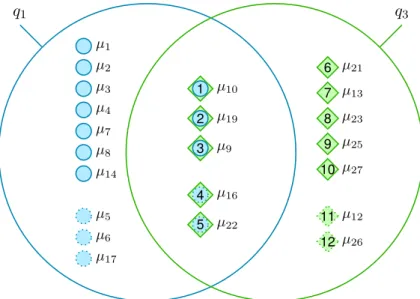
The overlap of the results of queriesq1andq3consists of the tuplesµ10,µ19andµ9(see figure 1.6).
Note that the tuplesµ16andµ22 also satisfy thewhere condition of queryq1, but they have not been loaded by queryq1, because they are only at position 12 and 13 of the ordering of the top-10 queryq1.
q1 q3 µ1 µ2 µ3 µ4 µ7 µ8 µ14 µ5 µ6 µ17 6 µ21 7 µ13 8 µ23 9 µ25 10 µ27 11 µ12 12 µ26 1 µ10 2 µ19 3 µ9 4 µ16 5 µ22
Figure 1.6.: Overlap between queryq1 and queryq3
The overlap of query q2 and query q3 contains the tuples µ10, µ9, µ16 and µ13 (see figure 1.7).
Note that the tuplesµ19,µ22,µ21,µ23,µ25 andµ27also satisfy thewhere condition of queryq2, but they have not been loaded by queryq2, because they are only at position 12 or worse of the ordering of the top-10 queryq2.
1.2. Running Example
Tuple µ12, however, has been loaded by query q2, but it is not needed by query q3, because it is at position 11 of the ordering used by queryq3.
In contrast, tupleµ26is loaded by neither queryq1nor queryq2, despite it satisfying both their whereconditions, because it is only at position 18 for queryq2 or position 12 for queryq3, respectively. q2 q3 µ7 µ8 µ11 µ14 µ15 µ17 µ20 1 µ10 3 µ9 4 µ16 7 µ13 11 µ12 2 µ19 5 µ22 6 µ21 8 µ23 9 µ25 10 µ27 12 µ26
Figure 1.7.: Overlap between queryq2 and queryq3
Together, in theory, the results of queryq1 and queryq2 can contribute the tuples µ10,
µ19,µ9,µ16andµ13to the result of queryq3. Again, this will only be possible if a cache is used that supports sorted and limited queries, e.g., a top-k semantic cache.
Once again, the first four tuples of queryq3, i.e.,µ10,µ19,µ9andµ16, have already been loaded by queriesq1andq2. If a top-k semantic cache is able to evaluate that all tuples that will have to be loaded from the server are greater than these four tuples, e.g., with a multidimensional histogram, it can return these four tuples at once. By this means, the top-k semantic cache is able to pipeline the result of queryq3 (see figure 1.8).
A thorough overview of the overlaps of the results of queriesq1,q2 andq3 can be seen in figure 1.9.
In conclusion, the queriesq1,q2 andq3show the caching and pipelining potential of top-k queries that can only be exploited by a top-k semantic cache.
1 3 4 7 11 1 2 3
5 6 8 9 10 12
load do not load
pipelining
from cache
from server
Figure 1.8.: Pipelining possibility of queryq3
q1 q2 q3 µ1 µ2 µ3 µ4 µ5 µ6 µ11 µ15 µ20 µ7 µ8 µ14 µ17 7 µ13 11 µ12 6 µ21 8 µ23 9 µ25 10 µ27 12 µ26 1 µ10 3 µ9 4 µ16 2 µ19 5 µ22
1.3. Problem Description
1.3. Problem Description
To the best of our knowledge, there exists no semantic cache that can store limited queries. In addition, there exists no semantic cache that can pipeline partial results of queries with orderings. We will attempt to design a top-k semantic cache that can do both.
Approaches that can process limited queries with orderings do exist [APT03, LNX08]. But they ignore the limit for their cache management. They send the query without the limit to the back-end database and cache the result of that unlimited query. While this approach might be utilized for server-side caching, it is not reasonable for client-side caching, because, using this approach, plenty of irrelevant, unneeded tuples are transferred through the slow connection between server and client.
The first question that we have to answer is how to model segments of a top-k semantic cache. Then, we have to introduce set operations like difference, intersection, and union that operate on these segments to facilitate cache management. In addition, we have to design an algorithm for query processing in a top-k semantic cache.
To allow for pipelining of partial results of sorted queries, we must be able to estimate a lower bound for the remaining tuples that have to be transferred from the server to the client. Hence, we need to develop a method to estimate a lower bound for the result of a given remainder query.
1.4. Approach
First, we will identify all properties that are needed to describe a segment of a top-k semantic cache. We will regard the challenge of using logical expression to specify the utilized orderings and limits. In addition, we will study and prove how to use logical expressions to describe the set of loaded or not yet loaded tuples, respectively.
Based on the segment descriptions and the proven logical expressions, we will develop algorithms for set operations like difference, intersection and union on these segments. Thereby, we will consider the possibility of in-place implementations of these algorithms. Then, we will introduce cache organization, coalescing strategies, and query processing for a top-k semantic cache.
We will consider multidimensional histograms to estimate lower bounds of query results of sorted queries. We will design an algorithm that can estimate lower bounds of query results of sorted queries using aforementioned multidimensional histograms. Furthermore, we will analyze the difficulty of histogram selection under given space constraints.
We will implement and evaluate the proposed top-k semantic cache. For our experi-ments, we will use well-established, proven benchmarks like the Yahoo! Cloud Serving
Benchmark [CST+10] and the Twitter benchmark [CHBG10]. In addition, we will use real world practical queries of the MonArch 3 system [SWF11].
1.5. Assumptions
We assume that we use a Java application that accesses a database using a JDBC driver (see figure 1.10). We assume that the connection has a high latency and a low throughput. Database Cloud Java Application JDBC Driver
Figure 1.10.: Set-up with high latency and low throughput
The Java application must implement the JDBC interface to integrate the JDBC driver. Hence, we can assume that the JDBC driver is interchangeable. We assume that the top-k semantic cache is implemented as a JDBC driver. It uses the original JDBC connection to access the database. To store the data of the cache elements, it uses a second JDBC connection to an in-memory database like HSQLDB [Thed] or to a fast local database like MySQL [Ora]. Therefore, the top-k semantic cache can be transparently integrated between the Java application and the JDBC driver (see figure 1.11).
We assume that all queries are projection-selection-join top-k queries in SQL. We will consider neither sub-queries nor aggregations.
Our approach does not consider transactions.
In addition, we assume that data in the database is not changed, i.e., no updates, no deletions and no insertions do occur. Of course, updates can be handled. But they are beyond the scope of this thesis. We outline briefly how updates can be processed by the cache.
Local updates that are passed through the top-k semantic cache are unproblematic. The top-k semantic cache can update its elements and histograms accordingly, and then pass the update on to the server. In the prototype IQCache (see chapter 7), the top-k semantic cache is informed about allupdate,insert anddelete statements that pass through the cache.
1.6. Contributions Database Java Application Cloud JDBC Driver Top-k Semantic Cache In-Memory Database JDBC Driver
Figure 1.11.: Set-up with top-k semantic cache
Updates from external sources are more complex. There are several possible ap-proaches to this situation. First, the server could maintain an update table for each client. Then, the client can access the update table at a convenient time to pull any available updates. Secondly, the server could maintain one update table with timestamped update information. Doing so, each client can still pull all updates since its last check-up, but the overhead for the server is reduced significantly. Thirdly, the server could send updates to all registered clients and thus push the updates to the clients. This approach would avoid the periodical inquiries of the clients, but may prove problematic if clients are unavailable at times due to network disruptions, which is not unheard of for mobile devices. Finally, the cache could completely forgo updates and rely on the cache replacement policy to keep its data sufficiently current by removing cache elements that contain data that is deemed too old to use. Thereby, the cache can enforce a maximum age for its tuples.
1.6. Contributions
We propose a new semantic cache that naturally supports top-k queries as cache elements.
The top-k semantic cache has the following innovative aspects:
1. Top-k semantic caching: In this thesis, we introduce new techniques to describe the tuples of partially loaded sorted queries. In addition, we also state and prove how to describe the remaining tuples that have not yet been loaded. We present algorithms for the creation of new cache elements that represent top-k queries as well as for calculation of the difference, intersection and union of two of these cache elements. Thereby, we enable the storage of sorted and especially limited
queries, which no other semantic cache can do. Finally, in this thesis, we introduce a novel algorithm for top-k query processing that uses stored top-k query results to compute the answer to the given top-k query.
2. Pipelining of top-k queries: We have developed an innovative algorithm that, using multidimensional histograms, can estimate the lower bounds of query results of sorted queries. With this algorithm, our top-k semantic cache is able to pipeline results of top-k queries. Something, no other semantic cache has been able to do. Thereby, the query execution performance of the top-k semantic cache can be increased.
3. Hybrid solver: We have developed a new SMT solver, a solver for expressions over various domains. Using a novel formula to assess the complexity of expressions, this hybrid solver is able to distinctly outperform all other considered solvers when processing the actual expressions that the prototype IQCache is posing to the solver during various benchmarks. We are the first to apply efficient SMT solvers, which have seen tremendous progress over the last ten years, to semantic caching. 4. Three-valued logic: Because of the incorporation ofnull values, expressions in
SQL use three-valued logic. Other approaches use a simplified view of SQL by assuming only two-valued logic. We do not. In our approach, the cache elements are described by three-valued logic. And the algorithms for cache management and query processing in a top-k semantic cache, which are based on propositions that we have both established and proven in this thesis, operate in three-valued logic.
5. Transparency: The top-k semantic cache provides transparent caching inside a JDBC driver. Thus, it removes the need for an application-specific cache.
6. Datatypes: Other prototypes of semantic caches only support integer variables. In contrast, our prototype IQCache supports various data types like integer, double and varchar. Thereby, the evaluation is not limited to one data type. And the results are more meaningful in relation to a practical application.
1.7. Overview
This thesis consists of three parts. Each of these parts contains three chapters.
Part I covers the fundamentals of semantic caching. Chapter 1 introduces and motivates semantic caching and especially top-k semantic caching. It presents a motivating running example that will accompany this thesis. It concludes by highlighting the contributions of this thesis. Chapter 2 discusses the related work of semantic caching in great detail.
1.7. Overview
Chapter 3 deals with the satisfiability of expressions in SQL. First, the chapter introduces the concept of satisfiability over various domains. Then, the chapter examines SMT solver, i.e., solver for expressions over various domains. It studies in-depth which SMT solvers are best suitable for the use case of checking if expressions in SQL are satisfiable. Because SQL uses three-valued logic and supports various domains, the chapter further discusses three-valued logic in SQL and the combination of three-valued logic and satisfiability.
Part II covers the design of a top-k semantic cache. Chapter 4 defines and describes its segments. In addition, the chapter introduces set operations – like difference, intersection and union – on segments. Chapter 5 proposes an algorithm for the estimation of bounds of query results that operates on multidimensional histograms. With this algorithm, the top-k semantic cache is able to pipeline query results of queries that can only be partially answered by the cache. Chapter 6 discusses cache organization and query processing in a top-k semantic cache.
The techniques for top-k semantic caching that are described in this thesis have been implemented in the prototype IQCache. Part III discusses the results obtained in practical experiments using this prototype. Chapter 7 showcases some interesting aspects of the implementation of IQCache. Chapter 8 contains a thorough evaluation of top-k semantic caching using the prototype IQCache and the benchmarks Yahoo! Cloud Serving Benchmark [CST+10], the Twitter benchmark [CHBG10], and some test queries from the MonArch 3 system [SWF11]. Chapter 9 discusses future work like prefetching, context-awareness and the mobile use case. Finally, the last section of this chapter summarizes the core contributions of this thesis.
2. Related Work of Semantic Caching
In this chapter, we will discuss the related work of semantic caching in general. Other related work will be discussed in the relevant sections. For example, during the selection of a suitable solver for a top-k semantic cache, SMT solvers are studied in great detail (see section 3.2.1). And related work on histograms and their typical applications is discussed during the introduction of multidimensional histograms (see section 5.1). Furthermore, related work on cache replacement policies is mentioned when we present the performance of the different replacement strategies in a top-k semantic cache (see section 7.2).
2.1. Semantic Caching of SQL Queries
Semantic caching has first been proposed byS. Dar et al.[DFJ+96] andA. Keller and J.
Basu [KB96].
S. Dar et al. propose a semantic cache for simple select-project queries to single relations [DFJ+96]. Their semantic cache does support neither joins nor orderings nor limits. They introduce the basic terminology of semantic caching, including probe query and remainder query. They compare semantic caching with tuple caching and page caching. They conclude that semantic caching generally outperforms tuple and page caching. In addition, they study replacement policies (see section 7.2) and coalescing strategies for semantic caches (see section 4.2 and section 6.2.5).
A. Keller and J. Basu present a semantic cache for select-project-join queries [KB96]. They only allowwhereconditions with range predicates. They elaborately discuss the challenge of maintaining cache currency due to inserts, updates and deletes. They propose to augment queries to make them more suitable to caching by adding attributes to theselect clause or by simplifyingwhereconditions by dropping a part of it. The latter can speed up query processing and cache management, but can also possibly cause a significant increase in result size. This would waste client and server resources as well as strain the network connection. And it can result in the transfer of tuples that may never be used by future queries.
Since then, semantic caching of SQL queries has received great interest and has been widely studied.
P. Godfrey and J. Gryzintroduce a logical framework for semantic caching [GG97, GG98]. They consider different types of overlaps and subsumptions of select-project queries and
the semantic cache. But they consider neither sorted nor limited queries. They propose to introduce semantic caching techniques in complex environments like heterogeneous databases or data warehouses to optimize query evaluation. In addition, they briefly discuss the possible application of semantic caching to data security (as sensitive data can be transferred less across the network if it is cached locally), fault tolerance, and approximate query answering. In addition, they mention that semantic caching might enable answer set pipelining, but they do not propose how this could possibly achieved.
D. Lee and W. Chupresent CoWeb [LC99, LC01], a semantic cache for web sources. Typically, web sources provide less querying possibilities than traditional database systems. Hence, they introduce a query matching algorithm that finds the best matched query based on the capabilities of the web source. CoWeb only supports query with conjunctive predicates. It does not allow joins. They consider neither sorted nor limited queries. In addition, they study semantic locality, i.e., the similarity among queries, and its effect on semantic caches. Concretely, they investigate the influence of the number of attributes in thewhere conditions and the frequency of occurrence of attributes in thewhere conditions. Furthermore, they examine the influence of data locality using different query spaces. Given a workload and a database instance, a query space is defined as the set of the tuples of all query results.
Q. Ren et al. introduce a formal semantic caching model [RDK03]. They are the first to formally describe segments and query processing in a semantic cache. But their semantic cache only allows select-project queries of single relations. Furthermore, it is restricted to conjunctive predicates without inequality. They explain coalescence and decomposition, which are needed to avoid redundant data in the semantic cache. In addition, they study the impact of the physical organization of the database like indexing and clustering, the query workload, and the network bandwidth on semantic caching. Using the formal semantic caching model of Q. Ren et al.,H. Wan et al. apply semantic caching to data grids and data intensive computing [WHZL04]. Hence, they also only consider select-project queries without joins. They argue that data in a data grid can be classified as structural, i.e., relational, data. Furthermore, they assume that occurring queries have very large results. They have implemented a semantic caching service for a data grid. In their experiments, semantic caching can reduce network traffic.
G. Soundararajan and C. Amzapresent a template-based semantic cache for select-project-join queries [SA05]. Their semantic cache can only detect overlaps of queries that have the same template (i.e., could be based on the same prepared statement). In addition, it is restricted to queries with conjunctive predicates. But it does allow the aggregationscount andmax as well as orderings, but no limits. Their semantic cache can process insert statements. Newly inserted tuples are kept in separate tables, one per regular database table. Furthermore, their semantic cache can handle update and delete statements that pass through the semantic cache. They use the TPC-W benchmark [Men02] to evaluate their semantic cache. They can show that their semantic cache is able to achieve a significant performance improvement in their experiments.
2.1. Semantic Caching of SQL Queries
J. Cai et al. introduce semantic query processing for aggregate select-project-join queries [CJYZ05]. Their approach supports the operatorgroup by and the aggregations
min,max,countandsum. They have implemented their semantic cache as part of their StarTP database system. They claim that first evaluations show very promising results, but their paper does not contain any experiments.
M. Bashir and M. Qadir propose a 4-level hierarchical indexing scheme to improve query processing inside a semantic cache [BQ06a]. The scheme indexes cached queries using the hierarchical information provided by the SQL query itself (database, table, attribute, and predicate).
B. Jónsson et al. revisit semantic caching of select-project queries over single relations. They present a detailed performance analysis of semantic caching using various work-loads [JAT+06]. For simple workloads, their performance study shows that semantic caching produces low overhead, is insensitive to clustering, unburdens the network, and can answer queries without contacting the server. For more complex workloads, they have uncovered that semantic caching does strain the server. Because complex remainder conditions in the remainder queries require more effort from the server. But even for complex workloads, their semantic cache has been able to use the network efficiently and successfully reduce query response times. They conclude that semantic caching can be applied to various workloads and has a wide range of applications.
M. Abbas and M. Qadir analyze the formal semantic cache model of Q. Ren et al.. They discuss and exemplify possible weaknesses of the approach [AQ09].
M. Ahmad et al. enhance the 4-level hierarchical indexing scheme of M. Bashir and M. Qadir. They claim that their scheme is able to reduce the number of segments that have to be considered during query processing [AAQA10]. We also use a scheme to partition our cache. However, in our top-k semantic cache, we use equivalence classes based on the existing joins and a fast, heuristic join detection algorithm to reduce the number of segments that have to be considered for a posed query (see section 6.1).
N. Ryeng et al. apply semantic caching to a distributed database system [RHN11]. Thereby, the caches of nodes of the distributed database system are not limited to base tables, but can contain intermediate results. They study different LRU-based replacement policies. They evaluate their system with the TPC-H benchmark [Tra]. Using semantic caches, they can reduce query execution time by 40 to 50 percent. In our evaluation, we have achieved a similar result (see chapter 8). They conclude that semantic caching in distributed database systems enable scaling the system without excessive network traffic.
There are surveys on semantic caching byB. Jónsson et al. [JAT+06],M. Bashir and M. Qadir [BQ06b],M. Ahmad et al.[AQS08], andP. Kumar et al. [KDV13].
Altogether, none of the surveyed semantic caches can store limited queries. Some existing approaches can process limited queries. But they do so by removing the limit. They pose the query without the limit to the database and then cache the result
of that query. This approach might be utilized successfully for server-side caching [APT03, LNX08]. But it is not feasible for client-side caching, because it transfers too many irrelevant tuples through the bottleneck between server and client. In contrast, our top-k semantic cache that is presented in this thesis is able to store limited queries. In addition, none of the surveyed semantic caches can pipeline partial matches of queries with orderings. To directly answer a sorted query from the semantic cache, existing approaches need the cache to contain the complete answer. In contrast, our top-k semantic cache is able to pipeline the query result if only a partial match is found in the cache. To achieve this performance enhancement, it uses an algorithm that operates on multidimensional histograms (see section 5.3).
Furthermore, in the last ten years, the research community has made tremendous progress in the development of efficient solvers for logical expressions over various domains, i.e., SMT solvers. This research should spark renewed interest in semantic caching. We are the first to apply SMT solvers to semantic caching. We have built a hybrid solver that is especially tuned to solve the expressions that occur during the operation of a semantic cache (see section 3.2.2).
2.2. Semantic Caching of Non-SQL Queries
Semantic caching has also been employed for a multitude of non-SQL applications. For the sake of completeness, we will briefly survey the application of semantic caching to XML databases, web queries, information retrieval, and spatial data.
2.2.1. XML Databases
Semantic caching has also been applied to XML databases.
L. Chen et al. present XCache [CRW02], a semantic cache for XML queries. Their algorithm for query containment is based on an algorithm for subtyping in XML [HVP05].
G. Li et al. propose SCEND [LFT+06], a semantic cache that contains materialized XPath views. In an XML database, their semantic cache enables faster XML query processing. To enhance the number of queries that can be answered using the semantic cache, they have developed an algorithm to decompose complex queries into simpler ones.
M. Sumalatha et al. also present a semantic cache for XML queries [SVK+07a, SVK+07b]. Their semantic cache similarly splits complex queries into simple sub-queries. Furthermore, it organizes the cached elements in a tree structure.
2.3. Other Related Caching Techniques
2.2.2. Web Queries and Information Retrieval
B. Chidlovskii and U. Borghoff propose a semantic cache for conjunctive boolean key-word-based web queries [CB00]. Disjunctions are not directly supported. Queries that contain disjunctions are transformed into a disjunctive normal form and split into conjunctive sub-queries. Their semantic cache can exploit subsumptions and overlaps of queries.
Q. Luo et al. have studied form-based proxy-caching of top-k conjunctive keyword-based web queries for database-backed web servers [LN01, Luo05, LNX08]. Because web searches with form-based interfaces enforce a common structure on the queries, their semantic caching scheme can use a template-based approach. The top-k operator is removed from a query before the query is sent to the web server. To support top-k queries, they have implemented the top-k operator in their semantic cache, which will apply it to the full result before it is passed to the user.
E. Benson et al. present Sync Kit [BMKM10], a client-side in-browser cache inspired by semantic caching that uses the persistent database API of HTML5.
A. Peters and A. Heuer argue that semantic caching of boolean web queries can be used to reduce data loss in ad-hoc networks [PH11]. They present BlueS, a service-based framework for data accessibility and management in ad-hoc environments.
B. Cambazoglu et al. apply semantic caching techniques to text retrieval [CAOU12]. They employ the result cache of a search engine. They propose query processing strategies to answer previously unseen user queries using the result cache. In their experiments, their approach could retrieve at least two relevant results for more than 75 percent of the queries.
2.2.3. Spatial Data
B. Zheng et al. present a semantic cache that accelerates mobile nearest-neighbor search [ZLL04]. They define the semantic region of a spatial object as its Voronoi cell.
H. Hu et al. discuss semantic caching of tree nodes in an R-tree [HXW+05]. They examine how to process spatial queries on the cached tree nodes.
J. Thompson introduce semantic caching of shortest paths for location-based services [TYJ12]. Each sub-path of a shortest path is a shortest path. Hence, if two paths share two nodes, they will share a sub-path, i.e., the paths will overlap. Their semantic cache exploits this observation.
2.3. Other Related Caching Techniques
The following caching techniques are related to semantic caching, because they also present algorithms that make use of subsumptions of queries. But they are not effective
strategies for client-side caching in an environment with low throughput and high latency, since, for instance, they do not support partial answering, only allow for conjunctive queries, or focus on mid-tier or server-side caching, respectively.
2.3.1. Logical Caching
K. Amiri et al.present DBProxy [APTP03, APT03], a logical cache for select-project-join queries. DBProxy does not support partial matches. It can only answer queries that are completely contained within the cache. Hence, it is not a semantic cache. In addition, their cache only supportswhere conditions in disjunctive normal form. It does permit orderings and limits. But DBProxy cannot store results of limited queries. It processes limited queries by removing the limit. It retrieves the result of the query without the limit, and caches the result of that query. To improve the performance of query containment checking, their cache can create equivalence classes of queries that match the same template. They have evaluated DBProxy using the TPC-W benchmark [Men02]. In their experiments, their cache was able to significantly accelerate workload of the benchmark.
2.3.2. Table Caching
A table cache contains tables or sub-tables instead of query results. Commonly, the cached tables are statically defined by the user. During query processing, a table cache may utilize techniques that are also similarly used in semantic caches.
The TimesTen Teampresents TimesTen, an in-memory mid-tier cache for applications with a data-intensive workload [The02]. The user has to choose the cached tables using a browser-based tool. The cache supports the ACID properties. It unburdens the central database by offloading data processing work. TimesTen has been acquired by the Oracle Corporation in 2005. Data-intensive applications that use an Oracle database can now utilize TimesTen as an in-memory cache database in front of the Oracle Database.
Luo et al. introduce transparent caching of full tables at mid-tier level to the IBM DB2 database [LKM+02]. Initially, the selection of the cached tables had to be conducted by the user. Their cache, called DBCache, supports distributed query processing, i.e., the cache uses query plans that may involve both the cache and the remote server.Altinel et al.have enhancedDBCacheto also be able to cache parts of tables and dynamically choose the cached tables [ABK+03].
Larson et al.present MTCache, a caching solution similar to DBCache for the Microsoft SQL Server [LGZ03].
T. Härder and A. Bühmann analyze the technical challenges of using fully-fledged database management systems as mid-tier caches [HB08]. Particularly, they discuss TimesTen and DBCache in their work.
W. Wang et al.present EasyCache [WLJ+14], which uses Hazelcast, an in-memory data grid, for distributed data storage. The cache transforms a table of the database into a
2.3. Other Related Caching Techniques
Hazelcast map. Each row of the table is converted into a key-value pair. The primary key of the table is used as the key in the Hazelcast map. EasyCache itself is implemented inside a JDBC driver. EasyCache accepts select-project-join queries and translates them into key-value operations on Hazelcast. Currently, EasyCache supports neither orderings nor limits. Nevertheless, in their evaluation using the TPC-W benchmark [Men02], EasyCache was able to significantly improve response times.
2.3.3. Answering Queries Using Views
Answering queries using views is engaged in how to find a rewriting of a given query using materialized views. The rewriting has to be complete, i.e., the query has to be completely answered by the set of views. In addition, the rewriting should preferably be minimal.
A. Levy et al.have been the first to thoroughly study answering queries using materialized views [LMS95]. They only consider queries with conjunctive predicates and materialized views based on conjunctive queries. In their work, they analyze the complexity of the difficulty of finding minimal or complete rewritings, respectively. They prove that both of the problems are NP-complete. In addition,A. Levy et al.introduce an algorithm for rewritings of queries with conjunctive predicates, the bucket algorithm [LRO96].
X. Qianalso presents an exponential-time algorithm that finds all possible query rewrit-ings of a given conjunctive query. In addition, he provides a polynomial-time algorithm, the inverse-rules algorithm, for the special case of conjunctive queries without cyclical joins [Qia96]. M. Duschka and M. Genesereth have implemented the inverse-rules algorithm in their database system Infomaster [DG97].
R. Pottinger and A. Halevy introduce MiniCon [PH01], a scalable algorithm that finds rewritings of a conjunctive query using views. It is able to outperform both the bucket algorithm and the inverse-rules algorithm.
The algorithms for answering queries using views have been applied to caching. For example,I. Brunkhorst and H. Dhraief introduce answering queries using cached views to P2P networks [BD07]. Their Edutella project aims to build a scalable, schema-based infrastructure for the Semantic Web. They propose to add caching on end-user nodes. They use the MiniCon algorithm. Consequently, their cache supports select-project-join queries with conjunctive predicates. But the proposed cache does not support partial containment.
2.3.4. Caching of Top-k Queries with Linear Score Functions
Much research in the processing of top-k queries with linear score functions like Fagin’s algorithm [Fag96], the Threshold algorithm [FLN01], the No Random Access algorithm [FLN01], and the Stream-Combine algorithm [GBK01] has sparked interest in answering top-k queries with linear score functions using views.
First,V. Hristidis et al.present the PREFER algorithm [HKP01]. This algorithm selects only one materialized view to answer a query. It cannot use multiple views.
G. Das et al.propose the LPTA algorithm [DGKT06]. This algorithm can utilize multiple materialized views to answer a query. But it needs either each materialized view to contain a complete ranking of all tuples, or available attribute base views, which are complete rankings of all tuples according to the values of the attribute.
M. Xie et al. introduce several improvements to the LPTA algorithm with their algorithm LPTA+[XLW13]. Their enhancements allow the algorithm LPTA+to find certain answers even when a complete ranking of all tuples in the view or attribute base views are not available. In addition, they present IV-Search, a new algorithm for answering top-k queries with linear score functions using views that utilizes an inverted view index. This index stores the contents of all materialized views in a central data structure in memory. Thereby, it significantly improves the performance of view selection.
All these approaches only support queries with conjunctive range predicates. They only allow linear score functions. The reason for these restrictions is that these algorithms use linear programming, e.g., the SIMPLEX algorithm [Dan98], during query processing. In contrast, in our top-k semantic cache, we use logical descriptions and SMT solver. Hence, we support non-linear score functions, especially lexicographical orderings. In addition, our approach is not limited to conjunctive predicates.
3. Satisfiability
In the early seventies, Stephen A. Cook and Leonid Levin independently showed that any problem in NP can be reduced with a polynomial time many-one reduction to the boolean satisfiability problem (SAT), i.e., the problem of determining whether a boolean formula is satisfiable [Coo71, Lev73]. Today, their ground-breaking result is known as the Cook-Levin theorem.
The proof showed that there exists a subset of NP that all problems of NP can be reduced to with a polynomial time many-one reduction. This subset is representative for the difficulty of NP. It is called NP-complete.
The proof sparked much research into NP-complete problems. In 1972, Richard M. Karp published 21 NP-complete problems [Kar72]. And in 1979, Michael R. Garey and David S. Johnson presented a book with more than 300 NP-complete problems [GJ79]. New NP-complete problems are still being discovered every day.
Because all problems in NP can be reduced to the boolean satisfiability problem (SAT), a solver for SAT can in principle solve all problems of NP. And as it was shown that many practically relevant problems are NP-complete, much research in SAT solvers has been conducted. By modern SAT solvers, even though SAT is NP-complete in general, many practical instances can be solved efficiently using heuristic methods.
In recent years, the extension of SAT from the boolean domain to various domains, e.g., the integer, real number or bit vector domain, has gained much attention. This extension is called satisfiability modulo theories (SMT). SMT solvers are now available that can solve these extensions of SAT very efficiently, even though, they typically remain NP-complete.
While satisfiability modulo theories (SMT) is based on two-valued propositional or first-order logic, SQL uses a three-valued logic based on the common subset of Kleene logic and Łukasiewicz logic [Kle50, Łuk70, Kle03]. Fortunately, SMT solvers can be used for SQL expressions after applying a transformation function to the three-valued logical expressions of SQL [BG04, BG05].
3.1. Satisfiablity and Domains
The boolean satisfiability problem (SAT) only considers variables from the boolean domain (B). We will extend the satisfiability problems to various domains including
integers (Z), real numbers (R) and varchars (SB(n), see definition 3). An overview of the
domains can bee seen in table 3.1. domain domain description
B booleans
Z integers
R real numbers
SB(n) varchars over alphabetB with maximum lengthn(see definition 3)
Table 3.1.: Overview of domains
3.1.1. Variables and Domains
To create expressions using variables from various domains, we need to be able to define a variable from a certain domain.
Definition 1 (Variable) LetMbe a set. Then, we definevar(M)as the set of all variables
with domainM.
On the other hand, we must be able to get the domain of a variable.
Definition 2 (Domain function) The domain function dom returns the domain of a variable. Ifx∈var(M)is a variable,dom(x) =M.
Example 1 (Variable and Domain) Letxbe a variable withx∈var(Z). Then,xis an
integer variable, i.e., a variable from the integer domain. Therefore,dom(x) =Z.
3.1.2. The Varchar Domain
WhileB,ZandRare well-known, well-defined, widely used sets, we do have to define
the varchar domain. Along the way, we will also define the string domain, which is very similar to the varchar domain, but does not have a maximum length restriction.
Definition 3 (String Domain, Varchar Domain) Thestring domainSB contains all character sequences that uses characters from the alphabetB.
SB def= {b1◦. . .◦bi | i∈N0 ∧ ∀j ∈ {1, . . . , i}:bj ∈B}
Thevarchar domainSB(n)contains all character sequences that uses characters from
the alphabetB that have a length of at mostnletters:
SB(n)def= {b1◦. . .◦bi | i∈ {0, . . . , n} ∧ ∀j∈ {1, . . . , i}:bj ∈B}
Therefore, every varchar domain can be seen as a string domain with a maximum length restriction.
3.1. Satisfiablity and Domains
Example 2 (Varchar Domain) If we restrict the alphabet to0and1and the maximum length to two, the following seven different varchars are possible:
S{0,1}(2) ={,’0’,’1’,’00’,’01’,’10’,’11’}
Proposition 1 (Size of Varchar Domain) The number of varchars in a varchar domain grows rapidly with an increasing alphabet and a greater maximum length. It can be described by the following formula:
|SB(n)|= 1 |B|= 0 n+ 1 |B|= 1 |B|n+1−1 |B|−1 |B| ≥2
Proof. For|B| = 0, only the empty sequence is possible. Hence, |SB(n)| = 1. For
|B|= 1, we can repeat the single character between 0andntimes. Therefore n+ 1 different sequences can be built. Finally, for|B| ≥2, we can construct1empty sequence,
|B|sequences of length1,|B|2 sequences of length2and so on. Thereby,|
SB(n)|=
1 +|B|+|B|2+. . .+|B|n= |B|n+1−1
|B|−1 .
Example 3 (Size of Varchar Domain) For an alphabet of 128 different characters (i.e., 1 byte) and for a maximum length of 30, the varchar domain constains the astronomical size of more than1063different varchars (12812830+1−1−1 >1063).
Strings and varchars are typically ordered lexicographically.
Definition 4 (Lexicographical Order on Varchars) LetB be an ordered alphabet and lets=a1. . . ams ∈SB(m)andt=b1. . . bnt ∈SB(n)be varchars. The lexicographical
order<Son the varcharssandtis defined as follows:
s <SB tiff. (ms< nt ∧ ∀j∈ {1, . . . , ms}:aj =bj)
∨(∃i∈ {1, . . . ,min{ms, nt}}: (ai<Bbi ∧ ∀j∈ {1, . . . , i−1}:aj =bj))
Example 4 (Lexicographical Order on Varchars) The varchars of the varchar domain from example 2, i.e., S{0,1}(2), the varchar domain with the alphabet{0,1} and the
maximum length two, are lexicographically ordered as follows:
3.1.3. From SAT to SMT
First, we investigate a typical boolean satisfiability problem.
Example 5 (Boolean satisfiability problem) Given the boolean variables a, b, c ∈
var(B), consider the following boolean expression in conjunctive normal form:
(a∨b)∧(¬b∨ ¬c)∧(¬a∨c)∧(¬a∨b∨ ¬c)
We want to figure out if the expression is satisfiable. To do this, we need to find an assignment of truth values to the boolean variablesa,bandcthat satisfies the expression. In fact, such an assignment does exist, namely, we can assign false toa, true toband false toc.
Satisfiability modulo theories (SMT) is an extension of SAT from the boolean domain to various domains, e.g., the integer, real number or varchar domain. For instance, in satis-fiability modulo theories, boolean expressions can be enriched with linear constraints. Example 6 (Satisfiability modulo theories) Given the varchar variablesx,y,z
∈var(S{0,1}(2)), consider the following conjunctive expression with linear constraints:
(’01’≤x) ∧ (x < y) ∧ (y < z) ∧ (z≤’1’)
Again, we want to work out if the given expression is satisfiable. Hence, we have to find a legal assignment of values to the varchar variablesx,y andz that satisfies the expression.
Actually, there is no such assignment. The variable x must be assigned at least ’01’ asx ≥’01’. Thus, we assign ’01’ tox. The variablezhas to be assigned at most ’1’, becausez≤’1’. Therefore, we assign ’1’ toz. The valueβy that we assign to variabley
must be greater than the value that we have assigned toxand smaller than the value that we have assigned toz, i.e., ’01’ < βy < ’1’. But it must also be a varchar with
maximum length of two, i.e.,βy ∈S{0,1}(2). As seen in example 4, such a value does not
exist.
Interestingly, the same expression does become satisfiable if the varchar variableyhas a greater maximum length, e.g.,y ∈var(S{0,1}(3)). Because ’01’<’010’<’011’<’1’
holds, we can assign ’010’ or ’011’ toy. And the assignment of ’01’ tox, ’010’ toyand ’1’ tozsatisfies the expression above.
Accordingly, we can conclude that the maximum length of the utilized varchar variables has an impact on the satisfiability of expressions containing those varchar variables. Hence, an SMT solver will have to take the domains of the used variables – e.g., the integer, real number or varchar domain – into consideration when it determines whether a given expression is satisfiable.
3.2. SMT Solver
3.2. SMT Solver
SMT solvers determine the satisfiability of expressions over various domains. In this section, we will discuss the selection of a suitable SMT solver for a top-k semantic cache. In addition, we will introduce a new hybrid solver, which is able to outperform all other considered solvers.
3.2.1. Solver Selection
We need an SMT solver to check if certain SQL expressions are satisfiable. For this reason, we have a couple of requirements that the SMT solver we eventually select for the top-k semantic cache must meet.
First of all, the SMT solver should be current with an active team behind it. It must not return false results for satisfiability checks, i.e., it must operate correctly. It must have a free license. It must be well documented. Available source code would be a plus, because, therewith, we could disable unused features or add new ones. It must be available for Windows 7 (64 bit) as this is our development platform. And it should support either the input format SMT-LIB 1.2 or SMT-LIB 2.0 [BST10]. A Java integration, e.g., in form of an API, would be an advantage as our prototype IQCache is implemented in Java.
SMT Solvers usually support different logics. These describe its functional range. They have been standardized by the SMT-LIB initiative, “an international initiative aimed at facilitating research and development in Satisfiability Modulo Theories (SMT)”, e.g., SMT solvers [BST10].
Databases, on the other hand, usually support many data types. As a start, we want to at least supportintegers,doubles andvarchars. That is why the selected SMT solver must be able to check if expressions with these data types are satisfiable. Hence, the SMT solver must support the three following logics:
• QF_LIA (unquantified linear integer arithmetic), i.e., boolean combinations of inequations between linear polynomials over integer variables [BST10]
• QF_LRA (unquantified linear real arithmetic), i.e., boolean combinations of inequa-tions between linear polynomials over real variables [BST10]
• QF_BV (closed quantifier-free formulas over the theory of fixed-size bitvectors) [BST10]
Another important aspect is the performance of the SMT solver. In fact, there is an annual competition for SMT solvers called the SMT-COMP1, which was first held in 2005
1
[CSW14, SMT14]. The participating SMT solvers are compared in various categories by their total execution time over many benchmarks, which mostly consist of large and complex expressions.
In contrast, in a top-k semantic cache, an SMT solver has a very different workload. It must check a lot of very comparatively small expressions in a very short time frame. Therefore, the overhead of the SMT solvers becomes much more important. As a consequence, the results of the SMT-COMPs can only be taken as an indicator. That is why we need a detailed evaluation of SMT solvers with regard to their usage in a top-k semantic cache. We have overseen several theses that evaluated many SMT solvers with regard to this [Hüb10, Jac11, DT14].
In his 2010 bachelor’s thesis “Semantic Caching with Linear Constraints” [Hüb10],Pius Hübl surveyed the solvers Choco [FP], Cream [Tam], Dragonbreath Engine [Nar], ILOG J-Solver [IBMb], JaCoP [KS], JACK [AFK+, AKSS02], JCL [TWF97], Koalog [Koa], Open3DCFD [Bus], SUGAR [TTKB09], Temporal Constraint Solver [Gre], and Yices [DM06].
After careful consideration, for a detailed evaluation, he chose the Choco solver, which is written in Java and provides a Java API, and the Yices solver, which he integrated into the evaluation environment using the Java Native Interface (JNI). Thereafter, he elaborately compared the Choco solver, the Yices solver and the DNF solver. The latter is a fast SMT solver for simple expressions and uses techniques described in [GSW96] and [SB00]. We have implemented the DNF solver as part of our prototype IQCache, i.e., the prototype of a top-k semantic cache.
The results of the evaluation were clear-cut. The Yices solver, despite its integration via JNI, was able to beat the Choco solver distinctly. And the DNF solver proved to be extremely fast and unmatched for simple expressions. But, as expected, it could not cope well with more complex expressions.
In consequence of these results, we have integrated the Yices solver into the prototype IQCache.
In his 2011 bachelor’s thesis “Evaluation of SMT Solvers for Usage in a Semantic Cache” [Jac11],Nils Jacobsconsidered the SMT solvers AProVENIA [BDE+14], Beaver [JLS09], CVC3 [BT07], DPT [GG], MiniSMT [ZM10], SatEEn [KJS09], SONOLAR [Lap10], Spear [BH08], veriT [BCBdODF09], Yices [DM06], Yices 2 [Dut14], and Z3 [DMB08].
After surveying and researching the solvers, he selected CVC3, Yices 2 and Z3 for comparison with themselves and the already integrated solvers, Yices and DNF. He chose not to use the Java Native Interface and integrated CVC3, Yices 2 and Z3 as a process into the evaluation environment.
The evaluation showed that the process integration produces too much overhead. An integration via JNI is much preferable. He could demonstrate that Yices 2 and Z3 have a much better performance than CVC3 for typical top-k semantic cache workloads. In addition, the fixed cost, i.e., the overhead for a single satisfiability check, of Z3 proved to be consistently higher than the one of Yices or Yices 2.
3.2. SMT Solver
In her 2014 bachelor’s thesis “Evaluation of SMT Solvers and SMT-Lib 2.0 for Usage in a Semantic Cache” [DT14],Mailan Dinh-Thanhstudied the solvers Alt-Ergo [CIM13], Barcelogic [BNO+08], Beaver [JLS09], Boolector [BB09], CVC4, [BCD+11], MathSAT 5 [CGSS13], MiniSMT [ZM10], Mistral [DDMA12], Open SMT [BPST10], SMT Interpol [CHN12], SONOLAR [Lap10], STP [GD07], veriT [BCBdODF09], Yices [DM06], Yices 2 [Dut14], and Z3 [DMB08].
After thoroughly considering all solvers, she picked MathSAT 5 and Z3. She integrated them into the prototype IQCache using the provided Java APIs, which utilize the Java Native Interface.
She used the actual expressions of the prototype IQCache during the Yahoo! Cloud Serving Benchmark [CST+10], the Twitter benchmark [CHBG10], and while executing real queries of the MonArch 3 system [SWF11] to comprehensively and extensively evaluate the usage of MathSAT 5, Z3 and already integrated Yices in a top-k semantic cache.
In the evaluation, Yices performed far better for simpler expressions than MathSAT 5. But the latter was considerably faster for more complex expressions. There was no clear-cut winner. Only Z3 could be discarded, because, again, its fixed cost made it the clear looser of the comparison.
The observation that for differently complex expressions different SMT solvers should be chosen to achieve optimal overall performance has led to the development of a hybrid solver.
3.2.2. Hybrid Solver
The evaluations of several theses indicated that different solvers are best for differently complex expressions [Hüb10, Jac11, DT14]. The DNF solver is best used for very simple expressions. The Yices solver is very effective for simple to moderately complex expressions. The MathSAT 5 solver should be used for complex expressions. To choose the best of these solvers for a given expression, we need a quick way to select the most suitable, i.e., the fastest solver with regard to a given expression. Therefore, we need a way to quickly estimate the complexity of an expression. But prior to that, we have to find a reliable measure that can express perceived complexity with hard numbers. We investigated many dimensions like the number of conjunctions, the number of disjunctions, the number of negations, the length of the examined expression and combinations of the aforementioned ones. None of these proved to be an accurate measure to determine the most suitable SMT solver.
Finally, we did find a measure that works extremely, almost astonishingly, well at selecting the fastest SMT solver for the current expression: the length of the straightforward disjunctive normal form of the negation-free conversion of the original expression. The removal of all negations from an expression is done by pushing all negations to the leaves of the expression using the de Morgan’s laws. At the leaves, any negation
![Figure 1.2.: Entity-relationship model of the running example using Chen’s notation [Che76]](https://thumb-us.123doks.com/thumbv2/123dok_us/10223155.2926185/13.892.179.626.361.716/figure-entity-relationship-model-running-example-using-notation.webp)