Interim recommendations for the reporting
of extensively drug resistant and pan-drug
resistant isolates of Enterobacteriaceae,
Pseudomonas aeruginosa, Acinetobacter
spp. and Stenotrophomonas maltophilia
German GJ
1, Jamieson FB
2, Gilmour M
3, Almohri H
4, Bullard J
5, Domingo MC
6, Fuller J
7,
Girouard G
8, Haldane D
9, Hoang L
10, Levett PN
11, Longtin J
6, Melano R
2, Needle R
12, Patel SN
2,
Rebbapragada A
13, Reyes RC
14, and Mulvey MR
3*Affiliations
1Health PEI, Charlottetown, PEI 2Public Health Ontario Laboratories, Toronto, ON
3National Microbiology Laboratory, Public Health Agency of Canada, Winnipeg, MB
4LifeLabs, Toronto, ON 5Cadham Provincial Laboratory, Winnipeg, MB
6Laboratoire de santé publique du Québec, INSPQ, Ste-Anne-de-Bellevue, QC 7Alberta Provincial Laboratory for Public Health, Edmonton, AB 8Centre hospitalier universitaire Dr-Georges-L.-Dumont, Moncton, NB 9Queen Elizabeth II Health Science Centre, Halifax, NS
10BC Centre for Disease Control Public Health Laboratory, Vancouver, BC 11Saskatchewan Disease Control Laboratory, Regina, SK 12Newfoundland Public Health Laboratory, St. John’s, NL 13Dynacare, Brampton, ON 14LifeLabs, Burnaby, BC *Correspondence: Michael. [email protected]
1.0 Introduction
These recommendations are produced under the auspices and authority of the Canadian Public Health Laboratory Network, Antimicrobial Resistance Working Group. They represent a consensus of peer reviewed information and expert opinion on the most appropriate ways to test for and report a multi-drug resistant phenotype in common Gram-negative pathogens. These recommendations were developed for use by all Canadian non-veterinary clinical microbiology laboratories to provide standardization for provincial and national surveillance programs.
2.0 Background
Antimicrobial resistance is a growing concern for human health as bacterial pathogens continue to accumulate genes and genomic alterations that confer resistance to antimicrobials. Most concerning is the occurrence of multiple resistance traits within individual key pathogens, which greatly limits, if not entirely eliminates the arsenal of effective treatment options for those infections, thereby leading to poor clinical outcomes. In Canada, we have observed these highly resistant strains in Enterobacteriaceae, Acinetobacter spp., Stenotrophomonas
Suggested citation: German GJ, Jamieson FB, Gilmour M, Almohri H, Bullard J, Domingo MC, Fuller J, Girouard G, Haldane D, Hoang L, Levett PN, Longtin J, Melano R, Needle R, Patel SN, Rebbapragada A, Reyes RC, and Mulvey MR. Interim Recommendations for the Reporting of Extensively Drug Resistant and Pan Drug Resistant Isolates of Enterobacteriaceae, Pseudomonas aeruginosa, Acinetobacter spp. and Stenotrophomonas maltophilia. Can Comm Dis Rep 2016;42:91-7.
Note
The recommendations in this publication should be considered preliminary for one year from the publication date. Comments regarding the document should be sent to Dr. Michael Mulvey. All comments received will be reviewed by the Canadian Public Health Laboratory Network Antimicrobial Resistance Subcommittee before the final recommendations are drafted and released.
maltophilia, and Pseudomonas aeruginosa (1-3). There is a need for laboratories to classify organisms that are resistant to multiple antimicrobials in order to consistently and accurately share the information locally, nationally, and internationally with the medical community, public health authorities and policy makers. More specifically, classification as ‘multi-drug resistant’ is commonly an actionable finding within hospital Infection Prevention & Control programs. Recently, there has been a proposal to internationally standardize these definitions in selected Gram-positive and Gram-negative organisms (4), yet this proposal for interim definitions has not yet led to a revised definition or national recommendations.
The goal of this document is to provide Canadian laboratories with a framework for consistent reporting and monitoring of multi-drug resistant organisms (MDRO), extensively drug resistant organisms (XDRO), and pan-drug resistant organisms (PDRO). The recommendations were based on an interim international proposal published in 2012 for Gram-negative organisms (4). This document modifies the following for the Canadian setting: 1) Resistance was used instead of non-susceptibility (Intermediate and Resistant) to better match which antimicrobials will be clinically used for treating resistant infections; antimicrobials that are more easily tested in the laboratory; and those that would limit unnecessary reference testing. 2) MDRO rules are separated for commonly used antimicrobials in the community setting for urine infections and non-urine infections. 3) Rather than all classes of antimicrobials being considered in the definitions, only relevant classes that are commonly tested in Canadian clinical laboratories were considered. Also within a class of antimicrobials, resistance to the most commonly used antimicrobial for treating severe infections (i.e. meropenem or imipenem) was considered rather than an inferior drug for infections (i.e. ertapenem for the carbapenems). 4) Since XDRO definitions will fluctuate from country to country based on 2nd and 3rd line available
antimicrobials, adjustments were made for antimicrobials available/approved for use in Canada rather than all drug categories listed in the Clinical Laboratory Standards Institute (CLSI) (5). The justification for these modifications can be found in Appendix 1. Over time as new antimicrobials become available, previously available antimicrobials lose effectiveness, or no longer available, the definitions will necessitate periodic review. The recommendations stated herein are considered interim and are open for stakeholder consultation such that future recommendations evolve to accommodate public health, community care, and acute care partners.
3.0 Recommendations for Antimicrobial
Susceptibility Testing
3.1 A resistant interpretation of an isolate can be determined using disk diffusion, broth microdilution, or agar dilution following CLSI guidelines for the testing of Enterobacteriaceae, Pseudomonas aeruginosa, Acinetobacter spp. and
Stenotrophomonas maltophilia (5). A Health Canada or Federal Drug Administration (FDA) approved automated method or gradient diffusion strips can also be used for the generation of the antimicrobial susceptibility data.
3.2 Current CLSI breakpoints (M100) for resistance should
XDRO, and PDRO. It is understood that some laboratories use automated methods with Food and Drug Administration (FDA; www.fda.gov) breakpoints that may differ from the CLSI recommendations. A laboratory using FDA breakpoints should include the breakpoint difference in any report for MDRO, XDRO, and PDRO.
3.3 Certain species of Enterobacteriaceae should not be tested for particular antimicrobial agents because of intrinsic resistance to the agent (Table 1, Exceptions).
4.0 Definitions of Screening/Testing for
MDRO, XDRO and PDRO
These interim recommendations are to be applied only to clinical/diagnostic specimens. However, acute care and long term care facilities, and by extension health authorities, may choose to still apply the definitions of MDRO/XDRO/PDRO for screening purposes as determined by their own fiscal situation and local health resources. If isolates are part of a specialized surveillance program (e.g. in-patient screening), it should be clearly indicated in the laboratory report that the MDRO/XDRO/ PDRO is pertinent for colonization or carriage status only. 4.1 Enterobacteriaceae Multi-Drug Resistance Definition It is recognized that laboratories may not test Gram-negative isolates for all classes of antimicrobial agents and therefore would not be able to determine MDRO, XDRO, and PDRO. Therefore, we have included a category of multi-drug resistant organisms (MDRO) that should be considered for screening isolates for XDRO or PDRO.
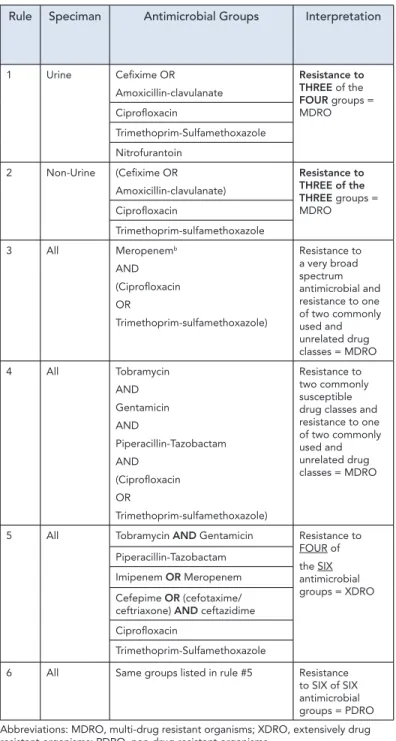
4.1.1 There are four rules for MDRO status in Enterobacteriaceae which takes into consideration the specific specimen type (Table 1).
4.2 Acinetobacter spp. or Pseudomonas aeruginosa
Multi-drug Resistance Definition
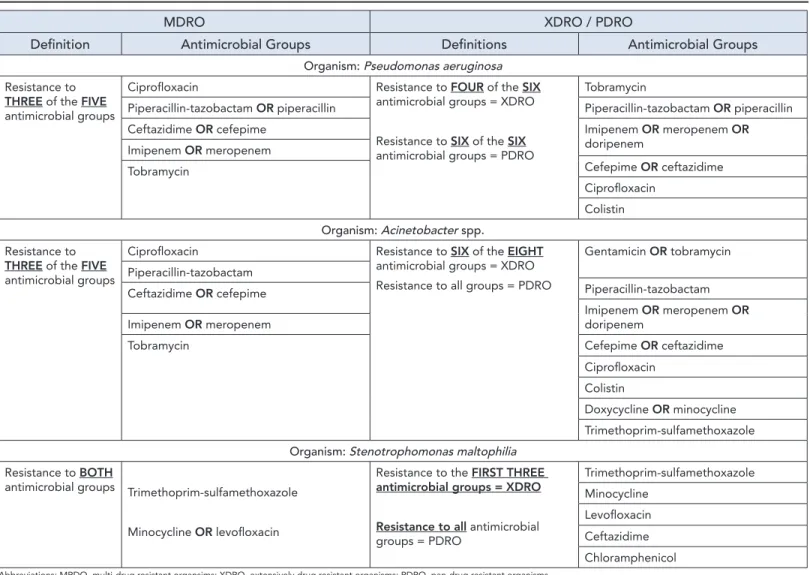
4.2.1 An isolate should be considered MDRO if resistant to THREE of the FIVE antimicrobial agents listed below (Table 2):
1. Ciprofloxacin
2. Piperacillin-tazobactam OR piperacillin (specifically for P. aeruginosa)
3. Ceftazidime OR cefepime 4. Imipenem OR meropenem 5. Tobramycin
4.3 Stenotrophomonas maltophilia Multi-Drug Resistance Definition
4.3.1 S. maltophilia is intrinsically resistant to all carbapenems and most cephalosporins. A clinical isolate should be considered an MDRO if it is resistant to trimethoprim-sulfamethoxazole and subsequent susceptibility testing indicates it is also resistant to an oral anti-microbial (minocycline or levofloxacin) [Table 2].
5.0 Confirmation of XDRO
5.1 Enterobacteriaceae XDRO Definition
5.1.1 An isolate that has been determined to be an MDRO should be considered an XDRO by testing/assessing resistance to other antimicrobial agents listed in this section.
5.1.2 Unlike the definition of MDRO for Enterobacteriaceae, the type of specimen does not need to be considered for the definition of XDRO.
5.1.3 An isolate of Enterobacteriaceae should be considered an XDRO when the isolate is resistant to FOUR of the SIX antimicrobial agents listed below (Table 1):
1. Tobramycin AND gentamicin 2. Piperacillin-tazobactam 3. Imipenem OR meropenem
4. Cefepime OR (cefotaxime/ceftriaxone) AND ceftazidime 5. Ciprofloxacin
6. Trimethoprim-sulfamethoxazole
5.2 Pseudomonas aeruginosa XDRO Definition
5.2.1 A P. aeruginosa should be considered an XDRO when the isolate is resistant to FOUR of the SIX antimicrobial agents listed below (Table 2):
1. Tobramycin
2. PiperacillinOR piperacillin-tazobactam 3. ImipenemOR meropenemORdoripenem 4. Cefepime ORceftazidime
5. Ciprofloxacin
6. Colistin
5.2.2 A P. aeruginosa should be considered a PDRO when the isolate is resistant to ALL of the antimicrobial agents listed in 5.2.1.
5.3 Acinetobacter spp. XDRO Definition
5.3.1 An Acinetobacter spp. should be considered an XDRO when the isolate is resistant to SIX of the EIGHT antimicrobial agents listed below (Table 2):
1. Gentamicin OR Tobramycin 2. Piperacillin-tazobactam
3. Imipenem OR meropenem OR doripenem 4. Cefepime OR ceftazidime
5. Ciprofloxacin 6. Colistin
7. Doxycycline OR minocycline
8. Trimethoprim-sulfamethoxazole (note: intrinsically resistant to trimethoprim)
5.4 Stenotrophomonasmaltophilia XDRO Definition A S. maltophilia should be considered an XDRO if resistant to three oral antimicrobials (trimethoprim-sulfamethoxazole, minocycline, and levofloxacin). The isolate should be referred for complete antimicrobial susceptibility testing to exclude a PDRO (see Table 2).
Rule Speciman Antimicrobial Groups Interpretation
1 Urine Cefixime OR Amoxicillin-clavulanate Resistance to THREE of the FOUR groups = MDRO Ciprofloxacin Trimethoprim-Sulfamethoxazole Nitrofurantoin 2 Non-Urine (Cefixime OR Amoxicillin-clavulanate) Resistance to THREE of the THREE groups = MDRO Ciprofloxacin Trimethoprim-sulfamethoxazole 3 All Meropenemb AND (Ciprofloxacin OR Trimethoprim-sulfamethoxazole) Resistance to a very broad spectrum antimicrobial and resistance to one of two commonly used and unrelated drug classes = MDRO 4 All Tobramycin AND Gentamicin AND Piperacillin-Tazobactam AND (Ciprofloxacin OR Trimethoprim-sulfamethoxazole) Resistance to two commonly susceptible drug classes and resistance to one of two commonly used and unrelated drug classes = MDRO
5 All Tobramycin AND Gentamicin Resistance to
FOUR of the SIX antimicrobial groups = XDRO Piperacillin-Tazobactam Imipenem OR Meropenem Cefepime OR (cefotaxime/ ceftriaxone) AND ceftazidime Ciprofloxacin
Trimethoprim-Sulfamethoxazole
6 All Same groups listed in rule #5 Resistance
to SIX of SIX antimicrobial groups = PDRO Abbreviations: MDRO, multi-drug resistant organisms; XDRO, extensively drug resistant organisms; PDRO, pan-drug resistant organisms
a Expert rules modified from Leclercq et al., 2013 (7)
b Imipenem can be substituted for meropenem with the exception of Proteus spp.
Table 1: Rules for the determination of Multi-Drug-,
Extensively Drug-, Pan-Drug Resistant Organisms in
6.0 Confirmation of PDRO
An Enterobacteriaceae, P. aeruginosa, Acinetobacter spp. should be considered a PDRO when the isolate is resistant to ALL antimicrobial agents listed in Table 1 (rule 6), section 5.2.1, or 5.3.1, respectively. S. maltophilia should be considered a PDRO if it is resistant to all of the following: trimethoprim-sulfamethoxazole, levofloxacin, ceftazidime, and chloramphenicol.
7.0 Reporting to Reference Laboratories
7.1 Any laboratory identifying a MDRO that cannot confirm an XDRO or PDRO using additional antimicrobial susceptibility tests should send the isolate to a reference (provincial) laboratory (See Appendix 2).
7.2 The reference (provincial) laboratory should be notified of any XDR or PDR organisms identified and the isolate should be forwarded to the reference laboratory, and should include the following information:
1. Age of patient
2. Gender of patient
3. Type of clinical specimen (blood, respiratory, skin/soft tissue, or urine)
4. Date of collection
5. Antimicrobial susceptibility testing results from submitting laboratory
6. Out of Canada travel history in the last 3 months. Travel history is dated from the time of the first isolation of the organism. This is highly recommended for inpatients and desirable for outpatients. All countries traveled should be listed.
7.3 If multiple clinical isolates of the same species and
susceptibility pattern are recovered from the same patient, send the isolate from the most invasive site where possible. Additional isolates of the same species and susceptibility pattern should be reported/sent to a reference laboratory no more frequently than every 7 days after the first isolate. Annotating as an MDRO/ XDRO/PDRO on the clinical report should continue for each isolate regardless number of isolates or time interval between specimens.
MDRO XDRO / PDRO
Definition Antimicrobial Groups Definitions Antimicrobial Groups
Organism: Pseudomonas aeruginosa
Resistance to
THREE of the FIVE
antimicrobial groups
Ciprofloxacin Resistance to FOUR of the SIX
antimicrobial groups = XDRO
Resistance to SIX of the SIX
antimicrobial groups = PDRO
Tobramycin
Piperacillin-tazobactam OR piperacillin Piperacillin-tazobactam OR piperacillin
Ceftazidime OR cefepime Imipenem OR meropenem OR
doripenem Imipenem OR meropenem Cefepime OR ceftazidime Tobramycin Ciprofloxacin Colistin Organism: Acinetobacter spp. Resistance to
THREE of the FIVE
antimicrobial groups
Ciprofloxacin Resistance to SIX of the EIGHT
antimicrobial groups = XDRO Resistance to all groups = PDRO
Gentamicin OR tobramycin Piperacillin-tazobactam Piperacillin-tazobactam Ceftazidime OR cefepime Imipenem OR meropenem OR doripenem Imipenem OR meropenem
Tobramycin Cefepime OR ceftazidime
Ciprofloxacin Colistin
Doxycycline OR minocycline
Trimethoprim-sulfamethoxazole
Organism: Stenotrophomonas maltophilia
Resistance to BOTH
antimicrobial groups Trimethoprim-sulfamethoxazole
Minocycline OR levofloxacin
Resistance to the FIRST THREE
antimicrobial groups = XDRO Resistance to all antimicrobial groups = PDRO Trimethoprim-sulfamethoxazole Minocycline Levofloxacin Ceftazidime Chloramphenicol
Table 2: Definitions for the determination of Multi-Drug-, Extensively Drug-, Pan-Drug Resistant Organisms in
select organisms
7.4 It is suggested that reports of clinical specimens found to contain XDRO or PDRO isolates incorporate the term Extensively Drug Resistant Organism or Pan-Drug Resistant Organism within the body of the clinical report.
7.5 Any XDRO or PDRO isolate identified should be reported to public health according to local, regional, and provincial regulations with the additional information outlined in 7.2. 7.6 The originating laboratory should retain the XDRO or PDRO isolates for at least six months, or as required by provincial or local regulations.
7.7 The reference (provincial) laboratory should report all of the data to the National Microbiology Laboratory as defined in 7.2.
Acknowledgements
The subcommittee would like to acknowledge the work of Dr. John Conly (University of Alberta), Dr. Charles Frenette (McGill University), and all the other members of the Canadian Infectious Disease Steering Committee Antimicrobial Resistance Surveillance Task Group. We also appreciate the support of Dr. George Zhanel (University of Manitoba) of the Canadian Antimicrobial Resistance Alliance for feedback on earlier versions of the document. We thank members of the Canadian Public Health Laboratory Network Laboratory Director’s Council for review and final approval of the document. We would also like to thank Ms. Sandra Radons-Arneson from our secretariat for her support.
Conflict of interest
None.
Funding
This work was supported in kind by all laboratories of the authors and the Canadian Public Health Laboratory Network Antimicrobial Resistance Subcommittee.
References
1. Laupland KB, Parkins MD, Church DL, Gregson DB, Louie TJ, Conly JM, Elsayed S, Pitout JDD. 2005. Population-based epidemiological study of infections caused by carbapenem-resistant Pseudomonas aeruginosa in the Calgary Health Region: importance of metallo-beta-lactamase (MBL)-producing strains. J Infect Dis 192:1606–1612.
2. Mataseje LF, Bryce E, Roscoe D, Boyd DA, Embree J, Gravel D, Katz K, Kibsey P, Kuhn M, Mounchili A, Simor A, Taylor G, Thomas E, Turgeon N, Mulvey MR, Canadian Nosocomial Infection Surveillance Program. 2012. Carbapenem-resistant Gram-negative bacilli in Canada 2009-10: results from the Canadian Nosocomial Infection Surveillance Program (CNISP). J Antimicrob Chemother 67:1359–1367.
3. Tien HC, Battad A, Bryce EA, Fuller J, Mulvey M, Bernard K, Brisebois R, Doucet JJ, Rizoli SB, Fowler R, Simor A. 2007. Multi-drug resistant Acinetobacter infections in critically injured Canadian forces soldiers. BMC Infect Dis 7:95-2000. 4. Magiorakos AP, Srinivasan A, Carey RB, Carmeli Y, Falagas
ME, Giske CG, Harbarth S, Hindler JF, Kahlmeter G, Olsson-Liljequist B, Paterson DL, Rice LB, Stelling J, Struelens MJ, Vatopoulos A, Weber JT, Monnet DL. 2012. Multidrug-resistant, extensively drug-resistant and pandrug-resistant bacteria: an international expert proposal for interim standard definitions for acquired resistance. Clin Microbiol Infect 18:268-281.
5. Clinical and Laboratory Standards Institute. Performance Standards for Antimicrobial Susceptibility Testing: Twenty-Third Informational Supplement M100-S25. CLSI, Wayne, PA, USA, 2015.
6. Mosby’s Medical Dictionary 9th ed 2012 St. Louis, MO: Mosby Elsevier.
7. Leclercq R, Canton R, Brown DFJ, Giske CG, Heisig P, MacGowan AP, Mouton JW, Nordmann P, Rodloff AC, Rossolini GM, Soussy CJ, Steinbakk M, Winstanley TG, Kahlmeter G. 2013. EUCAST expert rules in antimicrobial susceptibility testing. Clin Microbiol Infect 19:141–160.
The article published by Magiorakos and colleagues (2012) was used as the main reference for the development of these Canadian recommendations. Drs. German and Mulvey developed the initial framework for the document, which was reviewed by the Canadian Public Health Laboratory Network (CPHLN) AMR Working Group members and invited collaborators. Two main considerations were discussed by the working group members: (i) formulation of a recommendation that focused on antimicrobial drugs commonly used in Canada; and (ii) creation of a document that is easy to use by frontline laboratories, which predominantly utilize automated methods for generating antimicrobial susceptibility data.
Three rounds of discussion and document revision took place with the working group. This included discussion and suggestions from the Communicable and Infectious Disease Steering Committee (CIDSC) AMR Task Group from the Pan-Canadian Public Health Network. The final draft recommendations were reviewed by the CPHLN Executive. Major variation with recommendations in this document as compared to Magiorakos et. al. (2012) was as follows:
1. The working group decided to focus on Gram-negative isolates to keep the recommendations straightforward and achievable. It was decided that recommendations for Gram-positive organisms would be addressed in a future document;
2. Stenotrophomonas maltophilia was added as an additional Gram-negative organism to be considered for the reporting of MDRO, XDRO and PDRO in the Canadian document; 3. Although the definition of MDRO in Gram-negative
organisms is an important consideration, given the treatment complications that can be associated with these infections, it was decided at a provincial and national level to voluntarily report only XDRO and PDRO isolates and use the identification of an MDRO as a screening test to direct further testing and reporting of resistant isolates. This was done to ensure frontline laboratories could easily report their findings to reference laboratories, or request additional tests of antimicrobial drugs not covered under the frontline antimicrobial drug panel needed to confirm XDRO/PDRO.
4. A great deal of discussion focused on the value of using the definition of resistance, as defined by CLSI (2015), rather than that of non-susceptibility proposed by Magiorakos et. al. (2012). It was decided to use the CLSI definition of resistance based on the main arguments put forward, which were: (i) front-line laboratories may have difficulty analyzing ‘intermediate resistance’ data in the context of MDRO/ XDRO/PDRO; (ii) there were concerns about the reporting of these organisms in relation to public health. A stringent definition of resistance was determined to be the most feasible solution.
5. It was noted that laboratories may have to use FDA breakpoints, which may differ from the CLSI definitions. It was requested in the recommendations that these differences be noted in the report to the reference laboratory.
6. The exhaustive antimicrobial agents listed in the Tables of the Magiorakos et. al. (2012) publication was simplified to reflect the antimicrobial agents commonly used and available in Canada.
7. Ertapenem was removed as a marker for carbapenem resistance in Enterobacteriaceae. The specificity of
ertapennem is lower than that of meropenem and imipenem and is not commonly used in a clinical laboratory setting. 8. With the exception of Acinetobacter spp. and S. maltophilia,
the tetracyclines were removed from the list of antimicrobials to be considered as they are not frequently tested in
frontline laboratories nor are they commonly used to treat serious infections.
9. The Canadian recommendations requested additional clinical information that were not included in the Magiorakos et. al. (2012) publication.
Appendix 1
Dr. Linda Hoang
BC Public Health Microbiology & Reference Laboratory, 655 West 12th Avenue,
Vancouver, BC, V5Z 4R4 [email protected] Dr. Jeff Fuller
Alberta Provincial Laboratory for Public Health, Alberta Health Services,
2B3.13 WMC, 8440-112 Street, Edmonton, AB, T6G 2J2
[email protected] Dr. Paul Levett
Saskatchewan Disease Control Laboratory, 5 Research Drive,
Regina, SK, S4S 0A4 [email protected] Dr. Jared Bullard
Cadham Provincial Laboratory, 750 William Avenue,
Winnipeg, MB, R3E 3J7 [email protected] Dr. Samir Patel
Public Health Ontario Laboratories, 661 University Avenue, Ste. 1701 Toronto, ON, N5G 1M1
[email protected] Dr. Brigitte Lefebvre
Laboratoire de santé publique du Québec, Institut national de santé publique du Québec, 20045 chemin Sainte-Marie,
Ste-Anne-de-Bellevue (Québec) H9X 3R5 [email protected]
Dr. Gabriel Girouard
Centre Hospitalier Universitaire Dr-Georges-L-Dumont, 330 Avenue Universite,
Moncton, NB, E1C 2Z3 [email protected] Dr. David Haldane
Queen Elizabeth II Health Science Centre, 5788 University Avenue,
Halifax, NS, B3H 1V8
[email protected] Dr. Greg German
Queen Elizabeth Hospital 60 Riverside Drive
Charlottetown, PE C1A 8T5 [email protected]
Robert Needle
Newfoundland Public Health Laboratory, Dr. L.A. Miller Centre,
100 Forest Road, St. John’s, NL, A1A 3Z9 [email protected] Dr. Michael Mulvey
National Microbiology Laboratory 1015 Arlington Street
Winnipeg, MB, R3E 3R2