Title: Mining Twitter for Crisis Management:
Real-time Floods Detection in the Arabian Peninsula
Name: Waleed Alabbas
This is a digitised version of a dissertation submitted to the University of
Bedfordshire.
It is available to view only.
This item is subject to copyright.
i
Mining Twitter for Crisis Management:
Real-time Floods Detection in the Arabian
Peninsula
By
Waleed Alabbas
A thesis submitted to the University of Bedfordshire in partial fulfilment of the requirements for the degree of Doctor of Philosophy
University of Bedfordshire
Institute for Research in Applicable Computing April 2018
ii
I Waleed Alabbas declare that this thesis and the work presented in it are my own and has been generated by me as the result of my own original research.
Mining Twitter for Crisis Management: Real-time Floods Detection in the Arabian Peninsula I confirm that:
1. This work was done wholly or mainly while in candidature for a research degree at this University;
2. Where any part of this thesis has previously been submitted for a degree or any other qualification at this University or any other institution, this has been clearly stated;
3. Where I have cited the published work of others, this is always clearly attributed;
4. Where I have quoted from the work of others, the source is always given. With the exception of such quotations, this thesis is entirely my own work;
5. I have acknowledged all main sources of help;
6. Where the thesis is based on work done by myself jointly with others, I have made clear exactly what was done by others and what I have contributed myself;
7. Either none of this work has been published before submission, or parts of this work have been published as indicated on [insert page number or heading]:
Name of candidate: Waleed Alabbas Signature:
iii
Abstract
In recent years, large amounts of data have been made available on microblog platforms such as Twitter, however, it is difficult to filter and extract information and knowledge from such data because of the high volume, including noisy data. On Twitter, the general public are able to report real-world events such as floods in real time, and act as social sensors. Consequently, it is beneficial to have a method that can detect flood events automatically in real time to help governmental authorities, such as crisis management authorities, to detect the event and make decisions during the early stages of the event.
This thesis proposes a real time flood detection system by mining Arabic Tweets using machine learning and data mining techniques. The proposed system comprises five main components: data collection, pre-processing, flooding event extract, location inferring, location named entity link, and flooding event visualisation. An effective method of flood detection from Arabic tweets is presented and evaluated by using supervised learning techniques. Furthermore, this work presents a location named entity inferring method based on the Learning to Search method, the results show that the proposed method outperformed the existing systems with significantly higher accuracy in tasks of inferring flood locations from tweets which are written in colloquial Arabic. For the location named entity link, a method has been designed by utilising Google API services as a knowledge base to extract accurate geocode coordinates that are associated with location named entities mentioned in tweets. The results show that the proposed location link method locate 56.8% of tweets with a distance range of 0 – 10 km from the actual location. Further analysis has shown that the accuracy in locating tweets in an actual city and region are 78.9% and 84.2% respectively.
iv
Table of Contents
Chapter 1: Introduction ... 1
1.1. Background ... 2
1.1.1. Message Propagation on Social Networks ... 3
1.1.2. Arabic Text ... 5
1.1.3. Event Definition and Categorisation ... 7
1.2. Limitations of Existing Work and Challenges ... 9
1.3. Motivation and Research objectives ... 12
1.4. Problem statement and research questions ... 14
1.5. Scope and Limitations ... 18
1.6. Significance and contribution of the research ... 18
1.7. Thesis Organisation ... 20
Chapter 2: Background ... 24
2.1. A mathematical definition of the text classification task ... 24
2.2. Architecture for a text categorization system ... 26
2.3. Classifiers ... 28
2.3.1. Support Vector Machines ... 29
2.3.2. Neural networks ... 30
2.3.3. Decision tree classifiers ... 31
v
2.3.5. K-Nearest Neighbour Classifier ... 34
2.4. Performance Measures ... 35
2.4.1. Accuracy, Recall, Precision and F1 measures ... 35
2.4.2. McNemar's Test ... 36
2.5. Learn to Search (L2S) ... 37
Chapter 3: Literature Review ... 41
3.1. Introduction ... 41
3.2. Text classification ... 41
3.3. Arabic Text classification (Systematic Literature Review) ... 43
3.3.1 Methodology ... 44
3.3.2 Results analysis and discussion ... 50
3.3.3 Colloquial Arabic Text Classification ... 60
.3.4 Event Detection in Social Networks ... 62
3.4.1 New Event Detection ... 63
3.4.2 Event Location Inference on Twitter ... 64
3.4.3 Arabic NER on Twitter ... 65
3.5. Chapter summary... 67
Chapter 4: Research Methodology ... 70
4.1 Research Method ... 70
4.2 Proposed approach ... 70
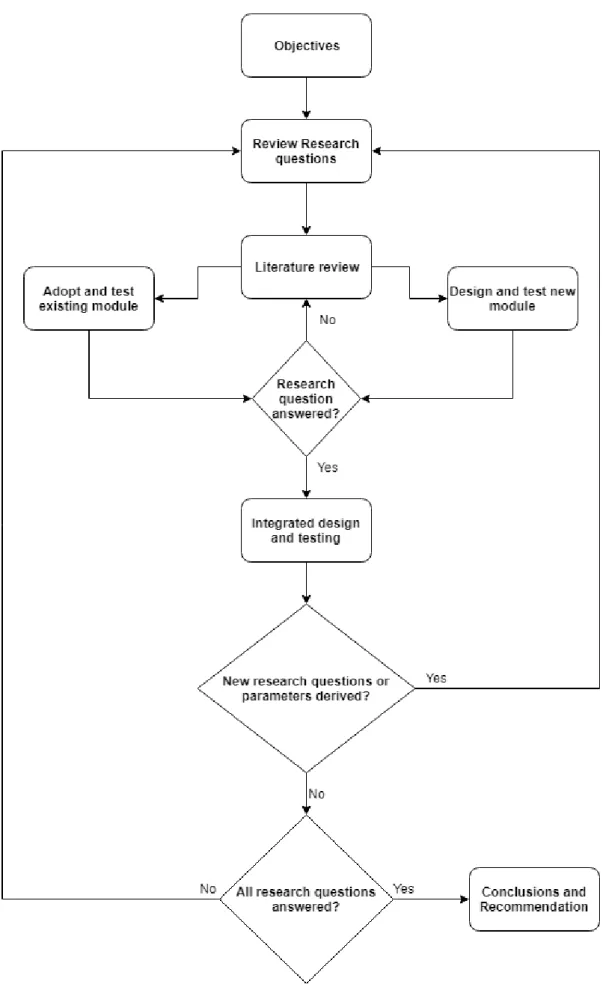
4.2.1 Objectives ... 70
vi
4.2.3 Literature review ... 72
4.2.4 Adopt & test existing modules ... 72
4.2.5 Design and test new module ... 73
4.2.6 Research question answered? ... 73
4.2.7 Integrated design and testing ... 73
4.2.8 New sub questions or parameters derived? ... 73
4.2.9 All research questions answered? ... 74
4.2.10 Conclusions & recommendations ... 74
4.3 System Design ... 74
4.3.1 Micro-blog Loader: Tweets Loader ... 74
4.3.2 Pre-processing ... 75
4.3.3 Classifier ... 76
4.3.4 Location Detector... 76
4.3.5 Event Visualiser ... 77
4.4 Specification ... 77
4.4.1 Software System Attributes ... 77
4.4.2 Hardware Requirements ... 78
4.4.3 Software Requirements ... 79
4.4.4 System Analysis and Design Tools ... 79
4.4.5 System Implementation Tools ... 80
4.5 Data Sets ... 81
vii
4.5.2 The National Climatic Data Center API ... 83
4.5.3 Data Collection ... 84
4.6 Experiments & Analysis ... 85
4.6.1 Experiment 1: Systematic Literature Review ... 85
4.6.2 Experiment 2: Classification of Colloquial Arabic Tweets in real-time to detect high-risk floods ... 85
4.6.3 Experiment 3: Location Inference from Twitter ... 85
4.6.4 Experiment 4: Locations Named Entity Linking ... 86
Chapter 5: Classification of Colloquial Arabic Tweets in real-time to detect high-risk floods ... 87
5.1 Introduction ... 87
5.2 Problems and Challenges ... 88
5.3 Methodology ... 89 5.3.1 Data Collection ... 92 5.3.2 Data Labelling ... 93 5.3.3 Text pre-processing ... 94 5.3.4 Data Division ... 96 5.3.5 Data Representation ... 97 5.3.6 Training Models ... 98
5.4 Results and discussion ... 100
5.5 Chapter summary... 105
Chapter 6: Location Inference from Twitter ... 106
viii
6.2 Problems and Challenges ... 107
6.3 Types of Locations and Spatial Features on Twitter ... 108
6.4 Methodology ... 109
6.4.1 Tweet gathering stage ... 110
6.4.2 Text pre-processing ... 111
6.4.3 Classification stage ... 112
6.4.4 Location Named Entity Recognition ... 113
6.5 Results, Analysis and Discussion ... 115
6.6 Chapter summary... 119
Chapter 7: Locations Named Entity Linking ... 120
7.1 Introduction ... 120
7.2 Problems and Challenges ... 121
7.3 Location NEL Method ... 122
7.4 Location NEL Results and Discussion ... 128
7.5 Chapter summary... 132
Chapter 8: A system for Real-Time Flood Detection ... 133
8.1 Introduction ... 133
8.2 Systems in Real-Time Flood Detection ... 134
8.2.1 Microblog Loader and Pre-processing ... 134
8.2.2 Tweet location NER and NEL ... 135
8.2.3 Floods event visualisation ... 135
ix
8.4 Run Time Performance ... 138
8.5 Verifying and extending the system ... 139
8.6 Chapter summary... 143
Chapter 9: Conclusions and Future Research Directions ... 144
9.1 Summary of Contributions ... 144
9.2 Future Directions ... 151
References ... 154 Appendix A: Test Dataset of NER task and performance results of NER systems .. Error! Bookmark not defined.
Appendix B: Test Dataset of NEL task ... Error! Bookmark not defined. Appendix C: Rainfall daily amount and number of tweets that mentioned high risk floods during the period 05 May - 01 Jun 2017, in Makah, Saudi Arabia ... Error! Bookmark not defined.
x
List of Tables
Table 1-1 Twitter term definition (Twitter, 2018b) ... 5
Table 1-2 sub-objectives ... 13
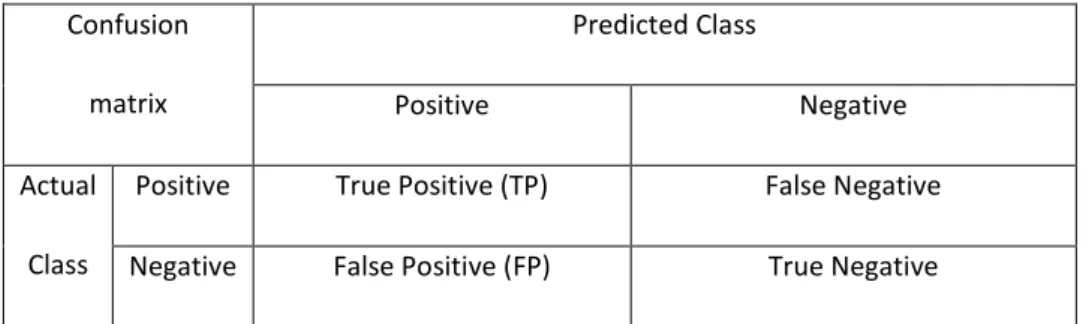
Table 2-1 Confusion matrix ... 36
Table 2-2 Possible results of two algorithms ... 37
Table 3-1 DATABASES ... 46
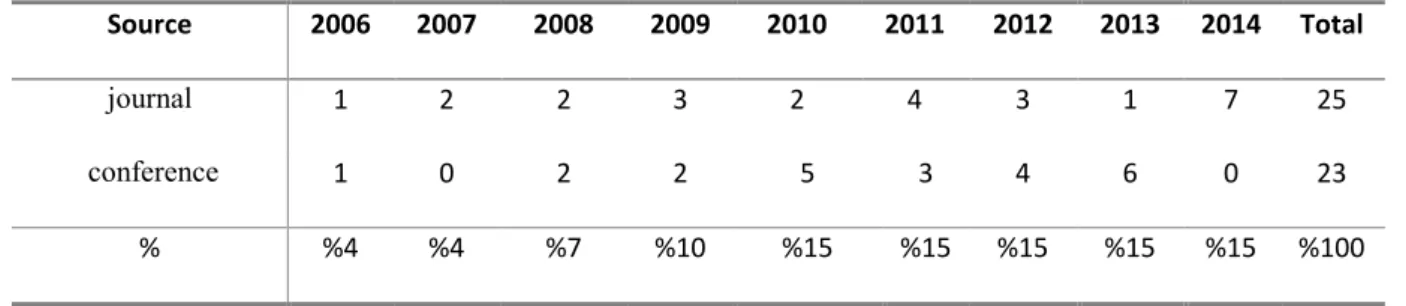
Table 3-2 THE DISTRIBUTION OF PRIMARY STUDIES BY PUBLICATION TYPE AND PUBLICATION YEAR50 Table 3-3 KEY FOCUS AREA FOR INCLUDED PAPERS ... 51
Table 3-4 SOURCES FOR BUILDING DATASETS ... 52
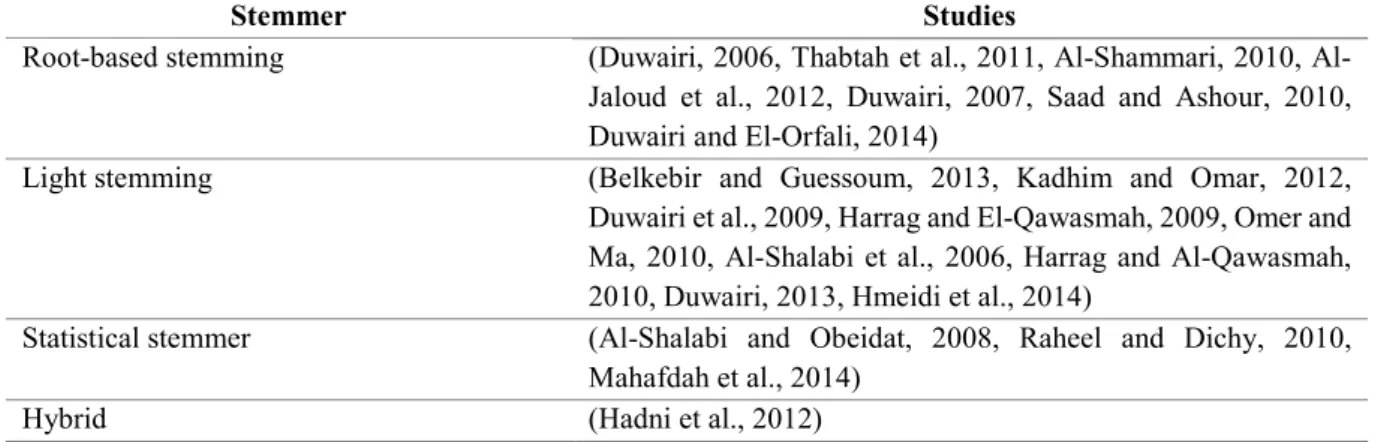
Table 3-5 STEMMER TECHNIQUES USED ... 54
Table 3-6 FEATURE SELECTION TECHNIQUES ... 56
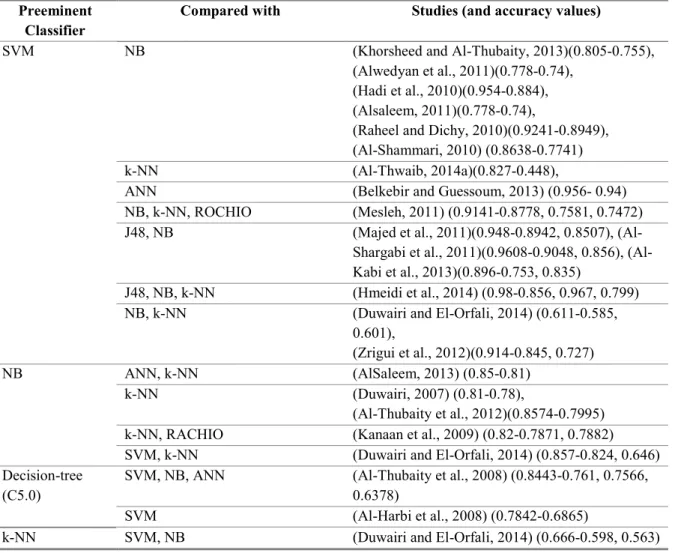
Table 3-7 STUDIES INVESTIGATING ACCURACY ... 58
Table 4-1 System analysis and design tools. ... 79
Table 4-2 System implementation tools. ... 80
Table 5-1 Instructions for annotators prior to the annotation task (classification) ... 94
Table 5-2 Example tweets and annotations to the annotators before the classification task (Classes are: Event or Non-Event). ... 94
Table 5-3 Data division ... 97
Table 5-4 Algorithm accuracy, precision, recall and F-score ... 101
Table 5-5 Classification results of classifiers ... 102
Table 6-1 Location NER systems results ... 118
Table 6-2 NER systems perform on 3 example tweets (TP = True Positive, FP= False Positive, FN= False Negative, TN= True Negative,) ... 119
xi
Table 7-1 address types that returns by Google geocode API (Google, 2018a) ... 127
Table 7-2 Example of the NEL method results to link and mapped tweets ... 129
Table 7-3 Accuracy of the proposed NEL method ... 130
xii
List of Figures
Figure 1-1 Flood Risk Matrix ... 14
Figure 2-1 Paradigms in text classification ... 25
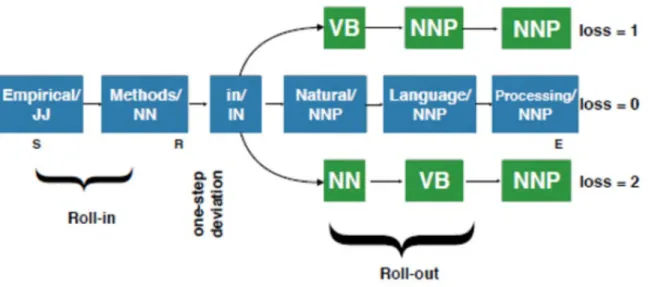
Figure 2-2 A search space for part of speech tagging, explored by a policy that chooses to “explore” at state R (Sharaf et al.,2017). ... 39
Figure 2-3 Learning to Search algorithm (Sharaf et al.,2017) ... 40
Figure 3-1 Main stages followed in this SLR. ... 45
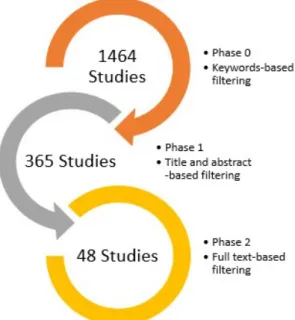
Figure 3-2 The number of primary studies included in each phase of the study selection procedure49 Figure 4-1 flow diagram of the methodology used in this research ... 71
Figure 4-2 The architecture of the proposed system ... 75
Figure 5-1 MAIN STEPS IN TWEETS CLASSIFICATION ... 91
Figure 5-2 examples of tweets and the changes at pre-processing, stemming, data representation (TF-IDF) stages ... 98
Figure 5-3 Classifiers F1-Scores ... 102
Figure 6-1 Main steps to infer high risk floods location from tweets ... 110
Figure 6-2 Number of tweets by source ... 112
Figure 6-3 Number of tweets per class ... 113
Figure 6-4 Example inputs and desired outputs for named entity recognition task. ... 115
Figure 6-5 Examples of location NER systems results. It denote error as the following true positive , false positive and false negative ... 116
Figure 8-1 result screenshot ... 136
xiii
Figure 8-3 Rainfall daily amount for Arabian Peninsula during time period between 5 May and 1 Jun 2017 ... 140 Figure 8-4 number of tweets by class during time period between 5 May and 1 Jun 2017 ... 141 Figure 8-5 daily rainfall amount received in Makkah region (above), and number of tweets are located in Makkah region (below) during time period between 5 May and 1 Jun 2017... 141 Figure 8-6 scatterplot shows the daily rainfall amount and number of tweets data. ... 143
xiv
List of Abbreviations
Abbreviation Term
AU Active users on social media. AI Artificial Intelligence
API Application programming interface. C5.0 Decision-tree.
CA Classic Arabic. CHI Chi-square
DA Dialectal Arabic.
DRT Dimensionality Reduction Techniques DSS Decision Support Systems.
FS Features Selection.
IOB Inside I, Outside O and Beginning B tagging scheme IR Information retrieval.
CRF conditional Random Field K-NN K-Nearest Neighbour.
L2S Learning to Search lat latitude coordinate long longitude coordinate
ML Machine learning.
MSA Modern standard Arabic. NA not available
NB Naïve Bayes. NE Named Entity
NED New Event Detection. NEL Named Entity Linking
xv NER named entity recognition NLP Natural Language Processing. NNET Neural Networks
NOAA National Oceanic and Atmospheric Administration OSM Open Street Map
OSN Online social network. POI point-of interest POS Part-of-speech.
RED Retrospective Event Detection. SLR Systematic Literature Review.
ST Stemming Techniques SVM Support Vector Machines.
TC Text classification.
TF-IDF Term Frequency-Inverse Document Frequency TW Term Weighting.
xvi
List of Publications
The following refereed publications are part of the key results from the research work presented in this thesis, which has previously been published in international conferences.
• Alabbas, W., Al-Khateeb, H.M. and Mansour, A., 2016, October. Arabic text classification methods: Systematic literature review of primary studies. In Information Science and Technology (CiSt), 2016 4th IEEE International Colloquium on (pp. 361-367). IEEE.
• Alabbas, W., al-Khateeb, H.M., Mansour, A., Epiphaniou, G. and Frommholz, I., 2017, June. Classification of colloquial Arabic tweets in real-time to detect high-risk floods. In Social Media, Wearable and Web Analytics (Social Media), 2017 International Conference On (pp. 1-8). IEEE.
1
Chapter 1:
Introduction
Social media platforms are becoming increasingly popular. This can be evidenced by the huge and increasing amount of text generated by users on a day-to-day basis. According to Smith (2017) there were 2.46 billion active users (AU) on social media platforms in 2017. The same report estimates that the number of AU on social media platforms will increase by 18% to 2.9 billion AU in 2020. Moreover, this translates to the availability of huge data and a wealth of information (Medvet and Bartoli, 2012). Meanwhile, the availability of this huge data introduces many challenges for researchers who are trying to analyse and process such data.
Twitter is an online social media platform that allows users to post short texts called tweets with the option to attach a link to a website, photograph, or video. The popularity and features of Twitter have paved the way for practical applications to consider real-world events. For instance, Sakaki et al., (2010) developed an earthquake reporting system by analysing Japanese tweets. Their system detects earthquakes faster than the Japan Meteorological Agency. Events detection generally works by scanning Twitter for texts, or so-called tweets, containing keywords relating to a defined topic or theme, which in turn, can be compiled and analysed for newsgathering, research, intelligence, and the detection of disasters and other important occurrences.
Twitter users generated 500 million tweets per day on average in 2016, and just over one-third (34%) of all tweets were in the English language, with 6% in Arabic, making it the sixth most used language on Twitter. Furthermore, Aslam, (2017) report that Saudi Arabia has the highest number of AU on Twitter.
2
In this thesis, an effective method for detecting flood events in real time, by collecting and analysing tweets which are written in Arabic, is presented. Furthermore, a flood detection system that employs tweets and rainfall data from reliable global organisations has been developed to help emergency authorities to detect and track flood events and their locations. In this chapter, the research introduction will be discussed, including the background, motivation, main contributions and the organisation of this thesis.
1.1.Background
Currently, existing User-Generated Content (UGC) platforms such as Twitter are being considered as powerful channels for sharing and exchanging information over the Internet. In the event of a natural disaster or other event, Twitter users generate a huge number of messages sharing and discussing event information and their opinions on this event. The tweets’ content can lead to detecting significant events in the Twitter stream. However, to properly detect events on social media platforms, it is necessary to define and understand the concept of social media platforms and how users are reporting events using such channels.
The following sub-section, firstly addresses how users propagate events-related contents on Twitter. Secondly, it will define the concept of event detection from an emergence management perspective, consequently categorising event detection on social media into four types based on event type and detection task. Thirdly, characterising and distinguishing between Arabic and other Languages will be discussed. Last but not least, the limitations of the existing work on event detection from social media in general, and event detection from Arabic tweets, will be discussed.
3
1.1.1. Message Propagation on Social Networks
Social media platforms are highly interactive platforms via which their users publish, discuss and post thousands of user-generated content, including a wide range of topics and events. In 2007 Ellison (2007) defined social media networks sites as “web-based services that allow individuals to construct a public or semi-public profile within a bounded system, articulate a list of other users with whom they share a connection, and view and traverse their list of connections and those made by others within the system”. Later in 2008 Krishnamurthy and Dou (2008) defined social media sites as user-generated services whereby users can produce, design, publish, or edit content such as blogs, microblogs, online review sites, virtual game worlds, images or video sharing sites.
In the 1970s, Dynes (1970) studied victims of disaster behaviour and observed that they do not lose control and make quick decisions based on the information available to them at the time. The first responders to a disaster event are often neighbours and friends and other members of the public. They rush to the scene to perform search and rescue operations, administer first aid, and perform critical tasks necessary during the first moments of response. The growing use of social media to gather and share information, organise relief efforts, and communicate nowadays, means that the members of the public who can play a valuable role in these situations is no longer limited to those in the areas of impact. The following scenario summarises how social media users and emergency authorities react during significant events (Latonero and Shklovski, 2011):
1) In the event of a natural disaster or significant event, Twitter users who observed this event post tweets about the event to share event information with their followers.
4
2) In a short time, Twitter users retweet tweets that are received from their social networks and share the event information which comes from traditional media and official sources.
3) Emergency Management Agencies employ Twitter and other social media platforms to share event information with the public, especially affected communities.
4) After that, Emergency Management Agencies monitor Twitter data streaming to gather information during the time of the event.
This thesis focuses on detecting real-time events on Twitter, and a set of Twitter specific terms is used throughout. Table 1-1 shows the most popular twitter terms and their definitions.
In terms of social connectivity, Twitter allows a user to follow any number of other users. The Twitter user can follow other users without requiring approval. Users can set their privacy preferences so that their updates are available only to each user’s followers. By default, the posted messages are publicly available to anyone. In this work, only messages posted publicly on Twitter are considered.
Twitter provides an application programming interface (API), which allows developers to programmatically access the public data streams as well as many features of the service. For instance, Twitter streaming API provides filtering by location, keywords, author, and so on. The availability of Twitter data has motivated significant research work in various disciplines and led to numerous applications and tools.
5 Table 1-1 Twitter term definition (Twitter, 2018b)
Term Definition
Twitter An information network made up of 280-character messages (including photos, videos and links) from all over the world.
Tweet A Tweet may contain photos, videos, links and up to 280 characters of text. @username A username is how you're identified on Twitter, and is always preceded
immediately by the @ symbol. Retweet
(RT)
A retweet is a repost or forward of a tweet by another user.
Like Likes are used by users when they like a tweet. By favoriting a tweet, a user can let the original poster know that they have liked their tweet. The total number of times a tweet has been favorited is visible to everyone.
Followers A follower is another Twitter account that has followed you to receive your Tweets on their Home timeline.
Followees People who the user followers. The total number of followees a user has is also visible to everyone.
hashtag Written with a # symbol—is used to index keywords or topics on Twitter. This function was created on Twitter, and allows people to easily follow topics they are interested in
reply A reply is a response to another person’s Tweet.
mention A mention is a Tweet that contains another person’s @username anywhere in the body of the Tweet.
User profile The user profile displays user information, as well as all Tweets that have been posted.
monthly active users
Is someone who logs in (but does not necessarily tweet) once a month.
1.1.2. Arabic Text
Arabic is the fifth most widely used language in the world. It is officially used in 22 countries, and is the mother tongue of more than 422 million persons and the second language
6
of almost another 250 million. Arabic has 28 letters and the orientation of writing is from right to left. Its script has a unique shape, marks, diacritics, style (font), numerals, distinctive letters and none distinctive letters (Odeh et al., 2015). Noaman and Al-Ghuribi (2012) have discussed its complex morphology and how words could have different meanings within a given context. Arabic is highly inflectional and derivational (El-Halees, 2007); it does not use capitalisation for proper nouns, which is a very useful input when classifying English documents. Arabic synonyms are widespread (Saad and Ashour, 2010). The majority of words have a tri-letter root, while the rest have a quad-letter root, penta-letter root or hexa-letter root (Khreisat, 2009).
Arabic can be classified with respect to its morphology, syntax, and lexical combinations into three different categories: classic Arabic (CA), modern standard Arabic (MSA), and dialectal Arabic (DA) (Habash, 2010). There are many varieties of Arabic dialects distributed across the Arab world. There are often several variants of a dialect within the same country. Colloquial Arabic text is a collective term for the spoken languages or dialects of people throughout the Arab world, and is therefore widely used on social media. It is generally characterised as being highly unstructured, inconsistent, and difficult to process. In natural language processing, researchers have classified Arabic dialects into five different groups, namely: Egyptian (spoken in Egypt, but understood universally), Maghrebi (spoken in all of North Africa), Gulf (spoken primarily in Saudi Arabia, UAE, Kuwait and Qatar), Iraqi (spoken in Iraq), and Levantine (spoken primarily in the Levant, Syria and Palestine) (Cotterell and Callison-Burch, 2014) (Al-Sabbagh and Girju, 2012). In contrast, MSA is the official Arabic language that is taught in schools and defined as the accepted medium for formal communication. MSA is therefore more understood, has specific grammar rules, and is structured and more consistent.
7
Arabic is a morphologically rich language as a result of the following points:
• A given term can take on several meanings depending on the context, such as (بھذ) which may mean gold or went.
• Many people tend to use the dialect of their country or English words in Arabic letters instead of using MSA such as (ىرأ =فوﺷأ) or ( Coffee = ﻲﻓوﻛ )
• Repeating the letter more than once to intensify the meaning or feeling (which can be seen clearly in social media) such as لﯾﯾﯾﯾﯾﻣﺟ, which in MSA is written as لﯾﻣﺟ. • Arabic has various diacritics;diacritics change the meaning of words. For example,
(“confusing” “سْﺑَﻟ”) and (“dress” “ سﺑِﻟ”) can both be read as the same word when written without diacritics.
Recently, Twitter has been growing exceptionally fast in the Arab world. The Arabic Social Media Report 2017 (Salem, 2017) states that there are 11.1 million monthly active users in the Arab world, generating 27.4 million tweets per day, and 72% of those tweets are written in Arabic. More than one third of the tweets generated in the Arab world come from Saudi Arabia.
Users on social networks typically use colloquial Arabic by using their local dialect such as Egyptian and Gulf dialects (Al-Sabbagh and Girju, 2012). In natural language processing (NLP), dealing with text written in a colloquial language creates additional challenges, and these challenges can clearly be seen when moving to microblog platforms such as Twitter.
1.1.3. Event Definition and Categorisation In general, an event can be defined as follows:
Definition 1.1. An “event” is something that occurs in a certain place during a particular interval of time (Dictionary, 2018).
8
Events on social media platforms can be loosely defined as real-world happenings that occur within similar time periods and geographical locations, and that have been mentioned by online users in the forms of images, videos or texts. A slightly different definition that also includes the concept of event on social media is given by (Dong et al., 2015). These authors identify an “event” on social media as follows:
Definition 1.2. Events on social media are real world happenings that are reflected by data that are concentrated either in both time and space, or in at least one of these two dimensions.
Atefeh and Khreich (Atefeh and Khreich, 2015) have presented a survey of techniques that can be applied to Twitter-based event detection. They have classified event types as ‘specified’ or ‘unspecified’; detection tasks as ‘Retrospective Event Detection (RED)’ or ‘New Event Detection (NED)’, and detection methods as ‘supervised’ or ‘unsupervised’ methods. Unspecified Event Detection: The nature of Twitter posts is that they reflect events as they unfold; hence, these tweets are particularly useful for unknown event detection. Unknown events of interest are typically driven by emerging events, breaking news, and general topics that attract the attention of a large number of Twitter users.
Specified Event Detection: Specified event detection includes known or planned social events. These events could be partially or fully specified by the related content or metadata information, such as location, time, venue, and performers.
New event detection (NED): NED involves the discovery of new events from live streams in (near) real time. NED techniques involve continuous monitoring of Twitter signals to discover new events in near real time. They are naturally suited to detecting unknown real world events or breaking news. Although NED approaches do not impose any assumptions on the event, they are not restricted to unspecified event detection. When the monitoring task
9
involves specific events (natural disasters, celebrities, etc.) or specific information about the event description (e.g., geographical location), this information could be integrated into the NED system.
Retrospective event detection (RED): focuses on discovering previously unidentified events from accumulated historical collections.
1.2.Limitations of Existing Work and Challenges
This section highlights a number of challenges met by researchers when dealing with event detection from social media.
Volume and Velocity: The volume and velocity of social media messages posted during crises are extremely high, which makes it hard for decision makers to respond in a timely manner. Real-Time Event Detection: flood events should be identified as soon as possible. In this case, methods for flood detection should consider the process time to detect flood events.
Noise and Veracity: social media platform user generated information is characterised by noise. Noise in social media flows from advertisements, spam messages and bot accounts that publish large volumes of messages. Another obstacle is that textual information on social media is limited. Users usually publish very short messages, which makes it difficult to apply text mining and NLP methods.
Machine learning (ML) approaches: In ML selecting, the most suitable approach to apply in supervised learning is not a trivial task. Textual representations such as Term-Document matrices are not sufficient. For event detection, the ML approach should be based on the content-based attributes that appear in messages.
Evaluation: The most important task in ML is evaluation, which compares the result produced with other existing studies’ results by using open datasets. Unfortunately, the availability of
10
event detection datasets is very limited, and none of these data sets are suitable for this work, as it focuses on a specific type of event (floods) and specific language (Arabic).
Named entity recognition (NER) is an important form of Information Extraction (IE) task, which identifies snippets of a text that mention events and issues in the real world, and it is used for a number of IE tasks, such as NEL, co-reference resolution, and relation extraction. However, NER is often difficult to utilise with user-generated content, especially within the microblog genre, due to limited amount of contextual information contained within short messages, as well as the limited curation of content conducted by third parties, including editors for newswire. This section will highlight various state-of-the-art NER methods and their performance with regard to microblog data.
NER systems use a number of techniques, such as gazetteer-based lookups, for example the ANNIE system produced by GATE (Cunningham et al., 2002); DBpedia Spotlight (DBpedia, 2017); Lupedia (Ontotext, 2018); machine learning-based methods for detecting named entities (e.g. the Stanford NER system) (Finkel et al., 2005); TextRazor (Txtrazor, 2018), and Alchemy API (IBM, 2018). It is only recently that Twitter has been considered an active research topic for NER. Moreover, various approaches have been suggested for its application in the English language, for example, the approach by (Ritter et al., 2011), which involves applying tokenisation, along with POS tagging and topic models in order to look for named entities. Importantly the system put forward by Ritter et al (2011) has been shown to perform better than the Stanford NER system with Twitter datasets.
NER systems may find it hard to cope with colloquial Arabic text due to the ambiguity of some words that are undiacritized, which results in them having different meanings
11
according to the specific context they are used as a result of the missing diacritics, and this makes NER Systems even more complex than usual (Abdallah et al., 2012). The majority of modern Arabic written texts are written in colloquial Arabic, but previous work has addressed NER only with Modern Standard Arabic (MSA) text, such as news articles (Zayed and El-Beltagy, 2012); (Zirikly and Diab, 2014). Therefore, (Abdallah et al., 2012) have put forward a simple integration method that combines a rule-based system and a machine-learning classifier to better recognise Arabic entries. To do so, (Abdallah et al., 2012) repeated the work by (Benajiba et al., 2008) and integrated it with a Decision Tree classifier, which resulted in an integrated system that achieved 8-12% better than the rule based system alone.
A NER system designed for colloquial Arabic, specifically the Egyptian Dialect, was introduced by (Zirikly and Diab, 2014), which could identify person and location named entities by applying: Inside I, Outside O and Beginning B (IOB) as the tagging scheme. To test the system, they chose an Egyptian dialect dataset from a set of web blogs made up of almost 40k tokens that included 285 people and 153 location named entities. (Zirikly and Diab, 2014) found that their system reached an F-score of 91% for location NER when they applied a Levenshtein match approach to discover the similarities between the input and a gazetteer entry. (Zirikly and Diab, 2015) used two datasets in order to develop an Arabic entity system- one containing Arabic tweets, and the other an Egyptian dialectal dataset. They found that the performance of the Arabic NER system proposed underperformed when tested with a Twitter corpus, and the highest F-score result achieved was 61% when applying gazetteers; Brown Clustering (Brown et al., 1992), and Word2vec Clustering (Mikolov et al., 2013). Yet their system achieved an F-score of 91% for location NER when a formal Egyptian dialectal dataset was used.
12
As well as addressing the location NER task, the current research has explored inferring the event location through tweets that mention flood events and contain more than one location NE. The aim of this was to infer a single location that refers to the specific flood event location.
There are many existing flood event detection systems which have been developed by researchers or organisations. The following list shows the limitations of the existing systems:
• Does not support the Arabic language (petabencana, 2018, Tag, 2018). Most existing systems focus on the English Language because of the difficulty in analysing text written in other languages (e.g. Arabic, Persian).
• Does not utilise trusted and real-time rainfall data which could help to analyse and detect flood events (petabencana, 2018; Tag, 2018).
1.3.Motivation and Research objectives
Social media platforms are important sources for spreading real time information about natural disaster events (such as floods, earthquakes and tornadoes) and significant events like traffic jams, fires, riots and terrorist attacks. The huge amount of information has inspired researchers to detect and track those events. Natural disaster events need to be detected in real time in their early stages when they are observed by social media users. However, with such short and noisy messages coming from social media platforms, it is difficult to detect the event by filtering and sorting posts manually. Consequently, it would be beneficial to have a method that can perform this task automatically in real time to help governmental authorities to detect the event and make decisions during the early stages of the event. Recently, floods have become the most frequent natural disaster in the Arabian Peninsula; they occur several times a year and cause severe threat and damage to life and
13
property. In one of the worse cases, in 2009, over 120 civilians were reported to have been killed. Part of the reason for such severe damage was the lack of real-time information on the event, and inefficient Decision Support Systems (DSS) to utilise available resources efficiently (Mashael Al, 2010); (Al-Saggaf, 2012).
Many researchers have proposed models and techniques for the purpose of detecting natural disaster events on social media, but these have mostly focused on English as the communication medium, whereas other languages have received relatively less coverage. As geography and NLP tools all differ in their language, this work is important in its own right for location inference with the Arabic language. Moreover, to the best of our knowledge, and further to the very limited amount of research on event detection from Arabic users in general, there is no evident research that has addressed flood detection from Arabic tweets.
The objective of the current research is to design a system that can be used for flood events detection in real time. The system will be implemented, tested and analysed to check its accuracy and viability. This main objective has been divided into the following two sub-objectives:
Table 1-2 sub-objectives
# Sub-objective
O1 Design and implement a real-time detection system for flooding O2 Analyse the performance of this aforementioned system.
• 01: The design and implementation of a real-time detection system for flooding will show that data from Twitter users can be used to create sensors for detect flooding events in real time.
14
• 02: An analysis of the performance of the system will help in refining the algorithm
by considering parameter selection, and carrying out further testing and analysis to discover its limits.
1.4.Problem statement and research questions
All emergency events require a fast response, and decisions based on first-hand information. Short messages posted on social media sites such as Twitter can typically reflect these events as they happen, because people often use Twitter to report real-life events, which can improve the information basis for disaster response with regard to natural disasters. The impact of natural disasters appears to be worse due to not identifying floods in real time, as well as the lack of mitigation implementation and slow response rate.
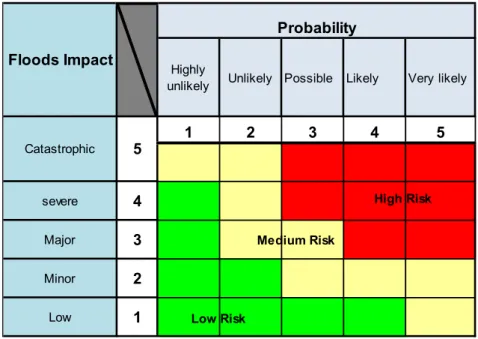
Highly
unlikely Unlikely Possible Likely Very likely
1 2 3 4 5 4 3 2 1 Floods Impact Probability Major Low Minor 5 Catastrophic severe Medium Risk Low Risk High Risk
15
Floods are natural, yet they are notorious disasters since they have the potential to occur suddenly (e.g. breakdown of a dam or quick melting of snowfall). However, crisis management works to minimise the level of damage they cause to people, places and communities by identifying them in real time. This work has applied a Flood Risk Matrix, as shown in Figure 1-1 to determine levels of flood risk. The matrix works by adding the ratings for the ‘likelihood’ of flooding to the ratings for predicted ‘consequences’, giving an overall risk score. This risk score is then used to rank the flood risk. This risk ranking is then used to help classify each tweet into a positive class (tweets mentioning high risk floods) or negative class (otherwise).
Humanitarian organisations and volunteer networks often set up live online, manual crisis mapping sites during natural disaster events, for example, the Haiti earthquake of 2010; Hurricane Sandy in 2012, and the Oklahoma tornado in 2013. In this way, they take crowdsourced information from news reports, social media, and civil protection agency alerts, and check and filter it before presenting it live on online crisis maps made available to the general public to view. However, there are a number of challenges in doing so, such as automating the task of carrying out real-time data fusion involving huge volumes of heterogeneous information from multiple sources and ensuring this data is trustworthy and credible.
Real-time geospatial information systems (GIS) usually map social media microblog reports, and they typically use geotag metadata with longitude/latitude coordinates. In this way, social media data can be turned into a crowdsourcing virtual sensor network, including mapping Twitter messages ready to be plotted. The US Geological Survey (USGS) explains that a major advantage of Twitter-based detection systems, rather than sensor-based systems, is their speed in detection speed and low costs. It is possible to combine social media GIS systems
16
with conventional GIS systems to deploy hardware-based sensors, for example in situ seismic sensors; remote sensing aerial photography, and satellite imaging. This will lead to forming a coherent picture of what is going on, and it can be presented to emergency responders; civil protection authorities, and even the general public, in order to better coordinate response efforts and create greater awareness.
A disadvantage is that just one percent of all tweets contain geotag metadata, and out of these, the geotags can be a combination of genuine mobile devices (using GPS) and Twitter’s default information on the user’s home location. The tweeted text may also contain references to additional locations that are geospatially far from the location of the device that has sent the tweet. While this may not be a problem for mapping course-grained earthquake regions, it presents problems for finer-grained maps that are required for monitoring flooding.
(Amezquita-Sanchez et al., 2017) carried out s state of the art review on how different flood prediction systems work, and they found that there are different types and sources of data need to be made use of by applying big data technologies in order to further develop and improve flood prediction models. In addition, they claim that rainfall data collected via satellite imagery and monitoring stations are important sources of data for predicting flood events.
In their review of flood prediction technologies (Amezquita-Sanchez et al., 2017) discovered the importance of using a range of data sources, and that there is a gap in the knowledge, therefore, they suggest attempting to incorporate rainfall data, including weather station,
17
satellite data and social media data, as a way of conducting further research on developing flood prediction systems.
Event detection systems have been applied to detect events from social media networks. Multiple authors (de Bruijn et al., 2018, Jongman et al., 2015, Eilander et al., 2016) have developed flood detection systems by analysing social media networks’ content, although none of those systems used the Arabic language. Furthermore, none of those systems studied or analysed rainfall data. This work focuses on filling this gap by developing a flood detection system that includes Arabic text. Moreover, the proposed system analyses rainfall data collected from a reliable global organisation (National Oceanic and Atmospheric Administration).
In summary, this research aims to address the gaps in flood detection by developing a flood detection system that can be achieved by answering the following research questions:
• RQ1: How is it possible to identify and extract particular events from social media networks’ messages where the writing used contains the form of a short description or keyword tags? (Abbreviations are also widely used in a message; moreover, the messages are often noisy).
• RQ2: How events’ locations be inferred and extracted from social media messages? • RQ3: How can an inferred location be linked to maps to produce event visualisation
and information?
18 1.5.Scope and Limitations
The main focus of this work is to develop a flood detection system by extracting flood events in real time from Twitter using machine learning (ML) techniques, and provide information about detected events to help emergency authorities to detect and track flooding events. The information collected on events can either be used for social awareness, or to help decision makers within emergency authorities. In this research, the Twitter dataset collected from Twitter Streaming API has been analysed. The scope of the research is restricted to analysing only this specific event in the Twitter dataset. Furthermore, because of using supervised learning techniques in the proposed system, the scope is restricted to tweets written in the Arabic language. The most important requirement of a natural disaster detection system is that it can be used in real time monitoring; therefore, it is essential that this system focuses on the effectiveness and efficiency of detecting the event in real time.
1.6.Significance and contribution of the research
This research focuses on proposing a system for detecting flood event from social media platforms, especially Twitter, using ML and data mining techniques. The major contributions of this research are outlined as follows:
• A Systematic Literature Review (SLR) utilising a strict search protocol to summarise the key characteristics of the different Text Classification (TC) techniques and methods used to classify Arabic text. This SLR focuses on critical analysis of the literature from year 2006 to 2014 which will serve the scholars and researchers to
19
analyse the latest work of Arabic text classification as well as provide them a baseline for future trends and comparisons.
• An effective method to classify natural events from short messages posted on Twitter is proposed. In order to classify event-related tweets and achieve high performance accuracy, we study the impact of light stemming and removing prefixes and suffixes on colloquial Arabic text classification. We compare Naive Bayes (NB), Support Vector Machines (SVM), Decision-tree (J48, C5.0), Neural Networks (NNET) and K-Nearest Neighbor (k-NN) classification algorithms, showing that using light stemming or removing prefixes and suffixes contributes to reducing classification performance in term of accuracy
• A location inferring method is incorporated to extract events’ locations, as mentioned in social media messages. Identify events locations from tweets is one of the main challenging tasks related to social media currently addressed in the NLP community. Existing NER methods have mainly focused on extract all mentioned location NE and do not distinguish the event location NE from other location NEs which are mentioned in a tweet. Furthermore the state of the art NER Systems based on gazetteers or conditional Random Field (CRF) models underperformed when tested on the Twitter corpus for both the Arabic and English languages (Zirikly and Diab, 2015); (Derczynski et al., 2015). As a third and main contribution, we propose a novel method based on the learning-to-search (L2S) approach that identify event location NE mentions and distinguish it from other location NEs mentions in tweets and outperform existing Arabic NER systems in term of accuracy when tested on colloquial Arabic text.
20
• An effective Named Entity Linked (NEL) method to addresses the geo/non-geo or geo/geo ambiguity which occur when more than one place has the same name entity but are actually different spatial locations. We have developed algorithm by utilising Google maps API to identify the most accurate location associated with the event location NE in tweets.
• Implementing a flood detection system that provides users with an overview of live floods events. The system supports event tracking by allowing users to specify the time period and search keywords in order to visualise the floods events on Google maps. Furthermore, the system visualises live rainfall amounts on the same maps.
1.7.Thesis Organisation
In this thesis, the problem of flooding event detection in real time is investigated, and solutions are provided to address this problem. Techniques are presented that are related to three main areas: Arabic text classification, location Named Entity (NE) and Named Entity Linking (NEL). This thesis is organised into seven chapters, as summarised below:
• Chapter 1 - Introduction
This chapter presents a brief background and provides important definitions for the research. Furthermore, the motivation, problem statement and the scope and limitations of the research are stated. The chapter concludes with the contributions of this work.
• Chapter 2 – Background
This chapter sets out the machine learning concepts, definitions and algorithms used in this research. The chapter contains five sections, which are as follows: the first and second
21
sections describe the classification of texts and their architecture. The third section lists and defines the classifiers used in the experiments in this research. The fourth section presents the performance measures that have been used in the research, and finally, the fifth chapter describes the Learn to Search (L2S) method that has been used for the NER task in this research.
• Chapter 3 - Literature Review
The research works related to this thesis that have been produced in recent years are reviewed. The chapter is divided into two main sections: The first section covers the work that has been done on Arabic text classification, through a systematic review that covers this area. The second section discusses what works have been produced for event detection from social networks. This chapter also presents various NER techniques and focuses on extracting location NER from Arabic text.
• Chapter 4 – Research Methodology
The methodology used in the current research is explained in this chapter, beginning with the rationale behind the choice of the research methods. A flow chart is included, which illustrates the methodology and the processes followed in the research, and then the specific methods used are explained in more detail. The chapter ends by outlining how the experiment has been conducted and the process of analysis, followed by a summary of the chapter’s main content.
• Chapter 5 - Classification of Colloquial Arabic Tweets in real-time to detect high-risk floods
A set of different experiments are proposed to study the classification task in colloquial Arabic text. In particular, the impact of the stemming process on Colloquial Arabic text is
22
investigated. In this chapter, machine learning methods are used to separate flood event content from non-flood events using mainly the Support Vector Machine (SVM), Naïve Bayes (NB), Neural Networks (NNET), K-Nearest Neighbor (k-NN), Decision Tree j48 and C5.0 classifiers. The chapter concludes with a discussion of the experiments’ results.
• Chapter 6 - Location Inference from Twitter
The types of location and spatial features on Twitter are identified and the spatial features used for flood event detection are stated. Then the Learning to Search (L2S) method is introduced to be used to infer flood event location’s NE. In addition, the Location NER method is presented to infer the event location from Arabic tweets and share the proposed method’s results. The chapter concludes with a comparison of the proposed method results with existing Arabic NER systems.
• Chapter 7 - Location Named Entity Linking
This chapter introduces and defines location Named Entity Linking (NEL) tasks and lists the challenges faced in solving location NEL using colloquial Arabic text. The approach to linking the location NE to an instance in a knowledge-base is explained. The chapter concludes with an evaluation of the proposed approach and the results.
• Chapter 8 - Real-time Flood Detection system
This chapter presents the real-time floods detection system by combining tweets data which is extracted from Twitter, and rainfall data which is extracted from National Oceanic and Atmospheric Administration (NOAA). The system structure and implementation screenshots and system limitations are presented and explained.
23 • Chapter 9 - Conclusions and future work
The main conclusions and contributions of the work are summarised in this chapter. The practical outcomes of this research for flood detection systems, and the outlook for the future direction of the work are highlighted.
24
Chapter 2:
Background
2.1.A mathematical definition of the text classification task
Text Categorisation is the discipline within which the automatic classification of text documents under predefined categories or classes is carried out (Wright et al., 1999). The task of text categorisation comes under the Automatic Classification, which may be referred to as Pattern Recognition, and used within Machine Learning. Classification is important, and if unsupervised classification is used, the possible final classes cannot be predicted. However, unsupervised classification techniques may be useful for discovering possible groups or classes, such as Document Clustering. Where the class or classes are predefined, supervised techniques can be used to find an approximate solution to a problem, provided that a training collection is available, and this is usually referred to as Text Categorization, with Document Clustering coming under a different discipline.
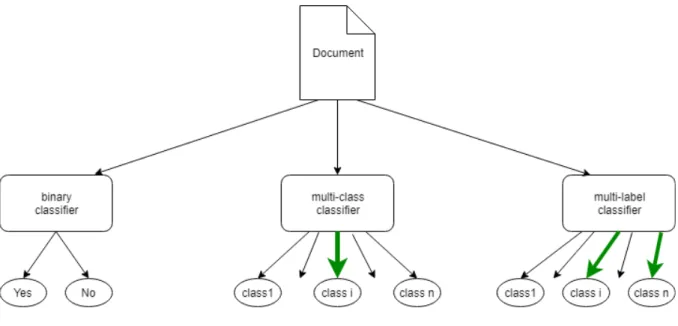
It is possible to identify three paradigms within text categorisation as illustrated in Figure 2-1 to binary cases, multi-class cases, and multi-label cases.
• For binary cases, the sample will belong to one of two given classes, and so the classifier must determine which of these two the sample goes with.
• For multi-class cases, the sample belongs to a specific class of m classes.
• For multi-label cases, the sample can belongs to a number of classes at the same time, as classes could overlap through the documents used.
25 Figure 2-1 Paradigms in text classification
For binary classification, supervised algorithms are used to train a classifier, and a sample document is assigned to one out of two potential sets. These potential sets are normally labelled belonging samples, which are positive, or not belonging samples, which are negative respectively; or as two different classes in a one against one approach to classifying. Binary classification allows a number of different algorithms to be used, such as Linear Regression; Naive Bayes; Support Vector Machines (SVM). The binary case forms the initial case, and the two other cases can be built based on this. For multi-class or multi-label tasks, a binary classifier is usually trained for every class according to the traditional approach, with the binary base case revealing the level of confidence in the classification, whether it is ranked first (multi-class assignment),or is a top ranking one (multi-label assignment). Researchers such as Allwein (Allwein et al., 2000) have addressed these three paradigms and have come up with a common framework that can help to reduce multi-class problems and switch t margin-based classifiers to a binary approach.
26
2.2.Architecture for a text categorization system
The scheme contains several variants, although they involve only minor differences to the common design. The following components can be used to build a text categorization system (Montejo Ráez, 2005):
1. Feature extraction: The text is in plain format (ASCII) and is processed and indexed according to the following two steps:
a) Feature identification, which involves identifying which features to keep, such as words, entities, bigrams or stemmed terms that are representative components of the original document. Feature identification usually involves techniques relevant to natural language processing and the retrieval of statistical information.
b) Feature weighting, as after the features have been selected, it is necessary to calculate a weight for measuring whether they are relevant to the document, and for this; a number of approaches may be used to do this, although the bag-of-words approach is usually used as it is a traditional way of simplifying the processing.
2. Dimensionality reduction (DR): Retrieving information and text categorisation often result in problems due to the great number of distinctive features involved, and because every word in piece of text could be a required feature. While stemming and other lemmatization techniques could lessen this number, it still presents an issue when using Machine Learning (ML)
27
techniques to for text categorisation, and so alternative methods are suggested so as to reduce the dimensionality of the set of features. This includes ranking the ability of a term concerning whether it is a good indicator for documents as well as classes. In this way, useful information for discarding terms can be provided by using measures such as Chi square, mutual information, information gain, or even document frequency (Yang and Pedersen, 1997). Through term selection, or discarding, it is possible to reduce the dimensionality of the feature space; alternatively, term extraction, or feature transformation, could be used. This requires replacing words with other entities that cover the existing stems or words, and grouping them together to form semantic sets based on a unique global characteristic. Feature extraction and dimensionality reduction can therefore transform text documents into samples ready for use in the future with learning algorithms.
3. Classifier training: This forms the core of the system and involves using machine learning methods to create an autonomous classifier through the use of supervised learning algorithms. The wide variety of classification approaches (e.g. statistical, probabilistic, neural networks, fuzzy logic etc) used for a range of problems, in particular, pattern recognition and its variants, means that the vast range of algorithms available can be overwhelming. However, the research on comparing different classifiers for text categorisation, highlights the most useful potential approaches, including Naive Bayes (McCallum and Nigam, 1998), Support Vector Machines (Sun et al., 2009). The conversion of the documents into feature lists in the previous
28
stage manes that the algorithms should work in the same way as for other types of data in text format.
4. Thresholding: In order to reach a hard classification involving yes or no answers, in addition to classifier outputs that have a value that matches a document and a class, it must be decided whether the document should be assigned to a category, and this is done by assigning a specific threshold. The threshold is fixed, and the value forms a decision boundary, when it comes to the S-Cut, R-Cut or P-Cut approaches (Yang, 2001). Alternatively, the limit may be based not on the classification status value, but on the number of classes assigned to a document. This means that a fixed number of classes will be attached to every document (Pouliquen et al., 2006).
In summary, it is necessary to convert a document according to a specific set of features that the classification algorithm can use. The learning process is dependent on the algorithms used as the proposed architecture is based on these. Usually, a training collection divided into a learning set and a validation set is used.
2.3.Classifiers
So far it has been shown how documents can be converted by forming a list of specific attributes or features for condensing down the original text. In this way documents can be changed into a format that is more suitable for learning algorithms. This is useful due to the extant amount of machine learning research that has led to a
29
huge choice of supervised algorithms for training binary classifiers. The options are so wide ranging that a detailed description of each one is not possible, therefore only those relevant to the current system will be explored, along with some brief reference to a few others.
2.3.1. Support Vector Machines
Support vector machines use the Structural Risk Minimization principle of computational learning theory, which involves finding a hypothesis h for ensuring the lowest true error (Joachims, 1998). The true error of h refers to the probability of h making an error with an unseen and randomly selected test example. Furthermore, it is possible to set an upper boundary to connect the true error of a hypothesis h with the error of h for a training set using VC-Dimension, and the complexity of the hypothesis space containing h. Support vector machines can be used to discover the hypothesis h, which will help to reduce the boundary of the true error by controlling the VC-Dimension of H.
SVMs are universal learners, and in their basic form they can learn a linear threshold function. In addition, the simple “plug-in" of the correct kernel function means they can be used to learn: radial basic function (RBF) networks; polynomial classifiers, and three-layer sigmoid neural nets (Joachims, 1998).
A very useful property of SVMs is their ability to learn independently of the dimensionality of the feature space, as they measure the complexity of hypotheses according to the margin set for separating the data, rather than the number of features, which allows them to generalise despite perhaps a high number of features, provided the data is separated by a wide enough margin using hypothesis space functions. This feature regarding margins facilitates excellent parameter settings for the learner, such as the kernel width in an RBF network. The most
30
useful parameter setting produces a hypothesis with the lowest VC-Dimension, as that facilitates fully automatic parameter tuning and does not require expensive cross-validation (Vapnik, 2013).
The formula used for the output of an SVM that is linear is u = 𝑤𝑤��⃗. ��⃗ − 𝑏𝑏𝑥𝑥 , where 𝑤𝑤��⃗ is the normal vector to the hyperplane, and 𝑥𝑥⃗ is the input vector. For the linear case, the margin is the distance of the hyperplane to the nearest examples, whether positive or negative, and increasing the margin can be done through optimisation as follows: minimise 12 ‖𝑤𝑤��⃗‖2 subject to 𝑦𝑦𝑖𝑖 (𝑤𝑤��⃗. ��⃗ − 𝑏𝑏𝑥𝑥 ) ≥1 ,∀𝑖𝑖 where xi is the ith training example and yi is the correct output of the SVM for the ith training example.
2.3.2. Neural networks
Neural network text classifier refers to a network of units, with the input units representing terms; the output units representing categories of interest, and the weights around the edges that link units representing dependent relations. In order to classify a test document dj, it is necessary to load its term weights wkj into the input units. These units are activated by propagating them forward through the network, with the value of the output units determining the decisions on categorisation. Training NNs is often done using backpropagation, which involves the weights of a training document being loaded into the input units, and in case of a misclassification, the error is “backpropagated” to prevent changing the network parameters and prevent or reduce the error. The perceptron is a linear classifier, and it is the simplest type of NN classifier (Dagan et al., 1997). Alternative types of linear NN classifiers are available for logistic regression, and these have been suggested by (Schütze et al., 1995) and (Wiener et al., 1995) who found they are effective and have a very
31
good yield. Alternatively, non-linear NN (Lam and Lee, 1999, Weigend et al., 1999) is a network that has at least one additional layer of units, where the training condition typically represents higher-order interactions between terms which the network cannot learn. Comparative experiments linking non-linear NNs to linear NNs have shown no improvements to non-linear NNs (Schütze et al., 1995), or negligible improvements compared to linear NNs (Wiener et al., 1995).
2.3.3. Decision tree classifiers
Probabilistic methods are quantitative and therefore are not that effective due to being difficult to interpret manually, although a class of algorithms that avoid this problem are symbolic, or non-numeric algorithms. Inductive rule learners and decision tree learners are the most widely used examples of non-numeric algorithms. A decision tree (DT) text classifier has internal nodes that are labelled, with branches moving off from them known as tests that check the weight of the term in the test document, and leaves are labelled according to categories (Mitchell, 1997). This type of classifier categorises test documents dj by recursively testing the weights that the terms label and checking their internal nodes in vector dj, until a leaf node is attained, with this node’s label then assigned to dj. These types of classifiers usually involve binary document representations, and are therefore made up of binary trees. Several standard packages can be used for DT learning, and the majority of DT approaches to TC have used such a package, for example ID3 (Fuhr et al., 1991), C4.5 (Joachims, 1998) (Cohen and Hirsh, Cohen and Singer, Joachims, Lewis and Catlett), and C5 (Li and Jain). With regard to TC efforts based on experimental DT packages, Dumais et al. (Dumais et al.); Lewis and Ringuette (Lewis and Ringuette), and Weiss et al. (Weiss et al.) have explored
32
these. One method that may be used to learn a DT for category ci involves the divide and conquer strategy, which requires: (i) checking that all the training examples have been given the same label (either ci or 𝑐𝑐𝑐𝑐���⃗); otherwise, select a term tk, and separate classes of documents with the same value for tk by putting each class into a separate subtree. The process is repeated again for the subtrees until every leaf generated has training examples assigned to the same category ci, and this then forms the label of a certain leaf on the tree. An essential key step is to choose the term tk on which to carry out the split, and this is usually done using information gain or entropy criterion; however, a “fully grown” tree could be susceptible to overfitting due to some branches being too specific for the training data. Therefore, the majority of DT learning methods incorporate one method for growing the tree and one for removing overly specific branches (pruning). There are many variations of this basic schema used in DT learning (Mitchell, 1997). DT text classifiers can be the main classification tool (Fuhr et al., Lewis and Catlett, Lewis and Ringuette), or used either as baseline classifiers (Cohen and Singer, Joachims), or as members of a classifier committee (Li and Jain, Allwein et al., Weiss et al.).
2.3.4. Naïve Bayes Classifier
A simple Bayesian classification algorithm is the Naive Bayes classifier (Lewis and Ringuette, 1994), which has been shown to be useful for text categorisation, and to solve the text categorisation problem, one document d ∈ D corresponds to one data instance, with D referring to the training document set. Document d can be represented as a selection (bag) of words, with each word w ∈ d coming from a set W of feature words, and every document
33
d is linked to a class label c ∈ C, with C denoting the class label set. Naive Bayes classifiers are used to estimate the conditional probability P(c|d) that a document d belongs to a class c.
𝑃𝑃(𝑐𝑐|𝑑𝑑) =𝑃𝑃(𝑐𝑐).𝑃𝑃(𝑑𝑑|𝑐𝑐)
Furthermore, a major assumption regarding Naive Bayes classifiers is that the words in the documents are independent of the class value.
𝑃𝑃(𝑐𝑐|𝑑𝑑) =𝑃𝑃(𝑐𝑐)� 𝑃𝑃(𝑤𝑤|𝑐𝑐)
𝑤𝑤∈𝑑𝑑
A popular way of estimating P(w|c) is by using Laplacian smoothing: 𝑃𝑃(𝑤𝑤|𝑐𝑐) =1 +|𝑤𝑤| + 𝑛𝑛(𝑤𝑤𝑛𝑛(,𝑐𝑐𝑐𝑐))
where the number of the word positions is n(w, c), and these are occupied by w in all of the training examples with a class value of c. n(c) is the number of word positions from class value is c, and |W| is the total number of distinct words contained in the training set.
A number of extensions to the Naive Bayes classifiers have been suggested, for example Nigam et al. (2000) combined the Expectation-Maximization (EM) (Dempster, Laird, & Rubin 1977) and the Naive Bayes classifiers for learning from a semi-supervised algorithm for both labelled and unlabelled documents. The EM algorithm maximises the probability of both labelled and unlabelled data. In addition, the algorithm used by Nigam et al. (2000) was applied by Rigutini et al. (2005) to deal with the cross-lingual text categorisation issues, and