FM 5-0
THE OPERATIONS
PROCESS
MARCH 2010
DISTRIBUTION RESTRICTION: Approved for public release; distribution is unlimited.
HEADQUARTERS
FM 5-0, C1
Change No. 1 Headquarters
Department of the Army Washington, DC, 18 March 2011
The Operations Process
1. Change 1 to FM 5-0, 26 March 2010, is updated to align with Change 1 to FM 3-0. 2. This change modifies the Army operational concept to emphasize mission command.3. This change replaces the command and control element of combat power and warfighting function with mission command.
4. Significant changes are marked with a plus-minus sign at the beginning of the discussion (±).
Remove Old Pages Insert New Pages
Foreword n/a
pages i through ix pages i through viii
pages 1-1 through 1-13 pages 1-1 through 1-11
pages 2-1 through 2-10 pages 2-1 through 2-10
pages 3-1 through 3-6 pages 3-1 through 3-6
pages 3-11 through 3-13 pages 3-11 through 3-13
pages 4-1 through 4-10 pages 4-1 through 4-10
pages 5-1 through 5-4 pages 5-1 through 5-4
pages 5-9 through 5-14 pages 5-9 through 5-14
pages 6-1 through 6-2 pages 6-1 through 6-2
pages 6-5 through 6-8 pages 6-5 through 6-8
pages A-1through A-10 pages A-1through A-10
pages B-1 through B-39 pages B-1 through B-40
pages C-7 through C-10 pages C-7 through C-10
pages D-1 through D-4 pages D-1 through D-4
pages E-1 through E-6 pages E-1 through E-6
pages E-11 through E-27 pages E-11 through E-24
pages F-1 through F-2 pages F-1 through F-2
pages F-5 through F-8 pages F-5 through F-8
pages G-1 through G-2 pages G-1 through G-2
pages Glossary-1 through Glossary-9 pages Glossary-1 through Glossary-9 pages References-1 thru References-4 pages References-1 thru References-4 pages Index-1 through Index-10 pages Index-1 through Index-10
PIN: 082115-001 5. File this transmittal sheet in front of the publication for reference purposes.
DISTRUBUTION RESTRICTION: Approved for public release; distribution is unlimited.
By order of the Secretary of the Army:
GEORGE W. CASEY, JR.
General, United States Army
Chief of Staff
Official:
JOYCE E. MORROW
Administrative Assistant to the Secretary of the Army 1104903
DISTRIBUTION:
Active Army, Army National Guard, and United States Army Reserve: Not to be distributed. Electronic media only.
Distribution Restriction: Approved for public release; distribution is unlimited.
*This publication supersedes FM 5-0, 20 January 2005, and FMI 5-0.1, 31 March 2006.
18 March 2011 FM 5-0, C1 i
Field Manual No. 5-0
Headquarters Department of the Army Washington, DC, 26 March 2010
The Operations Process
Contents
Page
PREFACE... v INTRODUCTION ... vi ±Chapter 1 FUNDAMENTALS OF THE OPERATIONS PROCESS ... 1-1
±The Nature of Operations ... 1-1 ±Mission Command ... 1-2 ±The Operations Process ... 1-3 ±Integrating Processes and Continuing Activities ... 1-6 ±Running Estimates ... 1-7 ±Fundamentals ... 1-7
Chapter 2 PLANNING ... 2-1
Planning and Plans ... 2-1 Planning and the Levels of War ... 2-1 The Value of Planning ... 2-2 Conceptual and Detailed Planning ... 2-6 Fundamentals of Planning ... 2-8 Key Components of a Plan ... 2-14
Chapter 3 DESIGN ... 3-1 Design Defined ... 3-1 Design Goals ... 3-2 Design in Context ... 3-3 Leading Design ... 3-6 Design Methodology ... 3-7 Chapter 4 PREPARATION ... 4-1 Preparation Functions ... 4-1 Preparation and the Operations Process ... 4-2 Preparation Activities ... 4-3
Chapter 5 EXECUTION ... 5-1
ii FM 5-0, C1 18 March 2011 Responsibilities During Execution ... 5-3 Decisionmaking During Execution ... 5-5 Rapid Decisionmaking and Synchronization Process ... 5-8
Chapter 6 ASSESSMENT ... 6-1
Assessment Fundamentals ... 6-1 Assessment Process... 6-1 Assessment and the Levels of War ... 6-4 Considerations for Effective Assessment ... 6-5 Assessment Working Groups ... 6-9 Assessment Support ... 6-10
Appendix A COMMAND POST ORGANIZATION AND OPERATIONS ... A-1 Appendix B THE MILITARY DECISIONMAKING PROCESS ... B-1 Appendix C TROOP LEADING PROCEDURES ... C-1 Appendix D GUIDELINES FOR COMMANDER’S PLANNING GUIDANCE... D-1 Appendix E ARMY OPERATION PLAN AND ORDER FORMAT ... E-1 Appendix F TASK ORGANIZATION ... F-1 Appendix G RUNNING ESTIMATES ... G-1 Appendix H FORMAL ASSESSMENT PLANS ... H-1 Appendix I REHEARSALS ... I-1 Appendix J MILITARY BRIEFINGS ... J-1 GLOSSARY ... Glossary-1 REFERENCES ... References-1
INDEX ... Index-1
Figures
Figure 1-1. The operations process ... 1-3 ±Figure 2-1. The Army problem solving model ... 2-3 Figure 2-2. The planning construct ... 2-7 Figure 2-3. Commander’s visualization ... 2-9 Figure 3-1. The design methodology ... 3-7 Figure 5-1. Decisions in execution ... 5-6 Figure 5-2. Rapid decisionmaking and synchronization process ... 5-8 ±Figure A-1. Functional and integrating cells... A-3 Figure A-2. Integration of plans, future operations, and current operations ... A-5 ±Figure B-1. The steps of the military decisionmaking process ... B-3 ±Figure B-2. Mission analysis ... B-6 Figure B-3. COA development ... B-16 Figure B-4. Sample brigade COA sketch ... B-21 Figure B-5. COA analysis and war-gaming... B-22
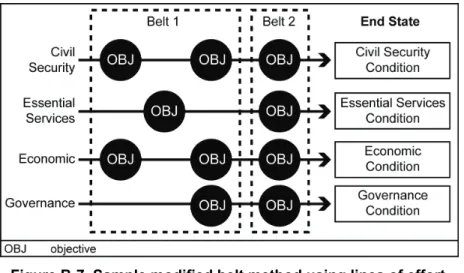
18 March 2011 FM 5-0, C1 iii Figure B-6. Sample belt method ...B-27 Figure B-7. Sample modified belt method using lines of effort ...B-27 Figure B-8. Sample avenue-in-depth method ...B-28 Figure B-9. Sample modified avenue-in-depth method using lines of effort ...B-28 Figure B-10. Sample box method ...B-29 Figure B-11. Sample modified box method using lines of effort ...B-29 Figure B-13. Sample sketch note technique ...B-31 Figure B-14. COA comparison ...B-34 Figure B-15. Sample advantages and disadvantages ...B-35 Figure B-16. Sample decision matrix ...B-35 Figure C-1. Parallel planning ... C-2 Figure C-2. Planning at company and below ... C-3 Figure C-3. Sample schedule ... C-4 Figure C-4. Sample mission and COA statements ... C-9 Figure E-1. Paragraph layout for plans and orders ... E-4 ±Figure E-2. Annotated Army OPLAN/OPORD format ... E-9 ±Figure E-3. Annotated attachment format (general) ...E-18 ±Figure E-4. Annotated WARNO format ...E-20 ±Figure E-5. Annotated sample FRAGO ...E-22 Figure E-6. Example of overlay order graphic ...E-23 ±Figure F-1. Sample outline format for a task organization (52d Infantry Division) ... F-5 Figure G-1. Generic base running estimate format ... G-2 Figure H-1. Sample of end state conditions for defensive operations ... H-3 Figure H-2. Sample of end state conditions for stability operations ... H-4 Figure H-3. Sample assessment framework ... H-6 Figure I-1. Rehearsal techniques ... I-3 Figure J-1. Information briefing format ... J-1 Figure J-2. Decision briefing format ... J-2 Figure J-3. Considerations during planning ... J-4 Figure J-4. Considerations during preparation ... J-5
Tables
Table 2-1. Types of problems and solution strategies ... 2-4 Table 5-1. Decision types and related actions ... 5-7 ±Table 5-2. Examples of change indicators ... 5-9 ±Table 5-3. Considerations for synchronization and decision implementation actions ... 5-12 Table 6-1. Assessment measures and indicators ... 6-3 Table B-1. Historical minimum planning ratios ...B-17 ±Table E-1. Designated letters for dates and times ... E-6 ±Table E-2. List of attachments and responsible staff officers ...E-16
iv FM 5-0, C1 18 March 2011 Table F-1. Army command relationships ... F-3 Table F-2. Army support relationships ... F-4 ±Table F-3. Order for listing units in a task organization ... F-7 Table I-1. Example sustainment and protection actions for rehearsals ... I-12
18 March 2011 FM 5-0, C1 v
Preface
FM 5-0 (C1), The Operations Process, constitutes the Army’s view on planning, preparing, executing, and assessing operations. It describes how commanders—supported by their staffs, subordinate commanders, and other military and civilian partners—exercise mission command during the conduct of full spectrum operations. It describes how design assists commanders with understanding complex problems and developing an operational approach to solve or manage those problems throughout the conduct of operations.
This manual applies to all Army forces. The principal audience for this manual is Army commanders and unit staffs (officers, noncommissioned officers, and Soldiers). Commanders and staffs of Army headquarters serving as a joint task force or a multinational headquarters should also refer to applicable joint or multinational doctrine for the exercise of command and control. Trainers and educators throughout the Army also use this manual. Terms that have joint or Army definitions are identified in both the glossary and the text. Glossary references: The glossary lists most terms used in field manual (FM) 5-0 that have joint or Army definitions. Terms for which FM 5-0 is the proponent field manual (the authority) are indicated with an asterisk in the glossary. Text references: Definitions for which FM 5-0 is the proponent field manual are printed in boldface in the text. These terms and their definitions will be incorporated into the next revision of FM 1-02, Operational Terms and Graphics. For other definitions in the text, the term is italicized and the number of the proponent manual follows the definition.
FM 5-0 applies to the Active Army, the Army National Guard (ARNG)/Army National Guard of the United States (ARNGUS), and the United States Army Reserve (USAR) unless otherwise stated.
The proponent of this publication is the United .States Army Training and Doctrine Command (TRADOC). The preparing agency is the Combined Arms Doctrine Directorate, U.S. Army Combined Arms Center. Send written comments and recommendations on DA Form 2028 (Recommended Changes to Publications and Blank Forms) to Commander, U.S. Army Combined Arms Center and Fort Leavenworth, ATTN: ATZL-MCK-D (FM 5-0), 300 McPherson Avenue, Fort Leavenworth, KS 66027-2337; by e-mail to: [email protected]; or submit an electronic DA Form 2028.
vi FM 5-0, C1 18 March 2011
Introduction
This change to FM 5-0 updates the operations process to account for new doctrine established in change 1 to FM 3-0 (2008). While the major activities of the operations process have not changed, changes in FM 3-0 that significantly impact FM 5-0 include—
• Replacement of the term and definition of command and control with the term and definition of mission command. The revised definition of mission command now accounts for both the Army’s philosophy of command (formerly known as mission command) as well as the exercise of authority and direction to accomplish missions (formerly known as command and control). (Note: Joint, other Service, and some allied doctrine retain the term command and control). • Replacement of the term, definition, and tasks of the command and control warfighting
function with the term, definition, and tasks of the mission command warfighting function.
• Rescindment of the term battle command. While the term is rescinded, the commander’s activities of understand, visualize, describe, direct, lead, and assess remain the primary activities commanders use to drive the operations process.
• Replacement of the five Army information tasks (information engagement, command and control warfare, information protection, operations security, and military deception) with the mission command warfighting task Conduct inform and influence and cyber/electro-magnetic activities. As part of this change, the terms information engagement, command and control warfare, and information protection are rescinded. In addition, the term and definition of psychological operations is replaced with the term and definition of military information support operations.
FM 5-0, Change 1, provides doctrine on the operations process as a whole, a chapter on design, and a chapter for each activity of the operations process. The appendixes describe the tactics, techniques, and procedures for conducting the military decisionmaking process, conducting troop leading procedures, and writing operation plans and orders.
Chapter 1 provides an overview of the operations process. It describes the general nature of operations in which commanders, supported by their staffs, exercise mission command. Next, this chapter describes the operations process and highlights the commander’s role in its execution. Discussions of integrating processes, continuing activities, and running estimates follow. The chapter concludes by discussing fundamentals commanders and staffs consider for the effective execution of the operations process. Change 1 updates the chapter with the new mission command taxonomy and modifies the fundamentals of the operations process. Chapter 2 addresses the planning. It describes planning as an essential element of mission command and a continuous activity of the operations process. This chapter defines planning, describes planning at the different levels of war, and lists the value of effective planning. This chapter concludes offering fundamentals for effective planning and describes the key components of a plan or order. Change 1 updates the chapter with the new mission command taxonomy.
Chapter 3 describes design. It describes a methodology that assists commanders, staffs, and others in understanding the operational environment, framing problems, and developing an operational approach to solve those problems. This chapter addresses requirements to reframe the problem when changes in the operational environment render the operational approach and its associated logic no longer applicable. Change 1 updates the chapter with the new mission command taxonomy.
Chapter 4 is about preparation—the activity that helps transition the force from planning to execution. The chapter discusses activities within the headquarters and across the force that improve a unit’s ability to execute operations. Change 1 updates the chapter with the new mission command taxonomy and updates the discussion on building partnerships and teams.
18 March 2011 FM 5-0, C1 vii Chapter 5 provides doctrine on execution. It lists fundamentals to guide execution and describes the roles of the commander and staff when directing and synchronizing the current operation. It describes assessment and decisionmaking in execution and concludes with a discussion of the rapid decisionmaking and synchronization process. Change 1 updates the chapter with the new mission command taxonomy and adds a discussion of operational adaptability.
Chapter 6 provides the fundamentals of assessment, including its definition and purpose. It describes the assessment process and offers guidelines for effective assessment. Change 1 updates the chapter with the new mission command taxonomy.
Ten appendixes complement the body of this manual. Appendix A discusses command post organization and operations. The steps of the military decisionmaking process are in appendix B. Troop leading procedures are addressed in appendix C. Commanders planning guidance and formats for operation plans and orders are addressed in appendixes D and E respectively. Appendix F provides formats for developing task organization. Running estimates are described in appendix G. Guidelines for developing a formal assessment plan are addressed in appendix H. Techniques for conducting rehearsals and developing military briefings are addressed in appendixes I and J respectively. The updated appendixes account for the new mission command taxonomy to include the mission command warfighting task, “Conduct inform and influence and cyber/electrometric activities.” The modified operation order format accounts for these changes.
18 March 2011 FM 5-0, C1 1-1
Chapter 1
±Fundamentals of the Operations Process
This chapter describes the general nature of operations in which commanders, supported by their staffs, exercise mission command. Next, this chapter describes the operations process and highlights the commander’s role in its execution. Discussions of the integrating processes, continuing activities, and running estimates follow. The chapter concludes with the fundamentals commanders and staffs consider for the effective execution of the operations process.
±THE NATURE OF OPERATIONS
1-1. To understand doctrine regarding the operations process, Soldiers first must appreciate the general nature of operations. Military operations are characterized by the continuous, mutual adaptation of give and take, moves and countermoves among all participants. In operations, Army forces face thinking and adaptive enemies, changing civilian perceptions and differing agendas of various actors (organizations and individuals) in an operational area. Leaders can never predict with certainty how enemies or civilians will act and react or how events may develop.
1-2. The enemy is not an inanimate object to be acted upon but an independent and active force with its own objectives. While friendly forces try to impose their will on the enemy, the enemy resists and seeks to impose its will on friendly forces. This dynamic also occurs among civilian groups whose own desires influence and are influenced by operations. Appreciating these relationships among opposing human wills is essential to understanding the fundamental nature of operations. As all sides take action, each side reacts, learns, and adapts.
1-3. Whether operations are designed to relieve suffering from a natural disaster or to defeat a large enemy force, operations are conducted in complex, ever-changing, and uncertain operational environments. An operational environment is a composite of the conditions, circumstances, and influences that affect the employment of capabilities and bear on the decisions of the commander (JP 3-0). An operational environment includes physical areas (air, land, maritime, and space domains) and cyberspace. It also includes the information that shapes conditions in those areas as well as enemy, adversary, friendly, and neutral aspects relevant to operations. An operational environment is not isolated or independent but interconnected by various influences (for example, information and economics) from around the globe.
C
OMPLEX ANDE
VERC
HANGING1-4. An operational environment is both complex and continuously changing. Complexity describes situations with many parts and subparts (structural complexity) as well as the behaviors and resulting relationships among those parts and subparts (interactive complexity). How the many entities behave and interact with each other within an operational environment is difficult to discern and always results in differing circumstances. No two operational environments are the same. While aspects of an operational environment may be less complex than other aspects, an operational environment as a whole is both structurally and interactively complex.
1-5. In addition, an operational environment is not static but continually evolves. This evolution results in part, from humans interacting within an operational environment as well as from their ability to learn and adapt. As people take action within an operational environment, the operational environment changes. Some of these changes are anticipated while others are not. Some changes are immediate and apparent while other changes are delayed or hidden. The complex and dynamic nature of an operational environment makes determining the relationship between cause and effect difficult and contributes to the uncertainty of military operations.
1-2 FM 5-0, C1 18 March 2011
U
NCERTAINTY1-6. Uncertainty is what is not known about a given situation or a lack of understanding of how a situation may evolve. Effective leaders accept that they conduct operations in operational environments that are inherently uncertain. They realize that concrete answers or perfect solutions to operational problems are rarely apparent. For example, the commander and staff may be uncertain about the exact location and strength of an enemy force. Even if the staff feels confident about the enemies location and strength, the commander still questions what to infer from those facts—the enemy’s intentions, for example. And even if the commander makes a reasonable inference, the many options available to the enemy make predicting the enemy’s exact behavior quite difficult.
1-7. Similarly, clearly discerning the motivations and reactions of various population groups with respect to the friendly force or the enemy often proves difficult. American ideas of what is normal or rational are not universal. Members of other societies often have different world views, notions of rationality, appropriate behavior, levels of religious devotion, and cultural norms. These differences in perspectives add to the uncertain nature of operations.
1-8. Chance and friction also contribute to the uncertain nature of operations. Chance is the lack of order or clear predictability of operations. A major sand storm that delays offensive operations or the death of a key local leader that leads to an eruption of violence illustrates chance. Friction is the combination of countless factors that impinge on the conduct of operations. Friction may range from broken equipment that slows movement to unclear and complicated plans that leads to confusion.
1-9. During operations, leaders make decisions, develop plans, and direct actions under varying degrees of complexity and uncertainty. Predictability in operations is rare, making centralized decisionmaking and orderly processes ineffective. Commanders seek to counter the uncertainty of operations by empowering subordinates at the scene to make decisions, act, and quickly adapt to changing circumstances. As such, commanders exercise mission command throughout the conduct of operations.
±MISSION COMMAND
1-10. Mission command is the exercise of authority and direction by the commander using mission orders to enable disciplined initiative within the commander’s intent to empower agile and adaptive leaders in the conduct of full spectrum operations. It is commander-led and blends the art of command and the science of control to integrate the warfighting functions to accomplish the mission (FM 3-0).
1-11. Effective mission command requires an environment of mutual trust and understanding among commanders and subordinates. It requires a command climate in which commanders encourage subordinates to exercise disciplined initiative to seize opportunities and counter threats within the commander’s intent. Through mission orders, commanders focus their orders on the purpose of the operation rather than on the details of how to perform assigned tasks. Doing this minimizes detailed control and allows subordinates the greatest possible freedom of action. Finally, when delegating authority to subordinates, commanders set the necessary conditions for success by allocating appropriate resources to subordinates based on assigned tasks.
1-12. The commander is the central figure in mission command. Commanders combine the art of command and the science of control to understand situations, make decisions, and direct actions. However, commanders cannot exercise mission command alone except in the smallest organizations. Thus, commanders perform these functions through mission command networks and systems—the coordinated application of personnel, networks, procedures, equipment and facilities, knowledge management, and information management systems essential for the commander to conduct operations (FM 3-0).
1-13. A commander’s mission command networks and systems begins with people. No amount of technology can reduce the importance of the human dimension. Therefore, commanders base their mission command networks and systems on human characteristics more than on equipment and procedures. The staff is a key component of the mission command system. Staff members assist commanders and exercise control on their behalf to include—
Providing relevant information and analyses.
18 March 2011 FM 5-0, C1 1-3
Preparing plans and orders. Monitoring operations.
Controlling operations.
Assessing the progress of operations.
See appendix A for a detailed discussion of how commanders organize their headquarters into command posts during the conduct of operations.
±THE OPERATIONS PROCESS
1-14. Throughout operations, commanders, assisted by their staffs, integrate numerous process and activities within the headquarters and across the force as they exercise mission command. The Army’s overarching framework to do this is the operations process. The operations process consists of the major mission command activities performed during operations: planning, preparing, executing, and continuously assessing the operation. The commander drives the operations process through leadership (FM 3-0). The activities of the operations process are not discrete; they overlap and recur as circumstances demand as shown in figure 1-1.
Figure 1-1. The operations process
T
HEC
OMMANDER’
SR
OLE1-15. At the center of the operations process is the commander. Commanders drive the operations process by combining the art of command with the science of control to understand, visualize, describe, direct, lead, and assess operations. The commander’s role in the operations process takes on different emphasis during planning, preparing, executing, and assessing. For example, during planning commanders focus their activities on understanding, visualizing, and describing while directing, leading, and assessing. During execution, commanders often focus on directing, leading, and assessing while improving their understanding and modifying their visualization.
1-4 FM 5-0, C1 18 March 2011 Understand
1-16. Throughout the operations process, commanders seek to build and maintain their understanding of the operational environment and the problem. To understand something is to grasp its nature and significance. Understanding includes establishing context—the set of circumstances that surround a particular event or situation. Commanders lead design activities (see chapter 3) and collaborate and dialog with superior, subordinate, and adjacent commanders, and other military and civilian partners to gain a greater understanding of the operational environment and the problem. Commanders continuously update their understanding throughout the conduct of operations based on inputs from others and their personal observations. Based on their updated understanding to include an assessment of progress, commanders adjust operations as required. (See paragraphs 1-41 to 1-50 for a detailed discussion of situational understanding).
Visualize
1-17. As commanders begin to understand the situation to include the problem, they start envisioning potential solutions. Collectively, this is known as the commander’s visualization—the mental process of developing situational understanding, determining a desired end state, and envisioning the broad sequence of events by which the force may achieve the end state. The commander’s visualization provides the basis for developing plans and orders. During execution, it helps commanders determine if, when, and what to decide as they adapt to changing conditions.
Describe
1-18. As commanders visualize an operation during planning, they describe it to their staffs and subordinates to facilitate shared understanding of the situation, the mission, and their commander’s intent. During planning, commanders ensure subordinates understand the visualization well enough to begin course of action development and preparation activities. Commanders describe their visualization in their initial commander’s intent and planning guidance to include an operational approach—the broad general actions that will guide the force toward the desired end state. They describe gaps in their visualization by identifying commander’s critical information requirements (CCIRs). During execution, commanders describe their updated visualization as planning guidance that results in fragmentary orders.
Direct
1-19. Commanders direct all aspects of operations. Commanders make decisions and direct actions based on their situational understanding during planning, preparation, execution, and assessment. They use control measures to focus the operation on the desired end state. Commanders direct operations by—
Preparing and approving plans and orders.
Assigning and adjusting tasks, task organization, and control measures based on changing
conditions.
Positioning units to maximize combat power, anticipate actions, or create or preserve options.
Positioning key leaders to ensure observation and supervision at critical times and places. Allocating resources based on opportunities and threats.
Accepting risk to create opportunities to seize, retain, and exploit the initiative. Committing the reserve.
Changing priorities of support.
Lead
1-20. Leadership is the process of influencing people by providing purpose, direction, and motivation, while operating to accomplish the mission and improving the organization (FM 6-22). Leadership inspires Soldiers to accomplish things that they otherwise might not. Through leadership, commanders provide purpose, direction, and motivation to subordinate commanders, their staff, and Soldiers throughout the conduct of operations. In turn, Soldiers respond to the leadership of the commander, and may seek to emulate the style of leadership the commander exhibits. (See FM 6-22 for a detailed discussion on leadership).
18 March 2011 FM 5-0, C1 1-5 1-21. Commanders are ultimately responsible for what their forces do or fail to do. As such, where the commander locates within the area of operations is an important consideration. Commanders balance their time between leading the staff through the operations process and providing purpose, direction, and motivation to subordinate commanders and Soldiers away from the command post. No standard pattern or simple prescription exists for command presence; different commanders lead differently.
1-22. By spending time with the staff, the commander learns from the staff while providing knowledge and expertise to ensure directives from the headquarters reflect their intent. By circulating among subordinate units, commanders assess subordinates’ preparation and execution, get to know new units in the task organization, and personally motivate Soldiers. Commanders also visit with civilian organization to build teams and partnerships and promote unity of effort.
Assess
1-23. Commanders assess continuously to better understand current conditions and determine how the operation is progressing. Commanders incorporate the assessments of the staff, subordinate commanders, and other partners to form their personal assessment of the situation. (See chapter 6 for doctrine on assessment.) Based on their assessment, commanders modify plans and orders to better accomplish the mission. If their assessment reveals a significant variance from their original commander’s visualization, commanders reframe the problem.
A
CTIVITIES OF THEO
PERATIONSP
ROCESS1-24. The activities of the operations process (plan, prepare, execute, and assess) may be sequential at the start of an operation. However, once operations have begun, a headquarters often conducts parts of each activity simultaneously. Planning is continuous. After the completion of the initial order, the commander and staff continuously revise the plan based on changing circumstances. Preparing begins when a unit receives a mission. It always overlaps with planning and continues through execution for some subordinate units. Execution puts a plan into action. As the unit is executing the current operation, the commander and staff are planning future operations based on the assessment of progress. Assessing is continuous and influences the other three activities. Subordinate units of the same command may be in different stages of the operations process. At any time during the operations process, commanders may reframe based on a shift in understanding or significant changes in the operational environment. This may lead to a new perspective on the problem resulting in an entirely new plan.
Planning
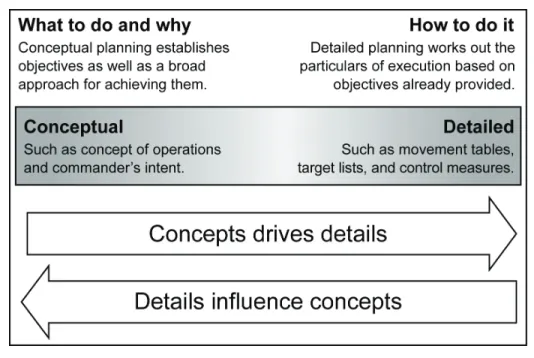
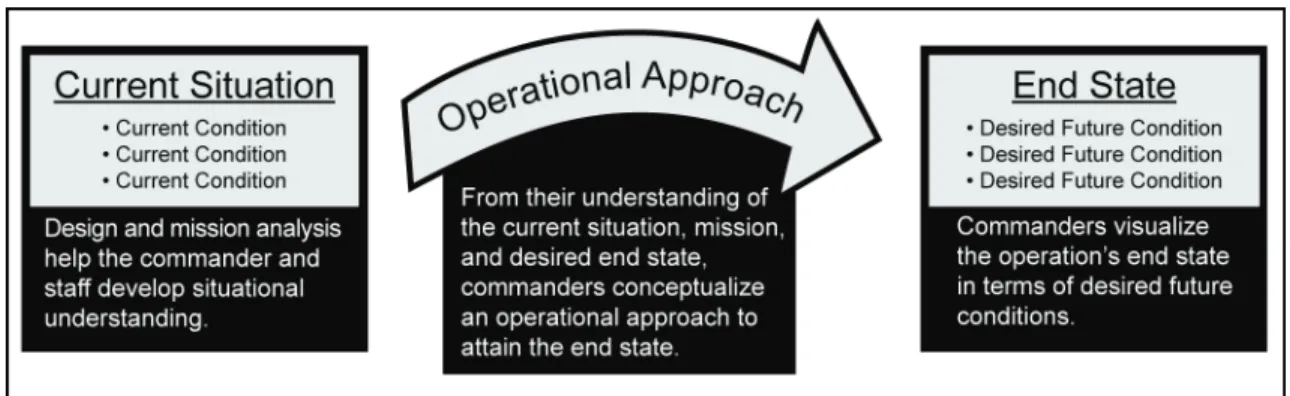
1-25. Planning is the art and science of understanding a situation, envisioning a desired future, and laying out effective ways of bringing that future about. Planning is both conceptual and detailed. Conceptual planning includes developing an understanding of the operational environment, framing the problem, defining a desired end state, and developing an operational approach to achieve the desired end state. Conceptual planning generally corresponds to the art of operations and is commander led. Both design (see chapter 3) and the military decisionmaking process (see appendix B) assist commanders and staffs with the conceptual aspects of planning. Detailed planning translates the operational approach into a complete and practical plan. Detailed planning generally corresponds to the science of operations and encompasses the specifics of implementation. Detailed planning works out the scheduling, coordination, or technical issues involved with moving, sustaining, administering, and directing forces.
1-26. Planning results in a plan or order that communicates the commander visualization and directs actions of subordinates focusing on the desired end state. Planning is continuous. While planning may start an iteration of the operations process, commanders and staffs revise plans and develop branches and sequels during execution (see chapter 2 for the fundamentals of planning).
Preparation
1-27. Preparation consists of activities that units perform to improve their ability to execute an operation. Activities of preparation help the force and Soldiers improve their ability to execute an operation. Preparation creates conditions that improve friendly forces’ opportunities for success. It requires staff, unit,
1-6 FM 5-0, C1 18 March 2011 and Soldier actions to transition the force from planning to execution. It includes building effective teams among modular formation and with joint, interagency, intergovernmental, and multinational partners. 1-28. Activities of preparation help develop a shared understanding of the situation and what is required for execution. These activities—such as backbriefs, rehearsals, and inspections—help units, staffs, and Soldiers better understand their roles in upcoming operations, practice complicated tasks, and ensure equipment and weapons function properly. (Chapter 4 addresses preparation in detail.)
Execution
1-29. Planning and preparation accomplish nothing if the commander does not execute effectively. Execution is putting a plan into action while using situational understanding to assess progress and adjust operations as the situation changes. Execution focuses on concerted action to seize and retain the initiative, build and maintain momentum, and exploit success. Commanders create conditions for seizing the initiative by acting while encouraging operational adaptability across the force. (Chapter 5 discusses execution.) Assessment
1-30. Assessment is continuously monitoring and evaluating the current situation and the progress of an operation. Assessment involves continuously analyzing the operational environment to help commanders and their staffs understand the current situation and its evolution during operations. Based on this understanding, commanders and staffs evaluate relevant information to help them judge how operations are progressing toward achieving objectives and the desired end state.
1-31. Assessment precedes and guides the other activities of the operations process and concludes each operation or phase of an operation. However, the focus of assessment differs during planning, preparation, and execution. During planning, assessment focuses on gathering information about the operational environment to assist the commander and staff with understanding the current situation. Assessment activities during planning also include developing an assessment plan that describes measurable tasks, objectives, end state conditions, and associated criterion to assist with assessing progress. During preparation and execution, assessment focuses on monitoring the current situation and evaluating the operation’s progress toward stated objectives and end state conditions.
±INTEGRATING PROCESSES AND CONTINUING ACTIVITIES
1-32. Throughout the operations process, commanders and staffs synchronize the warfighting functions in accordance with the commander’s intent and concept of operations. Commanders and staffs use several integrating processes and continuing activities to do this.
1-33. Integrating processes combine efforts of the commander and staff to synchronize specific functions throughout the operations process. The integrating process includes—
Intelligence preparation of the battlefield. (See FM 2-01.3.)
Targeting. (See FM 3-60.)
Intelligence, surveillance, and reconnaissance synchronization. (See TC 2-01.) Composite risk management. (See FM 5-19.)
Knowledge management. (See FM 6-01.1.)
1-34. The commander and staff also ensure several activities are continuously planned for and coordinated. The following continuing activities require particular concern of the commander and staff throughout the operations process:
Intelligence, surveillance, and reconnaissance. (See TC 2-01.)
Security operations. (See FM 3-90.) Protection. (See FM 3-37.)
Liaison and coordination. (See FM 6-0.) Terrain management. (See FM 3-90.)
Information management. (See FM 6-0.) Airspace command and control. (See FM 3-52.)
18 March 2011 FM 5-0, C1 1-7
±RUNNING ESTIMATES
1-35. The running estimate is a principle knowledge management tool used by the commander and staff throughout the operations process. A running estimate assesses the current situation to determine if the current operation is proceeding according to the commander’s intent and if future operations are supportable.
1-36. Effective plans and successful execution hinge on current running estimates. Running estimates always include recommendations for anticipated decisions. During planning, commanders use these recommendations to select feasible courses of action for further analysis. During preparation and execution, commanders use recommendations from running estimates in decisionmaking. Failure to maintain running estimates may lead to errors or omissions that result in flawed plans or bad decisions.
1-37. The commander’s running estimate includes a summary of the problem, the operational approach, and all variables that affect the mission. Commanders integrate personal knowledge of the situation, analysis of the operational and mission variables, assessments by subordinate commanders and other organizations, and relevant details gained from running estimates. Commanders use their personal estimates to cross-check and supplement the running estimates of the staff. (See appendix G for more detailed discussion on running estimates.)
±FUNDAMENTALS
1-38. The operations process, while simple in concept (plan, prepare, execute, and assess), is dynamic in execution. Commanders and staffs use the operations process to integrate numerous processes and activities executed throughout the headquarters and subordinate units. Commanders organize and train their staff to plan, prepare, and execute operations simultaneously while continually assessing. Commanders are responsible for training their staffs as integrated teams to do this. They use the following fundamentals to guide the effective execution of the operations process:
Commanders drive the operations process.
Situational understanding is fundamental to effective decisionmaking throughout the operations
process.
Design pervades the operations process.
Commanders continually consider and combine tasks focused on the population as well as those
tasks focused on enemy forces.
Continuous assessment enables organizational learning and operational adaptability.
C
OMMANDERC
ENTRICCommanders drive the operations process.
1-39. Commanders are the most important participant in the operations process. While staffs perform essential functions that amplify the effectiveness of operations, commanders play the central role in the operations process by applying the art of command and science of control to understand, visualize, describe, direct, lead, and assess operations. Through leadership—the process of influencing people by providing purpose, direction, and motivation—commanders drive the operations process. Commanders rely on their education, experience, knowledge, and judgment as they make decisions and lead subordinates throughout the conduct of operations.
1-40. Mission command requires commanders to take prudent risks, exercise initiative, and act decisively. Because uncertainty exists in all military operations, commanders incur risk when making decisions during the conduct of operations. Faced with an uncertain situation, there is a natural tendency to hesitate and gather more information to reduce the uncertainty. However, waiting and gathering information might reduce uncertainty but will not eliminate it. Waiting may even increase uncertainty by providing the enemy with time to seize the initiative or it may allow events to deteriorate. It is far better to manage uncertainty by acting and developing the situation.
1-8 FM 5-0, C1 18 March 2011
S
ITUATIONALU
NDERSTANDINGSituational understanding is fundamental to effective decisionmaking throughout the operations process.
1-41. Situational understanding is the product of applying analysis and judgment to relevant information to determine the relationships among the mission variables to facilitate decisionmaking (FM 3-0). Success in operations demands timely and effective decisions based on applying judgment to available information and knowledge. Building and maintaining situational understanding is essential for commanders when establishing the situation’s context, developing effective plans, assessing operations, and making quality decisions during execution.
1-42. Commanders and staffs continually work to maintain their situational understanding and work through periods of reduced understanding as the situation evolves. As commanders develop their situational understanding, they see patterns emerge, dissipate, and reappear in their operational environment. These patterns help them direct their own forces’ actions with respect to other friendly forces, civilian organizations, the enemy, the terrain, and the population. While complete understanding is the ideal for planning and decisionmaking, commanders accept they will often have to act despite significant gaps in their understanding.
Operational and Misson Variables
1-43. Commanders and staffs use the operational and mission variables to help build their situational understanding. They analyze and describe an operational environment in terms of eight interrelated operational variables: political, military, economic, social, information, infrastructure, physical environment, and time (known as PMESII-PT). (See FM 3-0.) Upon receipt of a mission, commanders filter information categorized by the operational variables into relevant information with respect to the mission. They use the mission variables, in combination with the operational variables, to refine their understanding of the situation and to visualize, describe, and direct operations. The mission variables are mission, enemy, terrain and weather, troops and support available, time available, and civil considerations. As a set, the mission variables are abbreviated METT-TC. (See FM 3-0.)
Cultural Understanding
1-44. As part of building their situational understanding, commanders consider how culture (both their own and others’ within an operational area) affects operations. Culture is the shared beliefs, values, customs, behaviors, and artifacts members of a society use to cope with the world and each other. Culture influences how people make judgments about what is right and wrong and how they assess what is important and unimportant. Culture provides a framework for rational thought and decisions. What one culture considers rational another culture may consider irrational.
1-45. Understanding the culture of a particular society or group within a society can significantly improve the force’s ability to accomplish the mission. Leaders are mindful of cultural factors in three contexts:
Awareness of the cultures within a region that the organization operates.
Sensitivity to the different backgrounds, traditions, and operational methods of the various
military (joint and multinational), civilian (intergovernmental, nongovernmental, and private), and host-nation organizations.
Awareness of how one’s own culture affects how one perceives a situation.
1-46. Understanding other cultures applies to all operations, not just those dominated by stability. For example, some enemies consider surrender a dishonor worse than death whereas others consider surrender an honorable option. Commanders use different tactics with the enemy depending on the culture.
1-47. Understanding the culture of joint and multinational forces and civilian organizations within an operational area is crucial to successful operations. Army leaders learn the customs as well as the doctrine and procedures of their partners. These leaders consider how culture influences how their military and civilian partners understand situations and arrive at decisions. This understanding helps build unity of effort.
18 March 2011 FM 5-0, C1 1-9 1-48. Effective Army leaders understand and appreciate their own culture (individual, military, and national) in relation to the various cultures of others in the operational area. Just as culture shapes how other groups view themselves and the world around them, culture shapes how commanders, leaders, and Soldiers perceive the world. Individuals tend to interpret events according to the principles and values intrinsic to their culture. Effective commanders acknowledge that their individual perceptions greatly influence how they understand situations and make decisions. Through reflection, collaboration, and analysis of differences between their culture and that of the cultures in the operational area, commanders expose and question their assumptions about the situation. (See FM 3-24 and FM 2-01.3 for details to analyze socio-cultural data.)
Red Teaming
1-49. Red teams also assist the commander and staff in building and maintaining their understanding. Red teaming is a function that provides commanders an independent ability to fully explore alternative plans and operations in the context of the operational environment and from the perspective of partners, adversaries, and others. Red teams assist the commander and staff with critical and creative thinking and help them avoid groupthink, mirror imaging, cultural missteps, and tunnel vision throughout the conduct of operations.
1-50. Throughout the operations process, red team members help identify relevant actors, clarify the problem, and explain how others may view the problem from their perspectives. They challenge assumptions and the analysis used to build the plan. In essence, red teams provide the commander and staff with an independent capability to challenge the organization’s thinking.
D
ESIGNDesign pervades the operations process.
1-51. Design underpins the commander’s role in leading innovative, adaptive efforts throughout the operations process. Design—an approach to critical and creative thinking—assists commanders with understanding, visualizing, and describing problems and developing approaches to solve them. Commanders use design to gain a greater understanding of the operational environment and an appreciation of the problem. They visualize and describe an operational approach that serves as the main idea. This idea informs detailed planning and guides the force through preparation and execution. While continuously assessing changes in the operational environment and the progress of operations, design helps commanders determine if they need to reframe the problem, which may lead to a new operational approach. (Chapter 3 discusses design in detail). Key aspects of design continuously applied throughout the operations process include—
Critical and creative thinking. Collaboration and dialog. Critical and Creative Thinking
1-52. To assist commanders in understanding and decisionmaking, commanders and staffs apply critical and creative thinking throughout the operations process. Critical thinking is a deliberate process of thought used to discern truth in situations where direct observation is insufficient, impossible, or impractical. Critical thinkers are purposeful and reflective thinkers that apply self-regulating judgment about what to believe or what to do in response to observations, experience, verbal or written expressions, or arguments. Critical thinking involves determining the meaning and significance of what is observed or expressed. It also involves determining whether adequate justification exists to accept conclusions as true based on a given inference or argument. Critical thinking is key to understanding situations, identifying problems, finding causes, arriving at justifiable conclusions, making quality plans, and assessing the progress of operations.
1-53. Creative thinking involves creating something new or original. Often leaders face unfamiliar problems or old problems requiring new solutions. Creative thinking leads to new insights, novel approaches, fresh perspectives, and new ways of understanding and conceiving things. Leaders look at different options to solve problems by using adaptive approaches (drawing from previous similar
1-10 FM 5-0, C1 18 March 2011 circumstances) or innovative approaches (coming up with completely new ideas). In both instances, leaders use creative thinking to apply imagination and depart from the old way of doing things. (See FM 6-22 for a detailed discussion on critical and creative thinking.)
Collaboration and Dialog
1-54. Commanders encourage active collaboration and dialog throughout the operations process. Collaboration and dialog aids in developing shared situational understanding throughout the force. Throughout the operations process, commanders, subordinate commanders, staffs, and other partners collaborate and dialog actively, sharing and questioning information, perceptions, and ideas to better understand situations and make decisions. Collaboration is two or more people or organizations working together toward common goals by sharing knowledge and building consensus. Dialog is a way to collaborate that involves the candid exchange of ideas or opinions among participants that encourages frank discussions in areas of disagreement.
1-55. Effective collaboration includes continuous dialog that leads to increased understanding of the situation across the force, including the current problems. In addition to the organizations within their command, commanders also collaborate with civilian and other military organizations in the operational area to better understand their perspectives and build unity of effort. This leads to a shared understanding of the situation and improves coordination and cooperation among all participants toward common objectives. 1-56. Through collaboration and dialog, the commander creates a learning environment by allowing participants to think critically and creatively and share their ideas, opinions, and recommendations without fear of retribution. Groupthink—a characteristic exhibited by members of a group who seek to reach consensus on issues while minimizing conflict within the group—is the antithesis of healthy collaboration. Effective collaboration and dialog requires candor and a free, yet mutually respectful, competition of ideas. Participants must feel free to make viewpoints based on their expertise, experience, and insight; this includes sharing ideas that contradict the opinions held by those of higher rank. Successful commanders willingly listen to novel ideas and counter arguments concerning any problem.
1-57. Disciplined questioning helps commanders, staffs, subordinate commanders, and other partners probe their own and others’ thinking as they collaborate and dialog. Disciplined questioning helps to explore ideas, understand problems, and uncover assumptions. These questions help challenge claims or premises by revealing a contradiction or internal inconsistency in logic. Examples of disciplined questions that probe reasons and evidence include the following:
Could you give me an example? How does X relate to Y?
When you say X, are you implying Y?
All your reasoning depends on the idea that X exists. Why have you based your reasoning on X
instead of Y?
Why do you think that is true? What is your evidence?
1-58. Collaboration occurs during planning and continues through execution regardless of the physical location of participants. Today’s information systems and collaborative planning tools enable commanders and staffs worldwide to collaborate in real time. During planning, commanders, subordinates, and other partners share their understanding of the situation, participate in course of action development and decisionmaking, and resolve conflicts before the higher headquarters issues the operation order. This collaboration results in an improved understanding of the situation, commander’s intent, concept of operations, and tasks to subordinate units throughout the force. Since all echelons develop their plans nearly simultaneously, collaborative planning shortens planning time.
1-59. Similar benefits of collaboration apply during preparation and execution. Commanders, subordinates, and partners compare assessments of the situation and exchange ideas on how to act during execution. Coupled with firm decisionmaking by the commander, collaboration and dialog enable the force to adapt more quickly in changing conditions. Assessment, which occurs continuously, is also enhanced when commanders and subordinates collaborate in assessing the progress of the operation, to include sharing ideas on what is or is not working and how to modify plans to better accomplish the mission. Knowledge
18 March 2011 FM 5-0, C1 1-11 management facilitates collaboration and the transfer of knowledge among the commander, staff, subordinate commanders, and other partners throughout the operations process. (See FM 6-01.1.)
F
ULLS
PECTRUMO
PERATIONSCommanders continually consider and combine tasks focused on the population as well as those tasks focused on enemy forces.
1-60. Military operations involve more than combat between armed opponents. Winning battle and engagements while shaping the civilian situation is critical to long-term success. Because of this, commanders conduct full spectrum operations—offense, defense, stability or civil support operations—to balance actions taken to protect the population with actions taken against the enemy. Commanders continually consider and combine stability tasks focused on the population with offensive and defensive tasks forces on the enemy throughout the operations process. For homeland security, commanders focus tasks on civil support with defensive and offensive tasks. No single element is always more important than the others. Rather, combinations of the elements, which commanders constantly adapt to changing conditions, are the key to successful full spectrum operations.
A
SSESS,
L
EARN,
ANDA
DAPTContinuous assessment enables organizational learning and operational adaptability.
1-61. Army organizations must learn throughout the conduct of operations to effectively adapt to changing circumstances. Assessment is a continuous activity of the operations process and a primary feedback mechanism that enables the command as a whole to learn and adapt (see chapter 6).
1-62. Plans are based on imperfect understanding and assumptions on how the commander expects a situation to evolve. Continuous assessment helps commanders recognize shortcomings in the plan and changes in the operational environment. During execution, commanders and their staffs principally learn by assessing the results of action. In those instances when assessment reveals minor variances from the commander’s visualization, commanders adjust plans as required. In those instances when assessment reveals a significant variance from the commander’s original visualization, commanders reframe the problem and develop an entirely new plan as required.
1-63. The learning that occurs through assessment enables operational adaptability—a quality that Army leaders and forces exhibit based on critical and creative thinking, comfort with ambiguity and uncertainty, a willingness to accept prudent risk, and their ability to rapidly adjust to changing circumstances. Operational adaptability requires a mindset based on flexibility of thought calling for leaders at all levels who are comfortable with collaborative planning and decentralized execution, have a tolerance for ambiguity, and possess the ability and willingness to make rapid adjustments according to the situation.
18 March 2011 FM 5-0, C1 2-1
Chapter 2
Planning
This chapter provides an overview of planning. It describes planning as an essential element of mission command and a continuous activity of the operations process. It defines planning, describes planning at the different levels of war, and lists the value of effective planning. This chapter concludes by offering fundamentals for effective planning and describing how to develop key components of a plan or order.
PLANNING AND PLANS
2-1. Planning is the process by which commanders (and the staff, if available) translate the commander’s visualization into a specific course of action for preparation and execution, focusing on the expected results (FM 3-0). Put another way, planning is the art and science of understanding a situation, envisioning a desired future, and laying out an operational approach to achieve that future. Based on this understanding and operational approach, planning continues with the development of a fully synchronized operation plan or order that arranges potential actions in time, space, and purpose to guide the force during execution. 2-2. Planning is both a continuous and a cyclical activity of the operations process. While planning may start an iteration of the operations process, planning does not stop with production of an order. During preparation and execution, the plan is continuously refined as situational understanding improves. Through assessment, subordinates and others provide feedback as to what is working, what is not working, and how the force can do things better. In some circumstances, commanders may determine that the current order (to include associated branches and sequels) is no longer relevant to the situation. In these instances, commanders reframe the problem and initiate planning activities to develop a new plan.
2-3. Planning may be highly structured involving commanders, staff, subordinate commanders, and others to develop a fully synchronized plan. Planning is also less structured, such as platoon leaders and squad leaders rapidly determining a scheme of maneuver for a hasty attack. Planning is conducted for different planning horizons, from long-range to short-range. Depending on the echelon and circumstances, units may plan in years, months, or weeks, or in days, hours, and minutes.
2-4. A product of planning is a plan or order—a directive for future action. Commanders issue plans and orders to subordinates to communicate their understanding of the situation and their visualization of an operation. A plan is a continuous, evolving framework of anticipated actions that maximizes opportunities. It guides subordinates as they progress through each phase of the operation. Any plan is a framework from which to adapt, not a script to be followed to the letter. The measure of a good plan is not whether execution transpires as planned, but whether the plan facilitates effective action in the face of unforeseen events. Good plans and orders foster initiative.
2-5. Plans and orderscome in many forms and vary in scope, complexity, and length of time addressed. Generally, a plan is developed well in advance of execution and is not executed until directed. A plan becomes an order when directed for execution based on a specific time or an event. Some planning results in written orders complete with attachments. Other planning produces brief fragmentary orders issued verbally and followed in writing. See appendix E for instructions and formats for writing plans and orders.
PLANNING AND THE LEVELS OF WAR
2-6. The levels of war help clarify the links between strategic objectives and tactical actions. The three levels are strategic, operational, and tactical, although no distinct limits or boundaries exist between them.
2-2 FM 5-0, C1 18 March 2011 2-7. The levels of war correspond to specific levels of responsibility and planning with decisions at one level affecting other levels. Among the levels of war, the planning horizons differ greatly.
2-8. Joint strategic planning provides strategic guidance and direction to friendly forces for security cooperation planning, joint operations planning, and force planning. Joint strategic planning occurs primarily at the national and theater strategic levels. This planning helps the President, the Secretary of Defense, and other members of the National Security Council—
Formulate political-military assessments.
Define political and military objectives and end states.
Develop strategic concepts and options. Allocate resources.
2-9. Combatant commanders prepare strategic estimates, strategies, and plans to accomplish their mission. Commanders base these estimates, strategies, and plans on strategic guidance and direction from the President, Secretary of Defense, and Chairman of the Joint Chiefs of Staff. (See JP 5-0 for more information on joint strategic planning.)
2-10. Typically, operational-level planning focuses on developing plans for campaigns and major operations. Joint force commanders (combatant commanders and their subordinate joint task force commanders) and their component commanders (Service and functional) conduct operational-level planning. Planning at the operational level focuses on operational art, the application of creative imagination by commanders and staffs—supported by their skill, knowledge, and experience—to design strategies, campaigns, and major operations and organize and employ military forces. Operational art integrates ends, ways, and means across the levels of war (JP 3-0). Operational-level planners use the Joint Operation Planning and Execution System (known as JOPES), the joint operation planning process (known as JOPP), and elements of operational design to develop campaign plans, joint operation plans and orders, and supporting plans. (JP 5-0 discusses joint operation planning. JP 3-31 discusses operational level planning from a land component perspective.)
2-11. While components of a joint force assist joint force commanders in developing a campaign plan, Army forces do not develop independent campaign plans. A campaign plan is a joint operation plan for a series of related major operations aimed at achieving strategic or operational objectives within a given time and space (JP 5-0). Army forces develop supporting plans (operation plans and orders) nested with the joint force commander’s campaign plan.
2-12. and tactical-level planning complement each other but have different aims. Operational-level planning involves broader dimensions of time, space, and purpose than tactical-Operational-level planning involves. It is often more complex and less defined. Operational-level planners need to define an operational area, estimate forces required, and evaluate operation requirements. In contrast, tactical-level planning proceeds from an existing operational design. Normally, areas of operations are prescribed, objectives and available forces are identified, and sequences of activities are specified for tactical-level commanders.
2-13. Tactical-level planning revolves around how best to achieve objectives and accomplish tasks assigned by higher headquarters. Planning horizons for tactical-level planning are relatively shorter than planning horizons for operational-level planning. While tactical-level planning works within the framework of an operational-level plan, tactical planning includes developing long-range plans for solving complex problems. These plans combine offensive, defensive, and stability or civil support operations to achieve objectives and accomplish the mission over extended periods.
THE VALUE OF PLANNING
2-14. All planning is based on imperfect knowledge and assumptions about the future. Planning cannot predict exactly what the effects of the operation will be, how enemies will behave with precision, or how civilians will respond to the friendly force or the enemy. Nonetheless, the understanding and learning that occurs during planning have great value. Even if units do not execute the plan precisely as envisioned—and few ever do—the process of planning results in improved situational understanding that facilitates future
18 March 2011 FM 5-0, C1 2-3 decisionmaking. General of the Army Dwight D. Eisenhower referred to this quality of planning when saying, “Plans are worthless, but planning is everything.”
2-15. All military activities benefit from some kind of planning. If commanders had no way to influence the future, if they believed that the natural course of events would lead to a satisfactory outcome, or if they could achieve the desired results purely by reacting, they would have no reason to plan. While there may be instances where these conditions apply, they are rare. Planning and plans help leaders—
Understand and develop solutions to problems. Anticipate events and adapt to changing circumstances.
Task-organize the force and prioritize efforts. Direct, coordinate, and synchronize action.
P
LANNINGH
ELPSL
EADERSU
NDERSTAND ANDD
EVELOPS
OLUTIONS TOP
ROBLEMS2-16. A problem is an issue or obstacle that makes it difficult to achieve a desired goal or objective. In a broad sense, a problem exists when an individual becomes aware of a significant difference between what actually is and what is desired. In the context of operations, an operational problem is the issue or set of issues that impede commanders from achieving their desired end state.
2-17. Throughout operations, Army leaders face various problems, often requiring unique and creative solutions. Planning helps commanders and staffs understand problems and develop solutions. Not all problems require the same level of planning. For simple problems, leaders often identify them and quickly decide on a solution—sometimes on the spot. Planning is critical, however, when a problem is actually a set of interrelated issues, and the solution to each affects the others. For complex situations, planning offers ways to deal with the complete set of problems as a whole. Some situations require extensive planning, some very little. In general, the more complex a situation, the more important and involved the planning effort.
2-18. Just as planning is only part of the operations process, planning is only part of problem solving. In addition to planning, problem solving includes implementing the planned solution (execution), learning from the implementation of the solution (assessment), and modifying or developing a new solution as required. The object of problem solving is not just to solve near-term problems but to do so in a way that forms the basis for long-term success.
2-19. The Army problem solving model appears in figure 2-1. Army problem solving applies to all Army activities, not just operations. The Army problem solving model establishes the base logic for the military decisionmaking process and troop leading procedures.
• Identify the problem.
• Gather information.
• Determine evaluation criteria.
• Generate potential solutions.
• Analyze potential solutions.
• Select the best solution.
• Make and implement the decision. .
±Figure 2-1. The Army problem solving model
2-20. Depending on the structure of the problem, leaders may take different approaches to both understanding problems and developing solutions. (See table 2-1.) The degree of interactive complexity of a given situation (see chapter 1) is the primary factor that determines the problem’s structure. In terms of structure, there are three types of problems: well-structured, medium-structured, and ill-structured. Perception of the individual as to whether a problem is well, medium, or ill structured depends, in part, on the knowledge, skills, and ability of that individual.