IMPROVING THE GENERATION OF GROUND TRUTHS
BASED ON PARTIALLY ORDERED LISTS
Julián Urbano, Mónica Marrero, Diego Martín and Juan Lloréns
University Carlos III of MadridDepartment of Computer Science
{jurbano, mmarrero, dmandres, llorens}@inf.uc3m.es
ABSTRACT
Ground truths based on partially ordered lists have been used for some years now to evaluate the effectiveness of Music Information Retrieval systems, especially in tasks related to symbolic melodic similarity. However, there has been practically no meta-evaluation to measure or improve the correctness of these evaluations. In this paper we revise the methodology used to generate these ground truths and disclose some issues that need to be addressed. In particular, we focus on the arrangement and aggrega-tion of the relevant results, and show that it is not possi-ble to ensure lists completely consistent. We develop a measure of consistency based on Average Dynamic Re-call and propose several alternatives to arrange the lists, all of which prove to be more consistent than the original method. The results of the MIREX 2005 evaluation are revisited using these alternative ground truths.
1. INTRODUCTION
Information Retrieval (IR) is known for having evolved as a highly experimental discipline. New techniques ap-pear every year, and it is necessary to perform an exhaus-tive and methodological evaluation to figure out which of these techniques really mean a step forward in the field. These evaluations have been carried out since the late 50's in what has come to be known as the Cranfield para-digm. Given a fixed document collection, IR systems provide their results for certain information needs. Then, they are evaluated against the so called ground truths, which contain information about the documents that should ideally be retrieved by a system. Usually, these ground truths take the form of a matrix, containing the relevance, assessed by humans, for each document to an information need (traditional values are "irrelevant", "re-levant" and "highly re"re-levant").
These evaluations have been carried out mostly in Text Information Retrieval, with the TREC conferences as its flagship [1]. Music Information Retrieval (MIR), on the other hand, is a relatively young discipline, and this kind of evaluations has been somewhat scarce until the arrival of MIREX in 2005 as a first attempt to perform TREC-like evaluations in the musical domain [2]. Music IR
dif-fers from Text IR in many aspects [3], making the con-struction and maintenance of such test collections very difficult. In particular, it is unclear what relevance level to assign to a document for a given information need.
In the case of melodic similarity, some studies indicate that relevance is continuous [4]. Single melodic changes such as moving a note up or down in pitch, or extending or shortening its duration, are not perceived to change the overall melody. Nonetheless, the relationship with the original melody is gradually weaker as more changes are applied to it. There does not seem to be common criteria to split the degree of relevance into different levels, so assessments with a fixed scale seem inappropriate.
Ground truths based on partially ordered lists at-tempted to handle this problem with relevance assessment by the beginning of 2005 [5]. Instead of having docu-ments with a fixed relevance level, these ground truths are lists with ordered groups of documents. The earlier a group appears in the list, the more relevant its documents are, and documents within the same group are assumed to be equally relevant. That way, the ideal retrieval should return these documents in order of relevance, although permutations within the same group are allowed. Because traditional effectiveness measures such as precision or recall need relevance assessments with a fixed scale, a new measure, called Average Dynamic Recall (ADR) [6], was developed also in 2005 to evaluate retrieval systems with ground truths based on partially ordered lists.
The first edition of MIREX had a task for symbolic melodic similarity [7], where 11 ground truths based on partially ordered lists were used along with ADR to eva-luate state-of-the-art retrieval systems. Similar methods were used in the 2006 and 2007 editions, as well as in private evaluations external to MIREX, such as [8] [9] [10] and [11]. However, we are not aware of any meta-evaluation work addressing the correctness or improve-ment of these ground truths. Indeed, a thorough examina-tion shows that the lists have some inconsistencies as to the arrangement and aggregation of documents in groups.
The paper is organized as follows. In Section 2 we re-view the methodology followed to create these ground truths. Section 3 unveils some inconsistencies and shows that it is not possible to ensure fully-consistent lists. In Section 4 we propose several alternatives to set up the groups, and present a measure to quantify consistency. Section 5 shows the results of the alternatives proposed and revise the MIREX 2005 evaluation using them. The paper ends with conclusions and lines for future work. Permission to make digital or hard copies of all or part of this work for
personal or classroom use is granted without fee provided that copies are not made or distributed for profit or commercial advantage and that copies bear this notice and the full citation on the first page.
2. CURRENT METHODOLOGY
The original method to create ground truths based on par-tially ordered lists, as described in [5], was used with the RISM A/II collection [12], which at the time contained about half a million musical incipits. The methodology followed may be divided in four steps: filtering, ranking, arranging and aggregating.
First, several features were calculated for each docu-ment (musical incipits in this case), such as pitch range, interval histogram or motive repetitions. Filtering by these features, the initial collection was gradually nar-rowed down to under 300 incipits per query. Then, clear-ly irrelevant incipits were manualclear-ly excluded, and several melodic similarity algorithms were used to add supposed-ly relevant incipits. Second, and once the lists had about 50 candidate incipits each, 35 experts ranked them in terms of melodic similarity to the corresponding query: the more similar a candidate was to the query, the higher it had to be ranked in the list. Incipits that seemed very different from the query could be left unranked. Third, incipits were arranged according to the median of their rank sample. If two incipits had the same median rank, the means were used to resolve the tie. Therefore, the in-cipits that on average were ranked higher by the experts appeared with higher ranks in the ordered list. Fourth, in-cipits whose rank samples were similar were aggregated within a group, so as to indicate that they were similarly relevant to the query. Thus, a retrieval system could re-turn them with their rank swapped and still be considered correct. The Mann-Whitney U test (also known as Wil-coxon Rank Sum test, see Appendix) [13], was used to tell whether two incipits had similar ranks or not.
Figure 1. First three results for query 000.111.706-1.1.1. Top to bottom:
same incipit as the query, incipit 000.113.506-1.1.1 and incipit 000.116.073-1.1.1.
The ground truths generated have some odd results, as already noted in [5] and [9]. For example, in the list for the query incipit 270.000.749-1.19.1, the first result is the same as the query; the second one (incipit 270.000.746-1.41.1) is written with a different clef, but otherwise iden-tical to the query; and the third result (incipit 270.000.748-1.19.1) is the same as the first half of the query. Although the experts were told to disregard these kinds of changes in the melody, these three results ended up in different groups, indicating that their relevances to the query were significantly different. Also, incipits with virtually the same changes in the melody were sometimes placed in different groups, as it occurs with incipits 000.113.506-1.1.1 and 000.116.073-1.1.1 with respect to the query 000.111.706-1.1.1 (see Figure 1).
These rare results seem to be caused by the second step of the methodology, when experts ranked the results.
Though important, we will not focus on them in this pa-per. There are other problems with this kind of ground truths that have not been addressed yet and lead to sistent result lists and incorrect evaluation. These incon-sistencies arise at steps three and four, and they are the ones we address here.
3. INCONSISTENCIES DUE TO ARRANGEMENT AND AGGREGATION We thoroughly examined the 11 ground truth lists used in the evaluation of the symbolic melodic similarity task in MIREX 2005 (Eval05 for short), and found that there are pairs of incipits contained in the same group of relevance although there is a significant difference between the ranks the experts gave them (i.e. an intra-group inconsis-tency). For example, incipits 453.001.547-1.1.3 and 451.509.336-1.1.1, for query 190.011.224-1.1.1, are in the same group (see Figure 2), but their difference is sig-nificant. That means that if a retrieval system returned them in reverse order it would be considered correct, de-spite the experts clearly ranked them differently. On the other hand, incipits for which no significant difference could be found form part of different groups (i.e. an inter-group inconsistency). Incipits 700.000.686-1.1.1 and 450.034.972-1.1.1 for the previous query are an example (see Figure 2). Similarly, if a retrieval system returned them in reverse order, it would not be considered correct, despite no difference was found in the experts rankings.
These inconsistencies appear throughout the lists, and they are caused by the initial arrangement and the aggre-gation function used in the third and fourth steps. 3.1 Arrangement
In the third step of the methodology, incipits are arranged according to the median and mean ranks they were given by the experts. Because the Mann-Whitney U test is used later on to find statistically significant differences be-tween the incipits’ ranks, using central-tendency meas-ures such as the median and the mean might not be ap-propriate to arrange the results, because they do not ac-count for the dispersion in the samples.
Although rare, this phenomenon may happen: we ex-amined the 11 ground truths of the Eval05 collection and found it. For example, incipits 850.014.902-1.1.1 and 451.002.538-1.1.1 are ranked 20th and 22nd, respective-ly, for query 400.065.784-1.1.1. Their sample median ranks are 12 and 12.5, so the first one is ranked higher. However, a 1-tailed Mann-Whitney U test shows that it is highly probable for the true medians to be ordered the other way around, so the second incipit should be ranked higher than the first one.
3.2 Aggregation
In the fourth step of the methodology, incipits are aggre-gated in groups according to their relevance to the query. The rationale originally used by the aggregation function is as follows: traverse from top to bottom the list of inci-pits already arranged by median and mean, and begin a
X
new relevance group if the different from
fore, it will probably allow
in the beginning and the end of the cause they are not different group will begin only ly different from likely to grow a lot. tency in the 11 lists of the that out of the
same relevance group, ent. All these
incorrect evaluation when allowing an incipit to appear earlier in the results list
same group as
There can also be cases where the aggregation function places an incipit in a new group, but the
significantly different
finished. This next incipit should be in the previous group, but that is not possible since it has been already closed because of the previous
453.001.547-1.1.3 started group 4 for the query 190.011.224-1.1.1, because it was different
pits in group 3. However, the incipit 700.000.686 in group 3, is not significantly different 450.034.972-1.1.1, which is in group 4
these inter-group inconsistent pairs also translate to inco rect evaluation
earlier in the results for being misplaced in a later group started by another incipit that was sufficiently different. 3.3 Fully Consistent
Inconsistencies come from two different sources: the in tial arrangemen
of documents in the wrong order, and the aggregation function may combine significantly different incipits or set apart similar ones. The aggregation function can mit gate these problems, but
lem: hypothesis testing is not transitive. Let X, Y and
ferent incipits that the median of the median of
suggest that the median
X < Y, Y < Z
pletely paradoxical, it actually happens the ground truth
and Z be the rank samples of incipits 702.002.512 804.002.648-1.1.2 and 450.021.643
and 16th respectively. A 1 shows that the median of the one of Y
of Y is significantly smaller than the one of 0.239), but the median rank of
cantly smaller than the one of
though p-values this large would not usually be accepted to reject a null hypothesis, they are valid in our case, since the significance level
new relevance group if the
from all incipits in the current group , it will probably allow
in the beginning and the end of the cause they are not different group will begin only when a
from all the previous ones, so the group is likely to grow a lot. We looked for this kind of inconsi tency in the 11 lists of the
out of the total 509 ordered pairs of incipi same relevance group, 178
hese intra-group inconsistent pairs translate incorrect evaluation when allowing an incipit to appear
in the results list just same group as another one
There can also be cases where the aggregation function places an incipit in a new group, but the
significantly different from
This next incipit should be in the previous group, but that is not possible since it has been already closed because of the previous
1.1.3 started group 4 for the query 1.1.1, because it was different
pits in group 3. However, the incipit 700.000.686 in group 3, is not significantly different
1.1.1, which is in group 4
group inconsistent pairs also translate to inco rect evaluation when not permitting an incipit to appear earlier in the results for being misplaced in a later group started by another incipit that was sufficiently different.
onsistent Lists
Inconsistencies come from two different sources: the in tial arrangement by median and mean may arrange pairs of documents in the wrong order, and the aggregation function may combine significantly different incipits or set apart similar ones. The aggregation function can mit gate these problems, but there is
esis testing is not transitive.
and Z be the rank samples given to three di pits. The Mann
that the median of Y is less than the median of the median of X is less than the median of suggest that the medians of
Z but X = Z). Although this might seem co
pletely paradoxical, it actually happens the ground truth list for query 400.065.784
be the rank samples of incipits 702.002.512 1.1.2 and 450.021.643
and 16th respectively. A 1 shows that the median of
(p-value = 0.238) and t is significantly smaller than the one of 0.239), but the median rank of
cantly smaller than the one of
values this large would not usually be accepted null hypothesis, they are valid in our case, significance level
new relevance group if the pivot incipit is significantl all incipits in the current group
, it will probably allow significantly different in the beginning and the end of the same cause they are not different from a third one.
when an incipit is very significan all the previous ones, so the group is
We looked for this kind of inconsi tency in the 11 lists of the Eval05 collection
ordered pairs of incipi 178 (35%) are significantly diffe
inconsistent pairs translate incorrect evaluation when allowing an incipit to appear
just for being ranked a little
There can also be cases where the aggregation function places an incipit in a new group, but the
from some others in the group just This next incipit should be in the previous group, but that is not possible since it has been already closed because of the previous one. For example,
1.1.3 started group 4 for the query 1.1.1, because it was different
pits in group 3. However, the incipit 700.000.686 in group 3, is not significantly different
1.1.1, which is in group 4 (see Figure 2) group inconsistent pairs also translate to inco
when not permitting an incipit to appear earlier in the results for being misplaced in a later group started by another incipit that was sufficiently different.
ists
Inconsistencies come from two different sources: the in t by median and mean may arrange pairs of documents in the wrong order, and the aggregation function may combine significantly different incipits or set apart similar ones. The aggregation function can mit
there is a more profound esis testing is not transitive.
be the rank samples given to three di . The Mann-Whitney U test may suggest
is less than the median of is less than the median of
of X and Z are not different . Although this might seem co pletely paradoxical, it actually happens
for query 400.065.784
be the rank samples of incipits 702.002.512 1.1.2 and 450.021.643-1.1.1, ranked 6th, 8th and 16th respectively. A 1-tailed Mann
shows that the median of X is significantly smaller than value = 0.238) and that the median rank is significantly smaller than the one of
0.239), but the median rank of X does not seem signif cantly smaller than the one of Z (p-value = 0.272). A
values this large would not usually be accepted null hypothesis, they are valid in our case, significance level originally used was 0.25
incipit is significantl all incipits in the current group [5]. Ther
significantly different incipits same group, just b a third one. A new
is very significan all the previous ones, so the group is
We looked for this kind of inconsi collection, and found ordered pairs of incipits in the
significantly diffe inconsistent pairs translate incorrect evaluation when allowing an incipit to appear
for being misplaced in the a little higher.
There can also be cases where the aggregation function places an incipit in a new group, but the next one is not
some others in the group just This next incipit should be in the previous group, but that is not possible since it has been already For example, incipit 1.1.3 started group 4 for the query 1.1.1, because it was different from all inc pits in group 3. However, the incipit 700.000.686-1.1.1, in group 3, is not significantly different from incipit
(see Figure 2). group inconsistent pairs also translate to inco
when not permitting an incipit to appear earlier in the results for being misplaced in a later group started by another incipit that was sufficiently different.
Inconsistencies come from two different sources: the in t by median and mean may arrange pairs of documents in the wrong order, and the aggregation function may combine significantly different incipits or set apart similar ones. The aggregation function can mit
a more profound pro
be the rank samples given to three di Whitney U test may suggest is less than the median of Z, and that is less than the median of Y. Still, it may
are not different . Although this might seem co pletely paradoxical, it actually happens, for example for query 400.065.784-1.1.1. Let be the rank samples of incipits 702.002.512-1.1.1,
1.1.1, ranked 6th, 8th tailed Mann-Whitney U test is significantly smaller than hat the median rank is significantly smaller than the one of Z (p-value =
does not seem signif value = 0.272). A values this large would not usually be accepted
null hypothesis, they are valid in our case, originally used was 0.25 [5]
incipit is significantly There-incipits group, just
be-A new is very significant-all the previous ones, so the group is
We looked for this kind of inconsis-, and found
ts in the significantly differ-inconsistent pairs translate into incorrect evaluation when allowing an incipit to appear in the
There can also be cases where the aggregation function is not some others in the group just This next incipit should be in the previous group, but that is not possible since it has been already incipit 1.1.3 started group 4 for the query all
inci-1.1.1, incipit . All group inconsistent pairs also translate to
incor-when not permitting an incipit to appear earlier in the results for being misplaced in a later group started by another incipit that was sufficiently different.
Inconsistencies come from two different sources: the ini-t by median and mean may arrange pairs of documents in the wrong order, and the aggregation function may combine significantly different incipits or set apart similar ones. The aggregation function can
miti-
prob-be the rank samples given to three dif-Whitney U test may suggest
, and that . Still, it may (i.e. . Although this might seem
com-, for example in 1.1.1. Let X, Y 1.1.1, 1.1.1, ranked 6th, 8th Whitney U test is significantly smaller than hat the median rank value = does not seem
signifi-value = 0.272). Al-values this large would not usually be accepted
null hypothesis, they are valid in our case, [5]. A: 700.000.686 B: 453.001.547 C: 450.034.972 D: 451.509.336 Figure
According to the experts: group inconsistency),
Therefore, it is lists with this method
should be in a group ranked higher than be in a group ranked higher than
should be in the same group, which is clearly impossible. Simila example in 4. The pend permissive, l with
function too restrictive leads to likelihood of
function should minimize these pro lists as consistent as possible
We consider three different rationales to be followed
At this point, we have to consider whether 2 1-tailed te
were used, looking for 2 ranks.
dian and mean, we believe the tests should be 1 looking for 1
incipits in step three, we may assume that an incipit a pearing after another one has a rank either lower or equ but not higher. In these situations, 1
powerful than their 2
probable for them to find a difference between two sa ples if there really is one
Therefore, we obtain six different f
ing each of the three rationales with each of the two st tistical tests. We call these functions
Any originally used are pr A: 700.000.686-1.1.1 B: 453.001.547-1.1.3 C: 450.034.972-1.1.1 D: 451.509.336-1.1.1
Figure 2. Excerpt of the ground truth for query
According to the experts: group inconsistency),
Therefore, it is lists with this method
should be in a group ranked higher than be in a group ranked higher than
should be in the same group, which is clearly impossible. Similar cases can be found with 2
example in Figure 2
ALTERNATIVE AGGREGAT The number of intra
pend on the aggregation function used. A function too permissive, like the original one, leads to
with more likelihood of function too restrictive leads to likelihood of inter
function should minimize these pro lists as consistent as possible
We consider three different rationales to be followed • All: a new group is started if the
significantly different
current group. This should lead to larger groups. • Any: a new group is started if the
significantly different
rent group. This should lead to smaller groups. • Prev: a new group is started if t
significantly different
At this point, we have to consider whether 2 tailed tests should be used
were used, looking for 2 ranks. But, because the i
dian and mean, we believe the tests should be 1 looking for 1-way differences in ranks. After arranging incipits in step three, we may assume that an incipit a pearing after another one has a rank either lower or equ but not higher. In these situations, 1
powerful than their 2
probable for them to find a difference between two sa ples if there really is one
Therefore, we obtain six different f
ing each of the three rationales with each of the two st tistical tests. We call these functions
Any-1, Prev-2 and
originally used by Typke et.al. are proposed in this paper.
Query : 190.011.224
Group 3
Group 4
Excerpt of the ground truth for query According to the experts: B≠D
(intra-group inconsistency), A≠B and B=C (2 Therefore, it is not possible
lists with this method. In the example above, incipit should be in a group ranked higher than
be in a group ranked higher than
should be in the same group, which is clearly impossible. r cases can be found with 2
Figure 2 (X ≠ Y, X = Z
ALTERNATIVE AGGREGAT number of intra- and inter
on the aggregation function used. A function too ike the original one, leads to
likelihood of intra-group inconsistencies, but a function too restrictive leads to
inter-group inconsistencies. function should minimize these pro lists as consistent as possible.
We consider three different rationales to be followed : a new group is started if the
significantly different
current group. This should lead to larger groups. : a new group is started if the
significantly different from any
rent group. This should lead to smaller groups. : a new group is started if t
significantly different from
At this point, we have to consider whether 2 sts should be used
were used, looking for 2-way differences in median , because the incipits are already sorted by m dian and mean, we believe the tests should be 1
way differences in ranks. After arranging incipits in step three, we may assume that an incipit a pearing after another one has a rank either lower or equ but not higher. In these situations, 1
powerful than their 2-tailed counterparts, so it is more probable for them to find a difference between two sa ples if there really is one (see Appendix)
Therefore, we obtain six different f
ing each of the three rationales with each of the two st tistical tests. We call these functions
and Prev-1. Note that by Typke et.al. oposed in this paper.
190.011.224-1.1.1
Group 3
Group 4
Excerpt of the ground truth for query 190.011.224 -group inconsistency), (2-tailed non-transitivity as possible to ensure fully consistent . In the example above, incipit should be in a group ranked higher than Y,
be in a group ranked higher than Z. However,
should be in the same group, which is clearly impossible. r cases can be found with 2-tailed tests, such as the
X = Z but Y = Z
ALTERNATIVE AGGREGATION FUNCTIONS and inter-group inconsistencies d on the aggregation function used. A function too
ike the original one, leads to
group inconsistencies, but a function too restrictive leads to smaller groups with
group inconsistencies. The aggregation function should minimize these problems and generate
We consider three different rationales to be followed : a new group is started if the pivot
significantly different from every incipit in the current group. This should lead to larger groups.
: a new group is started if the pivot from any incipit in the cu rent group. This should lead to smaller groups.
: a new group is started if the pivot from the previous one. At this point, we have to consider whether 2
sts should be used. Originally, 2
way differences in median ncipits are already sorted by m dian and mean, we believe the tests should be 1
way differences in ranks. After arranging incipits in step three, we may assume that an incipit a pearing after another one has a rank either lower or equ but not higher. In these situations, 1-tailed tests are more
tailed counterparts, so it is more probable for them to find a difference between two sa
(see Appendix).
Therefore, we obtain six different functions, combi ing each of the three rationales with each of the two st tistical tests. We call these functions All-2,
Note that All-2 is the function by Typke et.al. [5], while the other five 190.011.224-1.1.1 group inconsistency), A=C (inter transitivity as A=C). to ensure fully consistent . In the example above, incipit X
, which should . However, X and Z should be in the same group, which is clearly impossible. tailed tests, such as the
Y = Z).
ION FUNCTIONS group inconsistencies de-on the aggregatide-on functide-on used. A functide-on too
ike the original one, leads to larger groups group inconsistencies, but a smaller groups with more he aggregation blems and generate
We consider three different rationales to be followed: pivot incipit is every incipit in the current group. This should lead to larger groups.
pivot incipit is incipit in the cur-rent group. This should lead to smaller groups.
pivot incipit is the previous one. At this point, we have to consider whether 2-tailed or
. Originally, 2-tailed tests way differences in median ncipits are already sorted by me-dian and mean, we believe the tests should be 1-tailed,
way differences in ranks. After arranging incipits in step three, we may assume that an incipit ap-pearing after another one has a rank either lower or equal,
tailed tests are more tailed counterparts, so it is more probable for them to find a difference between two
sam-unctions, combin-ing each of the three rationales with each of the two sta-, All-1sta-, Any-2 is the function , while the other five 1.1.1. (inter-to ensure fully consistent
X
should
Z
should be in the same group, which is clearly impossible. tailed tests, such as the
ION FUNCTIONS e-on the aggregatie-on functie-on used. A functie-on too
larger groups group inconsistencies, but a more he aggregation blems and generate
incipit is every incipit in the
incipit is
r-incipit is
tailed or tailed tests way differences in median e-tailed, way differences in ranks. After arranging p-al, tailed tests are more tailed counterparts, so it is more
m- n-
a-2,
is the function , while the other five
4.1 Measure of list consistency
To evaluate the 5 alternative functions presented above, and compare them with the original one, we developed a measure of consistency based on Average Dynamic Re-call [6]. ADR is the main effectiveness measure used to evaluate retrieval systems against ground truths based on partially ordered lists, so we followed its same idea to measure their consistency, and hence the correctness of the evaluation itself. ADR measures the average recall over the first n documents, where n is the number of doc-uments in the ground truth. At each point, the set of rele-vant documents allowed comprises all previous docu-ments in the list plus all those in the same group as the pivot, because they are supposed to be equally relevant.
With a ground truth list like 〈(A, B), (C), (D, E, F)〉, and a retrieval list such as 〈B, C, A, G, H, D〉. ADR would be calculated as in Table 1. In the first two positions, ei-ther document A or B is considered correct because they are in the same relevance group, so both of them can be expected. At position 3, both A and B are expected be-cause they appear before in the list, and only C is added when expanding the second group. However, when posi-tion 4 is reached, every document in the third group may be expected. Recall is calculated at each position, and the overall ADR is the mean average of these recalls, 0.753 in this case.
Position Retrieved Expected Correct Recall
1 B A,B 1 1 2 B,C A,B 1 0.5 3 B,C,A A,B,C 3 1 4 B,C,A,G A,B,C,D,E,F 3 0.75 5 B,C,A,G,H A,B,C,D,E,F 3 0.6 6 B,C,A,G,H,D A,B,C,D,E,F 4 0.667
Table 1. Example of ADR calculation.
To measure the consistency, the list is traversed from top to bottom, expanding the group corresponding to the pivot incipit. At each position, it is calculated the percen-tage of incipits expanded that are actually correct accord-ing to the experts rankaccord-ings. At the end, the mean of those percentages is calculated. Therefore, a final value of 1 means that every expansion is correct and hence the list is fully-consistent. A value of 0 means that every expansion is incorrect. The pivot incipit is never considered for the calculation, because it will always be correctly expanded.
There are two types of incorrect expansion: false posi-tives (i.e. an incipit is included in the set of expected, but it is significantly different from the pivot) and false nega-tives (i.e. an incipit is not included in the set of expected, but it is not significantly different from the pivot). Note that false positives correspond to intra-group inconsisten-cies, and false negatives correspond to inter-group incon-sistencies. In the example above, imagine A and C are not significantly different, but D and F are. In that case, the expansion at position 1 is missing incipit C (a false nega-tive due to an inter-group inconsistency between groups 1 and 2). Also, the expansion at position 4 would incorrect-ly include incipit F (a false positive due to an intra-group
inconsistency in group 3). Note that at position 2, C would not be correctly expanded, as it is still significantly different from B. Note also that position 6 is not consi-dered, as there is actually no expansion at the end of the list. In this case, the overall list consistency would be 0.86 (see Table 2). Position Correct expansion Actual expansion % of correct expansions 1 B,C B 0.5 2 A A 1 3 A,B A,B 1 4 A,B,C,E A,B,C,E,F 0.8 5 A,B,C,D,F A,B,C,D,F 1
Table 2. Example of list consistency calculation.
As before, we can measure the inconsistencies using both 2-tailed and 1-tailed tests. In the former, two incipits are expected to be in the same expanded set if a 2-tailed Mann-Whitney U test is not rejected. In the latter, they are expected to be in the same expanded set if none of the two 1-tailed tests is rejected (i.e. the true median rank of one incipit seems to be neither less nor greater than the other’s). Note that both the 2-tailed and the 1-tailed measures account for inconsistencies originated by the aggregation function but only the 1-tailed version ac-counts for inconsistencies due to the simple arrangement by median and mean. We call these two measures ADR-2 and ADR-1 consistency.
Because of the non-transitivity problem, lists are not expected to have an overall consistency of 1. However, it could be maximized by changing the aggregation func-tion, thus improving the correctness of the evaluation.
5. RESULTS
The five alternative aggregation functions proposed back in Section 4 were used to re-generate the 11 lists in the
Eval05 collection and compare them with the original
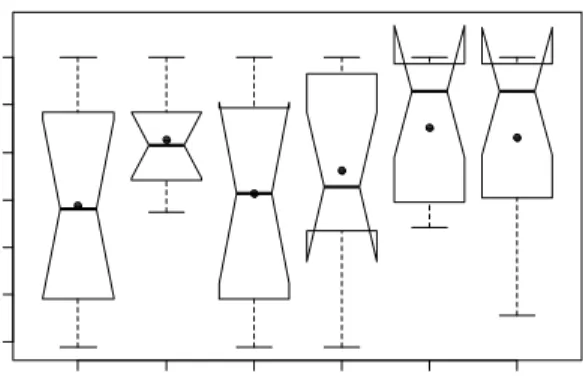
function All-2. We used the ADR-1 consistency measure to calculate the overall consistency of each list. The re-sults are in Figure 3 and in Table 3.
Figure 3. ADR-1 consistency for the six aggregation functions.
Solid circles indicate the mean value. Notches mark the 95% confidence interval around the median.
As can be seen, the original function, All-2, is outper-formed by all of the five alternatives proposed. All-2 leads to an average consistency of 0.844, which is the
All-2 Any-2 Prev-2 All-1 Any-1 Prev-1
0 .7 0 0 .7 5 0 .8 0 0 .8 5 0 .9 0 0 .9 5 1 .0 0 Aggregation function A D R -1 c o n si st en cy
smallest of the six. However, Prev-2 and All-1 are not significantly better according to a 1-tailed t-test at the 0.10 significance level. Moreover, the All functions lead to results with more variability, while the Any functions are more stable in terms of consistency. These results in-dicate that if the lists were generated with the 2,
Any-1 or Prev-Any-1 aggregation functions, they would be more
consistent, and so would be the evaluation with them. Interestingly, the relative order for each of the three 2-tailed and 1-2-tailed functions is maintained. That is, the All functions perform the worst, followed by Prev and Any, which perform the best both in terms of average consis-tency and variability.
Our guess back in Section 3.2 was that the larger the sizes of the relevance groups are, the more inconsistent the lists are too. To examine this, we calculated the mean number of incipits per group for each of the 11 resultant lists. Figure 4 and Table 3 show the results.
Figure 4. Mean number of incipits per group for each aggregation
func-tion. Solid circles indicate the mean value. Notches mark the 95% con-fidence interval around the median.
As expected, the All functions lead to larger groups, because an incipit goes to a new group only if it is differ-ent from all the previous ones. On the other hand, the Any functions generate smaller groups, because only one dif-ference needs to be found to place the incipit in a new group. Similarly, the Any-2 function leads to significantly smaller groups than All-2 at the 0.10 significance level, and Any-1 is significantly smaller at the 0.05 level.
Aggregation function
ADR-1 consistency
Incipits
per group Pearson’s r
All-2 0.844 3.752 -0.892*** Any-2 0.913** 2.539* -0.862*** Prev-2 0.857 3.683 -0.937*** All-1 0.881 3.297 -0.954*** Any-1 0.926** 1.981** -0.749*** Prev-1 0.916* 2.858 -0.939***
Table 3. Summary of results. * for significant difference at the 0.10 lev-el, ** at the 0.05 level and *** at the 0.01 level.
Following these results, there seems to be a direct rela-tionship between the size of the groups and the overall consistency of the lists. We checked this by calculating the Pearson’s r correlation coefficient between the two variables and, as expected, there is a strong negative cor-relation, indicating that the size of the groups affects the
consistency of the lists (see Table 3). This is why the All functions perform worse and the Any functions perform better: the All versions generate larger groups. Doing so, they allow for many incorrect expansions in the form of false positives due to intra-group inconsistencies.
5.1 MIREX 2005 Results Revisited
In the 2005 edition of the MIREX evaluations, there was a task for symbolic melodic similarity that used 11 ground truths based on partially ordered lists (what so far we have called the Eval05 collection). In particular, 7 dif-ferent systems were evaluated.
We calculated the ADR score of each system with the lists generated by the five alternative aggregation func-tions (see Table 4). Every alternative evaluation produces worse results than the original, except for Prev-2, which leads to the same scores. Indeed, every system performed worse for every alternative set of ground truths, with re-ductions in ADR score of up to 12%.
System All-2 Any-2 Prev-2 All-1 Any-1 Prev-1
GAM 0.66 0.59 0.66 0.624 0.583 0.605 O 0.65 0.607 0.65 0.643 0.593 0.639 US 0.642 0.604 0.642 0.639 0.594 0.628 TWV 0.571 0.558 0.571 0.566 0.556 0.564 L(P3) 0.558 0.52 0.558 0.54 0.515 0.534 L(DP) 0.543 0.503 0.543 0.511 0.494 0.506 FM 0.518 0.498 0.518 0.507 0.483 0.507 τ - 0.81 1 0.81 0.714 0.714
Table 4. ADR results of the systems that participated in MIREX 2005
with the lists resulting from the alternative aggregation functions. GAM = Grachten, Arcos and Mántaras; O = Orio; US = Uitdenbogerd and Suyoto; TWV = Typke, Wiering and Veltkamp; L(P3) = Lemström (P3), L(DP) = Lemström (DP); FM = Frieler and Müllensiefen. Best scores appear in bold face.
More importantly, the relative order of the systems, in terms of their mean ADR score, is also modified. For ex-ample, with the original lists GAM was the best system, followed by O and US. With the Any-2 lists, O is ranked first, before US and GAM. However, with the Any-1 lists the order is reversed: US, O and GAM. We calculated Kendall’s τ correlation coefficient to measure the differ-ences in the ranking of systems (see Table 4). A value of 1 means that two rankings are equal, and a value of -1 means that they are reversed. Except for Prev-2, which produces the same results as All-2, the correlation coeffi-cients tell us that the resulting rankings are different.
6. CONCLUSIONS AND FUTURE WORK With their appearance in 2005, ground truths based on partially ordered lists represented a big leap towards the scientific evaluation of Music Information Retrieval sys-tems, particularly for melodic similarity tasks. They have been widely accepted and used by the community, both in MIREX and other private evaluations.
We have revised the methodology used to generate these lists, unveiling some unaddressed problems. We have shown that the lists generated have inconsistencies, and propose several alternatives to minimize them. Using ADR-1 consistency, we have shown that our alternatives All-2 Any-2 Prev-2 All-1 Any-1 Prev-1
1 2 3 4 5 6 7 Aggregation function A v er ag e n u m b er o f in ci p it s p er g ro u p
lead to better results. We have also seen how would have changed the evaluation of the symbolic melodic similarity task in MIREX 2005, showing that the absolute effec-tiveness figures would have changed notably, and the ranking of systems would have been different too.
More meta-evaluation work in this line has to be car-ried out to improve the evaluation in MIR. In this paper we have focused on the last two steps of the methodolo-gy, analyzing the evaluation collection used in MIREX 2005. Other test collections should be analyzed, and the first two steps of the methodology should be studied as well because they are known to produce odd results too. One of the reasons may be the subjectivity on the judg-ments that the loose definition of the task can lead to, as already noted in [2] and [3]. More precise definitions of the information need sought by these tasks would surely lead to more coherent judgments by the experts.
One point that has not been discussed in the literature either is the significance level used by the aggregation function, which was 0.25 for the original lists. Our meas-ure of consistency also works with a significance level to decide whether incipits are correctly arranged or not, and though they should probably be the same, we should study what value is more appropriate in both cases.
Finally, the lists generated with the alternative aggre-gation functions show diverse characteristics, mainly in terms of group sizes and differences among incipits in the same group. Other effectiveness measures, besides ADR, could be proposed to exploit these characteristics, while accounting for the unavoidable inconsistencies.
ACKNOWLEDGEMENTS
We thank Carlos Gómez, Rainier Typke and the IMIRSEL group, especially Mert Bay and Stephen Downie, for providing us with the MIREX evaluation da-ta. We also thank William Frakes and Gabriella Belli for their insight regarding statistics and hypothesis testing.
APPENDIX. THE MANN-WHITNEY U TEST The Mann-Whitney U test [13], or Wilcoxon Rank-Sum test, is a non-parametric statistical test to assess whether the true medians of two independent samples, say X and Y, are significantly different or not. Consider X as the sam-ple of ranks of 600.258.342-1.1.2 for query 600.053.481-1.1.1, and Y the ranks given to incipit 850.020.721-1.1.1. The test statistic U is calculated as:
U=|X|·|Y|+|Y||Y|+1
2 -rankyi
|Y| i=1
where rank(yi) is the rank that the i-th number of Y would
have in the set X ∪ Y. In our example, U = 131. The
criti-cal value is criti-calculated depending on the alternative hypo-thesis H1. For a 2-tailed test, H1 would be that the true
medians are different, but if a 1-tailed is chosen instead
H1 would be that the true median of X is less than the true median of Y (or the other way around). In the 2-tailed case, the rejection region is spread around both sides of
the critical value, while in the 1-tailed case it is only in one side. Therefore, the 2-tailed case accounts for 2-way differences (X > Y or X < Y), while the 1-tailed case looks only for 1-way differences (X < Y in our case).
With a significance level of 0.25, the critical value for the 2-tailed test is U2 = 121, while for the 1-tailed test it is U1 = 136. Thus, the 1-tailed null hypothesis would be
re-jected because U < U1, but the 2-tailed would not because U > U2. In this case, the 2-tailed test fails to detect that the medians are, in fact, different. Because the 1-tailed test looks for a signed difference, it is more powerful and rejects the null hypothesis (H0 = X ≤ Y in our example).
REFERENCES
[1] E.M. Voorhees and D.K. Harman, TREC: Experiment and Evaluation in Information Retrieval, MIT Press, 2005. [2] J.S. Downie, A.F. Ehmann, M. Bay, and M.C. Jones, "The
Music Information Retrieval Evaluation eXchange: Some Observations and Insights," Advances in Music Informa-tion Retrieval, W.R. Zbigniew and A.A. Wieczorkowska, Springer, 2010, pp. 93-115.
[3] J.S. Downie, "The Scientific Evaluation of Music Infor-mation Retrieval Systems: Foundations and Future," Com-puter Music Journal, vol. 28, no. 2, 2004, pp. 12-23. [4] E. Selfridge-Field, "Conceptual and Representational
Is-sues in Melodic Comparison," Computing in Musicology, vol. 11, 1998, pp. 3-64.
[5] R. Typke, M. den Hoed, J. de Nooijer, F. Wiering, and R.C. Veltkamp, "A Ground Truth For Half A Million Musical Incipits," Journal of Digital Information Man-agement, vol. 3, no. 1, 2005, pp. 34-39.
[6] R. Typke, R.C. Veltkamp, and F. Wiering, "A Measure for Evaluating Retrieval Techniques based on Partially Or-dered Ground Truth Lists," IEEE International Confe-rence on Multimedia and Expo, 2006, pp. 1793-1796. [7] J.S. Downie, K. West, A.F. Ehmann, and E. Vincent, "The
2005 Music Information Retrieval Evaluation Exchange (MIREX 2005): Preliminary Overview," International Conference on Music Information Retrieval, 2005, pp. 320-323.
[8] M. Grachten, J. Arcos, and R. López, "A Case Based Ap-proach to Expressivity-Aware Tempo Transformation," Machine Learning, vol. 65, no. 2, 2006, pp. 411-437. [9] P. Hanna, P. Ferraro, and M. Robine, "On Optimizing the
Editing Algorithms for Evaluating Similarity Between Monophonic Musical Sequences," Journal of New Music Research, vol. 36, no. 4, 2007, pp. 267-279.
[10] J. Urbano, J. Lloréns, J. Morato, and S. Sánchez-Cuadrado, "Using the Shape of Music to Compute the Si-milarity between Symbolic Musical Pieces," International Conference on Computer Music Modeling and Retrieval, 2010.
[11] A. Pinto and P. Tagliolato, "A Generalized Graph-Spectral Approach to Melodic Modeling and Retrieval," Interna-tional ACM Conference on Multimedia Information Re-trieval, 2008, pp. 89-96.
[12] K. Saur Verlag, "Répertoire International des Sources Musicales (RISM). Serie A/II, Manuscrits Musicaux après 1600," 2002.
[13] H.B. Mann and D.R. Whitney, "On a Test of Whether One of Two Random Variables is Stochastically Larger than the Other," Annals of Mathematical Statistics, vol. 18, no. 1, 1947, pp. 50-60.