THE DEVELOPMENT OF AN IMPLEMENTATION FRAMEWORK
FOR SERVICE-LEARNING IN THE UNDERGRADUATE NURSING
PROGRAMME IN THE WESTERN CAPE
HESTER JULIE (7402946)
Thesis submitted in fulfilment of the requirements for the degree
Doctor Philosophiae in the School of Nursing,
University of the Western Cape
Supervisor: Professor O Adejumo
Date submitted: October 2014
ABSTRACT
THE DEVELOPMENT OF AN IMPLEMENTATION FRAMEWORK FOR
SERVICE-LEARNING IN THE UNDERGRADUATE NURSING PROGRAMME IN THE WESTERN CAPE
H Julie
Doctor Philosophiae in the School of Nursing, University of the Western Cape.
In this doctoral thesis, I explored how the national guidelines for higher education to institutionalise service-learning as a particular type of community engagement were
implemented in South African higher education institutions. Whilst the particular School of Nursing where the study was conducted was cognisant of the national policy imperative on service-learning as stipulated in the guidelines of the Higher Education Quality Committee (HEQC), operationalisation within the academic programmes had not been addressed. An intervention study was thus undertaken to develop a service-learning implementation framework for the School of Nursing using the multi-phased design and development model of Rothman and Thomas (1994). The factors that influenced the implementation of the HEQC’s service-learning policy guidelines in the nursing programmes were explored during the first phase: problem analysis and project planning. During this phase, the research focused on the readiness of the school to institutionalise service-learning at organisational and individual level because service-learning scholars advocate a systems approach to service-learning institutionalisation. At organisational level, the research question
investigated whether the higher education institution had created an enabling environment for the school to institutionalise service-learning successfully in the academic. The factors that
i
were associated with readiness at organisational (school) level were those cited as critical success factors for service-learning institutionalisation by Furco (2002) or better known in South African terminology as service-learning good practice indicators. Individual readiness was determined in terms of service-learning scholarship and willingness to participate in service-learning -capacitating activities.
Research indicates that most higher education institutions in South Africa failed to establish a standard practice for SL within the formalised systems in their respective academic
programmes. Hence the aim of the phase 2 of the study was to identify which factors promoted or inhibited SL implementation. A purposive sample of 13 key informants from eight South African universities was interviewed with the intention of developing the prescriptive intervention theory for institutionalizing SL in a nursing academic programme. During the design phase the intervention plan identified the determinant factors for the service-learning implementation framework i.e. the intervention elements (change strategies) were formulated to address the gaps that were identified by the core findings of phases 1 and 2. It included correcting the prevalent theory-practice gap that emanated from the conceptual confusion regarding the differentiation of service-learning from other forms of community engagement curricular activities; addressing the lack of knowledge related to the national service-learning policy guidelines by involving the academics and clinical supervisors in service-learning capacity building and scholarship; developing a service-learning
pedagogical model for the school by providing concrete implementation guidelines to embed learning pedagogy in undergraduate nursing modules that are amenable to service-learning ; and formulating service-service-learning institutionalisation criteria for the nursing programme of the school in accordance with the service-learning quality indicators of the HEQC. ii
This study makes a significant contribution to nursing education and service-learning institutionalisation in the following areas: The implementation framework was developed to institutionalise service-learning in a nursing programme as opposed to just a module is a first of its kind in South Africa. The contextualised service-learning definition that was formulated for the School of Nursing contributes to the service-learning operationalisation discourse at the higher education institution.
KEYWORDS
Service-learningImplementation framework
Undergraduate nursing programme Nurse educators Service-learning institutionalisation iii
DECLARATION
I declare that The development of an implementation framework for service-learning in the undergraduate nursing programme in the Western Cape is my own work, that it has not been submitted before for any degree or examination in any other university, and that all the sources I have used or quoted have been indicated and acknowledged as complete references.
Hester Julie Date: October 2014
Signed: iv
DEDICATION
I dedicate this work to my Creator and Sustainer and all the women who refuse to abort their dreams. v
ACKNOWLEDGEMENTS
I am indebted to many people who have supported me during this academic journey. Therefore, I would like to thank the following people for their contribution to my study:
• my supervisor, Prof. O Adejumo, for his guidance;
• Prof. Susan Terblance, Dr Ruth Albertyn and Prof. Priscilla Daniels, for their invaluable support as mentors and critical friends during this journey;
• the Women and Health Taskforce of the Network: Towards Unity for Health, especially Prof. Judy Lewis and Todd Maja;
• the senior pastor and leadership of the Lighthouse Family Church, Belhar, for giving the students access to the Belhar community under the caring eyes of the
compassionate mercy workers. A heartfelt thanks to pastor Andrea Sampson and the Joshua pastoral couple who played a pivotal role since 2010 in getting gender-based violence on the agenda of the Lighthouse Family Church, Belhar.
• the National Research Foundation, for their financial support;
• Professor Priscilla Daniels and Mrs Traacey-Ann Adonis for their support and mentoring;
• the School of Nursing, for providing me many enriching experiences, especially my fellow doctoral students, Lorraine Fakude and Rugira Modeste;
• Ms Jackie Viljoen, for language editing my thesis and the publications; and
• My natural and spiritual family, for standing in the gap for me and carrying me when I felt like quitting.
vi
LIST OF ABBREVIATIONS
CE Community Engagement
CEU Community Engagement Unit
CENTALS Centre for Teaching and Learning Scholarship CHE Council on Higher Education
CHESP Community-Higher Education Service Partnership
COP Community of Practice
D&D Design and Development DoE Department of Education
DVC Deputy Vice-Chancellor
FGD Focus group disscusion
GBV Gender-Based Violence
HE Higher Education
HEI Higher Education Institution HEIs Higher Education Institutions
HEQC Higher Education Quality Committee HEQA Higher Education Quality Assurance
IR: DD Intervention research: Design and development IOP Institutional Operational Plan
JET Joint Education Trust KU Knowledge Utilisation
MERP Monitoring, Evaluation and Research Programme
NGT Nominal Group Technique
NRS Nursing
NQF National Qualifications Framework vii
SAHECEF South African Higher Education Community Engagement Forum
SL Service-learning
SLM Skills Laboratory Methodology
SON School of Nursing
SAQA South African Qualifications Authority SANC South African Nursing Council
UGNP Undergraduate Nursing Programme USA United States of America
UWC University of Western Cape WHO World health Organization
viii
TABLE OF CONTENT
1. CHAPTER 1: OVERVIEW OF THE STUDY ... 1
1.1 INTRODUCTION ... 1
1.2 INTERNATIONAL AND NATIONAL CONTEXTUALISATION ... 2
1.3 LOCAL CONTEXTUALISATION OF STUDY ... 6
1.4 THE DEVELOPMENT OF SL IN THE SCHOOL OF NURSING ... 8
1.5 STATEMENT OF THE RESEARCH PROBLEM ... 9
1.6 AIM ... 10
1.7 OBJECTIVES ... 10
1.8 DELIMITATION OF THE STUDY ... 11
1.9 PRAGMATISM AS THE PARADIGMATIC PERSPECTIVE ... 12
1.10 THE THEORETICAL FRAMEWORK UNDERPINNING THE STUDY ... 12
1.11 METHODOLOGICAL FRAMEWORK ... 14
1.12 THE SIGNIFICANCE OF THE STUDY... 15
1.13 CONCEPT CLARIFICATION ... 15
1.14 LAYOUT OF THE REPORT... 17
1.15 CONCLUSION ... 17
2. CHAPTER 2: LITERATURE RELEVANT TO THE SL IMPLEMENTATION FRAMEWORK THAT WAS DEVELOPED ... 19
2.1 INTRODUCTION ... 19
2.2 DEFINING SERVICE-LEARNING AS A FORM OF CE ... 19
2.3 THEORETICAL AND PHILOSOPHICAL UNDERPINNINGS OF SL ... 22
2.4 SOCIAL AND POLITICAL PHILOSOPHICAL UNDERPINNINGS OF SL ... 24
2.5 THE INSTITUTIONALISATION OF SL IN THE ACADEMIC PROGRAMME ... 25
2.6 COMMUNITY ENGAGEMENT THROUGH SERVICE-LEARNING ... 25
2.7 THE ROLE OF HIGHER EDUCATION INSTITUTIONS IN SL INSTITUTIONALISATION ... 27 2.8 SL INSTITUTIONALISATION MODELS ... 29 ix
2.8.1 FURCO’S SELF-ASSESSMENT RUBRIC ... 29
2.8.2 HOLLAND’S MATRIX FOR LEVELS OF COMMITMENT TO SERVICE... 31
2.8.3 THE WINGSPREAD FRAMEWORK ... 32
2.8.4 THE SOUTH AFRICAN FRAMEWORK FOR COMMUNITY ENGAGEMENT THROUGH SERVICE-LEARNING ... 33
2.9 ORGANISATIONAL CHANGE MANAGEMENT ... 38
2.10 THEORETICAL FRAMEWORK ... 41
3. CHAPTER 3: RESEARCH DESIGN AND METHODOLOGY ... 44
3.1 INTRODUCTION ... 44
3.2 PHILOSOPHICAL (PARADIGM) PERSPECTIVES ... 44
3.3 PRAGMATISM ... 45
3.4 MIXED-METHOD RESEARCH APPROACH ... 47
3.5 RESEARCH DESIGN... 51
3.6 METHODOLOGICAL FRAMEWORK ... 51
3.7 THE DESIGN AND DEVELOPMENT (D&D) MODEL ... 52
3.8 PHASE 1: PROBLEM ANALYSIS AND PROJECT PLANNING ... 53
3.8.1 RESEARCH APPROACH ... 55
3.8.2 RESEARCH SETTING... 55
3.8.3 IDENTIFYING AND INVOLVING CLIENTS ... 56
3.8.3.1 Inclusion criteria ... 57
3.8.3.2 Sample size ... 57
3.8.4 GAINING ENTRY AND COOPERATION FROM SETTINGS ... 58
3.8.5 IDENTIFYING THE CONCERNS OF THE POPULATION ... 59
3.8.6 ANALYSING IDENTIFIED PROBLEMS ... 59
3.8.6.1 Data collection method and process ... 63
3.8.6.2 Data collection instrument ... 64
3.8.6.3 Structure of the questionnaire ... 65 x
3.8.6.3.1 Pre-testing of instrument ... 66
3.8.6.4 Validity and reliability of instrument ... 67
3.8.6.4.1 Data analysis and process ... 67
3.8.7 LITERATURE REVIEW FOR POTENTIAL INTERVENTION ... 68
3.8.8 DETERMINING THE FEASIBILITY OF THE STUDY ... 69
3.8.8.1 Population and sampling ... 69
3.8.8.2 Data collection method and process ... 70
3.8.8.3 Analysis ... 70
3.9 PHASE 2: INFORMATION GATHERING AND SYNTHESIS RELATED TO SL INSTITUTIONALISATION ... 72
3.9.1 USING EXISTING INFORMATION SOURCES ... 72
3.9.2 STUDYING NATURAL EXAMPLES ... 73
3.9.2.1 Research approach ... 73
3.9.2.2 The study population, sampling and inclusion criteria ... 74
3.9.2.3 Data collection method and instrument ... 75
3.9.3 IDENTIFYING FUNCTIONAL ELEMENTS FOR THE SL FRAMEWORK... 75
3.9.4 SYNTHESISING DATA AND FORMULATING CONCLUSIONS (INTERVENTION THEORY) ... 75 3.10 TRUSTWORTHINESS ... 77 3.10.1 CREDIBILITY ... 77 3.10.2 TRANSFERABILITY ... 77 3.10.3 CONFIRMABILITY ... 78 3.10.4 REFLEXIVITY ... 78 3.10.5 DEPENDABILITY ... 78 3.11 PHASE 3: DESIGN ... 78 xi
3.11.1 INTERVENTION MODEL FOR THE INTERVENTION PLAN ... 79
3.11.2 DESIGN BOUNDARIES AND CRITERIA ... 81
3.11.3 SPECIFICATIONS OF THE DOMAIN BOUNDARIES ... 81
3.11.4 SPECIFYING THE PROCEDURAL ELEMENTS ... 82
3.11.5 IDENTIFY COLLABORATORS ... 82
3.11.6 IDENTIFY DESIGN PROBLEMS AND INTERVENTION REQUIREMENTS ... 83
3.11.7 FORMULATE INITIAL INTERVENTION AND PROCEDURES ... 83
3.12 EARLY DEVELOPMENT AND PILOTING TESTING: PHASE 4 ... 86
3.12.1 PROTOTYPES AND PRELIMINARY INTERVENTIONS TO INSTITUTIONALISE SL IN THE UNDERGRADUATE NURSING PROGRAMME ... 87
3.12.1.1 Gender-based violence module guide ... 88
3.12.1.2 The preliminary intervention ... 89
3.13 PILOT TEST OF THE SL MODULE ... 89
3.14 APPLYING DESIGN CRITERIA TO THE PILOT INTERVENTION ... 90
3.15 METHODOLOGY FOR PHASE 4 ... 91
3.15.1 PILOTING OF THE GBV SL MODULE ... 91
3.15.1.1 Student survey SL module design ... 91
3.15.1.1.1 Study population and sample ... 91
3.15.1.1.2 Data collection method and process ... 92
3.15.1.1.3 Data collection instrument ... 92
3.15.1.1.4 Reliability and analysis ... 93
3.15.1.2 Developing a SL definition ... 93
3.15.1.2.1 Setting and target population... 93
3.15.1.2.2 Sampling... 93
3.15.1.2.3 Data collection method... 94
3.15.1.2.4 Data collection process... 94 xii
3.15.1.2. 5 Data analysis ... 94
3.16 ETHICAL CONSIDERATIONS ... 95
3.16.1 INFORMED CONSENT ... 95
3.16.2 PRIVACY AND CONFIDENTIALITY ... 96
3.16.3 THE RIGHT TO FREEDOM OF CHOICE AND WITHDRAWAL... 96
3.16.4 AVOIDING HARM ... 97
3.17 SUMMARY OF METHODOLOGY ... 97
4. CHAPTER 4: PRESENTATION OF THE FINDINGS ... 98
4.1 INTRODUCTION ... 98
4.2 PHASE 1: PROBLEM ANALYSIS AND PROJECT PLANNING ... 98
4.2.1 DEMOGRAPHIC PROFILE OF SAMPLE ... 98
4.2.1.1 Age group... 99
4.2.1.2 Total years of nursing experience ... 99
4.2.1.3 Highest qualification ... 99
4.2.1.4 Years employed at institution ... 100
4.2.1.5 Employment category ... 100
4.2.2 CHALLENGES TO INSTITUTIONALISING SERVICE-LEARNING AS PERCEIVED BY THE RESPONDENTS ... 100
4.2.3 THE CRITICAL SUCCESS FACTORS FOR SL INSTITUTIONALISATION ... 103
4.2.3.1 Philosophy and mission of service-learning (dimension 1) ... 103
4.4.3.2. Academic support for and involvement in SL (dimension 2) ... 104
4.2.3.3 Student support for and involvement in SL (dimension 3) ... 104
4.2.3.4 Institutional support for SL (dimension 5) ... 106
4.2.4 SERVICE-LEARNING SCHOLARSHIP NEEDS ... 107 xiii
4.2.4.1 Previous exposure to service-learning ... 108
4.2.4.2 Self-identified SL training needs ... 108
4.2.4.3 Willingness to participate in SL capacity building ... 108
4.2.4.4 Understanding of service-learning ... 109
4.2.4.5 Summary of the findings related to SL scholarship ... 109
4.2.5 DETERMINING THE FEASIBILITY OF THE STUDY ... 110
4.2.5.1 Interpretation of the FGD ... 111
4.3 PHASE 2: INFORMATION GATHERING AND SYNTHESIS ... 112
4.3.1 FUNCTIONAL ELEMENTS ... 113
4.3.2 SYNTHESIS OF THE DATA ... 113
4.3.3 CHALLENGES REGARDING THE TRANSITION TO INCORPORATE SL ... 114
4.3.3.1 Challenges related to a common understanding and expression of SL ... 115
4.3.3.2 Lack of integration ... 115
4.3.3.3 Sustainability of SL initiatives ... 116
4.3.3.4 Lack of resources and support... 116
4.3.4 PERSONAL CHALLENGES ... 117
4.3.4.1 Staff attitudes ... 117
4.3.4.2 Students’ attitudes ... 117
4.3.5 MATTERS RELATED TO SUCCESSFUL IMPLEMENTATION ... 118
4.3.5.1 Structural and procedural matters ... 118
4.3.5.2 Alignment to strategic objectives, mission and vision of the institution . 119
xiv
4.3.5.3 Buy-in and support from top structure ... 120
4.3.6 MATTERS RELATED TO CURRICULUM ... 121
4.3.6.1 Importance of adopting a dynamic approach to SL ... 121
4.3.6.2 Progressive extensioning ... 121
4.3.6.3 Comprehensive approach ... 122
4.3.6.4 Partnership framework... 123
4.3.7 PERSONAL MATTERS ... 123
4.3.7.1 Personal epistemological, pedagogical and attitudinal shifts required ... 123
4.3.7.2 Professional development and mentoring of staff ... 124
4.3.7.3 Building reflective practitioners ... 124
4.3.8 SUMMARY OF FINDINGS FROM SL EXPERTS ... 125
4.4 DESIGN PHASE ... 125
4.4.1 INTERVENTION MODEL FOR THE INTERVENTION PLAN ... 125
4.4.1.1 The prescriptive theory of the intervention plan ... 126
4.4.1.2 Prescriptive elements of the intervention plan ... 126
4.4.2 SPECIFICATION OF THE DOMAIN BOUNDARIES ... 129
4.4.3 SPECIFYING THE PROCEDURAL ELEMENTS ... 130
4.4.3.1 Assessing individual readiness ... 130
4.4.3.2 Monitoring and evaluation system for SL institutionalisation ... 132
4.5 EARLY DEVELOPMENT AND PILOTING: PHASE 4 ... 133
4.5.1 GBV MODULE GUIDE AS AN SL PEDAGOGICAL MODEL ... 134
4.5.2 APPLICATION OF THE INTERVENTION DESIGN CRITERIA ... 134
xv
4.5.2.1 Incorporation of the SL project in the module outcomes ... 135
4.5.2.2 Explanation of the teaching strategies ... 136
4.5.2.2.1.1 Case-based learning approach ... 137
4.5.2.2.1.2 Theoretical underpinning of service-learning ... 137
4.5.2.3 Reflection ... 139
4.5.2.4 Assessment of SL in the GBV module ... 139
4.5.2.5 Detailed description of the SL requirements ... 140
4.5.2.6 Integration of gender-based violence theory into the SL projects ... 140
4.5.2.7 Weekly programme planner ... 141
4.5.3 PILOTING OF GBV SL MODULE ... 141
4.5.3.1 Socio-demographic information ... 142
4.5.3.2 SL module experiences ... 143
4.5.3.3 Clear links between the module outcomes and service activities ... 145
4.5.3.4 SL different from other module-related community activities ... 148
4.5.3.5 Resources or strategies most helpful for facilitating deep learning ... 150
4.5.3.6 Difference in the assessment of the SL module ... 151
4.5.3.7 Findings derived from the open-ended component of the question ... 151
4.5.3.8 Suggestions to improve the SL module ... 153
4.5.3.9 Characteristics of SL module ... 154 xvi
4.5.3.10 General appreciation of the SL module ... 156
4.5.4 SUMMARY OF THE FINDINGS ON THE SL MODULE DESIGN ... 157
4.6 THE CONCEPTUAL FRAMEWORK FOR THE SL DEFINITION ... 157
4.6.1 ITEM CLARIFICATION AND MERGING OF CONCEPTS ... 157
4.6.2 FINAL RANKING OF THE MASTER CONCEPT LIST ... 159
4.6.3 SUMMARY ... 159
5. CHAPTER 5: DISCUSSION OF FINDINGS ... 160
5.1 INTRODUCTION ... 160
5.2 IDENTIFY AND ANALYSE KEY PROBLEMS: PHASE 1 ... 160
5.2.1 DEMOGRAPHIC INFORMATION ... 160
5.3 PERCEIVED LEVEL OF SL INSTITUTIONALISATION AT UWC ... 162
5.3.1 PHILOSOPHY AND MISSION STATEMENT ... 162
5.3.2 ACADEMIC SUPPORT FOR AND INVOLVEMENT IN SL ... 165
5.3.3 STUDENT SUPPORT AND COMMUNITY INVOLVEMENT IN SL ... 166
5.3.4 INSTITUTIONAL SUPPORT FOR SL ... 167
5.4 BENCHMARKING AGAINST INSTITUTIONAL QUALITY INDICATORS ... 169
5.4.1 INSTITUTIONAL INPUT INDICATORS ... 170
5.4.2 INSTITUTIONAL PROCESS INDICATORS ... 171
5.4.3 INSTITUTIONAL OUTPUT AND IMPACT INDICATORS ... 172
5.5 SL SCHOLARSHIP STATUS IN THE SON ... 173
5.6 SON’S READINESS FOR SL INSTITUTIONALISATION ... 176
5.7 SETTING GOALS ... 176
5.8 FEASIBILITY OF THE INTERVENTION PLAN ... 178
5.9 INFORMATION GATHERING AND SYNTHESIS: PHASE 2 ... 180
5.10 DESIGN: PHASE 3 ... 180
5.11 EARLY INTERVENTIONS AND PILOTING: PHASE 4 ... 181
5.11.1 DESIGN OF THE SL MODULE ... 181
5.11.2 PILOTING OF THE SL PEDAGOGICAL MODEL ... 183 xvii
5.11.3 PREPARING FOR SL IMPLEMENTATION: CONCEPTUALISATION OF SL ... 184
5.11.4 CONCEPTUAL FRAMEWORK FOR THE SL DEFINITION ... 189
5.11.5 SUMMARY ... 192
5.12 FACTORS INFLUENCING THE INTERVENTION ... 192
5.12.1 ENVIRONMENTAL FACTORS... 192
5.12.2 INTERVENER CHARACTERISTICS ... 193
5.12.3 CHALLENGES RELATED TO THE IMPLEMENTATION READINESS ... 193
5.12.4 INFLUENCE OF THE DOMINANT CURRICULAR CUSTOMS AND VALUES ... 194
5.12.4.1 Readiness of the academics ... 194
5.12.4.2 Readiness of the students ... 195
5.13 SUMMARY OF THE FINDINGS ... 200
6. CHAPTER 6: SL IMPLEMENTATION FRAMEWORK, LIMITATIONS AND RECOMMENDATIONS ... 202
6.1 INTRODUCTION ... 202
6.2 THE SL IMPLEMENTATION FRAMEWORK ... 205
6.2.1 THE PRINCIPLES UNDERGIRDING THE SL IMPLEMENTATION FRAMEWORK ... 205
6.2.1.1 Organisational change theory ... 205
6.2.1.2 Intervention theory ... 207
6.2.1.3 SL institutionalisation ... 207
6.2.2 THE DETERMINING FACTORS FOR THE SL IMPLEMENTATION FRAMEWORK .... 208
6.2.3 Prescriptive elements for the SL implementation framework ... 208
6.2.3.1 School and programme level SL institutionalisation indicators ... 209
6.2.4 THE DOMAIN BOUNDARIES FOR THE SL IMPLEMENTATION FRAMEWORK ... 210
6.2.4.1 Assessing readiness for SL institutionalisation ... 211
6.2.4.2 A monitoring and evaluation system for SL institutionalisation ... 211 xviii
6.2.4.3 SL definition ... 219
6.2.4.4 Developing an SL pedagogical model ... 220
6.3 SUMMARY AND CONCLUSIONS ... 220
6.4 LIMITATIONS OF THE STUDY AND RECOMMENDATIONS ... 221
6.4.1 FACILITATION OF STRUCTURED STUDENT REFLECTIONS ... 221
6.4.2 STRUCTURE OF THE DISSERTATION ... 221
6.4.3 COMMUNITY VOICE ... 222
6.4.4 REFLEXIVITY ... 222
6.4.5 REFINEMENT OF THE SL DEFINITION ... 223
6.4.6 TOOL TO ASSESS PERSONAL READINESS ... 223
6.4.7 GENERALISABILITY OF RESULTS ... 223
6.4.8 SCHOLARLY OUTPUT ... 223
6.4.8.1 International conference presentations... 224
6.4.8.2 National conference presentations ... 224
6.4.8.3 Publications ... 225
7. REFERENCES ... 226
8. ANNEXURES ... 243
ANNEXURE 1: ETHICAL CLEARANCE LETTER ... 244
ANNEXURE 2: INFORMATION LEAFLET AND CONSENT FORM ... 245
ANNEXURE 3: PHASE 1 QUESTIONNAIRE ... 246
ANNEXURE 5: PHASE 3 PROJECT DESIGN FGD CONSENT FORM ... 256
ANNEXURE 6: REPORT B4 LEVEL MEETING 2012 ... 257
ANNEXURE 7: PHASE 4 SL WORKSHOPS ... 259
ANNEXURE 8: GBV SL MODULE GUIDE ... 260
ANNEXURE 8.1: EXCERPTS FROM THE WEEKLY PROGRAMME IN THE GBV MODULE GUIDE ... 288 xix
ANNEXURE 8.2: TIME TABLE GBV MODULE 2012 ... 290
ANNEXURE 9: SL MODULE DESIGN GUIDELINES ... 291
ANNEXURE 10: SL MODULE DESIGN QUESTIONNAIRE ... 299
ANNEXURE 11: GRIEVANCE LETTER ... 303
ANNEXURE 12: RESPONSE TO GRIEVANCE LETTER ... 311
ANNEXURE 13: MOTIVATION FOR THE DISCONTINUATION OF THE SL GBV MODULE IN 2013 ... 317
ANNEXURE 14: SHORT PROGRAM FOR SERVICE-LEARNING AND COMMUNITY ENGAGEMENT (SPSLCE)... 318
List of tables Table 2.1: Holland’s matrix for levels of relevance ... 32
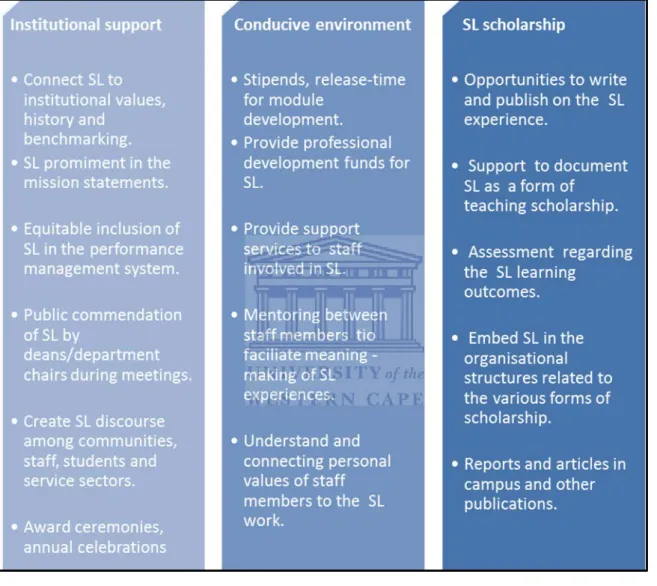
Table 2.2: South African SL framework for institutional level guidelines ... 34
Table 2.3: A comparison of phased models of change process ... 42
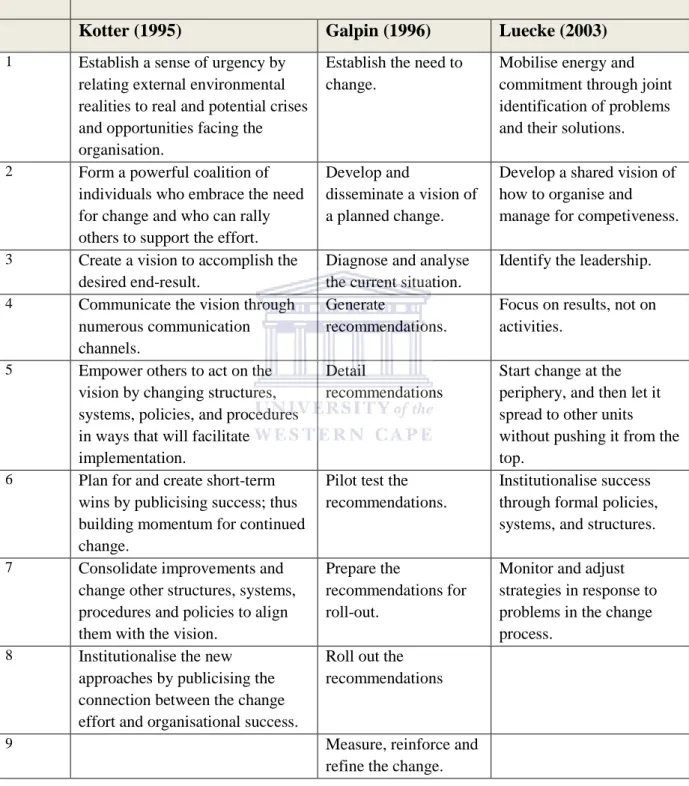
Table 3.1: Intervention research: Design & development framework merging of research approaches and methods ... 49
Table 3.2: Sampling framework, required sample and actual sample size ... 58
Table 3.3: Variables influencing SL institutionalisation at the individual level... 63
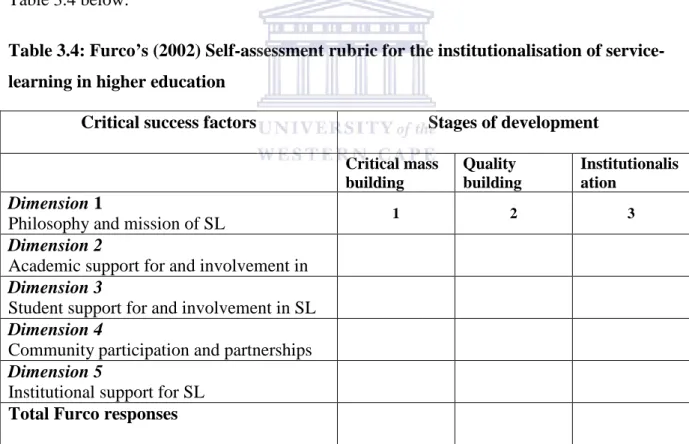
Table 3.4: Furco’s (2002) Self-assessment rubric for the institutionalisation of service-learning in higher education... 64
Table 3.5: Sample of SL experts interviewed ... 74
Table 4.1: Gender, age group, nursing experience, highest qualification, years of employment and employment category of respondents... 98
Table 4.2: Interpretation key ... 101
Table 4.3: The overall Furco responses for the different dimensions ... 102
Table 4.4: Philosophy and mission statement – institutionalisation stage ... 103
Table 4.5: Academic support and involvement in SL... 104 xx
Table 4.6 : Stage of institutionalisation for student support ... 105 Table 4.7: Stage of institutionalisation for community participation and partnerships ... 105 Table 4.8: Stage of institutionalisation for institutional support... 106 Table 4.9: Previous exposure to service-learning ... 108 Table 4.10: SL Training needs ... 108 Table 4.11: Willingness to participate in capacity-building activities ... 109 Table 4.12: Findings of the FGD with the 4th year level nursing educators ... 110 Table 4.13: Key elements to consider during the intervention plan of the study ... 113 Table 4.14: The individual’s readiness to institutionalise SL in own teaching practice ... 131 Table 4.15: Gender, age group, race and the community partner ... 142 Table 4.16: Students experiences of SL module ... 143 Table 4.17: Clearly links module outcomes with service activities. ... 146 Table 4.18: SL activities different from other module-related community activities. ... 148 Table 4.19: Sources and strategies facilitating deep learning ... 150 Table 4.20: Differences between SL and other modules ... 152 Table 4.21: Suggestions to improve the SL module ... 153 Table 4.22: Characteristics of the SL module ... 155 Table 4.23: General appreciation of the SL module ... 156 Table 4.24: Master concept list of the nominal group technique N=48... 158 Table 4.25: Final ranking of the master concept list ... 159 Table 6.1: School level guidelines ... 213 Table 6.2: Academic programme level guidelines ... 215 Table 6.3: Module/course level guidelines ... 217
xxi
List of Figures
Figure 2.1: Adapted SL institutionalisation self-assessment rubric for HEIs (Furco 2002:3). 30 Figure 2.2: Erasmus (2007) adapted model ... 39 Figure 2.3: Erasmus’ model (2007) ... 40 Figure 2.4: Distinctions among community-engaged learning (HEQC 2006a:21) ...
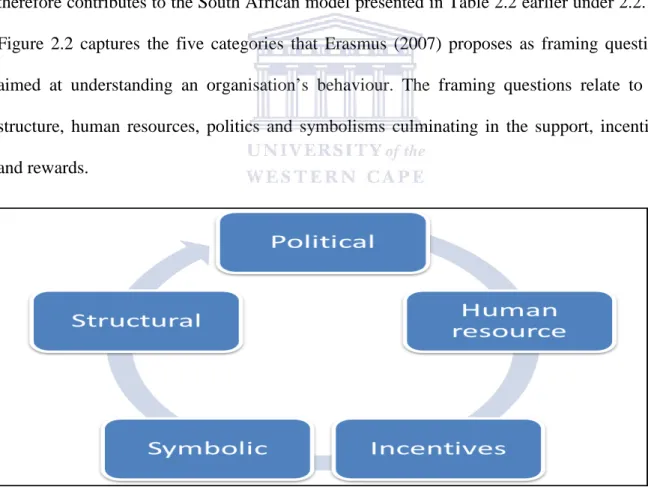
Figure 3.1: The operational steps executed of the design & development model (adapted from Rothman & Thomas 1994:10–11). ... 53 Figure 3.2: Conceptual framework for SL institutionalisation ... 69 Figure 3.3: Elements of an intervention theory (adapted from Burns & Grove 2004:320) ... 76 Figure 3.4: Design processes for formulation of the SL implementation framework ... 79 Figure 3.5: Elements of the prescriptive theory (adapted from Burns & Grove 2004:320) .... 81 Figure 4.1: Overall Furco responses for all five dimensions ... 101 Figure 4.2: Process to identify the functional elements for SL implementation framework . 128 Figure 5.1: Service-learning conceptual framework (Julie 2014) ... 190 Figure 6.1: Prescriptive elements for SL framework ... 209 Figure 6.2: Domain boundaries for the SL framework ... 210
xxii
1.
CHAPTER 1: OVERVIEW OF THE STUDY
1.1
INTRODUCTION
Scholars in the field of community engagement contend that the service-learning (SL) policy implementation in higher education is more likely to be successful when there is a strong institutional commitment (Furco 2002:3; Julie, Daniels & Khanyile 2007; Lazarus, Erasmus, Hendricks, Nduna & Slammat 2007), the policy implementation is well conceptualised (Hall 2010:24), and the practice model is consistent with available best practice evidence and international standards (Butin 2003:1674). While it can be claimed that South Africa’s community engagement (CE) and service-learning (SL) policy is “reasonably consistent with expectations of good practice, there has been persistent dissatisfaction with outcomes” (Hall 2010:8).
The institutional audits completed by the Higher Education Quality Committee (HEQC) between 2004 and 2008 revealed that, although higher education institutions (HEIs) included CE in their mission statements, most of these institutions failed to operationalised CE in their three-year rolling plans submitted to the Department of Education (DoE) (Lazarus et al., 2007). The operationalisation of CE and SL was further compounded by conceptual confusion. A literature review done by Bender (2008b:82–83) on the conceptualisation of CE and SL concluded that concepts like SL, CE, community service and the scholarship of engagement are used interchangeably (Lazarus, Erasmus, Hendricks, Nduna & Slammat 2008), people have different and sometimes conflicting conceptions of community engagement and SL (Hall 2010), and that misconceptions and myths exist regarding community-engaged teaching and learning (Naudé 2006:16).
1
1.2
INTERNATIONAL AND NATIONAL CONTEXTUALISATION
The service-learning (SL) movement was birthed out of discontent because there was a global outcry for higher education institutions (HEIs) to be more accountable for both the effectiveness and relevance of their educational programmes (Bringle & Hatcher 2005:25; Castle & Osman 2003; HEQC 2006a:4). South African HEIs were prompted to embrace social responsibility as their mandate (Erasmus 2005:3; Lazarus et al. 2008:58) and were charged to “reinsert the public good into higher education” (Bawa 2003:51) by “making available their expertise and infrastructure for community service programmes” (DoE, 1997:10). This global outcry of discontent gave impetus to the SL movement according to Butin (2006). His claim, that SL is actively supported by governments because of the inherent potential that SL has to contribute to the societal transformation agendas of governments, is confirmed by other scholars (Bender 2008b:84; DoE 1997:10–11; Erasmus 2005:3; Waghid 2012:71–72). Butin further asserts that the diffusion of SL can be attributed to the fact that “higher education has begun to embrace a scholarship of engagement” (Butin 2006:473). In the USA, the SL movement started in the 1960s (Stanton & Erasmus 2013:62). It is important to mention that the American SL advocates first built a critical mass across academia during a 30-year period before they embarked on discourses about SL institutionalisation in higher education institutions (Butin 2006:475; Stanton & Erasmus 2013). However, SL as engaged scholarship has gained momentum since its endorsement by the Carnegie Foundation, various national associations and regional accreditation bodies (Weerts & Sandman 2010).Although SL in South Africa was greatly influenced by American scholars (Bender 2008b; HEQC 2006:138) the SL movement in this country did not take the same route as in the 2
United States of America (USA) to institutionalise SL in the South African higher education system. So, instead of adopting the USA’s SL diffusion model described previously, SL became firmly entrenched in South African HEIs policy documents in less than a decade to give effect to the societal transformation agenda of the newly elected government (HEQC 2006a:12).
The concept SL was first introduced in South African higher education when the Joint Education Trust (JET) investigated the conceptualisation and potential role of SL at HEIs in 1997–1998 (Lazarus et al. 2008:58). According to these authors the interest in SL was closely associated with the transformation agenda of the new democratic government. The government was exploring ways to translate the South African constitutional values into educational discourses (DoE 1997). Hence, the Community Higher Education Service Partnership (CHESP) research project was established in 1999 in response to a call of the White Paper on Education (1997) for “feasibility studies and pilot programmes which explore the potential of community service in higher education” (Lazarus et al 2008:58). The Department of Education (
DoE
) also commissioned the development of an SL policy framework for HEIs (HEQC 2006a:10–12). This rapid SL legislation, however, created a gap between the national SL policy intention and implementation at institutional level. Valid reasons are provided like institutional mergers, faculty reorganisations and major reforms in qualifications and curricula (Mouton & Wildschut 2005:121). However, this policy implementation gap could partly be ascribed to government failing to ensure that a critical mass of SL champions was developed at institutional level (Julie 2014). Hindsight indicates that most of the HEIs were not sufficiently capacitated to translate these national SL policies successfully into the academic programmes despite the numerous SL exemplars that were developed during the CHESP research project (HEQC 2006a:12). This statement, however, is 3
not intended to diminish the pivotal role CHESP played in the formulation of the national policy guidelines that mandated the integration of CE and SL in the South African higher education system (HEQC 2006a:12).
The following policy documents are foundational to the SL movement in South Africa: • the White Paper on Higher Education (DoE 1997);
• the National Plan for Higher Education (DoE 2001);
• the Founding Document of Higher Education Quality Committee (HEQC 2001); • the HEQC Criteria for Institutional Audits (2004a); and
• the HEQC Criteria for Programme Accreditation (2004b).
The Criteria for Institutional Audits (HEQC, 2004a) specifically lists SL in Criterion 7 and CE in Criterion 18 (HEQC, 2004a:19). The national policy imperative for SL in HEIs is explicitly stated in the Institutional Audit Framework and Institutional Audit Criteria (HEQC, 2004a:19; HEQC 2004d: 5). Criterion 1 stipulates that the institution’s mission be translated into a strategic plan with clear timeframes and resources for the achievement of goals and targets in its core function of teaching, learning and research. Criterion 7 states that institutions with SL as part of their mission should:
• integrate service-learning programmes into institutional and academic planning via their mission and strategic goals;
• adequately resource and provide enabling mechanisms to support the implementation of service-learning, including staff and student capacity development; and
• review and monitor arrangements to gauge the impact and outcomes of service-learning programmes on the institution and other participating constituencies (HEQC 2004d:11). Although SL is embedded in these policy documents, Mouton and Wildschut (2005:121) concluded that South African HEIs show a lack of strong SL scholarship. A key recommendation from the milestone Bantry Bay Conference held in 2006 (Fourie 2006:9)
4
was that “A rigorous conceptual framework for community engagement is required, which articulates the key concepts and issues related to community engagement and serves as a useful guide to informing effective community engagement practices at HEIs.”
Smith (2011:9–10) provides a succinct summary of the CE–SL movement in South Africa. He states that the period prior to the landmark 2006 Community Engagement in Higher Education conference was characterised by institutional marketing. During this period, HEIs accepted the American-developed SL theoretical frameworks and practice models generally uncritically (Bender 2008b:83). However, between 2006 and 2009, HEIs moved towards critical self-analysis and open discourse about the status quo of community engagement (CE), which culminated in the founding of the South African Higher Education Community
Engagement Forum (SAHECEF) in 2009 (Smith-Tolken & Williams 2011:5). These
authentic deliberations revealed that, although South Africa’s CE and SL policies were highly regarded (Hall 2010:8), CE scholars at HEIs were concerned about implementation issues at multiple levels (Albertyn & Daniels 2009:410). These concerns included the
operationalisation of CE in institutional plans (Lazarus et al., 2007), conceptual confusion (Bender 2008b:82), and the absence ofconceptual frameworks that could concretise CE activities (Hall 2010:24).
The response of the Council on Higher Education (CHE) to the gap between the SL policy intention and implementation is that change is not exclusively driven by national policy but rather that it is “propelled from within HEIs and stakeholders” (HEQC 2004e:10). This is corroborated in the publication Service-learning in the disciplines: Lessons from the field which identified pedagogy, partnerships and institutional support as essential components for a successful, sustained SL programme (Stanton 2008:3). South African academics and scholars are therefore pursuing a better-theorised understanding of community engagement
5
through engaged scholarship (Bender 2008a; Bender 2008b; Hall 2010; Lazarus et al. 2007; Smith-Tolken & Williams 2011).
It should be noted that, although the quality assurance of SL curricula is regulated legislatively at national level through programme accreditation and institutional audits by the HEQC, creating an environment conducive to the institutionalisation of CE and SL falls within the domain of the respective HEIs. Hence, an overview of the development of CE and SL at the University of the Western Cape (UWC) since 1999 is provided next.
1.3
LOCAL CONTEXTUALISATION OF STUDY
The University of the Western Cape (UWC) participated in the national CHESP project from its inception in 1999. The 2005 Higher Education Institutional Report of UWC provides a succinct overview of the development of SL at UWC. Milestones for the designated SL Unit, established in 1999, include SL module development and implementation in 2000–2004 (Adonis 2005:5), the development of draft community SL policy guidelines in 2003 to bridge the CE policy gap at UWC (Daniels & Adonis 2003), capacity-building activities for academics in nursing and pharmacy in 2005 (Adonis 2005:5) . The factors that facilitated the advancement of SL at UWC included institutional commitment and support, funding of human resources, office space and scholarship development activities (Adonis 2005:9). In fact, UWC received a commendation from HEQC regarding the scope of CE activities which included SL, civic engagement and student-led approaches apparent in the Faculty of Community and Health Sciences, Education and the Library (CHE 2008:19). However, the gap in the institutional arrangements and structures around CE is captured in the HEQC’s recommendation that “UWC consider identifying specific criteria to assess the quality of the different approaches to CE used by the university” (CHE 2008:19). In other words, the
6
university needs to provide clear operational guidelines to implement its CE strategy effectively in the academic programmes.
The Institutional Operational Plan (IOP) 2010–2014 of UWC that was developed subsequent to the HEQC audit is used to benchmark the progress made in policy formulation since the recommendation in 2008. This strategic document indicates that CE is integral to UWC’s ethos. The IOP document further states that CE is operationalised as “service engagements of students and staff with communities through service-learning, internships and supervised voluntary work” (UWC 2009:5–6). However, the concerns raised in the institutional audit (HEQC 2008:19) were not fully addressed.
The CE statement in the IOP needs further operationalisation in terms of providing the UWC constituencies with an SL strategic plan. Such a strategic plan should at the very least provide scholars within UWC with clear indicators regarding the differentiation of CE activities within academic programmes. Such a UWC-formulated CE typology should provide definitions for the different forms of CE. SL learning outcomes should be linked to timeframes, targets and resources in order to institutionalise SL into formal academic programmes on campus. Even if UWC’s preference is for the infusion model that advocates that SL be infused into existing policies rather than developing a separate policy for SL, the policy still needs to be operationalised to meet the HEQC’s institutional audit criteria of capacity development for students and staff and to institute monitoring and evaluation mechanisms specific to SL modules or programmes (HEQC 2004:11).
The gap identified by the HEQC (2008:19), namely the operationalisation of CE and SL at UWC, was key to the problem of the study. The operationalisation also raises questions about institutional compliance, especially related to criteria 1 and 7 of the Criteria for Institutional Audits that deals with the institutionalisation of SL (HEQC 2004d:11). In other words, is 7
UWC’s CE policy sufficiently directive to provide guidance to academics whose intent is to institutionalise SL into modules or academic programmes?
1.4
THE DEVELOPMENT OF SL IN THE SCHOOL OF NURSING
The school of nursing (SON) became part of the national CHESP project when the researcher responded to a call to develop an SL module in 2002 (Julie, Daniels & Adonis 2005:3). SL as a teaching methodology was piloted in the Gender-Based Violence (GBV) module from 2003–2005, which formed part of the Monitoring, Evaluation and Research Programme (MERP) of CHESP (Lazarus et al 2007:96). The SON therefore contributed to the development of the HEQC’s resource document for HEIs (HEQC 2006b:96–97).
During that stage, the SL module was identified as a flagship project for the SON and attracted international interest in the form of a three-year international collaborative SL programme (Julie 2006; Julie 2010). Unfortunately, the SL programme in the SON was pushed to the periphery during the ensuing years. This was the result, partly, of the case-based methodology (Le Roux & Khanyile 2012:1) and the skills laboratory method (Jeggels, Traut & Kwast 2010:2) were identified and thus developed as the preferred teaching methodologies for teaching theory and clinical nursing respectively, in the undergraduate nursing programme (UWC 2013:28). This turn of events away from embedding SL pedagogy in the undergraduate programme despite the ground-breaking work referred to above, underscored the importance of having SL institutionalised in the academic programmes of the school. 8
1.5
STATEMENT OF THE RESEARCH PROBLEM
The SON at UWC advocated SL in the school’s strategic and marketing plans (SON 2006). Yet, no attention was given to how these SL statements would be translated into the undergraduate, nursing programme due to a number of reasons. Firstly, at institutional level, UWC’s strategic objectives regarding CE and SL implementation strategies need to be revisited. This concern was raised at different times by different key informants at institutional level (Daniels & Adonis 2003:1) and at national level (HEQC 2008:19) respectively.
Secondly, at school level, the researcher observed that even at managerial level, SL was used loosely to describe any community-based or student-related project activities. This conceptual fogginess indicated the need for the SON to develop a common understanding of SL. Some of the academics, who were functioning as custodians of the academic programmes, were not conversant with the national SL policy guidelines (Julie & Adejumo 2014). The academic coordinator of the international SL Project, spanning 2007–2010, noted as a concern in the final report that no evidence of any epistemological shifts of moving towards SL as pedagogy could be located in the revised curriculum during the lifespan of this project (Julie & Bartholomeus 2010). This observation, however, was contested by the school’s academic gatekeepers (Annexure 13). Reasons given included that –
• the school had developed a memorandum of understanding with the Theewaterskloof Health District to provide preceptorship to undergraduate nurses during their clinical placements in these rural community health facilities; and
• professional nurses from these facilities were trained as preceptors in the skills laboratory methodology (SLM) in 2007 and 2008 and were centrally involved in
9
redesigning the modules to embed the SLM in the undergraduate curriculum in 2007 and 2008.
However, SL did not feature in either the training or the redesigning of the undergraduate nursing curriculum. This omission revealed that the academics and clinical supervisors may not have been familiar with the national SL policy guidelines (HEQC 2006a; HEQC 2006b). It was therefore necessary to analyse the challenges linked to these nurse educators’ understanding or perceptions related to the implementation of the SL guidelines.
In summary, it became evident that the SON needed a formalised framework to institutionalise SL in the nursing programme. Hence, this study set out to develop such an implementation framework.
1.6
AIM
The main aim of this study was to develop a framework for implementing service-learning in selected modules in the undergraduate nursing programme in the Western Cape.
1.7
OBJECTIVES
The following objectives of the study were formulated:
1: To analyse the understanding or perceptions of the academics and clinical supervisors regarding the challenges experienced during the implementation of the HEQC’s SL guidelines in the nursing programme at UWC. The following two subsidiary objectives were further formulated from this objective:
1.1 to determine the extent to which the HEQC’s SL guidelines were perceived to be reflected in the CE policy documents of the research university; and
10
1.2. to determine the challenges that the respondents experienced in the implementation of the HEQC’s SL guidelines in the nursing programme at UWC in terms of previous exposure to SL, understanding of SL, request for SL information, and the indication to participate in SL capacity development.
2: To collate information on successful elements of existing models from publications and observation of practice examples of SL institutionalisation nationally and internationally. 3: To design an intervention plan for and applying the information needed to institutionalise
SL in the undergraduate nursing programme of the SON at UWC.
4: To develop a relevant construct of SL to facilitate shared conceptual understanding within the SON at UWC.
5: To pilot the intervention plan in selected modules in the undergraduate nursing programme within the SON at UWC.
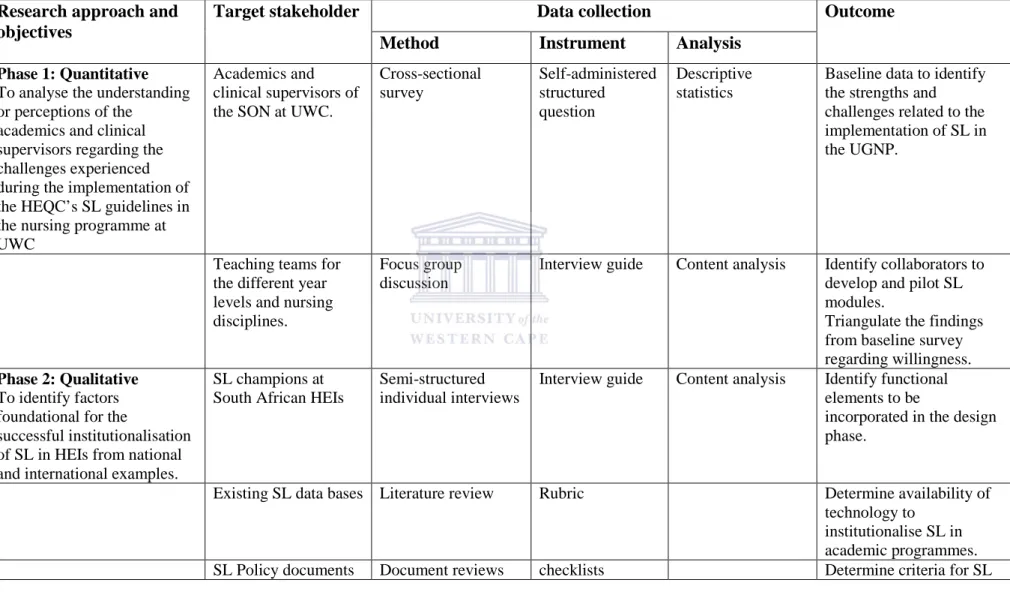
The main objectives correlate with the phases of the research methodological framework developed by Rothman and Thomas (1994): Intervention research: Design and development (IR: D&D), that informed this study.
1.8
DELIMITATION OF THE STUDY
The SL implementation framework was formulated from the recommendations that emanated from the research findings of Phase 4. It is therefore recommended that the evaluation, advanced development and dissemination of the implementation framework be done as post-doctoral work. 11
1.9
PRAGMATISM AS THE PARADIGMATIC PERSPECTIVE
Intervention researchers (Du Preez &Roux 2008:81; Melnyk & Fineout- Overholt 2011; Thomas & Rothman 2013) advocate a “methodical, flexible, process-oriented, and problem-solving approach for intervention research”. These characteristics are congruent with those reflected in pragmatism (Morgan 2007). The meta-theoretical paradigm of pragmatism is further discussed in Chapter 3.
1.10
THE THEORETICAL FRAMEWORK UNDERPINNING THE
STUDY
Since the design of the pragmatic mixed-methods research approach should be informed by a theoretical framework (Evans, Coon & Ume 2011:278), the following principles of organisational change of the theoretical model of Armenakis and Bedeian (1999:302) informed the design of this IR: D&D study:
The change message should include a discrepancy that would convince the individual of the
need to change. The base line survey completed in Phase 1 provided the evidence of the discrepancy and, hence, the impetus for collaborating in the research project. This contextual information about the status quo of SL scholarship amongst academics and SL practice in the undergraduate nursing programme in the school of nursing was linked to the national CE and SL policy brief for HEIs.
The individuals should believe that they have the capability to change successfully
(self-efficacy). The academics in SON were positively persuaded that they would be able to implement SL successfully in their respective communities of practice in the school by following the best practice SL guidelines provided by the HEQC.
12
They [the nurse educators] should be convinced that it is in their best interest to change
(personal valence). The assumption was that, if academics have an understanding that developing socially responsive health professionals was a national imperative and that HEIs would be subject to regular institutional audits by HEQC, these academics would commit as individuals to implement SL pedagogy in the modules they teach and hence contribute towards the institutionalisation of SL at UWC.
The academics and clinical supervisors involved in the operational level of the undergraduate nursing curriculum should be assured that they would receive principal supportto effect the necessary changes in the undergraduate curriculum from the relevant university structures. This support is provided by the management of SON, the Community Engagement Unit (CEU) of UWC and the Office of the Deputy Vice-Chancellor.
The desired change is right for the focal organisation (appropriateness). The SON should be convinced of the merits of adopting SL pedagogy in addition to the current dominant case-based teaching methodology in the undergraduate nursing programme.
The principles of SL institutionalisation (Furco 2002) guided the design of the intervention plan. Recruitment activities were directed at key stakeholders (academics, clinical supervisors and community partners) to develop an implementation framework for SL (Bringle &
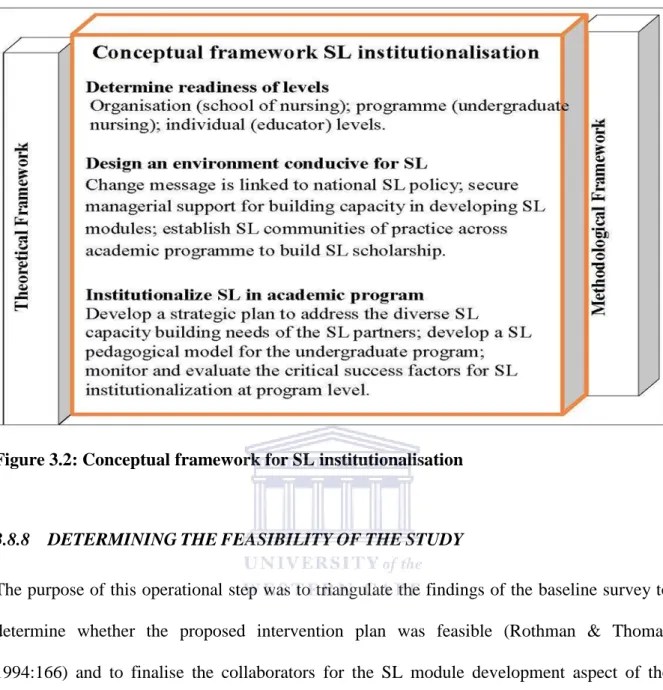
Hatcher, 2000:2). SL capacitating activities were designed with the view of sustaining the involvement of the nursing educators by marketing SL as engaged scholarship. Hence, the key areas that were targeted for the development of the implementation framework (See Figure 3.2) in the nursing programme included activities related to:
13
• the design and piloting of an SL pedagogical model for the undergraduate nursing programme;
• working towards conceptual clarity and a common understanding of how SL is understood in the SON; and
• creating an enabling environment for SL scholarship by formulating best practice guidelines to institutionalise SL in the undergraduate nursing programme.
1.11
METHODOLOGICAL FRAMEWORK
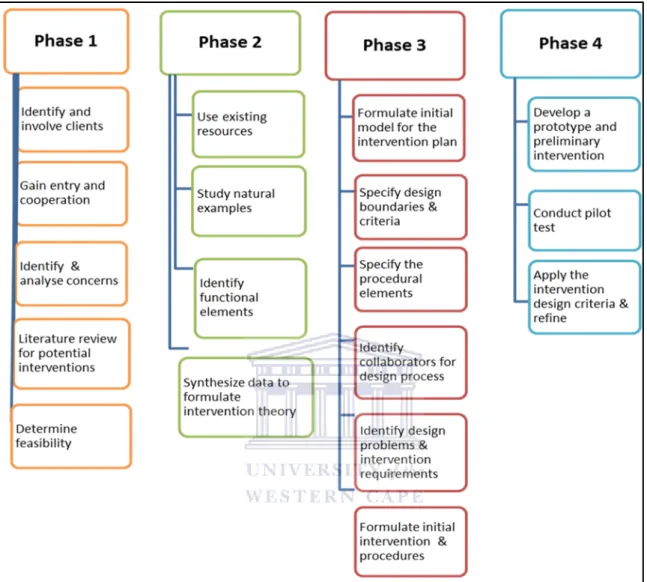
This study was guided by the operational steps of the first four phases of the IR: D&D model of Rothman and Thomas (1994). See Figure 3.1(page 55). Phase 1, the problem analysis and project planning phase, provided the baseline information needed for the subsequent phases. The outcome of Phase 2, the information gathering and synthesis phase, identified and incorporated the functional elements from practice examples in the intervention theory for the study. During Phase 3, the design phase, the intervention theory derived from the previous two phases, culminated in the draft intervention plan for developing a SL implementation framework for SON. During Phase 4, the early development and piloting phase, various prototypes were developed for the SL implementation framework. A questionnaire to measure the readiness and willingness of nurse educators to participate in the SL institutionalisation process, a SL module guide as a prototype of a SL pedagogical model and a contextualised SL definition for SON was developed. A monitoring and evaluation system for SON was also designed. The SL module guide was furthermore piloted in the real setting with the fourth-year undergraduate students with the purpose to further refine the SL module development guidelines for the SL implementation framework.
14
1.12
THE SIGNIFICANCE OF THE STUDY
This study makes a significant contribution to nursing education and SL institutionalisation in the following areas:
The implementation framework was developed to institutionalise SL in the undergraduate nursing programme as opposed to just a module is a first of its kind in South Africa.
A contextualised SL definition was formulated for the SON as a new contribution to the CE and SL operationalisation discourse at UWC.
Questions were developed to measure individual readiness for SL institutionalisation. This contribution extended the scope of Furco’s (2002) Self-Assessment Rubric for the Institutionalisation of Service-Learning in Higher Education. See Table 4.14 for the questions related to individual readiness.
1.13
CONCEPT CLARIFICATION
The study adopted as far as possible the definitions of the HEQC because these are regarded as the gold standard for benchmarking SL in South Africa (Albertyn & Daniels 2009:410). Community engagement (CE)
The HEQC (2004b:15) defines CE as:
Initiatives and processes through which the expertise of the higher education institution in the areas of teaching and research are applied, to address issues relevant to its community… CE typically finds expression in a variety of forms, ranging from informal and relatively unstructured activities to formal and structured academic programmes addressed at particular community needs (service-learning programmes).
15
However, the focus should be on partnering with communities so that HEIs become really engaged when addressing the social transformation policy imperatives (Lazarus et al. 2008: 58). Community engagement is defined as “initiatives and processes through which the expertise of the institution in the areas of teaching and research are applied to address issues relevant to its community” (CHE 2012:1).
Higher education institution (HEI)
In this study, HEI refers to a public institution that provides higher education on a full-time, part-time or distance basis, leading to qualifications higher than Grade 12, and which was established as a public higher education institution under the South African Higher Education Act, No. 101 of 1997 in (DoE 1997).
Service-learning
The Higher Education Quality Assurance Criteria for Institutional Audits, (HEQC 2004a:26) defines SL as: “Applied learning which is directed at specific community needs and is integrated into an academic programme and curriculum. It could be credit-bearing and assessed, and may or may not take place in a work environment.”
In addition to the above definition, this study regarded SL as a teaching methodology and scholarly activity. The scope of the community development SL activities was aligned to the academic learning outcomes of the module. Therefore, the study adopted the following definition of SL:
Service-learning (SL) was conceptualised as an engaged pedagogy that integrates theory with relevant community service projects. The SL assignments and group discussions were designed to facilitate reflection geared towards greater integration of the contents of the
16
psychiatric mental health nursing and gender-based violence (GBV) modules, and social responsiveness within nursing as the overarching discipline.
SL institutionalisation refers to the process through which SL is perceived and supported as an essential component of the undergraduate nursing curriculum and thus embedded in the organisational structures and culture of the SON. Tangible commitment to mainstream SL is demonstrated by a quality control system that measures SL indicators at the academic programme level, thus ensuring that SL becomes an integral part of the infrastructure and everyday operations of the SON’s academic programmes and scholarly output (Fredericks, Holman & Canales 2002:1).
1.14
LAYOUT OF THE REPORT
Chapter 1 contextualises and presents the overview of the study.
Chapter 2 covers the literature review and theoretical framework for the study. Chapter 3 describes the research design and methodology used in this study. Chapter 4 is a presentation of the findings of the study.
Chapter 5 discusses the findings.
Chapter 6 provides a discussion of the SL implementation framework, limitations and recommendations for further research.
1.15
CONCLUSION
This chapter provided the introduction and background to the research and laid the foundation for the subsequent chapters. The background provided a synoptic overview of the development of the service-learning (SL) movement. The rationale for the study, the
17
statement of the problem, the research aim and the objectives of the study were presented. The epistemological assumptions underpinning the study, the layout of the thesis and conceptual clarifications for the selected key concepts were described.
18
2.
CHAPTER 2: LITERATURE RELEVANT TO THE SL
IMPLEMENTATION FRAMEWORK THAT WAS
DEVELOPED
2.1
INTRODUCTION
This chapter departs from a conventional literature review chapter in that the purpose of the review was to provide an overview of the important SL-related frameworks and underpinnings identified as potential interventions in Figure 3.2: Conceptual framework for SL institutionalisation. The focal discussion points of this chapter therefore include the institutionalisation of SL in academic programmes, the critical role that HEIs play in providing an enabling environment for SL institutionalisation, the personal commitment of individuals of the SL partnerships to the SL institutionalisation process, and concludes with the change framework that underpinned this study.
2.2
DEFINING SERVICE-LEARNING AS A FORM OF CE
There are numerous definitions of the term service-learning (SL) in the literature as indicated by the existence of 147 different definitions in 1990 already (Eyler and Giles 1999). The HEQC acknowledge that the term SL is contested in stating that some scholars prefer the term academic SL to highlight the importance of SL as an academic endeavour, while others prefer community service-learning (CSL) to indicate the importance of the community partner in the learning activity (HEQ 2006b).
Two widely accepted international definitions are provided to contextualise the South African perspectives on SL. Bringle and Hatcher (2004:127) define SL as:
19
a course-based, credit-bearing educational experience in which students participate in an organised service activity that meets identified community goals, reflect on the service activity in such a way as to gain further understanding of course content, a broader appreciation of the discipline, and an enhanced sense of civic responsibility.
The definition provided by Eyler and Giles (1999:77) locates SL in the pedagogical framework of experiential learning as it states,
Service-learning is a form of experiential education where learning occurs through a cycle of action and reflection as students work with others through a process of applying what they are learning to community problems and, at the same time, reflecting upon their experience as they seek to achieve real objectives for the community and deeper understanding and skills for themselves.
A common thread in the above definitions of SL is the focus on community needs, experiential learning and service provision through reflective practice. Although South African perspectives endorse the above definitions, they add to the international understanding of SL by emphasising that academic credit is not for the community service per se but for the academic learning that occurs as a result of the reflection on the community service (Bender, Daniels, Lazarus, Naudé & Sattar, 2006). Osman and Petersen (2013:7) expand on the above mentioned definitions by asserting that SL is a philosophy with an accompanying pedagogy aimed at developing critical citizenship in students. These authors assert that SL challenges academics to reconceptualise their curriculum and disciplinary training and their role as educators when their praxis is interrogated through the lenses of critical social and transformative learning theories (Osman & Petersen 2013:12). SL
20
facilitates in students the development of cognitive complexity and citizen skills (Bender 2009:313), critical discourse instead of technicist decision-making skills (Waghid 2009:20).
The position adopted by UWC and criteria for SL will serve as the conclusion on the definitions of SL because the definitions also refer to structural issues.
Service-learning should be based on an equal partnership with intersectoral involvement linking theory and practice through in service training and service to others and is based on an educational exchange through reflective activities and reciprocal learning. It should also have a credit-bearing component and demands resources (financial and human) and is a learning activity that should receive appropriate academic recognition(Daniels & Adonis, 2003:2). Since scholars are encouraged to develop contextualised definitions for SL, criteria have been provided by the HEQC to identify the differentiating features of SL as a type of CE based on the research by the JET on SL in South Africa and international literature (HEQC 2006a:30):
• relevant and meaningful service should be provided with and not for the community; • academic learning should make clear the connection between module objectives and
service activities;
• structured opportunities for reflection should be provided to transform, clarify, reinforce and expand the concrete service experiences of students into knowledge; and
• SL activities should be designed to cultivate a sense of civic responsibility in students (HEQC 2006a:25). 21
Bender (2009:313) added to this list quality service, collaboration and evaluation and assessment. SL therefore challenges educators to make paradigm shifts in that active engagement, collaborative learning and social justice be included in notions of academic excellence (Von Kotze 2004). Hence concepts like ‘engaged scholarship’ and ‘scholarship of engagement’ became part of the SL discourse. Engaged scholarship refers to scholarly outreach and engagement activities that “reflect a knowledge-based approach to teaching, research, and service for the direct benefit of external audiences” (McNall, Reed, Brown & Allen 2009:319). Whereas scholarship of engagement is developed when academics “reflect on, study, write about, and disseminate scholarship about their [engagement] activities” (McNall et al. 2009:320).
2.3
THEORETICAL AND PHILOSOPHICAL UNDERPINNINGS OF
SL
SL is relatively new in the social and educational landscapes and is therefore a contested field, and the very nature of SL is questioned according to Butin (2006). He criticises the fogginess surrounding SL, which is being regarded as pedagogy, philosophy and/or a social movement. He states that, if SL claims to be more than a social movement, then SL should have a clearly defined and commonly shared body of knowledge. However, providing evidence of SL as a scholarly field is challenging because SL was marginalised from mainstream academia due to being primarily praxis-oriented (Giles & Eyler 1994:77). Proponents of SL contend that SL needs to develop theory as a body of knowledge and as a guide for pedagogical practice (Sandmann, Kiely & Grenier 2009: 17). Kiely (2005:6) thus proposes that the research agenda should aim at “generating empirical knowledge that explain and support the unique philosophical and epistemological underpinnings of service-learning”, 22
thereby, expanding the previous research agenda of seeking conceptual clarity, identifying good practice guidelines and institutionalising SL in HEIs (Giles & Eyler 1994:78). The proliferation of SL publications in South Africa and internationally since 2009 is an indication of this scholarly quest to provide a sound theoretical grounding for SL.
Aspedagogy, SL is rooted in the theories of experiential education and constructivism, which are best described in Kolb’s experiential learning cycle (Kolb 1984), which links education, work and personal development (Butin 2006:479; HEQC 2006a:17). Dewey (1916), the founder of experiential learning theory, states that knowledge is socially constructed and should therefore be grounded in authentic life experiences. The five areas of Dewey’s theory that relate to SL, include linking education to experience, democratic community, social service, reflective enquiry and education for social transformation (HEQC 2006a:17). However, the success of experiential learning is dependent on the learners’ ability to create new knowledge by transferring existing knowledge to divergent social situations. Hence, experiential learning inherently has the potential for transformational learning. It is therefore imperative that educators facilitate learners’ mastery of subject matter by applying problem-solving skills to develop social responsiveness. Kolb’s cycle of experiential learning is also widely used in SL pedagogy (HEQC 2006a:16). However, Kiely (2005) critiques Kolb’s model in stating that the influence of the educator on the transformational learning process, contextual factors, and the affective aspects are downplayed (The supremacy that is given to the constructivist approach to learning and reflection in transformational learning is also challenged. 23
2.4
SOCIAL AND POLITICAL PHILOSOPHICAL UNDERPINNINGS
OF SL
SL theory is embedded in Dewey’s notions of community, citizenship and democracy (Giles & Eyler 1994:78). From an SL perspective, the call for democracy is linked to expectations of mutuality, reciprocity and equity. These concepts are pertinent to the principle of justice when developing collaborative community relations. Rosner-Salazar (2003:64) states that social justice is “… having the perspective that allows one to take social action against social structural inequality and an understanding of oppression and equality which allows greater insight into methods of eradicating them”. This stance is supported by South African scholars (Naudé 2012; Von Kotze 2004; Waghid 2009). However, Boyle-Baise et al. 2006:18) concede that service for justice is rare because hat less than one per cent of SL activities fall into this category.
Hence, Butin (2006:293) argues that SL should be positioned as scholarship and thus contribute towards strengthening the SL knowledge base. A similar argument is made by Sandmann et al. (2009:17) who state that, unless the SL field is informed by robust theory, specifically programme planning theory, the learning process is bound to be stifled by the traditional technical–rational approach to curriculum planning. Kiely (2005) thus proposes that Mezirow’s (2000) empirically tested framework be used to explain “the transformative impact of service learning on students’ personal, civic, moral, and intellectual learning and development” (Kiely, 2005:7). SL curricula also need to be properly sequenced for maximum educational benefits and integrating service learning into the curriculum involves a pedagogical strategy that goes beyond the scope of a single course (Osman & Petersen
24
2013:7). This current study was informed by the theoretical framework which focuses on the individual’s readiness for change.
The role of higher education is captured in the discourse on the institutionalisation of SL in higher education.
2.5
THE INSTITUTIONALISATION OF SL IN THE ACADEMIC
PROGRAMME
The fact that the HEQC policies referred in the introductory section are inclusive of but not necessarily exclusive to SL (Bender 2008b:83) contributes to the problems academics experience when introducing SL in the curriculum (Bender 2008b; Hall 2010). It is thus necessary to contextualise SL within the broader CE discourse. Although community service was commonplace in many HEIs in South Africa, the evolving terminology captured in consecutive policy documents indicated a clearer understanding of the social transformation mandate for HEIs (DoE 1997); HEQC 2001; HEQC 2004a; 2004b; 2004c; HEQC 2006a; HEQC 2006b). However, SL implementation challenges related to conceptual issues and the theoretical underpinnings of SL was still reported recently (Hall 2010; Julie & Adejumo 2014) in spite of the conceptual framework provided in Figure 2.4 below for the distinctions amongst CE learning(HEQC 2006b:21).
2.6
COMMUNITY ENGAGEMENT THROUGH SERVICE-LEARNING
Engagement in this context is defined as:
The partnership of university knowledge and resources with those of the public and private sectors to enrich scholarship, research, and creative activity; enhance curriculum, teaching, and learning; prepare educated, engaged citizens; strengthen democratic values and civic 25
responsibility; address critical societal issues; and contribute to the public good (McNall et al. 2009:318).
Certain characteristics are advocated by Bringle and Hatcher (2011) as the hallmark for engagement. These include that the engagement activities must be scholarly, demonstrate engaged scholarship that encompass the missions of teaching, research and service; these activities must be reciprocal and mutually beneficial for both the university and community partners; and engagement must embrace the processes and values of a civil democracy. Different frameworks have been suggested on how HEIs operationalised the above ideals, based on their particular ethos and philosophy reflected in the HEI’s engagement with the community (Kasworm & Abdrahim 2014:121). However, Figure 2.4 below illustrates the framework based on the seminal work of Furco (1996) that is commonly used internationally and nationally. The different types of CE are presented along a continuum to indicate the type of CE that is linked to the primary beneficiary and the primary goal of the service.
Figure 2.1: Distinctions among community-engaged learning (HEQC 2006a:21)
26