The impact of peer‐mentoring on
the experience of first year
business students
Marilena Antoniadou and Hannah-Louise Holmes
Abstract
Peer mentoring in higher education is becoming increasingly common and is regarded as an effective intervention to ensure the successful transition and even retention of students. This article discusses a newly established peer mentoring initiative, which was introduced by Manchester Metropolitan University, aimed at enhancing the transition and induction of first year students. Specifically, it presents a case study of the students' experiences and perceptions of the peer-mentoring scheme amongst students studying Business and evaluates the scheme after one year of its implementation. The findings are based on a questionnaire of 105 business students. Analysis of the findings, indicated a perception of clear benefits for the peer mentoring scheme, including enhanced performance and willingness to receive support from peer-mentors on coursework. Perceived disadvantages were related to a lack of awareness of the scheme and to limited meetings with peer-mentors. The paper concludes that despite not all students were aware of who their peer-mentors were, engagement in the peer-mentoring scheme has a potentially useful role in creating an environment for meaningful relationships amongst students across all levels.
Introduction and background
The increasingly competitive market among higher education institutions has put the issues of student retention and progression firmly on their agenda, particularly for undergraduate students (King, Morison, Reed and Stachow, 1999; Oldfield and Baron, 2000). Universities have been increasingly directed towards the marketisation of higher education, a process spurred by the introduction of tuition fees, internationalisation and the increase of student numbers (Collini, 2011). This shift in the function of universities is epitomised by the search for efficient support mechanisms that would improve student retention, academic progression and performance, and student experience in general.
Creating a sense of belonging for the students can be seen as a big challenge for universities, however evidence suggests that the development of learning communities in large classes can significantly increase retention rates and academic achievement (Tinto, 1987). Interestingly, research by McInnis et al (1995) found that a high number of undergraduate students have never got together with other course-mates to discuss subject matters and that poorer achievers were less sociable than other students. Moreover, nearly half of the students with academic marks between 50% and 70% ‘almost always’ worked with other students on their course, in order to receive help.
Extensive research has identified peer-mentoring as an effective strategy that is linked with the aforementioned outcomes of retention, progression and academic success (Freedman, 1993; Johnson, 2002; McLean, 2004; Pagan & Edwards-Wilson, 2002; Topping, 1996). Peer-mentoring is regarded as the recruitment of more experienced, qualified students who are able and willing to provide guidance and support to less experienced students, in order to enable them to navigate through their educational journey. More specifically, according to Kram (1983), peer-mentoringis a helping relationship in which individuals of similar age and experience come together, either informally or through formal mentoring schemes, in the pursuit of fulfilling some combination of functions that are career-related (e.g. information sharing, career strategy) and psychosocial (e.g. emotional support, personal feedback, friendship). Peer mentoring has now becoming popular in the UK, and has the power to not only positively impact students’ progression and performance levels, but also to improve the levels of well-being and integration in university life (Philips et al, 2004; Collings et al, 2014). Generally, students in first year need more support than second and third year students (Lowis and Castley, 2008). Therefore, peer-mentors may serve to either support course task-related or career-related functions (such as, providing advice, support, and information related to coursework accomplishment, professional development, and career pathways), or psychosocial function (such as, providing emotional and psychological support) (Kram and Isabella, 1985). It has been evidenced that peer support and mentoring not only helps mentees to ‘fit in’ to university life, but also works as a way of enhancing their personal and professional development, as well as smoothing transitions into, and through, university (Topping, 1996; Christie,
2014). Mentors have the knowledge, experience and ‘power’ to provide task and psychosocial support, which enhances the elements of acceptance, confirmation, counselling, role modelling, and
friendship (Angelique et al., 2002).
However, although considerable research supports the use of peer-mentoring to improve academic performance and decrease student attrition, it was only very recently that Manchester Metropolitan University introduced a formal ‘Student Peer Mentoring’ scheme across all of its Programmes. Accordingly, this case study was carried out to evaluate the peer-mentoring scheme, as a newly introduced programme aiming to improve transition and induction of the first year students at Manchester Metropolitan University. Specifically, it describes the scheme that was used within the Business Management Programme of the Faculty of Business and Law, as one of the Faculty’s biggest programmes.
Aim and Objectives
The overall aim of this research was to evaluate the Peer-mentoring scheme in the Business Management Programme, based on the first-year students’ perceptions. The specific objectives were: 1) to explore students’ levels of awareness of the peer mentoring
scheme
2) to explore students’ views in relation to student experience factors
3) to identify good practices and limitations within the peer-mentoring system
4) to generate an action plan and recommendations for the improvement of the peer mentoring scheme and disseminate to the faculty staff.
The Peer Mentoring Scheme for Business Management
The scheme within the Business Management Programme involved the recruitment as mentors of 20 students from the second and final years, who have performed well in the Programme, aiming to assist the first-year students with their transition, settling in, and overall
experience during the year. The number of students was determined on a 1:20 ratio, of 1 mentor for every 20 students in Year 1. Although general guidelines were communicated centrally from the Faculty, certain initiatives were taken within the Programme. The main rationale had a remit to support the students before the Programme even starts, as well as during their first year in University. The 20 mentors received formal training from the Centre for Excellence in Learning and Teaching (CELT) and were encouraged to develop their relationship with their mentees from August 2015 and over the course of the year. The peer mentoring scheme was coordinated by the Head of Year 1 of the Programme; it included five categories and is summarised in Table 1.
Table 1: The Peer-Mentoring Scheme Activities – Business Management
Area Peer Mentor responsibilities Transition /
Induction
Preparation of Welcome Video, emailed directly to all students who were enrolled in the Programme – https://www.youtube.com/watch?v=odw689Ehpeo
Social Media interaction during August and onwards. Facebook Group: MMU Business Management ‘15
Lead induction for the student cohort, with Sports afternoon and pizza session Networking parties during Induction week to help develop friendships and team bonding facilitating the formation of social networks, which eased the transition to university.
Photos and contact details of all Peer-mentors were available on Moodle, Social media and updated during the year.
Student Expectations
Day-to-day Q&A on Social Media. Informing them about student services and uploading photos to generate sense of belonging.
Liaise with Head of Year 1 about emerging issues.
Programme Maintain frequent communication with students, helping with Induction task, giving feedback on coursework, attending tutorials and arranging drop-in sessions for feed-forward.
Two Harvard Referencing Workshops were scheduled to introduce them to the system.
Attendance on Open & Visit days to network with potential students and family members. Participation on Taster sessions.
Extracurricular Activities
Organise parties and events, meetings outside teaching hours and business competitions on social media.
Participation in the Business And Management Society, as committee members. Planning of the Business Ball.
Collaboration with the MMU Entrepreneurs Society for co-hosted events and workshops.
Employability Development
Generate and communicate information about placements. Advice on how to secure placements and internships. Acting as Employability role models.
Methodology and Methods
A quantitative survey was designed and implemented to determine awareness of and opinions about the peer-mentoring system. Surveys are commonly used in the education field, particularly helping in the planning, decision-making and in the evaluation of the effectiveness of implemented programmes (Cohen, Manion & Morrison, 2007). A questionnaire was considered a suitable data collection method, as it allowed asking the same set of standardised questions to a large number of respondents (Saunders & Lewis, 2012). In particular, a web questionnaire, utilising Bristol Online Survey (BOS), was circulated via an email with a hyperlink to the actual questionnaire, as well as via Social media. An online questionnaire was preferred as it allowed access to a large number of people with common characteristics in a short amount of time and reduced cost - compared to a paper-based survey (Cude, 2004). Online surveys are also linked with higher response rates than traditional paper-based questionnaire distribution. The covering email explained the project’s aim and invited students to contribute to the study on a voluntary basis.
The target population for the current study, defined as the total group of people from whom the researcher can obtain information that would meet the research objectives (Cohen et al., 1997), comprised all the Level 4 students registered in the Business Management
Programme of all modes (Business Management 3-Years, Business Management with placement, Business Management with overseas study) (N= 345, as at May 2016). The questionnaire consisted of six questions including multiple choice, matrix and close-ended
questions. The questions were influenced by the areas that the peer-mentors had a responsibility for, as per Table 1. Examples of these categories involved the following topics:
students’ awareness of the peer-mentors perceptions about helpfulness on guidance induction
opportunities for coursework support enhancement academic and personal support
skill development
willingness to contact them and further suggestions for the scheme.
The questions on awareness and opinions on the peer-mentoring scheme were preceded by a demographic question on the mode of study (3-Year Programme, with placement or overseas study) that would allow the population to be segmented.
The online questionnaire was created using Bristol Online Survey (BOS), an online survey software program offered free to the MMUBS members. BOS had the advantage of providing assistance throughout the entire research process, including questionnaire design with unlimited number of questions and responses and the capability to export data for analysis and interpretation of the results. Responses were automatically recorded with BOS and data were collected and stored on a secure password protected site provided by this software package. The development, administration and data analysis of this survey took place from May to June 2016.
Results
Of the 346 students who were invited, 105 responded, representing a 30.4% response rate. The majority of the respondents were from the 4-Year placement Programme (48.6%), with the rest coming from the 3-Year mode (45.6%) and the Overseas mode (5.7%). Based on all
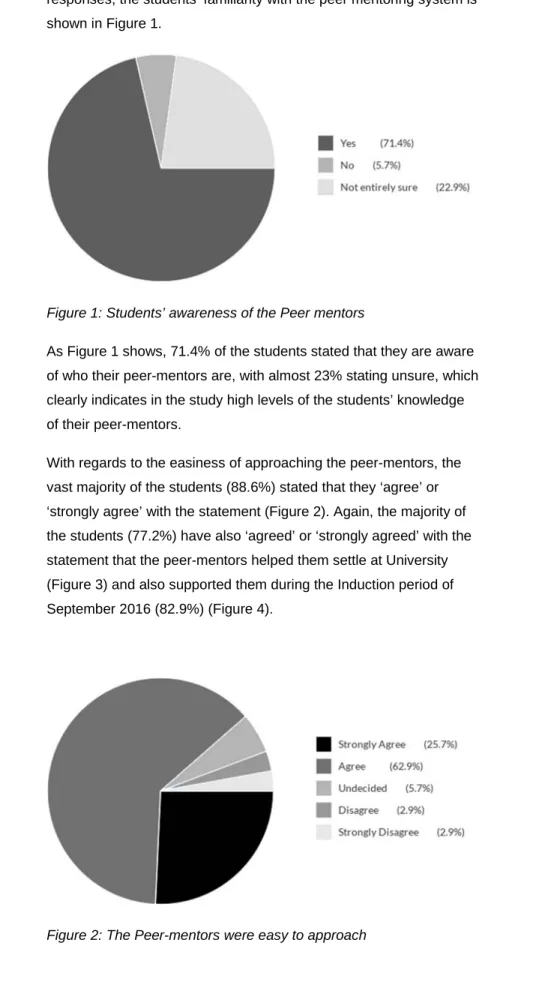
responses, the students’ familiarity with the peer mentoring system is shown in Figure 1.
Figure 1: Students’ awareness of the Peer mentors
As Figure 1 shows, 71.4% of the students stated that they are aware of who their peer-mentors are, with almost 23% stating unsure, which clearly indicates in the study high levels of the students’ knowledge of their peer-mentors.
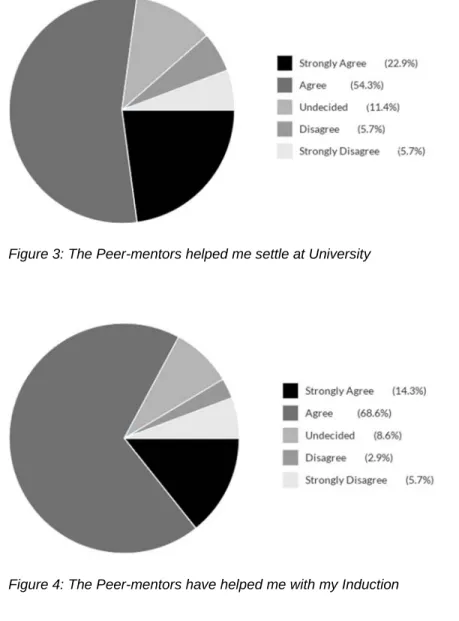
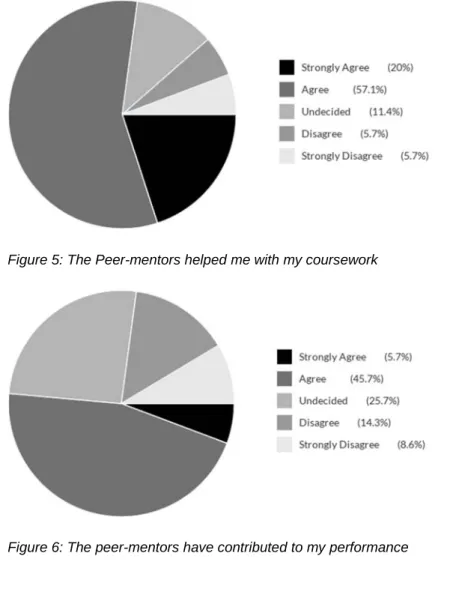
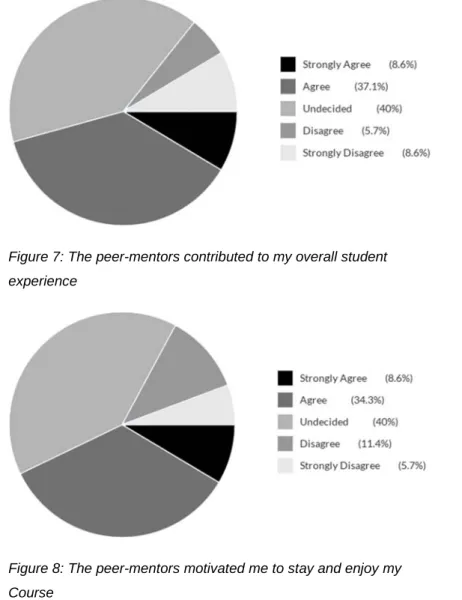
With regards to the easiness of approaching the peer-mentors, the vast majority of the students (88.6%) stated that they ‘agree’ or ‘strongly agree’ with the statement (Figure 2). Again, the majority of the students (77.2%) have also ‘agreed’ or ‘strongly agreed’ with the statement that the peer-mentors helped them settle at University (Figure 3) and also supported them during the Induction period of September 2016 (82.9%) (Figure 4).
Figure 3: The Peer-mentors helped me settle at University
Figure 4: The Peer-mentors have helped me with my Induction
With regards to the first year’s academic performance, the peer-mentors’ contribution again appeared to be significant. The majority of the respondents (77.1%) stated that the peer-mentors had an involvement and helped them with their coursework (Figure 5). Despite being at a lower level, around half of the respondents agreed (51.4%) that their peer-mentors had some contribution to their over academic performance (Figure 6).
Figure 5: The Peer-mentors helped me with my coursework
Figure 6: The peer-mentors have contributed to my performance
Moving to questions about the students’ overall experience in their First Year, the results were slightly different. It was indeed pleasing that when respondents were asked about their overall first year experience of the Programme, the respondents stated that the peer-mentors had some contribution (Figure 7), with just 1% disagreeing with the statement. A large percentage (40%) were undecided about this statement, which raised concerns about further engaging the peer mentors throughout the year and not solely during Induction. The peer-mentors were also perceived to have some contribution to motivating the respondents to stay and enjoy their Course (Figure 8), something that has significant implications for student retention in the first year.
Figure 7: The peer-mentors contributed to my overall student experience
Figure 8: The peer-mentors motivated me to stay and enjoy my Course
Perhaps for these reasons, many respondents stated that they would be likely to contact their peer mentors in the following academic year for any academic concerns (Figure 9). A significant percentage (72.3%) stated that they would be likely or very likely to contact their peer-mentors.
Figure 9: Likeliness to contact peer-mentors in the following academic year
Finally, when the students were asked to qualitatively comment on any recommendations they would wish to see in the peer-mentoring scheme in the following year, the responses were around the provision of more effective participation, more physical meetings with them and online chats and more contact in the tutorials, particularly during assignment periods. Some have also recommended the provision of more events and extra-curricular activities.
A further analysis was undertaken to identify different segments of the respondent population. However, with regard to mode of study, analysis showed that there were not significant differences in the levels of familiarity nor on the respondents’ perceptions.
Discussion
The research has successfully fulfilled its objectives, namely to explore first year students’ familiarity of the peer mentoring scheme and to identify their views in relation to specific student experience factors that the peer-mentors had involvement during the academic year of 2015/16. The data gathered can be used to shape future decisions and investigations about peer-mentoring schemes that make up the student experience.
From the Programme team’s standpoint, the results are revealing and informative. Based on the views of all respondents, the awareness and familiarity levels were satisfactory, considering that
71% stated familiarity with their peer mentors. It was also
encouraging that the majority of the respondents stated that the peer mentors helped them settle at University, helped with their induction and also with their performance within the course.
Considering that peers and transition are two of the main aspects of the undergraduate student experience (Jones, 2010) it is indeed promising that the student mentor scheme has helped to successfully fulfil these aspects. This aligns with research that has highlighted the importance of developing social lives at university and creating course friendships and relationships with peers (e.g. Titus, 2004; Willcoxson et al., 2011). In particular, support from peers is a crucial element of a positive higher education experience (Yorke and Longden, 2008), which the peer mentor scheme appears to have achieved. From the findings, qualitative recommendations for the provision of more meetings, more extracurricular activities, and provision of further assistance on coursework and job search have been made.
Recommendations & Action Points
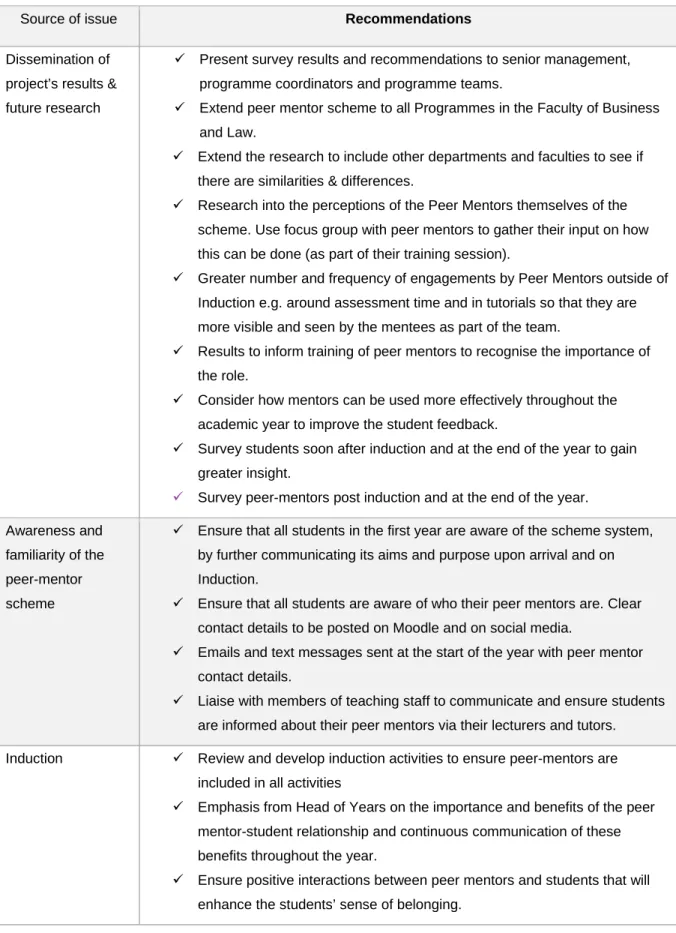
The results now give an exceptionally strong basis for further monitoring of the progress of this initiative in relation to the student experience in the future. For the first time we have a baseline of the impact of the peer mentoring system from the students’ point of view, which helps in creating recommendations and action points (Table 2). The authors will ensure that the project’s findings will be circulated in written form among the programme teams across faculties, together with recommendations and an action plan for the future. Emphasis will be placed on communicating the message that a successful peer mentoring system can have a significant impact on the first year’s transition, performance and satisfaction. The students as main actors, together with the Programme teams can determine whether or not this has been achieved; therefore, further
investigation to qualitatively explore the students’ views and continuous evaluations of the students’ satisfaction in relation to the peer mentoring system should be undertaken on a regular basis.
Table 2: Recommendations and action points
Source of issue Recommendations
Dissemination of project’s results & future research
Present survey results and recommendations to senior management, programme coordinators and programme teams.
Extend peer mentor scheme to all Programmes in the Faculty of Business and Law.
Extend the research to include other departments and faculties to see if there are similarities & differences.
Research into the perceptions of the Peer Mentors themselves of the scheme. Use focus group with peer mentors to gather their input on how this can be done (as part of their training session).
Greater number and frequency of engagements by Peer Mentors outside of Induction e.g. around assessment time and in tutorials so that they are more visible and seen by the mentees as part of the team.
Results to inform training of peer mentors to recognise the importance of the role.
Consider how mentors can be used more effectively throughout the academic year to improve the student feedback.
Survey students soon after induction and at the end of the year to gain greater insight.
Survey peer-mentors post induction and at the end of the year. Awareness and
familiarity of the peer-mentor scheme
Ensure that all students in the first year are aware of the scheme system, by further communicating its aims and purpose upon arrival and on Induction.
Ensure that all students are aware of who their peer mentors are. Clear contact details to be posted on Moodle and on social media.
Emails and text messages sent at the start of the year with peer mentor contact details.
Liaise with members of teaching staff to communicate and ensure students are informed about their peer mentors via their lecturers and tutors. Induction Review and develop induction activities to ensure peer-mentors are
included in all activities
Emphasis from Head of Years on the importance and benefits of the peer mentor-student relationship and continuous communication of these benefits throughout the year.
Ensure positive interactions between peer mentors and students that will enhance the students’ sense of belonging.
Regular communication with peer mentors to ensure that their mentees feel personally accepted, respected, included, and supported by the university. Regular online-chat dates on social media for each Programme, where
students can have a Q&A with their peer-mentors. Extracurricular
activities
Generate social opportunities and improve peer mentor involvement in social activities (trips, competitions, teambuilding workshops, athletic and sport events, company visits)
Work closely with the Student Union in their planning and delivery of social activities that will better meet the need of students.
Employability Initiate peer-mentors to share their placement or employability experiences via social media, to enhance motivation on employability activities.
Emphasis to be placed on raising awareness of the employability and careers hub of the Business School
Encourage students to create a LinkedIn account to increase opportunities for meeting people from the industry. A social media workshop can be organised to explain the students the benefits of using their social accounts for employability purposes.
Encourage peer-mentors to develop a ‘tool-kit’ for students on how to establish professional parameters and enable them to secure placements, by sharing their experiences. Together with the Placement team,
workshops can be co-hosted by peer-mentors to help with CV writing, assessment days preparation and interview skills.
References
Angelique, H., Kyle, K. & Taylor, E. (2002) Mentors and muses: new strategies for academic success, Innovative Higher Education, 26, 195–209.
Bornsheuer-Boswell, J. N. (2014). Editor’s Overview: Mentoring in Higher Education: The Keys to Success. Mentoring & Tutoring: Partnership in Learning, 22(1), 1-3.
Christie, H. (2014). Peer mentoring in higher education: issues of power and control. Teaching in Higher Education, 19(8), 955-965. Cohen, L., Manion, L., & Morrison, K. (2007). Research Methods in Education. Education, 55, pp. 469–470). doi:10.1111/j.1467-8527.2007.00388_4.x
Collings, R., Swanson, V., & Watkins, R. (2014). The impact of peer mentoring on levels of student wellbeing, integration and retention: a controlled comparative evaluation of residential students in UK higher education. Higher Education, 1-16.
Collini, S. (2012) What Are Universities For? Harmondsworth: Penguin.
Freedman, M. (1993) The kindness of strangers: adult mentors, urban youth, and the new volunteerism (San Francisco, Jossey-Bass Publishers).
Cude, B. (2004). Collecting research online: A primer for extension, research, and instruction. In J. Fox (Ed.), Proceedings of the Eastern Family Economics and Resource Management Association, 31-34. Johnson, W. B. (2002) The intentional mentor: strategies and guidelines for the practice of mentoring, Professional Psychology: Research and Practice, 33, 88–96.
Jones, R. (2010). So just what is the Student Experience? The development of a conceptual framework for the student experience of undergraduate business students based on the themes emerging in the academic literature. In Paper delivered at the SRHE Annual Research Conference. Newport.
King, M., Morison, I., Reed, G., & Stachow, G. (1999). Student feedback systems in the business school: a departmental model.
Quality assurance in Education, 7(2), 90-100.
Kram, K. (1983) Phases of the mentor relationship, Academy of Management Journal, 26, 608–625.
Kram, K. & Isabella, L. (1985) Mentoring alternatives: the role of peer relationships in career development, Academy of Management Journal, 28, 110–132.
Lowis, M., & Castley, A. (2008). Factors affecting student progression and achievement: prediction and intervention. A two‐
year study. Innovations in Education and Teaching International,
45(4), 333-343.
McLean, M. (2004) Does the curriculum matter in peer mentoring? from mentee to mentor in problem-based learning: a unique case study, Mentoring & Tutoring, 12, 173–186.
McInnis, C., James, R. and McNaught, C. (1995). First Year on Campus: Diversity in the initial experiences of Australian
undergraduates. A Commissioned Project of the Committee for the Advancement of University Teaching, September 1995. Centre for the Study of Higher Education, University of Melbourne.
Oldfield, B. M., & Baron, S. (2000). Student perceptions of service quality in a UK university business and management faculty. Quality Assurance in education, 8(2), 85-95.
Pagan, R. & Edwards-Wilson, R. (2002) A mentoring program for remedial students, Journal of College Student Retention, 4, 207–226. Phillips, R., Swanson, V., & Morgan-Klein, B. (2004). Students helping students: The effectiveness of peer mentoring in UK higher education. Paper presented at the psychology of education section annual conference. Glasgow, 5–7th November 2004.
Saunders, M., & Lewis, P. (2012). Doing research in business and management: An essential guide to planning your project. Harlow: Financial Times Prentice Hall.
Tinto, V. (1989). Dropout from Higher education: A theoretical synthesis of recent research Review of Educational Research45 (1), 89-125.
Titus, M.A., 2004. An examination of the influence of institutional context on student persistence at 4-year colleges and universities: A multilevel approach. Research in Higher Education, 45, pp.673–699 Topping, K. J. (1996). The effectiveness of peer tutoring in further and higher education: A typology and review of the literature. Higher education, 32(3), 321-345.
Willcoxson, L., Cotter, J. & Joy, S., 2011. Beyond the first‐year experience: the impact on attrition of student experiences throughout undergraduate degree studies in six diverse universities. Studies in Higher Education, 36, pp.331–352.
Yorke, M., & Longden, B. (2008). The first-year experience in higher education in the UK. The Higher Education Academy. Retrieved from http://www.heacademy.ac.uk/assets/York/documents/resources/publi cations/FYEFinalReport.pdf