ISBT 128 STANDARD
Coding and Labeling of Medical
Devices Using ISBT 128
Version 1.3.0
April 2015
Tracking Number ICCBBA ST-011
Published by: ICCBBA
© 2015 ICCBBA, All rights reserved www.iccbba.org
COPYRIGHT NOTICE AND LICENSING INFORMATION
Copyright 2013-2015. ISBT 128is not in the public domain and is protected by law. Implementation of ISBT 128requires the end-user to register with ICCBBA and to pay an annual license fee. License fees are established by the ICCBBA Board of Directors to cover the expenses of maintaining and extending ISBT 128, and making available current versions of the documents and database tables that are needed to implement the Standard.
This document is intended for the use of those implementing ISBT 128, regulatory agencies, and software developers and other manufacturers that support end-users. National Guidelines describing its use in a particular country may be an additional source of information for the end-user. If such Guidelines exist, they must be consulted because there are options in ISBT 128, and country-specific information pertaining to the particular use of such options will only be found in such Guidelines.
Any use of this document, or the accompanying database tables, by other than registered and licensed facilities, or facilities that have obtained their computer software from a registered and licensed developer, is strictly forbidden. Copying any portion of the Standard, or of any
accompanying database table, either in electronic or other format, without express written permission from ICCBBA is strictly forbidden. Posting of any portion of the Standard, or of any accompanying database table, to any online service by anyone other than ICCBBA is strictly forbidden.
Warranty
ICCBBA provides no warranty that the use of ISBT 128is suitable for any particular purpose and the selection, use, efficiency, and suitability of ISBT 128is the sole responsibility of the Licensed User. There are no guarantees or warranties attached to the ISBT 128 Standardother than that ICCBBA agrees to furnish registered and licensed end-users with the most up-to-date information available. Successful implementation of the ISBT 128 Standard, and use of any accompanying database table(s), depend(s) upon the correct incorporation of the rules and table contents into the software used by or provided to the registered and licensed facility. ICCBBA makes no other warranties of any kind, whether expressed or implied, including any implied warranty of merchantability or fitness for any particular purpose. Further information can be found at www.iccbba.org.
Liability
ICCBBA's liability is limited to that specified in the ICCBBA License Agreement which is available on the ICCBBA Website. Under no circumstances shall ICCBBA's liability exceed the current annual license fee, and ICCBBA will in no circumstances be liable for any damages whatsoever, including without limitation damages for loss of data, business or goodwill, or any other consequential losses of any nature arising from the use of ISBT 128.
ICCBBA manages the ISBT 128 Standard. ICCBBA is not an accrediting organization and is not responsible for adherence to the standard, the selection of Product Codes, or product labeling by facilities registered for its use.
© 2015 ICCBBA, All rights reserved www.iccbba.org
Editor
Pat Distler, MS, MT(ASCP)SBB Technical Director, ICCBBA
Standards Committee
John Armitage, Prof., BSc, PhD United Kingdom Paul Ashford, MSc. CEng. CSci. ICCBBA
Wayne Bolton, B.App.Sc., M.App.Sc Australia
Suzanne Butch, MA, MT(ASCP)SBB United States of America
Pat Distler, MS, MT(ASCP)SBB ICCBBA
Jørgen Georgsen, MD Denmark
Suzy Grabowski, BA, BB(ASCP)SBB United States of America
Mario Muon, MD Portugal
Stefan Poniatowski, BSc, MIBMS Australia
Leigh Sims Poston, BS, MT(ASCP) United States of America Ineke Slaper-Cortenbach, PhD The Netherlands
Izabela Uhrynowska-Tyszkiewicz, MD, PhD Poland
Diane Wilson, BSN, MSN/MHA United States of America Zbigniew Szczepiorkowski, MD, PhD United States of America
© 2015 ICCBBA, All rights reserved www.iccbba.org
Table of Contents
Introduction ... 5 1.1 Purpose ... 5 1.2 Scope ... 5 1.3 Intended Audience ... 5 1.4 Normative References ... 5 1.5 Other References ... 6 1.6 Background... 61.7 Changes in This Version ... 8
Device Identifier ...10
2.1 Processor Product Identification Code (PPIC) [Data Structure 034] ...10
Production Identifiers ...12
3.1 Donation Identification Number [Data Structure 001] ...13
3.2 Product Divisions [Data Structure 032] ...15
3.3 Expiration Date [Data Structure 004] ...16
3.4 Production Date [Data Structure 008]...17
3.5 MPHO Lot Number [Data Structure 035] ...18
3.6 Compound Messages ...19
3.6.1 Compound Message [Data Structure 023] ...19
3.6.2 Creating Compound Messages – Example ...20
3.6.3 ICCBBA-Specified Compound Messages ...23
Labeling ...24
4.1 Bar Code ...24
4.2 Text ...24
4.3 Position on Package ...26
Product Description Codes (PDCs) ...28
5.1 Internationally Standardized PDCs ...28
5.1.1 Terminology ...28
5.1.2 Structure of Product Descriptions within the Database ...29
5.1.3 PDC Database ...29
5.1.4 Selecting PDCs ...30
5.1.5 Requesting New PDCs ...38
Abbreviations ...43
Glossary ...44
© 2015 ICCBBA, All rights reserved www.iccbba.org
Figures
Figure 1 Data Structure 034 ... 11
Figure 2 Compound Message ... 22
Figure 3 Label Example ... 24
Figure 4 Eye-Readable Text for UDI ... 25
Figure 5 Example Labels – Device with HCT/P Component ... 26
Figure 6 ASTM Format for Orthopedic Implants Used in Arthroplasty ... 27
Figure 7 Opening Screen on Lookup Tool ... 32
Figure 8 Lookup a Description from a PDC ... 34
Figure 9 Lookup a Description from a PDC (Opening Screen) ... 34
Figure 10 Looking up a PDC from a Description Screen ... 35
Figure 11 Describing Product ... 35
Figure 12 Lookup PDC that Exactly Matches Criteria ... 36
Figure 13 Lookup All PDCs that Match Criteria ... 36
Figure 14 Use of Export List Function ... 37
Figure 15 Text File Created ... 37
Figure 16 On-Line Request Form ... 40
Figure 17 Examples of Drop-Down Menus ... 41
Figure 18 Examples of Attribute Drop-Down Menus ... 42
Tables
Table 1 Production Identifiers ... 12Table 2 Excerpt from RT017 ... 20
© 2015 ICCBBA, All rights reserved www.iccbba.org
Introduction
1.1 Purpose
The purpose of this document is to provide requirements and guidance for the labeling of medical devices containing a human tissue or cellular component using the ISBT 128 Standard.
1.2 Scope
This document is a supplement to the ISBT 128 Standard Technical Specification. It provides specific requirements and guidance for facilities labeling medical devices that contain human cells, tissues, or cellular or tissue-based products (HCT/P) that are regulated as medical devices. It focuses on Unique Device Identification (UDI) labeling. The document addresses US regulations for medical device identification.
1.3 Intended Audience
The intended audience of this document is the staff (management, information technology, quality, validation, and laboratory) in tissue banks or cellular therapy facilities that produce HCT/P products regulated as medical devices. It is also intended for software developers and label vendors that provide products for these facilities.
1.4 Normative References
ISBT 128 Standard Technical Specification (ST-001)
Code of Federal Regulations, UDI Device Identification System, 21 CFR Parts 16, 801, 803, 806, 810, 814, 820, 821, 822, 830, 1271.3
US, Section 201(h) of the Federal Food Drug & Cosmetic (FD&C)
ISO/IEC 15415:2011(E), Information technology — Automatic identification and data capture techniques — Bar code symbol print quality test specification —
Two-dimensional symbols
ISO/IEC 15459-2:2006(E): Information technology — Unique identifiers — Part 2: Registration procedures
ISO/IEC 15459-4-2014(E): Information technology – Automatic identification and data capture techniques – Unique Identification—Part 4 Individual products and product packages
ISO/IEC 15459-3:2006(E): Information technology — Unique identifiers — Part 3: Common rules for unique identifiers
© 2015 ICCBBA, All rights reserved www.iccbba.org
ISO/IEC 16022:2006(E), Information technology — International symbology specification — Data Matrix (and correction ISO/IEC 16022:2006/Cor 1:2008/Cor 2:2011)
1.5 Other References
ICCBBA Website (www.iccbba.org) Implementation Guides:
Use of Data Matrix Symbols with ISBT 128 (IG-014) Use of Product Divisions [Data Structure 032] (IG-023) Use of the Dimensions [Data Structure 029] (IG-026)
Use of the Processing Facility Information Code [Data Structure 033] (IG-031) Use of the Donation Identification Number [Data Structure 001] (IG-033) ISBT 128 Facility Identification Number (IG-034)
ASTM F29–3 - 13 Guide for Presentation of End User Labeling Information for Orthopedic Implants Used in Joint Arthroplasty.
1.6 Background
In the US, human cellular and tissue products may be classified as biologics, drugs, advanced medicinal therapies, medical devices, or be placed in other regulatory categories. This classification affects how the products are labeled.
However, from a traceability standpoint, it is essential that cells and tissues, regardless of regulatory classification, be traceable from donor to recipient, and that all cells and tissues from a single donor can be readily cross-referenced to support effective recall. Effective biovigilance requires standardization of terminology and coding of products at a generic level.
This document will discuss the coding and labeling of cellular and tissue products classified as medical devices in the US, specifically in relation to new Part 800 regulations (referenced in Section 1.4). These regulations describe a unique device identifier (UDI) that consists of a device identifier (DI) and a production identifier (PI). The DI includes static elements related to the device (a manufacturer identification code and a product code). The PI is dynamic information and may include one or more of the following: distinct identification code required by 21 CFR 1271.3 for HCT/P, lot number, serial number, manufacturing date, and expiration date.
ICCBBA has developed an ISBT 128 UDI that satisfies the regulations, and also carries the critical information required for biologics traceability and biovigilance. Using ISBT 128 identification for cells and tissues across all regulatory classifications ensures a harmonized approach to identification and a seamless traceability pathway.
In particular, the ISBT 128 DI includes three elements: a Facility Identification Number, a Facility-defined Product Code, and the ISBT 128 standardized Product Description Code.
© 2015 ICCBBA, All rights reserved www.iccbba.org
The ISBT 128 PI requires a globally unique Donation Identification Number that satisfies the distinct identification code required by 21 CFR 1271.3 and the Product Divisions Code as a serial number. Other PIs allowed by the FDA UDI regulations may also be included.
The ISBT 128 Standard is designed specifically for the labeling of medical products of human origin. Guidance developed by GS1 and ICCBBA on the selection of the most appropriate system for labeling medical devices is found in the Appendix.
© 2015 ICCBBA, All rights reserved www.iccbba.org
1.7 Changes in This Version
Version 1.2.0 Chapter, Section, Table, or Figure Version 1.3.0 Chapter, Section, Table, or Figure Change Rationale
1. 1.4 1.4 Added reference to ISO/IEC 15459
This standard applies to medical device labeling.
2. 1.6 1.6
A reference to the use of the Appendix to select a system for labeling of medical devices was added.
This was added to assist the user in selecting an appropriate system.
3. 3.5 3.5
Lower case alphas are no longer permitted in this data structure.
This change reflects a change to ISO 15459-4.
4. 3.6.1 3.6.1
The name of the table references was changed to ICCBBA-Specified
Compound Messages.
Non-ICCBBA specified messages are also structured so the old name of the table was no longer appropriate.
5. 3.6.1 3.6.1
Information indicating an unstructured compound message should be used only when there is a not a structured message was deleted.
The use of non-ICCBBA specified messages is no longer discouraged.
6. 5.1.3 5.1.3
This section was updated to describe the new database.
A new database structure is in use. (Proposal 11-004)
7. 5.1.3.2 The section on queries was deleted.
The number of tissue codes has become too great for a query to be useful.
© 2015 ICCBBA, All rights reserved www.iccbba.org Version 1.2.0 Chapter, Section, Table, or Figure Version 1.3.0 Chapter, Section, Table, or Figure Change Rationale 8. 5.1.4.3
The section on the use of formulas to find PDCs was deleted.
The new lookup tool makes using the formulas to find a PDC
unnecessary. 9. 5.1.4.4 5.1.4.3
This section was updated to describe the new lookup tool.
A new tool for looking up PDCs is now available. 10. 5.1.5, Figure 9, Figure 10, and Figure 11. 5.1.5.1, Figure 16 and Figure 18
This section was updated to delete the use of Modifiers and to include “Demineralized” as an Attribute group.
Modifiers are no longer used in tissue
descriptions. Demineralized was moved from being a Modifier to being an Attribute.
11. Appendix
An appendix for the
guidance statement by GS1 and ICCBBA was added.
This document provides guidance on the selection of the appropriate
standard for labeling medical devices.
© 2015 ICCBBA, All rights reserved www.iccbba.org
Device Identifier
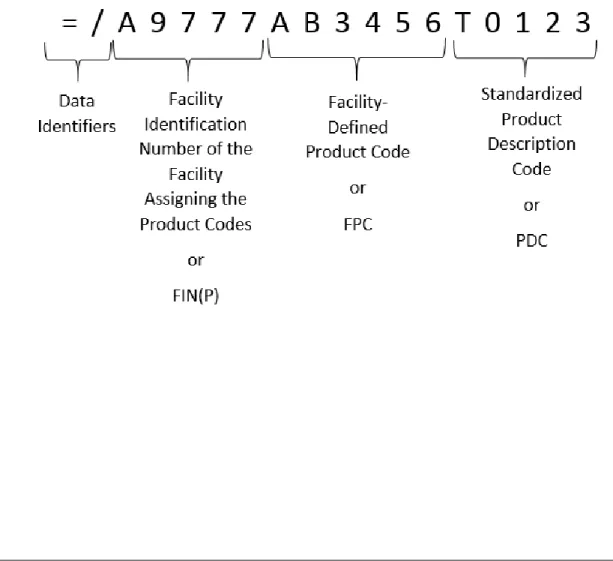
Within ISBT 128, the Processor Product Identification Code [Data Structure 034] shall be used to encode the Device Identifier (UDI-DI). In this data structure there is a facility identifier and two product codes: a 6-character facility-defined product code and a 5-character standardized product description code.
2.1 Processor Product Identification Code (PPIC) [Data
Structure 034]
Purpose: Data Structure 034 shall identify the processing or labeling facility, a facility-defined product code, and a standardized product description code.
Structure: =/nnnnnppppppqqqqq
Element Length Type
= 1 Data identifier, first character
/ 1 Data identifier, second character
nnnnn 5 Alphanumeric {A-N, P-Z, 0-9}
pppppp 6 Alphanumeric {A-Z, 0-9}
qqqqq 5 Alphanumeric {A–Z, 0-9}
The 16-character data string nnnnnppppppqqqqq shall be encoded and interpreted as follows:
nnnnn shall specify the Facility Identification Number of the facility that assigned the Product Description Code [FIN(P)]. The FIN(P) is issued by ICCBBA as the Issuing Agency for ISBT 128 identifiers and is encoded and interpreted by reference to the ICCBBA Registered Facility table published and maintained by ICCBBA in the password-protected area of the ICCBBA Website. The facility that assigned the Product Code may, or may not, be the same facility that assigned the Donation Identification Number (DIN). pppppp shall specify a Facility-defined Product Code (FPC) assigned by
the processing or labeling facility indicating a catalog or other number that identifies the type of product within its system. If a value is not required, the default value 000000 (zeroes) shall be used. This facility may choose to publish reference tables for use by the organizations receiving the product. If the number is less than 6 characters, leading zeroes shall be used.
This code shall distinguish between two products that have the same standardized Product Description Code but require
© 2015 ICCBBA, All rights reserved www.iccbba.org
different DIs. This may be because two product lines are slightly different or because a product changes in a way that requires a new DI but not a new Product Description Code.
qqqqq shall specify the Product Description Code (PDC). This code shall be encoded and interpreted by reference to the ISBT 128 Product Description Code Database table published and maintained by ICCBBA in the password-protected area of the ICCBBA Website.
See Chapter 5 for information on selection of a standardized PDC.
Note on traceability: For all HCT/P the combination of ISBT 128 Donation Identification Number, PDC, and Product Divisions code shall create global uniqueness. The FPC shall not be used as a complete or partial alternative to any of these data
elements.
© 2015 ICCBBA, All rights reserved www.iccbba.org
Production Identifiers
Production Identifiers (PIs) specified in the UDI final rule may be one or more of the following: Distinct identification code required by 21 CFR 1271.3 for HCT/P
Serial number Expiration date Manufacturing date Lot number
The data structures shown in Table 1 may be used for these identifiers. Table 1 Production Identifiers
UDI Identifier ISBT 128 Data Structure [Data Structure Number] Distinct Identification Code Donation Identification Number [001]
Serial Number Product Divisions [032]
Expiration Date Expiration Date [004]
Manufacturing Date Production Date [008]
Lot Number MPHO Lot Number [035]
To provide traceability for an HCT/P, ISBT 128 requires that the PI shall include: The Donation Identification Number (DIN)
The Product Divisions Code used as a serial number to uniquely identify each product from a donation
The expiration date, lot number, and manufacturing (production) date shall be included as part of the PI if they are used on the label.
© 2015 ICCBBA, All rights reserved www.iccbba.org
3.1 Donation Identification Number [Data Structure 001]
Note: This is the only data structure in which the second character of the data identifier shall be part of the data content.
Purpose: Data Structure 001 shall specify a Donation Identification Number (DIN) that is a unique identification of a donation event [collection or recovery] or a product pool from anywhere in the world over a one hundred year period.
Structure: =αppppyynnnnnnff
Element Length Type
= 1 data identifier, first character
α 1
data identifier, second character alphanumeric {A–N; P–Z; 1–9}
pppp 4
first two characters alphanumeric {A-N, P-Z, 0-9}; second two characters numeric {0–9}
Current usage is numeric for all four characters. Alpha characters may be introduced into positions 1 and 2 in the future
(e.g., if α = A and pppp = BC12, the αpppp will be ABC12)
yy 2 numeric {0–9}
nnnnnn 6 numeric {0–9}
ff 2 alphanumeric {0–9}, {A-H, J-N, P, R-Y}
The fifteen (15)-character data content string, αppppyynnnnnnff, shall be encoded and interpreted as follows:
αpppp shall specify the Facility Identification Number (FIN) of the organization that assigned the DIN and shall be encoded and interpreted by reference to the ICCBBA Registered Facilities database published and maintained by ICCBBA in the password-protected area of the ICCBBA Website. yy shall specify the last two digits of the year in which the donation was collected or recovered (or, in the case of a tissue processing facility assigning a DIN, this may be the year in which the first product from the donation event was processed).
Notes: In practice, this is the “nominal” year. To cut down on wastage, DIN labels may be used for up to one month in the year before, and one month in the year after, the year shown on the label.
© 2015 ICCBBA, All rights reserved www.iccbba.org
In the case of a tissue processing facility assigning a DIN, the DIN year code may be the year of the donation event OR the year in which the first product was processed. Usage shall be consistent within a facility. That is, if the DIN year code is the year the first tissue from the donation event was processed, the facility must always use the year the first tissue from a donation event was processed to determine the year code.
nnnnnn shall specify a sequence number indicating the particular collection, recovery, or product pool within the given year for the facility identified by the FIN.
ff are “flag characters.”
At the current time flag characters shall not be used for medical devices with an HCT/P element and the value of ff shall be set to 00.
© 2015 ICCBBA, All rights reserved www.iccbba.org
3.2 Product Divisions [Data Structure 032]
Purpose: Data Structure 032 shall convey information about divisions and shall serve as a serial number for HCT/P regulated as medical devices. Structure: =,dddddd
Element Length Type
= 1 Data identifier, first character
, 1 Data identifier, second character
dddddd 6 Alphanumeric {A-Z, 0-9}
The 6-character data string dddddd shall be encoded and interpreted as follows: dddddd shall specify the division code
The division code allows for a high level of flexibility.
© 2015 ICCBBA, All rights reserved www.iccbba.org
3.3 Expiration Date [Data Structure 004]
Purpose: Data Structure 004 shall indicate the date at the end of which the item expires.
Structure: =>cyyjjj
Element Length Type
= 1 data identifier, first character
> 1 data identifier, second character
c 1 numeric {0–9}
yy 2 numeric {0–9}
jjj 3 numeric {0–9}
The six (6)-character data content string, cyyjjj, is encoded and interpreted as follows: c shall specify the century of the year in which the item expires
yy shall specify the year within the century in which the item expires jjj shall specify the ordinal (Julian) date on which the item expires
© 2015 ICCBBA, All rights reserved www.iccbba.org
3.4 Production Date [Data Structure 008]
Purpose: Data Structure 008 shall indicate the date on which the product was produced.
Structure: =}cyyjjj
The six (6)-character data content string, cyyjjj shall be encoded and interpreted as follows:
c shall specify the century of the year in which the product was produced yy shall specify the year within the century in which the product was
produced
jjj shall specify the ordinal (Julian) date on which the product was produced
Element Length Type
= 1 data identifier, first character
} 1 data identifier, second character
c 1 numeric {0–9}
yy 2 numeric {0–9}
© 2015 ICCBBA, All rights reserved www.iccbba.org
3.5 MPHO Lot Number [Data Structure 035]
Purpose: Data Structure 035 shall be used for the lot number of Medical Products of Human Origin
Structure: &,1xxxxxxxxxxxxxxxxxx
Element Length Type
& 1 data identifier, first character
, 1 data identifier, second character
1 1 data identifier, third character xxxxxxxxxxxxxxxxxx 18 alphanumeric {A–Z; 0–9}
The data content string shall be up to 18 characters and shall be encoded and interpreted as follows:
xxxxxxxxxxxxxxxxxx Facility defined lot number
Note: Only upper case alphas may be used in this data structure when it is used within a PI.
© 2015 ICCBBA, All rights reserved www.iccbba.org
3.6 Compound Messages
In order to convey the full UDI (device identifier and production identifier information), in a single bar code, a compound message is needed. This data structure allows different data structures to be combined into a single message and may be used with high capacity delivery mechanisms such as 2-D bar codes and RFID tags.
3.6.1 Compound Message [Data Structure 023]
Purpose: Data Structure 023 shall allow multiple data structures to be combined into a single data string to facilitate use of newer technology delivery systems.
Structure: =+aabbb
Element Length Type
= 1 data identifier, first character
+ 1 data identifier, second character
aa 2 numeric {0-9}
bbb 3 numeric {0-9}
The five-character data content string aabbb shall be encoded and interpreted as follows:
aa shall specify the number of ISBT 128 data structures that follow; bbb shall be either:
all zeros – indicating this is an undefined message, i.e., only the number of data structures is identified, but not what each one is
a three-digit number referencing an entry in an ICCBBA maintained table that defines the sequence of the data structures within a compound message (see Table W2, [RT017] ICCBBA-Specified Compound Messages described in the ISBT 128 Standard Technical Specification. The reference table is found on the ICCBBA Website.)
Rules for constructing compound messages:
1. A compound message shall comprise a string of ISBT 128 data structures (excluding nationally defined structures), beginning with the Compound Message [Data Structure 023].
2. Data structures shall be combined with no intervening characters in the order shown on Table RT017 for ICCBBA-specified messages and each data structure shall begin with its data identifier characters.
© 2015 ICCBBA, All rights reserved www.iccbba.org
3. The string shall only contain ISBT 128 data structures.
4. The number of data structures following the Compound Message Data Structure shall be indicated in element aa of the Compound Message Data Structure.
5. If an ICCBBA-specified sequence is used in the compound message, the reference number of the structure shall be included in element bbb of the Compound Message Data Structure.
6. If the message is not defined, the Compound Message Data Structure shall have element bbb set to zeros, and element aa shall be set as specified in Rule 4.
ICCBBA-specified messages are defined in Table W2, ICCBBA-Specified Compound Messages (described in the ISBT 128 Standard Technical Specification). Requests for additional entries should be submitted to the ICCBBA office ([email protected]).
Reading software should always verify the integrity of the data string, including checking that the correct number of data structures appears. Data should only be interpreted if the integrity of the entire data string has been confirmed.
3.6.2 Creating Compound Messages – Example
The Data Structures desired in a compound message are: Processor Product Identification Code [034] Product Divisions [032]
Donation Identification Number [001] Expiration Date [004]
Per Table W2 [RT017] - ICCBBA-Specified Compound Messages, these data structures and the order of them is the standard compound message #035.
Table 2 Excerpt from RT017
ID Number of Data Structures
Data Structure
Numbers Data Structures
035 04 [034];[032];[001];[004]
Processor Product Identification Code;Product Divisions;Donation Identification Number;Expiration Date
© 2015 ICCBBA, All rights reserved www.iccbba.org
The message desired is:
Data Structure Information to transfer Data Identifier and Code
Processor Product Identification Code or PPIC (DI)
Facility: A9997
Facility-defined product code: XYZ100 Standardized Product Code: T0944
=/A9997XYZ100T0944 Product Divisions 12 =,000012 Donation Identification Number A99991412345600 =A99991412345600
Expiration Date 31 JAN 2016 =>016031
A compound message with this data would be: Data Characters Meaning of Data Characters
=+ Data identifier
04 There are four data structures in the message
035 This is standard message 035 from Table RT017
=/A9997XYZ100T0944 Processor Product Identification Code is A9997XYZ100T0944
=,000012 Product division is 12
=A99991412345600 Donation Identification Number for the HCT/P is A999914123456
=>016031 Expiration date is 31 JAN 2016 The data string would therefore be:
=+04035=/A9997XYZ100T0944=,000012=A99991412345600=>016031
The Data Matrix symbol would be:
This symbol, created with an X dimension of 0.36 mm has a size of approximately 9 mm by 9 mm.
© 2015 ICCBBA, All rights reserved www.iccbba.org
© 2015 ICCBBA, All rights reserved www.iccbba.org
3.6.3 ICCBBA-Specified Compound Messages
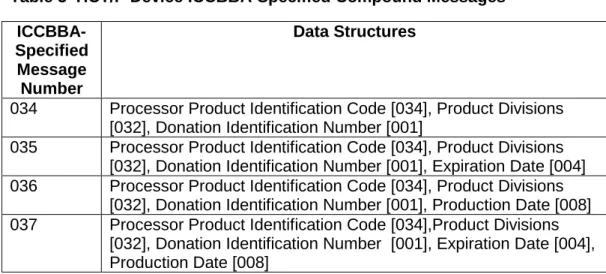
A full list of ICCBBA-specified compound messages is found as Table W2 (RT017) on the ICCBBA Website. Some messages specific for HCT/P devices are shown on Table 3. Additional standard messages may be requested by contacting [email protected].
Table 3 HCT/P Device ICCBBA-Specified Compound Messages
ICCBBA-Specified Message Number
Data Structures
034 Processor Product Identification Code [034], Product Divisions [032], Donation Identification Number [001]
035 Processor Product Identification Code [034], Product Divisions [032], Donation Identification Number [001], Expiration Date [004] 036 Processor Product Identification Code [034], Product Divisions
[032], Donation Identification Number [001], Production Date [008] 037 Processor Product Identification Code [034],Product Divisions
[032], Donation Identification Number [001], Expiration Date [004], Production Date [008]
© 2015 ICCBBA, All rights reserved www.iccbba.org
Labeling
4.1 Bar Code
A Data Matrix (2-D) symbol may be used to convey the compound message on the product label. Printing of the bar code should follow appropriate ISO standards (listed in Section 1.4) and the ISBT 128 Standard Technical Specification for specifications. Linear bar codes may be used if space on the label permits. Because of the length of the bar codes, separate bar codes would be needed for the DI and the PI. Separate bar codes may also be needed for the various data structures within the PI.
4.2 Text
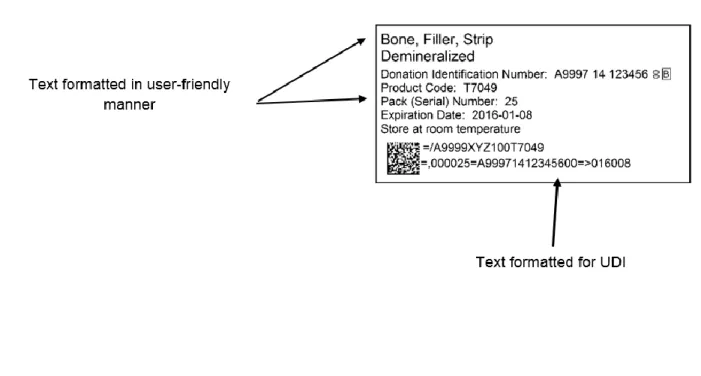
Text for the various identifiers should be printed in both the UDI format and user-friendly format as shown in Figure 3. Text in user-friendly format may omit leading zeroes. Characters to print in eye-readable UDI text: Eye-readable text corresponding to UDI information within the bar code should be printed on the product label. The UDI
information includes the data content and data identifiers for data structures comprising the DI and PI. See Figure 4.
Characters NOT to print in eye-readable UDI text: The characters corresponding to the compound message data identifier and message code. See Figure 4.
© 2015 ICCBBA, All rights reserved www.iccbba.org
Figure 4 Eye-Readable Text for UDI Bar coded message:
Eye-readable text for the code above should be as shown below (and as shown in red above):
= / A 9 9 9 7 X Y Z 1 0 0 T 0 9 4 4 = , 0 0 0 0 1 2 = A 9 9 9 9 1 4 1 2 3 4 5 6 0 0 = > 0 1 6 0 3 1
It is acceptable to print the device identifier on a separate line from the production identifier: =/A9997XYZ100T0944
© 2015 ICCBBA, All rights reserved www.iccbba.org
4.3 Position on Package
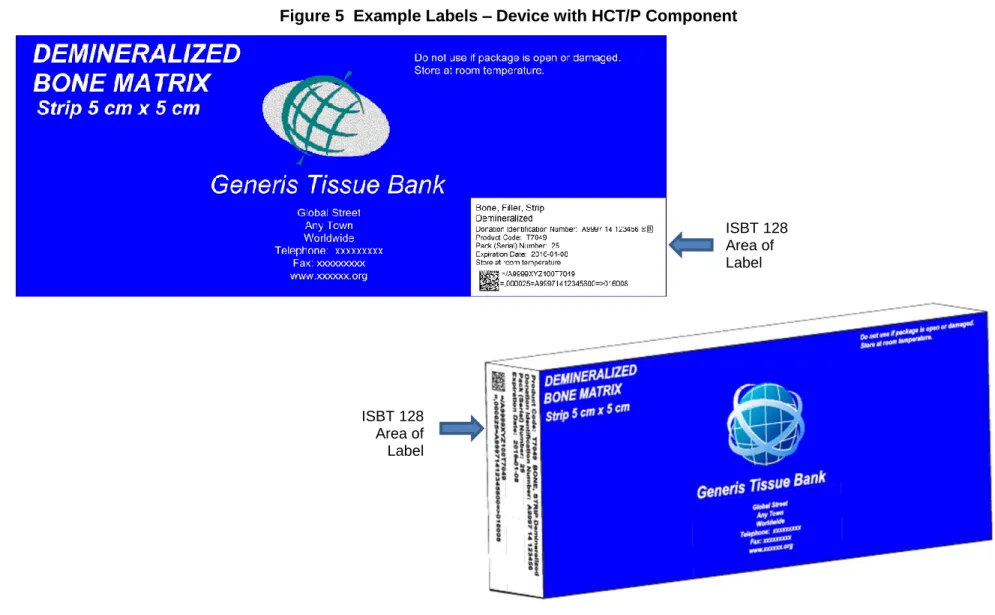
Positioning of the UDI on the label is not standardized at this time. Below are two options, but other placement is acceptable. Figure 5 Example Labels – Device with HCT/P Component
ISBT 128 Area of Label ISBT 128 Area of Label
© 2015 ICCBBA, All Rights Reserved www.iccbba.org
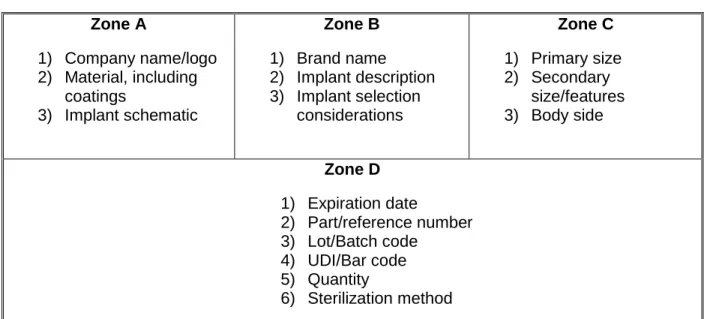
ASTM guidance (see 1.5) exists for standardizing the presentation on the label of the information for orthopedic implants used in arthroplasty and includes the location the information should appear on the box. This scheme, shown in Figure 6, could be
adapted for other implants. Facilities may want to take this information into consideration for label design.
Figure 6 ASTM Format for Orthopedic Implants Used in Arthroplasty Zone A 1) Company name/logo 2) Material, including coatings 3) Implant schematic Zone B 1) Brand name 2) Implant description 3) Implant selection considerations Zone C 1) Primary size 2) Secondary size/features 3) Body side Zone D 1) Expiration date 2) Part/reference number 3) Lot/Batch code 4) UDI/Bar code 5) Quantity 6) Sterilization method
© 2015 ICCBBA, All Rights Reserved www.iccbba.org
Product Description Codes (PDCs)
Standardized PDCs are used in the Processor Product Identification Code [Data Structure 034], which is the device identifier (DI).
5.1 Internationally Standardized PDCs
The last five characters of the Processor Product Identification Code provide a
standardized description of the HCT/P product. Products are described through the use of Class and Attributes. Each of the characteristics that make up the product description is defined in the document: Standard Terminology for Blood, Cellular Therapy, and Tissue Product Descriptions.
In general, the descriptions included in the ISBT 128 database tables are intended for use in final product labeling. A “final product” is defined as a product appropriate for transfer from the recovery and/or processing facility inventory to some other inventory. However, with the use of the “For Further Processing” Attribute, facilities may optionally use ISBT 128 product codes internally from the time of the recovery of tissue or
collection of a cellular therapy product.
An outdate period is not defined in the description since each country determines the permissible period after collection, recovery, or further processing during which the product may be used.
The PDC does contain information about manufacturing, but is not intended to be a complete record of all processing steps; that is, it is not a portable data file of the manufacturing process.
Note: Terminology used as examples in this section is for tissues. Terminology that will apply to HCT/P regulated as medical devices has not yet been requested. However, the same principles will apply to medical device’s product description codes.
5.1.1 Terminology
The PDC uniquely defines an HCT/P product in terms of its characteristics. All products have a Class and may have one or more Attributes.
5.1.1.1 Class
Class are a general description of products (such as Femoral Head, Ground Bone, and Cortical Bone Ring).
5.1.1.2 Attributes
Attributes provide additional information about the HCT/P product. HCT/P thus may be further described through the addition of one Attribute variable from one or more Attribute groups.
© 2015 ICCBBA, All Rights Reserved www.iccbba.org
Attributes are organized into groups of mutually exclusive terms. Each group has a default value that applies if no attribute variables are selected.
The document Standard Terminology for Blood, Cellular Therapy, and Tissue Product Descriptions provides complete descriptions of currently defined Classes and Attributes.
5.1.2 Structure of Product Descriptions within the Database
Once defined, product descriptions are placed into a reference table database. Each description is assigned a unique five-character Product Description Code (PDC) for electronic communication. Although there is no structure to the five-character PDC, the description of the product within the database is rigidly
structured. Each product is defined in the ICCBBA database minimally in terms of its Class.
The Class and Attributes are separated in the product name by the “|” delimiter: CLASS|Attribute
For example:
Attributes may be used to further describe the product. Only one variable from each Attribute group may be used. Attributes are also separated by the “|” delimiter: CLASS|Attribute|Attribute
For example:
The order in which the Attributes appear in the description field of the database is the order in which they appear in the Attributes table of the database.
The order in which text appears in the description field of the database does not specify the order in which Attributes will appear as label text. Since this can be country-specific, national guidelines as to the placement of label text should be consulted.
5.1.3 PDC Database
Starting with Version 6.0.0, the ISBT 128 Product Description Code database has been restructured to accommodate future growth. Tables following the
Product Description Code Description
T0308 TENDON, GRACILIS|Frozen
Product Description Code Description
T0267 TENDON, TIBIALIS, ANTERIOR|Frozen|Left
T0268 TENDON, TIBIALIS, ANTERIOR|Frozen|Right
© 2015 ICCBBA, All Rights Reserved www.iccbba.org
previous format will temporarily continue to be provided. As the use of ISBT 128 continues to grow (more than 11,000 Product Description Codes and 11 types of products now exist), it is expected that the original database structure will
become inadequate. While the limitations of the database have not been reached, it is deemed necessary to redesign the database now to support the anticipated growth. While it cannot be foreseen just how long the old database design will continue to meet the needs, ICCBBA strongly recommends that software that utilizes more than just the Product Description Codes (e.g., uses product formulas) be updated as soon as possible. ICCBBA will continue to support the current tables until the end of 2016, unless the original table structures can no longer support new products.
Details of the new database structure may be found in ISBT 128 Standard Product Description Code Database (ST-010).
The structure of the new database may not affect all existing ISBT 128 software. Existing software that only utilizes the ISBT 128 Product Description Codes should not be affected. The Product Description Codes themselves have not been redefined or restructured.
All ISBT 128 database tables shall be published in the password-protected area of the ICCBBA Website. This file is a Microsoft Access® file and is listed on the Website as:
ISBT 128 Product Description Code Database
5.1.4 Selecting PDCs
Tissue PDCs begin with the letter “T”. The codes are listed in alphabetical order in the full database so tissue codes are found near the end of the full database tables.
To appropriately select product descriptions, it is important to understand the definitions of each term. These definitions are found in Standard Terminology for Blood, Cellular Therapy, and Tissue Product Descriptions.
5.1.4.1 “Retired” Codes
Over time, codes may become inappropriate, redundant, or errors may be discovered. As a result, a mechanism must exist to discontinue future use of these codes. However, because products may exist in inventories across the world, the codes must be retained in the database for backward compatibility.
To accomplish this goal, a column exists in the ICCBBA database to indicate such codes. This “Retired Date” column indicates the date on which ICCBBA recommended the codes no longer be used for new products. Software should be written to recognize these codes, but not assign them to newly created products. It is understood that facilities must be given time to retire codes after ICCBBA has made its recommendation.
© 2015 ICCBBA, All Rights Reserved www.iccbba.org
5.1.4.2 Level of Detail
Following national guidelines, facilities can determine the level of detail that must be encoded into an electronically-readable format according to the needs of its customers.
Note: For even more detail about the dimensions of a product (volume, length, height, depth, etc.), another data structure, Dimensions Data Structure [029] may be used. For more information on the use of this data structure, see the ISBT 128 Standard Technical Specification and Implementation Guide: Use of the Dimensions [Data Structure 029]. 5.1.4.3 Using the Product Code Look-up Tool to Locate PDCs
Searching for the correct PDC can be simplified by the use of the PDC lookup program available on the ICCBBA Website. (From home page, select “Lookup Tools” from the menu at the top of the page. Then select “Find Product Information.”) This is a Microsoft Excel file that can be downloaded onto your computer. It is compatible with Microsoft Excel 2007-2013. It has not been validated, and cannot be used, with earlier versions of Microsoft Excel.
It is updated with each new version of the PDC database
(approximately once a month). Therefore, users must download this tool frequently to ensure the most recent PDCs are available.
The program can be used to lookup a description for a given PDC or lookup a PDC based on a description.
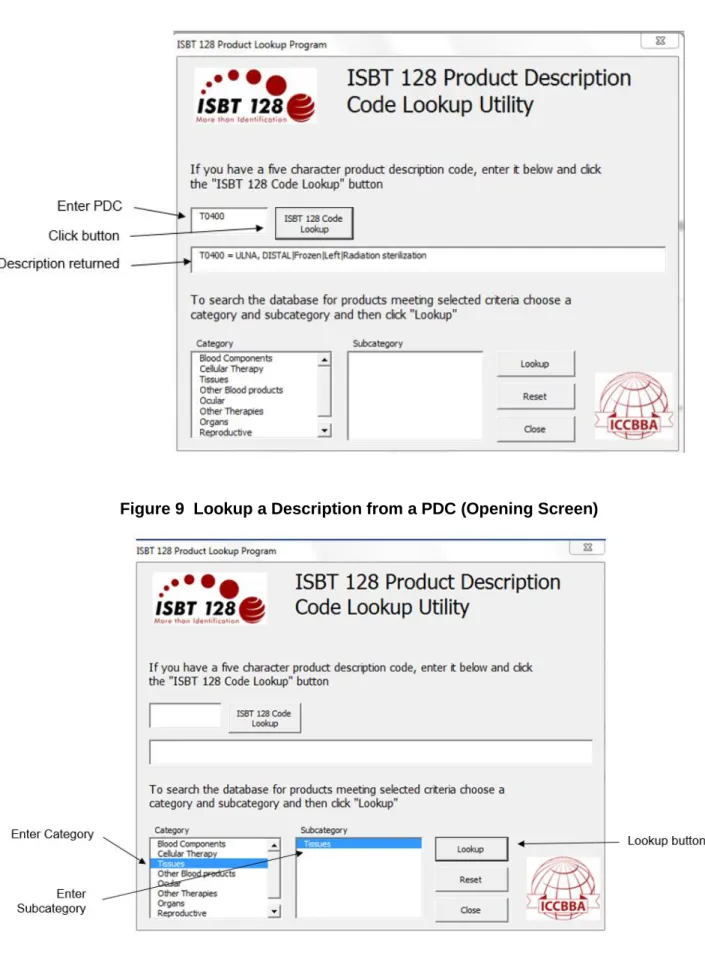
When the program is opened, the ISBT 128 Product Description Code Lookup Utility screen will appear. See Figure 7.
© 2015 ICCBBA, All Rights Reserved www.iccbba.org
© 2015 ICCBBA, All Rights Reserved www.iccbba.org
To find the description when you know the PDC (see Figure 8): Enter the PDC in the first field.
Click on the ISBT 128 Code Lookup button.
The description will appear in the field below the ISBT 128 Code Lookup button.
To lookup another description, click the Reset button and repeat the first 3 steps.
To close tool, click the Close button. To find a PDC for a given product description:
Click on Tissues in the Category Field and Tissues in the Subcategory field. See Figure 10. (Currently, category and subcategory are the same, but this will not always be the case.) Click the “Lookup Button” to the right of the Subcategory field. The ISBT 128 Product Lookup by Description screen will appear.
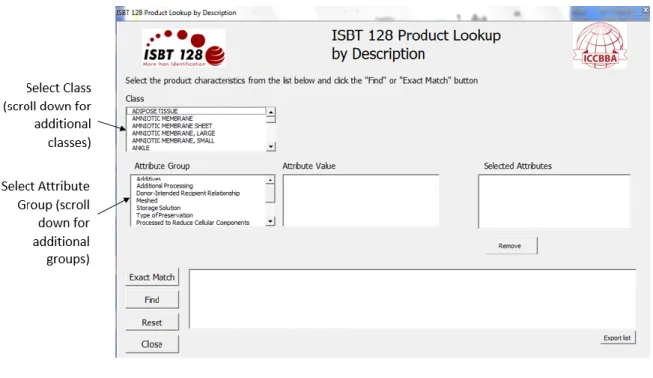
See Figure 10.
Click on the Class desired. See Figure 10. Select Attributes, if desired. See Figure 11.
Click on the Attribute group desired. Attribute values
corresponding to the class selected will appear in the Attribute Value field.
Click on the value desired. This value will appear in the Selected Attributes window.
Select additional Attributes following these same steps. At this point there are two options, “Exact Match” and “Find.”
Clicking “Exact Match” will bring up the PDC that exactly meets the selection criteria. See Figure 12.
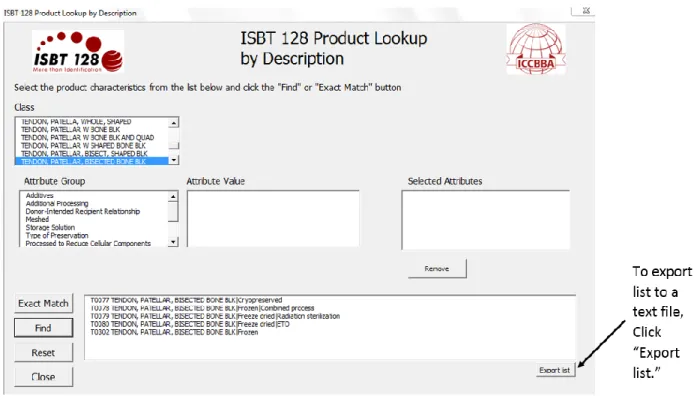
Clicking “Find” will result in a list of products that include these criteria. See Figure 13
If desired, click the Export List button to export the list of products in a text file to a selected location. See Figure 14 and Figure 15. The text file will be named Product Description Codes. (Note: If you export a second list to the same location, it will overwrite the first list unless you change the name of the file.)
Use the Reset button to clear the screen and allow a new query to be performed.
© 2015 ICCBBA, All Rights Reserved www.iccbba.org
Figure 8 Lookup a Description from a PDC
© 2015 ICCBBA, All Rights Reserved www.iccbba.org
Figure 10 Looking up a PDC from a Description Screen
© 2015 ICCBBA, All Rights Reserved www.iccbba.org
Figure 12 Lookup PDC that Exactly Matches Criteria
© 2015 ICCBBA, All Rights Reserved www.iccbba.org
Figure 14 Use of Export List Function
© 2015 ICCBBA, All Rights Reserved www.iccbba.org
5.1.5 Requesting New PDCs
An on-line form for requesting new PDCs is available on the ICCBBA Website. See Figure 16.
Codes that represent new combinations of existing Classes or Attributes will generally be added on the next database update. The database is updated approximately 10 times each year.
If a new Class, a new Attribute group, or a new variable within an existing
Attribute group is included in the requested product description code, the request must be accompanied by appropriate definitions of the new characteristic.
Requests for new characteristics will be reviewed by appropriate technical advisory groups to ensure international consensus with the terminology chosen. New PDCs must be compatible with the existing system. If there is a question of compatibility, the request may be referred to the Standards Committee of
ICCBBA.
Updates to the PDCs will be regularly posted in the password-protected section of the ICCBBA Website and made apparent by a change in the Version Number of the Product Code database. Version control sheets describing the changes are published with each update.
5.1.5.1 Completing the Request Form
The form for requesting new codes is found on the ICCBBA Website. It is found in the Subject Area tab, under Tissues or Cellular Therapy (as appropriate for the product being requested) and is called Request a Code. One completed form is required for each new PDC requested. Minimally, the request must include a Class.
Select one Class from the dropdown list.
Select an Attribute from each Attribute group where a non-default value is required (only one per Attribute group) from the dropdown lists. Click on “Submit to ICCBBA”.
If a new Class, Attribute group, or variable within an Attribute group is needed, please contact the ICCBBA Technical Director
([email protected]). A definition compatible with the format of those in the Standard Terminology for Blood, Cellular Therapy, and Tissue Product Descriptions must accompany such a request.
© 2015 ICCBBA, All Rights Reserved www.iccbba.org
5.1.5.2 Submitting the Request
Click on the “Submit to ICCBBA” button to submit the form to the appropriate individual at ICCBBA. You will receive an automated acknowledgement of the submission. Questions should be submitted to ICCBBA at [email protected].
© 2015 ICCBBA All rights reserved www.iccbba.org
© 2015 ICCBBA All rights reserved www.iccbba.org
Figure 17 Examples of Drop-Down Menus CLASS
(Scroll down on Website dropdown menu for more options)
© 2015 ICCBBA All rights reserved www.iccbba.org
Figure 18 Examples of Attribute Drop-Down Menus
Meshed Additive Additional Processing Donor-Intended Recipient Relationship
Storage Solution Type of
Preservation Processed to Reduce Cellular Components Anatomical Position Processing Status
Unit of Issue Pathogen
Reduction
Nominal Granule Size
© 2015 ICCBBA All rights reserved www.iccbba.org
Abbreviations
ASTM Formerly known as American Society for Testing and Materials. Now is called ASTM International.
CFR Code of Federal Regulations DI Device Identifier
DIN Donation Identification Number FDA US Food and Drug Administration FIN Facility Identification Number FPC Facility-Defined Product Code
HCT/P Human cells, tissues, or cellular or tissue-based products IEC International Electrotechnical Commission
ISO International Standards Organization MPHO Medical Products of Human Origin PDC Product Description Code
PI Production Identifier
PPIC Processor Product Identification Code UDI Unique Device Identifier
© 2015 ICCBBA All rights reserved www.iccbba.org
Glossary
Data Content
The characters in a data structure that encode the information for which the data structure is named. The data content does not include the data identifier. (The Donation Identification Number is an exception to this rule. See Section 3.1, page 13.)
Data Identifier
The first two or three characters in a data structure that identify the data structure. These will always be present when the data structure is used as a bar code, but may be omitted when the data structure is used in situations in which the data structure identity is unambiguously and explicitly defined. (The Donation Identification Number is an exception to this rule. The second character of the data identifier can never be
dropped because it is also part of the data content.)
Data Structure
Information content comprising the data identifier and data content. When a data structure is represented as a bar code, the term data structure does not include the symbology-specific and always present start and stop codes, the symbology-specific check characters or any specified control characters.
Device Identifier A mandatory fixed portion of a UDI that identifies the specific version or model of a device and the labeler of that device (21 CFR 801.3).
Medical Device
An instrument, apparatus, implement, machine, contrivance, implant, in vitro reagent, or other similar or related article, including a component part, or accessory which is:
recognized in the official National Formulary, or the United States Pharmacopoeia, or any supplement to them,
intended for use in the diagnosis of disease or other conditions, or in the cure, mitigation, treatment, or prevention of disease, in man or other animals, or
intended to affect the structure or any function of the body of man or other animals, and which does not achieve its primary intended purposes through chemical action within or on the body of man or other animals and which is not dependent upon being metabolized for the achievement of any of its primary intended purposes.
(Section 201(h) of the Federal Food Drug & Cosmetic Act)
Ordinal Date
A system for maintaining dates that numbers the first day of the year (January 1) as 1 and the last (December 31) as 365 or 366 (in a leap year). Also known as Julian Date.
© 2015 ICCBBA All rights reserved www.iccbba.org
Production Identifier
A conditional, variable portion of a UDI that identifies one or more of the following when included on the label of the device:
(i) The lot or batch within which a device was manufactured; (ii) The serial number of a specific device;
(iii) The expiration date of a specific device; (iv) The date a specific device was manufactured.
(v) For HCT/P regulated as a device, the distinct identification code required by § 1271.290(c) (CFR 801.3).
Unique Device Identifier
An identifier that adequately identifies a device through its distribution and use by meeting the requirements of 21 CFR 830.20. A unique device identifier is composed of a device identifier and a production identifier (21 CFR 801.3).
© 2015 ICCBBA All rights reserved www.iccbba.org