© 2012 IJAIR. ALL RIGHTS RESERVED
International Journal of Advanced and Innovative
Research
ISSN: 2278-7844
Available online at
http://ijair.jctjournals.com
Volume 1, Issue 2, July 2012
An Embedded ATM Security Design using ARM
Processor with Fingerprint recognition and GSM
S.M. Shamsheer Daula
Dr.K.E Sreenivasa Murthy
Asst.Professor
Principal,
G.Pulla Reddy Engineering College
SKTRMC,Kondair.
Kurnool,A.P India.
Andhra Pradesh,India
Email:
[email protected]
Email:
[email protected]
Abstract - The main objective of this system is to develop an
embedded system, which is used for ATM security applications. In these systems, Bankers will collect the customer finger prints and mobile number while opening the accounts then customer only access ATM machine. The working of these ATM machine is when customer place finger on the finger print module when it access automatically generates every time different 4-digit code as a message to the mobile of the authorized customer through GSM modem connected to the microcontroller. The code received by the customer should be entered by pressing the keys on the touch screen. After entering it checks whether it is a valid one or not and allows the customer further access.
Keywords - ATM terminal; ARM9; fingerprint recognition;
image enhancement; GSM MODEM.
1.INTRODUCTION
Now-a-days, in the self-service banking system has got extensive popularization with the characteristic offering high-quality 24 hours service for customer. Using the ATM (Automatic Teller Machine) which provide customers with the convenient banknote trading is very common. However, the financial crime case rises repeatedly in recent years, a lot of criminals tamper with the ATM terminal and steal user's credit card and password by illegal means. Once user's bank card is lost and the password is stolen, the criminal will draw all cash in the shortest time, which will bring enormous financial losses to customer. How to carry on the valid identity to the customer becomes the focus in current financial circle. Traditional ATM systems authenticate generally by using
the credit card and the password, the method has some defects. Using credit card and password cannot verify the client's identity exactly. In recent years, the algorithm that the fingerprint recognition continuously updated and sending the four digit code by the controller which has offered new verification means for us, the original password authentication method combined with the biometric identification technology verify the clients' identity better and achieve the purpose that use of ATM
machines improve the safety effectively.
2. THE CHARACTERISTICS OF THE
SYSTEM DESIGN
The embedded ATM client authentication system is based on fingerprint recognition which is designed after analyzed existed ATM system. The S3C2440 chip[2] is used as the core of these embedded system which is associated with the technologies of fingerprint recognition and current high speed network communication.
The primary functions are shown as follows:
• Fingerprint recognition: The masters' fingerprint information was used as the standards of identification. It must certify the feature of the human fingerprint before using ATM system[7]. • Remote authentication: System can compare
current client's fingerprint information with remote fingerprint data server.
• Message alarming: different 4-digit code as a message to the mobile of the authorized customer without any noise, in order to access the Terminal.
Two discriminate analysis methods: Besides the fingerprint recognition, the mode of password recognition can be also used for the system.
3. HARDWARE DESIGN AND
SOFTWARE DESIGN
The design of entire system consisted of two part which are hardware and software. The hardware are designed by the rules of embedded system, and the steps
of software consisted of three parts. The more details are shown as follows.
A. Hardware Design
The S3C2440 chip is used as the core of entire hardware. Furthermore, the modules of LCD, keyboard, alarm, fingerprint recognition are connected with the main chip (S3C2440)[1][3].The SRAM and FLASH are also embodied in the system. There are some modules consisted of the system as
follows:
• LCD module: The OMAP5910 is used in this module as a LCD
controller, it
supported
1024*1024 image of 15 gray-scale or 3375 colours.
• keyboard module: It can be used for inputting passwords.
• SRAM and FLASH: The 16-bit 29LV160BB-
70REC of FLASH chip and the 32-bit HY57V561620CT-6 of SRAM chip are
connected with the main chip. Their
© 2012 IJAIR. ALL RIGHTS RESERVED
are storing the running code, the information of
fingerprint and the
algorithm.
• Fingerprint recognition module: Atmel Company's AT77CI04B be used as a fingerprint recognition. It has a 500dpi
resolution, anti-press, anti-static,
anticorrosion[2].
•
Ethernet switch controller: RTL8308B can provides eight 10/100 Mbps RMII Ethernet ports, which can connect police network and remote fingerprint data server.
Figure 3.1. The block diagram of hardware
Before using the ATM terminal, the client's fingerprint feature will be connected to the remote fingerprint data server to match fingerprint data with the master's, if the result isn't correct, the system will call police automatically and send alarm to the credit card owner.
B. Software
design
The design was component of three parts included the design of main program flow chart, the initializing ones, and the algorithm of fingerprint recognition flow chart.
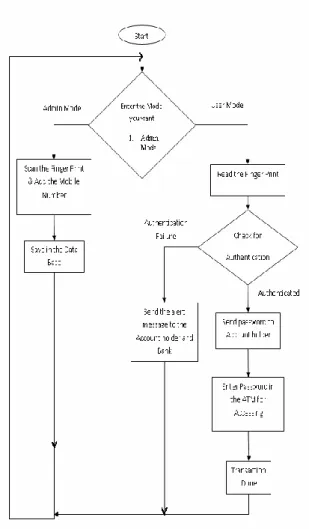
This system of software is implemented by the steps as follows: first of all, the Linux kernel and the File system are loaded into the main chip. The next, the system is initialized to implement specific task, such as checking ATM system, GSM communication[8][6] and so on, and then each module reset for ready to run commands. Before using ATM terminal, the mobile number and
fingerprint of the customer is required.
Figure 3.2.
The overall flow chart of softwareFirst the system is required the owner's fingerprint. If all the recognition is right, the system would send password
to the Account holder and he will enter the same password in touch screen for accessing the ATM Terminal. If Authentication Failure then it send the alert message to the Account holder and Bank. The overall flow chart of software is shown in figure 3.2.
In the process of inputting fingerprint, the AT77CI04B which is a linear sensor that captures fingerprint images by sweeping the finger over the sensing area, will used for acquiring the image of fingerprint. This product embed true hardware based 8- way navigation and click functions. The fingerprint information will be temporarily stored in SRAM and upload to the remote finger data server to compare through bank network. The result of process
will be controlled by main chip(S3C2440
)[1][4].
Figure 3.3.
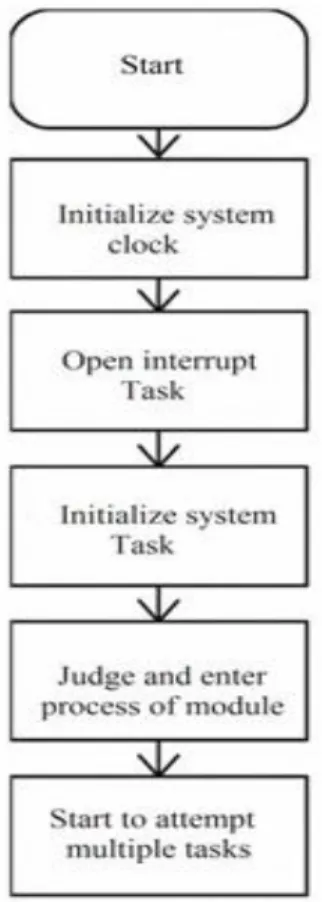
The flow chart of fingerprint recognition The initializing process means that set the hardware and software and then start the multiple mission module, each module will be started according to thepriority processes. At first, initialize the system clock,
and execute the codes of open interrupt and the open interrupt task. Then, the system would judge and enter process of module. finally, the system would start to attempt multiple tasks. The initializing flow chart is shown in figure 3.3
C. The design of fingerprint
recognition algorithm
The design of algorithm based on fingerprint recognition is so vital for the whole system. We would approach two steps to process the images of fingerprint
.
1) The detail of fingerprint recognition process.
The first step was the acquisition of fingerprint image by above device mentioned in the algorithm, and the results could be sent to the following process. secondly, pre-processing the images acquired. After obtain the fingerprint image, it must be pre-processing. Generally, pre-processing of one's is filtering, histogram computing, image enhancement and image binarization. Lastly, the characteristic value was extracted, and the results of the above measures would be compared with the information of owner's fingerprint in the database so as to verify whether the character is matched, and then the system returned the results matched or not.
2) The design of fingerprint image enhancement
Fingerprint recognition module is an extremely important part of the system, the high-quality images was the major factors of influencing the performance in the system. The algorithm of fingerprint recognition based on the algorithm of Gabor and direction filter was used. fingerprint enhancement algorithm based on Gabor filter could be better to remove noise, strengthen the definition between the ridge and valley, it could significantly improve the image enhancement processing capacity, but this algorithm was slow in dealing with the high capacity requirements.
GSM
Global System for Mobile Communications ( GSM: originally from Group Special Mobile) is the most popular standard for mobile phones in the world. Its promoter, the GSM Association, estimates that 82% of the global mobile market uses the standard GSM is used by over 2 billion people across more than 212 countries and territories. GSM differs from its predecessors in that both signalling and speech channels are digital call quality, and thus is considered a second generation (2G) mobile phone system. This has also meant that data communication was built into the system using the 3rd Generation Partnership Project (3GPP). GSM also pioneered a low-cost alternative to voice calls, the Short message service. GSM
© 2012 IJAIR. ALL RIGHTS RESERVED
is a digital mobile telephone system that is w i d e l y u s e d i n E u r o p e a n d o t h e r p a r t s o f t h e w o r l d .
GSM uses a variation of Time Division Multiple Access(TDMA) and GSM is the most widely used of the three digital wireless telephone technologies (TDMA, GSM, and CDMA). GSM digitizers and compresses data, then sends it down a channel with two other streams of user data, each in its own time slot[5][9]. It operates at either the 900 MHz or 1,800 MHz frequency band. GSM is the de facto wireless telephone standard in Europe. GSM has over one billion users worldwide and is available in 190 countries.
T e c h n i c a l
d e t a i l s :
GSM is a cellular network, which means that mobile phones connect to it by searching for cells in the immediate vicinity. GSM networks operate in four different frequency ranges.
Most GSM networks operate in the 900 MHz or
1800 MHz bands. Some countries in the
Americans(including Canada and the United States) use the 850 MHz and 1900 MHz bands because the 900 and
1800 MHz frequency bands were already allocated. The rarer 400 and 450 MHz frequency bands are assigned in some countries, notably Scandinavia, where these frequencies were previously used for first-generation systems.
The
Future of
GSM
GSM together with other technologies is part of an evolution of wireless mobile telecommunication that
includes High-Speed Circuit-Switched
Data(DSCSD),
General Packet Radio System (GPRS), Enhanced Data rate for GSM Evolution (EDGE), and Universal Mobile Telecommunications Service(UMTS).
4. RESULTS
Figure 4.1 First enter as ADMIN mode for
registration
Figure 4.2 Click on the number box for enrolling phone number
Figure 4.3 Successfully registered your phone number then enroll finger print by placing on fingerprint module.
.
Figure 4.5 Now in USER Mode
Figure 4.6 Message as “Your Registration Number is 280 ” for the USER
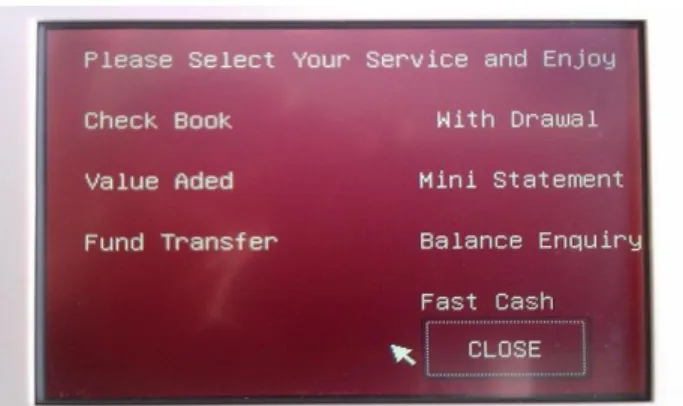
Figure 4.8 The authentication success and we entered into
APPLICATION WINDOW
5. RESULTS ANALYSIS
The applications of this project are at bank sector for enrolling the customer major details, Enrolling fingerprint, register personal number, Verification of customer fingerprint, Generating 3-digit PIN number and sending it to authorized customer, enabling access to further process for authenticated person, etc. Some of the other applications are as follows:
Fingerprint image analysis for automatic identification technology has been developed to the point where it can be used in a number of major applications. Important industries affected by this technology include network security and protection, smart money and biometric identifier systems for many major government sectors such as FBI, NIST and DMV
6. CONCLUSIONS
The Implementation of ATM security by using fingerprint recognition and GSM MODEM took advantages of the stability and reliability of fingerprint characteristics. Additional, the system also contains the original verifying methods which was inputting owner's password which is send by the controller. The security features were enhanced largely for the stability and reliability of owner recognition. The whole system was build on the technology of embedded system which makes the system more safe, reliable and easy to use.
REFERENCES
[1] Ernest Karjala, Teodor Neagoe, ARM® and Low-Power Applications, Embedded Systems Conference, Silicon Valley,2008
[2] Professor David Brooks, lecture 1 notes from course CS246: Advanced Computer Architecture, Spring 2007, Harvard University,
http://www.eecs.harvard.edu/~dbrooks/cs246/#Course%20
[3] T. Mudge, "Power: A First-Class Architectural3 Design Constraint," IEEE Computer, 2009.
© 2012 IJAIR. ALL RIGHTS RESERVED
[4] Aurangzeb Khan, Senior Member, IEEE, Philip Watson, George Kuo, Due Le, Trung Nguyen, Steven Yang, Peter Bennett, Pokai Huang, Jaspal Gill, Chris Hawkins, John Goodenough, Demin Wang, Irfan Ahmed, Peter Tran, Helder Mak, Oanh Kim, Frank Martin, Yimu Fan, David
Application to the ARM 1136JF-S Microprocessor”, IEEE Journal of Solid-State Circuits, Vol. 41, No. 8, August 2008
[5] Krisztián Flautner, David Flynn (ARM Limited), and Mark Rives (National Semiconductor Corporation), DesignCon 2008, System-on-Chip and ASIC Design
[6] Lin Hong, Wan Yifei, Anil Jain. Fingerprint image
enhancement: algorithm and performance
evaluation[J].IEEE Transactions on Pattern Analysis and Machine intelligence. ,2008, 777-789. [7] ESaatci, V Tavsanogh. Fingerprint image
enhancement using CNN gabor-Cpe filter[C].
Proceedings of the 7th IEEE International Workshop on Cellular Neural Networks and their Applications 2002: 377-382.
[8] Gu J, Zhou J, Zhang D.A combination model for
orientation field of fingerprints. Pattern Recognition, 2004, 37: 543-553.
[9] Cheng J, Tian J. Fingerprint enhancement with dyadic scale-space. Pattern Recognition Letters, 2004, 25(11): 1273-1284.
[10] Satoshi Shigematsu, Takahiro Hatano, Hiroki Morimura, Katsuyuki Machida, and Yukio Okazaki, ”A Wireless Battery-powered Fingerprint Identification System for Ubiquitous User Authentication,” IEEE International Conference on new fingerprint identification, 2009.
[11] David Cormie, “The ARM9™ Microarchitecture,” ARM Ltd, April 2010.