Journal of Language and Culture Vol. 4(1), pp. 10-17, March 2013 Available online http://www.academicjournals.org/JLC
DOI: 10.5897/IJEAPS12.047
ISSN 2141-6540 ©2013 Academic Journals
Full Length Research Paper
Exploration and evaluation of the mathematical values
inculcation instrument
Mukhtar Alhaji Liman
1*, Mohd Burhan Ibrahim
2and Yusuf Isma’il
31
Department of Education, University of Maiduguri, Borno state, Nigeria.
2
Institute of Education, International Islamic University, Malaysia.
3
Centre for Distance Learning, University of Maiduguri, Borno state, Nigeria. Accepted 29 November, 2012
The concept of a values system in education including mathematics education cannot be over emphasized. This is because value based education stands to be the rudiment of classical successes in the attainment of beneficial knowledge, that is the knowledge which is cognizant of the material and spiritual needs of the individual and the society. This study aims at investigating and understanding the underlying factors of values inculcation in mathematics teaching and learning among mathematics teachers in the North eastern region of Nigeria. As such, this paper explores some of the universal values that are supposed to be tele-guiding mathematics instructional content delivery. The study involved n=509 service teachers teaching mathematics at various levels of secondary school education in the North eastern region of Nigeria. A likert-scale questionnaire consisting of 52 items cutting across the five hypothesized dimensions of values inculcation in mathematics teaching and learning which include ideological, attitudinal, sociological, computational and motivational mathematical values was used to obtain the teachers’ responses on the nature of the values they inculcate in their mathematics teaching and learning. The study intends to answer the research questions and hypotheses based on the predictive abilities of mathematical values inculcation measures and mathematical values inculcation measures that effectively predict the underlying five constructs for values inculcation. The results show that out of the 52 items proposed to measure the five latent constructs only 43 items clinched to the hypothesized five dimensions. This implied that values inculcation in mathematics teaching and learning should be geared using the five factor dimensions analysed in this study, particularly in the North eastern region of Nigeria.
Key words:Value system, mathematics, inculcation.
INTRODUCTION
The concept of values can be approached from a number of views depending on the issue at hand. The general perspective of the term 'values' can be referred to as something of interest, pleasure, liking, desire, goals, needs and many other kinds of selective orientations (Rokeach, 1973). It may be viewed as a conception, explicit or implicit, distinctive of an individual or charac-teristic of a group, of something desired which influences
*Corresponding author. E-mail: [email protected]. Tel: +2347037809632, +60146484290.
the selection from available modes, means, and ends of action (Kluckhohn, 1951). In addition, values function as a standard which assists an individual in decision-making to formulate judgments and to select the most sound, acceptable and appropriate course of action (Grundstei, 1995). Furthermore, values have three dimensions, namely cognitive, affective and directive.
The cognitive dimension refers to value as an internal code or mechanism that enables us to distinguish bet-ween good and bad, right and wrong and that constituted the grounds for decision-making process and the final course of action (Kluckhohn and Strodtbeck, 1961). The affective dimension refers to values as an expression of
human needs which create a specific mode of conduct or end-state of existence. In a similar vein values project the state of desirability and human aspirations that are activated by human needs and predispositions, while the directive dimension implies that values provide direction and guidance in resolving conflicts or dilemmas, and in coping with needs or claims for social and psychological defences of choices made (Rokeach, 1973).
These assertions indicate that the amalgamation of cognition, affection and direction generates a compre-hensive and inclusive notion of value. Values can be classified into subsets or clusters such as basic values, moral values, social and political values, spiritual values and other more specific values for example. Basic values include survival, caring, comfort, dignity, freedom, know-ledge and self-respect. They are universal ends in themselves and are rooted in human nature (Beck, 1993). Basic values represent the ultimate life-goals that people have and in order to promote these ultimate life-goals people need various intermediate or instrumental values that function as a means of attaining the fundamental or basic values. These instrumental values include moral, social and spiritual values (Beck, 1993).
Mathematical values as conceptualized by Bishop (1988) are those effective qualities which mathematics teachers usually possess in their mathematics classroom teaching and learning processes which usually tend to remain in the minds of learners more so than procedural methods. Furthermore, the three interrelated cluster values in mathematics teaching and learning as concept-tualized by Bishop (1988) include ideological, attitudinal and sociological mathematical values.
In light of the above, the concept of a value system plays a significant role in aiding the understanding of mathematics teaching and learning. This is because, an integrated and well defined mathematical value system which is well established and made explicit can enable one to identify potential areas of conflict between mathematical conceptual knowledge and the needs and aspirations of a society. It enables one in his/her decision-making process, determination of short and long-range purposes, and goals and priorities in terms of the mathematical knowledge to be taught.
A mathematical values system can be seen as a mirror-image of an individual's character, attitude, knowledge
and perception towards mathematical conceptual teaching
and learning.
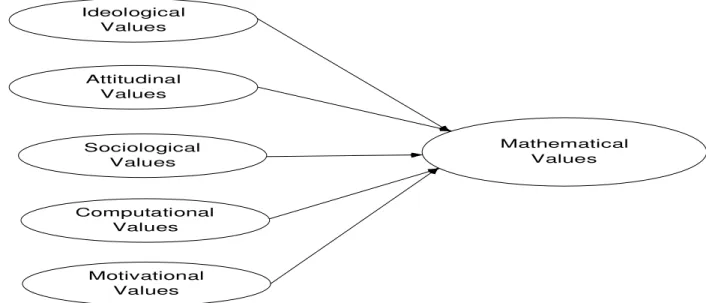
Conceptual model for the study
This study adopts and extends the three cluster model proposed by Bishop (1988). The three values clusters have been described as complementary pairs, where rationalism and objectivism are the twin ideologies of mathematics, those of control and progress are the attitudinal values which drive mathematical development, while sociologically, the values of openness and mystery
Liman et al. 11
are those related to potential ownership of, or distance from mathematical knowledge and the relationship between the people who generate that knowledge and other people in the society (Bishop, 1988).
The model depicts that there is a relationship between ideological and attitudinal mathematical values incul-cation, as well as between attitudinal and sociological mathematics values inculcation. Studies indicated that when mathematical values inculcation are imbibed through mathematical contents delivery, mathematics learners tend to show more commitment toward learning mathematics (White, 1959 and Bishop, 1988). Figure 1 gives the general conceptual model for mathematical values inculcation.
Research questions and hypotheses
The study sets to answer the following research questions and carry out analysis on the hypotheses based on the underlined conceptual frame-work used to understand the phenomenon under study. The questions include.
1. Do the variables measure the latent construct “ideological mathematical values”?
2. What is the effect of measuring the latent construct “attitudinal mathematical values”?
3. What is the outcome of measuring the latent construct “sociological mathematical values”?
4. Do the items measure the latent construct “computational mathematical values”?
5. What is the result of measuring the latent construct “motivational mathematical values”?
Research hypotheses
1. The variables will measure ideological mathematical values.
2. There will be a positive effect between a latent construct and the indicators of attitudinal mathematical values.
3. The variables will measure sociological mathematical values.
4. The observed variables will measure computational mathematical values.
5. The observed items will measure motivational mathematical values.
METHODOLOGY
Population and sample size
The data for the study were collected through a constructed 7- likertype survey questionnaire administered to mathematics teachers, at various levels of secondary schools system in the North eastern region of Nigeria. The region consists of six states namely Adamawa, Bauchi, Borno, Gombe, Taraba and Yobe State.
12 J. Lang. Cult. Ideological Values Mathematical Values Attitudinal Values Sociological Values Computational Values Motivational Values
Figure 1. Hypothesized mathematical values inculcation model.
Table 1. Sampling adequacy of required sample size.
Population size Confidence = 95% margin of error Confidence = 99% margin of error
5.0% 3.5% 2.5% 1.0% 5.0% 3.5% 2.5% 1.0%
400 196 265 318 384 250 309 348 391
500 217 306 377 475 285 365 421 485
1,200 291 474 674 1067 427 636 827 1119
1,500 306 515 759 1297 460 712 959 1376
Source: The research advisors (2006).
A stratified random sampling technique was used in obtaining the sample size of the study. The population of study was N=1145. Based on the population of study, n=509 was found to be the sample size of the study. The sample size used for the study was obtained on the basis of 3.5% margin of error and 95% confidence interval as well as the use of online sample size calculator (Krejcie and Morgan, 1970). In order to obtain the required sample size, 599 questionnaires were distributed to secondary schools mathematics teachers across the six states. Out of which, 530 questionnaires account for 88.5% were returned, 5 were totally not completed and 11 had one forms of mutilation or the other. As such, out of 530, 16, (3.0%) were null and void and 514 which account for 96.9% questionnaires were keyed in into the SPSS window Version 17.0. Thereafter, 5 responses to the questionnaires items, account for .9% were found to be outliers and they were removed from the analysis.
Tables 1 and 2 depict the details procedure.
Research instrument
A self-constructed survey instrument used for the data collection of the study consists of fifty two (52) items used for measuring the five (5) latent constructs of the study. Ideological mathematical values IDE) were measured by twelve (12) items while attitudinal mathematical values (ATT) were measured with twelve (12) items.
Similarly, sociological mathematical values (SOC) and compu-tational mathematical values (COM) were measured with seven (7) and twelve (12) items respectively. Lastly, Motivational mathe-matical values (MOT) were measured with nine (9) items. A seven point likert-type measuring scale of 1 to 7 with one (1) being Strongly Disagree (SD) and seven (7) being Strongly Agree (SA) as well as one (1) being Never (N) and seven (7) being Always (A) were the options presented to the respondents.
Normality of the study’s manifests
The 52 items were analysed using descriptive statistics. Each of the variables of the instrument of values inculcation in mathematics teaching and learning used in the study was summarized in Appendix II. The mean, standard deviation, and the normality distribution using the value of skewness and kurtosis were computed for each of the items. The range of mean score from 7-Likert scale was from 5.01 to 5.94 and the standard deviation was from 1.49 to 1.87, except for item COM37 which exhibited abnormality with standard deviation 3.57 higher than other items. The statistic values (z) of skewness and Kurtosis of all the items fell below the threshold of 3.0, except for the item COM37 with value of skewness and Kurtosis that violated the threshold of < 3.0 (Kline, 2011; Hair et al., 1998, 2010). The item “COM37” was then deleted from further analysis. Appendix I give the structure of the
Liman et al. 13
Table 2. Stratified sample size for mathematics teachers.
State Total no.
distributed Total returned Percentage returned Total usable Percentage usable Adamawa 103 92 89.3% 88 95.7% Bauchi 96 84 87.5% 81 96.4% Borno 108 97 89.8% 93 95.9% Gombe 96 84 87.5% 81 96.4% Taraba 93 82 88.2% 78 95.1% Yobe 103 91 88.3% 88 96.7% Total 599 530 88.5% 509 96.0%
Table 3. Cronbanch’s alpha for the Latent constructs of values inculcation.
Description No. of items Cronbach’s alpha Overall Cronbach’s alpha
Ideological mathematical values 12 0.836
0.945
Attitudinal mathematical values 12 0.833
Sociological mathematical values 07 0.762
Computational mathematical values 11 0.840
Motivational mathematical values 09 0.846
Total Number of Items 51
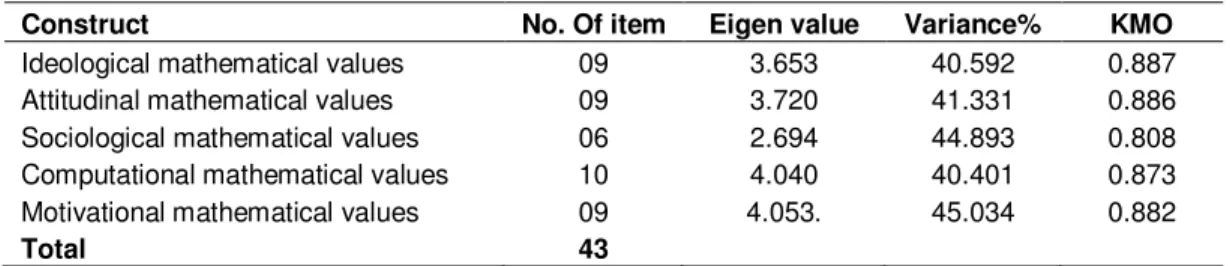
Table 4. Eigenvalues, variance and KMO for mathematical values inculcation measures.
Construct No. Of item Eigen value Variance% KMO
Ideological mathematical values 09 3.653 40.592 0.887
Attitudinal mathematical values 09 3.720 41.331 0.886
Sociological mathematical values 06 2.694 44.893 0.808
Computational mathematical values 10 4.040 40.401 0.873
Motivational mathematical values 09 4.053. 45.034 0.882
Total 43
mathematical values inculcation instrument used for this study.
Instrument validity and reliability
Prior to the administration of the instrument, the variables were subjected to face and content validity. Principal Component Analysis was used for extraction and Varimax used as the rotation method. The Kaiser-Meyer-Olkin measure of sampling adequacy (KMO) value of each construct’s manifests was ascertained. The Barllet’s Test of Sphericity and the Eigen value factor extraction method of each construct’s indicators were assessed. Cronbach’s Alpha was employed to ascertain the reliability of the instruments and the result of each construct shows values above 0.7 (Table 3) which indicates good internal consistency of the measure (Hair et al., 2010).
Factor analysis
Factor analysis is a type of validity study that ascertains whether a particular set of measures do or do not reflect measured latent
constructs (Allen and Yen, 1979; Straub, 1989). Therefore, in this study, factor analysis was performed on the latent constructs of values inculcation measures. The first factor analysis was conducted on ideological mathematical values variables followed by the variables pertaining to attitudinal, sociological, computational and motivational mathematical values. The criteria used in determining a cut-off loading point for factors are the consideration of factors with eigenvalues greater 1.0 and to interpret factors to determine which factor loadings are worth considering. This study adopts loadings of 0.50 as significant even though the sample size is greater than 120. Though the researchers have the liberty of choosing factor loadings lower than 0.50, they considered factor loadings of 0.50 as recommended in Hair et al. (2010).
Table 4 shows the results of Eigenvalues, percentage of variance explained and Kaiser-Meyer-Olkin Measure of Sampling adequacy (KMO) of the measures of values inculcation in mathematics teaching and learning. The analysis reveals that each construct of values inculcation in mathematics teaching and learning explains > 40% of the variance. Furthermore, factors with eigenvalue >1.0 were considered. The Kaiser-Meyer-Olkin Measure of sampling adequacy (KMO) of each construct is > 0.70 which is within the threshold as recommended by Hair et al. (2010). Therefore, the
14 J. Lang. Cult.
analysis shows the evidence of constructs validity as explained by the percentage of variance explained of each construct which clinches to threshold of 40 and above (Allen and Yen, 1979; Straub, 1989).
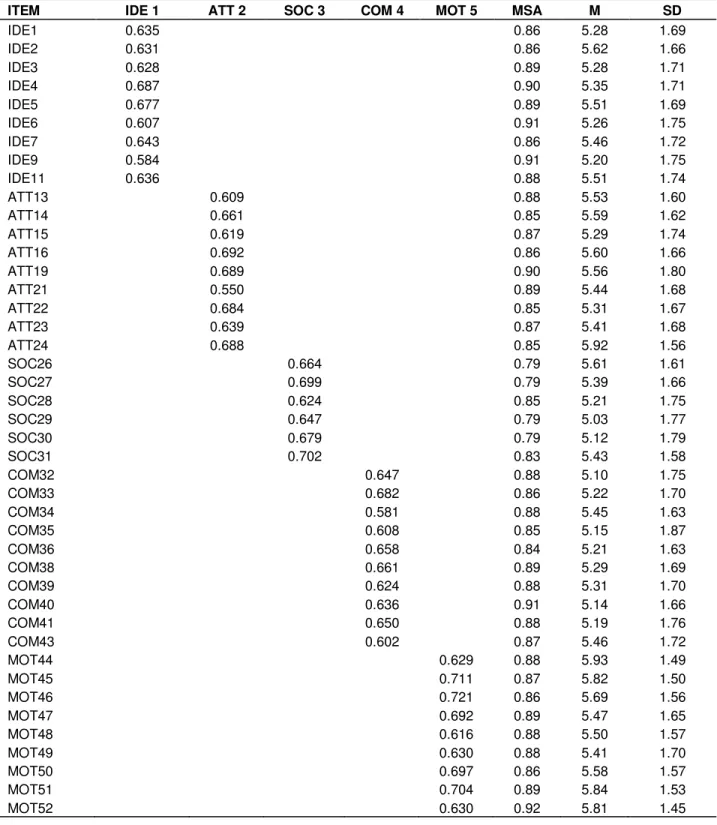
Table 5 shows the summary of the analysis of the 5-factor dimensions hypothesized to measure values inculcation in mathematics teaching and learning. The 5-dimensions include: ideological, attitudinal, sociological, computational and motivational mathematical values.
Table 5 shows the analysis of ideological mathematical values scale which consists of twelve items designed to measure values inculcation in mathematics teaching and learning. Out of the twelve items, nine items were successfully loaded on the factor with loadings ranging from 0.584 to 0.687. Items IDE8, IDE10 and IDE11 have one form of factorial violation each and as such they were dropped and the nine items which clinched to the factor with factor loading > 0.50 as set out by the researchers were retained. This converges to the acceptable threshold recommended by Hair et al. (2010). The measure of sampling adequacy of each measure is (MSA) > 0.50 and that gives support of the factor extraction procedure. In total, one factor solution explains 40.6% with an eigenvalue of 3.7 > 1. The analysis of the attitudinal mathematical values scale had twelve items designed to initially measure the latent construct “attitudinal mathematical values”, but eight items loaded appropriately to the factor with loading ranging from 0.550 to 0.688. The four items ATT17, ATT18 and ATT20 which failed clinching to the construct were deleted. The analysis reveals that all the factors loading to the construct attitudinal mathematical
values exceed the threshold of 0.50 and as a result the items were retained. The measure of sampling adequacy of each item is greater than 0.50 and that gives adequate support of the factor extraction technique. The mean and standard deviation are within the range of 5.29 to 5.90 and 1.56 to 1.80. In terms of variance of the measures, the factor explains 41.3% with an eigenvalue of 3.7 >1 (Hair et al., 2010).
The sociological mathematical values scale consists of seven items proposed to measure values inculcation in mathematics teaching and learning among the secondary schools mathematics teachers in the North eastern region of Nigeria. Six out of the seven items converged to the latent construct sociological mathematical values as shown in Table 5. The factor loadings are within the range of 0.624 to 0.702 and also within the cut-off point of 0.50 and above as set out by the researchers. The mean and standard deviation of the measures are between 5.03 to 5.61 and 1.58 to 1.79. Similarly, the measure of sampling adequacy (MSA) of each item stands to be > 0.50 which gives adequate support for the factor extraction method. The results of this analysis show that the factor variance explained 44.9% with an acceptable eigenvalue of 2.7 >1.0 as recommended by Hair et al. (2010).
The analysis of computational mathematical values inculcation construct reveals that ten items out of the proposed twelve converged to the construct. Item COM37 and COM 42 have factorial violation respectively. The remaining items’ factor loadings exceeded 0.50 and the loading ranged from 0.581 to 0.682 which is an indication of strong inter items correlation among the measures. The measure of sampling adequacy (MSA) of each item ranges from 0.849 to 0.913, while the mean score and the standard deviation of the measures range between 5.41 to 5.93 and 1.49 to 1.70 respectively. The percentage of variance of the measure is reported to be 40.4%, with an eigenvalue of 4.0 >1.0.
Table 5 provided the results of factor loadings, measure of sampling adequacy (MSA) of each item, mean and standard deviation of the motivational mathematical values inculcation construct. All the nine items proposed to measure the latent construct consistently loaded to the construct. The examination of the analysis revealed that factor loadings of the items range from 0.616 to 0.711, while the range of (MSA) was between 0.858 and 0.923. Furthermore, the mean and standard deviation of the
measures stand between the range of 5.47 to 5.93 and 1.45 to 1.70 respectively. The variance explained by the factor was 45.0% with an eigenvalue 4.1 > 1.0. This analysis revealed that the factor loadings of the measures were within the cut-off point of 0.50 and above (Hair et al., 2010).
DISCUSSION
In line with the objective of the study, the findings revealed that the measures of values inculcation in mathematics teaching and learning, as hypothesized, had clinched to the underlying five factor dimensions (Table 5). Furthermore, as advocated by Bishop and Clarkson (1998), Bishop et al. (2010) and Liman et al. (2011ab) ideological mathematical values is an important construct in measuring teaching and learning of mathematics more especially at the grass root level of mathematics education, such as secondary schools. This is because, secondary schools’ level mathematics education required cultivation of learners’ interest and infusing learners’ minds to have values attached to the subject. Ideological mathematical values as one of construct for values inculcation referred to those mathematical values derived from objectivism and rationalism of mathematics as a school subject. This finding concurred with the previous findings of Bishop (1988), 1999, Dede (2011) and Liman et al. (2011ab), respectively.
Going by the analysis of measures of attitudinal mathematical values in Tables 3, 4 and 5 revealed that the items had really measured the construct. This finding supported the findings of Dede (2011) and liman et al. (2011ab). Attitudinal mathematical values as the second construct for values inculcation in mathematics teaching and learning referred to those values associated with control and progress of learners of mathematics (Bishop, 1988, 1999; Bishop and Clarkson, 1998; Liman et al., 2011ab). These values include: positive feeling among students learning mathematics, confidence in handling mathematical problems, humbleness and a sense of maturity in the course of mathematical problem solving interactive session, creation of lovely atmosphere for mathematics teaching and learning encounter and cultivating the culture of punctuality among students learning mathematics.
The items measuring the third construct for values inculcation in mathematics teaching and learning tagged “sociological mathematical values” had really measured it (Tables 3, 4 and 5). Sociological mathematical values are those values related to openness and mystery of mathematics teaching and learning. The classification of these values includes: joyful atmosphere for mathematics teaching and learning, equality in treatment of mathema-tics students’ “social justice”, project based mathemamathema-tics learning which ultimately promotes the value of “friend-ships” among students, freedom of expression of mathematical ideas “democratization” and among other positive social tendencies. This finding re- affirmed the findings of Bishop (1998, 1999), Dede (2011) and Liman
Liman et al. 15
Table 5. Exploratory factor analysis (EFA) result for the constructs of values inculcation in mathematics teaching and learning.
ITEM IDE 1 ATT 2 SOC 3 COM 4 MOT 5 MSA M SD
IDE1 0.635 0.86 5.28 1.69 IDE2 0.631 0.86 5.62 1.66 IDE3 0.628 0.89 5.28 1.71 IDE4 0.687 0.90 5.35 1.71 IDE5 0.677 0.89 5.51 1.69 IDE6 0.607 0.91 5.26 1.75 IDE7 0.643 0.86 5.46 1.72 IDE9 0.584 0.91 5.20 1.75 IDE11 0.636 0.88 5.51 1.74 ATT13 0.609 0.88 5.53 1.60 ATT14 0.661 0.85 5.59 1.62 ATT15 0.619 0.87 5.29 1.74 ATT16 0.692 0.86 5.60 1.66 ATT19 0.689 0.90 5.56 1.80 ATT21 0.550 0.89 5.44 1.68 ATT22 0.684 0.85 5.31 1.67 ATT23 0.639 0.87 5.41 1.68 ATT24 0.688 0.85 5.92 1.56 SOC26 0.664 0.79 5.61 1.61 SOC27 0.699 0.79 5.39 1.66 SOC28 0.624 0.85 5.21 1.75 SOC29 0.647 0.79 5.03 1.77 SOC30 0.679 0.79 5.12 1.79 SOC31 0.702 0.83 5.43 1.58 COM32 0.647 0.88 5.10 1.75 COM33 0.682 0.86 5.22 1.70 COM34 0.581 0.88 5.45 1.63 COM35 0.608 0.85 5.15 1.87 COM36 0.658 0.84 5.21 1.63 COM38 0.661 0.89 5.29 1.69 COM39 0.624 0.88 5.31 1.70 COM40 0.636 0.91 5.14 1.66 COM41 0.650 0.88 5.19 1.76 COM43 0.602 0.87 5.46 1.72 MOT44 0.629 0.88 5.93 1.49 MOT45 0.711 0.87 5.82 1.50 MOT46 0.721 0.86 5.69 1.56 MOT47 0.692 0.89 5.47 1.65 MOT48 0.616 0.88 5.50 1.57 MOT49 0.630 0.88 5.41 1.70 MOT50 0.697 0.86 5.58 1.57 MOT51 0.704 0.89 5.84 1.53 MOT52 0.630 0.92 5.81 1.45
Note: Factor loadings less than .50 have been omitted and variables have been sorted by loading on each factor. IDE=Ideological mathematical values, ATT=Attitudinal mathematical values, SOC=Sociological mathematical values, COM=Computational mathematical values, MOT=Motivational mathematical values, MSA=Measure of sampling adequacy, M=Mean and SD=Standard deviation of each item.
et al. (2011) respectively.
The manifests of the computational mathematical
values as fourth construct for values inculcation in mathe-matics teaching and learning encounter proved to be
16 J. Lang. Cult.
good measures (Table 3, 4 and 5). Computational mathe-matical values referred to those values associated with computer applications and usages. It was advocated that computer applications and usage facilitate effective mathematics instructional contents delivery (Basturk, 2005). The computational mathematical values incul-cation measures include: creation of a curious mind, self management and control, cultivating learners’ interest and attention, cultivation of value of neatness and beauty, self discovery and instant feedback. This finding supported the findings of Basturk (2005).
The analysis of the variables measuring the fifth construct for values inculcation in mathematics teaching and learning encounter revealed a consistent result between the measures and the latent construct (Table 3, 4 and 5). Motivational mathematical values are intimately linked to the ways students think, feel, and act in schools where there is mathematics teaching and learning. These values include: rewarding higher achievers and encou-raging the lower ones, unveiling incentives attached to the learning of mathematics, cultivating the culture of perseverance and diligence. This finding confirmed the findings of Fennema (1989) and Schoenfeld (1992).
Finally, the hypothesized 5-dimension for values inculcation in mathematics teaching and learning sup-ported the data (Table 3, 4 and 5). Measures of values inculcation in mathematics teaching and learning were developed through review of a number of researches conducted qualitatively in the area of mathematics education. The measures were subjected to a number of validation processes such as face validity, content validity and exploratory factor analysis in order to find out the factor dimensions of the mathematical values inculcation measures.
Practical contributions and implications for practice A value study in mathematics education is very im-portance in the sense that it enables understanding of mathematics teaching and learning. Therefore, this study can contribute to the practical knowledge of mathematics teachers about the values they inculcate in mathematics classrooms. In terms of measures, the study offers practical knowledge as the measures can now be used by mathematics educators interested in researching values education in mathematics teaching and learning. This study also provides insights into the issue of values inculcation in mathematical contents delivery in such a way that mathematics teachers in secondary schools, institutions of higher learning, mathematics curriculum planner/designers, educational policy makers and all others stakeholders in education will be able to embrace and emphasize facilitating and implementing values based teaching and learning of mathematics. Educational policy makers should ensure adequate support in terms of the implementation of the enactment of values based
mathematics education. They should ensure proper allocation of resources towards realizing mathematical values inculcation in mathematics classroom teaching and learning.
Conclusion
The findings of this study will have important implications for all stakeholders especially mathematics educators, mathematics curriculum designers, educational admini-strators and policy makers on how to improve values inculcation in mathematical content delivery. Mathematics teachers should ensure and endeavour to inculcate the values that are imbedded in mathematical contents to the learners of mathematics. They should enable learners to see the beauty of learning the mathematics rather than debunking the procedural aspect of mathematical contents delivery. Although they are interwoven in actualizing the ultimate objective of inculcating values in the teaching of mathematics, teachers should never-he-less emphasize values. Mathematics curriculum design-ners should be mindful in spelling out values conveyed in each mathematical text-module. This will enable mathe-matics teachers easy conveyance of values to learners. Educational administrators and policy makers exert greater efforts in ensuring effective values conveyance in mathematics classroom teaching and learning with laudable policies such as train the trainers’ workshop, mathematical symposium and further in-service training of mathematics teachers. Furthermore, future studies may examine the evaluation of the measurement model for values inculcation in mathematical contents delivery through confirmatory factor analysis (CFA). This will provide greater insights to values inculcation in mathe-matics teaching and learning in the North eastern region of Nigeria.
REFERENCES
Allen MJ, Yen WM (1979). Introduction to measurement theory. Monterey: Brooks-Cole.
Basturk R (2005). The Effectiveness of Computer-Assisted Instruction in Teaching Introductory Statistics. J. Educ. Technol. Soc. 8(2):170-178. Beck C (1993). Learning to live the good life: values in adulthood.
Toronto: OISE Press.
Bishop AJ (1988). Mathematical Enculturation: A cultural perspective in Mathematics Education.Dordrecht, Holland: Kluwer.
Bishop AJ, Clarkson P (1998). What values do you think you are teaching when you teach mathematics? In: Gough J & Mousley J (Eds.), Mathematics: Exploring all angles (pp.30-38). Melbourne: Mathematical Association of Victoria.
Bishop AJ, Gunstone D, Clarke B, Corrigan D (2010). Values in mathematics and science education: Researchers' and teachers' views on the similarities and differences for the Learning of Mathematic 26(1):7-11.
Dede Y (2011). Mathematics Education Values Questionnaire for Turkish Pre-service Mathematics Teachers: Design, Validation and Results. Int. J. Sci. Math. Educ. 9:603-626.
Fennema E (1989). The Study of Affect and Mathematics: A Proposal Generic Model for Research. In: McLeod DB, Adams VM (Eds.)
Affect and mathematical problem solving: A new perspective (pp.205-219). Springer, New York.
Grundstein-Amado R (1995). Values education: a new direction for medical education. J. Medical Ethics 21:174-178.
Hair JF, Black WC, Babin BJ, Anderson RE (2010). Multivariate Data Analysis. A global perspective. published by Pearson Education, Inc., Upper saddle River, New Jersey 07458.
Kline RB (2011). Principles and Practice of Structural Equation Modeling. London, The Guilford press.
Kluckhohn C (1951). Values and value-orientations in the theory of action: an exploration in definition and classification. In: Parson T, Shils EA, (eds). Toward a general theory of action.Cambridge, MA: Harvard University Press.
Kluckhohn FR, Strodtbeck FL (1961). Variations in Value Orientations.
Evanston, Illinois: Row, Person and Company.
Liman MA, Ibrahim MB, Shittu AT (2011a). Exploratory Factor Analysis: Validation of Mathematical Values Inculcation Model among Secondary Schools’ Mathematics Teachers in North-Eastern Region Nigeria. Interdiscipl. J. Contemp. Res. Bus. 3(1):64-72.
Liman et al. 17
Liman MA, Sahari MN, Shittu AT (2011b). Confirmatory Factor Analysis: The Validation of Mathematical Values Inculcation Path Measurement Model Among Secondary Schools’ Mathematics Teachers’ in the North-Eastern Region, Nigeria. Inter-discipl. J. Contemp. Res. Bus. 2(11):660-666.
Rokeach M (1973). The nature of human values. New York: The Free Press.
Schoenfeld A (1992). ‘Learning to think mathematically: problem solving, meta cognition and sense making in mathematics’, In: Grows DA (ed.), Handbook of Research on Mathematics Teaching and Learning, MacMillan, New York pp.334-370.
Straub D (1989). Validiting instrument in management of information system research. J. Manag. Info. Syst. Quart. 13(2):147-169. White LA (1959). The evolution of culture. New York: McGraw-Hill.
APPENDIX I
QUESTIONNAIRE ON SECONDARY SCHOOL MATHEMATICS TEACHERS’ATTITUDE TO AND COMPETENCE IN MATHEMATICAL VALUES INCULCATION
This questionnaire is designed to obtain information on relevant responses on the above referenced research. You are required to read carefully and provide authentic ratings of your opinion on each item as indicated. Please feel free to response as your responses will be treated with strict confidentiality.
Please indicate or tick () as appropriate. Section A: Demographic information
School Type: Private or Public
Sex: Male Female
Age: ……….
Tribe: Kanuri Hausa Fulani Yoruba Igbo
Others, please list ……… Qualification: Diploma (Maths/Education) NCE (Mathematics) B. SC Ed (Mathematics) B.SC (Mathematics)
Others (Please mention) ………..
Number of years you have been teaching mathematics………..
S/No.
Section B
Ideological mathematical values
Never Always 1 2 3 4 5 6 7
1. I emphasize on the value of precision in my mathematics teaching. O O O O O O O
2. Logical reasoning is one of the values I encourage in my mathematics teaching.
O O O O O O O
3. In my mathematics teaching, I emphasize on the value of working collaboratively.
O O O O O O O
4. The teaching of equations enables me to convey the value of equality in treatment to my students.
O O O O O O O
5. I cultivate the value of truthfulness in my mathematics teaching and learning.
O O O O O O O
6. Perseverance is one value I encourage in my mathematics teaching and learning.
O O O O O O O
7. In teaching mathematics, I encourage the value of competency in problem solving of my students.
O O O O O O O
8. I emphasize on the value of self-reliance in my mathematics teaching.
O O O O O O O
9. The teaching of ratios and proportions enable me to convey the value of honesty to my students.
O O O O O O O
10. In problem solving, I recommend the value of patience to my students.
O O O O O O O
11. By asking applied questions, I encourage the value of critical thinking of my students.
12. The portrayals of my good mannerism in my mathematics teaching enable me to cultivate the value of self-discipline of my students.
O O O O O O O
S/No. Section C
Attitudinal mathematical values
Never Always 1 2 3 4 5 6 7
13. Mathematical classroom discussions enable me to convey the value of positive feeling to my students.
O O O O O O O
14. Individual mathematical assignment presentations enable me to cultivate the value of confidence in my students.
O O O O O O O
15. Attending to my students’ mathematical problems enable me to convey the value of humbleness to my students.
O O O O O O O
16. I act as a source of guidance to students in my mathematics teaching.
O O O O O O O
17. I cultivate the value of kindness in my mathematics teaching through giving make-up assignment to my students.
O O O O O O O
18. By listening to mathematical problems of my students, I cultivate in them the value of love.
O O O O O O O
19. Punctuality is one of the values I emphasize in my mathematics teaching and learning.
O O O O O O O
20. Mathematics group project enable me to cultivate the value of similarities among my students.
O O O O O O O
21. In my teaching, I comfort those students who have difficulty in mathematics learning.
O O O O O O O
22. By allowing students to explore on mathematical problems, I cultivate in them the value of creativity.
O O O O O O O
23. Illustration of different methods of mathematical problem solving, I cultivate the value of innovative tendency in my students.
O O O O O O O
24. I emphasize on the value of “practice make perfect” in my mathematics teaching.
O O O O O O O
S/No. Section D
Sociological mathematical values
Strongly Strongly Disagree Agreed 1 2 3 4 5 6 7
25. By using puzzles and riddles, I create joyful atmosphere of mathematics teaching and learning.
O O O O O O O
26. Equal treatments of my students in my mathematics teaching enable me to convey the value of social justice.
O O O O O O O
27. Mathematical knowledge sharing among students via project based learning promotes the value of friendships.
O O O O O O O
28. By allowing individual contributions to mathematics teaching and learning of my students, I emphasize on the value of being democratic.
O O O O O O O
29. Appreciation of the beauty of nature is one of the values I convey in my mathematics teaching of geometrical shapes, in comparison with plants and architectural design.
O O O O O O O
30. I organize mathematics career talk on values attached to mathematics as a discipline.
O O O O O O O
31. In teaching the concepts of probability, I emphasize on the value of predictive tendencies of my students.
O O O O O O O
S/No. Section E
Computational mathematical values
Strongly Strongly Disagree Agreed 1 2 3 4 5 6 7
32. I inculcate the value of curiosity in my students via mathematics computer aided instruction (CAI).
33. Mathematics computer aided instruction (CAI) serve as a means of inculcating the value of self management in my students.
O O O O O O O
34. Mathematics examples provided by means of computer cultivate the value of interest in learning mathematics of my students.
O O O O O O O
35. Mathematics computer aided instruction (CAI) enables me to emphasize on the value of immediate feedback to my students.
O O O O O O O
36. Mathematics computer aided instruction (CAI) enables me to inculcate the value of self organization in my students.
O O O O O O O
37. Mathematics instruction via computer enables me to convey the value of self confidence in my students.
O O O O O O O
38. Mathematics computer aided instruction (CAI) enables me cultivate the value of social interaction in my students.
O O O O O O O
39. Presentations of mathematics instruction via computers enable me to convey the value of accuracy in my students.
O O O O O O O
40. Mathematics instruction via computer enables me to emphasize on the value of preciseness in my students.
O O O O O O O
41. Mathematics interactive learning via computers cultivates the value of self dependency of my students.
O O O O O O O
42. Mathematics computer graphics enable me to inculcate the value of beauty in my students.
O O O O O O O
43. Mathematics computer aided instruction (CAI) enables me to cultivate the value of self discovery learning of my students.
O O O O O O O
S/No. Section F
Motivational mathematical values
Strongly Strongly Disagree Agreed 1 2 3 4 5 6 7
44. I cultivate the value of hardworking in my mathematics students by rewarding best performance.
O O O O O O O
45. In my mathematics teaching, I motivate my students by telling them benefits attributed to the learning mathematics.
O O O O O O O
46. I motivate my mathematics students by relating mathematics teaching to what they knew in their environment.
O O O O O O O
47. I emphasize on the value of perseverance in my mathematics teaching via problem solving of tough questions.
O O O O O O O
48. I motivate my mathematics students by telling them the story of past famous mathematicians.
O O O O O O O
49. I motivate my mathematics students by seeing me as their role model. O O O O O O O
50. I motivate my mathematics students by telling them great inventions derived from mathematics discovery.
O O O O O O O
51. I emphasize on the value of positive believe that mathematics is not a difficult subject by giving example of higher achieving mathematics students.
O O O O O O O
52. I emphasize on the value of appreciation in my mathematics teaching using positive reinforcements.
O O O O O O O
Appendix II. Distributions of variables of the study.
Tem Mean statistic Std. deviation statistic Skewness statistic Kurtosis statistic Q1 5.2809 1.68763 -.918 .043 Q2 5.6228 1.65747 -1.350 1.053 Q3 5.2790 1.70824 -.766 -.369
Appendix II. Contd. Q4 5.3497 1.70787 -.988 .089 Q5 5.5069 1.69252 -1.083 .243 Q6 5.2613 1.74803 -.944 -.022 Q7 5.4597 1.71746 -1.111 .320 Q8 5.0138 1.93644 -.682 -.692 Q9 5.2004 1.75439 -.859 -.221 Q10 5.4617 1.77499 -1.153 .312 Q11 5.5088 1.73954 -1.124 .306 Q12 5.3831 1.71738 -1.042 .201 Q13 5.5521 1.60454 -1.287 1.028 Q14 5.5874 1.62374 -1.240 .782 Q15 5.2868 1.74345 -.927 -.076 Q16 5.6031 1.66355 -1.217 .616 Q17 5.1965 1.79805 -.900 -.218 Q18 5.3104 1.82877 -1.035 .014 Q19 5.5560 1.80204 -1.240 .491 Q20 5.3281 1.63513 -1.025 .293 Q21 5.4381 1.67620 -1.041 .210 Q22 5.3143 1.67173 -.901 -.088 Q23 5.4067 1.67592 -1.046 .220 Q24 5.8998 1.56354 -1.639 2.021 Q25 5.5639 1.78421 -1.324 .716 Q26 5.6051 1.60807 -1.249 .813 Q27 5.3949 1.65868 -1.116 .501 Q28 5.2083 1.74785 -.963 .033 Q29 5.0295 1.76836 -.795 -.281 Q30 5.1238 1.79084 -.771 -.416 Q31 5.4263 1.58393 -1.063 .591 Q32 5.0963 1.74692 -.726 -.407 Q33 5.2240 1.69904 -.907 .030 Q34 5.4499 1.63257 -1.101 .509 Q35 5.1532 1.86875 -.920 -.223 Q36 5.2122 1.63083 -.782 -.201 Q37 5.3733 3.57459 15.108 300.721 Q38 5.2868 1.69071 -.871 -.136 Q39 5.3124 1.70301 -.966 .102 Q40 5.1375 1.66031 -.764 -.252 Q41 5.1866 1.76429 -.875 -.156 Q42 5.0373 1.85725 -.786 -.439 Q43 5.4578 1.71741 -1.089 .180 Q44 5.9371 1.49144 -1.701 2.471 Q45 5.8232 1.50071 -1.535 1.780 Q46 5.6935 1.56373 -1.303 .973 Q47 5.4695 1.65343 -1.094 .332 Q48 5.5010 1.59431 -1.184 .741 Q49 5.4126 1.70303 -1.061 .247 Q50 5.5815 1.57232 -1.164 .668 Q51 5.8350 1.53190 -1.498 1.623 Q52 5.8114 1.44988 -1.563 2.191