WEB-BASED LEARNING TOOL: DESIGN AND DEVELOPMENT OF AN ONLINE BASIC ENGLISH SUPPORT MATERIAL FOR YOUNG CHILDREN
AT ELEMENTARY LEVEL
A THESIS SUBMITTED TO
THE GRADUATE SCHOOL OF NATURAL AND APPLIED SCIENCES OF
THE MIDDLE EAST TECHNICAL UNIVERSITY
BY
LEVENT DURDU
IN PARTIAL FULFILLMENT OF THE REQUIREMENTS FOR THE DEGREE OF MASTER OF SCIENCE
IN
THE DEPARTMENT OF COMPUTER EDUCATION AND INSTRUCTIONAL TECHNOLOGY
Approval of the Graduate School of Natural and Applied Sciences
____________________________ Prof. Dr. Canan ÖZGEN
Director
I certify that this thesis satisfies all the requirements as a thesis for the degree of Master of Science.
____________________________
Prof. Dr. M. Yaşar ÖZDEN Head of Department
This is to certify that we have read this thesis and that in our opinion it is fully adequate, in scope and quality, as a thesis for the degree of Master of Science.
____________________________
Prof. Dr. M. Yaşar ÖZDEN Supervisor
Examining Committee Members
Prof. Dr. M. Yaşar ÖZDEN ____________________________
Assoc. Prof. Dr. Safure BULUT ____________________________
Asst. Prof. Dr. Zahide YILDIRIM ____________________________
Asst. Prof. Dr. Soner YILDIRIM ____________________________
ABSTRACT
WEB-BASED LEARNING TOOL: DESIGN AND
DEVELOPMENT OF AN ONLINE BASIC ENGLISH
SUPPORT MATERIAL FOR YOUNG CHILDREN
AT ELEMENTARY LEVEL
Durdu, Levent
M.S., Department of Computer Education and Instructional Technology
Supervisor: Prof. Dr. M. Yaşar ÖZDEN
September 2003, 110 pages
This study investigated the students’ and teacher’s perception of a web-based learning tool for an English course which was given as a second language at elementary level. The site was used as a supplementary material for 8th grade students in METU College.
The researcher developed the site specifically for this study and in the development process internet and database technologies were used.
The data were collected from the 22, 8th grade students through a computer attitude
scale and a questionnaire, which was developed by the researcher. An interview with the course teacher was conducted. Descriptive statistics, frequency distributions and researcher observation were used to express the results of the study.
The results showed that the site was perceived positively by more than half of the students in terms of vocabulary learning through the dictionary and activities page. The site was evaluated by the students and nearly most of the students found the site to be useful in terms of acquiring hearsay through the dictionary and the chat page of the site. More than half of the students perceived the chat environment more suitable for communication than classroom environment. The course teacher evaluated the site to be useful in terms of vocabulary learning, hearsay and online communication.
Keywords: Second language learning, computer-assisted language learning, online communication.
ÖZ
WEB-TABANLI ÖĞRENME ARACI: ORTAOKUL
SEVİYESİNDEKİ ÇOCUKLAR İÇİN ÇEVRİMİÇİ
TEMEL İNGİLİZCE DESTEK MATERYALİNİN
TASARIMI VE GELİŞTİRİLMESİ
Durdu, Levent
Yüksek Lisans, Bilgisayar ve Öğretim Teknolojileri Eğitimi Bölümü
Tez Yöneticisi: Prof. Dr. M. Yaşar ÖZDEN
Eylül 2003, 110 sayfa
Bu çalışmanın amacı ortaokul öğrencilerine yönelik ikinci dil olarak verilen İngilizce dersi için hazırlanan web tabanlı öğrenme aracının öğrenci ve öğretmen algılarını
araştırmaktır. Site ODTÜ Koleji’nde 8. sınıf öğrencilerine destek aracı olarak hazırlanmıştır. Site özellikle bu çalışma için internet ve veritabanı teknolojileri kullanılarak araştırmacı tarafından geliştirilmiştir.
Veriler 8. sınıfa devam eden 22 öğrenci üzerinde yapılan bilgisayara karşı tutum testi ve araştırmacı tarafından hazırlanan anket ve ders öğretmeni ile yapılan görüşme ile toplanmıştır. Araştırmanın sonuçları betimsel istatistik, frekans dağılımları ve araştırmacı
gözlemleri vasıtası ile sunulmuştur.
Araştırmanın sonuçları göstermiştir ki sitede bulunan sözlük sayfası ve aktiviteler sayfası
kelime öğrenimi açısından öğrencilerin yarısından fazlası tarafından olumlu olarak algılanmıştır. Site içersinde bulunan sözlük sayfası ve sohbet sayfası kulak dolgunluğu kazanımı açısından yaklaşık çoğu öğrenci tarafından yararlı olarak değerlendirilmiştir. Öğrencilerin yarısından fazlası sohbet ortamının tartışma için sınıf ortamından daha uygun olduğunu belirtmişlerdir. Ders öğretmeni siteyi kelime öğrenme, kulak dolgunluğu ve çevrimiçi iletişim açısından yararlı olarak değerlendirmiştir.
Anahtar Kelimeler:İkinci dil öğrenimi, bilgisayar destekli dil öğrenimi, çevrimiçi iletişim.
ACKNOWLEDGEMENTS
Firstly and the foremost, I would like express my deep appreciation to my thesis supervisor Prof. Dr. M. Yaşar Özden for his guidance, support and encouragement throughout the study.
I would like to express my sincere gratitude to examination committee members, Assoc. Prof. Dr. Safure Bulut, Asst. Prof. Dr. Zahide Yıldırım, Asst. Prof. Dr. Soner Yıldırım and Dr. Hasan Karaaslan for their valuable suggestions and comments.
I would like to thank to Asst. Prof. Dr. Ercan Kiraz, Asst. Prof. Dr. Soner Yıldırım and Asst. Prof. Dr. Zahide Yıldırım for their assistance in preparing the instrument of the study.
I would like to thanks Meltem Koca, Nazlan Bilgen, Şule Ayaz, Halil Ersoy, Levent Bayram, M. Banu Gündoğan and Erol Özçelik for their valuable support and help throughout the study.
Finally, I would like to express my love and deep gratitude to all members of my family and my fiancé, Pınar Onay, for their patience, encouragement and for their unwavering faith in me.
TABLE OF CONTENTS
ABSTRACT ... iii
ÖZ ... v
ACKNOWLEDGEMENT ... vii
TABLE OF CONTENTS... viii
LIST OF TABLES... xi
LIST OF FIGURES ... xiii
CHAPTER 1. INTRODUCTION... 1
1.1 Background of the Study... 1
1.2 Statement of the Problem ... 4
1.3 Purpose of the Study... 5
1.4 Significance of the Study ... 7
1.5 Definitions of Terms... 8
2. REVIEW OF LITERATURE... 10
2.1 Use of Computers in Education... 10
2.2 Computer Assisted Language Learning... 16
2.2.1 History of CALL ... 17
2.2.2 Vocabulary Learning in CALL ... 20
2.2.3 Communication in CALL ... 24
2.2.4 Listening and Pronunciation in CALL... 28
2.3 MS-Agent Technology... 31
2.4 Summary ... 32
3. METHODOLOGY ... 34
3.1 Research Questions ... 34
3.2 Design of the Study... 35
3.4 Participants ... 40
3.5 Instruments... 40
3.5.1 Computer Attitude Scale... 40
3.5.2 Students’ Perceptions about the Web-based Learning Tool Questionnaire ... 41
3.5.2.1 Dictionary Page Related Questions ... 42
3.5.2.2 Activities Page Related Questions ... 44
3.5.2.3 Chat Page Related Questions ... 45
3.5.2.4 MS-Agent Character Related Questions ... 46
3.5.3 Interview on Teacher’s Perception about the Web-based Learning Tool... 47
3.6 Data Collection Procedures ... 48
3.7 Data Analysis Procedure... 48
3.8 Assumptions... 49
3.9 Limitations... 49
4. RESULTS ... 51
4.1 Characteristics of the Participants... 51
4.2 Students’ Attitudes Toward Computers... 52
4.3 Students’ Perceptions about the Web-based Learning Tool... 53
4.3.1 Students’ Perceptions about the Web-based Learning Tool in terms of Vocabulary Learning... 53
4.3.1.1 Students’ Perceptions about the Dictionary Page in terms of Vocabulary Learning... 54
4.3.1.2 Students’ Perceptions about the Activities Page in terms of Vocabulary Learning... 55
4.3.2 Students’ Perceptions of the Web-based Learning Tool in terms of Hearsay ... 58
4.3.2.1 Students’ Perceptions about the Dictionary Page in terms of Hearsay ... 58
4.3.2.2 Students’ Perceptions about the Chat Page in terms of Hearsay ... 62
4.3.3 Students’ Perceptions about the Web-based Learning Tool in terms of Communication... 63
4.3.4 Problems That Students Faced While Using the
Web-based Learning Tool... 67
4.3.5 How Should the Web-based Learning Tool Improved to be more Effective... 69
4.3.6 Students’ Perceptions about the MS-Agent Character ... 71
4.4 Teacher’s Perception about the Web-based Learning Tool... 73
4.4.1 Teacher’s Perception about the Vocabulary Learning... 74
4.4.2 Teacher’s Perceptions about the Hearsay... 75
4.4.3 Teacher’s Perceptions about the Communication ... 75
4.4.4 Teacher’s Perceptions about the MS-Agent Character... 76
5. DISCUSSION, CONCLUSIONS AND RECOMMENDATIONS ... 77
5.1 Discussion... 77
5.1.1 Vocabulary Learning... 78
5.1.2 Hearsay ... 80
5.1.3 Communication... 81
5.1.4 Problems of the Pages and Expectations ... 83
5.1.5 The MS-Agent Character ... 84
5.2 Conclusions ... 84
5.3 Recommendations for Practice ... 85
5.4 Recommendations for Researchers... 86
5.5 Recommendations for Future Research... 87
REFERENCES... 89
APPENDICES A. Computer Attitude Scale... 96
B. Students’ Perceptions of the Web-based Learning Tool Questionnaire... 100
C. Teacher Interview Questions ... 104
LIST OF TABLES
TABLE
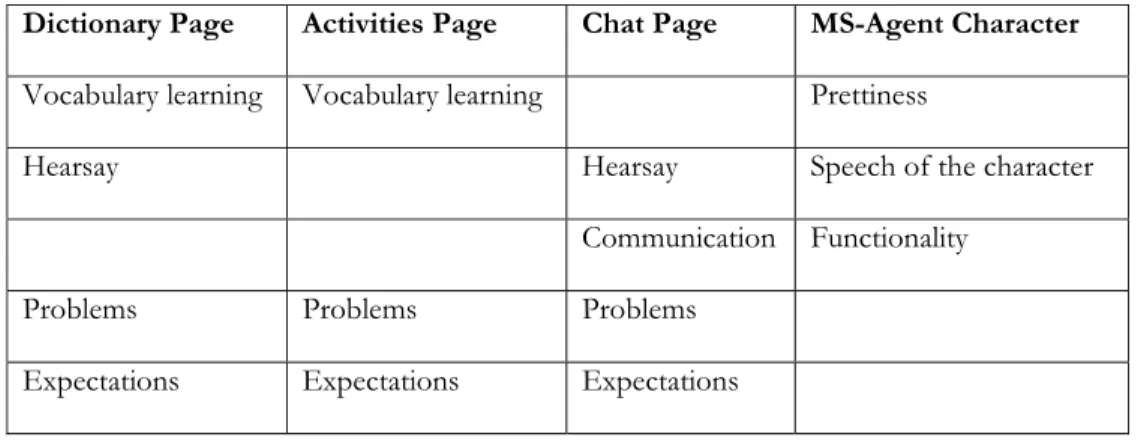
3.1 Students’ perceptions questionnaire main and sub-categories ... 42
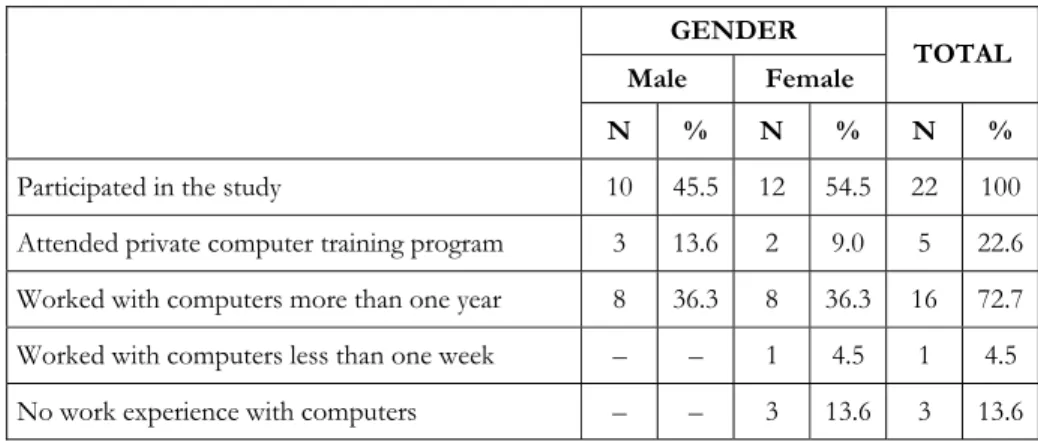
4.1 Characteristics of participants... 52
4.2 Summary of sub-scales of the CAS... 52
4.3 Students’ perceptions about the dictionary page in terms vocabulary learning ... 54
4.4 Students’ perceptions about the activities page in terms vocabulary learning ... 57
4.5 Students’ perception about the dictionary page usage summary ... 59
4.6 Students’ perceptions about the dictionary page in terms hearsay ... 60
4.7 Students experiences in terms of pronouncing ... 61
4.8 Students’ perceptions about the chat page in terms hearsay ... 62
4.9 Students previous chat use ... 64
4.10 Students’ perceptions on the comparison of the chat environment with the classroom environment in terms of expressing their ideas ... 64
4.11 Students’ perceptions on the comparison of the chat environment with the classroom environment... 66
4.12 Students’ perceptions about the use of the chat environment... 67
4.13 Students’ perceptions about the dictionary page in terms of problems ... 68
4.14 Students’ perceptions about the chat page in terms of problems... 68
4.15 Students’ perceptions about the activities page in terms of problems... 69
4.16 Students’ perceptions about the dictionary page in terms of expectations ... 70
4.17 Students’ perceptions about the activities page in terms of expectations ... 70
4.18 Students’ perceptions about the activities page in terms of expectations ... 71
4.19 Students’ perceptions about the Merlin character in terms its prettiness... 71
4.21 Students perceptions about the speech of
Merlin character in terms of understandability... 72 4.22 Students’ perceptions about the Merlin character
LIST OF FIGURES
FIGURE
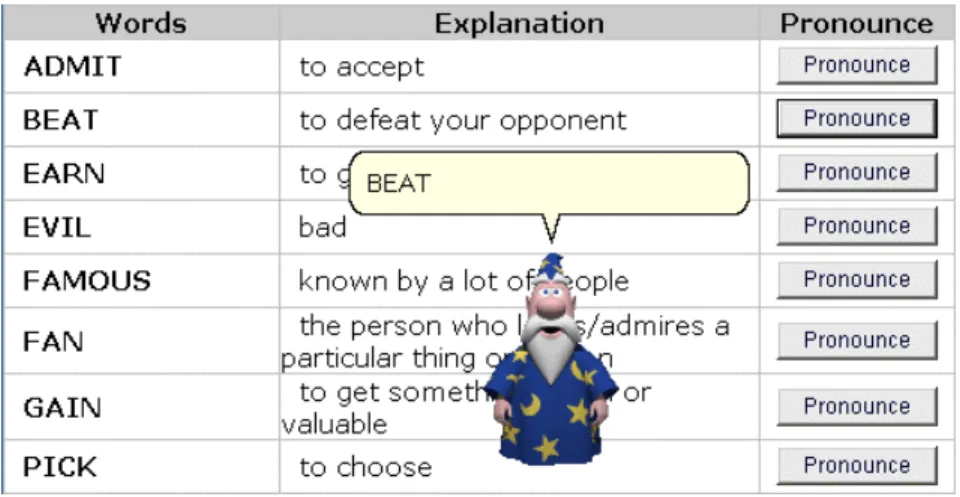
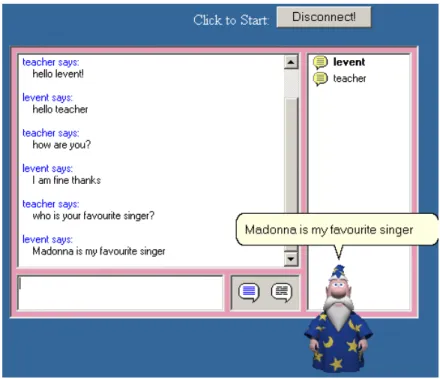
3.1 Dictionary Page of the Web-based Learning Tool ... 38 3.2 Activities Page of the Web-based Learning Tool... 38 3.3 Chat Page of the Web-based Learning Tool... 39 4.1 Students’ perceptions about the vocabulary learning versus time
spent in dictionary page... 55 4.2 Students’ perceptions about hearsay versus time spent in dictionary page ... 61 4.3 Students’ perceptions about hearsay versus time spent in chat page ... 63
CHAPTER 1
INTRODUCTION
In this chapter, the background of the study, the statement of the problem, the purpose of the study, the significance of the study and the definitions of the terms will be presented.
1.1 Background of the Study
The human being shows an effort to develop technology because of his or her own needs. Sometimes the developments in the technology bring out new needs for human beings. Some technological developments can be called as “revolutions” for the world. Computer is one and probably the most important of these technological revolutions. With the development of computer it is made possible to overcome some difficult works such as calculations, database systems, etc. in fast and reliable ways. Computers are not only used for great calculations and very complex scientific experiments, but also used in our daily life routines. Word processors, spread sheets, games, etc. are the programs that take part in our routine works. Moreover, with the development of internet; communication and accessing information became easier, faster and cheaper. The development in computer technology also attracted the educators’ attention to concentrate on how to benefit from such a capability. Starting from the early stages of
their development, computers are used in different areas of education for several purposes. Language teaching and learning, especially foreign language teaching and learning got a great deal to benefit from computers. As Özdemir (2001) stated that “in modern age, foreign language, especially English, is at the center of economical, social, scientific, and educational lives.” (p.1) Therefore, there were several great projects with high budgets to explore uses of computers in language learning and teaching. PLATO, TICCIT, ATHENA, ALLP, CAMILLE, OLA, and etc. are some projects that mainly focused on uses of computers for language learning (Levy, 1997).
Contemporary studies focus on effective uses of computers in educational settings. As Kidd (1989) clearly stated that:
“At the present time it seems to be widely accepted that the computer has the potential to be a useful tool in the learning process. What remains to be done is to create courseware that effectively exploits this potential. In addition, one must produce enough good courseware to enable computer to become an integral part of the curriculum.” (p.69)
Foreign language teaching and learning is a great area that has many parts to be investigated. Most of the researchers divide foreign language teaching in four main skill categories. Listening, speaking, reading and writing are the required skills to acquire a foreign language.
There were many researches that tried to explain the acquisition of syntax, grammar and reading. However, it is also important to lighten the acquisition of vocabulary and phonology as Levy (1997) stressed that “SLA research has concentrated primarily on explaining the acquisition of morphology and syntax, a little known about the acquisition of phonology and much less about the acquisition of lexis…” (p.53).
Moreover, Liu, Moore, Graham and Lee (2003) stated that computer technology has the potential of helping language learners in improving oral and listening skills. There is an imbalance where most of the studies focused on reading and writing, however, only few studies focused on listening and speaking.
In learning a foreign language, learners may have acquired some skills but they have difficulties in understanding a native speech in a conversation. Rochet (1989) specially expressed that the students may learned the required skills such as reading and writing, however, foreign language learners have difficulties in perceiving speech. Moreover, he states that there are not so many programs that aim teaching foreign language pronunciation. In his book Grittner (1969) underlines the minimum learning objectives that are essential for communications. For the listening ability, he states that it essential to understand the words in conversations.
Speaking is also an important skill for acquiring a foreign language. Huebener (1960) stresses the importance of speaking skill for foreign language learning that speaking skill can be acquired by much repetition. However, the traditional classroom is very inadequate for offering such an opportunity. On the other hand, speaking skill comes after listening skill. Learners must first understand how a word is pronounced. Then, the learner can try to speak the word. Huebener continues that in order to improve listening skill there are three requirements: attention, concentration and application. The listening can be effective only after giving attention to these requirements.
The language laboratories give opportunities to learners to work individually at their own pace. Moreover, Huebener (1960) gave credit to language laboratories indicating
that enabling students to work with an individualized environment makes students motivated. Moreover, he stated that in acquiring a foreign language, understanding and speaking are the most important essentials and a language laboratory should be supportive within this framework. Language laboratory should be used for giving such a practice opportunity for these essentials. Moreover, he stressed that providing much and regular practice for listening is the fundamental aim of the language laboratory.
Ladefoged (1967) stated that “The ability to produce differences between sounds often comes before the ability to hear these differences.” (p.168, cited in Rochet, 1989). On the other hand, Jones and Fortescue (1991) stated clearly that “learning to recognize and distinguish the sounds of a language is a prerequisite both for effective listening comprehension and for good pronunciation” (p.78). There were different ideas about which one comes first, listening or speaking. As stated above some of the researchers indicated that for a good speaking listening comes first (Paulston, 1976; Fortescue, 1991). First a learner understands how a specific word sounds and then the learner can produce it. After a learner learnt how to produce a word, then he or she will be able to discriminate the words in a normal conversation.
1.2 Statement of the Problem
Physical investments and necessary arrangements are made by the governments in order to increase the use of new technologies in all levels of education. Computer assisted instruction now entered our classrooms, especially private colleges are effectively using this tool and this usage is encouraged by the school directors within different courses. Public schools will be using new technologies especially computer programs and internet applications as supportive materials for their courses.
In order to develop effective and usable applications for classroom instruction various kinds of variables should be investigated. Different areas require some common but mostly different variables to be revealed. Teaching and learning English as a second language is one of areas that should be investigated in different aspects. There is a need to investigate different applications for computer assisted language learning in different educational settings with different means of media. Özdemir (2001) stresses the advantages of new technologies, and states that “easy, cheap, and fast accessibility of computers and internet, and multimedia technologies including visual-auditory interactive skills are creating a new area for foreign language teachers and learners” (p.6). Microsoft Ms-Agent which was used in this study is a new technology that brings some features such as fast sound transfer rate, speech and animations. Whether all these features of this technology within a well designed internet application can be used effectively in foreign language teaching and learning environment needs to be explained clearly.
In their implications for future research chapter Liu, Moore, Graham and Lee (2003) clearly stated that there is a need for explaining how computers can be used to support second language learning (i.e., the kinds of tasks or activities that should be used in what kind of settings). They also stress that most of the studies are at college level, and it is important to conduct a research on K-12 setting.
1.3 Purpose of the Study
This study tries to shed light on understanding different usage areas and purposes of internet environment for foreign language education. Therefore, the web-based learning
tool was prepared as a supportive material for the English course for the 8th grade
students at the elementary level.
The purpose of this research is to investigate the web-based learning tool in terms of students’ perceptions and the teacher’s perception in the context of elementary level second language learning. Liu et al. stressed the importance of student perceptions about the new tools as “because students are the consumers of the new educational tools, their perceptions and evaluations are essential to ensure quality instruction.” (p.263)
Presentation of the words, crossword puzzle, and chat environment help young students in their English vocabulary learning and hearsay and students’ perceptions about online communication are investigated. This study tries to answer the following main questions:
1. What are the students’ and the course teacher’s perceptions about the web-based learning tool in terms of vocabulary learning?
2. What are the students’ and the course teacher’s perceptions about the web-based learning tool in terms of hearsay?
3. What are the students’ and the course teacher’s perceptions about the web-based learning tool in terms of communication?
4. What problems do the students face while using the web-based learning tool? 5. How should the web-based learning tool be improved to be more effective? 6. What are the students’ and the course teacher’s perceptions about the internet
1.4 Significance of the Study
Language learning, especially second language learning requires systematic practice and repetition. Students learn the new words in class sessions and they practice what they learn by traditional methods such as continuously writing the direct meaning of the word or using flash cards. However, these traditional methods are not very attractive and are usually boring. On the other hand, today’s children; to say were born with computers; they are familiar with them and they like playing and working with computers. Computers bring more attractive and enjoyable features with them, and educational institutions started to benefit from the advantages of the computers. As a result, computers started to take part in educational systems. At the beginning, academic studies mainly concentrated on whether to use computers or not. However, effective uses of computers, different uses of computer applications, the conditions where the use of computers are also studied.
Özdemir (2001) expressed that ‘Computer Assisted Language Learning programs with an educational basis can effectively complement and sometimes replace traditional language teaching techniques’ (p.7). Therefore, it is significant to investigate in which conditions the use of computers and internet are valuable in the context of teaching and learning English as a second language.
In their implications for future research Liu, Moore, Graham and Lee (2003) gave several suggestions. They indicated that most of the studies focused on anxiety, attitudes and most of them try to explore reading and writing skills. However, there is a need for the investigation of less-explored skills which are speaking and listening. They indicated that although speech recognition with computers have some problems with the available
technology, computers can be effectively used in improving listening skill. They also continue that studies should focus on specially K-12 level, because most of the literature interested with higher grade levels.
The results of this study aims to contribute to the understanding of design and development of phases of computer-assisted language learning. Moreover, this research may help researchers to benefit from the findings in terms of design and development of computer-assisted language learning applications for young learners.
1.5 Definitions of Terms
The following terms will be used by the researcher and explanations are provided so as to assist the reader in understanding the study.
Computer-Assisted Language Learning: “The search for and study of applications of the computer in language teaching and learning”. (Levy, 1997, p.1)
Tool: “For computers to function as tool, the computer need only have some useful capability programmed into it”. (Levy, 1997, p.83)
Web-based learning tool (WBLT): The web site developed by the researcher especially for this study as a supplementary material for the English language course which was given as a second language.
Perception: In this study perception is used as seeing, hearing, understanding the site being used, and processing, acquiring and organizing the information got by this experience.
Hearsay: In this study hearsay refers to the first step of hearing pronunciation of a word and becoming familiar with that pronunciation.
Chat: In this study, the term chat refers to electronic chat like MSN or ICQ. In this electronic chat environment, all students write into same room and they all see their writings. Moreover, they can hear what they write.
CHAPTER 2
REVIEW OF LITERATURE
In this chapter, the review of the literature about the use of computers in education, computer-assisted language learning, related research and summary of the literature will be presented.
2.1 Use of Computers in Education
Our world now opens a period which may be called as digital age. Like the industry revolution, countries are trying to catch and utilize amazing technological developments into every area of their technical and social life. Tremendous developments in technical areas directed governments to benefit from its advantages by starting several projects to integrate different uses of technology in social life. In order to facilitate and to speed up the production, procedures of bureaucracy, and etc. different kinds of technological developments were used. When concentrated on the social life, computers are mainly used, for the past decade especially internet has been the most popular tool that plays a great role in our routine works. The term electronic is now used in our daily life communications. E-mail, e-government, e-university, e-lesson, and etc. are the terms that are not strange to hear in social communications.
Governments also started to benefit from technological developments in educational settings. Computers are used in five major areas which are educational research, educational service management, measurement and evaluation, counseling services, computer education and teaching learning activities such as computer aided instruction (İmer, 2000). Further, use of technologies especially computer technology and internet in educational settings became countries’ governmental politics.
Turkey also followed these technological developments and made necessary investments required for effective uses of technologies in social context. Uses of technologies in educational settings in Turkey encouraged and became governmental politics, too. In the ‘Long Term Strategy and 8th Five Year Development Plan 2001-2005’ of Turkish
State Planning Organization (2001), use of new technologies in all areas of education, but especially in primary education was strongly expressed that;
“Satisfactory developments in utilization and extension of new technologies in education could not have been ensured. Initiating computerized education at all levels of education with a special emphasis on primary education, providing internet access for every school and producing curriculums as software programs bear great importance.” (p.88)
Turkish State Planning Organization continues to stress the importance of the usage of computers in all levels of education by;
“Technological facilities, particularly computer technology shall be utilized at the utmost level; open university education and new educational methods using high technology shall be put into practice at all levels of education.” (p.89)
As it can be seen from the report of Turkish State Planning Organization, especially in primary education use of computers is a governmental politics. Moreover, it is one of the required strategies in adaptation for European Union. In order to use the computers in schools, first, infrastructure of the schools must be established. Turkish Ministry of National Education started a project called National Education Development Project (NEDP) to establish computer laboratories in 1997. Turkish Ministry of National Education established and continues to establish computer laboratories in public schools for the use of new technologies in educational settings. For example, there are 2.358 multimedia computers and 6.627 PCs, 321 computer laboratories, and 713 computers which are connected to the internet in the public elementary schools in Ankara (MEB, 2002). All these investments were made to increase the use of new technologies in educational settings.
On the other hand, to increase the use of computer technologies in educational settings teachers should be computer literate and appropriate software must be developed for teachers to use in their classrooms. Turkish Council of Higher Education (1998) reformed teacher preparation undergraduate programs of faculties of education via adding some courses into curriculum to extend the usage of information technologies in the schools and to teach how to develop the various kinds of instructional materials that are necessary for classroom instruction. With this reform it is aimed that teacher candidates will be familiar with and know how to use different kinds of technologies such as computer, internet, multimedia, television, video, projector, etc. in their classrooms. Thus, teachers of the future will become familiar with the new technology, and they will use several kinds of technologies in their teaching-learning environment more effectively and productively. Therefore, for teachers to be computer literate in all
departments in the faculties of education in Turkey started to offer two technology training must courses starting from 1998-1999 academic year. These courses are ‘Computer Applications in Education’ and ‘Instructional Technologies and Material Preparation’.
As Turkish Council of Higher Education noticed that it is not enough to establish computer labs and electronic classrooms in the schools for integrating technology in the educational system. In order to use the technology in classrooms teachers must be aware of technology and uses of technology in their classrooms. Especially, in English language education, teachers need training in the use of technology (Mielke & Flores, 1992, cited in Padron & Waxman, 1996). Results of the studies of Padron (1993) and Liao (1993) stress that if preservice and inservice teachers are able to use variety of computers and different kind of applications, then they will be more comfortable to use computers in their classroom settings (cited in Padron & Waxman, 1996).
Instructional technology improves student achievement when integrated into K-12 education. However, for this improvement to occur, teachers must be familiar with computers, have positive attitudes towards computers, be comfortable with the technology and be able to use it effectively. Especially, experienced teachers have difficulty in finding effective uses of computers in their classrooms (Rakes & Casey, 2002).
Computers made preparation of appropriate learning environments for the learners possible. Therefore, teacher candidates in universities and already working teachers have to be aware of the new technologies and abilities to use them (Akpınar, 1999). When
teachers are familiar with the different uses of technology, then they will use it in their classrooms. Moreover, in their pre-service education, the more they use computers and different kind of computer applications, the more they will have positive attitudes towards computers. Akbaba and Kurubacak (1998) concluded in their study that elementary school teachers have positive attitudes towards technology.
Today, most of the schools are equipped with several technologies, especially with computers over the past decade. At any levels of the education, technologies such as multimedia, internet, intranet, etc. have important roles and used for different purposes (Akbaba & Kurubacak). Moreover, there is an increasing trend in the use of computers in every area of education. “Especially thousands of researches done to prove that the use of computers in learning environments is more effective than books, films, teachers and other traditional methods” (Alessi & Trollip, 2001, p.5). Besides, Kidd (1989) clearly pointed out that computer’s useful capabilities in learning process widely accepted. It is important to use the potential of computers by creating several applications. Liu, Moore, Graham and Lee (2003) stated that most of the researches support the idea that use of computers in learning environment enhances teaching and learning. Multimedia and internet used widely and there are various forms of distance learning. Use of computers as tools to support language learning environment get an attention both from educators and learners.
Computer-based instruction is potentially effective in most educational settings. Moreover, it is important to decide at which grade level use of computers is the most effective. According to the Robley’s (1989) study, effectiveness of computer based
instruction is significant at all grades levels, however, findings can not be used in favor of any particular level.
It is important to integrate technology in educational settings in order to enhance learning, moreover, the quality of the material that is going to be used must be carefully designed and developed. Web sites that are prepared to support for the classroom instruction will be helpful to the students if they include:
- “Lesson summaries and educational games that aim subject repetition, - Asking some questions about the lesson topic,
- Enables students to evaluate themselves with short quizzes” (Akkoyunlu, 1999, p.81).
Ağır, Sütçü and Sarı (2001) found some interesting results in their study which was about elementary students views of education over the internet. This study showed that 75% of the students see internet as a school and 32% of the students see internet as a library. Today’s children know the value of technology, and they use it in every area of their life. Moreover, they are aware of the potential of computers in their education. As it can be seen from the result of Ağır et al., most of the students see internet as an information source.
Ağır et al. (2001) study investigated students’ opinions about the courses that they are taking can be learned over the internet or not. Some interesting conclusions were drawn from their study such as 80% of the students thought that “Social Science” course can be learned from the internet, their second choice was “Science” course with 75% and their third choice was “Computer” course and their fourth choice was “English” course with 70%. Ağır et al. also investigated students’ attitudes towards internet. 52% of the students think that they want to learn English from internet. Ağır et al. focused on the
question whether replacing classroom environment with internet environment or not. However, internet environment can be more effective when used as supplementary to the classroom environment.
2.2 Computer-Assisted Language Learning (CALL)
With today’s technology, computers are used for several purposes. They replace some old technologies. Digital slides replaced acetates, data show projector replaced overhead projector, and computer laboratories now replaced language laboratories. Now, equipped computer laboratories can handle all requirements of language laboratories. Huebener (1960) gave advantages of the language laboratory, which can be said for computer laboratories, too.
1. All objectives of a language course can be achieved in the laboratory: speaking, understanding, pronouncing, learning vocabulary, carrying on a conversation, memorizing, reading and dictation.
2. The near-ideal pronunciation of native speakers is always available in the laboratory.
3. The student becomes readily accustomed to different kinds of voices. In the conventional classroom he hears only his teacher’s voice.
4. In the laboratory the student can listen over and over again. 5. The laboratory gives every student an opportunity to practice individually during the whole period.
6. By constant repetition and oral drill the student acquires with ease a new set of speech habits- the real objective of learning a foreign language. (p. 112)
When developing an application for learners, there is a procedure that should be followed. Higgins and Johns (1984) described the commonly used drill-and-practice structure as:
1. Select task or question 2. display question 3. accept student’s answer
5. report success or failure 6. adjust student’s running score 7. return to (1) (p.39)
When the students are with less proficiency level, the content and the supporting material for the lessons must be carefully investigated. Therefore, the teacher must organize the supporting material for his or her lessons. Brandl (2002) states that “by pre-selecting and preparing the readings, the instructor tailors the contents and tasks to the students’ proficiency level” (p.90) and concludes that learners at the beginning or intermediate level, teacher-facilitated approaches has the highest potential.
2.2.1 History of CALL
In his book Levy (1997) summarizes the historical development of CALL in major periods and with important projects. The first application of computer-assisted instruction was programmed instruction. Actually, programmed instruction was the grandfather of the learning theory for computer environments. The studies of the B.F. Skinner were the most interesting studies which ground the behaviorist theory and guided many researchers.
The starting point of CALL can be traced to the PLATO (Programmed Logic for Automatic Teaching Operations) Project which was initiated at the University of Illinois in 1960 (Levy, 1997; Ahmad, Corbett, Rogers and Sussex, 1989). PLATO was aimed to provide interactive materials and let the learners to work with their own pace. It had a simple e-mail system that the learners post messages to the teacher. This system gives the opportunity of communicating between the teacher and the learners. Moreover, in
the PLATO, information about learners and learners’ records are kept. Reading, writing and listening are the general examples of CALL materials for foreign language.
In 1970’s with the humanistic methods studies focused more deeply on language learning and teaching, and the needs of the individual learner that is emotions and feelings. As Nunan (1988) stated that in 1970’s, there is a tendency from teacher centered to learner centered methodology, especially the “individualization of the learning process” became the focus point in language learning (cited in Cecchetto and Stroinska, 1989). Besides, communicative language teaching emerged (Hoven, 1999). After the invention of microcomputer in 1973, special interest in CALL increased and software for CALL produced. Another great project was the TICCIT (Time-shared, Interactive, Computer Controlled Information Television) started in 1971. TICCIT was designed to use television and computer technologies together. It can be thought as the first CAI example by combining text, audio and video. In later versions of TICCIT named as MicroTICCIT enabled the learners to choose the context and the presentation of context that is different from the PLATO. Learner control became more important.
Educational Testing Service (1978, cited in Levy, 1997) evaluated PLATO and TICCIT projects, and concluded that PLATO Project didn’t show any significant positive or negative effect on learners’ achievement although it appealed both teachers and students. On the other hand, in the TICCIT Project there was a significant positive improvement on the learners’ achievement. However, it was interesting that in TICCIT dropout rate was higher.
In early 1980’s microcomputers became widespread and cheap, therefore teacher-programmers started to produce CALL software especially using BASIC programming language. Storyboard was a well-known program of the 1980s which was written by John Higgins. This program aims to reconstruct a text from a vide range of clues such as introductory materials and textual clues. In 1983, an eight –year research called Project Athena was established by the Massachusetts Institute of Technology (MIT) with funding of $50 million dollars. Within this project Athena Language Learning Project (ALLP) was established and mainly concentrated on creation of communication-based prototypes for various courses such as French, German and English as a Second Language. ALLP consisted of multimedia authoring environments, hypertext and hypermedia systems, artificial intelligence techniques and simulations as language learning materials.
In 1990’s internet was the most important technologic development that brought many features with it. With the rapid development of internet, multimedia materials such as text, sound and video became widely used. CALL projects also started to use internet in different ways. CAMILLE (Computer-Aided Multimedia Interactive Language Learning) was started by participation of France, Spain, Netherlands and UK. The main purpose of the project was to give basic courses for Spanish and Dutch, advanced courses in English and French. In CAMILLE project the learning environment is in the center of the design. Learning is more important than teaching. Therefore, it provides tools to facilitate learning. These tools include learning activities, pronunciation of the words spoken by a native speaker in a dictionary, audio and video recordings and etc.
Another project was OLA (Oral Language Archive) started in 1994 at Carnegie Mellon University. Primary purpose of this project was to provide digitized sound recordings for foreign language learning over the internet. French, German, Japanese, Russian, Spanish were the main languages included in the project.
A historical perspective for CALL is summarized above from the book of Levy (1997). Now, most of the studies focus on questioning how technology can be used more effectively in learning environments rather than questioning can technology place in learning environments. Harrell (1999) concluded that with carefully designed Computer Assisted Language Learning software, all the functions in a traditional classroom teaching situation, except for the actual physical contact, may be simulated by way of telecommunication technologies, creating a virtual classroom electronically.
2.2.2 Vocabulary Learning in CALL
Wilkins (1974) stated the importance vocabulary and indicated that vocabulary is important as much as grammar and must be mastered in order to have knowledge of a language. Paulston (1976) and Kidd (1989) stated that for language teaching and learning the study of vocabulary is very important area, however it is the most neglected one or left to initiative of the student. Paulston stated that the purpose of teaching vocabulary is preparing students to recall and use words in communications. Ertaş
(1999) defined the use of words in appropriate situations as production of vocabulary. When vocabulary learning is considered, providing different kinds of practice environment for students become central issue. Teachers use classroom activities, games and role playing activities to facilitate classroom instruction. Now, computers play a great role in creating activities and practice environments to learners. Gillespie and
McKee (1999) suggested that if computer programs going to be used within a computer based learning environment, they should give concentration on specific language skills, especially which can be helpful to develop language awareness such as translation and vocabulary acquisition.
When the teacher’s role changes to facilitator (Higgins and Johns, 1984) or advisor in a multimedia environment (Liu et al., 2003), it is important for the teacher to create attractive, interesting and enjoyable learning environments where students motivated to learn a language. As Jones and Fortescue (1991) expressed that computerized activity is different from the non-computer version. Computer makes a chance which is motivates students. It is obvious that attractive exercises get attention of the students. However, it shouldn’t be forgotten that while creating activities for the students, the objective of the exercise must be clear in teacher’s mind. Guberman (1989) concluded that students should be guided to produce meaningful sentences and messages. Therefore, he stated that it is necessary for the students to completely focus on the gist of the exercise that is meaning and spelling of terms. Therefore, teacher should prepare activities that are focusing on the desired language skills. Besides, students should be aware of what are they doing (Bayyurt & Kitaplı, 1999), as Şire (1999) found that successful students aware of their responsibilities and have a tendency to practice English.
Activities are created for vocabulary learning aiming to provide opportunity to learners for practicing the vocabulary. Jones and Fortescue (1991), Kidd (1989) indicated the difficulty of teaching and learning vocabulary and stated that vocabulary learning often neglected. However, vocabulary is a very important area of learning a foreign language. The classroom teacher (personal communications, March 18, 2003) also indicated that
students usually don’t pay attention to vocabulary learning. Moreover, they do not know how to study vocabulary. Therefore, it is important for the teacher to create environment for students to practice vocabulary. Higgins and Johns (1984) stated that the strength of learning is related to number repetitions. However, rote memorization is not very attractive for learners and is not an effective learning strategy. Therefore, learners neglect studying vocabulary, and it become teacher’s responsibility create practice environments for learners. Sarıçoban (1999) stressed that it is necessary to have or create environment convenient to activities that will help learners to develop determined skills. He recommended that activities should support practice, and autonomous learning should be emphasized.
When presenting new vocabulary items some techniques and approaches are used. Gairns and Redman (1986, cited in Ertaş, 1999, p.190) outlined the techniques and approaches as:
1. Traditional approaches A. Visual techniques
a. visuals
b. mime and gesture B. Verbal techniques
a. Illustrative situations b. Synonym and definitions c. Contrasts and opposites d. Scales e. Examples of type C. Translation 2. Student-centered learning A. Asking others B. Using dictionary C. Guessing from context
Ertaş (1999) conducted a study on 5th grade students aiming to find whether traditional
study of Ertaş, consisting of 12 teachers who were teaching at 5th grade, revealed that
teachers use “synonymy and definition” technique mostly and “scales” to be the least used. Totally, 58% of the teachers generally preferred traditional techniques, 42% of the teachers used student-centered or both.
The study of Ritter (1993) revealed that 92% of the learners participated in his study preferred learning new vocabulary using a computer program. Students were asked to give reason for choosing studying vocabulary in front of computers. Most of the students thought that it was funny and 88% of them thought that it was good than working in traditional methods (cited in Liu et al., 2003).
Teachers mainly prepare classroom activities for learners to practice. Games are the most used activities used by the teachers to enhance classroom instruction. Games can be used for several purposes in teaching a foreign language. In her study Keskil (1999) gave the advantages of using games in the foreign language classroom.
• games are activities that promote learning through pleasure (Argondizzo, 1992, cited in Keskil, p.79),
• games can lower anxiety and can thus make acquisition of input more likely (Richard-Amato, 1996, cited in Keskil, p.79),
• games are highly motivating, relevant interesting and comprehensible (Richard-Amato, 1996, cited in Keskil, p.79),
• games can be used to a) develop and reinforce concepts (eg., colors, shapes, word definitions) b) to add diversion to the regular classroom activities c) to introduce new ideas d) to practice communication skills (Richard-Amato, 1996, cited in Keskil, p.79).
Several kinds of activities and games can be used for different purposes. Keskil (1999) gave a puzzle example that can be used in language classroom. She uses picture puzzle to teach vocabulary. She stated that such an activity can help learners in writing and
spelling. She concluded that different variations of puzzle such as dictating words can be also used.
Bayyurt and Kitaplı (1999) found that there is a problem when students don’t understand the purposes of the activities. Therefore, classroom activities should be explained to all students. The purposes of the activities should be clear to students because students and teachers have different expectations from teaching and learning activities.
The study of McCreesh (1989) resulted that the students who spent more time with computers thought that computers can replace a teacher. It was also reported that when the learners participated both classroom sessions and computer labs get higher grades in phrasal verbs and vocabulary. Therefore, for vocabulary learning it is important to supplement classroom teaching with an appropriate practice environment.
2.2.3 Communication in CALL
Yavuz (1999) stated the focus given on communicative competence in foreign language teaching and learning process. Carel (1997) explained the recent developments in foreign language education in terms of communicative competence and concluded that learners were expected to interpret and product meaning properly in the context of target language and culture. Other researches also give considerable credit to interaction with the native speakers for second language learning environments (Toyoda & Harrison, 2002). Living in the target language community is the best way to learn a language; this means being in constant contact with the target language can be the best way to learn a foreign language. However, it is not always possible to live in target
culture, and then in classroom situation target language is used whenever there is a practicable environment; the real daily experiences of the target language simulated (Mitterer, Marini, MacRae, & Joe, 1989). Difficulties in experiencing with the target language context and lack of full access to the target culture squeezed teachers between textbooks and classroom materials. Most of the traditional materials are linear and not interactive enough to support an environment for improving skills for communicative competence. On the other hand, uses of hypermedia/multimedia technologies can support more appropriate context for students in terms of experiencing in the target language.
Communication is the key concept in teaching and learning a foreign language (Wilkins, 1974). Communication of meaning is at the heart of language learning (Elyıldırım, 1999), so most of the foreign language teaching/learning strategies depend on communicative basics. American Council on the Teaching of Foreign Languages (ACTFL, 1999) states the importance of communication in their report named Standards for Foreign Language Learning by saying that “communication is at the heart of second language study, whether the communication takes place face-to-face, in writing, or across centuries through the reading of literature.” (p.2). Report continues with explanations to communication standards with several examples. First standard is concerned mainly with the learners’ interpersonal communication skills with whom they are in personal contact. The sample for the 8th grade about this standard is explained as:
“Students exchange information about personal events, memorable experiences, and other school subjects with peers and/or members of target cultures.” (ACTFL, 1999, p.2)
The next standard is about comprehending written and spoken language on a variety of topics. Learners should easily understand materials which come from their common culture and related to their common interests and result in successful comprehension. (ACTFL, 1999).
In Turkey, Ministry of National Education published the regulations related with the skills that are nearly same for all different kind of schools;
- understanding what is said in normal speed, - speaking intelligibly,
- comprehending a text with slient and loud reading,
- expressing the feelings, thoughts, and impressions in written form (p.262, Sarıçoban, 1999).
On the other hand, the study of Budak (1992, cited in Sarıçoban) revealed the priority given to four basic skills by the language teachers in Turkey as;
- reading a text,
- understanding what is said - expressing his idea orally
- expressing his idea in a written form (p.260).
Liu, Moore, Graham and Lee (2003) clearly stated that there are several tools such as e-mail, chat, bulletin boards, etc. used in second and foreign language learning. Especially for communicative language skills to be enhanced by e-mail and chat can be used effectively. Moreover, e-mail and chat enable collaborative work, sharing and critical thinking. Moreover, study of Lam (2000) which was a case study consisted of e-mail messages, online exchanges and discussions on the web. It was concluded that technology is a very useful tool in promoting writing skills.
Cecchetto and Stoinska (1989) discussed the classroom environment with the computer environment for second language learning. They gave some credit to classroom
environment that the learners are motivated to success because of some reasons such as in front of their peers they want to be successful, so they will get higher marks. However, they also stated that sometimes this type of tension became a stress for the learners. In such situations, students won’t respond. For the students who feel freeze in front of the teacher, computers creates an ideal environment. Liu et al. (2003) also supports this idea by saying that CMC provides students equal chance of participation when compared with classroom environment or face-to-face activities. Therefore, computer environment can be thought as an ideal environment for the students to express their ideas without anxiety, and with equal chance of participation when compared with classroom environment.
Sotillo (2000) stated that instantaneous interaction on a LAN (Local Area Network) is very exiting considering the computer-mediated communication. She continued that “electronic discussion encourages learners to construct knowledge cooperatively” (p.83). Chat gives an environment which enable instant online interaction. In chat environment students write their ideas and feelings about the subject being discussed. First of all they share their ideas in a written form, and they produce meaningful communication.
There is another advantage of online communication. Computerized applications can help us to record user actions. All the writings and actions can be recorded with a well designed online communication such as forum, chat, etc. When reviewing for CALL studies on negotiation of meaning, Toyoda and Harrison (2002) pointed the advantage of saved communication logs that can be in class learning materials. Moreover, these logs can be precious resources for enhancement of the learners’ inter-language (Blake, 2000).
Chapelle (1997) suggested several suggestions on CALL activities, especially in communicative context. She put the emphasis on that CALL activities should offer opportunities for students to express themselves. Therefore, CALL activities must require learners to produce linguistic output. She gave three research examples on CALL activities, one of which was about electronic discussion. In this study, students were attending two class hours in a week and one laboratory hour. Students were given a story which they expected to read before coming to lab session. When they logged in they received instructor’s questions about the topic and then they began to electronic discussion in written format (Kelm, 1992, cited in Chapelle, 1997).
Based on her review of literature, Chapelle (1997) suggested that there is a need for descriptive research that documents the nature of the interaction that the learners engage in within various CALL contexts. Therefore, it is important for researchers to create different computer applications for second or foreign languages.
2.2.4 Listening and Pronunciation in CALL
Listening, speaking, reading and writing are the four necessary skills of a foreign language (Grittner, 1969; Wilkins, 1974; Paulston, 1976; Carrell, Devine and Eskey, 1990; Şire, 1999; Sarıçoban, 1999). In a communicative context we use mainly listening and speaking abilities with our vocabulary. Carrell et al. gave considerable credit to listening over reading and speaking over writing. All over these abilities, listening is the most necessary part of communicating in any language (Grittner, 1969). Macy & Feyten (2002) explains the importance of listening ability by stressing that listening ability is very essential in language learning. Moreover, listening ability is the most used language skill among speaking, reading and writing.
Courtright and Wesolek (2001) gave a great value to pronunciation of the new words learned by all levels but especially by elementary level learners. They emphasized that when vocabulary instruction is concerned; showing the relation between the new word learnt and the pronunciation of the word is very considerable for language learning. They concluded that for a good vocabulary acquisition it is important to give an opportunity for learners to hear when they see new vocabulary.
Paulston (1976) stated that in language learning acquiring a good pronunciation is the most difficult task. It is clear that after some age, it becomes difficult to pronounce like a native. Therefore, it should be given a great importance to help young learners to acquire a good pronunciation. Moreover, Paulston strongly explained that for children learning pronunciation occurs by imitation and concluded that for teaching pronunciation there are four steps to be followed. There steps are:
1. selection and presentation of the sound feature to be thought
2. recognition of the new sound and discrimination between similar sounds
3. production of the sound feature, first in words and phases and finally 4. production of the sound feature in a communicative situation (Paulston,
1976, p.94).
According to Liu Moore Graham and Lee (2003) there were several software tools that are aiming to support specific skill acquisition. Researches investigated software which mostly focused on reading and writing skills. However, “the literature seems to indicate that the greatest need for software development is in the areas of listening and speaking, because these two areas were found to be sparsely represented.” (p.253).
There are some researches focused on listening and speaking skills. For example, the study of Higgins (1989) revealed some information about pronunciation and phonetics.
He indicated his experiences that the computer is already turning the whole area of pronunciation and phonetics into a more experimental subject, allowing students to look at sounds as well as they hear it, and to get rid of some of their preconceptions about, for instance, sounds and spellings.
For CALL exercises speech technology can offer several kinds of environments. One example is sound discrimination. In foreign language learning pronouncing and understanding the discriminations of some words are difficult (Wilkins, 1974). For example, English “r” and “w” are difficult to distinguish for the non-native speakers. Another example is giving the words pronunciations which may be used for dictation exercises. (Ahmad, Corbett, Rogers, & Sussex, 1989)
Demirezen (1999) pointed an important problem in teaching foreign languages. He calls the problem as “foreign accent problem” and defined it as transferring the articulation habits involved in mother tongue to pronunciation of the target language. Of course this transfer occurs in a non-native foreign language speaker’s pronunciation. Demirezen continued that the ideal is pronouncing the standard English with a native-like competence and fluency. He stressed that students are affected by the foreign accent of the teacher. Therefore, “students have a general tendency to hear the sounds of the target language in terms of their mother tongue” (p.174). Because of this reason, many students have difficulties in understanding normal spoken English while listening. Finally, he concluded that in order to refine pronunciation and listening comprehension, native sounds should be listened that is video cassettes, audio cassettes, films, and TV can be used.
Liu et al. stated that for speech recognition it is not very feasible to use it in second language learning because today’s technology is not able to give reliable feedbacks to a given input. Therefore, in order to use speech recognition in second language learning, the development of the technology in the area of recognition must be waited. On the other side there are several research focused on listening. Brett (1997) found that using multimedia technology promotes listening skills in effective ways (cited in Liu et al. 2003). Jacobsdottir and Hooper (1995) concluded that listening skills acquired effectively when students given text with spoken words (cited in Liu et al. 2003).
2.3 MS-Agent Technology
Rickenberg and Reeves (2000) studied on animated characters on anxiety, task performance and evaluations of user interfaces. They conducted their research in three dimensions: “no character, a character that ignored the user and a character that closely monitored work on the web site” (p.49). They used Microsoft Agent technology for their study. Their study showed that animated character that monitors the users closely, users feel anxious and their performance was decreased when compared to no character and character that ignored the user. Study also described that users with high internal locus of control showed significantly less anxiety, more performance than users with high external locus of control. Besides all, their study relies on animated character’s directly watching the user actions and recording the user interactions. They concluded their research with a soft conclusion that it is the character’s actions such as “what it does, what it says and how it presents itself” (p.55) that has effect on user behavior.
2.4 Summary
Uses of technology especially computers and internet in every area of education is enhances learning environments. Several researches conducted in order to prove effectiveness of computers in different areas. Today, computers are accepted to be effective tools by most of the researchers and educators. Such a result also directed governments to invest on uses of technology in every area of social life especially in education. Necessary budgets are reserved to equip schools with several kinds of technologies. Also teacher preparation programs in the universities redesigned in order to prepare technology aware teachers. Tomorrows teachers will be expected to follow and use technological developments in their classrooms.
Now, studies focus in what situations use of technology is effective. Therefore, it is important to research on effect of different uses of computers in different areas. Most of the studies are at the university level as expected. However, there is a need for research in lower grades especially at K-12 level.
Vocabulary learning is an important area in second language learning. The literature also gave considerable credit for vocabulary learning. However, most of the researchers express vocabulary learning actually to be the most neglected area. It is clear that teachers must create opportunities for learners to practice vocabulary. Using computers in creating practice environments for learners found to be effective. Especially, computerized exercises said to be both attractive and exiting for young learners.
Communication is said to be a very important concept in second language learning. Interaction with native speakers in target culture discussed to be the most effective in
terms of second or foreign language learning. However, literature also explains the difficulties of experiencing in the target culture. Therefore, some alternatives were given. Online communication is said to be effective both in terms of communicative language and writing. Especially chat found to be effective in promoting collaborative work and critical thinking.
For second language learning, most of the studies focused on primarily reading and writing skills. However, listening is also an important aspect in language learning. Moreover, it is expressed that there is a need for developing applications for listening and pronunciation. The advantages of speech technologies also expressed in different ways. It is stated that giving learners the opportunity of listening the words can enhance students listening skill.
CHAPTER 3
METHODOLOGY
In this chapter, the subjects and the context of the study within the framework of the overall design of the study will be presented. The research questions, the research design, the web-based learning tool, the participants, the instruments, the data collection procedures, the data analysis procedure, the assumptions and the limitations of the study will be described.
3.1 Research Questions
The purpose of this research is to investigate the web-based learning tool in terms of students’ perceptions and the teacher’s perception at elementary level ESL instruction. This study tries to answer the following main and sub questions:
1. What are the students’ and teacher’s perceptions about the web-based learning tool in terms of vocabulary learning?
a. What are the students’ and teacher’s perceptions about the dictionary page in terms of vocabulary learning?
b. What are the students’ and teacher’s perceptions about activities page in terms of vocabulary learning?
2. What are the students’ and teacher’s perceptions about the web-based learning tool in terms of hearsay?
a. What are the students’ and teacher’s perceptions about dictionary page in terms of hearsay?
b. What are the students’ and teacher’s perceptions about chat page in terms of hearsay?
3. What are the students’ and teacher’s perceptions about the web-based learning tool in terms of communication?
4. What problems do students face while using the web-based learning tool? a. What problems do students face during using dictionary page of the site? b. What problems do students face during using activities page of the site? c. What problems do students face during using chat page of the site? 5. How should the web-based learning tool be improved to be more effective?
a. How should dictionary page be improved to be more effective? b. How should activities page be improved to be more effective? c. How should chat page be improved to be more effective?
6. What are the students’ and teacher’s perceptions about the internet character used in the web-based learning tool?
3.2 Design of the Study
This study is descriptive study, which was conducted with 8th grade students at the
METU College. The English course is carried with eight lecture sessions in a week and one laboratory session for a unit. However, not all the English language teachers have to conduct laboratory sessions, it depends on the teacher whether perform laboratory activities or not. Lectures sessions were carried out in the classroom settings with mostly
traditional methods. Laboratory sessions were carried out for giving an opportunity to students to practice the unit content in an attractive environment. In the laboratory sessions there were one subject area teacher (i.e., English language teacher) and one IT specialist who solves probable computer problems and help students in case they face any problems.
The researcher developed a supplementary web site (web-based learning tool) specifically for the English course given as a second language. The web-based learning tool was used during two laboratory sessions of “Superstars” unit of the course. All of the content of the tool was created by the teacher.
The purpose of this study is to investigate the web-based learning tool in terms of students’ and the teacher’s perceptions. One week before the laboratory session, computer attitude scale (CAS) was given to the students to get the idea of their attitudes towards computers. Just after the treatment, student perceptions questionnaire were given which was developed by the researcher. An interview was also conducted with the course teacher one week after the treatment. Quantitative methods used to gather and analyze students’ attitudes towards computers and perceptions about the web-based learning tool. Qualitative methods used to gather and analyze the teacher’s perception.
3.3 Web-based Learning Tool
The web site was designed considering the needs of the teacher and the course. In the development process of the web site two meetings were conducted with the content area teacher and the computer teacher. As Kidd (1980) stated that “in order to produce effective programs teachers must involve in the creation and development stages of the