The Version of Scholarly Record of this Article is published in the JOURNAL OF EXPERIMENTAL CHILD PSYCHOLOGY (2014), available online at:
http://dx.doi.org/10.1016/j.jecp.2014.01.002. Note that this article may not exactly replicate the final version published JOURNAL OF EXPERIMENTAL CHILD PSYCHOLOGY. It is not the version of record and is therefore not suitable for citation.
Giofrè, D., Mammarella, I. C., & Cornoldi, C. (2014). The relationship between geometry, working memory and intelligence in children. Journal of Experimental Child Psychology, 123, 112– 128. doi:10.1016/j.jecp.2014.01.002
The relationship between geometry, working memory and intelligence in children. David Giofrè¹, Irene Cristina Mammarella², Cesare Cornoldi¹
¹ Department of General Psychology, University of Padova, Italy
² Department of Developmental and Social Psychology, University of Padova, Italy
Correspondence concerning this article should be addressed to: David Giofrè
Department of General Psychology University of Padova (Italy)
via Venezia 8 – 35131 – Padova Italy E-mail: [email protected]
Abstract
Although geometry is one of the main areas of mathematical learning, the cognitive processes underlying geometry-related academic achievement have not been studied in detail. This study explored the relationship between working memory (WM), intelligence (g-factor) and geometry in 176 typically-developing children attending school in their 4th and 5th grades. Structural equation modeling showed that about 40% of the variance in academic achievement and in intuitive
geometry (which is assumed to be independent of a person’s cultural background) were explained by WM and the g-factor. After taking intelligence and WM into account, intuitive geometry was no longer significantly related to academic achievement in geometry. We also found intuitive geometry closely related to fluid intelligence (as measured by Raven) and reasoning ability, while academic achievement in geometry depended largely on WM. These results were confirmed by a series of regressions in which we estimated the contributions of WM, intelligence and intuitive geometry to the unique and shared variance explaining academic achievement in geometry. Theoretical and educational implications of the relationship between WM, intelligence and academic achievement in geometry are discussed.
Keywords: Geometry, Geometrical achievement, Working memory, Intelligence; Children; Development
Highlights: i) WM uniquely predicts a large proportion of the variance in 4th- and 5th-graders’ academic achievement in geometry. ii) When the contribution of WM is partialled out, intelligence does not significantly explain academic achievement in geometry. iii) Intuitive geometry is closely related to fluid intelligence.
The Relationship Between Geometry, Working Memory and Intelligence in Children
Geometry is a fundamental component of mathematical learning, and also important in many aspects of everyday life (Cass, Cates, Smith, & Jackson, 2003). Without a proficient geometrical knowledge, students may lack the skills they need to gain an advanced knowledge in the fields of science, technology, engineering and mathematics (STEM; Zhang, Ding, Stegall, & Mo, 2012). Despite this, the cognitive processes underlying the development of geometrical knowledge have not been studied in depth.
Previous studies revealed that geometry involves visuospatial working memory (VSWM), i.e. the ability to retain and manipulate visuospatial information (Giofrè, Mammarella, Ronconi, & Cornoldi, 2013). Furthermore, geometrical academic problems typically also involve finding a solution to a problem, and this capacity should relate to reasoning, and therefore to intelligence (Clements & Battista, 1992). To our knowledge, however, there has been no research to date on the involvement of working memory (WM) and intelligence in geometry. The present study explored the involvement of WM and intelligence in two different aspects of geometry, i.e. intuitive geometry and academic achievement.
Intuitive and academic geometry
It has been suggested that human mathematical skills emerge from different
representational systems. A first system should be based on intuition and shared by adults, infants and non-human animals, and rely on non-symbolic representations; a second system should be unique to humans who have received a formal education, and rely on symbolic representations (Halberda, Mazzocco, & Feigenson, 2008). Regarding numerical cognition, other authors assume the existence of two different types of preverbal intuitive
representations, i.e. analogue representations of approximate numerosities for large sets, object-tracking representations for small sets (Feigenson, Dehaene, & Spelke, 2004).
Moreover, some researchers actually hypothesize the existence of more than two systems (Carey, 2009) or propose that geometry systems are distinct from number systems (Spelke, Lee, & Izard, 2010), thus further articulating the mathematical domain.
Concerning geometry in particular, a distinction has been proposed between intuitive and academic geometry (Giofrè, Mammarella, Ronconi, et al., 2013). The former includes abilities that are believed to be independent of a person’s cultural background and education; the latter depends on learning and education. In fact, it has been suggested (Spelke et al., 2010; see also Dehaene, Izard, Pica, & Spelke, 2006) that geometry includes a core intuitive knowledge. Numerous intuitions seem to develop during childhood and spontaneously accord with the principles of Euclidean geometry, even in the absence of training in mathematics (Izard, Pica, Spelke, & Dehaene, 2011). Dehaene and co-authors (2006), suggested a procedure for assessing intuitive geometry and examining to what extent it may be culture-independent. They administered multiple-choice tests that involved identifying elements that violated intuitive geometric rules to Amazonian Indians with no formal geometry education and found that Amazonian Indian children’s and adults’ performance in these intuitive geometry tasks was relatively good and comparable with that of a sample of North American children, while North American adults had a better performance. These authors’ intuitive geometry assessment procedure was also able to predict a significant portion of the variance in an academic achievement task (Giofrè, Mammarella, Ronconi, et al., 2013), and to discriminate between children with nonverbal learning disabilities (who failed in spatial but not in verbal tasks) and typically-developing children (Mammarella, Giofrè, Ferrara, & Cornoldi, 2013).
Academic geometry, on the other hand, represents a student’s ability to answer the typical geometry questions contained in the mathematical curriculum (Giofrè, Mammarella, Ronconi, et al., 2013) that could be not solved without formal instruction. It is considered one of the most important areas of mathematical learning, and it is linked to a student’s future
academic and professional success (Verstijnen, Van Leeuwen, Goldschmidt, Hamel, & Hennessey, 1998). The main difference between intuitive geometry and academic geometry lies in that the latter requires formal education and relies on a symbolic system, while the former does not. Academic geometry demands an explicit knowledge of mathematics, and particularly of geometrical principles such as diagonals, parallel lines, and right angles, and the ability to solve geometrical problems such as calculating the area or perimeter of a figure; it relies heavily on formal education. In Italy, for example, the primary school geometry curriculum is divided into two phases. During the first three years, teaching is partly informal and children have to learn how to locate and move objects in space using terms such as “above” or “below”, and to recognize and correctly name plane and three-dimensional figures. In the 4th and 5th grades, there is a crucial transition: teaching becomes more formal and structured, and children learn formulas for measuring the perimeter and area of
geometrical figures, for instance, and for converting units of measure (e.g. from mm to cm). The passage to 4th grade therefore marks the distinction between intuitive and academic geometry, as applied by the standardized procedures for assessing school achievement in geometry (in Italy, the Geometry test devised by Mammarella, Todeschini, Englaro, Lucangeli & Cornoldi, 2012), which includes questions and problems that individuals who have received no formal instruction would be unable to answer.
Cognitive processes involved in geometry: working memory and intelligence
Working memory. WM is a limited-capacity system that enables information to be stored temporarily and manipulated (Baddeley, 2000). In the tripartite model of WM initially proposed by Baddeley and Hitch (1974), the central executive is the component responsible for controlling resources and monitoring information processing across informational
domains, while the storage of information is mediated by two domain-specific slave systems, i.e. the phonological loop, which handles the temporary storage of verbal information, and the
visuospatial sketchpad, which specializes in retaining and manipulating visual and spatial representations (Baddeley, 1996). This model met with strong support (Baddeley, 2012) and further refinements of the model (Baddeley, 2000; Cornoldi & Vecchi, 2003) have maintained the distinction between the modality-independent central and the specific verbal and
visuospatial components.
Various other models have been suggested for describing WM in children. In particular, WM has been considered as: i) a single construct (Pascual-Leone, 1970); ii) a modality-dependent construct, distinguishing only between a visuospatial and a verbal component (Shah & Miyake, 1996); and iii) a modality-independent model, distinguishing only between WM and short-term memory (STM; Engle, Tuholski, Laughlin, & Conway, 1999). A tripartite model distinguishing between a partly modality-independent active WM component and two modality-dependent short-term memory components (one verbal and the other visuospatial) has proved the best (i.e. produced a better fit than the other WM models) (Alloway, Gathercole, & Pickering, 2006; Giofrè, Mammarella, & Cornoldi, 2013).
It is important to understand the structure of WM because this enables us to see how it relates to performance in various tasks. A large body of research has shown that WM predicts success in school-related tasks, such as reading comprehension (Carretti, Borella, Cornoldi, & De Beni, 2009), approximate mental addition (Caviola, Mammarella, Cornoldi, & Lucangeli, 2012), mathematical skills (Alloway & Passolunghi, 2011), multi-digit operations (Heathcote, 1994), nonverbal problem-solving (Rasmussen & Bisanz, 2005), mathematical achievement (Bull, Espy, & Wiebe, 2008; Jarvis & Gathercole, 2003; Maybery & Do, 2003; Passolunghi, Mammarella, & Altoè, 2008). Giofrè, Mammarella, Ronconi, and coauthors (2013) recently showed that WM may also be related to geometrical achievement in late adolescence.
Intelligence. Intelligence can be defined as the ability to reason, plan, solve problems, think abstractly, understand complex ideas, learn quickly, and learn from experience
‘g-factor’ derived from the common variance in a representative sample of intellectual tests seems to offer a useful approximation of the basic aspects of intelligence (e.g. Hunt, 2011; Spearman, 1904). The g-factor and academic achievement are considered closely-related but distinguishable constructs (Kaufman, Reynolds, Liu, Kaufman, & McGrew, 2012). In fact, language, reasoning, WM and the attentional processes underlying reading and mathematical operations also underlie intellectual functioning (Deary, Strand, Smith, & Fernandes, 2007; Hunt, 2011).
Notably, intelligence is a broad construct that involves many aspects, one of which is WM. Although the two constructs are closely related, they do not appear to overlap
completely and the two constructs can be considered as distinguishable (Conway, Kane, & Engle, 2003). Their relationship is under debate (Martínez et al., 2011) and there is no
consensus on this relationship between WM and intelligence in children. The claim that STM accounts for this relationship (e.g. Hornung, Brunner, Reuter, & Martin, 2011) has been questioned (e.g. Engel De Abreu, Conway, & Gathercole, 2010), and it has also been argued that highly-controlled WM processes have a greater power for predicting intelligence in typically-developing children (Cornoldi, Orsini, Cianci, Giofrè, & Pezzuti, 2013) than in particular populations (Cornoldi, Giofrè, Calgaro, & Stupiggia, 2013). The idea that different components of WM relate differently to intelligence has found further support: a recent study on 4th- and 5th-graders, for instance, supported the relationship between WM and intelligence, but showed that only active WM and visuospatial short-term memory were significantly related to intelligence, while verbal short-term memory did not (Giofrè, Mammarella, & Cornoldi, 2013).
Relationship between academic geometry, working memory and intelligence. Academic geometry can be supported by WM in various ways. It typically involves retaining and manipulating different types of information. Giofrè, Mammarella, Ronconi, and coauthors (2013) found WM involved in explaining the variance in academic achievement in a geometry
task in 12th and 13th-graders. They found, for example, that VSWM explains a significant portion of the variance in geometrical performance and mediates the relationship between the intuitive geometry task proposed by Dehaene and coauthors (2006) and academic
achievement in geometry. VSWM only mediated some aspects of the intuitive geometry task, however (i.e. the manipulation of symmetrical figures, chiral figures, metric properties and geometrical transformation), while other aspects (i.e. topology, Euclidean geometry, and geometrical figures) were related to academic achievement in geometry, but were not
mediated by VSWM tasks. The variance in academic achievement in geometry explained by the predictors was also relatively low (i.e. 14%). Unfortunately, the study considered only a few predictors and did not include a measure of verbal WM and reasoning. Academic
geometry might also be supported by verbal WM, which could be involved in maintaining the verbal information needed to solve a geometrical problem (i.e. the text describing a problem, procedures, formulas, and so on). Similarly, reasoning abilities could be especially important to solving geometrical problems. In fact, other factors may be involved in academic
achievement in geometry (see Aydın & Ubuz, 2010), such as verbal WM or reasoning abilities (Giofrè, Mammarella, Ronconi, et al., 2013).
A role for VSWM in success in geometrical tasks is also indirectly supported by the study by Mammarella, Giofrè and coauthors (2013), who found that children with symptoms of non-verbal learning disabilities (NLD), whose impaired VSWM has been amply
documented (e.g. Mammarella & Cornoldi, 2013), failed in intuitive geometry tasks (Dehaene et al., 2006). Here again, this study suffers from the limitation that the authors did not
consider other variables potentially correlated with the intuitive geometry task. It could therefore be argued that the reason why these children with NLD symptoms performed poorly in the intuitive geometry task was because it is similar to some non-verbal intelligence tests in which these children also fail.
Background and aims of the present study
The present study was devoted to examining the relationship between intelligence, WM and geometry (both intuitive geometry and school achievement in geometry). Previous research on the relationship between geometry and VSWM in adolescents showed: that VSWM, and ‘active’ VSWM in particular, directly predicted academic achievement in geometry; that intuitive geometry affected academic achievement in geometry; and that children with NLD have problems with intuitive geometry tasks (Giofrè, Mammarella,
Ronconi, et al., 2013; Mammarella, Giofrè, et al., 2013). These earlier studies did not consider verbal WM tasks or measures of intelligence, however, offering only a partial view of the cognitive factors underlying geometrical competence.
In the present study, we tried to make up for these limitations and explore the nature of the relationship between WM, intelligence and geometry (both intuitive and academic
achievement in geometry) in 4th- and 5th-grade schoolchildren. We chose to consider 4th- and 5th-graders because this age group coincides with the children’s first crucial impact with geometry at school, which involves an important transition associated with a broad mental reorganization, making it particularly appropriate for studying the relationship between different aspects of WM, intelligence (see Demetriou et al., 2013 on this point) and learning outcomes. It also enabled us to draw on the findings of a previous study (Giofrè, Mammarella, & Cornoldi, 2013), in which we were able to collect WM and intelligence measures in the same sample of children.
The first aim of the present study was to elucidate the relationship between academic achievement in geometry, intuitive geometry, WM and intelligence using the structural equation modeling (SEM) approach. In a previous study on adolescents by Giofrè and co-authors (Giofrè, Mammarella, Ronconi, et al., 2013), active VSWM was the best predictor of geometrical achievement. We consequently hypothesized that active WM would predict a large proportion of the variance in geometrical achievement in younger children too, while the
passive component would not. We also expected to find both WM and intelligence strongly related to academic achievement in geometry, and predicted that the contributions of WM and intelligence could be separated.
Our second aim was to shed light on intuitive geometry and on the task proposed by Dehaene and collaborators (2006), analyzing to what extent this task predicts academic achievement in geometry over and above the contribution of intelligence. In fact, Giofrè, Mammarella, Ronconi, et al., (2013) found performance in this task significantly related to academic achievement in geometry, but they did not measure intelligence, and the g-factor may have an important role in solving geometrical problems, irrespective of any instruction. The g-factor may be, in fact, implicit in the task proposed by Dehaene et al. (2006) for measuring intuitive geometry skills. This intuitive geometry task involves finding the odd figure out across a number of distractors, so it may be that this task predicted a part of the variance in academic achievement in geometry in the study by Giofrè and co-authors because reasoning abilities related with fluid intelligence were also involved (Giofrè, Mammarella, Ronconi, et al., 2013). We therefore examined whether the contribution of intuitive geometry to academic achievement in geometry is still significant after intelligence has been taken into account.
In the present study we first tested four models concerning the relationship between intelligence (the g-factor), WM, intuitive geometry and academic geometry (see Figure 1). The first model was based on previous analyses on the structure of WM and its relationship with intelligence (Giofrè, Mammarella, & Cornoldi, 2013), and with geometry (Giofrè, Mammarella, Ronconi, et al., 2013). In this first model, the short-term verbal (STM-V) and short-term visuospatial (STM-VS) factors were regressed on WM, the g-factor was regressed on STM-V, STM-VS, and WM, the intuitive geometry factor was regressed on the g-factor, and geometrical achievement (GEO-ach) was regressed on the g-factor and on the intuitive geometry factor (I-GEO) because previous findings had suggested that the intuitive geometry
task predicted a significant portion of the variance in academic achievement in geometry (Giofrè, Mammarella, Ronconi, et al., 2013). In our second model, we eliminated the direct path from I-GEO to ach, based on the assumption that the variance explained in GEO-ach and, attributable to I-GEO was explained by the g-factor instead. In model 3, we included the direct effect of WM on GEO-ach to see whether intelligence explained a portion of the variance in GEO-ach over and above the effect of WM. In model 4, we included a path from WM to I-GEO to see whether WM explains a portion of the variance in I-GEO, over and above the effect of intelligence. We also ran a series of regression analyses to shed light on the unique and shared contributions of WM, intelligence, and intuitive geometry to explaining the variance in academic achievement in geometry.
Figure 1 about here
Method
Participants
We collected data for 183 participants, but 7 of them had extremely low scores for Raven’s colored progressive matrices (below the 5th percentile of the Italian norms Belacchi, Scalisi, Cannoni, & Cornoldi, 2008) so we preferred to exclude them from the analysis. A total of 176 typically-developing children (96 male, Mage=9.27, SD=.719 months), in 4th (n=72) and 5th grade
(n=104) were thus included in the final sample. The children were attending schools in the urban area of two large cities of a southern Italian Region. The children were almost all (94%) from Italian families, and the remaining 6% had lived in Italy for at least three years and had no difficulty understanding the instructions on the tasks. The children were tested from January to March.
Materials
Geometry
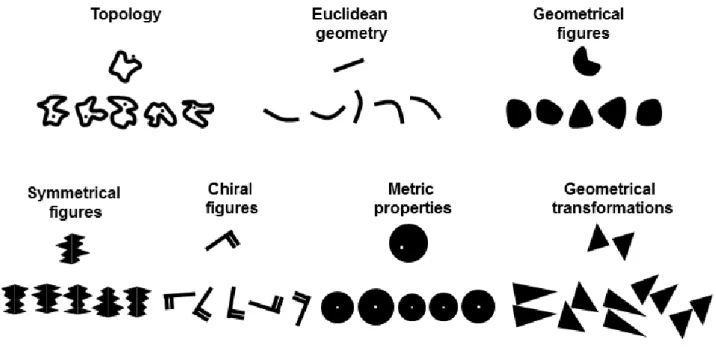
Intuitive geometry task (I-GEO; Dehaene et al., 2006). Items consisting of arrays of 6 images, 5 of which instantiated the desired concept, while one violated it. For each stimulus, participants were asked to click on the odd one out (Figure 2). Items were randomly presented and remained on the screen until participants gave an answer. Forty-three items were presented, split into 7 categories (Figure 2): topology (e.g. closed vs. open figures), Euclidean geometry (e.g. concepts of straight lines, parallel lines, etc.), geometrical figures (e.g. squares, triangles, and so on), symmetrical figures (e.g. figures showing horizontal or vertical symmetrical axes), chiral figures (in which the odd-one-out was a mirror image), metric properties (e.g. the concept of equidistance), and geometrical transformation (e.g. figure translations and rotations).
Academic achievement test. Tasks were taken from the standardized geometrical
achievement test (Mammarella et al., 2012). In the Geometrical problems (GEO-P) task, children were asked to solve 9 geometrical problems. They had to calculate the area of complex figures, or solve complex geometrical exercises and problems. An example of a problem is, “A rectangle has one side that is 10 cm long, while the other side is twice as long; calculate the perimeter”. The test lasted approximately 30 minutes. For each problem, children scored 2 for the right answer, 1 for a partial correct answer, and 0 for a wrong or no answer. The final score was the sum of the scores for each problem. In the Geometrical questions (GEO-Q) task, children were asked to answer 8
multiple-choice geometrical questions concerning geometrical concepts or definitions (e.g. concave, segment, goniometer, and parallelogram). An example of a question is: “What is a segment? a) A portion of a line with an origin and tending to infinity; b) A portion of a line limited by two points; c) A portion of a line with no origin and tending to infinity. The test lasted approximately 10 minutes. The score was the sum of the correct answers.
General cognitive ability (g)
Colored progressive matrices (CPM; Raven, Raven, & Court, 1998). In this test, the children were asked to complete a geometrical figure by choosing the missing piece from among a set of options. The test consisted of 36 items divided into three sets of 12 (A, AB, and B). The test lasted approximately 20 minutes. The score was the sum of the correct answers.
Primary mental ability - reasoning (PMA-R; Thurstone & Thurstone, 1963). This task assesses the ability to discover rules and apply them to verbal reasoning. It is a written test in which children had to choose which word from a set of four was the odd one out, e.g. cow, dog, cat, cap (the answer is cap). The test included 25 sets of words and children were allowed 11 minutes to complete it. The score was the sum of the correct answers.
Primary mental ability - verbal meaning (PMA-V; Thurstone & Thurstone, 1963). In this written test, the children had to choose a synonym for a given word from among four options, e.g. small: (a) slow, (b) cold; (c) simple; (d) tiny (the answer is tiny). The test included 30 items and had to be completed within 12 minutes. The score was the sum of the correct answers.
Working memory tasks
Verbal short-term memory (STM-V)
Simple span tasks (syllable span task, SSPAN; and digit span task, DSPAN). These tasks examined short-term memory involving the passive storage and recall of information (Cornoldi & Vecchi, 2003). Syllables or digits were presented verbally at a rate of 1 item per second, proceeding from the shortest series to the longest (from 2 to 6 items). There was no time limit for recalling the syllables or digits in the same, forward order. The score was the number of digits or syllables accurately recalled in the right order.
Visuospatial short-term memory (STM-VS)
Matrices span tasks (derived from Hornung et al., 2011). Short-term visuospatial storage capacity was assessed by means of two location span tasks. The children had to memorize and recall the positions of blue cells that appeared briefly (for 1 second) in different positions on the screen. After a series of blue cells had been presented, the children used the mouse to click on the locations where they had seen a blue cell appear. The number of blue cells presented in each series ranged from 2 to 6. There were two different conditions: in the first, the targets appeared and
disappeared on a visible (4×4) grid in the center of the screen (matrices span task, grid [MSTG]); in the second, the targets appeared and disappeared on a plain black screen with no grid (matrices span task, no grid [MSTNG]). The score was the number of cells accurately reproduced in the right order.
Active working memory
Categorization working memory span (CWMS; Borella, Carretti, & De Beni, 2008; De Beni, Palladino, Pazzaglia, & Cornoldi, 1998). The material consisted of series of word lists containing four words of high-medium frequency. The series included a variable number of lists (from 2 to 5). The children were asked to read each word aloud and to press the space bar when there was an animal noun. After completing each series, they had to recall the last word in each list, in the right order of presentation. The score was the overall number of accurately recalled words.
Listening span test (LST; Daneman & Carpenter, 1980; Palladino, 2005). The children listened to sets of sentences arranged into series of different lengths (containing from 2 to 5 sentences) and they had to say whether each sentence was true or false. After each series had been presented, the children had to recall the last word in each sentence, in the order in which they were presented. The score was the number of accurately recalled words.
Visual pattern test active (VPTA; Mammarella et al., 2006; Mammarella, Borella, Pastore, & Pazzaglia, 2013). This task tests the ability to maintain and process spatial information
simultaneously presented on a computer screen. Eighteen matrices, adapted from the Visual Pattern test (Della Sala, Gray, Baddeley, & Wilson, 1997), of increasing size (the smallest with 4 squares and 2 cells filled, the largest with 14 squares and 7 cells filled) contained a variable number of cells to remember (from 2 to 7). After each matrix had been shown for 3 seconds, the children were presented with a blank test matrix on which they were asked to reproduce the pattern of the
previously-seen cells by clicking in the cells corresponding to the same positions but one row lower down (the bottom row in the presentation matrix was always empty). The score was the number of accurately placed cells.
Procedure
The tasks were administered as part of an experimental battery designed to explore WM, intelligence and academic achievement; some of the results emerging from the project that focused specifically on the relationship between intelligence and WM have been presented elsewhere (Giofrè, Mammarella, & Cornoldi, 2013). Participants were tested in the classroom in two group sessions lasting approximately 1 hour each (sessions 1 and 2), and during individual sessions lasting approximately 90 min in a quiet room away from the classroom (session 3). Participants were first administered the general cognitive abilities (session 1), then the geometry achievement tasks (session 2) and finally the intuitive geometry and the WM tasks (session 3).
Tests on general cognitive ability were administered in a fixed order (CPM, V, PMA-R) in the first collective session; the geometrical tasks were also administered in a fixed order (geometrical problems and geometrical questions) in the second collective session. During the individual sessions, the tasks were presented in the following fixed order: the intuitive geometry task; the syllable span task; the matrix span task, with grid; the visual pattern test, active version; the categorization working memory span task; the number span task; the matrix span task, no grid; and the listening span task. All these tasks were presented on a 15” laptop and were programmed using E-prime II. Each task began with two training trials. The partial credit score was used for WM
(see Conway et al., 2005, for details). As the procedure, scoring systems and rationale for the WM and intelligence tasks have already been reported elsewhere (Giofrè, Mammarella, & Cornoldi, 2013), we focus here on the geometry tasks.
Results
Statistical analyses
The assumption of multivariate normality and linearity was tested using the PRELIS package and all the CFA and SEM analyses were estimated with the LISREL 8.80 software (Jöreskog & Sörbom, 2002, 2006). Individual scores from any variable that were more than 3 standard deviations from the mean were defined as univariate outliers. Fifteen values, i.e. 3 for the PMA reasoning, 1 for the digit span task, 1 for the categorization WM span, 1 for the listening span test, and 9 for the intuitive geometry tasks (0.66% of the total) were found to be univariate outliers according to this criterion, and were replaced with a value corresponding to 3 standard deviations from the appropriate mean (Tabachnick & Fidell, 2007).
The measure of relative multivariate kurtosis was 1.03. This value can be considered relatively small, so the estimation method that we chose (maximum likelihood) is robust against several types of violation of the multivariate normality assumption (Bollen, 1989).
Model fit was assessed using various indices following the criteria suggested by Hu and Bentler (1999). We considered the comparative fit index (CFI), the non-normed fit index (NNFI), the standardized root mean square residual (SRMR), and the root mean square error (REMSEA). The chi-square difference (χ2
D) and the Akaike Information Criterion (AIC) were also used to compare
the fit of alternative models (Kline, 2011). To take the children’s different ages and school grades into account a partial correlation analysis was conducted with age in months and grade partialled out. Partial correlations were used in all the analyses. Descriptive statistics, correlations and Cronbach’s alpha values are shown in Table 1.
Table 1 about here
Measurement model
We used a two-step modeling approach. In the first step, Model 0, we estimated a CFA measurement model for testing the relationship between g, STM-V, STM-VS, WM, GEO-ach, and I-GEO (Table 2). Note that I-GEO has only one indicator. We thus set the error variance for the intuitive geometry task (IGT) at .19 (1-Reliabilty) (see Kline, 2011). This model gave a good fit (Table 3). Table 2 shows a very strong correlation between the factors: the g-factor correlates closely with WM and I-GEO. The GEO-ach factor also correlates well with the g-factor and WM. We consequently decided to test other structural equation models.
Table 2 about here
Structural equation models
Model 1. This model was based on previous findings on the relationship between WM and intelligence (Giofrè, Mammarella, & Cornoldi, 2013), and between geometry and WM (Giofrè, Mammarella, Ronconi, et al., 2013). The fit of the model was appropriate (Table 3; Figure 1). It should be noted that I-GEO was not significantly related to GEO-ach once the contribution of the factor had been partialled out, probably due to the strong correlation between I-GEO and the g-factor (Table 2).
Model 2. Here we tried to improve the fit of the model by eliminating the path from I-GEO to GEO-ach (Figure 1). The model provided a good fit with the data, better than the previous model (Table 3), and showed that the path from I-GEO to GEO-ach is no longer significant after
Model 3. Here we hypothesized that active WM directly predicted a significant portion of the GEO-ach variance (Figure 1). When this pattern was included in the model, the model’s fit improved significantly. The path from the g-factor to GEO-ach was also no longer significant. This is probably due to the strong correlation between WM and the g-factor (Table 3), and the
relationship between the g-factor and GEO-ach is likely to be largely attributable to the variance shared between WM and the g-factor (Figures 1 and 3). This model had a better fit than any of the other models (i.e. had a lower AIC and the fit was significantly better; Table 3).
Model 4. We also included a path from WM to I-GEO in this model (Figure 1). Its fit changed very little and did not improve significantly (Table 3). The relationship between WM and I-GEO was not significant either, so Model 3 was retained as our best-fitting model.
Figure 3 about here Table 2 and 3 about here
Multiple regressions
In the final set of analyses, we used variance partitioning to examine the unique and shared portions of the variance explained in academic achievement in geometry. This gave us the opportunity to see the specific contribution of intuitive geometry to academic achievement in geometry. We conducted a series of regression analyses to obtain R2 values from different combinations of predictor variables in order to partition the variance. For each variable entering into the regression, inter-factor correlations were used for WM, g-factor, and
intuitive geometry (see Unsworth, Spillers, & Brewer, 2010, for a similar procedure). We thus portioned the variance into unique and shared components (Chuah & Maybery, 1999). To make the analysis more straightforward, we opted to consider WM as a single construct (i.e. we entered STM-V, STM-VS and WM simultaneously). As shown in Table 4 and Figure 4,
we found that WM, g-factor and intuitive geometry shared a conspicuous portion of the variance explained in academic achievement in geometry. The variance explained by the combined contribution of WM and g-factor was also considerable. In particular, WM
explained a large portion of the unique variance in academic achievement in geometry. After the contribution of WM had been taken into account, I-GEO only explained a residual portion of the variance, and when the g-factor was entered in the first step, I-GEO accounted for a very small portion of the variance.
Table 4 about here Figure 4 about here
Discussion
The present study was devoted to elucidating the relationship between achievement in geometry, intuitive geometry, WM and intelligence using the structural equation modeling (SEM) approach.
A first main issue concerned the relationship between WM, intelligence and
geometrical achievement. An earlier study on adolescents (Giofrè, Mammarella, Ronconi, et al., 2013) found that active VSWM was a good predictor of geometrical achievement, but it did not systematically consider the role of the different WM components and intelligence. In the present study, by considering the role of different WM components separately, we were able to test the hypothesis that – as already seen for other measures of achievement in complex skills (e.g. Carretti et al., 2009) – active WM would predict a large portion of the variance in geometrical achievement in younger children too, while short-term storage components would not. Different measures of intelligence were also adopted in the present study to ascertain the role of intelligence, which may affect the acquisition of geometrical knowledge. By considering both WM and intelligence, we started with the hypothesis that
they are strongly related to academic achievement in geometry, and that the contributions of WM and intelligence can be separated (e.g. Conway et al., 2003).
A second aim concerned the specific case of intuitive geometry and the task devised by Dehaene and collaborators (2006) to measure it, based on evidence supporting the distinction between intuitive geometry and academic achievement in geometry (Giofrè, Mammarella, Ronconi, et al., 2013; see also Clements, 2003, 2004; Dehaene et al., 2006; Izard & Spelke, 2009; Spelke et al., 2010). It had already been suggested that a relationship existed between intuitive geometry, academic achievement in geometry and visuospatial WM. This distinction was based on the fact that a previous study had found different aspects of VSWM significantly related to intuitive and academic geometry, since an active VSWM task predicted academic achievement in geometry, whereas the relationship between a passive VSWM task and academic achievement in geometry was mediated by the intuitive geometry task (Giofrè, Mammarella, Ronconi, et al., 2013).
Concerning our first aim, we found WM strongly related to geometrical achievement in 4th and 5th graders, irrespective of their intelligence. The present results thus extend our previous findings and offer a better insight on the influence of WM on 4th- and 5th-graders’ achievement in geometry. As in Giofrè, Mammarella, Ronconi, et al. (2013), we found that an active WM factor – including both verbal and visuospatial measures – is directly related to academic achievement in geometry. Unlike earlier studies, in the present research we assessed not only visuospatial but also verbal WM, based on the observation that formal education in geometry involves both visuospatial and verbal materials, such as texts, definitions, formulas and theorems.
As for the relationship between academic achievement in geometry, WM and intelligence, one of the strengths of the present research lies in that intelligence and WM explained a large portion of the variance in academic achievement. Compared with the study by Giofrè and co-authors (Giofrè, Mammarella, Ronconi, et al., 2013), in which only 14% of this variance was
explained by VSWM, in the present study we found that WM and the g-factor explained about 40% of the variance in academic achievement in geometry. This may be attributable to the fact that: i) we included verbal as well as spatial measures of WM; ii) we considered academic achievement in geometry as a latent factor, thus reducing the effects of measurement errors.
Despite the typically strong relationship identified between intelligence and academic achievement (e.g. Frey & Detterman, 2004), intelligence did not uniquely explain a significant portion of the variance in geometrical achievement in our final model. It is worth noting that the relationship between WM and intelligence has been previously documented (e.g. Engle et al., 1999), and a conspicuous portion of the variance was shared amongst all the variables in the present study, particularly between WM and intelligence. Working memory is very important and many aspects of intelligence affecting geometrical achievement can be attributed to its contribution. Working memory may also support academic geometry by providing the cognitive recourses needed to solve a problem, by allowing the temporary storage and manipulation of stimuli in the verbal and visuospatial modalities, for instance. It has been shown that WM training may have effects on mathematical reasoning (e.g. Holmes, Gathercole, & Dunning, 2009) and that training based on visual-chunking representation accommodation, which is related to WM, is effective in improving performance on geometry in students with mathematical disabilities (Zhang et al., 2012). Therefore, we could hypothesize that the relationship between intelligence and geometry may increase in later phases of schooling as a function of the increasing quantity of reasoning requested. During primary school the typical geometry school curriculum is, in fact, mainly focused on issues strongly relying on WM like the acquisition of definitions and rules, figures manipulations and spatial simple transformations, and only in the secondary school children abstract reasoning and the construction of a proof are introduced.
The fact that academic achievement in geometry is predicted by WM and intelligence, but the effect of intelligence becomes insignificant after adjusting for WM, is congruent with other results in the mathematical fields showing that WM - not intelligence - is the best predictor of
literacy and numeracy (Alloway & Alloway, 2010), and math ability (Passolunghi, Vercelloni, & Schadee, 2007). It has also been demonstrated that WM and intelligence are both important to various aspects of mathematics (Träff, 2013), but the portion of variance uniquely attributable to intelligence is only very small. Such evidence reinforces the importance of WM in mathematics and geometry.
Concerning the second aim of our study, we found that intuitive geometry does not predict geometrical achievement, but it is strongly related to intelligence. In the present study, different models were tested to elucidate the relationship between WM, the g-factor, and intuitive geometry, and the best model showed that, once the contributions of intelligence and WM had been taken into account, intuitive geometry did not mediate the relationship between WM and the variance in academic achievement in geometry. This finding indicates that intuitive geometry is related to intelligence, and particularly to the results obtained with Raven’s colored progressive matrices (r=.43; Table 1), which are arguably a good measure of fluid intelligence (e.g. Jensen, 1998).
Compared with previous studies (e.g. Giofrè, Mammarella, Ronconi, et al., 2013), we found that intuitive geometry also shared a large portion of variance with intelligence and with different measures of WM. Our results showed that active WM is related indirectly to intuitive geometry, while intelligence is directly related to it. The intuitive geometry task proposed by Dehaene and co-authors (2006) seems to involve reasoning processes, which are needed to decide which of a set of six simple shapes is the odd one out, and completing this task also calls upon abilities related to intelligence (Cattell, 1971). Some of the aspects involved in completing the intuitive geometry task (e.g. geometrical transformation) are also important in solving the Raven non-verbal intelligence test used in the present study. The intuitive geometry task used here may therefore demand a component closely related to fluid intelligence, although it seems also to involve specific
geometrical intuitions (e.g. symmetry and topology) that seem substantially independent from the construct of intelligence. In fact, a portion of the variance of the intuitive geometry task was not shared with the intelligence tasks.
The present study also shows that intuitive geometry is related but separable from academic achievement in geometry. However, intuitive and academic achievement in geometry – similarly to what happens for the number system (Dehaene, Bossini, & Giraux, 1993; Halberda et al., 2008; Piazza, Pica, Izard, Spelke, & Dehaene, 2013) – can mutually influence one another over the course of mathematics instruction. The role of education could also explain why children participating to the present study had a lower performance in the intuitive geometry task compared to children of the same age participating to other studies (e.g. Izard & Spelke, 2009). This result could be attributed to the modest importance given to geometrical instruction in many Italian schools (Giofrè, Mammarella, Ronconi, et al., 2013).
It is worth noting that, unlike previous research (Giofrè, Mammarella, Ronconi, et al., 2013) in which the intuitive geometry task was separated into two factors, only a single factor of intuitive geometry was considered in the present study. This was done because further analyses generated no relevant additional information. Further research is therefore needed to clarify whether or not a single- or a multi-factor structure of intuitive geometry is tenable across different age groups (e.g. Izard & Spelke, 2009).
Future studies should also include other cognitive measures that might be related to
geometrical achievement, and mental rotation tasks in particular, given that geometry is also related to the capacity to mentally rotate stimuli (Zhang et al., 2012), and it has been argued that the
capacity to manipulate and rotate objects is a component of intelligence (Johnson & Bouchard, 2005). Further research should also analyze how WM and intelligence may change during an
individual’s development and the geometry curriculum places different demands on different school grades. This is because reasoning becomes crucial at higher levels of geometrical education and, with time, reasoning ability may become more important to academic achievement in geometry than WM.
Educational implications could be drawn from our findings, which could provide teachers and educators with information on the cognitive processes involved in geometrical achievement.
For example, knowing that WM, and active WM in particular, is involved in academic geometry could help teachers to propose activities and teach strategies designed to avoid overloading
children’s WM capacity (Gathercole, Alloway, Willis, & Adams 2006). There are many reasons for recommending that schools pay particular attention to children’s achievement in geometry.
Nowadays, geometry is included in the mathematical curriculum all over the world, and in
international assessments like the PISA (OECD, 2010). It has been suggested that PISA proficiency scores predict educational outcomes (Fischbach, Keller, Preckel, & Brunner, 2012) and that
teaching geometry has a positive effect in helping to improve spatial intelligence (Gittler & Glück, 1998). Geometry and geometrical problem-solving are needed in the complex society in which we live. A nation’s wellbeing depends on its capacity to excel in STEM fields, which are strongly related to mathematics and geometry. The study of geometry (e.g. trigonometry) is important because people’s cognitive abilities are largely reliant on a society’s mental cognitive artifacts (ways of thinking used to reason about phenomena; see Hunt, 2012).
In conclusion, the present study gives some important insight on the relationship between academic achievement in geometry and underlying cognitive factors. In particular, we highlighted the major contribution of WM to geometrical achievement, regardless of intelligence, and the specific role of intuitive geometry (as measured by the task proposed by Dehaene et al., 2006), shedding important light on an area - geometry - which has yet to be thoroughly explored by psychological research.
References
Alloway, T. P., & Alloway, R. G. (2010). Investigating the predictive roles of working memory and IQ in academic attainment. Journal of Experimental Child Psychology, 106(1), 20–9.
doi:10.1016/j.jecp.2009.11.003
Alloway, T. P., Gathercole, S. E., & Pickering, S. J. (2006). Verbal and visuospatial short-term and working memory in children: are they separable? Child Development, 77(6), 1698–716. doi:10.1111/j.1467-8624.2006.00968.x
Alloway, T. P., & Passolunghi, M. C. (2011). The relationship between working memory, IQ, and mathematical skills in children. Learning and Individual Differences, 21(1), 133–137.
doi:10.1016/j.lindif.2010.09.013
Aydın, U., & Ubuz, B. (2010). Structural model of metacognition and knowledge of geometry. Learning and Individual Differences, 20(5), 436–445. doi:10.1016/j.lindif.2010.06.002 Baddeley, A. D. (1996). Exploring the central executive. The Quarterly Journal of Experimental
Psychology Section A, 49(1), 5–28.
Baddeley, A. D. (2000). The episodic buffer: a new component of working memory? Trends in Cognitive Sciences, 4(11), 417–423. doi:10.1016/S1364-6613(00)01538-2
Baddeley, A. D. (2012). Working memory: theories, models, and controversies. Annual Review of Psychology, 63, 1–29. doi:10.1146/annurev-psych-120710-100422
Baddeley, A. D., & Hitch, G. J. (1974). Working Memory. In G. A. Bower (Ed.), The Psychology of Learning and Motivation: Advances in Research and Theory (Vol. 8, pp. 47–90). New York: Academic Press.
Belacchi, C., Scalisi, T., Cannoni, E., & Cornoldi, C. (2008). CPM - Coloured Progressive Matrices Standardizzazione Italiana. Florence, Italy: Giunti O. S.
Bollen, K. A. (1989). Structural equations with latent variables. New York, NY: Wiley.
Borella, E., Carretti, B., & De Beni, R. (2008). Working memory and inhibition across the adult life-span. Acta Psychologica, 128(1), 33–44. doi:10.1016/j.actpsy.2007.09.008
Bull, R., Espy, K. A., & Wiebe, S. A. (2008). Short-term memory, working memory, and executive functioning in preschoolers: longitudinal predictors of mathematical achievement at age 7 years. Developmental Neuropsychology, 33(3), 205–28. doi:10.1080/87565640801982312 Carey, S. (2009). The origin of concepts. New York: Oxford University Press.
Carretti, B., Borella, E., Cornoldi, C., & De Beni, R. (2009). Role of working memory in explaining the performance of individuals with specific reading comprehension difficulties: A meta-analysis. Learning and Individual Differences, 19(2), 246–251.
doi:10.1016/j.lindif.2008.10.002
Cass, M., Cates, D., Smith, M., & Jackson, C. (2003). Effects of manipulative instruction on solving area and perimeter problems by students with learning disabilities. Learning Disabilities Research and Practice, 18(2), 112–120. doi:10.1111/1540-5826.00067
Cattell, R. B. (1971). Abilities: their Structure, Growth, and Action. (Houghton Mifflin, Ed.). New York, NY: Houghton Mifflin.
Caviola, S., Mammarella, I. C., Cornoldi, C., & Lucangeli, D. (2012). The involvement of working memory in children’s exact and approximate mental addition. Journal of Experimental Child Psychology, 112(2), 141–60. doi:10.1016/j.jecp.2012.02.005
Chuah, Y. M., & Maybery, M. T. (1999). Verbal and spatial short-term memory: Common sources of developmental change? Journal of Experimental Child Psychology, 73(1), 7–44.
doi:10.1006/jecp.1999.2493
Clements, D. H. (2003). Teaching and learning geometry. In J. Kilpatrick, W. G. Martin, & D. Schifter (Eds.), A Research Companion to Principles and Standards for School Mathematics (pp. 151–178). Reston, VA: National Council of Teachers of Mathematics.
Clements, D. H. (2004). Curriculum research: Toward a framework for “research-based curricula.” Educational Research, (April).
Clements, D. H., & Battista, M. T. (1992). Geometry and spatial reasoning. In D. A. Grouws (Ed.), Handbook of Research on Mathematics Teaching and Learning (pp. 420–464). New York, NY: MacMillan.
Conway, A. R. A., Kane, M. J., Bunting, M. F., Hambrick, D. Z., Wilhelm, O., & Engle, R. W. (2005). Working memory span tasks: A methodological review and user’s guide. Psychonomic Bulletin & Review, 12(5), 769–786. doi:10.3758/BF03196772
Conway, A. R. A., Kane, M. J., & Engle, R. W. (2003). Working memory capacity and its relation to general intelligence. Trends in Cognitive Sciences, 7(12), 547–552.
doi:10.1016/j.tics.2003.10.005
Cornoldi, C., Giofrè, D., Calgaro, G., & Stupiggia, C. (2013). Attentional WM is not necessarily specifically related with fluid intelligence: The case of smart children with ADHD symptoms. Psychological Research, 77(4), 508–515. doi:10.1007/s00426-012-0446-8
Cornoldi, C., Orsini, A., Cianci, L., Giofrè, D., & Pezzuti, L. (2013). Intelligence and working memory control: Evidence from the WISC-IV administration to Italian children. Learning and Individual Differences, 26, 9–14. doi:10.1016/j.lindif.2013.04.005
Cornoldi, C., & Vecchi, T. (2003). Visuo-spatial Working Memory and Individual Differences. Hove: Psychology Pr.
Daneman, M., & Carpenter, P. A. (1980). Individual differences in working memory and reading. Journal of Verbal Learning and Verbal Behavior, 19(4), 450–466. doi:10.1016/S0022-5371(80)90312-6
De Beni, R., Palladino, P., Pazzaglia, F., & Cornoldi, C. (1998). Increases in intrusion errors and working memory deficit of poor comprehenders. The Quarterly Journal of Experimental Psychology, 51(2), 305–20. doi:10.1080/713755761
Deary, I. J., Strand, S., Smith, P., & Fernandes, C. (2007). Intelligence and educational achievement. Intelligence, 35(1), 13–21. doi:10.1016/j.intell.2006.02.001
Dehaene, S., Bossini, S., & Giraux, P. (1993). The mental representation of parity and number magnitude. Journal of Experimental Psychology: General, 122(3), 371–396.
doi:10.1037/0096-3445.122.3.371
Dehaene, S., Izard, V., Pica, P., & Spelke, E. S. (2006). Core knowledge of geometry in an Amazonian indigene group. Science, 311(5759), 381–4. doi:10.1126/science.1121739 Della Sala, S., Gray, C., Baddeley, A. D., & Wilson, L. (1997). Visual Patterns Test. Bury St
Edmonds, England: Thames Valley Test Company.
Demetriou, A., Spanoudis, G., Shayer, M., Mouyi, A., Kazi, S., & Platsidou, M. (2013). Cycles in speed-working memory-G relations: Towards a developmental-differential theory of the mind. Intelligence, 41(1), 34–50. doi:10.1016/j.intell.2012.10.010
Engel De Abreu, P. M. J., Conway, A. R. A., & Gathercole, S. E. (2010). Working memory and fluid intelligence in young children. Intelligence, 38(6), 552–561.
doi:10.1016/j.intell.2010.07.003
Engle, R. W., Tuholski, S. W., Laughlin, J. E., & Conway, A. R. A. (1999). Working memory, short-term memory, and general fluid intelligence: A latent-variable approach. Journal of Experimental Psychology: General, 128(3), 309–331. doi:10.1037/0096-3445.128.3.309 Feigenson, L., Dehaene, S., & Spelke, E. (2004). Core systems of number. Trends in Cognitive
Sciences, 8(7), 307–14. doi:10.1016/j.tics.2004.05.002
Fischbach, A., Keller, U., Preckel, F., & Brunner, M. (2012). PISA proficiency scores predict educational outcomes. Learning and Individual Differences. doi:10.1016/j.lindif.2012.10.012 Frey, M. C., & Detterman, D. K. (2004). Scholastic assessment or g? The relationship between the
Scholastic Assessment Test and general cognitive ability. Psychological Science, 15(6), 373–8. doi:10.1111/j.0956-7976.2004.00687.x
Gathercole, S. E., Alloway, T. P., Willis, C., & Adams, A.-M. (2006). Working memory in children with reading disabilities. Journal of Experimental Child Psychology, 93, 265-81. doi:
Giofrè, D., Mammarella, I. C., & Cornoldi, C. (2013). The structure of working memory and how it relates to intelligence in children. Intelligence, 41(5), 396–406.
doi:10.1016/j.intell.2013.06.006
Giofrè, D., Mammarella, I. C., Ronconi, L., & Cornoldi, C. (2013). Visuospatial working memory in intuitive geometry, and in academic achievement in geometry. Learning and Individual Differences, 23, 114–122. doi:10.1016/j.lindif.2012.09.012
Gittler, G., & Glück, J. (1998). Differential transfer of learning: Effects of instruction in descriptive geometry on spatial test performance. Journal of Geometry and Graphics, 2(1), 71–84.
Gottfredson, L. (1997). Mainstream science on intelligence: An editorial with 52 signatories, history, and bibliography. Intelligence, 24(1), 13–23. doi:10.1016/S0160-2896(97)90011-8 Halberda, J., Mazzocco, M. M. M., & Feigenson, L. (2008). Individual differences in non-verbal
number acuity correlate with maths achievement. Nature, 455(7213), 665–8. doi:10.1038/nature07246
Heathcote, D. (1994). The role of visuo-spatial working memory in the mental addition of multi-digit addends. Cahiers de Psychologie Cognitive/Current Psychology of Cognition, 13(2), 207–245. Retrieved from http://psycnet.apa.org/psycinfo/1995-08317-001
Holmes, J., Gathercole, S. E., & Dunning, D. L. (2009). Adaptive training leads to sustained enhancement of poor working memory in children. Developmental Science, 12(4), F9–15. doi:10.1111/j.1467-7687.2009.00848.x
Hornung, C., Brunner, M., Reuter, R. A. P., & Martin, R. (2011). Children’s working memory: Its structure and relationship to fluid intelligence. Intelligence, 39(4), 210–221.
doi:10.1016/j.intell.2011.03.002
Hu, L., & Bentler, P. M. (1999). Cutoff criteria for fit indexes in covariance structure analysis: Conventional criteria versus new alternatives. Structural Equation Modeling, 6(1), 1–55. doi:10.1080/10705519909540118
Hunt, E. (2012). What Makes Nations Intelligent? Perspectives on Psychological Science, 7(3), 284–306. doi:10.1177/1745691612442905
Izard, V., Pica, P., Spelke, E. S., & Dehaene, S. (2011). From the Cover: Flexible intuitions of Euclidean geometry in an Amazonian indigene group. Proceedings of the National Academy of Sciences of the United States of America, 108(24), 9782–7. doi:10.1073/pnas.1016686108 Izard, V., & Spelke, E. S. (2009). Development of sensitivity to geometry in visual forms. Human
Evolution, 23(3), 213–248.
Jarvis, H. L., & Gathercole, S. E. (2003). Verbal and non-verbal working memory and
achievements on National Curriculum tests at 11 and 14 years of age. Educational and Child Psychology.
Jensen, A. R. (1998). The g Factor: the Science of Mental Ability. Westport, CT: Praeger.
Johnson, W., & Bouchard, T. J. (2005). The structure of human intelligence: It is verbal, perceptual, and image rotation (VPR), not fluid and crystallized. Intelligence, 33(4), 393–416.
doi:10.1016/j.intell.2004.12.002
Jöreskog, K. G., & Sörbom, D. (2002). PRELIS 2 User’s Reference Guide. (Third Edit.). Lincolnwood, IL: Scientific Software International.
Jöreskog, K. G., & Sörbom, D. (2006). LISREL for Windows [Computer software]. Lincolnwood, IL: Scientific Software International.
Kaufman, S. B., Reynolds, M. R., Liu, X., Kaufman, A. S., & McGrew, K. S. (2012). Are cognitive g and academic achievement g one and the same g? An exploration on the Woodcock–Johnson and Kaufman tests. Intelligence, 40(2), 123–138. doi:10.1016/j.intell.2012.01.009
Kline, R. B. (2011). Principles and Practice of Structural Equation Modeling (Third edit.). New York, NY: Guilford Press.
Mammarella, I. C., Borella, E., Pastore, M., & Pazzaglia, F. (2013). The structure of visuospatial memory in adulthood. Learning and Individual Differences, 25, 99-110.
Mammarella, I. C., & Cornoldi, C. (2013). An analysis of the criteria used to diagnose children with Nonverbal Learning Disability (NLD). Child Neuropsychology.
doi:10.1080/09297049.2013.796920
Mammarella, I. C., Cornoldi, C., Pazzaglia, F. Toso, C., Grimoldi, M., & Vio, C. (2006). Evidence for a double dissociation between spatial-simultaneous and spatial-sequential working memory in visuospatial (nonverbal) learning disabled children. Brain and Cognition, 62(1), 58-67. doi: 10.1016/j.bandc.2006.03.007
Mammarella, I. C., Giofrè, D., Ferrara, R., & Cornoldi, C. (2013). Intuitive geometry and visuospatial working memory in children showing symptoms of nonverbal learning disabilities. Child Neuropsychology, 19(3), 235–49. doi:10.1080/09297049.2011.640931 Mammarella, I. C., Todeschini, M., & Englaro, G., Lucangeli, & Cornoldi, C. (2012). Geometria
test [Test of geometry]. Trento, Italy: Erickson.
Martínez, K., Burgaleta, M., Román, F. J., Escorial, S., Shih, P. C., Quiroga, M. Á., & Colom, R. (2011). Can fluid intelligence be reduced to “simple” short-term storage? Intelligence, 39(6), 473–480. doi:10.1016/j.intell.2011.09.001
Maybery, M. T., & Do, N. (2003). Relationships between facets of working memory and performance on a curriculum-based mathematics test in children. Educational and Child Psychology, 20(3), 77–92.
Organisation for Economic Co-operation & Development (OECD) (2010). Education at a Glance 2010. Paris, France: OECD Publishing.
Palladino, P. (2005). Uno strumento per esaminare la memoria di lavoro verbale in bambini di scuola elementare: taratura e validità [A test for examining WM in primary school: Standardization and validity]. Psicologia Clinica dello Sviluppo, (25), 129–150. doi:10.1449/20152
Pascual-Leone, J. (1970). A mathematical model for the transition rule in Piaget’s developmental stages. Acta Psychologica, 32, 301–345. doi:10.1016/0001-6918(70)90108-3
Passolunghi, M. C., Mammarella, I. C., & Altoè, G. (2008). Cognitive abilities as precursors of the early acquisition of mathematical skills during first through second grades. Developmental Neuropsychology, 33(3), 229–50. doi:10.1080/87565640801982320
Passolunghi, M. C., Vercelloni, B., & Schadee, H. (2007). The precursors of mathematics learning: Working memory, phonological ability and numerical competence. Cognitive Development, 22(2), 165–184. doi:10.1016/j.cogdev.2006.09.001
Piazza, M., Pica, P., Izard, V., Spelke, E. S., & Dehaene, S. (2013). Education enhances the acuity of the nonverbal approximate number system. Psychological Science, 24(6), 1037–43. doi:10.1177/0956797612464057
Rasmussen, C., & Bisanz, J. (2005). Representation and working memory in early arithmetic. Journal of Experimental Child Psychology, 91(2), 137–57. doi:10.1016/j.jecp.2005.01.004 Raven, J., Raven, J. C., & Court, J. H. (1998). Raven Manual, Section 2 (Coloured Progressive
Matrices). Oxford, England: Oxford Psychologist Press.
Shah, P., & Miyake, A. (1996). The separability of working memory resources for spatial thinking and language processing: An individual differences approach. Journal of Experimental Psychology: General, 125(1), 4–27. doi:10.1037/0096-3445.125.1.4
Spearman, C. (1904). “General intelligence,” objectively determined and measured. The American Journal of Psychology, 15(2), 201. doi:10.2307/1412107
Spelke, E. S., Lee, S. A., & Izard, V. (2010). Beyond core knowledge: Natural geometry. Cognitive Science, 34(5), 863–884. doi:10.1111/j.1551-6709.2010.01110.x
Tabachnick, B. G., & Fidell, L. S. (2007). Using Multivariate Statistics (5th ed.). New York, NY: Allyn and Bacon.
Thurstone, L. L., & Thurstone, T. G. (1963). Primary mental abilities. Chicago, IL: Science Research.
Träff, U. (2013). The contribution of general cognitive abilities and number abilities to different aspects of mathematics in children. Journal of Experimental Child Psychology, 116(2), 139– 156. doi:10.1016/j.jecp.2013.04.007
Unsworth, N., Spillers, G. J., & Brewer, G. A. (2010). The contributions of primary and secondary memory to working memory capacity: An individual differences analysis of immediate free recall. Journal of Experimental Psychology: Learning, Memory, and Cognition, 36(1), 240–7. doi:10.1037/a0017739
Verstijnen, I. ., van Leeuwen, C., Goldschmidt, G., Hamel, R., & Hennessey, J. (1998). Creative discovery in imagery and perception: Combining is relatively easy, restructuring takes a sketch. Acta Psychologica, 99(2), 177–200. doi:10.1016/S0001-6918(98)00010-9
Zhang, D., Ding, Y., Stegall, J., & Mo, L. (2012). The effect of visual-chunking-representation accommodation on geometry testing for students with math disabilities. Learning Disabilities Research & Practice, 27(4), 167–177. doi:10.1111/j.1540-5826.2012.00364.x
Table 1
Correlations, means (M), standard deviations (SD), and reliabilities for all the measures
Tasks 1 2 3 4 5 6 7 8 9 10 11 12 13 g 1 CPM — .43 .44 .25 .13 .29 .32 .31 .22 .33 .29 .30 .42 2 PMA-R .45 — .55 .23 .17 .39 .39 .32 .33 .17 .26 .15 .35 3 PMA-V .45 .62 — .23 .21 .41 .42 .46 .36 .31 .12 .21 .42 STM-V 4 SSPAN .26 .28 .29 — .53 .26 .37 .37 .36 .23 .25 .22 .25 5 DSPAN .14 .20 .25 .55 — .26 .33 .38 .45 .25 .21 .15 .21 STM-VS 6 MSTG .30 .40 .40 .26 .26 — .72 .30 .31 .37 .20 .08 .31 7 MSTNG .33 .40 .43 .36 .32 .72 — .33 .30 .30 .15 .12 .36 WM 8 CWMS .32 .38 .51 .41 .40 .31 .33 — .53 .28 .26 .19 .31 9 LST .25 .40 .45 .40 .47 .32 .30 .57 — .37 .28 .20 .20 10 VPTA .33 .19 .32 .25 .26 .38 .30 .30 .38 — .21 .24 .37 Geometry 11 GEO-P .30 .28 .15 .26 .22 .21 .17 .27 .29 .21 — .32 .23 12 GEO-Q .32 .25 .33 .26 .18 .10 .16 .25 .28 .26 .33 — .17 13 IGT .43 .37 .42 .25 .21 .32 .38 .32 .22 .37 .24 .20 — M 28.26 16.32 20.73 41.80 46.30 39.50 29.53 26.59 27.43 59.81 5.82 4.09 25.91 SD 4.93 4.03 7.34 8.58 8.08 10.14 10.03 6.59 6.76 11.75 3.47 1.82 5.99 Reliability .82 .78 .93 .69 .70 .83 .83 .77 .83 .91 .59 .50 .81
Note. Zero order correlation below and partial correlation (controlling for age and school grade) above the diagonal; all coefficients ≥ .15 are significant at .05 level; CPM=colored progressive matrices; PMA-R=primary verbal abilities, reasoning; PMA-V, primary mental abilities, verbal; SSPAN, syllable span; DSPAN, number span; MSTG, matrix span task, grid; MSTNG, matrix span task, no-grid; CWMS, categorization working memory span; LST, listening span task; VPTA, visual pattern test, active; GEO-P, geometrical problems; GEO-Q, geometrical questions; IGT, intuitive geometry task; Reliability, Cronbach’s alpha.
Table 2
Factor loadings and inter-factor correlation for the measurement model
Factor loading matrix
STM-V STM-VS WM g Math Literacy 1 CPM .62* 2 PMA-R .69* 3 PMA-V .76* 4 SSPAN .71* 5 DSPAN .74* 6 MSTG .81* 7 MSTNG .89* 8 CWMS .71* 9 LST .71* 10 VPTA .49* 11 GEO-P .61* 12 GEO-Q .53* 13 IGT .90F
Inter-factor correlation matrix
g 1 STM-V .40* 1 STM-VS .63* .51* 1 WM .71* .74* .54* 1 GEO-ach .52* .50* .29* .61* 1 I-GEO .63* .35* .44* .46* .40* 1
Note. CPM=colored progressive matrices; PMA-R, primary mental abilities-reasoning; PMA-V, primary mental abilities-verbal; SSPAN, syllable span; DSPAN, number span; MSTG, matrix span task, grid; MSTNG, matrix span task, no-grid; CWMS, categorization working memory span; LST, listening span task; VPTA, visual pattern test, active; IGT, intuitive geometry task; GEO-P,
geometrical problems; GEO-Q, geometrical questions; V, verbal short-term memory; STM-VS, visuospatial short-term memory; WM, working memory; I-GEO, intuitive geometry; g, g factor; GEO-ach, geometrical achievement.
*
p<.05.
F
Table 3
Fit indices for the measurement model and structural equation models for relationships between WM, g and geometry
Model χ2M(df) χ2D(df) RMSEA SRMR CFI NNFI AIC
Measurement model
0 76.393(51)a — .05 .05 .98 .97 154.00
Structural equation models
1 88.922(58)b — .05 .06 .98 .97 149.82
2 89.059(59)c 0.14(1)d .05 .06 .98 .97 148.27 3 81.526(58)e 7.53(1)f .05 .05 .98 .98 145.40 4 80.915(57)g 0.61(1)h .05 .05 .98 .97 147.41 Note. χ2
M=model chi-square, χ2D=chi-square difference, RMSEA=root mean square error of
approximation, SMSR=standardized root mean square residuals, CFI=comparative fit index, NNFI=non-normed fit index, AIC=Akaike Information Criterion.
a p=.012. b p=.006. c p=.007. d p=.711. e p=.023. f p=.006. g p=.020. h p=.435.
Table 4
Regression analysis predicting academic achievement in geometry from WM, g, and I-GEO.
Step Estimate Model 1 Model 2 Model 3 Model 4 Model 5 Model 6
1 R2 .381a .381a .269b .269b .158c .158c
2 R2change .043ab .024ac .155ba .009bc .247ca .120cb
3 R2change .005abc .024acb .005bac .151bca .024cab .151cba
Note. aworking memory (WM).
b
g-factor (g).
c
Figure 1. Structural models of the relationship between WM, g and geometry. Paths significant at .05 level are indicated by solid lines. STM-V, verbal short-term memory; STM-VS, visuospatial short-term memory; WM, working memory; I-GEO, intuitive geometry; g, g-factor; GEO-ach, geometrical achievement.
Figure 2. Examples of each geometrical category in the intuitive geometry task (Dehaene et al., 2006). The odd one out is shown at the top in each image for easy reference, but in the real test the odd one out was placed at random among the other five elements.
Figure 3. Measurement model of the relationship between WM, g-factor and geometry. Paths significant at .05 level are indicated by solid lines and paths in gray are fixed. CPM=colored progressive matrices; PMA-R=primary verbal abilities, reasoning; PMA-V=primary mental abilities, verbal; SSPAN=syllable span; DSPAN=number span; MSTG=matrix span task, grid; MSTNG=matrix span task, no-grid; CWMS=categorization working memory span; LST=listening span task; VPTA=visual pattern test, active; GEO-P=geometrical problems; GEO-Q=geometrical questions; IGT=intuitive geometry task; STM-V=verbal term memory; STM-S=spatial short-term memory; WM=working memory; g=g-factor; GEO-ach=geometrical achievement;
Figure 4. Venn diagrams indicating the shared and unique variance explained in academic achievement in geometry by working memory (WM), the g-factor (g), and intuitive geometry (I-GEO). .151 .096 .024 .131 .004 .019 .005 WM g I-GEO