University
of
Cape
Town
Transforming teaching through the transformative
integration of emerging technologies in the ePlay
MakerSpace: a critical, socio-cultural design-based study
Isabel Tarling
Supervisor: Associate Professor Dick Ng’ambi
This thesis is submitted for the award of the Doctor of Philosophy in Education at the University of Cape Town, School of Education, Faculty of Humanities
University
of
Cape
Town
The copyright of this thesis vests in the author. No
quotation from it or information derived from it is to be
published without full acknowledgement of the source.
The thesis is to be used for private study or
non-commercial research purposes only.
Published by the University of Cape Town (UCT) in terms
of the non-exclusive license granted to UCT by the author.
1
The copyright of this thesis vests in the author. No quotation from it or
information derived from it is to be published without full
acknowledgement of the source. The thesis is to be used for private
study or non-commercial research purposes only.
Published by the University of Cape Town (UCT) in terms of the
non-exclusive license granted to UCT by the author.
Declaration: I hereby declare that I have read and understood the regulations governing the submission of Doctor of Philosophy, including those relating to
length and plagiarism, as contained by the University, and that this thesis conforms to those regulations.
The financial assistance of the National Research Foundation (NRF) towards this research is acknowledged. Opinions expressed in this study are those of the author
2
Abstract
Despite South African schools and teachers gaining greater access to the tools, innovations, concepts and advancements of emerging technologies (ETs), the potential of ETs to
transform teaching and improve learning remains largely unexploited. The majority of the
country’s schools are classified as disadvantaged, being resource constrained and
functioning in contexts of multiple deprivation and poverty. Learning is severely compromised in many disadvantaged schools, as evidenced by learners’ persistent
underachievement in standardised national and international assessments. Consequently, improving the quality of teaching especially at primary school level, is identified as a national priority. Three extensive curriculum reforms, intensified teacher professional development, and the provision of ETs, have however not achieved widespread and sustained change to teaching practices. This suggests that existing teacher professional development (TPD) initiatives do not effectively prepare teachers from the country’s disadvantaged schools to exploit the transformative potential of ETs, to change their
practice and manage change within their complex and dynamic education contexts. Instead, ETs that originate in advanced economies are frequently assumed universally applicable and application-neutral. Informed by this perspective, TPD is designed to prepare teachers to use or teach with ETs, either emphasizing technical skills or competencies to use tools, or in rare cases focussing on the concepts, innovations and advancements of ETs. TPD models that systematically and explicitly prepare South Africa’s teachers from disadvantaged schools to exploit the transformative potential of ETs and change their practice is not available.
This study employs a socially embedded, progressive transformation perspective to ET. Accordingly, while it is assumed ETs have the capacity to improve learning, the form and processes of improvement and change to teaching practices are understood as locally developed by teachers. Informed by this perspective, transformative ET integration is conceptualised as contextually embedded, locally developed innovation and knowledge-production to effect change to teaching and improve learning driven by contextually specific
3
requirements and priorities. The transformative integration of ETs emphasizes the need to develop teachers dispositions to innovate and create, to experiment and take risks.
However, within the field of education in South Africa, teachers’ dispositions reflect
capacities to reproducing the structures of the field intent on increasing the flow of cultural capital, rather than dispositions of creativity and innovation.
This study employs a critical, socio-cultural design-based theoretical frame and asks how the
transformation of teachers’ dispositions may translate into their transformative integration
of emerging technologies. The ePlay MakerSpace model is conceptualised as providing both inculcation processes and enabling conditions to transform teachers’ dispositions. Using a design-based research approach, two iterations of the ePlay MakerSpace model are designed, enacted and formatively evaluated to refine the design principles for the ePlay MakerSpace inculcation processes and enabling conditions. Data is collected through
teachers’ created artifacts, their reflections and online posts, the formative evaluations of
each iteration, and school-visits and interviews with teachers 3 – 4 weeks after each ePlay MakerSpace iteration. The evidence presented indicates that the majority of teachers transformatively integrated ET in their classrooms and/or schools, to address local priorities and solve contextual challenges. Through a retrospective analysis of the data, the process to transform teachers’ dispositions was refined, as well as the design framework and design methodology for the ePlay MakerSpace. The study contributes to the development of theory relating to teacher change, and the processes and conditions that support teacher’ change.
4
Declaration
I declare that this thesis is my own work and that it has not been submitted before, for any purpose, to any other institution.
Signed: Isabel Tarling
5
Acknowledgements
What an immense privilege it has been to share this journey of discover with so many incredible and generous individuals! Thank you to each one of you for your time and energy, your support and your contribution!
Prof Dick Ng’ambi, my supervisor and fellow world-changer, for your tremendousinsight, generous feedback and unwavering patience.
The CTLI for structural and systemic support, and allowing me to use the CTLI courses as research sites to the benefit of the department, schools, teachers and learners.
The many teachers, subject advisers and leaders for participating either in the reference groups or in the ePlay MakerSpace, and allowing me to learn from you.
My family and friends, and particularly my daughters, for sharing my dreams andliving in hope that ‘one day’ would eventually arrive!
My Craig, for being my rock and anchor in the storms, and for always believing that I would eventually get finished!6
Abbreviations and Acronyms
CAPS Curriculum and Assessment Policy Statement
CTLI Cape Teaching and Leadership Institute
DBE Department of Basic Education
DBR Design-Based Research
DHET Department of Higher Education and Training
DOE Department of Education
ET / ETs Emerging Technology / Emerging Technologies
HOTS Higher Order Thinking Skills
ICTs Information and Communication Technologies
IWB Interactive Whiteboard
LOTS Lower Order Thinking Skills
NMC New Media Consortium
SA South Africa
TCF Teaching Change Frame
TIP Tool Introductory Process
TPACK Technological, Pedagogical and Content Knowledge
TPD Teacher Professional Development
TPD4ETs Teacher Professional Development to prepare teacher to integrate emerging technologies
7
List of figures
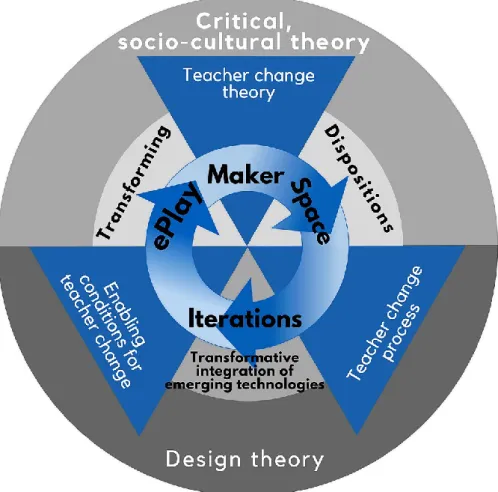
Page referenceFigure 1 Conceptual frame for the study 42
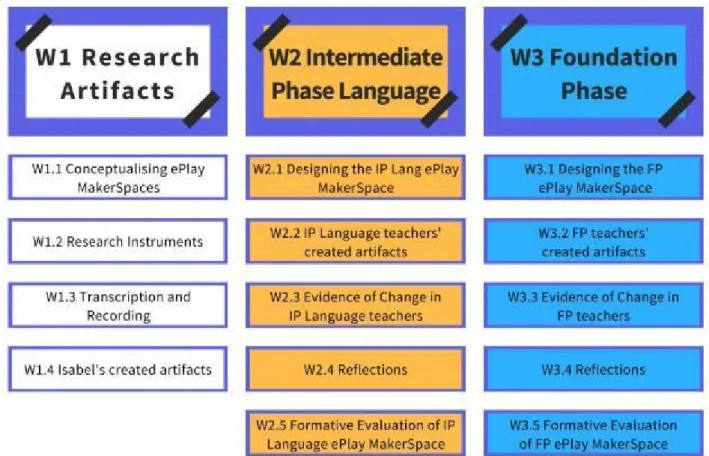
Figure 2 Screenshot from ePlay MakerSpace Data Production website
44
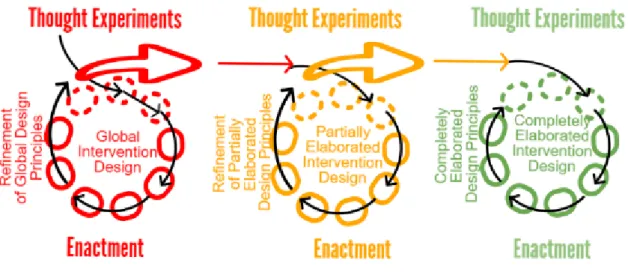
Figure 3 Iteration cycle to identify completely elaborated interventions
83
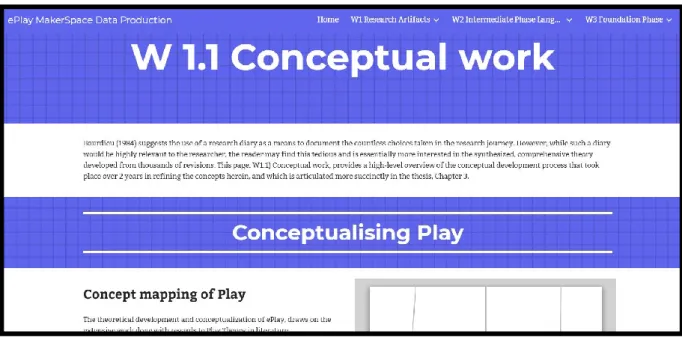
Figure 4 Screenshot from the website 85
Figure 5 Collaborative Concept Map developed in the ePlay MakerSpace
93
Figure 6 Centre circle on Concept Maps 94
Error! Reference source not found. 116
Figure 8 An extract of the draft framework for the IP Language ICT Integration course
119
Figure 9 Formative evaluation results of IP Language teachers' participation
150
Figure 10 Creativity measured in IP Language teachers' artifacts 165
Figure 11 Creativity measured for School F's teachers' created artifacts
169
Figure 12 A Gr 7 Learners' cartoon (click to follow the link) 171
Figure 13 Creativity measures for School A’s teachers’ created artifacts
175
Figure 14 Creativity measured in School K's teachers' created artifacts
178
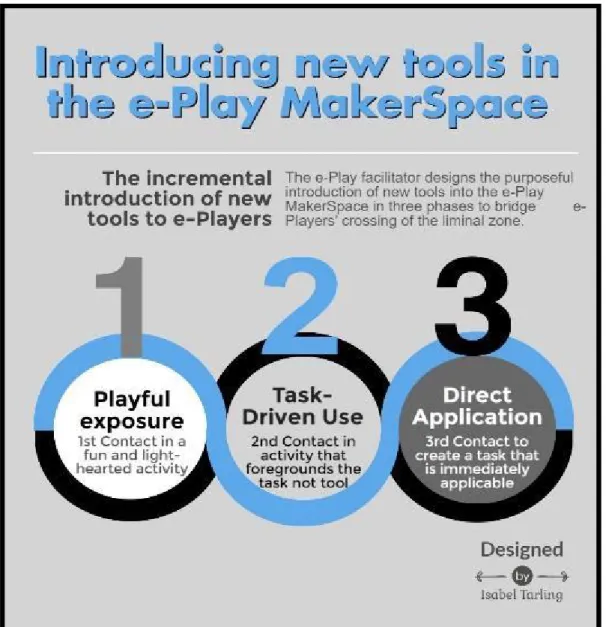
Figure 15 Introducing new tools in the ePlay MakerSpace 186
Figure 16 The Interaction model for Teacher Professional Development
187
Figure 17 First-generation design principles (1gDPs) 190
Figure 19 Formative evaluation indicating IP Language (orange) and FP (blue) teachers' participation
8
Figure 20 Creativity measured in FP teachers' created artifacts 234
Figure 21 FP teachers' self-identified current and goal positions on the TCF
238
Figure 22 Creativity measure of artifacts created by teachers from School F
242
Figure 23 Participation measure by teachers from School F 243
Figure 24 Grade 1 (left) and Grade 3 (right) learners at School O using their own devices in the class
247
Figure 25 Creativity measure of artifacts created by teachers from School O
250
Figure 26 Participation measure of teachers from School O 251
Figure 27 Creativity measure of artifacts created by FP19, FP20, FP12 and FP05
253
Figure 28 Participation measure of FP19, FP20, FP12 and FP05 254
Figure 29 The DBE IQMS process (SACE 2014) 271
Figure 30 Collated results from Bourdieuian coding of CM data from Iteration 1 and 2
275
Figure 32 Bourdieuian coding analysis for Iteration 1 (IP Language) Day 1 and 3 CM data
279
Figure 31 Bourdieuian coding analysis for Iteration 2 (FP) Day 1 and 3 CM data
279
Figure 33 Teachers' journeys of change 285
Figure 34 Mapping the ePlay MakerSpace process 298
9
List of Tables
Page referenceTable 1 Comparison between Creativity measure in CMs between IP Language and FP teachers
235
Table 2 Collated results from Bourdieuian coding of CM data from Iteration 1 and 2
275
Table 3 Word-frequency analysis in terms of Bourdieuian codes for Iteration 1 and 2
10
Table of Contents
Abstract……….….……….2
Declaration………..……….4
Acknowledgements………..………..5
Abbreviations and acronyms………..………..6
List of figures………..………..………..7
List of tables………..………..9
Chapter 1
Introduction ... 171.1 Background ... 18
1.2 Conceptualising the transformative integration of emerging technologies ... 22
1.3 Teacher professional development and the transformative integration of ETs ... 25
1.4 Theoretical framework ... 28
1.4.1 Critical, socio-cultural theory ... 29
1.4.2 Design theory ... 36
1.5 The research problem ... 39
1.6 Conceptual frame for the study ... 41
1.7 Structure of the thesis ... 43
11
Chapter 2
Literature Review ... 472.1 Theories of teaching change ... 47
2.1.1 Strategies of the field to effect change ... 49
2.1.2 Understanding the scope of change ... 53
2.2 Processes of inculcation to transform dispositions ... 56
2.2.1 The awakening of consciousness ... 57
2.2.2 Training, pedagogic work and transmission ... 64
2.3 Enabling conditions for the transformation of dispositions ... 67
2.3.1 A review of play theory ... 68
2.3.2 Conceptualising ePlay as a unique form of play and the ePlay MakerSpace ... 70
2.3.3 Conceptualising the ePlay MakerSpace inculcation process ... 73
2.4 Global design principles for the ePlay MakerSpace ... 75
2.5 Summary ... 76
Chapter 3
Methodology ... 793.1 Developing the Methodology ... 79
3.2 Data production for the study ... 87
3.2.1 Interviews ... 87
3.2.2 Participants’ created artifacts ... 92
12
3.2.4 Formative evaluation ... 96
3.3 Data analysis ... 103
3.3.1 Problem analysis to develop teacher change theory ... 106
3.3.2 Analysis of the ePlay MakerSpace ... 107
3.3.3 Analysis of the research process and methodology ... 108
3.4 Quality of the Research... 109
3.4.1 Descriptive validity ... 109
3.4.2 Interpretive validity ... 111
3.4.3 Theoretical validity ... 113
3.5 Ethics ... 114
3.6 In summary ... 114
Chapter 4
ePlay MakerSpace Iteration 1 ... 1174.1 Problem identification and design of ePlay MakerSpace Iteration 1 ... 117
4.1.1 Problem identification ... 118
4.1.2 Developing the course manual ... 120
4.1.3 Designing Iteration 2 ... 121
4.2 Enactment of Iteration 2 ... 123
4.2.1 Challenges in the ePlay MakerSpace venue ... 124
13
4.2.3 1gDP10) Relational learning ... 129
4.2.4 1gDP8) Professional learning ... 131
4.2.5 GDP7) Reflective learning ... 132
4.2.6 GDP11) Transformational learning ... 136
4.3 Formative evaluation and analysis of Iteration 2 ... 140
4.3.1 Evaluating the context of the intervention ... 140
4.3.2 Evaluation of teachers’ participation ... 148
4.3.3 Evaluating the design and enactment of the intervention ... 153
4.3.3.1.1 Criteria: Practicality ... 154
4.3.3.1.2 Criteria: Relevance ... 157
4.3.3.1.3 Criteria: Sustainability... 158
4.3.3.1.4 Criteria: Effectiveness ... 159
4.3.3.1.5 Criteria: Validity ... 159
4.3.4 Formative evaluation of the enactment and implementation procedure ... 160
4.3.5 Evaluating change ... 164
4.3.5.2.1 School F ... 168
4.3.5.2.2 Change at School A ... 173
4.3.5.2.3 Change at School K ... 177
14
4.5 Concluding comments ... 189
Chapter 5
ePlay MakerSpace Iteration 2 ... 1915.1 Problem identification and design of the FP ePlay MakerSpace ... 191
5.1.1 Problem identification ... 192
5.1.2 Developing the course manual ... 193
5.1.3 Designing Iteration 2 ... 194
5.2 Enactment of Iteration 2 ... 196
5.2.1 Participants and venue ... 196
5.2.2 1gDP8) Active learning ... 197
5.2.3 1gDP9) Relational learning ... 199
5.2.4 1gDP7) Professional learning ... 204
5.2.5 1gDP6) Reflective learning ... 206
5.2.6 1gDP10) Transformational learning ... 209
5.3 Evaluation and analysis of FP ePlay MakerSpace ... 211
5.3.1 Evaluating the context of the intervention ... 211
5.3.2 Systemic level factors ... 212
5.3.3 Institutional and classroom level factors ... 213
5.3.4 Evaluation participation ... 216
15 5.3.5.1.1 Criteria: Practicality ... 219 5.3.5.1.2 Criteria: Relevance ... 220 5.3.5.1.3 Criteria: Sustainability... 222 5.3.5.1.4 Criteria: Effectiveness ... 223 5.3.5.1.5 Criteria: Validity ... 224
5.3.5.2.1 Criteria: Procedural strengths ... 225
5.3.5.2.2 Criteria: Procedural weaknesses ... 228
5.3.5.2.3 Criteria: Procedural opportunities ... 230
5.3.5.2.4 Criteria: Procedural threats ... 231
5.3.6 Evaluating change ... 232
5.3.6.2.1 School F: FP04 and FP16 ... 238
5.3.6.2.2 School O: FP11, FP14 and FP15 ... 243
5.3.6.2.3 Additional examples of change: FP19 and FP20, and FP12 and FP05 ... 252
5.3.6.2.4 Findings from changes observed ... 257
5.4 Elaborating and refining the design principles ... 259
5.5 Concluding comments ... 266
Chapter 6
Analysis ... 2676.1 Refining teacher change theory ... 267
16
6.1.2 Accumulating cultural capital in the ePlay MakerSpace ... 273
6.1.3 Appropriating cultural capital to effect change ... 282
6.2 Refining the design framework for the ePlay MakerSpace ... 288
6.3 Refining the design methodology ... 296
6.4 In summary ... 299
Chapter 7
Conclusion ... 3007.1 Key findings ... 300
7.2 Review of the research process ... 307
7.3 The contribution to research ... 309
7.4 Limitations and future research... 311
7.5 In conclusion ... 312
References ... 313
Appendix A) Hyperlinks ... 344
Appendix B) Concept Mapping Protocol ... 347
Appendix C) Evaluating Participation ... 355
Appendix D) Evaluating the model ... 357
17
Chapter 1
Introduction
Much hope is placed in ETs generally, and in South African in particular, to support urgently needed change in teaching (Department of Education, 2004; Western Cape Education Department, 2012; Department of Basic Education, 2015) and address persistent challenges
to learning in the country’s many dysfunctional schools (Christie et al., 2010; Weeks, 2012;
Spaull, 2013; Maringe and Moletsane, 2015). ETs are conceptualised as tools, concepts, innovations and advancements utilised in education contexts (Veletsianos, 2010) with the potential to transform learning processes (Belland, 2009). Yet, despite national and
provincial initiatives increasing school’s access to ETs (Miller et al., 2006; Chigona et al.,
2010; Ford and Botha, 2010; Bladergroen et al., 2012; Mooketsi and Chigona, 2016), both in terms of connectivity and devices, the country’s learners consistently underachieve in different international benchmarking tests (Mullis et al., 2016a, 2016b, 2016c; OECD, 2016) and national standardised assessments (Spaull, 2013; Masondo, 2016). The continued failure of the majority of South Africa’s learners indicates that the greater access to ETs has not translated into changed teaching and learning processes, suggesting that schools and teachers have not exploited the potential of ETs to transform teaching and learning practices.
This chapter serves different purposes. It introduces the study by discussing the urgent need for change to teaching and learning in South Africa and articulating the potential of
emerging technologies to support education transformation. This positions the study within and across the fields of emerging technology, education reform and teacher professional development, and develops key constructs used in the study. Somewhat unorthodox, the chapter also introduces and develops the critical, socio-cultural design-based theoretical frame and the conceptual frame for the study. These framings are strategically developed in Chapter 1 to epistemologically articulate and shape how the study is designed and
conducted, and how theoretical contributions are developed. The theoretical frame in particular shapes the research problem and the questions the study addresses. Lastly, the
18
chapter describes the structure of the thesis and rationale for the website that accompanies the thesis.
1.1
Background
The South African education system has persistently failed to prepare the country’s youth with the skills and knowledge needed to excel in the knowledge society (Christie et al., 2010; Weeks, 2012; Spaull, 2013). Most learners in the country attend township, rural, farming or mining schools (Maringe and Moletsane, 2015) that have limited access to facilities or resources. Such schools are coded at quintile 1 or 2 (Department of Basic Education, 2015) and collect minimal or no school fees, and are collectively referred to as
disadvantaged schools.
Disadvantaged schools are frequently described as dysfunctional (Taylor, 2008; Weeks, 2012; Spaull, 2013; Maringe and Moletsane, 2015) and lacking a culture of teaching and learning (Christie, 1998; Heystek and Lethoko, 2001; Weeks, 2012). Such dysfunction is frequently typified by loosely bounded timetabling, high absenteeism by both teachers and learners, and low expectations that encourage mediocrity rather than excellence (Christie, Butler and Potterton, 2007; Taylor, 2008; Weeks, 2012; Spaull, 2013). While strong
leadership has been shown to positively influence and direct schooling communities towards goals of transformation (Hayes et al., 2004; Christie, Butler and Potterton, 2007; Christie, 2010; Christie et al., 2010), this is not always the case. Instead, many leaders are underqualified, lack leadership skills and are often unable to manage the complexities of multiple deprivation in which they function (Christie, 2010; Maringe and Moletsane, 2015). Rather than improving instruction through designed and targeted strategies (Taylor, 2008), the lack of leadership capacities function to reproduce legacies of dysfunction (Grant, Jasson and Lawrence, 2010; Weeks, 2012) and constrain transformation and improvement of learning.
In addition to institutional and leadership challenges, education researchers (Christie et al., 2010; Hoadley, 2012; Weeks, 2012; Spaull, 2013) question the quality of teaching and
19
learning in the majority of disadvantaged schools. International benchmarking tests repeatedly find that irrespective of grade or subject area, most of the country’s children underperform, displaying limited knowledge and proficiency in Mathematics and Science (Mullis, Martin, Foy and Hooper, 2016a), and finding that 78% of Grade 4 learners cannot read for meaning (Mullis et al., 2016). Such profound underachievement is symptomatic of widespread learning challenges which Spaull (2013) found, typically originate in the
Foundation and Intermediate Phases (Grades R – 6). Learning challenges that occur early in
a child’s schooling career, tend to extend and become insurmountable, serving to “preclude
pupils from following the curriculum at higher grades” (Spaull, 2013, p. 57). This leads to high drop-out rates (Lehohla, 2016) as a result of learners’ failure to progress within the system, while up to 25% of those that remain, fail to achieve a national senior certificate at the end of their school careers (Motshekga in Masondo, 2016).
Education researchers (Christie et al., 2010; Hoadley, 2012; Weeks, 2012; Spaull, 2013), noting ongoing institutional, leadership and teaching challenges, and learners’ persistent underachievement, conclude that learning is severely compromised in the majority of South African schools. Correlating learners’ persistent underachievement to poor quality teaching especially in primary schools, “[i]mproving what teachers do in their classrooms” (Taylor, 2008, p. 21) is identified as a national priority (Taylor, 2008; Christie et al., 2010; Spaull, 2013).
Although the Department of Basic Education has implemented a range of reform initiatives to improve the quality of teaching, these have not led to sustained and widespread change to teaching or improved learning outcomes. Since the fall of Apartheid in 1994, the national curriculum has been completely redesigned three times, leading to the current Curriculum and Assessment Policy Statement (CAPS) (Chisholm and Leyendecker, 2008; Fataar, 2012; Christie, 2016). The CAPS is a tightly-scripted and ‘teacher-proof’ (Hargreaves et al., 2001; Darling-Hammond, 2010; Fataar, 2012) curriculum, that aims to regulate instructional time
and restrict teachers’ pedagogic choices in accordance with “a strict regulatory regime to
govern curriculum implementation” (Fataar, 2012, p. 58). Following international trends of education reform and the standardisation movement (Hargreaves and Fink, 2007) each
20
curriculum reform added increasingly rigid boundaries to facilitate coverage of all curriculum areas, enforced through bureaucratic processes.
Additionally, the Integrated Quality Management System (IQMS) (SACE, 2014; Department of Basic Education, 2015) was introduced in 2003 and subsequently revised, to monitor and evaluate policy implementation. Teacher professional development and school
improvement initiatives (Christie et al., 2010; Fataar, 2012; Hoadley, 2012; Weeks, 2012; Spaull, 2013) have also been prioritised. However, evidenced by learners’ persistent
underachievement in the past two decades, researchers (Christie et al., 2010; Weeks, 2012; Spaull, 2013) conclude that these reforms have been largely unsuccessful to improve the quality of teaching and learning. Subsequently, much hope is placed in ET integration as potential means to achieve education reform.
ET integration is another systemic reform initiative aimed at improving the quality of teaching and learning (Department of Education, 2004, 2007; Department of Basic Education, 2015) to create “greater access to learning opportunities and personalised learning experiences” (Department of Education, 2007, p. 1). National and provincial departments of education have increased schools and teachers’ access to devices and connectivity (WCED, 2011; Mooketsi and Chigona, 2016), and in some cases provided teachers with training to use these (Bladergroen et al., 2012; Mooketsi and Chigona, 2016). However, while ETs are increasingly available and valued, respected and treasured in disadvantaged schools, these are often underutilised or locked away (Chigona et al., 2010; Bladergroen et al., 2012; Tarling and Ng’ambi, 2016). A teacher from a township school describes her experience:
“In my school we have two computer labs. One has about 50 or 60 computers that all work but it is always locked. Nobody ever uses it. On the other side of the school is another computer lab from ‘Group X’ and they have people who come to work with the kids there every two weeks or so. The teachers send the kids there but they never use our own lab. They just refuse. I am always telling them, ‘Come, let me show you how’ but they just refuse. They don’t want to.”(Tarling and Ng’ambi, 2016, p. 554)
21
As this teachers’ example illustrates, although teachers in her school had gained substantial access to two computer labs with enough computers to allow learners to work
independently, these generally remain locked away and unused. Another computer lab was used only when Group X facilitators worked with learners but teachers did not attend the sessions themselves. Bladergroen et al. (2012) noted similar non-use of devices in their study, finding that teachers continued employing teacher-centred didactical instruction, using existing pedagogic tools and administrative procedures, and that ETs were perceived as inconsequential to learning (Chigona et al., 2011; Rega and Van Zyl, 2011; Bladergroen et al., 2012).
Although multiple descriptions of non-use are available, pockets of innovation (Tondeur, Forkosh-Baruch, et al., 2016) have been noted. However, where teachers have started using ETs, and comparable to international trends, ETs are typically used to reinforce rather than transform existing teaching and learning practices (Zhao and Cziko, 2001; Ford and Botha, 2010; Glover et al., 2016). Ford and Botha (2010) for instance, found that teachers
substituted traditional oral drill-and-practice activities for virtual versions thereof using mobile phones. Thus, while ETs can play a significant role in supporting change to teaching and learning in South Africa, increased access alone does not necessarily translate into improved teaching and learning. The working group on Teacher Professional Development at EDUsummIT2015, noted in this regard:
“…merely providing ICT does not inevitably improve learning, but beyond access, it is how teachers use ICT that makes a difference” (Tondeur, Forkosh-Baruch, et al., 2016, p. 110)
Researchers (Twining et al., 2013; Tondeur, Forkosh-Baruch, et al., 2016) emphasize the importance of teacher professional development (TPD) to prepare teachers to use ETs to promote 21st century learning. However, in light of persistent challenges and failures of TPD
models to improve the quality of teaching in South Africa, Chigona et al. (2010) urge
researchers to first critically examine existing initiatives to achieve ET integration, and to use findings from this to inform change to the design of current TPD models. Similarly, Belland
22
(2009) argues that ET integration needs to be clearly articulated and defined, to inform the design of change strategies.
1.2
Conceptualising the transformative integration of
emerging technologies
ET integration is framed in multiple ways (Belland, 2009) indicative of different underlying assumptions and perceptions of ETs. Veletsianos (2010) defines ETs as tools, concepts, innovations and advancements utilised in education contexts. In addition, Belland (2009) notes, ETs have the potential to transform learning processes. Using Avgerou’s (2010) work, different assumptions and perspectives regarding ET integration, can be identified within these two key areas of ETs.
Perspectives regarding ETs as tools, concepts, innovations and advancements, can be grouped in terms of a) transfer and diffusion processes; or b) as socially embedded action (Avgerou, 2010). From a transfer and diffusion perspective, ETs are assumed to be
mechanistic, decontextualized and application-neutral (Kreutzer, 2009) tools, concepts or innovations. In order to adopt (Loucks-Horsley, 1996; Zhao, Kuh and Carini, 2005; Miller et al., 2006; Bhati et al., 2009) or domesticate (Donner and Gitau, 2009; Chigona et al., 2010) ETs, a transfer and diffusion perspective emphasizes the need for technical skills or
competencies. Transfer and diffusion perspectives, Avgerou (2010) argues, often originate from the advanced economies of North America and Europe, and assumes ETs are
universally transferable to the needs of developing countries. In this study, approaches to ET integration that emphasize technical skills or competencies from a transfer and diffusion perspective, are termed competency-based approaches.
ET integration framed as socially embedded action, views ETs as situated within local contexts and used by local actors to create shared meanings and practices (Avgerou, 2010). Research using a socially embedded perspective of ET integration, is often grounded in social theory, and sees the ET integration process as dynamic, emergent and evolving over time (Avgerou, 2010). Veletsianos’ (2010) development of ETs falls within this approach, as
23
he conceptualises ETs as knowledge-enabling, constantly evolving and embedded within pluralistic cultural contexts. Similarly, Mishra and Koehler (2006) emphasize ET integration as socially embedded action. Using the TPACK framework, they see ET integration as emerging from the intersection of teachers’ technological, pedagogical and content
knowledge (Mishra and Koehler, 2006; Koehler et al., 2011). Furthermore, they (Koehler et al., 2011) emphasize the dynamic and perpetually changing nature of ETs, and the need for teachers to develop different kinds of knowledge to meliorate generic tools and create locally applicable and practical applications. In this study, approaches to ET integration that emphasize ETs as socially embedded, knowledge-enabling and innovative action, are referred to knowledge-based approaches.
Framings of ET integration that emphasize the transformative potential of ETs, Avgerou (2010) argues, emphasize either a) progressive or b) disruptive perspective. Progressive transformational research frames ET integration as enabling of change, viewing ETs as instruments to achieve economic, social and learning gains (Avgerou, 2010). In order to achieve such gains, progressive transformation perspectives acknowledge the need for change in the way ETs are used as well as the cultural or organisational contexts and
structures in which it is applied. Belland’s (2009) conception of ET integration draws on a
progressive transformation perspective when he defines ET integration as:
“the sustainable and persistent change in the social system of K-12 schools caused by the adoption of technology to help students construct knowledge” (Belland, 2009, p. 355).
Belland’s (2009) framing of ET integration emphasizes the potential of ETs to support and
effect change within the system as means to improve learning. Similarly, Christensen’s (1997) definition of sustaining innovation supports a progressive transformation perspective when he argues that sustaining innovations increases the performance or improves the output of systems, products or services. A progressive transformation perspective in research seeks to understand the processes and conditions required for ET integration to
24
effect change and reach expected benefits within existing contexts, systems or organisations.
Avgerou (2010) also identifies a disruptive transformation perspective that views ET
integration as “a contested endeavour or as involving action with unequal effects on
different categories of population, and thus… laden with conflict” (p. 8). Research from a disruptive transformation perspective, typically identifies conflicts, contradictions, (hidden) agendas and power struggles (Avgerou, 2010). A disruptive transformation perspective may for instance emphasize the unequal benefit to different categories of the population
(Avgerou, 2010) conceptualised as the digital divide (Warschauer, 2002), challenge the effectiveness or educational value of ET integration (Oppenheimer, 2003; Warschauer, 2003) or contest discourses that emphasize the universal value of ETs (Chigona and
Mooketsi, 2011; Bladergroen et al., 2012). Similarly, this perspective questions the ethical, safe and appropriate use of ETs, by learners and users in general, and whether learning is indeed positively impacted by ETs (OECD 2015). Additionally, Christensen’s (1997) definition of disruptive innovations, Veletsianos’ (2010) emphasis on the disruptive nature of ETs and
Sharples et al.’s (2009) definition of disruptions as “emerging issues that have the potential to lead to behaviours that diverge from the trends” all fall within a disruptive transformation perspective.
In view of Avgerou’s (2010) four research perspectives, this study combines a socially
embedded perspective of ET integration with a progressive transformation perspective. A
socially embedded, progressive transformation perspective assumes ETs have the capacity to improve learning, but sees the form and processes of improvement and change as locally developed by teachers to serve the needs of their learners and school. Assuming that the
transfer and diffusion of “technologies and improvisations from technologically advanced
societies do not work” (Avgerou, 2010, p. 12), this research perspective emphasizes the need for local improvisation and innovation. This perspective further assumes that change is driven by local needs and priorities and accomplished within existing social, political or administrative conditions. Hence, teachers need to develop capacities to innovate, create and manage change processes, but depending on teachers’ needs, this may also require the
25
development of different competencies and/or kinds of knowledge. The integration of ETs is then conceptualised as contextually embedded, locally developed innovation and
knowledge-production to effect change to teaching and improve learning that is driven by contextually specific requirements and priorities, collectively referred to as transformative integration of ETs.
Transformative ET integration can significantly contribute to improving the quality of teaching and learning. Teacher professional development is a crucial element to prepare teachers to transformatively integrate ETs and effect change to current teaching and learning practices.
1.3
Teacher professional development and the
transformative integration of ETs
It is undeniable that teacher professional development (TPD) is a key element of educational change in general, and specifically through the transformative integration of ETs (Tondeur, Forkosh-Baruch, et al., 2016). Researchers in the field (Fullan, 1995, 2007; Guskey, 2002; Desimone, 2009; Parsons et al., 2013) have identified key features of effective TPD
generally, while others (Twining et al., 2013; Tondeur, Forkosh-Baruch, et al., 2016; Pareja Roblin et al., 2018) developed guidelines for TPD that prepares teachers to integrate ETs, referred to in this study as TPD4ETs. However, as Chigona et al. (2010) notes, existing TPD models have proven largely unsuccessful to prepare South African teachers to integrate ETs and change their practice. This section problematises existing TPD approaches using the
four perspectives developed from Avgerou’s (2010) work, and identifies the gap in existing
knowledge that this study addresses.
TPD4ETs can be classified according to the underlying perspective towards ETs that it supports. TPD4ETs that follows a transfer and diffusion perspective typically emphasize a competency-based approach and develops teachers’ technical skill or generic competencies to use specific devices or software (Mishra and Koehler, 2006; Ertmer and Ottenbreit-Leftwich, 2010; Inan and Lowther, 2010; Gibson et al., 2014). Knowledge-based approaches
26
to TPD depart from a socially embedded perspective, such as the pedagogy first approach (Watson, 2001; Glover et al., 2016) or Koehler et al.’s (2011) deep-play model, and
emphasize the development of different kinds of knowledge within local settings.
Although competency and knowledge-based TPD4ETs is widely used, the continued lack of change to teaching and learning raises questions as to its effectiveness to achieve
widespread and sustained change to teaching and learning (Chigona et al., 2010; Twining et al., 2013; Tondeur, Forkosh-Baruch, et al., 2016). The design and enactment of TPD4ETs tend to follow the logic that competency-based TPD4ETs prepares teachers to use ETs, while knowledge-based TPD4ETs prepare teachers to teach with ETs. However, as has been widely argued (Zhao and Cziko, 2001; Chigona et al., 2011; Bladergroen et al., 2012; Glover et al., 2016), despite greater access to ETs and to competency and knowledge-based TPD4ETs, teachers globally and in South Africa continue to either underutilise ETs or to keep it locked away (Ford and Botha, 2010; Bladergroen et al., 2012; Tarling and Ng’ambi, 2016), limiting its potential to transform teaching and learning. It appears that transformation of teaching and learning, although seen as an outcome of either competency or knowledge-based approaches to TPD4ETs, implies rather than explicitly includes capacities to prepare teachers to transform withETs.
Despite greater access to ETs, the persistent lack of widespread and sustained change to teaching in South Africa and globally, suggests that TPD4ETs should more effectively prepare teachers to exploit the transformative potential of ETs. To this end, Tondeur et al. (2016) and Twining et al. (2013) argue that TPD4ETs should capacitate teachers to manage their own change processes in order to negotiate existing practices, and adapt and change this. Echoing this call, different researchers identify the need to equip teachers as change agents (Samuel, 2008; van der Heijden et al., 2015) or to capacitate teachers to change despite the system (Fullan, 1995). Additionally, Hargreaves (2003) emphasizes the need for teachers to develop dispositions of creativity, innovation and ingenuity, and Koehler et al. (2011) stress the need for dispositions of risk-taking and experimentation to prepare teachers to manage complex and constantly changing education contexts. However, although many call for teachers to develop dispositions to create and innovate (Watson, 2001; Hargreaves, 2003;
27
Kampylis, 2010; Koehler et al., 2011; Kampylis, Bocconi and Punie, 2012; Punie, Bocconi and Kampylis, 2012) or to take risks and experiment as means to foster such 21st century skills
(Fullan, 2013; Tondeur, Forkosh-Baruch, et al., 2016) in learners, few studies seek to understand how teachers change existing dispositions in order to develop such new dispositions. Similarly, although calls for change to teachers’ practices, beliefs or
perceptions are frequent, there appears a gap in literature regarding mechanisms through which teachers change their practice, beliefs or perceptions, or the processes and enabling conditions that can support such change as a function of the transformative potential of ETs.
A further gap in the field of TPD4ETs is identified with regards to the underlying perspectives informing research. Reeves and Reeves criticise the field for conducting isolated studies that
focus “on new things rather than significant problems” (Reeves and Reeves, 2015, p. 29),
arguing that such research has limited impact on effecting change to teaching and learning practices (Reeves, 2006; Amiel and Reeves, 2008; Reeves and Reeves, 2015). TPD4ETs research that focuses on new things, the tools, innovations, concepts and advancement of ETs, is typically informed by transfer or diffusion, or socially embedded perspectives (Avgerou, 2010). Although often acknowledging the transformative potential of ETs, the focus on new things fails to address the significant problem of understanding how existing teaching practices can be transformed, and the processes and enabling conditions that may support this change process.
Moreover, being informed by a diffusion and transfer perspective, education research generally and specifically with regards to ET integration, tend to normalize concepts, innovation, advancements and tools that originate in advanced economies as universally applicable in developing countries. Bourdieu and Wacquant (1992) emphatically argue against research that assumes dogmatized normalizations of thought through the
circumscription of intellectual contexts and empirical terrains. More so, they (Bourdieu and Wacquant, 1992) argue, research that isolates theory and practice, only serves to
reproduced such dogmatized normalization, which Bourdieu (1962b in Grenfell, 2008) stresses, robs individuals of the meaning of their action. Thus while researchers (Zhao et al., 2002; Ertmer and Ottenbreit-Leftwich, 2010; Tondeur, van Braak, et al., 2016; Pareja Roblin
28
et al., 2018) frequently identify constraining or enabling factors impacting pedagogical change to integrate ETs, such accounts rarely understand change to teaching from the contexts of multiple deprivation or dynamic contextual challenges in which South African primary school teachers function. Such research, as Fullan (1992) and Chisholm and Leyendecker (2008) argue, frequently underestimate the scope of change required and “how difficult it will be for teachers to implement the changes which will be required in practices, materials, beliefs and skills” (Fullan, 1992, p. 55 original emphasis).
This study addresses these various gaps in literature from a socially embedded, progressive transformation perspective. This perspective guided the conceptual development of
transformational ET integration to orientate the research, and informed the need to redesign TPD4ETs. However, an additional construct is required to think about, understand and analyse how teacher change may occur. In the next section, the theoretical frame for the study is developed and a potential teacher change process conceptualised, towards clarifying the research problem of the study.
1.4
Theoretical framework
The theoretical frame is strategically developed at the start of the study to structure all aspects of the research through a critical, socio-cultural design-based framework. The placement of the theoretical frame at the start of the study and before identifying the research problem, is informed by arguments in the field. Researchers variously criticize education research for adding theory almost as an afterthought (Reeves, McKenney and Herrington, 2011), or using theory and particularly Bourdieu’s theory of practice, to bestow gravitas (Reay, 2004) without doing much work beyond that. Instead, Reeves, McKenney and Herrington (2011), argue, theory must play a primary role in shaping the research, to which Cobb, Confrey, diSessa, Lehrer and Shauble (2003, p. 10) add: “the theory must do real work”.Since “the value of theory lies in its ability to produce changes in the world” (Barab and Squire, 2004, p. 6), the theoretical frame is strategically placed here to inform every aspect of this socially embedded, transformative research project: from clarifying the research problem, the literature review and development of the methodology, to the
29
iterative development and testing of the ePlay MakerSpace TPD4ETs model and the
retrospective analysis. In this way, theory informs every aspect of the study, doing real work to understand change and also to produce it. Additionally, the theoretical frame serves as a reflexive tool to critically interrogate my own unthought-of epistemologies, research dispositions and assumptions regarding the object and process of research and analysis, to increase the interpretive and theoretical validity of the study as a whole.
This study combines critical, cultural theory, and design-theory. A critical, socio-cultural lens enables an understanding of what is going on and why in existing practice, in order to imagine how this could be done differently using different tools in different ways (Callewaert, 1999). Design-theory, builds on these imagined ideas and behaviours to
generate designs that are iteratively developed and tested to create the enabling conditions for the transformative integration of ETs. The rationale for the inclusion of these
components in the theoretical frame is subsequently developed.
1.4.1
Critical, socio-cultural theory
Critical and socio-cultural theory forms the first part of the theoretical frame, the unique attributes of both providing particular ways of thinking and analysis. Somekh (2007) argues that socio-cultural theory offers a powerful lens to research and analyse ETs and pedagogic innovation, and means to reflecting on the way in which human action is shaped by cultural, institutional and historical contexts. Complementing socio-cultural theory, critical theory is premised on the social nature of activity and belief, functioning outside of frameworks and patterns of analysis in order to interrogate existing social relations in terms of power and contradictions (Popkewitz, 1999). A critical theory of education for example, has to
unambiguously explicate “the very nature of the phenomenon achieved in theory as opposed
to both the established and the oppositional perspective” (Callewaert, 1999, p. 129). Thus, the critical, socio-cultural theorist examines belief claims, and through reflection and analysis of this, works to identify underlying structures and relationships, leading to an imagined solution or alternate way of thinking.
30
Pierre Bourdieu’s (1984, 1990a, 1998a) logic of practice draws on critical and socio-cultural
theory, and forms the first part of the theoretical frame for the study, informing the conceptual development of an individual teacher change process. Different reasons informed the choice to include Bourdieu’s theory of practice. Callewaert (1999) and Burbules and Berk (1999) contend that critical theorists should purposefully avoid dichotomizing knowledge, or using arbitrary boundaries that obscure descriptions and explanations of the social world. Instead, they argue, critical theory must lead to an imagined solution, an alternative way of thinking beyond current thought structures and presuppositions (Burbules and Berk, 1999; Callewaert, 1999). Bourdieu’s work transcends antagonisms between polarised modes of knowledge while preserving insights gained from each mode (Callewaert, 1999). Instead of antithetical poles, Bourdieu argues against
dichotomies such as agency and structure, contending that such polarities are essentially positioned along a continuum between subjectivism and objectivism (Bourdieu 2000;
Wacquant & Deyanov 2002; Bourdieu 1990b). Bourdieu (1984, 1990a, 1998a) further breaks with the notion of a practical sense and the possibility to interpret this by programmed objectification, and the meta-description and explanation that forms the object of science. The separation of practical sense and scientific explanation, Bourdieu argues, robs people of the meaning of their actions (Bourdieu, 1962b in Grenfell, 2008) since both form different aspects of human endeavour.
In this study, Bourdieu’s thinking tools of habitus, field and capital (1984, 1990a, 1998a) are
used to describe and analyse teachers’ pedagogic practices and choices within a broader context of the school, community and education landscape, and embedded in historic, cultural and social forces. Field, capital and habitus are assumed relational, inter-dependent and co-constructed, neither being dominant, primary or causal (Thomson, 2008). Teachers function within an existing social space where cultural, social and organisational forces impact their pedagogic choices (Somekh, 2007). Bourdieu conceptualises this social space as the field in which social transactions, interactions and events occur (Bourdieu, 1991;
31
operating in the field, and simultaneously forms and operates on agents’ habitus, while being shape by the habitus.
A field is structured by the principles and rules that govern the flow of capital, which capital is valued, how it is produced and reproduced, transferred or exchanged, and who manages this (Bourdieu, 1990a). Hierarchies of discrimination based on a system of social domination and subordination are produced, as certain assets or capitals are assigned more worth or value than others, based on arbitrarily assigned principles that constitute the field
(Bourdieu, 1986, 1990a). Subsequently, agents are distributed in the field based on their access to and volume of legitimated and valued capital (Bourdieu, 1998a). Those in a
position of power typically command a significant volume of legitimated and valued capital, and manage the flow of this capital, either constraining or providing limited access to those with less power. This creates competition within the field as agents vie for and use different strategies to accumulate valued and legitimated capital in order to maintain or improve their position.
Bourdieu (1986) conceptualises capital as accumulated labour distinguishing a) objectified, material or economic capital; and b) incorporated, embodied symbolic capital in the form of cultural (related to knowledge or know-how) or social capital (related to social relations).
Material or symbolic capital enables actors in a field to “appropriate social energy in the
form of reified or living labor[sic]”(Bourdieu, 1986, p. 15). The field of education for instance, mostly values cultural capital, and assigns positions of power within the field to those with high volumes of cultural capital, and positioning those with low volumes of cultural capital in the least powerful positions. Those who command the greatest volume of rare and legitimated forms of knowledge and know-how, are assigned distinction (Bourdieu, 1984), such as the cultural capital to transformatively integrate ETs and improve learning outcomes, in a field where this is not commonly practiced.
Individuals acting within and across fields, internalise and produce the logic of the field and capitals valued therein, within their collective or individual habitus. Bourdieu (1990a, p. 55)
32
function below consciousness to produce thoughts, perceptions and actions of individuals and groups which correspond to the conditions of its production. Habitus represents the generative principle through which individuals make objective judgements and
classifications, as well as the system of classification (Bourdieu, 1984) through which social practices are produced and reproduced in the field. This conception of habitus bridges dichotomies between structure and agency, macro- and micro-, or external and internal forces (Grenfell, 1995; Reay, 2004; Deer, 2008) and provides a way to explain how the outer social conditions are internalised, and in turn shape external social conditions (Maton, 2008; Moore, 2008; Wagner and McLaughlin, 2015).
The habitus is structured by acquired systems of durable, transposable and generative
dispositions “which incline agents to act and react in certain ways” (Bourdieu, 1998b, p. 12).
Dispositions are both durable and generative structuring structures that shape and structure “fundamental modes of construction of reality” (Bourdieu, 1990b, p. 388), beliefs,
perceptions and practices (Bourdieu, 1990a; Maton, 2008). Like a fish in water, the
individual may remain entirely unaware of the existence of dispositions (Bourdieu, 2000, p. 14), making decisions or forming actions, beliefs and perceptions as if guided by a practical sense or sense for the game. The durability of dispositions provides a means to understand the challenges teachers experience when wanting to change, while the generative nature of dispositions provides the keys to address these challenges and transform dispositions to effect change. The durability of dispositions is discussed first to understand the challenges teachers experience when wanting to change.
Bourdieu (1992) contends that durable and transposable dispositions are instilled and inculcated in individuals through the cumulative exposure over a lifetime to social conditions in various fields, that are structured by and in turn structure beliefs, practices and perceptions (Bourdieu, 1990a, 1991). The primary conditions during childhood inculcate the most durable dispositions (Bourdieu and Passeron, 1977), but dispositions can also be formed and transferred to agents or institutions through pedagogic work, training or inculcation of specific dispositions demanded by a field (Bourdieu, 2000). In this way, different types of dispositions are acquired, such as the scholastic disposition (Bourdieu,
33
2000) or the disinterested disposition (Bourdieu and Wacquant, 1992), dispositions of creativity and innovation (Hargreaves et al., 2001) or of experimentation and risk-taking (Koehler et al., 2011).
The durability of dispositions are the result of a spontaneous tendency to perpetuate structures that correspond to the conditions under which dispositions were formed (Bourdieu, 1990a, 2000). As a result of this spontaneous tendency, dispositions shape perceptions, beliefs and practices to correspond to the conditions under which these were formed (Bourdieu and Passeron, 1977). Dispositions thus constitute the accumulated product of prior civilizations, social classes or ethnic groups that are socially inscribed into minds (Bourdieu, 1990b) in order to perpetuate these structures and let the past remain “present and active in the dispositions it has produced” (Bourdieu, 2000, p. 64). Additionally,
dispositions encapsulate potentialities that “are actualized only in definite conditions”
(Bourdieu, 1990b, p. 388), and not necessarily in others. Teachers may for instance, “act and react in certain ways” (Bourdieu, 1998b, p. 12) while in school but act differently in other fields.
South African teachers for instance as Samuel (2008) argues, are products of a teacher-training model that values teachers as transmitters of pre-packaged knowledge. A systemic narrative has fostered “a dependency on State-driven teaching and learning material” (Samuel, 2008, p. 11) and framed teachers not as professionals and agents of change, but as agents to be changed. Samuel (2008) contends that teachers internalised this deficit
narrative from the field, as a victim mode and incapable of improving the quality of teaching and learning on their own. Bladergroen and colleagues (2012) found evidence of this
internalised deficit discourse in teachers participating on their study, who portrayed themselves as helpless outsiders who needed external support to advance their personal and professional learning and development. In both Samuel (2008) and Bladergroen et al.’s (2012) studies, teachers however saw themselves as active agents outside of school, and fulfilled different leadership capacities in community groups. Thus, actualised within school conditions, teachers displayed dispositions to reproduce and replicate, instead of innovate and create: they reproduced the state-led deficit narrative, saw themselves as primarily
34
responsible for reproducing the cultural capital valued and legitimised by the field of education, and dependent on externally produced innovation. Bourdieu (1990a, 1991, 1998b, 2000; 1992) extends this discussion with the notion of symbolic violence, where the durability and spontaneous tendency of teachers’ dispositions become implicit in
reproducing dispositions to perpetuate for instance inequality or deficit discourses.
The durability and spontaneous tendency of dispositions to reproduce the conditions under which it was formed, may lead to a situation of inertia or hysteresis (Bourdieu and Passeron, 1977; Bourdieu, 1990a, 2000; Bourdieu and Wacquant, 1992). Bourdieu (1990a, 1991, 2000) argues that since dispositions tend to reproduce beliefs, perceptions and practices
corresponding to the conditions under which it was formed, an individual may experience:
“inertia (or hysteresis) of habitus which ha[s] a spontaneous tendency… to perpetuate structures corresponding to the conditions of production” (Bourdieu, 2000, p. 160).
As such, while the individual may recognise the need for change, or even express a desire to change, they keep behaving, believing and perceiving in much the same manner. This results in “a situation where the field passes you by – leaves you high and dry” (Grenfell, 2015,
personal correspondence) despite the individuals’ best intentions to change. For example,
while the teachers in Bladergroen et al.’s (2012) study expressed the need for change and were positive about the impact ETs can have on education, they did not change their practice even after a years’ training and support by the research team. While it is
undeniable that other factors impacted their inability to change, the influence of hysteresis is and particularly the spontaneous tendency of dispositions to reproduce the conditions under which it was formed, is evident in this example.
Apart from being durable, dispositions are also generative structures. Bourdieu emphasizes the generative nature of dispositions, emphasizing that sustained change can be achieved
through the “transformation of dispositions” (Bourdieu and Passeron, 1977, p. 209).
Transformation in this sense, drawing on Berger’s (2004) work, involves a reshaping of how dispositions are to formed to reshape not only what someone thinks, believes or
35
experiences the world, but fundamentally “how he or she thinks about things” (Berger,
2004, p. 340), sees things, and creates meaning from this.
Dispositions can be practically transformed through secondary pedagogic work that employs different modes of inculcation (Bourdieu and Passeron, 1977). Different modes of
inculcation to transform dispositions are identified as: conversion (Bourdieu and Passeron, 1977); the awakening of consciousness (Bourdieu, 1990); inculcation through training, pedagogic work and the transmission through active practice of capacities leading to
practical mastery (Bourdieu and Passeron, 1977; Bourdieu, 1990). Conversion is described as “the complete substitution of one habitus” (Bourdieu and Passeron, 1977, p. 44) for a new habitus such as would happen when soldiers attend basic training, children attend boarding school or where a cult may remove followers from familiar fields and place them in new social conditions. Since this study is concerned with the transformation of particular dispositions to create and innovate (Hargreaves et al., 2001), take risks and experiment (Koehler et al., 2011), and not the entire substitutions of the habitus, inculcation through conversion is not pursued. Instead, the transformation of dispositions is understood as involving a) conscious awakening, and b) training, pedagogic work and transmission through active practice.
Both the durable and generative nature of dispositions are valuable theoretical frames through which to view individual teacher change as taking place within education fields, structured by valued and legitimised cultural capital. Bourdieu’s critical, sociocultural theory provides the means to understand the challenges teachers experience when wanting to change their pedagogic habitus (Fullan, 1995, 2007; Guskey, 2002; Feldman and Fataar, 2014; Fataar and Feldman, 2016). Additionally, the process of conscious awakening, inculcation and transmission through secondary pedagogic work, frames the potential change process.
Bourdieu frequently defended his theory of practice against claims of determinism, saying
such criticism is nothing but “pharisaical [sic] denunciations” (Bourdieu, 2000, p. 6) born
36
several centuries of literary, artistic and philosophical worship” (Bourdieu, 2000, p. 7). It is potentially arguable that dispositions and the habitus that constitute the accumulated product of history, can be reduced to deterministic reproduction. However, this suggests a misreading of the generative nature of dispositions (Bourdieu, 1984, 1990, 2000), and
particularly Bourdieu’s (1984) insistence that the ‘fuzziness’ and uncertainty of practice
cannot be governed by conscious, systematic rules. Additionally, Bourdieu insists that while individuals may know their own limitations or the constraints of a situation, they may also overcome these constraints and limitations (Bourdieu, 2000) as a function of dispositions to resist (Bourdieu and Wacquant, 1992). It is the task of the critical sociologist to examine enabling conditions under which such dispositions of resistance can be constituted, triggered or effected (Bourdieu and Wacquant, 1992), and informed by this, to design processes and spaces in which such resistance and change can occur. This introduces the need for the second part of the theoretical frame, design theory.
1.4.2
Design theory
Design theory complements and also differs from critical, socio-cultural theory. Critical, socio-cultural theory provides a means to identify and understand the underlying structures and relationships between actors functioning within a social field, leading to an imagined solution (Burbules and Berk, 1999; Callewaert, 1999). Design moves from imagined solutions, to iteratively develop, test and refine solutions (Reeves, 2006), producing knowledge that is actionable and open to validation (Sloane, 2006). It is this continuation, from understanding structures and relationships ending in imagined solutions, to the pragmatic development of solutions that have a real-world impact on practice, that informs the decision to include design theory as the second part of this study’s theoretical frame.
Elements of critical, socio-cultural and design theory are included in design-based research
(DBR). DBR builds bridges between “many levels, factors and actors” (van den Akker, 2010,
p. 178) to produce research that has a direct impact on policy, practice and further research. Although different terms are used for DBR: design research ( van den Akker et al., 2006), educational design research (Reeves, McKenney and Herrington, 2011), design experiments
37
(Cobb et al., 2003) or design and development research (van den Akker, 2010), all draw on the affordances of design to create pragmatic solutions to educational challenges (Reeves, McKenney and Herrington, 2011). Furthermore, research that uses DBR typically develops methodologies that blend the goals of scientific and/or humanistic approaches with the theory-driven designs of learning environments to understand how, when and why
educational innovation works in practice (Design-Based Research Collective, 2003; Sloane, 2006). The bridging-function of DBR is essential to this study to navigate and address complex and dynamic challenges from multiple fields including education reform, teacher professional development (TPD) and teacher change, education technologies and the
learning sciences. The study’s inclusion of critical, socio-cultural and design theories also
impacts the methodological development, requiring further bridging between goals of humanistic and design approaches.
Despite the many commonalities between critical, socio-cultural theory and design theory, epistemological differences set these theories apart. Epistemologically, critical, socio-cultural theory views knowledge as socially constructed (Sloane, 2006) through the interactions, relations and structures between fields and agents functioning therein. In contrast, design theory understands knowledge as incomplete and an outcome of emergent
and complex inquiry “into systems that do not yet exist” (Sloane, 2006, p. 21). As such,
design theory employs a future-orientation, seeing research as a means to create abstractions of what could be, rather than what is already in existence.
The future-oriented positioning of design is essential to develop solutions for ‘wicked’ problems as those identified in the NMC Horizon reports (Johnson et al., 2013, 2014, 2015a; Adams Becker et al., 2016), and think beyond current thought patterns and ineffective processes. Wicked problems typically lack sufficient information to clarify the problem at
hand, are very often complex, vaguely articulated, and “require additional data and insights
before solutions will even be possible” (Johnson et al., 2014, p. 18). Solutions to address wicked problems cannot merely transform, optimize or superimpose existing solutions (Design-Based Research Collective, 2003; van den Akker et al., 2006). In Bourdieu’s terms, wicked problems emerge as a consequence of the conditions of the field at a particular time
38
and space. Employing dispositions that were formed under similar conditions as that which formed the wicked problems, will, under influence of the spontaneous tendency of
dispositions, create solutions that tend to perpetuate such conditions. Thus, to address wicked problems requires the transformation of dispositions (Bourdieu and Passeron, 1977), and particularly research dispositions, to not only think differently about the problem, but to change how thinking and research of wicked problems is conducted. The
future-orientation and epistemology of design that sees knowledge as emerging from the iterative design process provides a useful means with which to purposefully achieve this break with the conditions of the research field, but also to potentially support transformation of research dispositions.
Design theory and the bridging function of DBR, address many of Bourdieu and Wacquant’s (1992) concerns regarding research in general. Bourdieu and Wacquant (1992) argue against the splintering of theoretical and research activities into isolated activities, and for research to invert the accepted order by work from practical understanding to identify principles and epistemological rules. The emergent epistemology and iterative nature of DBR, strives to build bridges (van den Akker, 2010) rather than isolate research and theory, iteratively developing actionable and valid knowledge (Sloane, 2006) from a practical understanding to identify design principles. Furthermore, Edelson (2002, p. 107) contends that DBR
“eliminates the boundary between design and research”, an argument that aligns closely to
Bourdieu and Wacquant’s (1992) insistence against splintering theory and research.
Epistemologically, a design-orientation aligns with a socially embedded research
perspective. Design provides an activity base premised on the epistemology that knowledge emerges from a speculative and exploratory process that leads to dynamic and complex learning outcomes (Design-Based Research Collective, 2003). The design-epistemology supports processes to change existing inadequate systems and structures to more desirable, improved situations (Sloane, 2006). Since knowledge is assumed incomplete, a design-orientation assumes that it is all but impossible to account for all emergent phenomena or to analyse every possible factor or element that may impact a learning system (Design-Based Research Collective, 2003). Instead, knowledge is seen as emerging from the